INFORMATION CODING IN
AIRCRAFT TRANSPONDERS
Prepared by
Bildiukevych Aleksandr
IAN 309
TRANSPONDER
 A transponder (short-for transmitter-responder and
sometimes abbreviated to XPDR, XPNDR, TPDR or TP) is an
electronic device that produces a response when it receives a
radio-frequency interrogation. Aircraft have transponders to
assist in identifying them on air traffic control radar; and
collision avoidance systems have been developed to use
transponder transmissions as a means of detecting aircraft at
risk of colliding with each other.
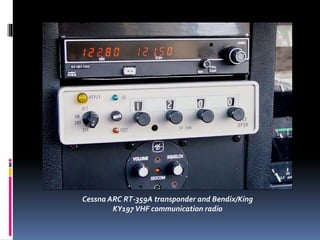
Cessna ARC RT-359A transponder and Bendix/King
KY197VHF communication radio
SQUAWK
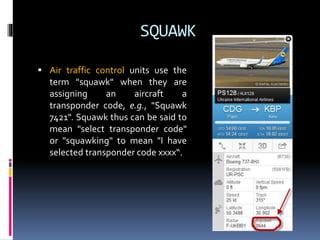
 Air traffic control units use the
term "squawk" when they are
assigning an aircraft a
transponder code, e.g., "Squawk
7421". Squawk thus can be said to
mean "select transponder code"
or "squawking" to mean "I have
selected transponder code xxxx“.
 The use of the word "squawk"
comes from the system's origin in
the World War II identification,
friend or foe (IFF) system, which
was code-named "Parrot".
TRANSPONDER CODES
 Transponder codes are four digit numbers transmitted
by the transponder in an aircraft in response to a
secondary surveillance radar interrogation signal to
assist air traffic controllers in traffic separation. A
discrete transponder code (often called a squawk code) is
assigned by air traffic controllers to uniquely identify an
aircraft. This allows easy identification of aircraft on
radar.
 Squawk codes are four-digit octal numbers; the dials on a
transponder read from zero to seven, inclusive. Thus the
lowest possible squawk is 0000 and the highest is 7777.
Four octal digits can represent up to 4096 different
codes.
EMERGENCY CODES
There are three worldwide codes, which used
for notification of ATC about emergency
situation on board.
7700 – Emergency (SOS, MAYDAY);
7600 – Radio Failure (Lost Communications);
7500 – Aircraft hijacking;
SECONDARY SURVEILLANCE RADAR
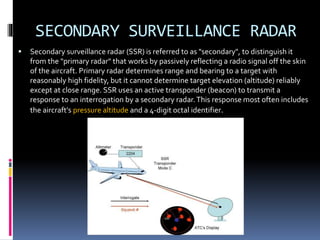
 Secondary surveillance radar (SSR) is referred to as "secondary", to distinguish it
from the "primary radar" that works by passively reflecting a radio signal off the skin
of the aircraft. Primary radar determines range and bearing to a target with
reasonably high fidelity, but it cannot determine target elevation (altitude) reliably
except at close range. SSR uses an active transponder (beacon) to transmit a
response to an interrogation by a secondary radar.This response most often includes
the aircraft's pressure altitude and a 4-digit octal identifier.
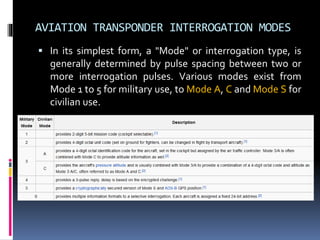
AVIATION TRANSPONDER INTERROGATION MODES
 In its simplest form, a "Mode" or interrogation type, is
generally determined by pulse spacing between two or
more interrogation pulses. Various modes exist from
Mode 1 to 5 for military use, to Mode A, C and Mode S for
civilian use.
ADS-B TRANSPONDER
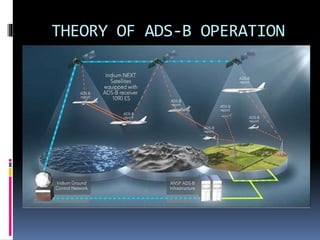
 Automatic dependent surveillance – broadcast
(ADS–B) is a cooperative surveillance technology in
which an aircraft determines its position via satellite
navigation and periodically broadcasts it, enabling it
to be tracked. The information can be received by air
traffic control ground stations as a replacement for
secondary radar. It can also be received by other
aircraft to provide situational awareness and allow
self separation.
 ADS–B is "automatic" in that it requires no pilot or
external input. It is "dependent" in that it depends on
data from the aircraft's navigation system.
THEORY OF ADS-B OPERATION
THANK YOU FOR ATTENTION!

Information coding in aircraft transponders

  • 1.
    INFORMATION CODING IN AIRCRAFTTRANSPONDERS Prepared by Bildiukevych Aleksandr IAN 309
  • 2.
    TRANSPONDER  A transponder(short-for transmitter-responder and sometimes abbreviated to XPDR, XPNDR, TPDR or TP) is an electronic device that produces a response when it receives a radio-frequency interrogation. Aircraft have transponders to assist in identifying them on air traffic control radar; and collision avoidance systems have been developed to use transponder transmissions as a means of detecting aircraft at risk of colliding with each other.
  • 3.
    Cessna ARC RT-359Atransponder and Bendix/King KY197VHF communication radio
  • 4.
    SQUAWK  Air trafficcontrol units use the term "squawk" when they are assigning an aircraft a transponder code, e.g., "Squawk 7421". Squawk thus can be said to mean "select transponder code" or "squawking" to mean "I have selected transponder code xxxx“.
  • 5.
     The useof the word "squawk" comes from the system's origin in the World War II identification, friend or foe (IFF) system, which was code-named "Parrot".
  • 6.
    TRANSPONDER CODES  Transpondercodes are four digit numbers transmitted by the transponder in an aircraft in response to a secondary surveillance radar interrogation signal to assist air traffic controllers in traffic separation. A discrete transponder code (often called a squawk code) is assigned by air traffic controllers to uniquely identify an aircraft. This allows easy identification of aircraft on radar.  Squawk codes are four-digit octal numbers; the dials on a transponder read from zero to seven, inclusive. Thus the lowest possible squawk is 0000 and the highest is 7777. Four octal digits can represent up to 4096 different codes.
  • 7.
    EMERGENCY CODES There arethree worldwide codes, which used for notification of ATC about emergency situation on board. 7700 – Emergency (SOS, MAYDAY); 7600 – Radio Failure (Lost Communications); 7500 – Aircraft hijacking;
  • 8.
    SECONDARY SURVEILLANCE RADAR Secondary surveillance radar (SSR) is referred to as "secondary", to distinguish it from the "primary radar" that works by passively reflecting a radio signal off the skin of the aircraft. Primary radar determines range and bearing to a target with reasonably high fidelity, but it cannot determine target elevation (altitude) reliably except at close range. SSR uses an active transponder (beacon) to transmit a response to an interrogation by a secondary radar.This response most often includes the aircraft's pressure altitude and a 4-digit octal identifier.
  • 9.
    AVIATION TRANSPONDER INTERROGATIONMODES  In its simplest form, a "Mode" or interrogation type, is generally determined by pulse spacing between two or more interrogation pulses. Various modes exist from Mode 1 to 5 for military use, to Mode A, C and Mode S for civilian use.
  • 10.
    ADS-B TRANSPONDER  Automaticdependent surveillance – broadcast (ADS–B) is a cooperative surveillance technology in which an aircraft determines its position via satellite navigation and periodically broadcasts it, enabling it to be tracked. The information can be received by air traffic control ground stations as a replacement for secondary radar. It can also be received by other aircraft to provide situational awareness and allow self separation.  ADS–B is "automatic" in that it requires no pilot or external input. It is "dependent" in that it depends on data from the aircraft's navigation system.
  • 11.
    THEORY OF ADS-BOPERATION
  • 12.
    THANK YOU FORATTENTION!