Addressing Modes in 8051
Microcontroller
A.Usha Rani,
Department of Physics and Electronics,
St.Ann’s College for Women
Basics of a program statement in
assembly language
A statement in assembly language program consists of
three
fields-
Label
Instructions
Comments
These fields are arranged as
[Label:] Instructions [//Comments]
Label
It is used to assign name to the memory location or
program
Instructions
Every instruction has two parts
Opcode - It specifies the operation to be performed.
Operands – It is the data on which operation is to be
performed
Operands are of two types.
Source operand – The operands which are inputs for an
operation.
Destination operand – The operands that will store the
result of an operation.
Comments
Comments are used to describe the operation performed
by an instruction.
They help in understanding the program easily.
Mostly comments start with “//”
Example
MOV R0, #10H //Move 10H into register R0
Opcode – MOV
Operands – R0, 10H
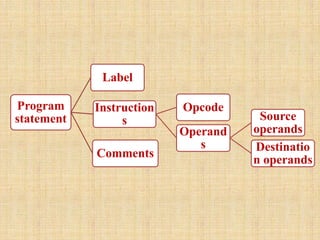
Program
statement
Label
Instruction
s
Opcode
Operand
s
Source
operands
Destinatio
n operands
Comments
The various ways of accessing data are called
addressing modes.
The way by which the source and destination
operands are specified in an instruction are
called addressing modes.
The instruction may contain one or more
operands.
These addressing modes are determined when
it is designed and cannot be changed by the
Programmer.
8051 microcontroller provides five addressing
modes.
 Immediate
 Register
 Direct
 Register Indirect Addressing
 Indexed Addressing
Immediate Addressing Mode
The operand comes immediately after the opcode
The data is given as part of the instruction.
The immediate data must be preceded by the sign
‘#’
The source operand is constant.
The information can be loaded into any of the
registers including DPTR
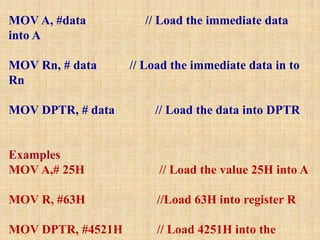
MOV A, #data // Load the immediate data
into A
MOV Rn, # data // Load the immediate data in to
Rn
MOV DPTR, # data // Load the data into DPTR
Examples
MOV A,# 25H // Load the value 25H into A
MOV R, #63H //Load 63H into register R
MOV DPTR, #4521H // Load 4251H into the
Register Addressing Mode
The operands are specified by register names.
It requires only one byte memory.
Involves the use of registers to hold the data to be
manipulated.
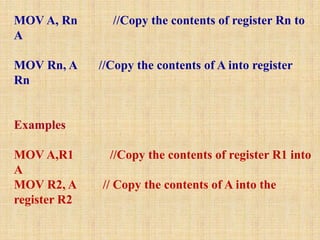
MOV A, Rn //Copy the contents of register Rn to
A
MOV Rn, A //Copy the contents of A into register
Rn
Examples
MOV A,R1 //Copy the contents of register R1 into
A
MOV R2, A // Copy the contents of A into the
register R2
Direct Addressing Mode
The data is stored in RAM memory location
whose address is known and the address is given as
part of the instruction.
The data is accessed directly from the memory.
MOV A, Direct // Copy data from address Direct into A
MOV Direct, A //Copy data from A into address
Direct
MOV Rn, Direct //Copy data from address
Direct into register Rn
MOV Direct, Rn // Copy data from register Rn into
address Direct
MOV Direct, #data // load immediate data into
address Direct
MOV direct1,direct2 //copy data from address direct2
Examples
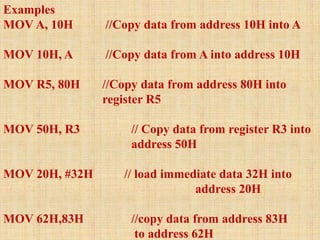
MOV A, 10H //Copy data from address 10H into A
MOV 10H, A //Copy data from A into address 10H
MOV R5, 80H //Copy data from address 80H into
register R5
MOV 50H, R3 // Copy data from register R3 into
address 50H
MOV 20H, #32H // load immediate data 32H into
address 20H
MOV 62H,83H //copy data from address 83H
to address 62H
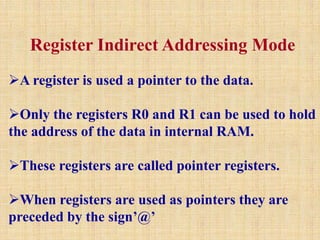
Register Indirect Addressing Mode
A register is used a pointer to the data.
Only the registers R0 and R1 can be used to hold
the address of the data in internal RAM.
These registers are called pointer registers.
When registers are used as pointers they are
preceded by the sign’@’
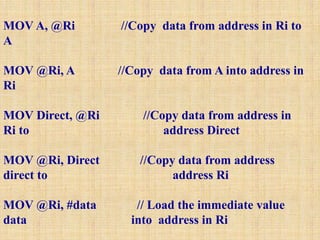
MOV A, @Ri //Copy data from address in Ri to
A
MOV @Ri, A //Copy data from A into address in
Ri
MOV Direct, @Ri //Copy data from address in
Ri to address Direct
MOV @Ri, Direct //Copy data from address
direct to address Ri
MOV @Ri, #data // Load the immediate value
data into address in Ri
Examples
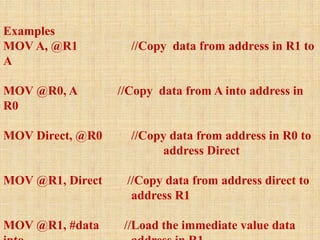
MOV A, @R1 //Copy data from address in R1 to
A
MOV @R0, A //Copy data from A into address in
R0
MOV Direct, @R0 //Copy data from address in R0 to
address Direct
MOV @R1, Direct //Copy data from address direct to
address R1
MOV @R1, #data //Load the immediate value data
Indexed Addressing Mode
Two registers are used to form the address of
the data.
The contents of either Program Counter(PC) or
Data Pointer(DPTR) are used as base address and
Accumulator is used as index address.
The combination of the contents of these two
registers gives the final address.
This addressing mode is used to access data
tables from program memory and in
implementing jump tables
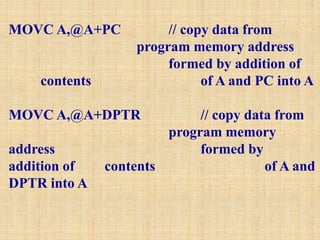
MOVC A,@A+PC // copy data from
program memory address
formed by addition of
contents of A and PC into A
MOVC A,@A+DPTR // copy data from
program memory
address formed by
addition of contents of A and
DPTR into A
Thank you

Microcontroller 8051 addressing modes

  • 1.
    Addressing Modes in8051 Microcontroller A.Usha Rani, Department of Physics and Electronics, St.Ann’s College for Women
  • 2.
    Basics of aprogram statement in assembly language A statement in assembly language program consists of three fields- Label Instructions Comments These fields are arranged as [Label:] Instructions [//Comments] Label It is used to assign name to the memory location or program
  • 3.
    Instructions Every instruction hastwo parts Opcode - It specifies the operation to be performed. Operands – It is the data on which operation is to be performed Operands are of two types. Source operand – The operands which are inputs for an operation. Destination operand – The operands that will store the result of an operation.
  • 4.
    Comments Comments are usedto describe the operation performed by an instruction. They help in understanding the program easily. Mostly comments start with “//” Example MOV R0, #10H //Move 10H into register R0 Opcode – MOV Operands – R0, 10H
  • 5.
  • 6.
    The various waysof accessing data are called addressing modes. The way by which the source and destination operands are specified in an instruction are called addressing modes. The instruction may contain one or more operands. These addressing modes are determined when it is designed and cannot be changed by the Programmer.
  • 7.
    8051 microcontroller providesfive addressing modes.  Immediate  Register  Direct  Register Indirect Addressing  Indexed Addressing
  • 8.
    Immediate Addressing Mode Theoperand comes immediately after the opcode The data is given as part of the instruction. The immediate data must be preceded by the sign ‘#’ The source operand is constant. The information can be loaded into any of the registers including DPTR
  • 9.
    MOV A, #data// Load the immediate data into A MOV Rn, # data // Load the immediate data in to Rn MOV DPTR, # data // Load the data into DPTR Examples MOV A,# 25H // Load the value 25H into A MOV R, #63H //Load 63H into register R MOV DPTR, #4521H // Load 4251H into the
  • 10.
    Register Addressing Mode Theoperands are specified by register names. It requires only one byte memory. Involves the use of registers to hold the data to be manipulated.
  • 11.
    MOV A, Rn//Copy the contents of register Rn to A MOV Rn, A //Copy the contents of A into register Rn Examples MOV A,R1 //Copy the contents of register R1 into A MOV R2, A // Copy the contents of A into the register R2
  • 12.
    Direct Addressing Mode Thedata is stored in RAM memory location whose address is known and the address is given as part of the instruction. The data is accessed directly from the memory.
  • 13.
    MOV A, Direct// Copy data from address Direct into A MOV Direct, A //Copy data from A into address Direct MOV Rn, Direct //Copy data from address Direct into register Rn MOV Direct, Rn // Copy data from register Rn into address Direct MOV Direct, #data // load immediate data into address Direct MOV direct1,direct2 //copy data from address direct2
  • 14.
    Examples MOV A, 10H//Copy data from address 10H into A MOV 10H, A //Copy data from A into address 10H MOV R5, 80H //Copy data from address 80H into register R5 MOV 50H, R3 // Copy data from register R3 into address 50H MOV 20H, #32H // load immediate data 32H into address 20H MOV 62H,83H //copy data from address 83H to address 62H
  • 15.
    Register Indirect AddressingMode A register is used a pointer to the data. Only the registers R0 and R1 can be used to hold the address of the data in internal RAM. These registers are called pointer registers. When registers are used as pointers they are preceded by the sign’@’
  • 16.
    MOV A, @Ri//Copy data from address in Ri to A MOV @Ri, A //Copy data from A into address in Ri MOV Direct, @Ri //Copy data from address in Ri to address Direct MOV @Ri, Direct //Copy data from address direct to address Ri MOV @Ri, #data // Load the immediate value data into address in Ri
  • 17.
    Examples MOV A, @R1//Copy data from address in R1 to A MOV @R0, A //Copy data from A into address in R0 MOV Direct, @R0 //Copy data from address in R0 to address Direct MOV @R1, Direct //Copy data from address direct to address R1 MOV @R1, #data //Load the immediate value data
  • 18.
    Indexed Addressing Mode Tworegisters are used to form the address of the data. The contents of either Program Counter(PC) or Data Pointer(DPTR) are used as base address and Accumulator is used as index address. The combination of the contents of these two registers gives the final address. This addressing mode is used to access data tables from program memory and in implementing jump tables
  • 19.
    MOVC A,@A+PC //copy data from program memory address formed by addition of contents of A and PC into A MOVC A,@A+DPTR // copy data from program memory address formed by addition of contents of A and DPTR into A
  • 20.