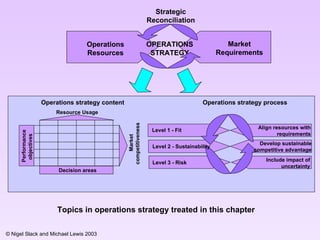
Resource Usage Performance objectives  Market competitiveness  Decision areas Operations strategy process Operations strategy content Topics in operations strategy treated in this chapter Operations Resources Market Requirements OPERATIONS STRATEGY Strategic Reconciliation Level 1 - Fit Level 3 - Risk Align resources with requirements Include impact of uncertainty Level 2 - Sustainability  Develop sustainable competitive advantage
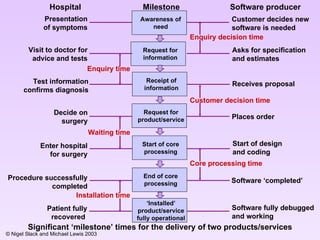
Milestone Hospital Software producer Presentation of symptoms Visit to doctor for advice and tests Test information confirms diagnosis Decide on surgery Enter hospital for surgery Procedure successfully completed Patient fully recovered  Installation time Waiting time Enquiry time Core processing time Customer decision time Enquiry decision time Asks for specification and estimates Receives proposal Places order Start of design and coding Software ‘completed’  Software fully debugged and working Customer decides new software is needed Significant ‘milestone’ times for the delivery of two products/services ‘ Installed’ product/service fully operational End of core processing Start of core processing Request for product/service Receipt of information Request for information Awareness of need
First/Business-class cabin, airport lounges, pick-up service Economy cabin Wealthy people, business people, VIPs Travellers (friends and family), vacation takers, cost-sensitive business travel Wide range, may need to be customised  Standardized cabin Relatively high  Relatively low Relatively low volume Relatively high volume Medium to high  Low to medium First/Business class Economy class Customization, extra service, comfort features, convenience Quality (specification and conformance), Flexibility, Speed Price, acceptable service Cost, Quality (conformance) Services Customers Service range Rate of service innovation Volume of activity Profit margins  Main competitive factors Performance objectives Different product groups require different performance objectives
Market  Competitiveness Speed Flexibility Cost Dependability Quality The operations function can provide a competitive advantage through its performance at the five  competitive  objectives Being RIGHT Being FAST Being ON TIME Being ABLE TO CHANGE Being PRODUCTIVE
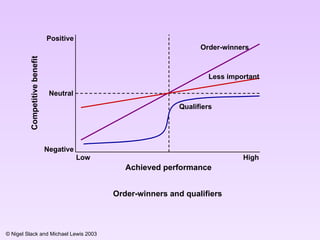
Low High Negative Positive Competitive benefit Neutral Achieved performance Order-winners and qualifiers Order-winners Less important Qualifiers
Priority of performance objectives Customer Needs Competitors’ Actions The  priority of performance objectives is influenced by what is regarded as important by customers and how the operation performs against competitors Performance against competitors Importance to customers
= x Average revenue Average cost = x x Utilization Working capital  Productivity of fixed assets = x Operations strategy decision areas Development and organization Process technology Supply network Capacity Decomposing the ratio profit/total assets Output Total assets  Profit Output  Profit Total assets  Profit Output  Revenue Output  Cost Output  Output Total assets  Output Capacity  Fixed assets Total assets  Capacity Fixed assets
The Elements of an International Operations Strategy Operations Decisions are shaped by COMPETENCIES and CONSTRAINTS Resource Deployment Do it yourself or  buy-in? Customer and  supplier  relationships Supply chain  dynamics and  integration Supply Network ISSUES - Capacity Structure ISSUES - Capacity Location Focus &  segmentation L/T  forecasts Process Technology ISSUES - Development rate Automation Size Integration In our out-house  development Development and Organization New  product/service  development Organization  structure  Performance  measurement Improvement  strategy   ISSUES   -
Issues include : Total capacity Number, size of sites Allocation of tasks to  sites Location Issues include : Vertical integration Network  behaviour Supplier relationships Supplier development Issues include : Rate of development Automation Integration  Implementation Subcontracted  development Issues include : Responsibility  relationships Performance and  control  Process development  Product and service  development Capacity Supply Network Process Technology Development and Organi z ation The four categories of operations strategy decision areas Resource Usage
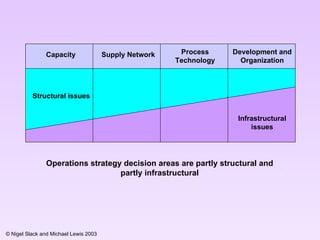
Structural issues Infrastructural issues Operations strategy decision areas are partly structural and partly infrastructural Process Technology Development and Organi z ation Supply Network Capacity
Operations strategy is defined by the intersections of performance objectives and Operations decisions Quality Market Competitiveness Speed Dependability Flexibility Cost Competitive Objectives are prioritized by CUSTOMERS and COMPETITORS Capacity Supply Network Process Technology Development and Organization  Resource  Usage Operations Decisions  shape COMPETENCIES and CONSTRAINTS
Quality Performance objectives Resource Usage Market Competitiveness Decision areas Speed Dependability Flexibility Cost The operations strategy matrix Capacity Supply Network Process Technology Development and Organization  Operations strategy
Largest retailer in Japan Sells 1.5X as much per store as nearest rival History of cautious expansion and technical and service innovation “ Field Counsellors” spread operations knowledge (also do distance training) Expansion by territory to reduce disn costs Early use of TIS (total information system) TIS controls stock replenishment twice a day delivery (sales analysed twice a day) New system not internet-based New services include, Banking terminals Downloading games Downloading music to MD Internet ordering and collection 7-Eleven Japan
COST  in terms of minimizing… operating cost capital cost working capital QUALITY  of products and services Speed and dependability combined to indicate  AVAILABILITY FLEXIBILITY  of response to sales and customer trends Resource Deployment Market Competitiveness    pivotal  critical  secondary 7-11 JAPAN Area dominance reduces distribution and advertising costs   Location of stores Size of stores Distribution center grouping by temperature  Distribution centers and inventory management systems give fast stock replenishment   TIS allows trends to be forecast and supply adjustments made    Common distribution centers give small frequent deliveries from fewer sources    Number and type of  distribution centers Order and stock  replenishment TIS gives comprehensive and sophisticated analysis of sales  &  supply patterns daily   The Total  Information System  (TIS) Information sharing and parenting system spreads service ideas    Field counselors with sales data help stores to minimize waste and increase sales   Franchisee  relationships New  product/service  development Approach to  operations  improvement DEVELOPMENT AND ORGANIZATION PROCESS TECHNOLOGY SUPPLY NETWORKS CAPACITY
Level 1 - Fit The practice of operations strategy involves considering fit, sustainability and risk Level 2 - Sustainability  Level 3 - Risk Align resources with requirements Develop sustainable competitive advantage Include impact of uncertainty Increasing complexity
Market requirements  Level of operations resource capability In operations strategy ‘fit’ is the alignment between market and operations capability Line of fit Alignment between market and operations capability X Y
Market requirements  Sustainable improvement implies simultaneous extension/improvement of market requirements and operations capabilities Level of operations resource capability Extension of market requirements Sustainable improvement Improvements in operations capabilities
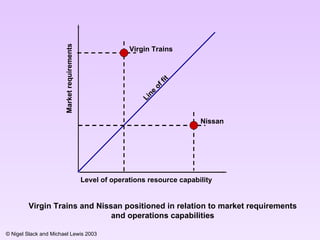
Market requirements  Virgin Trains and Nissan positioned in relation to market requirements and operations capabilities Level of operations resource capability Line of fit Nissan Virgin Trains
Dresding Medical - Polar diagram illustrating the relative importance of the performance objectives for the current and new products X X X Quality (specification) Quality (conformance) Speed Dependability Volume flexibility Delivery flexibility  Customization Cost Current products New products X X X X X
Quality (spec) Quality (conform) Speed Dependability Delivery flex Volume flex Customization Cost Performance objectives Lab style manufacture easy to change capacity incrementally 50% of activities in-house Low process technology (but high product technology) R&D, Mfg. and Sales all share common knowledge base. Incremental new product development Capacity Supply Network Process Technology Development and Organization Resource Usage Market Competitiveness Dresding Medical - Current product range * * * * * * * * * * * * * * * * * * * * * * * * * * * very important medium importance some importance  * * * * * * * * Decision areas * * * * * * Slide 2.17
Quality (spec) Quality (conform) Speed Dependability Delivery flex Volume flex Customization Cost Performance objectives May need to adjust quickly depending on demand New supplies will be needed / developed Needs investment in volume processes R&D, Mfg. and Sales less interdependent. Faster time-to-market needed Capacity Supply Network Process Technology Development and Organization Resource Usage Market Competitiveness Dresding Medical - New product range * * * * * * * * * * * * * * * * * * very important medium importance some importance  * * * * * * * Decision areas * * * * * * * * * * * * * * * * * * * * * * Slide 2.18
Quality Performance objectives Capacity Supply Network Process Technology Development and Organization  Resource Usage Market Competitiveness Decision areas ‘ Fit’ is concerned with ensuring comprehensiveness, correspondence, coherence and criticality Speed Dependability Flexibility Cost Critical Critical Critical Critical Critical Coherence Correspondence Comprehensive?

Chap02

  • 1.
    Resource Usage Performanceobjectives Market competitiveness Decision areas Operations strategy process Operations strategy content Topics in operations strategy treated in this chapter Operations Resources Market Requirements OPERATIONS STRATEGY Strategic Reconciliation Level 1 - Fit Level 3 - Risk Align resources with requirements Include impact of uncertainty Level 2 - Sustainability Develop sustainable competitive advantage
  • 2.
    Milestone Hospital Softwareproducer Presentation of symptoms Visit to doctor for advice and tests Test information confirms diagnosis Decide on surgery Enter hospital for surgery Procedure successfully completed Patient fully recovered Installation time Waiting time Enquiry time Core processing time Customer decision time Enquiry decision time Asks for specification and estimates Receives proposal Places order Start of design and coding Software ‘completed’ Software fully debugged and working Customer decides new software is needed Significant ‘milestone’ times for the delivery of two products/services ‘ Installed’ product/service fully operational End of core processing Start of core processing Request for product/service Receipt of information Request for information Awareness of need
  • 3.
    First/Business-class cabin, airportlounges, pick-up service Economy cabin Wealthy people, business people, VIPs Travellers (friends and family), vacation takers, cost-sensitive business travel Wide range, may need to be customised Standardized cabin Relatively high Relatively low Relatively low volume Relatively high volume Medium to high Low to medium First/Business class Economy class Customization, extra service, comfort features, convenience Quality (specification and conformance), Flexibility, Speed Price, acceptable service Cost, Quality (conformance) Services Customers Service range Rate of service innovation Volume of activity Profit margins Main competitive factors Performance objectives Different product groups require different performance objectives
  • 4.
    Market CompetitivenessSpeed Flexibility Cost Dependability Quality The operations function can provide a competitive advantage through its performance at the five competitive objectives Being RIGHT Being FAST Being ON TIME Being ABLE TO CHANGE Being PRODUCTIVE
  • 5.
    Low High NegativePositive Competitive benefit Neutral Achieved performance Order-winners and qualifiers Order-winners Less important Qualifiers
  • 6.
    Priority of performanceobjectives Customer Needs Competitors’ Actions The priority of performance objectives is influenced by what is regarded as important by customers and how the operation performs against competitors Performance against competitors Importance to customers
  • 7.
    = x Averagerevenue Average cost = x x Utilization Working capital Productivity of fixed assets = x Operations strategy decision areas Development and organization Process technology Supply network Capacity Decomposing the ratio profit/total assets Output Total assets Profit Output Profit Total assets Profit Output Revenue Output Cost Output Output Total assets Output Capacity Fixed assets Total assets Capacity Fixed assets
  • 8.
    The Elements ofan International Operations Strategy Operations Decisions are shaped by COMPETENCIES and CONSTRAINTS Resource Deployment Do it yourself or buy-in? Customer and supplier relationships Supply chain dynamics and integration Supply Network ISSUES - Capacity Structure ISSUES - Capacity Location Focus & segmentation L/T forecasts Process Technology ISSUES - Development rate Automation Size Integration In our out-house development Development and Organization New product/service development Organization structure Performance measurement Improvement strategy ISSUES -
  • 9.
    Issues include :Total capacity Number, size of sites Allocation of tasks to sites Location Issues include : Vertical integration Network behaviour Supplier relationships Supplier development Issues include : Rate of development Automation Integration Implementation Subcontracted development Issues include : Responsibility relationships Performance and control Process development Product and service development Capacity Supply Network Process Technology Development and Organi z ation The four categories of operations strategy decision areas Resource Usage
  • 10.
    Structural issues Infrastructuralissues Operations strategy decision areas are partly structural and partly infrastructural Process Technology Development and Organi z ation Supply Network Capacity
  • 11.
    Operations strategy isdefined by the intersections of performance objectives and Operations decisions Quality Market Competitiveness Speed Dependability Flexibility Cost Competitive Objectives are prioritized by CUSTOMERS and COMPETITORS Capacity Supply Network Process Technology Development and Organization Resource Usage Operations Decisions shape COMPETENCIES and CONSTRAINTS
  • 12.
    Quality Performance objectivesResource Usage Market Competitiveness Decision areas Speed Dependability Flexibility Cost The operations strategy matrix Capacity Supply Network Process Technology Development and Organization Operations strategy
  • 13.
    Largest retailer inJapan Sells 1.5X as much per store as nearest rival History of cautious expansion and technical and service innovation “ Field Counsellors” spread operations knowledge (also do distance training) Expansion by territory to reduce disn costs Early use of TIS (total information system) TIS controls stock replenishment twice a day delivery (sales analysed twice a day) New system not internet-based New services include, Banking terminals Downloading games Downloading music to MD Internet ordering and collection 7-Eleven Japan
  • 14.
    COST interms of minimizing… operating cost capital cost working capital QUALITY of products and services Speed and dependability combined to indicate AVAILABILITY FLEXIBILITY of response to sales and customer trends Resource Deployment Market Competitiveness  pivotal  critical  secondary 7-11 JAPAN Area dominance reduces distribution and advertising costs  Location of stores Size of stores Distribution center grouping by temperature  Distribution centers and inventory management systems give fast stock replenishment  TIS allows trends to be forecast and supply adjustments made  Common distribution centers give small frequent deliveries from fewer sources  Number and type of distribution centers Order and stock replenishment TIS gives comprehensive and sophisticated analysis of sales & supply patterns daily  The Total Information System (TIS) Information sharing and parenting system spreads service ideas  Field counselors with sales data help stores to minimize waste and increase sales  Franchisee relationships New product/service development Approach to operations improvement DEVELOPMENT AND ORGANIZATION PROCESS TECHNOLOGY SUPPLY NETWORKS CAPACITY
  • 15.
    Level 1 -Fit The practice of operations strategy involves considering fit, sustainability and risk Level 2 - Sustainability Level 3 - Risk Align resources with requirements Develop sustainable competitive advantage Include impact of uncertainty Increasing complexity
  • 16.
    Market requirements Level of operations resource capability In operations strategy ‘fit’ is the alignment between market and operations capability Line of fit Alignment between market and operations capability X Y
  • 17.
    Market requirements Sustainable improvement implies simultaneous extension/improvement of market requirements and operations capabilities Level of operations resource capability Extension of market requirements Sustainable improvement Improvements in operations capabilities
  • 18.
    Market requirements Virgin Trains and Nissan positioned in relation to market requirements and operations capabilities Level of operations resource capability Line of fit Nissan Virgin Trains
  • 19.
    Dresding Medical -Polar diagram illustrating the relative importance of the performance objectives for the current and new products X X X Quality (specification) Quality (conformance) Speed Dependability Volume flexibility Delivery flexibility Customization Cost Current products New products X X X X X
  • 20.
    Quality (spec) Quality(conform) Speed Dependability Delivery flex Volume flex Customization Cost Performance objectives Lab style manufacture easy to change capacity incrementally 50% of activities in-house Low process technology (but high product technology) R&D, Mfg. and Sales all share common knowledge base. Incremental new product development Capacity Supply Network Process Technology Development and Organization Resource Usage Market Competitiveness Dresding Medical - Current product range * * * * * * * * * * * * * * * * * * * * * * * * * * * very important medium importance some importance * * * * * * * * Decision areas * * * * * * Slide 2.17
  • 21.
    Quality (spec) Quality(conform) Speed Dependability Delivery flex Volume flex Customization Cost Performance objectives May need to adjust quickly depending on demand New supplies will be needed / developed Needs investment in volume processes R&D, Mfg. and Sales less interdependent. Faster time-to-market needed Capacity Supply Network Process Technology Development and Organization Resource Usage Market Competitiveness Dresding Medical - New product range * * * * * * * * * * * * * * * * * * very important medium importance some importance * * * * * * * Decision areas * * * * * * * * * * * * * * * * * * * * * * Slide 2.18
  • 22.
    Quality Performance objectivesCapacity Supply Network Process Technology Development and Organization Resource Usage Market Competitiveness Decision areas ‘ Fit’ is concerned with ensuring comprehensiveness, correspondence, coherence and criticality Speed Dependability Flexibility Cost Critical Critical Critical Critical Critical Coherence Correspondence Comprehensive?