Operations Management
“ OperationManagement is the management of activities that
create goods and services through the transformation of
inputs into outputs.”
• Operations management is an area of management
concerned with overseeing, designing, and controlling the
process of production and redesigning business operations in
the production of goods or services.
• It deals with both Products and services.
3.
The Operations areas: Subject Framework
• Introduction To Operations Management
1.Operations in manufacturing
2.Operations in Services
3.Operations strategy
• The production and manufacturing systems.
• The Total quality control studies.
• The lean concepts and six sigma introduction
• Supply chain management concepts
3
4.
Operations management
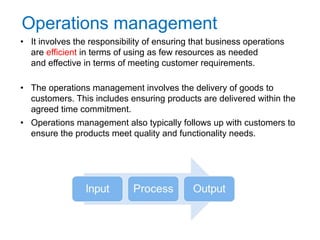
• Itinvolves the responsibility of ensuring that business operations
are efficient in terms of using as few resources as needed
and effective in terms of meeting customer requirements.
• The operations management involves the delivery of goods to
customers. This includes ensuring products are delivered within the
agreed time commitment.
• Operations management also typically follows up with customers to
ensure the products meet quality and functionality needs.
4
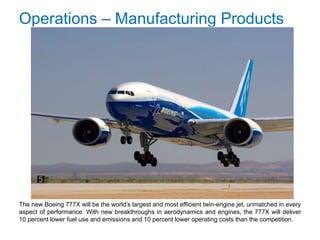
Operations – ManufacturingProducts
The new Boeing 777X will be the world’s largest and most efficient twin-engine jet, unmatched in every
aspect of performance. With new breakthroughs in aerodynamics and engines, the 777X will deliver
10 percent lower fuel use and emissions and 10 percent lower operating costs than the competition.
6
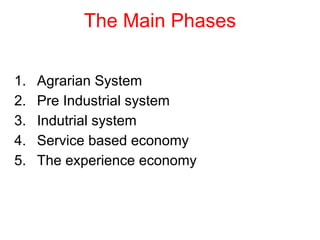
The Main Phases
1.Agrarian System
2. Pre Industrial system
3. Indutrial system
4. Service based economy
5. The experience economy
12.
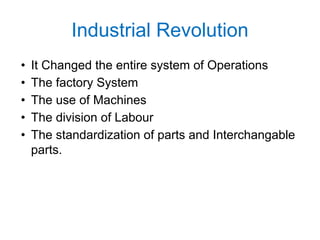
Industrial Revolution
• ItChanged the entire system of Operations
• The factory System
• The use of Machines
• The division of Labour
• The standardization of parts and Interchangable
parts.
13.
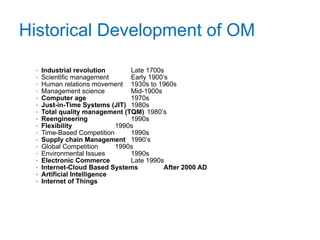
Historical Development ofOM
• Industrial revolution Late 1700s
• Scientific management Early 1900’s
• Human relations movement 1930s to 1960s
• Management science Mid-1900s
• Computer age 1970s
• Just-in-Time Systems (JIT) 1980s
• Total quality management (TQM) 1980’s
• Reengineering 1990s
• Flexibility 1990s
• Time-Based Competition 1990s
• Supply chain Management 1990’s
• Global Competition 1990s
• Environmental Issues 1990s
• Electronic Commerce Late 1990s
• Internet-Cloud Based Systems After 2000 AD
• Artificial Intelligence
• Internet of Things
13
14.
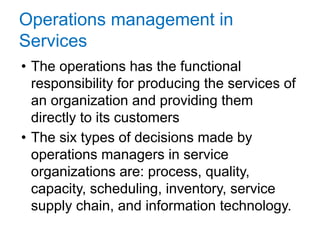
Operations management in
Services
•The operations has the functional
responsibility for producing the services of
an organization and providing them
directly to its customers
• The six types of decisions made by
operations managers in service
organizations are: process, quality,
capacity, scheduling, inventory, service
supply chain, and information technology.
14
15.
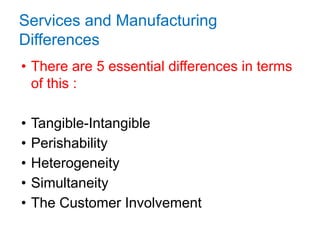
Services and Manufacturing
Differences
•There are 5 essential differences in terms
of this :
• Tangible-Intangible
• Perishability
• Heterogeneity
• Simultaneity
• The Customer Involvement
15
16.
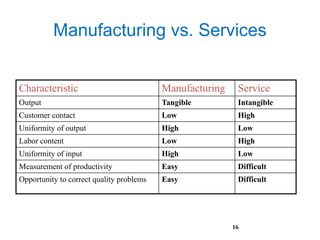
Manufacturing vs. Services
CharacteristicManufacturing Service
Output Tangible Intangible
Customer contact Low High
Uniformity of output High Low
Labor content Low High
Uniformity of input High Low
Measurement of productivity Easy Difficult
Opportunity to correct quality problems Easy Difficult
16
17.
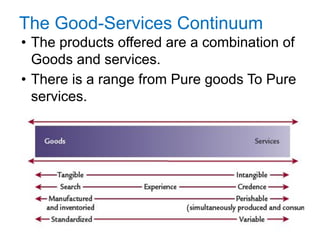
The Good-Services Continuum
•The products offered are a combination of
Goods and services.
• There is a range from Pure goods To Pure
services.
17
18.
Servitization : Itis the concept that any
product can be delivered ‘as a service’.
•An example of this is Rolls-Royce ‘Power by the Hour’ model where no
longer would they simply sell jet engines and warranties, they would
instead offer the operator flight-hours – the responsibility would then be
entirely on Rolls Royce to deliver the contracted number of hours whilst
achieving certain availability metrics.
•It helps in more care for the product and also more customer retention.
18
19.
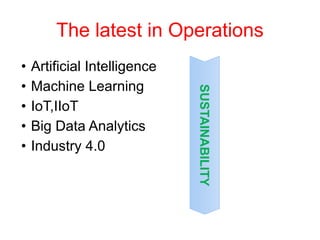
The latest inOperations
• Artificial Intelligence
• Machine Learning
• IoT,IIoT
• Big Data Analytics
• Industry 4.0
SUSTAINABILITY
Systems (Holistic) Approach
•Emphasize interrelations among subsystems.
• A systems approach is essential whenever something is
being designed, redesigned, implemented, or improved. It
is important to take into account the impact on all parts of
the system.
• Example: A new feature is added to a product.
– Designer must take into account how customers will
view the change, instructions for using new feature, the
cost, training of workers, production schedule, quality
standard, advertising must be informed about the new
feature.
21
“The whole is greater than
the sum of the parts.”
• Strategy (fromGreek stratēgia, "art of troop
leader; office of general, command, generalship) is
a high level plan to achieve one or more goals
under conditions of uncertainty.
• Strategy is important because the resources
available to achieve these goals are usually limited.
• Strategy generally involves setting goals,
determining actions to achieve the goals, and
mobilizing resources to execute the actions. A
strategy describes how the ends (goals) will be
achieved by the means (resources).
Strategy
24.
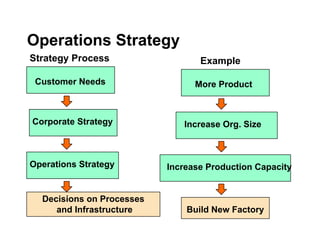
Operations Strategy
•A planspecifying how an organization
will allocate resources in order to support
infrastructure and production.
•An operations strategy is typically driven by the
overall business strategy of the organization, and
is designed to maximize the effectiveness of production
and support elements while minimizing costs.
•A plan of action implemented by a firm that describes how
they will employ their resources in the production of
a product or service.
•An operational strategy is a necessary element for
a business and supports the firm's corporate strategy.
25.
Operations Strategy
Example
Strategy Process
CustomerNeeds
Corporate Strategy
Operations Strategy
Decisions on Processes
and Infrastructure
More Product
Increase Org. Size
Increase Production Capacity
Build New Factory
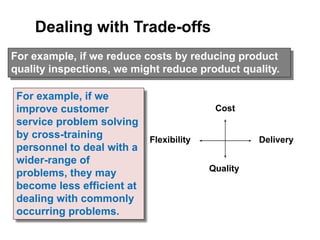
Dealing with Trade-offs
Cost
Quality
Delivery
Flexibility
Forexample, if we
improve customer
service problem solving
by cross-training
personnel to deal with a
wider-range of
problems, they may
become less efficient at
dealing with commonly
occurring problems.
For example, if we reduce costs by reducing product
quality inspections, we might reduce product quality.
29.
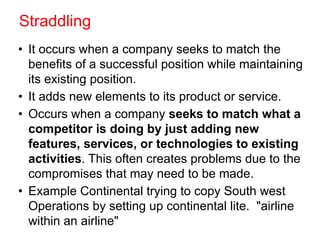
Straddling
• It occurswhen a company seeks to match the
benefits of a successful position while maintaining
its existing position.
• It adds new elements to its product or service.
• Occurs when a company seeks to match what a
competitor is doing by just adding new
features, services, or technologies to existing
activities. This often creates problems due to the
compromises that may need to be made.
• Example Continental trying to copy South west
Operations by setting up continental lite. "airline
within an airline"
30.
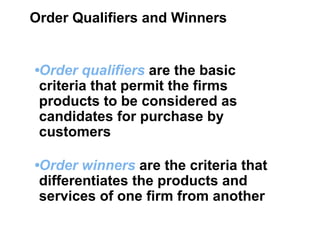
Order Qualifiers andWinners
•Order qualifiers are the basic
criteria that permit the firms
products to be considered as
candidates for purchase by
customers
•Order winners are the criteria that
differentiates the products and
services of one firm from another
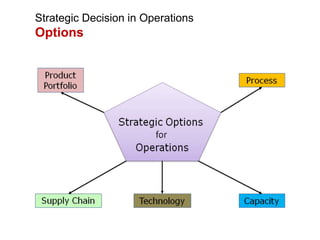
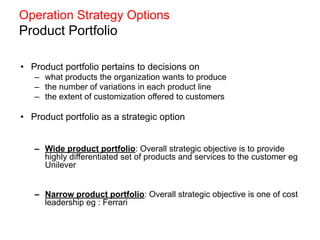
Operation Strategy Options
ProductPortfolio
• Product portfolio pertains to decisions on
– what products the organization wants to produce
– the number of variations in each product line
– the extent of customization offered to customers
• Product portfolio as a strategic option
– Wide product portfolio: Overall strategic objective is to provide
highly differentiated set of products and services to the customer eg
Unilever
– Narrow product portfolio: Overall strategic objective is one of cost
leadership eg : Ferrari
33.
Operation Strategy Options
ProcessChoices
– Continuous streamlined flow
– Intermittent or batch flow
– Jumbled flow
• Choice of process will be consistent with product
portfolio decisions
– A manufacturer emphasizing on production volumes, fewer
varieties and less cost will make process choices pertaining to
continuous streamlined flow (Hero Honda)
– An organization wishing to satisfy an objective of providing wide
range of products to the customers will adopt batch/intermittent
flow type the need to provide a very large variety and practically a
production volume of one or few will adopt jumbled flow (BHEL)
34.
Operation Strategy Options
SupplyChain issues
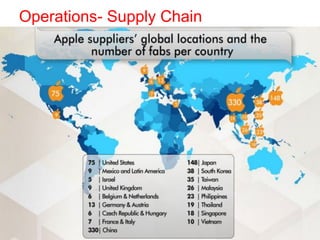
• Supply chain refers to the network of entities supplying
components and raw material to an organization as well as
those distributing the finished goods of an organization to the
customers through alternative channels
• Designing an appropriate supply chain calls for a better
understanding of the product profile for which the supply chain
is configured
• Two types of supply chains can be configured:
– Efficient supply chain: objective is cost optimization and better
utilization of resources employed in supply chain operations;
typically used in the case of functional products (machine tools,
engineered equipments)
– Responsive supply chain: the key objective is to develop a
capability to respond fast to the market requirements; typically
used in the case of innovative products (iPhone, Fancy Garments,
trendy Electronics Goods)
35.
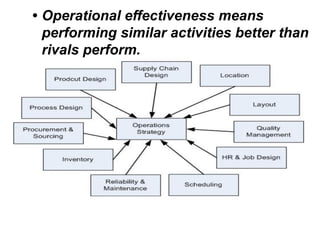
Ten Critical Decisions
1.Design of goods and services
2. Managing quality
3. Process and capacity design
4. Location strategy
5. Layout strategy
6. Human resources and job design
7. Supply-chain management
8. Inventory, MRP, JIT
9. Scheduling
10. Maintenance
36.
The Critical Decisions
1.Design of goods and services
– What good or service should we offer?
– How should we design these products and services?
2. Managing quality
– How do we define quality?
– Who is responsible for quality?
3. Process and capacity design
– What process and what capacity will these products
require?
– What equipment and technology is necessary for these
processes?
4. Location strategy
– Where should we put the facility?
– On what criteria should we base the location decision?
37.
The Critical Decisions
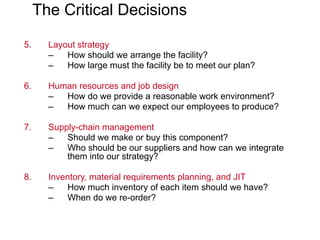
5.Layout strategy
– How should we arrange the facility?
– How large must the facility be to meet our plan?
6. Human resources and job design
– How do we provide a reasonable work environment?
– How much can we expect our employees to produce?
7. Supply-chain management
– Should we make or buy this component?
– Who should be our suppliers and how can we integrate
them into our strategy?
8. Inventory, material requirements planning, and JIT
– How much inventory of each item should we have?
– When do we re-order?
38.
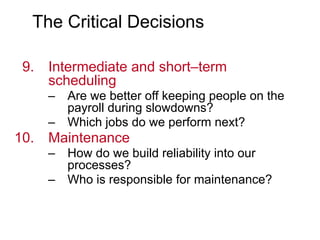
The Critical Decisions
9.Intermediate and short–term
scheduling
– Are we better off keeping people on the
payroll during slowdowns?
– Which jobs do we perform next?
10. Maintenance
– How do we build reliability into our
processes?
– Who is responsible for maintenance?