Operations Strategy
According to David (2005):
•‘Strategies are the means by which long-
term objectives will be achieved.’
2 - 3© 2014 Pearson Education, Inc.
Boeing’s Global Supply-Chain
Strategy
Some of the International Suppliers of Boeing 787 Components
SUPPLIER
HEADQUARTERS
COUNTRY COMPONENT
Latecoere France Passenger doors
Labinel France Wiring
Dassault France Design and PLM software
Messier-Bugatti France Electric brakes
Thales France Electrical power conversion
system and integrated standby
flight display
Messier-Dowty France Landing gear structure
Diehl Germany Interior lighting
2 - 4© 2014 Pearson Education, Inc.
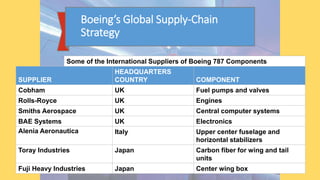
Boeing’s Global Supply-Chain
Strategy
Some of the International Suppliers of Boeing 787 Components
SUPPLIER
HEADQUARTERS
COUNTRY COMPONENT
Cobham UK Fuel pumps and valves
Rolls-Royce UK Engines
Smiths Aerospace UK Central computer systems
BAE Systems UK Electronics
Alenia Aeronautica Italy Upper center fuselage and
horizontal stabilizers
Toray Industries Japan Carbon fiber for wing and tail
units
Fuji Heavy Industries Japan Center wing box
2 - 5© 2014 Pearson Education, Inc.
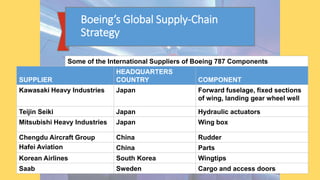
Boeing’s Global Supply-Chain
Strategy
Some of the International Suppliers of Boeing 787 Components
SUPPLIER
HEADQUARTERS
COUNTRY COMPONENT
Kawasaki Heavy Industries Japan Forward fuselage, fixed sections
of wing, landing gear wheel well
Teijin Seiki Japan Hydraulic actuators
Mitsubishi Heavy Industries Japan Wing box
Chengdu Aircraft Group China Rudder
Hafei Aviation China Parts
Korean Airlines South Korea Wingtips
Saab Sweden Cargo and access doors
Reasons to Globalize
Improve the supply chain
Reduce costs (labor, taxes, tariffs, etc.)
Improve operations
Understand markets
Improve products
Attract and retain global talent
1. Improve the Supply Chain
Locating
facilities
closer to
unique
resources
Auto design to California
Perfume manufacturing
in France
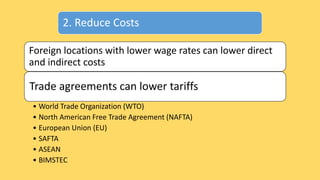
2. Reduce Costs
Foreign locations with lower wage rates can lower direct
and indirect costs
Trade agreements can lower tariffs
• World Trade Organization (WTO)
• North American Free Trade Agreement (NAFTA)
• European Union (EU)
• SAFTA
• ASEAN
• BIMSTEC
3. Improve Operations
Understand differences between how
business is handled in other countries
• Japanese – inventory management
• Scandinavians – ergonomics
International operations can improve
response time and customer service
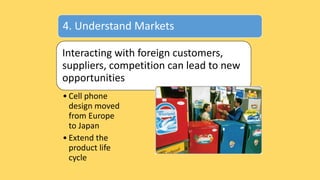
4. Understand Markets
Interacting with foreign customers,
suppliers, competition can lead to new
opportunities
• Cell phone
design moved
from Europe
to Japan
• Extend the
product life
cycle
5. Improve Products
Remain open to free flow of ideas
Toyota and BMW manage joint research
and development
• Reduced risk, state-of-the-art design, lower costs
Samsung and Bosch jointly produce
batteries
6. Attract and Retain Global Talent
Offer better employment
opportunities
• Better growth opportunities and insulation
against unemployment
• Relocate unneeded personnel to more
prosperous locations
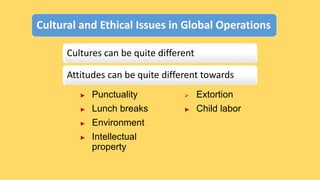
Cultural and Ethical Issues in Global Operations
Cultures can be quite different
Attitudes can be quite different towards
► Punctuality
► Lunch breaks
► Environment
► Intellectual
property
 Extortion
► Child labor
Companies Want To Consider
National literacy rate
Rate of innovation
Rate of technology change
Number of skilled workers
Political stability
Product liability laws
Export restrictions
Variations in language
Work ethic
Tax rates
Inflation
Availability of raw materials
Interest rates
Population
Number of miles of highway
Phone system
Vision & Mission Statement
Vision & Mission
• Vision is a bigger picture & future oriented while the
mission is more immediately focused on the present
• It is the vision that defines the end game and the mission is
the road map that will take you there
• For example, for a luxury products company, the vision
could be 'To be among most admired luxury brands in the
world' and mission could be 'To add style to the lives'
Examples
Vision of Google: “To Provide the access to
the worlds information in one click.”
Mission of Google: “To organize the worlds
information and make it universally accessible
and useful.”
Sample Missions
Sample Company Mission
To manufacture and service an innovative, growing, and
profitable worldwide microwave communications business
that exceeds our customers’ expectations.
Sample Operations Management Mission
To produce products consistent with the company’s mission
as the worldwide low-cost manufacturer.
Figure 2.3
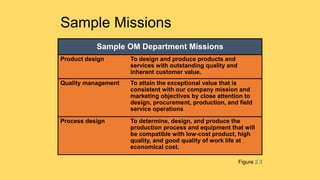
Sample Missions
Sample OM Department Missions
Product design To design and produce products and
services with outstanding quality and
inherent customer value.
Quality management To attain the exceptional value that is
consistent with our company mission and
marketing objectives by close attention to
design, procurement, production, and field
service operations
Process design To determine, design, and produce the
production process and equipment that will
be compatible with low-cost product, high
quality, and good quality of work life at
economical cost.
Figure 2.3
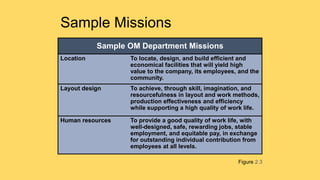
Sample Missions
Sample OM Department Missions
Location To locate, design, and build efficient and
economical facilities that will yield high
value to the company, its employees, and the
community.
Layout design To achieve, through skill, imagination, and
resourcefulness in layout and work methods,
production effectiveness and efficiency
while supporting a high quality of work life.
Human resources To provide a good quality of work life, with
well-designed, safe, rewarding jobs, stable
employment, and equitable pay, in exchange
for outstanding individual contribution from
employees at all levels.
Figure 2.3
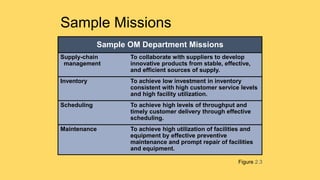
Sample Missions
Sample OM Department Missions
Supply-chain
management
To collaborate with suppliers to develop
innovative products from stable, effective,
and efficient sources of supply.
Inventory To achieve low investment in inventory
consistent with high customer service levels
and high facility utilization.
Scheduling To achieve high levels of throughput and
timely customer delivery through effective
scheduling.
Maintenance To achieve high utilization of facilities and
equipment by effective preventive
maintenance and prompt repair of facilities
and equipment.
Figure 2.3
Difference in Between Vision and Mission Statement
A vision statement is a description of
where a company wants to be in the
future
It concerns a firms future path and
position
It tells about future technology and
products
It answer the question why we are here
It should remain intact, even if the market
changes dramatically, because it speaks to
what you represent, not just what you do
Mission statement defines the organization's purpose and primary
objectives
It focuses on current business activities.
It tells about the current technology and current products
It answer the question what do we do.
It may change, but it should tie back to your core values and vision.
Developing Missions and Strategies
Mission statements tell an organization where it is going
The Strategy tells the organization how to get there
Mission
Mission - where is the
organization going?
• Organization’s purpose for being
• Answers ‘What do we contribute to
society?’
• Provides boundaries and focus
Benefit to
Society
Mission
Factors Affecting Mission
Philosophy
and Values
Profitability and
GrowthEnvironment
Customers Public Image
Strategy
► Action plan to achieve
mission
► Functional areas have
strategies
► Strategies exploit
opportunities and
strengths, neutralize
threats, and avoid
weaknesses
Competitive Priorities- The Edge
Four Important Operations Questions: Will you compete on –
• Cost?
• Quality?
• Time?
• Flexibility?
All of the above/Some Tradeoffs?
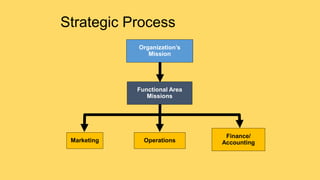
Strategic Process
Marketing Operations
Finance/
Accounting
Functional Area
Missions
Organization’s
Mission
28
Companies often do not understand the differences
between operational efficiency and strategy
• Operational efficiency is performing tasks well, even better than
competitors
• Strategy is a plan for competing in the marketplace
Operations strategy is to ensure all tasks performed
are the right tasks
Strategy Development Process
Determine the Corporate Mission
State the reason for the firm’s existence and identify the value it
wishes to create.
Form a Strategy
Build a competitive advantage, such as low price, design, or
volume flexibility, quality, quick delivery, dependability,
after-sale service, broad product lines.
Analyze the Environment
Identify the strengths, weaknesses, opportunities, and threats. Understand
the environment, customers, industry, and competitors.
Global Operations Strategy Options
CostReduction
High
Low
HighLow
Local Responsiveness
(Quick Response and/or Differentiation)
• Import/export or
license existing
product
International strategy
(eg, Harley-Davidson
U.S. Steel)
Global Operations Strategy Options
CostReduction
High
Low
HighLow
Local Responsiveness
(Quick Response and/or Differentiation)
• Import/export or
license existing
product
International
strategy
(eg, Harley-Davidson
U.S. Steel)
• Import/export or
license existing
product
International
strategy
(eg, Harley-Davidson
U.S. Steel)
Global Operations Strategy Options
CostReduction
High
Low
HighLow
Local Responsiveness
(Quick Response and/or Differentiation)
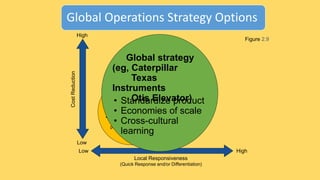
Figure 2.9
• Standardize product
• Economies of scale
• Cross-cultural
learning
Global strategy
(eg, Caterpillar
Texas
Instruments
Otis Elevator)
• Import/export or
license existing
product
International
strategy
(eg, Harley-Davidson
U.S. Steel)
Global Operations Strategy Options
CostReduction
High
Low
HighLow
Local Responsiveness
(Quick Response and/or Differentiation)
Figure 2.9
• Standardize product
• Economies of scale
• Cross-cultural learning
Global strategy
(eg, Caterpillar
Texas Instruments
Otis Elevator)
• Import/export or
license existing
product
International
strategy
(eg, Harley-Davidson
U.S. Steel)
Global Operations Strategy Options
• Standardize product
• Economies of scale
• Cross-cultural learning
Global strategy
(eg, Caterpillar
Texas Instruments
Otis Elevator)
CostReduction
High
Low
HighLow
Local Responsiveness
(Quick Response and/or Differentiation)
Figure 2.9
• Use existing domestic
model globally
• Franchise, joint
ventures, subsidiaries
Multidomestic
strategy
(eg, Heinz, McDonald’s)
• Import/export or
license existing
product
International
strategy
(eg, Harley-Davidson
U.S. Steel)
Global Operations Strategy Options
CostReduction
High
Low
HighLow
Local Responsiveness
(Quick Response and/or Differentiation)
Figure 2.9
• Use existing domestic
model globally
• Franchise, joint
ventures,
subsidiaries
Multidomestic
strategy
(eg, Heinz, McDonald’s
The Body Shop
Hard Rock Cafe)
• Standardize product
• Economies of scale
• Cross-cultural learning
Global strategy
(eg, Caterpillar
Texas Instruments
Otis Elevator)
• Import/export or
license existing
product
International
strategy
(eg, Harley-Davidson
U.S. Steel)
Global Operations Strategy Options
• Standardize product
• Economies of scale
• Cross-cultural learning
Global strategy
(eg, Caterpillar
Texas Instruments
Otis Elevator)
CostReduction
High
Low
HighLow
Local Responsiveness
(Quick Response and/or Differentiation)
Figure 2.9
• Use existing domestic
model globally
• Franchise, joint
ventures,
subsidiaries
Multidomestic
strategy
(eg, Heinz, McDonald’s
The Body Shop
Hard Rock Cafe)
Transnational
strategy
(eg, Coca-Cola, Nestlé)
• Move material,
people, ideas across
national boundaries
• Economies of scale
• Cross-cultural
learning
• Import/export or
license existing
product
International
strategy
(eg, Harley-Davidson
U.S. Steel)
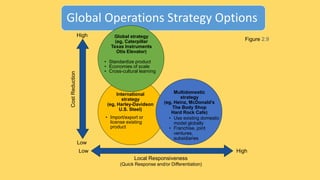
Global Operations Strategy Options
• Standardize product
• Economies of scale
• Cross-cultural learning
Global strategy
(eg, Caterpillar
Texas Instruments
Otis Elevator)
CostReduction
High
Low
HighLow
Local Responsiveness
(Quick Response and/or Differentiation)
Figure 2.9
• Use existing domestic
model globally
• Franchise, joint
ventures,
subsidiaries
Multidomestic
strategy
(eg, Heinz, McDonald’s
The Body Shop
Hard Rock Cafe)
Transnational
strategy
(eg, Coca-Cola, Nestlé)
• Move material,
people, ideas across
national boundaries
• Economies of scale
• Cross-cultural
learning
Strategies for Competitive Advantage
Differentiation – better, or at least different
Cost leadership – cheaper
Response – more responsive
Competing on Differentiation
Uniqueness can go beyond both the physical
characteristics and service attributes to encompass
everything that impacts customer’s perception of
value
► Disney Magic Kingdom – experience
differentiation
► Hamro Bhojanalaya
Competing on Cost
Provide the maximum value as perceived by
customer. Does not imply low quality.
Southwest Airlines – secondary airports, no
frills service, efficient utilization of equipment
Walmart – small overhead, shrinkage, and
distribution costs
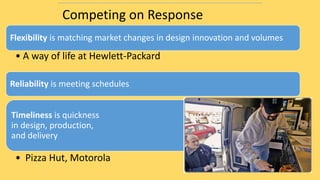
Competing on Response
Flexibility is matching market changes in design innovation and volumes
• A way of life at Hewlett-Packard
Reliability is meeting schedules
Timeliness is quickness
in design, production,
and delivery
• Pizza Hut, Motorola
Operations Management Contribution to Strategy
Operations management contributes to different strategies in following ways
Differentiation Strategy
• Innovative Design
• Broad Product Line
• After Sale Services
• Experience
Cost Leadership
• Low Overhead
• Effective Capacity Utilization
• Inventory Management
Response Strategy
• Flexibility
• Reliability
• Quickness
Strategy Development and Implementation
Identify key success factors
Integrate OM with other activities
Build and staff the organization
The operations manager’s job is to implement
an OM strategy, provide competitive
advantage, and increase productivity
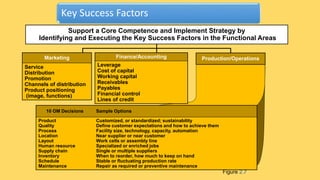
Key Success Factors
Production/Operations
Figure 2.7
Marketing
Service
Distribution
Promotion
Channels of distribution
Product positioning
(image, functions)
Finance/Accounting
Leverage
Cost of capital
Working capital
Receivables
Payables
Financial control
Lines of credit
10 OM Decisions Sample Options
Product
Quality
Process
Location
Layout
Human resource
Supply chain
Inventory
Schedule
Maintenance
Customized, or standardized; sustainability
Define customer expectations and how to achieve them
Facility size, technology, capacity, automation
Near supplier or near customer
Work cells or assembly line
Specialized or enriched jobs
Single or multiple suppliers
When to reorder, how much to keep on hand
Stable or fluctuating production rate
Repair as required or preventive maintenance
Support a Core Competence and Implement Strategy by
Identifying and Executing the Key Success Factors in the Functional Areas
Methods of Minimizing Non-sampling Errors
• Checking the sampling process
• Preparation of questionnaire
• Pilot survey
• Fix procedures
• Use of competent manpower
• Provide information
• Provide training
• Use of experts
• Checking data processing and analysis

Operations strategy

  • 1.
  • 2.
    According to David(2005): •‘Strategies are the means by which long- term objectives will be achieved.’
  • 3.
    2 - 3©2014 Pearson Education, Inc. Boeing’s Global Supply-Chain Strategy Some of the International Suppliers of Boeing 787 Components SUPPLIER HEADQUARTERS COUNTRY COMPONENT Latecoere France Passenger doors Labinel France Wiring Dassault France Design and PLM software Messier-Bugatti France Electric brakes Thales France Electrical power conversion system and integrated standby flight display Messier-Dowty France Landing gear structure Diehl Germany Interior lighting
  • 4.
    2 - 4©2014 Pearson Education, Inc. Boeing’s Global Supply-Chain Strategy Some of the International Suppliers of Boeing 787 Components SUPPLIER HEADQUARTERS COUNTRY COMPONENT Cobham UK Fuel pumps and valves Rolls-Royce UK Engines Smiths Aerospace UK Central computer systems BAE Systems UK Electronics Alenia Aeronautica Italy Upper center fuselage and horizontal stabilizers Toray Industries Japan Carbon fiber for wing and tail units Fuji Heavy Industries Japan Center wing box
  • 5.
    2 - 5©2014 Pearson Education, Inc. Boeing’s Global Supply-Chain Strategy Some of the International Suppliers of Boeing 787 Components SUPPLIER HEADQUARTERS COUNTRY COMPONENT Kawasaki Heavy Industries Japan Forward fuselage, fixed sections of wing, landing gear wheel well Teijin Seiki Japan Hydraulic actuators Mitsubishi Heavy Industries Japan Wing box Chengdu Aircraft Group China Rudder Hafei Aviation China Parts Korean Airlines South Korea Wingtips Saab Sweden Cargo and access doors
  • 6.
    Reasons to Globalize Improvethe supply chain Reduce costs (labor, taxes, tariffs, etc.) Improve operations Understand markets Improve products Attract and retain global talent
  • 7.
    1. Improve theSupply Chain Locating facilities closer to unique resources Auto design to California Perfume manufacturing in France
  • 8.
    2. Reduce Costs Foreignlocations with lower wage rates can lower direct and indirect costs Trade agreements can lower tariffs • World Trade Organization (WTO) • North American Free Trade Agreement (NAFTA) • European Union (EU) • SAFTA • ASEAN • BIMSTEC
  • 9.
    3. Improve Operations Understanddifferences between how business is handled in other countries • Japanese – inventory management • Scandinavians – ergonomics International operations can improve response time and customer service
  • 10.
    4. Understand Markets Interactingwith foreign customers, suppliers, competition can lead to new opportunities • Cell phone design moved from Europe to Japan • Extend the product life cycle
  • 11.
    5. Improve Products Remainopen to free flow of ideas Toyota and BMW manage joint research and development • Reduced risk, state-of-the-art design, lower costs Samsung and Bosch jointly produce batteries
  • 12.
    6. Attract andRetain Global Talent Offer better employment opportunities • Better growth opportunities and insulation against unemployment • Relocate unneeded personnel to more prosperous locations
  • 13.
    Cultural and EthicalIssues in Global Operations Cultures can be quite different Attitudes can be quite different towards ► Punctuality ► Lunch breaks ► Environment ► Intellectual property  Extortion ► Child labor
  • 14.
    Companies Want ToConsider National literacy rate Rate of innovation Rate of technology change Number of skilled workers Political stability Product liability laws Export restrictions Variations in language Work ethic Tax rates Inflation Availability of raw materials Interest rates Population Number of miles of highway Phone system
  • 15.
    Vision & MissionStatement Vision & Mission • Vision is a bigger picture & future oriented while the mission is more immediately focused on the present • It is the vision that defines the end game and the mission is the road map that will take you there • For example, for a luxury products company, the vision could be 'To be among most admired luxury brands in the world' and mission could be 'To add style to the lives'
  • 16.
    Examples Vision of Google:“To Provide the access to the worlds information in one click.” Mission of Google: “To organize the worlds information and make it universally accessible and useful.”
  • 17.
    Sample Missions Sample CompanyMission To manufacture and service an innovative, growing, and profitable worldwide microwave communications business that exceeds our customers’ expectations. Sample Operations Management Mission To produce products consistent with the company’s mission as the worldwide low-cost manufacturer. Figure 2.3
  • 18.
    Sample Missions Sample OMDepartment Missions Product design To design and produce products and services with outstanding quality and inherent customer value. Quality management To attain the exceptional value that is consistent with our company mission and marketing objectives by close attention to design, procurement, production, and field service operations Process design To determine, design, and produce the production process and equipment that will be compatible with low-cost product, high quality, and good quality of work life at economical cost. Figure 2.3
  • 19.
    Sample Missions Sample OMDepartment Missions Location To locate, design, and build efficient and economical facilities that will yield high value to the company, its employees, and the community. Layout design To achieve, through skill, imagination, and resourcefulness in layout and work methods, production effectiveness and efficiency while supporting a high quality of work life. Human resources To provide a good quality of work life, with well-designed, safe, rewarding jobs, stable employment, and equitable pay, in exchange for outstanding individual contribution from employees at all levels. Figure 2.3
  • 20.
    Sample Missions Sample OMDepartment Missions Supply-chain management To collaborate with suppliers to develop innovative products from stable, effective, and efficient sources of supply. Inventory To achieve low investment in inventory consistent with high customer service levels and high facility utilization. Scheduling To achieve high levels of throughput and timely customer delivery through effective scheduling. Maintenance To achieve high utilization of facilities and equipment by effective preventive maintenance and prompt repair of facilities and equipment. Figure 2.3
  • 21.
    Difference in BetweenVision and Mission Statement A vision statement is a description of where a company wants to be in the future It concerns a firms future path and position It tells about future technology and products It answer the question why we are here It should remain intact, even if the market changes dramatically, because it speaks to what you represent, not just what you do Mission statement defines the organization's purpose and primary objectives It focuses on current business activities. It tells about the current technology and current products It answer the question what do we do. It may change, but it should tie back to your core values and vision.
  • 22.
    Developing Missions andStrategies Mission statements tell an organization where it is going The Strategy tells the organization how to get there
  • 23.
    Mission Mission - whereis the organization going? • Organization’s purpose for being • Answers ‘What do we contribute to society?’ • Provides boundaries and focus
  • 24.
    Benefit to Society Mission Factors AffectingMission Philosophy and Values Profitability and GrowthEnvironment Customers Public Image
  • 25.
    Strategy ► Action planto achieve mission ► Functional areas have strategies ► Strategies exploit opportunities and strengths, neutralize threats, and avoid weaknesses
  • 26.
    Competitive Priorities- TheEdge Four Important Operations Questions: Will you compete on – • Cost? • Quality? • Time? • Flexibility? All of the above/Some Tradeoffs?
  • 27.
  • 28.
    28 Companies often donot understand the differences between operational efficiency and strategy • Operational efficiency is performing tasks well, even better than competitors • Strategy is a plan for competing in the marketplace Operations strategy is to ensure all tasks performed are the right tasks
  • 29.
    Strategy Development Process Determinethe Corporate Mission State the reason for the firm’s existence and identify the value it wishes to create. Form a Strategy Build a competitive advantage, such as low price, design, or volume flexibility, quality, quick delivery, dependability, after-sale service, broad product lines. Analyze the Environment Identify the strengths, weaknesses, opportunities, and threats. Understand the environment, customers, industry, and competitors.
  • 30.
    Global Operations StrategyOptions CostReduction High Low HighLow Local Responsiveness (Quick Response and/or Differentiation) • Import/export or license existing product International strategy (eg, Harley-Davidson U.S. Steel)
  • 31.
    Global Operations StrategyOptions CostReduction High Low HighLow Local Responsiveness (Quick Response and/or Differentiation) • Import/export or license existing product International strategy (eg, Harley-Davidson U.S. Steel)
  • 32.
    • Import/export or licenseexisting product International strategy (eg, Harley-Davidson U.S. Steel) Global Operations Strategy Options CostReduction High Low HighLow Local Responsiveness (Quick Response and/or Differentiation) Figure 2.9 • Standardize product • Economies of scale • Cross-cultural learning Global strategy (eg, Caterpillar Texas Instruments Otis Elevator)
  • 33.
    • Import/export or licenseexisting product International strategy (eg, Harley-Davidson U.S. Steel) Global Operations Strategy Options CostReduction High Low HighLow Local Responsiveness (Quick Response and/or Differentiation) Figure 2.9 • Standardize product • Economies of scale • Cross-cultural learning Global strategy (eg, Caterpillar Texas Instruments Otis Elevator)
  • 34.
    • Import/export or licenseexisting product International strategy (eg, Harley-Davidson U.S. Steel) Global Operations Strategy Options • Standardize product • Economies of scale • Cross-cultural learning Global strategy (eg, Caterpillar Texas Instruments Otis Elevator) CostReduction High Low HighLow Local Responsiveness (Quick Response and/or Differentiation) Figure 2.9 • Use existing domestic model globally • Franchise, joint ventures, subsidiaries Multidomestic strategy (eg, Heinz, McDonald’s)
  • 35.
    • Import/export or licenseexisting product International strategy (eg, Harley-Davidson U.S. Steel) Global Operations Strategy Options CostReduction High Low HighLow Local Responsiveness (Quick Response and/or Differentiation) Figure 2.9 • Use existing domestic model globally • Franchise, joint ventures, subsidiaries Multidomestic strategy (eg, Heinz, McDonald’s The Body Shop Hard Rock Cafe) • Standardize product • Economies of scale • Cross-cultural learning Global strategy (eg, Caterpillar Texas Instruments Otis Elevator)
  • 36.
    • Import/export or licenseexisting product International strategy (eg, Harley-Davidson U.S. Steel) Global Operations Strategy Options • Standardize product • Economies of scale • Cross-cultural learning Global strategy (eg, Caterpillar Texas Instruments Otis Elevator) CostReduction High Low HighLow Local Responsiveness (Quick Response and/or Differentiation) Figure 2.9 • Use existing domestic model globally • Franchise, joint ventures, subsidiaries Multidomestic strategy (eg, Heinz, McDonald’s The Body Shop Hard Rock Cafe) Transnational strategy (eg, Coca-Cola, Nestlé) • Move material, people, ideas across national boundaries • Economies of scale • Cross-cultural learning
  • 37.
    • Import/export or licenseexisting product International strategy (eg, Harley-Davidson U.S. Steel) Global Operations Strategy Options • Standardize product • Economies of scale • Cross-cultural learning Global strategy (eg, Caterpillar Texas Instruments Otis Elevator) CostReduction High Low HighLow Local Responsiveness (Quick Response and/or Differentiation) Figure 2.9 • Use existing domestic model globally • Franchise, joint ventures, subsidiaries Multidomestic strategy (eg, Heinz, McDonald’s The Body Shop Hard Rock Cafe) Transnational strategy (eg, Coca-Cola, Nestlé) • Move material, people, ideas across national boundaries • Economies of scale • Cross-cultural learning
  • 38.
    Strategies for CompetitiveAdvantage Differentiation – better, or at least different Cost leadership – cheaper Response – more responsive
  • 39.
    Competing on Differentiation Uniquenesscan go beyond both the physical characteristics and service attributes to encompass everything that impacts customer’s perception of value ► Disney Magic Kingdom – experience differentiation ► Hamro Bhojanalaya
  • 40.
    Competing on Cost Providethe maximum value as perceived by customer. Does not imply low quality. Southwest Airlines – secondary airports, no frills service, efficient utilization of equipment Walmart – small overhead, shrinkage, and distribution costs
  • 41.
    Competing on Response Flexibilityis matching market changes in design innovation and volumes • A way of life at Hewlett-Packard Reliability is meeting schedules Timeliness is quickness in design, production, and delivery • Pizza Hut, Motorola
  • 42.
    Operations Management Contributionto Strategy Operations management contributes to different strategies in following ways Differentiation Strategy • Innovative Design • Broad Product Line • After Sale Services • Experience Cost Leadership • Low Overhead • Effective Capacity Utilization • Inventory Management Response Strategy • Flexibility • Reliability • Quickness
  • 43.
    Strategy Development andImplementation Identify key success factors Integrate OM with other activities Build and staff the organization The operations manager’s job is to implement an OM strategy, provide competitive advantage, and increase productivity
  • 44.
    Key Success Factors Production/Operations Figure2.7 Marketing Service Distribution Promotion Channels of distribution Product positioning (image, functions) Finance/Accounting Leverage Cost of capital Working capital Receivables Payables Financial control Lines of credit 10 OM Decisions Sample Options Product Quality Process Location Layout Human resource Supply chain Inventory Schedule Maintenance Customized, or standardized; sustainability Define customer expectations and how to achieve them Facility size, technology, capacity, automation Near supplier or near customer Work cells or assembly line Specialized or enriched jobs Single or multiple suppliers When to reorder, how much to keep on hand Stable or fluctuating production rate Repair as required or preventive maintenance Support a Core Competence and Implement Strategy by Identifying and Executing the Key Success Factors in the Functional Areas
  • 45.
    Methods of MinimizingNon-sampling Errors • Checking the sampling process • Preparation of questionnaire • Pilot survey • Fix procedures • Use of competent manpower • Provide information • Provide training • Use of experts • Checking data processing and analysis