Android: a brilliant case for
collaborative management of
innovation & intellectual property (IP)
Exercise
market power
Sell DonateCollaborateLicense
Aim: dominate Aim: Collaborate
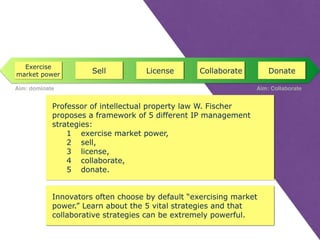
Professor of intellectual property law W. Fisher proposes
a framework of 5 different IP management strategies:
1 exercise market power,
2 sell,
3 license,
4 collaborate,
5 donate.
Innovators often choose by default “exercising market
power.” Learn about the 5 vital strategies and that
collaborative strategies can be extremely powerful.
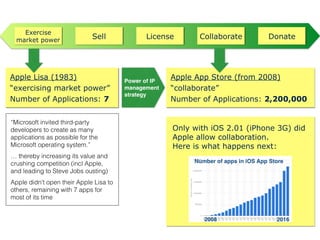
Only with iOS 2.01 (iPhone 3G) did
Apple allow collaboration.
Here is what happens next:
Apple Lisa (1983)
“exercising market power”
Number of Applications: 7
Apple App Store (from 2008)
“collaborate”
Number of Applications: 2,200,000
Exercise
market power
Sell DonateCollaborateLicense
Power of IP
management
strategy
2008 2016
Number of apps in iOS App Store
“Microsoft invited third-party
developers to create as many
applications as possible for the
Microsoft operating system.”
… thereby increasing its value and
crushing competition (incl Apple,
and leading to Steve Jobs ousting)
Apple didn’t open their Apple Lisa to
others, remaining with 7 apps for
most of its time
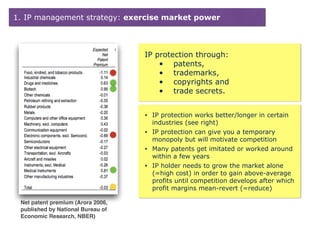
1. IP management strategy: exercise market power
IP protection through:
• patents,
• trademarks,
• copyrights and
• trade secrets.
Net patent premium (Arora 2006,
published by National Bureau of
Economic Research, NBER)
• IP protection works better/longer in certain
industries (see right)
• IP protection can give you a temporary
monopoly but will motivate competition
• Many patents get imitated or worked around
within a few years
• IP holder needs to grow the market alone
(=high cost) in order to gain above-average
profits until competition develops after which
profit margins mean-revert (=reduce)
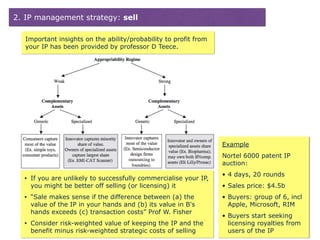
2. IP management strategy: sell
• If you are unlikely to successfully commercialise your IP,
you might be better off selling (or licensing) it
• “Sale makes sense if the difference between (a) the
value of the IP in your hands and (b) its value in B's
hands exceeds (c) transaction costs” Prof W. Fisher
• Consider risk-weighted value of keeping the IP and the
benefit minus risk-weighted strategic costs of selling
Example
Nortel 6000 patent IP
auction:
• 4 days, 20 rounds
• Sales price: $4.5b
• Buyers: group of 6, incl
Apple, Microsoft, RIM
• Buyers start seeking
licensing royalties from
users of the IP
Important insights on the ability/probability to profit from
your IP has been provided by professor D Teece.
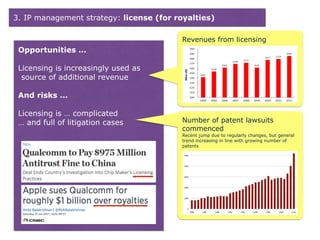
Opportunities …
Licensing is increasingly used as
source of additional revenue
And risks …
Licensing is … complicated
… and full of litigation cases Number of patent lawsuits
commenced
Recent jump due to regularly changes, but general
trend increasing in line with growing number of
patents
Revenues from licensing
3. IP management strategy: license (for royalties)
The case for collaborative approaches: the market’s potential
Using patents to exercise market
power is often based on the
assumption that the size of the
market is limited.
Collaborative approaches assume
- and contribute to - growing the
market
“I think there is a world market for
maybe five computers.” Thomas
Watson*, president of IBM, 1943.
“There is no reason anyone would
want a computer in their home.” Ken
Olsen*, founder of Digital Equipment
Corporation (DEC), 1977.
Market potential is hard to predict.
Collaborative approaches can
accelerate the growth trajectory
ANDROID is a brilliant example
* Ken Olsen has claimed to be quoted out of context, Thomas Watson has made
significant contributions in the early computer days. Both gents have our respect.
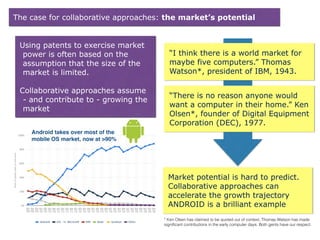
Android takes over most of the
mobile OS market, now at >90%
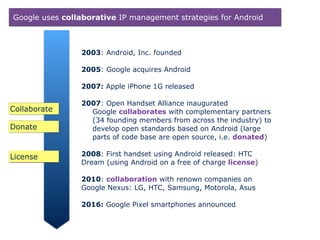
2003: Android, Inc. founded
2005: Google acquires Android
2007: Apple iPhone 1G released
2007: Open Handset Alliance inaugurated
Google collaborates with complementary partners
(34 founding members from across the industry) to
develop open standards based on Android (large
parts of code base are open source, i.e. donated)
2008: First handset using Android released: HTC
Dream (using Android on a free of charge license)
2010: collaboration with renown companies on
Google Nexus: LG, HTC, Samsung, Motorola, Asus
2016: Google Pixel smartphones announced
License
Collaborate
Donate
Google uses collaborative IP management strategies for Android
License
Collaborate
Donate
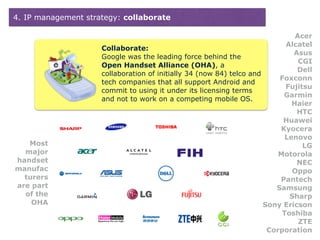
Collaborate:
Google was the leading force behind the
Open Handset Alliance (OHA), a
collaboration of initially 34 (now 84) telco and
tech companies that all support Android and
commit to using it under its licensing terms
and not to work on a competing mobile OS.
4. IP management strategy: collaborate
Acer
Alcatel
Asus
CGI
Dell
Foxconn
Fujitsu
Garmin
Haier
HTC
Huawei
Kyocera
Lenovo
LG
Motorola
NEC
Oppo
Pantech
Samsung
Sharp
Sony Ericson
Toshiba
ZTE
Corporation
Most
major
handset
manufac
turers
are part
of the
OHA
5. IP management strategy: donate
AOSP
Android Open Source Project
GMS
Google Mobile Service
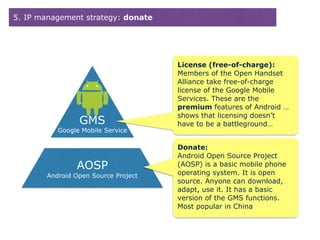
Donate:
Android Open Source Project
(AOSP) is a basic mobile phone
operating system. It is open
source. Anyone can download,
adapt, use it. It has a basic
version of the GMS functions.
Most popular in China
License (free-of-charge):
Members of the Open Handset
Alliance take free-of-charge
license of the Google Mobile
Services. These are the
premium features of Android …
shows that licensing doesn’t
have to be a battleground…
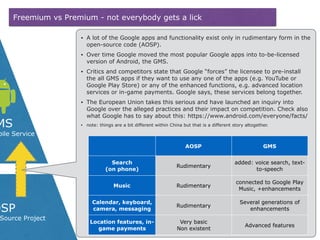
• A lot of the Google apps and functionality exist only in rudimentary form in the
open-source code (AOSP).
• Over time Google moved the most popular Google apps into to-be-licensed
version of Android, the GMS.
• Critics and competitors state that Google “forces” the licensee to pre-install
the all GMS apps if they want to use any one of the apps (e.g. YouTube or
Google Play Store) or any of the enhanced functions, e.g. advanced location
services or in-game payments. Google says, these services belong together.
• The European Union takes this serious and have launched an inquiry into
Google over the alleged practices and their impact on competition. Check also
what Google has to say about this: https://www.android.com/everyone/facts/
• note: things are a bit different within China but that is a different story altogether.
OSP
Source Project
MS
bile Service
Freemium vs Premium - not everybody gets a lick
AOSP GMS
Search
(on phone)
Rudimentary
added: voice search, text-
to-speech
Music Rudimentary
connected to Google Play
Music, +enhancements
Calendar, keyboard,
camera, messaging
Rudimentary
Several generations of
enhancements
Location features, in-
game payments
Very basic

Non existent
Advanced features
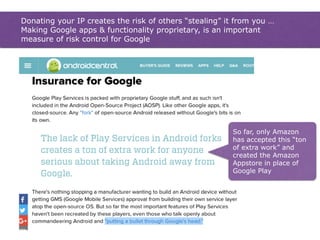
Donating your IP creates the risk of others “stealing” it from you …
Making Google apps & functionality proprietary, is an important
measure of risk control for Google
So far, only Amazon
has accepted this “ton
of extra work” and
created the Amazon
Appstore in place of
Google Play
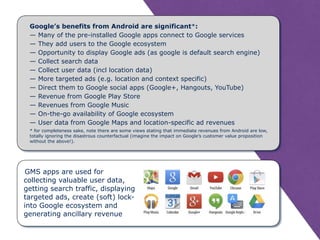
GMS apps are used for
collecting valuable user data,
getting search traffic, displaying
targeted ads, create (soft) lock-
into Google ecosystem and
generating ancillary revenue
Google’s benefits from Android are significant*:
— Many of the pre-installed Google apps connect to Google services
— They add users to the Google ecosystem
— Opportunity to display Google ads (as google is default search engine)
— Collect search data
— Collect user data (incl location data)
— More targeted ads (e.g. location and context specific)
— Direct them to Google social apps (Google+, Hangouts, YouTube)
— Revenue from Google Play Store
— Revenues from Google Music
— On-the-go availability of Google ecosystem
— User data from Google Maps and location-specific ad revenues
* for completeness sake, note there are some views stating that immediate revenues from Android are low,
totally ignoring the disastrous counterfactual (imagine the impact on Google’s customer value proposition
without the above!).
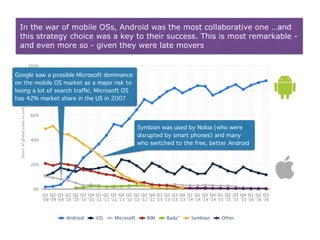
In the war of mobile OSs, Android was the most collaborative one …and
this strategy choice was a key to their success. This is most remarkable -
and even more so - given they were late movers
Symbian was used by Nokia (who were
disrupted by smart phones) and many
who switched to the free, better Android
Google saw a possible Microsoft dominance
on the mobile OS market as a major risk to
losing a lot of search traffic. Microsoft OS
has 42% market share in the US in 2007
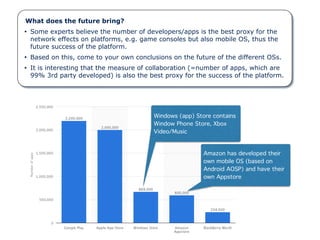
Amazon has developed their
own mobile OS (based on
Android AOSP) and have their
own Appstore
Windows (app) Store contains
Window Phone Store, Xbox
Video/Music
What does the future bring?
• Some experts believe the number of developers/apps is the best proxy for the
network effects on platforms, e.g. game consoles but also mobile OS, thus the
future success of the platform.
• Based on this, come to your own conclusions on the future of the different OSs.
• It is interesting that the measure of collaboration (=number of apps, which are
99% 3rd party developed) is also the best proxy for the success of the platform.
Understand your strategic options
managing your intellectual property
and
… make the most out of your
innovation idea:
We have 10 downloads (ebooks,
presentations, infographics and
worksheet) for you for a rapid
knowledge burst:
www.InnovationTactics.com/
strategic-IP-management

Android: a brilliant case for collaborative management of innovation

  • 1.
    Android: a brilliantcase for collaborative management of innovation & intellectual property (IP)
  • 2.
    Exercise market power Sell DonateCollaborateLicense Aim:dominate Aim: Collaborate Professor of intellectual property law W. Fisher proposes a framework of 5 different IP management strategies: 1 exercise market power, 2 sell, 3 license, 4 collaborate, 5 donate. Innovators often choose by default “exercising market power.” Learn about the 5 vital strategies and that collaborative strategies can be extremely powerful.
  • 3.
    Only with iOS2.01 (iPhone 3G) did Apple allow collaboration. Here is what happens next: Apple Lisa (1983) “exercising market power” Number of Applications: 7 Apple App Store (from 2008) “collaborate” Number of Applications: 2,200,000 Exercise market power Sell DonateCollaborateLicense Power of IP management strategy 2008 2016 Number of apps in iOS App Store “Microsoft invited third-party developers to create as many applications as possible for the Microsoft operating system.” … thereby increasing its value and crushing competition (incl Apple, and leading to Steve Jobs ousting) Apple didn’t open their Apple Lisa to others, remaining with 7 apps for most of its time
  • 4.
    1. IP managementstrategy: exercise market power IP protection through: • patents, • trademarks, • copyrights and • trade secrets. Net patent premium (Arora 2006, published by National Bureau of Economic Research, NBER) • IP protection works better/longer in certain industries (see right) • IP protection can give you a temporary monopoly but will motivate competition • Many patents get imitated or worked around within a few years • IP holder needs to grow the market alone (=high cost) in order to gain above-average profits until competition develops after which profit margins mean-revert (=reduce)
  • 5.
    2. IP managementstrategy: sell • If you are unlikely to successfully commercialise your IP, you might be better off selling (or licensing) it • “Sale makes sense if the difference between (a) the value of the IP in your hands and (b) its value in B's hands exceeds (c) transaction costs” Prof W. Fisher • Consider risk-weighted value of keeping the IP and the benefit minus risk-weighted strategic costs of selling Example Nortel 6000 patent IP auction: • 4 days, 20 rounds • Sales price: $4.5b • Buyers: group of 6, incl Apple, Microsoft, RIM • Buyers start seeking licensing royalties from users of the IP Important insights on the ability/probability to profit from your IP has been provided by professor D Teece.
  • 6.
    Opportunities … Licensing isincreasingly used as source of additional revenue And risks … Licensing is … complicated … and full of litigation cases Number of patent lawsuits commenced Recent jump due to regularly changes, but general trend increasing in line with growing number of patents Revenues from licensing 3. IP management strategy: license (for royalties)
  • 7.
    The case forcollaborative approaches: the market’s potential Using patents to exercise market power is often based on the assumption that the size of the market is limited. Collaborative approaches assume - and contribute to - growing the market “I think there is a world market for maybe five computers.” Thomas Watson*, president of IBM, 1943. “There is no reason anyone would want a computer in their home.” Ken Olsen*, founder of Digital Equipment Corporation (DEC), 1977. Market potential is hard to predict. Collaborative approaches can accelerate the growth trajectory ANDROID is a brilliant example * Ken Olsen has claimed to be quoted out of context, Thomas Watson has made significant contributions in the early computer days. Both gents have our respect. Android takes over most of the mobile OS market, now at >90%
  • 8.
    2003: Android, Inc.founded 2005: Google acquires Android 2007: Apple iPhone 1G released 2007: Open Handset Alliance inaugurated Google collaborates with complementary partners (34 founding members from across the industry) to develop open standards based on Android (large parts of code base are open source, i.e. donated) 2008: First handset using Android released: HTC Dream (using Android on a free of charge license) 2010: collaboration with renown companies on Google Nexus: LG, HTC, Samsung, Motorola, Asus 2016: Google Pixel smartphones announced License Collaborate Donate Google uses collaborative IP management strategies for Android License Collaborate Donate
  • 9.
    Collaborate: Google was theleading force behind the Open Handset Alliance (OHA), a collaboration of initially 34 (now 84) telco and tech companies that all support Android and commit to using it under its licensing terms and not to work on a competing mobile OS. 4. IP management strategy: collaborate Acer Alcatel Asus CGI Dell Foxconn Fujitsu Garmin Haier HTC Huawei Kyocera Lenovo LG Motorola NEC Oppo Pantech Samsung Sharp Sony Ericson Toshiba ZTE Corporation Most major handset manufac turers are part of the OHA
  • 10.
    5. IP managementstrategy: donate AOSP Android Open Source Project GMS Google Mobile Service Donate: Android Open Source Project (AOSP) is a basic mobile phone operating system. It is open source. Anyone can download, adapt, use it. It has a basic version of the GMS functions. Most popular in China License (free-of-charge): Members of the Open Handset Alliance take free-of-charge license of the Google Mobile Services. These are the premium features of Android … shows that licensing doesn’t have to be a battleground…
  • 11.
    • A lotof the Google apps and functionality exist only in rudimentary form in the open-source code (AOSP). • Over time Google moved the most popular Google apps into to-be-licensed version of Android, the GMS. • Critics and competitors state that Google “forces” the licensee to pre-install the all GMS apps if they want to use any one of the apps (e.g. YouTube or Google Play Store) or any of the enhanced functions, e.g. advanced location services or in-game payments. Google says, these services belong together. • The European Union takes this serious and have launched an inquiry into Google over the alleged practices and their impact on competition. Check also what Google has to say about this: https://www.android.com/everyone/facts/ • note: things are a bit different within China but that is a different story altogether. OSP Source Project MS bile Service Freemium vs Premium - not everybody gets a lick AOSP GMS Search (on phone) Rudimentary added: voice search, text- to-speech Music Rudimentary connected to Google Play Music, +enhancements Calendar, keyboard, camera, messaging Rudimentary Several generations of enhancements Location features, in- game payments Very basic
 Non existent Advanced features
  • 12.
    Donating your IPcreates the risk of others “stealing” it from you … Making Google apps & functionality proprietary, is an important measure of risk control for Google So far, only Amazon has accepted this “ton of extra work” and created the Amazon Appstore in place of Google Play
  • 13.
    GMS apps areused for collecting valuable user data, getting search traffic, displaying targeted ads, create (soft) lock- into Google ecosystem and generating ancillary revenue Google’s benefits from Android are significant*: — Many of the pre-installed Google apps connect to Google services — They add users to the Google ecosystem — Opportunity to display Google ads (as google is default search engine) — Collect search data — Collect user data (incl location data) — More targeted ads (e.g. location and context specific) — Direct them to Google social apps (Google+, Hangouts, YouTube) — Revenue from Google Play Store — Revenues from Google Music — On-the-go availability of Google ecosystem — User data from Google Maps and location-specific ad revenues * for completeness sake, note there are some views stating that immediate revenues from Android are low, totally ignoring the disastrous counterfactual (imagine the impact on Google’s customer value proposition without the above!).
  • 14.
    In the warof mobile OSs, Android was the most collaborative one …and this strategy choice was a key to their success. This is most remarkable - and even more so - given they were late movers Symbian was used by Nokia (who were disrupted by smart phones) and many who switched to the free, better Android Google saw a possible Microsoft dominance on the mobile OS market as a major risk to losing a lot of search traffic. Microsoft OS has 42% market share in the US in 2007
  • 15.
    Amazon has developedtheir own mobile OS (based on Android AOSP) and have their own Appstore Windows (app) Store contains Window Phone Store, Xbox Video/Music What does the future bring? • Some experts believe the number of developers/apps is the best proxy for the network effects on platforms, e.g. game consoles but also mobile OS, thus the future success of the platform. • Based on this, come to your own conclusions on the future of the different OSs. • It is interesting that the measure of collaboration (=number of apps, which are 99% 3rd party developed) is also the best proxy for the success of the platform.
  • 16.
    Understand your strategicoptions managing your intellectual property and … make the most out of your innovation idea: We have 10 downloads (ebooks, presentations, infographics and worksheet) for you for a rapid knowledge burst: www.InnovationTactics.com/ strategic-IP-management