Linux file system –
input and output
p.Vijaya priya
I- Msc (cs)
BY
Linux
 The Linux kernel is an open – source
monolithic Unix- like computer operating system
kernel.
 Its basic design from principles established in
Unix during the 1970s and 1980s.
 Linux is a small UNIX system. Version 1.o
released in 1944, 2.2 in 1999.
today used on 7-10 million corporate computer
network and web servers.
 A Linux file system is a structured collection
Of files on a disk drive or a partition.
A partition is a segment of memory and contains
some specific data.
 In our machine ,there can be various partitions
Of the memory .generally , every partition
Contains a file system
 The general- purpose computer system needs
To store data systematically so that we can easily
access the files less time.
Linux file system
 It stores the data on disks (HDD) or some
Equivalent storage type.
There may be below reasons for maintaining
The file system :
 primarily the computer saves data to the RAM
Storage; it may be lose the data if it gets turned
Off.
 Data storage is preferred on hard drives as
compared to standard RAM costs more than disk
Space.
What is the Linux file system ?
Linux files system is generally a built-in layer of a
Linux operating system used to handle the data
Management of the storage.
It helps to arrange the files on the disk storage.
It manages the files name ,file size, creation data,
And much more information about a file.
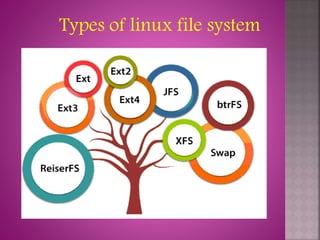
Types of linux file system
1.ext,ext2, ext3 and ext4 file system
 The file system Ext stands for Extended file
system. It was primarily developed for MINI os.
The Ext file system is an older version, and is no
Longer used due to some limitations.
Ext 2:
is the first linux file system that allows managing
Two terabytes data.
Ext4: file system is the faster file system among
All the ext file systems.
It is a very compatible option for the SSD(solid
-state drive) disks , and it is the default file
system in linux distribution.
Ext3 : is developed through ext2; it is an upgraded
Version of ext2 and contains backward
Compatibility.
2. JFS file system
 JFS stands for journaled file system, and it is
Developed by IBM for AIX Unix.
 It is an alternative to the Ext file system it can
Also be used in place of Ext4, where stability
Is need with few resources.
 It is handy file system when CPU power is
Limited.
3. ReiserFS file system
ReiserFs is an alternative to the Ext3 file system.
It has improved performance and advanced
Features.
 The reiserFS was used as the default file system
in SUSE returned to Ext3.
4.XFS file system
 XFS file system was considered as high –speed
JFS, which is developed for parallel I/O
processing
5. Btrfs file system
 Btrfs stands for the B tree file system.
 It is used for fault tolerance, repair
system, fun administration, extensive
storage configuration, and more
 It is not a good suit for production.
6.Swap file system
 Is used for memory paging in linux operating
system during the system hibernation.
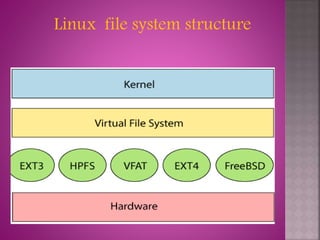
Linux file system structure
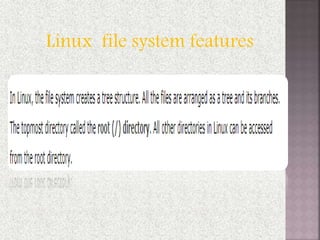
Linux file system features
Some key features of Linux file system
Are as following:
 Specific paths
 Partition ,directories, and drives
 Case sensitivity
 File extensions
 Hidden files
Input and output
Linux
 The Linux device –oriented file system
accesses disk storage through two caches :
 Data is caches in the page cache, which is
unified with the virtual memory system.
 Metadata is caches in the buffer cache, a
separate cache indexed by the physical block.
Input and output
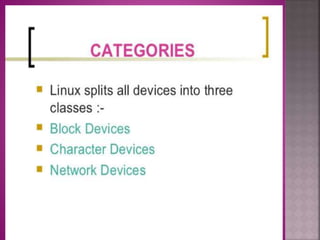
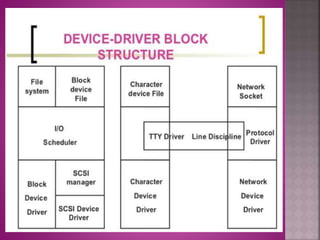
 Linux splits all devices into three
classes :
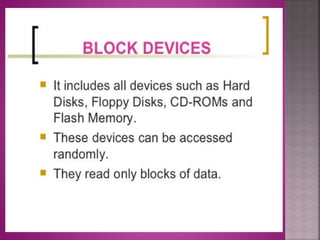
 Block devices allow random access to completely
independent, fixed size blocks of data.
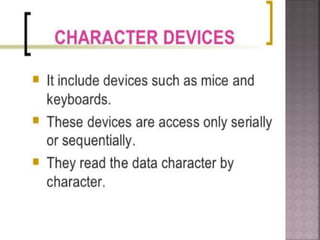
 Character devices include most other devices;
They don’t need to support the functionality
Of regular files.
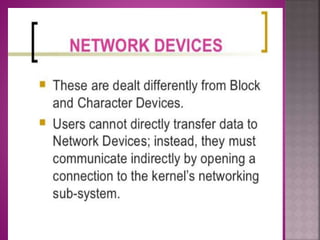
 Network devices are interfaced via the kernels ’s
Networking subsystem
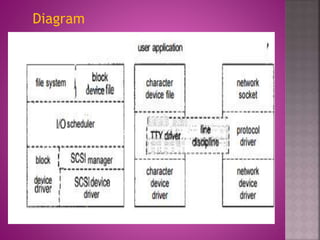
Diagram
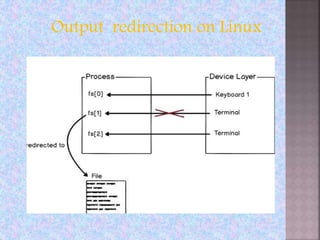
Output redirection on Linux
Thank you

Operating System

  • 1.
    Linux file system– input and output p.Vijaya priya I- Msc (cs) BY
  • 3.
    Linux  The Linuxkernel is an open – source monolithic Unix- like computer operating system kernel.  Its basic design from principles established in Unix during the 1970s and 1980s.  Linux is a small UNIX system. Version 1.o released in 1944, 2.2 in 1999. today used on 7-10 million corporate computer network and web servers.
  • 4.
     A Linuxfile system is a structured collection Of files on a disk drive or a partition. A partition is a segment of memory and contains some specific data.  In our machine ,there can be various partitions Of the memory .generally , every partition Contains a file system  The general- purpose computer system needs To store data systematically so that we can easily access the files less time. Linux file system
  • 5.
     It storesthe data on disks (HDD) or some Equivalent storage type. There may be below reasons for maintaining The file system :  primarily the computer saves data to the RAM Storage; it may be lose the data if it gets turned Off.  Data storage is preferred on hard drives as compared to standard RAM costs more than disk Space.
  • 6.
    What is theLinux file system ? Linux files system is generally a built-in layer of a Linux operating system used to handle the data Management of the storage. It helps to arrange the files on the disk storage. It manages the files name ,file size, creation data, And much more information about a file.
  • 7.
    Types of linuxfile system
  • 8.
    1.ext,ext2, ext3 andext4 file system  The file system Ext stands for Extended file system. It was primarily developed for MINI os. The Ext file system is an older version, and is no Longer used due to some limitations. Ext 2: is the first linux file system that allows managing Two terabytes data.
  • 9.
    Ext4: file systemis the faster file system among All the ext file systems. It is a very compatible option for the SSD(solid -state drive) disks , and it is the default file system in linux distribution. Ext3 : is developed through ext2; it is an upgraded Version of ext2 and contains backward Compatibility.
  • 10.
    2. JFS filesystem  JFS stands for journaled file system, and it is Developed by IBM for AIX Unix.  It is an alternative to the Ext file system it can Also be used in place of Ext4, where stability Is need with few resources.  It is handy file system when CPU power is Limited.
  • 11.
    3. ReiserFS filesystem ReiserFs is an alternative to the Ext3 file system. It has improved performance and advanced Features.  The reiserFS was used as the default file system in SUSE returned to Ext3. 4.XFS file system  XFS file system was considered as high –speed JFS, which is developed for parallel I/O processing
  • 12.
    5. Btrfs filesystem  Btrfs stands for the B tree file system.  It is used for fault tolerance, repair system, fun administration, extensive storage configuration, and more  It is not a good suit for production. 6.Swap file system  Is used for memory paging in linux operating system during the system hibernation.
  • 13.
  • 14.
  • 15.
    Some key featuresof Linux file system Are as following:  Specific paths  Partition ,directories, and drives  Case sensitivity  File extensions  Hidden files
  • 16.
  • 17.
     The Linuxdevice –oriented file system accesses disk storage through two caches :  Data is caches in the page cache, which is unified with the virtual memory system.  Metadata is caches in the buffer cache, a separate cache indexed by the physical block. Input and output
  • 18.
     Linux splitsall devices into three classes :  Block devices allow random access to completely independent, fixed size blocks of data.  Character devices include most other devices; They don’t need to support the functionality Of regular files.  Network devices are interfaced via the kernels ’s Networking subsystem
  • 19.
  • 25.
  • 27.