Understanding the Linux File
System
Architecture, Characteristics, and File
System Types in Linux
Introduction
• The Linux file system is a critical part of the
operating system, enabling efficient and
organized data management. It consists of
layers that work together to handle user
interactions and hardware operations.
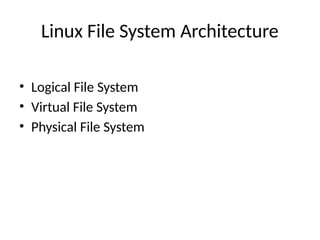
Linux File System Architecture
• Logical File System
• Virtual File System
• Physical File System
Logical File System
• Acts as the interface between user
applications and the file system. Handles
opening, reading, and closing files, making it
user-friendly.
Virtual File System (VFS)
• Allows multiple physical file systems to
operate concurrently. Provides a standardized
interface for compatibility.
Physical File System
• Manages the storage of physical memory
blocks on the disk. Ensures efficient allocation
and data retrieval.
Characteristics of a File System
• Space Management
• Filename Restrictions
• Directory Structure
• Metadata Handling
• Utilities for file operations
• Design Limitations
Important Concepts
• Journaling
• Versioning
• Inode
EXT File System
• First Linux-specific file system (1992). Basic
and outdated.
EXT2 File System
• Non-journaling; good for SSDs. Introduced in
1993.
EXT3 File System
• Journaling support, better boot times.
Introduced in 1999.
JFS File System
• IBM's journaling FS. Open-sourced for Linux in
1999.
XFS File System
• High-performance journaling FS with parallel
I/O support.
File System Comparison (Overview)
• Comparison table of journaling, performance,
compatibility, and advanced features.
Summary & Recommendations
• Use ext4 for general use, btrfs for advanced
features, and ext2 for flash storage. Choose
based on reliability, journaling needs, and
performance.
Thank You!
• Questions & Discussion

Linux_File_System_Presentation________________________

  • 1.
    Understanding the LinuxFile System Architecture, Characteristics, and File System Types in Linux
  • 2.
    Introduction • The Linuxfile system is a critical part of the operating system, enabling efficient and organized data management. It consists of layers that work together to handle user interactions and hardware operations.
  • 3.
    Linux File SystemArchitecture • Logical File System • Virtual File System • Physical File System
  • 4.
    Logical File System •Acts as the interface between user applications and the file system. Handles opening, reading, and closing files, making it user-friendly.
  • 5.
    Virtual File System(VFS) • Allows multiple physical file systems to operate concurrently. Provides a standardized interface for compatibility.
  • 6.
    Physical File System •Manages the storage of physical memory blocks on the disk. Ensures efficient allocation and data retrieval.
  • 7.
    Characteristics of aFile System • Space Management • Filename Restrictions • Directory Structure • Metadata Handling • Utilities for file operations • Design Limitations
  • 8.
  • 9.
    EXT File System •First Linux-specific file system (1992). Basic and outdated.
  • 10.
    EXT2 File System •Non-journaling; good for SSDs. Introduced in 1993.
  • 11.
    EXT3 File System •Journaling support, better boot times. Introduced in 1999.
  • 12.
    JFS File System •IBM's journaling FS. Open-sourced for Linux in 1999.
  • 13.
    XFS File System •High-performance journaling FS with parallel I/O support.
  • 14.
    File System Comparison(Overview) • Comparison table of journaling, performance, compatibility, and advanced features.
  • 15.
    Summary & Recommendations •Use ext4 for general use, btrfs for advanced features, and ext2 for flash storage. Choose based on reliability, journaling needs, and performance.
  • 16.