Open Topology: A Toolkit for Brain Isosurface Correction Sylvain JAUME (1) , Patrice RONDAO (2) , Benoit MACQ (2) (1)  Kitware Inc.,  (2)  University of Louvain
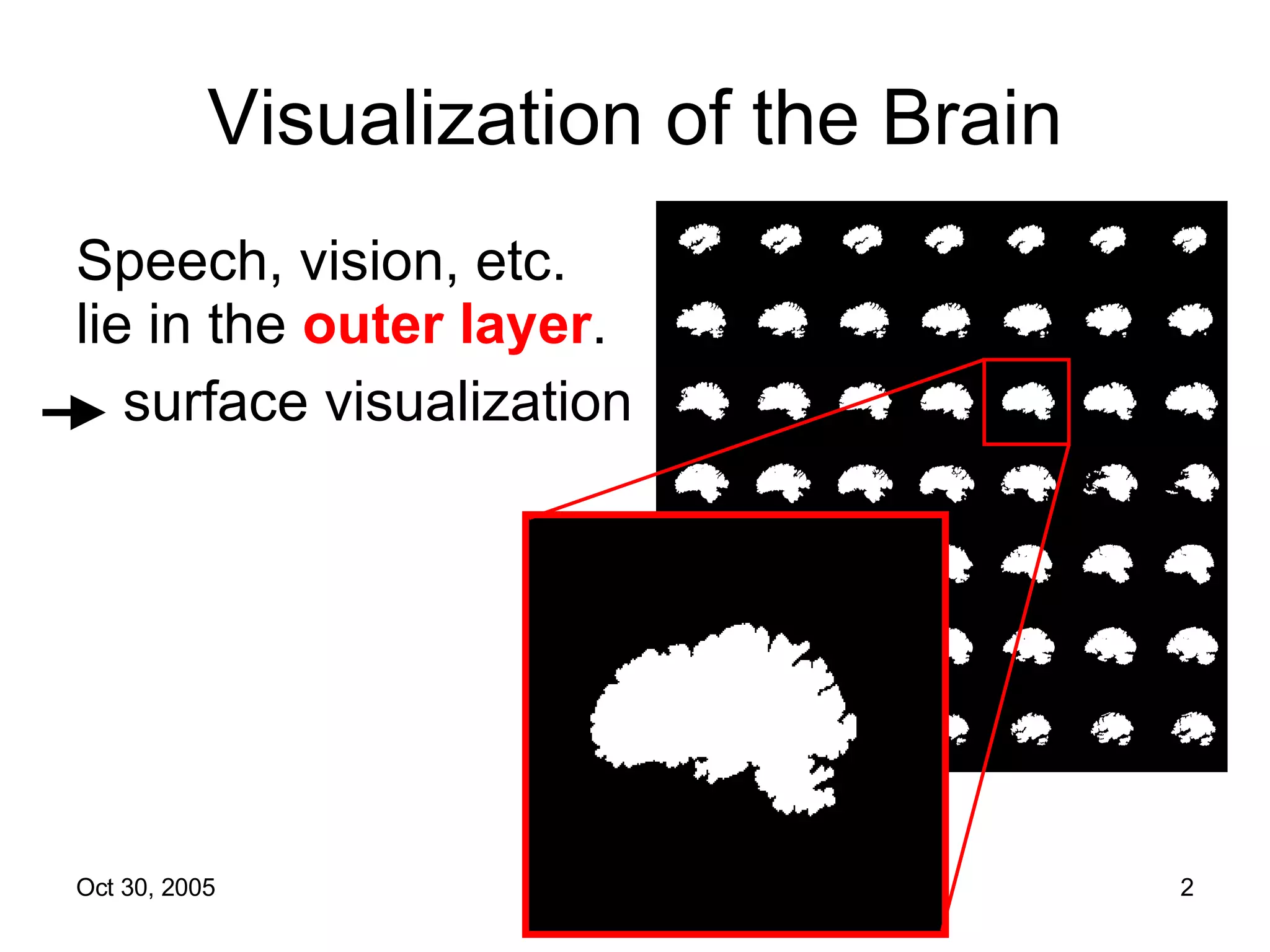
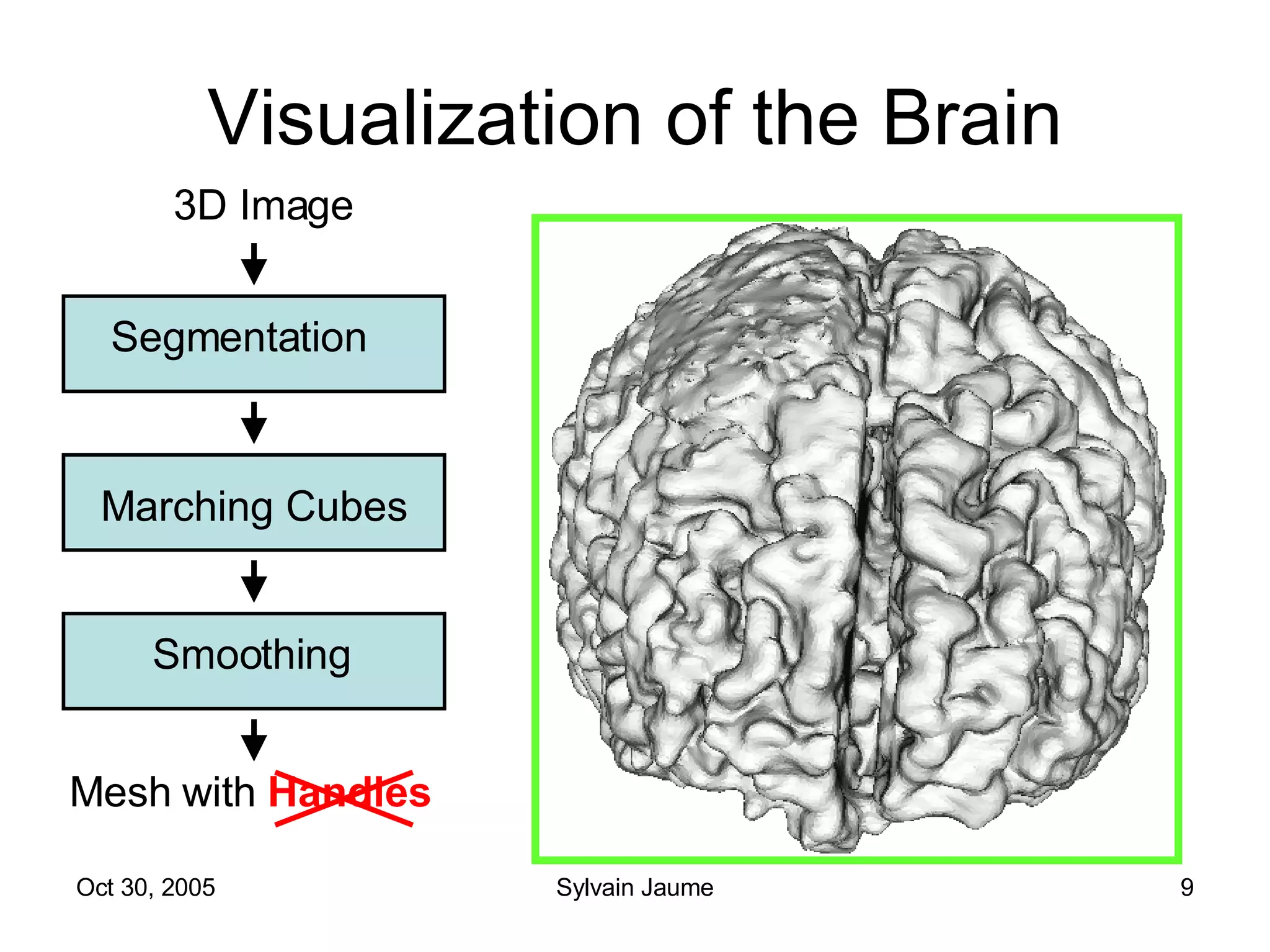
Visualization of the Brain Speech, vision, etc. lie in the  outer layer . surface visualization
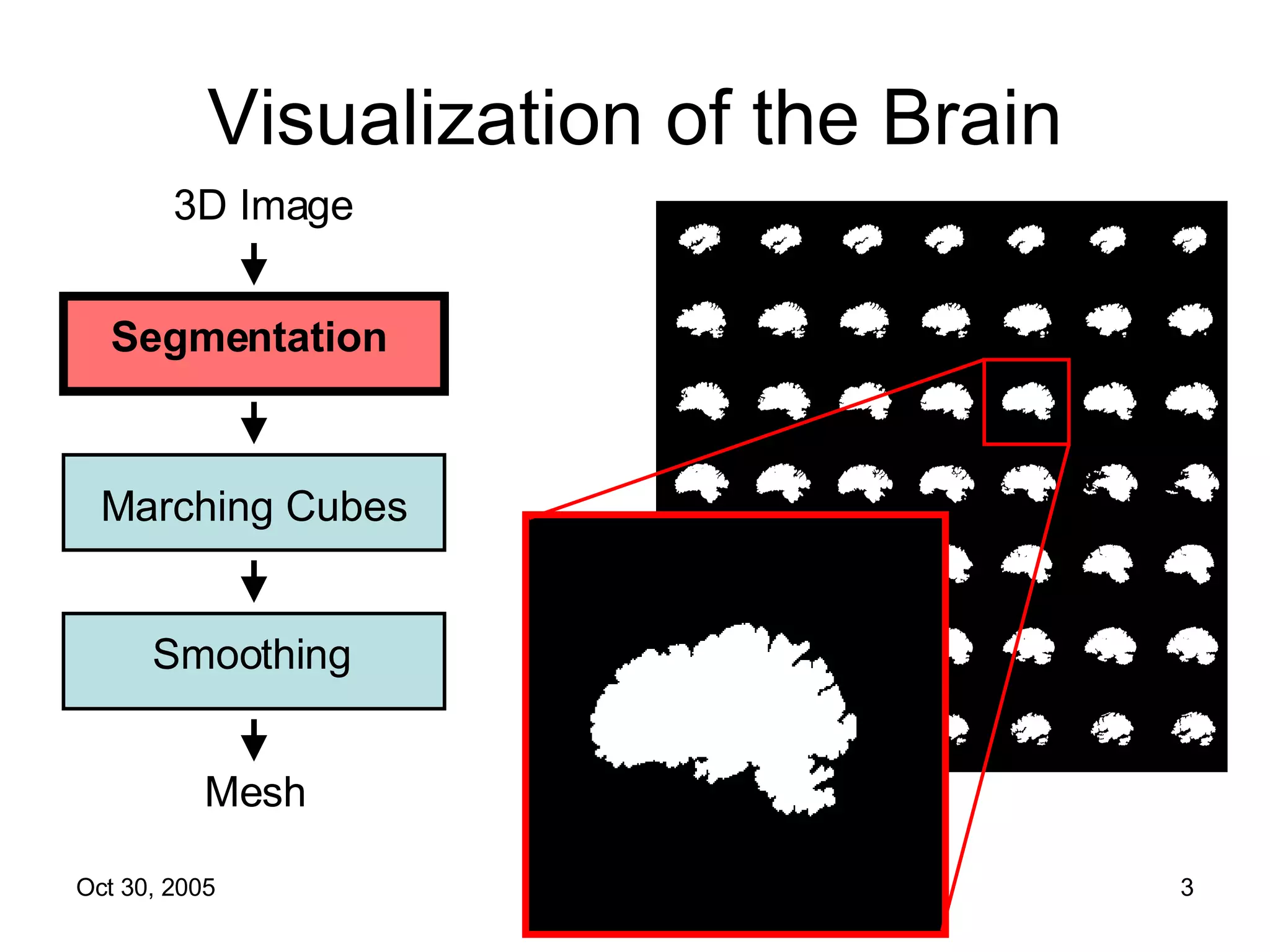
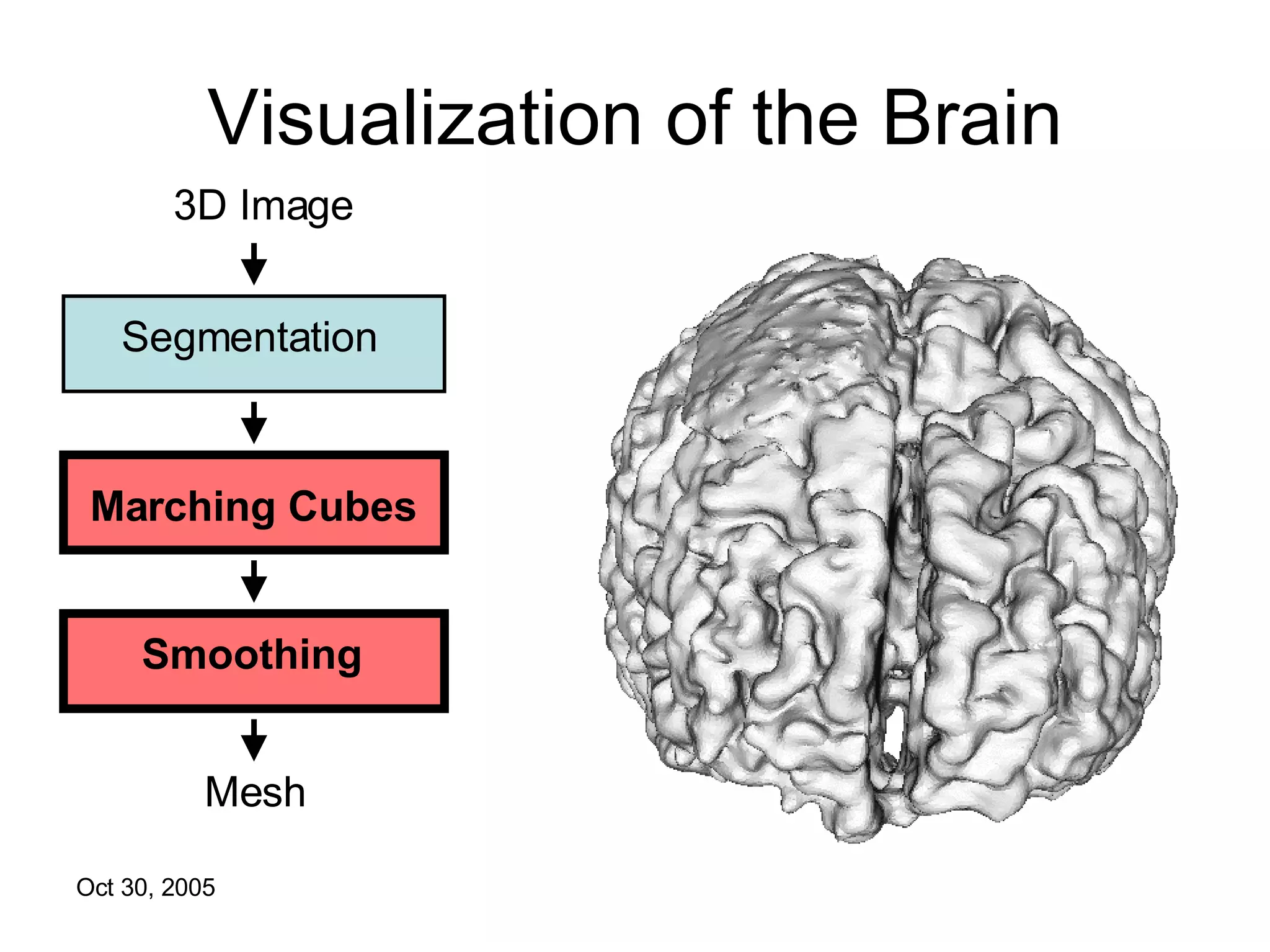
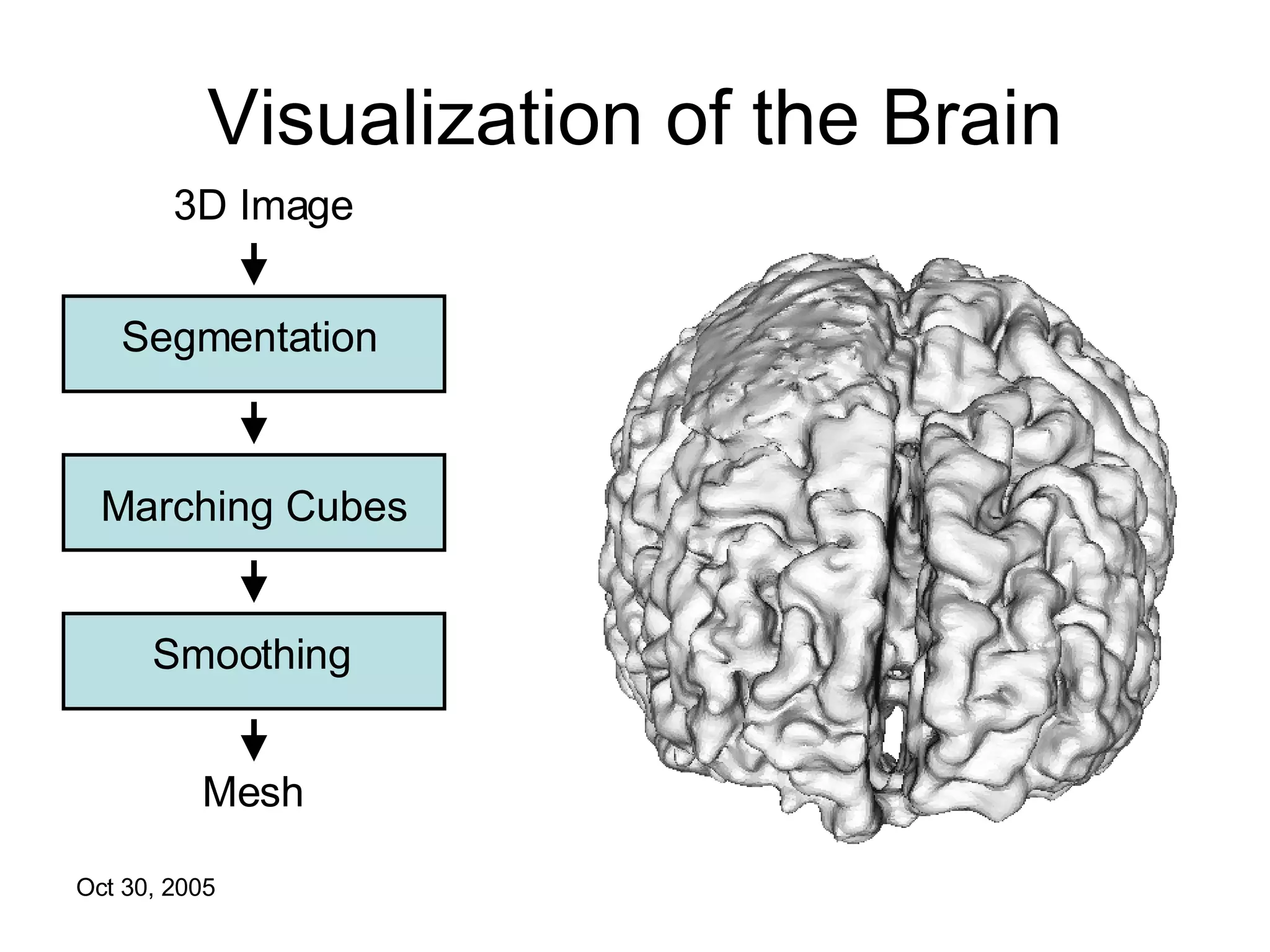
Visualization of the Brain 3D Image Segmentation Marching Cubes Smoothing Mesh
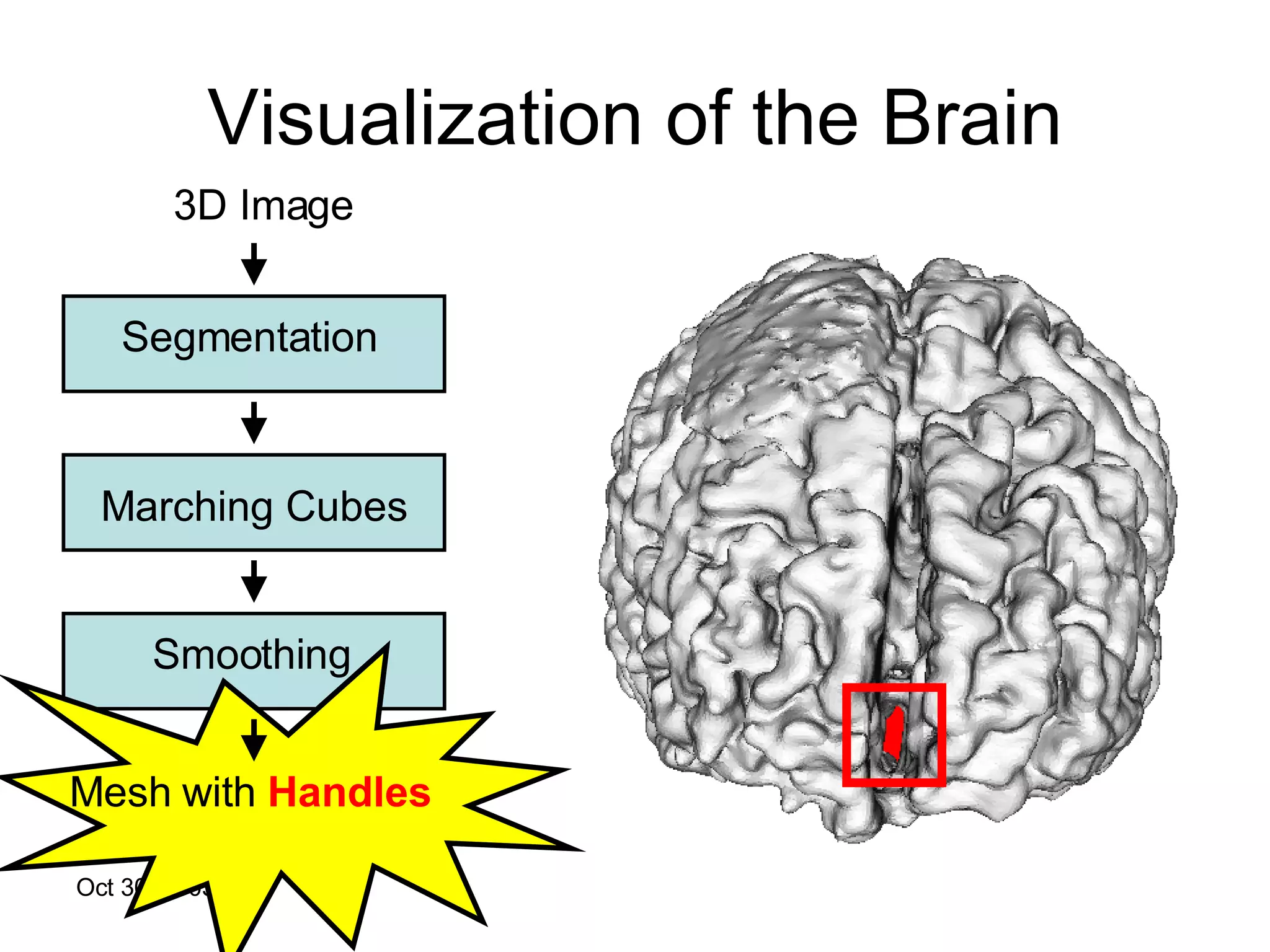
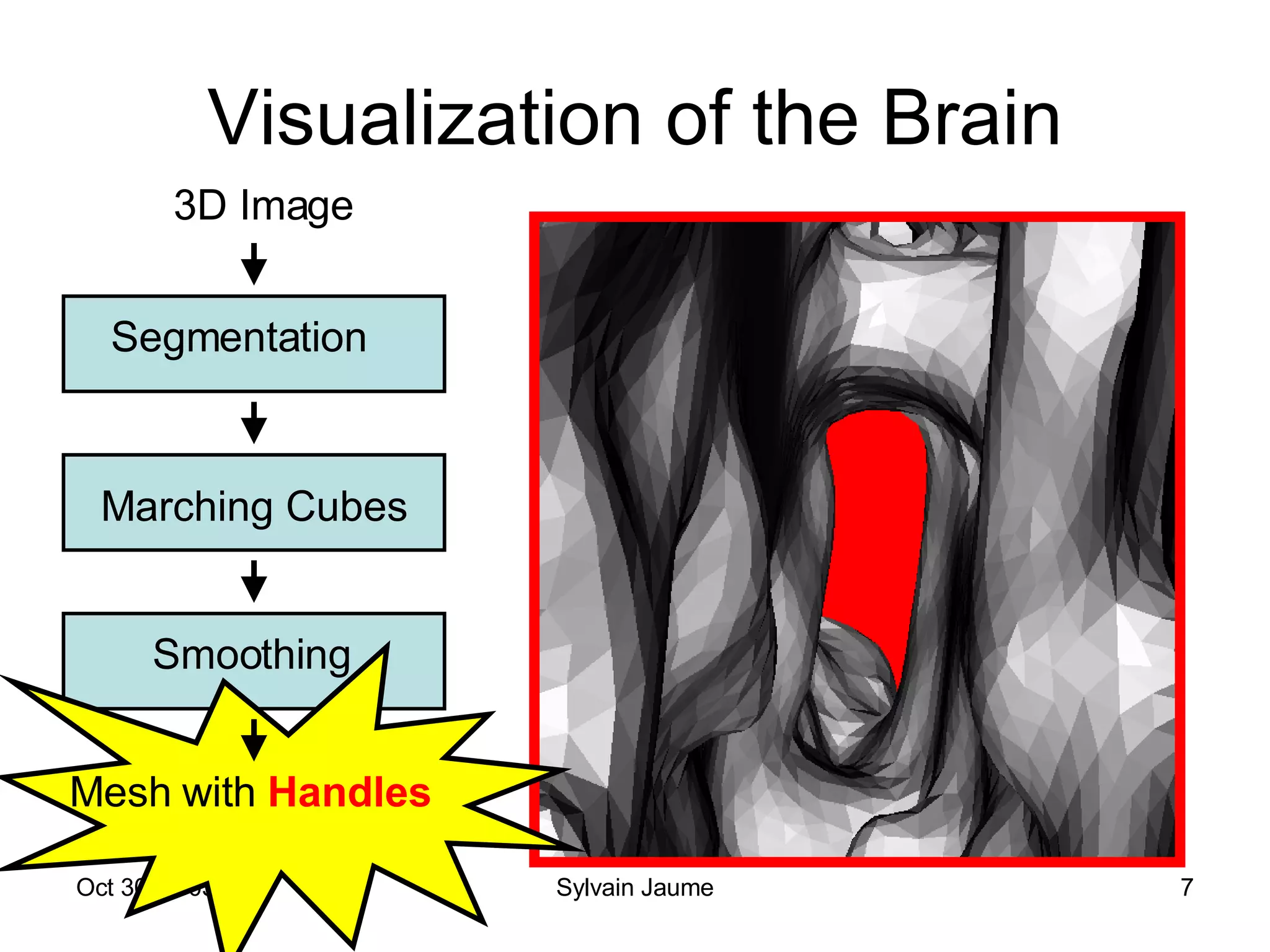
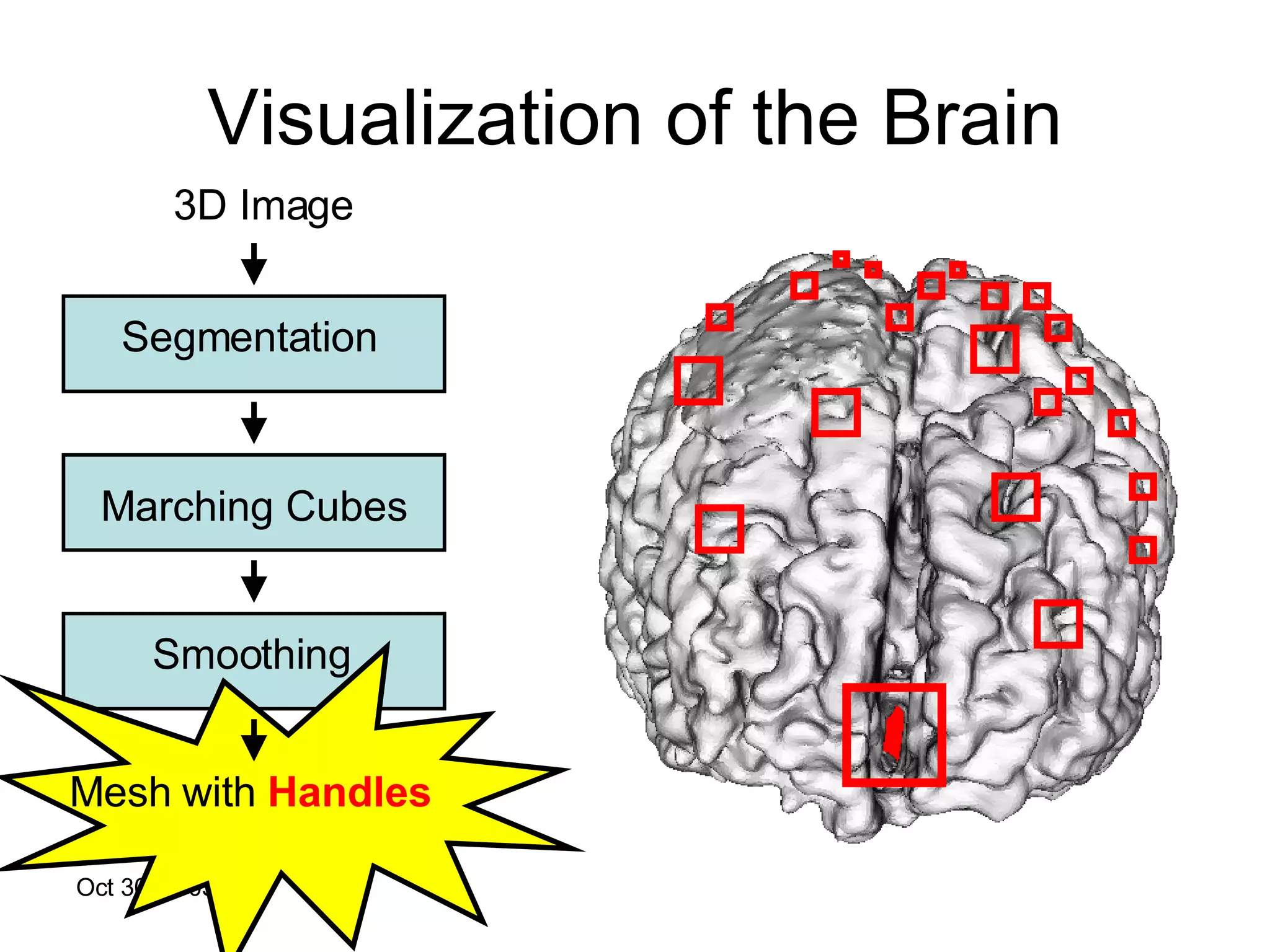
Visualization of the Brain 3D Image Segmentation Marching Cubes Smoothing Mesh with  Handles
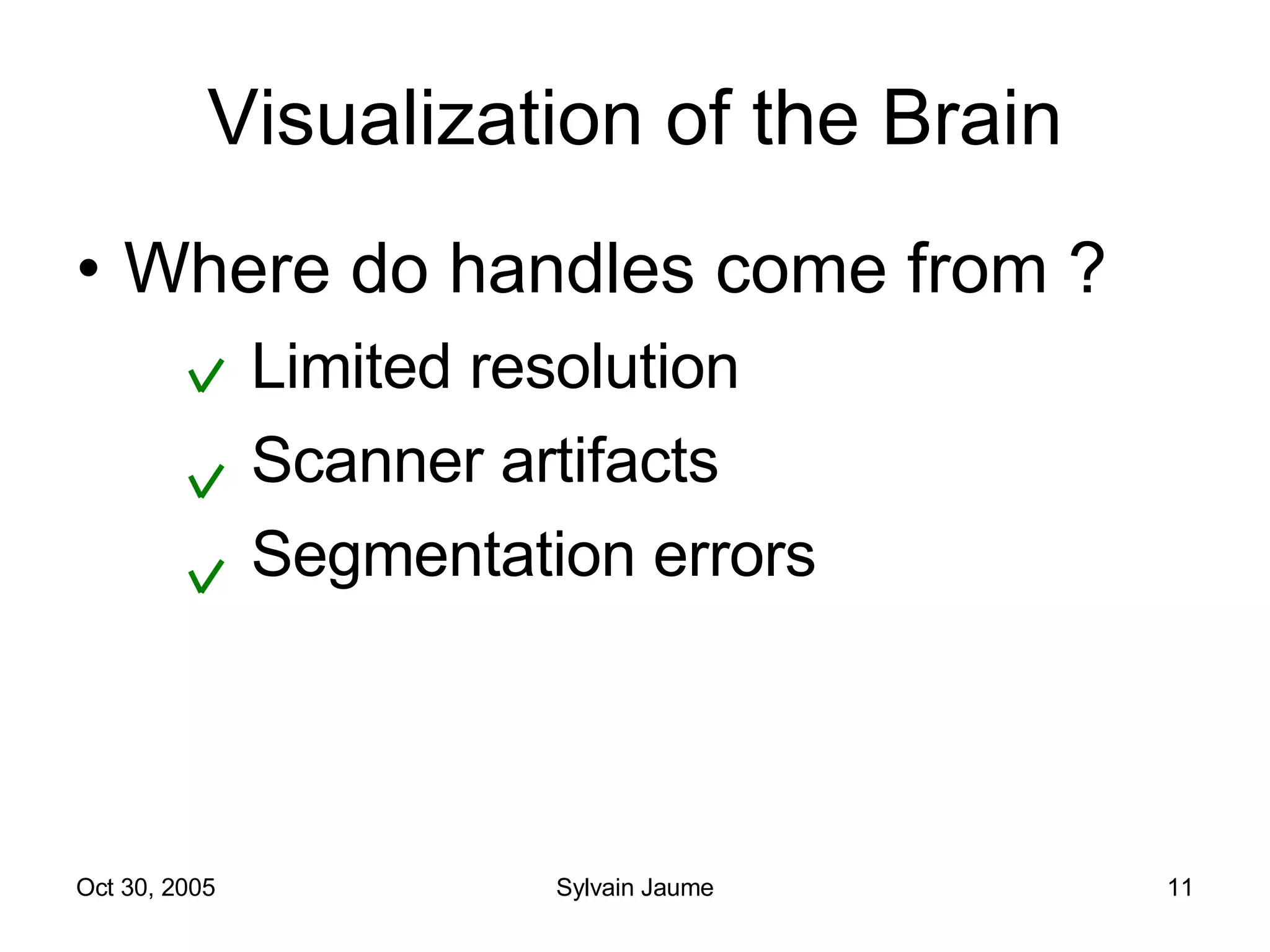
Visualization of the Brain Where do handles come from ? Limited resolution Scanner artifacts Segmentation errors
Visualization of the Brain Does it really matter ??? For 3D visualization For distance measurements For EEG source localization
State of the Art Image methods Malandain 93, Shattuck 01, Kriegeskorte 01 Mesh methods Fischl 01, Guskov 01, Wood 04, Segonne 05 Graph methods Han 02, Segonne 03 Level-Set methods Han 01, Bischoff 02
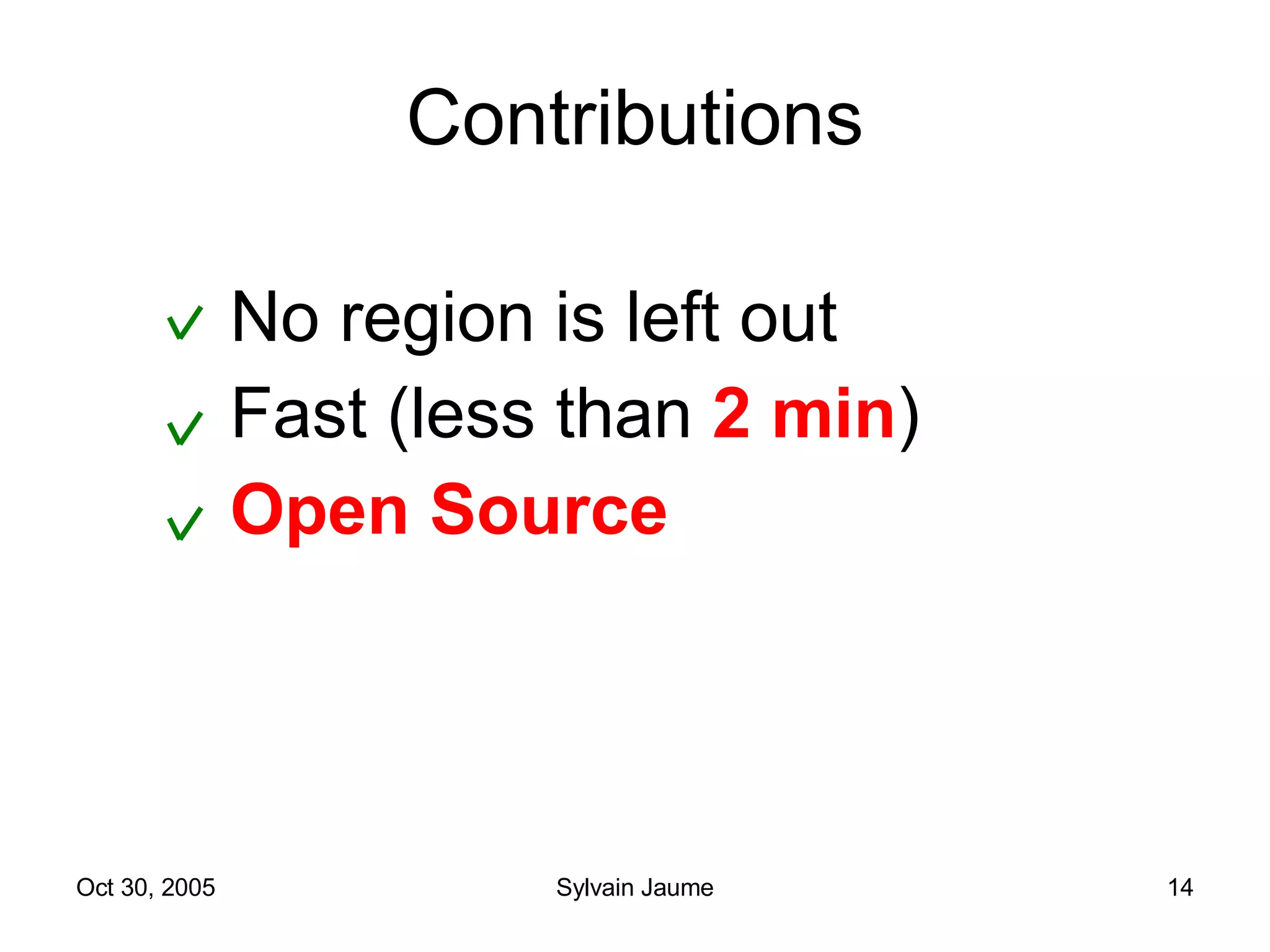
Contributions No region is left out Fast (less than  2 min ) Open Source
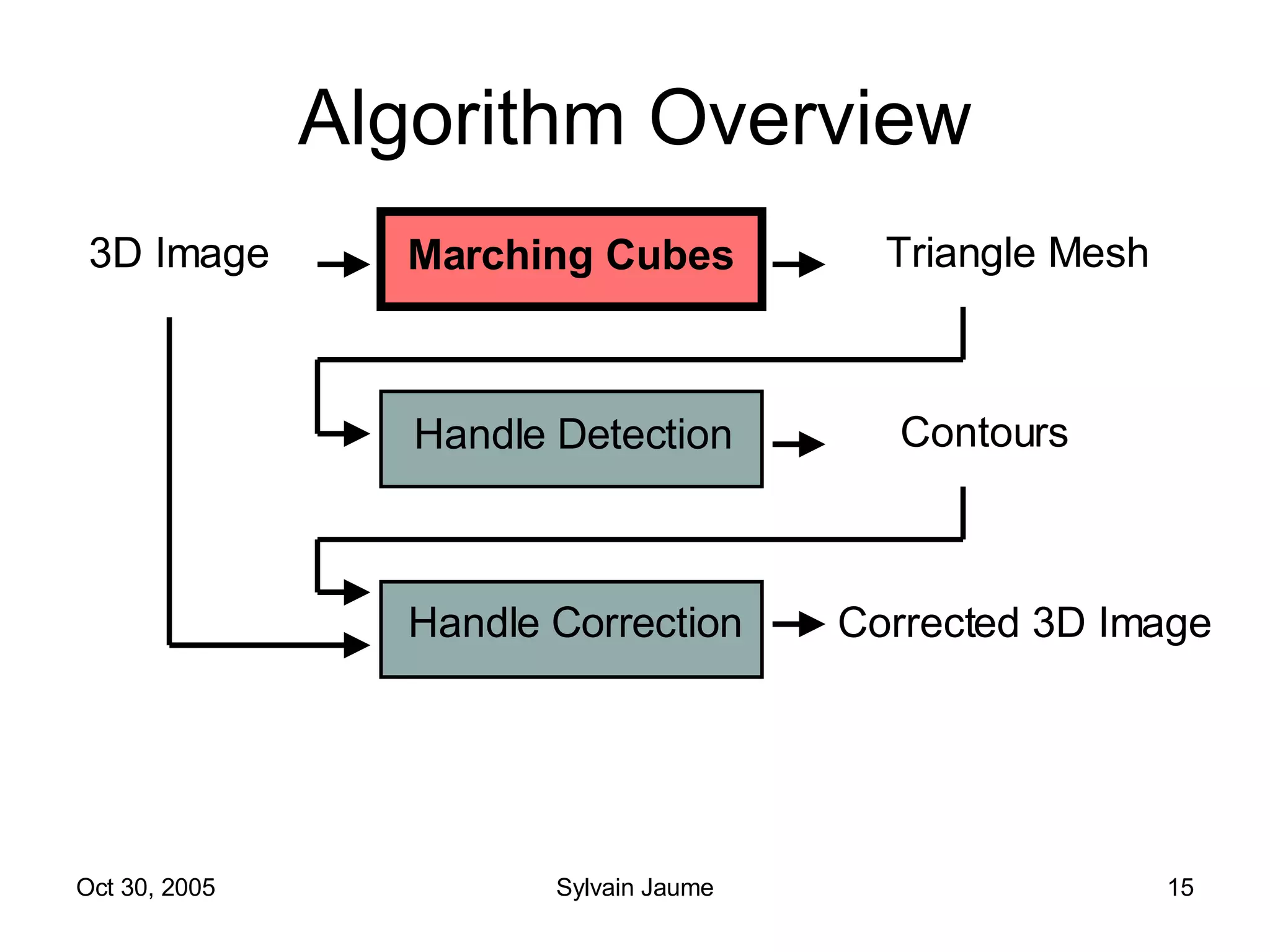
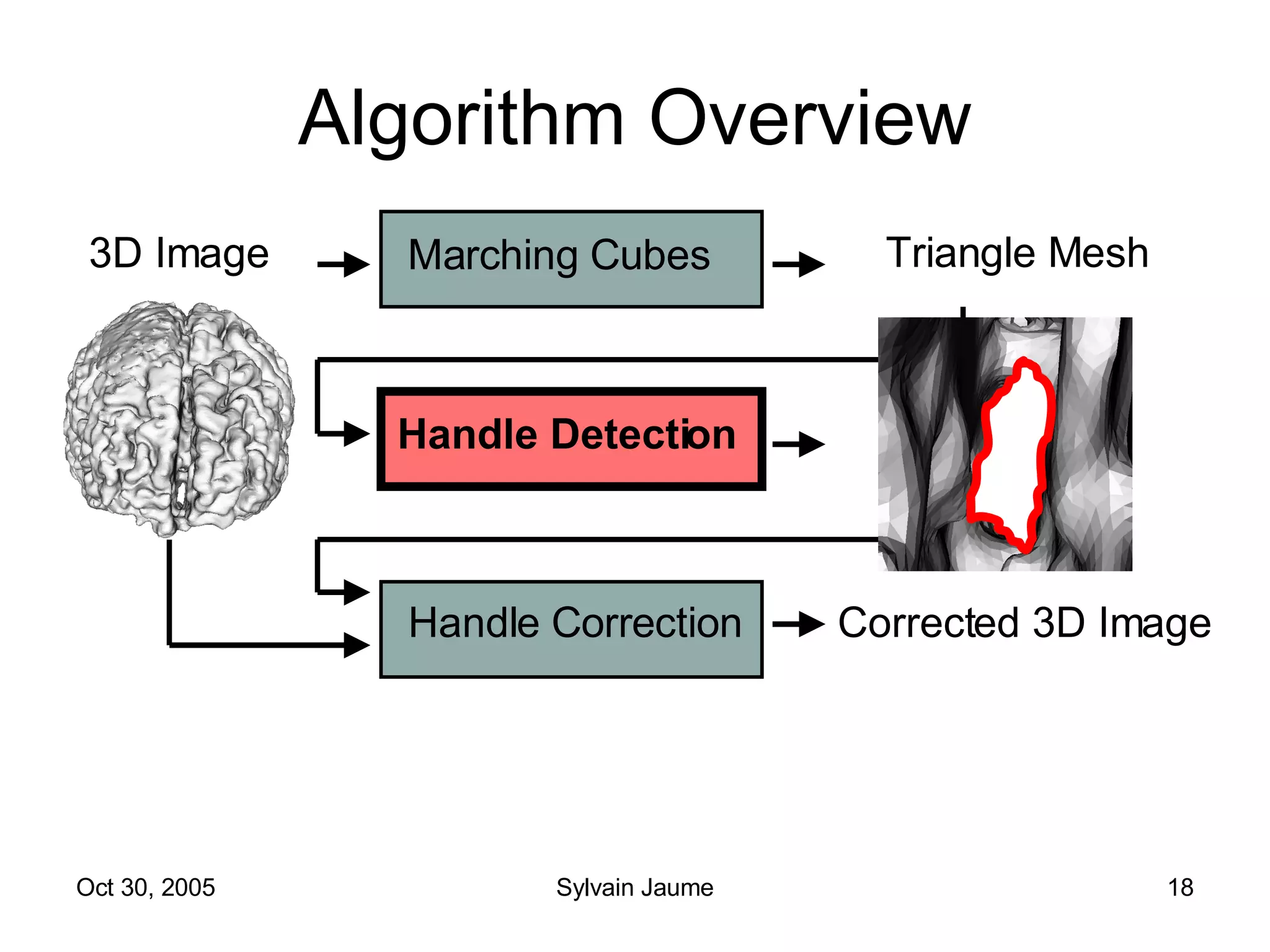
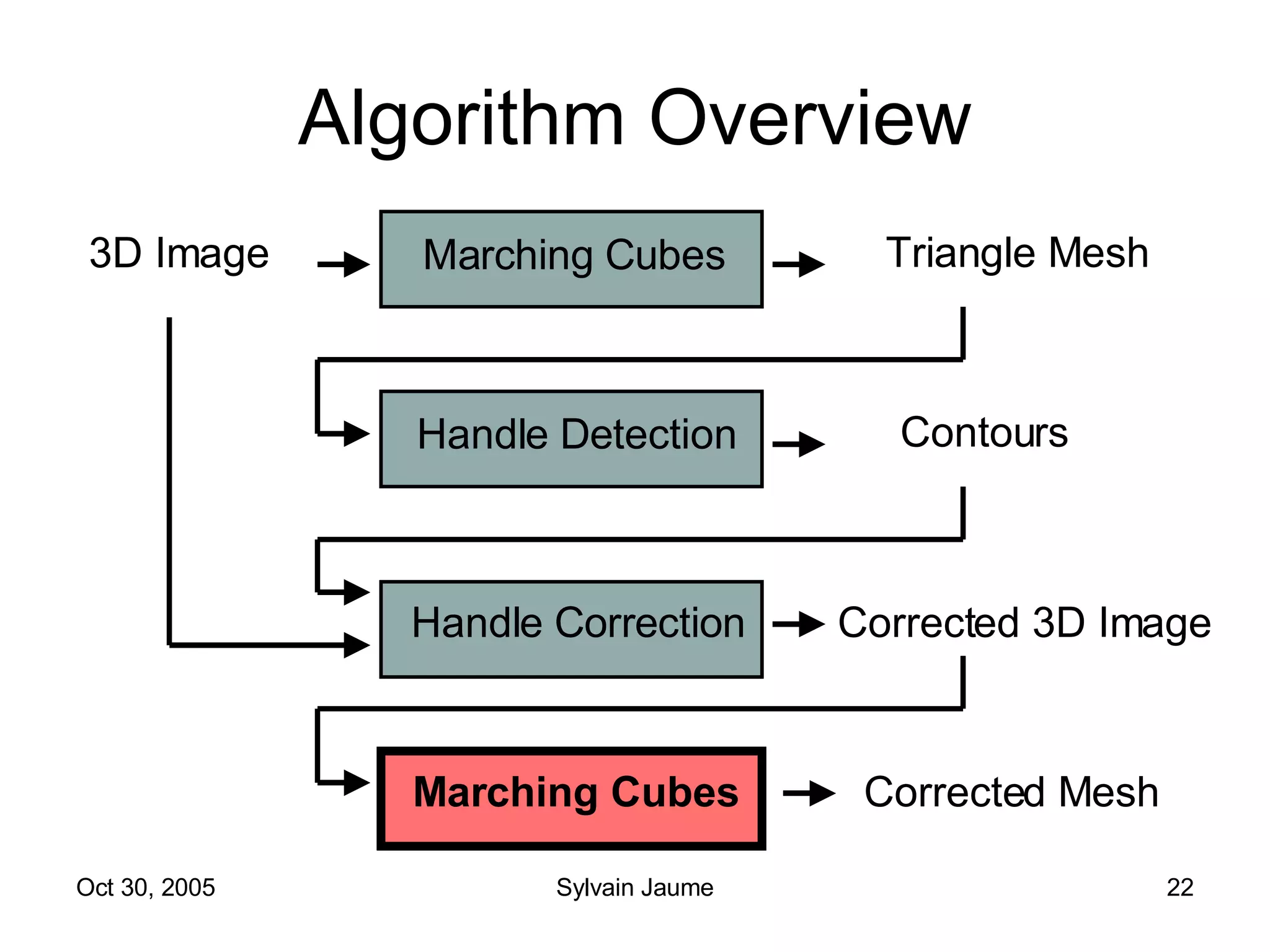
Algorithm Overview Marching Cubes Handle Detection Handle Correction 3D Image Triangle Mesh Corrected 3D Image Contours
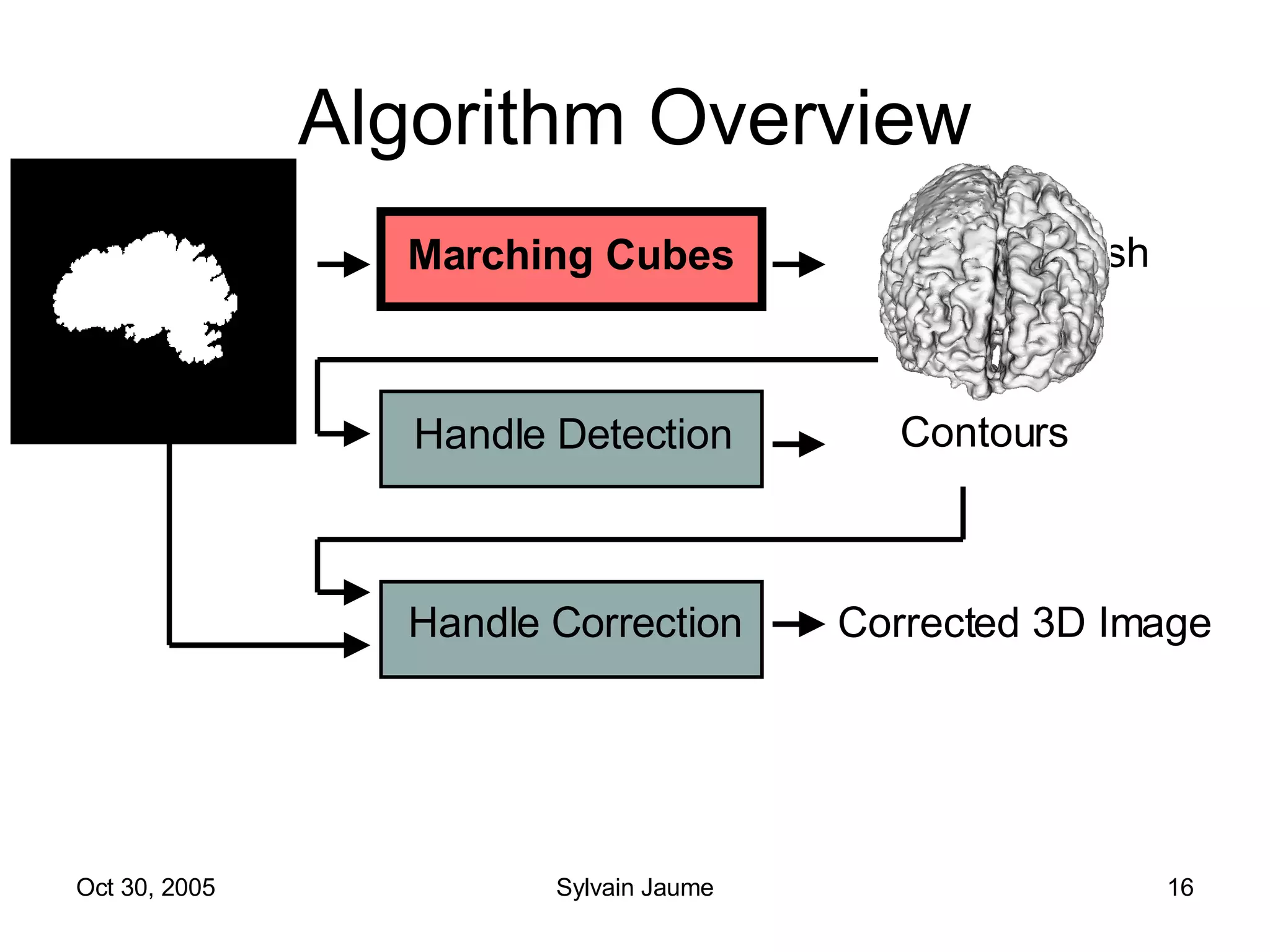
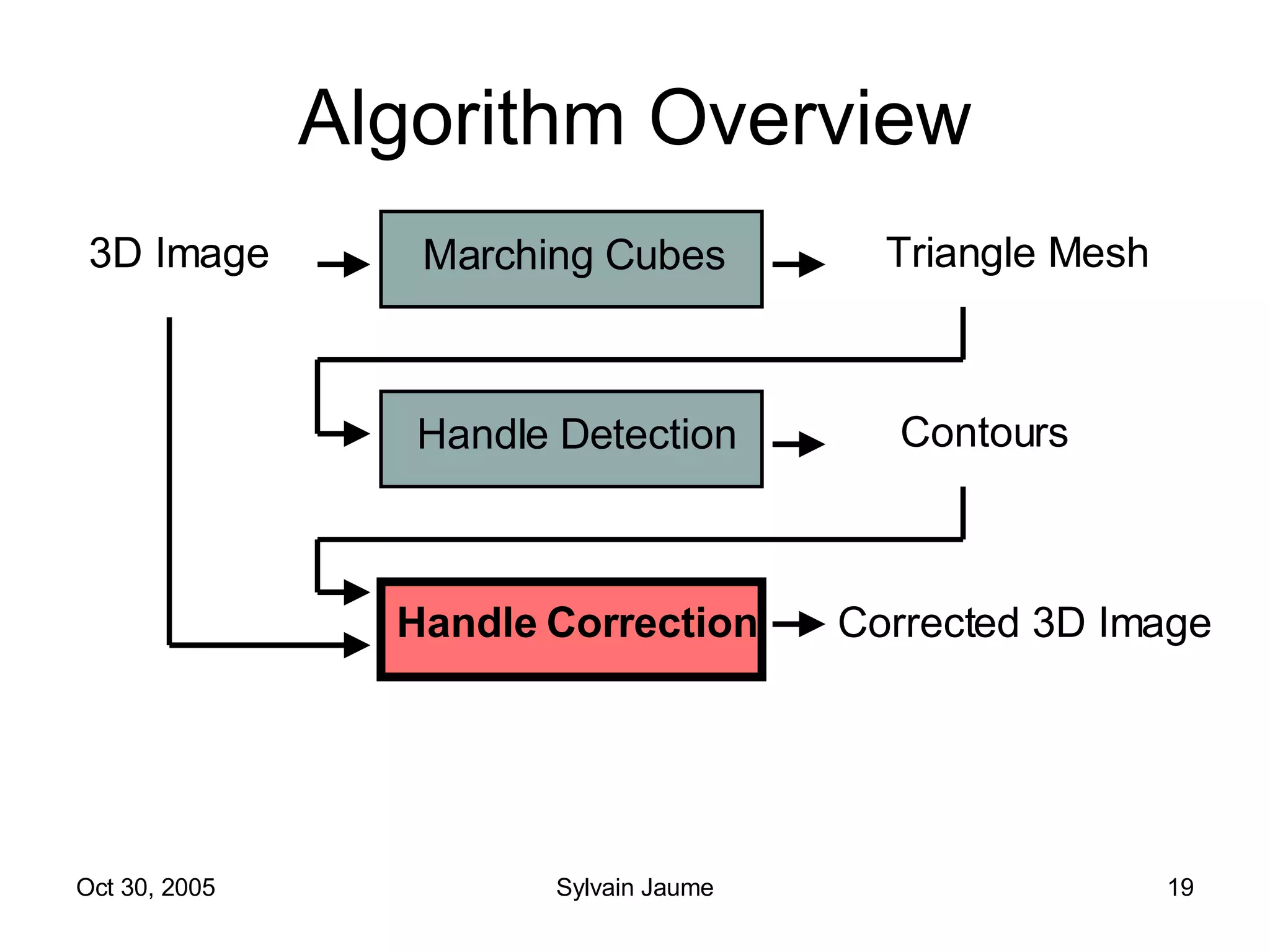
Algorithm Overview Marching Cubes Handle Detection Handle Correction 3D Image Triangle Mesh Contours Corrected 3D Image
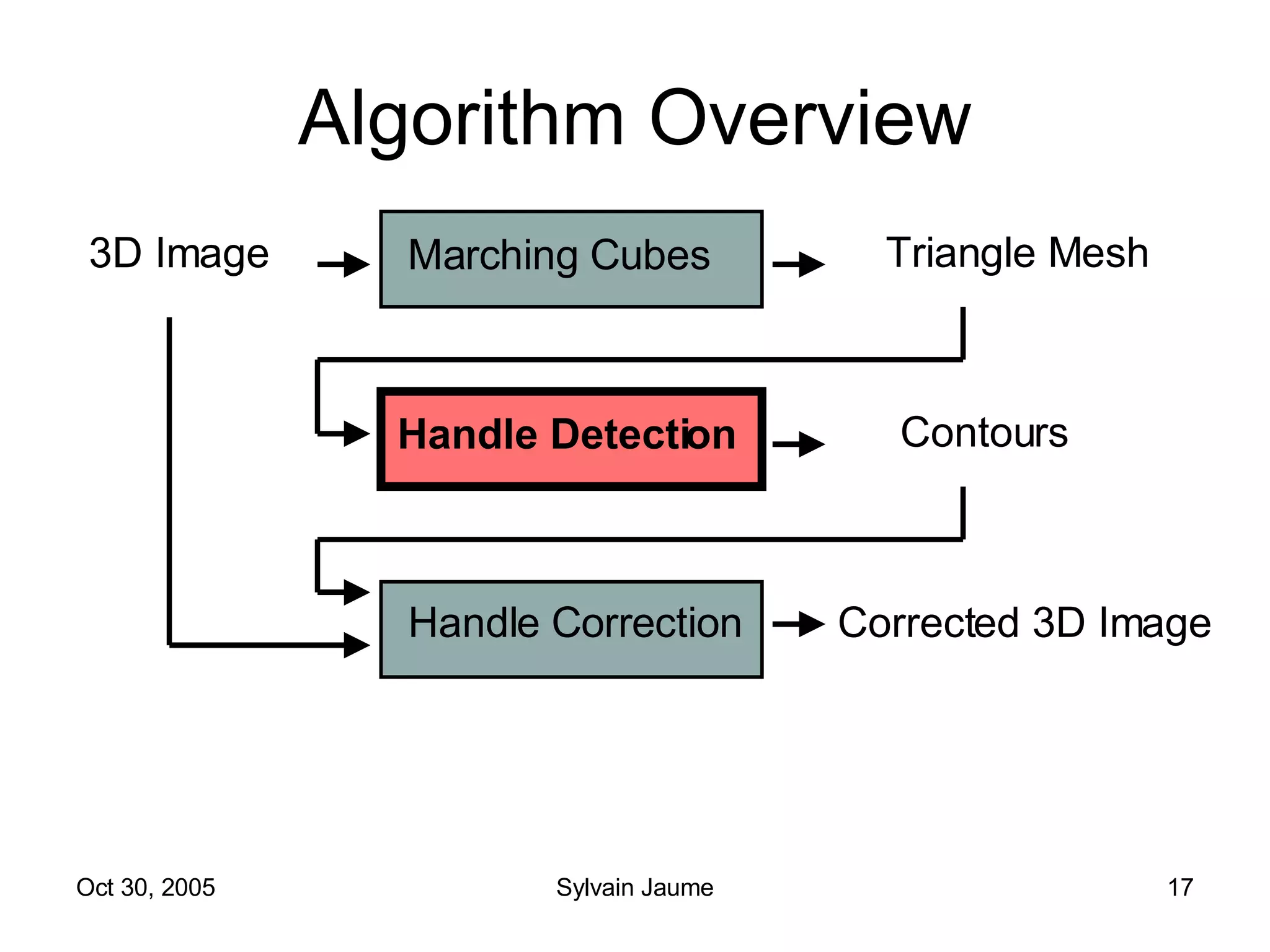
Algorithm Overview Marching Cubes Handle Detection Handle Correction 3D Image Triangle Mesh Polylines Corrected 3D Image
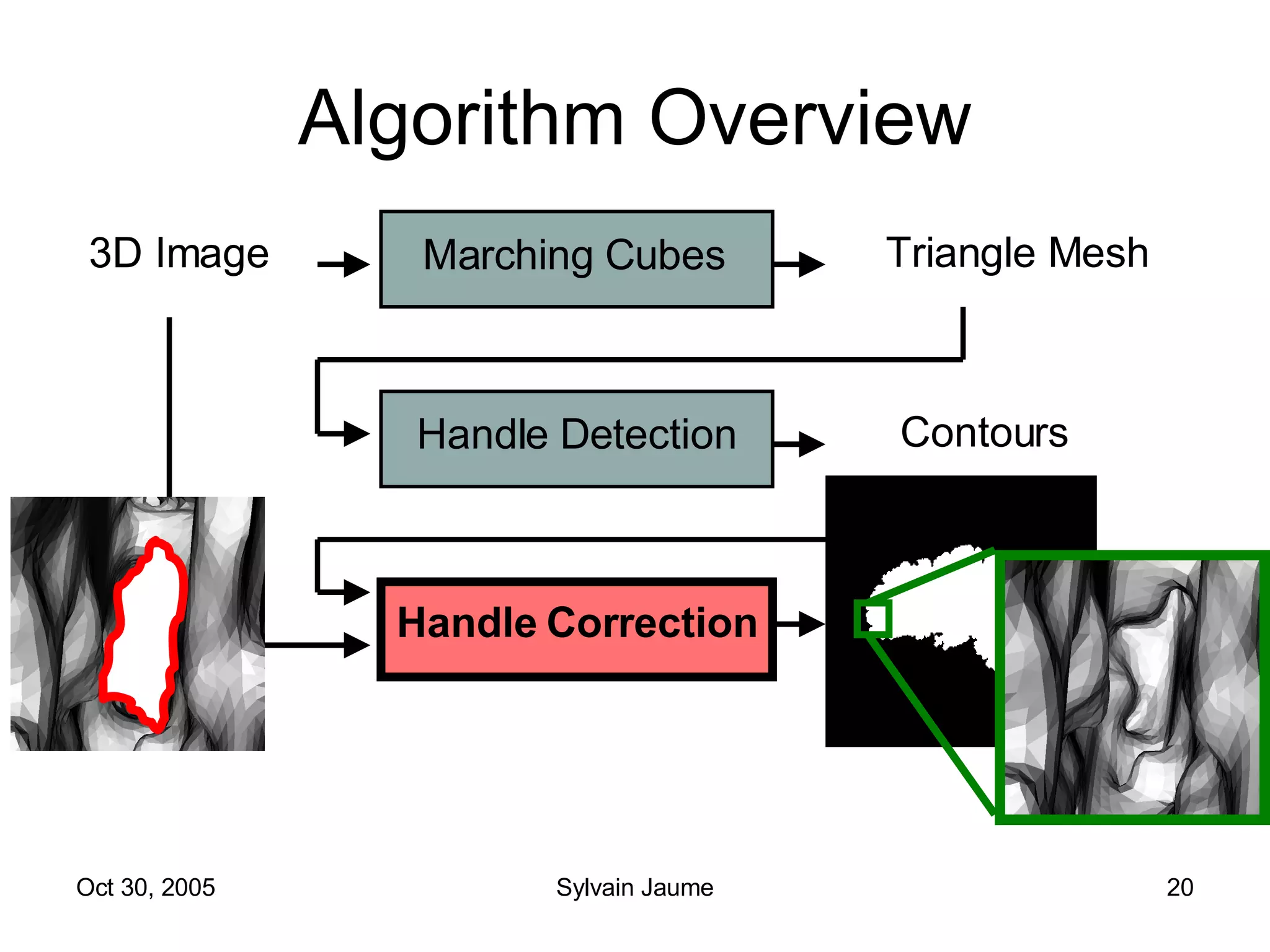
Algorithm Overview Marching Cubes Handle Detection Handle Correction 3D Image Triangle Mesh Contours Corrected 3D Image
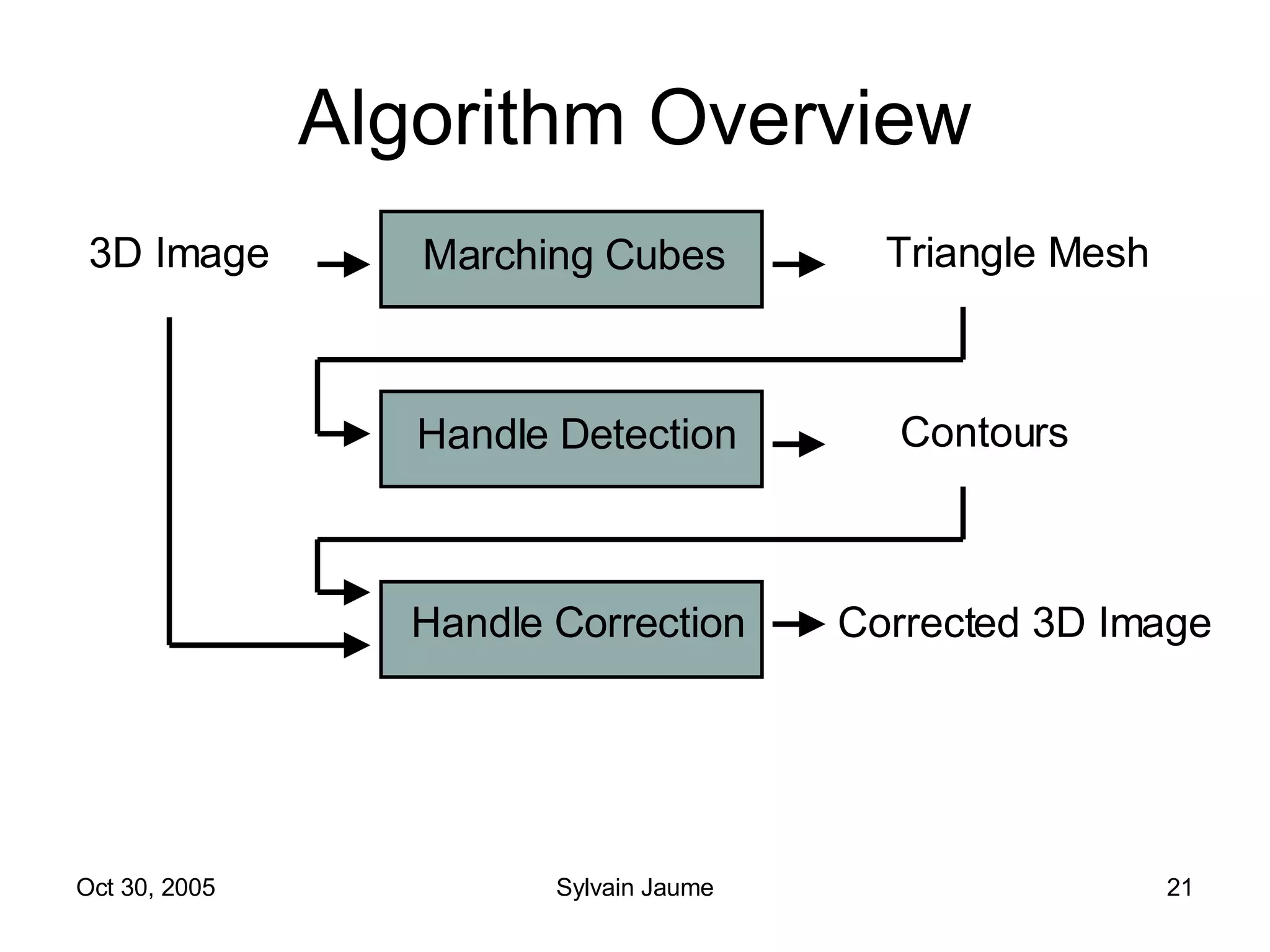
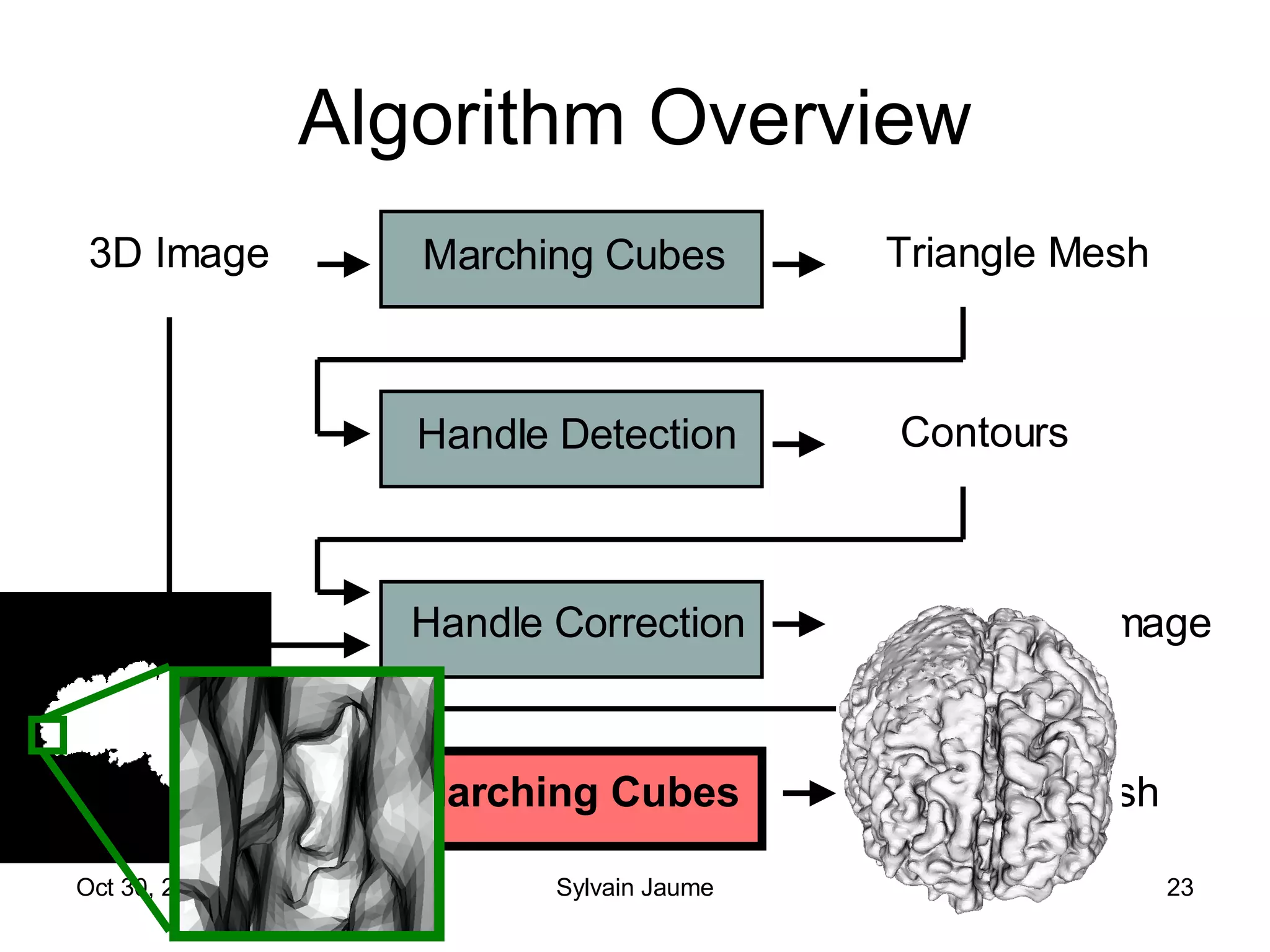
Algorithm Overview Marching Cubes Handle Detection Handle Correction 3D Image Triangle Mesh Contours Marching Cubes Corrected Mesh Corrected 3D Image
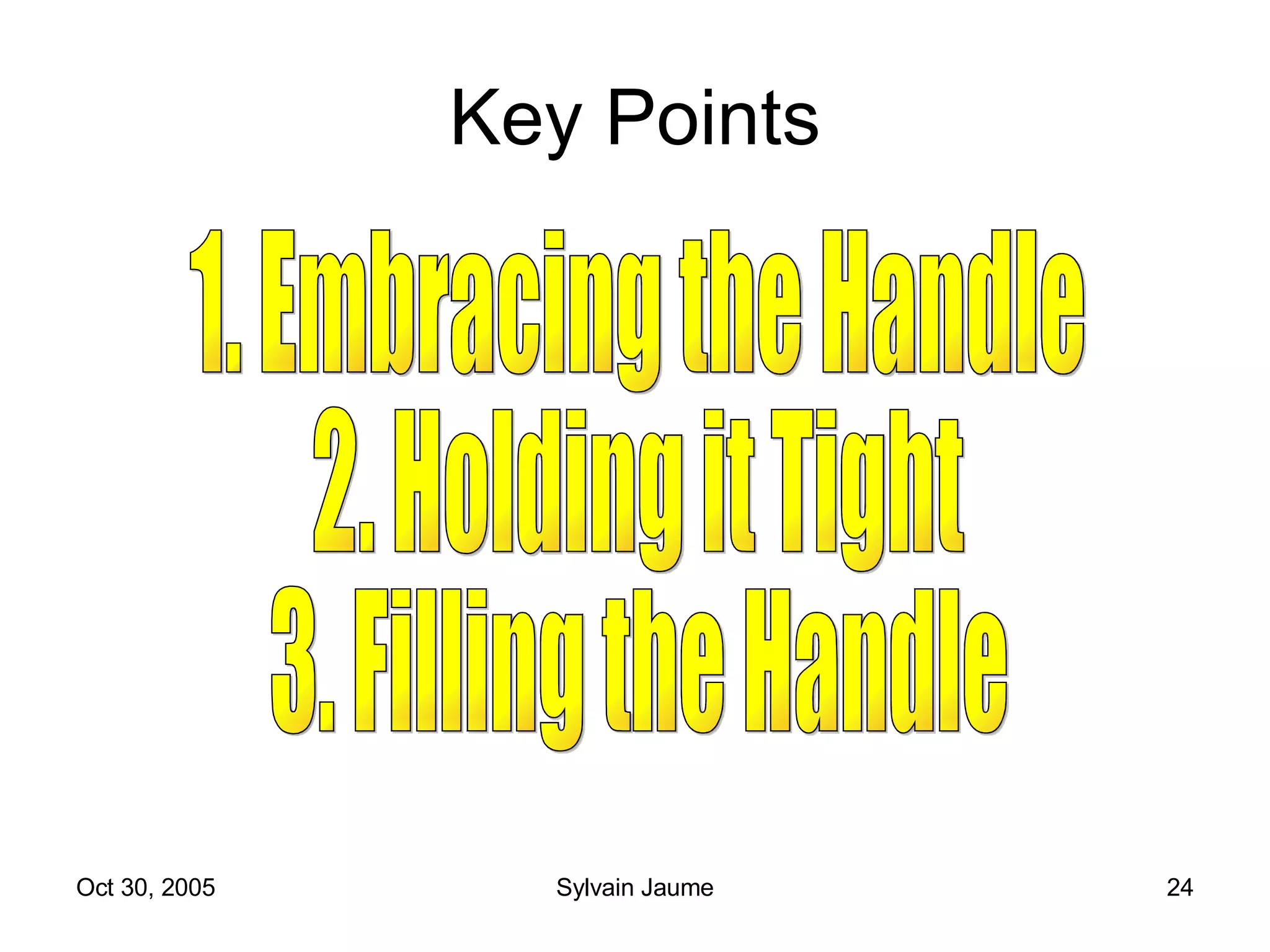
Key Points 1. Embracing the Handle 2. Holding it Tight 3. Filling the Handle
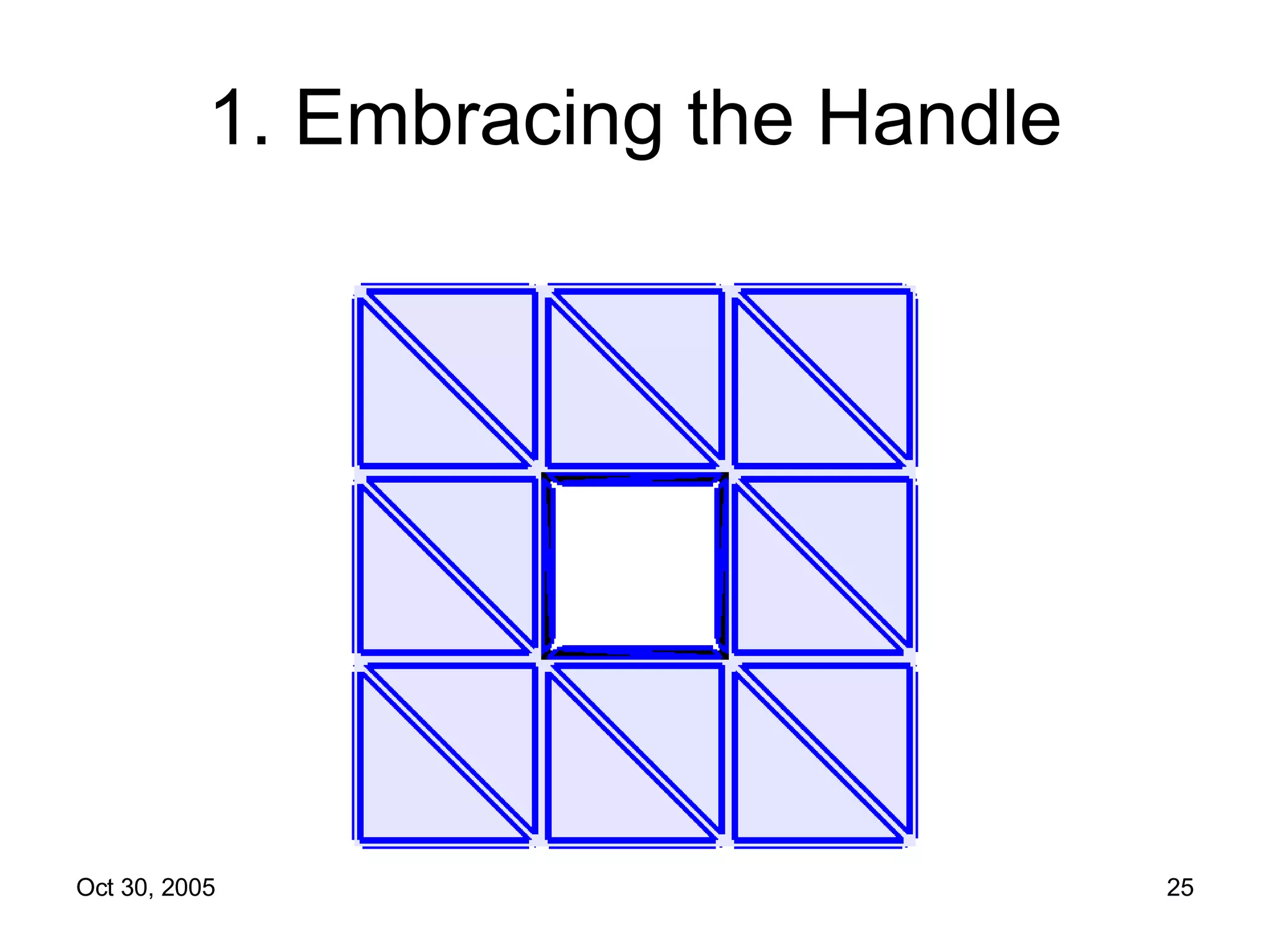
1. Embracing the Handle
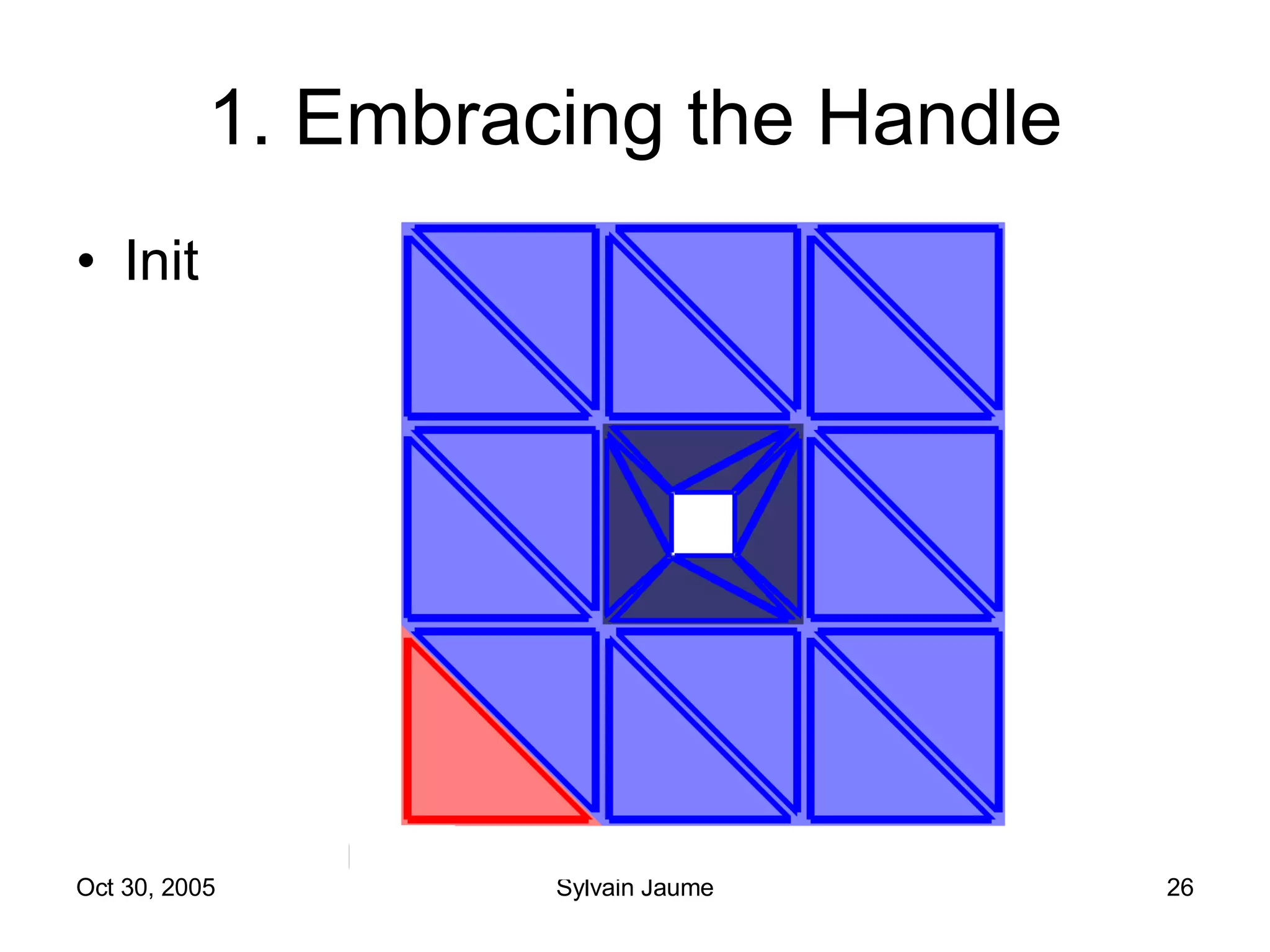
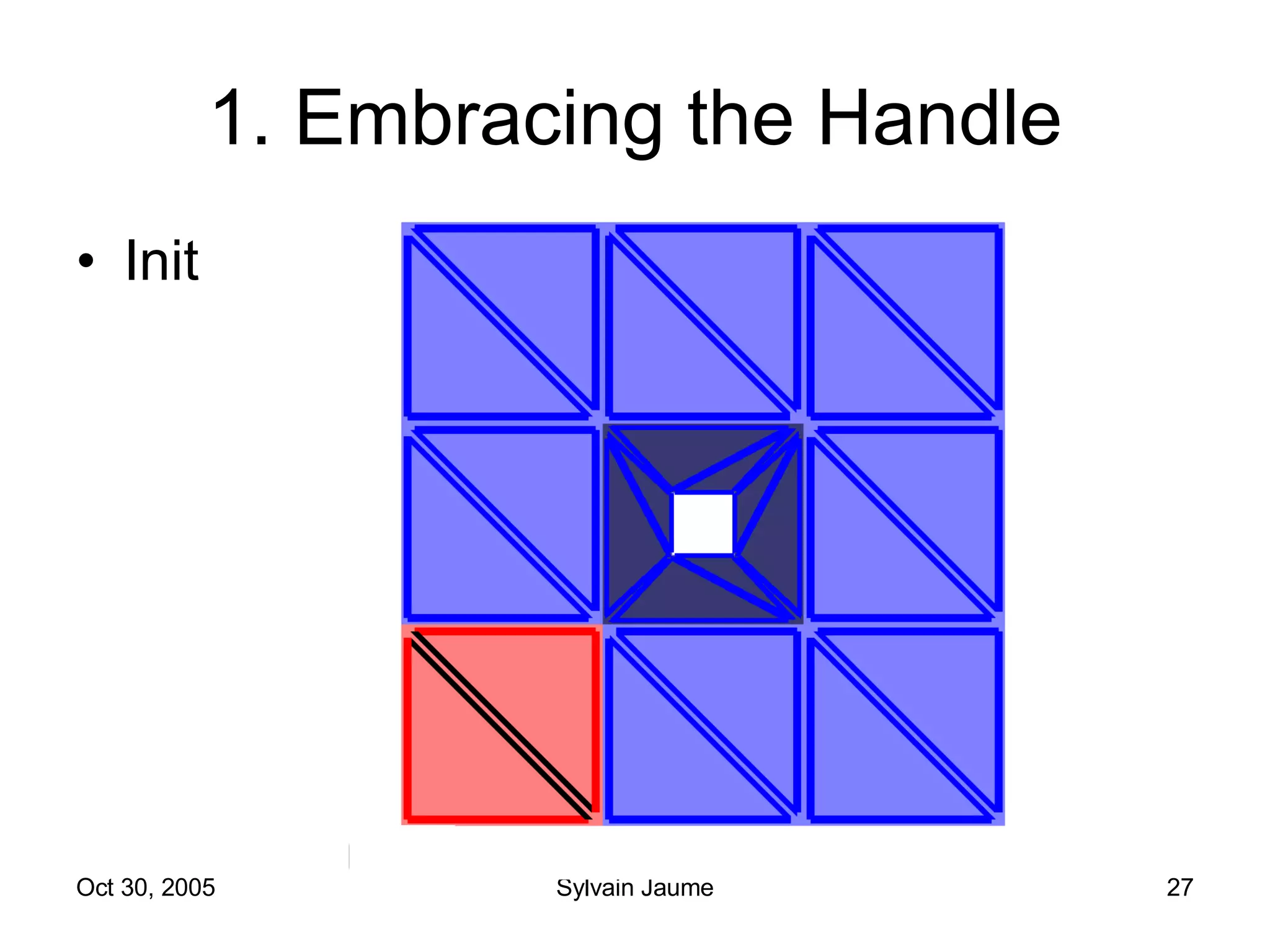
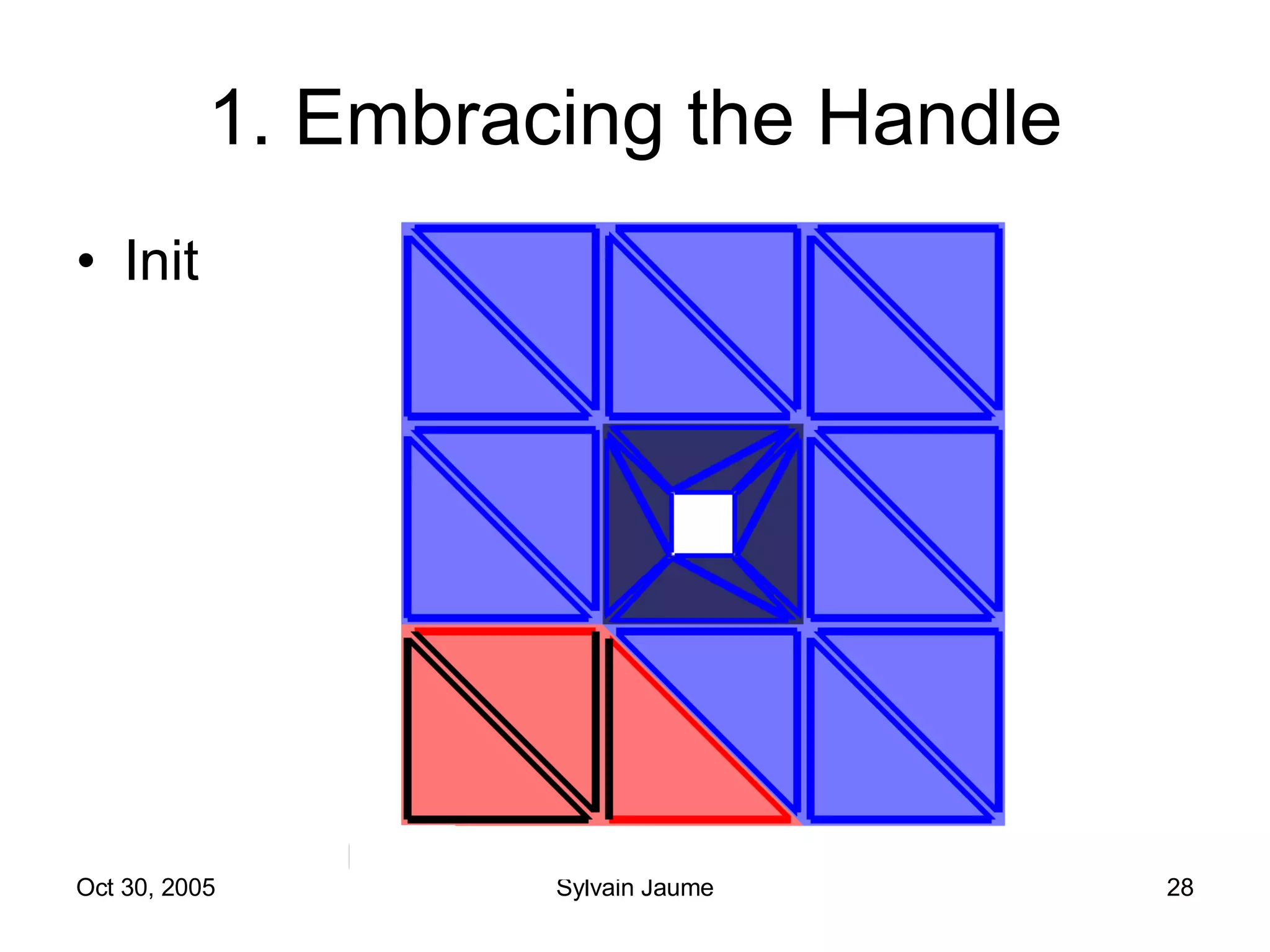
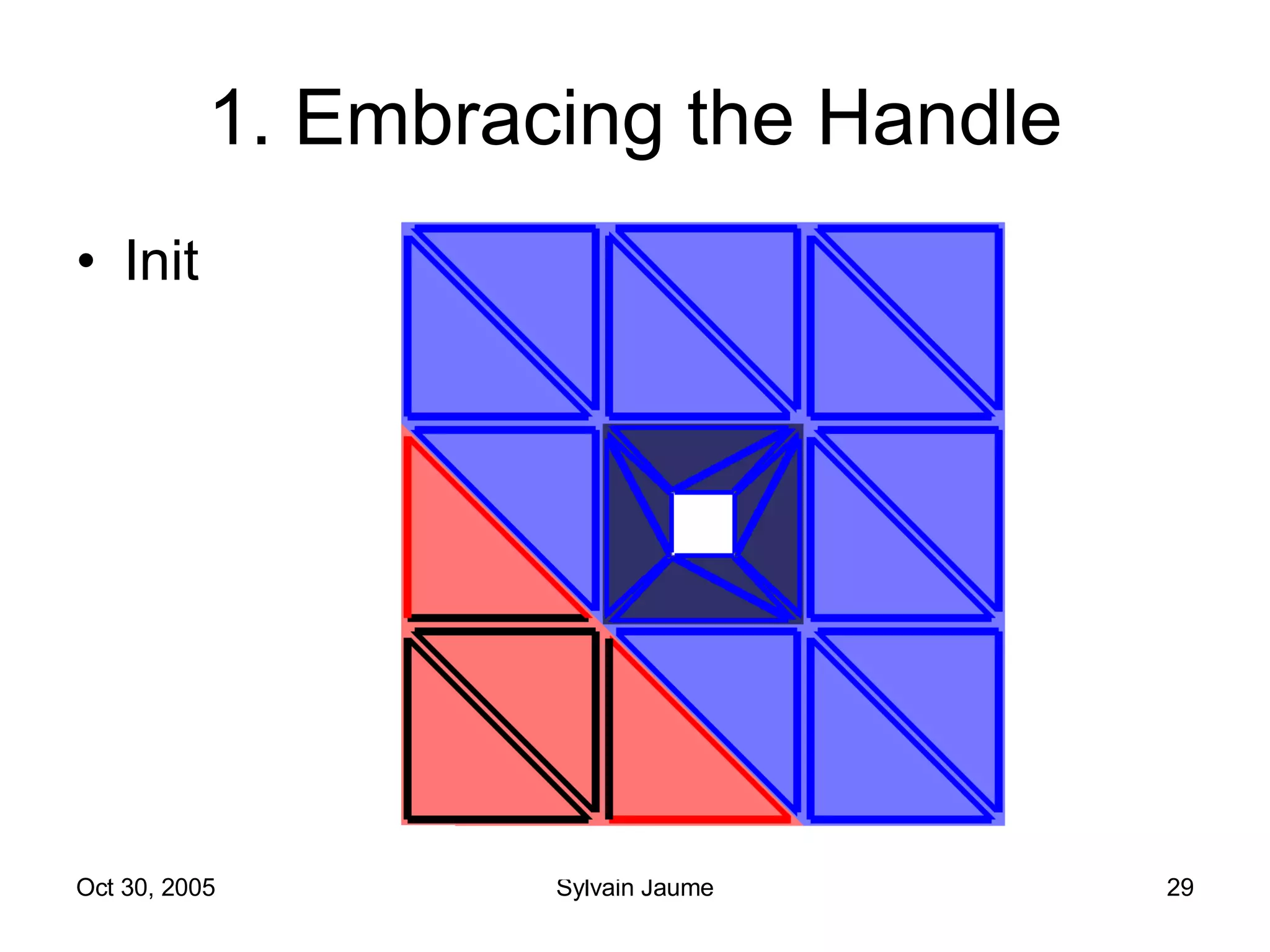
1. Embracing the Handle Init
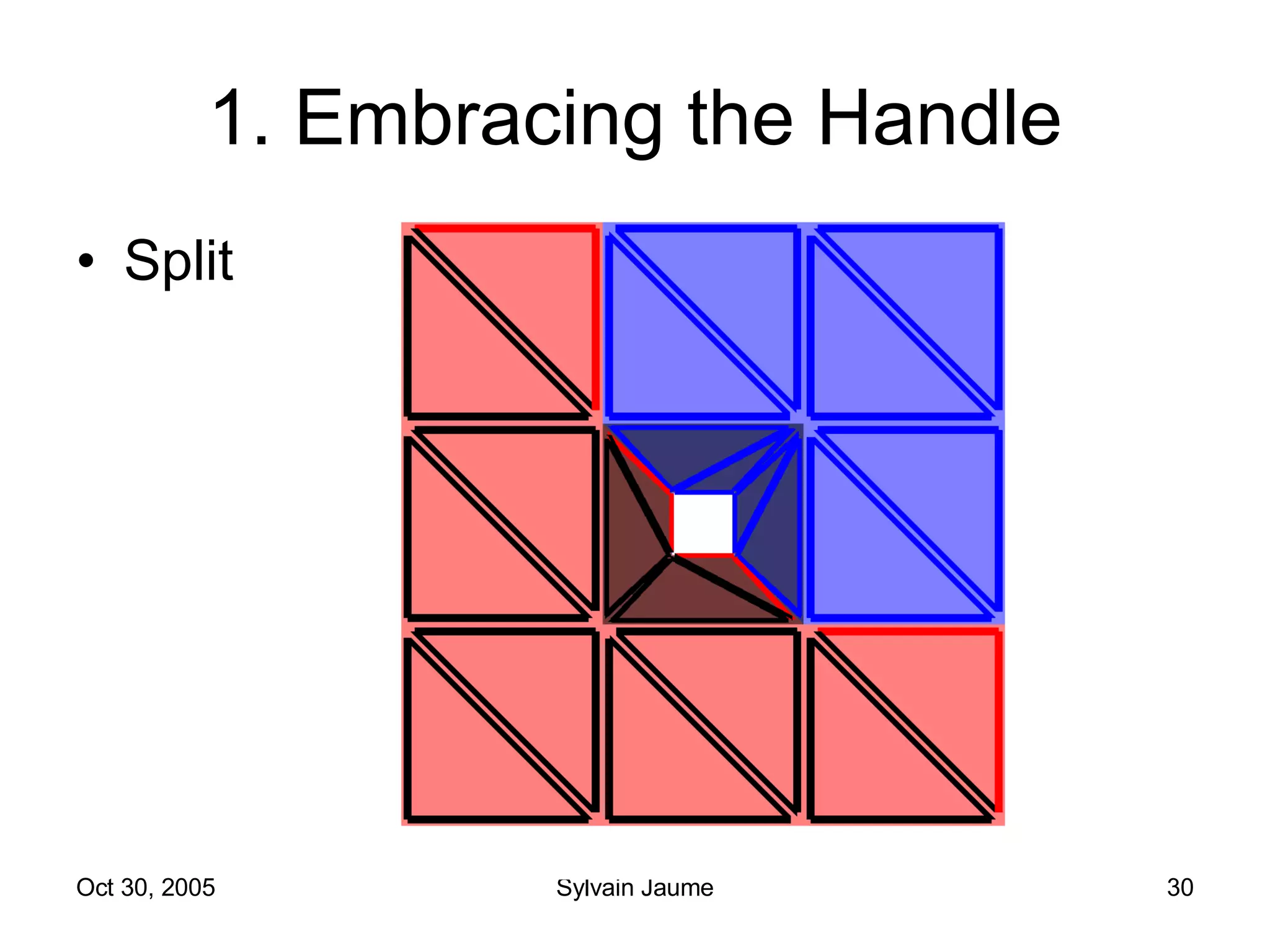
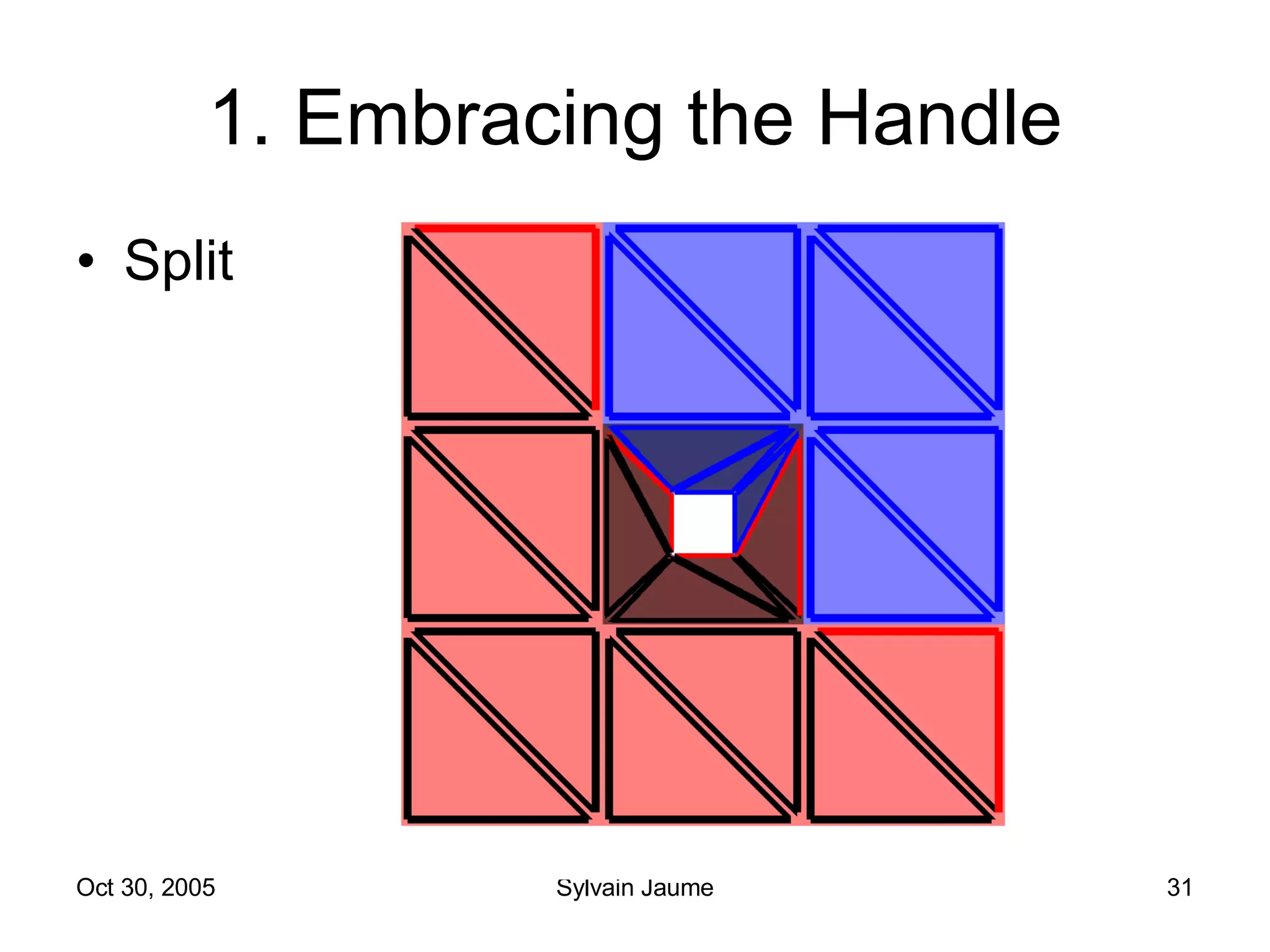
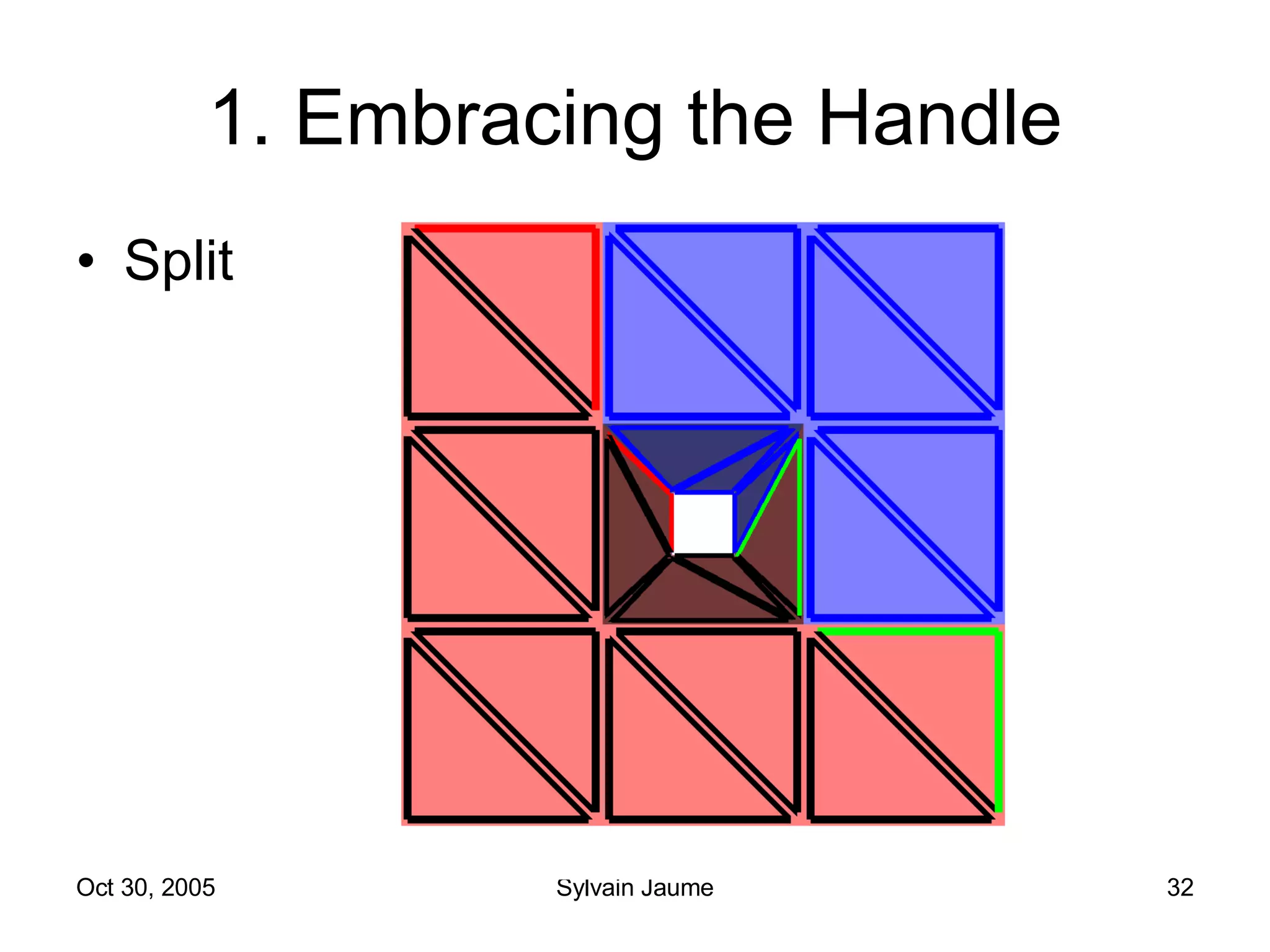
1. Embracing the Handle Split
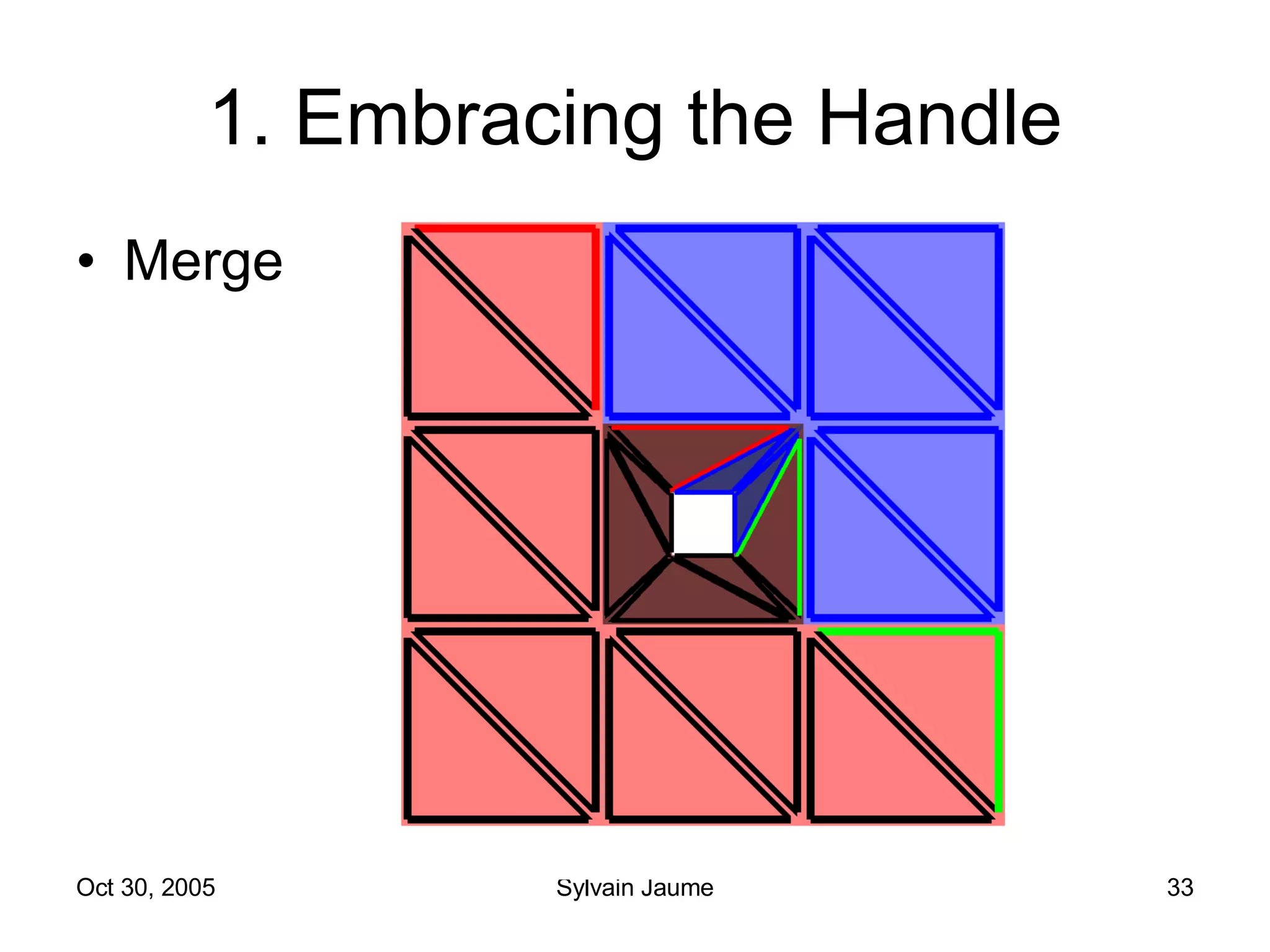
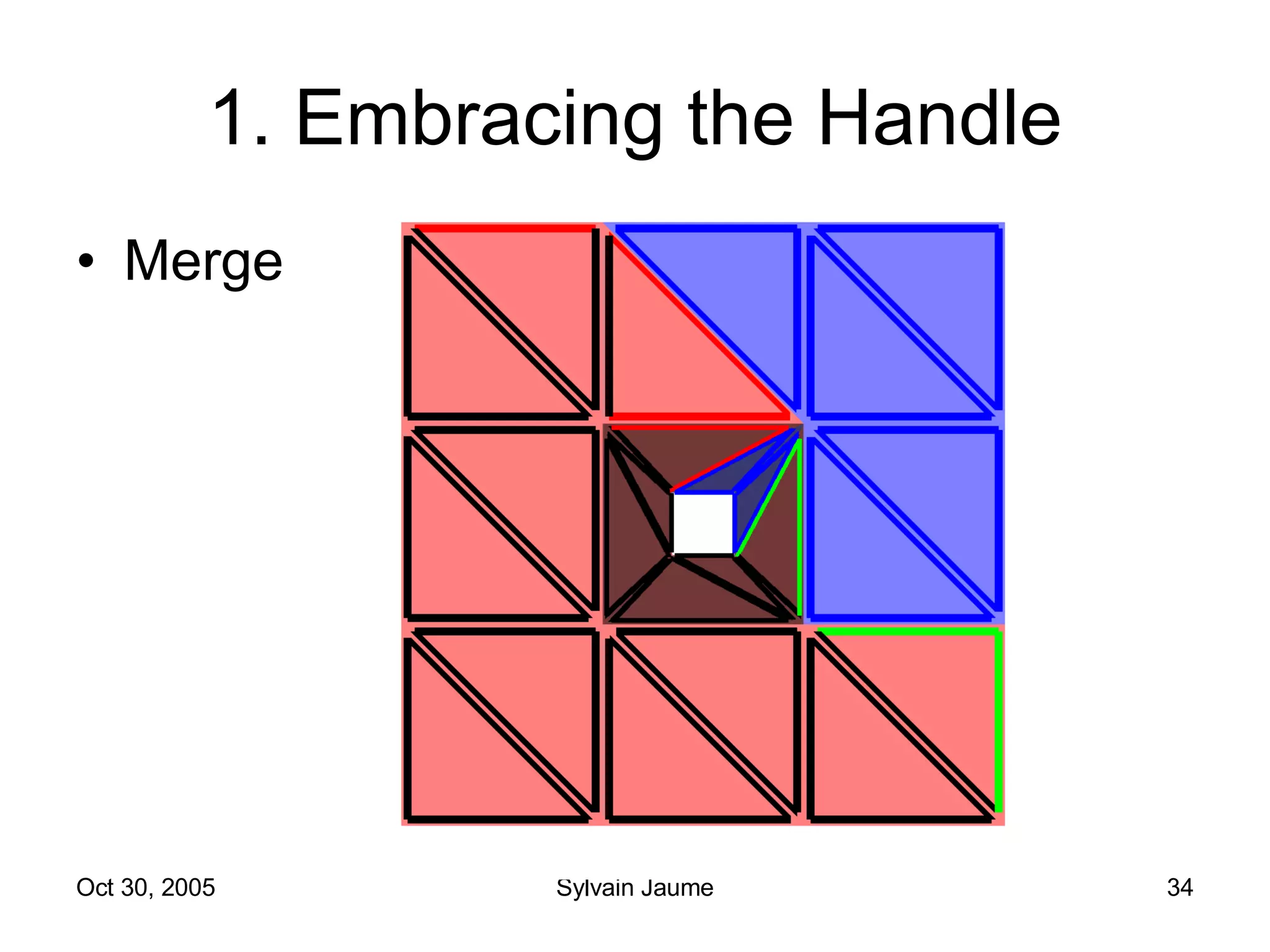
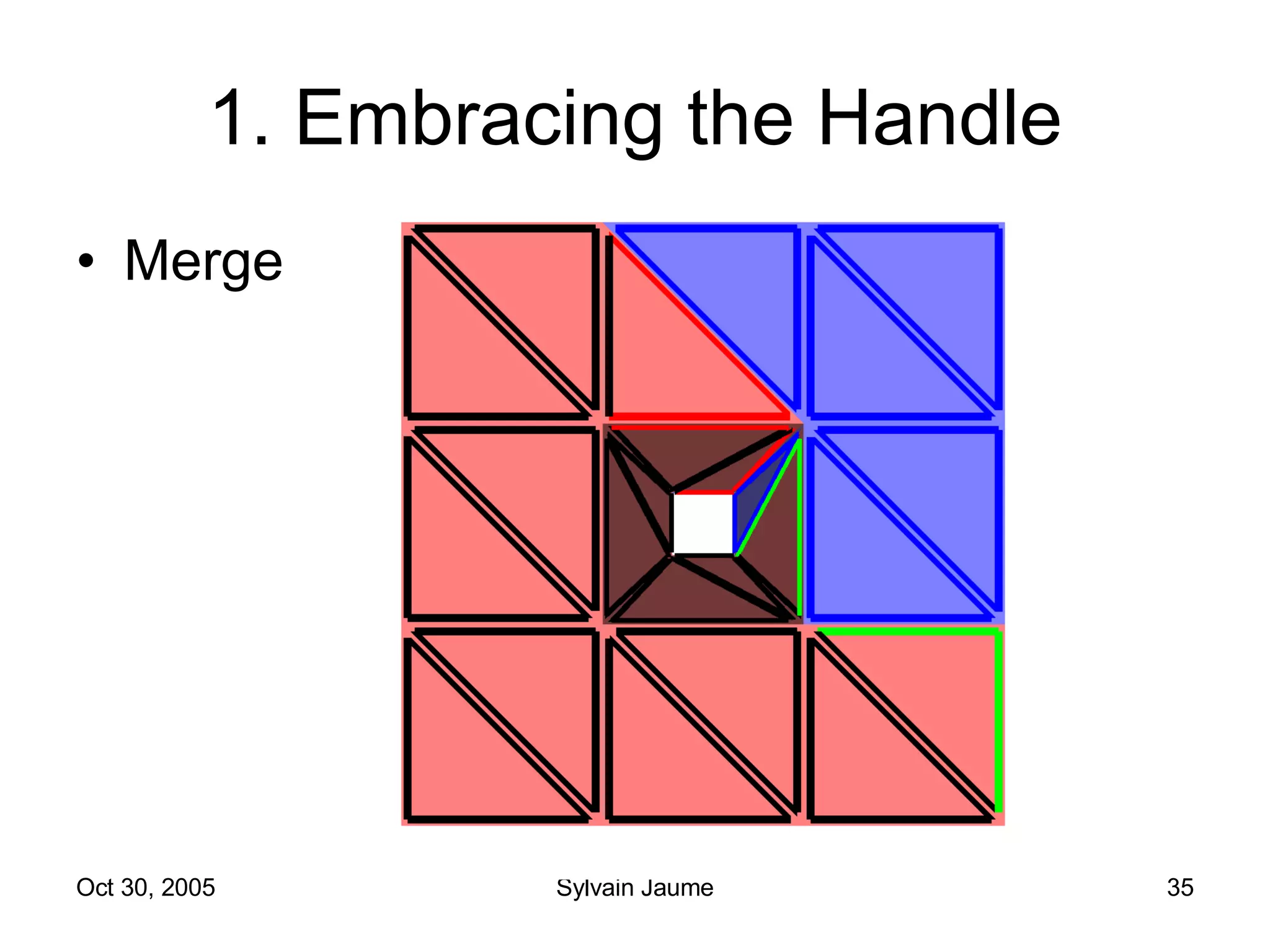
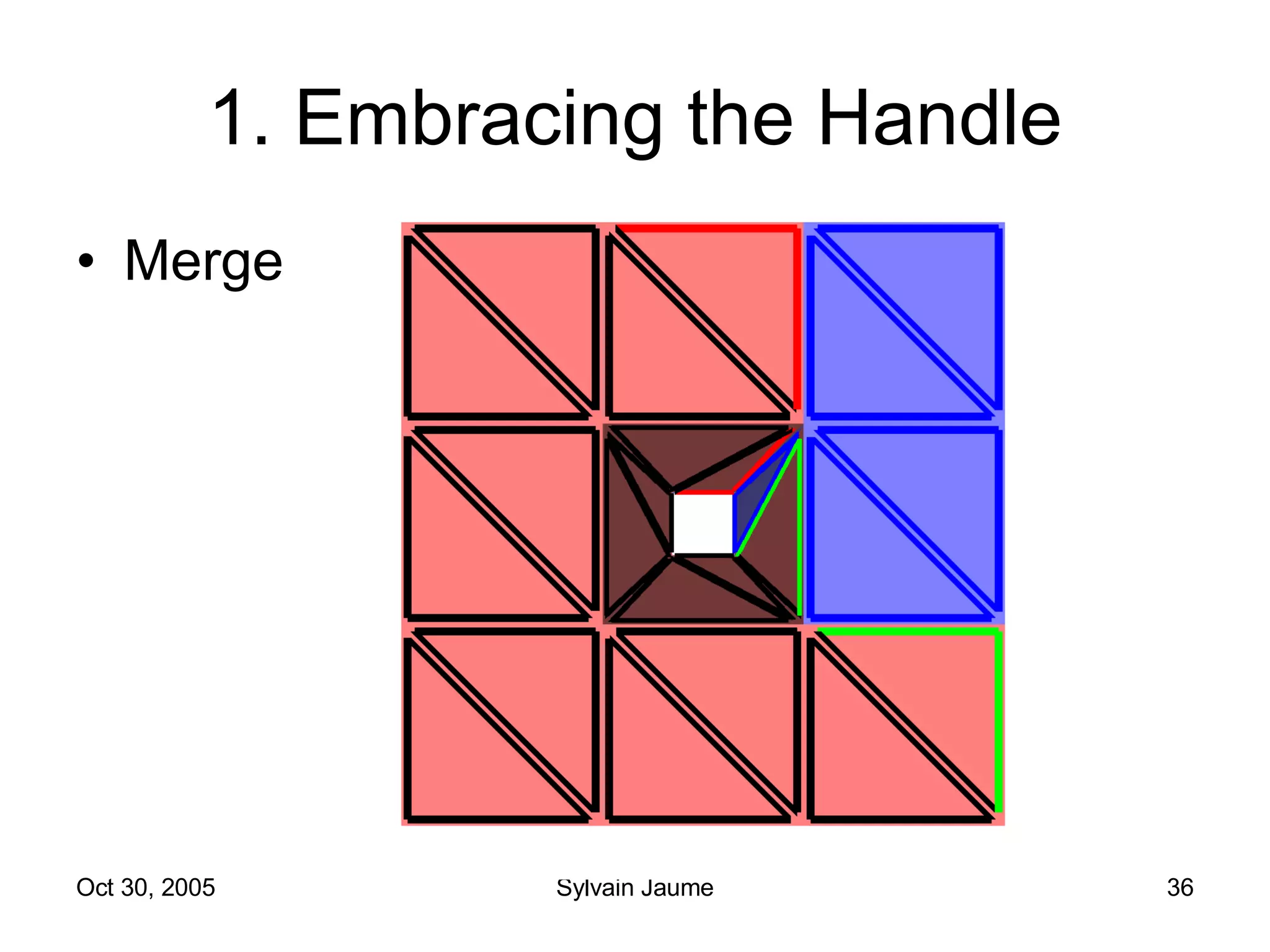
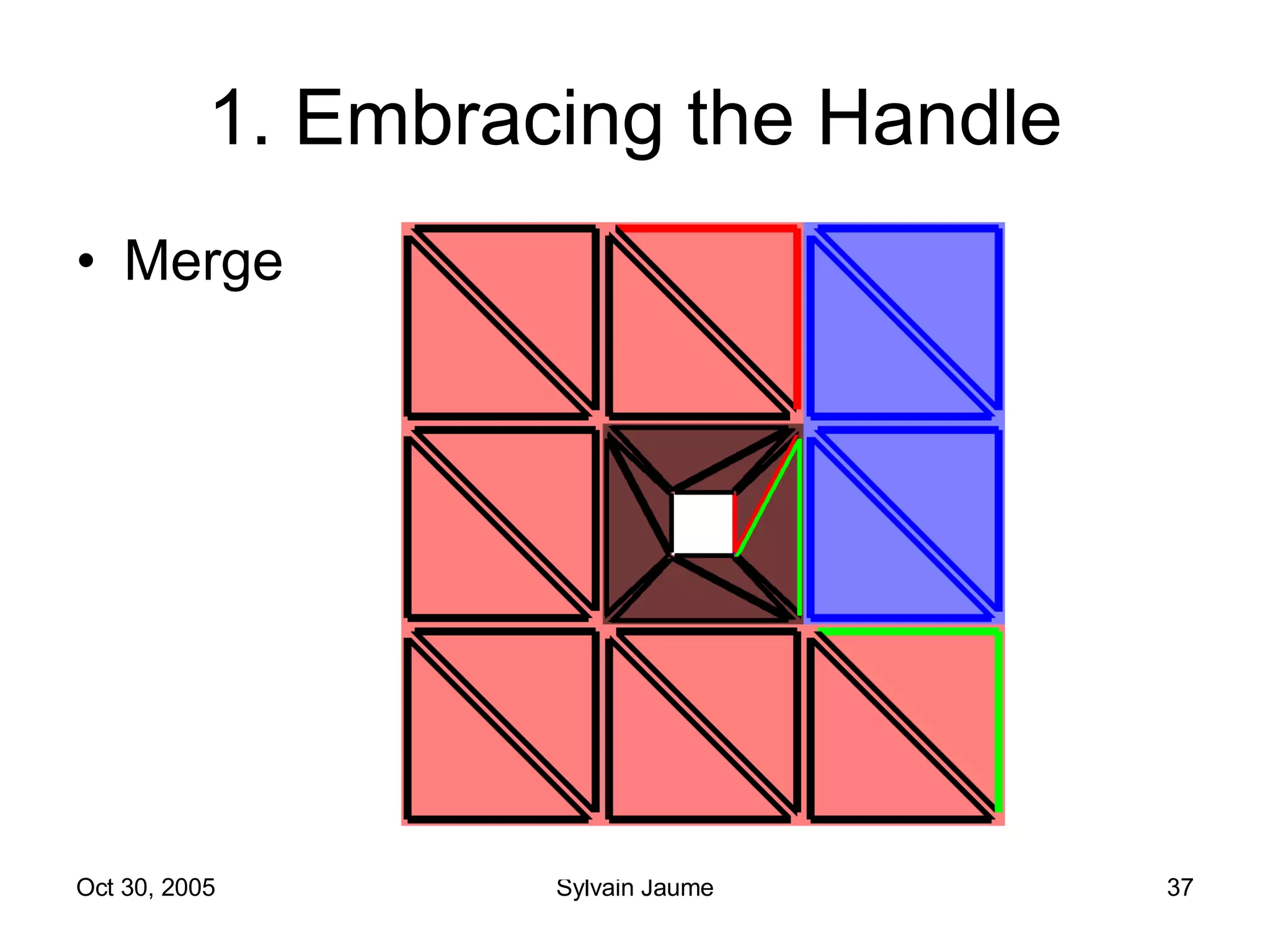
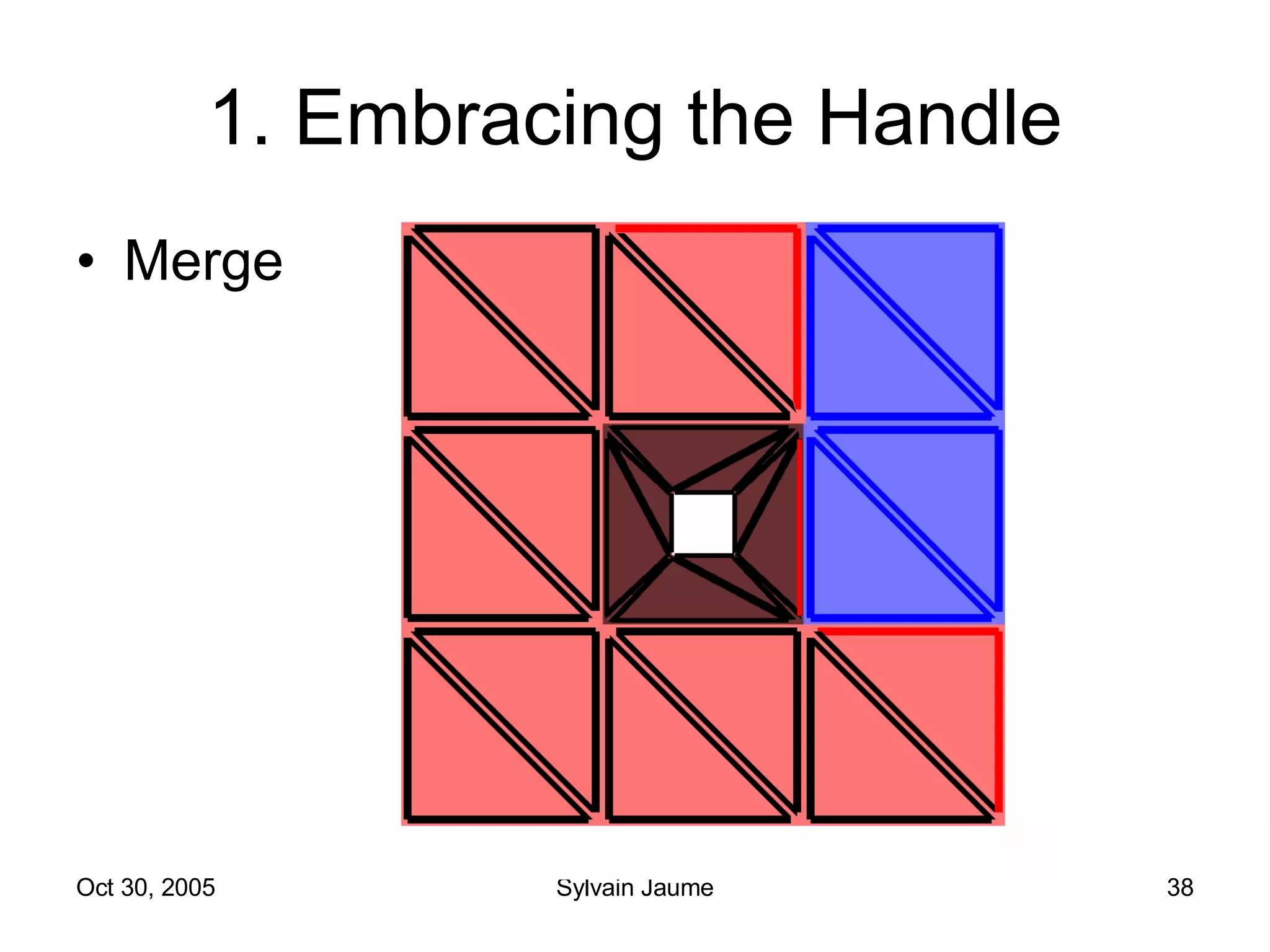
1. Embracing the Handle Merge
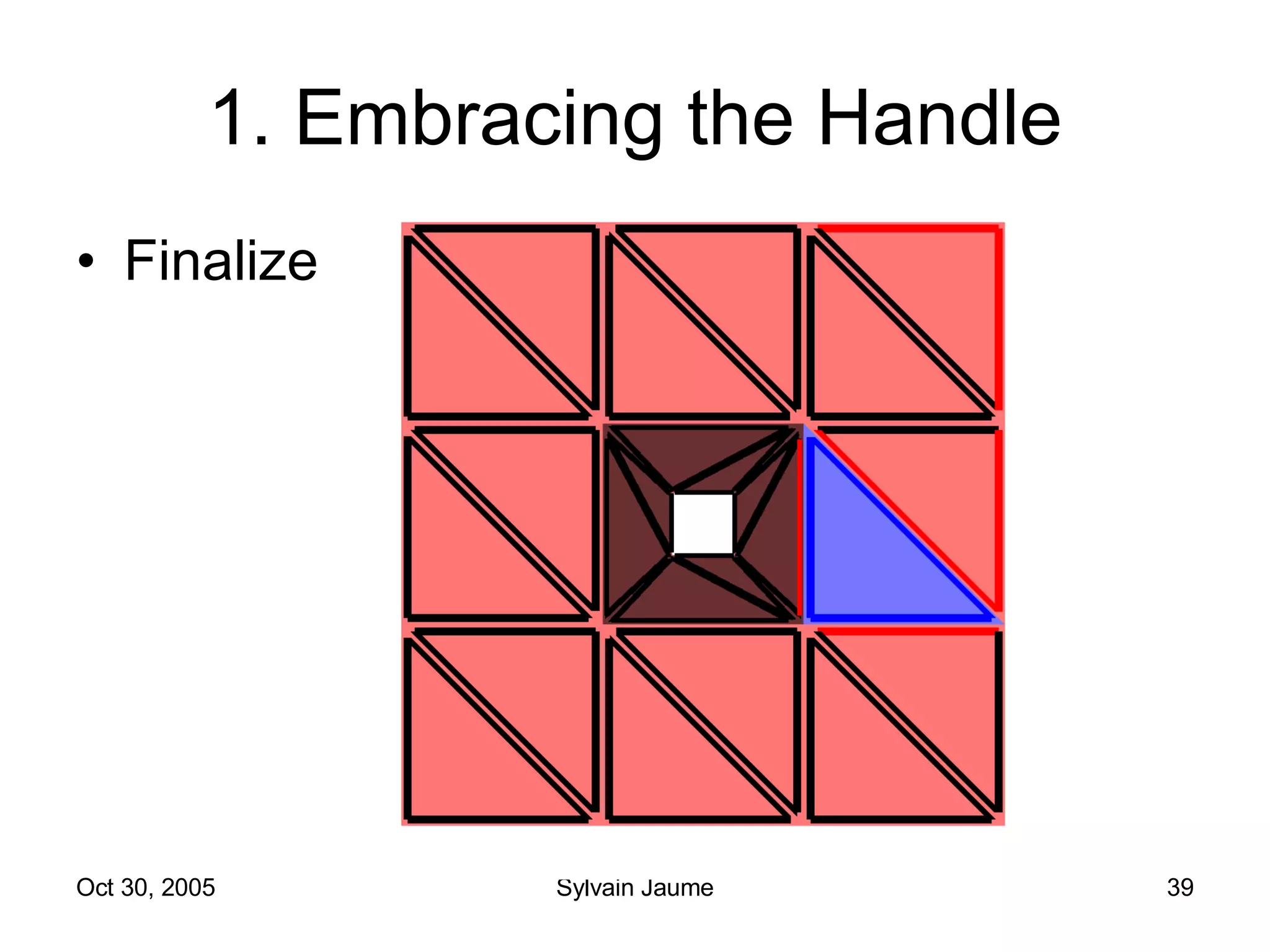
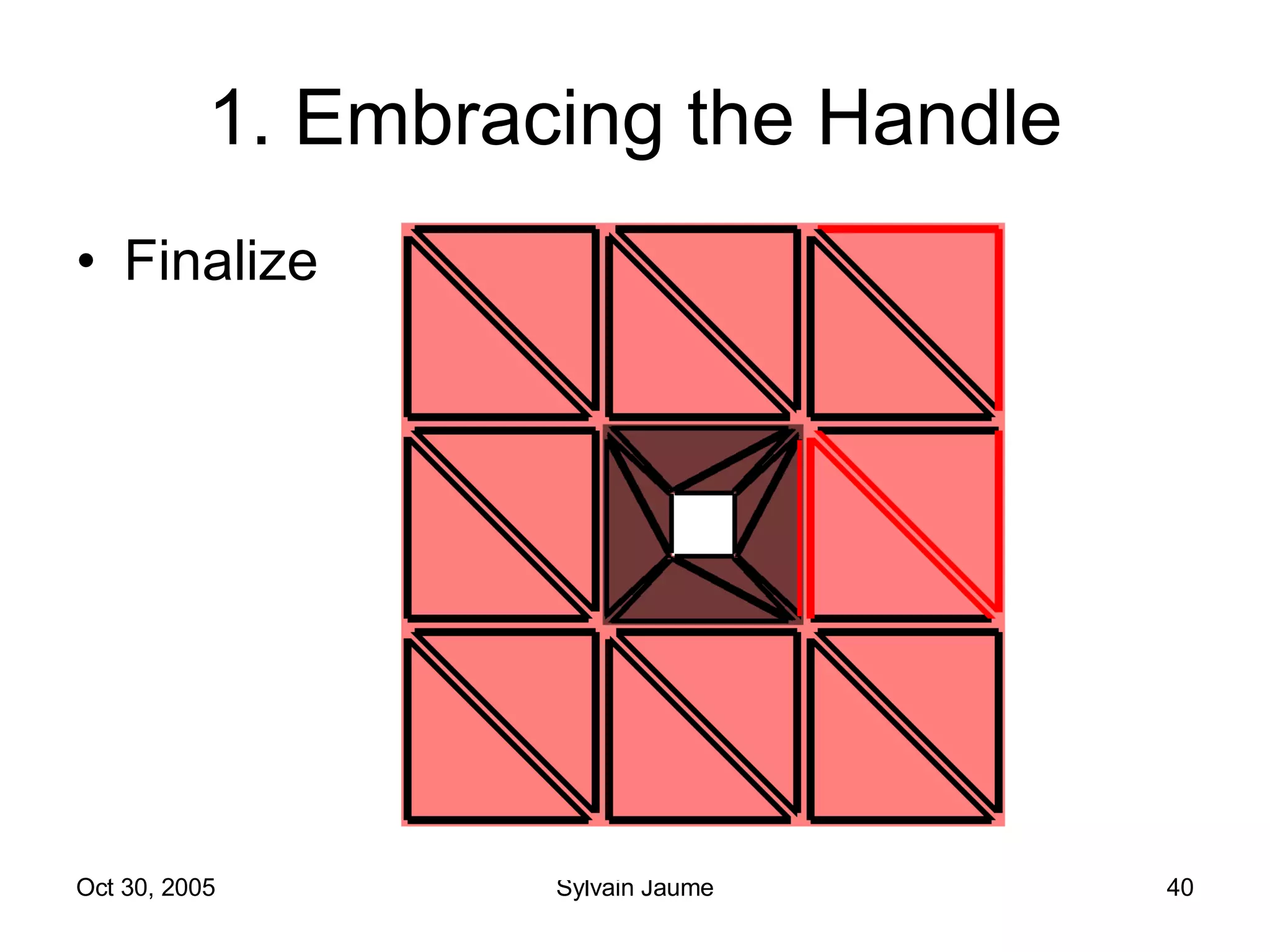
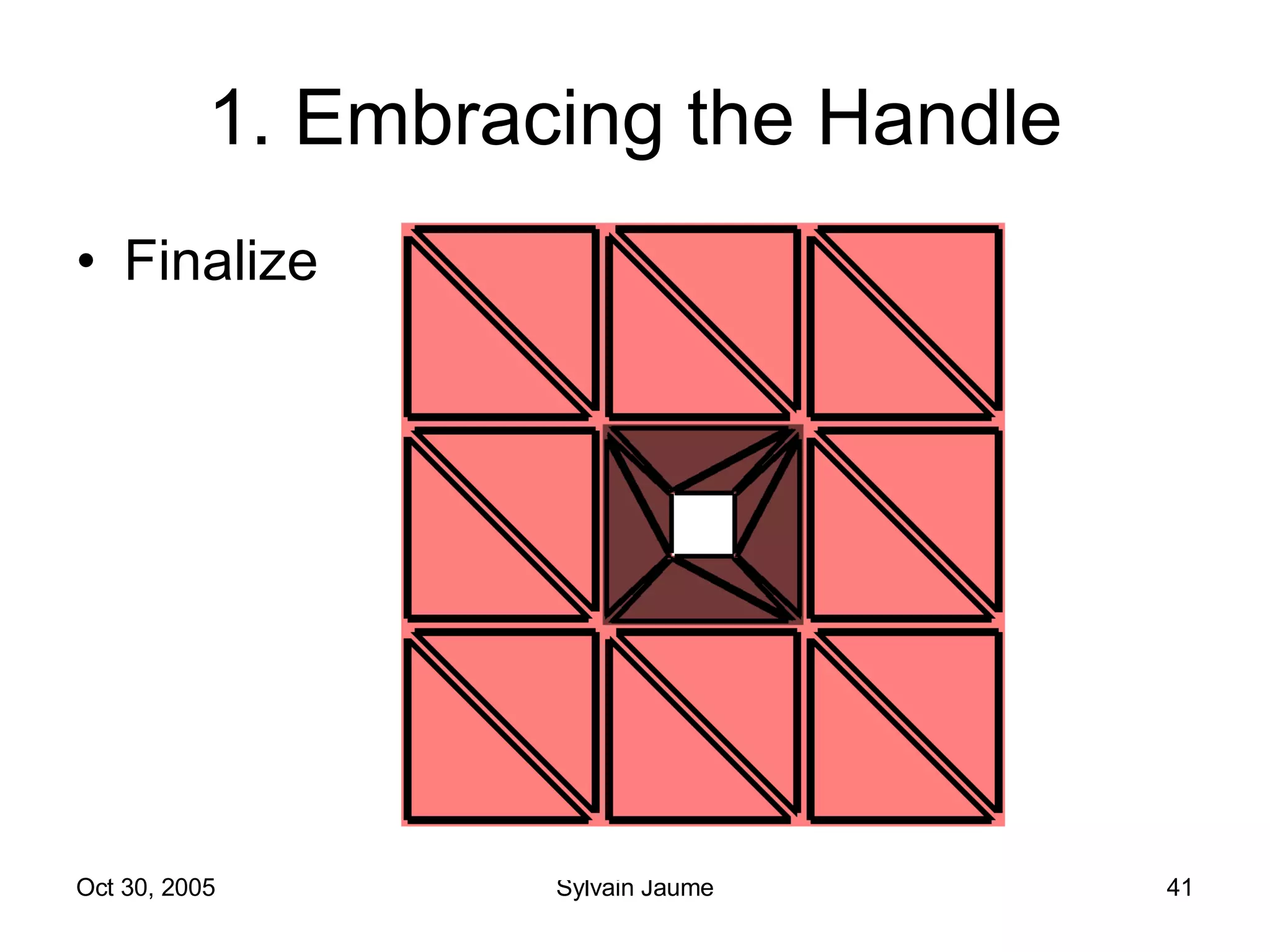
1. Embracing the Handle Finalize
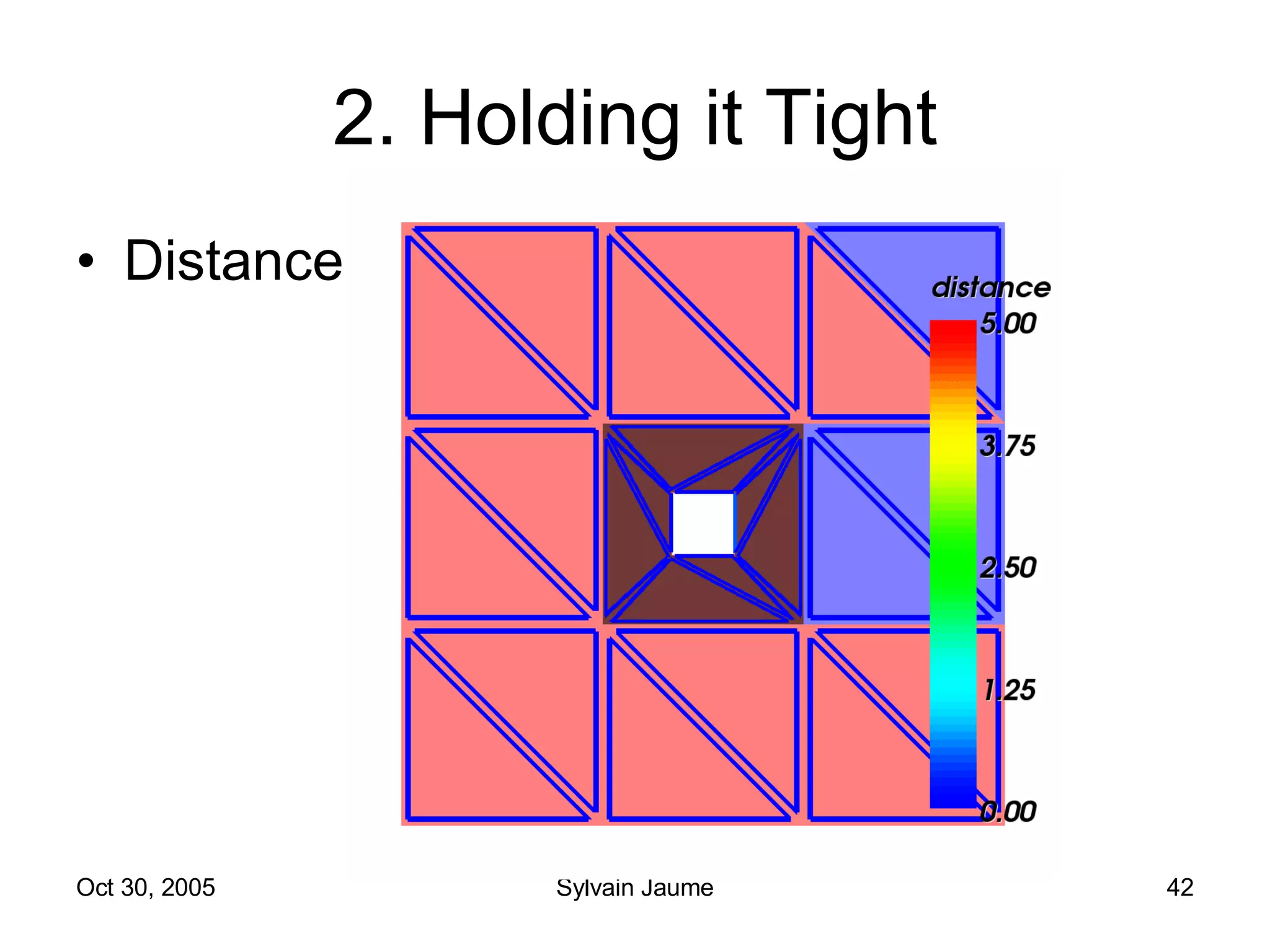
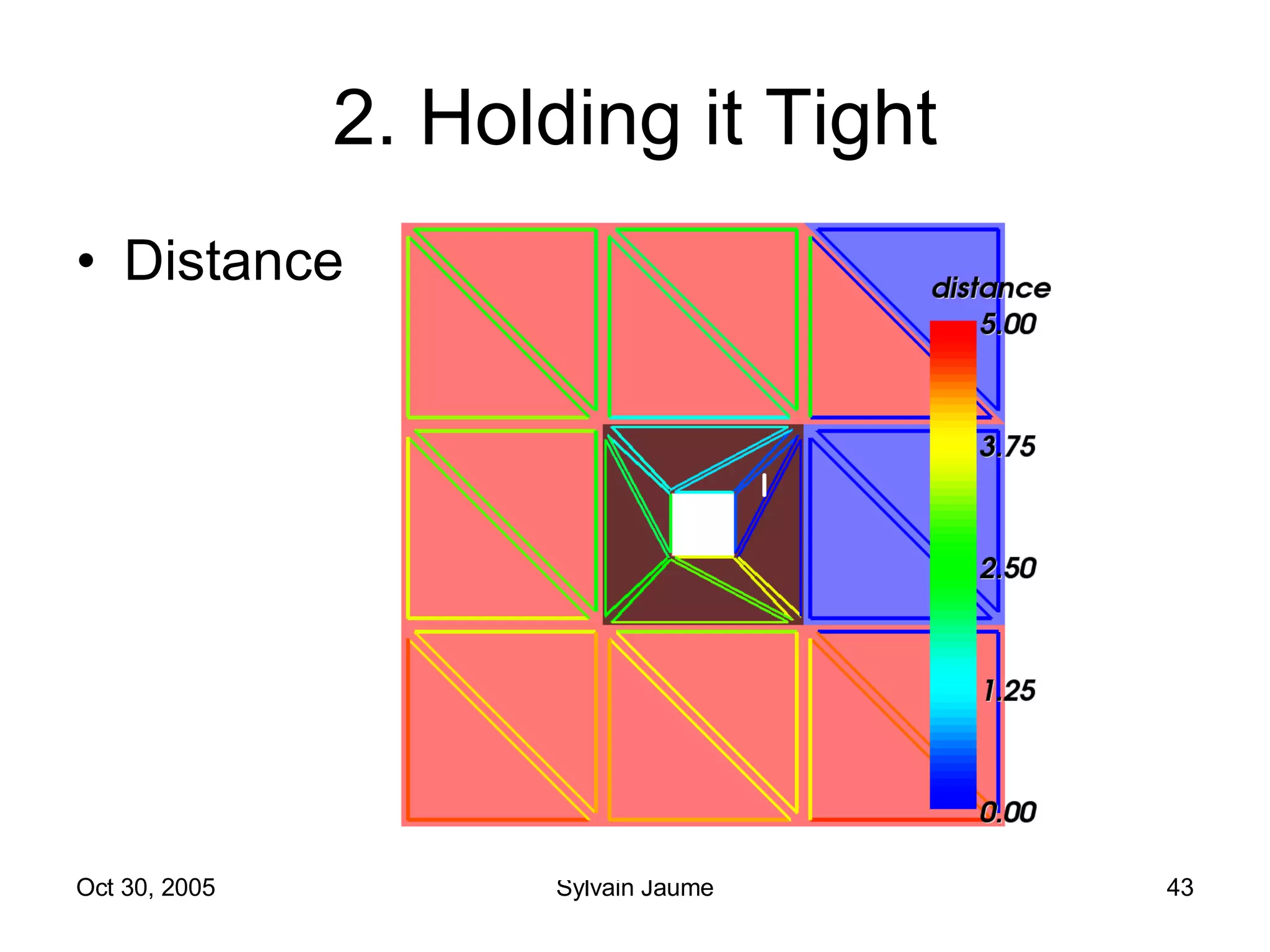
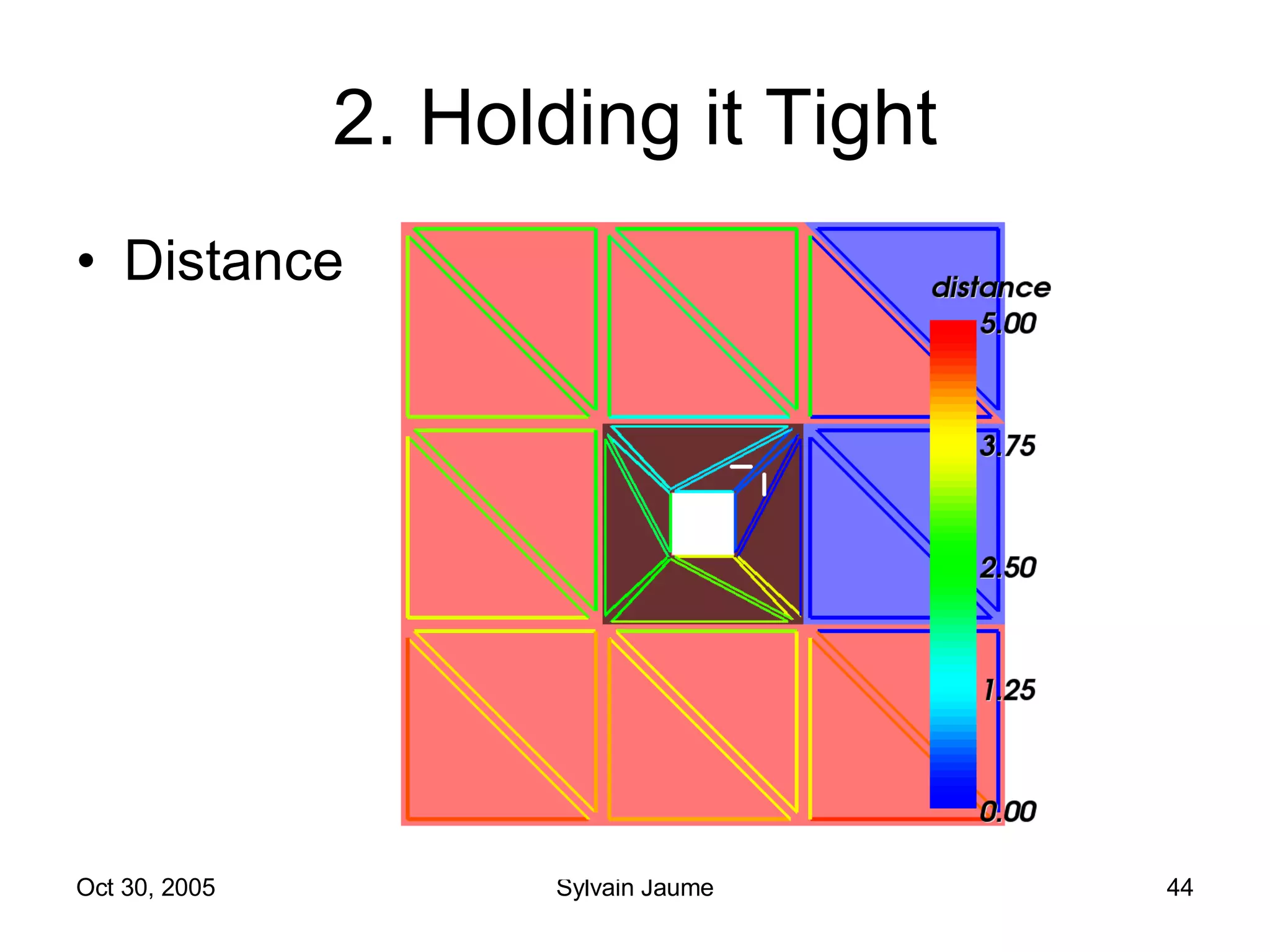
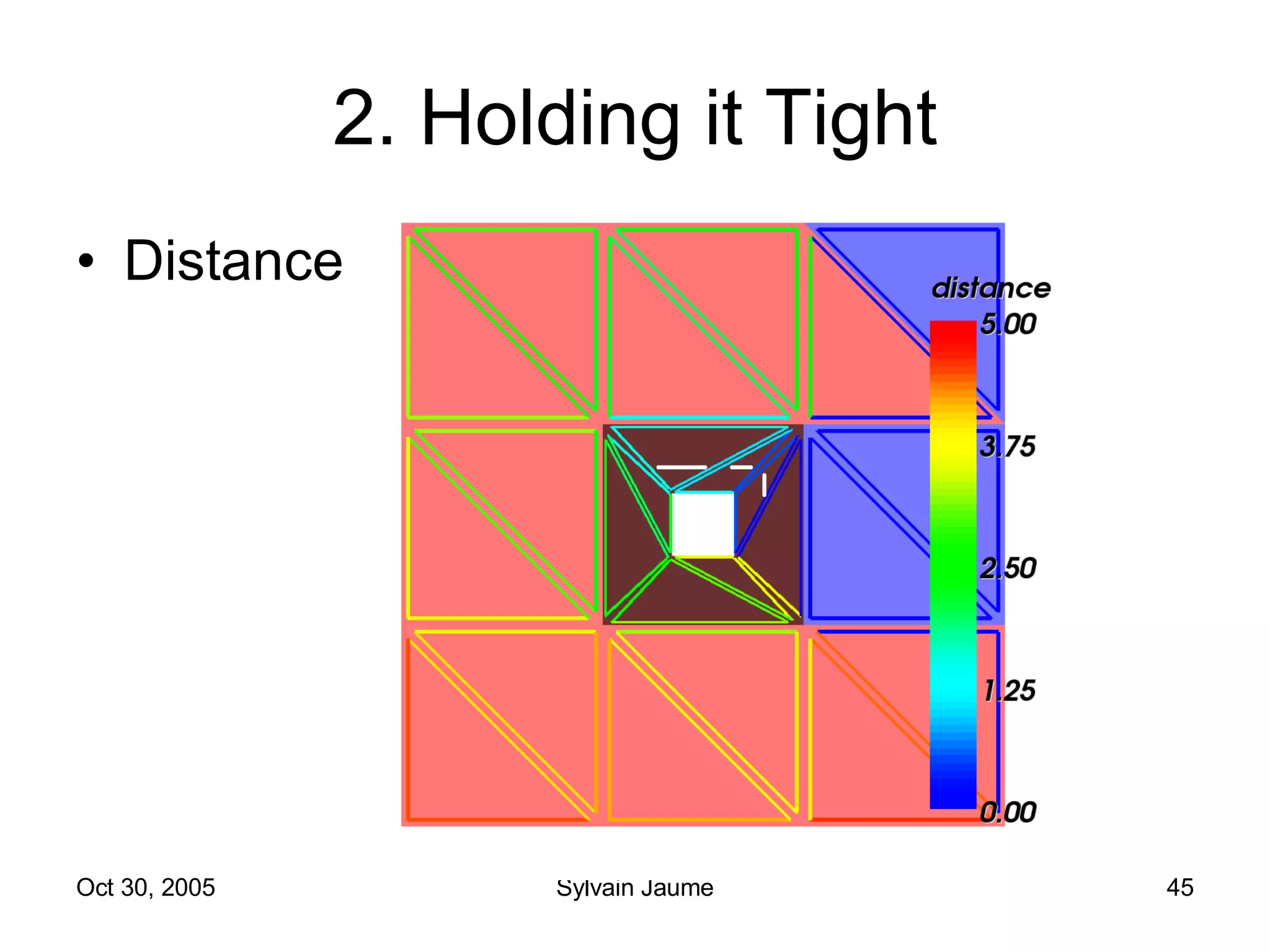
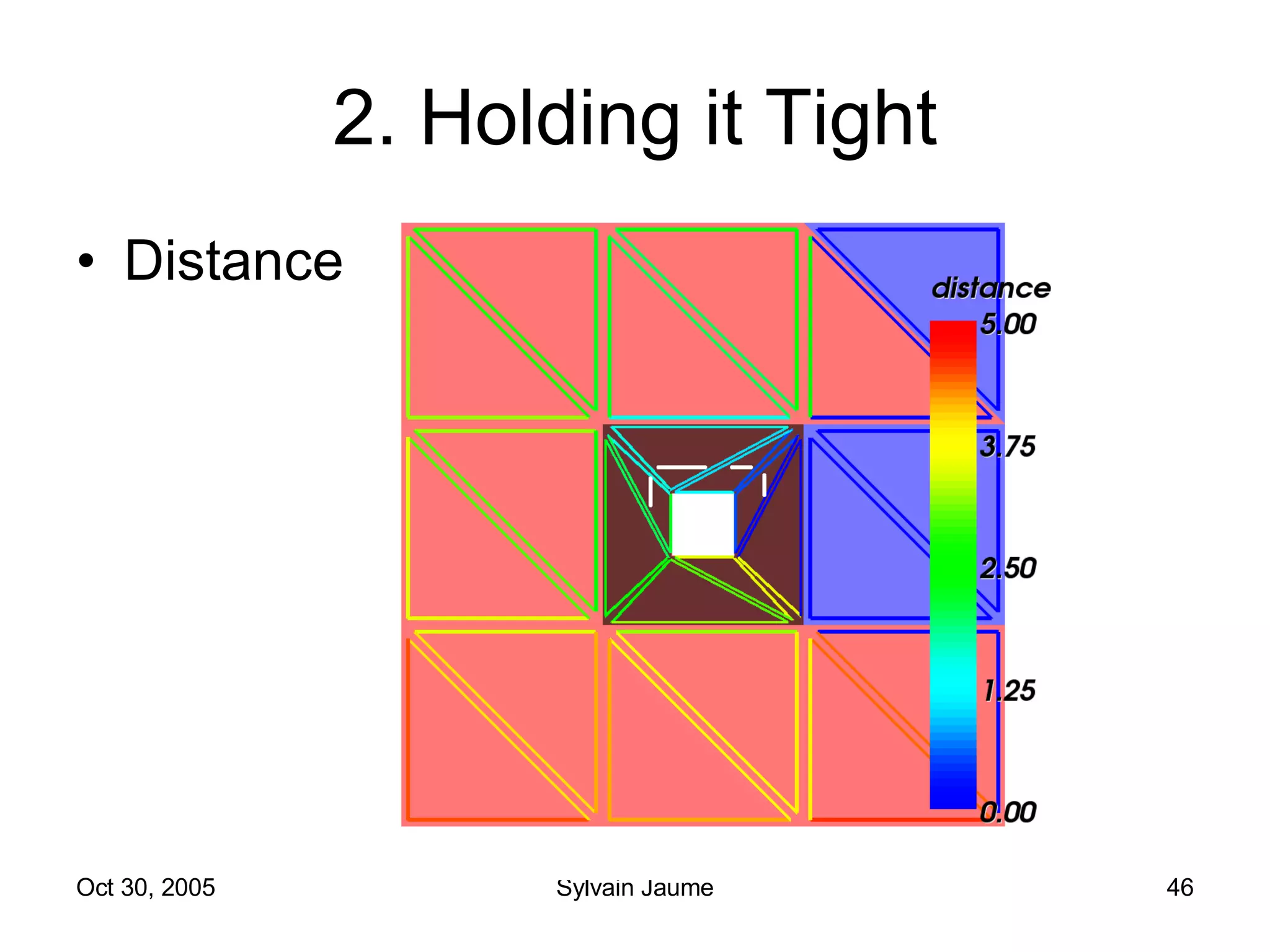
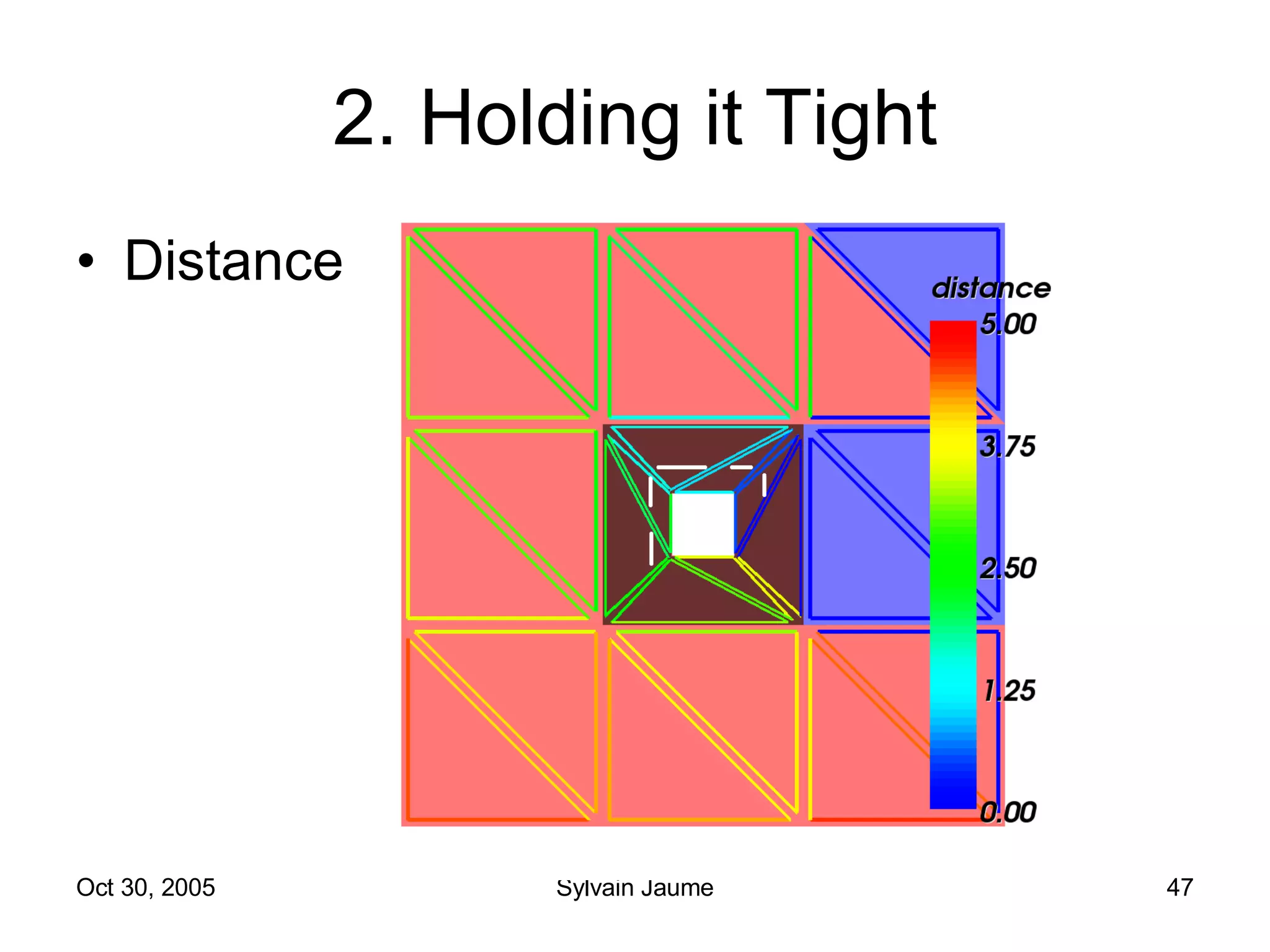
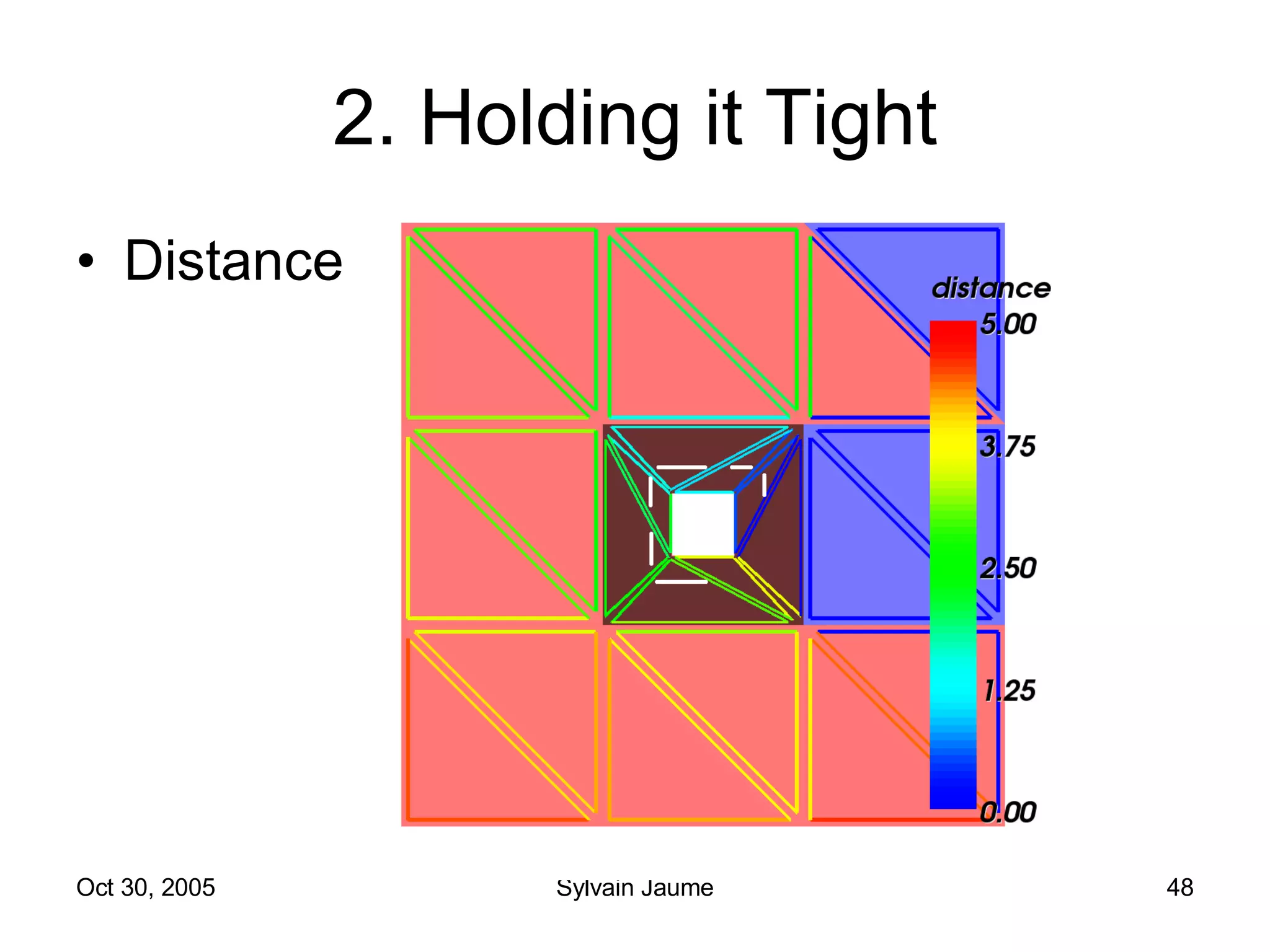
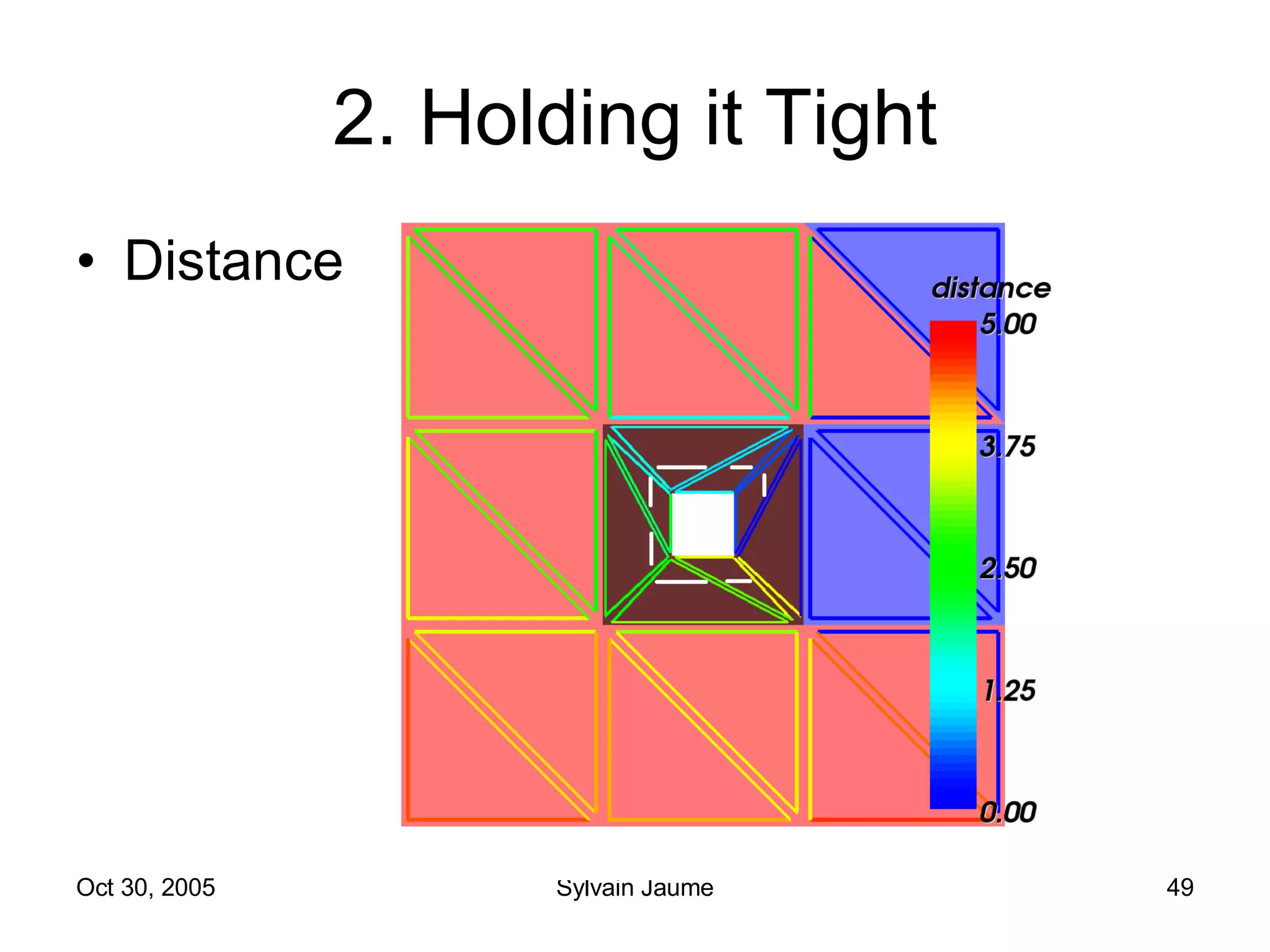
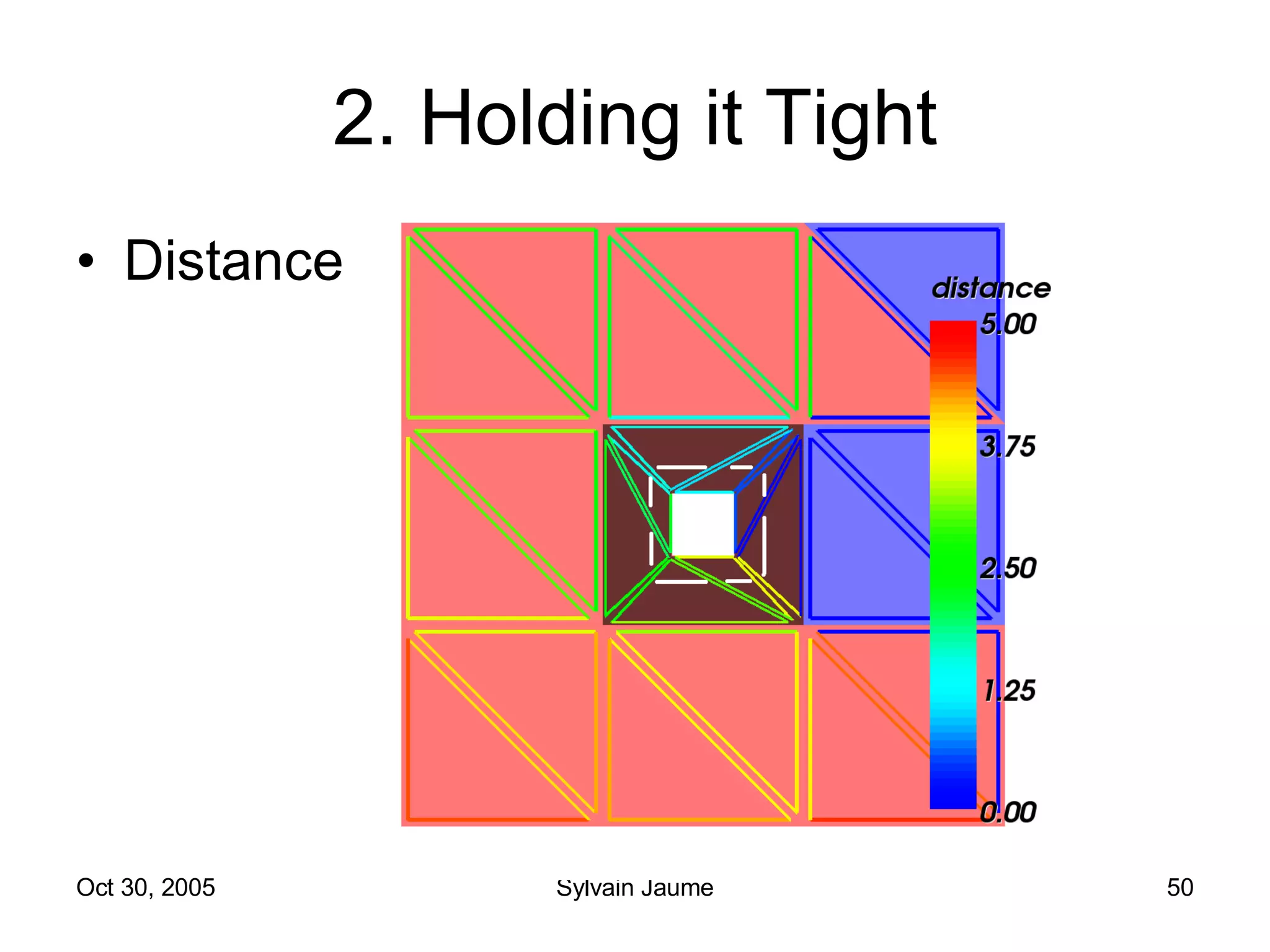
2. Holding it Tight Distance
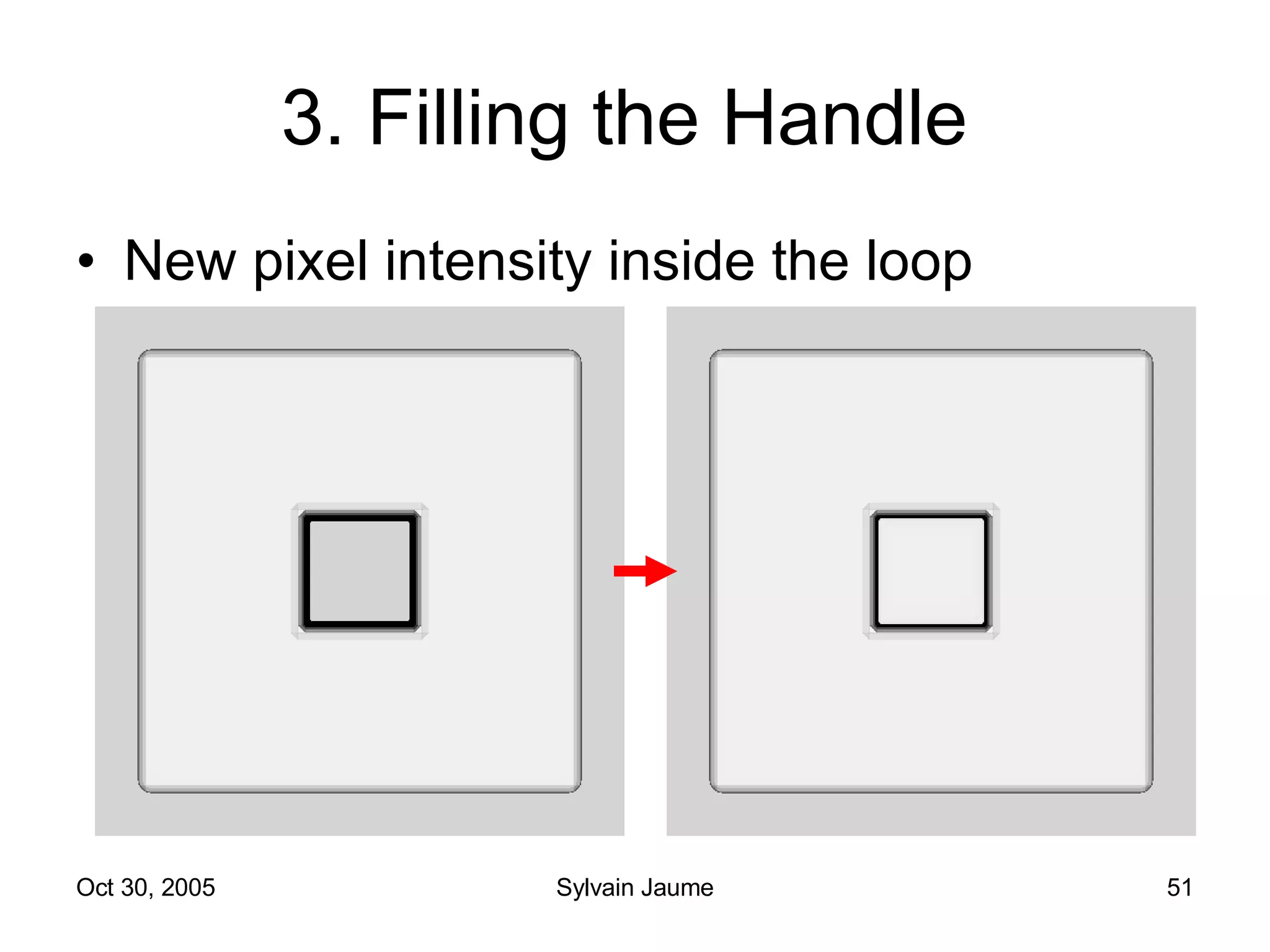
3. Filling the Handle  New pixel intensity inside the loop
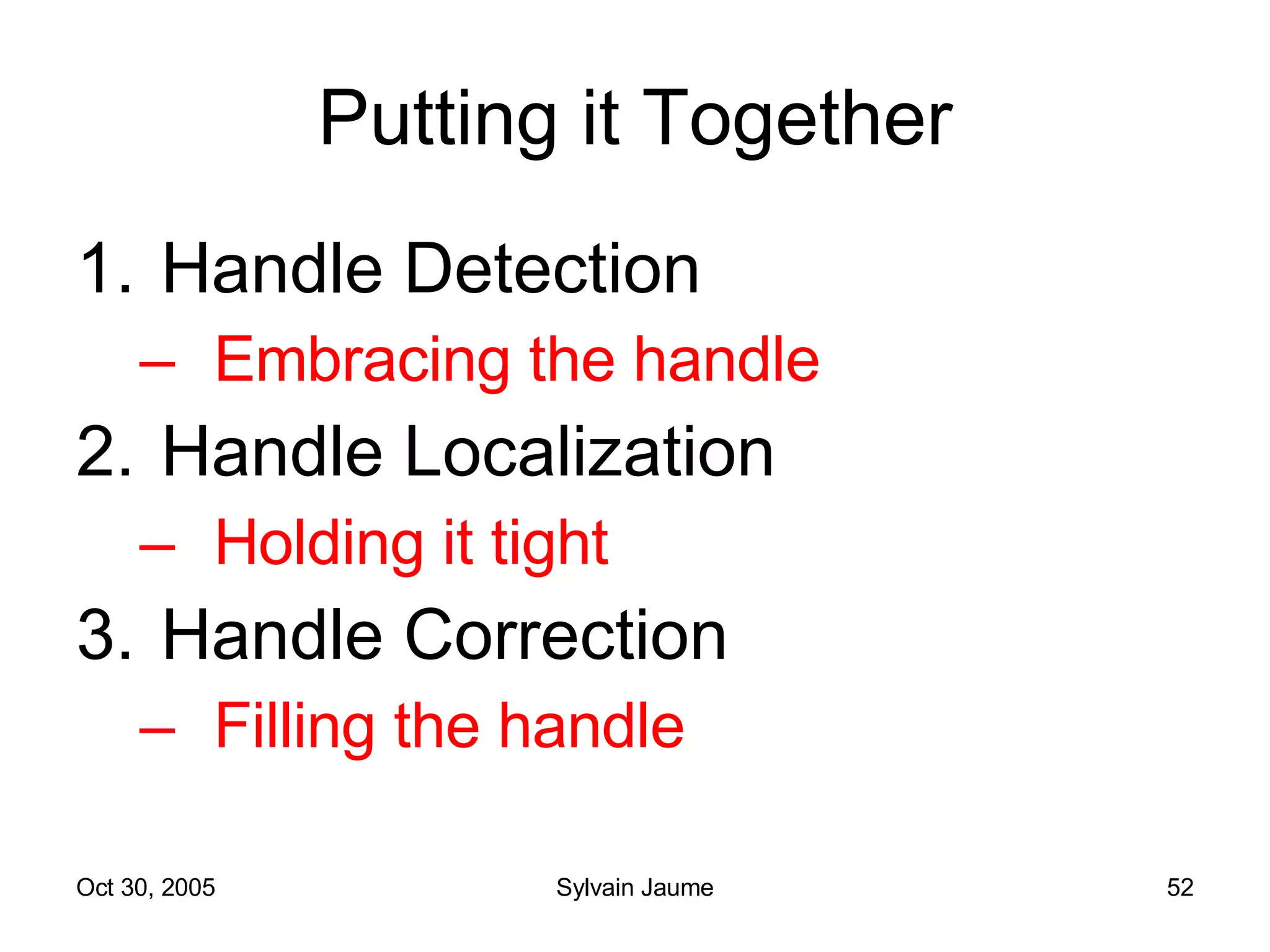
Putting it Together Handle Detection Embracing the handle Handle Localization Holding it tight Handle Correction Filling the handle
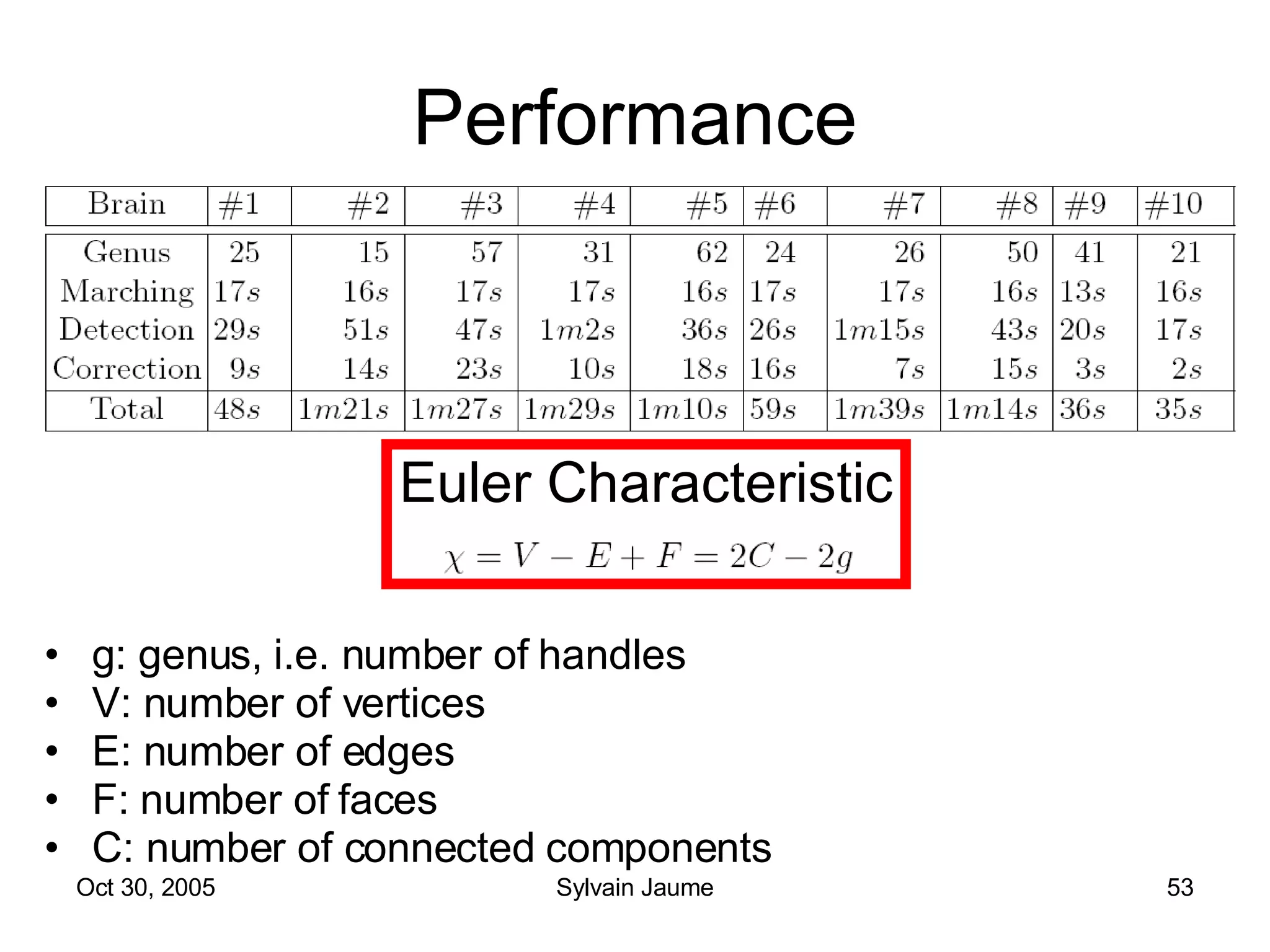
Performance g: genus, i.e. number of handles V: number of vertices E: number of edges F: number of faces C: number of connected components Euler Characteristic
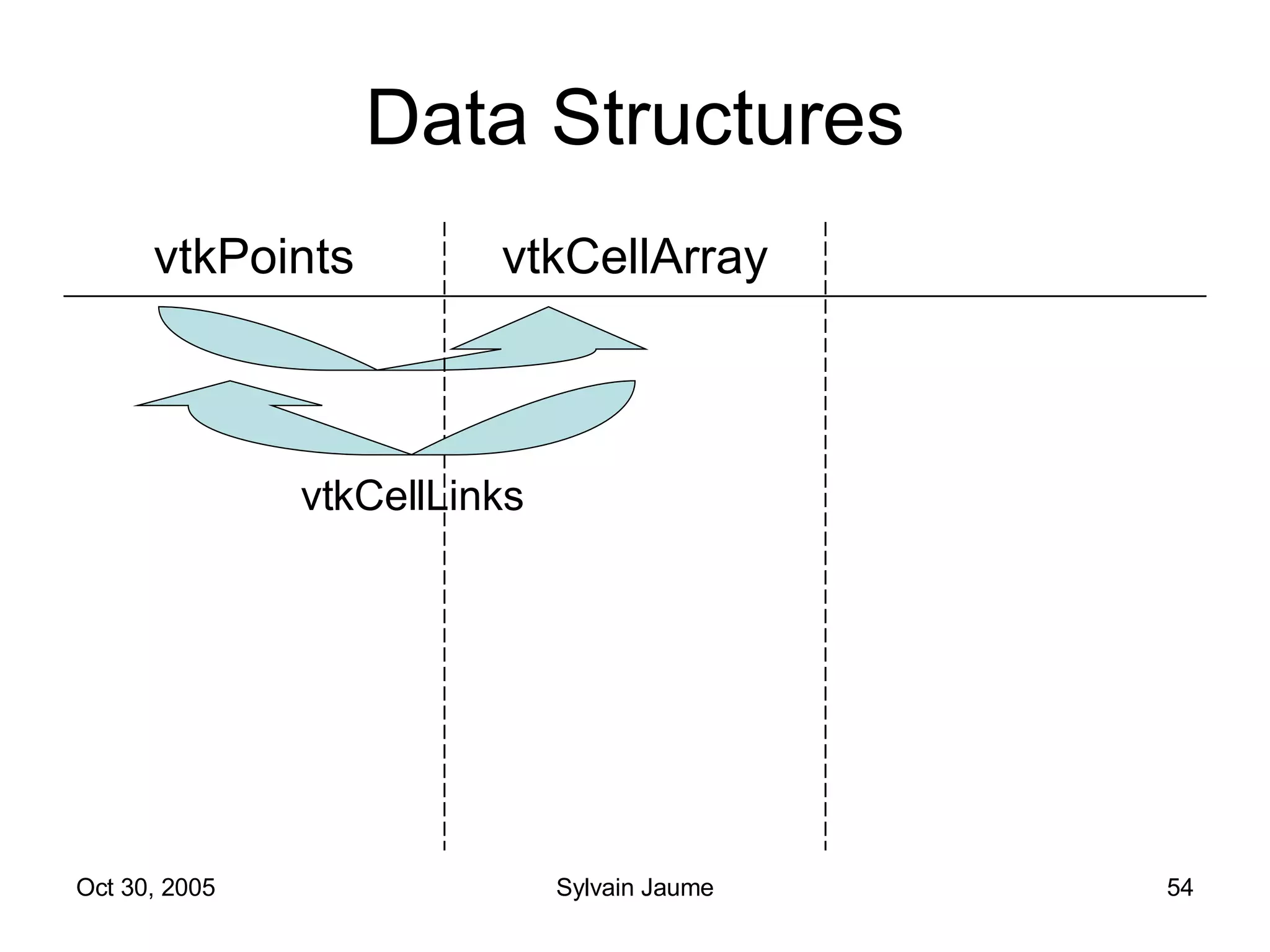
Data Structures vtkCellLinks vtkCellArray vtkPoints
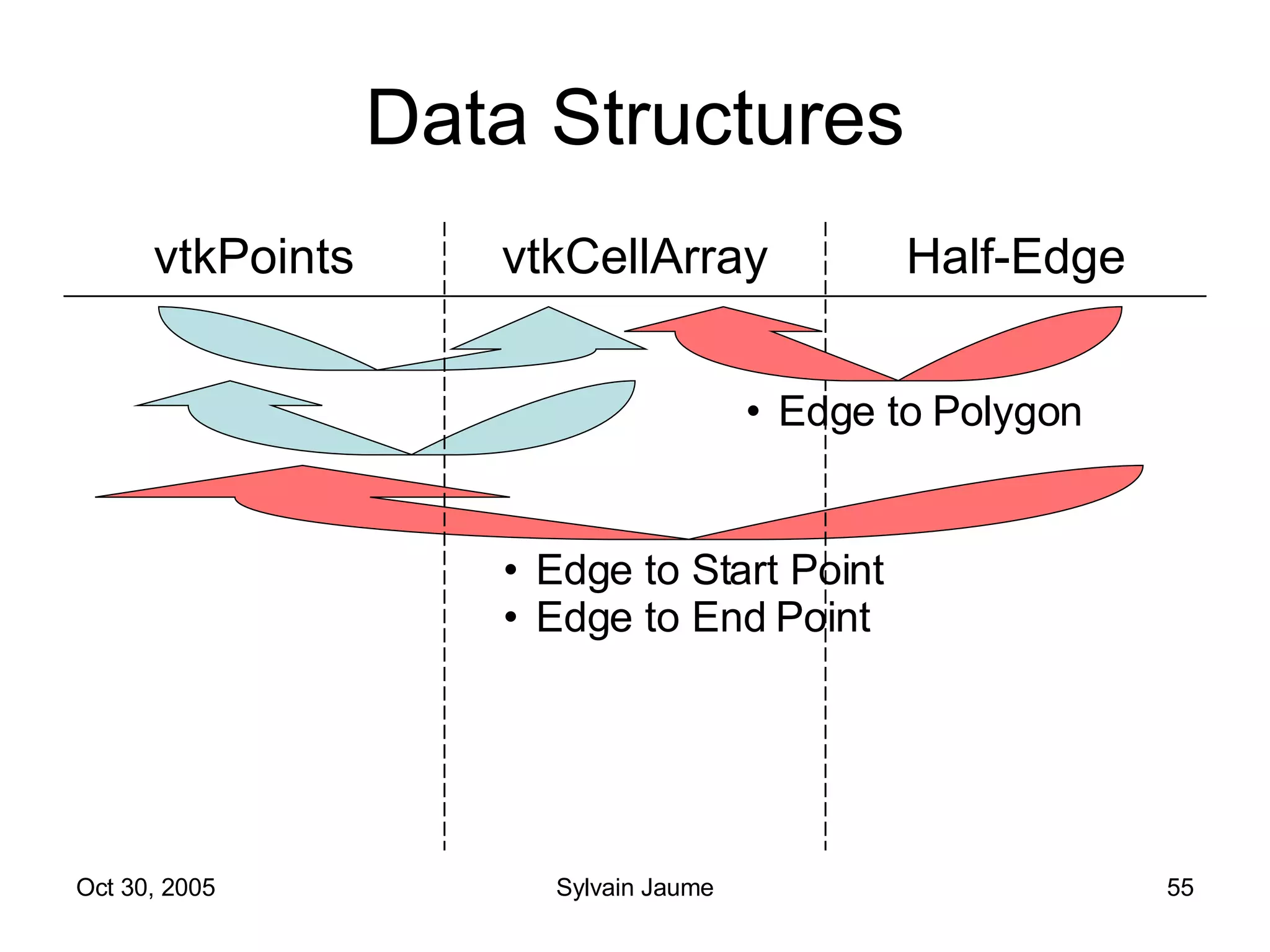
Data Structures Edge to Start Point Edge to End Point Edge to Polygon Half-Edge vtkCellArray vtkPoints
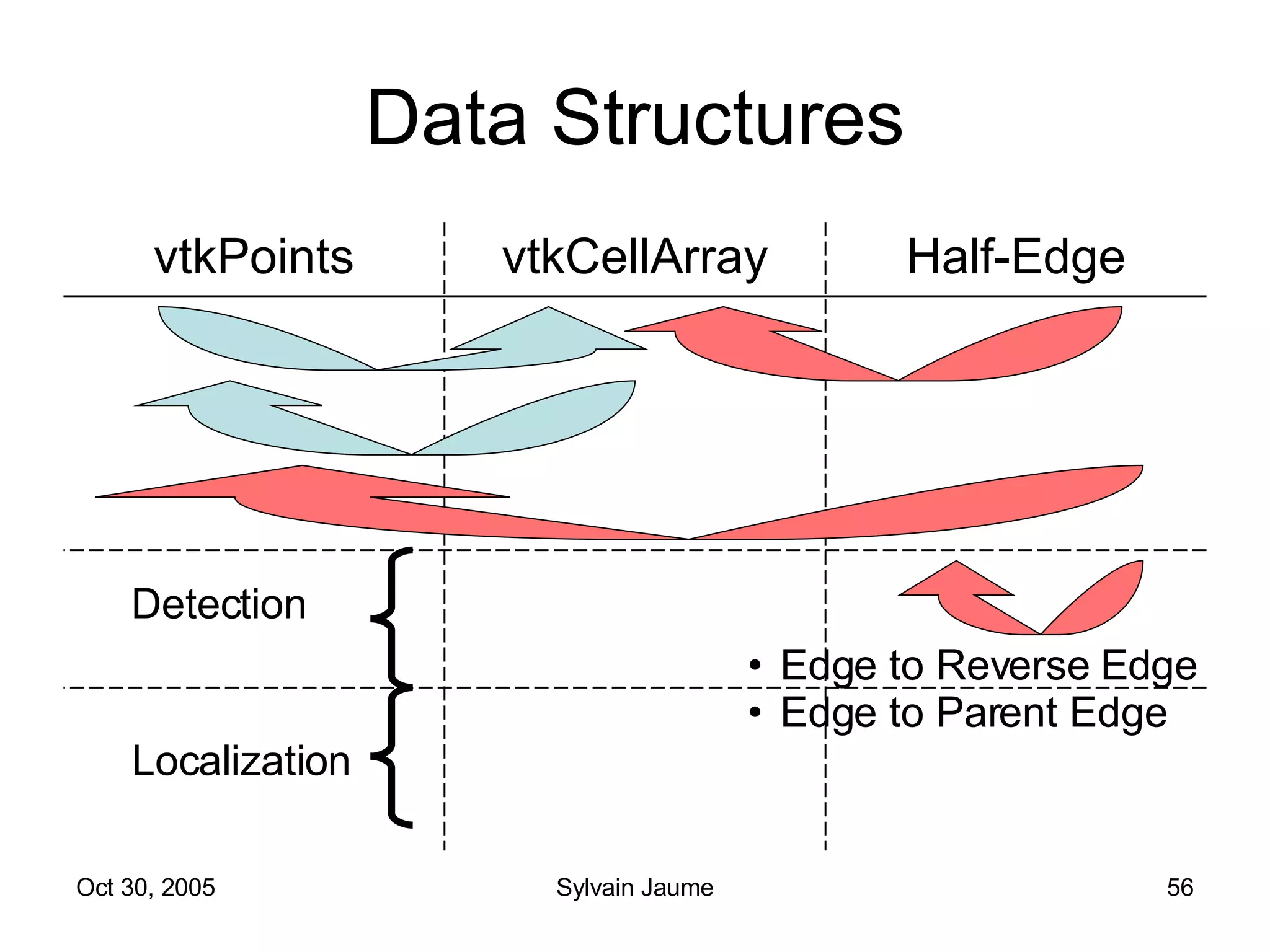
Data Structures Edge to Reverse Edge Edge to Parent Edge Detection Localization Half-Edge vtkCellArray vtkPoints
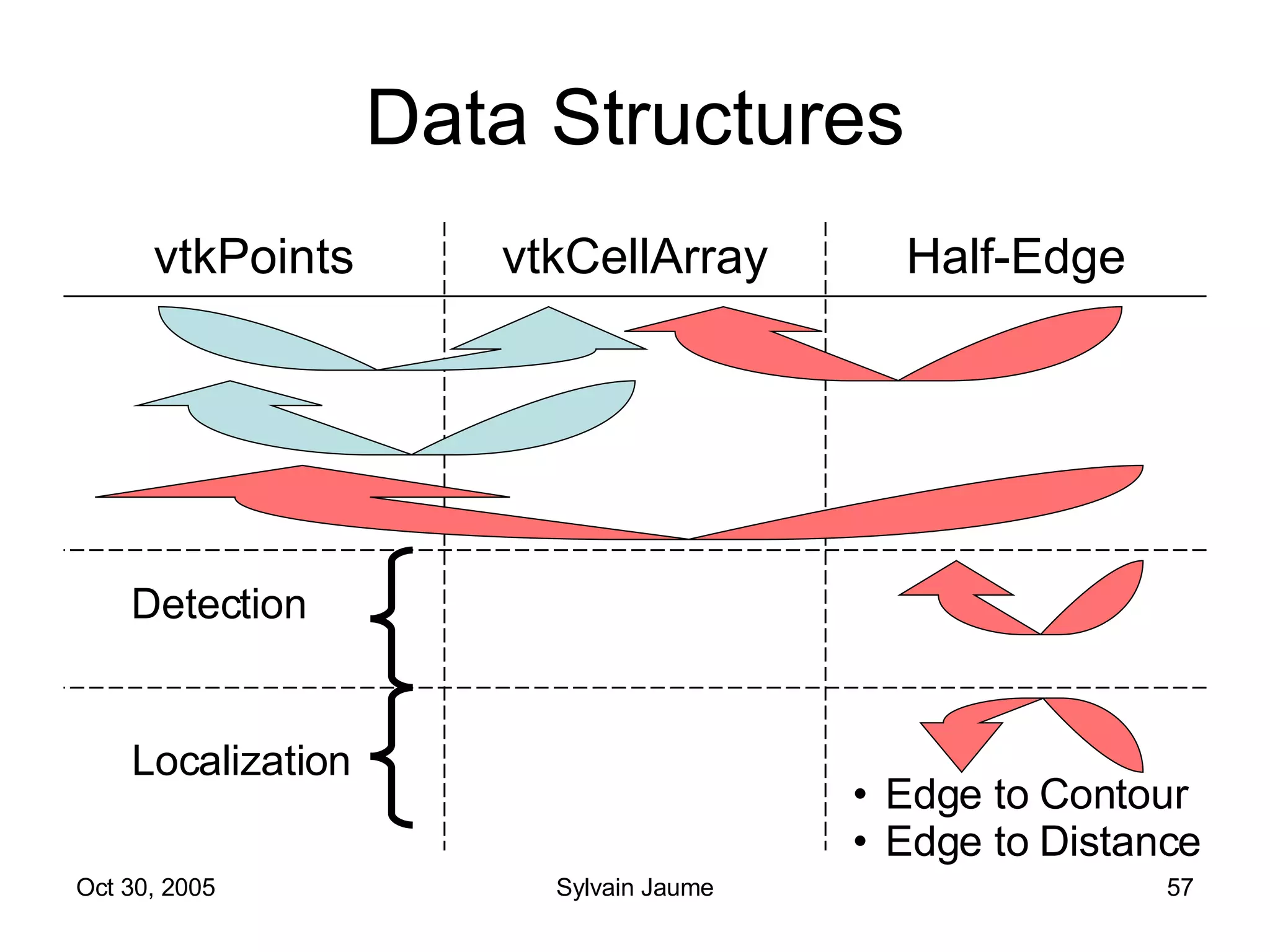
Data Structures Edge to Contour Edge to Distance Detection Localization Half-Edge vtkCellArray vtkPoints
Data Structures Extended Half-Edge Structure: Edge to Polygon Edge to Start Point Edge to End Point Edge to Reverse Edge Edge to Parent Edge Edge to Contour Edge to Distance
Code vtkHandleDetection Half-edge structure Area growing Shortest loop vtkHandleCorrection Loop to image Water-tight region
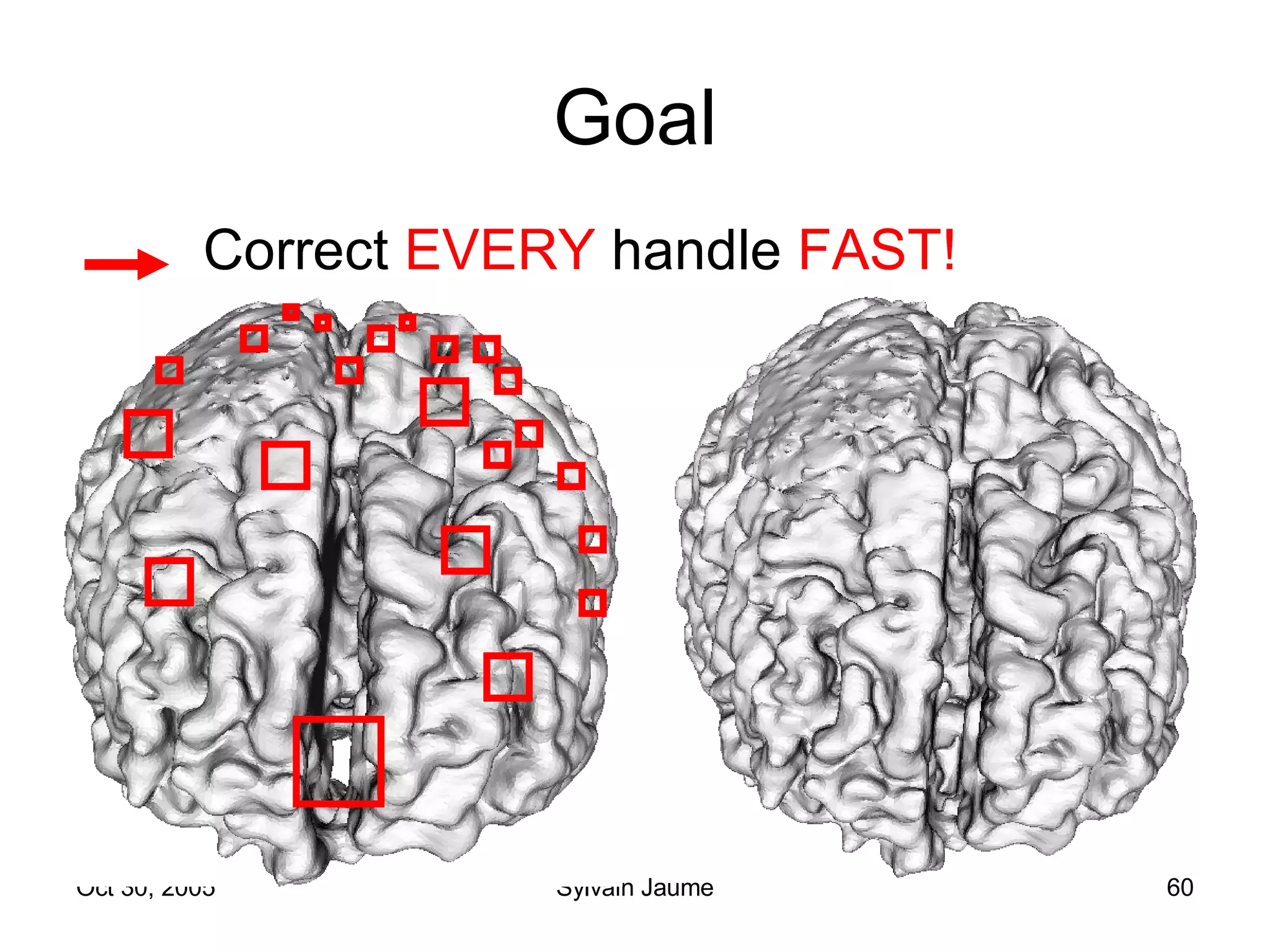
Goal Correct  EVERY  handle  FAST!
Perspectives Visualization, measurements, source localization Benchmarking with other methods Half-Edge algorithms Integration into CARET Software
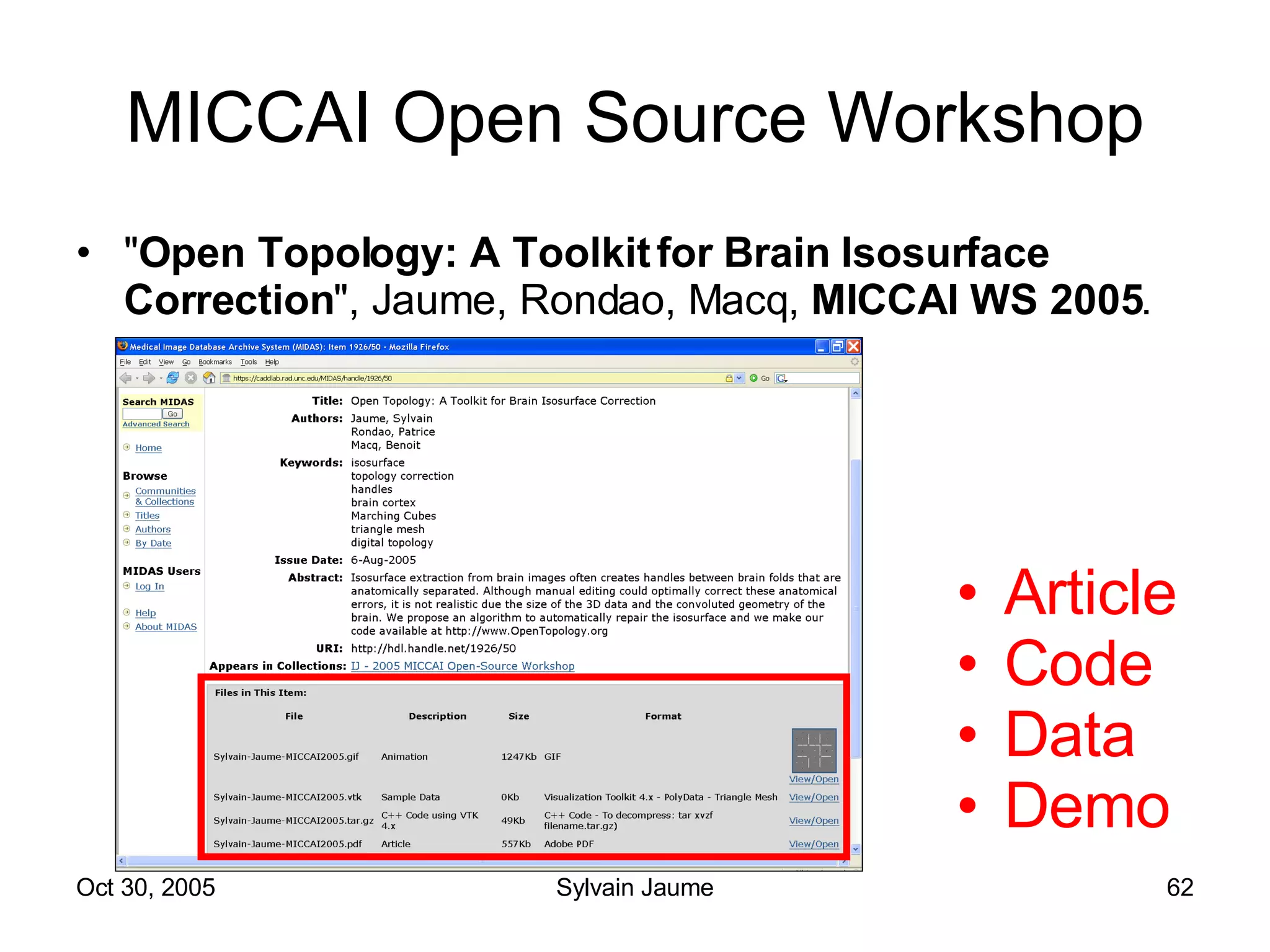
MICCAI Open Source Workshop " Open Topology: A Toolkit for Brain Isosurface Correction ", Jaume, Rondao, Macq,  MICCAI WS 2005 . Article Code Data Demo
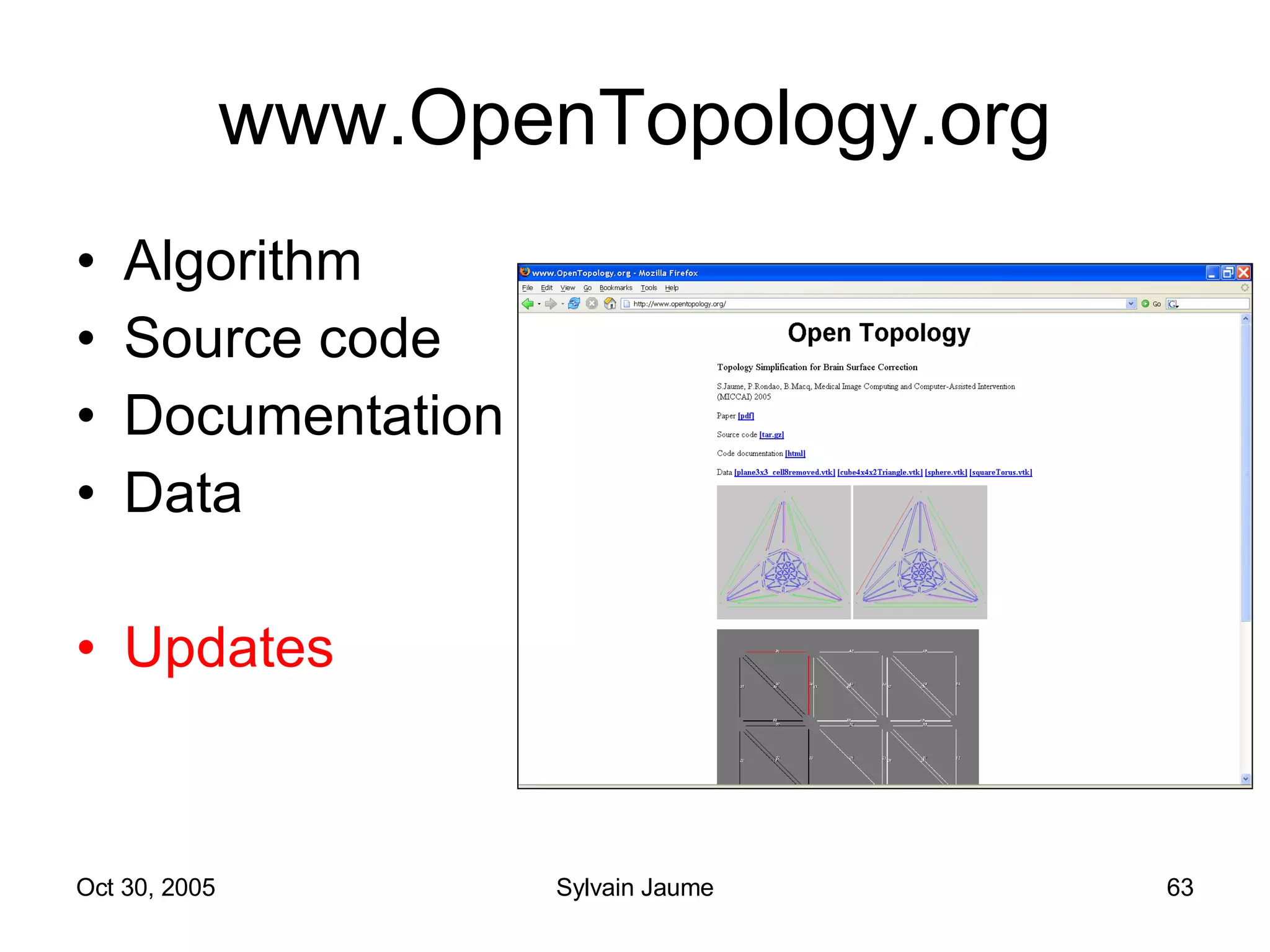
www.OpenTopology.org Algorithm Source code Documentation Data Updates
Acknowledgements Special thanks to M. Ferrant, S.K. Warfield, A.H. Barr, and many others at UCL-Belgium, CalTech, SPL, MIT, INRIA and VTK mailing list. Thank you for your interest!
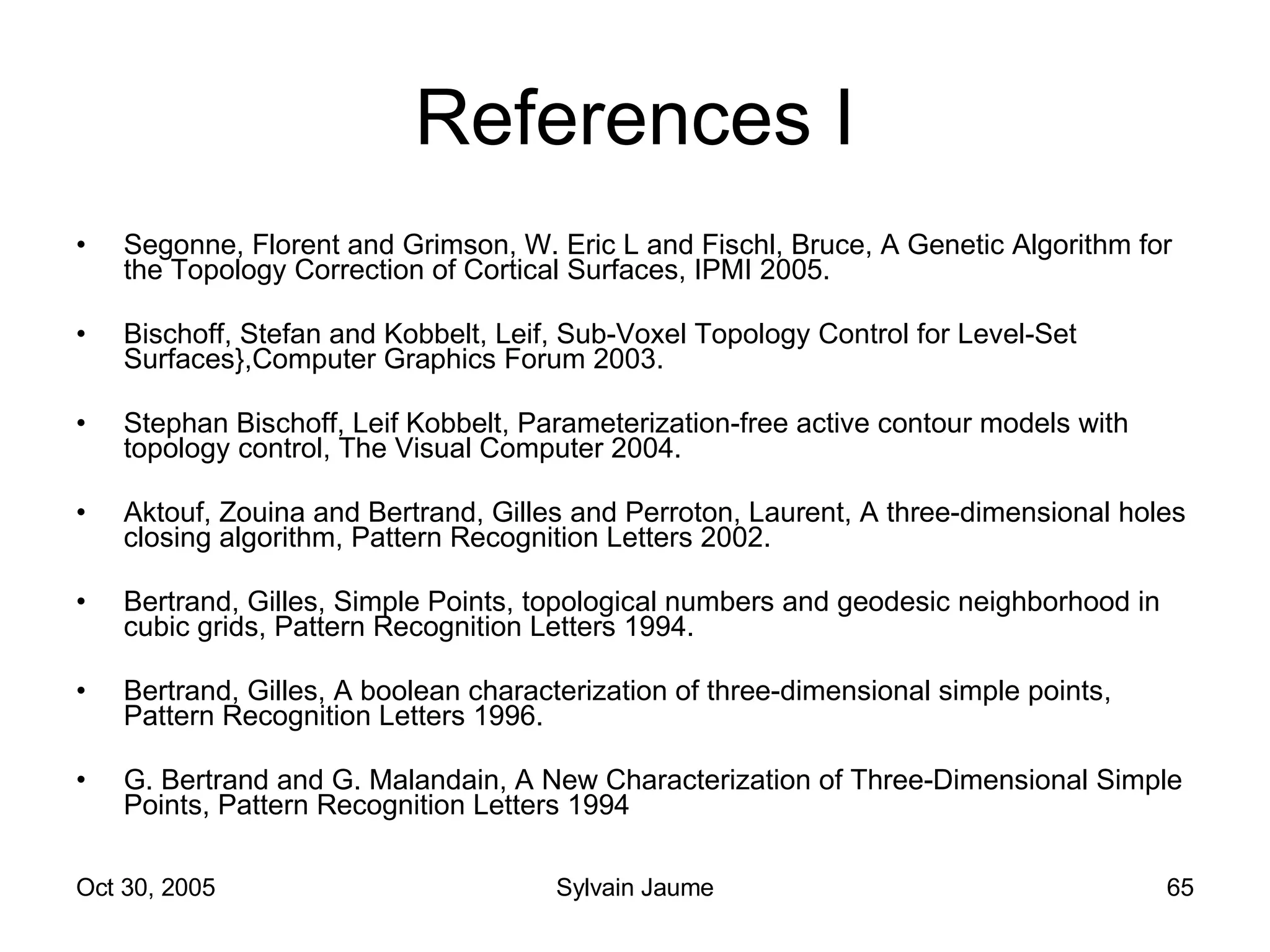
References I Segonne, Florent and Grimson, W. Eric L and Fischl, Bruce, A Genetic Algorithm for the Topology Correction of Cortical Surfaces, IPMI 2005. Bischoff, Stefan and Kobbelt, Leif, Sub-Voxel Topology Control for Level-Set Surfaces},Computer Graphics Forum 2003. Stephan Bischoff, Leif Kobbelt, Parameterization-free active contour models with topology control, The Visual Computer 2004. Aktouf, Zouina and Bertrand, Gilles and Perroton, Laurent, A three-dimensional holes closing algorithm, Pattern Recognition Letters 2002. Bertrand, Gilles, Simple Points, topological numbers and geodesic neighborhood in cubic grids, Pattern Recognition Letters 1994. Bertrand, Gilles, A boolean characterization of three-dimensional simple points, Pattern Recognition Letters 1996. G. Bertrand and G. Malandain, A New Characterization of Three-Dimensional Simple Points, Pattern Recognition Letters 1994
References II Fischl, B. and Liu, A. and Dale, A. M., Automated Manifold Surgery: Constructing Geometrically Accurate and Topologically Correct Models of the Human Cerebral Cortex, IEEE Transactions on Medical Imaging. Han, X., Xu, C., Braga-Neto, U., Prince, J., Topology Correction in Brain Cortex Segmentation Using a Multiscale Graph-based Algorithm, IEEE Transactions on Medical Imaging 2002. X. Han, C. Xu, D. Tosun, and J. L. Prince, Cortical Surface Reconstruction Using a Topology Preserving Geometric Deformable Model, MMBIA 2001. Kriegeskorte, N. and Goebel, R., An Efficient Algorithm for Topologically Correct Segmentation of the Cortical Sheet in Anatomical MR Volumes, NeuroImage, 2001. Shattuck, D. W. and Leahy, R. M., Automated Graph-based Analysis and Correction of Cortical Volume Topology, IEEE Transactions on Medical Imaging, 2001. Bischoff, S. and Kobbelt, L., Isosurface Reconstruction with Topology Control, Pacific Graphics Proceedings, 2002.
References III Bischoff, Stephan and Kobbelt, Leif, Topologically Correct Extraction of the Cortical Surface of a Brain Using Level-Set Methods, Bildverarbeitung fuer die Medizin, 2004. Malandain, Grégoire and Bertrand, Gilles and Ayache, Nicholas, Topological Segmentation of Discrete Surfaces, International Journal of Computer Vision, 1993. Zeng, X. and Staib, L. H. and Schultz, R. T. and Duncan, J. S., Segmentation and Measurement of the Cortex from 3D MR Images Using Coupled Surfaces Propagation, IEEE Transactions on Medical Imaging, 1999. Ségonne, F. and Fischl, B. and Grimson, E., Topology correction of Subcortical Structures, Medical Image Computing and Computer-Assisted Intervention (MICCAI) 2003. Guskov, I. and Wood, Z., Topological Noise Removal, Graphics Interface, 2001. Wood, Z. J. and Hoppe, H. and Desbrun, M. and Schröder, P., Removing Excess Topology from Isosurfaces, ACM Transactions on Graphics, 2004.
State of the Art Image methods Can miss large regions Mesh methods Self-intersections Graph methods Computationally intensive Level-Set methods Controlled with heuristics

Open Topology: A Toolkit for Brain Isosurface Correction-776

  • 1.
    Open Topology: AToolkit for Brain Isosurface Correction Sylvain JAUME (1) , Patrice RONDAO (2) , Benoit MACQ (2) (1) Kitware Inc., (2) University of Louvain
  • 2.
    Visualization of theBrain Speech, vision, etc. lie in the outer layer . surface visualization
  • 3.
    Visualization of theBrain 3D Image Segmentation Marching Cubes Smoothing Mesh
  • 4.
    Visualization of theBrain 3D Image Segmentation Marching Cubes Smoothing Mesh
  • 5.
    Visualization of theBrain 3D Image Segmentation Marching Cubes Smoothing Mesh
  • 6.
    Visualization of theBrain 3D Image Segmentation Marching Cubes Smoothing Mesh with Handles
  • 7.
    Visualization of theBrain 3D Image Segmentation Marching Cubes Smoothing Mesh with Handles
  • 8.
    Visualization of theBrain 3D Image Segmentation Marching Cubes Smoothing Mesh with Handles
  • 9.
    Visualization of theBrain 3D Image Segmentation Marching Cubes Smoothing Mesh with Handles
  • 10.
    Visualization of theBrain 3D Image Segmentation Marching Cubes Smoothing Mesh with Handles
  • 11.
    Visualization of theBrain Where do handles come from ? Limited resolution Scanner artifacts Segmentation errors
  • 12.
    Visualization of theBrain Does it really matter ??? For 3D visualization For distance measurements For EEG source localization
  • 13.
    State of theArt Image methods Malandain 93, Shattuck 01, Kriegeskorte 01 Mesh methods Fischl 01, Guskov 01, Wood 04, Segonne 05 Graph methods Han 02, Segonne 03 Level-Set methods Han 01, Bischoff 02
  • 14.
    Contributions No regionis left out Fast (less than 2 min ) Open Source
  • 15.
    Algorithm Overview MarchingCubes Handle Detection Handle Correction 3D Image Triangle Mesh Corrected 3D Image Contours
  • 16.
    Algorithm Overview MarchingCubes Handle Detection Handle Correction 3D Image Triangle Mesh Contours Corrected 3D Image
  • 17.
    Algorithm Overview MarchingCubes Handle Detection Handle Correction 3D Image Triangle Mesh Contours Corrected 3D Image
  • 18.
    Algorithm Overview MarchingCubes Handle Detection Handle Correction 3D Image Triangle Mesh Polylines Corrected 3D Image
  • 19.
    Algorithm Overview MarchingCubes Handle Detection Handle Correction 3D Image Triangle Mesh Contours Corrected 3D Image
  • 20.
    Algorithm Overview MarchingCubes Handle Detection Handle Correction 3D Image Triangle Mesh Contours Corrected 3D Image
  • 21.
    Algorithm Overview MarchingCubes Handle Detection Handle Correction 3D Image Triangle Mesh Contours Corrected 3D Image
  • 22.
    Algorithm Overview MarchingCubes Handle Detection Handle Correction 3D Image Triangle Mesh Contours Marching Cubes Corrected Mesh Corrected 3D Image
  • 23.
    Algorithm Overview MarchingCubes Handle Detection Handle Correction 3D Image Triangle Mesh Contours Marching Cubes Corrected Mesh Corrected 3D Image
  • 24.
    Key Points 1.Embracing the Handle 2. Holding it Tight 3. Filling the Handle
  • 25.
  • 26.
    1. Embracing theHandle Init
  • 27.
    1. Embracing theHandle Init
  • 28.
    1. Embracing theHandle Init
  • 29.
    1. Embracing theHandle Init
  • 30.
    1. Embracing theHandle Split
  • 31.
    1. Embracing theHandle Split
  • 32.
    1. Embracing theHandle Split
  • 33.
    1. Embracing theHandle Merge
  • 34.
    1. Embracing theHandle Merge
  • 35.
    1. Embracing theHandle Merge
  • 36.
    1. Embracing theHandle Merge
  • 37.
    1. Embracing theHandle Merge
  • 38.
    1. Embracing theHandle Merge
  • 39.
    1. Embracing theHandle Finalize
  • 40.
    1. Embracing theHandle Finalize
  • 41.
    1. Embracing theHandle Finalize
  • 42.
    2. Holding itTight Distance
  • 43.
    2. Holding itTight Distance
  • 44.
    2. Holding itTight Distance
  • 45.
    2. Holding itTight Distance
  • 46.
    2. Holding itTight Distance
  • 47.
    2. Holding itTight Distance
  • 48.
    2. Holding itTight Distance
  • 49.
    2. Holding itTight Distance
  • 50.
    2. Holding itTight Distance
  • 51.
    3. Filling theHandle New pixel intensity inside the loop
  • 52.
    Putting it TogetherHandle Detection Embracing the handle Handle Localization Holding it tight Handle Correction Filling the handle
  • 53.
    Performance g: genus,i.e. number of handles V: number of vertices E: number of edges F: number of faces C: number of connected components Euler Characteristic
  • 54.
    Data Structures vtkCellLinksvtkCellArray vtkPoints
  • 55.
    Data Structures Edgeto Start Point Edge to End Point Edge to Polygon Half-Edge vtkCellArray vtkPoints
  • 56.
    Data Structures Edgeto Reverse Edge Edge to Parent Edge Detection Localization Half-Edge vtkCellArray vtkPoints
  • 57.
    Data Structures Edgeto Contour Edge to Distance Detection Localization Half-Edge vtkCellArray vtkPoints
  • 58.
    Data Structures ExtendedHalf-Edge Structure: Edge to Polygon Edge to Start Point Edge to End Point Edge to Reverse Edge Edge to Parent Edge Edge to Contour Edge to Distance
  • 59.
    Code vtkHandleDetection Half-edgestructure Area growing Shortest loop vtkHandleCorrection Loop to image Water-tight region
  • 60.
    Goal Correct EVERY handle FAST!
  • 61.
    Perspectives Visualization, measurements,source localization Benchmarking with other methods Half-Edge algorithms Integration into CARET Software
  • 62.
    MICCAI Open SourceWorkshop " Open Topology: A Toolkit for Brain Isosurface Correction ", Jaume, Rondao, Macq, MICCAI WS 2005 . Article Code Data Demo
  • 63.
    www.OpenTopology.org Algorithm Sourcecode Documentation Data Updates
  • 64.
    Acknowledgements Special thanksto M. Ferrant, S.K. Warfield, A.H. Barr, and many others at UCL-Belgium, CalTech, SPL, MIT, INRIA and VTK mailing list. Thank you for your interest!
  • 65.
    References I Segonne,Florent and Grimson, W. Eric L and Fischl, Bruce, A Genetic Algorithm for the Topology Correction of Cortical Surfaces, IPMI 2005. Bischoff, Stefan and Kobbelt, Leif, Sub-Voxel Topology Control for Level-Set Surfaces},Computer Graphics Forum 2003. Stephan Bischoff, Leif Kobbelt, Parameterization-free active contour models with topology control, The Visual Computer 2004. Aktouf, Zouina and Bertrand, Gilles and Perroton, Laurent, A three-dimensional holes closing algorithm, Pattern Recognition Letters 2002. Bertrand, Gilles, Simple Points, topological numbers and geodesic neighborhood in cubic grids, Pattern Recognition Letters 1994. Bertrand, Gilles, A boolean characterization of three-dimensional simple points, Pattern Recognition Letters 1996. G. Bertrand and G. Malandain, A New Characterization of Three-Dimensional Simple Points, Pattern Recognition Letters 1994
  • 66.
    References II Fischl,B. and Liu, A. and Dale, A. M., Automated Manifold Surgery: Constructing Geometrically Accurate and Topologically Correct Models of the Human Cerebral Cortex, IEEE Transactions on Medical Imaging. Han, X., Xu, C., Braga-Neto, U., Prince, J., Topology Correction in Brain Cortex Segmentation Using a Multiscale Graph-based Algorithm, IEEE Transactions on Medical Imaging 2002. X. Han, C. Xu, D. Tosun, and J. L. Prince, Cortical Surface Reconstruction Using a Topology Preserving Geometric Deformable Model, MMBIA 2001. Kriegeskorte, N. and Goebel, R., An Efficient Algorithm for Topologically Correct Segmentation of the Cortical Sheet in Anatomical MR Volumes, NeuroImage, 2001. Shattuck, D. W. and Leahy, R. M., Automated Graph-based Analysis and Correction of Cortical Volume Topology, IEEE Transactions on Medical Imaging, 2001. Bischoff, S. and Kobbelt, L., Isosurface Reconstruction with Topology Control, Pacific Graphics Proceedings, 2002.
  • 67.
    References III Bischoff,Stephan and Kobbelt, Leif, Topologically Correct Extraction of the Cortical Surface of a Brain Using Level-Set Methods, Bildverarbeitung fuer die Medizin, 2004. Malandain, Grégoire and Bertrand, Gilles and Ayache, Nicholas, Topological Segmentation of Discrete Surfaces, International Journal of Computer Vision, 1993. Zeng, X. and Staib, L. H. and Schultz, R. T. and Duncan, J. S., Segmentation and Measurement of the Cortex from 3D MR Images Using Coupled Surfaces Propagation, IEEE Transactions on Medical Imaging, 1999. Ségonne, F. and Fischl, B. and Grimson, E., Topology correction of Subcortical Structures, Medical Image Computing and Computer-Assisted Intervention (MICCAI) 2003. Guskov, I. and Wood, Z., Topological Noise Removal, Graphics Interface, 2001. Wood, Z. J. and Hoppe, H. and Desbrun, M. and Schröder, P., Removing Excess Topology from Isosurfaces, ACM Transactions on Graphics, 2004.
  • 68.
    State of theArt Image methods Can miss large regions Mesh methods Self-intersections Graph methods Computationally intensive Level-Set methods Controlled with heuristics