MEDICAL IMAGE COMPUTING (CAP 5937)
LECTURE 7: Medical Image Segmentation (I)
(Radiology Applications of Segmentation, and Thresholding)
Dr. Ulas Bagci
HEC 221, Center for Research in Computer
Vision (CRCV), University of Central Florida
(UCF), Orlando, FL 32814.
bagci@ucf.edu or bagci@crcv.ucf.edu
1SPRING 2017
Outline
• Introduction to Medical Image Segmentation, type of
segmentation methods, and definitions
– Recognition & Delineation
• Simplest Segmentation Method(s): Thresholding
– Otsu Thresholding
– Parametric Method
– PET Image Thresholding Methods
• ITM (Iterative Thresholding Method)
2
Motivation for Image Segmentation
In the last 20 years the computer vision and medical imaging
communities have produced a number of useful algorithms for
localizing object boundaries in images.
3
Motivation for Image Segmentation
• Content based image retrieval
• Machine Vision
• Medical Imaging applications (tumor delineation,..)
• Object detection (face detection,…)
• 3D Reconstruction
• Object/Motion Tracking
• Object-based measurements such as size and shape
• Object recognition (face recognition,…)
• Fingerprint recognition,
• Video surveillance
• …
4
Segmentation Tools in RadiologyApplications
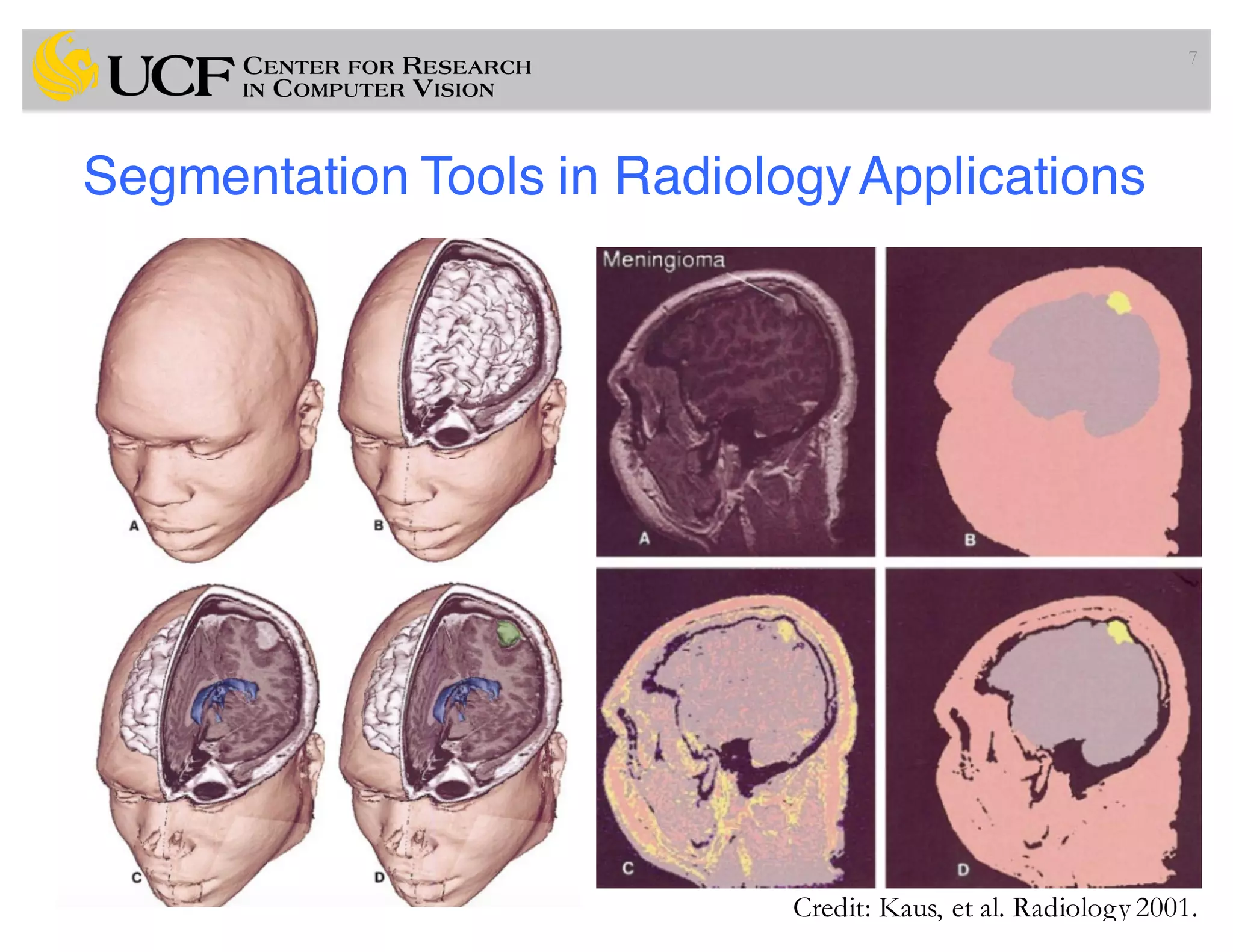
• 3D views to visualize structural information and spatial
anatomic relationships is a difficult task, which is usually
carried out in the clinician’s mind.
5
Segmentation Tools in RadiologyApplications
• 3D views to visualize structural information and spatial
anatomic relationships is a difficult task, which is usually
carried out in the clinician’s mind.
• Image-processing tools provide the surgeon with interactively
displayed 3D visual information.
6
Segmentation Tools in RadiologyApplications
7
Credit: Kaus, et al. Radiology 2001.
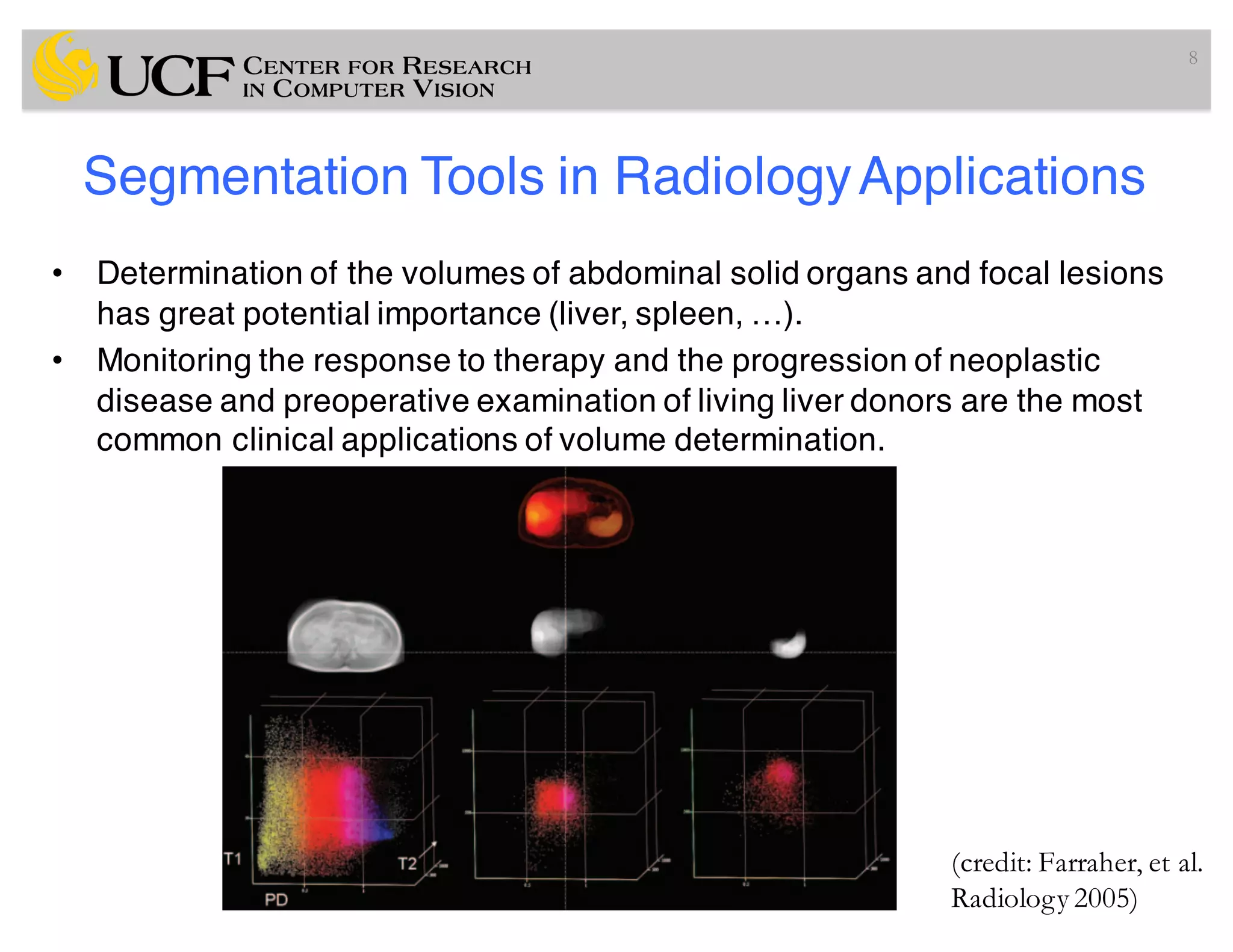
• Determination of the volumes of abdominal solid organs and focal lesions
has great potential importance (liver, spleen, …).
• Monitoring the response to therapy and the progression of neoplastic
disease and preoperative examination of living liver donors are the most
common clinical applications of volume determination.
8
Segmentation Tools in RadiologyApplications
(credit: Farraher, et al.
Radiology 2005)
Segmentation Tools in RadiologyApplications
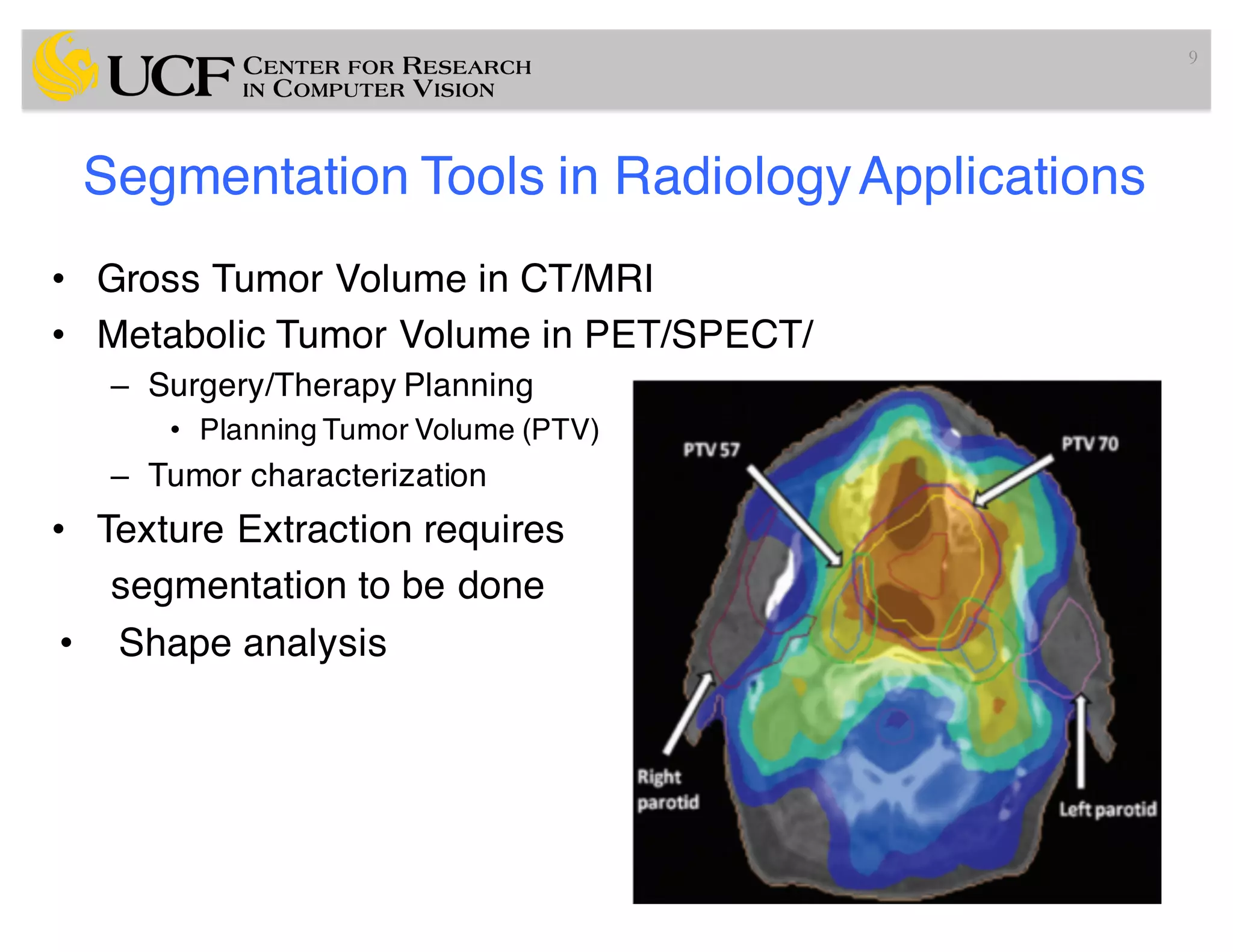
• Gross Tumor Volume in CT/MRI
• Metabolic Tumor Volume in PET/SPECT/
– Surgery/Therapy Planning
• Planning Tumor Volume (PTV)
– Tumor characterization
• Texture Extraction requires
segmentation to be done
• Shape analysis
9
Segmentation Tools in RadiologyApplications
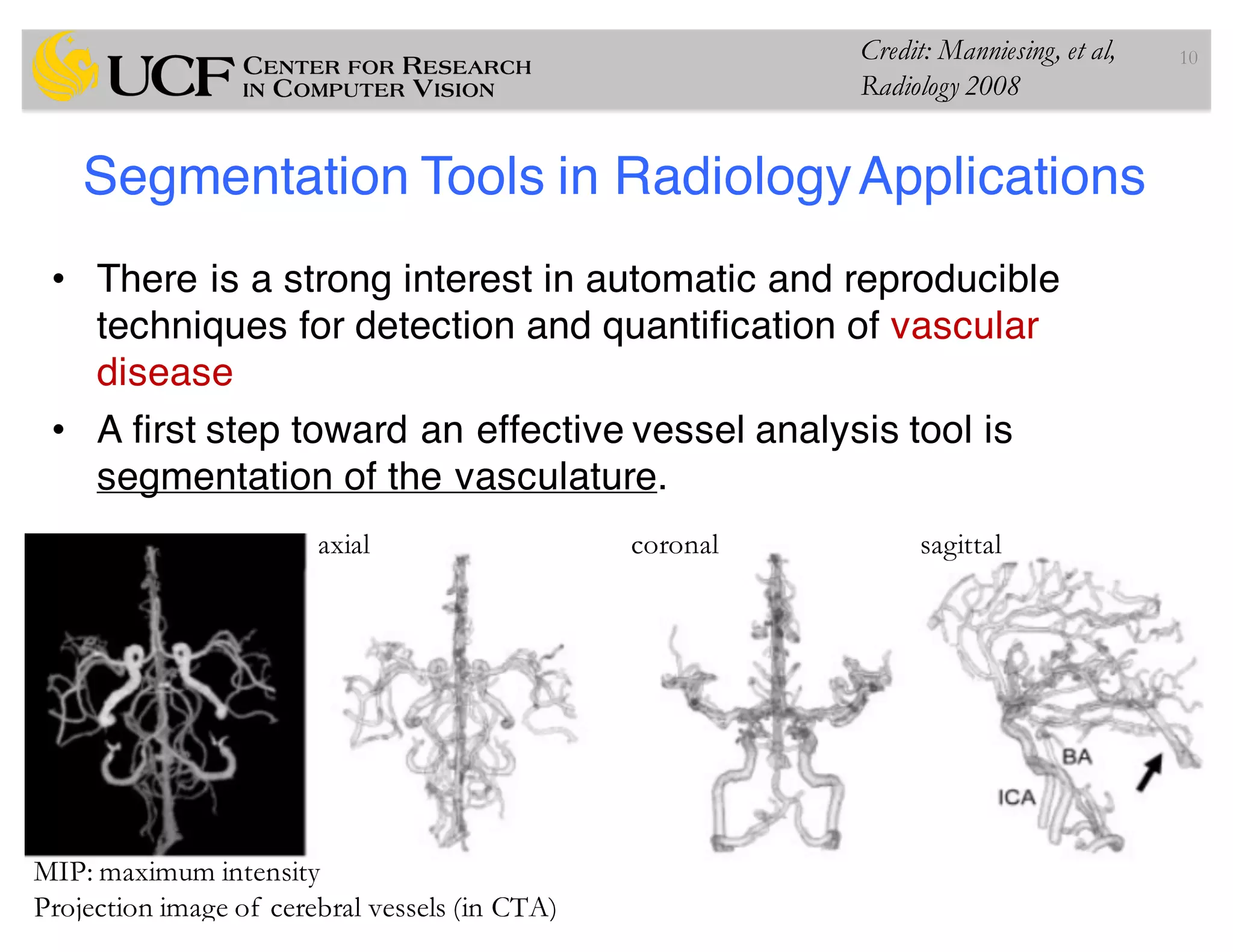
• There is a strong interest in automatic and reproducible
techniques for detection and quantification of vascular
disease
• A first step toward an effective vessel analysis tool is
segmentation of the vasculature.
10
axial coronal sagittal
Credit: Manniesing, et al,
Radiology 2008
MIP: maximum intensity
Projection image of cerebral vessels (in CTA)
Segmentation Tools in RadiologyApplications
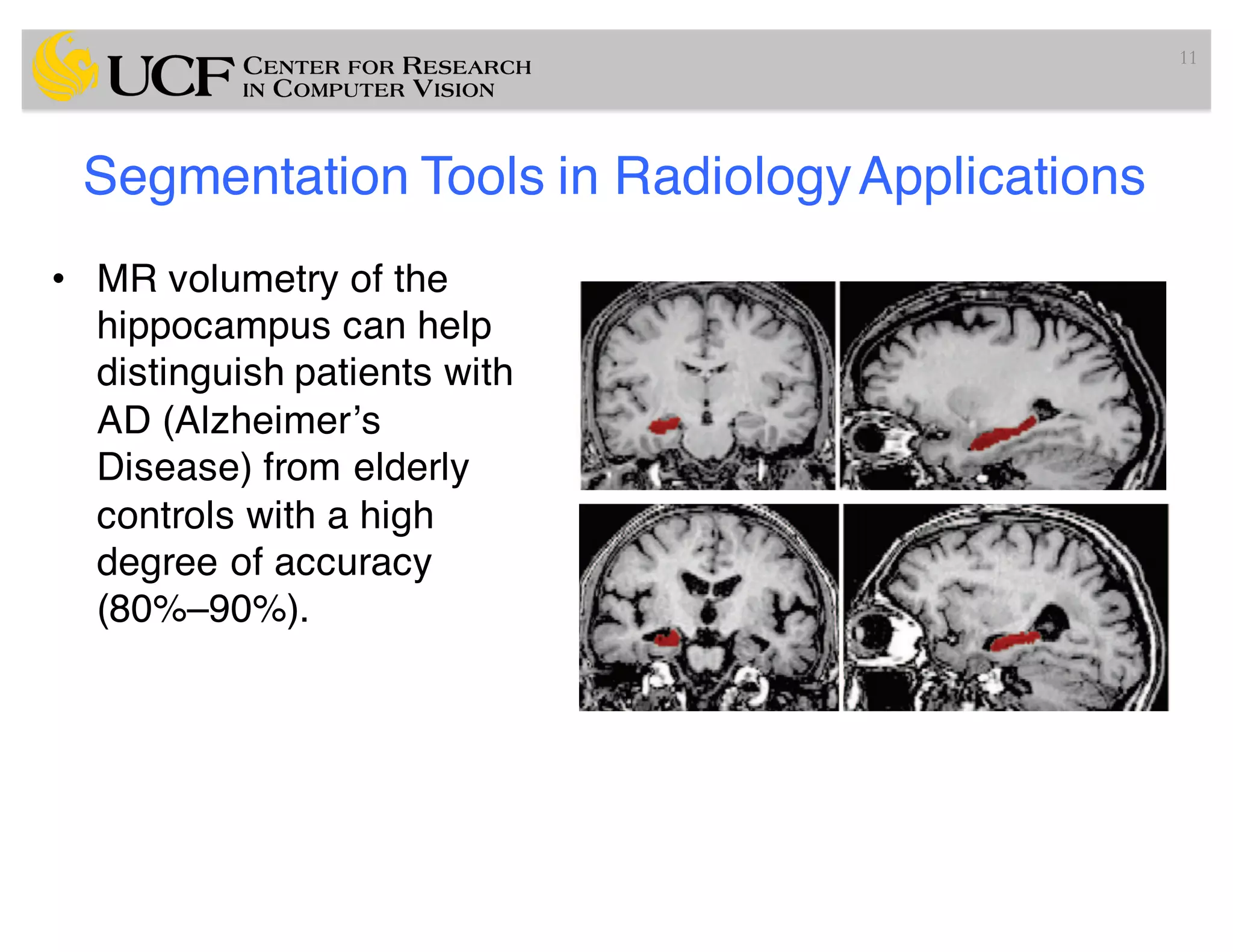
• MR volumetry of the
hippocampus can help
distinguish patients with
AD (Alzheimer’s
Disease) from elderly
controls with a high
degree of accuracy
(80%–90%).
11
Segmentation Tools in RadiologyApplications
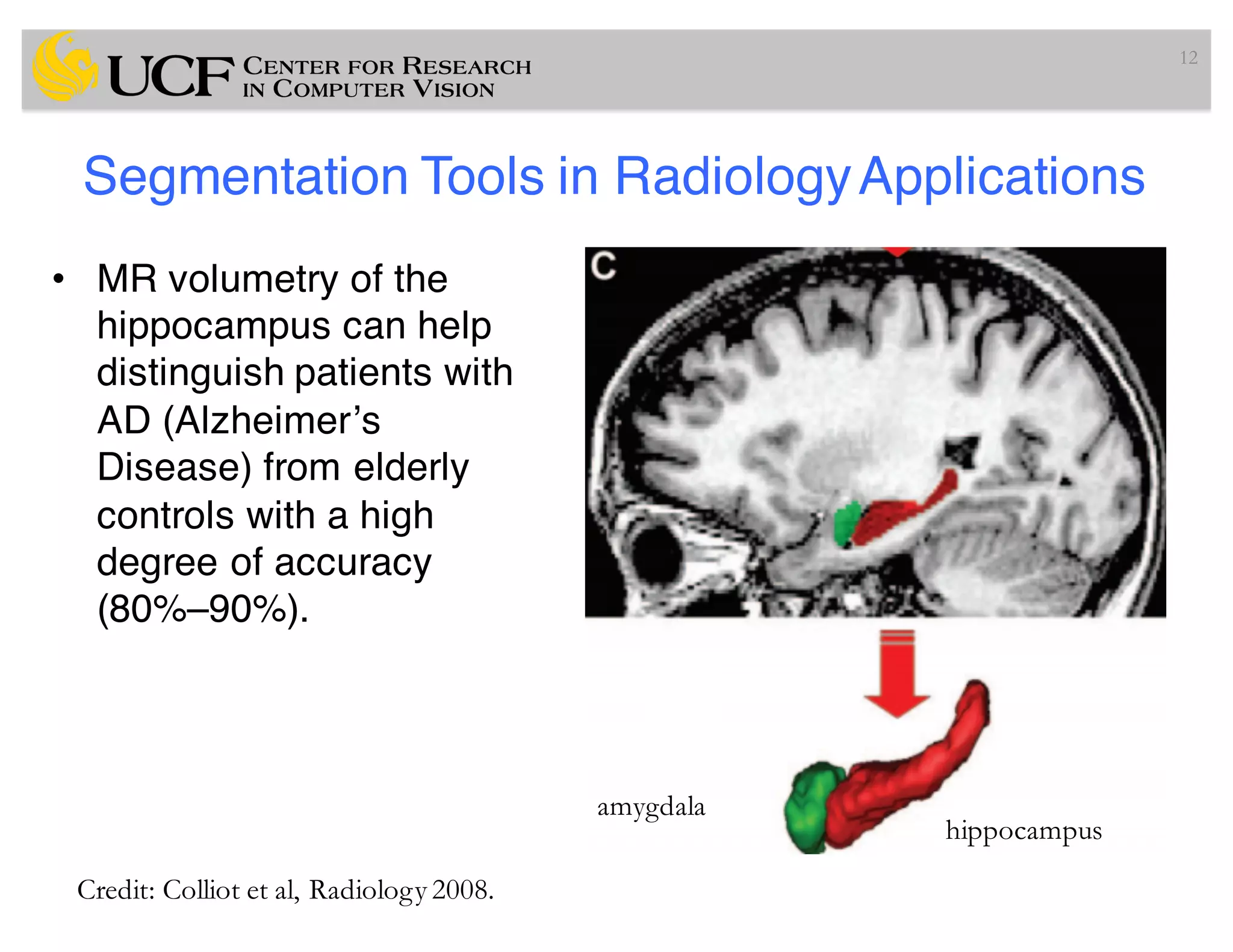
• MR volumetry of the
hippocampus can help
distinguish patients with
AD (Alzheimer’s
Disease) from elderly
controls with a high
degree of accuracy
(80%–90%).
12
hippocampus
amygdala
Credit: Colliot et al, Radiology 2008.
Image Segmentation
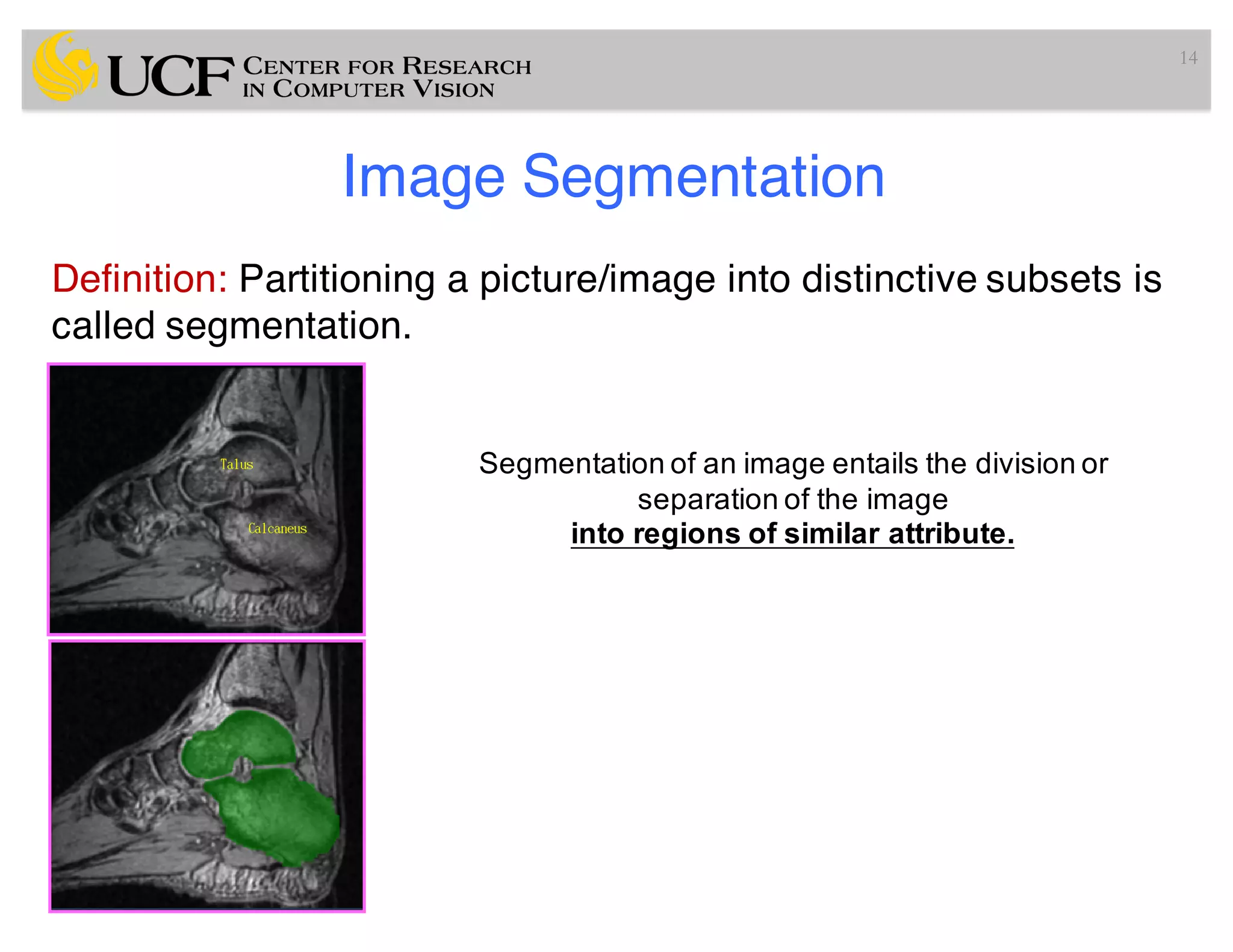
Definition: Partitioning a picture/image into distinctive subsets is
called segmentation.
13
Image Segmentation
Definition: Partitioning a picture/image into distinctive subsets is
called segmentation.
14
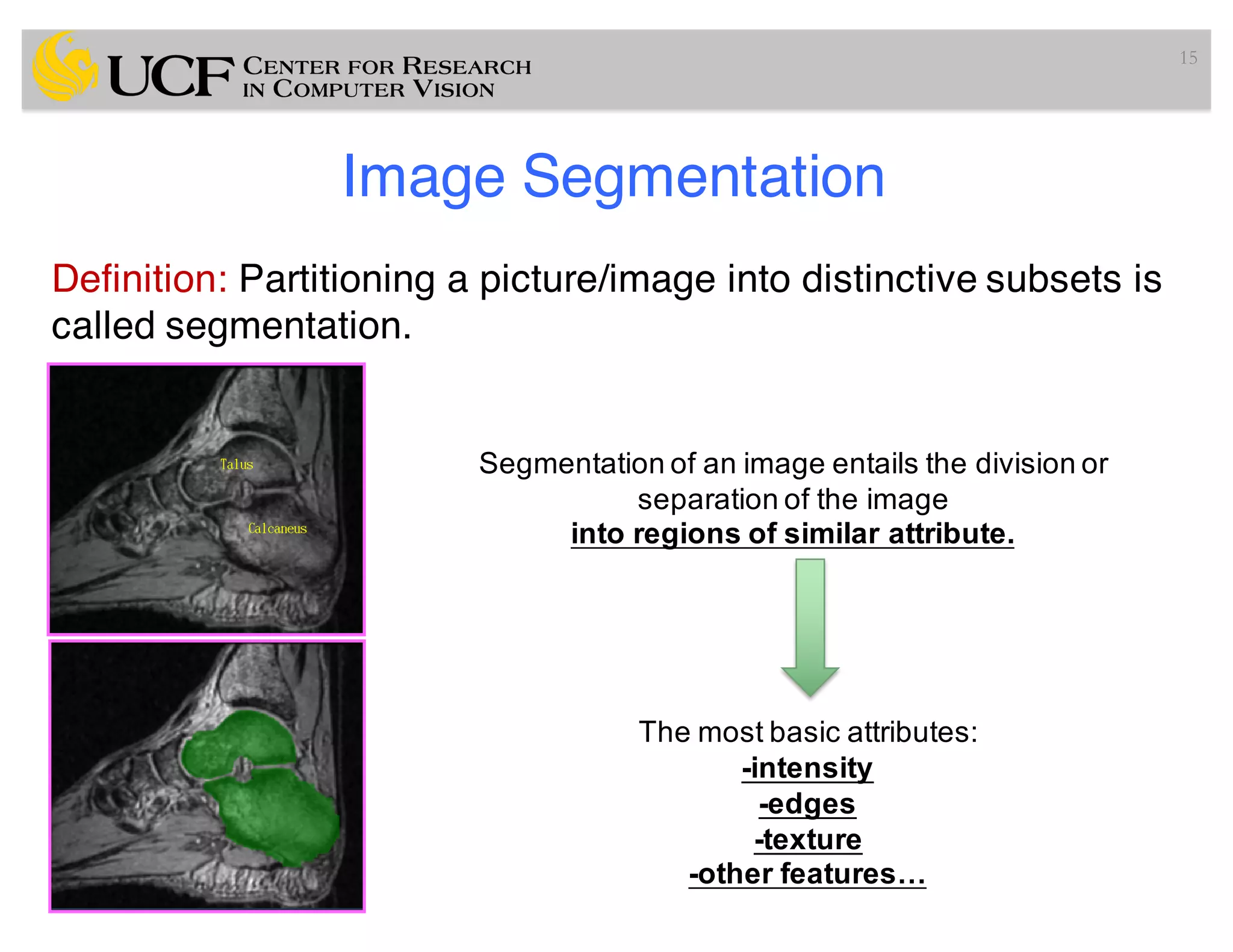
Segmentation of an image entails the division or
separation of the image
into regions of similar attribute.
Image Segmentation
Definition: Partitioning a picture/image into distinctive subsets is
called segmentation.
15
Segmentation of an image entails the division or
separation of the image
into regions of similar attribute.
The most basic attributes:
-intensity
-edges
-texture
-other features…
Image Segmentation
Definition: Partitioning a picture/image into distinctive subsets is
called segmentation.
16
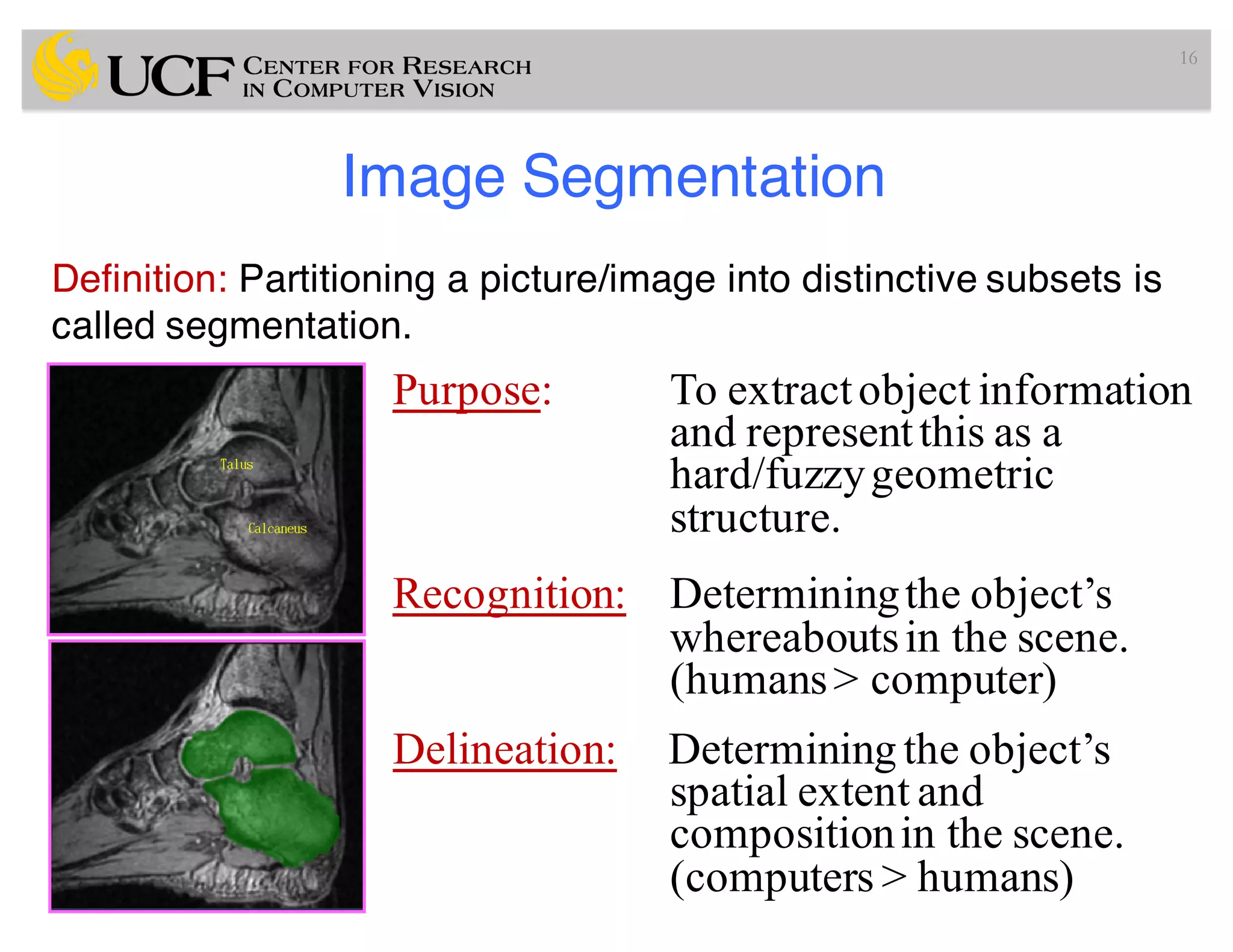
Purpose: To extractobject information
and representthis as a
hard/fuzzygeometric
structure.
Recognition: Determiningthe object’s
whereaboutsin the scene.
(humans> computer)
Delineation: Determining the object’s
spatial extent and
compositionin the scene.
(computers > humans)
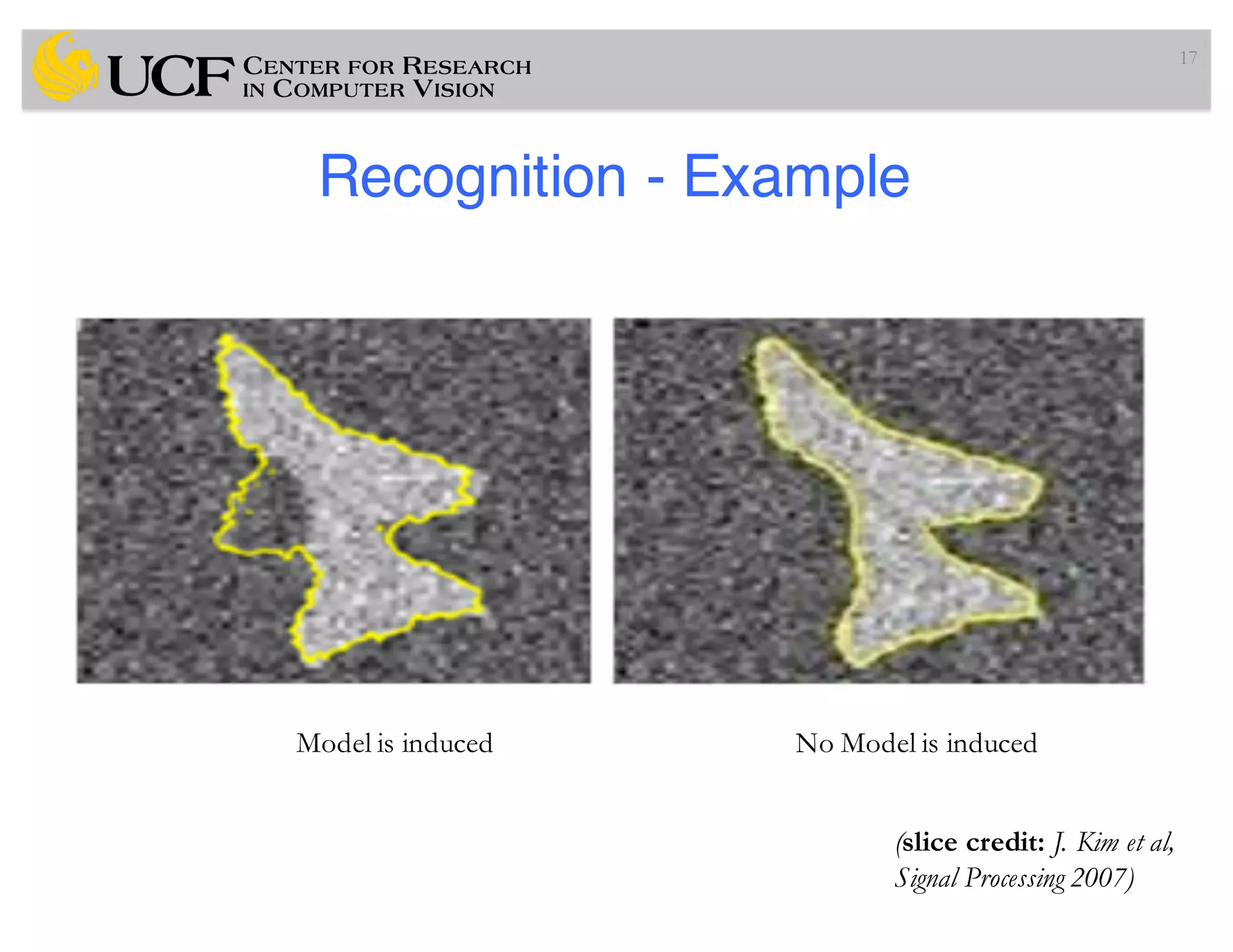
Recognition - Example
17
(slice credit: J. Kim et al,
Signal Processing 2007)
Model is induced No Model is induced
Approaches to Recognition
18
• Model-based
• Knowledge-based - Non-interactive
• Atlas-based
• Human-assisted - Interactive
Approaches to Recognition
19
• Model-based
• Knowledge-based - Non-interactive
• Atlas-based
• Human-assisted - Interactive
- They all originate from human knowledge.
- Their relative efficacy is unknown.
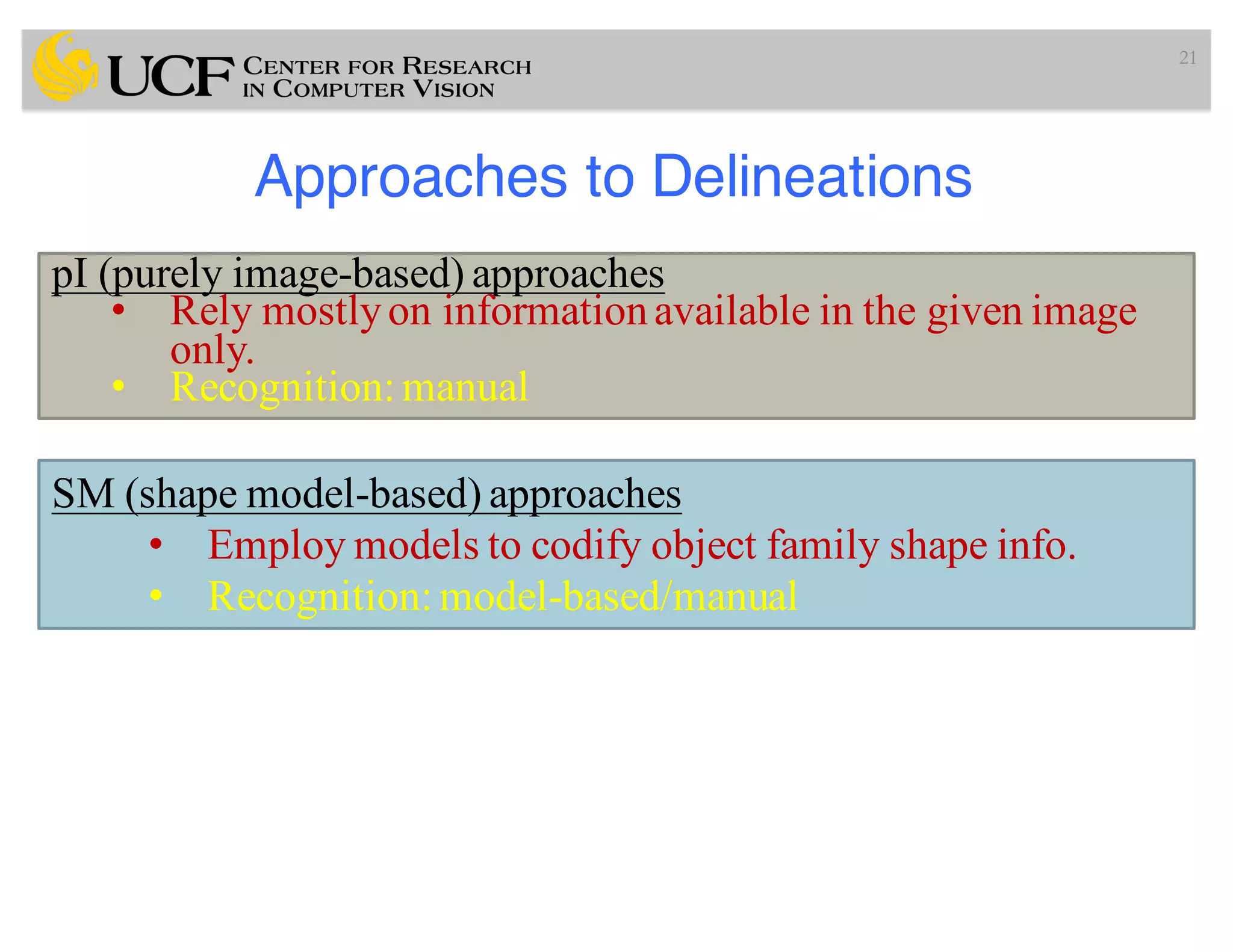
Approaches to Delineations
20
pI (purely image-based) approaches
• Rely mostlyon informationavailable in the given image
only.
• Recognition: manual
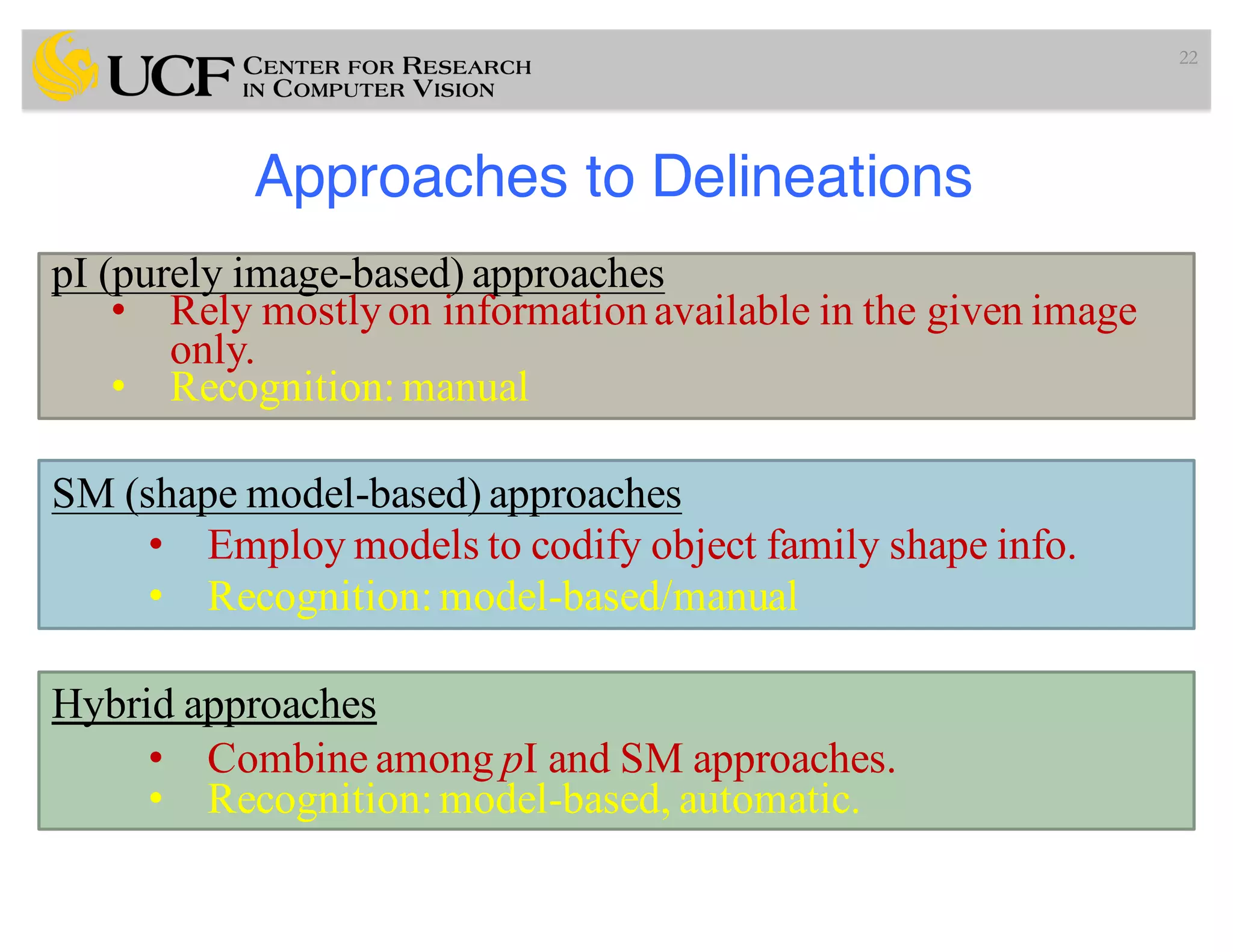
Approaches to Delineations
21
pI (purely image-based) approaches
• Rely mostlyon informationavailable in the given image
only.
• Recognition: manual
SM (shape model-based) approaches
• Employ models to codify object family shape info.
• Recognition: model-based/manual
Approaches to Delineations
22
pI (purely image-based) approaches
• Rely mostlyon informationavailable in the given image
only.
• Recognition: manual
SM (shape model-based) approaches
• Employ models to codify object family shape info.
• Recognition: model-based/manual
Hybrid approaches
• Combine among pI and SM approaches.
• Recognition: model-based, automatic.
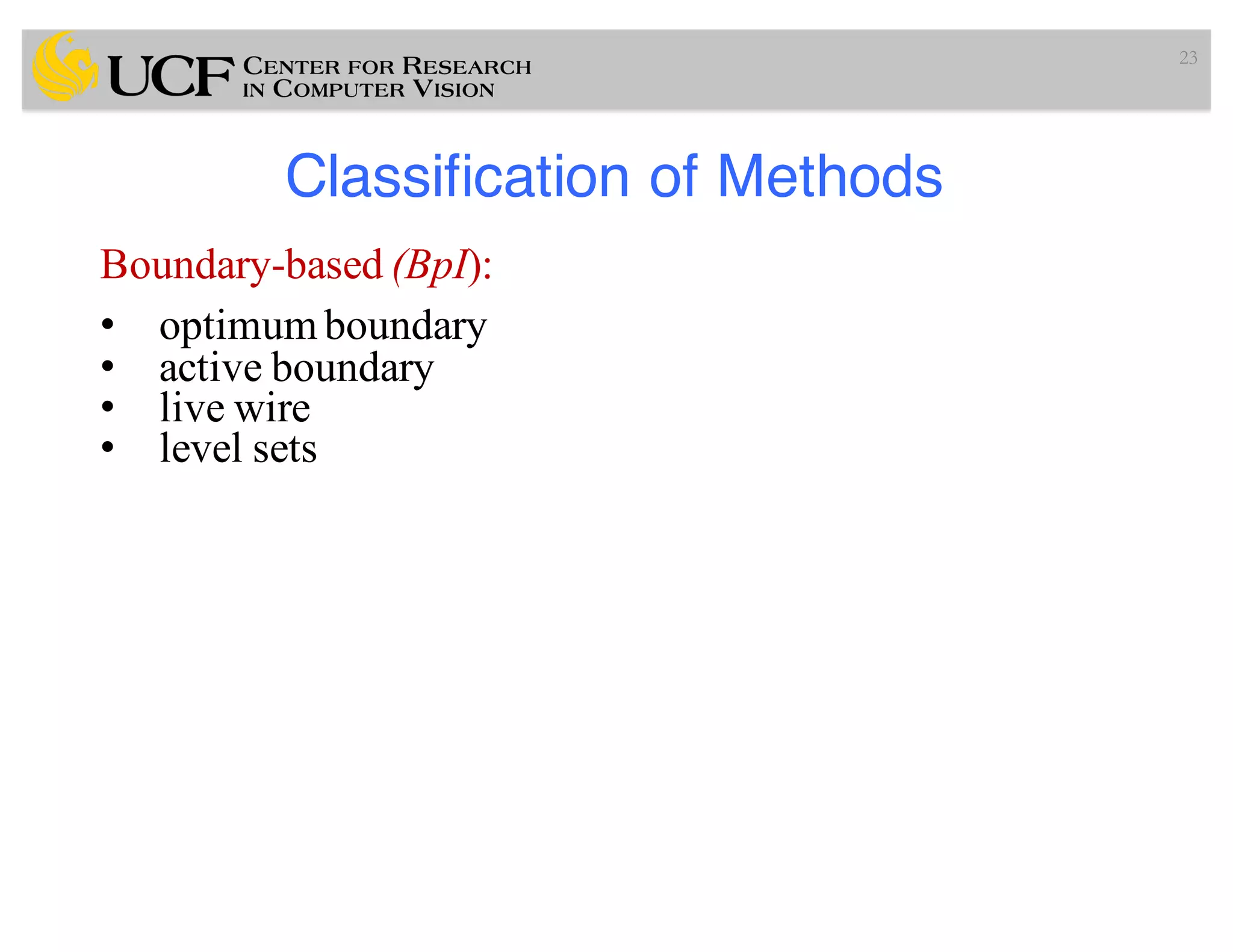
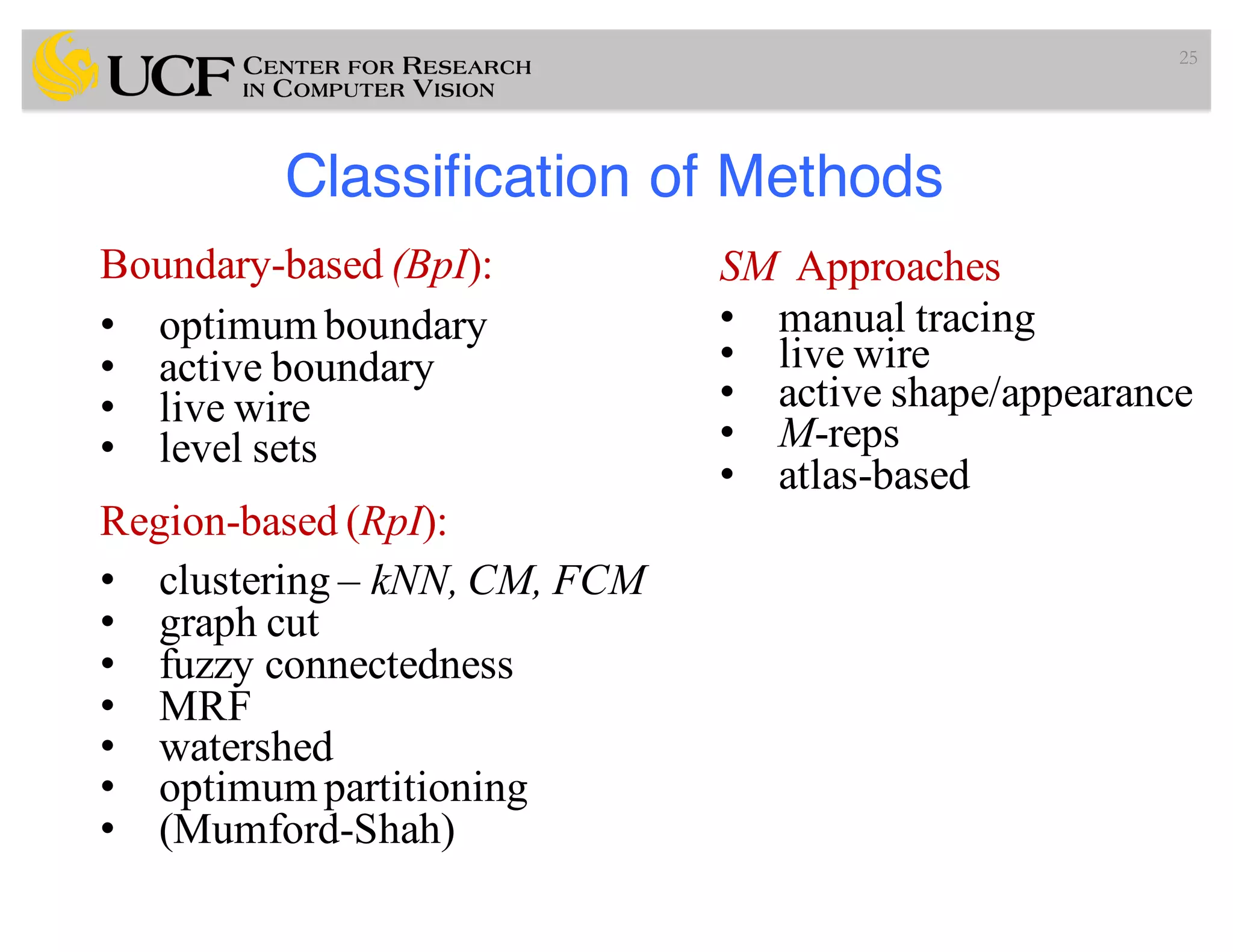
Classification of Methods
23
Boundary-based (BpI):
• optimum boundary
• active boundary
• live wire
• level sets
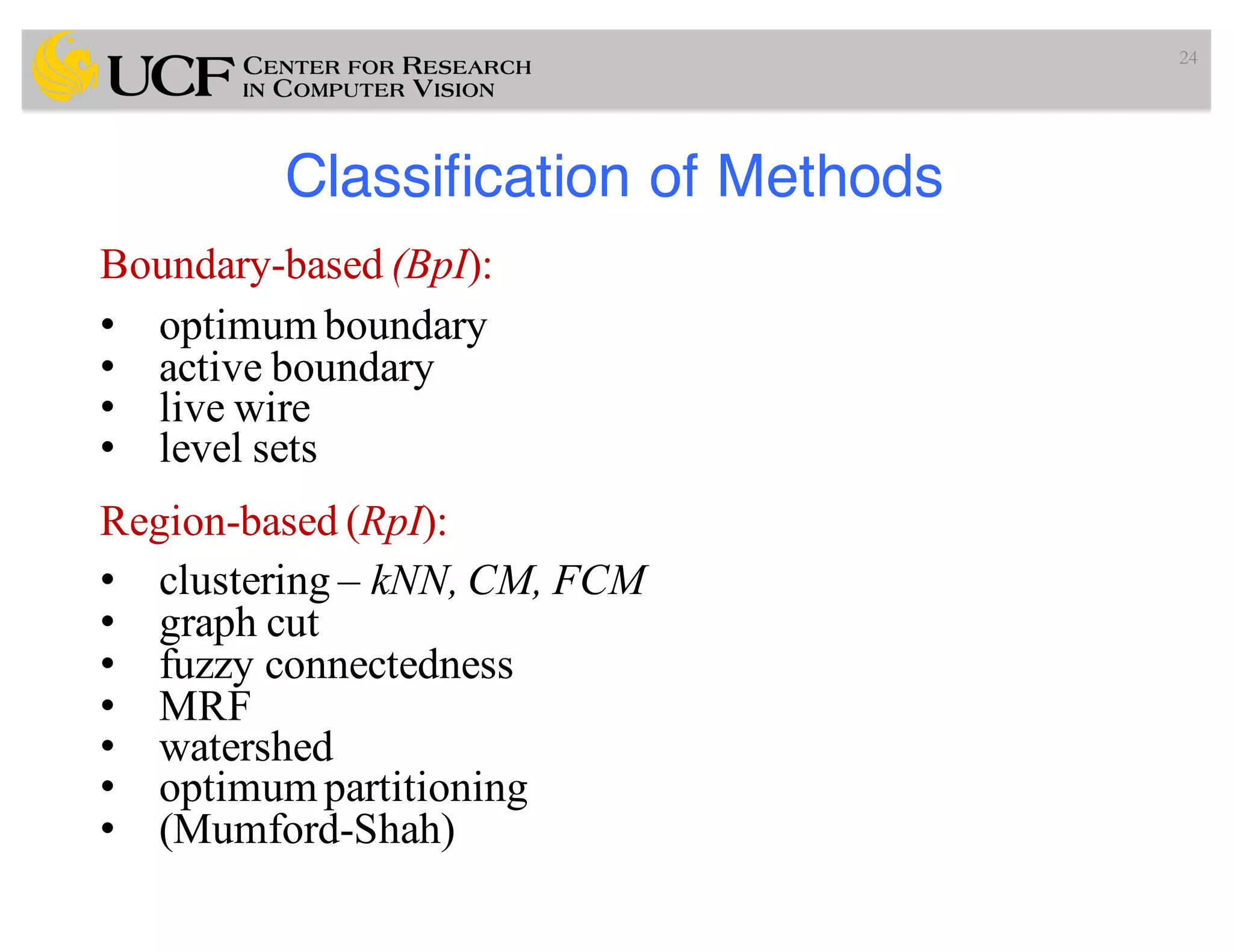
Classification of Methods
24
Boundary-based (BpI):
• optimum boundary
• active boundary
• live wire
• level sets
Region-based (RpI):
• clustering – kNN, CM, FCM
• graph cut
• fuzzy connectedness
• MRF
• watershed
• optimum partitioning
• (Mumford-Shah)
Classification of Methods
25
Boundary-based (BpI):
• optimum boundary
• active boundary
• live wire
• level sets
Region-based (RpI):
• clustering – kNN, CM, FCM
• graph cut
• fuzzy connectedness
• MRF
• watershed
• optimum partitioning
• (Mumford-Shah)
SM Approaches
• manual tracing
• live wire
• active shape/appearance
• M-reps
• atlas-based
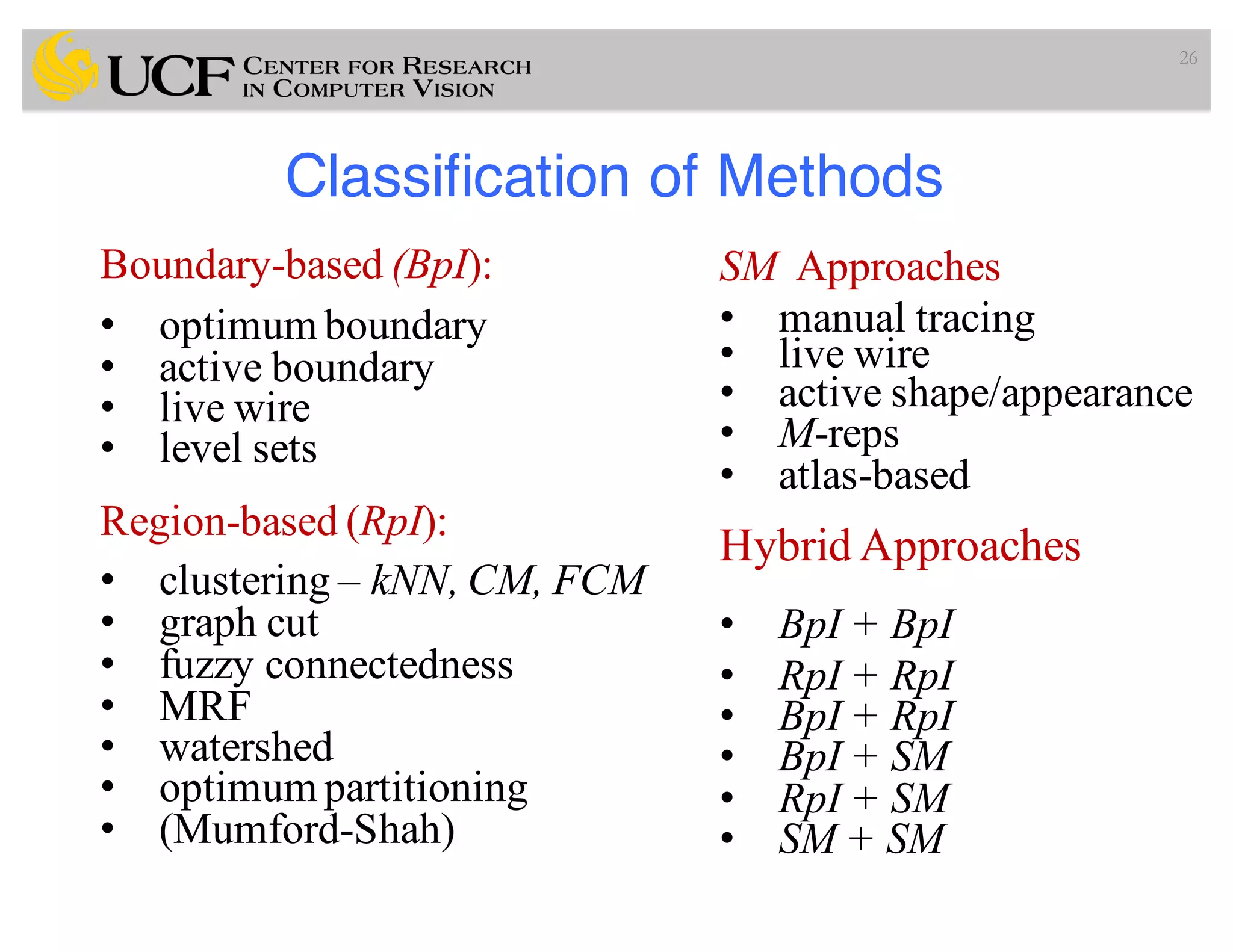
Classification of Methods
26
Boundary-based (BpI):
• optimum boundary
• active boundary
• live wire
• level sets
Region-based (RpI):
• clustering – kNN, CM, FCM
• graph cut
• fuzzy connectedness
• MRF
• watershed
• optimum partitioning
• (Mumford-Shah)
SM Approaches
• manual tracing
• live wire
• active shape/appearance
• M-reps
• atlas-based
Hybrid Approaches
• BpI + BpI
• RpI + RpI
• BpI + RpI
• BpI + SM
• RpI + SM
• SM + SM
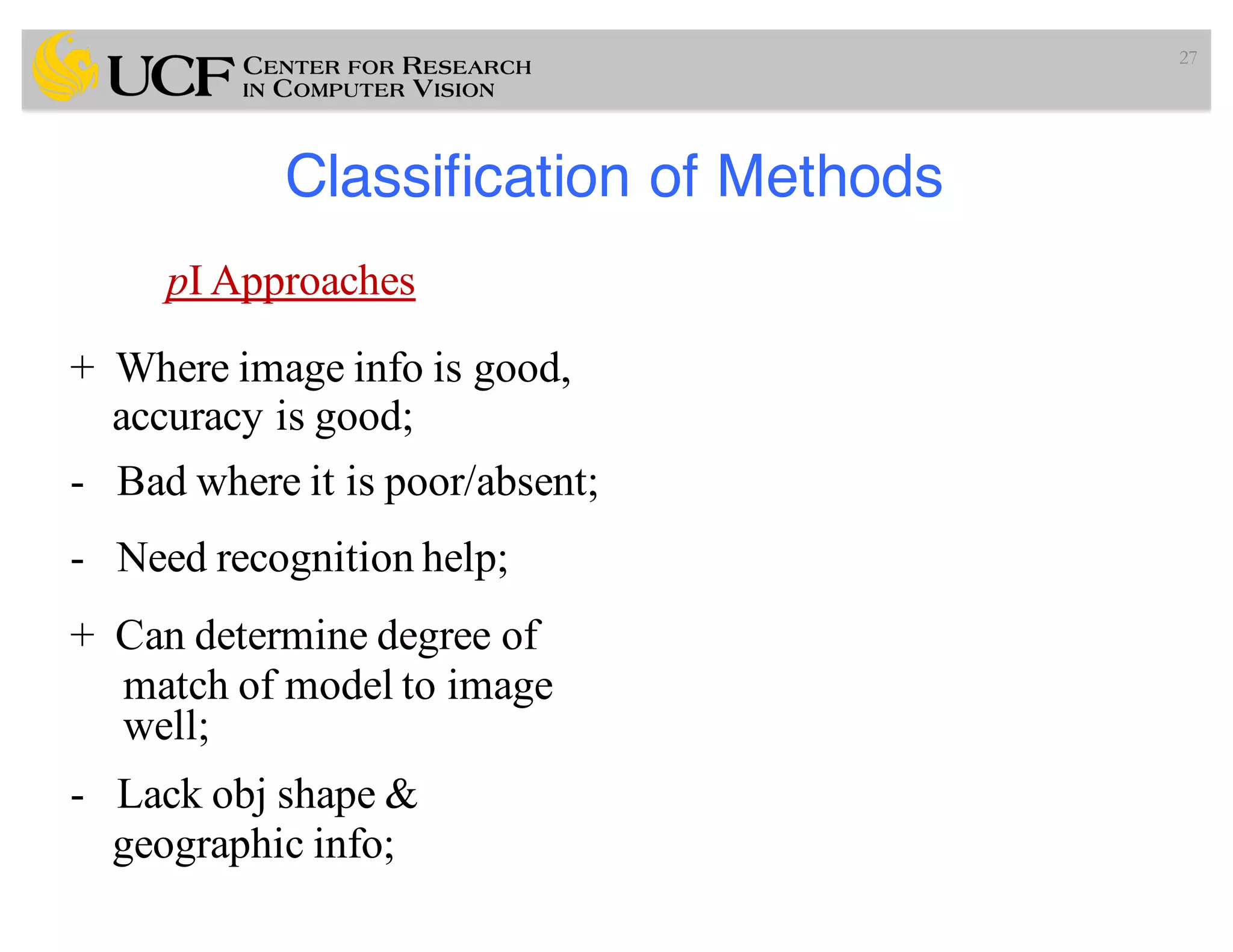
Classification of Methods
27
pI Approaches
+ Where image info is good,
accuracy is good;
- Bad where it is poor/absent;
- Need recognition help;
+ Can determine degree of
match of model to image
well;
- Lack obj shape &
geographic info;
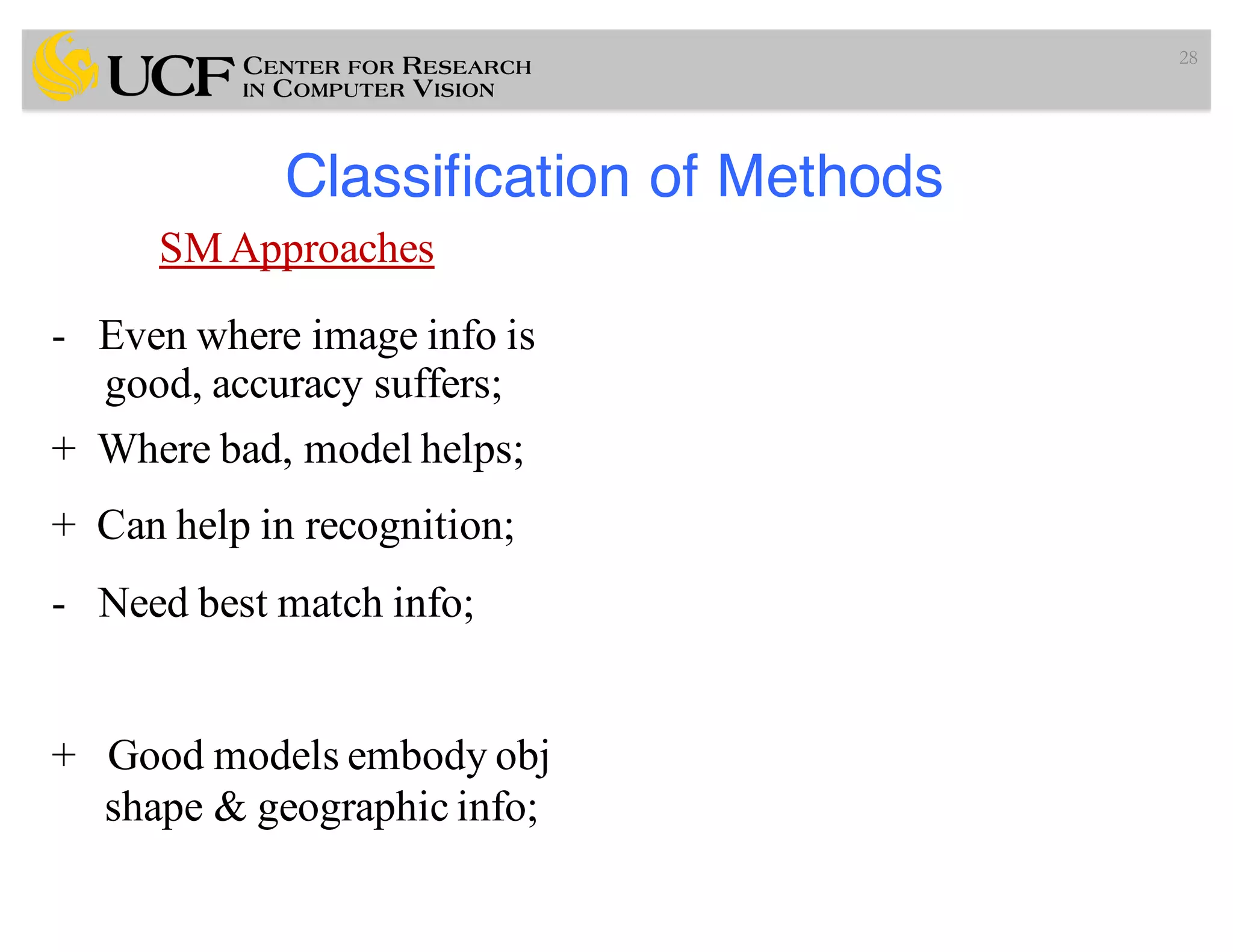
Classification of Methods
28
SMApproaches
- Even where image info is
good, accuracy suffers;
+ Where bad, model helps;
+ Can help in recognition;
- Need best match info;
+ Good models embody obj
shape & geographic info;
Purely Image Based Segmentation Methods
29
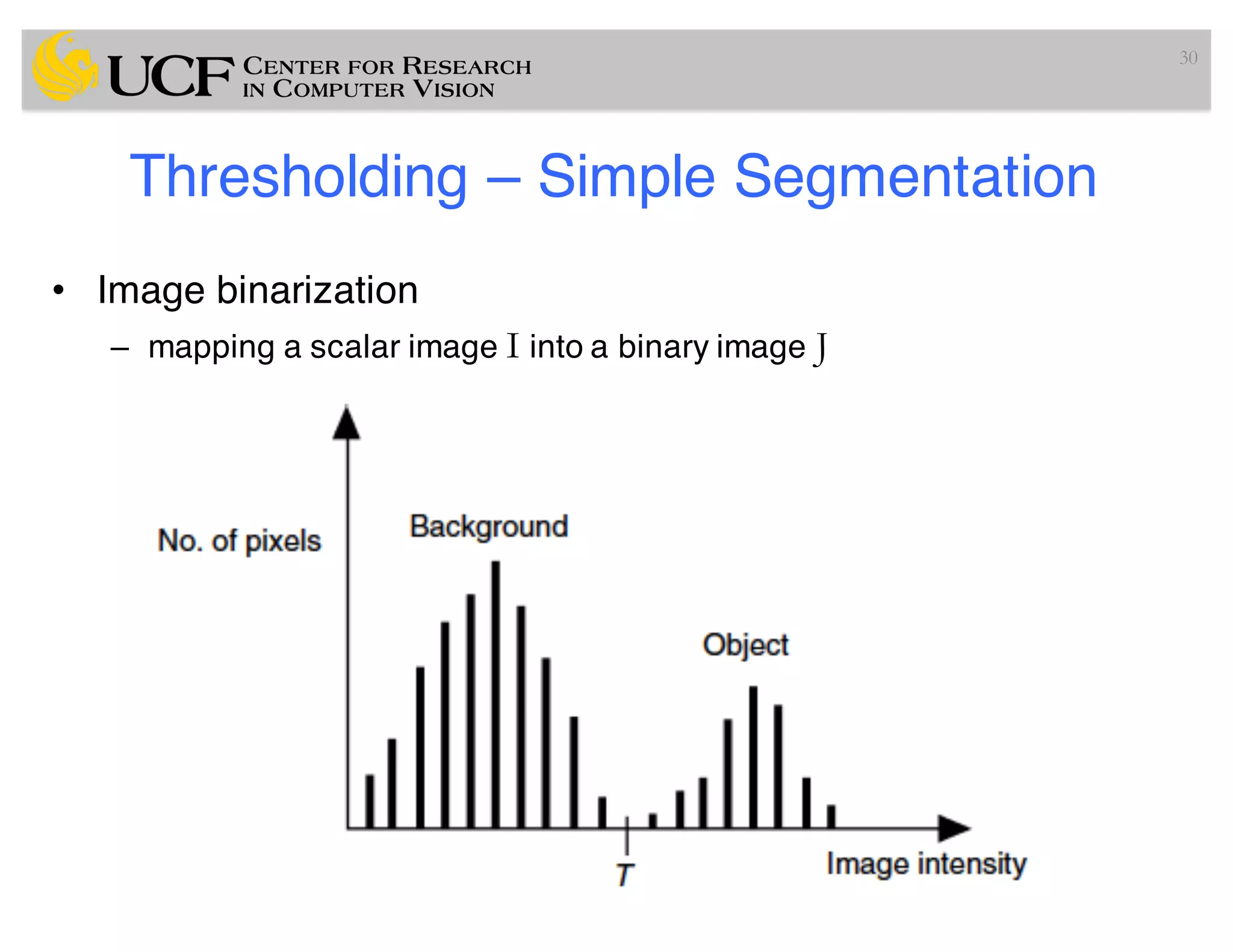
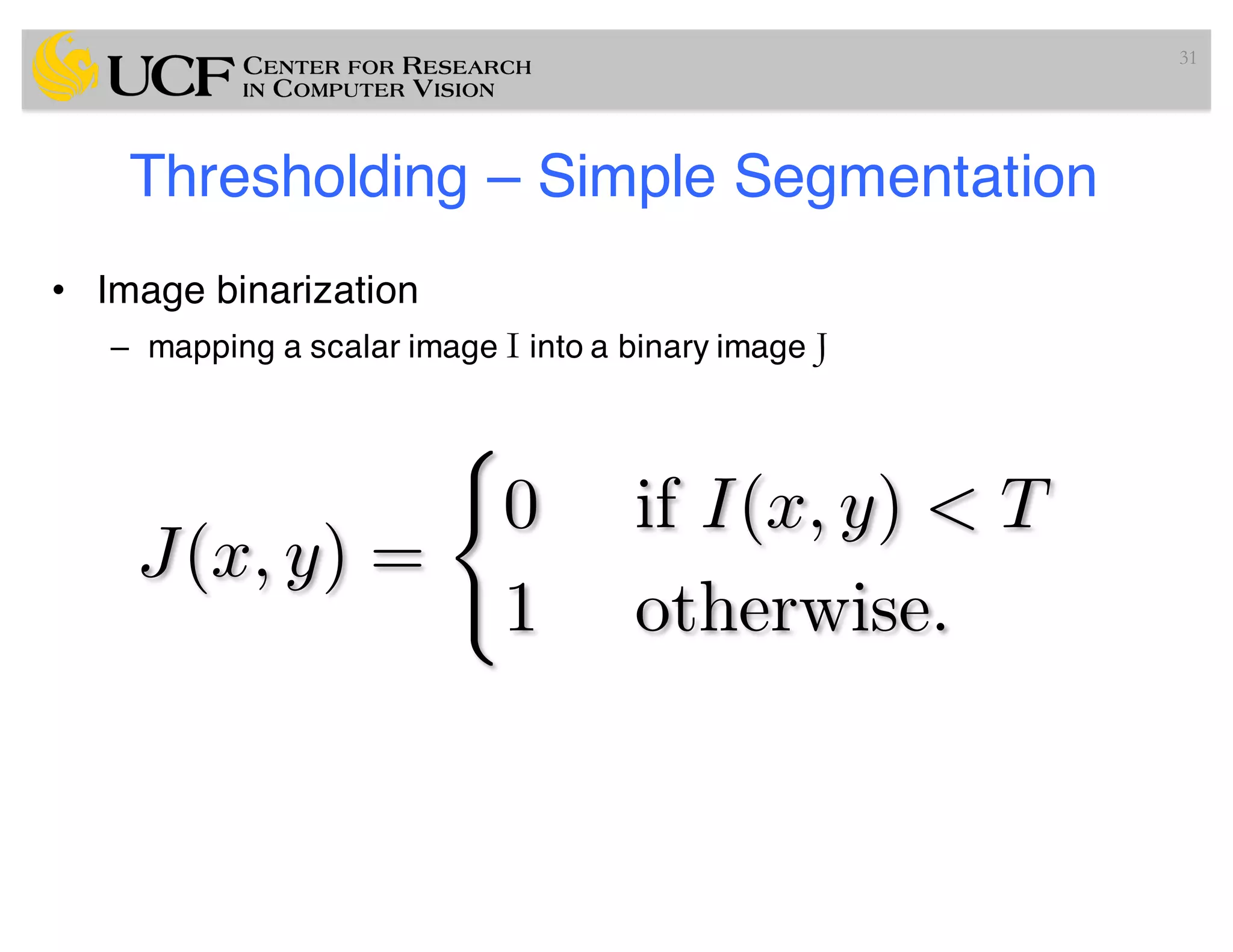
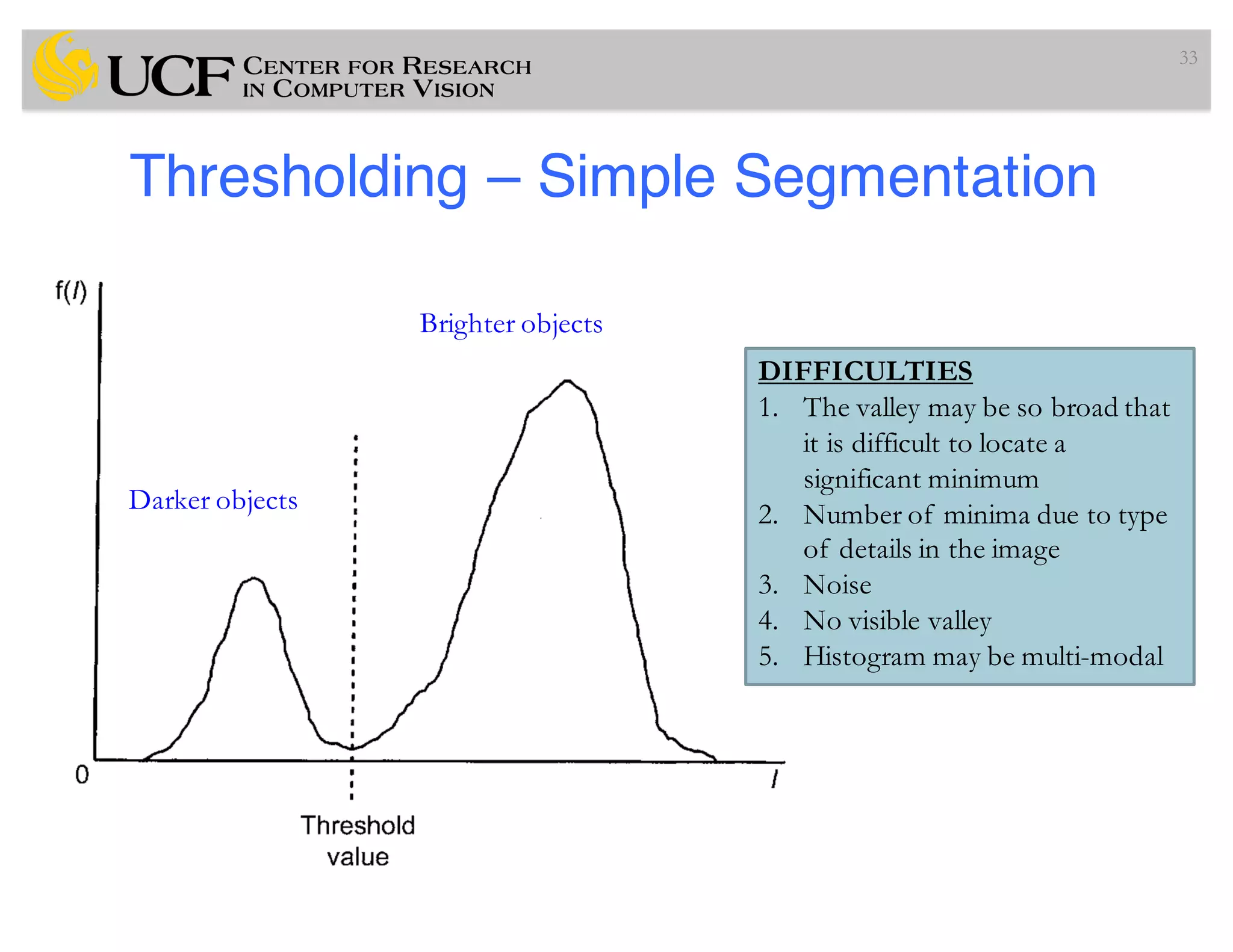
Thresholding – Simple Segmentation
• Image binarization
– mapping a scalar image I into a binary image J
30
J(x, y) =
(
0 if I(x, y) < T
1 otherwise.
Thresholding – Simple Segmentation
• Image binarization
– mapping a scalar image I into a binary image J
31
J(x, y) =
(
0 if I(x, y) < T
1 otherwise.
Thresholding – Simple Segmentation
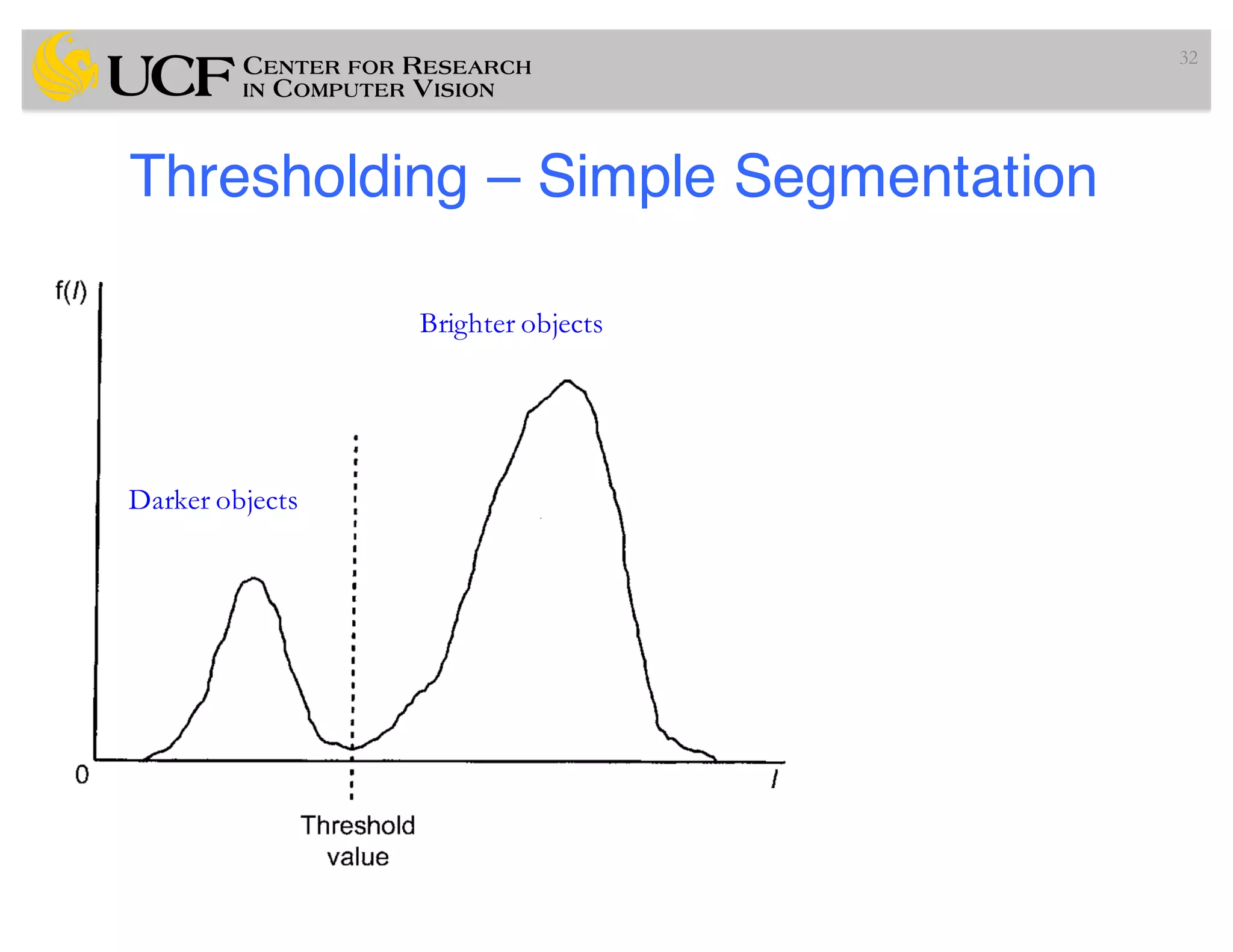
32
Brighter objects
Darker objects
Thresholding – Simple Segmentation
33
Brighter objects
Darker objects
DIFFICULTIES
1. The valley may be so broad that
it is difficult to locate a
significant minimum
2. Number of minima due to type
of details in the image
3. Noise
4. No visible valley
5. Histogram may be multi-modal
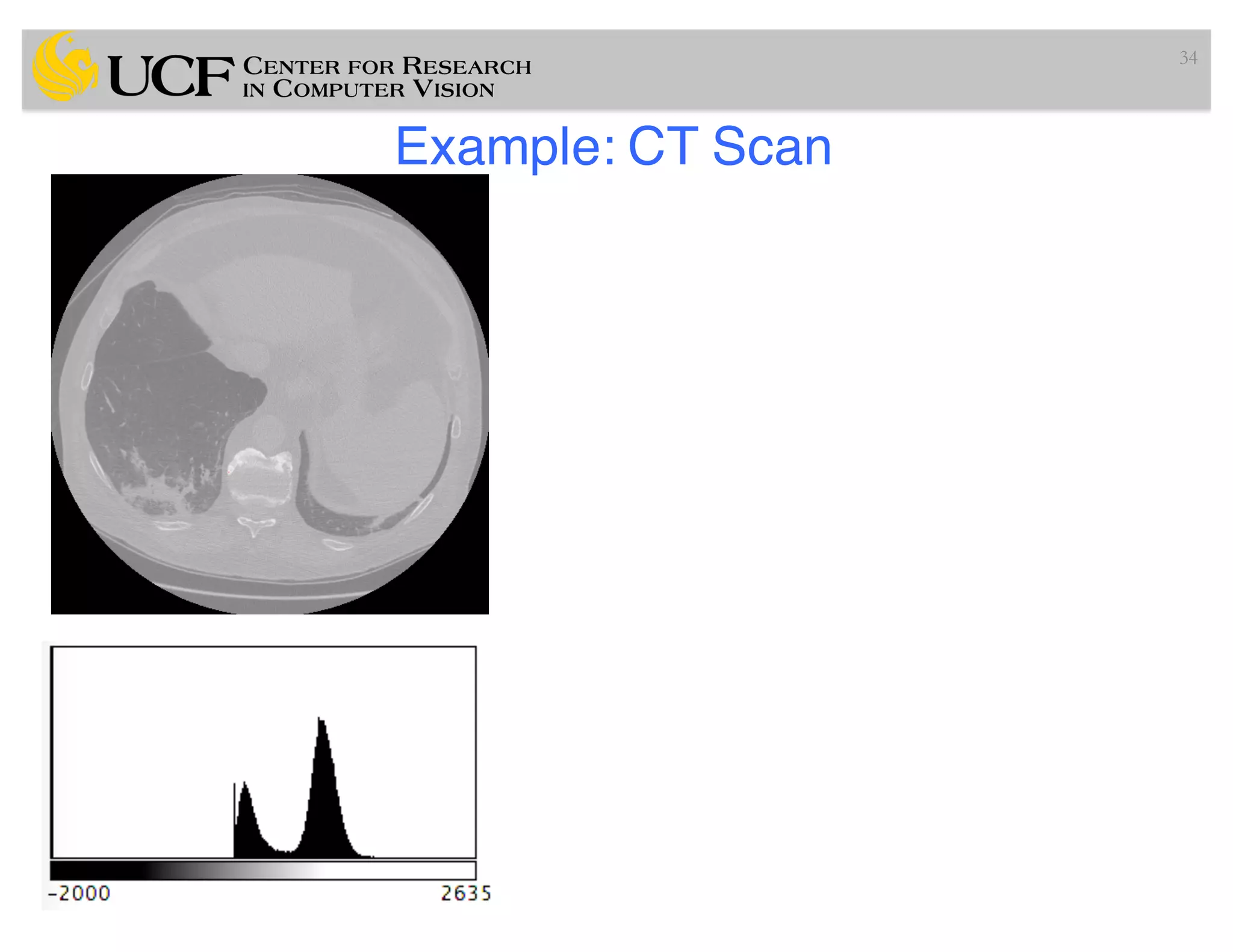
Example: CT Scan
34
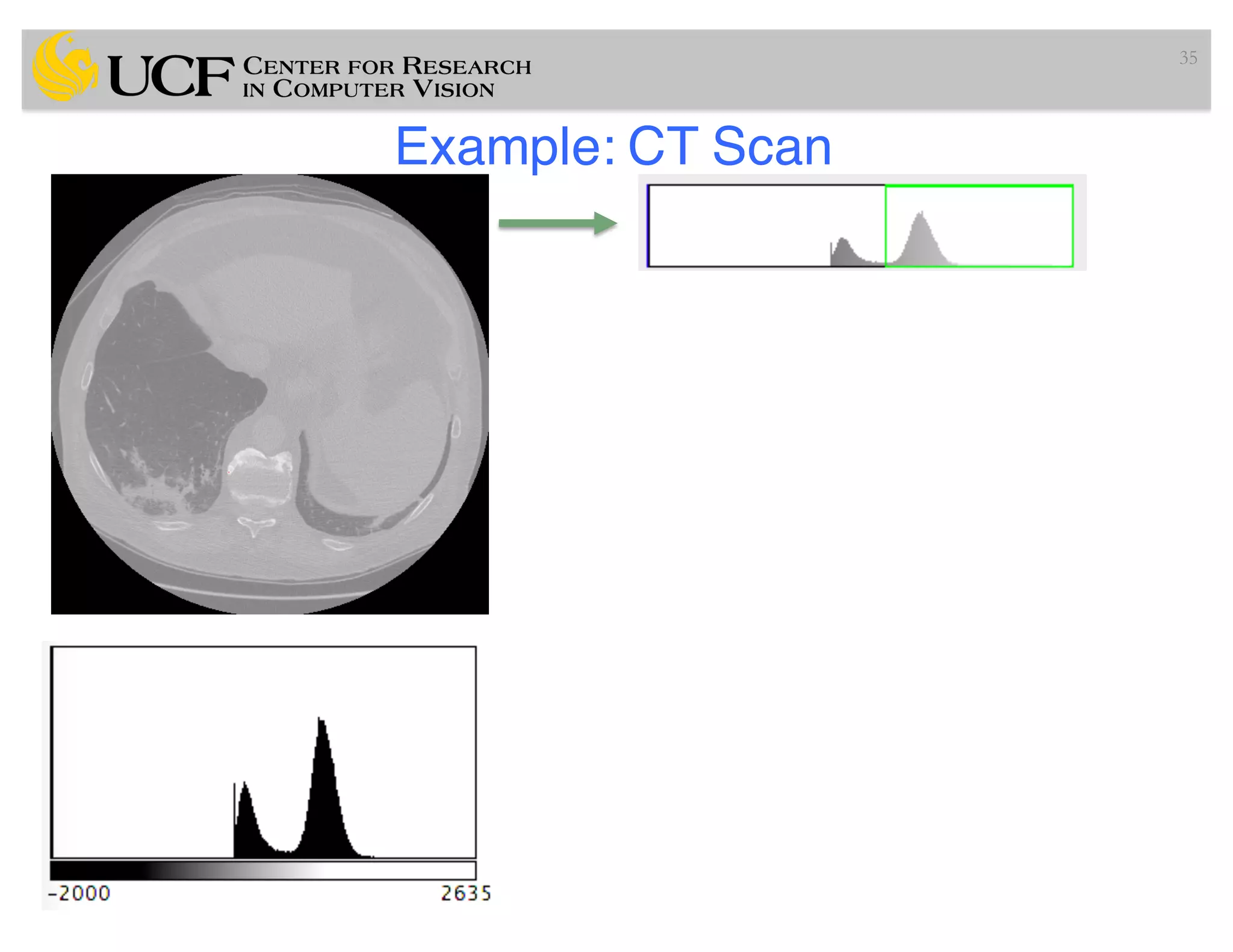
Example: CT Scan
35
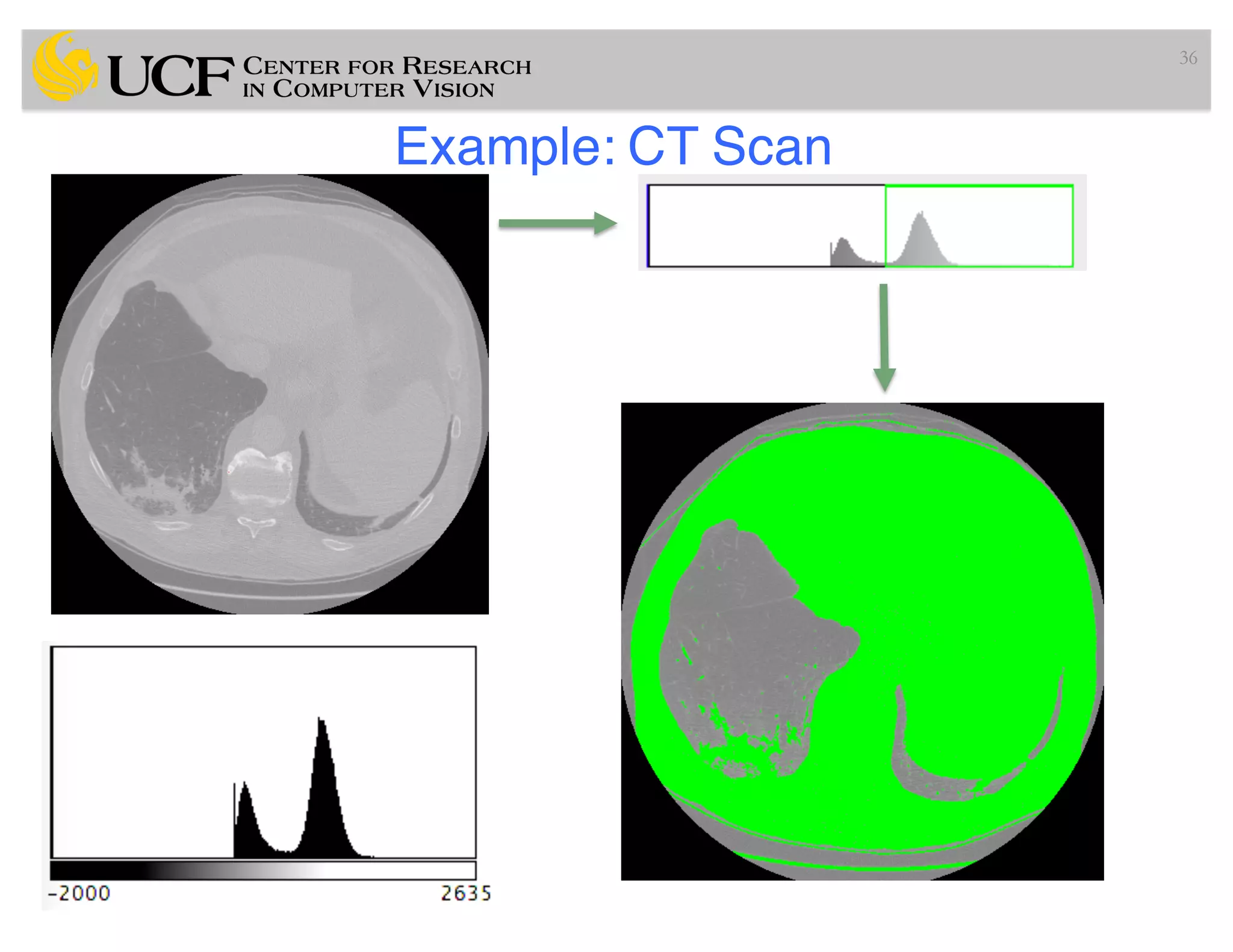
Example: CT Scan
36
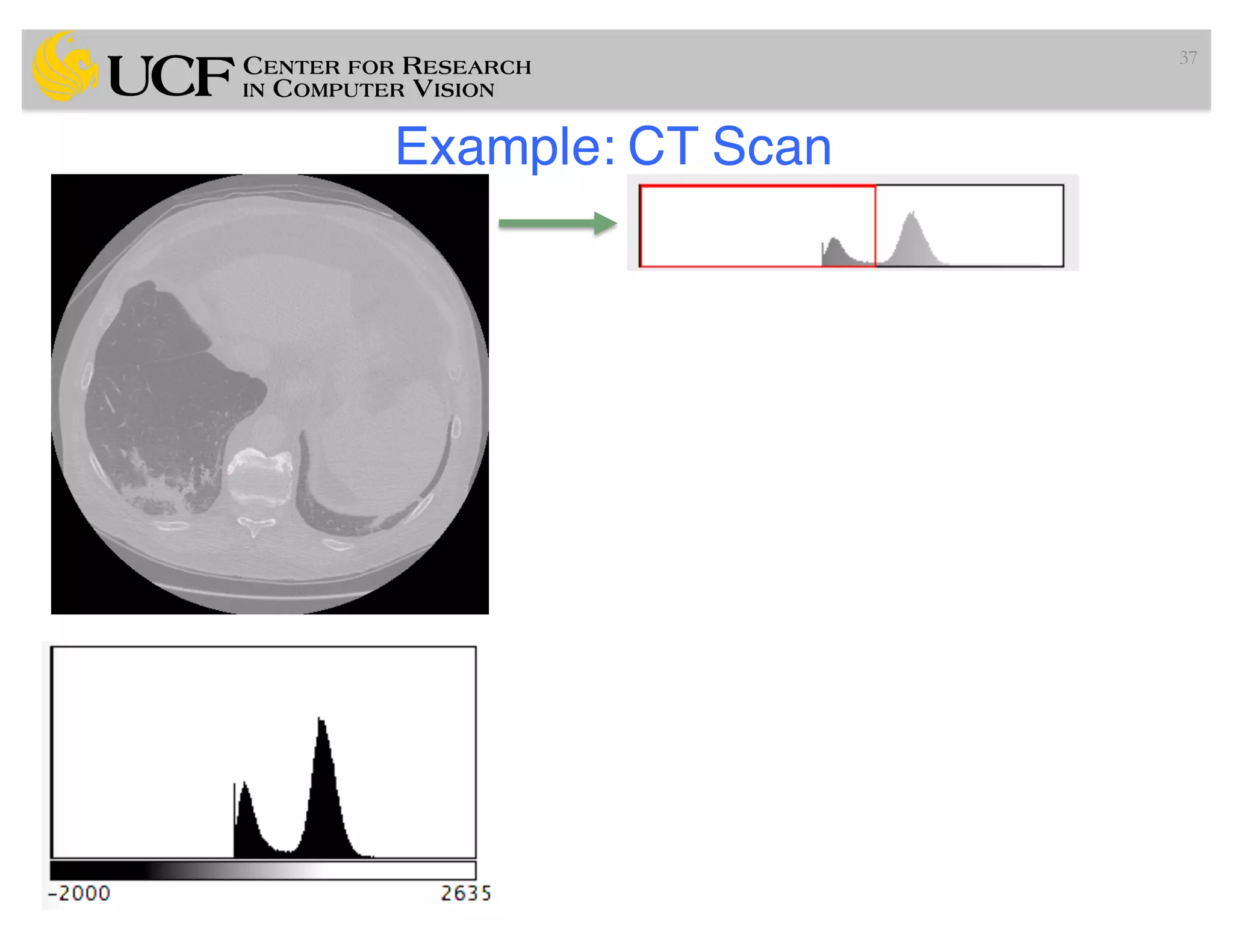
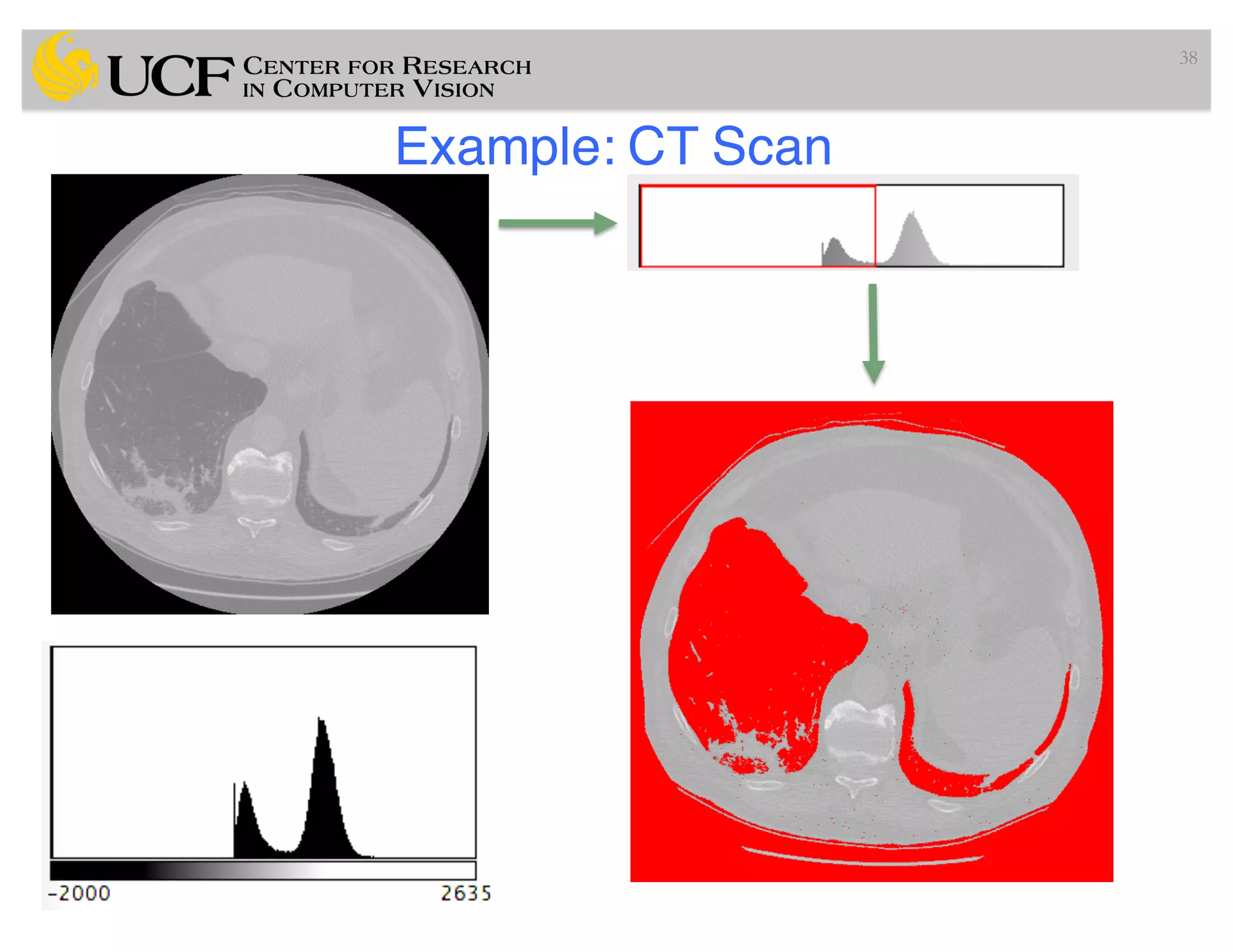
Example: CT Scan
37
Example: CT Scan
38
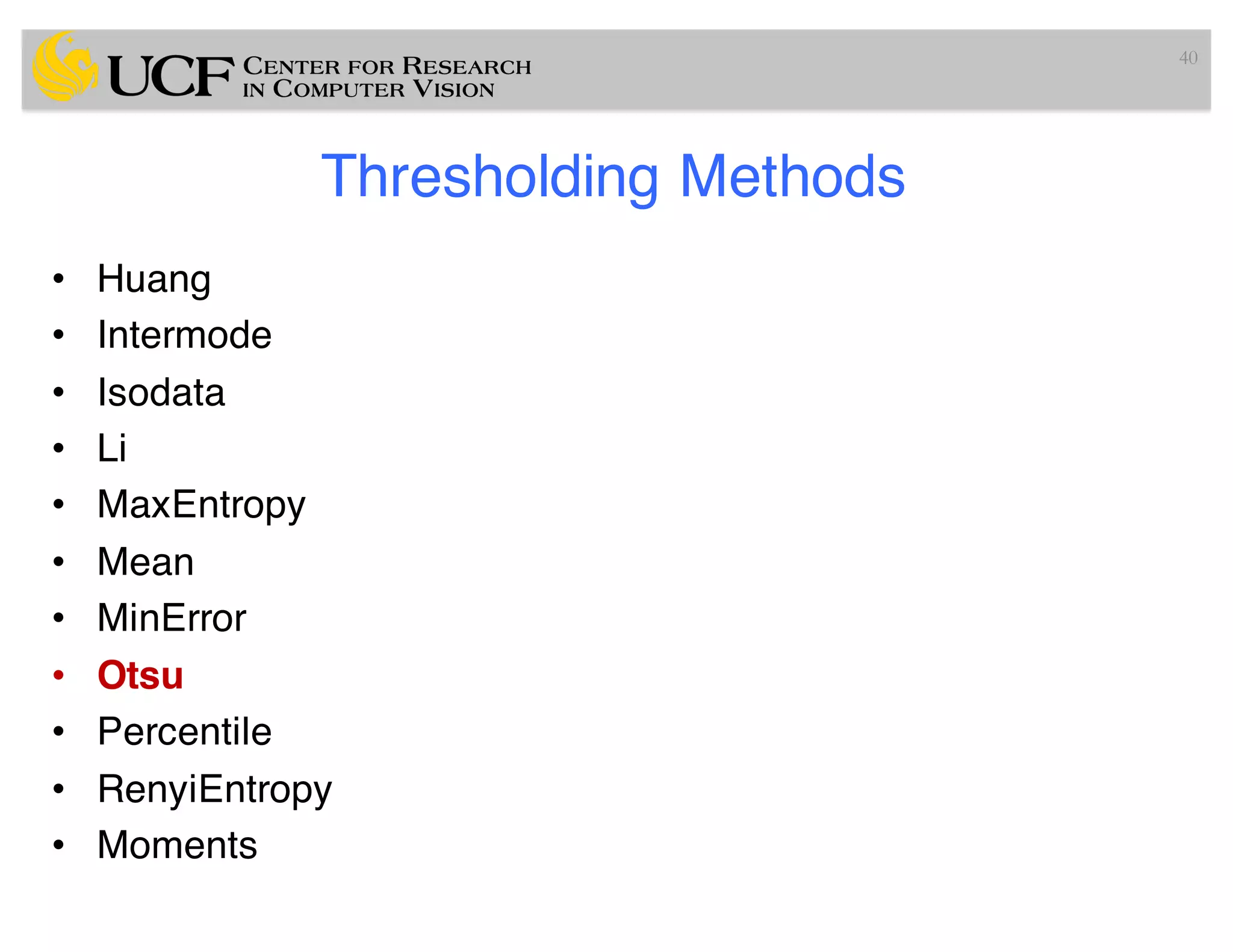
Thresholding Methods
• Huang
• Intermode
• Isodata
• Li
• MaxEntropy
• Mean
• MinError
• Otsu
• Percentile
• RenyiEntropy
• Moments
39
Thresholding Methods
• Huang
• Intermode
• Isodata
• Li
• MaxEntropy
• Mean
• MinError
• Otsu
• Percentile
• RenyiEntropy
• Moments
40
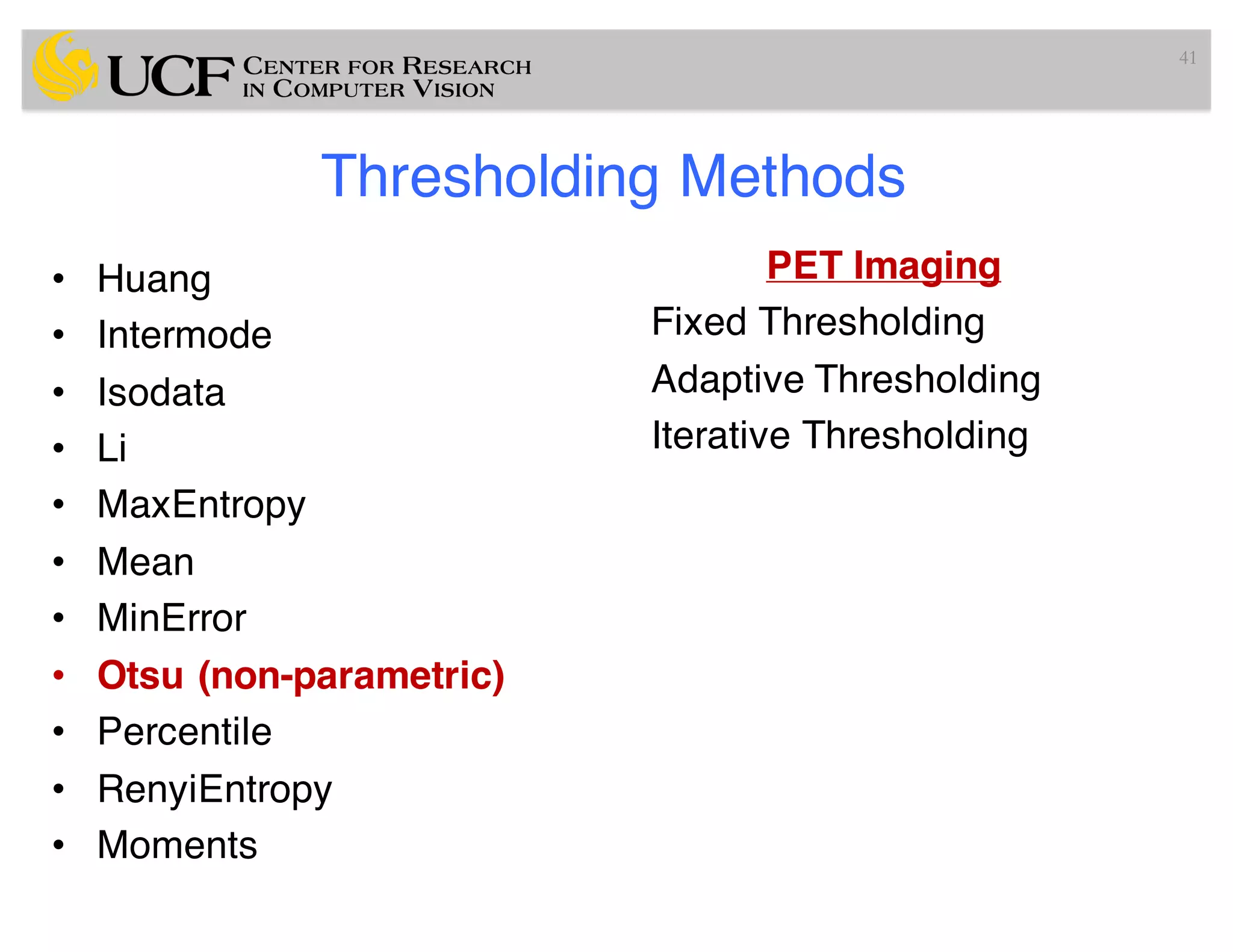
Thresholding Methods
PET Imaging
Fixed Thresholding
Adaptive Thresholding
Iterative Thresholding
41
• Huang
• Intermode
• Isodata
• Li
• MaxEntropy
• Mean
• MinError
• Otsu (non-parametric)
• Percentile
• RenyiEntropy
• Moments
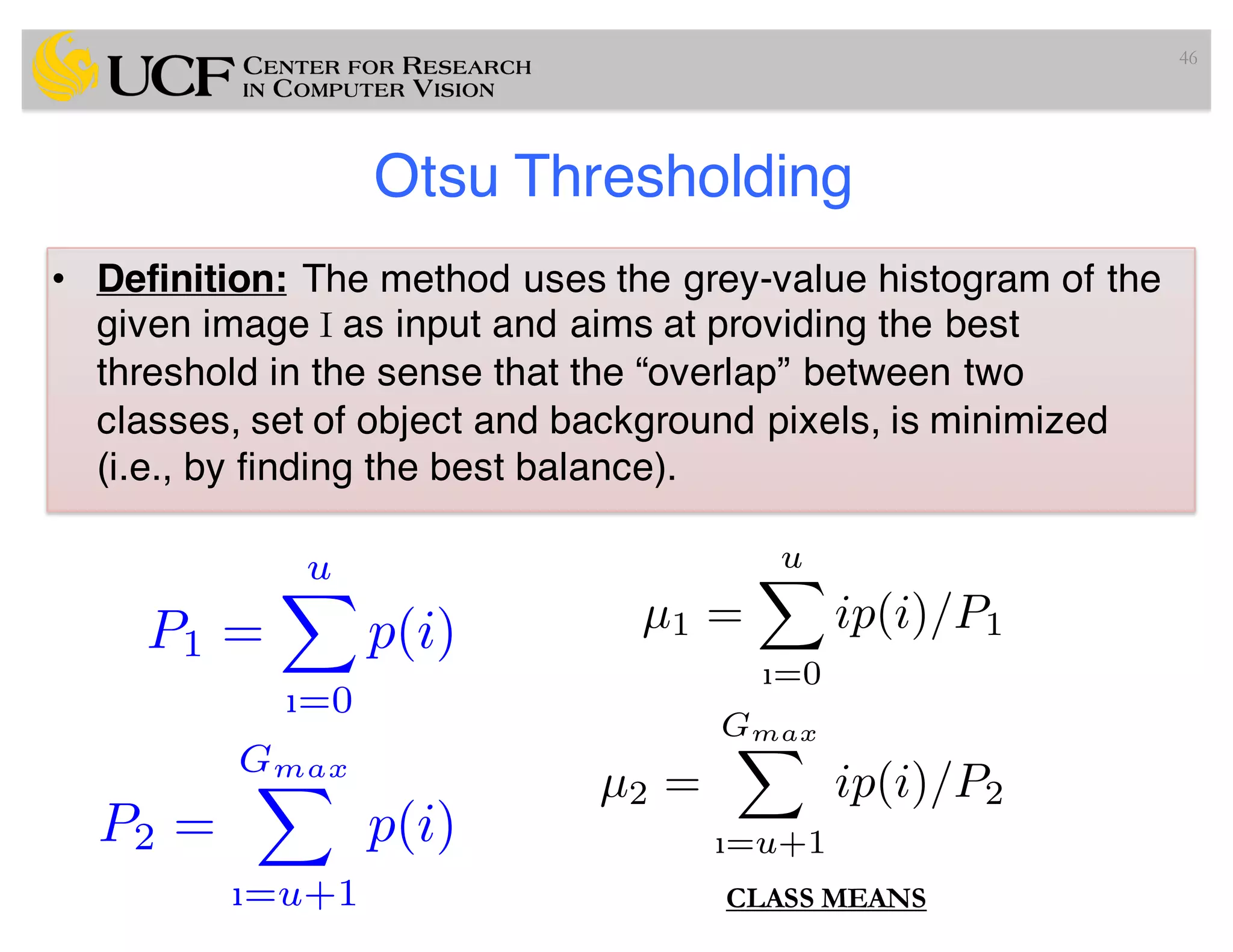
Otsu Thresholding
• Definition: The method uses the grey-value histogram of the
given image I as input and aims at providing the best
threshold in the sense that the “overlap” between two
classes, set of object and background pixels, is minimized
(i.e., by finding the best balance).
42
Otsu Thresholding
• Definition: The method uses the grey-value histogram of the
given image I as input and aims at providing the best
threshold in the sense that the “overlap” between two
classes, set of object and background pixels, is minimized
(i.e., by finding the best balance).
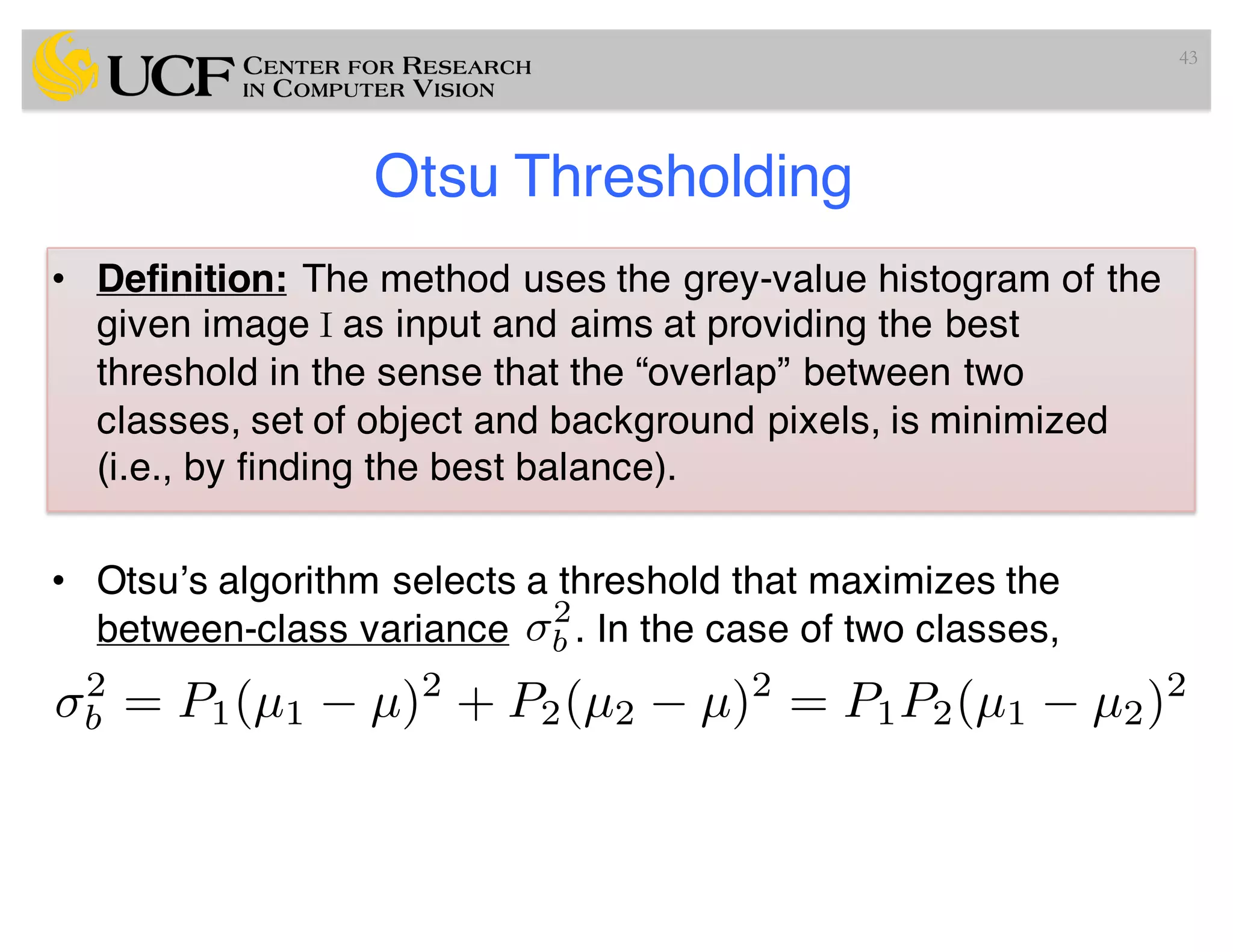
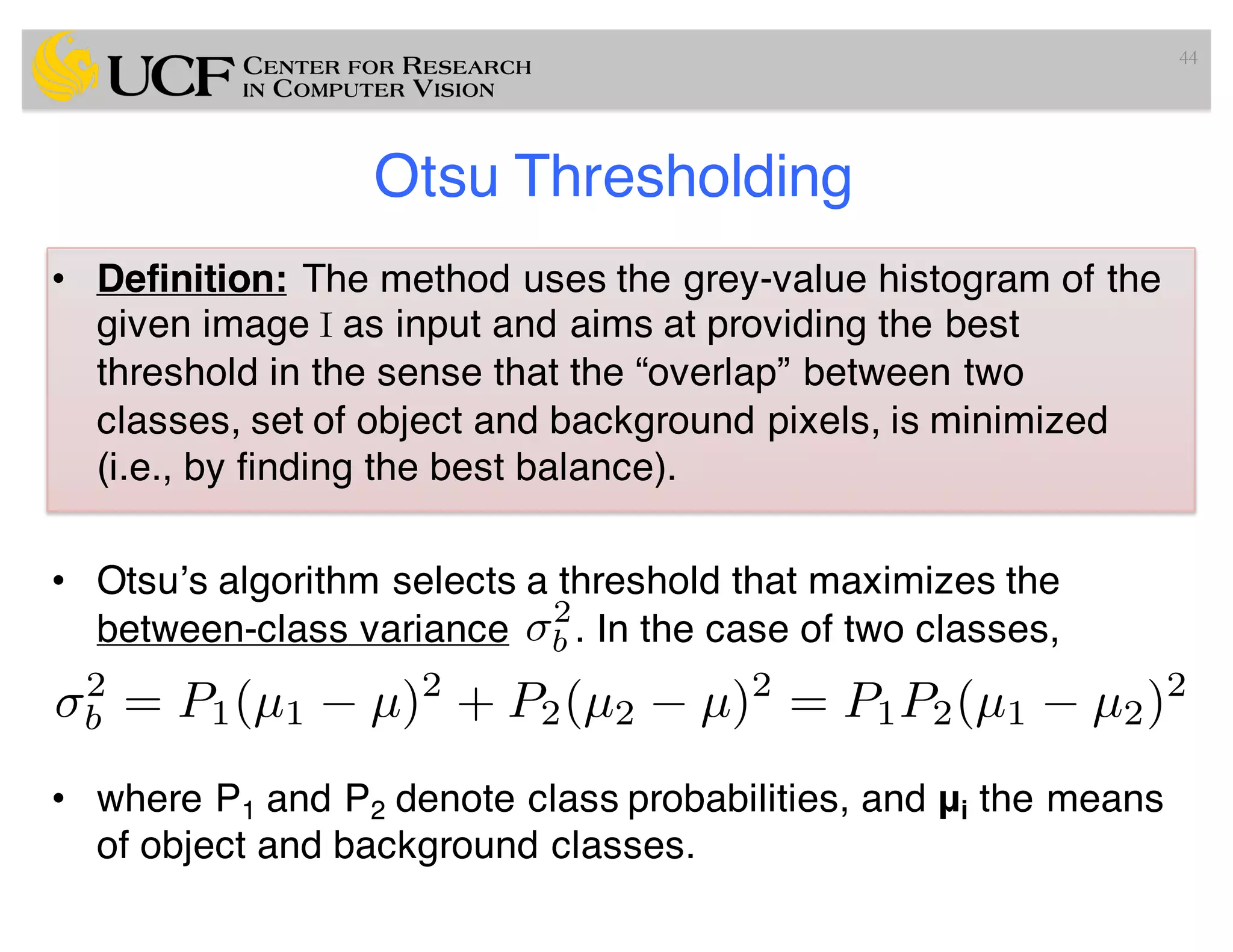
• Otsu’s algorithm selects a threshold that maximizes the
between-class variance . In the case of two classes,
43
2
b
2
b = P1(µ1 µ)2
+ P2(µ2 µ)2
= P1P2(µ1 µ2)2
Otsu Thresholding
• Definition: The method uses the grey-value histogram of the
given image I as input and aims at providing the best
threshold in the sense that the “overlap” between two
classes, set of object and background pixels, is minimized
(i.e., by finding the best balance).
• Otsu’s algorithm selects a threshold that maximizes the
between-class variance . In the case of two classes,
• where P1 and P2 denote class probabilities, and μi the means
of object and background classes.
44
2
b
2
b = P1(µ1 µ)2
+ P2(µ2 µ)2
= P1P2(µ1 µ2)2
Otsu Thresholding
• Definition: The method uses the grey-value histogram of the
given image I as input and aims at providing the best
threshold in the sense that the “overlap” between two
classes, set of object and background pixels, is minimized
(i.e., by finding the best balance).
45
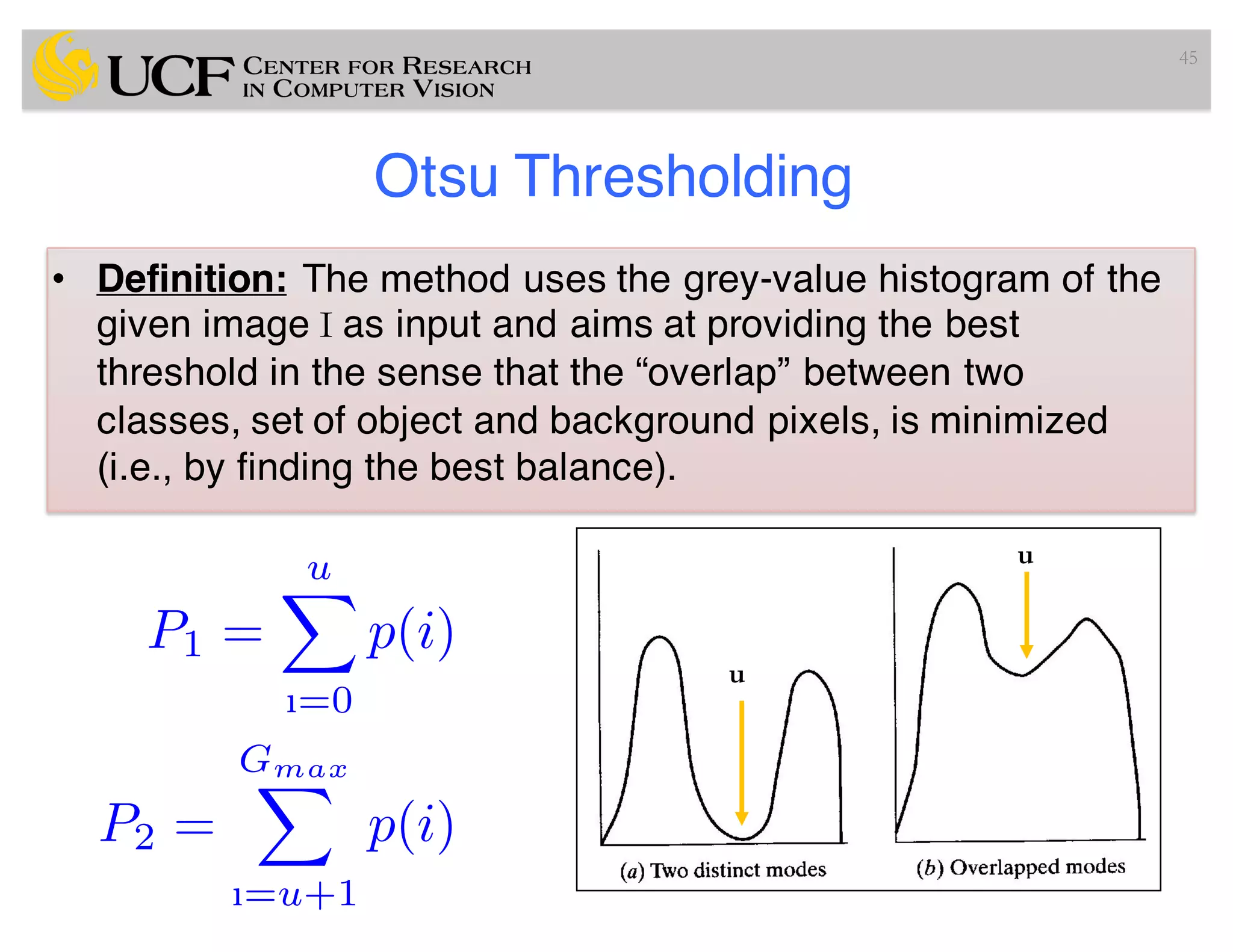
P1 =
uX
ı=0
p(i)
P2 =
GmaxX
ı=u+1
p(i)
u
u
Otsu Thresholding
• Definition: The method uses the grey-value histogram of the
given image I as input and aims at providing the best
threshold in the sense that the “overlap” between two
classes, set of object and background pixels, is minimized
(i.e., by finding the best balance).
46
P1 =
uX
ı=0
p(i)
P2 =
GmaxX
ı=u+1
p(i)
µ1 =
uX
ı=0
ip(i)/P1
µ2 =
GmaxX
ı=u+1
ip(i)/P2
CLASS MEANS
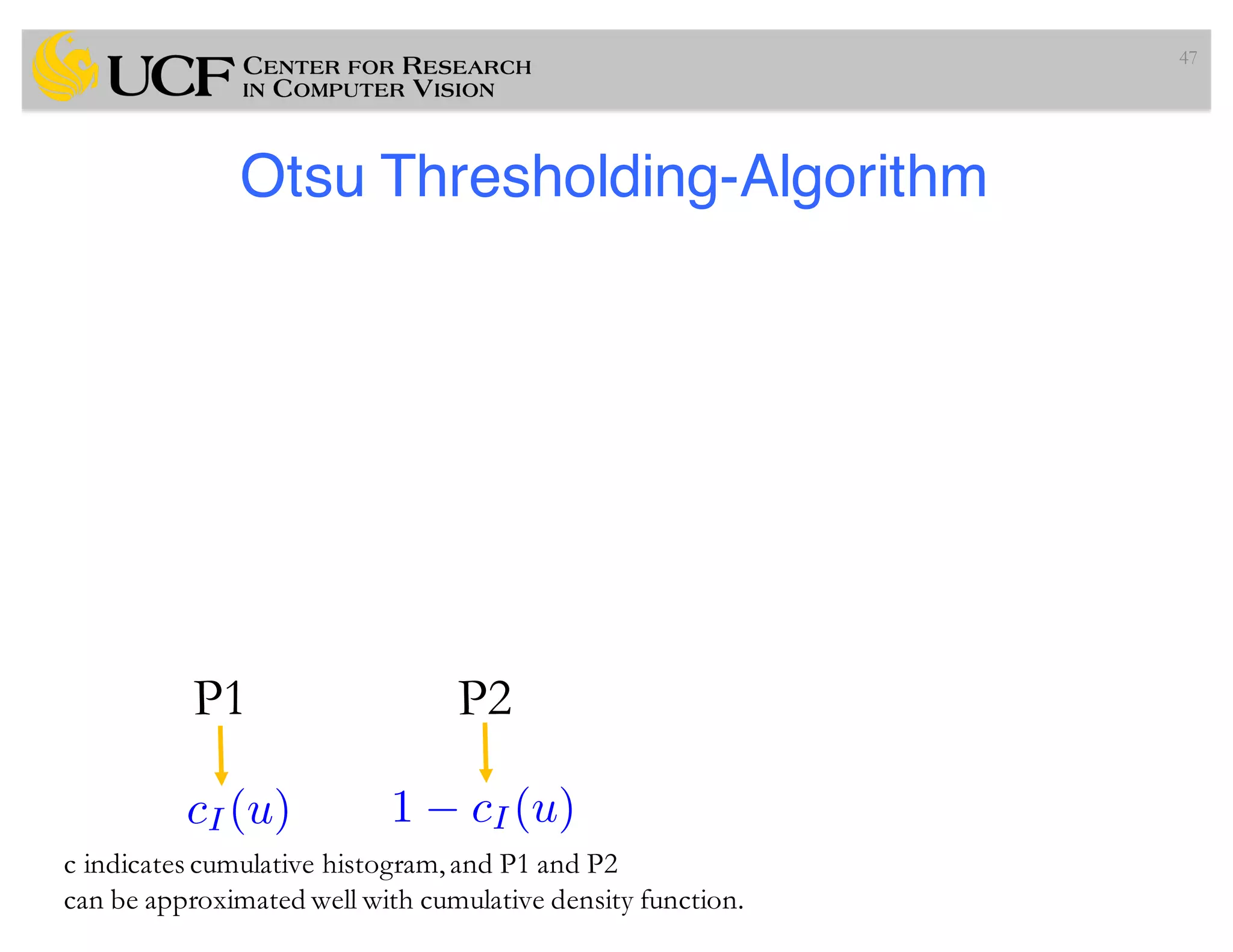
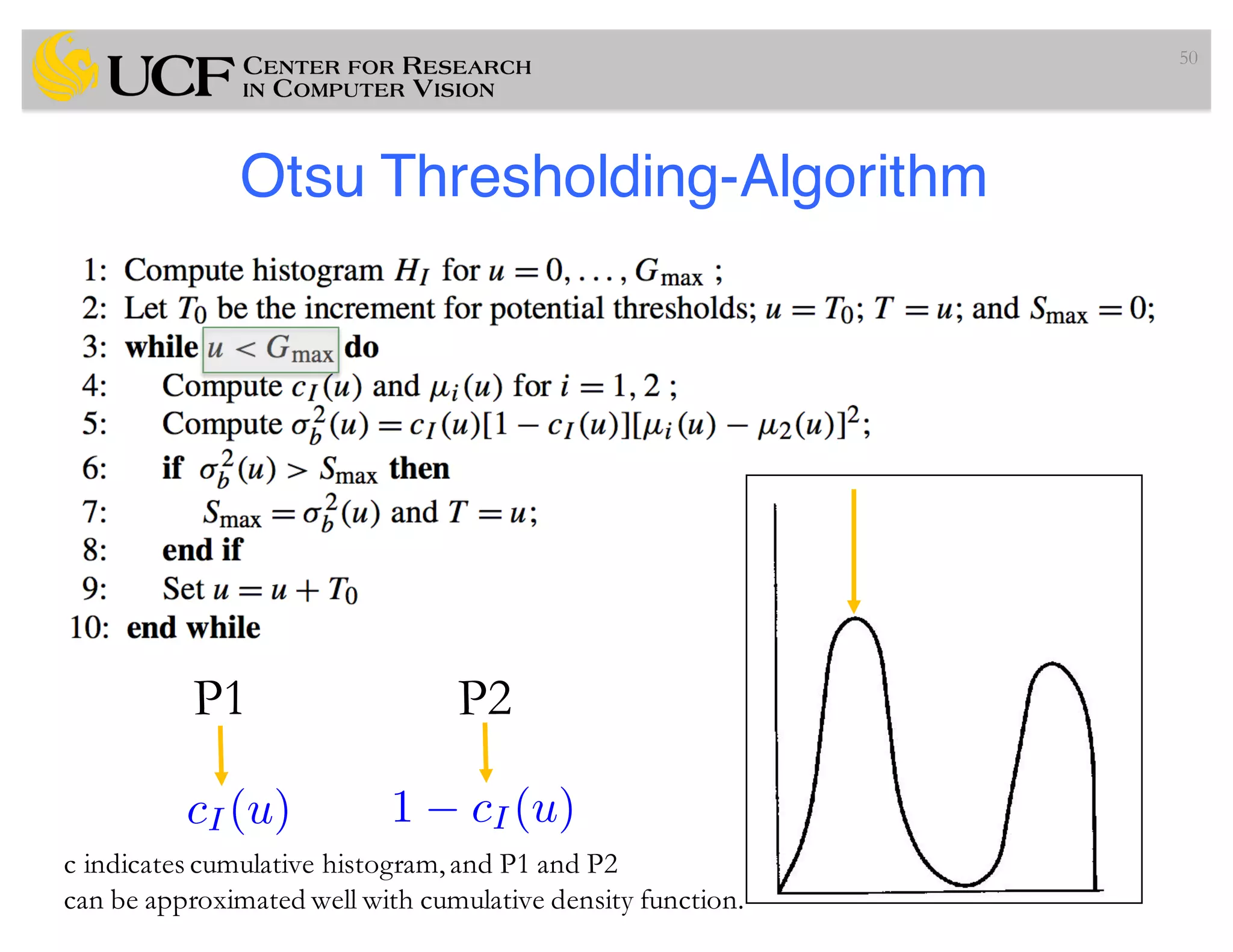
Otsu Thresholding-Algorithm
47
cI (u) 1 cI(u)
P1 P2
c indicates cumulative histogram,and P1 and P2
can be approximated well with cumulative density function.
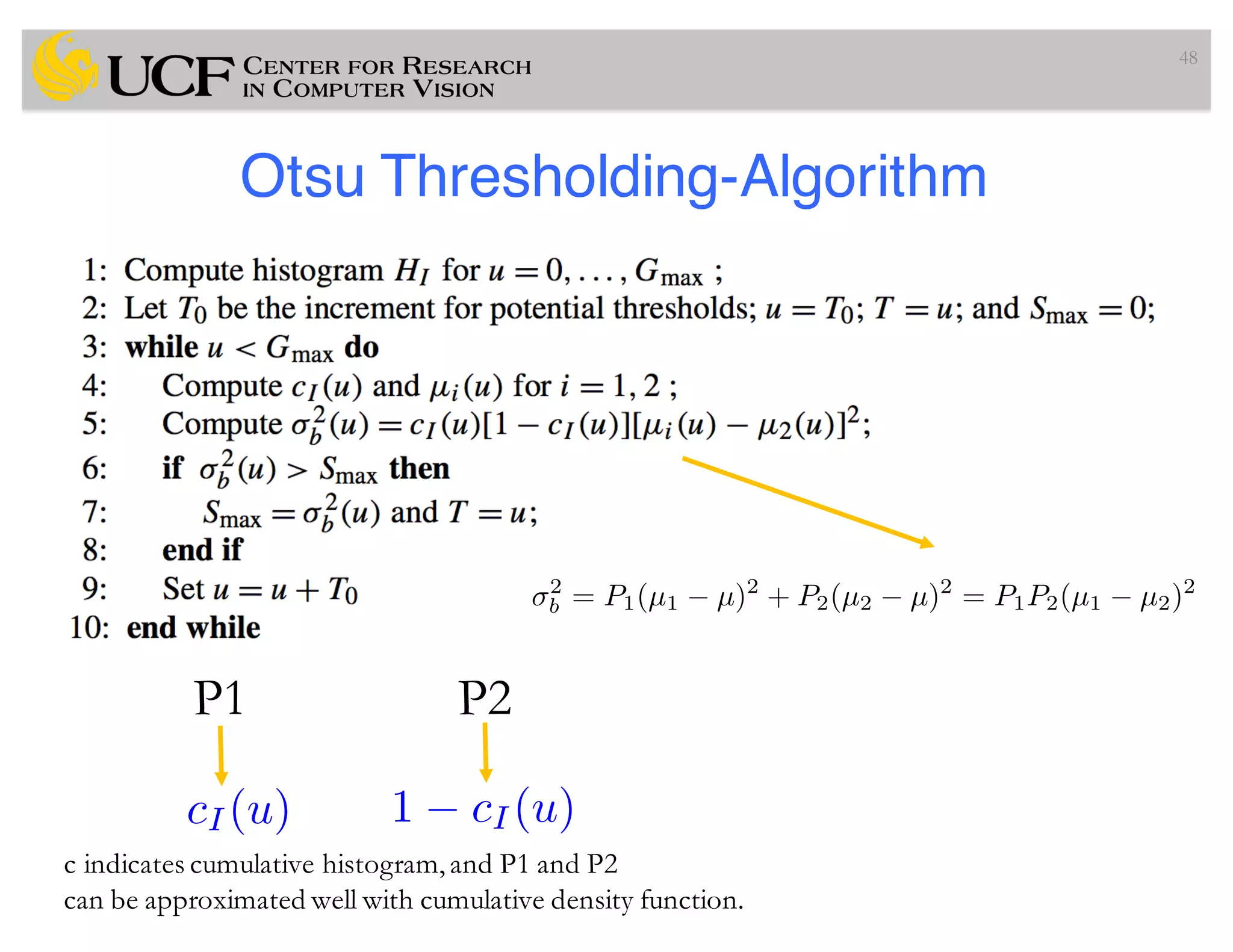
Otsu Thresholding-Algorithm
48
cI (u) 1 cI(u)
P1 P2
c indicates cumulative histogram,and P1 and P2
can be approximated well with cumulative density function.
2
b = P1(µ1 µ)2
+ P2(µ2 µ)2
= P1P2(µ1 µ2)2
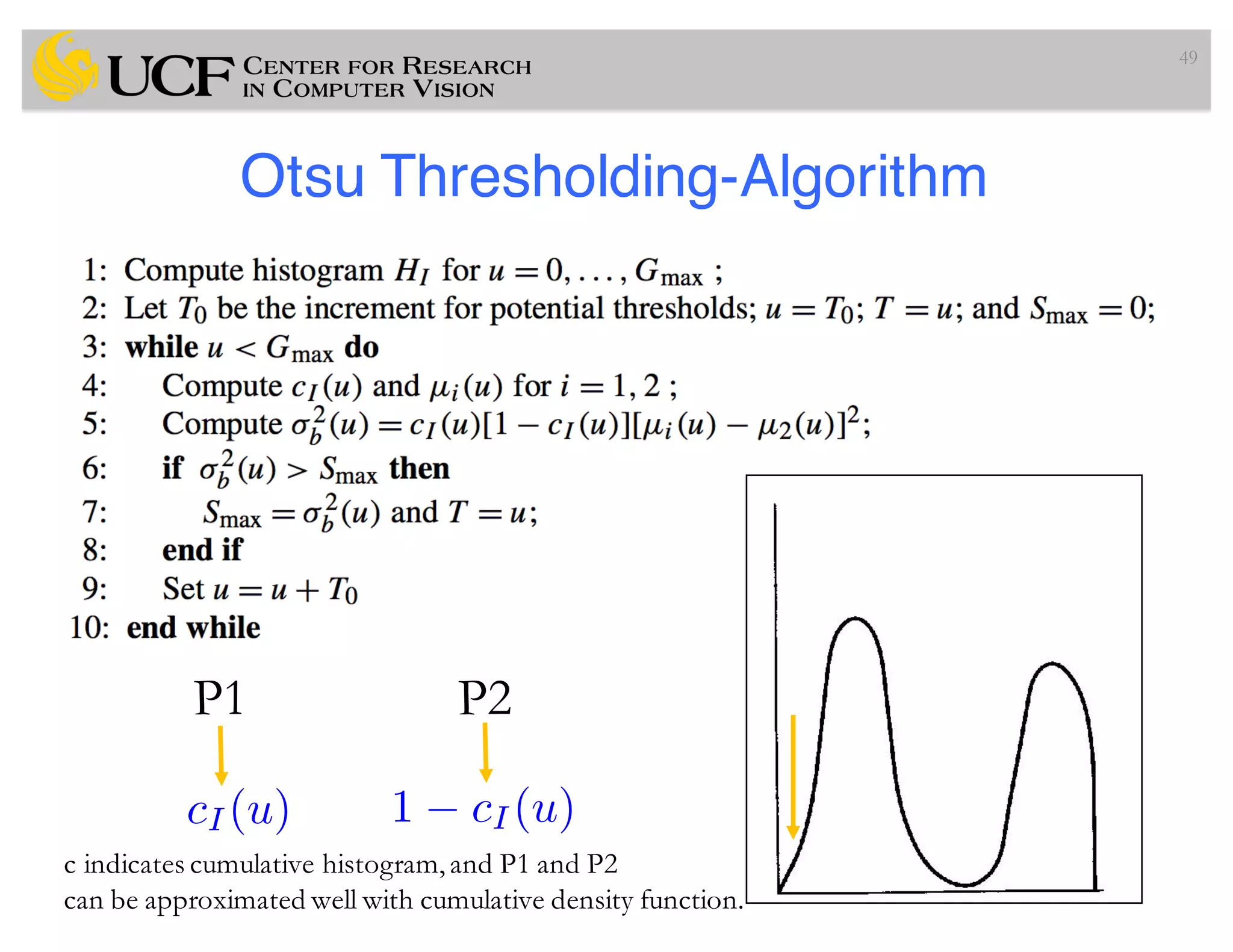
Otsu Thresholding-Algorithm
49
cI (u) 1 cI(u)
P1 P2
c indicates cumulative histogram,and P1 and P2
can be approximated well with cumulative density function.
Otsu Thresholding-Algorithm
50
cI (u) 1 cI(u)
P1 P2
c indicates cumulative histogram,and P1 and P2
can be approximated well with cumulative density function.
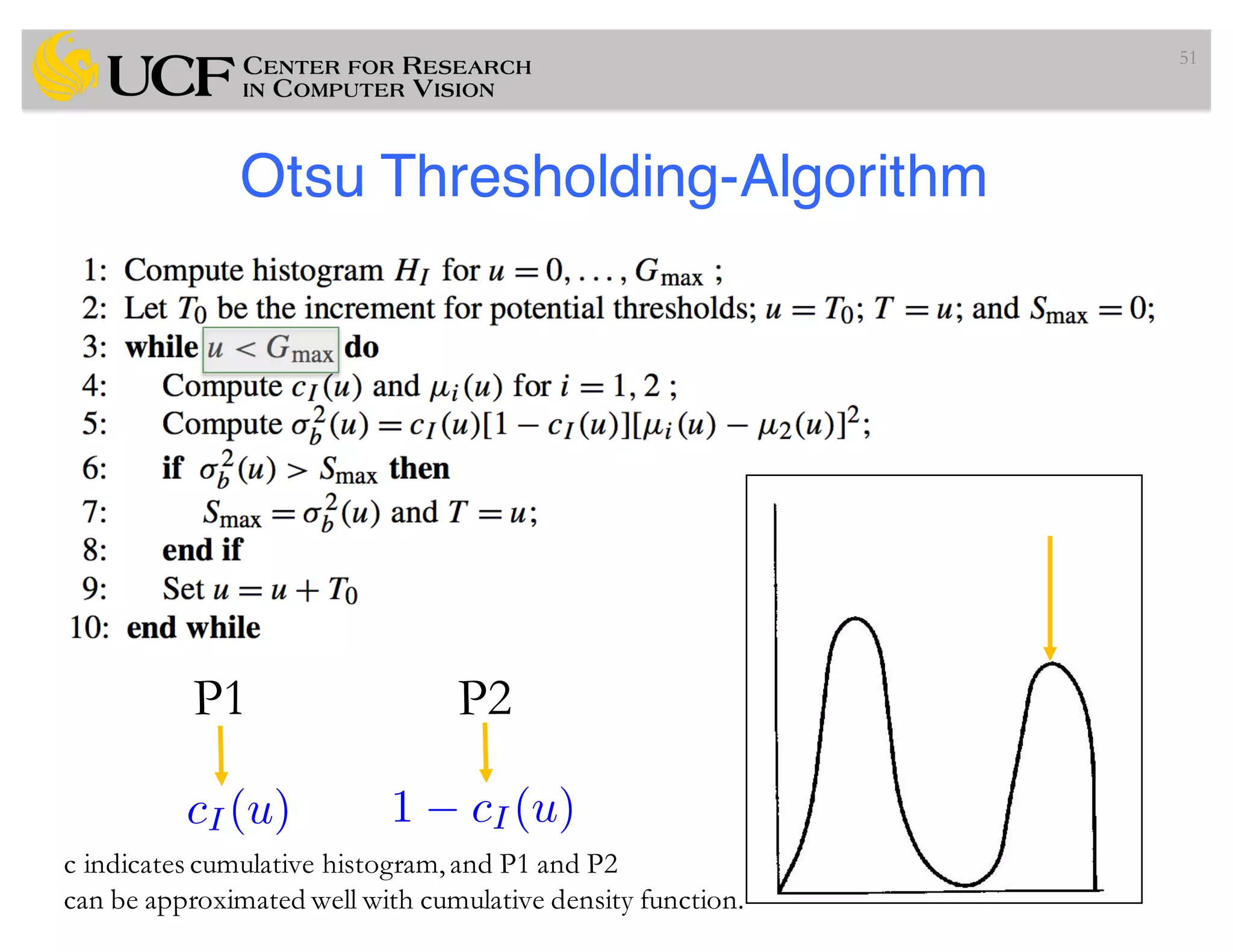
Otsu Thresholding-Algorithm
51
cI (u) 1 cI(u)
P1 P2
c indicates cumulative histogram,and P1 and P2
can be approximated well with cumulative density function.
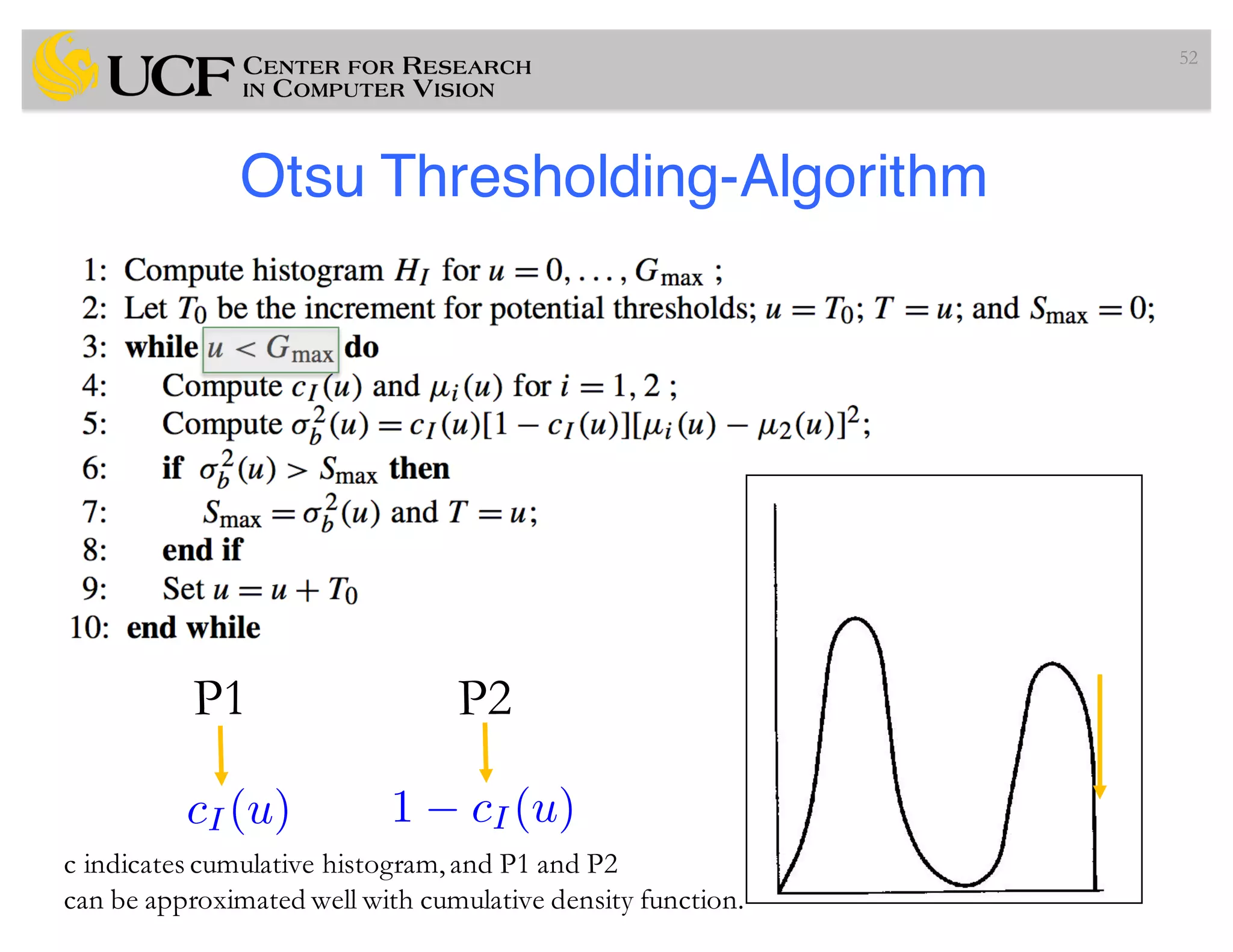
Otsu Thresholding-Algorithm
52
cI (u) 1 cI(u)
P1 P2
c indicates cumulative histogram,and P1 and P2
can be approximated well with cumulative density function.
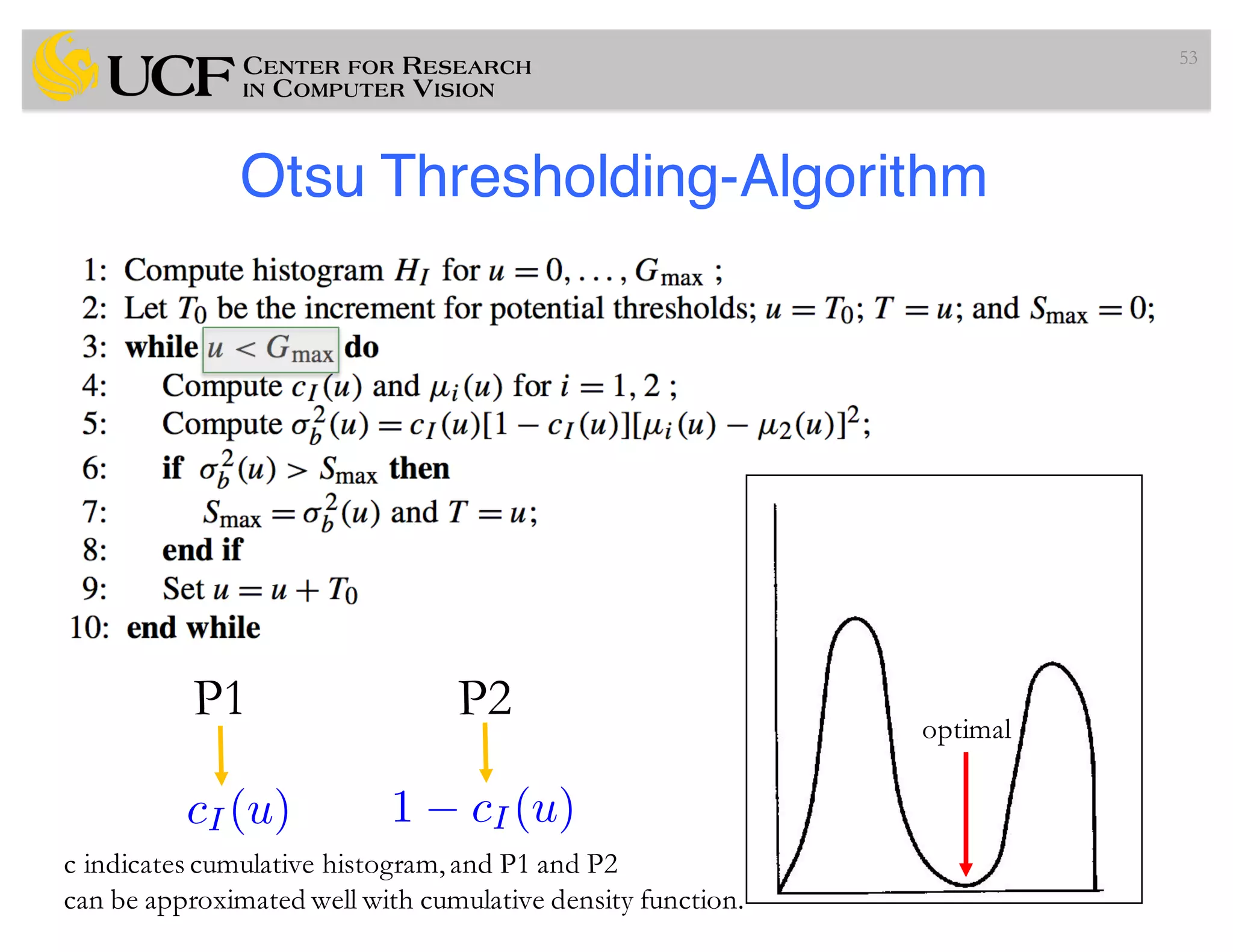
Otsu Thresholding-Algorithm
53
cI (u) 1 cI(u)
P1 P2
c indicates cumulative histogram,and P1 and P2
can be approximated well with cumulative density function.
optimal
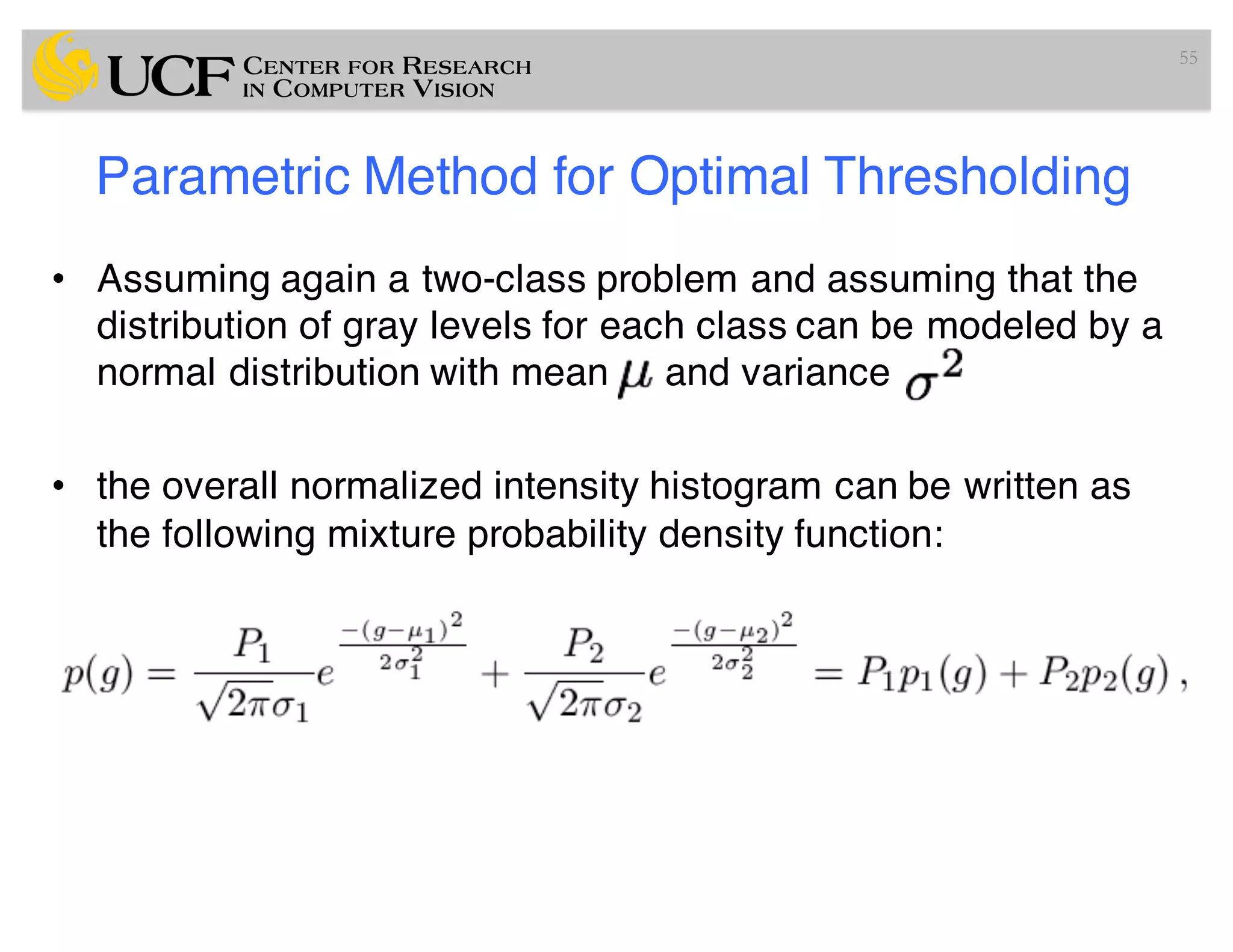
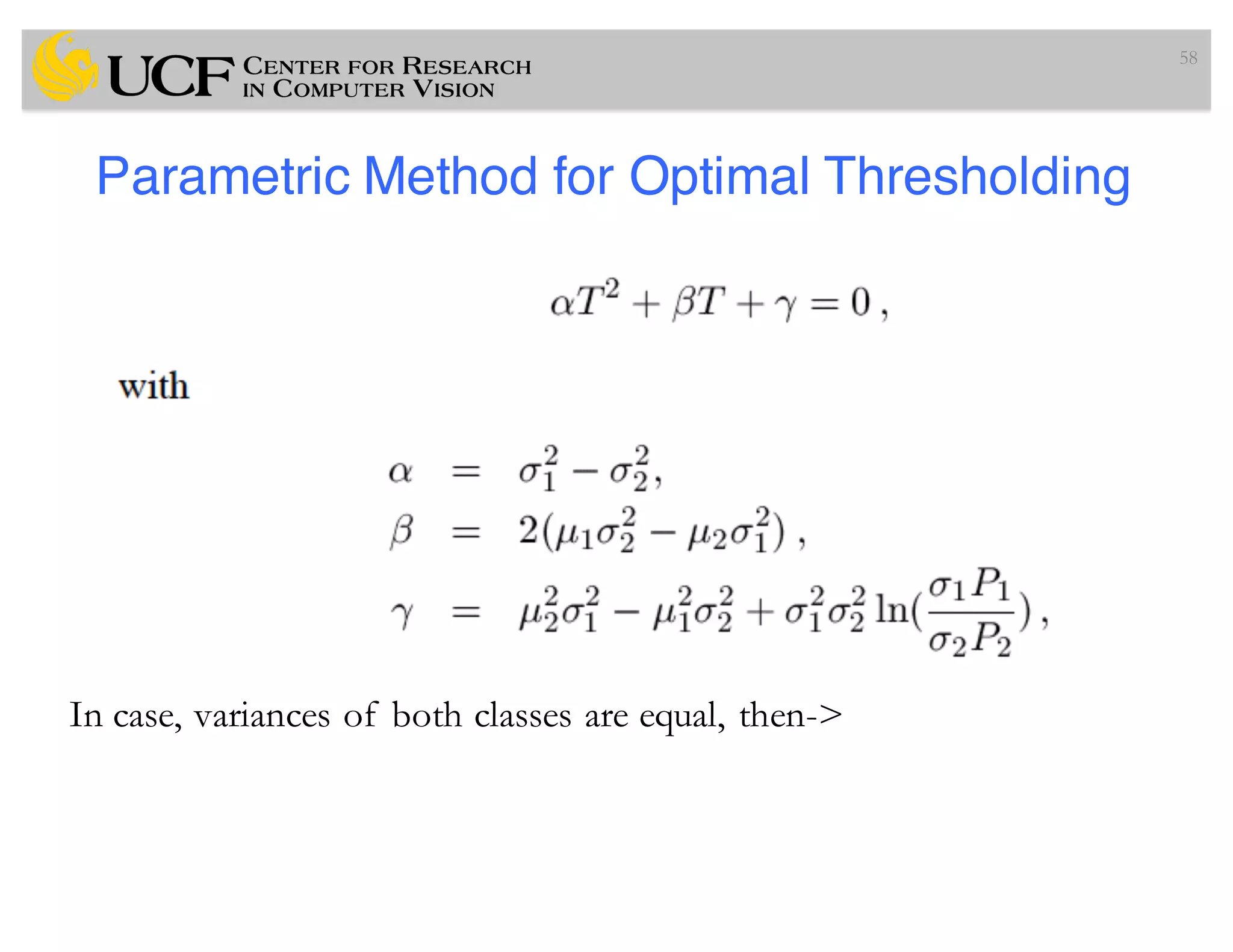
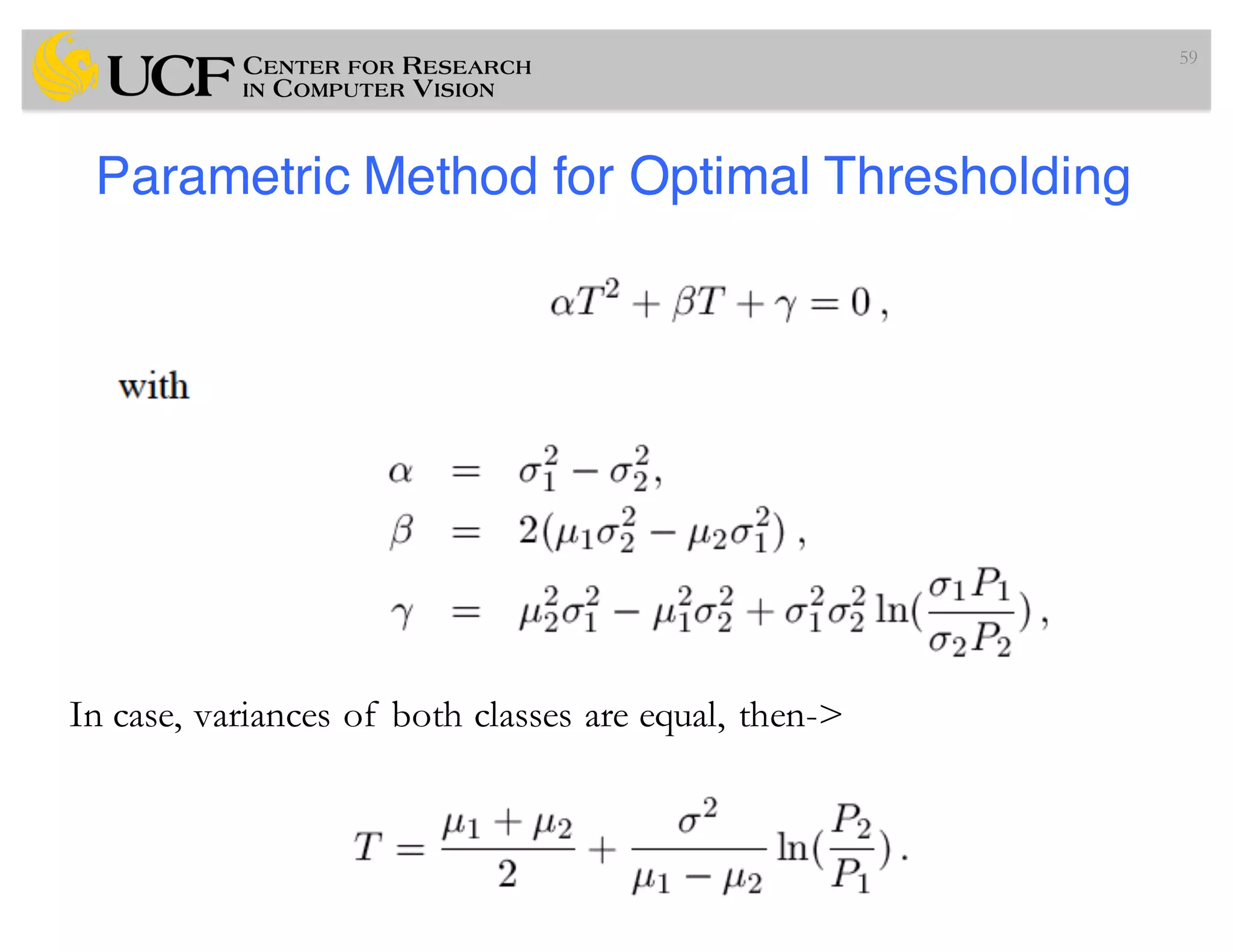
Parametric Method for Optimal Thresholding
• Assuming again a two-class problem and assuming that the
distribution of gray levels for each class can be modeled by a
normal distribution with mean and variance
54
Parametric Method for Optimal Thresholding
• Assuming again a two-class problem and assuming that the
distribution of gray levels for each class can be modeled by a
normal distribution with mean and variance
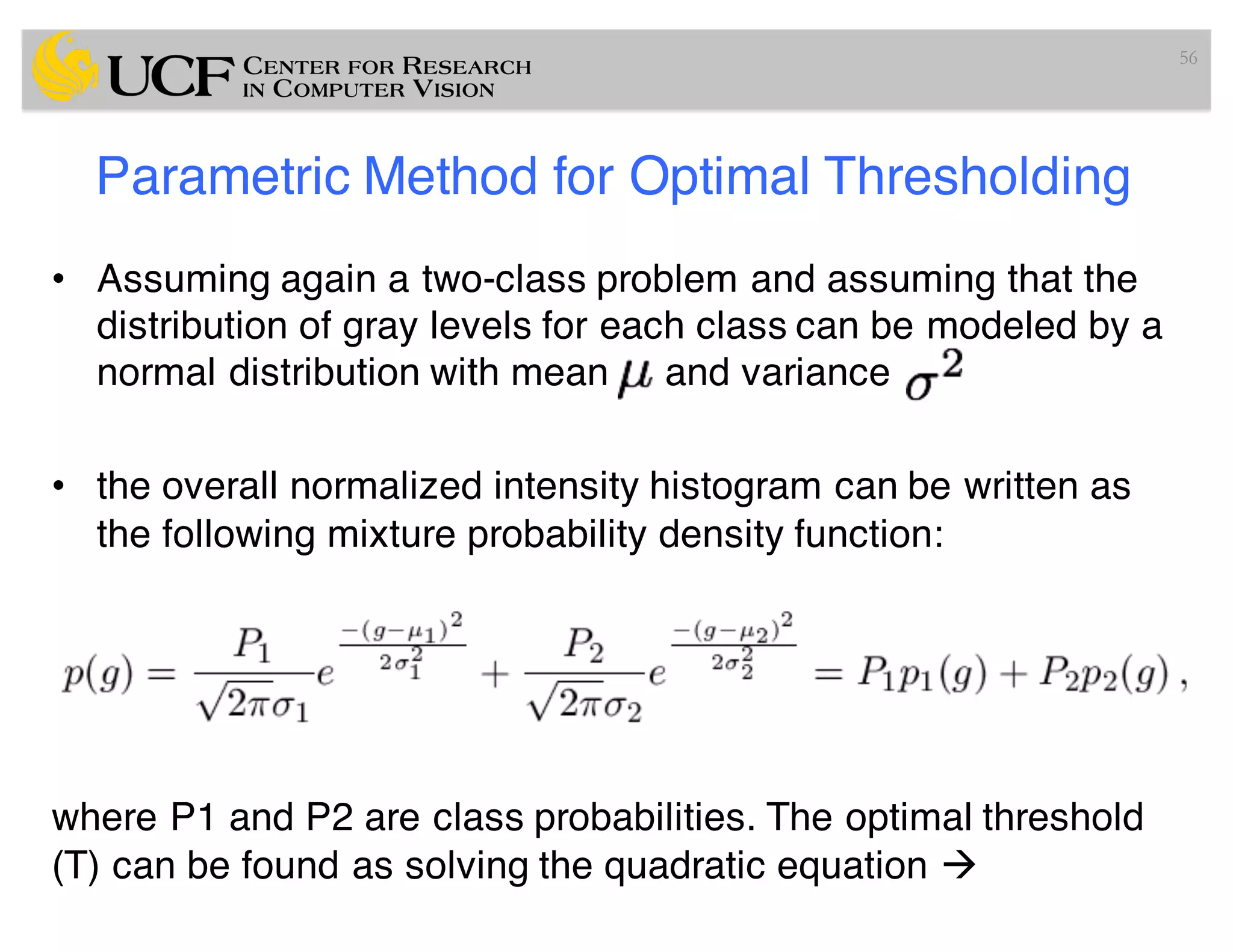
• the overall normalized intensity histogram can be written as
the following mixture probability density function:
55
Parametric Method for Optimal Thresholding
• Assuming again a two-class problem and assuming that the
distribution of gray levels for each class can be modeled by a
normal distribution with mean and variance
• the overall normalized intensity histogram can be written as
the following mixture probability density function:
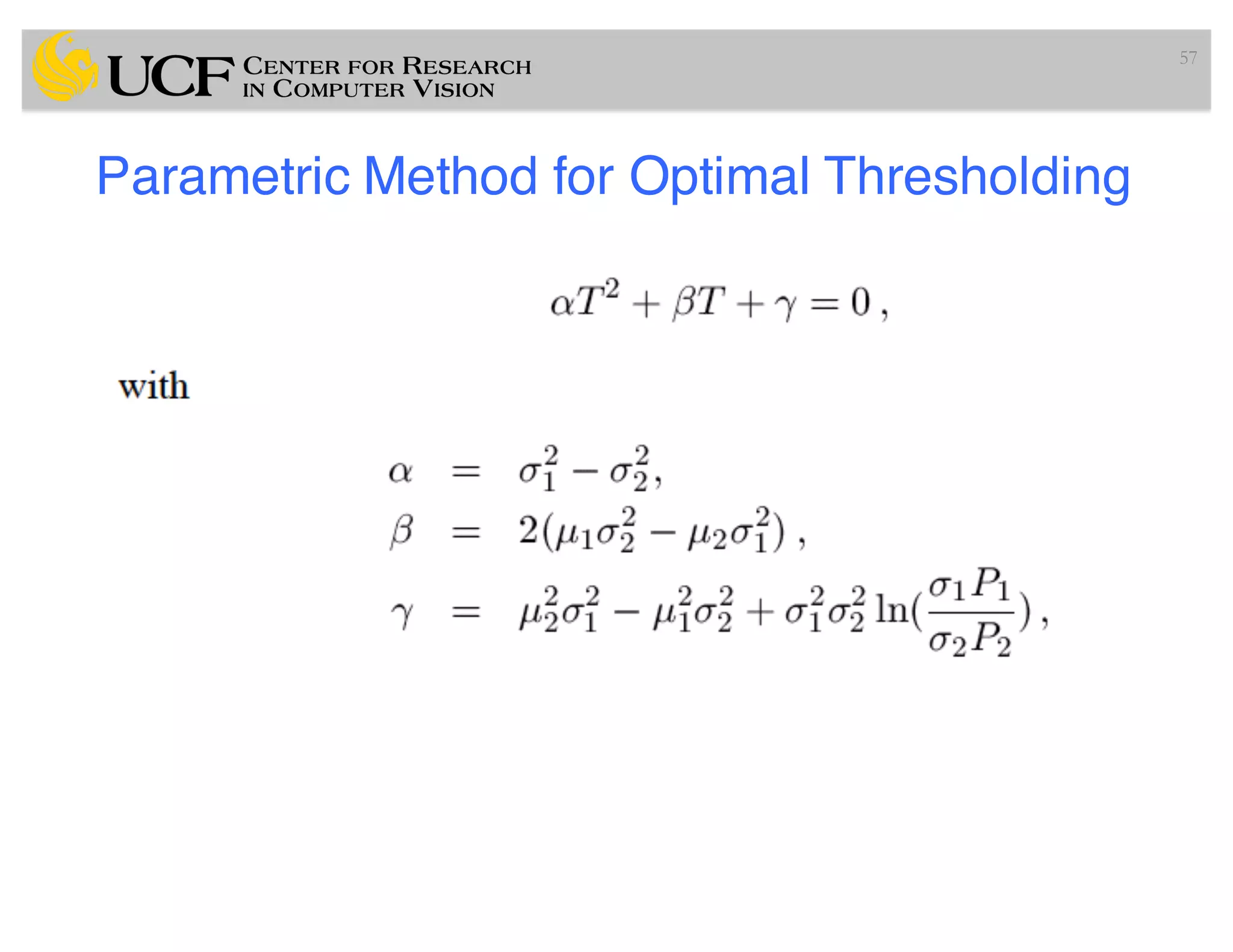
where P1 and P2 are class probabilities. The optimal threshold
(T) can be found as solving the quadratic equation à
56
Parametric Method for Optimal Thresholding
57
Parametric Method for Optimal Thresholding
58
In case, variances of both classes are equal, then->
Parametric Method for Optimal Thresholding
59
In case, variances of both classes are equal, then->
Thresholding methods for PET Image
Segmentation
• Due to the nature of PET images (i.e., low resolution with high
contrast), thresholding-based methods are suitable
– because the local or global intensity histogram usually provides a
sufficient level of information for separating the foreground (object of
interest) from the background. (Foster, Bagci, et al., CBM 2014)
60
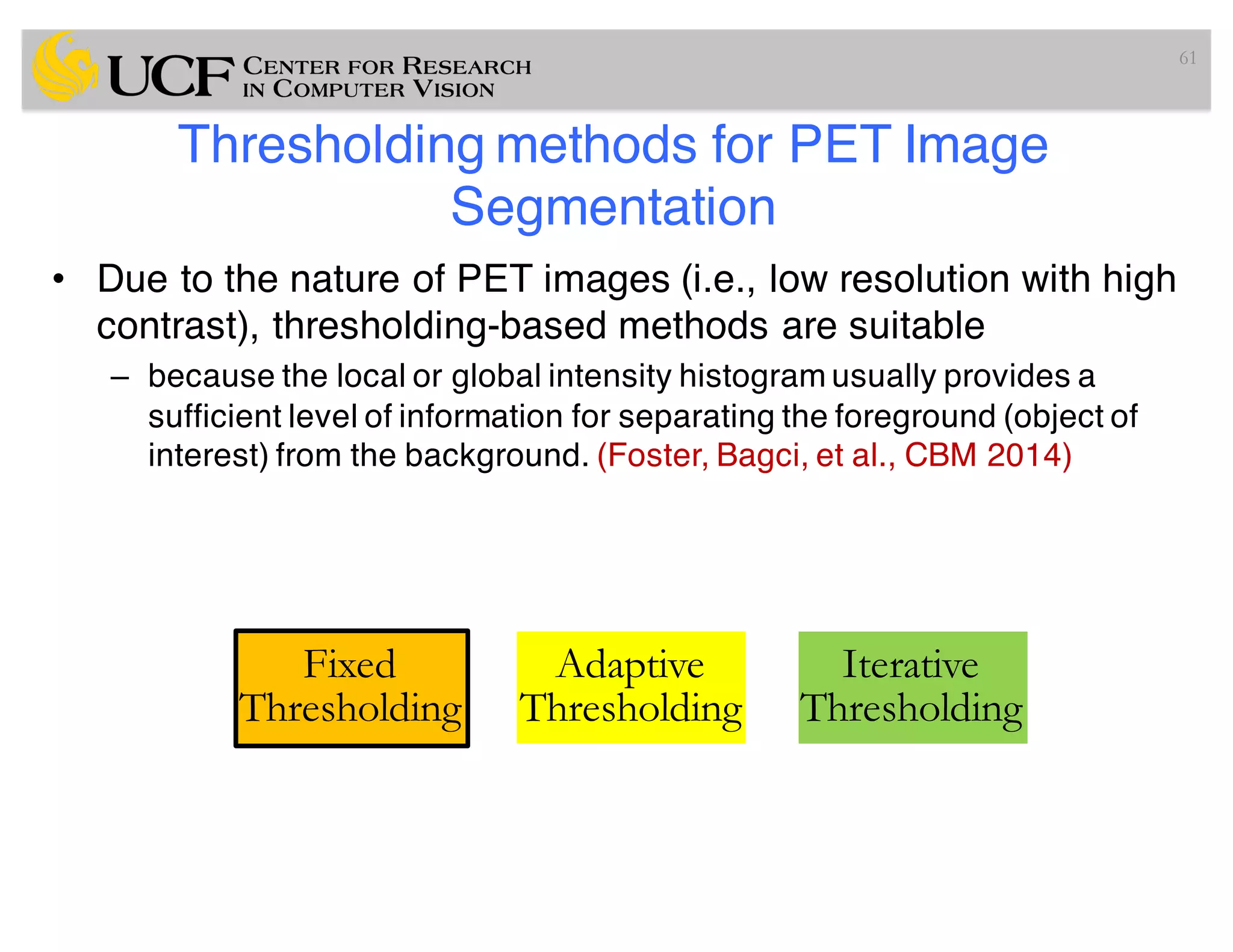
Thresholding methods for PET Image
Segmentation
• Due to the nature of PET images (i.e., low resolution with high
contrast), thresholding-based methods are suitable
– because the local or global intensity histogram usually provides a
sufficient level of information for separating the foreground (object of
interest) from the background. (Foster, Bagci, et al., CBM 2014)
61
Fixed
Thresholding
Adaptive
Thresholding
Iterative
Thresholding
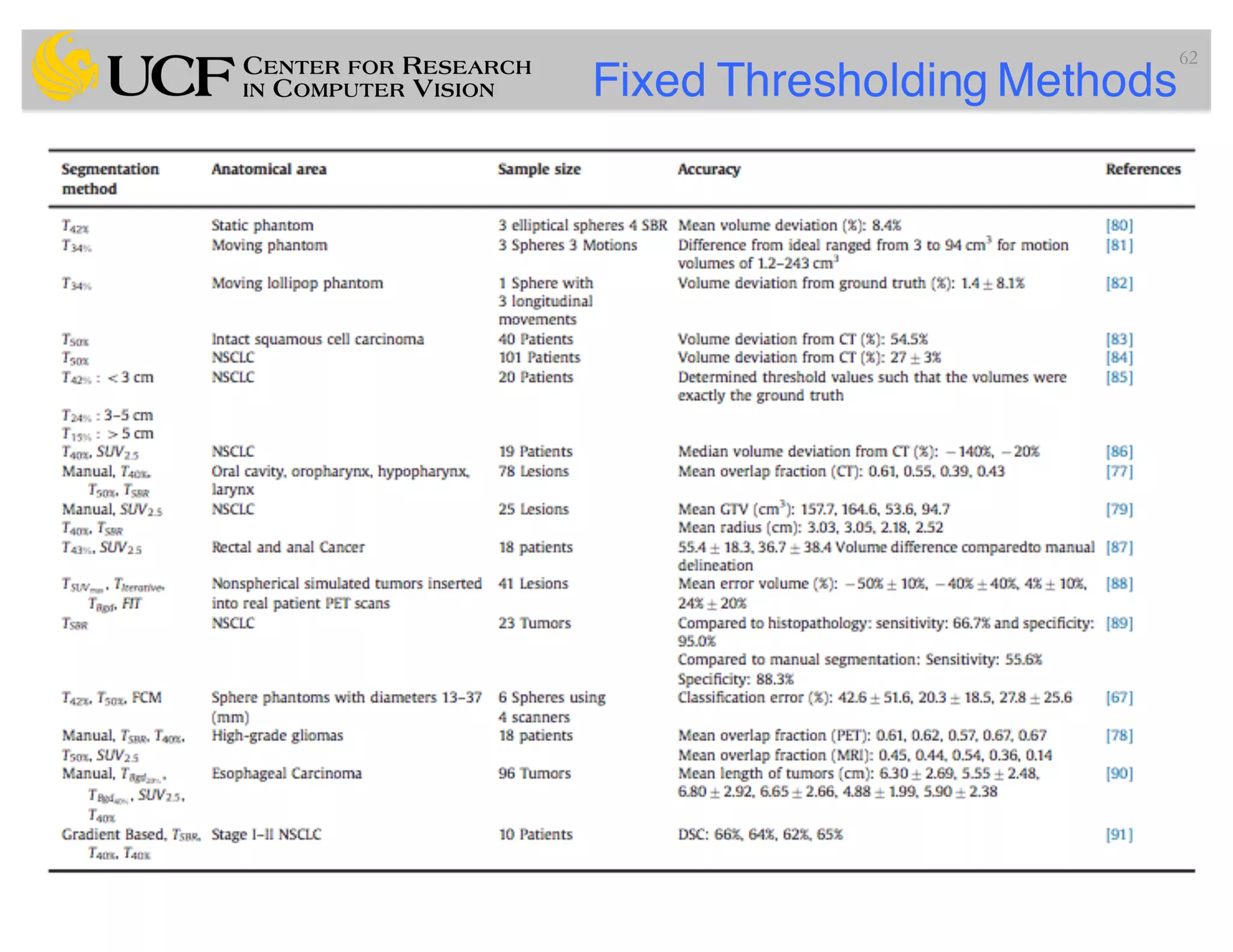
Fixed Thresholding Methods
• Due to the nature of PET images (i.e., low resolution with high
contrast), thresholding-based methods are suitable
– because the local or global intensity histogram usually provides a
sufficient level of information for separating the foreground (object of
interest) from the background. (Foster, Bagci, et al., CBM 2014)
62
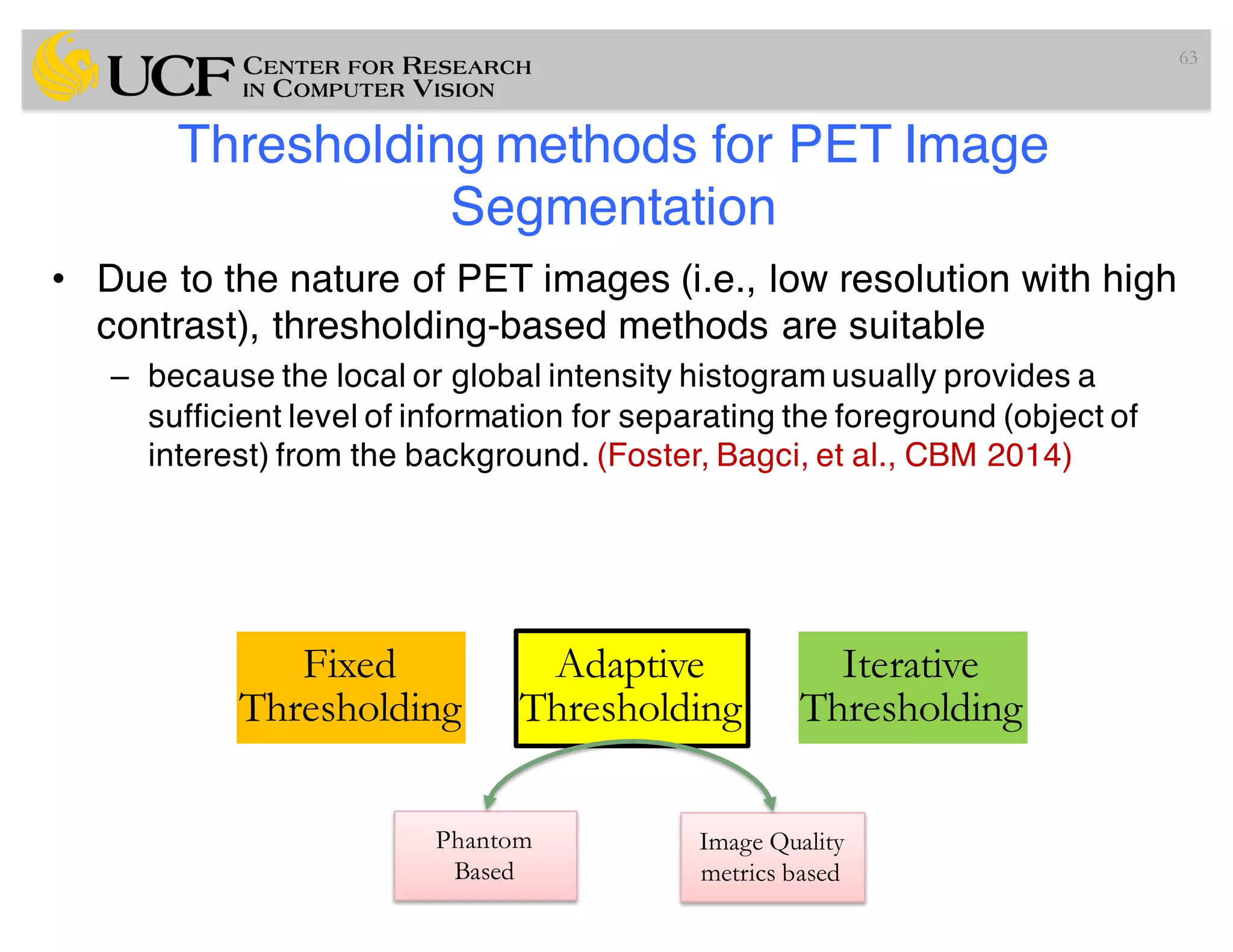
Thresholding methods for PET Image
Segmentation
• Due to the nature of PET images (i.e., low resolution with high
contrast), thresholding-based methods are suitable
– because the local or global intensity histogram usually provides a
sufficient level of information for separating the foreground (object of
interest) from the background. (Foster, Bagci, et al., CBM 2014)
63
Fixed
Thresholding
Adaptive
Thresholding
Iterative
Thresholding
Phantom
Based
Image Quality
metrics based
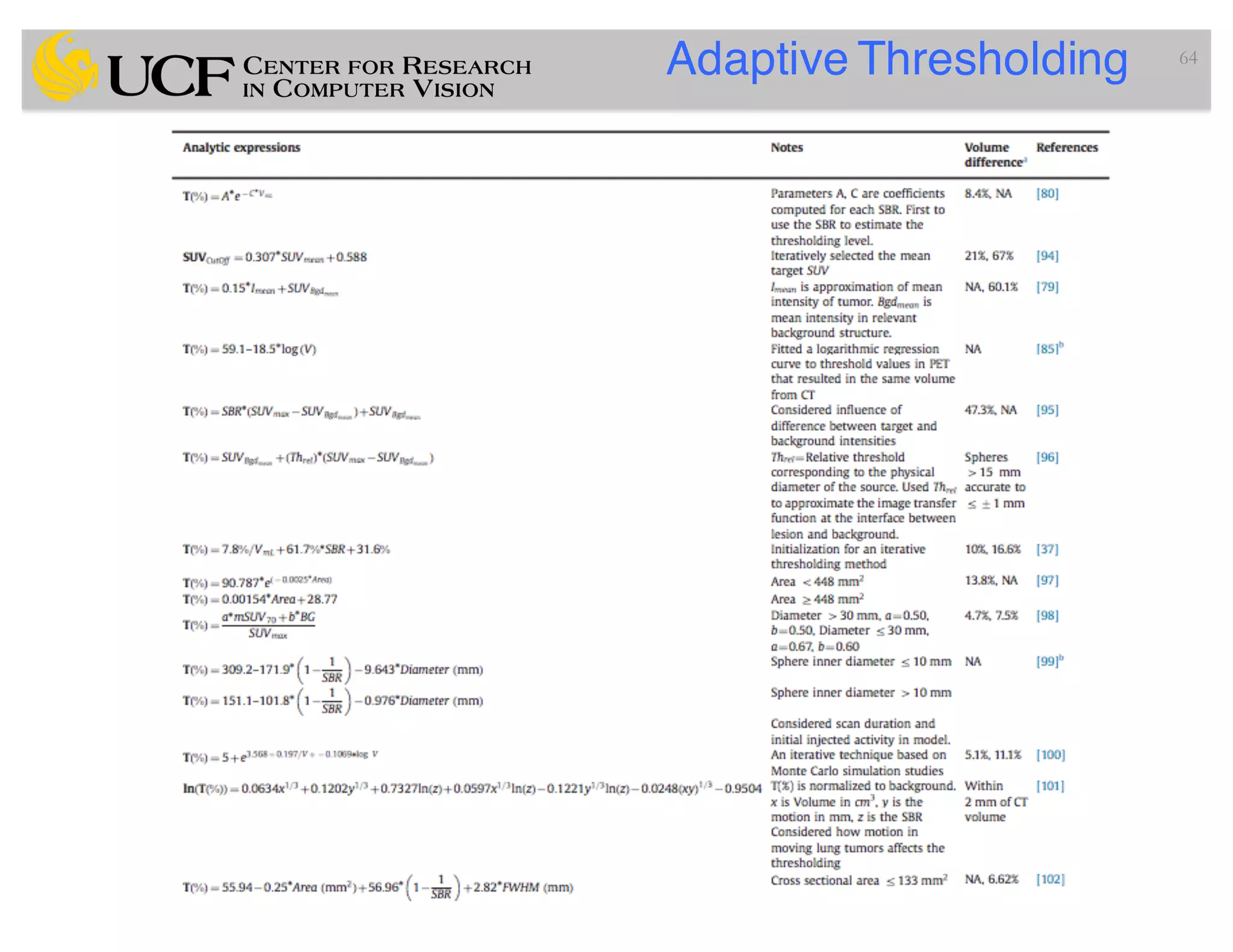
Adaptive Thresholding 64
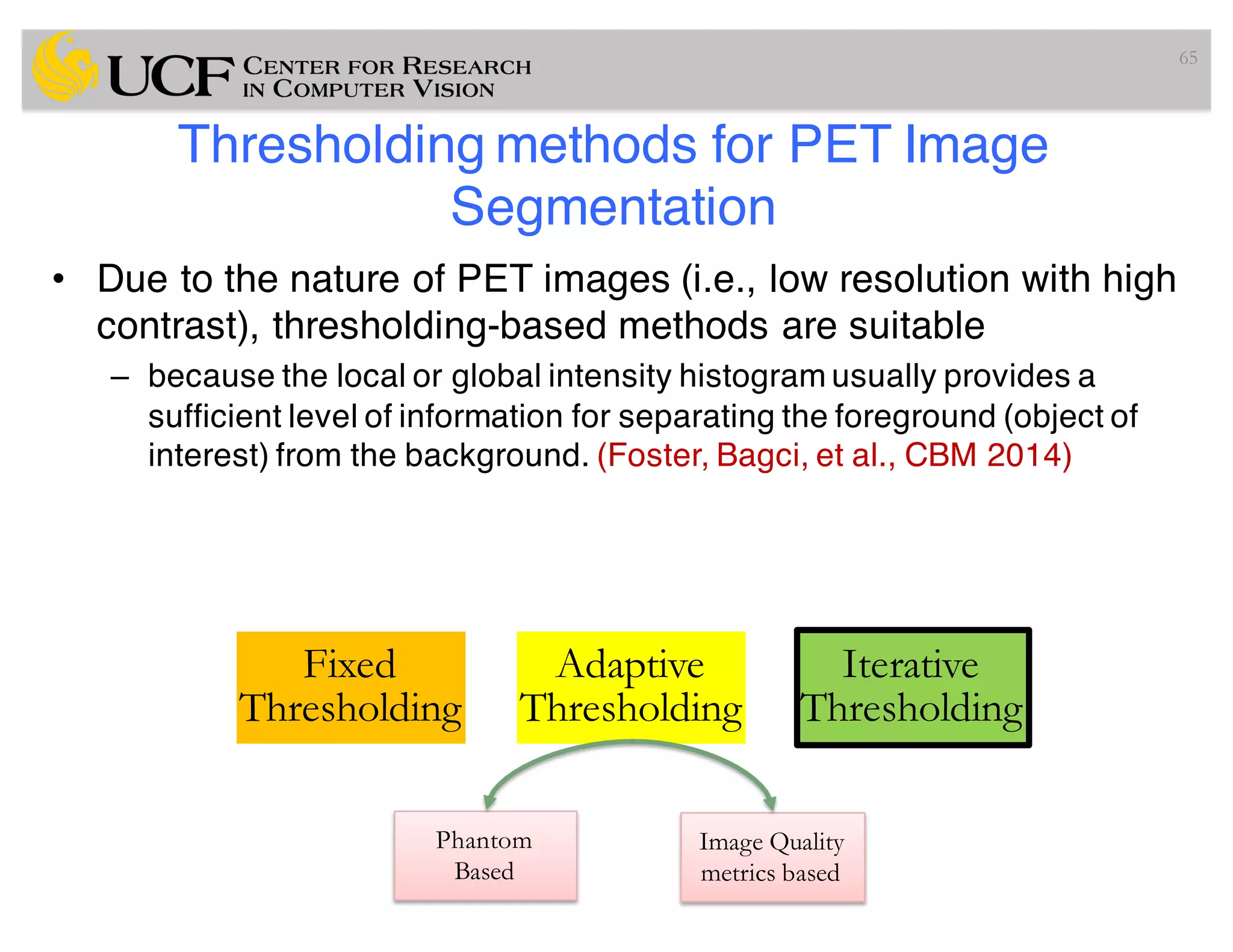
Thresholding methods for PET Image
Segmentation
• Due to the nature of PET images (i.e., low resolution with high
contrast), thresholding-based methods are suitable
– because the local or global intensity histogram usually provides a
sufficient level of information for separating the foreground (object of
interest) from the background. (Foster, Bagci, et al., CBM 2014)
65
Fixed
Thresholding
Adaptive
Thresholding
Iterative
Thresholding
Phantom
Based
Image Quality
metrics based
Iterative Thresholding Method (ITM)
66
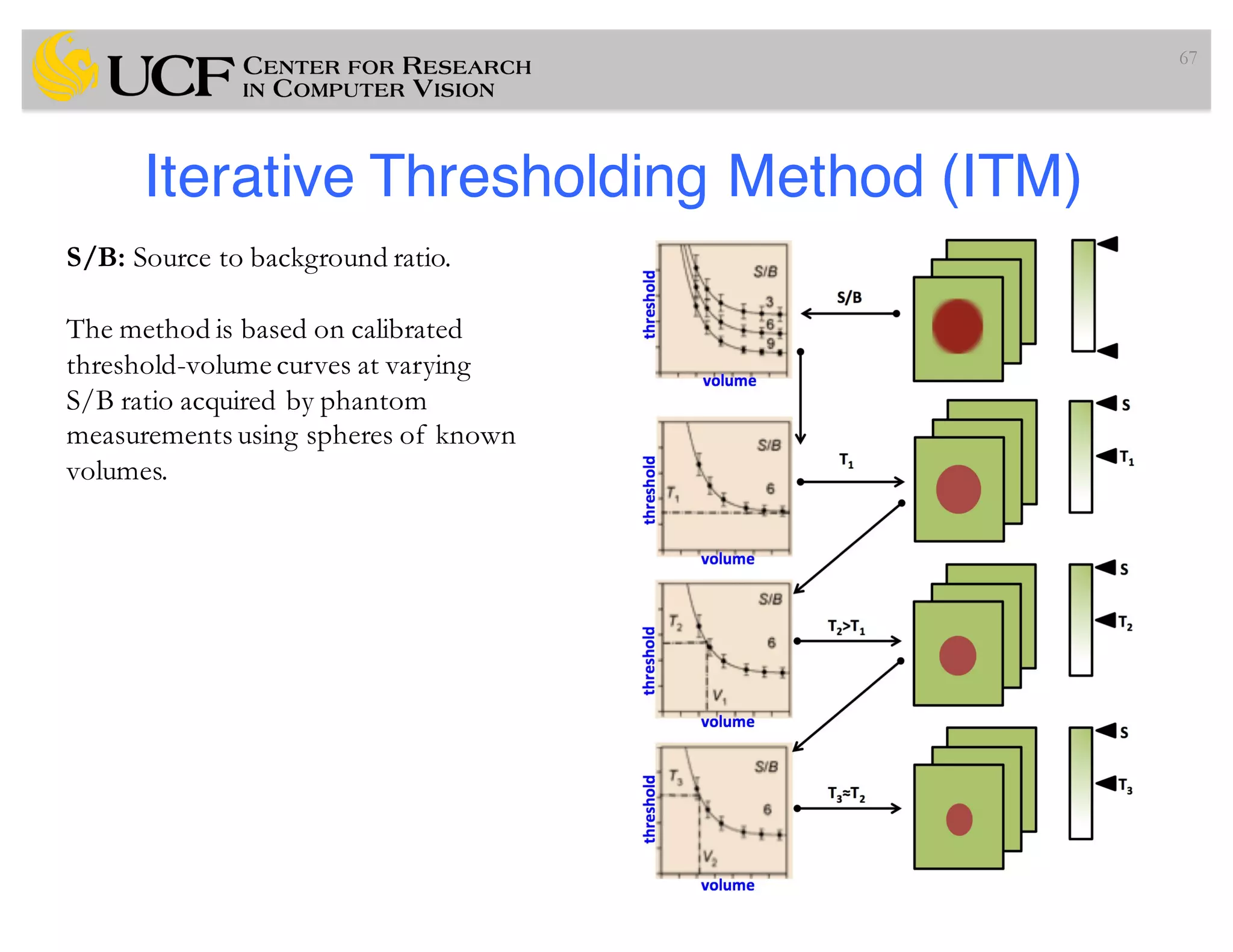
S/B: Source to background ratio.
The method is based on calibrated
threshold-volume curves at varying
S/B ratio acquired by phantom
measurements using spheres of known
volumes.
Iterative Thresholding Method (ITM)
67
S/B: Source to background ratio.
The method is based on calibrated
threshold-volume curves at varying
S/B ratio acquired by phantom
measurements using spheres of known
volumes.
Iterative Thresholding Method (ITM)
68
S/B: Source to background ratio.
The method is based on calibrated
threshold-volume curves at varying
S/B ratio acquired by phantom
measurements using spheres of known
volumes.
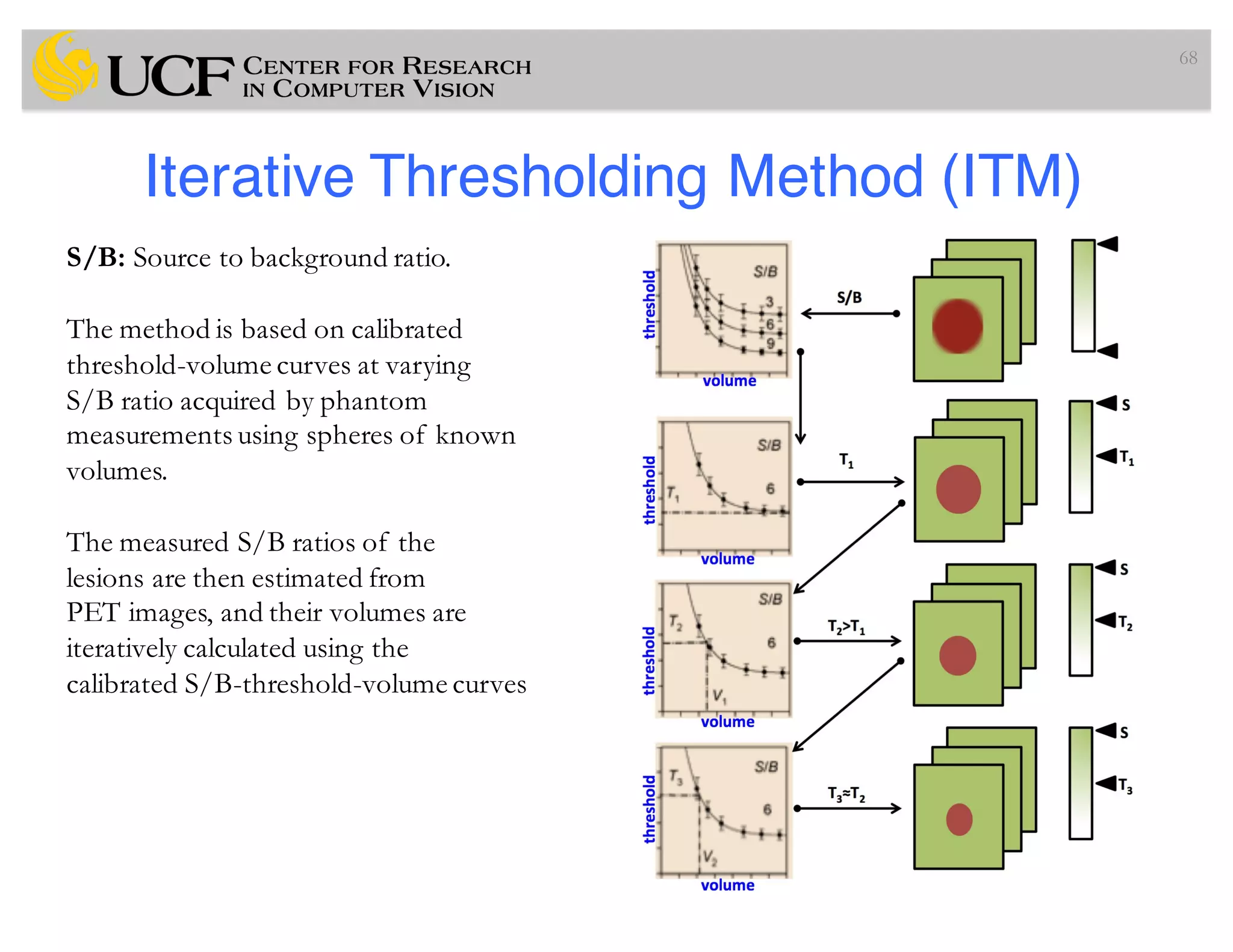
The measured S/B ratios of the
lesions are then estimated from
PET images, and their volumes are
iteratively calculated using the
calibrated S/B-threshold-volume curves
Iterative Thresholding Method (ITM)
69
S/B: Source to background ratio.
The method is based on calibrated
threshold-volume curves at varying
S/B ratio acquired by phantom
measurements using spheres of known
volumes.
The measured S/B ratios of the
lesions are then estimated from
PET images, and their volumes are
iteratively calculated using the
calibrated S/B-threshold-volume curves
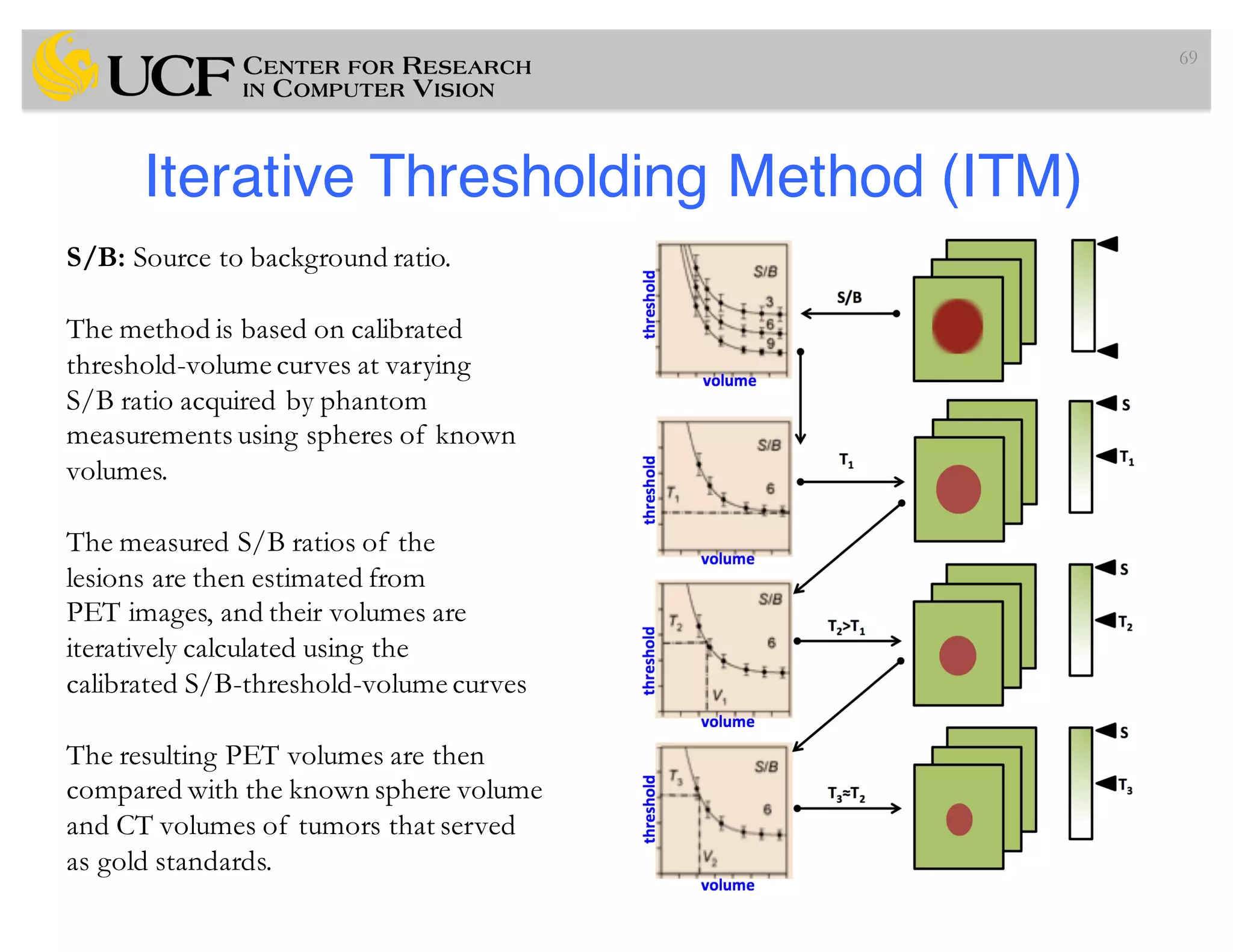
The resulting PET volumes are then
compared with the known sphere volume
and CT volumes of tumors that served
as gold standards.
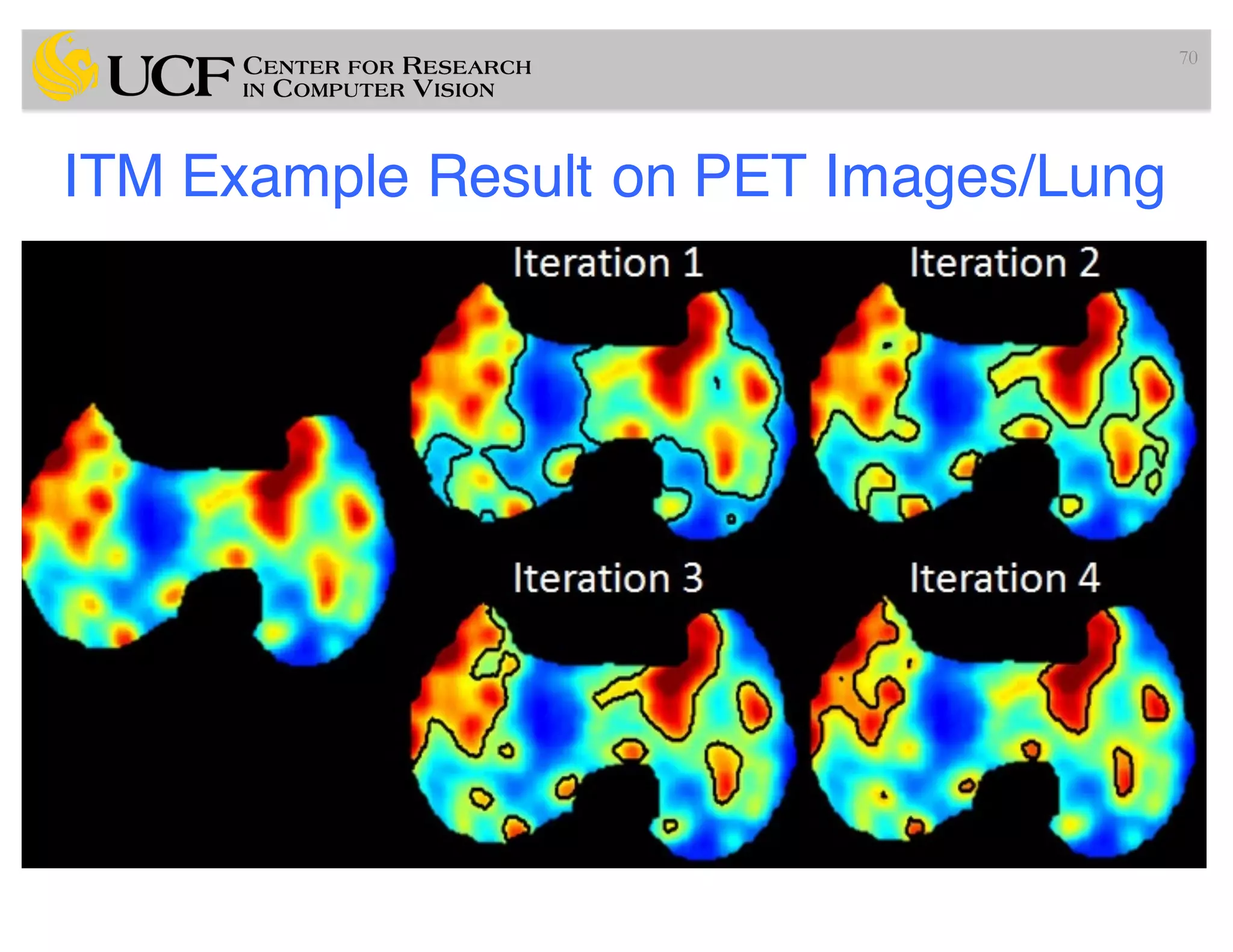
ITM Example Result on PET Images/Lung
70
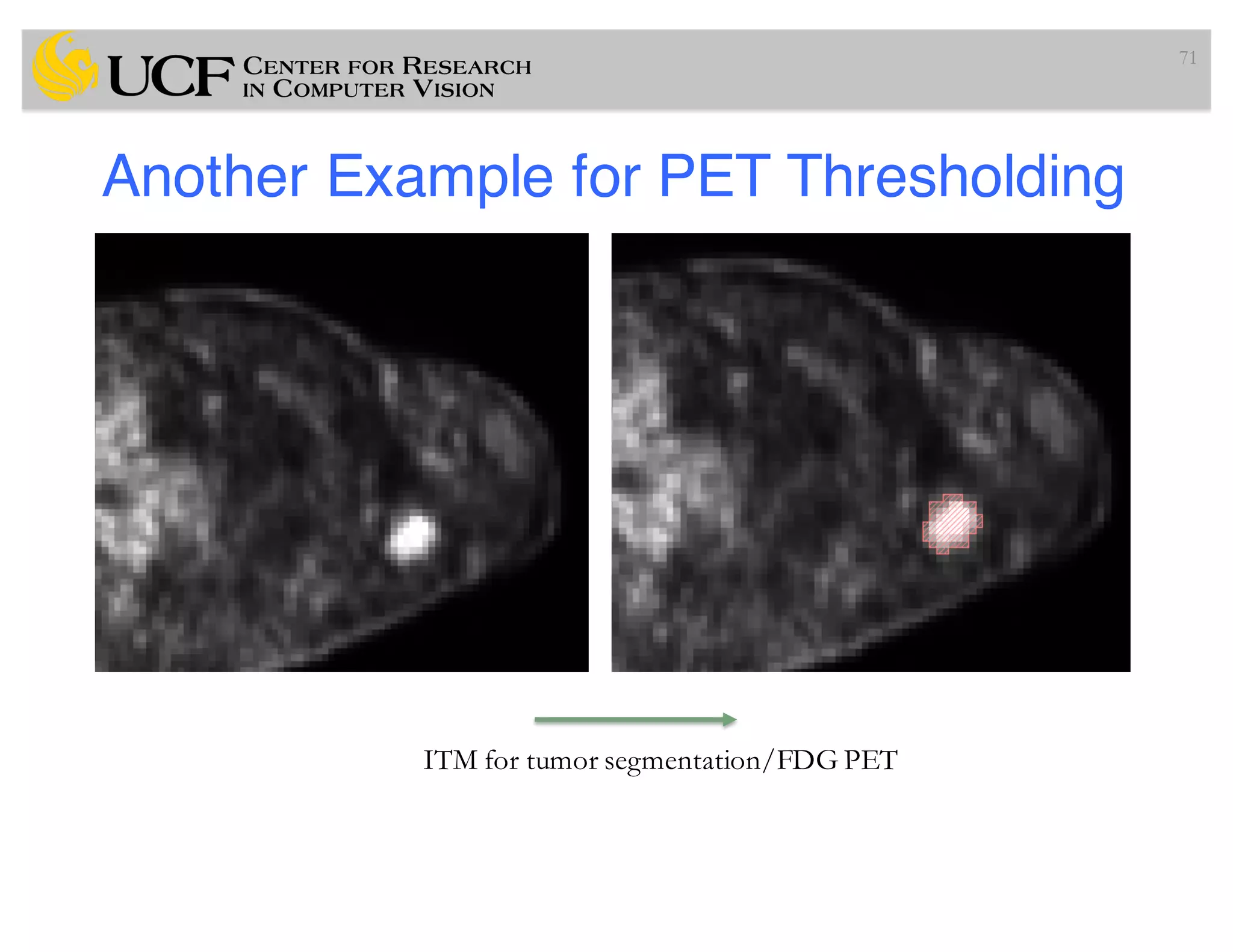
Another Example for PET Thresholding
71
ITM for tumor segmentation/FDG PET
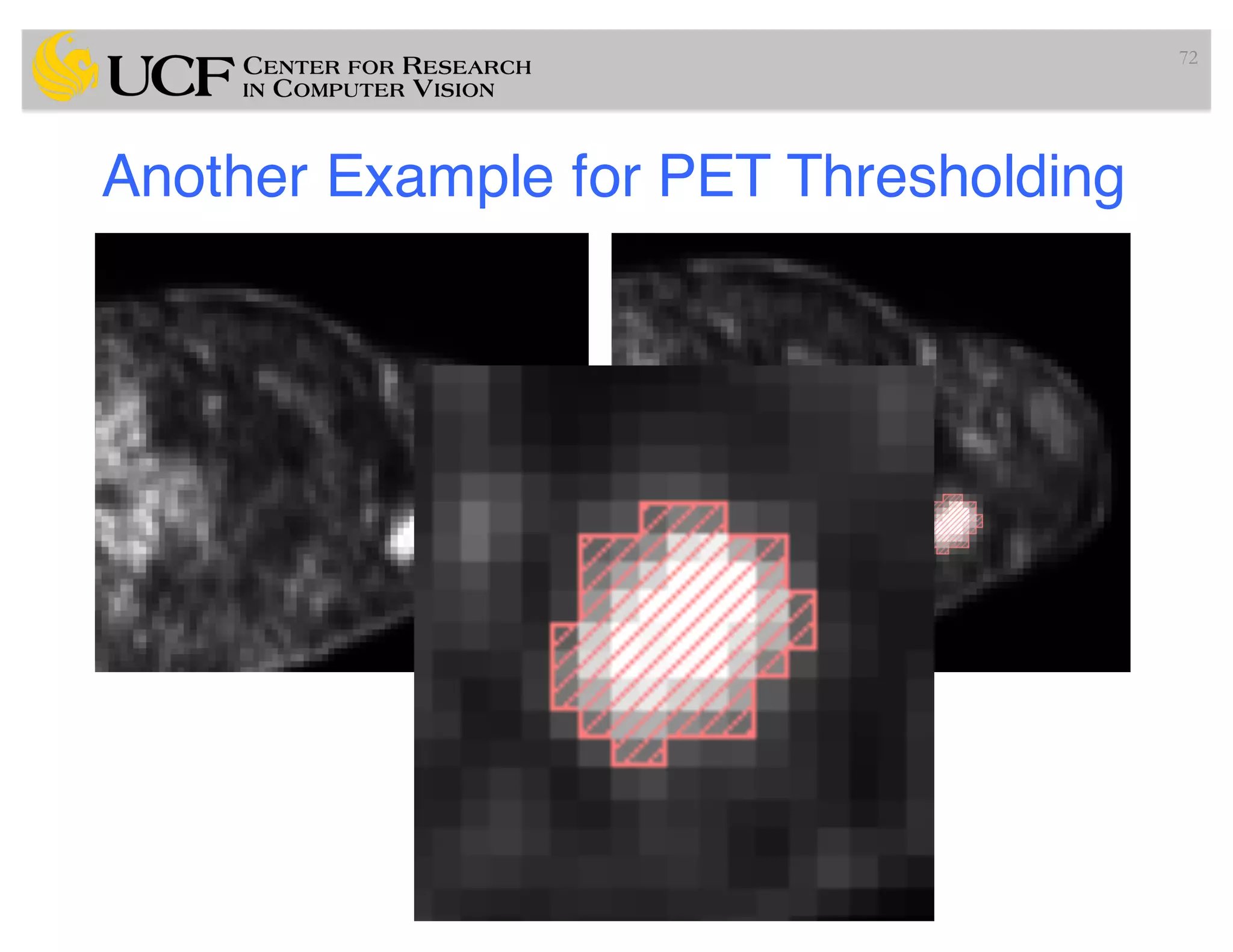
Another Example for PET Thresholding
72
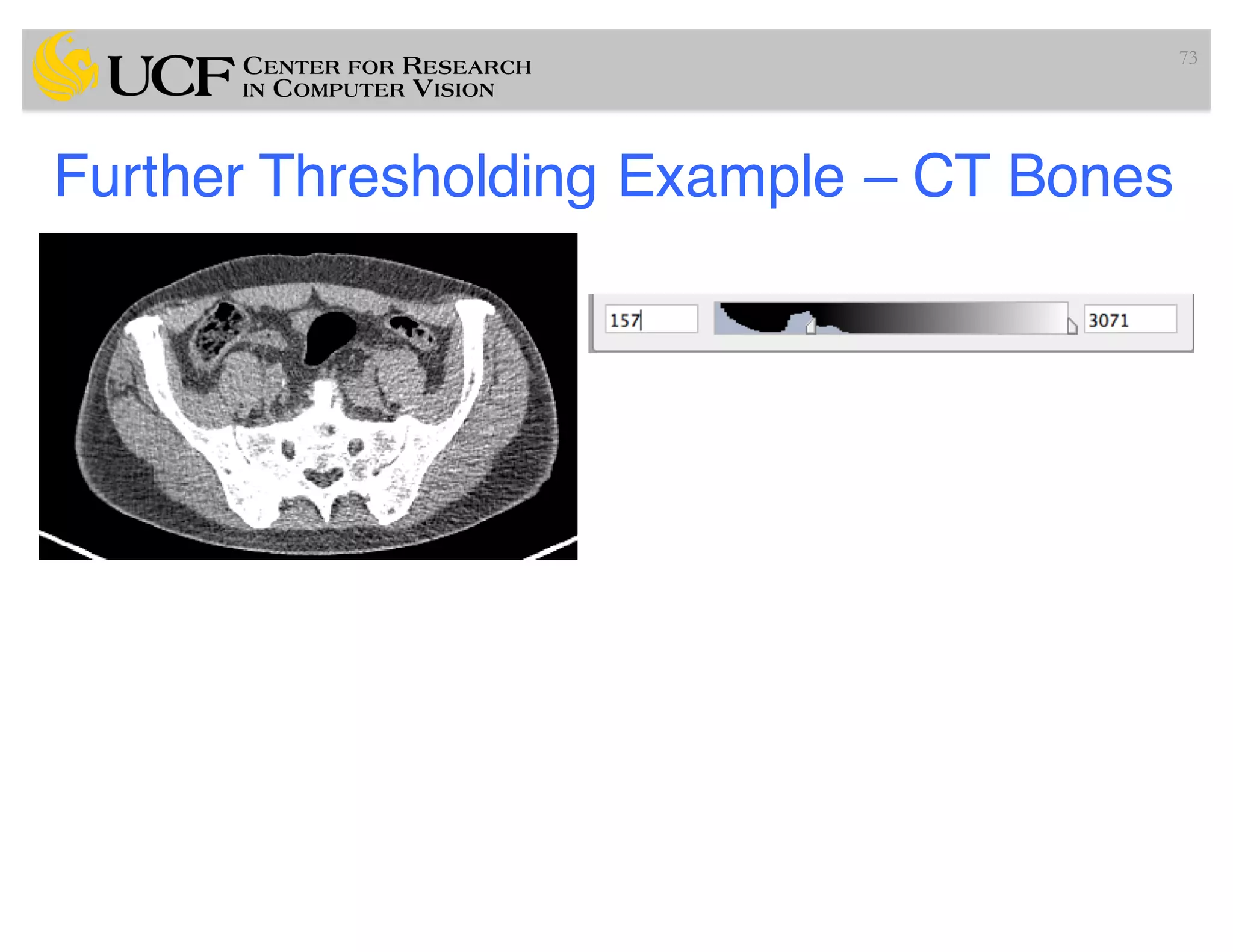
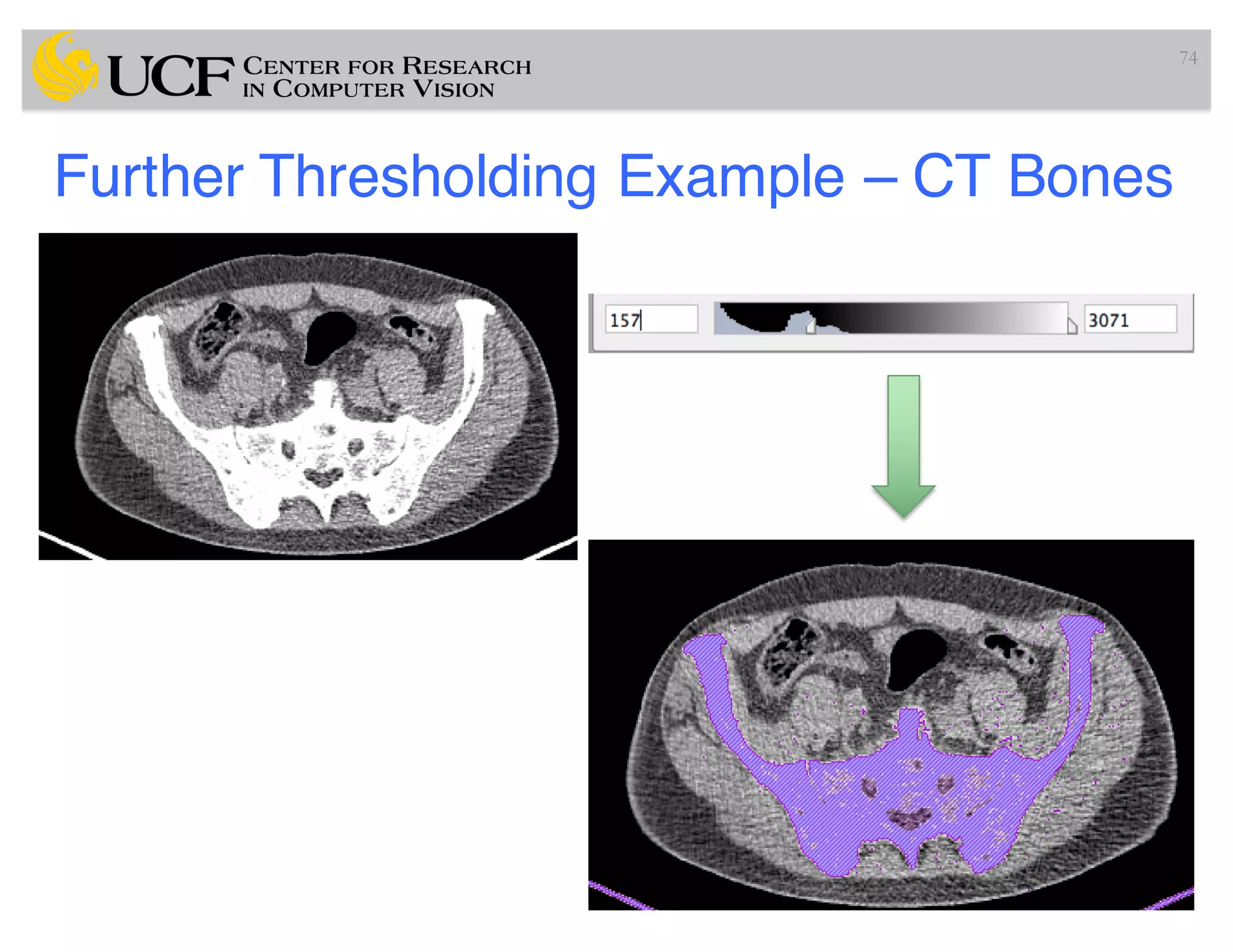
Further Thresholding Example – CT Bones
73
Further Thresholding Example – CT Bones
74
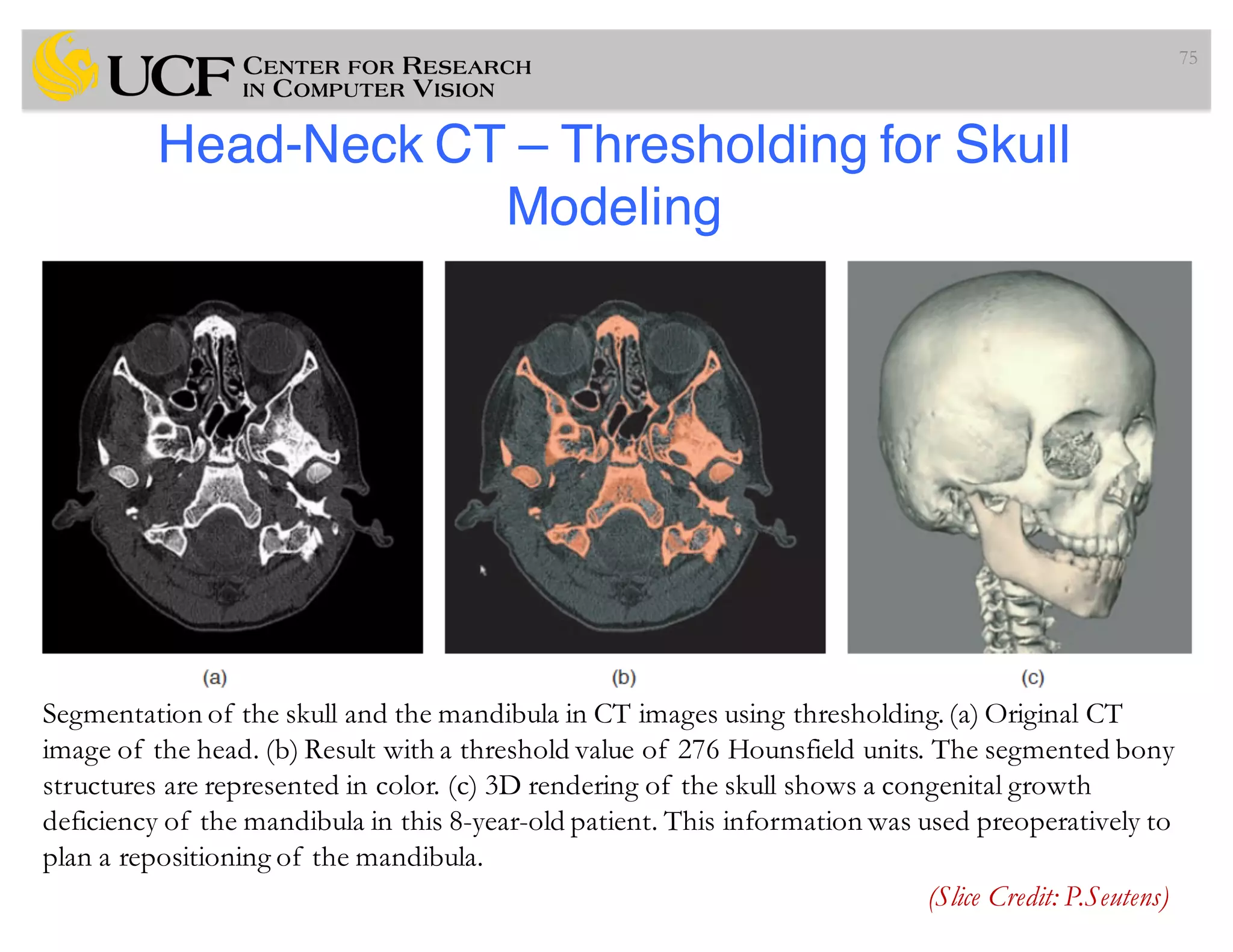
Head-Neck CT – Thresholding for Skull
Modeling
75
(Slice Credit: P.Seutens)
Segmentation of the skull and the mandibula in CT images using thresholding.(a) Original CT
image of the head. (b) Result with a threshold value of 276 Hounsfield units. The segmented bony
structures are represented in color. (c) 3D rendering of the skull shows a congenital growth
deficiency of the mandibula in this 8-year-old patient. This information was used preoperatively to
plan a repositioning of the mandibula.
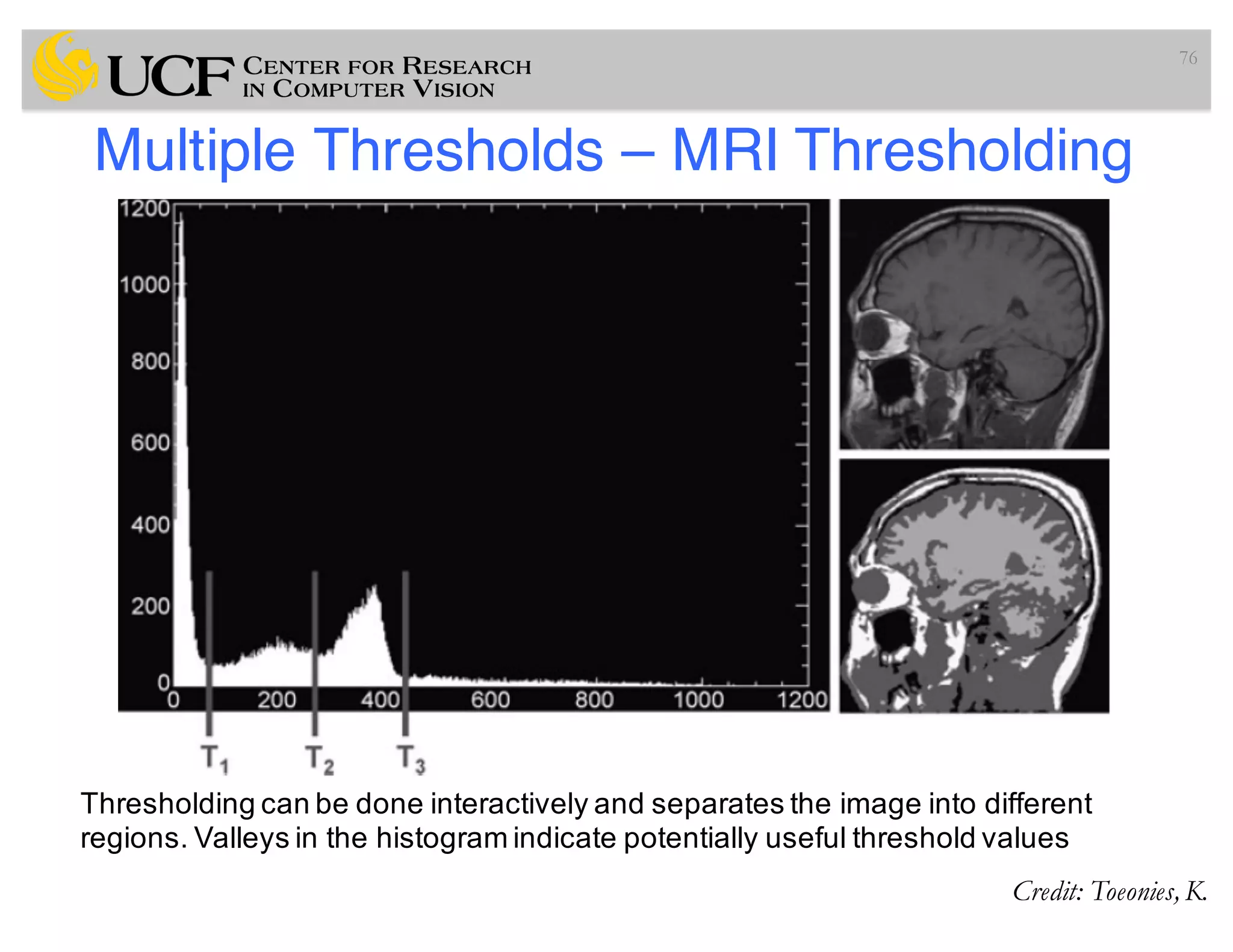
Multiple Thresholds – MRI Thresholding
76
Thresholding can be done interactively and separates the image into different
regions. Valleys in the histogram indicate potentially useful threshold values
Credit: Toeonies,K.
Summary of today’s lecture
• Introduction into the Medical Image Segmentation
• Recognition and Delineation concepts in Segmentation
• Simplest Segmentation method: Thresholding
– Otsu
– Parametric method for optimal thresholding
– PET Image thresholding
• ITM, fixed thresholding,etc.
77
Slide Credits and References
• Jayaram K. Udupa, MIPG of University of Pennsylvania, PA.
• P. Suetens, Fundamentals of Medical Imaging, Cambridge
Univ. Press.
• Foster, B., et al. CBM, Review paper, 2014.
• Kaus, et al. Radiology 2001.
• Toeonies, K., Medical Image Analysis.
• Farraher, et al., Radiology 2005
• Zaidi, H., Quantitative Analysis in Nuclear Medicine Imaging.
• Bailey et al. Positron Emission Tomography, Springer.
• Dawood, M., et al. Correction Techniques in Emission
Tomography
78

Lec7: Medical Image Segmentation (I) (Radiology Applications of Segmentation, and Thresholding)

  • 1.
    MEDICAL IMAGE COMPUTING(CAP 5937) LECTURE 7: Medical Image Segmentation (I) (Radiology Applications of Segmentation, and Thresholding) Dr. Ulas Bagci HEC 221, Center for Research in Computer Vision (CRCV), University of Central Florida (UCF), Orlando, FL 32814. bagci@ucf.edu or bagci@crcv.ucf.edu 1SPRING 2017
  • 2.
    Outline • Introduction toMedical Image Segmentation, type of segmentation methods, and definitions – Recognition & Delineation • Simplest Segmentation Method(s): Thresholding – Otsu Thresholding – Parametric Method – PET Image Thresholding Methods • ITM (Iterative Thresholding Method) 2
  • 3.
    Motivation for ImageSegmentation In the last 20 years the computer vision and medical imaging communities have produced a number of useful algorithms for localizing object boundaries in images. 3
  • 4.
    Motivation for ImageSegmentation • Content based image retrieval • Machine Vision • Medical Imaging applications (tumor delineation,..) • Object detection (face detection,…) • 3D Reconstruction • Object/Motion Tracking • Object-based measurements such as size and shape • Object recognition (face recognition,…) • Fingerprint recognition, • Video surveillance • … 4
  • 5.
    Segmentation Tools inRadiologyApplications • 3D views to visualize structural information and spatial anatomic relationships is a difficult task, which is usually carried out in the clinician’s mind. 5
  • 6.
    Segmentation Tools inRadiologyApplications • 3D views to visualize structural information and spatial anatomic relationships is a difficult task, which is usually carried out in the clinician’s mind. • Image-processing tools provide the surgeon with interactively displayed 3D visual information. 6
  • 7.
    Segmentation Tools inRadiologyApplications 7 Credit: Kaus, et al. Radiology 2001.
  • 8.
    • Determination ofthe volumes of abdominal solid organs and focal lesions has great potential importance (liver, spleen, …). • Monitoring the response to therapy and the progression of neoplastic disease and preoperative examination of living liver donors are the most common clinical applications of volume determination. 8 Segmentation Tools in RadiologyApplications (credit: Farraher, et al. Radiology 2005)
  • 9.
    Segmentation Tools inRadiologyApplications • Gross Tumor Volume in CT/MRI • Metabolic Tumor Volume in PET/SPECT/ – Surgery/Therapy Planning • Planning Tumor Volume (PTV) – Tumor characterization • Texture Extraction requires segmentation to be done • Shape analysis 9
  • 10.
    Segmentation Tools inRadiologyApplications • There is a strong interest in automatic and reproducible techniques for detection and quantification of vascular disease • A first step toward an effective vessel analysis tool is segmentation of the vasculature. 10 axial coronal sagittal Credit: Manniesing, et al, Radiology 2008 MIP: maximum intensity Projection image of cerebral vessels (in CTA)
  • 11.
    Segmentation Tools inRadiologyApplications • MR volumetry of the hippocampus can help distinguish patients with AD (Alzheimer’s Disease) from elderly controls with a high degree of accuracy (80%–90%). 11
  • 12.
    Segmentation Tools inRadiologyApplications • MR volumetry of the hippocampus can help distinguish patients with AD (Alzheimer’s Disease) from elderly controls with a high degree of accuracy (80%–90%). 12 hippocampus amygdala Credit: Colliot et al, Radiology 2008.
  • 13.
    Image Segmentation Definition: Partitioninga picture/image into distinctive subsets is called segmentation. 13
  • 14.
    Image Segmentation Definition: Partitioninga picture/image into distinctive subsets is called segmentation. 14 Segmentation of an image entails the division or separation of the image into regions of similar attribute.
  • 15.
    Image Segmentation Definition: Partitioninga picture/image into distinctive subsets is called segmentation. 15 Segmentation of an image entails the division or separation of the image into regions of similar attribute. The most basic attributes: -intensity -edges -texture -other features…
  • 16.
    Image Segmentation Definition: Partitioninga picture/image into distinctive subsets is called segmentation. 16 Purpose: To extractobject information and representthis as a hard/fuzzygeometric structure. Recognition: Determiningthe object’s whereaboutsin the scene. (humans> computer) Delineation: Determining the object’s spatial extent and compositionin the scene. (computers > humans)
  • 17.
    Recognition - Example 17 (slicecredit: J. Kim et al, Signal Processing 2007) Model is induced No Model is induced
  • 18.
    Approaches to Recognition 18 •Model-based • Knowledge-based - Non-interactive • Atlas-based • Human-assisted - Interactive
  • 19.
    Approaches to Recognition 19 •Model-based • Knowledge-based - Non-interactive • Atlas-based • Human-assisted - Interactive - They all originate from human knowledge. - Their relative efficacy is unknown.
  • 20.
    Approaches to Delineations 20 pI(purely image-based) approaches • Rely mostlyon informationavailable in the given image only. • Recognition: manual
  • 21.
    Approaches to Delineations 21 pI(purely image-based) approaches • Rely mostlyon informationavailable in the given image only. • Recognition: manual SM (shape model-based) approaches • Employ models to codify object family shape info. • Recognition: model-based/manual
  • 22.
    Approaches to Delineations 22 pI(purely image-based) approaches • Rely mostlyon informationavailable in the given image only. • Recognition: manual SM (shape model-based) approaches • Employ models to codify object family shape info. • Recognition: model-based/manual Hybrid approaches • Combine among pI and SM approaches. • Recognition: model-based, automatic.
  • 23.
    Classification of Methods 23 Boundary-based(BpI): • optimum boundary • active boundary • live wire • level sets
  • 24.
    Classification of Methods 24 Boundary-based(BpI): • optimum boundary • active boundary • live wire • level sets Region-based (RpI): • clustering – kNN, CM, FCM • graph cut • fuzzy connectedness • MRF • watershed • optimum partitioning • (Mumford-Shah)
  • 25.
    Classification of Methods 25 Boundary-based(BpI): • optimum boundary • active boundary • live wire • level sets Region-based (RpI): • clustering – kNN, CM, FCM • graph cut • fuzzy connectedness • MRF • watershed • optimum partitioning • (Mumford-Shah) SM Approaches • manual tracing • live wire • active shape/appearance • M-reps • atlas-based
  • 26.
    Classification of Methods 26 Boundary-based(BpI): • optimum boundary • active boundary • live wire • level sets Region-based (RpI): • clustering – kNN, CM, FCM • graph cut • fuzzy connectedness • MRF • watershed • optimum partitioning • (Mumford-Shah) SM Approaches • manual tracing • live wire • active shape/appearance • M-reps • atlas-based Hybrid Approaches • BpI + BpI • RpI + RpI • BpI + RpI • BpI + SM • RpI + SM • SM + SM
  • 27.
    Classification of Methods 27 pIApproaches + Where image info is good, accuracy is good; - Bad where it is poor/absent; - Need recognition help; + Can determine degree of match of model to image well; - Lack obj shape & geographic info;
  • 28.
    Classification of Methods 28 SMApproaches -Even where image info is good, accuracy suffers; + Where bad, model helps; + Can help in recognition; - Need best match info; + Good models embody obj shape & geographic info;
  • 29.
    Purely Image BasedSegmentation Methods 29
  • 30.
    Thresholding – SimpleSegmentation • Image binarization – mapping a scalar image I into a binary image J 30 J(x, y) = ( 0 if I(x, y) < T 1 otherwise.
  • 31.
    Thresholding – SimpleSegmentation • Image binarization – mapping a scalar image I into a binary image J 31 J(x, y) = ( 0 if I(x, y) < T 1 otherwise.
  • 32.
    Thresholding – SimpleSegmentation 32 Brighter objects Darker objects
  • 33.
    Thresholding – SimpleSegmentation 33 Brighter objects Darker objects DIFFICULTIES 1. The valley may be so broad that it is difficult to locate a significant minimum 2. Number of minima due to type of details in the image 3. Noise 4. No visible valley 5. Histogram may be multi-modal
  • 34.
  • 35.
  • 36.
  • 37.
  • 38.
  • 39.
    Thresholding Methods • Huang •Intermode • Isodata • Li • MaxEntropy • Mean • MinError • Otsu • Percentile • RenyiEntropy • Moments 39
  • 40.
    Thresholding Methods • Huang •Intermode • Isodata • Li • MaxEntropy • Mean • MinError • Otsu • Percentile • RenyiEntropy • Moments 40
  • 41.
    Thresholding Methods PET Imaging FixedThresholding Adaptive Thresholding Iterative Thresholding 41 • Huang • Intermode • Isodata • Li • MaxEntropy • Mean • MinError • Otsu (non-parametric) • Percentile • RenyiEntropy • Moments
  • 42.
    Otsu Thresholding • Definition:The method uses the grey-value histogram of the given image I as input and aims at providing the best threshold in the sense that the “overlap” between two classes, set of object and background pixels, is minimized (i.e., by finding the best balance). 42
  • 43.
    Otsu Thresholding • Definition:The method uses the grey-value histogram of the given image I as input and aims at providing the best threshold in the sense that the “overlap” between two classes, set of object and background pixels, is minimized (i.e., by finding the best balance). • Otsu’s algorithm selects a threshold that maximizes the between-class variance . In the case of two classes, 43 2 b 2 b = P1(µ1 µ)2 + P2(µ2 µ)2 = P1P2(µ1 µ2)2
  • 44.
    Otsu Thresholding • Definition:The method uses the grey-value histogram of the given image I as input and aims at providing the best threshold in the sense that the “overlap” between two classes, set of object and background pixels, is minimized (i.e., by finding the best balance). • Otsu’s algorithm selects a threshold that maximizes the between-class variance . In the case of two classes, • where P1 and P2 denote class probabilities, and μi the means of object and background classes. 44 2 b 2 b = P1(µ1 µ)2 + P2(µ2 µ)2 = P1P2(µ1 µ2)2
  • 45.
    Otsu Thresholding • Definition:The method uses the grey-value histogram of the given image I as input and aims at providing the best threshold in the sense that the “overlap” between two classes, set of object and background pixels, is minimized (i.e., by finding the best balance). 45 P1 = uX ı=0 p(i) P2 = GmaxX ı=u+1 p(i) u u
  • 46.
    Otsu Thresholding • Definition:The method uses the grey-value histogram of the given image I as input and aims at providing the best threshold in the sense that the “overlap” between two classes, set of object and background pixels, is minimized (i.e., by finding the best balance). 46 P1 = uX ı=0 p(i) P2 = GmaxX ı=u+1 p(i) µ1 = uX ı=0 ip(i)/P1 µ2 = GmaxX ı=u+1 ip(i)/P2 CLASS MEANS
  • 47.
    Otsu Thresholding-Algorithm 47 cI (u)1 cI(u) P1 P2 c indicates cumulative histogram,and P1 and P2 can be approximated well with cumulative density function.
  • 48.
    Otsu Thresholding-Algorithm 48 cI (u)1 cI(u) P1 P2 c indicates cumulative histogram,and P1 and P2 can be approximated well with cumulative density function. 2 b = P1(µ1 µ)2 + P2(µ2 µ)2 = P1P2(µ1 µ2)2
  • 49.
    Otsu Thresholding-Algorithm 49 cI (u)1 cI(u) P1 P2 c indicates cumulative histogram,and P1 and P2 can be approximated well with cumulative density function.
  • 50.
    Otsu Thresholding-Algorithm 50 cI (u)1 cI(u) P1 P2 c indicates cumulative histogram,and P1 and P2 can be approximated well with cumulative density function.
  • 51.
    Otsu Thresholding-Algorithm 51 cI (u)1 cI(u) P1 P2 c indicates cumulative histogram,and P1 and P2 can be approximated well with cumulative density function.
  • 52.
    Otsu Thresholding-Algorithm 52 cI (u)1 cI(u) P1 P2 c indicates cumulative histogram,and P1 and P2 can be approximated well with cumulative density function.
  • 53.
    Otsu Thresholding-Algorithm 53 cI (u)1 cI(u) P1 P2 c indicates cumulative histogram,and P1 and P2 can be approximated well with cumulative density function. optimal
  • 54.
    Parametric Method forOptimal Thresholding • Assuming again a two-class problem and assuming that the distribution of gray levels for each class can be modeled by a normal distribution with mean and variance 54
  • 55.
    Parametric Method forOptimal Thresholding • Assuming again a two-class problem and assuming that the distribution of gray levels for each class can be modeled by a normal distribution with mean and variance • the overall normalized intensity histogram can be written as the following mixture probability density function: 55
  • 56.
    Parametric Method forOptimal Thresholding • Assuming again a two-class problem and assuming that the distribution of gray levels for each class can be modeled by a normal distribution with mean and variance • the overall normalized intensity histogram can be written as the following mixture probability density function: where P1 and P2 are class probabilities. The optimal threshold (T) can be found as solving the quadratic equation à 56
  • 57.
    Parametric Method forOptimal Thresholding 57
  • 58.
    Parametric Method forOptimal Thresholding 58 In case, variances of both classes are equal, then->
  • 59.
    Parametric Method forOptimal Thresholding 59 In case, variances of both classes are equal, then->
  • 60.
    Thresholding methods forPET Image Segmentation • Due to the nature of PET images (i.e., low resolution with high contrast), thresholding-based methods are suitable – because the local or global intensity histogram usually provides a sufficient level of information for separating the foreground (object of interest) from the background. (Foster, Bagci, et al., CBM 2014) 60
  • 61.
    Thresholding methods forPET Image Segmentation • Due to the nature of PET images (i.e., low resolution with high contrast), thresholding-based methods are suitable – because the local or global intensity histogram usually provides a sufficient level of information for separating the foreground (object of interest) from the background. (Foster, Bagci, et al., CBM 2014) 61 Fixed Thresholding Adaptive Thresholding Iterative Thresholding
  • 62.
    Fixed Thresholding Methods •Due to the nature of PET images (i.e., low resolution with high contrast), thresholding-based methods are suitable – because the local or global intensity histogram usually provides a sufficient level of information for separating the foreground (object of interest) from the background. (Foster, Bagci, et al., CBM 2014) 62
  • 63.
    Thresholding methods forPET Image Segmentation • Due to the nature of PET images (i.e., low resolution with high contrast), thresholding-based methods are suitable – because the local or global intensity histogram usually provides a sufficient level of information for separating the foreground (object of interest) from the background. (Foster, Bagci, et al., CBM 2014) 63 Fixed Thresholding Adaptive Thresholding Iterative Thresholding Phantom Based Image Quality metrics based
  • 64.
  • 65.
    Thresholding methods forPET Image Segmentation • Due to the nature of PET images (i.e., low resolution with high contrast), thresholding-based methods are suitable – because the local or global intensity histogram usually provides a sufficient level of information for separating the foreground (object of interest) from the background. (Foster, Bagci, et al., CBM 2014) 65 Fixed Thresholding Adaptive Thresholding Iterative Thresholding Phantom Based Image Quality metrics based
  • 66.
    Iterative Thresholding Method(ITM) 66 S/B: Source to background ratio. The method is based on calibrated threshold-volume curves at varying S/B ratio acquired by phantom measurements using spheres of known volumes.
  • 67.
    Iterative Thresholding Method(ITM) 67 S/B: Source to background ratio. The method is based on calibrated threshold-volume curves at varying S/B ratio acquired by phantom measurements using spheres of known volumes.
  • 68.
    Iterative Thresholding Method(ITM) 68 S/B: Source to background ratio. The method is based on calibrated threshold-volume curves at varying S/B ratio acquired by phantom measurements using spheres of known volumes. The measured S/B ratios of the lesions are then estimated from PET images, and their volumes are iteratively calculated using the calibrated S/B-threshold-volume curves
  • 69.
    Iterative Thresholding Method(ITM) 69 S/B: Source to background ratio. The method is based on calibrated threshold-volume curves at varying S/B ratio acquired by phantom measurements using spheres of known volumes. The measured S/B ratios of the lesions are then estimated from PET images, and their volumes are iteratively calculated using the calibrated S/B-threshold-volume curves The resulting PET volumes are then compared with the known sphere volume and CT volumes of tumors that served as gold standards.
  • 70.
    ITM Example Resulton PET Images/Lung 70
  • 71.
    Another Example forPET Thresholding 71 ITM for tumor segmentation/FDG PET
  • 72.
    Another Example forPET Thresholding 72
  • 73.
  • 74.
  • 75.
    Head-Neck CT –Thresholding for Skull Modeling 75 (Slice Credit: P.Seutens) Segmentation of the skull and the mandibula in CT images using thresholding.(a) Original CT image of the head. (b) Result with a threshold value of 276 Hounsfield units. The segmented bony structures are represented in color. (c) 3D rendering of the skull shows a congenital growth deficiency of the mandibula in this 8-year-old patient. This information was used preoperatively to plan a repositioning of the mandibula.
  • 76.
    Multiple Thresholds –MRI Thresholding 76 Thresholding can be done interactively and separates the image into different regions. Valleys in the histogram indicate potentially useful threshold values Credit: Toeonies,K.
  • 77.
    Summary of today’slecture • Introduction into the Medical Image Segmentation • Recognition and Delineation concepts in Segmentation • Simplest Segmentation method: Thresholding – Otsu – Parametric method for optimal thresholding – PET Image thresholding • ITM, fixed thresholding,etc. 77
  • 78.
    Slide Credits andReferences • Jayaram K. Udupa, MIPG of University of Pennsylvania, PA. • P. Suetens, Fundamentals of Medical Imaging, Cambridge Univ. Press. • Foster, B., et al. CBM, Review paper, 2014. • Kaus, et al. Radiology 2001. • Toeonies, K., Medical Image Analysis. • Farraher, et al., Radiology 2005 • Zaidi, H., Quantitative Analysis in Nuclear Medicine Imaging. • Bailey et al. Positron Emission Tomography, Springer. • Dawood, M., et al. Correction Techniques in Emission Tomography 78