Open Source in a
Closed Network
Prodip Sen
CTO, HP Networks Function Virtualization
Chair, OPNFV Board of Directors
November 12, 2015
Background
NFV – Industry Progress
2November 12, 2015
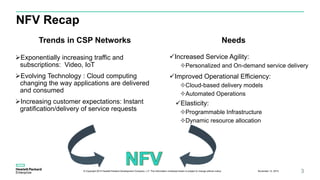
NFV Recap
Trends in CSP Networks
Exponentially increasing traffic and
subscriptions: Video, IoT
Evolving Technology : Cloud computing
changing the way applications are delivered
and consumed
Increasing customer expectations: Instant
gratification/delivery of service requests
Needs
Increased Service Agility:
Personalized and On-demand service delivery
Improved Operational Efficiency:
Cloud-based delivery models
Automated Operations
Elasticity:
Programmable Infrastructure
Dynamic resource allocation
3November 12, 2015© Copyright 2015 Hewlett-Packard Development Company, L.P. The information contained herein is subject to change without notice.
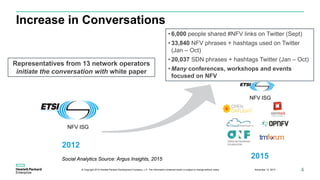
Increase in Conversations
4
2012
NFV ISG
NFV ISG
2015
Representatives from 13 network operators
initiate the conversation with white paper
• 6,000 people shared #NFV links on Twitter (Sept)
• 33,840 NFV phrases + hashtags used on Twitter
(Jan – Oct)
• 20,037 SDN phrases + hashtags Twitter (Jan – Oct)
• Many conferences, workshops and events
focused on NFV
Social Analytics Source: Argus Insights, 2015
November 12, 2015© Copyright 2015 Hewlett-Packard Development Company, L.P. The information contained herein is subject to change without notice.
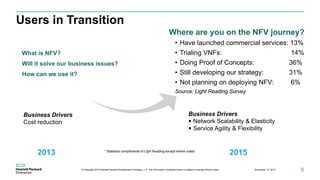
Users in Transition
© Copyright 2015 Hewlett-Packard Development Company, L.P. The information contained herein is subject to change without notice. 5
Where are you on the NFV journey?
• Have launched commercial services: 13%
• Trialing VNFs: 14%
• Doing Proof of Concepts: 36%
• Still developing our strategy: 31%
• Not planning on deploying NFV: 6%
Source: Light Reading Survey
* Statistics compliments of Light Reading except where noted.
What is NFV?
Will it solve our business issues?
How can we use it?
2013 2015
Business Drivers
Cost reduction
Business Drivers
• Network Scalability & Elasticity
• Service Agility & Flexibility
November 12, 2015
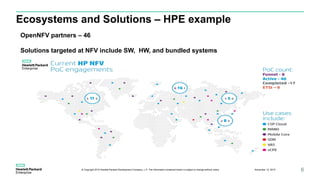
Ecosystems and Solutions – HPE example
© Copyright 2015 Hewlett-Packard Development Company, L.P. The information contained herein is subject to change without notice. 6
OpenNFV partners – 46
Solutions targeted at NFV include SW, HW, and bundled systems
November 12, 2015
Open Source
Promises and Challenges
7November 12, 2015
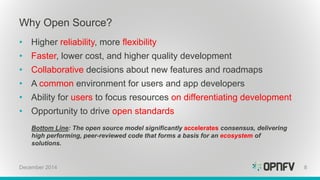
Why Open Source?
• Higher reliability, more flexibility
• Faster, lower cost, and higher quality development
• Collaborative decisions about new features and roadmaps
• A common environment for users and app developers
• Ability for users to focus resources on differentiating development
• Opportunity to drive open standards
Bottom Line: The open source model significantly accelerates consensus, delivering
high performing, peer-reviewed code that forms a basis for an ecosystem of
solutions.
8December 2014
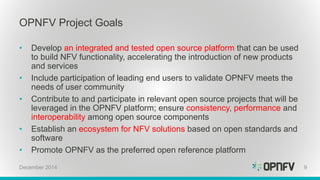
OPNFV Project Goals
• Develop an integrated and tested open source platform that can be used
to build NFV functionality, accelerating the introduction of new products
and services
• Include participation of leading end users to validate OPNFV meets the
needs of user community
• Contribute to and participate in relevant open source projects that will be
leveraged in the OPNFV platform; ensure consistency, performance and
interoperability among open source components
• Establish an ecosystem for NFV solutions based on open standards and
software
• Promote OPNFV as the preferred open reference platform
9December 2014
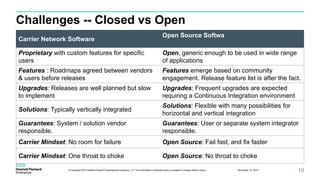
Challenges -- Closed vs Open
Carrier Network Software
Open Source Softwa
Proprietary with custom features for specific
users
Open, generic enough to be used in wide range
of applications
Features : Roadmaps agreed between vendors
& users before releases
Features emerge based on community
engagement. Release feature list is after the fact.
Upgrades: Releases are well planned but slow
to implement
Upgrades: Frequent upgrades are expected
requiring a Continuous Integration environment
Solutions: Typically vertically integrated
Solutions: Flexible with many possibilities for
horizontal and vertical integration
Guarantees: System / solution vendor
responsible.
Guarantees: User or separate system integrator
responsible.
Carrier Mindset: No room for failure Open Source: Fail fast, and fix faster
Carrier Mindset: One throat to choke Open Source: No throat to choke
10November 12, 2015© Copyright 2015 Hewlett-Packard Development Company, L.P. The information contained herein is subject to change without notice.
OPNFV
Achievements and Learnings
11November 12, 2015© Copyright 2015 Hewlett-Packard Development Company, L.P. The information contained herein is subject to change without notice.
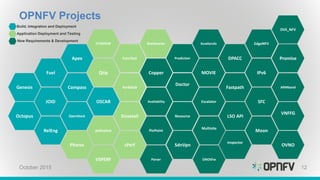
OPNFV Projects
12
Apex
Fuel
Compass
PinPoint
OpenStack
FuncTest
Qtip
Prediction
Copper
Doctor
DPACC
Availability
VNFFG
Resource
Promise
MOVIE
Multisite
Escalator
Fastpath
RelEng
LSO API
JOID
SdnVpn
IPv6
Moon
SFC
KvmfornfvBottlenecksSTORPERF
Dovetail
Inspector
Yardstick
cPerf
Genesis
Octopus
ARMband
policytest
EdgeNFV
OVNO
OVS_NFV
Build, Integration and Deployment
New Requirements & Development
Application Deployment and Testing
Pharos
OSCAR
VSPERF ONOSFwParser
October 2015
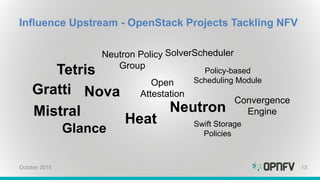
Influence Upstream - OpenStack Projects Tackling NFV
13
Glance
Gratti
Swift Storage
Policies
Convergence
Engine
Tetris Policy-based
Scheduling ModuleOpen
Attestation
Mistral
Neutron Policy
Group
SolverScheduler
Nova
Neutron
Heat
October 2015
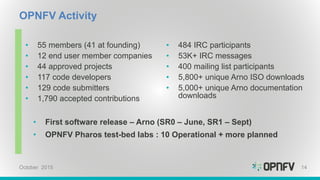
OPNFV Activity
14
• First software release – Arno (SR0 – June, SR1 – Sept)
• OPNFV Pharos test-bed labs : 10 Operational + more planned
October 2015
• 55 members (41 at founding)
• 12 end user member companies
• 44 approved projects
• 117 code developers
• 129 code submitters
• 1,790 accepted contributions
• 484 IRC participants
• 53K+ IRC messages
• 400 mailing list participants
• 5,800+ unique Arno ISO downloads
• 5,000+ unique Arno documentation
downloads
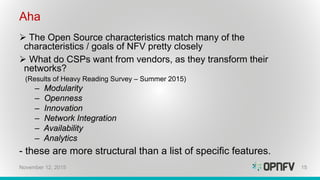
Aha
 The Open Source characteristics match many of the
characteristics / goals of NFV pretty closely
 What do CSPs want from vendors, as they transform their
networks?
(Results of Heavy Reading Survey – Summer 2015)
– Modularity
– Openness
– Innovation
– Network Integration
– Availability
– Analytics
- these are more structural than a list of specific features.
15November 12, 2015
Learnings
 The open source characteristics lend themselves to be an NFV
development framework.
 A framework for successful integration and for testing alternatives is more
important than the features themselves.
 Independent projects should be allowed to proceed in parallel according to
their pace, and try for inclusion in a release.
 Modularity, openness and interoperability become the criteria for
acceptance / inclusion in a release, rather than the nature of the feature(s).
 The larger open source community can be leveraged for innovation by
communicating gaps in capabilities upstream.
 Community, community, community ….
16November 12, 2015
Join Us
• Create an open, carrier-grade platform which meets performance, scale,
and reliability requirements.
– Take advantage of the innovation in the open source community.
– Coordinate upstream contributions to address gaps.
– Integrate open source components for an end-to-end solution.
– Incubate software development that addresses NFV needs and is not being
addressed in the open source community.
• Drive for faster traction and lower development cost on realizing a
carrier-grade NFV open platform.
– Take advantage of the resource multiplier effect due to multiple company
support.
– Improve speed of development and breadth of features.
November 12, 2015 17

Open Source in a Closed Network

  • 1.
    Open Source ina Closed Network Prodip Sen CTO, HP Networks Function Virtualization Chair, OPNFV Board of Directors November 12, 2015
  • 2.
    Background NFV – IndustryProgress 2November 12, 2015
  • 3.
    NFV Recap Trends inCSP Networks Exponentially increasing traffic and subscriptions: Video, IoT Evolving Technology : Cloud computing changing the way applications are delivered and consumed Increasing customer expectations: Instant gratification/delivery of service requests Needs Increased Service Agility: Personalized and On-demand service delivery Improved Operational Efficiency: Cloud-based delivery models Automated Operations Elasticity: Programmable Infrastructure Dynamic resource allocation 3November 12, 2015© Copyright 2015 Hewlett-Packard Development Company, L.P. The information contained herein is subject to change without notice.
  • 4.
    Increase in Conversations 4 2012 NFVISG NFV ISG 2015 Representatives from 13 network operators initiate the conversation with white paper • 6,000 people shared #NFV links on Twitter (Sept) • 33,840 NFV phrases + hashtags used on Twitter (Jan – Oct) • 20,037 SDN phrases + hashtags Twitter (Jan – Oct) • Many conferences, workshops and events focused on NFV Social Analytics Source: Argus Insights, 2015 November 12, 2015© Copyright 2015 Hewlett-Packard Development Company, L.P. The information contained herein is subject to change without notice.
  • 5.
    Users in Transition ©Copyright 2015 Hewlett-Packard Development Company, L.P. The information contained herein is subject to change without notice. 5 Where are you on the NFV journey? • Have launched commercial services: 13% • Trialing VNFs: 14% • Doing Proof of Concepts: 36% • Still developing our strategy: 31% • Not planning on deploying NFV: 6% Source: Light Reading Survey * Statistics compliments of Light Reading except where noted. What is NFV? Will it solve our business issues? How can we use it? 2013 2015 Business Drivers Cost reduction Business Drivers • Network Scalability & Elasticity • Service Agility & Flexibility November 12, 2015
  • 6.
    Ecosystems and Solutions– HPE example © Copyright 2015 Hewlett-Packard Development Company, L.P. The information contained herein is subject to change without notice. 6 OpenNFV partners – 46 Solutions targeted at NFV include SW, HW, and bundled systems November 12, 2015
  • 7.
    Open Source Promises andChallenges 7November 12, 2015
  • 8.
    Why Open Source? •Higher reliability, more flexibility • Faster, lower cost, and higher quality development • Collaborative decisions about new features and roadmaps • A common environment for users and app developers • Ability for users to focus resources on differentiating development • Opportunity to drive open standards Bottom Line: The open source model significantly accelerates consensus, delivering high performing, peer-reviewed code that forms a basis for an ecosystem of solutions. 8December 2014
  • 9.
    OPNFV Project Goals •Develop an integrated and tested open source platform that can be used to build NFV functionality, accelerating the introduction of new products and services • Include participation of leading end users to validate OPNFV meets the needs of user community • Contribute to and participate in relevant open source projects that will be leveraged in the OPNFV platform; ensure consistency, performance and interoperability among open source components • Establish an ecosystem for NFV solutions based on open standards and software • Promote OPNFV as the preferred open reference platform 9December 2014
  • 10.
    Challenges -- Closedvs Open Carrier Network Software Open Source Softwa Proprietary with custom features for specific users Open, generic enough to be used in wide range of applications Features : Roadmaps agreed between vendors & users before releases Features emerge based on community engagement. Release feature list is after the fact. Upgrades: Releases are well planned but slow to implement Upgrades: Frequent upgrades are expected requiring a Continuous Integration environment Solutions: Typically vertically integrated Solutions: Flexible with many possibilities for horizontal and vertical integration Guarantees: System / solution vendor responsible. Guarantees: User or separate system integrator responsible. Carrier Mindset: No room for failure Open Source: Fail fast, and fix faster Carrier Mindset: One throat to choke Open Source: No throat to choke 10November 12, 2015© Copyright 2015 Hewlett-Packard Development Company, L.P. The information contained herein is subject to change without notice.
  • 11.
    OPNFV Achievements and Learnings 11November12, 2015© Copyright 2015 Hewlett-Packard Development Company, L.P. The information contained herein is subject to change without notice.
  • 12.
  • 13.
    Influence Upstream -OpenStack Projects Tackling NFV 13 Glance Gratti Swift Storage Policies Convergence Engine Tetris Policy-based Scheduling ModuleOpen Attestation Mistral Neutron Policy Group SolverScheduler Nova Neutron Heat October 2015
  • 14.
    OPNFV Activity 14 • Firstsoftware release – Arno (SR0 – June, SR1 – Sept) • OPNFV Pharos test-bed labs : 10 Operational + more planned October 2015 • 55 members (41 at founding) • 12 end user member companies • 44 approved projects • 117 code developers • 129 code submitters • 1,790 accepted contributions • 484 IRC participants • 53K+ IRC messages • 400 mailing list participants • 5,800+ unique Arno ISO downloads • 5,000+ unique Arno documentation downloads
  • 15.
    Aha  The OpenSource characteristics match many of the characteristics / goals of NFV pretty closely  What do CSPs want from vendors, as they transform their networks? (Results of Heavy Reading Survey – Summer 2015) – Modularity – Openness – Innovation – Network Integration – Availability – Analytics - these are more structural than a list of specific features. 15November 12, 2015
  • 16.
    Learnings  The opensource characteristics lend themselves to be an NFV development framework.  A framework for successful integration and for testing alternatives is more important than the features themselves.  Independent projects should be allowed to proceed in parallel according to their pace, and try for inclusion in a release.  Modularity, openness and interoperability become the criteria for acceptance / inclusion in a release, rather than the nature of the feature(s).  The larger open source community can be leveraged for innovation by communicating gaps in capabilities upstream.  Community, community, community …. 16November 12, 2015
  • 17.
    Join Us • Createan open, carrier-grade platform which meets performance, scale, and reliability requirements. – Take advantage of the innovation in the open source community. – Coordinate upstream contributions to address gaps. – Integrate open source components for an end-to-end solution. – Incubate software development that addresses NFV needs and is not being addressed in the open source community. • Drive for faster traction and lower development cost on realizing a carrier-grade NFV open platform. – Take advantage of the resource multiplier effect due to multiple company support. – Improve speed of development and breadth of features. November 12, 2015 17