
Orchestrating Connectivity Services
over SDN and Legacy Networks
OPEN-O Mini Summit
Michael Kearns – Huawei, VP Fixed Network OSS
2
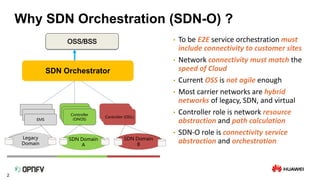
Why SDN Orchestration (SDN-O) ?
• To be E2E service orchestration must
include connectivity to customer sites
• Network connectivity must match the
speed of Cloud
• Current OSS is not agile enough
• Most carrier networks are hybrid
networks of legacy, SDN, and virtual
• Controller role is network resource
abstraction and path calculation
• SDN-O role is connectivity service
abstraction and orchestrationLegacy
Domain
SDN Domain
A
SDN Domain
B
Controller
(ONOS)EMS
OSS/BSS
SDN Orchestrator
Controller (ODL)
3
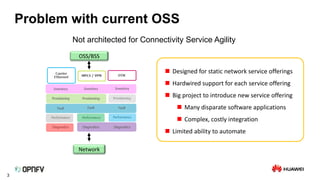
Problem with current OSS
 Designed for static network service offerings
 Hardwired support for each service offering
 Big project to introduce new service offering
 Many disparate software applications
 Complex, costly integration
 Limited ability to automate
Not architected for Connectivity Service Agility
OSS/BSS
Network
4
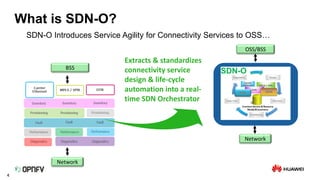
What is SDN-O?
NFV SDN
Extracts & standardizes
connectivity service
design & life-cycle
automation into a real-
time SDN Orchestrator
SDN-O
SDN-O Introduces Service Agility for Connectivity Services to OSS…
Network
BSS
OSS/BSS
Network
5
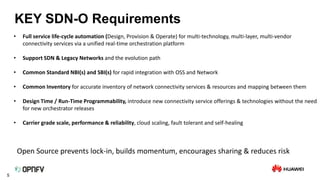
KEY SDN-O Requirements
• Full service life-cycle automation (Design, Provision & Operate) for multi-technology, multi-layer, multi-vendor
connectivity services via a unified real-time orchestration platform
• Support SDN & Legacy Networks and the evolution path
• Common Standard NBI(s) and SBI(s) for rapid integration with OSS and Network
• Common Inventory for accurate inventory of network connectivity services & resources and mapping between them
• Design Time / Run-Time Programmability, introduce new connectivity service offerings & technologies without the need
for new orchestrator releases
• Carrier grade scale, performance & reliability, cloud scaling, fault tolerant and self-healing
Open Source prevents lock-in, builds momentum, encourages sharing & reduces risk
6
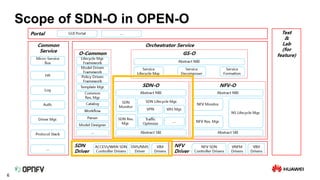
Scope of SDN-O in OPEN-O
7
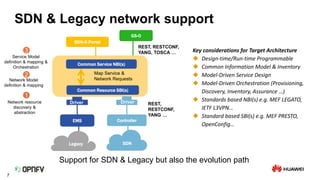
SDN & Legacy network support
DriverDriver
Legacy SDN
ControllerEMS
Common Resource SBI(s)
Common Service NBI(s)
SDN-O Portal
GS-O
REST, RESTCONF,
YANG, TOSCA …
Map Service &
Network Requests
REST,
RESTCONF,
YANG …
Key considerations for Target Architecture
 Design-time/Run-time Programmable
 Common Information Model & Inventory
 Model-Driven Service Design
 Model-Driven Orchestration (Provisioning,
Discovery, Inventory, Assurance …)
 Standards based NBI(s) e.g. MEF LEGATO,
IETF L3VPN…
 Standard based SBI(s) e.g. MEF PRESTO,
OpenConfig…
Support for SDN & Legacy but also the evolution path
Service Model
definition & mapping &
Orchestration
Network Model
definition & mapping
Network resource
discovery &
abstraction
3
2
1
8
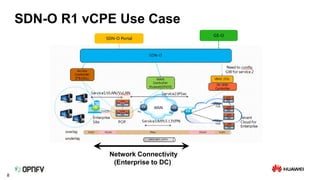
SDN-O R1 vCPE Use Case
Network Connectivity
(Enterprise to DC)
GS-O
SDN-O Portal
9
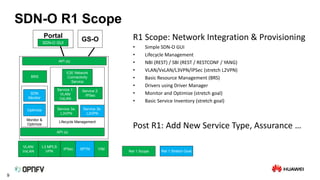
SDN-O R1 Scope
R1 Scope: Network Integration & Provisioning
• Simple SDN-O GUI
• Lifecycle Management
• NBI (REST) / SBI (REST / RESTCONF / YANG)
• VLAN/VxLAN/L3VPN/IPSec (stretch L2VPN)
• Basic Resource Management (BRS)
• Drivers using Driver Manager
• Monitor and Optimize (stretch goal)
• Basic Service Inventory (stretch goal)
Post R1: Add New Service Type, Assurance …
SDN-O
Portal
Lifecycle Management
SDN-O GUI
GS-O
E2E Network
Connectivity
Service
Service 1:
VLAN/
VxLAN
Service 2:
IPSec
Service 3a:
L3VPN
Service 3b:
L2VPN
Monitor &
Optimize
SDN
Monitor
Optimize
API (s)
API (s)
VLAN/
VxLAN
L3 MPLS
VPN
BRS
IPSec SPTN VIM
Rel 1 Scope Rel 1 Stretch Goal
10
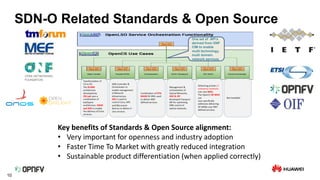
SDN-O Related Standards & Open Source
Key benefits of Standards & Open Source alignment:
• Very important for openness and industry adoption
• Faster Time To Market with greatly reduced integration
• Sustainable product differentiation (when applied correctly)
One set of API’s
derived from ONF
CIM to enable
multi technology,
multi domain
network services
11
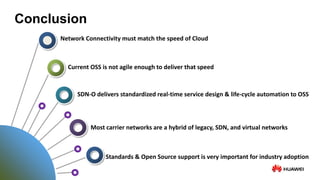
Conclusion
Network Connectivity must match the speed of Cloud
Current OSS is not agile enough to deliver that speed
Most carrier networks are a hybrid of legacy, SDN, and virtual networks
SDN-O delivers standardized real-time service design & life-cycle automation to OSS
Standards & Open Source support is very important for industry adoption
Copyright©2015 Huawei Technologies Co., Ltd. All Rights Reserved.
The information in this document may contain predictive statements including, without limitation,
statements regarding the future financial and operating results, future product portfolio, new technology,
etc. There are a number of factors that could cause actual results and developments to differ materially
from those expressed or implied in the predictive statements. Therefore, such information is provided
for reference purpose only and constitutes neither an offer nor an acceptance. Huawei may change the
information at any time without notice.

Summit 16: Open-O Mini-Summit - Orchestrating Network Connectivity Services

  • 1.
    Orchestrating Connectivity Services overSDN and Legacy Networks OPEN-O Mini Summit Michael Kearns – Huawei, VP Fixed Network OSS
  • 2.
    2 Why SDN Orchestration(SDN-O) ? • To be E2E service orchestration must include connectivity to customer sites • Network connectivity must match the speed of Cloud • Current OSS is not agile enough • Most carrier networks are hybrid networks of legacy, SDN, and virtual • Controller role is network resource abstraction and path calculation • SDN-O role is connectivity service abstraction and orchestrationLegacy Domain SDN Domain A SDN Domain B Controller (ONOS)EMS OSS/BSS SDN Orchestrator Controller (ODL)
  • 3.
    3 Problem with currentOSS  Designed for static network service offerings  Hardwired support for each service offering  Big project to introduce new service offering  Many disparate software applications  Complex, costly integration  Limited ability to automate Not architected for Connectivity Service Agility OSS/BSS Network
  • 4.
    4 What is SDN-O? NFVSDN Extracts & standardizes connectivity service design & life-cycle automation into a real- time SDN Orchestrator SDN-O SDN-O Introduces Service Agility for Connectivity Services to OSS… Network BSS OSS/BSS Network
  • 5.
    5 KEY SDN-O Requirements •Full service life-cycle automation (Design, Provision & Operate) for multi-technology, multi-layer, multi-vendor connectivity services via a unified real-time orchestration platform • Support SDN & Legacy Networks and the evolution path • Common Standard NBI(s) and SBI(s) for rapid integration with OSS and Network • Common Inventory for accurate inventory of network connectivity services & resources and mapping between them • Design Time / Run-Time Programmability, introduce new connectivity service offerings & technologies without the need for new orchestrator releases • Carrier grade scale, performance & reliability, cloud scaling, fault tolerant and self-healing Open Source prevents lock-in, builds momentum, encourages sharing & reduces risk
  • 6.
  • 7.
    7 SDN & Legacynetwork support DriverDriver Legacy SDN ControllerEMS Common Resource SBI(s) Common Service NBI(s) SDN-O Portal GS-O REST, RESTCONF, YANG, TOSCA … Map Service & Network Requests REST, RESTCONF, YANG … Key considerations for Target Architecture  Design-time/Run-time Programmable  Common Information Model & Inventory  Model-Driven Service Design  Model-Driven Orchestration (Provisioning, Discovery, Inventory, Assurance …)  Standards based NBI(s) e.g. MEF LEGATO, IETF L3VPN…  Standard based SBI(s) e.g. MEF PRESTO, OpenConfig… Support for SDN & Legacy but also the evolution path Service Model definition & mapping & Orchestration Network Model definition & mapping Network resource discovery & abstraction 3 2 1
  • 8.
    8 SDN-O R1 vCPEUse Case Network Connectivity (Enterprise to DC) GS-O SDN-O Portal
  • 9.
    9 SDN-O R1 Scope R1Scope: Network Integration & Provisioning • Simple SDN-O GUI • Lifecycle Management • NBI (REST) / SBI (REST / RESTCONF / YANG) • VLAN/VxLAN/L3VPN/IPSec (stretch L2VPN) • Basic Resource Management (BRS) • Drivers using Driver Manager • Monitor and Optimize (stretch goal) • Basic Service Inventory (stretch goal) Post R1: Add New Service Type, Assurance … SDN-O Portal Lifecycle Management SDN-O GUI GS-O E2E Network Connectivity Service Service 1: VLAN/ VxLAN Service 2: IPSec Service 3a: L3VPN Service 3b: L2VPN Monitor & Optimize SDN Monitor Optimize API (s) API (s) VLAN/ VxLAN L3 MPLS VPN BRS IPSec SPTN VIM Rel 1 Scope Rel 1 Stretch Goal
  • 10.
    10 SDN-O Related Standards& Open Source Key benefits of Standards & Open Source alignment: • Very important for openness and industry adoption • Faster Time To Market with greatly reduced integration • Sustainable product differentiation (when applied correctly) One set of API’s derived from ONF CIM to enable multi technology, multi domain network services
  • 11.
    11 Conclusion Network Connectivity mustmatch the speed of Cloud Current OSS is not agile enough to deliver that speed Most carrier networks are a hybrid of legacy, SDN, and virtual networks SDN-O delivers standardized real-time service design & life-cycle automation to OSS Standards & Open Source support is very important for industry adoption
  • 12.
    Copyright©2015 Huawei TechnologiesCo., Ltd. All Rights Reserved. The information in this document may contain predictive statements including, without limitation, statements regarding the future financial and operating results, future product portfolio, new technology, etc. There are a number of factors that could cause actual results and developments to differ materially from those expressed or implied in the predictive statements. Therefore, such information is provided for reference purpose only and constitutes neither an offer nor an acceptance. Huawei may change the information at any time without notice.