66
INDUSTRY PROGRESS TOWARDS A
NEXT-GEN OSS FOR A VIRTUALIZED
NETWORK
James Crawshaw, Senior Analyst, Heavy Reading
6
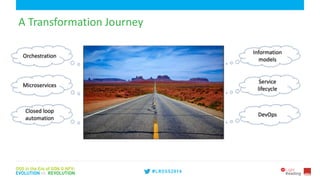
A Transformation Journey
Orchestration
Microservices
Closed loop
automation
Information
models
Service
lifecycle
DevOps
6
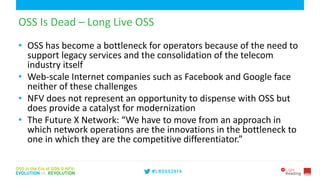
OSS Is Dead – Long Live OSS
• OSS has become a bottleneck for operators because of the need to
support legacy services and the consolidation of the telecom
industry itself
• Web-scale Internet companies such as Facebook and Google face
neither of these challenges
• NFV does not represent an opportunity to dispense with OSS but
does provide a catalyst for modernization
• The Future X Network: “We have to move from an approach in
which network operations are the innovations in the bottleneck to
one in which they are the competitive differentiator.”
6
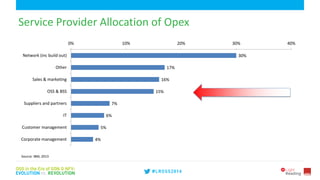
Service Provider Allocation of Opex
30%
17%
16%
15%
7%
6%
5%
4%
0% 10% 20% 30% 40%
Network (inc build out)
Other
Sales & marketing
OSS & BSS
Suppliers and partners
IT
Customer management
Corporate management
Source: IBM, 2013
6
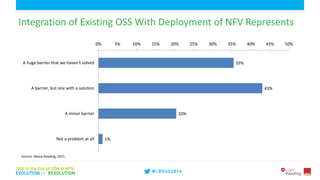
Integration of Existing OSS With Deployment of NFV Represents
35%
43%
20%
1%
0% 5% 10% 15% 20% 25% 30% 35% 40% 45% 50%
A huge barrier that we haven't solved
A barrier, but one with a solution
A minor barrier
Not a problem at all
Source: Heavy Reading, 2015
6
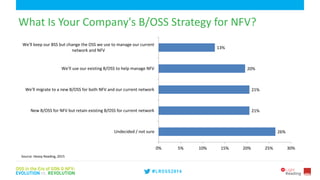
What Is Your Company's B/OSS Strategy for NFV?
26%
21%
21%
20%
13%
0% 5% 10% 15% 20% 25% 30%
Undecided / not sure
New B/OSS for NFV but retain existing B/OSS for current network
We'll migrate to a new B/OSS for both NFV and our current network
We'll use our existing B/OSS to help manage NFV
We'll keep our BSS but change the OSS we use to manage our current
network and NFV
Source: Heavy Reading, 2015
6
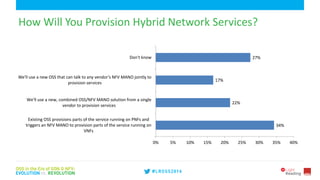
How Will You Provision Hybrid Network Services?
34%
22%
17%
27%
0% 5% 10% 15% 20% 25% 30% 35% 40%
Existing OSS provisions parts of the service running on PNFs and
triggers an NFV MANO to provision parts of the service running on
VNFs
We'll use a new, combined OSS/NFV MANO solution from a single
vendor to provision services
We'll use a new OSS that can talk to any vendor’s NFV MANO jointly to
provision services
Don't know
6
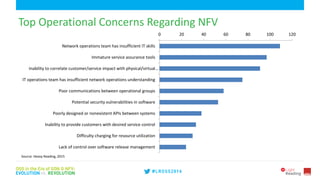
Top Operational Concerns Regarding NFV
0 20 40 60 80 100 120
Network operations team has insufficient IT skills
Immature service assurance tools
Inability to correlate customer/service impact with physical/virtual…
IT operations team has insufficient network operations understanding
Poor communications between operational groups
Potential security vulnerabilities in software
Poorly designed or nonexistent APIs between systems
Inability to provide customers with desired service control
Difficulty charging for resource utilization
Lack of control over software release management
Source: Heavy Reading, 2015
6
New Skill Requirements for NFV
• OSS Support Engineers – integration between existing OSS and new
orchestration components
• Network Management Engineers – movement from element
management to programming the network
• Integration/Test Lab Engineers – DevOps to support agile execution
• Data Scientist – New data collection and analytics processes
• Purchasing & Contract Management – more software licenses and
services, less hardware
• HR/Management – new hires and retraining of existing personnel
6
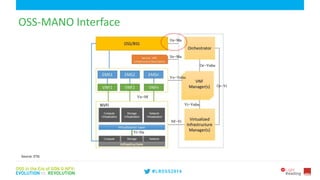
OSS-MANO Interface
Source: ETSI
6
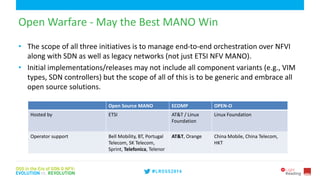
Open Warfare - May the Best MANO Win
• The scope of all three initiatives is to manage end-to-end orchestration over NFVI
along with SDN as well as legacy networks (not just ETSI NFV MANO).
• Initial implementations/releases may not include all component variants (e.g., VIM
types, SDN controllers) but the scope of all of this is to be generic and embrace all
open source solutions.
Open Source MANO ECOMP OPEN-O
Hosted by ETSI AT&T / Linux
Foundation
Linux Foundation
Operator support Bell Mobility, BT, Portugal
Telecom, SK Telecom,
Sprint, Telefonica, Telenor
AT&T, Orange China Mobile, China Telecom,
HKT
6
NFV-Ready OSS Needs to Be…
• Interoperable and modular:
– Common information models
– Open APIs
– Catalog-driven
• Highly automated – manual processes should be minimized
• Analytics led – use algorithms, machine learning and AI
• Real time – operators will need a live view of network and
service inventory
6
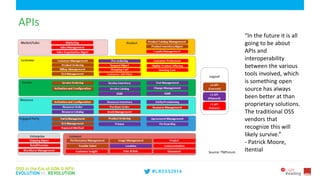
APIs
Source: TMForum
“In the future it is all
going to be about
APIs and
interoperability
between the various
tools involved, which
is something open
source has always
been better at than
proprietary solutions.
The traditional OSS
vendors that
recognize this will
likely survive.”
- Patrick Moore,
Itential
6
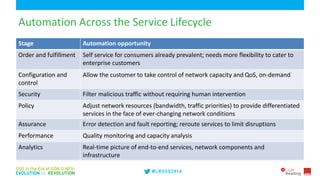
Automation Across the Service Lifecycle
Stage Automation opportunity
Order and fulfillment Self service for consumers already prevalent; needs more flexibility to cater to
enterprise customers
Configuration and
control
Allow the customer to take control of network capacity and QoS, on-demand
Security Filter malicious traffic without requiring human intervention
Policy Adjust network resources (bandwidth, traffic priorities) to provide differentiated
services in the face of ever-changing network conditions
Assurance Error detection and fault reporting; reroute services to limit disruptions
Performance Quality monitoring and capacity analysis
Analytics Real-time picture of end-to-end services, network components and
infrastructure
6
Evolution Not Revolution
As Verizon states in its NFV architecture whitepaper, “The
Introduction of EEO [end to end orchestration] does not imply a
wholesale replacement of existing OSS and BSS systems. Initially,
the operator will continue to manage most of its services using
existing systems and procedures. It may decide to introduce EEO
for specific new end-to-end services that rely heavily on
virtualized network functions. Over time, one can expect that
more and more services will be managed through EEO.”
6
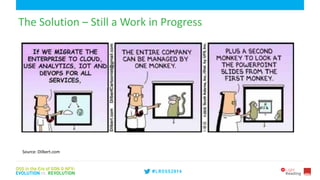
The Solution – Still a Work in Progress
Source: Dilbert.com

Industry progress towards a Next Gen OSS for a Virtualized Network

  • 1.
    66 INDUSTRY PROGRESS TOWARDSA NEXT-GEN OSS FOR A VIRTUALIZED NETWORK James Crawshaw, Senior Analyst, Heavy Reading
  • 2.
    6 A Transformation Journey Orchestration Microservices Closedloop automation Information models Service lifecycle DevOps
  • 3.
    6 OSS Is Dead– Long Live OSS • OSS has become a bottleneck for operators because of the need to support legacy services and the consolidation of the telecom industry itself • Web-scale Internet companies such as Facebook and Google face neither of these challenges • NFV does not represent an opportunity to dispense with OSS but does provide a catalyst for modernization • The Future X Network: “We have to move from an approach in which network operations are the innovations in the bottleneck to one in which they are the competitive differentiator.”
  • 4.
    6 Service Provider Allocationof Opex 30% 17% 16% 15% 7% 6% 5% 4% 0% 10% 20% 30% 40% Network (inc build out) Other Sales & marketing OSS & BSS Suppliers and partners IT Customer management Corporate management Source: IBM, 2013
  • 5.
    6 Integration of ExistingOSS With Deployment of NFV Represents 35% 43% 20% 1% 0% 5% 10% 15% 20% 25% 30% 35% 40% 45% 50% A huge barrier that we haven't solved A barrier, but one with a solution A minor barrier Not a problem at all Source: Heavy Reading, 2015
  • 6.
    6 What Is YourCompany's B/OSS Strategy for NFV? 26% 21% 21% 20% 13% 0% 5% 10% 15% 20% 25% 30% Undecided / not sure New B/OSS for NFV but retain existing B/OSS for current network We'll migrate to a new B/OSS for both NFV and our current network We'll use our existing B/OSS to help manage NFV We'll keep our BSS but change the OSS we use to manage our current network and NFV Source: Heavy Reading, 2015
  • 7.
    6 How Will YouProvision Hybrid Network Services? 34% 22% 17% 27% 0% 5% 10% 15% 20% 25% 30% 35% 40% Existing OSS provisions parts of the service running on PNFs and triggers an NFV MANO to provision parts of the service running on VNFs We'll use a new, combined OSS/NFV MANO solution from a single vendor to provision services We'll use a new OSS that can talk to any vendor’s NFV MANO jointly to provision services Don't know
  • 8.
    6 Top Operational ConcernsRegarding NFV 0 20 40 60 80 100 120 Network operations team has insufficient IT skills Immature service assurance tools Inability to correlate customer/service impact with physical/virtual… IT operations team has insufficient network operations understanding Poor communications between operational groups Potential security vulnerabilities in software Poorly designed or nonexistent APIs between systems Inability to provide customers with desired service control Difficulty charging for resource utilization Lack of control over software release management Source: Heavy Reading, 2015
  • 9.
    6 New Skill Requirementsfor NFV • OSS Support Engineers – integration between existing OSS and new orchestration components • Network Management Engineers – movement from element management to programming the network • Integration/Test Lab Engineers – DevOps to support agile execution • Data Scientist – New data collection and analytics processes • Purchasing & Contract Management – more software licenses and services, less hardware • HR/Management – new hires and retraining of existing personnel
  • 10.
  • 11.
    6 Open Warfare -May the Best MANO Win • The scope of all three initiatives is to manage end-to-end orchestration over NFVI along with SDN as well as legacy networks (not just ETSI NFV MANO). • Initial implementations/releases may not include all component variants (e.g., VIM types, SDN controllers) but the scope of all of this is to be generic and embrace all open source solutions. Open Source MANO ECOMP OPEN-O Hosted by ETSI AT&T / Linux Foundation Linux Foundation Operator support Bell Mobility, BT, Portugal Telecom, SK Telecom, Sprint, Telefonica, Telenor AT&T, Orange China Mobile, China Telecom, HKT
  • 12.
    6 NFV-Ready OSS Needsto Be… • Interoperable and modular: – Common information models – Open APIs – Catalog-driven • Highly automated – manual processes should be minimized • Analytics led – use algorithms, machine learning and AI • Real time – operators will need a live view of network and service inventory
  • 13.
    6 APIs Source: TMForum “In thefuture it is all going to be about APIs and interoperability between the various tools involved, which is something open source has always been better at than proprietary solutions. The traditional OSS vendors that recognize this will likely survive.” - Patrick Moore, Itential
  • 14.
    6 Automation Across theService Lifecycle Stage Automation opportunity Order and fulfillment Self service for consumers already prevalent; needs more flexibility to cater to enterprise customers Configuration and control Allow the customer to take control of network capacity and QoS, on-demand Security Filter malicious traffic without requiring human intervention Policy Adjust network resources (bandwidth, traffic priorities) to provide differentiated services in the face of ever-changing network conditions Assurance Error detection and fault reporting; reroute services to limit disruptions Performance Quality monitoring and capacity analysis Analytics Real-time picture of end-to-end services, network components and infrastructure
  • 15.
    6 Evolution Not Revolution AsVerizon states in its NFV architecture whitepaper, “The Introduction of EEO [end to end orchestration] does not imply a wholesale replacement of existing OSS and BSS systems. Initially, the operator will continue to manage most of its services using existing systems and procedures. It may decide to introduce EEO for specific new end-to-end services that rely heavily on virtualized network functions. Over time, one can expect that more and more services will be managed through EEO.”
  • 16.
    6 The Solution –Still a Work in Progress Source: Dilbert.com