NFV-SDN
Opensource
MP Odini/HPE – ETSI NFV Vice Chair
Dec, 2015
F
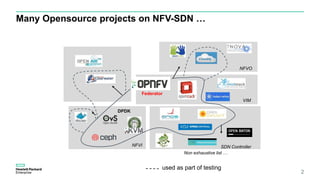
Many Opensource projects on NFV-SDN …
2
SDN Controller
VIM
DPDK
NFVI
NFVO
Non exhaustive list …
Federator
used as part of testing
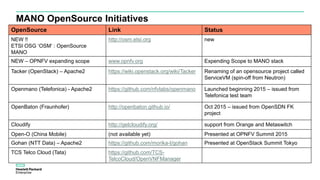
MANO OpenSource Initiatives
OpenSource Link Status
NEW !!
ETSI OSG ‘OSM’ : OpenSource
MANO
http://osm.etsi.org new
NEW – OPNFV expanding scope www.opnfv.org Expending Scope to MANO stack
Tacker (OpenStack) – Apache2 https://wiki.openstack.org/wiki/Tacker Renaming of an opensource project called
ServiceVM (spin-off from Neutron)
Openmano (Telefonica) - Apache2 https://github.com/nfvlabs/openmano Launched beginning 2015 – issued from
Telefonica test team
OpenBaton (Fraunhofer) http://openbaton.github.io/ Oct 2015 – issued from OpenSDN FK
project
Cloudify http://getcloudify.org/ support from Orange and Metaswitch
Open-O (China Mobile) (not available yet) Presented at OPNFV Summit 2015
Gohan (NTT Data) – Apache2 https://github.com/morika-t/gohan Presented at OpenStack Summit Tokyo
TCS Telco Cloud (Tata) https://github.com/TCS-
TelcoCloud/OpenVNFManager
Backup
MANO OpenSource
4
Overview
MANO opensource has emerged this past 1-2 years from 3 main sources :
• Cloud Opensource projects : ie Tacker in OpenStack, coming from neutron-ServiceVM project
• Operator labs => who opensourced their orchestration/test tool : Telefonica openmano, NTT Gohan, China
Mobile Open-O
• New small projects => generally led by vendors, small community, or University : ie Cloudify, OpenBaton,
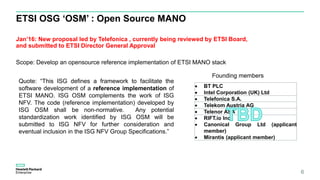
ETSI OSG ‘OSM’ : Open Source MANO
6
Jan’16: New proposal led by Telefonica , currently being reviewed by ETSI Board,
and submitted to ETSI Director General Approval
Scope: Develop an opensource reference implementation of ETSI MANO stack
Quote: “This ISG defines a framework to facilitate the
software development of a reference implementation of
ETSI MANO. ISG OSM complements the work of ISG
NFV. The code (reference implementation) developed by
ISG OSM shall be non-normative. Any potential
standardization work identified by ISG OSM will be
submitted to ISG NFV for further consideration and
eventual inclusion in the ISG NFV Group Specifications.”
 BT PLC
 Intel Corporation (UK) Ltd
 Telefonica S.A.
 Telekom Austria AG
 Telenor ASA
 RIFT.io Inc
 Canonical Group Ltd (applicant
member)
 Mirantis (applicant member)
Founding members
OPNFV
Chairman: Prodip Sen, HPE
7
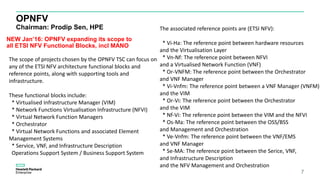
The scope of projects chosen by the OPNFV TSC can focus on
any of the ETSI NFV architecture functional blocks and
reference points, along with supporting tools and
infrastructure.
These functional blocks include:
* Virtualised Infrastructure Manager (VIM)
* Network Functions Virtualisation Infrastructure (NFVI)
* Virtual Network Function Managers
* Orchestrator
* Virtual Network Functions and associated Element
Management Systems
* Service, VNF, and Infrastructure Description
Operations Support System / Business Support System
The associated reference points are (ETSI NFV):
* Vi-Ha: The reference point between hardware resources
and the Virtualisation Layer
* Vn-Nf: The reference point between NFVI
and a Virtualised Network Function (VNF)
* Or-VNFM: The reference point between the Orchestrator
and VNF Manager
* Vi-Vnfm: The reference point between a VNF Manager (VNFM)
and the VIM
* Or-Vi: The reference point between the Orchestrator
and the VIM
* Nf-Vi: The reference point between the VIM and the NFVI
* Os-Ma: The reference point between the OSS/BSS
and Management and Orchestration
* Ve-Vnfm: The reference point between the VNF/EMS
and VNF Manager
* Se-MA: The reference point between the Serice, VNF,
and Infrastructure Description
and the NFV Management and Orchestration
NEW Jan’16: OPNFV expanding its scope to
all ETSI NFV Functional Blocks, incl MANO
Tacker
8
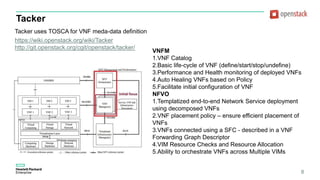
VNFM
1.VNF Catalog
2.Basic life-cycle of VNF (define/start/stop/undefine)
3.Performance and Health monitoring of deployed VNFs
4.Auto Healing VNFs based on Policy
5.Facilitate initial configuration of VNF
NFVO
1.Templatized end-to-end Network Service deployment
using decomposed VNFs
2.VNF placement policy – ensure efficient placement of
VNFs
3.VNFs connected using a SFC - described in a VNF
Forwarding Graph Descriptor
4.VIM Resource Checks and Resource Allocation
5.Ability to orchestrate VNFs across Multiple VIMs
Tacker uses TOSCA for VNF meda-data definition
https://wiki.openstack.org/wiki/Tacker
http://git.openstack.org/cgit/openstack/tacker/
Data Model
initial draft from June 2014 (??old)
https://docs.google.com/document/d/1xs8TvEVMszzND5uoWTHtd1tJnu7105Ekgq9hxiyXABQ/edit?pref=2&pli=1
9
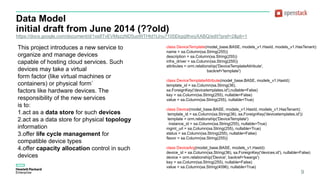
This project introduces a new service to
organize and manage devices
capable of hosting cloud services. Such
devices may take a virtual
form factor (like virtual machines or
containers) or physical form`
factors like hardware devices. The
responsibility of the new services
is to:
1.act as a data store for such devices
2.act as a data store for physical topology
information
3.offer life cycle management for
compatible device types
4.offer capacity allocation control in such
devices
class DeviceTemplate(model_base.BASE, models_v1.HasId, models_v1.HasTenant):
name = sa.Column(sa.String(255))
description = sa.Column(sa.String(255))
infra_driver = sa.Column(sa.String(255))
attributes = orm.relationship('DeviceTemplateAttribute',
backref='template')
class DeviceTemplateAttribute(model_base.BASE, models_v1.HasId):
template_id = sa.Column(sa.String(36),
sa.ForeignKey('devicetemplates.id'),nullable=False)
key = sa.Column(sa.String(255), nullable=False)
value = sa.Column(sa.String(255), nullable=True)
class Device(model_base.BASE, models_v1.HasId, models_v1.HasTenant):
template_id = sa.Column(sa.String(36), sa.ForeignKey('devicetemplates.id'))
template = orm.relationship('DeviceTemplate')
instance_id = sa.Column(sa.String(255), nullable=True)
mgmt_url = sa.Column(sa.String(255), nullable=True)
status = sa.Column(sa.String(255), nullable=False)
flavor = sa.Column(sa.String(255))
class DeviceArg(model_base.BASE, models_v1.HasId):
device_id = sa.Column(sa.String(36), sa.ForeignKey('devices.id'), nullable=False)
device = orm.relationship('Device', backref='kwargs')
key = sa.Column(sa.String(255), nullable=False)
value = sa.Column(sa.String(4096), nullable=True)
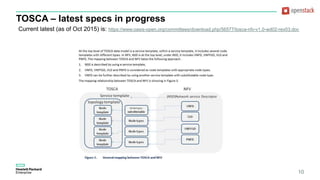
TOSCA – latest specs in progress
10
Current latest (as of Oct 2015) is: https://www.oasis-open.org/committees/download.php/56577/tosca-nfv-v1.0-wd02-rev03.doc
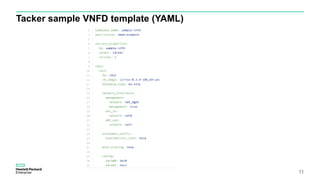
Tacker sample VNFD template (YAML)
11
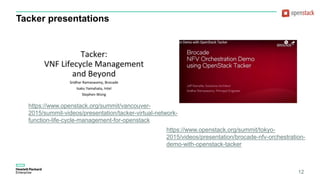
Tacker presentations
12
https://www.openstack.org/summit/vancouver-
2015/summit-videos/presentation/tacker-virtual-network-
function-life-cycle-management-for-openstack
https://www.openstack.org/summit/tokyo-
2015/videos/presentation/brocade-nfv-orchestration-
demo-with-openstack-tacker
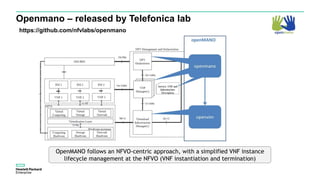
https://github.com/nfvlabs/openmano
OpenMANO follows an NFVO-centric approach, with a simplified VNF instance
lifecycle management at the NFVO (VNF instantiation and termination)
Openmano – released by Telefonica lab
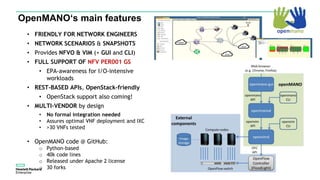
• FRIENDLY FOR NETWORK ENGINEERS
• NETWORK SCENARIOS & SNAPSHOTS
• Provides NFVO & VIM (+ GUI and CLI)
• FULL SUPPORT OF NFV PER001 GS
• EPA-awareness for I/O-intensive
workloads
• REST-BASED APIs, OpenStack-friendly
• OpenStack support also coming!
• MULTI-VENDOR by design
• No formal integration needed
• Assures optimal VNF deployment and IXC
• >30 VNFs tested
• OpenMANO code @ GitHub:
o Python-based
o 40k code lines
o Released under Apache 2 license
o 30 forks
OpenMANO‘s main features
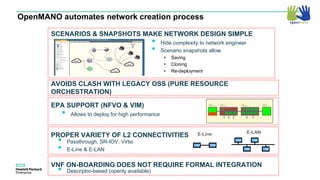
OpenMANO automates network creation process
SCENARIOS & SNAPSHOTS MAKE NETWORK DESIGN SIMPLE
AVOIDS CLASH WITH LEGACY OSS (PURE RESOURCE
ORCHESTRATION)
EPA SUPPORT (NFVO & VIM)
PROPER VARIETY OF L2 CONNECTIVITIES
VNF ON-BOARDING DOES NOT REQUIRE FORMAL INTEGRATION
• Hide complexity to network engineer
• Scenario snapshots allow
 Saving
 Cloning
 Re-deployment
• Allows to deploy for high performance
• Passthrough, SR-IOV, Virtio
• E-Line & E-LAN
• Descriptor-based (openly available)
VNF VNF
VNF VNF
VNF VNF
E-Line E-LAN
VNF
VNF
VNF
VNF
VNF
VM
VM VM
VM
VM
VM
VM
VM VM
VNF
VNF
VNF
VM
VM VM
VM
VM
VM
VM
VM VM
NS
(NETWORK
SCENARIO)
VNF
(SW-BASED NODE)
+
-
Abstraction
VM
(DEPLOYMENT UNIT)
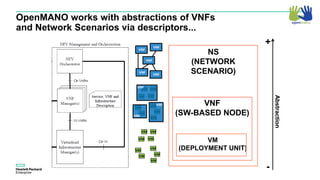
OpenMANO works with abstractions of VNFs
and Network Scenarios via descriptors...
x100
Line rate with 192
bytes frame size
x100
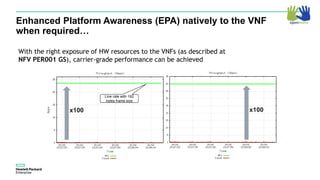
With the right exposure of HW resources to the VNFs (as described at
NFV PER001 GS), carrier-grade performance can be achieved
Enhanced Platform Awareness (EPA) natively to the VNF
when required…
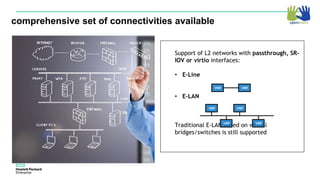
Support of L2 networks with passthrough, SR-
IOV or virtio interfaces:
• E-Line
• E-LAN
Traditional E-LAN based on virtual
bridges/switches is still supported
VNF VNF
VNF VNF
VNF VNF
comprehensive set of connectivities available
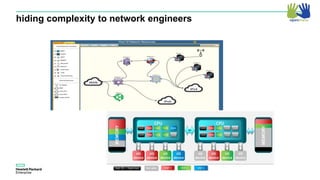
hiding complexity to network engineers
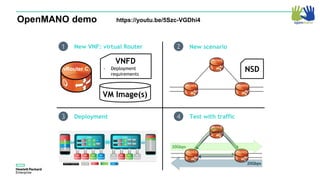
1 2New VNF: virtual Router New scenario
3 Deployment 4 Test with traffic
vRouter C
VNFD
- Deployment
requirements
NSD
VM Image(s)
OpenMANO demo https://youtu.be/5Szc-VGDhi4
Openbaton
21
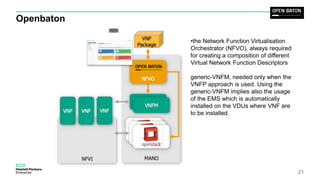
•the Network Function Virtualisation
Orchestrator (NFVO), always required
for creating a composition of different
Virtual Network Function Descriptors
generic-VNFM, needed only when the
VNFP approach is used. Using the
generic-VNFM implies also the usage
of the EMS which is automatically
installed on the VDUs where VNF are
to be installed.
openbaton
– OpenBaton is easily extensible. It integrates with OpenStack, and provides a plugin mechanism for
supporting additional VIM types. It supports Network Service management either using a generic VNFM or
interoperating with VNF-specific VNFM. It uses different mechanisms (REST or PUB/SUB) for
interoperating with the VNFMs. Its initial focus was to provide the main functionalities for provisioning and
managing Network Services, however in its future releases new additional features will provide
mechanisms for increasing the automation in NS management. Those new features will include
autoscaling, fault management, TOSCA, etc.
22
Openbaton code
23
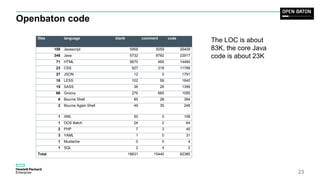
files language blank comment code
159 Javascript 5958 5059 26409
348 Java 5732 8782 22917
71 HTML 5670 460 14484
23 CSS 627 318 11789
27 JSON 12 0 1791
18 LESS 102 58 1640
15 SASS 36 26 1399
66 Groovy 276 665 1055
6 Bourne Shell 85 28 394
2 Bourne Again Shell 49 35 248
1 XML 50 0 108
1 DOS Batch 24 2 64
2 PHP 7 3 45
3 YAML 1 0 31
1 Mustache 0 0 4
1 SQL 2 4 2
Total 18631 15440 82380
The LOC is about
83K, the core Java
code is about 23K
Cloudify
24
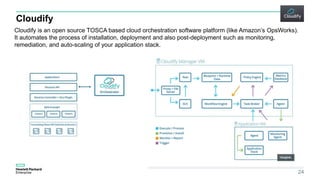
Cloudify is an open source TOSCA based cloud orchestration software platform (like Amazon’s OpsWorks).
It automates the process of installation, deployment and also post-deployment such as monitoring,
remediation, and auto-scaling of your application stack.
Cloudify
25
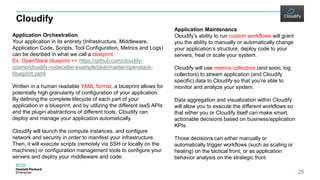
Application Orchestration
Your application in its entirety (Infrastructure, Middleware,
Application Code, Scripts, Tool Configuration, Metrics and Logs)
can be desribed in what we call a blueprint.
Ex: OpenStack blueprint => https://github.com/cloudify-
cosmo/cloudify-nodecellar-example/blob/master/openstack-
blueprint.yaml
Written in a human readable YAML format, a blueprint allows for
potentially high granularity of configuration of your application.
By defining the complete lifecycle of each part of your
application in a blueprint, and by utilizing the different IaaS APIs
and the plugin abstractions of different tools, Cloudify can
deploy and manage your application automatically.
Cloudify will launch the compute instances, and configure
network and security in order to manifest your infrastructure.
Then, it will execute scripts (remotely via SSH or locally on the
machines) or configuration management tools to configure your
servers and deploy your middleware and code.
Application Maintenance
Cloudify’s ability to run custom workflows will grant
you the ability to manually or automatically change
your application’s structure, deploy code to your
servers, heal or scale your system.
Cloudify will use metrics collectors (and soon, log
collectors) to stream application (and Cloudify
specific) data to Cloudify so that you’re able to
monitor and analyze your system.
Data aggregation and visualization within Cloudify
will allow you to execute the different workflows so
that either you or Cloudify itself can make smart,
actionable decisions based on business/application
KPIs.
Those decisions can either manually or
automatically trigger workflows (such as scaling or
healing) on the tactical front; or as application
behavior analysis on the strategic front.
Cloudify
26
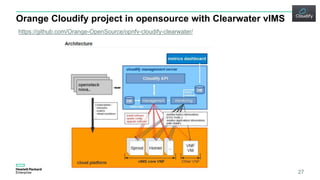
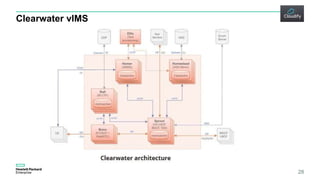
Orange Cloudify project in opensource with Clearwater vIMS
27
https://github.com/Orange-OpenSource/opnfv-cloudify-clearwater/
Clearwater vIMS
28
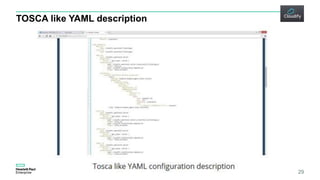
TOSCA like YAML description
29
Gohan – NTT opensource SDN/NFV Orchestration
30
https://www.openstack.org/summit/tokyo-2015/videos/presentation/gohan-an-open-source-service-development-engine-for-sdnnfv-orchestration
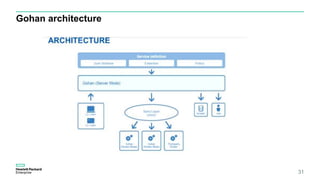
Gohan architecture
31
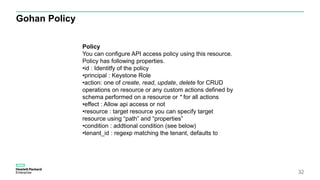
Gohan Policy
32
Policy
You can configure API access policy using this resource.
Policy has following properties.
•id : Identitfy of the policy
•principal : Keystone Role
•action: one of create, read, update, delete for CRUD
operations on resource or any custom actions defined by
schema performed on a resource or * for all actions
•effect : Allow api access or not
•resource : target resource you can specify target
resource using “path” and “properties”
•condition : addtional condition (see below)
•tenant_id : regexp matching the tenant, defaults to
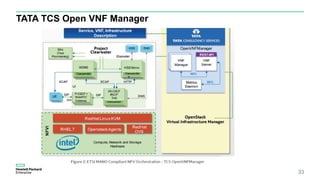
TATA TCS Open VNF Manager
33
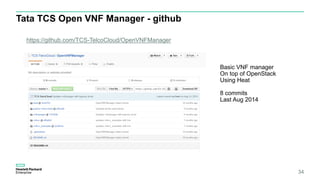
Tata TCS Open VNF Manager - github
34
https://github.com/TCS-TelcoCloud/OpenVNFManager
Basic VNF manager
On top of OpenStack
Using Heat
8 commits
Last Aug 2014
YangForge
YangForge provides runtime JavaScript execution based on YANG
schema modeling language – IETF (RFC 6020).
Basically, the framework enables YANG schema language to become
a programming language.
It utilizes YAML with custom tags to construct a portable module with
embedded code. It is written primarily using CoffeeScript and runs on
Node.js and the web browser (yes, it's isomorphic).
35
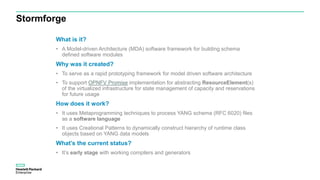
What is it?
• A Model-driven Architecture (MDA) software framework for building schema
defined software modules
Why was it created?
• To serve as a rapid prototyping framework for model driven software architecture
• To support OPNFV Promise implementation for abstracting ResourceElement(s)
of the virtualized infrastructure for state management of capacity and reservations
for future usage
How does it work?
• It uses Metaprogramming techniques to process YANG schema (RFC 6020) files
as a software language
• It uses Creational Patterns to dynamically construct hierarchy of runtime class
objects based on YANG data models
What’s the current status?
• It’s early stage with working compilers and generators
Stormforge
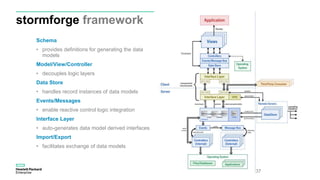
stormforge framework
37
Schema
• provides definitions for generating the data
models
Model/View/Controller
• decouples logic layers
Data Store
• handles record instances of data models
Events/Messages
• enable reactive control logic integration
Interface Layer
• auto-generates data model derived interfaces
Import/Export
• facilitates exchange of data models
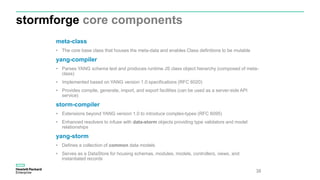
stormforge core components
38
meta-class
• The core base class that houses the meta-data and enables Class definitions to be mutable
yang-compiler
• Parses YANG schema text and produces runtime JS class object hierarchy (composed of meta-
class)
• Implemented based on YANG version 1.0 specifications (RFC 6020)
• Provides compile, generate, import, and export facilities (can be used as a server-side API
service)
storm-compiler
• Extensions beyond YANG version 1.0 to introduce complex-types (RFC 6095)
• Enhanced resolvers to infuse with data-storm objects providing type validators and model
relationships
yang-storm
• Defines a collection of common data models
• Serves as a DataStore for housing schemas, modules, models, controllers, views, and
instantiated records
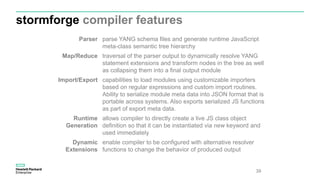
stormforge compiler features
39
Parser parse YANG schema files and generate runtime JavaScript
meta-class semantic tree hierarchy
Map/Reduce traversal of the parser output to dynamically resolve YANG
statement extensions and transform nodes in the tree as well
as collapsing them into a final output module
Import/Export capabilities to load modules using customizable importers
based on regular expressions and custom import routines.
Ability to serialize module meta data into JSON format that is
portable across systems. Also exports serialized JS functions
as part of export meta data.
Runtime
Generation
allows compiler to directly create a live JS class object
definition so that it can be instantiated via new keyword and
used immediately
Dynamic
Extensions
enable compiler to be configured with alternative resolver
functions to change the behavior of produced output
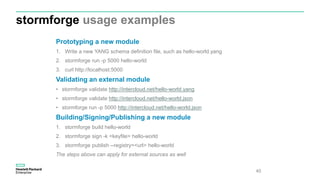
stormforge usage examples
40
Prototyping a new module
1. Write a new YANG schema definition file, such as hello-world.yang
2. stormforge run -p 5000 hello-world
3. curl http://localhost:5000
Validating an external module
• stormforge validate http://intercloud.net/hello-world.yang
• stormforge validate http://intercloud.net/hello-world.json
• stormforge run -p 5000 http://intercloud.net/hello-world.json
Building/Signing/Publishing a new module
1. stormforge build hello-world
2. stormforge sign -k <keyfile> hello-world
3. stormforge publish --registry=<url> hello-world
The steps above can apply for external sources as well
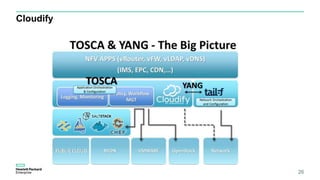
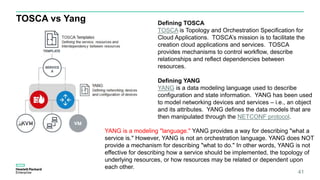
TOSCA vs Yang
41
Defining TOSCA
TOSCA is Topology and Orchestration Specification for
Cloud Applications. TOSCA’s mission is to facilitate the
creation cloud applications and services. TOSCA
provides mechanisms to control workflow, describe
relationships and reflect dependencies between
resources.
Defining YANG
YANG is a data modeling language used to describe
configuration and state information. YANG has been used
to model networking devices and services – i.e., an object
and its attributes. YANG defines the data models that are
then manipulated through the NETCONF protocol.
YANG is a modeling "language." YANG provides a way for describing "what a
service is." However, YANG is not an orchestration language. YANG does NOT
provide a mechanism for describing "what to do." In other words, YANG is not
effective for describing how a service should be implemented, the topology of
underlying resources, or how resources may be related or dependent upon
each other.
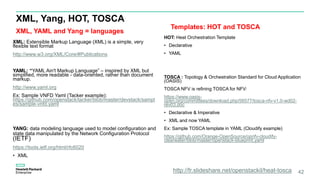
XML, Yang, HOT, TOSCA
XML, YAML and Yang = languages
XML: Extensible Markup Language (XML) is a simple, very
flexible text format
http://www.w3.org/XML/Core/#Publications
YAML: “YAML Ain't Markup Language” – inspired by XML but
simplified, more readable - data-oriented, rather than document
markup.
http://www.yaml.org
Ex; Sample VNFD Yaml (Tacker example):
https://github.com/openstack/tacker/blob/master/devstack/sampl
es/sample-vnfd.yaml
YANG: data modeling language used to model configuration and
state data manipulated by the Network Configuration Protocol
(IETF)
https://tools.ietf.org/html/rfc6020
• XML
Templates: HOT and TOSCA
HOT: Heat Orchestration Template
• Declarative
• YAML
TOSCA : Topology & Orchestration Standard for Cloud Application
(OASIS)
TOSCA NFV is refining TOSCA for NFV:
https://www.oasis-
open.org/committees/download.php/56577/tosca-nfv-v1.0-wd02-
rev03.doc
• Declarative & Imperative
• XML and now YAML
Ex: Sample TOSCA template in YAML (Cloudify example)
https://github.com/Orange-OpenSource/opnfv-cloudify-
clearwater/blob/master/openstack-blueprint.yaml
42http://fr.slideshare.net/openstackil/heat-tosca
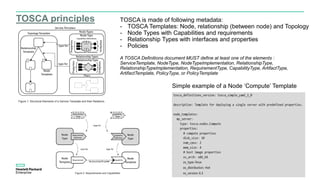
TOSCA principles
43
TOSCA is made of following metadata:
- TOSCA Templates: Node, relationship (between node) and Topology
- Node Types with Capabilities and requirements
- Relationship Types with interfaces and properties
- Policies
A TOSCA Definitions document MUST define at least one of the elements :
ServiceTemplate, NodeType, NodeTypeImplementation, RelationshipType,
RelationshipTypeImplementation, RequirementType, CapabilityType, ArtifactType,
ArtifactTemplate, PolicyType, or PolicyTemplate
Simple example of a Node ‘Compute’ Template
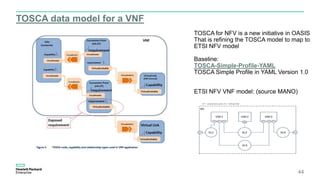
TOSCA data model for a VNF
44
TOSCA for NFV is a new initiative in OASIS
That is refining the TOSCA model to map to
ETSI NFV model
Baseline:
TOSCA-Simple-Profile-YAML
TOSCA Simple Profile in YAML Version 1.0
ETSI NFV VNF model: (source MANO)
TOSCA VNFD Template
45
Extract/simplified view of the Template:
tosca_definitions _version: tosca_simple_profile_for_nfv_1_0_0
topology_template:
inputs:
subsititution_mappings:
node_type: tosca.nodes.nfv.VNF.VNF2
requirements:
virtualLink1: [CP21, virtualLink]
capabilities:
forwarder1: [CP21, Forwarder]
VNF2 above has :
3 VDU (VDU1,2,3) = VNFCs
4 CP : 3 (CP22,23,24) for internal VL (inter-VNFV communication)
and 1-CP21 to external VL2
CP21: #endpoints of VNF2
type: tosca.nodes.nfv.CP
properties:
type:
requirements:
virtualbinding: VDU1
capabilities:
Forwarder
node_templates:
VDU1:
type: tosca.nodes.nfv.VDU
properties:
requirements:
- host:
node_filter:
capabilities:
# for selecting “host” (Container Capability)
- host
properties:
- num_cpus: { in_range: [ 1, 4 ] }
- mem_size: { greater_or_equal: 2 GB }
# for selecting “os” (OperatingSystem Capability)
- os:
properties:
- architecture: { equal: x86_64 }
- type: linux
- distribution: ubuntu Interfaces:
# omitted here for brevity
artifacts:
VM_image:vdu1.image #the VM image of VDU1
Interface:
Standard:
create:vdu1_install.sh
configure:
implementation: vdu1_configure.sh
internal_VL
type: tosca.nodes.nfv.VL.ELAN
Same for VDU1,2,3
CP22
type: tosca.nodes.nfv.CP
properties:
type:
requirements:
virtualbinding: VDU1
virtualLink: internal_VL
Same for CP23,24
But with VDU2
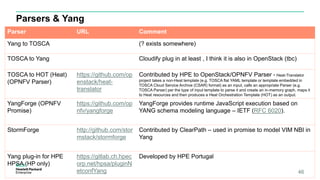
Parsers & Yang
46
Parser URL Comment
Yang to TOSCA (? exists somewhere)
TOSCA to Yang Cloudify plug in at least , I think it is also in OpenStack (tbc)
TOSCA to HOT (Heat)
(OPNFV Parser)
https://github.com/op
enstack/heat-
translator
Contributed by HPE to OpenStack/OPNFV Parser - Heat-Translator
project takes a non-Heat template (e.g. TOSCA flat YAML template or template embedded in
TOSCA Cloud Service Archive (CSAR) format) as an input, calls an appropriate Parser (e.g.
TOSCA Parser) per the type of input template to parse it and create an in-memory graph, maps it
to Heat resources and then produces a Heat Orchestration Template (HOT) as an output.
YangForge (OPNFV
Promise)
https://github.com/op
nfv/yangforge
YangForge provides runtime JavaScript execution based on
YANG schema modeling language – IETF (RFC 6020).
StormForge http://github.com/stor
mstack/stormforge
Contributed by ClearPath – used in promise to model VIM NBI in
Yang
Yang plug-in for HPE
HPSA (HP only)
https://gitlab.ch.hpec
orp.net/hpsa/pluginN
etconfYang
Developed by HPE Portugal
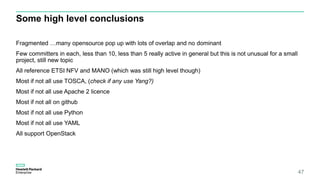
Some high level conclusions
Fragmented …many opensource pop up with lots of overlap and no dominant
Few committers in each, less than 10, less than 5 really active in general but this is not unusual for a small
project, still new topic
All reference ETSI NFV and MANO (which was still high level though)
Most if not all use TOSCA, (check if any use Yang?)
Most if not all use Apache 2 licence
Most if not all on github
Most if not all use Python
Most if not all use YAML
All support OpenStack
47
© Copyright 2012 Hewlett-Packard Development Company, L.P. The information contained herein is subject to change without notice.
Thankyou

NFV Open Source projects

  • 1.
    NFV-SDN Opensource MP Odini/HPE –ETSI NFV Vice Chair Dec, 2015
  • 2.
    F Many Opensource projectson NFV-SDN … 2 SDN Controller VIM DPDK NFVI NFVO Non exhaustive list … Federator used as part of testing
  • 3.
    MANO OpenSource Initiatives OpenSourceLink Status NEW !! ETSI OSG ‘OSM’ : OpenSource MANO http://osm.etsi.org new NEW – OPNFV expanding scope www.opnfv.org Expending Scope to MANO stack Tacker (OpenStack) – Apache2 https://wiki.openstack.org/wiki/Tacker Renaming of an opensource project called ServiceVM (spin-off from Neutron) Openmano (Telefonica) - Apache2 https://github.com/nfvlabs/openmano Launched beginning 2015 – issued from Telefonica test team OpenBaton (Fraunhofer) http://openbaton.github.io/ Oct 2015 – issued from OpenSDN FK project Cloudify http://getcloudify.org/ support from Orange and Metaswitch Open-O (China Mobile) (not available yet) Presented at OPNFV Summit 2015 Gohan (NTT Data) – Apache2 https://github.com/morika-t/gohan Presented at OpenStack Summit Tokyo TCS Telco Cloud (Tata) https://github.com/TCS- TelcoCloud/OpenVNFManager
  • 4.
  • 5.
    Overview MANO opensource hasemerged this past 1-2 years from 3 main sources : • Cloud Opensource projects : ie Tacker in OpenStack, coming from neutron-ServiceVM project • Operator labs => who opensourced their orchestration/test tool : Telefonica openmano, NTT Gohan, China Mobile Open-O • New small projects => generally led by vendors, small community, or University : ie Cloudify, OpenBaton,
  • 6.
    ETSI OSG ‘OSM’: Open Source MANO 6 Jan’16: New proposal led by Telefonica , currently being reviewed by ETSI Board, and submitted to ETSI Director General Approval Scope: Develop an opensource reference implementation of ETSI MANO stack Quote: “This ISG defines a framework to facilitate the software development of a reference implementation of ETSI MANO. ISG OSM complements the work of ISG NFV. The code (reference implementation) developed by ISG OSM shall be non-normative. Any potential standardization work identified by ISG OSM will be submitted to ISG NFV for further consideration and eventual inclusion in the ISG NFV Group Specifications.”  BT PLC  Intel Corporation (UK) Ltd  Telefonica S.A.  Telekom Austria AG  Telenor ASA  RIFT.io Inc  Canonical Group Ltd (applicant member)  Mirantis (applicant member) Founding members
  • 7.
    OPNFV Chairman: Prodip Sen,HPE 7 The scope of projects chosen by the OPNFV TSC can focus on any of the ETSI NFV architecture functional blocks and reference points, along with supporting tools and infrastructure. These functional blocks include: * Virtualised Infrastructure Manager (VIM) * Network Functions Virtualisation Infrastructure (NFVI) * Virtual Network Function Managers * Orchestrator * Virtual Network Functions and associated Element Management Systems * Service, VNF, and Infrastructure Description Operations Support System / Business Support System The associated reference points are (ETSI NFV): * Vi-Ha: The reference point between hardware resources and the Virtualisation Layer * Vn-Nf: The reference point between NFVI and a Virtualised Network Function (VNF) * Or-VNFM: The reference point between the Orchestrator and VNF Manager * Vi-Vnfm: The reference point between a VNF Manager (VNFM) and the VIM * Or-Vi: The reference point between the Orchestrator and the VIM * Nf-Vi: The reference point between the VIM and the NFVI * Os-Ma: The reference point between the OSS/BSS and Management and Orchestration * Ve-Vnfm: The reference point between the VNF/EMS and VNF Manager * Se-MA: The reference point between the Serice, VNF, and Infrastructure Description and the NFV Management and Orchestration NEW Jan’16: OPNFV expanding its scope to all ETSI NFV Functional Blocks, incl MANO
  • 8.
    Tacker 8 VNFM 1.VNF Catalog 2.Basic life-cycleof VNF (define/start/stop/undefine) 3.Performance and Health monitoring of deployed VNFs 4.Auto Healing VNFs based on Policy 5.Facilitate initial configuration of VNF NFVO 1.Templatized end-to-end Network Service deployment using decomposed VNFs 2.VNF placement policy – ensure efficient placement of VNFs 3.VNFs connected using a SFC - described in a VNF Forwarding Graph Descriptor 4.VIM Resource Checks and Resource Allocation 5.Ability to orchestrate VNFs across Multiple VIMs Tacker uses TOSCA for VNF meda-data definition https://wiki.openstack.org/wiki/Tacker http://git.openstack.org/cgit/openstack/tacker/
  • 9.
    Data Model initial draftfrom June 2014 (??old) https://docs.google.com/document/d/1xs8TvEVMszzND5uoWTHtd1tJnu7105Ekgq9hxiyXABQ/edit?pref=2&pli=1 9 This project introduces a new service to organize and manage devices capable of hosting cloud services. Such devices may take a virtual form factor (like virtual machines or containers) or physical form` factors like hardware devices. The responsibility of the new services is to: 1.act as a data store for such devices 2.act as a data store for physical topology information 3.offer life cycle management for compatible device types 4.offer capacity allocation control in such devices class DeviceTemplate(model_base.BASE, models_v1.HasId, models_v1.HasTenant): name = sa.Column(sa.String(255)) description = sa.Column(sa.String(255)) infra_driver = sa.Column(sa.String(255)) attributes = orm.relationship('DeviceTemplateAttribute', backref='template') class DeviceTemplateAttribute(model_base.BASE, models_v1.HasId): template_id = sa.Column(sa.String(36), sa.ForeignKey('devicetemplates.id'),nullable=False) key = sa.Column(sa.String(255), nullable=False) value = sa.Column(sa.String(255), nullable=True) class Device(model_base.BASE, models_v1.HasId, models_v1.HasTenant): template_id = sa.Column(sa.String(36), sa.ForeignKey('devicetemplates.id')) template = orm.relationship('DeviceTemplate') instance_id = sa.Column(sa.String(255), nullable=True) mgmt_url = sa.Column(sa.String(255), nullable=True) status = sa.Column(sa.String(255), nullable=False) flavor = sa.Column(sa.String(255)) class DeviceArg(model_base.BASE, models_v1.HasId): device_id = sa.Column(sa.String(36), sa.ForeignKey('devices.id'), nullable=False) device = orm.relationship('Device', backref='kwargs') key = sa.Column(sa.String(255), nullable=False) value = sa.Column(sa.String(4096), nullable=True)
  • 10.
    TOSCA – latestspecs in progress 10 Current latest (as of Oct 2015) is: https://www.oasis-open.org/committees/download.php/56577/tosca-nfv-v1.0-wd02-rev03.doc
  • 11.
    Tacker sample VNFDtemplate (YAML) 11
  • 12.
  • 13.
    https://github.com/nfvlabs/openmano OpenMANO follows anNFVO-centric approach, with a simplified VNF instance lifecycle management at the NFVO (VNF instantiation and termination) Openmano – released by Telefonica lab
  • 14.
    • FRIENDLY FORNETWORK ENGINEERS • NETWORK SCENARIOS & SNAPSHOTS • Provides NFVO & VIM (+ GUI and CLI) • FULL SUPPORT OF NFV PER001 GS • EPA-awareness for I/O-intensive workloads • REST-BASED APIs, OpenStack-friendly • OpenStack support also coming! • MULTI-VENDOR by design • No formal integration needed • Assures optimal VNF deployment and IXC • >30 VNFs tested • OpenMANO code @ GitHub: o Python-based o 40k code lines o Released under Apache 2 license o 30 forks OpenMANO‘s main features
  • 15.
    OpenMANO automates networkcreation process SCENARIOS & SNAPSHOTS MAKE NETWORK DESIGN SIMPLE AVOIDS CLASH WITH LEGACY OSS (PURE RESOURCE ORCHESTRATION) EPA SUPPORT (NFVO & VIM) PROPER VARIETY OF L2 CONNECTIVITIES VNF ON-BOARDING DOES NOT REQUIRE FORMAL INTEGRATION • Hide complexity to network engineer • Scenario snapshots allow  Saving  Cloning  Re-deployment • Allows to deploy for high performance • Passthrough, SR-IOV, Virtio • E-Line & E-LAN • Descriptor-based (openly available) VNF VNF VNF VNF VNF VNF E-Line E-LAN
  • 16.
    VNF VNF VNF VNF VNF VM VM VM VM VM VM VM VM VM VNF VNF VNF VM VMVM VM VM VM VM VM VM NS (NETWORK SCENARIO) VNF (SW-BASED NODE) + - Abstraction VM (DEPLOYMENT UNIT) OpenMANO works with abstractions of VNFs and Network Scenarios via descriptors...
  • 17.
    x100 Line rate with192 bytes frame size x100 With the right exposure of HW resources to the VNFs (as described at NFV PER001 GS), carrier-grade performance can be achieved Enhanced Platform Awareness (EPA) natively to the VNF when required…
  • 18.
    Support of L2networks with passthrough, SR- IOV or virtio interfaces: • E-Line • E-LAN Traditional E-LAN based on virtual bridges/switches is still supported VNF VNF VNF VNF VNF VNF comprehensive set of connectivities available
  • 19.
    hiding complexity tonetwork engineers
  • 20.
    1 2New VNF:virtual Router New scenario 3 Deployment 4 Test with traffic vRouter C VNFD - Deployment requirements NSD VM Image(s) OpenMANO demo https://youtu.be/5Szc-VGDhi4
  • 21.
    Openbaton 21 •the Network FunctionVirtualisation Orchestrator (NFVO), always required for creating a composition of different Virtual Network Function Descriptors generic-VNFM, needed only when the VNFP approach is used. Using the generic-VNFM implies also the usage of the EMS which is automatically installed on the VDUs where VNF are to be installed.
  • 22.
    openbaton – OpenBaton iseasily extensible. It integrates with OpenStack, and provides a plugin mechanism for supporting additional VIM types. It supports Network Service management either using a generic VNFM or interoperating with VNF-specific VNFM. It uses different mechanisms (REST or PUB/SUB) for interoperating with the VNFMs. Its initial focus was to provide the main functionalities for provisioning and managing Network Services, however in its future releases new additional features will provide mechanisms for increasing the automation in NS management. Those new features will include autoscaling, fault management, TOSCA, etc. 22
  • 23.
    Openbaton code 23 files languageblank comment code 159 Javascript 5958 5059 26409 348 Java 5732 8782 22917 71 HTML 5670 460 14484 23 CSS 627 318 11789 27 JSON 12 0 1791 18 LESS 102 58 1640 15 SASS 36 26 1399 66 Groovy 276 665 1055 6 Bourne Shell 85 28 394 2 Bourne Again Shell 49 35 248 1 XML 50 0 108 1 DOS Batch 24 2 64 2 PHP 7 3 45 3 YAML 1 0 31 1 Mustache 0 0 4 1 SQL 2 4 2 Total 18631 15440 82380 The LOC is about 83K, the core Java code is about 23K
  • 24.
    Cloudify 24 Cloudify is anopen source TOSCA based cloud orchestration software platform (like Amazon’s OpsWorks). It automates the process of installation, deployment and also post-deployment such as monitoring, remediation, and auto-scaling of your application stack.
  • 25.
    Cloudify 25 Application Orchestration Your applicationin its entirety (Infrastructure, Middleware, Application Code, Scripts, Tool Configuration, Metrics and Logs) can be desribed in what we call a blueprint. Ex: OpenStack blueprint => https://github.com/cloudify- cosmo/cloudify-nodecellar-example/blob/master/openstack- blueprint.yaml Written in a human readable YAML format, a blueprint allows for potentially high granularity of configuration of your application. By defining the complete lifecycle of each part of your application in a blueprint, and by utilizing the different IaaS APIs and the plugin abstractions of different tools, Cloudify can deploy and manage your application automatically. Cloudify will launch the compute instances, and configure network and security in order to manifest your infrastructure. Then, it will execute scripts (remotely via SSH or locally on the machines) or configuration management tools to configure your servers and deploy your middleware and code. Application Maintenance Cloudify’s ability to run custom workflows will grant you the ability to manually or automatically change your application’s structure, deploy code to your servers, heal or scale your system. Cloudify will use metrics collectors (and soon, log collectors) to stream application (and Cloudify specific) data to Cloudify so that you’re able to monitor and analyze your system. Data aggregation and visualization within Cloudify will allow you to execute the different workflows so that either you or Cloudify itself can make smart, actionable decisions based on business/application KPIs. Those decisions can either manually or automatically trigger workflows (such as scaling or healing) on the tactical front; or as application behavior analysis on the strategic front.
  • 26.
  • 27.
    Orange Cloudify projectin opensource with Clearwater vIMS 27 https://github.com/Orange-OpenSource/opnfv-cloudify-clearwater/
  • 28.
  • 29.
    TOSCA like YAMLdescription 29
  • 30.
    Gohan – NTTopensource SDN/NFV Orchestration 30 https://www.openstack.org/summit/tokyo-2015/videos/presentation/gohan-an-open-source-service-development-engine-for-sdnnfv-orchestration
  • 31.
  • 32.
    Gohan Policy 32 Policy You canconfigure API access policy using this resource. Policy has following properties. •id : Identitfy of the policy •principal : Keystone Role •action: one of create, read, update, delete for CRUD operations on resource or any custom actions defined by schema performed on a resource or * for all actions •effect : Allow api access or not •resource : target resource you can specify target resource using “path” and “properties” •condition : addtional condition (see below) •tenant_id : regexp matching the tenant, defaults to
  • 33.
    TATA TCS OpenVNF Manager 33
  • 34.
    Tata TCS OpenVNF Manager - github 34 https://github.com/TCS-TelcoCloud/OpenVNFManager Basic VNF manager On top of OpenStack Using Heat 8 commits Last Aug 2014
  • 35.
    YangForge YangForge provides runtimeJavaScript execution based on YANG schema modeling language – IETF (RFC 6020). Basically, the framework enables YANG schema language to become a programming language. It utilizes YAML with custom tags to construct a portable module with embedded code. It is written primarily using CoffeeScript and runs on Node.js and the web browser (yes, it's isomorphic). 35
  • 36.
    What is it? •A Model-driven Architecture (MDA) software framework for building schema defined software modules Why was it created? • To serve as a rapid prototyping framework for model driven software architecture • To support OPNFV Promise implementation for abstracting ResourceElement(s) of the virtualized infrastructure for state management of capacity and reservations for future usage How does it work? • It uses Metaprogramming techniques to process YANG schema (RFC 6020) files as a software language • It uses Creational Patterns to dynamically construct hierarchy of runtime class objects based on YANG data models What’s the current status? • It’s early stage with working compilers and generators Stormforge
  • 37.
    stormforge framework 37 Schema • providesdefinitions for generating the data models Model/View/Controller • decouples logic layers Data Store • handles record instances of data models Events/Messages • enable reactive control logic integration Interface Layer • auto-generates data model derived interfaces Import/Export • facilitates exchange of data models
  • 38.
    stormforge core components 38 meta-class •The core base class that houses the meta-data and enables Class definitions to be mutable yang-compiler • Parses YANG schema text and produces runtime JS class object hierarchy (composed of meta- class) • Implemented based on YANG version 1.0 specifications (RFC 6020) • Provides compile, generate, import, and export facilities (can be used as a server-side API service) storm-compiler • Extensions beyond YANG version 1.0 to introduce complex-types (RFC 6095) • Enhanced resolvers to infuse with data-storm objects providing type validators and model relationships yang-storm • Defines a collection of common data models • Serves as a DataStore for housing schemas, modules, models, controllers, views, and instantiated records
  • 39.
    stormforge compiler features 39 Parserparse YANG schema files and generate runtime JavaScript meta-class semantic tree hierarchy Map/Reduce traversal of the parser output to dynamically resolve YANG statement extensions and transform nodes in the tree as well as collapsing them into a final output module Import/Export capabilities to load modules using customizable importers based on regular expressions and custom import routines. Ability to serialize module meta data into JSON format that is portable across systems. Also exports serialized JS functions as part of export meta data. Runtime Generation allows compiler to directly create a live JS class object definition so that it can be instantiated via new keyword and used immediately Dynamic Extensions enable compiler to be configured with alternative resolver functions to change the behavior of produced output
  • 40.
    stormforge usage examples 40 Prototypinga new module 1. Write a new YANG schema definition file, such as hello-world.yang 2. stormforge run -p 5000 hello-world 3. curl http://localhost:5000 Validating an external module • stormforge validate http://intercloud.net/hello-world.yang • stormforge validate http://intercloud.net/hello-world.json • stormforge run -p 5000 http://intercloud.net/hello-world.json Building/Signing/Publishing a new module 1. stormforge build hello-world 2. stormforge sign -k <keyfile> hello-world 3. stormforge publish --registry=<url> hello-world The steps above can apply for external sources as well
  • 41.
    TOSCA vs Yang 41 DefiningTOSCA TOSCA is Topology and Orchestration Specification for Cloud Applications. TOSCA’s mission is to facilitate the creation cloud applications and services. TOSCA provides mechanisms to control workflow, describe relationships and reflect dependencies between resources. Defining YANG YANG is a data modeling language used to describe configuration and state information. YANG has been used to model networking devices and services – i.e., an object and its attributes. YANG defines the data models that are then manipulated through the NETCONF protocol. YANG is a modeling "language." YANG provides a way for describing "what a service is." However, YANG is not an orchestration language. YANG does NOT provide a mechanism for describing "what to do." In other words, YANG is not effective for describing how a service should be implemented, the topology of underlying resources, or how resources may be related or dependent upon each other.
  • 42.
    XML, Yang, HOT,TOSCA XML, YAML and Yang = languages XML: Extensible Markup Language (XML) is a simple, very flexible text format http://www.w3.org/XML/Core/#Publications YAML: “YAML Ain't Markup Language” – inspired by XML but simplified, more readable - data-oriented, rather than document markup. http://www.yaml.org Ex; Sample VNFD Yaml (Tacker example): https://github.com/openstack/tacker/blob/master/devstack/sampl es/sample-vnfd.yaml YANG: data modeling language used to model configuration and state data manipulated by the Network Configuration Protocol (IETF) https://tools.ietf.org/html/rfc6020 • XML Templates: HOT and TOSCA HOT: Heat Orchestration Template • Declarative • YAML TOSCA : Topology & Orchestration Standard for Cloud Application (OASIS) TOSCA NFV is refining TOSCA for NFV: https://www.oasis- open.org/committees/download.php/56577/tosca-nfv-v1.0-wd02- rev03.doc • Declarative & Imperative • XML and now YAML Ex: Sample TOSCA template in YAML (Cloudify example) https://github.com/Orange-OpenSource/opnfv-cloudify- clearwater/blob/master/openstack-blueprint.yaml 42http://fr.slideshare.net/openstackil/heat-tosca
  • 43.
    TOSCA principles 43 TOSCA ismade of following metadata: - TOSCA Templates: Node, relationship (between node) and Topology - Node Types with Capabilities and requirements - Relationship Types with interfaces and properties - Policies A TOSCA Definitions document MUST define at least one of the elements : ServiceTemplate, NodeType, NodeTypeImplementation, RelationshipType, RelationshipTypeImplementation, RequirementType, CapabilityType, ArtifactType, ArtifactTemplate, PolicyType, or PolicyTemplate Simple example of a Node ‘Compute’ Template
  • 44.
    TOSCA data modelfor a VNF 44 TOSCA for NFV is a new initiative in OASIS That is refining the TOSCA model to map to ETSI NFV model Baseline: TOSCA-Simple-Profile-YAML TOSCA Simple Profile in YAML Version 1.0 ETSI NFV VNF model: (source MANO)
  • 45.
    TOSCA VNFD Template 45 Extract/simplifiedview of the Template: tosca_definitions _version: tosca_simple_profile_for_nfv_1_0_0 topology_template: inputs: subsititution_mappings: node_type: tosca.nodes.nfv.VNF.VNF2 requirements: virtualLink1: [CP21, virtualLink] capabilities: forwarder1: [CP21, Forwarder] VNF2 above has : 3 VDU (VDU1,2,3) = VNFCs 4 CP : 3 (CP22,23,24) for internal VL (inter-VNFV communication) and 1-CP21 to external VL2 CP21: #endpoints of VNF2 type: tosca.nodes.nfv.CP properties: type: requirements: virtualbinding: VDU1 capabilities: Forwarder node_templates: VDU1: type: tosca.nodes.nfv.VDU properties: requirements: - host: node_filter: capabilities: # for selecting “host” (Container Capability) - host properties: - num_cpus: { in_range: [ 1, 4 ] } - mem_size: { greater_or_equal: 2 GB } # for selecting “os” (OperatingSystem Capability) - os: properties: - architecture: { equal: x86_64 } - type: linux - distribution: ubuntu Interfaces: # omitted here for brevity artifacts: VM_image:vdu1.image #the VM image of VDU1 Interface: Standard: create:vdu1_install.sh configure: implementation: vdu1_configure.sh internal_VL type: tosca.nodes.nfv.VL.ELAN Same for VDU1,2,3 CP22 type: tosca.nodes.nfv.CP properties: type: requirements: virtualbinding: VDU1 virtualLink: internal_VL Same for CP23,24 But with VDU2
  • 46.
    Parsers & Yang 46 ParserURL Comment Yang to TOSCA (? exists somewhere) TOSCA to Yang Cloudify plug in at least , I think it is also in OpenStack (tbc) TOSCA to HOT (Heat) (OPNFV Parser) https://github.com/op enstack/heat- translator Contributed by HPE to OpenStack/OPNFV Parser - Heat-Translator project takes a non-Heat template (e.g. TOSCA flat YAML template or template embedded in TOSCA Cloud Service Archive (CSAR) format) as an input, calls an appropriate Parser (e.g. TOSCA Parser) per the type of input template to parse it and create an in-memory graph, maps it to Heat resources and then produces a Heat Orchestration Template (HOT) as an output. YangForge (OPNFV Promise) https://github.com/op nfv/yangforge YangForge provides runtime JavaScript execution based on YANG schema modeling language – IETF (RFC 6020). StormForge http://github.com/stor mstack/stormforge Contributed by ClearPath – used in promise to model VIM NBI in Yang Yang plug-in for HPE HPSA (HP only) https://gitlab.ch.hpec orp.net/hpsa/pluginN etconfYang Developed by HPE Portugal
  • 47.
    Some high levelconclusions Fragmented …many opensource pop up with lots of overlap and no dominant Few committers in each, less than 10, less than 5 really active in general but this is not unusual for a small project, still new topic All reference ETSI NFV and MANO (which was still high level though) Most if not all use TOSCA, (check if any use Yang?) Most if not all use Apache 2 licence Most if not all on github Most if not all use Python Most if not all use YAML All support OpenStack 47
  • 48.
    © Copyright 2012Hewlett-Packard Development Company, L.P. The information contained herein is subject to change without notice. Thankyou