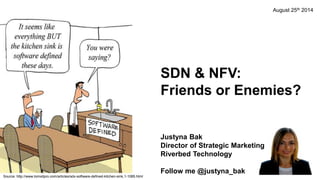

SDN & NFV:
Friends or Enemies?
Justyna Bak
Director of Strategic Marketing
Riverbed Technology
Follow me @justyna_bak
Source: http://www.tomsitpro.com/articles/sdx-software-defined-kitchen-sink,1-1085.html
August 25th 2014
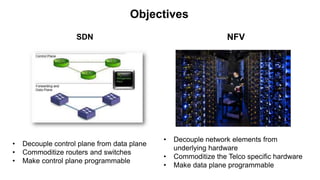
Objectives
SDN NFV
• Decouple control plane from data plane
• Commoditize routers and switches
• Make control plane programmable
• Decouple network elements from
underlying hardware
• Commoditize the Telco specific hardware
• Make data plane programmable
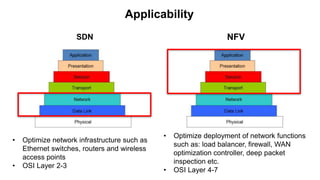
Applicability
SDN NFV
• Optimize network infrastructure such as
Ethernet switches, routers and wireless
access points
• OSI Layer 2-3
• Optimize deployment of network functions
such as: load balancer, firewall, WAN
optimization controller, deep packet
inspection etc.
• OSI Layer 4-7
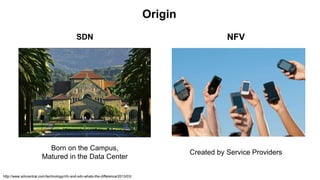
Origin
SDN NFV
Born on the Campus,
Matured in the Data Center
Created by Service Providers
http://www.sdncentral.com/technology/nfv-and-sdn-whats-the-difference/2013/03/
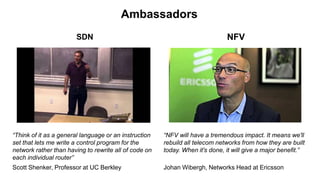
Ambassadors
SDN NFV
“Think of it as a general language or an instruction
set that lets me write a control program for the
network rather than having to rewrite all of code on
each individual router”
Scott Shenker, Professor at UC Berkley
“NFV will have a tremendous impact. It means we'll
rebuild all telecom networks from how they are built
today. When it's done, it will give a major benefit.”
Johan Wibergh, Networks Head at Ericsson
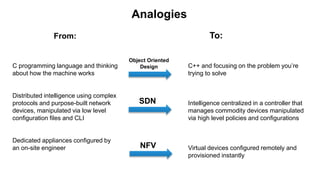
Analogies
From: To:
C programming language and thinking
about how the machine works
Distributed intelligence using complex
protocols and purpose-built network
devices, manipulated via low level
configuration files and CLI
Dedicated appliances configured by
an on-site engineer
C++ and focusing on the problem you’re
trying to solve
Intelligence centralized in a controller that
manages commodity devices manipulated
via high level policies and configurations
Virtual devices configured remotely and
provisioned instantly
SDN
NFV
Object Oriented
Design
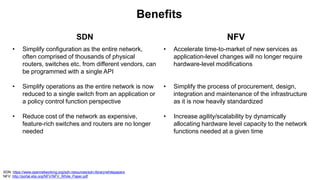
Benefits
SDN NFV
• Simplify configuration as the entire network,
often comprised of thousands of physical
routers, switches etc. from different vendors, can
be programmed with a single API
• Simplify operations as the entire network is now
reduced to a single switch from an application or
a policy control function perspective
• Reduce cost of the network as expensive,
feature-rich switches and routers are no longer
needed
• Accelerate time-to-market of new services as
application-level changes will no longer require
hardware-level modifications
• Simplify the process of procurement, design,
integration and maintenance of the infrastructure
as it is now heavily standardized
• Increase agility/scalability by dynamically
allocating hardware level capacity to the network
functions needed at a given time
SDN: https://www.opennetworking.org/sdn-resources/sdn-library/whitepapers
NFV: http://portal.etsi.org/NFV/NFV_White_Paper.pdf
Industry Standards
SDN NFV
Open Networking Foundation (ONF) European Telecommunications Standards
Institute (ETSI)
www.opennetworking.org http://www.etsi.org/technologies-clusters/technologies/nfv
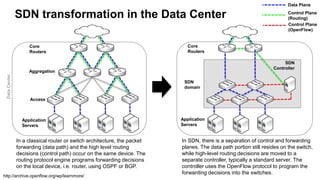
SDN transformation in the Data Center
DataCenter
Core
Routers
In a classical router or switch architecture, the packet
forwarding (data path) and the high level routing
decisions (control path) occur on the same device. The
routing protocol engine programs forwarding decisions
on the local device, i.e. router, using OSPF or BGP.
In SDN, there is a separation of control and forwarding
planes. The data path portion still resides on the switch,
while high-level routing decisions are moved to a
separate controller, typically a standard server. The
controller uses the OpenFlow protocol to program the
forwarding decisions into the switches.
Application
Servers
Data Plane
Control Plane
(Routing)
http://archive.openflow.org/wp/learnmore/
Aggregation
Access
Core
Routers
SDN
domain
SDN
Controller
Application
Servers
Control Plane
(OpenFlow)
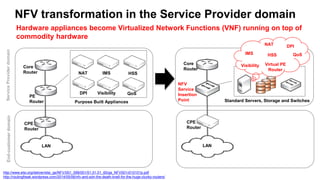
NFV transformation in the Service Provider domain
End-customerdomainServiceProviderdomain
http://www.etsi.org/deliver/etsi_gs/NFV/001_099/001/01.01.01_60/gs_NFV001v010101p.pdf
http://routingfreak.wordpress.com/2014/05/06/nfv-and-sdn-the-death-knell-for-the-huge-clunky-routers/
Hardware appliances become Virtualized Network Functions (VNF) running on top of
commodity hardware
Purpose Built Appliances
Core
Router
Standard Servers, Storage and Switches
DPI
HSS
NAT
IMS
DPI Visibility
IMSNAT
QoS
QoS
PE
Router
Core
Router
Virtual PE
Router
NFV
Service
Insertion
Point
HSS
Visibility
End-customerdomain
LAN
CPE
Router
LAN
CPE
Router
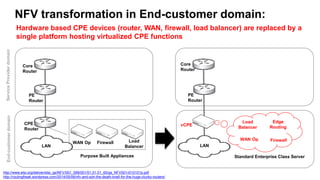
NFV transformation in End-customer domain:
End-customerdomainServiceProviderdomain
LAN
Core
Router
CPE
Router
http://www.etsi.org/deliver/etsi_gs/NFV/001_099/001/01.01.01_60/gs_NFV001v010101p.pdf
http://routingfreak.wordpress.com/2014/05/06/nfv-and-sdn-the-death-knell-for-the-huge-clunky-routers/
PE
Router
Core
Router
vCPE
Edge
Routing
Purpose Built Appliances
Load
Balancer
FirewallWAN Op
FirewallWAN Op
Load
Balancer
Standard Enterprise Class Server
PE
Router
Hardware based CPE devices (router, WAN, firewall, load balancer) are replaced by a
single platform hosting virtualized CPE functions
LAN
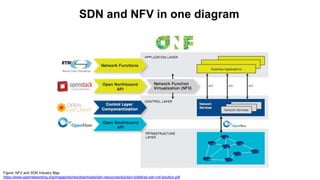
SDN and NFV in one diagram
Figure: NFV and SDN Industry Map
https://www.opennetworking.org/images/stories/downloads/sdn-resources/solution-briefs/sb-sdn-nvf-solution.pdf
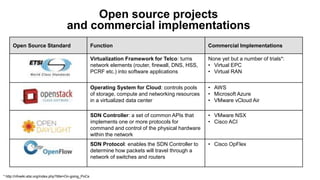
Open source projects
and commercial implementations
Open Source Standard Function Commercial Implementations
Virtualization Framework for Telco: turns
network elements (router, firewall, DNS, HSS,
PCRF etc.) into software applications
None yet but a number of trials*:
• Virtual EPC
• Virtual RAN
Operating System for Cloud: controls pools
of storage, compute and networking resources
in a virtualized data center
• AWS
• Microsoft Azure
• VMware vCloud Air
SDN Controller: a set of common APIs that
implements one or more protocols for
command and control of the physical hardware
within the network
• VMware NSX
• Cisco ACI
SDN Protocol: enables the SDN Controller to
determine how packets will travel through a
network of switches and routers
• Cisco OpFlex
* http://nfvwiki.etsi.org/index.php?title=On-going_PoCs
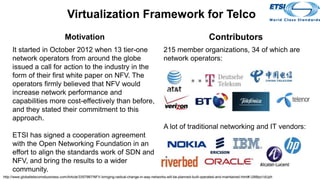
Virtualization Framework for Telco
Motivation Contributors
It started in October 2012 when 13 tier-one
network operators from around the globe
issued a call for action to the industry in the
form of their first white paper on NFV. The
operators firmly believed that NFV would
increase network performance and
capabilities more cost-effectively than before,
and they stated their commitment to this
approach.
ETSI has signed a cooperation agreement
with the Open Networking Foundation in an
effort to align the standards work of SDN and
NFV, and bring the results to a wider
community.
215 member organizations, 34 of which are
network operators:
A lot of traditional networking and IT vendors:
http://www.globaltelecomsbusiness.com/Article/3357987/NFV-bringing-radical-change-in-way-networks-will-be-planned-built-operated-and-maintained.html#.U9l8po1dUph
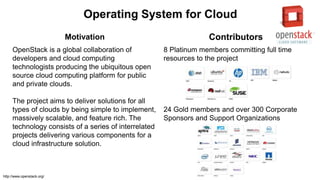
Operating System for Cloud
Motivation Contributors
OpenStack is a global collaboration of
developers and cloud computing
technologists producing the ubiquitous open
source cloud computing platform for public
and private clouds.
The project aims to deliver solutions for all
types of clouds by being simple to implement,
massively scalable, and feature rich. The
technology consists of a series of interrelated
projects delivering various components for a
cloud infrastructure solution.
8 Platinum members committing full time
resources to the project
24 Gold members and over 300 Corporate
Sponsors and Support Organizations
http://www.openstack.org/
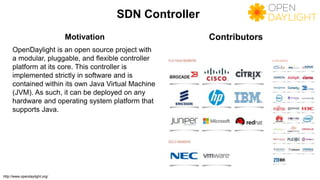
SDN Controller
Motivation Contributors
OpenDaylight is an open source project with
a modular, pluggable, and flexible controller
platform at its core. This controller is
implemented strictly in software and is
contained within its own Java Virtual Machine
(JVM). As such, it can be deployed on any
hardware and operating system platform that
supports Java.
http://www.opendaylight.org/
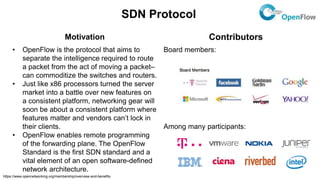
SDN Protocol
Motivation Contributors
• OpenFlow is the protocol that aims to
separate the intelligence required to route
a packet from the act of moving a packet–
can commoditize the switches and routers.
• Just like x86 processors turned the server
market into a battle over new features on
a consistent platform, networking gear will
soon be about a consistent platform where
features matter and vendors can’t lock in
their clients.
• OpenFlow enables remote programming
of the forwarding plane. The OpenFlow
Standard is the first SDN standard and a
vital element of an open software-defined
network architecture.
Board members:
Among many participants:
https://www.opennetworking.org/membership/overview-and-benefits
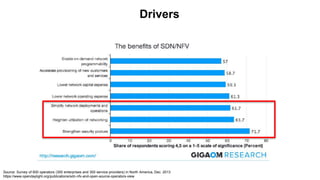
Source: Survey of 600 operators (300 enterprises and 300 service providers) in North America, Dec. 2013
https://www.opendaylight.org/publications/sdn-nfv-and-open-source-operators-view
Drivers
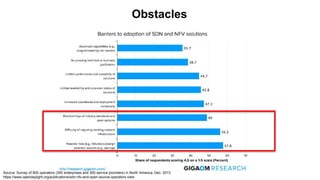
Obstacles
Source: Survey of 600 operators (300 enterprises and 300 service providers) in North America, Dec. 2013
https://www.opendaylight.org/publications/sdn-nfv-and-open-source-operators-view
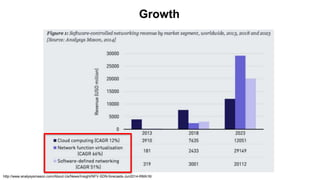
Growth
SDN NFV
x x
http://www.analysysmason.com/About-Us/News/Insight/NFV-SDN-forecasts-Jun2014-RMA16/
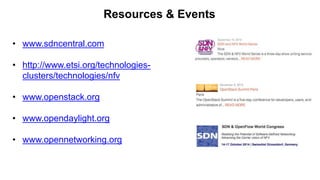
Resources & Events
• www.sdncentral.com
• http://www.etsi.org/technologies-
clusters/technologies/nfv
• www.openstack.org
• www.opendaylight.org
• www.opennetworking.org
Download the PowerPoint Version
Save days of research and forget about the hassle of building your own slides!
https://techsurprises.com/sdn-vs-nfv-presentation/
Thank you to the reviewers of this presentation
Kevin Glavin
Technical Director
Simone Morellato
Technical Director
Gianluca Mardente
Senior Technical Leader

SDN and NFV: Friends or Enemies

  • 1.
    SDN & NFV: Friendsor Enemies? Justyna Bak Director of Strategic Marketing Riverbed Technology Follow me @justyna_bak Source: http://www.tomsitpro.com/articles/sdx-software-defined-kitchen-sink,1-1085.html August 25th 2014
  • 2.
    Objectives SDN NFV • Decouplecontrol plane from data plane • Commoditize routers and switches • Make control plane programmable • Decouple network elements from underlying hardware • Commoditize the Telco specific hardware • Make data plane programmable
  • 3.
    Applicability SDN NFV • Optimizenetwork infrastructure such as Ethernet switches, routers and wireless access points • OSI Layer 2-3 • Optimize deployment of network functions such as: load balancer, firewall, WAN optimization controller, deep packet inspection etc. • OSI Layer 4-7
  • 4.
    Origin SDN NFV Born onthe Campus, Matured in the Data Center Created by Service Providers http://www.sdncentral.com/technology/nfv-and-sdn-whats-the-difference/2013/03/
  • 5.
    Ambassadors SDN NFV “Think ofit as a general language or an instruction set that lets me write a control program for the network rather than having to rewrite all of code on each individual router” Scott Shenker, Professor at UC Berkley “NFV will have a tremendous impact. It means we'll rebuild all telecom networks from how they are built today. When it's done, it will give a major benefit.” Johan Wibergh, Networks Head at Ericsson
  • 6.
    Analogies From: To: C programminglanguage and thinking about how the machine works Distributed intelligence using complex protocols and purpose-built network devices, manipulated via low level configuration files and CLI Dedicated appliances configured by an on-site engineer C++ and focusing on the problem you’re trying to solve Intelligence centralized in a controller that manages commodity devices manipulated via high level policies and configurations Virtual devices configured remotely and provisioned instantly SDN NFV Object Oriented Design
  • 7.
    Benefits SDN NFV • Simplifyconfiguration as the entire network, often comprised of thousands of physical routers, switches etc. from different vendors, can be programmed with a single API • Simplify operations as the entire network is now reduced to a single switch from an application or a policy control function perspective • Reduce cost of the network as expensive, feature-rich switches and routers are no longer needed • Accelerate time-to-market of new services as application-level changes will no longer require hardware-level modifications • Simplify the process of procurement, design, integration and maintenance of the infrastructure as it is now heavily standardized • Increase agility/scalability by dynamically allocating hardware level capacity to the network functions needed at a given time SDN: https://www.opennetworking.org/sdn-resources/sdn-library/whitepapers NFV: http://portal.etsi.org/NFV/NFV_White_Paper.pdf
  • 8.
    Industry Standards SDN NFV OpenNetworking Foundation (ONF) European Telecommunications Standards Institute (ETSI) www.opennetworking.org http://www.etsi.org/technologies-clusters/technologies/nfv
  • 9.
    SDN transformation inthe Data Center DataCenter Core Routers In a classical router or switch architecture, the packet forwarding (data path) and the high level routing decisions (control path) occur on the same device. The routing protocol engine programs forwarding decisions on the local device, i.e. router, using OSPF or BGP. In SDN, there is a separation of control and forwarding planes. The data path portion still resides on the switch, while high-level routing decisions are moved to a separate controller, typically a standard server. The controller uses the OpenFlow protocol to program the forwarding decisions into the switches. Application Servers Data Plane Control Plane (Routing) http://archive.openflow.org/wp/learnmore/ Aggregation Access Core Routers SDN domain SDN Controller Application Servers Control Plane (OpenFlow)
  • 10.
    NFV transformation inthe Service Provider domain End-customerdomainServiceProviderdomain http://www.etsi.org/deliver/etsi_gs/NFV/001_099/001/01.01.01_60/gs_NFV001v010101p.pdf http://routingfreak.wordpress.com/2014/05/06/nfv-and-sdn-the-death-knell-for-the-huge-clunky-routers/ Hardware appliances become Virtualized Network Functions (VNF) running on top of commodity hardware Purpose Built Appliances Core Router Standard Servers, Storage and Switches DPI HSS NAT IMS DPI Visibility IMSNAT QoS QoS PE Router Core Router Virtual PE Router NFV Service Insertion Point HSS Visibility End-customerdomain LAN CPE Router LAN CPE Router
  • 11.
    NFV transformation inEnd-customer domain: End-customerdomainServiceProviderdomain LAN Core Router CPE Router http://www.etsi.org/deliver/etsi_gs/NFV/001_099/001/01.01.01_60/gs_NFV001v010101p.pdf http://routingfreak.wordpress.com/2014/05/06/nfv-and-sdn-the-death-knell-for-the-huge-clunky-routers/ PE Router Core Router vCPE Edge Routing Purpose Built Appliances Load Balancer FirewallWAN Op FirewallWAN Op Load Balancer Standard Enterprise Class Server PE Router Hardware based CPE devices (router, WAN, firewall, load balancer) are replaced by a single platform hosting virtualized CPE functions LAN
  • 12.
    SDN and NFVin one diagram Figure: NFV and SDN Industry Map https://www.opennetworking.org/images/stories/downloads/sdn-resources/solution-briefs/sb-sdn-nvf-solution.pdf
  • 13.
    Open source projects andcommercial implementations Open Source Standard Function Commercial Implementations Virtualization Framework for Telco: turns network elements (router, firewall, DNS, HSS, PCRF etc.) into software applications None yet but a number of trials*: • Virtual EPC • Virtual RAN Operating System for Cloud: controls pools of storage, compute and networking resources in a virtualized data center • AWS • Microsoft Azure • VMware vCloud Air SDN Controller: a set of common APIs that implements one or more protocols for command and control of the physical hardware within the network • VMware NSX • Cisco ACI SDN Protocol: enables the SDN Controller to determine how packets will travel through a network of switches and routers • Cisco OpFlex * http://nfvwiki.etsi.org/index.php?title=On-going_PoCs
  • 14.
    Virtualization Framework forTelco Motivation Contributors It started in October 2012 when 13 tier-one network operators from around the globe issued a call for action to the industry in the form of their first white paper on NFV. The operators firmly believed that NFV would increase network performance and capabilities more cost-effectively than before, and they stated their commitment to this approach. ETSI has signed a cooperation agreement with the Open Networking Foundation in an effort to align the standards work of SDN and NFV, and bring the results to a wider community. 215 member organizations, 34 of which are network operators: A lot of traditional networking and IT vendors: http://www.globaltelecomsbusiness.com/Article/3357987/NFV-bringing-radical-change-in-way-networks-will-be-planned-built-operated-and-maintained.html#.U9l8po1dUph
  • 15.
    Operating System forCloud Motivation Contributors OpenStack is a global collaboration of developers and cloud computing technologists producing the ubiquitous open source cloud computing platform for public and private clouds. The project aims to deliver solutions for all types of clouds by being simple to implement, massively scalable, and feature rich. The technology consists of a series of interrelated projects delivering various components for a cloud infrastructure solution. 8 Platinum members committing full time resources to the project 24 Gold members and over 300 Corporate Sponsors and Support Organizations http://www.openstack.org/
  • 16.
    SDN Controller Motivation Contributors OpenDaylightis an open source project with a modular, pluggable, and flexible controller platform at its core. This controller is implemented strictly in software and is contained within its own Java Virtual Machine (JVM). As such, it can be deployed on any hardware and operating system platform that supports Java. http://www.opendaylight.org/
  • 17.
    SDN Protocol Motivation Contributors •OpenFlow is the protocol that aims to separate the intelligence required to route a packet from the act of moving a packet– can commoditize the switches and routers. • Just like x86 processors turned the server market into a battle over new features on a consistent platform, networking gear will soon be about a consistent platform where features matter and vendors can’t lock in their clients. • OpenFlow enables remote programming of the forwarding plane. The OpenFlow Standard is the first SDN standard and a vital element of an open software-defined network architecture. Board members: Among many participants: https://www.opennetworking.org/membership/overview-and-benefits
  • 18.
    Source: Survey of600 operators (300 enterprises and 300 service providers) in North America, Dec. 2013 https://www.opendaylight.org/publications/sdn-nfv-and-open-source-operators-view Drivers
  • 19.
    Obstacles Source: Survey of600 operators (300 enterprises and 300 service providers) in North America, Dec. 2013 https://www.opendaylight.org/publications/sdn-nfv-and-open-source-operators-view
  • 20.
  • 21.
    Resources & Events •www.sdncentral.com • http://www.etsi.org/technologies- clusters/technologies/nfv • www.openstack.org • www.opendaylight.org • www.opennetworking.org
  • 22.
    Download the PowerPointVersion Save days of research and forget about the hassle of building your own slides! https://techsurprises.com/sdn-vs-nfv-presentation/
  • 23.
    Thank you tothe reviewers of this presentation Kevin Glavin Technical Director Simone Morellato Technical Director Gianluca Mardente Senior Technical Leader