On the role of Open Source
in the Network Softwarization trend
Christian Esteve Rothenberg
Palestra da Série de Seminários do IC/Unicamp
Nov 18, 2016
Agenda
• What is Network Softwarization
• Open Source & Networking
• Some experiences and ongoing activities
Network Softwarization?
Source:
Image (right) http://stunlaw.blogspot.com.br/2013/08/softwarization-tentative-genealogy.html
Image (leftt) https://kc4lmd.files.wordpress.com/2015/01/computer-network-networking-austin.jpg
Network Softwarization
Existing
• CLIs
• Closed Source
• Vendor Lead
• Classic Network Appliances
New
• APIs
• Open Source
• Customer Lead
• Network Function
Virtualization (NFV)Adapted from: Kyle Mestery, Next Generation Network Developer Skills
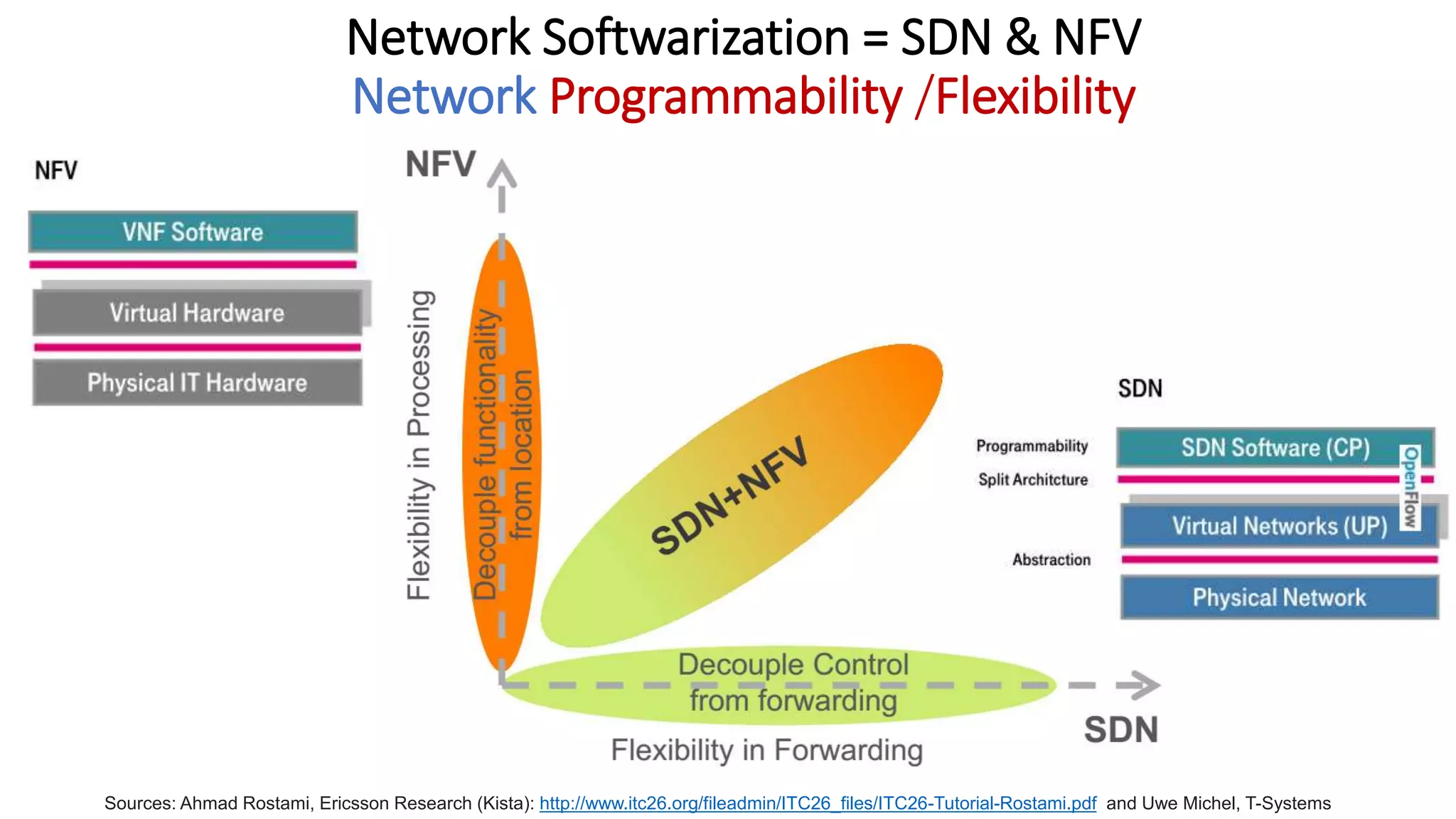
Network Softwarization = SDN & NFV
Network Programmability /Flexibility
Sources: Ahmad Rostami, Ericsson Research (Kista): http://www.itc26.org/fileadmin/ITC26_files/ITC26-Tutorial-Rostami.pdf and Uwe Michel, T-Systems
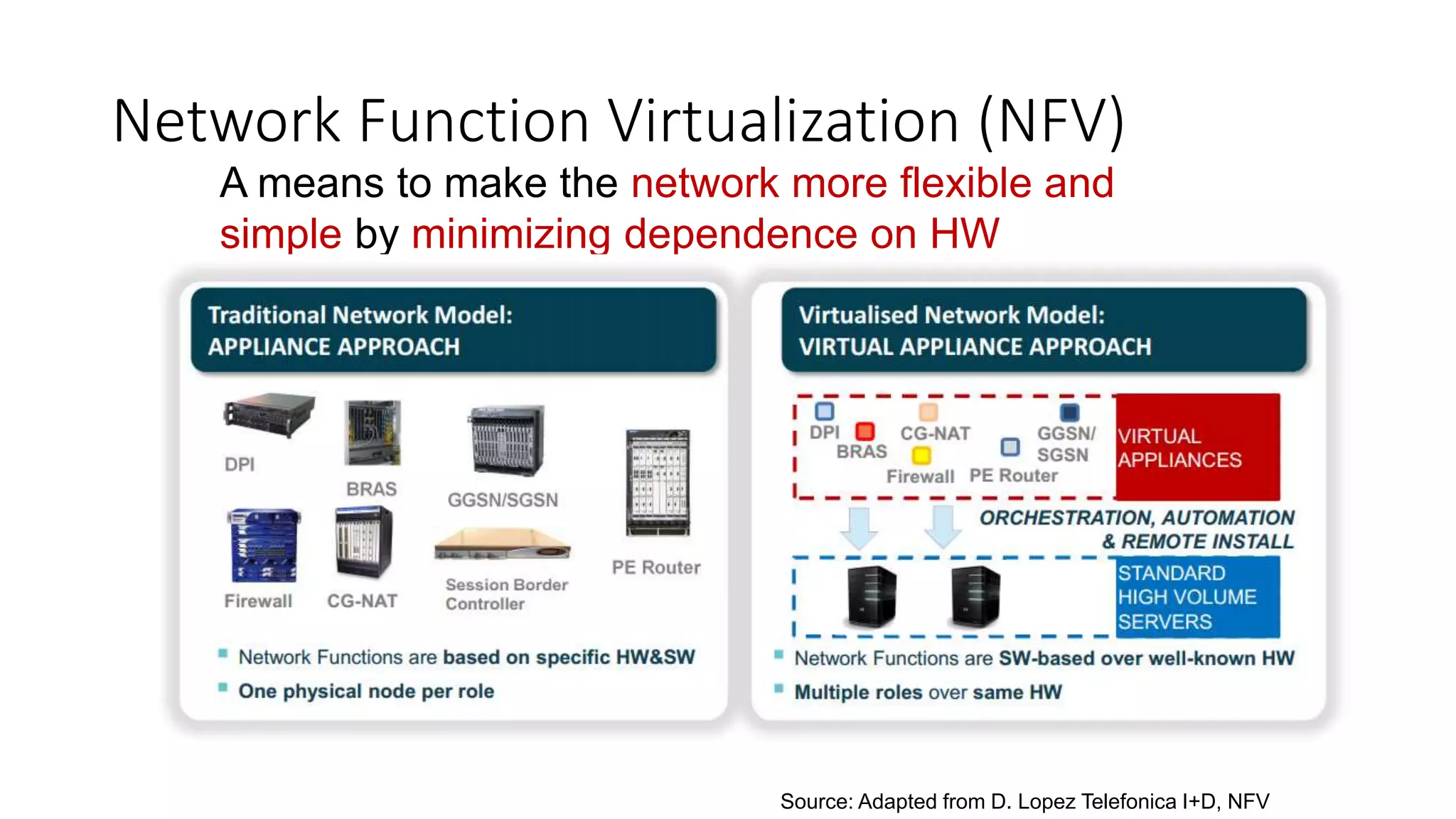
A means to make the network more flexible and
simple by minimizing dependence on HW
constraints
Network Function Virtualization (NFV)
Source: Adapted from D. Lopez Telefonica I+D, NFV
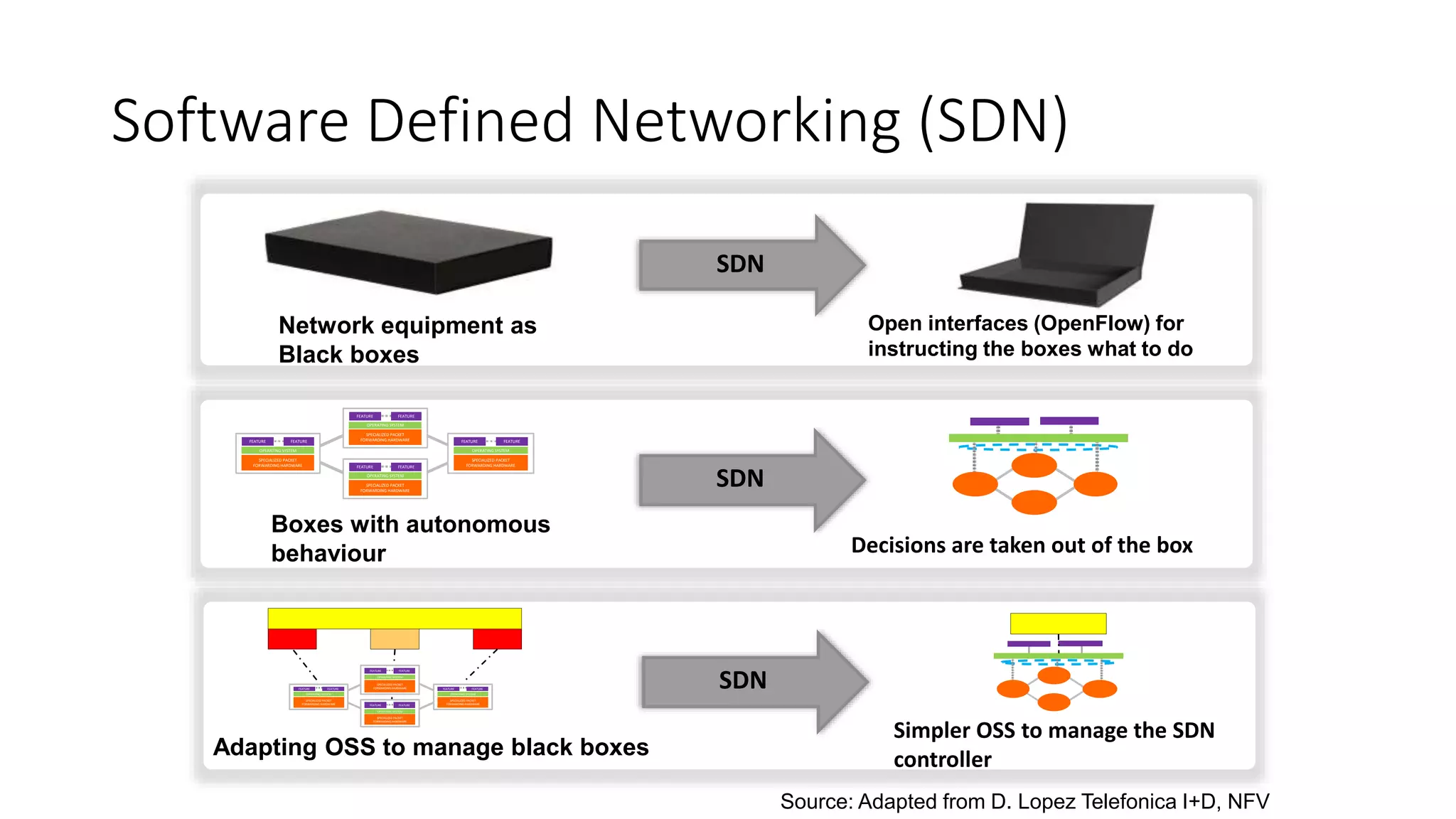
Network equipment as
Black boxes
Open interfaces (OpenFlow) for
instructing the boxes what to do
SDN
Boxes with autonomous
behaviour Decisions are taken out of the box
FEATURE FEATURE
OPERATING SYSTEM
SPECIALIZED PACKET
FORWARDING HARDWAREFEATURE FEATURE
OPERATING SYSTEM
SPECIALIZED PACKET
FORWARDING HARDWARE
FEATURE FEATURE
OPERATING SYSTEM
SPECIALIZED PACKET
FORWARDING HARDWAREFEATURE FEATURE
OPERATING SYSTEM
SPECIALIZED PACKET
FORWARDING HARDWARE
SDN
Adapting OSS to manage black boxes
Simpler OSS to manage the SDN
controller
SDN
FEATURE FEATURE
OPERATING SYSTEM
SPECIALIZED PACKET
FORWARDING HARDWAREFEATURE FEATURE
OPERATING SYSTEM
SPECIALIZED PACKET
FORWARDING HARDWARE
FEATURE FEATURE
OPERATING SYSTEM
SPECIALIZED PACKET
FORWARDING HARDWAREFEATURE FEATURE
OPERATING SYSTEM
SPECIALIZED PACKET
FORWARDING HARDWARE
Software Defined Networking (SDN)
Source: Adapted from D. Lopez Telefonica I+D, NFV
NFV vs. SDN
SDN ››› flexible forwarding & steering of traffic
in a physical or virtual network environment
[Network Re-Architecture]
NFV ››› flexible placement of virtualized
network functions across the network & cloud
[Appliance Re-Architecture] (initially)
››› SDN & NFV are complementary tools for
achieving full network programmability
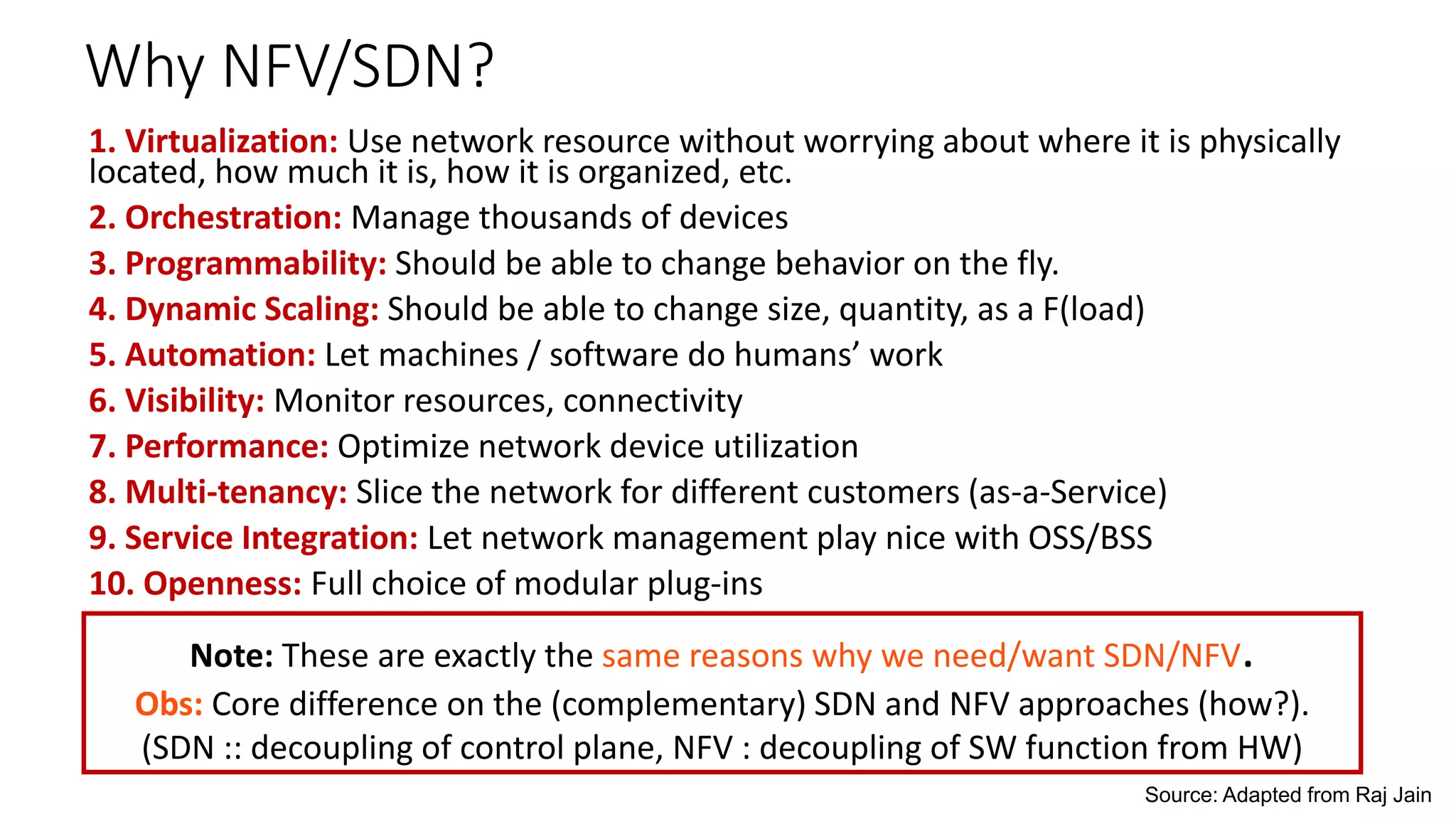
Why NFV/SDN?
1. Virtualization: Use network resource without worrying about where it is physically
located, how much it is, how it is organized, etc.
2. Orchestration: Manage thousands of devices
3. Programmability: Should be able to change behavior on the fly.
4. Dynamic Scaling: Should be able to change size, quantity, as a F(load)
5. Automation: Let machines / software do humans’ work
6. Visibility: Monitor resources, connectivity
7. Performance: Optimize network device utilization
8. Multi-tenancy: Slice the network for different customers (as-a-Service)
9. Service Integration: Let network management play nice with OSS/BSS
10. Openness: Full choice of modular plug-ins
Source: Adapted from Raj Jain
Note: These are exactly the same reasons why we need/want SDN/NFV.
Obs: Core difference on the (complementary) SDN and NFV approaches (how?).
(SDN :: decoupling of control plane, NFV : decoupling of SW function from HW)
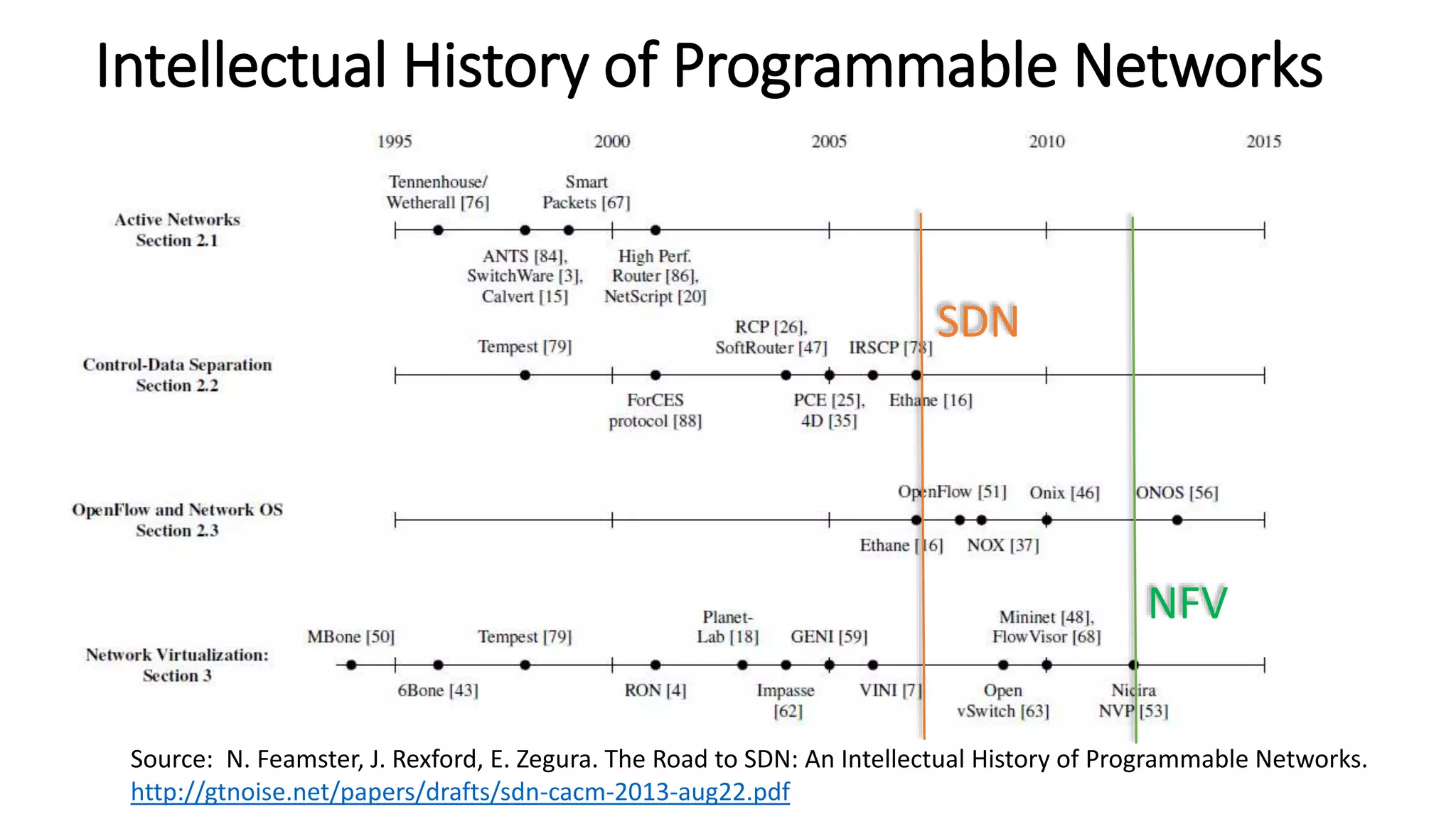
Intellectual History of Programmable Networks
Source: N. Feamster, J. Rexford, E. Zegura. The Road to SDN: An Intellectual History of Programmable Networks.
http://gtnoise.net/papers/drafts/sdn-cacm-2013-aug22.pdf
SDN
NFV
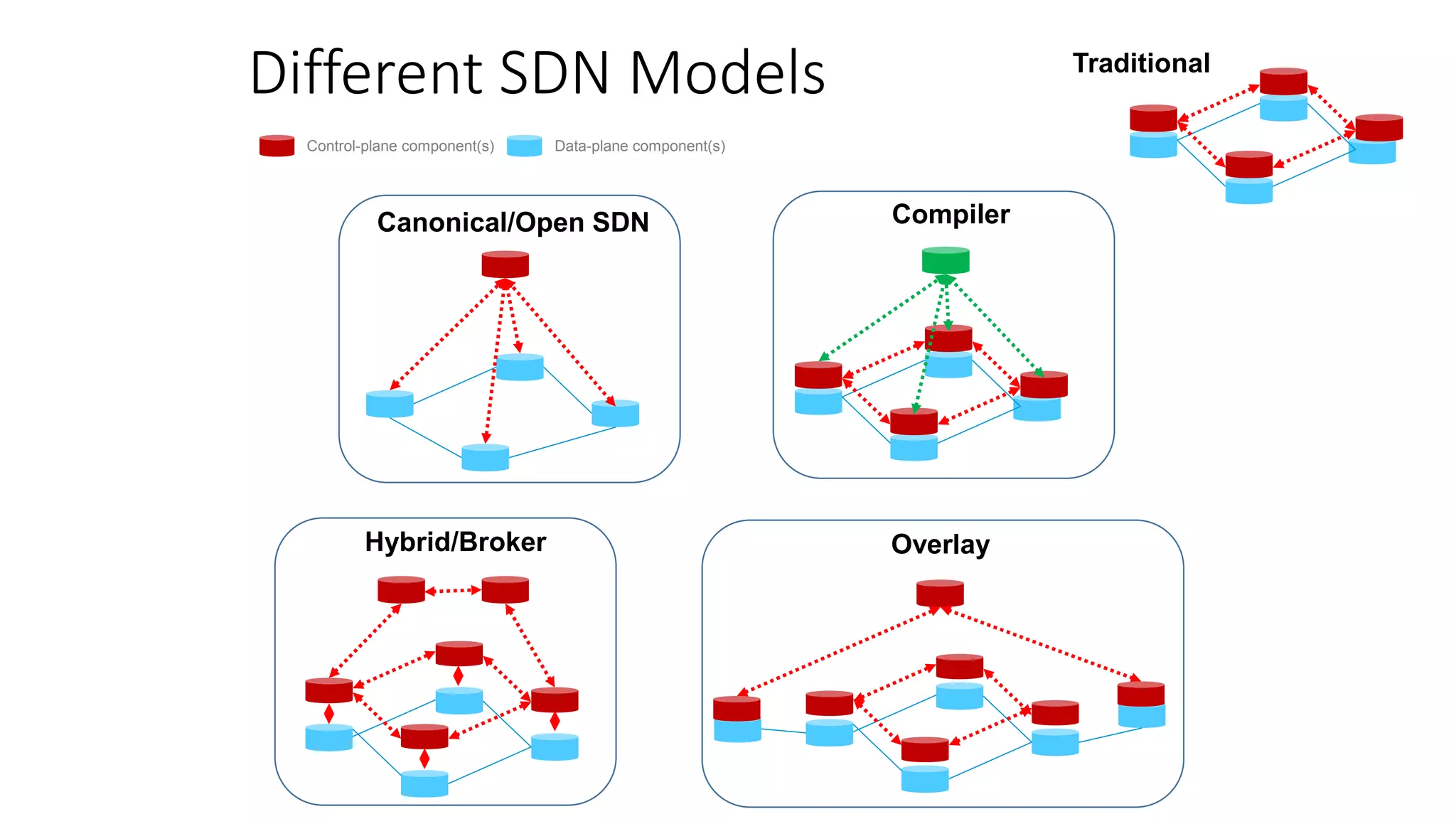
Different SDN Models
Control-plane component(s) Data-plane component(s)
Canonical/Open SDN
Traditional
Hybrid/Broker Overlay
Compiler
Legacy
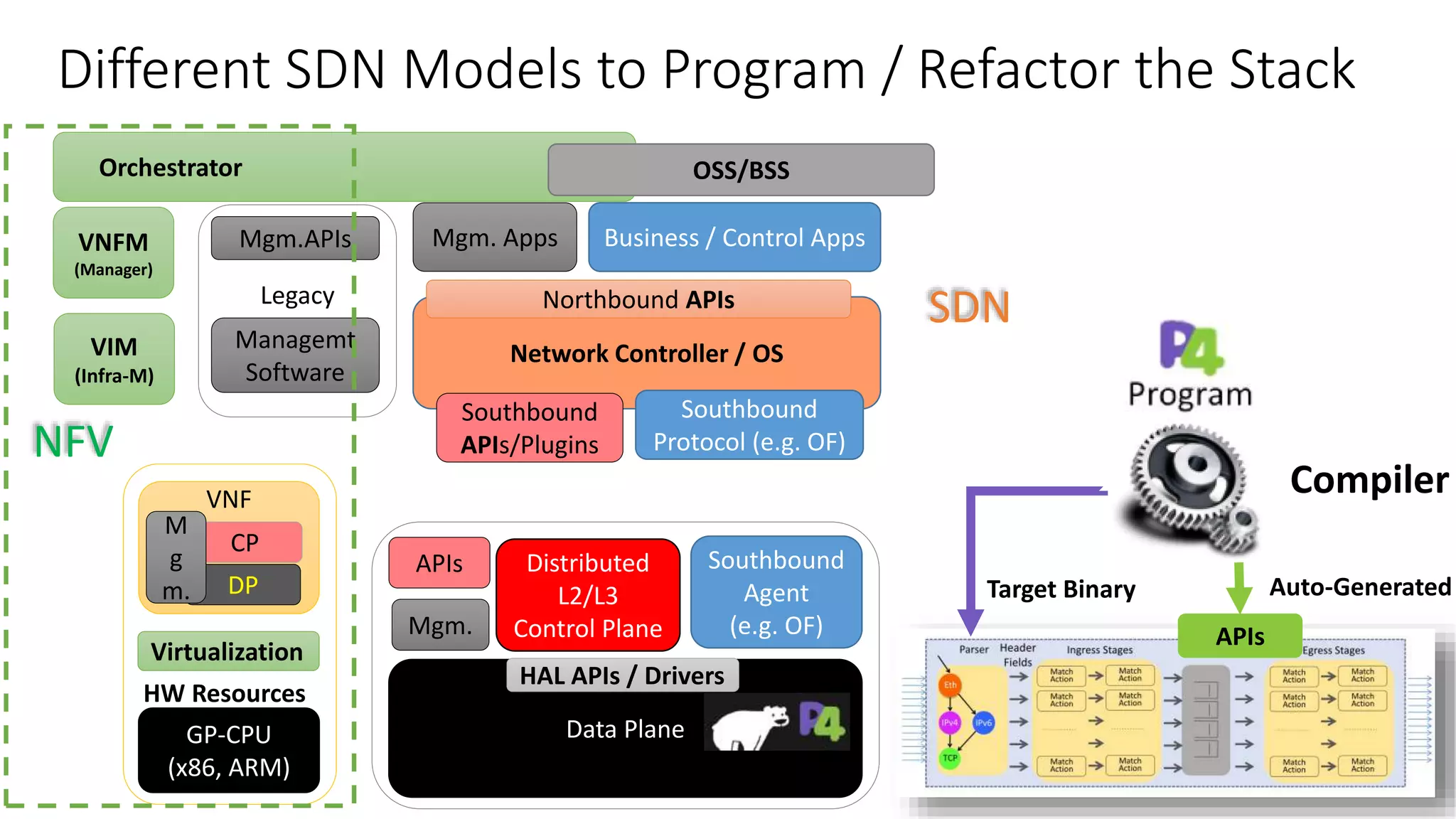
Different SDN Models to Program / Refactor the Stack
Data Plane
Mgm.APIs
Distributed
L2/L3
Control Plane
Managemt
Software
Mgm. Apps
Southbound
Agent
(e.g. OF)
Network Controller / OS
Southbound
Protocol (e.g. OF)
Business / Control Apps
Northbound APIs
Mgm.
HAL APIs / Drivers
Orchestrator
APIs
Compiler
Auto-GeneratedTarget Binary
SDN
VNF
GP-CPU
(x86, ARM)
HW Resources
Virtualization
DP
CP
M
g
m.
NFV
VNFM
(Manager)
VIM
(Infra-M)
OSS/BSS
APIs
Southbound
APIs/Plugins
Open Source & Networking
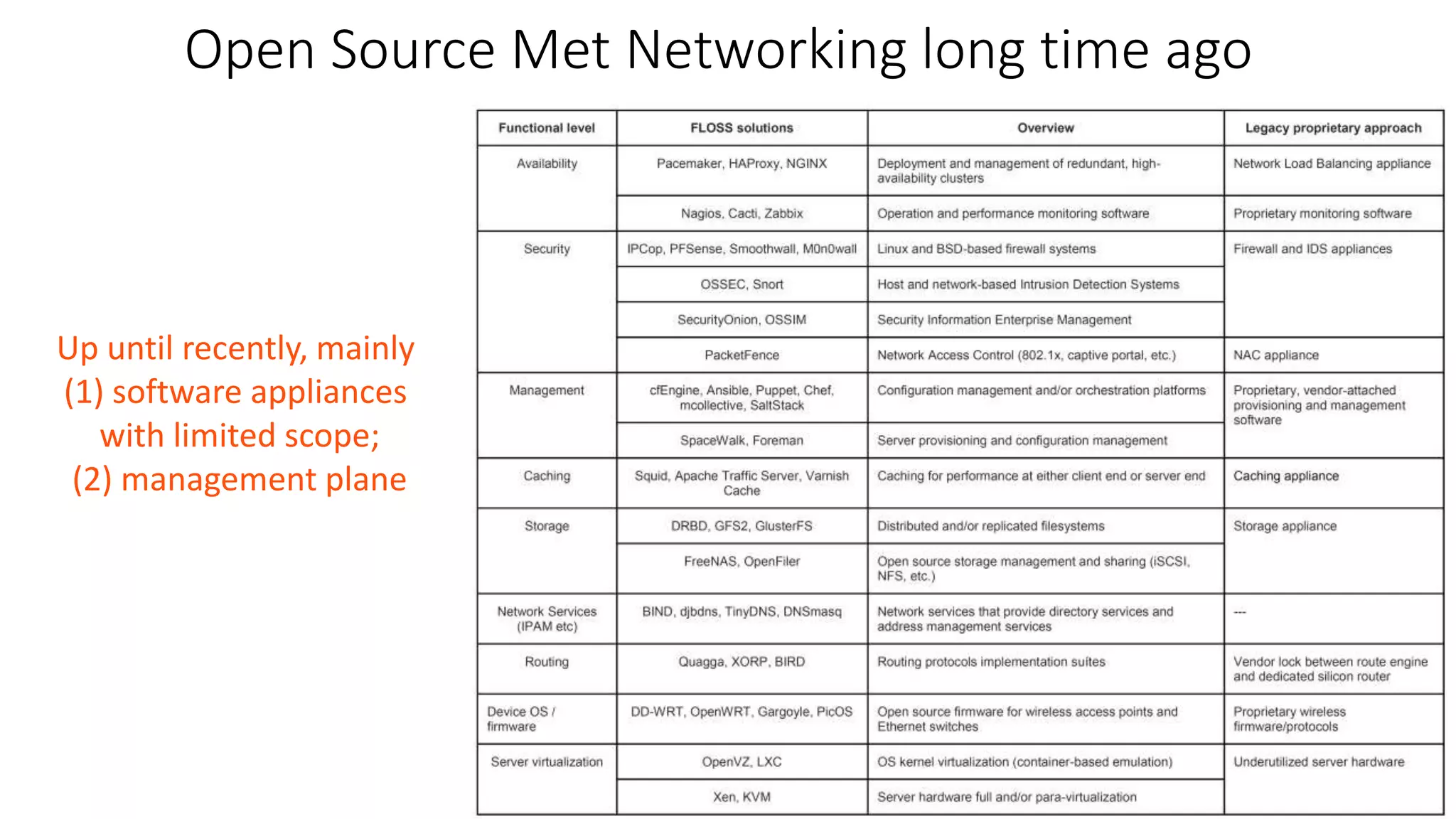
Open Source Met Networking long time ago
Up until recently, mainly
(1) software appliances
with limited scope;
(2) management plane
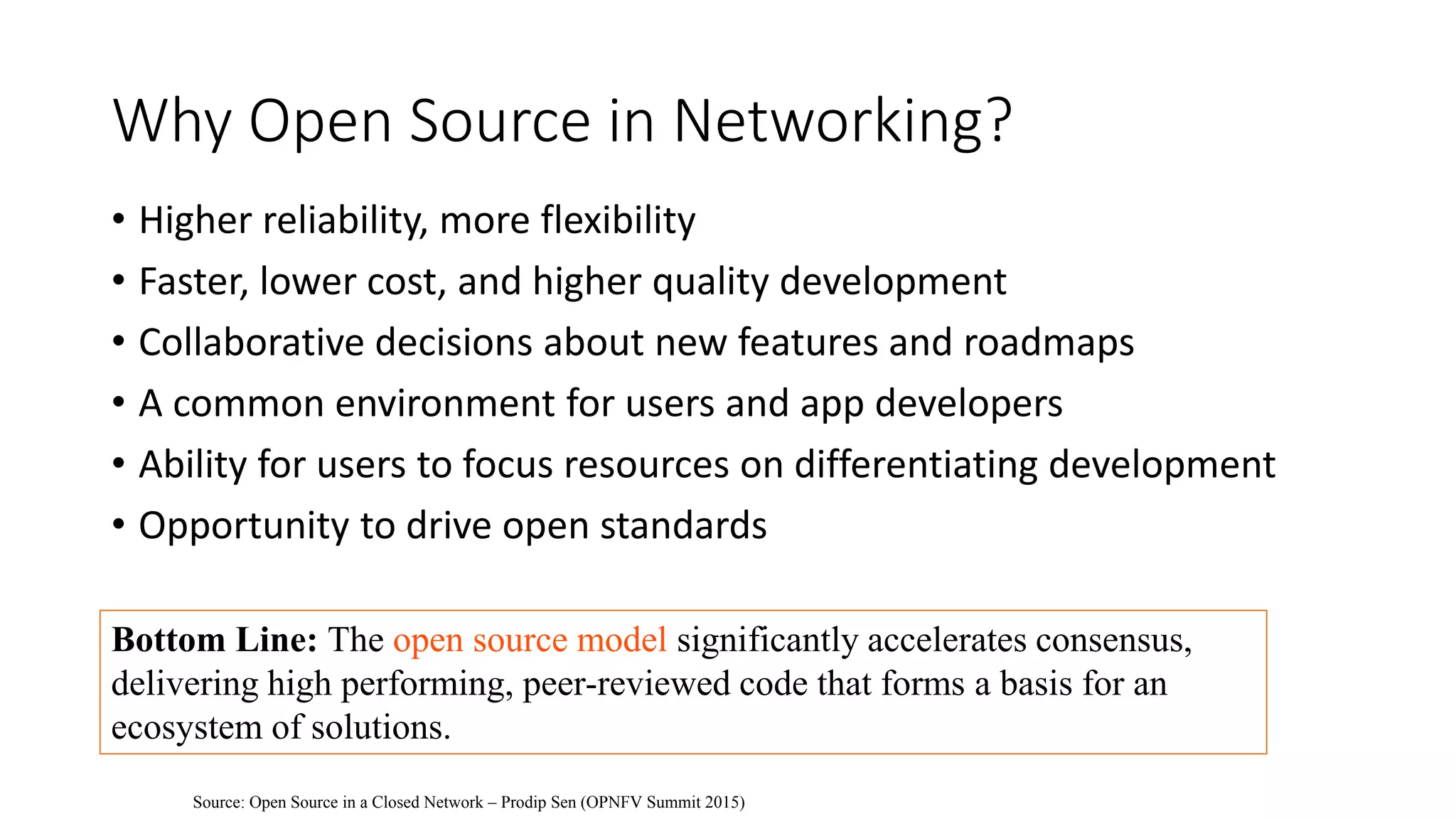
Why Open Source in Networking?
• Higher reliability, more flexibility
• Faster, lower cost, and higher quality development
• Collaborative decisions about new features and roadmaps
• A common environment for users and app developers
• Ability for users to focus resources on differentiating development
• Opportunity to drive open standards
Bottom Line: The open source model significantly accelerates consensus,
delivering high performing, peer-reviewed code that forms a basis for an
ecosystem of solutions.
Source: Open Source in a Closed Network – Prodip Sen (OPNFV Summit 2015)
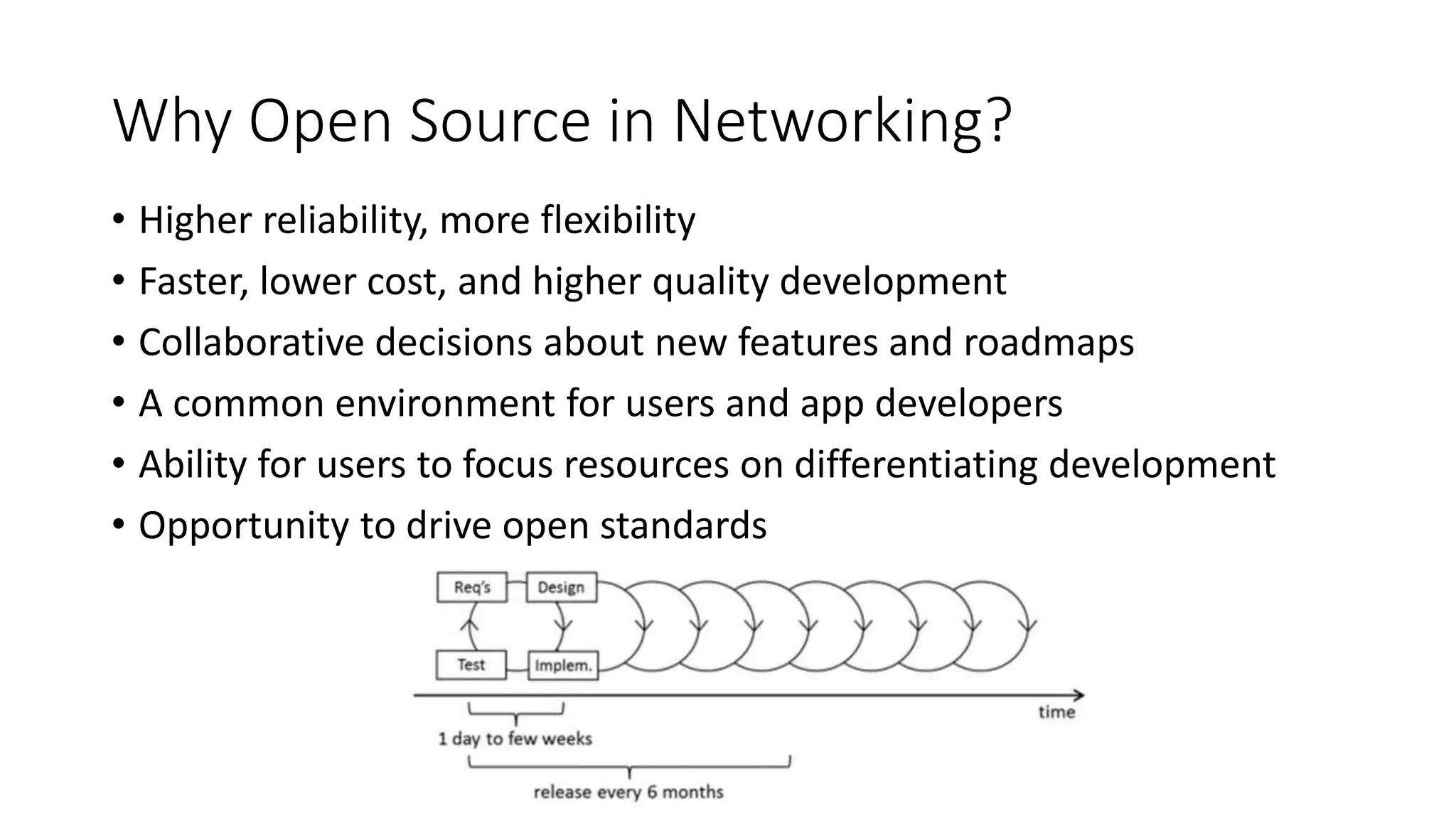
Why Open Source in Networking?
• Higher reliability, more flexibility
• Faster, lower cost, and higher quality development
• Collaborative decisions about new features and roadmaps
• A common environment for users and app developers
• Ability for users to focus resources on differentiating development
• Opportunity to drive open standards
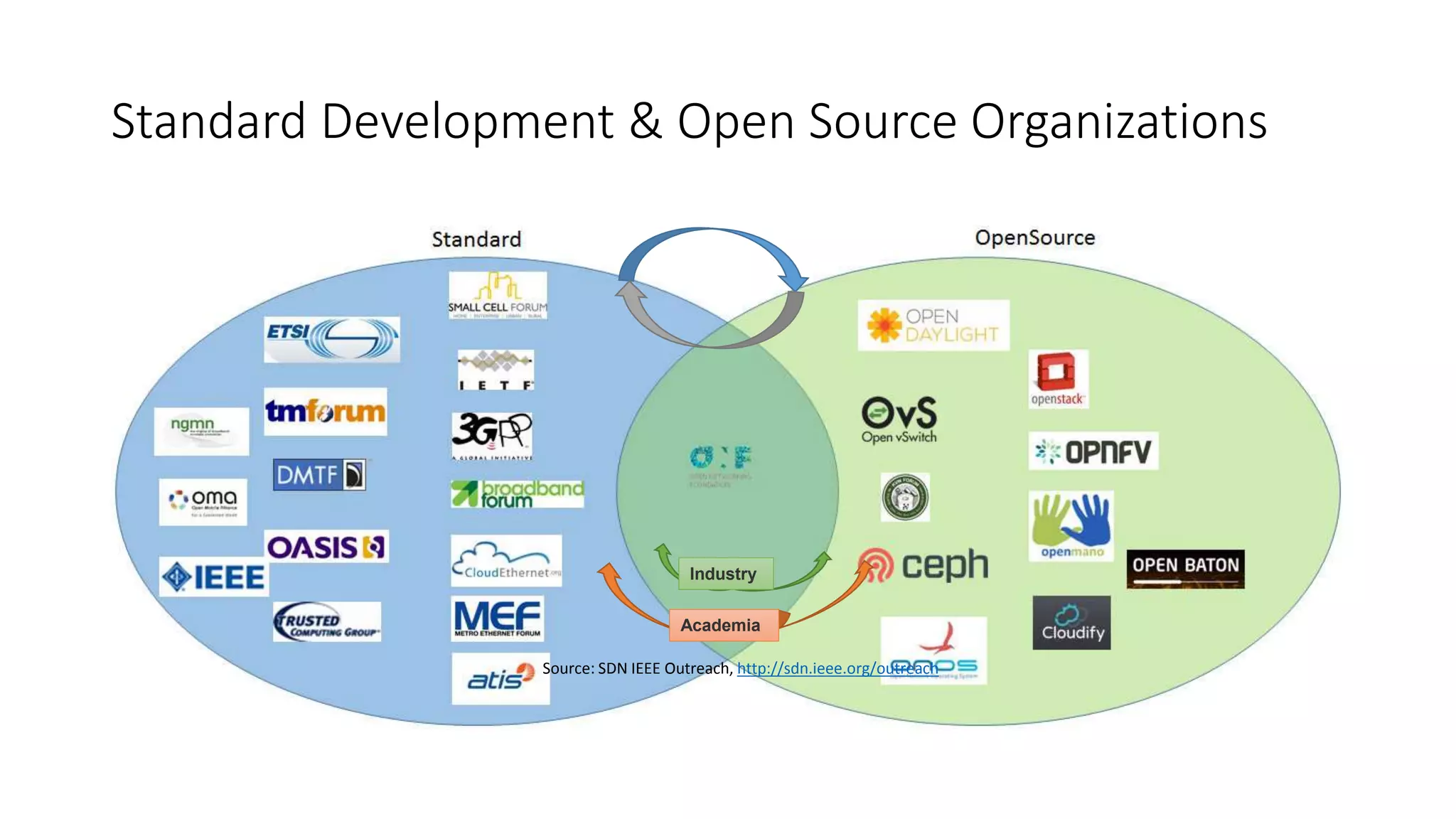
Standard Development & Open Source Organizations
Source: SDN IEEE Outreach, http://sdn.ieee.org/outreach
Academia
Industry
Foundations : The New Player
Target Collaboration
• Neutral and non-competing
• Legal framework for licensing, copyright, intellectual property management
"Companies feel they can collaborate on an open source project through an independent, not-for-profit entity that they trust
- this is incredibly important to them," --Allison Randa (Board President of Open Source Initiative)
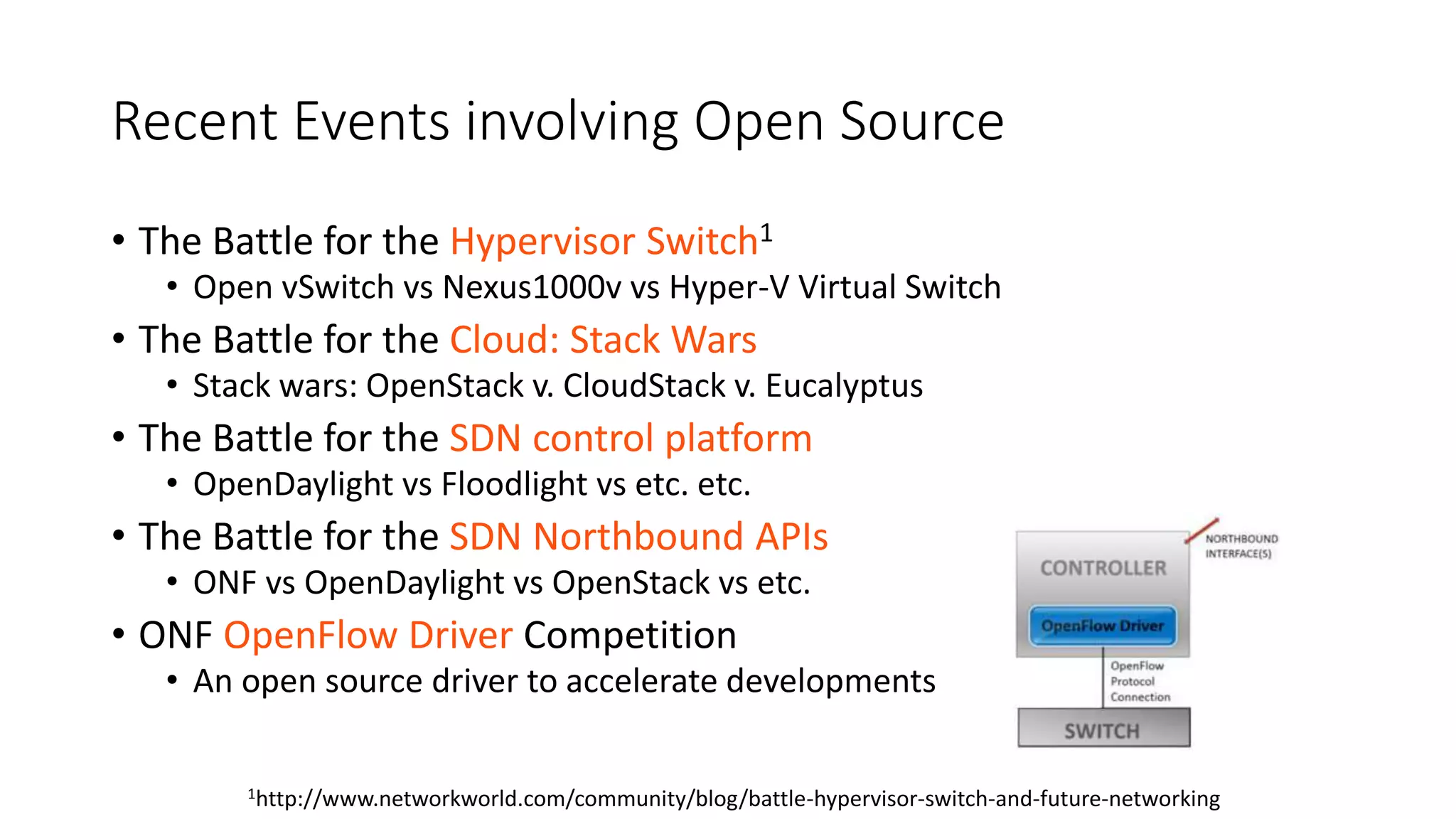
Recent Events involving Open Source
• The Battle for the Hypervisor Switch1
• Open vSwitch vs Nexus1000v vs Hyper-V Virtual Switch
• The Battle for the Cloud: Stack Wars
• Stack wars: OpenStack v. CloudStack v. Eucalyptus
• The Battle for the SDN control platform
• OpenDaylight vs Floodlight vs etc. etc.
• The Battle for the SDN Northbound APIs
• ONF vs OpenDaylight vs OpenStack vs etc.
• ONF OpenFlow Driver Competition
• An open source driver to accelerate developments
1http://www.networkworld.com/community/blog/battle-hypervisor-switch-and-future-networking
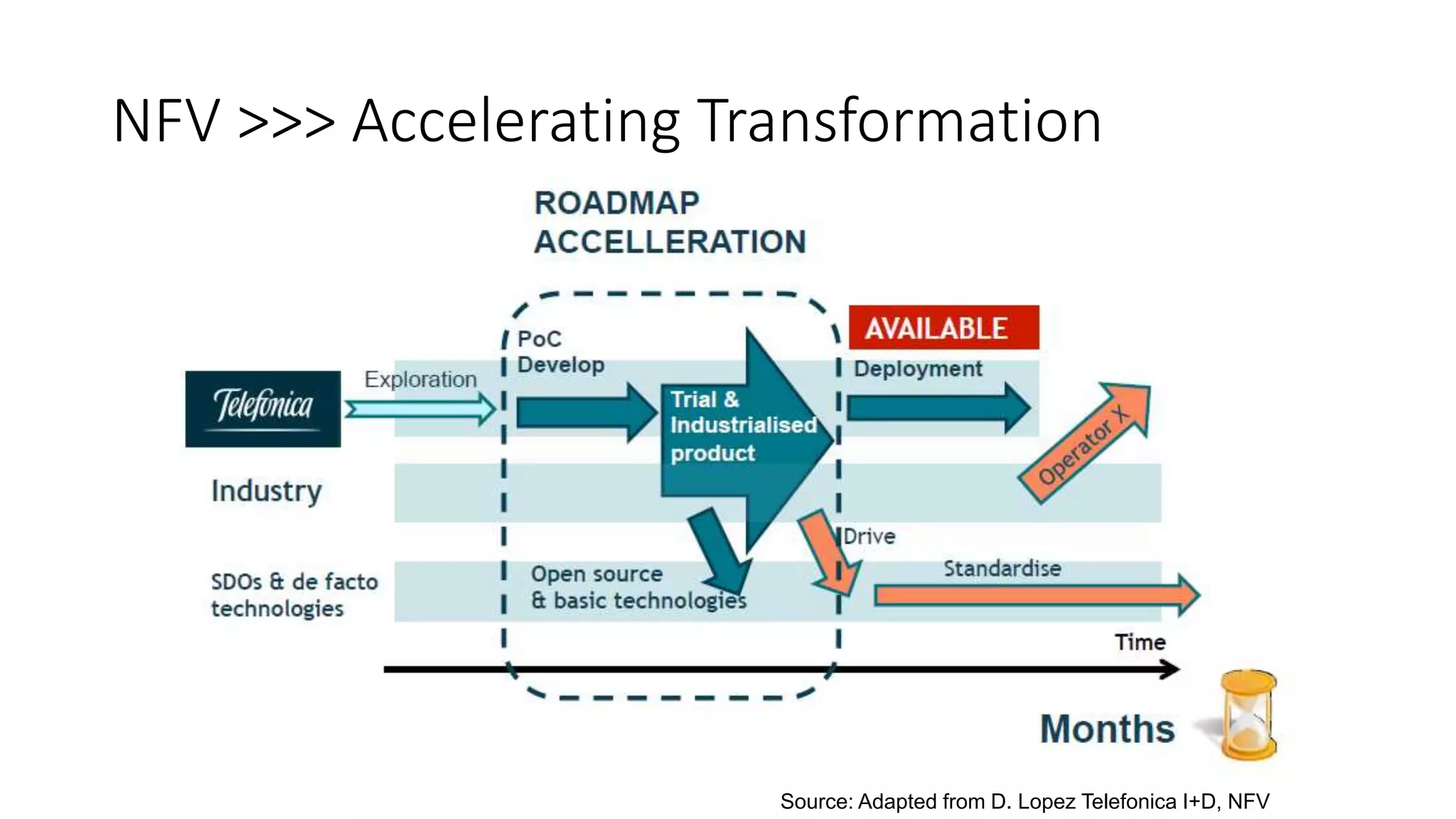
NFV >>> Accelerating Transformation
Source: Adapted from D. Lopez Telefonica I+D, NFV
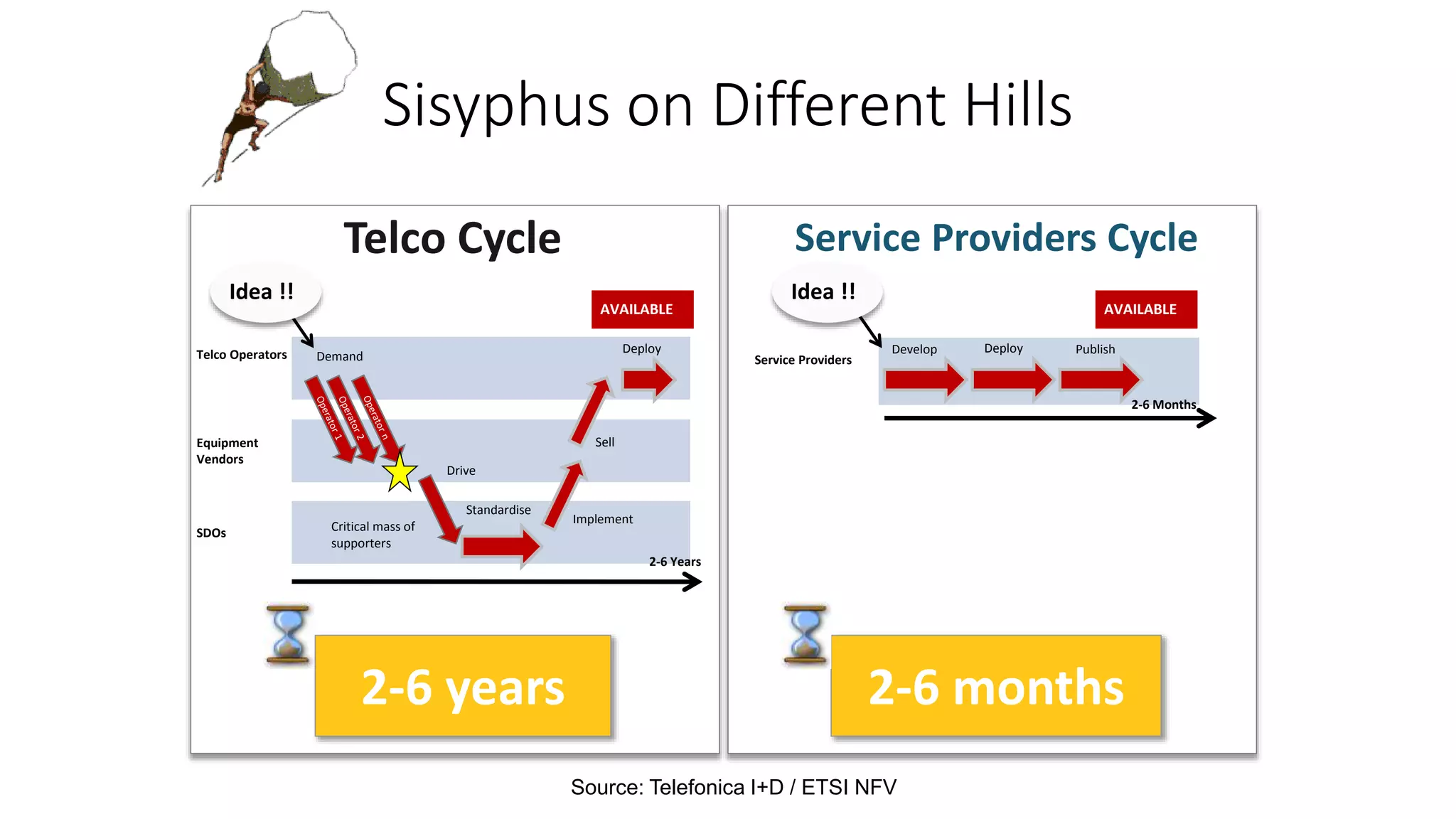
Sisyphus on Different Hills
Telco Operators
Equipment
Vendors
SDOs
2-6 Years
Demand
Drive
Standardise
Implement
Sell
Deploy
Critical mass of
supporters
Develop Deploy Publish
2-6 Months
Telco Cycle Service Providers Cycle
2-6 years 2-6 months
Service Providers
AVAILABLE AVAILABLE
Idea !! Idea !!
Source: Telefonica I+D / ETSI NFV
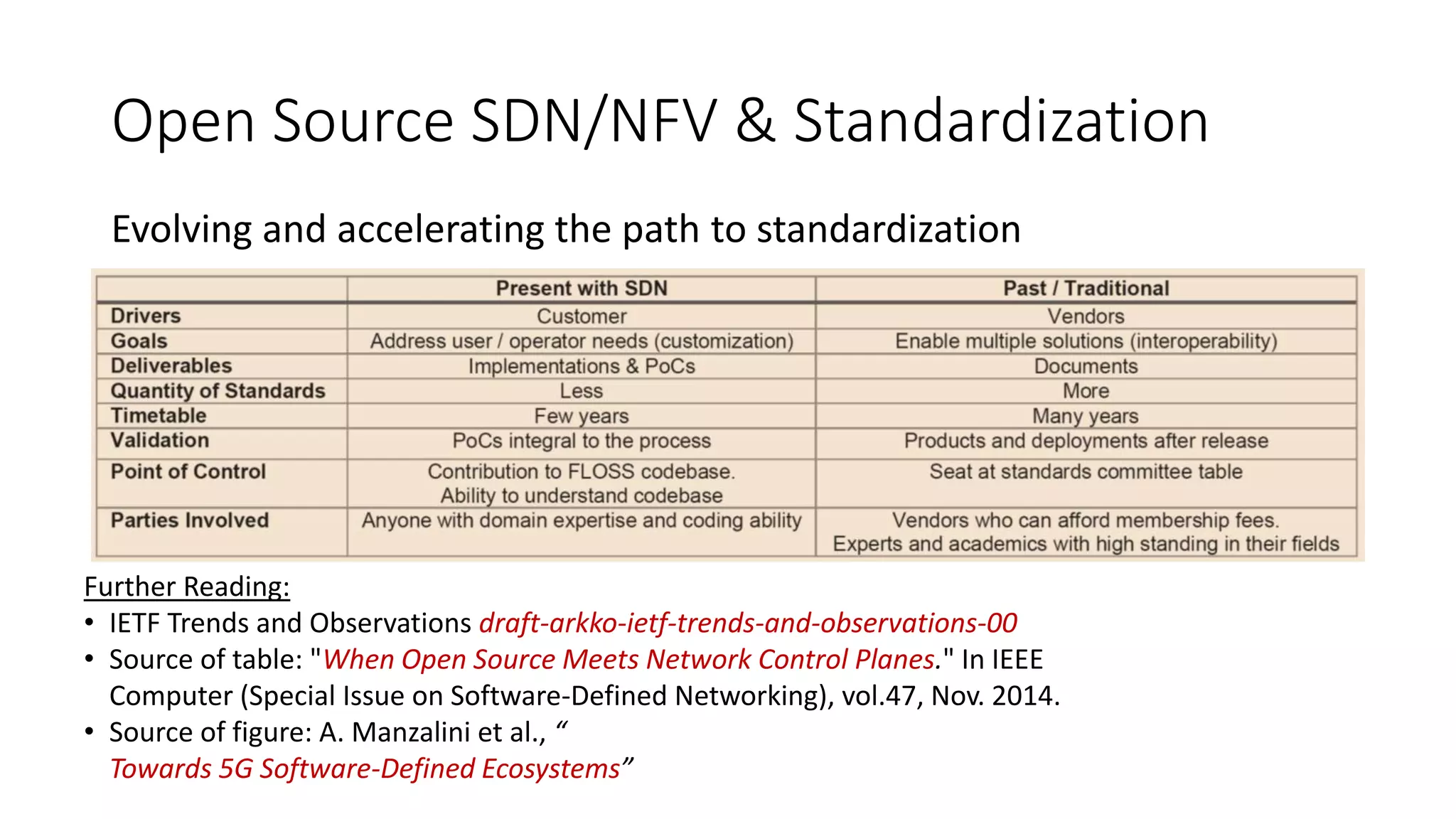
Open Source SDN/NFV & Standardization
Evolving and accelerating the path to standardization
Further Reading:
• IETF Trends and Observations draft-arkko-ietf-trends-and-observations-00
• Source of table: "When Open Source Meets Network Control Planes." In IEEE
Computer (Special Issue on Software-Defined Networking), vol.47, Nov. 2014.
• Source of figure: A. Manzalini et al., “
Towards 5G Software-Defined Ecosystems”
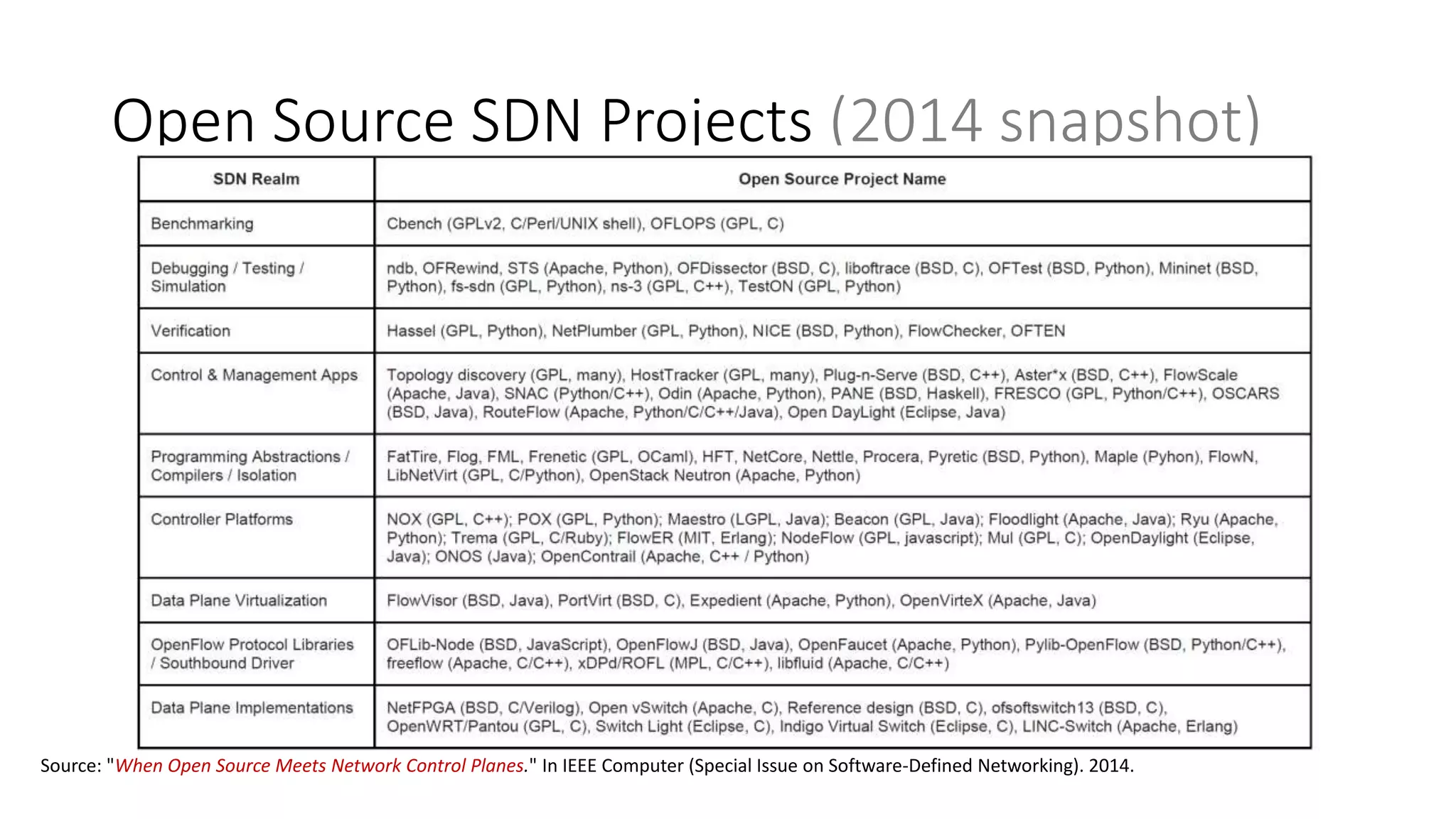
Open Source SDN Projects (2014 snapshot)
Source: "When Open Source Meets Network Control Planes." In IEEE Computer (Special Issue on Software-Defined Networking). 2014.
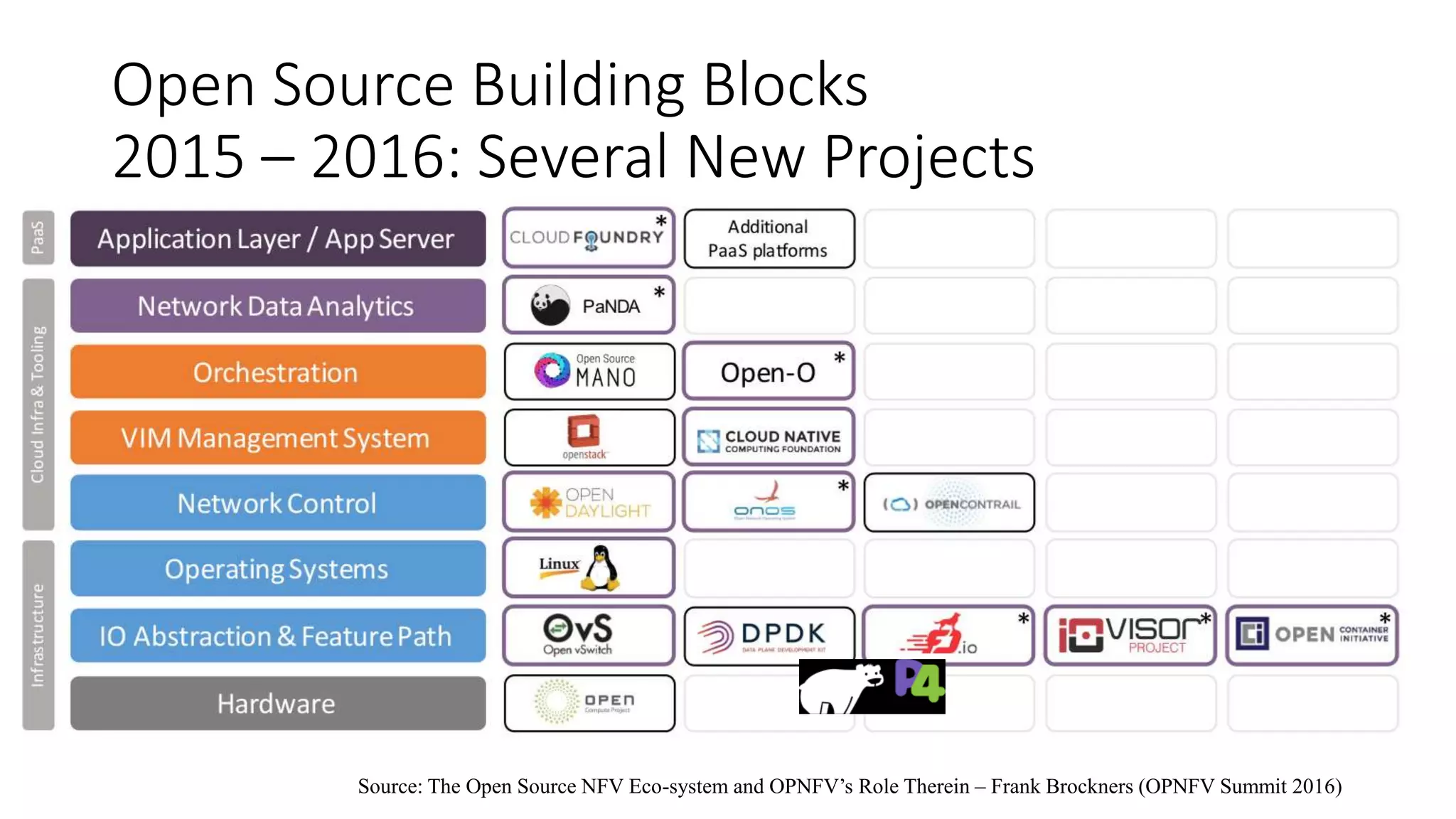
Open Source Building Blocks
2015 – 2016: Several New Projects
Source: The Open Source NFV Eco-system and OPNFV’s Role Therein – Frank Brockners (OPNFV Summit 2016)
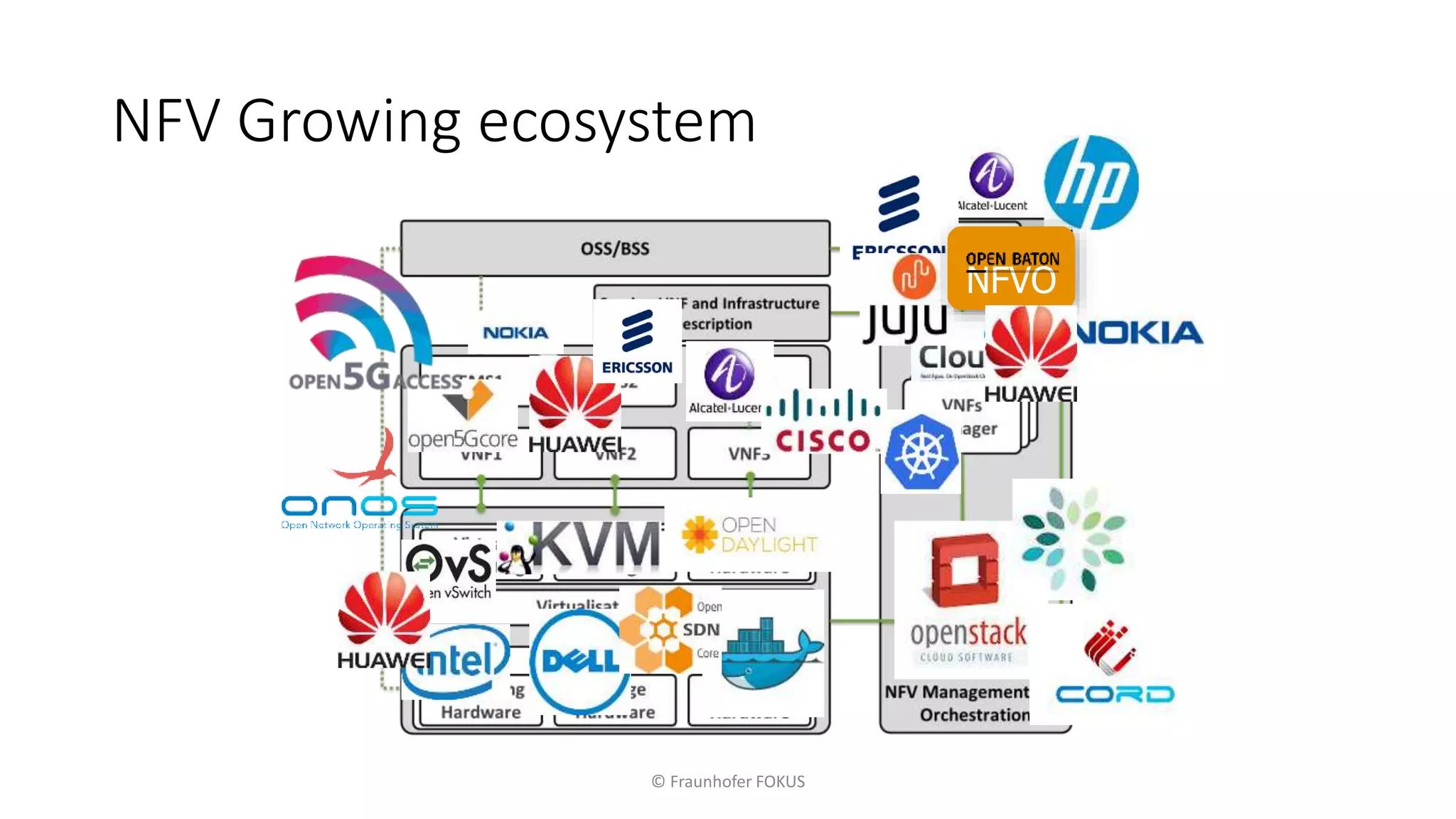
NFV Growing ecosystem
© Fraunhofer FOKUS
NFVO
A growing ecosystem...
5G Related Open Source
Experimentation
Testbeds
Source: http://www.5g-berlin.org/
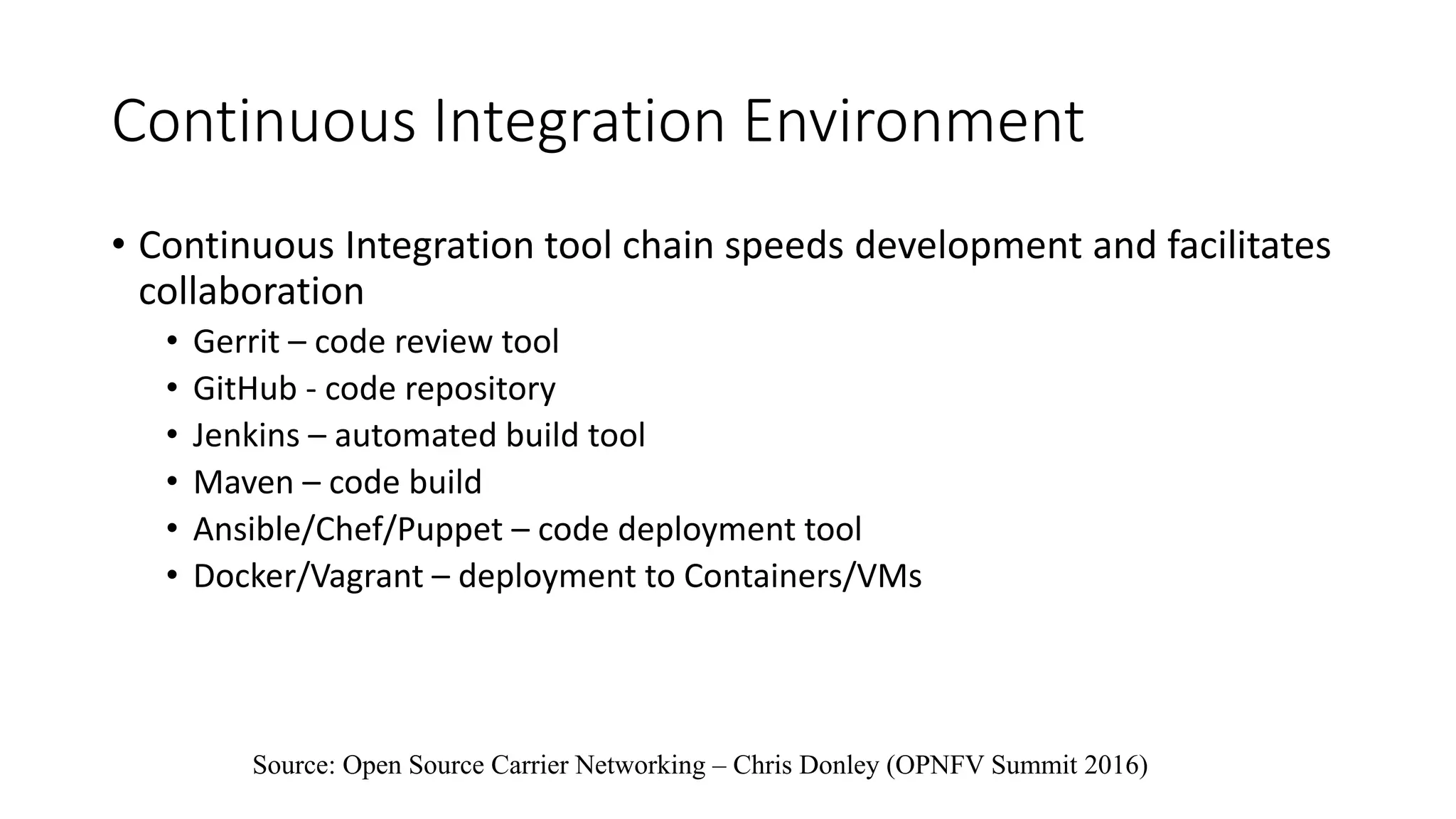
Continuous Integration Environment
• Continuous Integration tool chain speeds development and facilitates
collaboration
• Gerrit – code review tool
• GitHub - code repository
• Jenkins – automated build tool
• Maven – code build
• Ansible/Chef/Puppet – code deployment tool
• Docker/Vagrant – deployment to Containers/VMs
Source: Open Source Carrier Networking – Chris Donley (OPNFV Summit 2016)
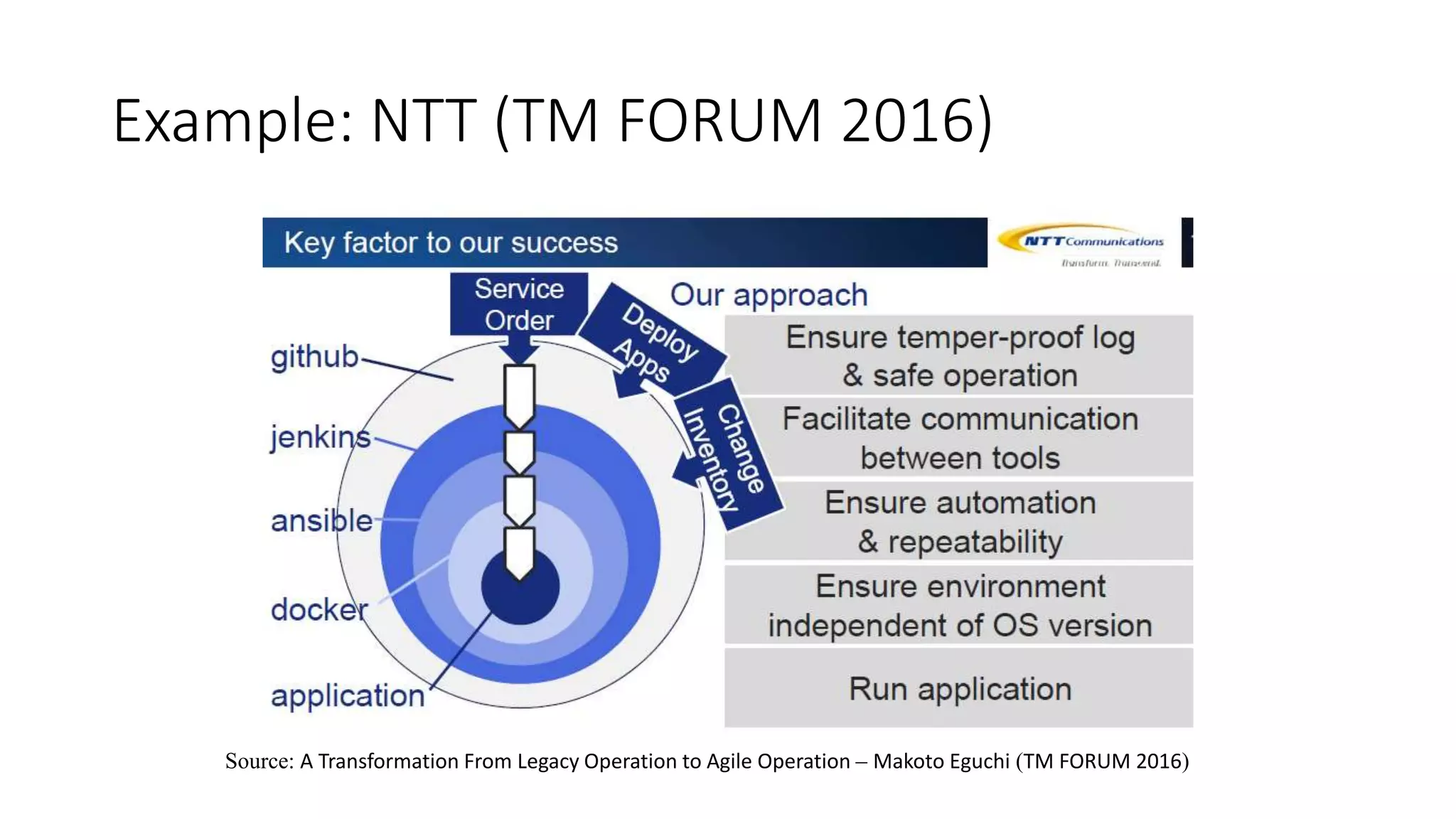
Example: NTT (TM FORUM 2016)
Source: A Transformation From Legacy Operation to Agile Operation – Makoto Eguchi (TM FORUM 2016)
All of This Leads Us To …
Software Defined Networking
DevOps Defined Networking
DevOps
Slide courtesy: Kyle Mestery
Detour on Layered Architectures and
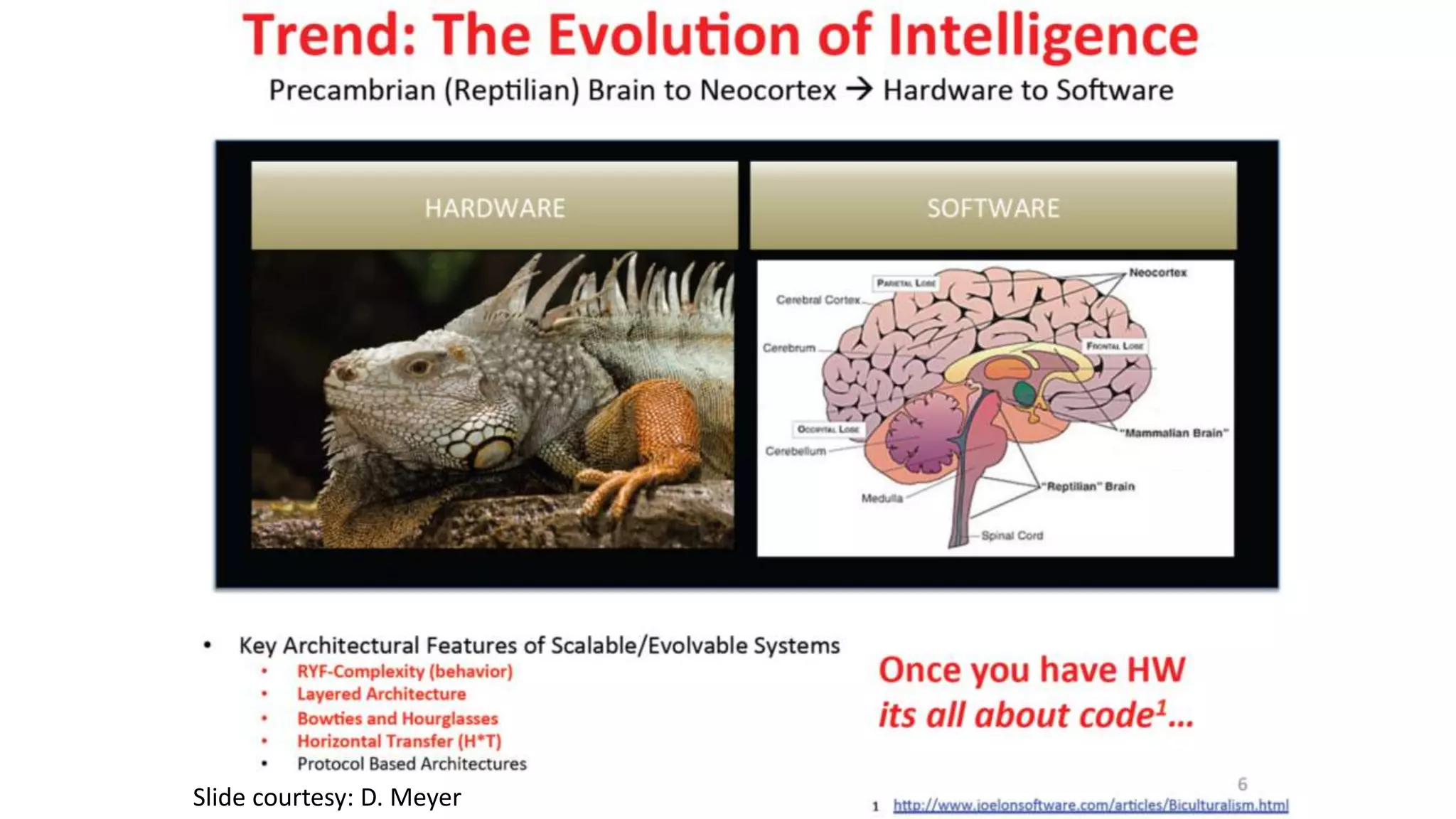
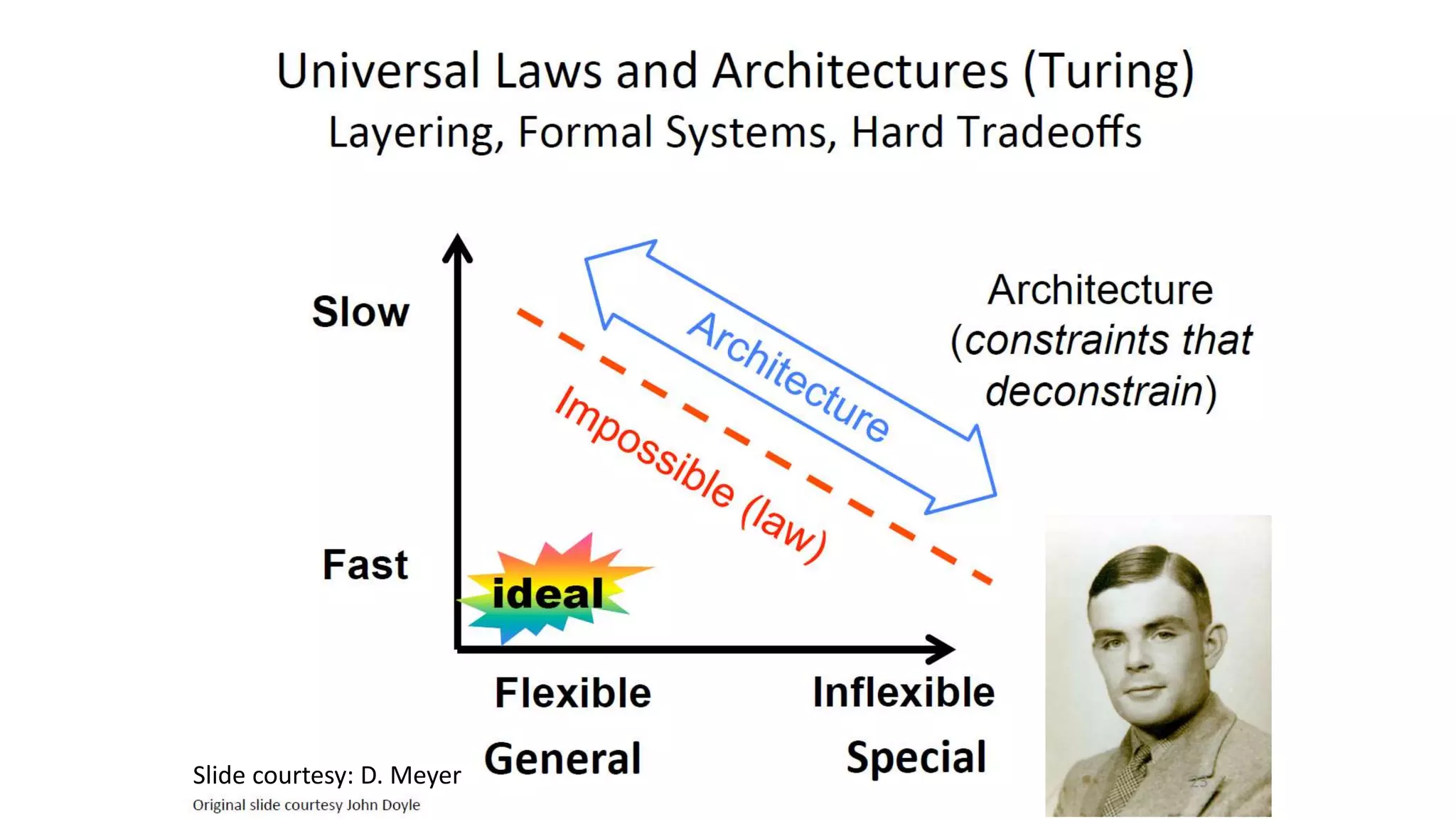
Complexity
And what does this have to do with SDN and Open Source
Slide courtesy: D. Meyer
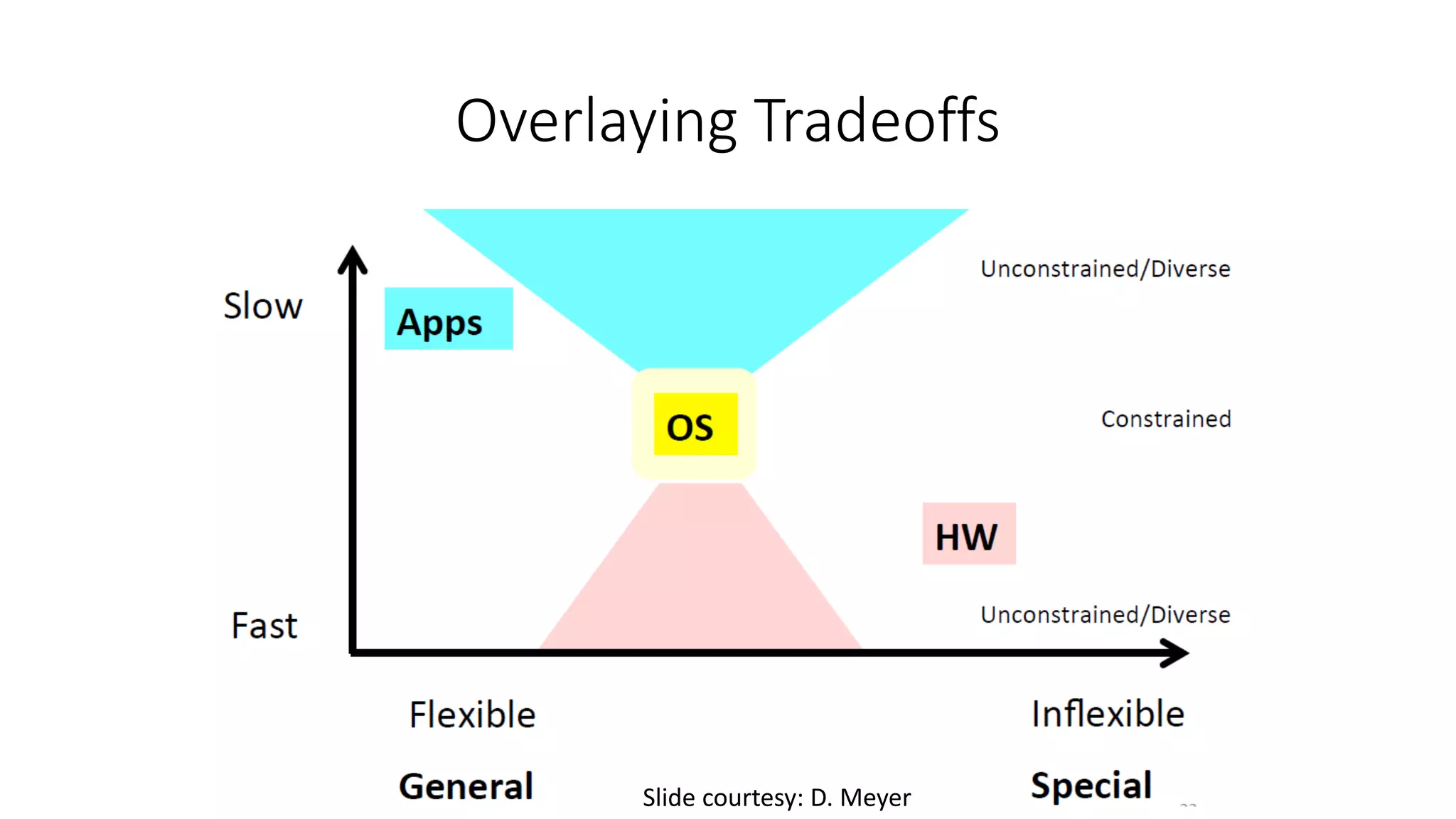
Overlaying Tradeoffs
Slide courtesy: D. Meyer
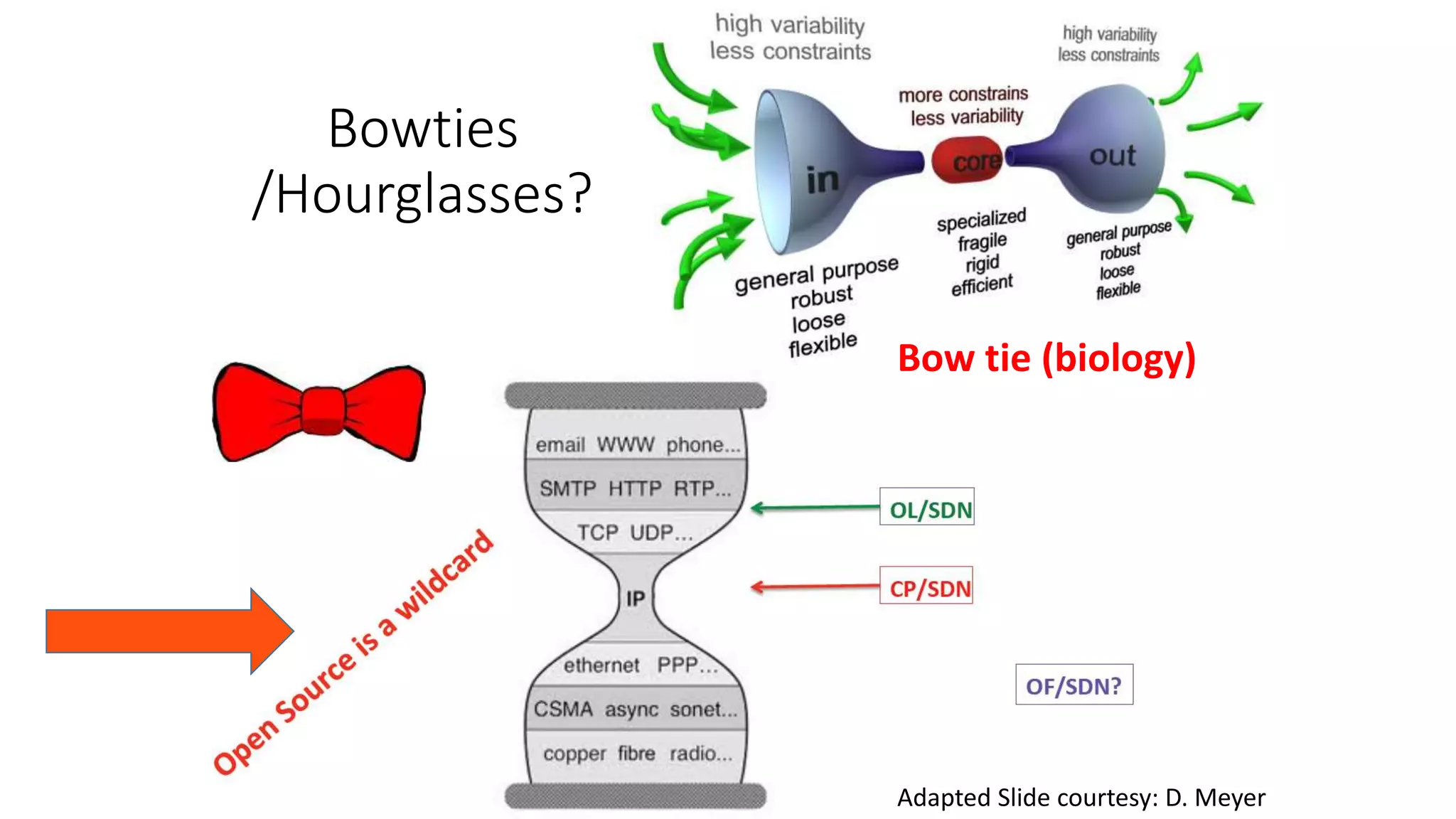
Bowties
/Hourglasses?
Adapted Slide courtesy: D. Meyer
Bow tie (biology)
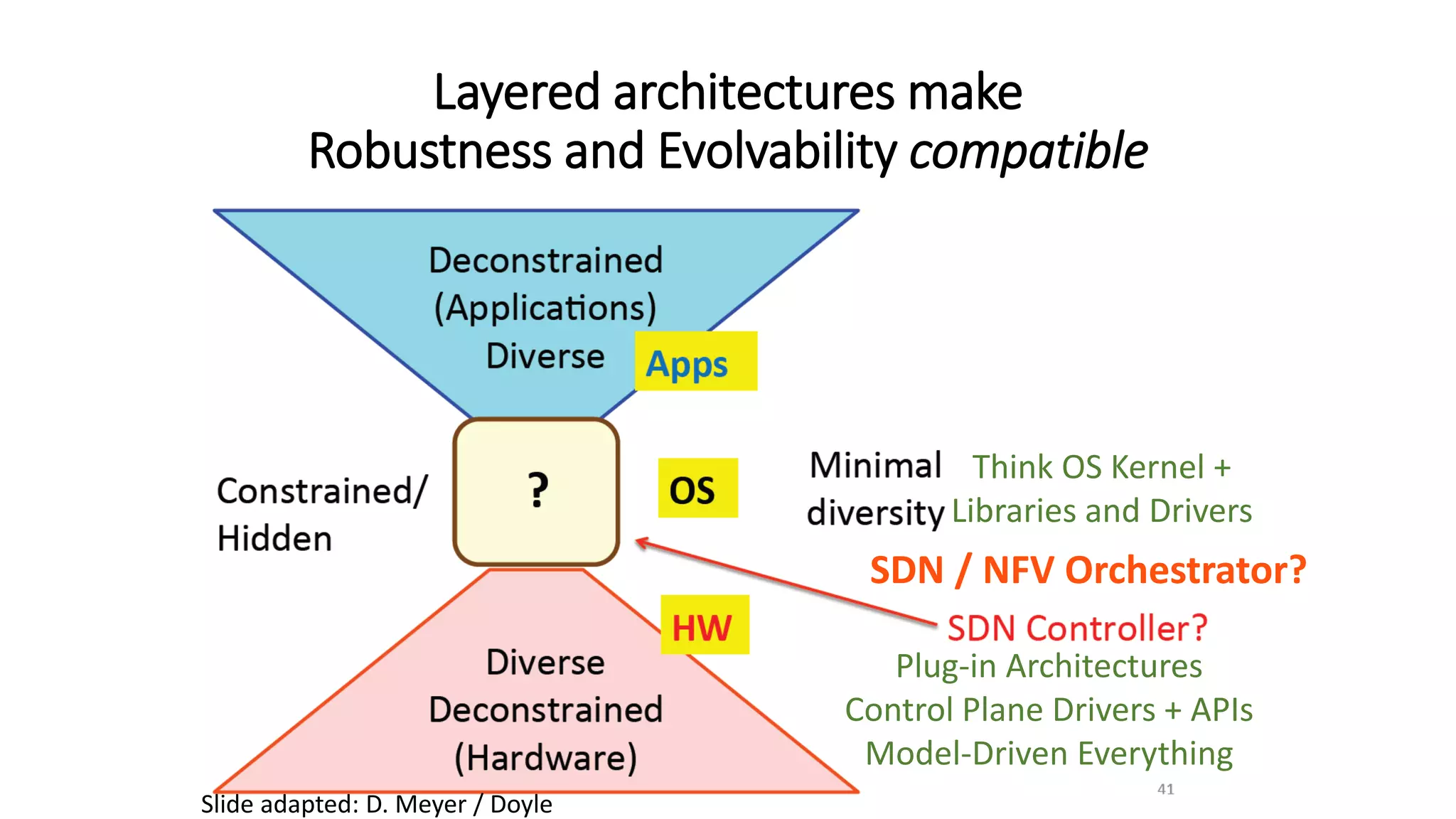
Layered architectures make
Robustness and Evolvability compatible
Slide adapted: D. Meyer / Doyle
Think OS Kernel +
Libraries and Drivers
Plug-in Architectures
Control Plane Drivers + APIs
Model-Driven Everything
SDN / NFV Orchestrator?
Some experiences and ongoing activities
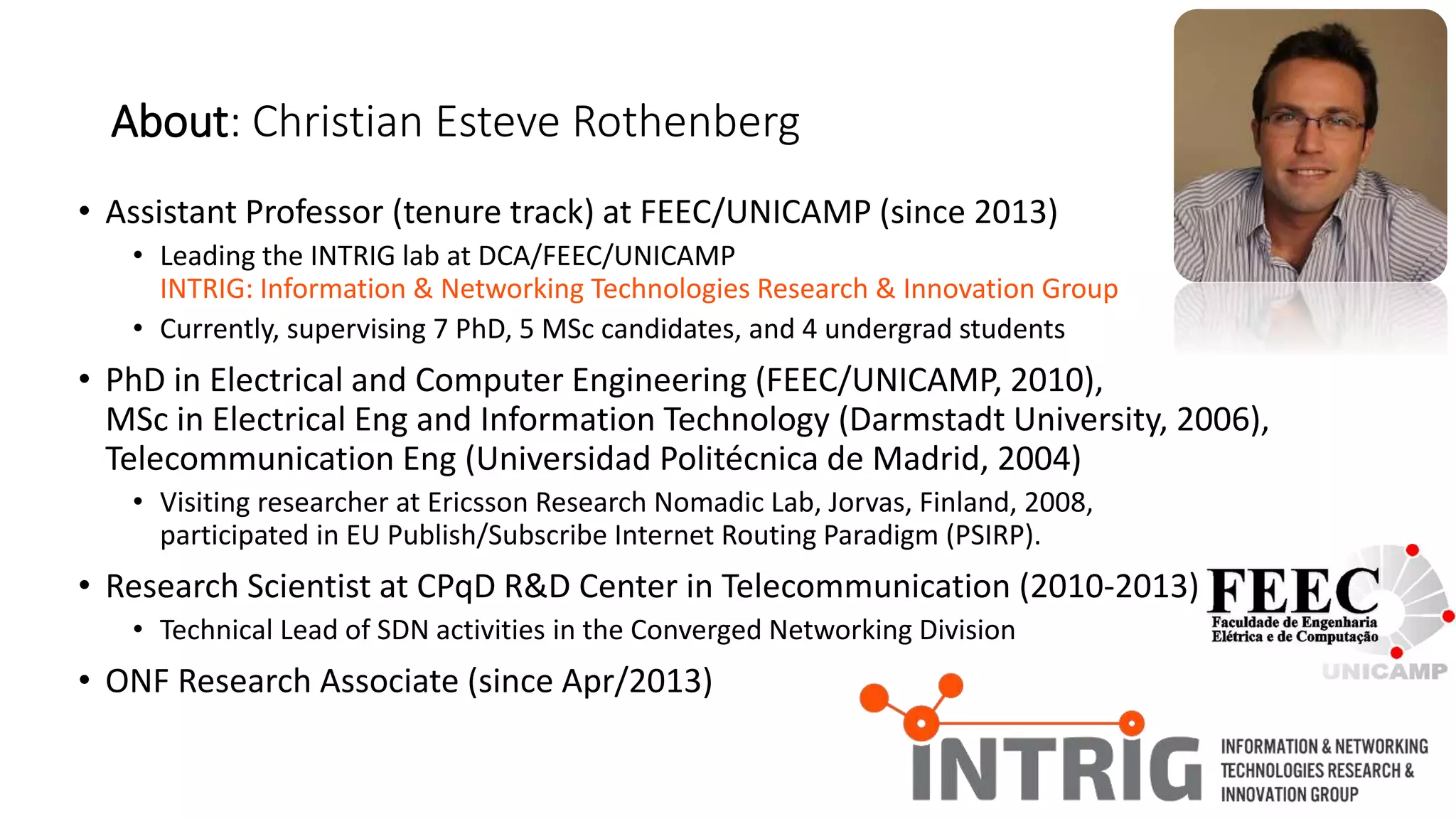
• Assistant Professor (tenure track) at FEEC/UNICAMP (since 2013)
• Leading the INTRIG lab at DCA/FEEC/UNICAMP
INTRIG: Information & Networking Technologies Research & Innovation Group
• Currently, supervising 7 PhD, 5 MSc candidates, and 4 undergrad students
• PhD in Electrical and Computer Engineering (FEEC/UNICAMP, 2010),
MSc in Electrical Eng and Information Technology (Darmstadt University, 2006),
Telecommunication Eng (Universidad Politécnica de Madrid, 2004)
• Visiting researcher at Ericsson Research Nomadic Lab, Jorvas, Finland, 2008,
participated in EU Publish/Subscribe Internet Routing Paradigm (PSIRP).
• Research Scientist at CPqD R&D Center in Telecommunication (2010-2013)
• Technical Lead of SDN activities in the Converged Networking Division
• ONF Research Associate (since Apr/2013)
About: Christian Esteve Rothenberg
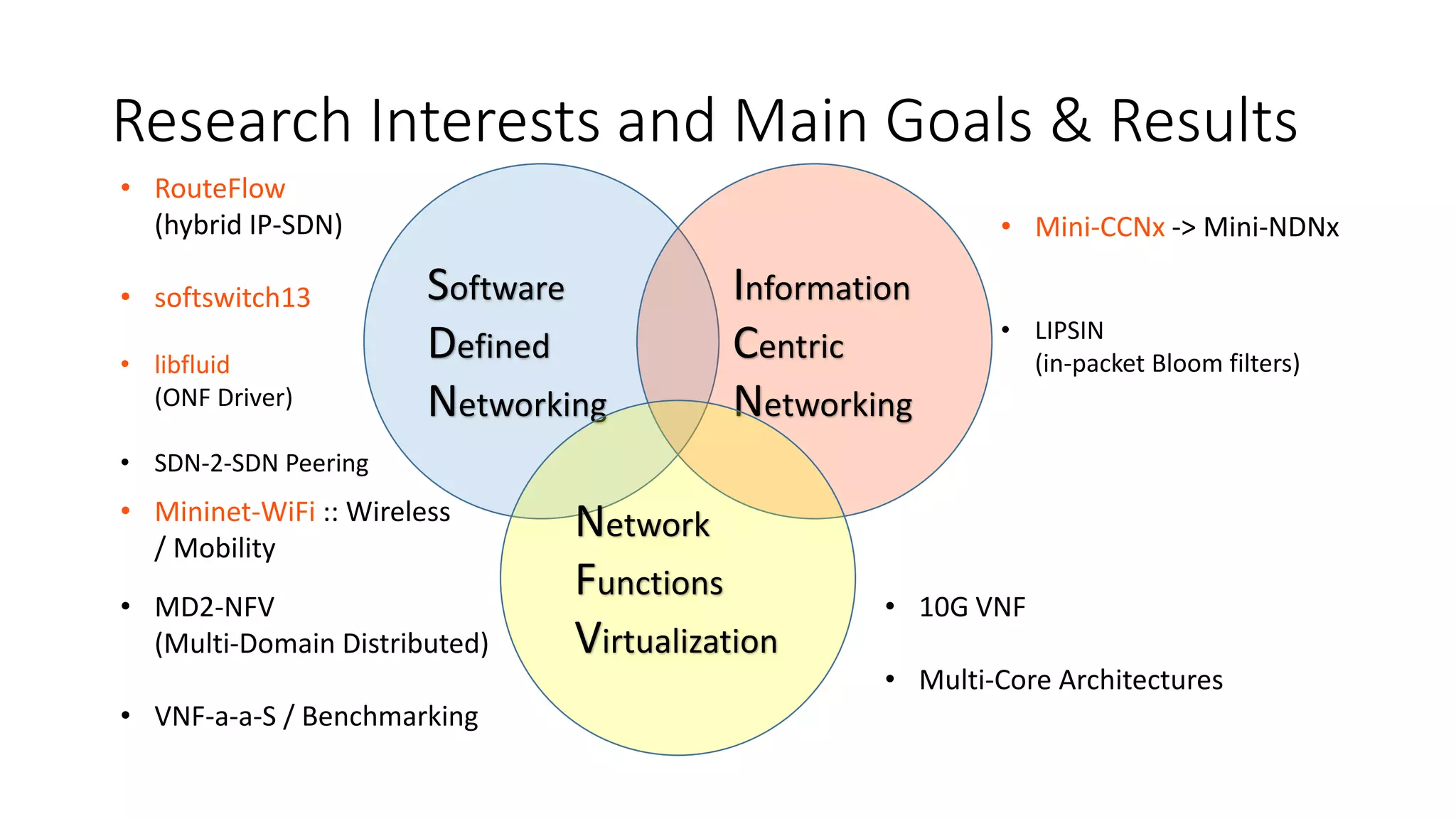
Research Interests and Main Goals & Results
Software
Defined
Networking
Information
Centric
Networking
Network
Functions
Virtualization
• RouteFlow
(hybrid IP-SDN)
• softswitch13
• libfluid
(ONF Driver)
• SDN-2-SDN Peering
• MD2-NFV
(Multi-Domain Distributed)
• VNF-a-a-S / Benchmarking
• Mini-CCNx -> Mini-NDNx
• LIPSIN
(in-packet Bloom filters)
• 10G VNF
• Multi-Core Architectures
• Mininet-WiFi :: Wireless
/ Mobility
Open Source minded Research @
• Extensive use of open source in support of research activities.
• Etherpad, Owncloud, Docker, Gitlab, etc.
• Publish versions of papers (in submission/accepted)
• Arxiv.org
• Make “source code” of papers available
• Overleaf, github
• Release all research data to allow third parties to re-use and reproduce
• Github, wiki + how to reproduce intrsuctions
• Highligh the reproducibility aspect in the papers
(today: plus, tomorrow: requirement/norm?)
• Students use github (private->public) as the research dev repository
• Even if no paper accepted or in early
• Create community-oriented open source projects
Technical lead of successful open source projects:
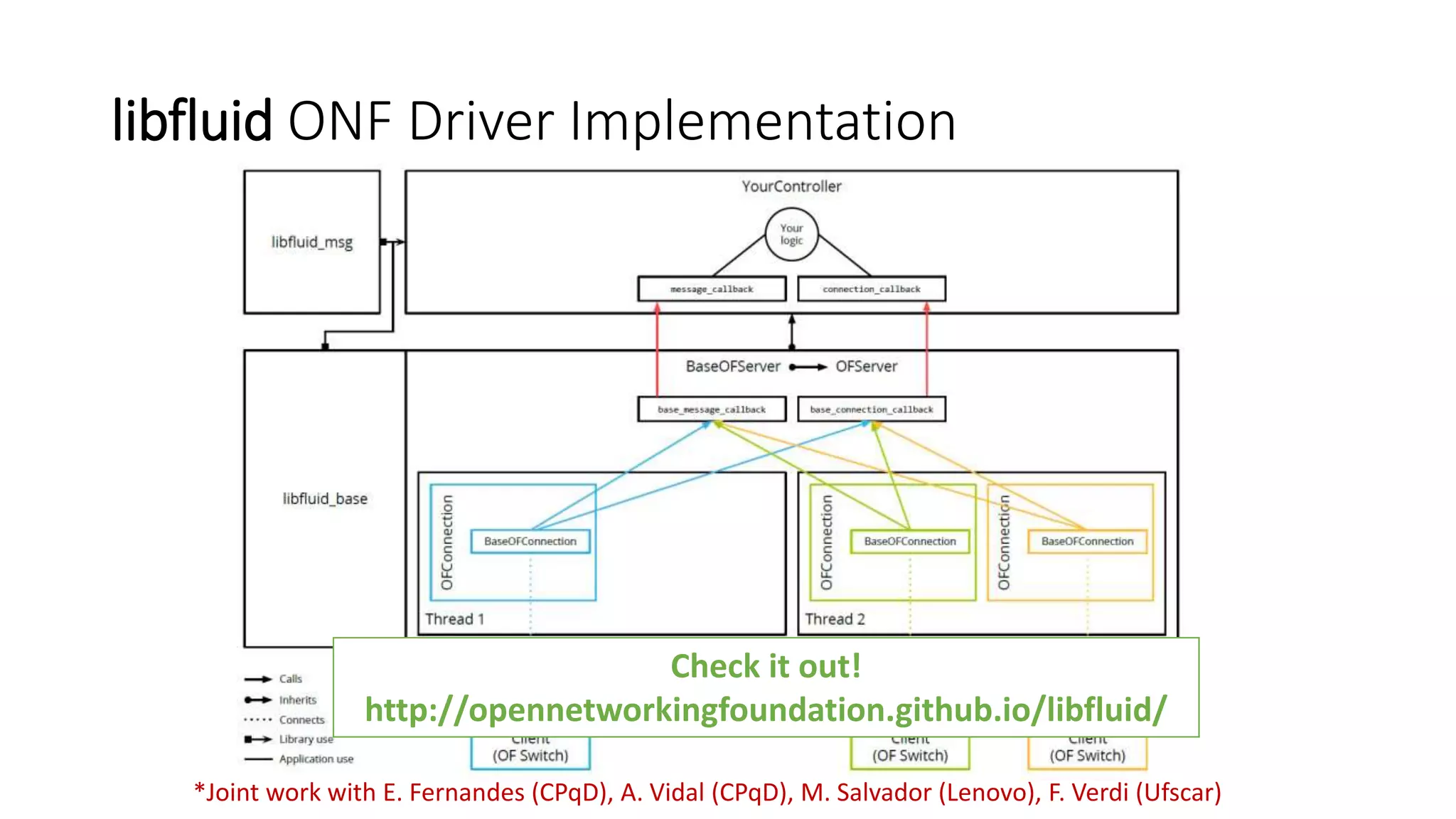
• libfluid, winner of the ONF Driver Competition (Mar/2014)
• http://opennetworkingfoundation.github.io/libfluid/
• softswitch13, first OpenFlow 1.2 and 1.3 soft switch, controller, and testing
framework [funded and technical collaboration with Ericsson] (2011 - 2013)
• https://github.com/CPqD/ofsoftswitch13
• Mini-CCNx, fast prototyping and experimentation of CCN networks (2013 - )
• https://github.com/carlosmscabral/mn-ccnx
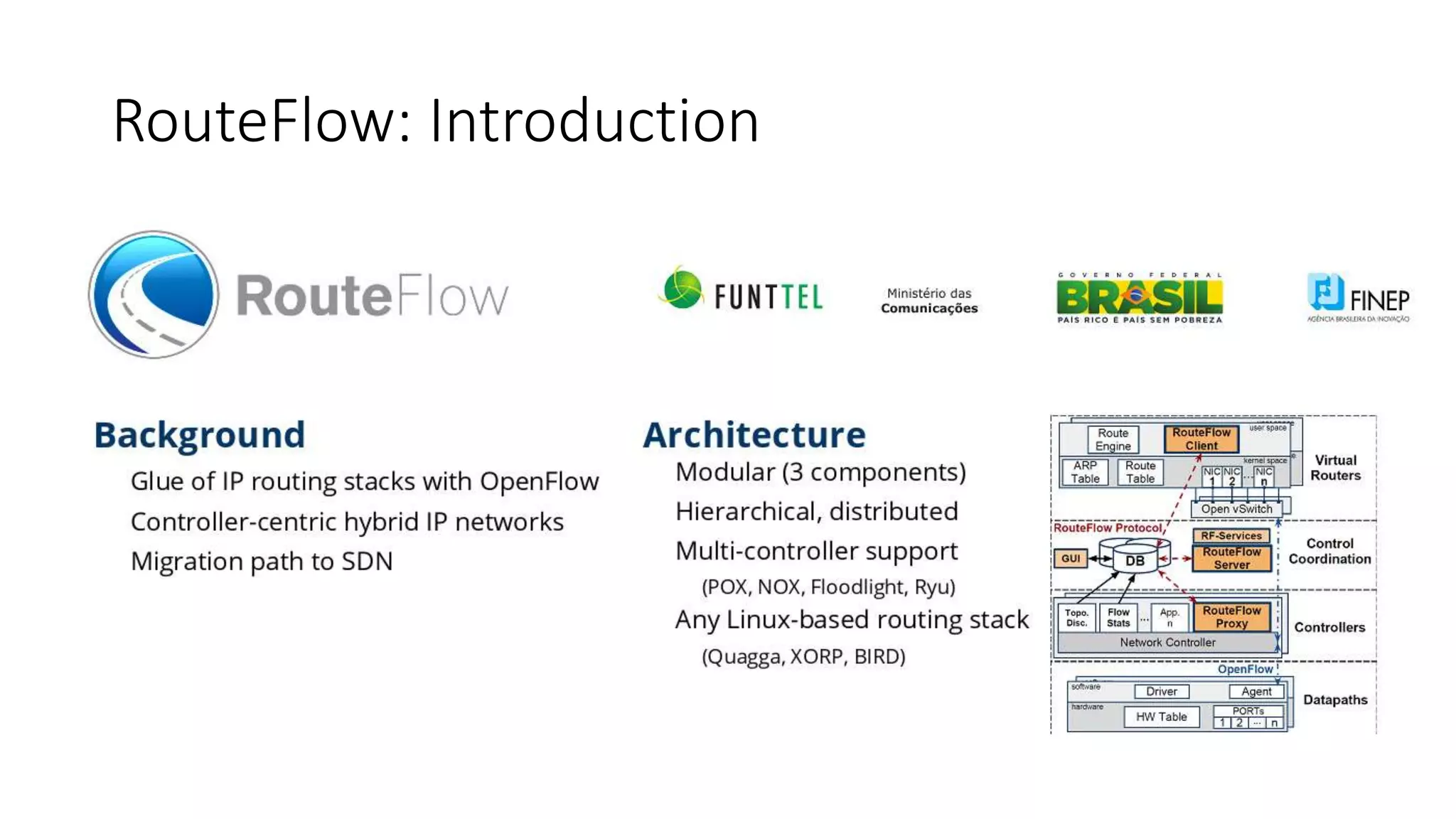
• RouteFlow, first IP routing architecture for SDN (2010 - ). 3 x GSOC projects
• https://github.com/routeflow/
More info: https://github.com/intrig-unicamp/ https://github.com/chesteve/ 43
Research Projects and Open Source Results
libfluid ONF Driver Implementation
*Joint work with E. Fernandes (CPqD), A. Vidal (CPqD), M. Salvador (Lenovo), F. Verdi (Ufscar)
Check it out!
http://opennetworkingfoundation.github.io/libfluid/
RouteFlow: Introduction
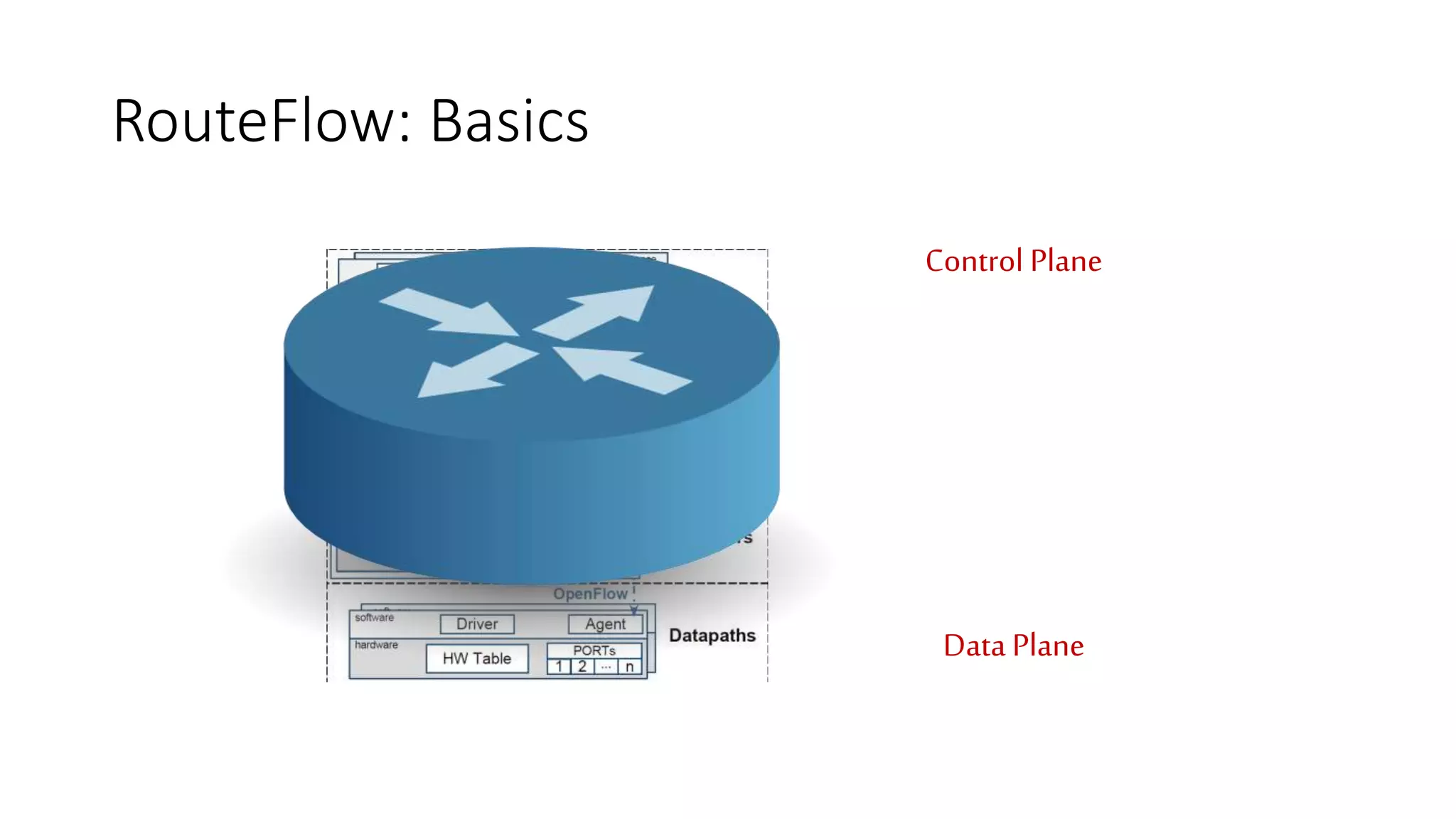
RouteFlow: Basics
Data Plane
Control Plane
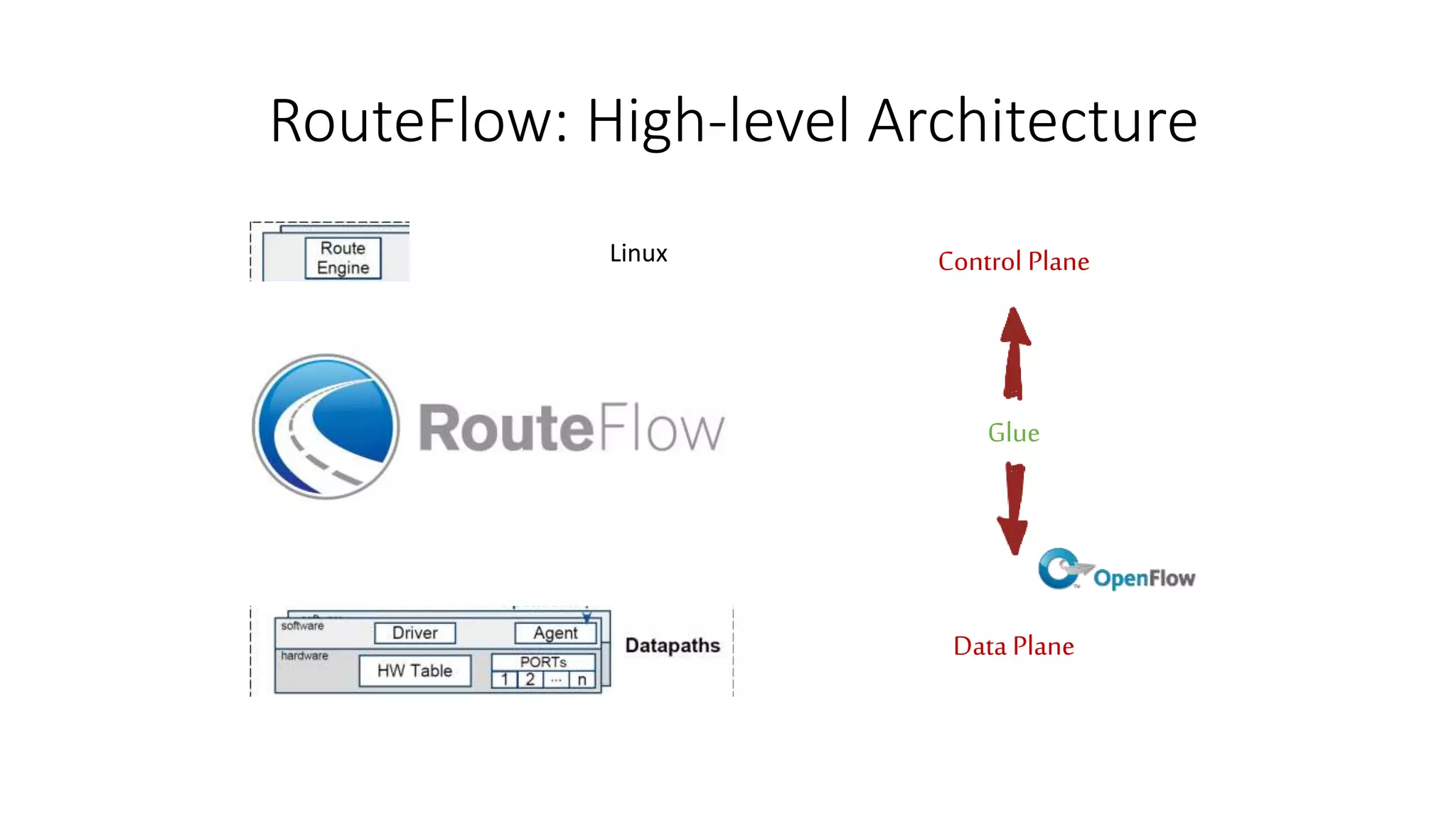
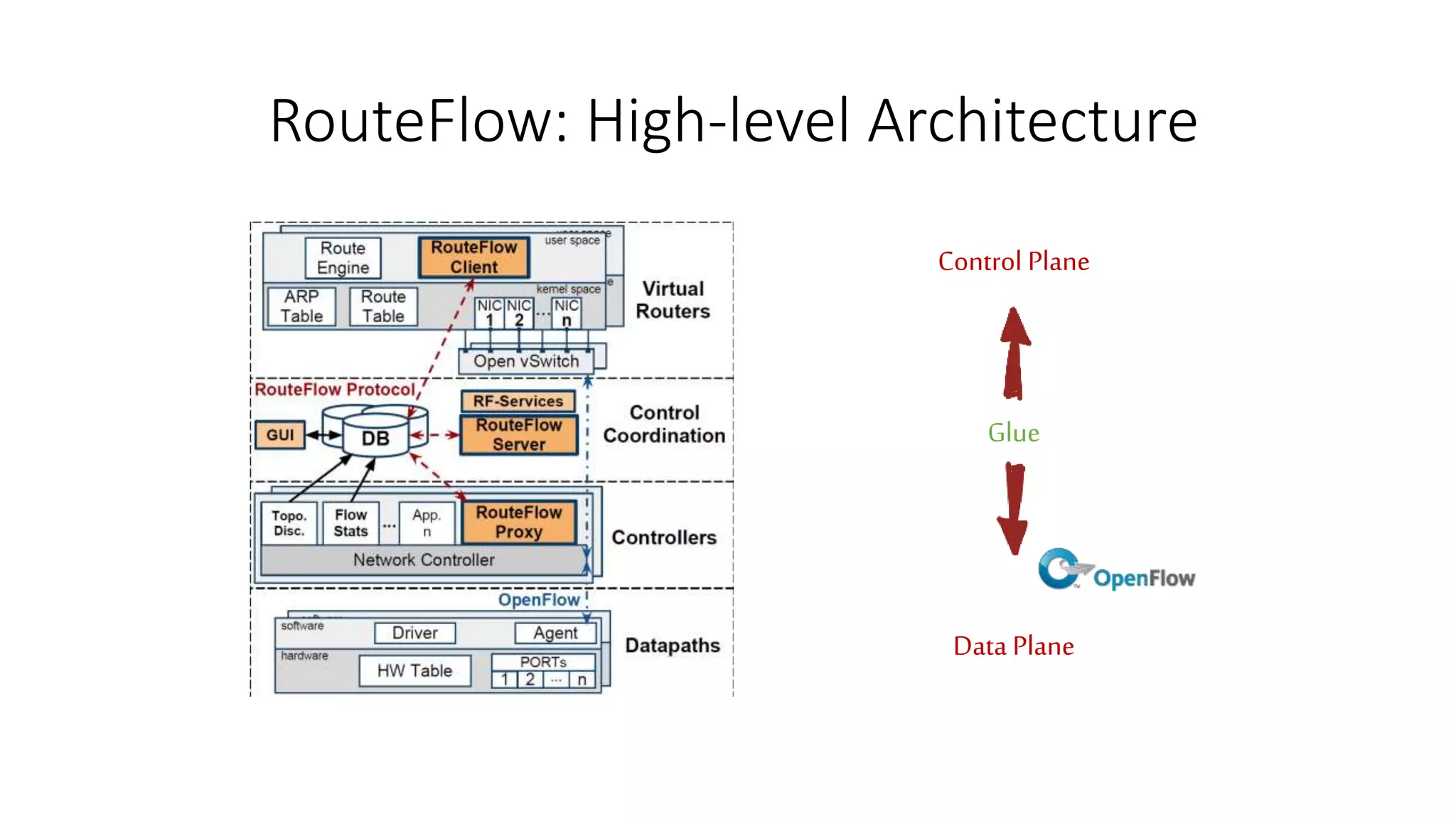
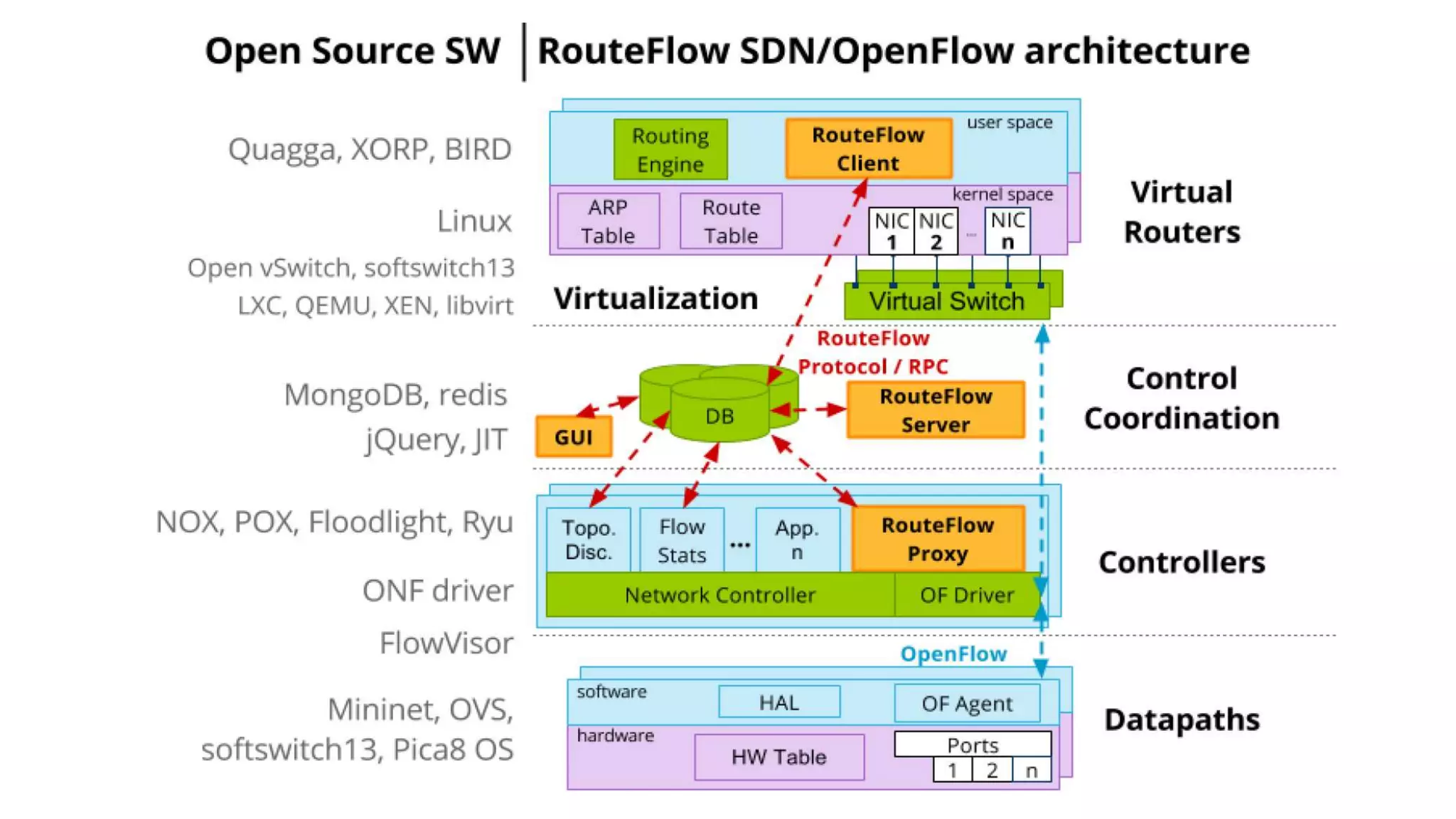
RouteFlow: High-level Architecture
Data Plane
Control Plane
Glue
Linux
RouteFlow: High-level Architecture
Data Plane
Control Plane
Glue
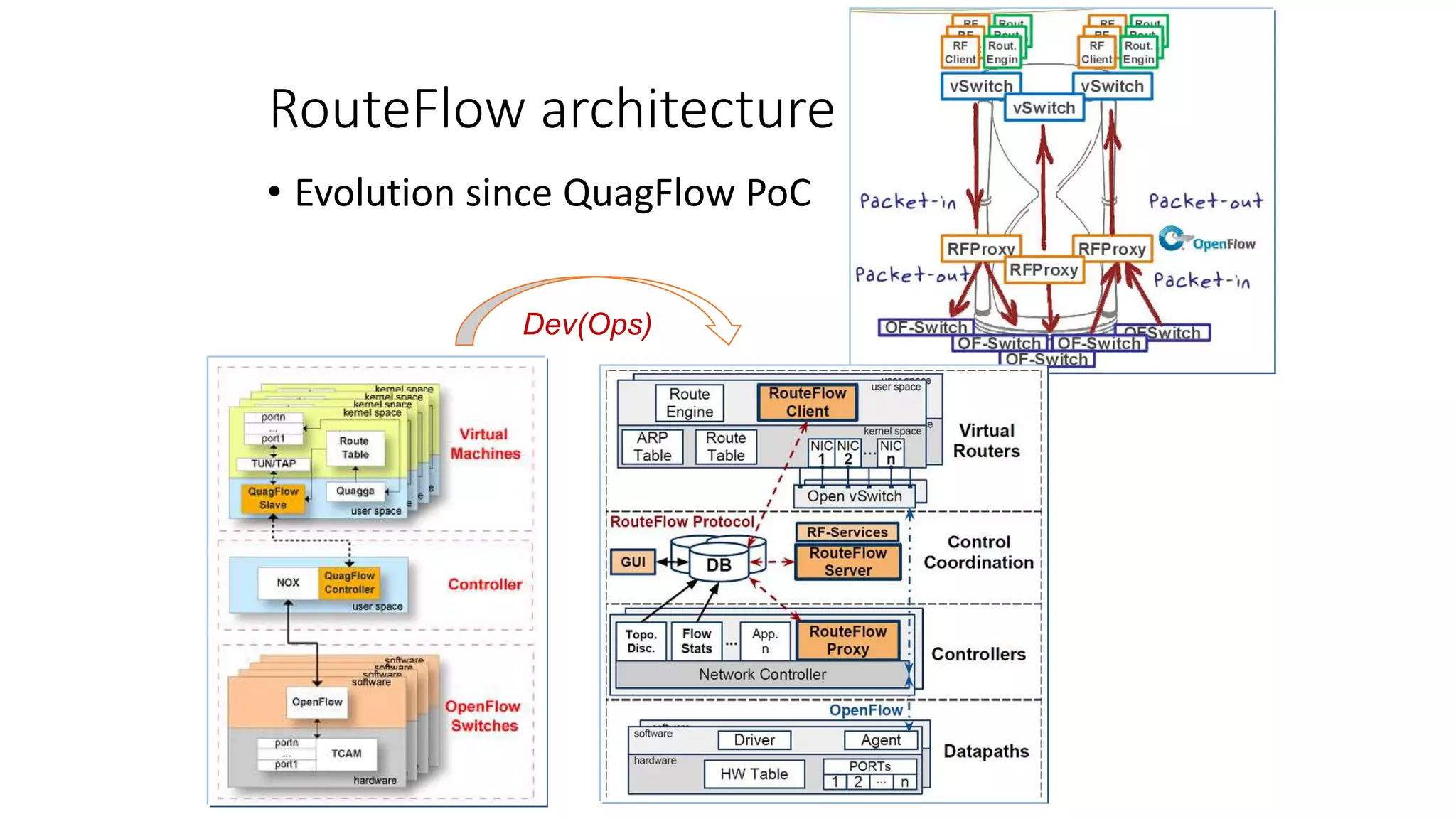
RouteFlow architecture
• Evolution since QuagFlow PoC
Dev(Ops)
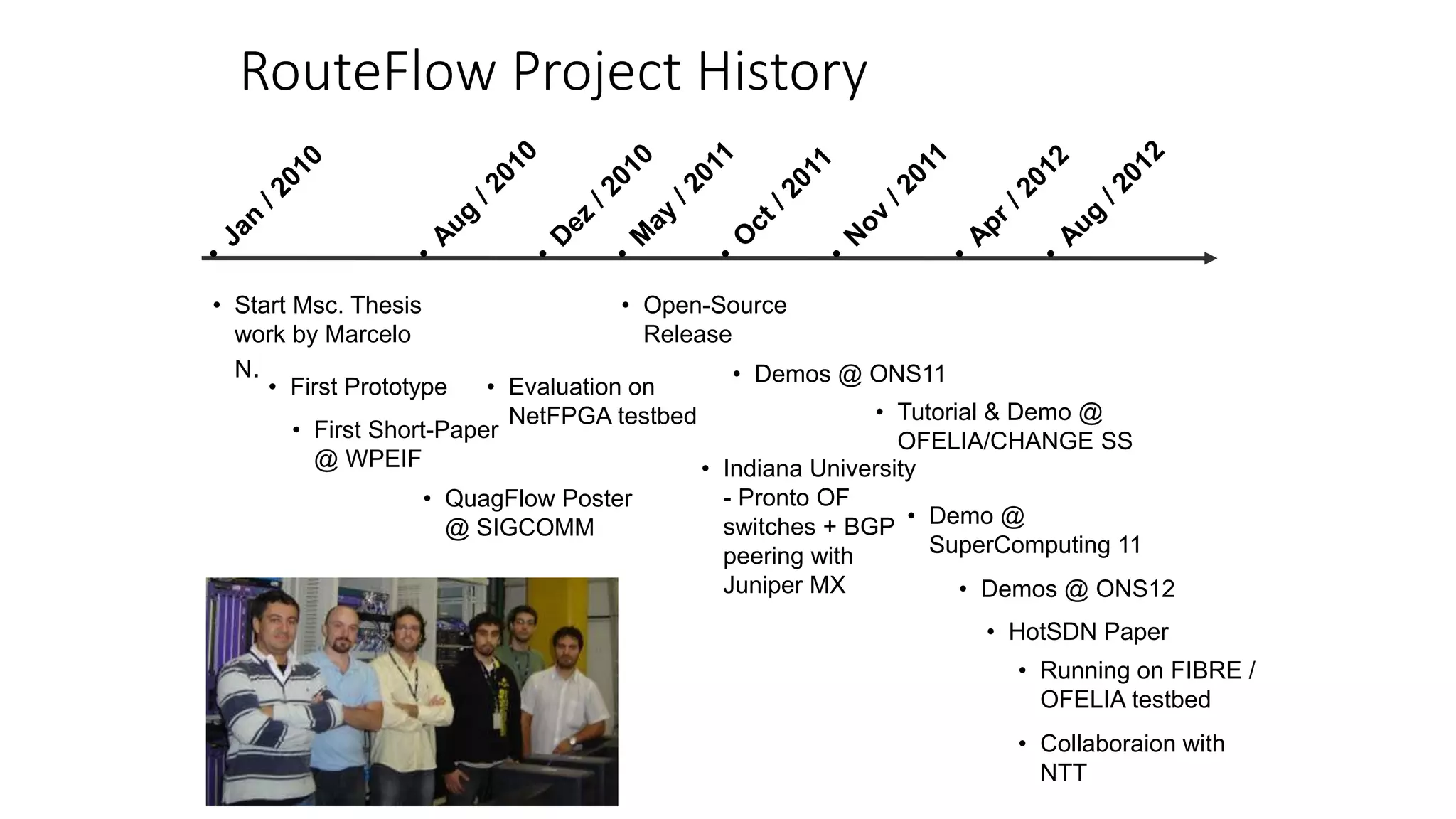
RouteFlow Project History
• Start Msc. Thesis
work by Marcelo
N.
• First Prototype
• QuagFlow Poster
@ SIGCOMM
• Open-Source
Release
• Demos @ ONS11
• Demo @
SuperComputing 11
• Tutorial & Demo @
OFELIA/CHANGE SS• First Short-Paper
@ WPEIF
• Evaluation on
NetFPGA testbed
• Indiana University
- Pronto OF
switches + BGP
peering with
Juniper MX • Demos @ ONS12
• Running on FIBRE /
OFELIA testbed
• HotSDN Paper
• Collaboraion with
NTT
http://go.cpqd.com.br/routeflow/
Visitors: 40,000+ (20,000+ unique)
From 3,000+ cities from 130+ countries!
900
days since
project start
Open Innovation
1000s
downloads!
Warning!
Outdated
[2014]
Community development
• Mailing List:
• 200 Members
• 160 Topics
• Code contributions:
(5K – 10K LOC, many testing hours, bug reports, etc)
Warning!
Outdated
[2014]
Github Activity
Warning!
Outdated
[2014]
Github Activity
Warning!
Outdated
[2014]
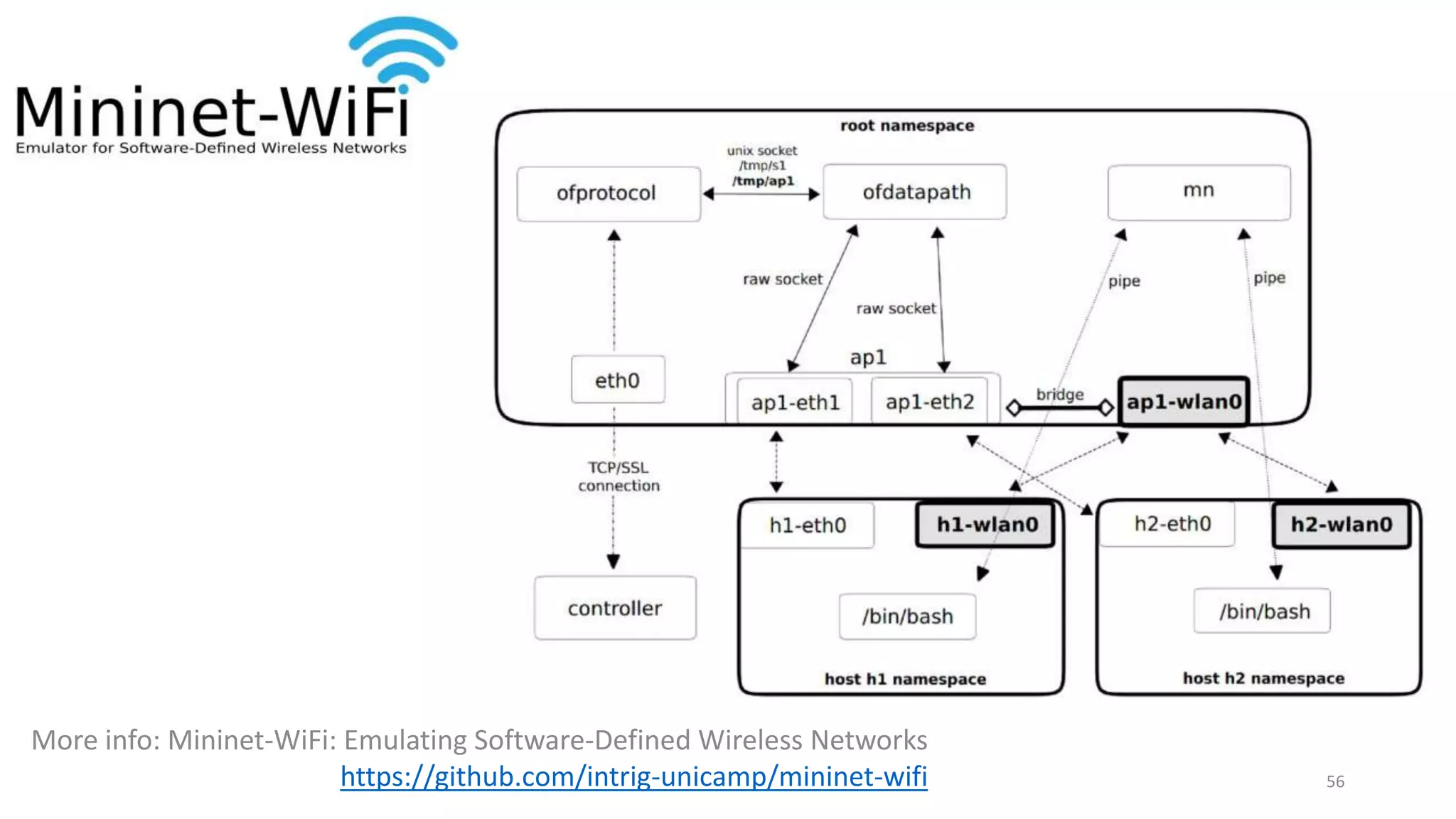
More info: Mininet-WiFi: Emulating Software-Defined Wireless Networks
https://github.com/intrig-unicamp/mininet-wifi 56
Mininet-WiFi
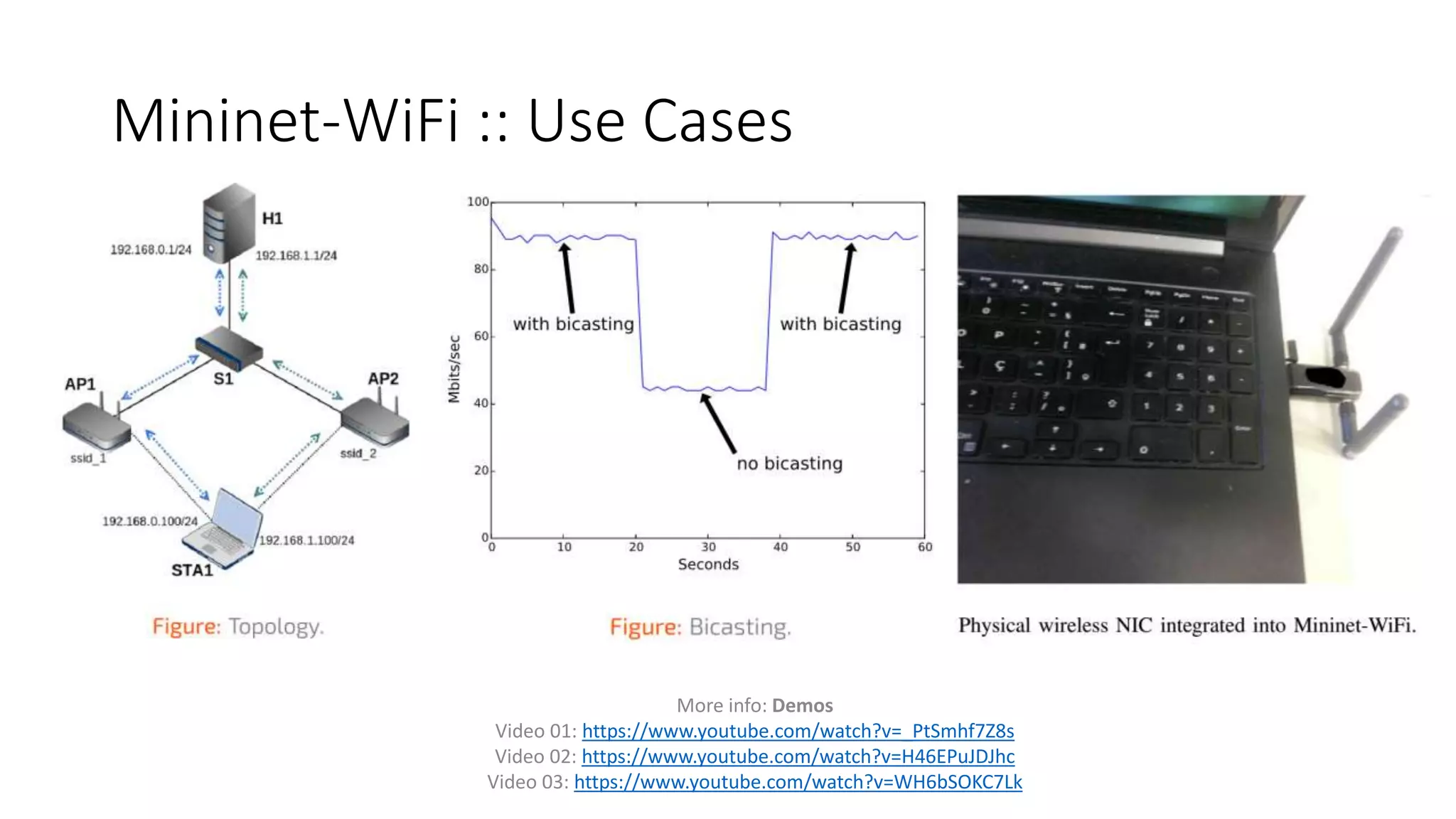
More info: Demos
Video 01: https://www.youtube.com/watch?v=_PtSmhf7Z8s
Video 02: https://www.youtube.com/watch?v=H46EPuJDJhc
Video 03: https://www.youtube.com/watch?v=WH6bSOKC7Lk
Mininet-WiFi :: Use Cases
58
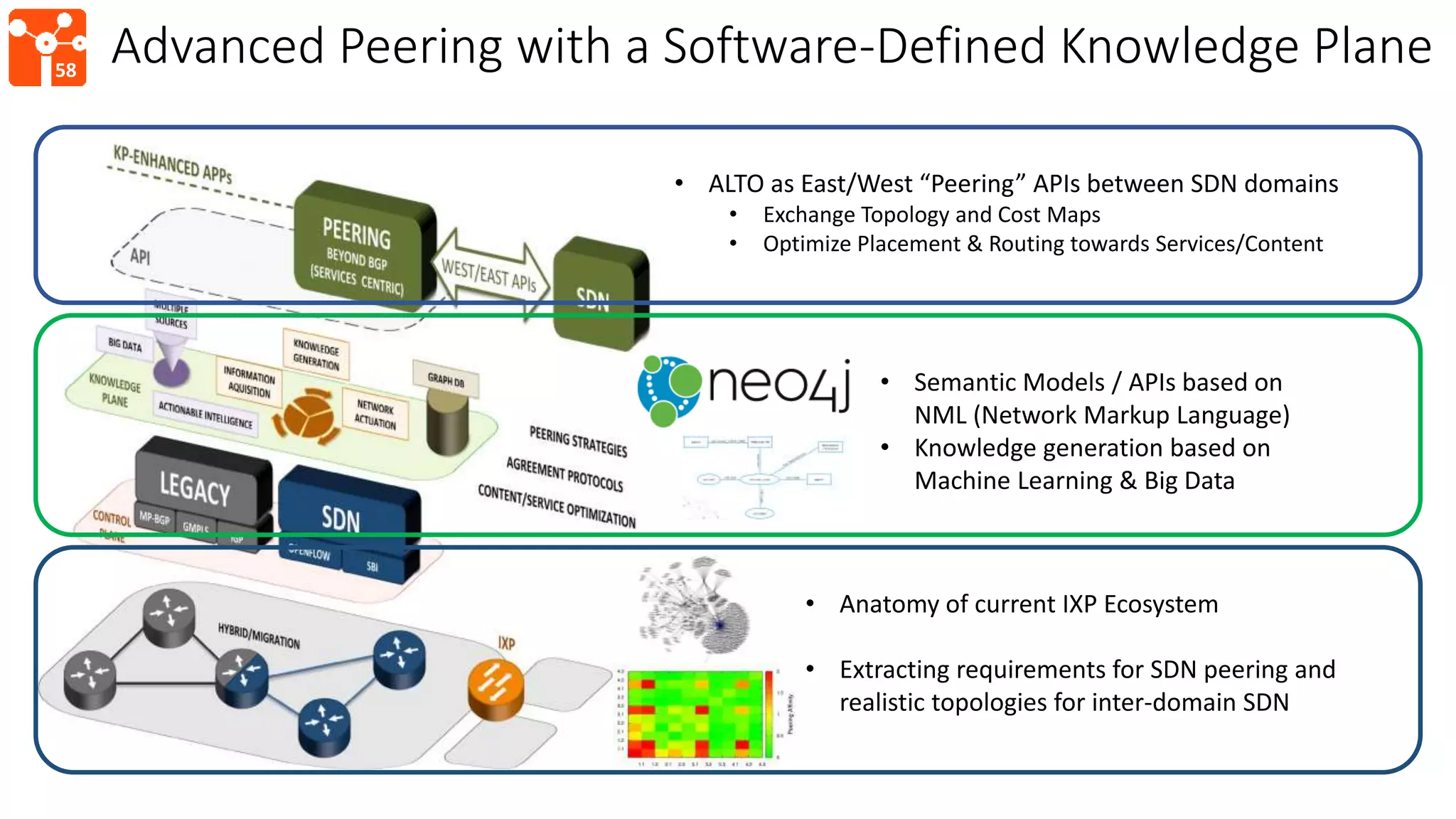
Advanced Peering with a Software-Defined Knowledge Plane
• Semantic Models / APIs based on
NML (Network Markup Language)
• Knowledge generation based on
Machine Learning & Big Data
• ALTO as East/West “Peering” APIs between SDN domains
• Exchange Topology and Cost Maps
• Optimize Placement & Routing towards Services/Content
• Anatomy of current IXP Ecosystem
• Extracting requirements for SDN peering and
realistic topologies for inter-domain SDN
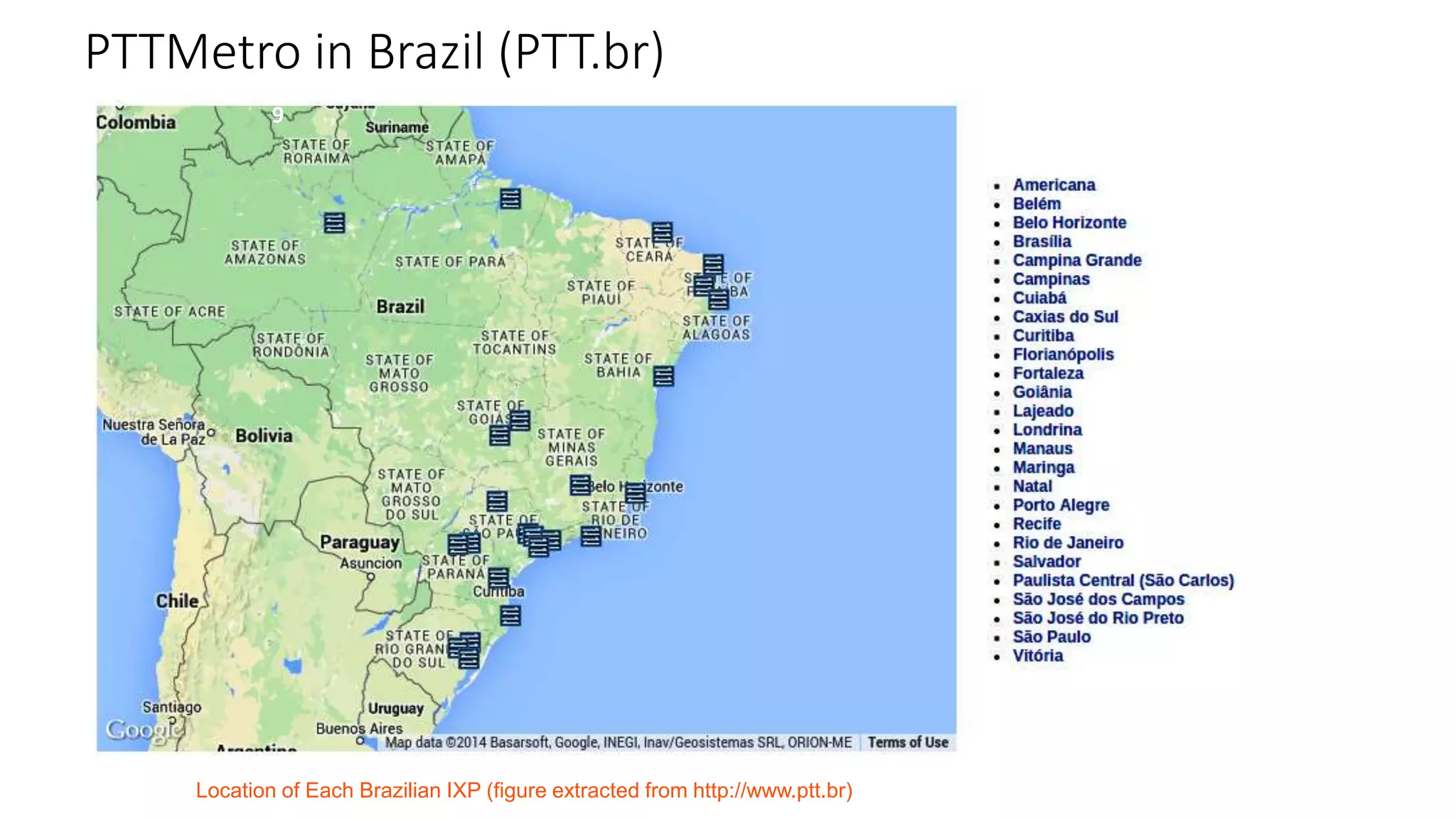
Location of Each Brazilian IXP (figure extracted from http://www.ptt.br)
05
9
PTTMetro in Brazil (PTT.br)
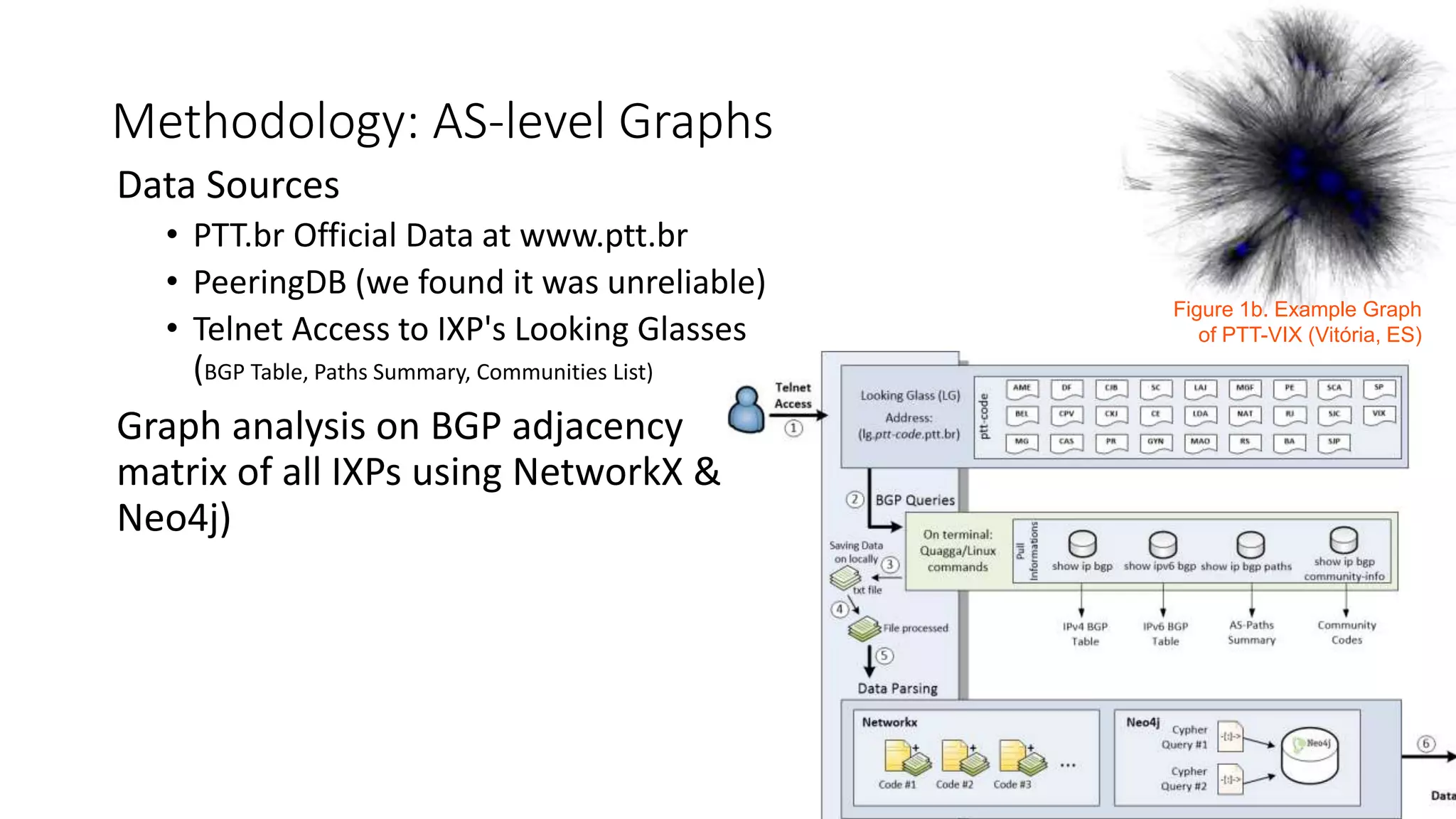
Figure 1b. Example Graph
of PTT-VIX (Vitória, ES)
Methodology: AS-level Graphs
Data Sources
• PTT.br Official Data at www.ptt.br
• PeeringDB (we found it was unreliable)
• Telnet Access to IXP's Looking Glasses
(BGP Table, Paths Summary, Communities List)
Graph analysis on BGP adjacency
matrix of all IXPs using NetworkX &
Neo4j)
61
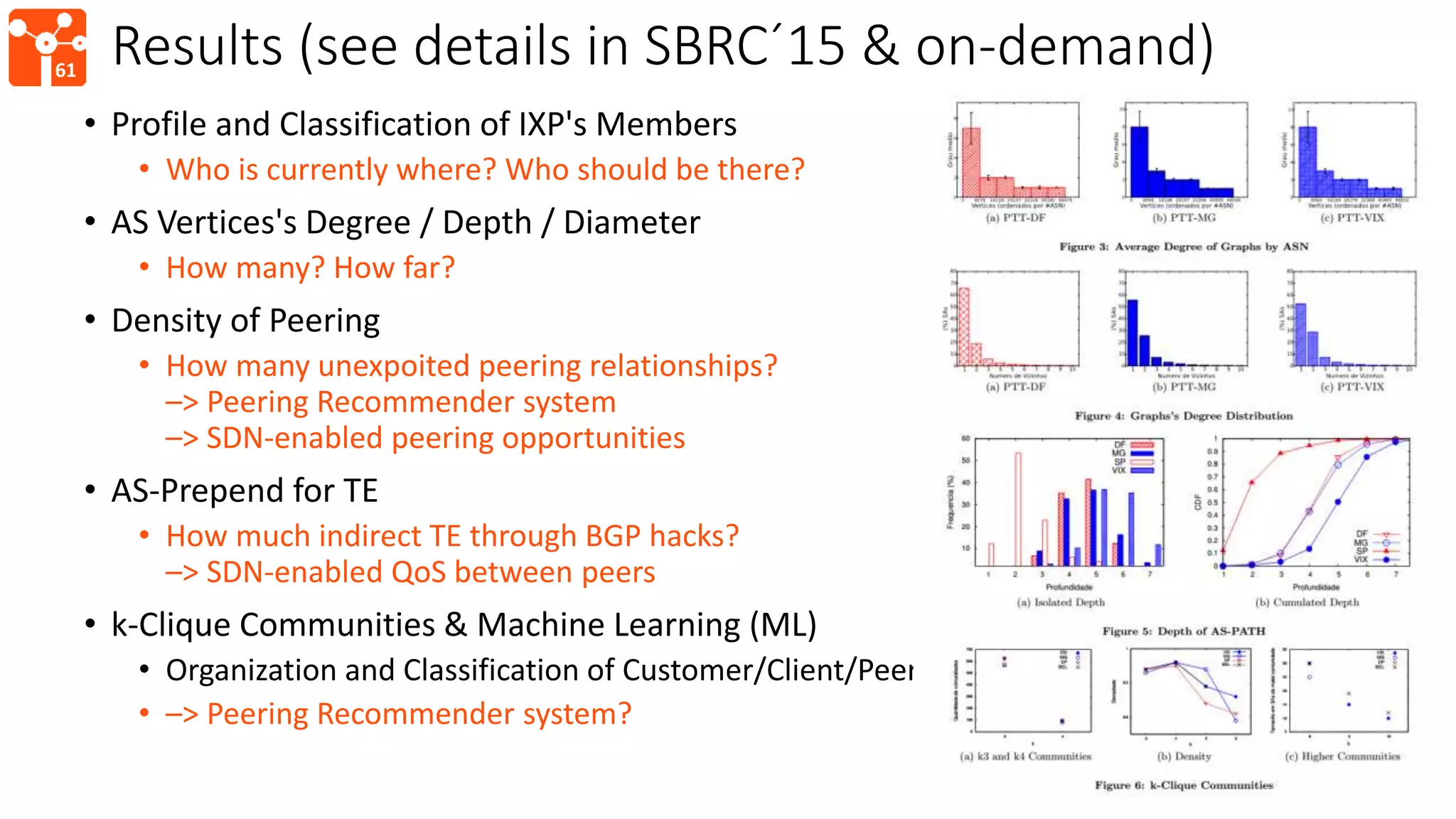
Results (see details in SBRC´15 & on-demand)
• Profile and Classification of IXP's Members
• Who is currently where? Who should be there?
• AS Vertices's Degree / Depth / Diameter
• How many? How far?
• Density of Peering
• How many unexpoited peering relationships?
–> Peering Recommender system
–> SDN-enabled peering opportunities
• AS-Prepend for TE
• How much indirect TE through BGP hacks?
–> SDN-enabled QoS between peers
• k-Clique Communities & Machine Learning (ML)
• Organization and Classification of Customer/Client/Peers
• –> Peering Recommender system?
Research challenges (1/2)
Research and development around Software Defined Networking (SDN) and
Network Function Virtualization (NFV) is vast and testbeds and related toolkits in
academia addressing SDN, NFV, Mobile Edge Computing (MEC) and 5G
technologies are being set-up
• A strong impact on the industry is anticipated
Many open source initiatives with high potentials are not known by other
researchers due to the lack of visibility
• Scientific publications are a good mean for those researchers to get some
visibility, but that’s not enough
Research challenges (2/2)
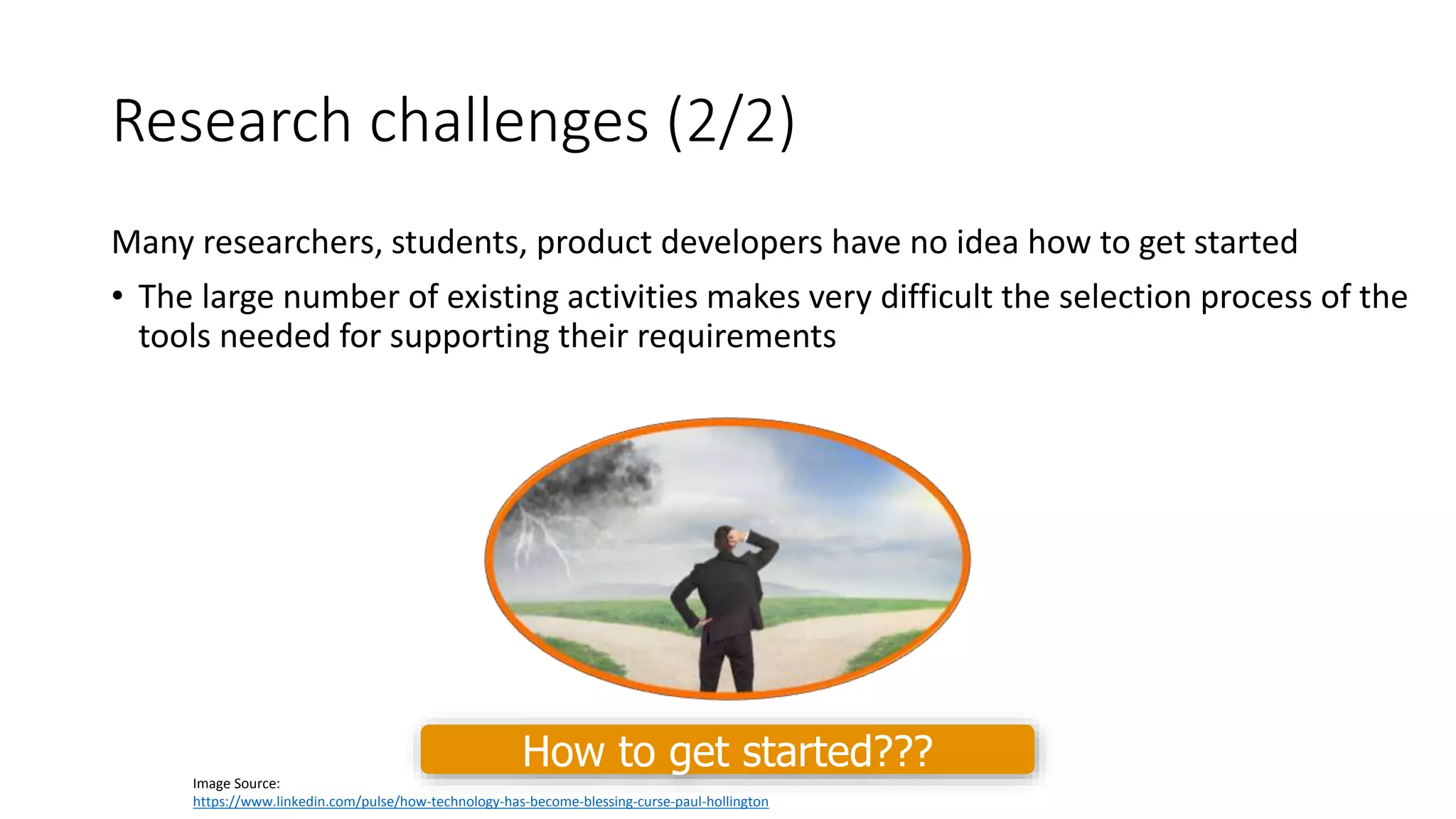
Many researchers, students, product developers have no idea how to get started
• The large number of existing activities makes very difficult the selection process of the
tools needed for supporting their requirements
Image Source:
https://www.linkedin.com/pulse/how-technology-has-become-blessing-curse-paul-hollington
How to get started???
Towards a “Wikipedia” of Toolkits & Testbeds
© Fraunhofer FOKUS
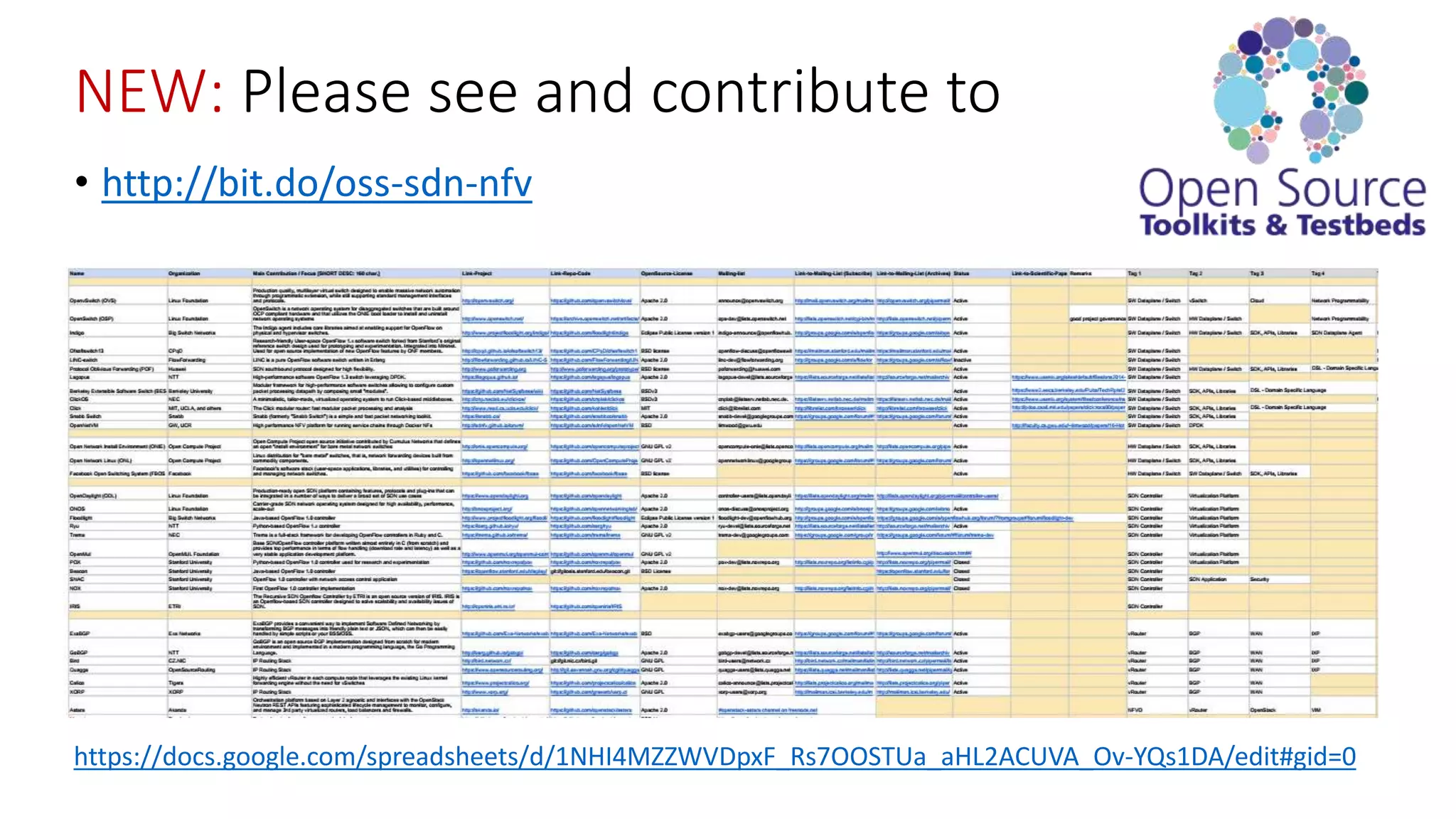
• http://bit.do/oss-sdn-nfv
NEW: Please see and contribute to
https://docs.google.com/spreadsheets/d/1NHI4MZZWVDpxF_Rs7OOSTUa_aHL2ACUVA_Ov-YQs1DA/edit#gid=0
Concluding Remarks
Think and be “open” in your research
• Carry effective open source strategy (tool selection + upstream contributions)
• Reproducible research (open source + open data)
The future is all about Software Ecosystems
• Open Interfaces: Protocols, APIs, Code, Tool Chains
• Open Control Platforms at every level (layer?)
• “Best of Breed” markets
Thank you!
Questions?
BACKUP
Phase 3: Open the Wiki to the public community
• Managed by the community
• Open to any registered user
• Scales nicely / cost-effective (effort/per-person)
• Content updates, curation, etc.
• Area caretakers to validate updates
Image Source: Photographed by Lane Hartwell (http://fetching.net/) on behalf of the Wikimedia Foundation.
https://commons.wikimedia.org/wiki/File:Wikipedia_mini_globe_handheld.jpg
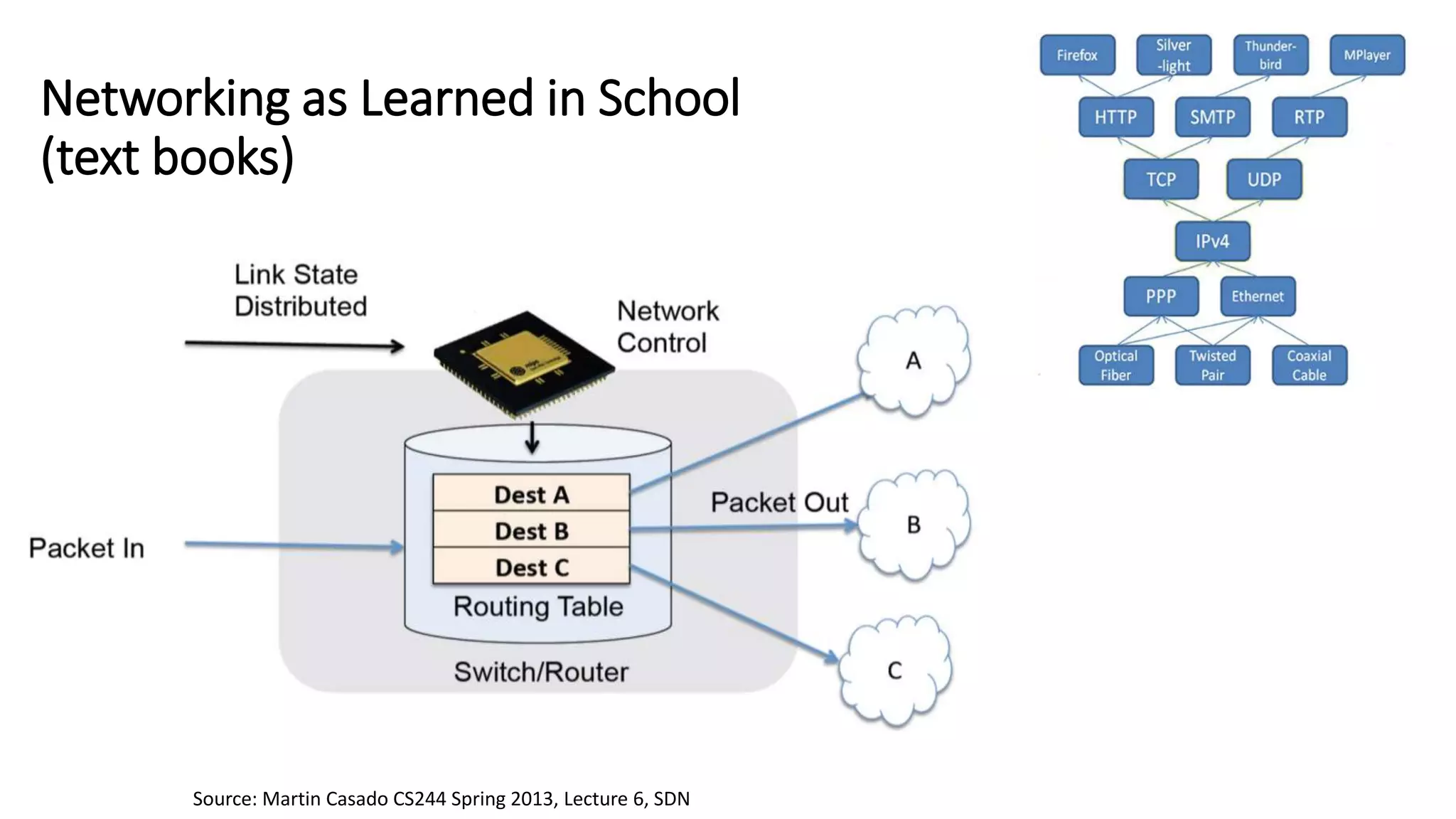
Networking as Learned in School
(text books)
Source: Martin Casado CS244 Spring 2013, Lecture 6, SDN
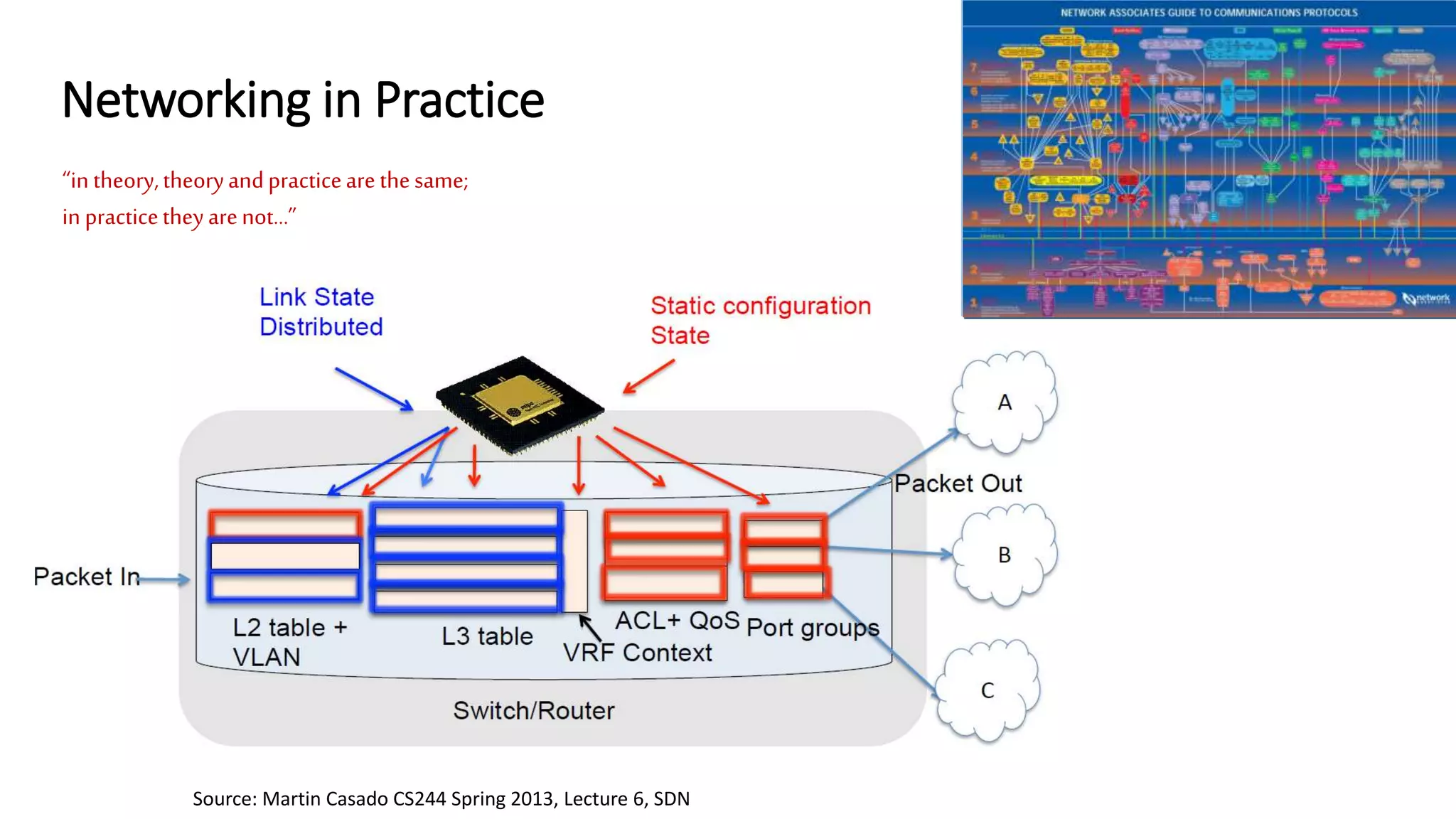
Networking in Practice
“in theory,theoryandpracticearethesame;
in practicetheyarenot...”
Source: Martin Casado CS244 Spring 2013, Lecture 6, SDN
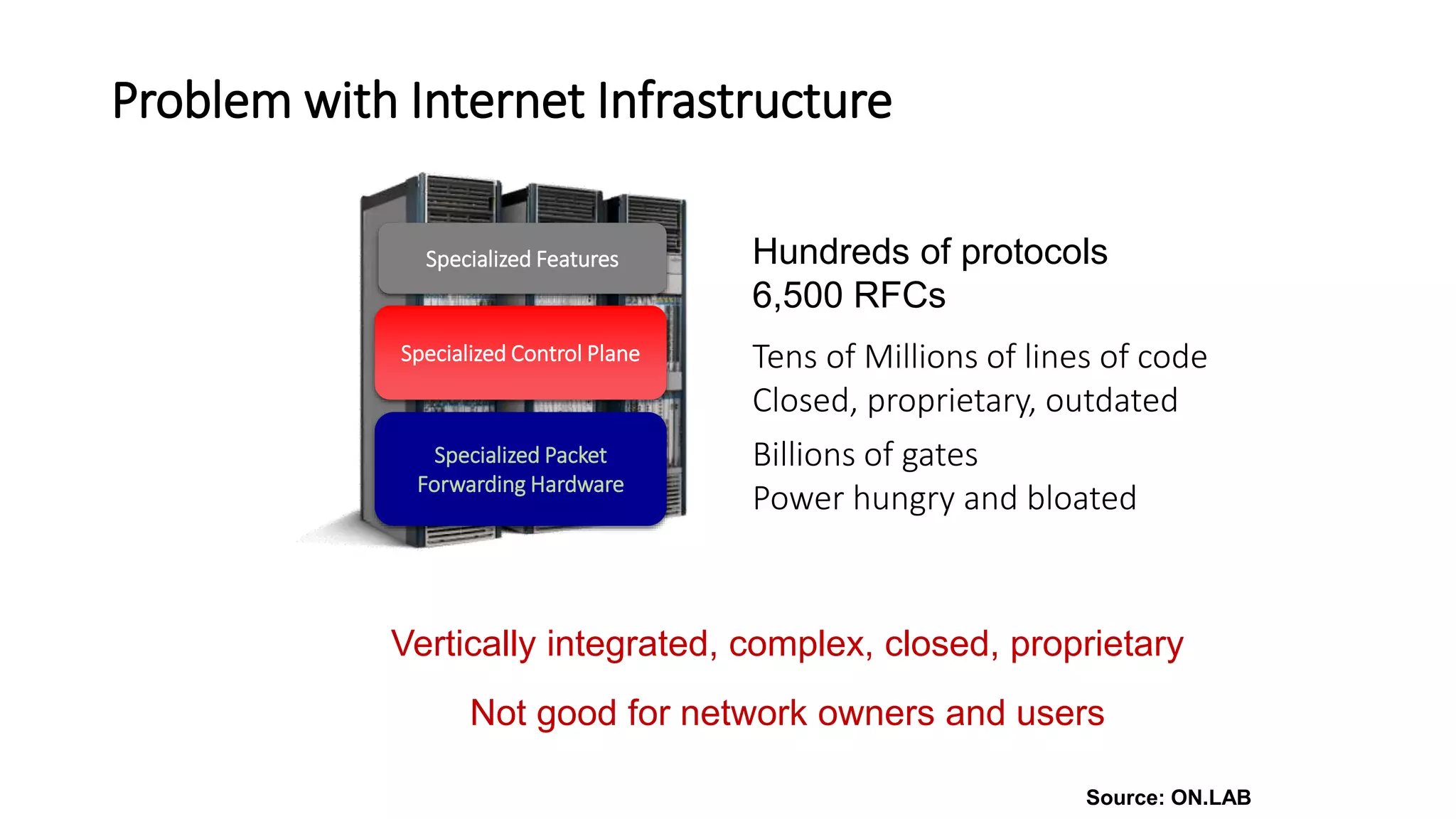
Tens of Millions of lines of code
Closed, proprietary, outdated
Hundreds of protocols
6,500 RFCs
Billions of gates
Power hungry and bloated
Vertically integrated, complex, closed, proprietary
Not good for network owners and users
Specialized Packet
Forwarding Hardware
Specialized Control Plane
Specialized Features
Problem with Internet Infrastructure
Source: ON.LAB
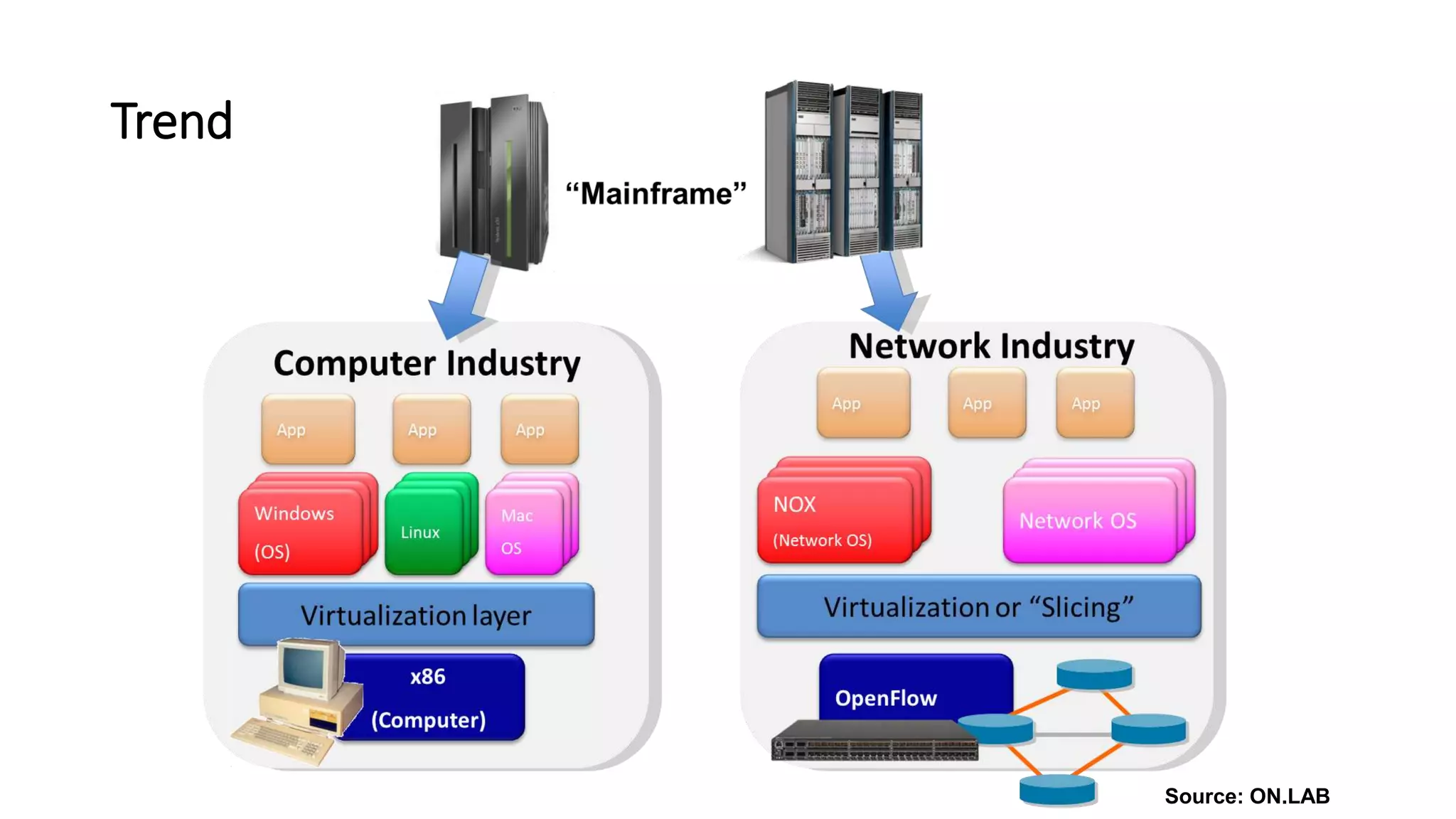
Trend
Source: ON.LAB
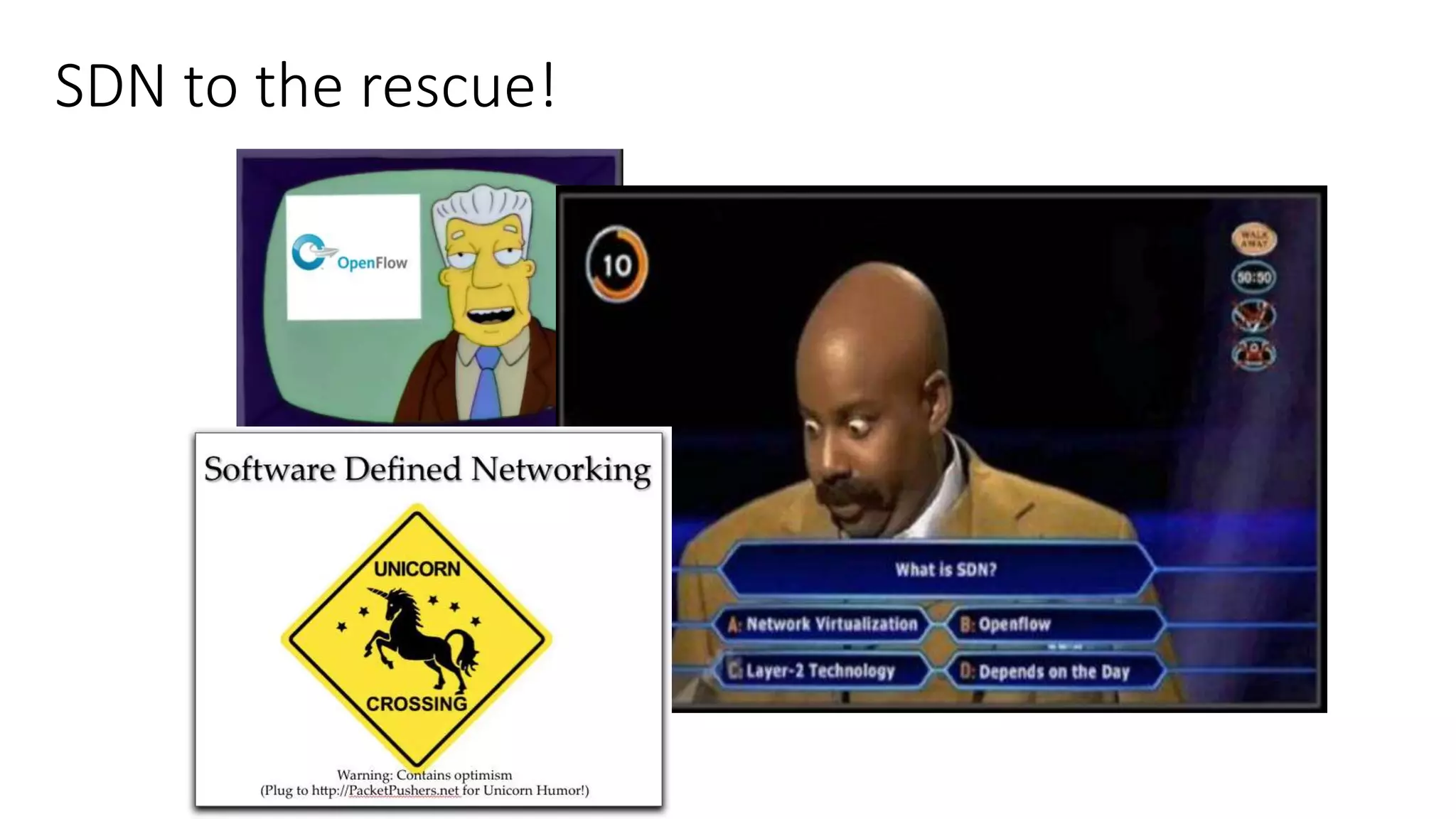
SDN to the rescue!
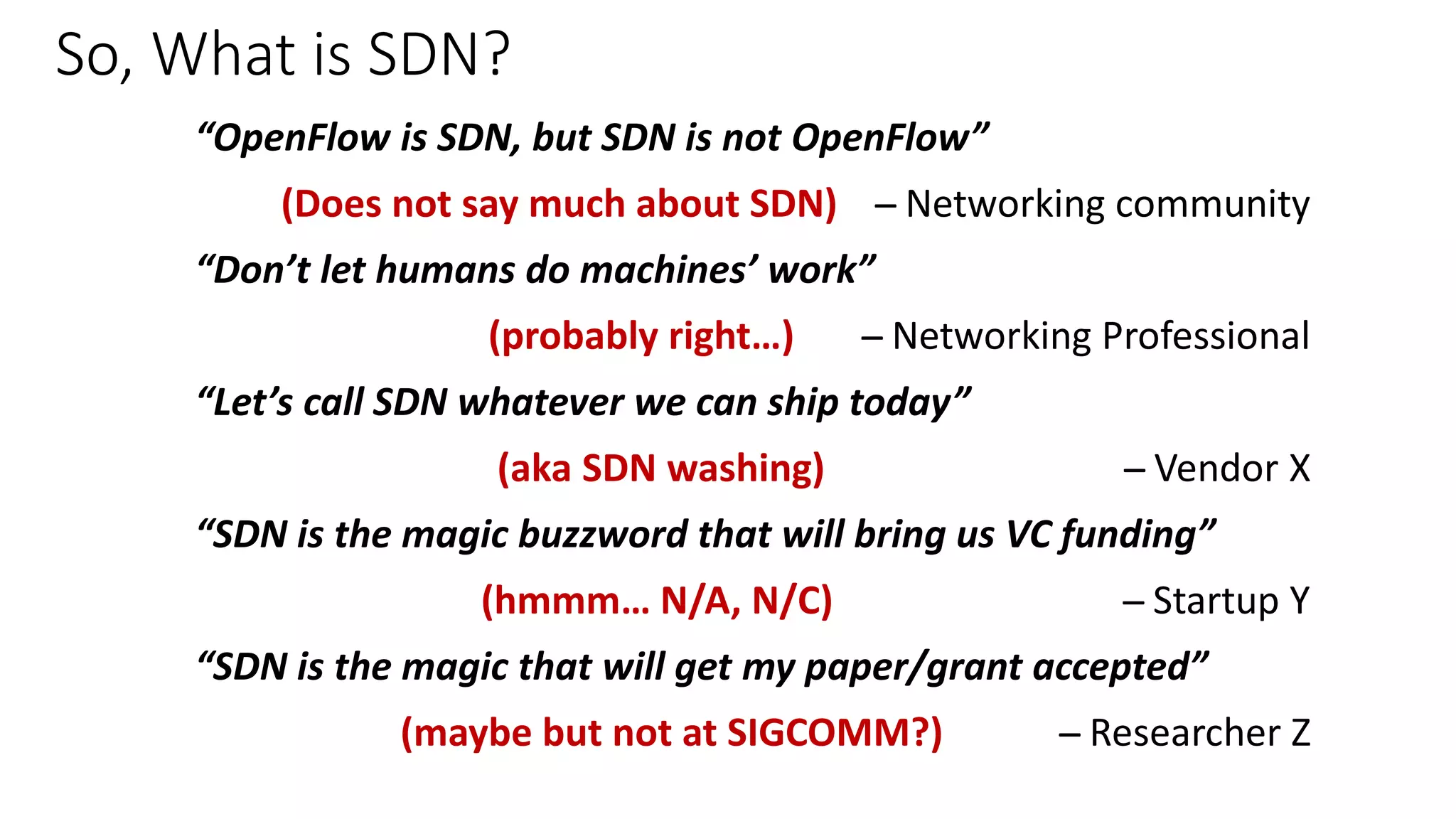
So, What is SDN?
“OpenFlow is SDN, but SDN is not OpenFlow”
(Does not say much about SDN) ̶̶̶̶̶̶̶̶̶ Networking community
“Don’t let humans do machines’ work”
(probably right…) ̶̶̶̶̶̶̶̶̶ Networking Professional
“Let’s call SDN whatever we can ship today”
(aka SDN washing) ̶̶̶̶̶̶̶̶̶ Vendor X
“SDN is the magic buzzword that will bring us VC funding”
(hmmm… N/A, N/C) ̶̶̶̶̶̶̶̶̶ Startup Y
“SDN is the magic that will get my paper/grant accepted”
(maybe but not at SIGCOMM?) ̶̶̶̶̶̶̶̶̶ Researcher Z
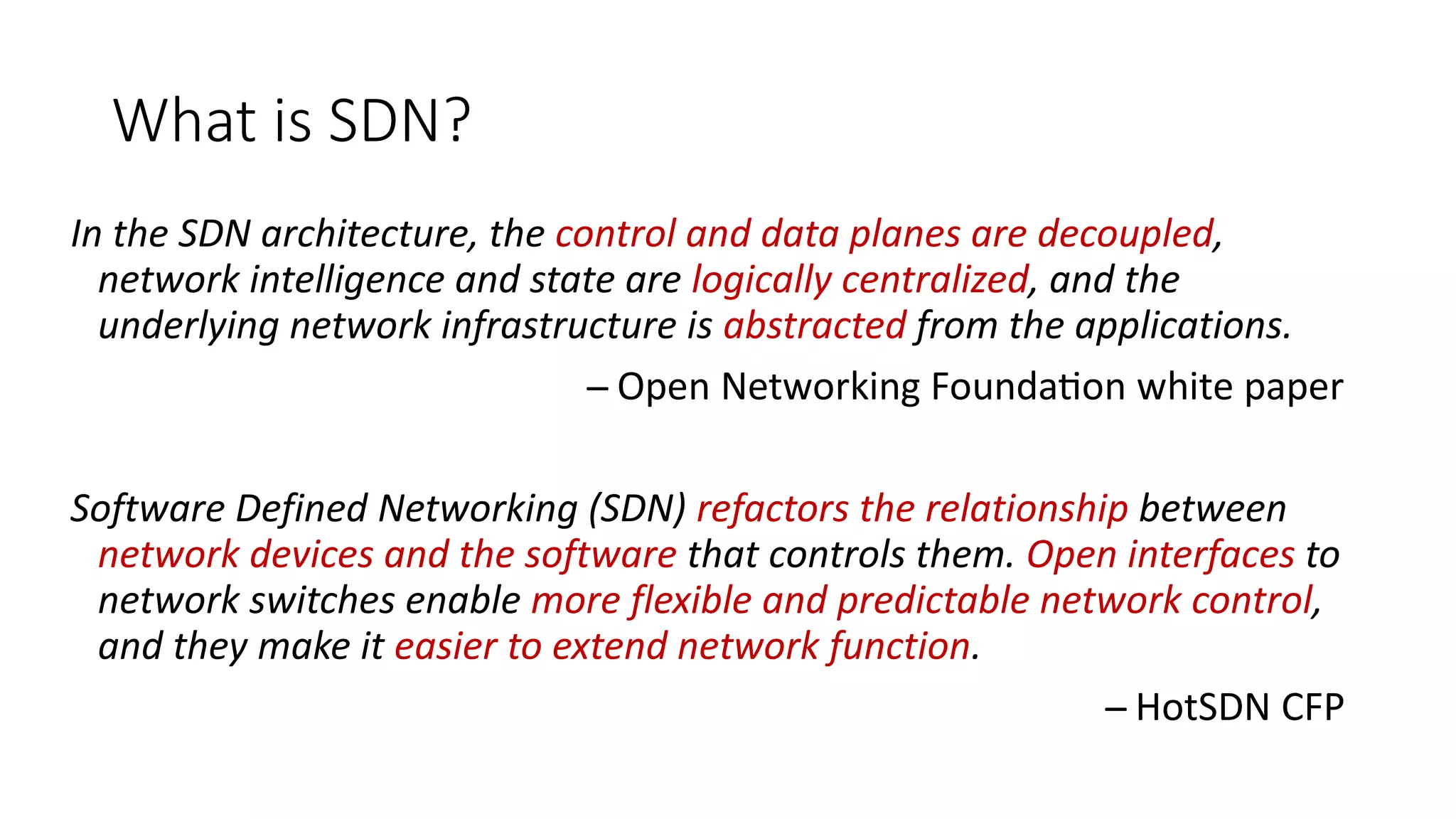
What is SDN?
In the SDN architecture, the control and data planes are decoupled,
network intelligence and state are logically centralized, and the
underlying network infrastructure is abstracted from the applications.
̶̶̶̶̶̶̶̶̶ Open Networking Foundation white paper
Software Defined Networking (SDN) refactors the relationship between
network devices and the software that controls them. Open interfaces to
network switches enable more flexible and predictable network control,
and they make it easier to extend network function.
̶̶̶̶̶̶̶̶̶ HotSDN CFP
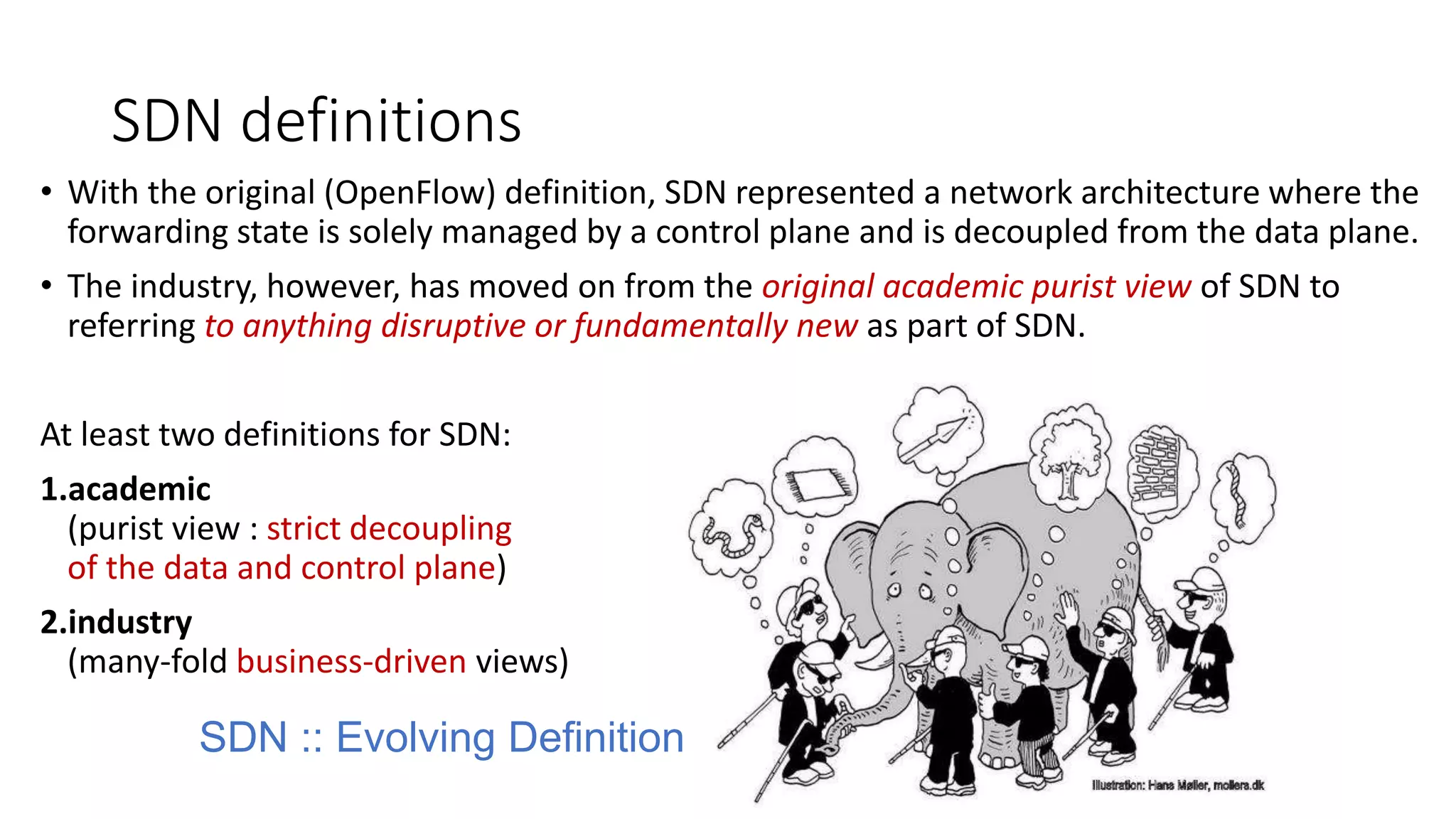
SDN definitions
• With the original (OpenFlow) definition, SDN represented a network architecture where the
forwarding state is solely managed by a control plane and is decoupled from the data plane.
• The industry, however, has moved on from the original academic purist view of SDN to
referring to anything disruptive or fundamentally new as part of SDN.
At least two definitions for SDN:
1.academic
(purist view : strict decoupling
of the data and control plane)
2.industry
(many-fold business-driven views)
SDN :: Evolving Definition
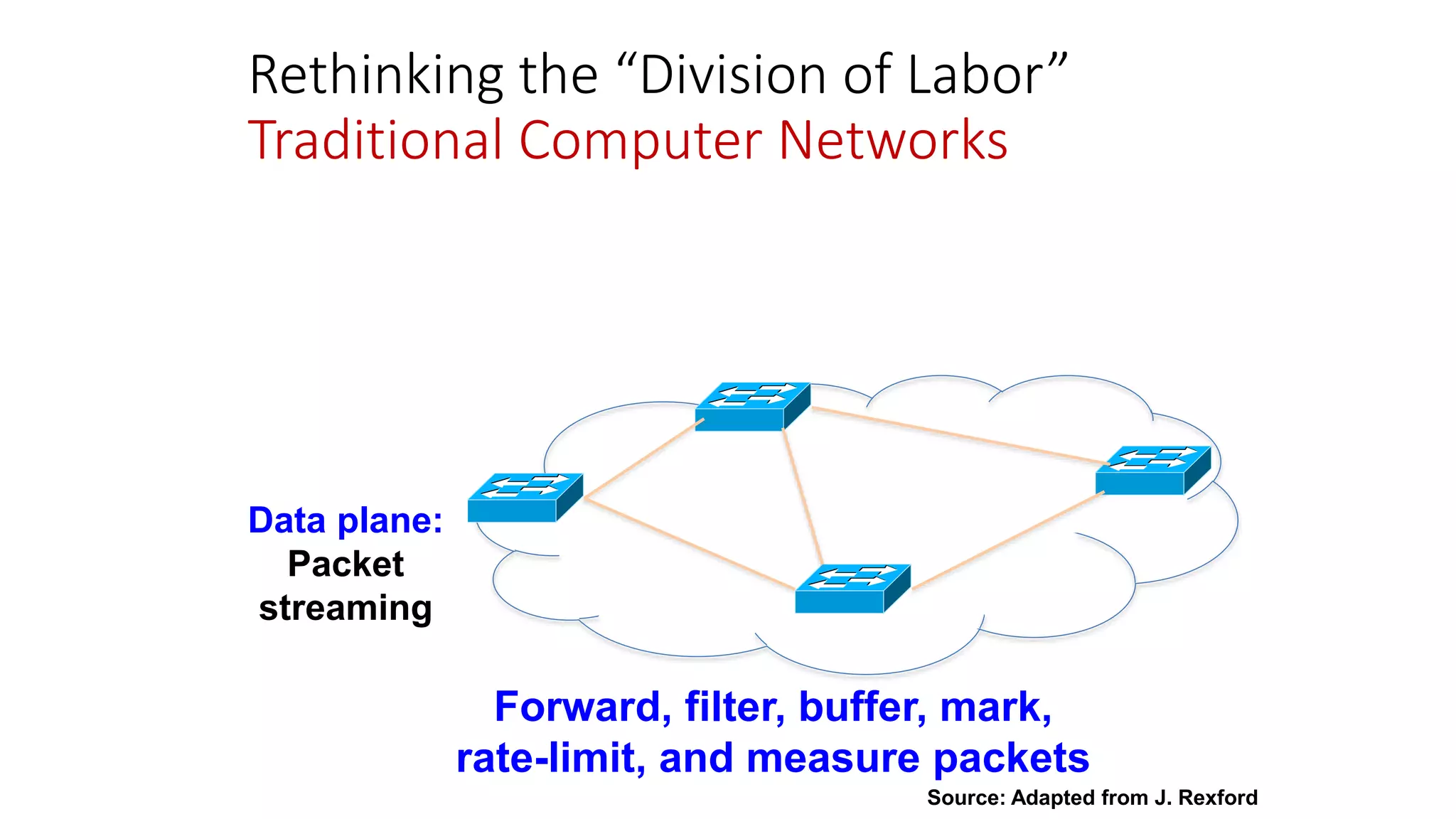
Rethinking the “Division of Labor”
Traditional Computer Networks
Data plane:
Packet
streaming
Forward, filter, buffer, mark,
rate-limit, and measure packets
Source: Adapted from J. Rexford
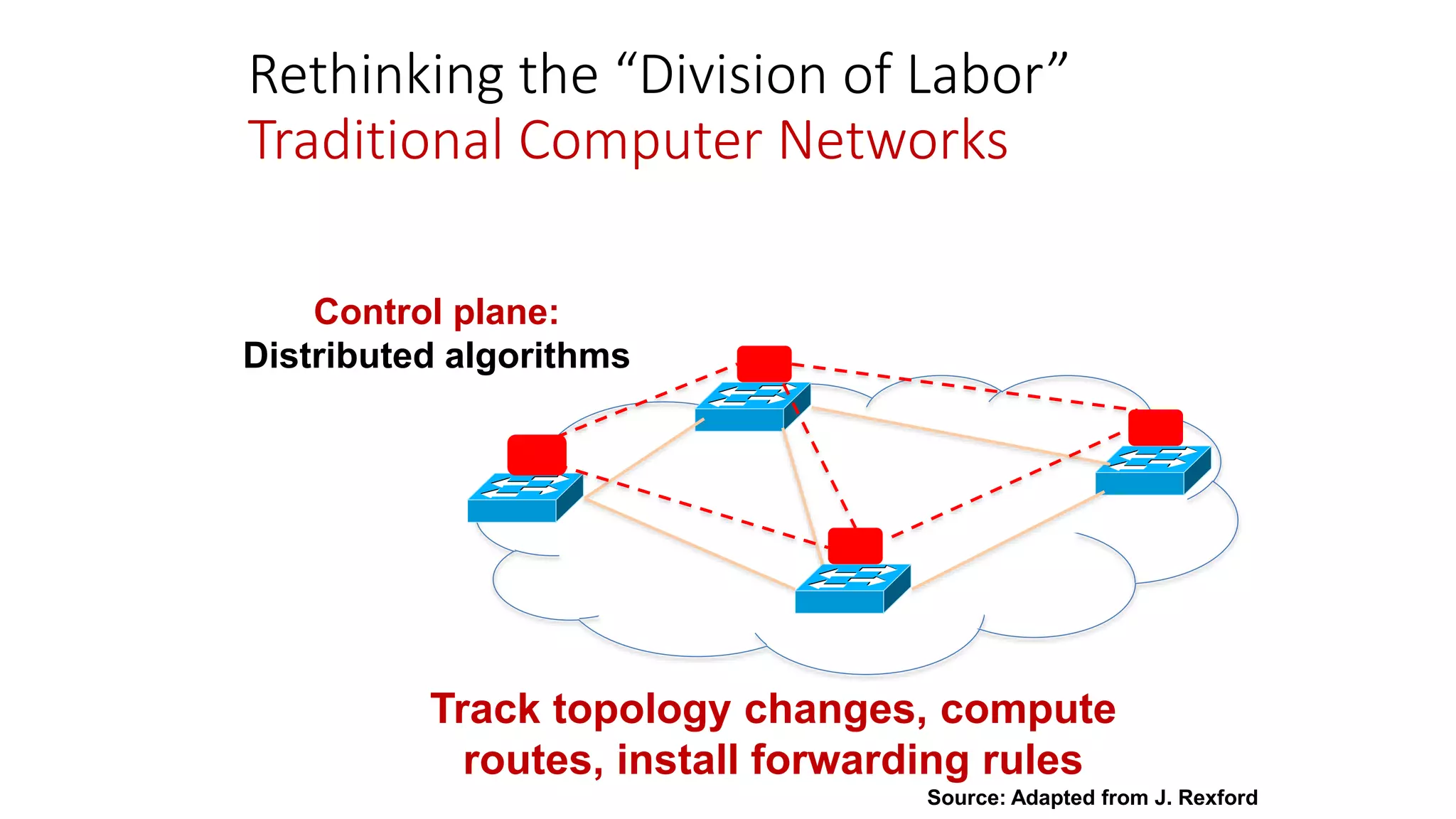
Track topology changes, compute
routes, install forwarding rules
Control plane:
Distributed algorithms
Rethinking the “Division of Labor”
Traditional Computer Networks
Source: Adapted from J. Rexford
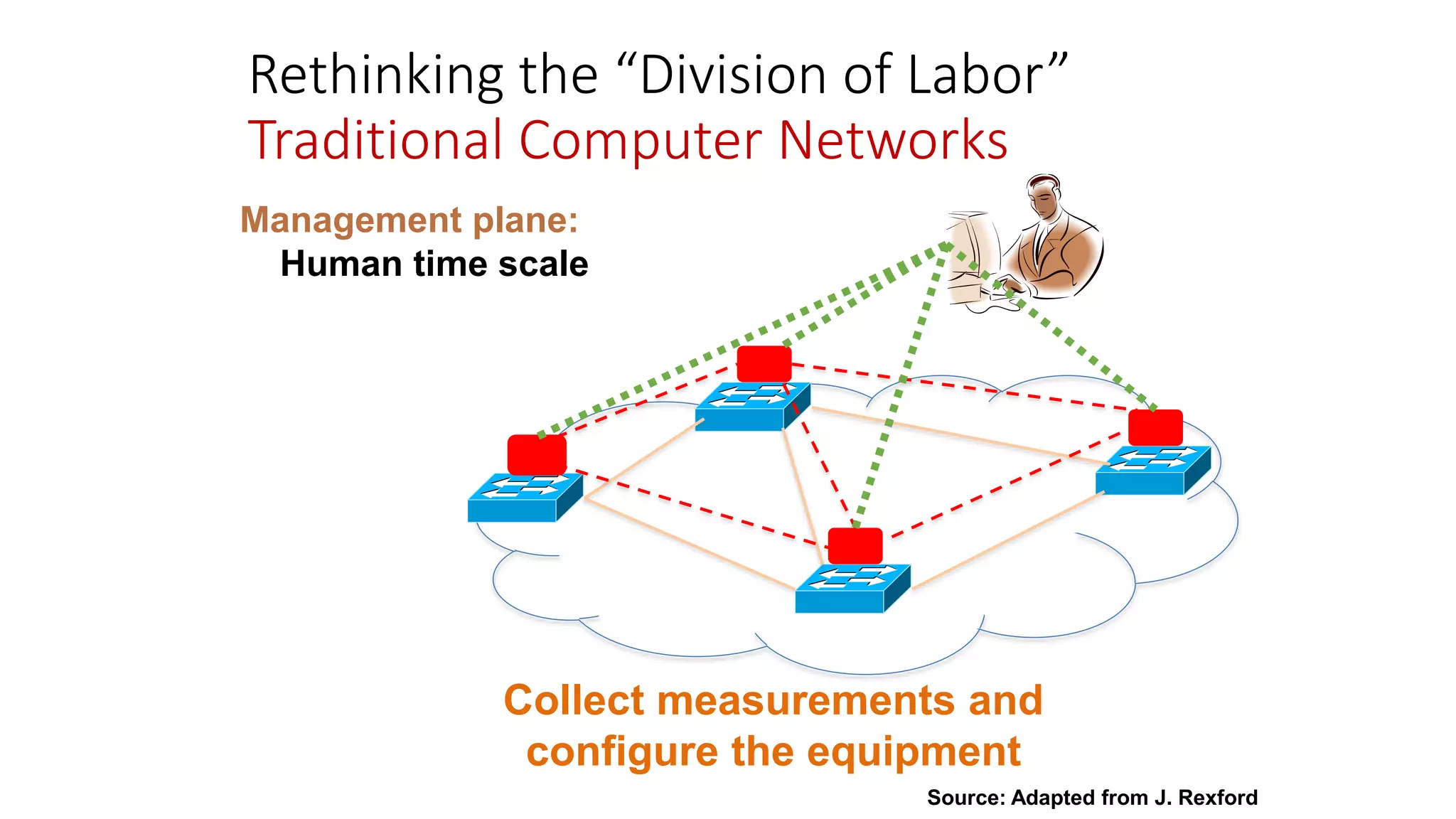
Collect measurements and
configure the equipment
Management plane:
Human time scale
Rethinking the “Division of Labor”
Traditional Computer Networks
Source: Adapted from J. Rexford
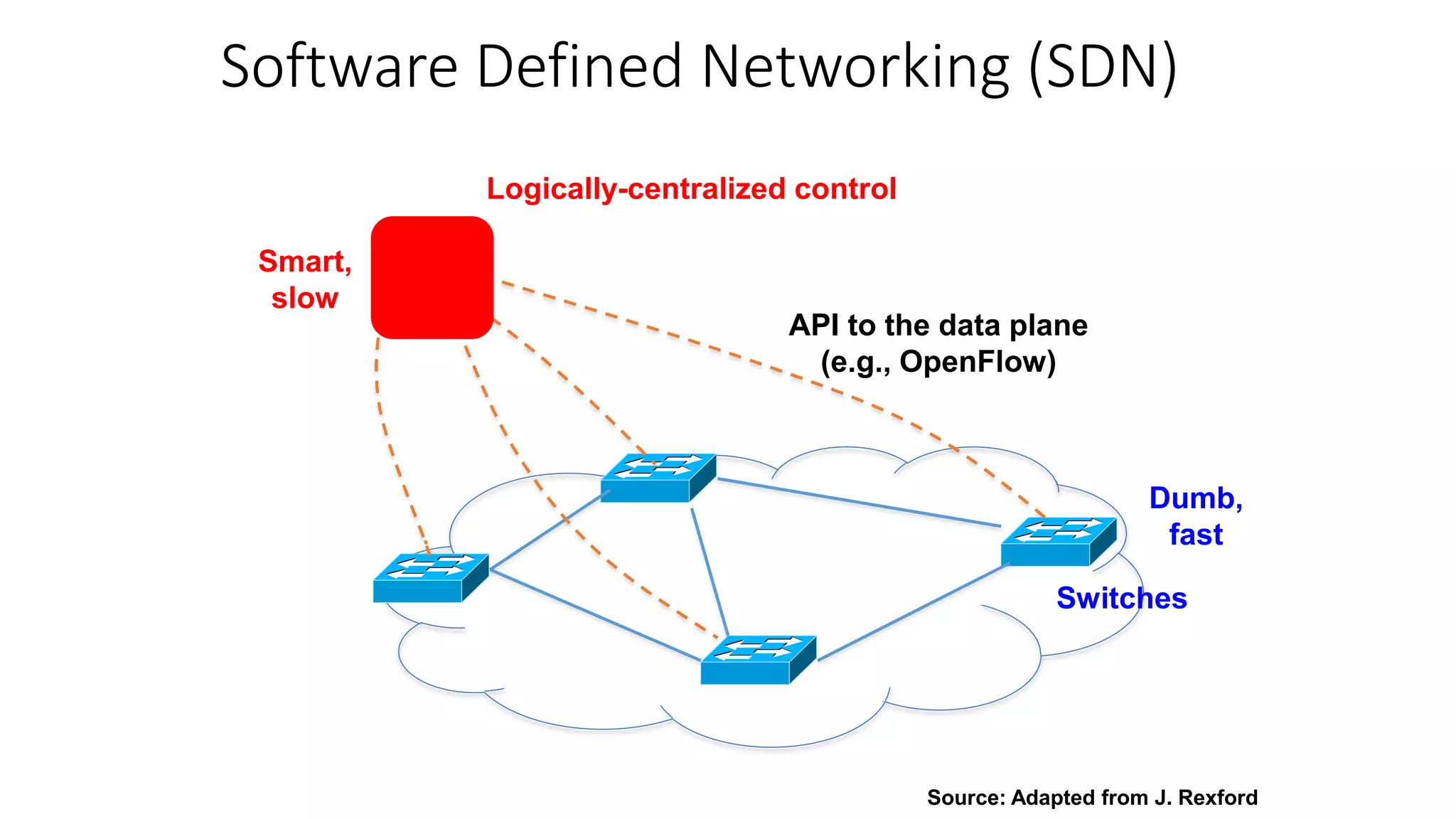
Software Defined Networking (SDN)
API to the data plane
(e.g., OpenFlow)
Logically-centralized control
Switches
Smart,
slow
Dumb,
fast
Source: Adapted from J. Rexford
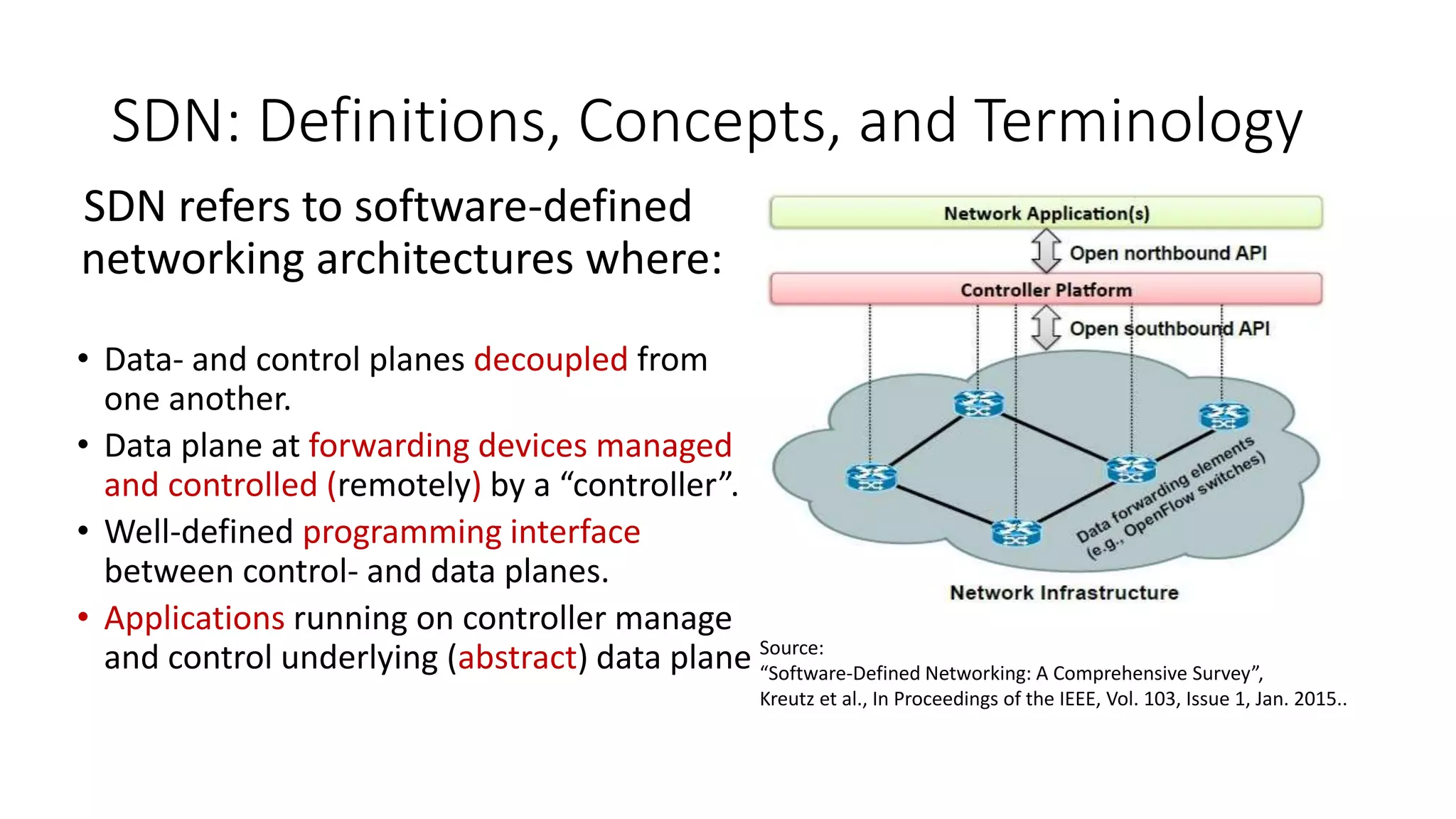
SDN refers to software-defined
networking architectures where:
• Data- and control planes decoupled from
one another.
• Data plane at forwarding devices managed
and controlled (remotely) by a “controller”.
• Well-defined programming interface
between control- and data planes.
• Applications running on controller manage
and control underlying (abstract) data plane Source:
“Software-Defined Networking: A Comprehensive Survey”,
Kreutz et al., In Proceedings of the IEEE, Vol. 103, Issue 1, Jan. 2015..
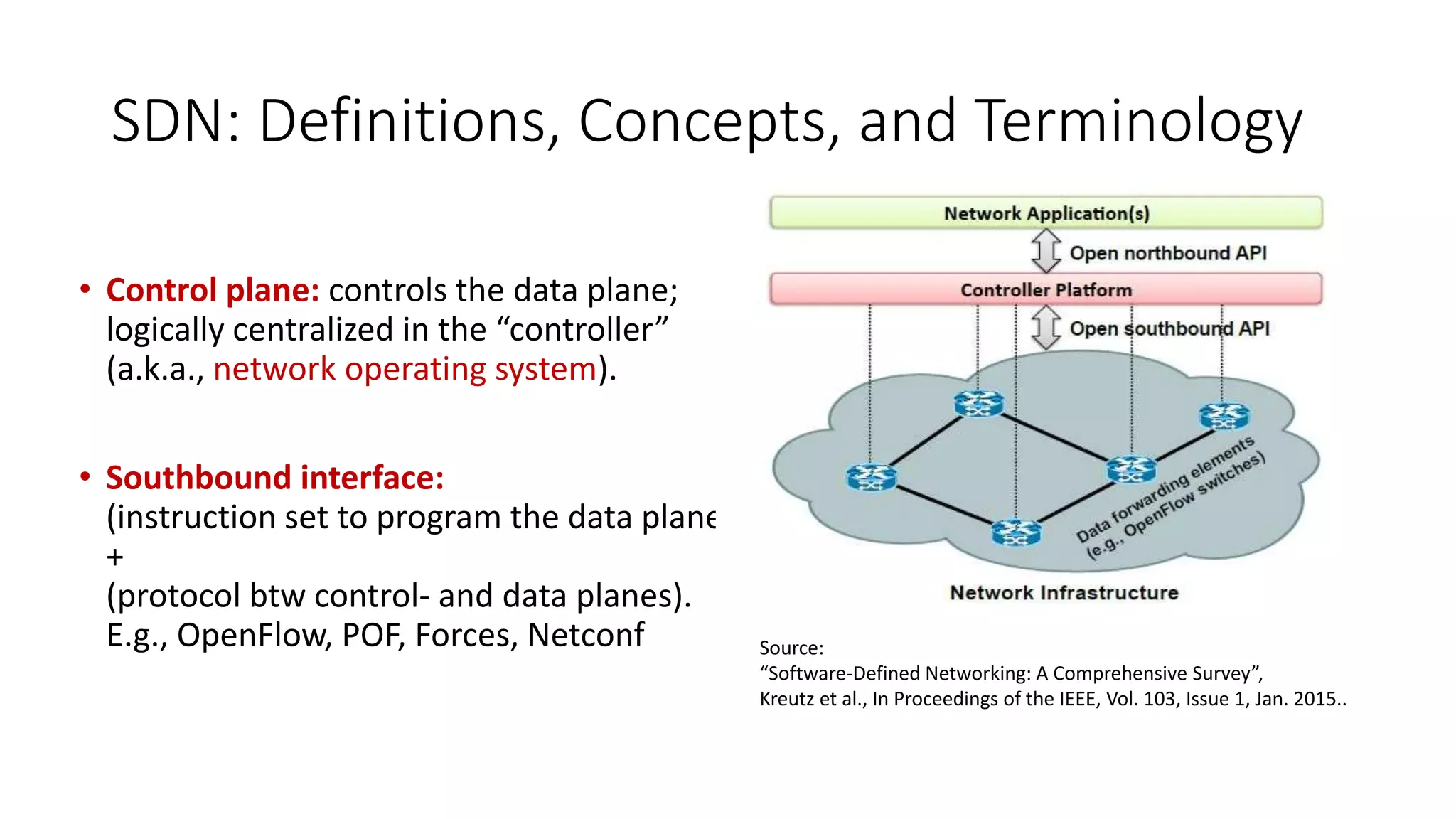
SDN: Definitions, Concepts, and Terminology
• Control plane: controls the data plane;
logically centralized in the “controller”
(a.k.a., network operating system).
• Southbound interface:
(instruction set to program the data plane)
+
(protocol btw control- and data planes).
E.g., OpenFlow, POF, Forces, Netconf
SDN: Definitions, Concepts, and Terminology
Source:
“Software-Defined Networking: A Comprehensive Survey”,
Kreutz et al., In Proceedings of the IEEE, Vol. 103, Issue 1, Jan. 2015..
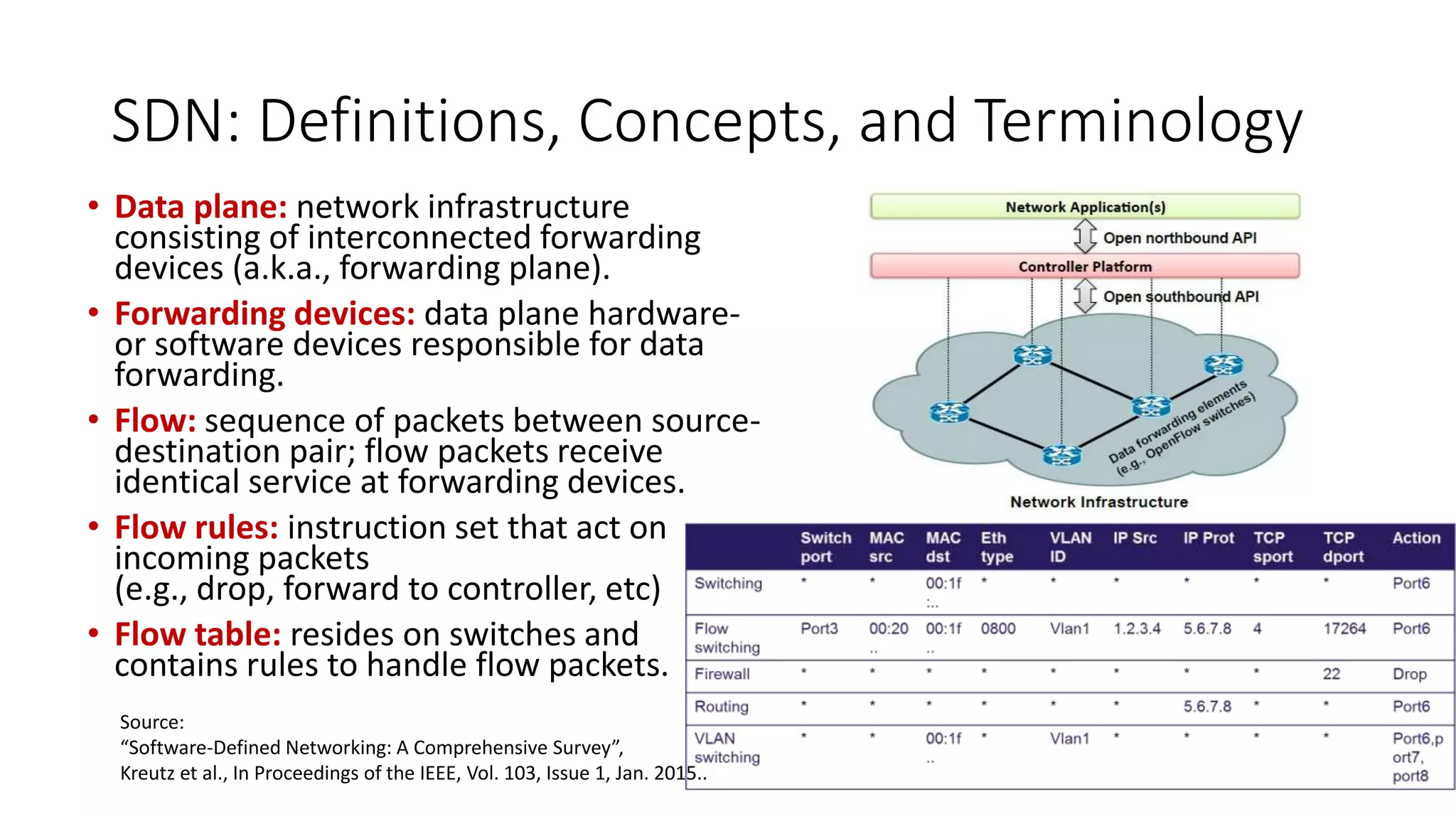
• Data plane: network infrastructure
consisting of interconnected forwarding
devices (a.k.a., forwarding plane).
• Forwarding devices: data plane hardware-
or software devices responsible for data
forwarding.
• Flow: sequence of packets between source-
destination pair; flow packets receive
identical service at forwarding devices.
• Flow rules: instruction set that act on
incoming packets
(e.g., drop, forward to controller, etc)
• Flow table: resides on switches and
contains rules to handle flow packets.
SDN: Definitions, Concepts, and Terminology
Source:
“Software-Defined Networking: A Comprehensive Survey”,
Kreutz et al., In Proceedings of the IEEE, Vol. 103, Issue 1, Jan. 2015..
SDN: Definitions, Concepts, and Terminology
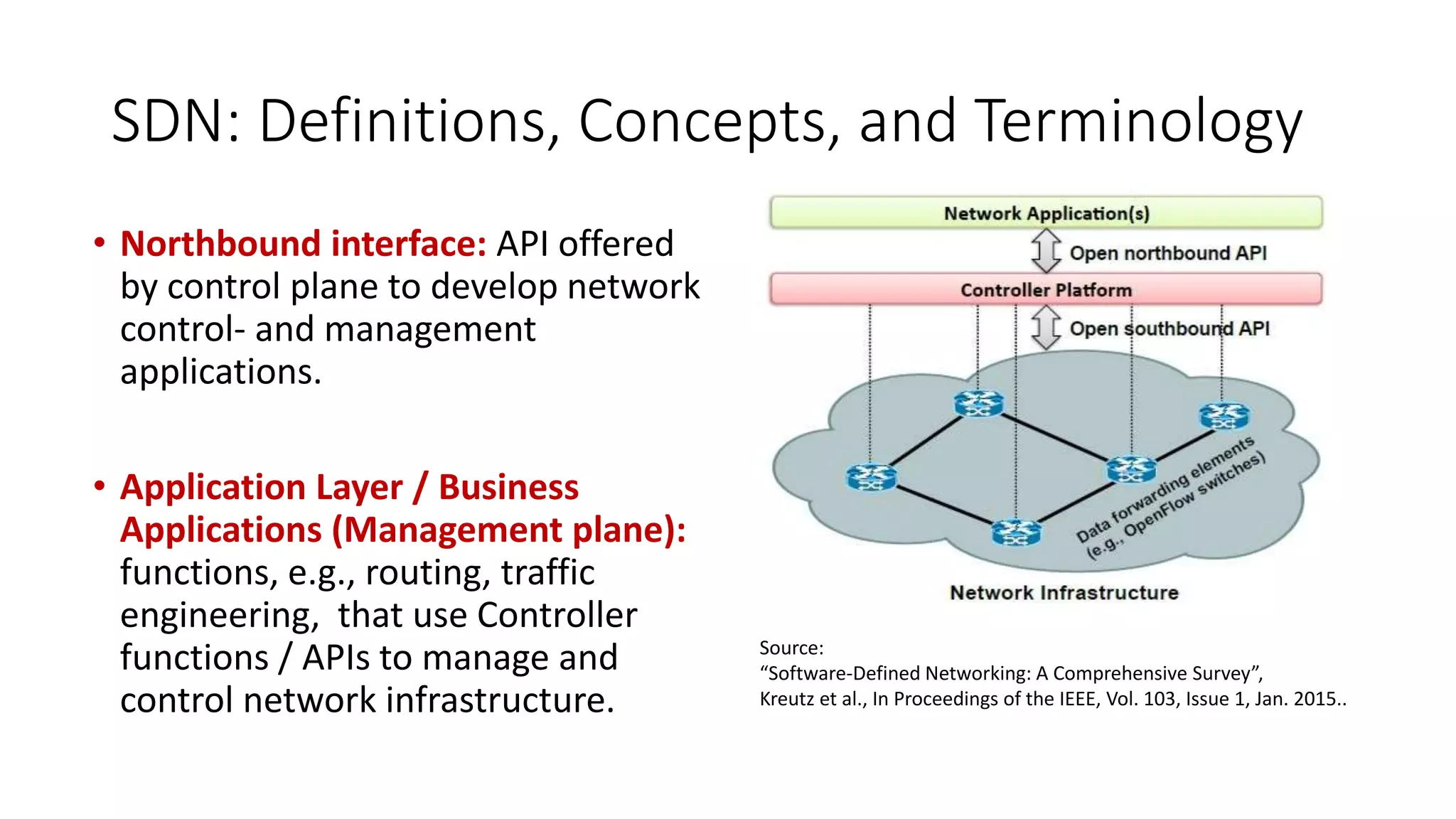
• Northbound interface: API offered
by control plane to develop network
control- and management
applications.
• Application Layer / Business
Applications (Management plane):
functions, e.g., routing, traffic
engineering, that use Controller
functions / APIs to manage and
control network infrastructure.
Source:
“Software-Defined Networking: A Comprehensive Survey”,
Kreutz et al., In Proceedings of the IEEE, Vol. 103, Issue 1, Jan. 2015..
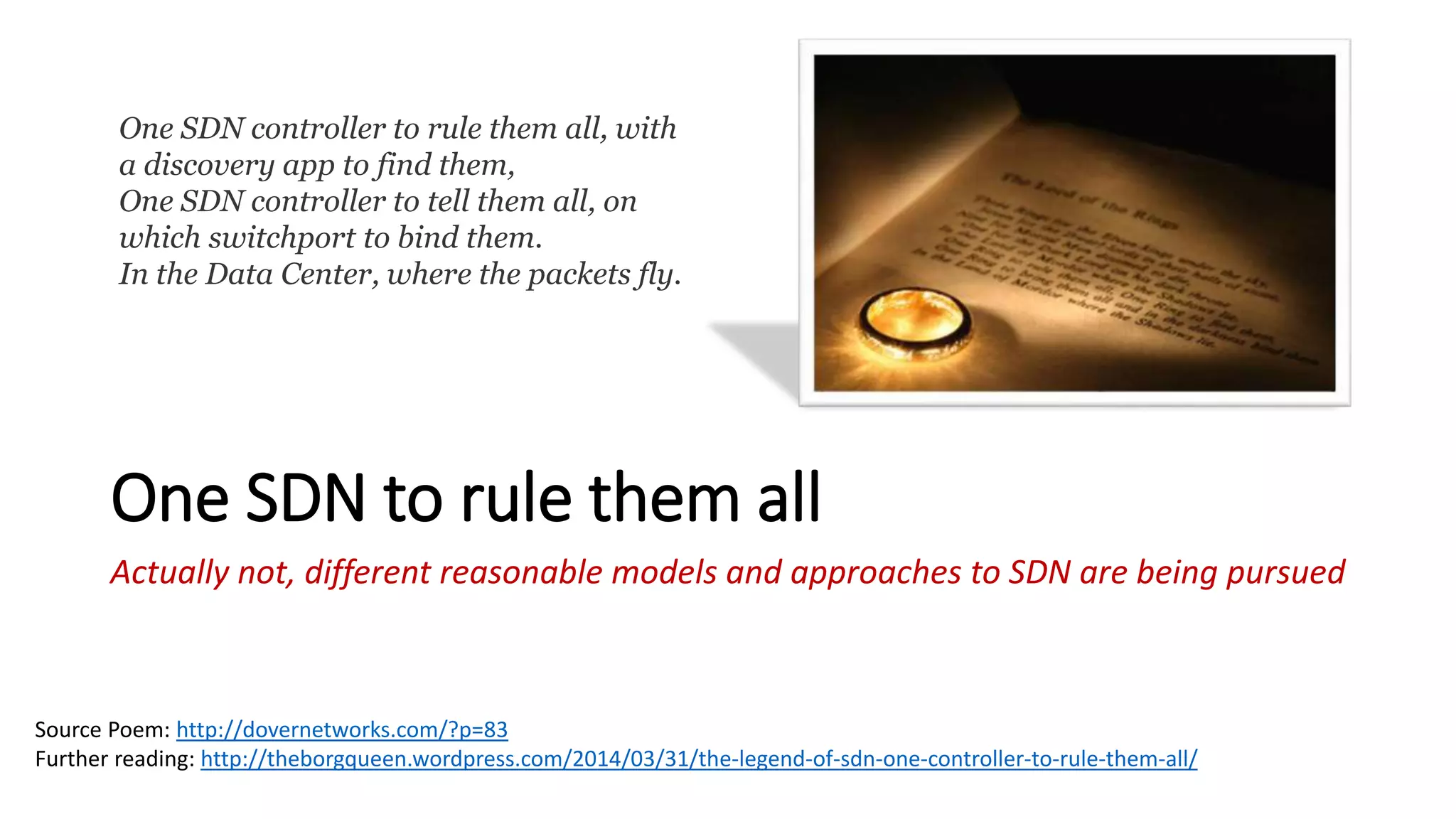
One SDN to rule them all
Actually not, different reasonable models and approaches to SDN are being pursued
One SDN controller to rule them all, with
a discovery app to find them,
One SDN controller to tell them all, on
which switchport to bind them.
In the Data Center, where the packets fly.
Source Poem: http://dovernetworks.com/?p=83
Further reading: http://theborgqueen.wordpress.com/2014/03/31/the-legend-of-sdn-one-controller-to-rule-them-all/
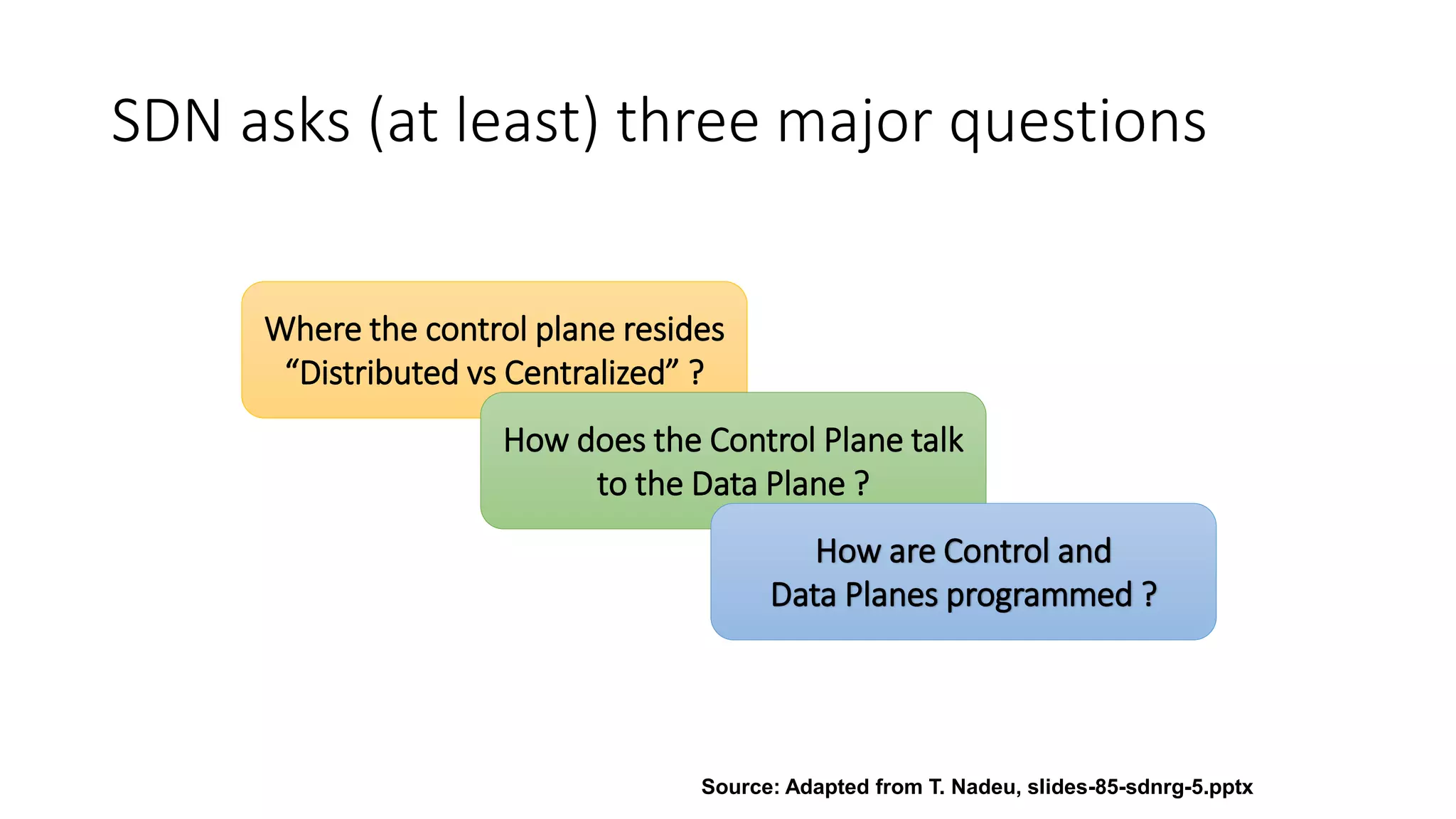
SDN asks (at least) three major questions
Where the control plane resides
“Distributed vs Centralized” ?
How does the Control Plane talk
to the Data Plane ?
How are Control and
Data Planes programmed ?
Source: Adapted from T. Nadeu, slides-85-sdnrg-5.pptx
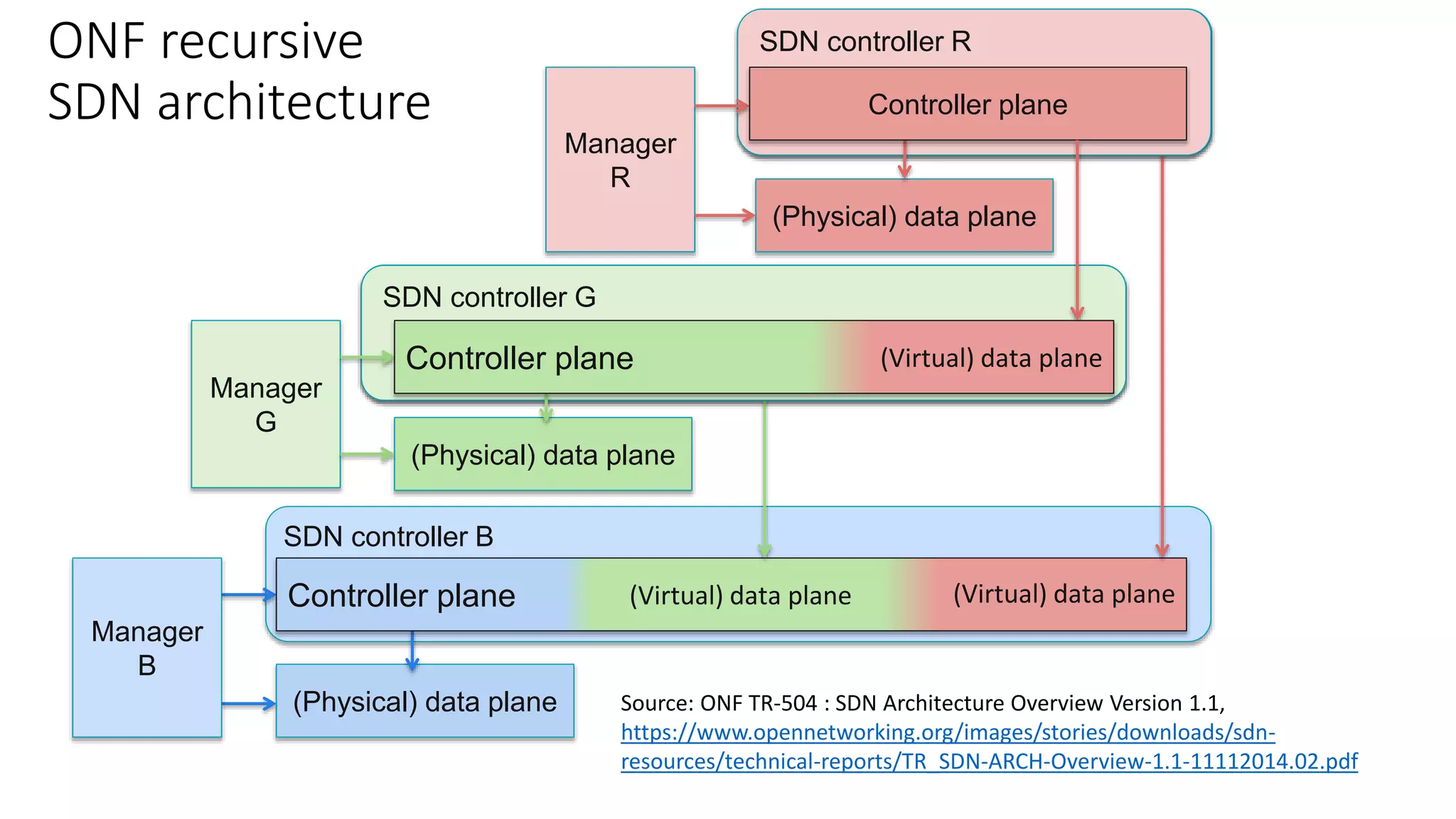
ONF recursive
SDN architecture
SDN controller B
(Physical) data plane
Manager
B
Customer G application
Controller plane (Virtual) data plane (Virtual) data plane
Customer R application
SDN controller G
(Physical) data plane
Manager
G
SDN controller R
(Physical) data plane
Manager
R
Controller plane
Controller plane (Virtual) data plane
Source: ONF TR-504 : SDN Architecture Overview Version 1.1,
https://www.opennetworking.org/images/stories/downloads/sdn-
resources/technical-reports/TR_SDN-ARCH-Overview-1.1-11112014.02.pdf
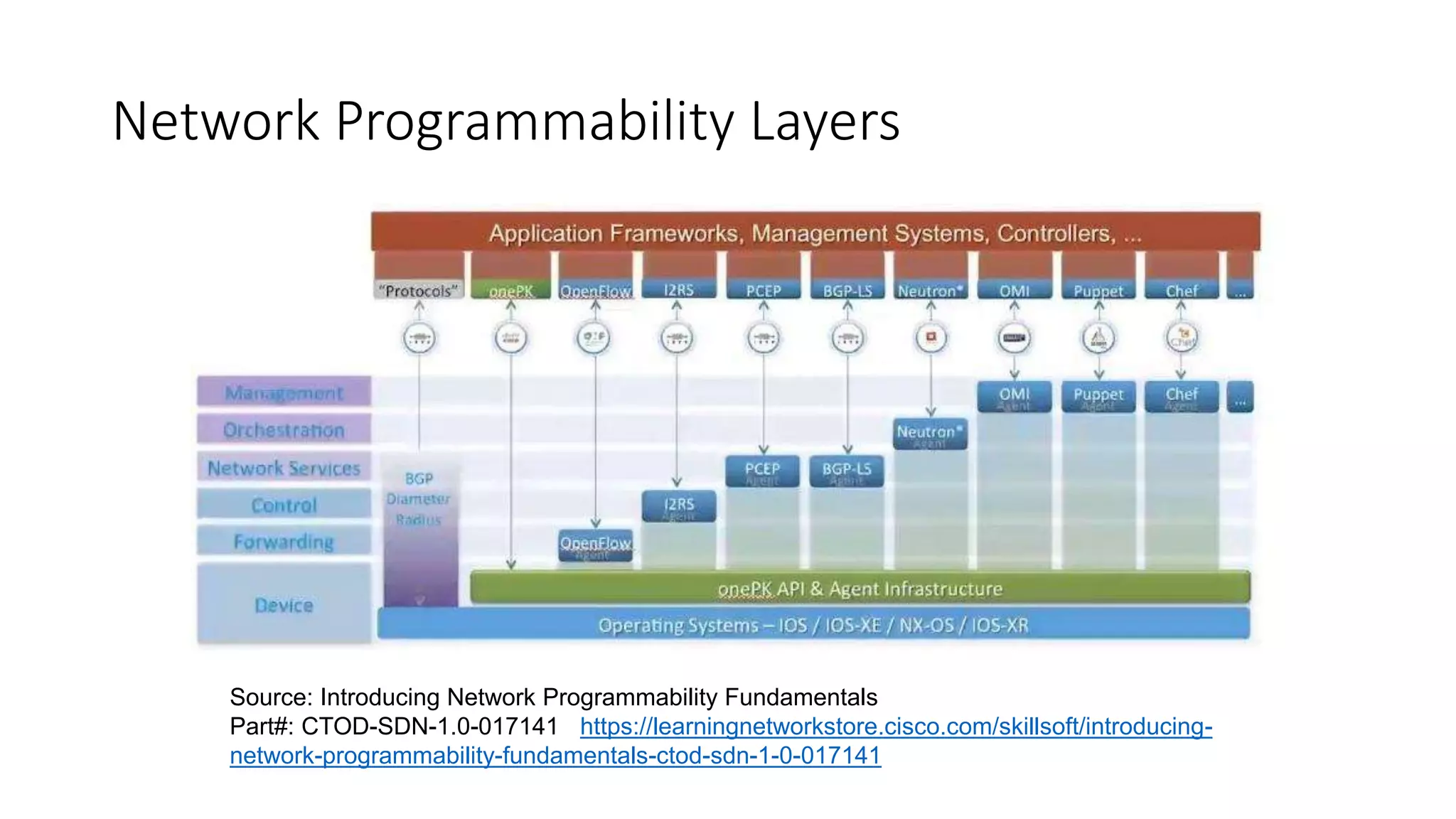
Network Programmability Layers
Source: Introducing Network Programmability Fundamentals
Part#: CTOD-SDN-1.0-017141 https://learningnetworkstore.cisco.com/skillsoft/introducing-
network-programmability-fundamentals-ctod-sdn-1-0-017141
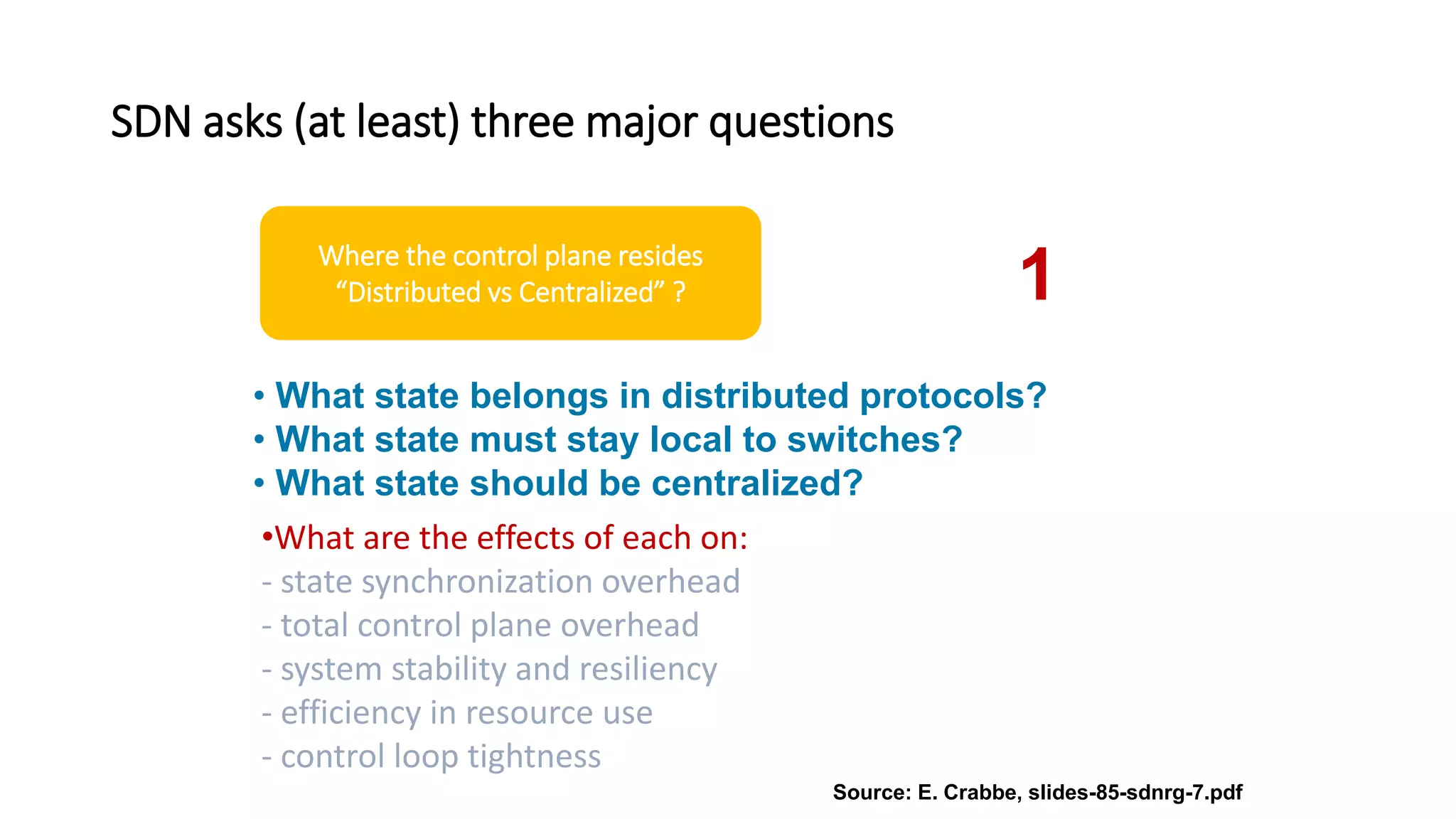
SDN asks (at least) three major questions
Where the control plane resides
“Distributed vs Centralized” ?
• What state belongs in distributed protocols?
• What state must stay local to switches?
• What state should be centralized?
•What are the effects of each on:
- state synchronization overhead
- total control plane overhead
- system stability and resiliency
- efficiency in resource use
- control loop tightness
Source: E. Crabbe, slides-85-sdnrg-7.pdf
1
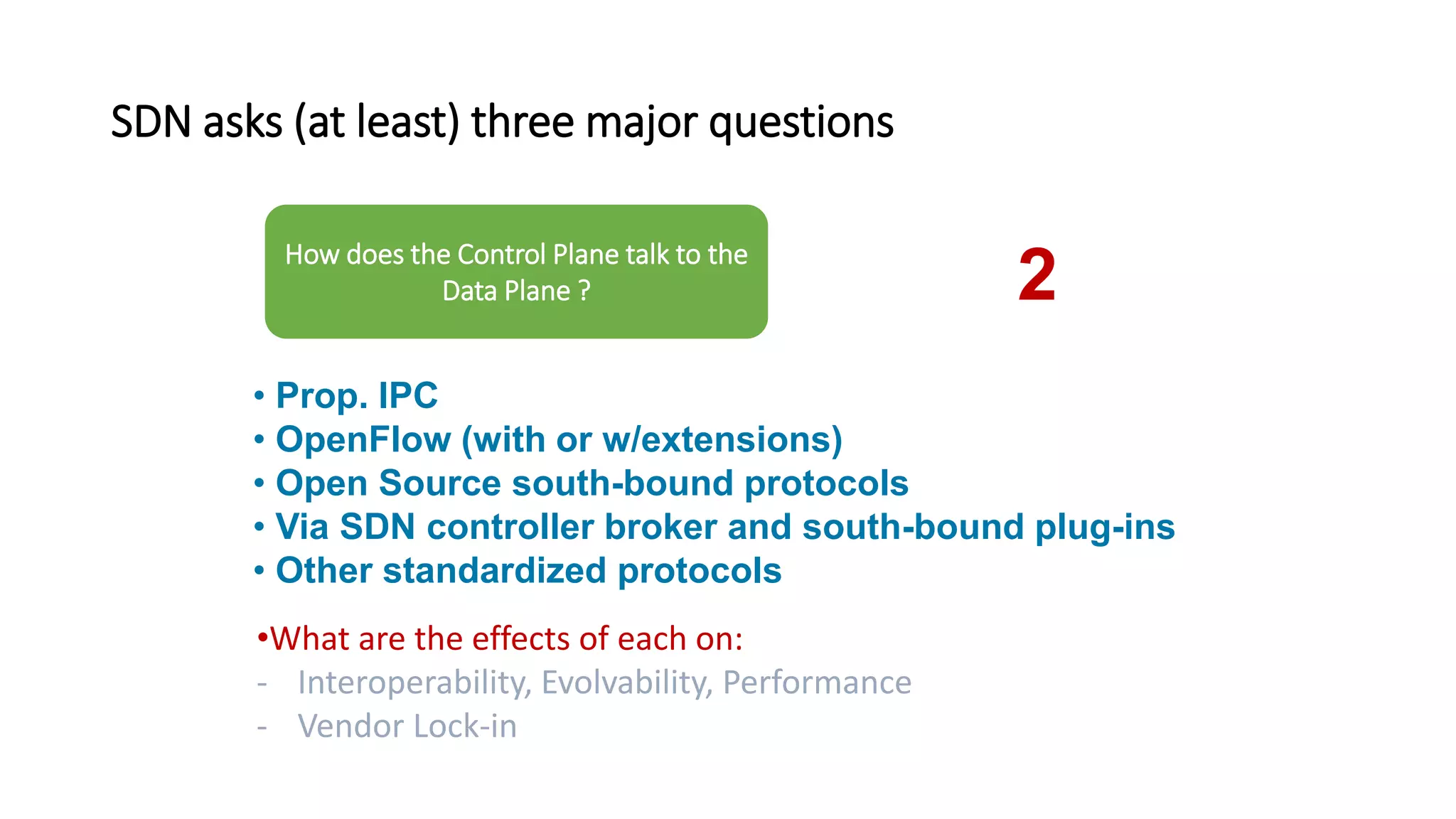
SDN asks (at least) three major questions
• Prop. IPC
• OpenFlow (with or w/extensions)
• Open Source south-bound protocols
• Via SDN controller broker and south-bound plug-ins
• Other standardized protocols
•What are the effects of each on:
- Interoperability, Evolvability, Performance
- Vendor Lock-in
How does the Control Plane talk to the
Data Plane ? 2
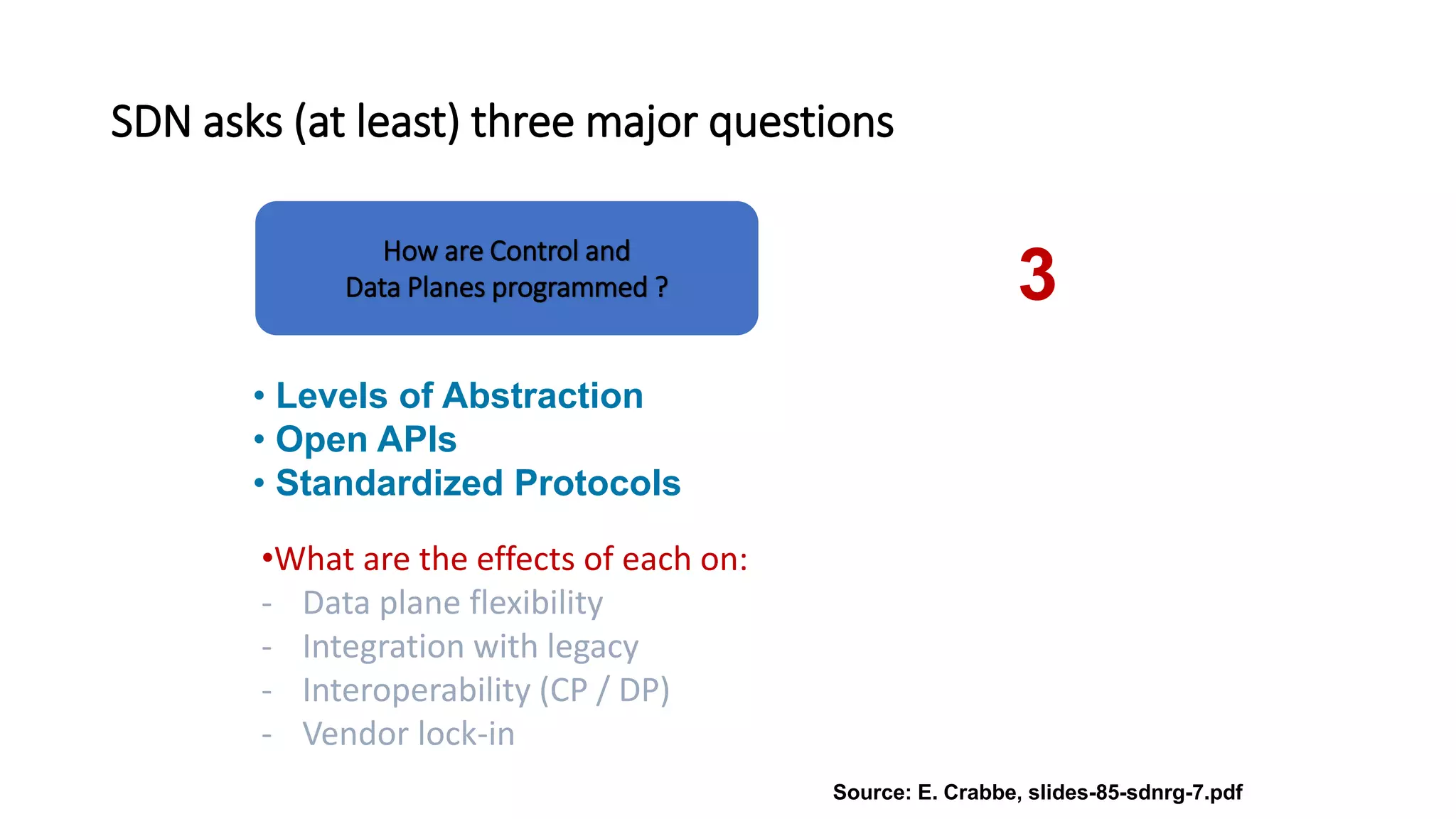
SDN asks (at least) three major questions
• Levels of Abstraction
• Open APIs
• Standardized Protocols
•What are the effects of each on:
- Data plane flexibility
- Integration with legacy
- Interoperability (CP / DP)
- Vendor lock-in
Source: E. Crabbe, slides-85-sdnrg-7.pdf
How are Control and
Data Planes programmed ? 3
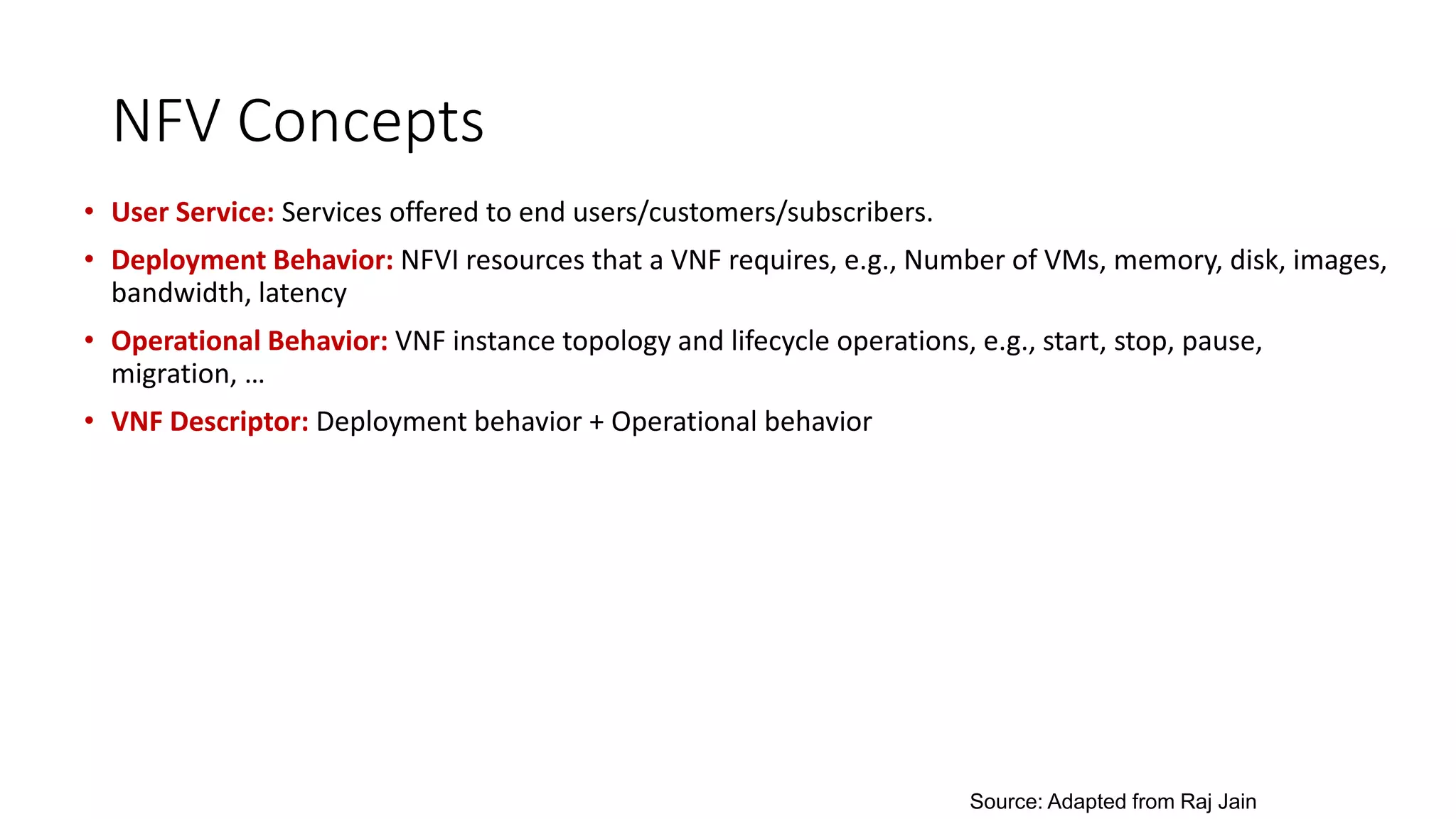
NFV Concepts
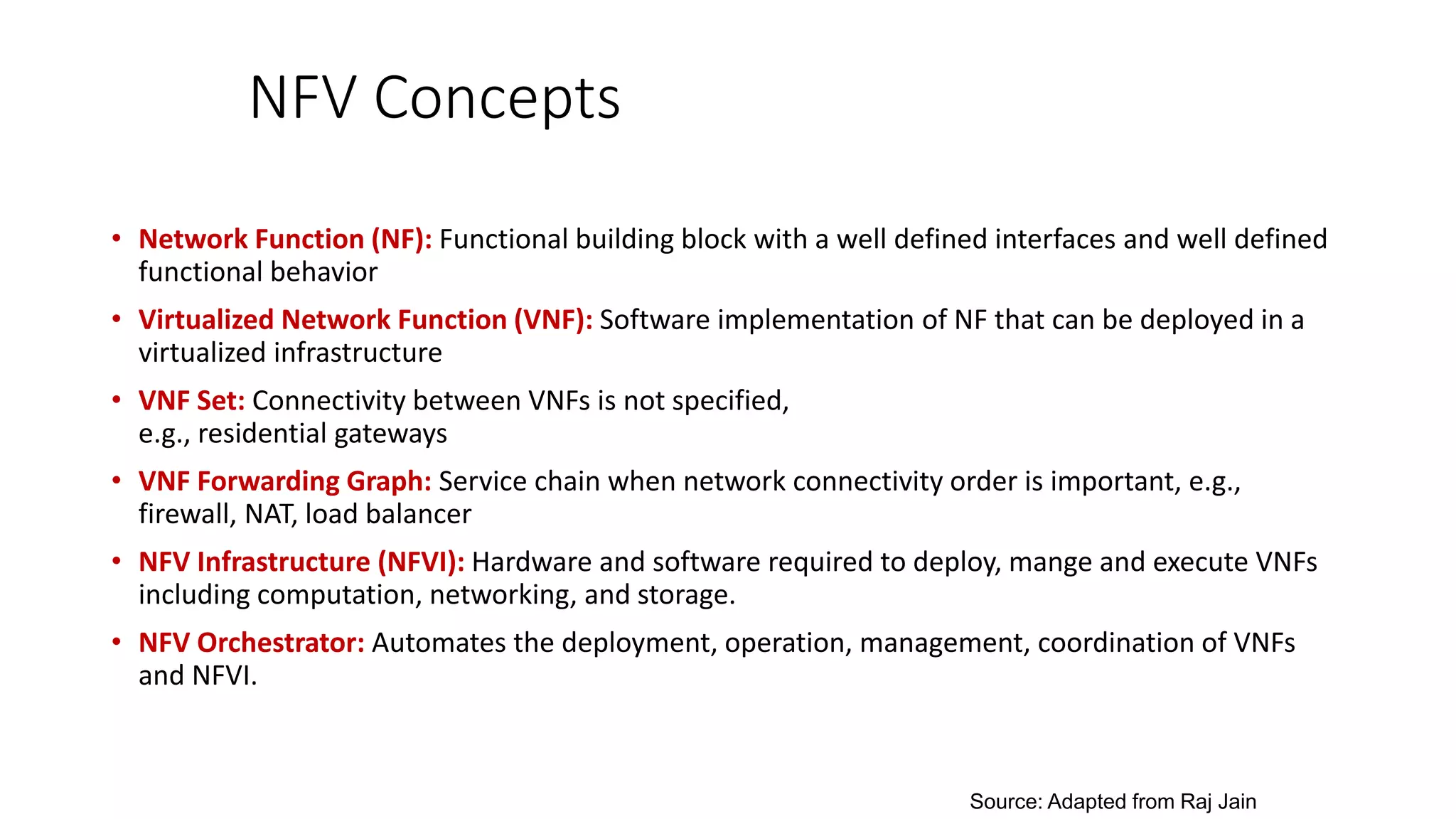
• Network Function (NF): Functional building block with a well defined interfaces and well defined
functional behavior
• Virtualized Network Function (VNF): Software implementation of NF that can be deployed in a
virtualized infrastructure
• VNF Set: Connectivity between VNFs is not specified,
e.g., residential gateways
• VNF Forwarding Graph: Service chain when network connectivity order is important, e.g.,
firewall, NAT, load balancer
• NFV Infrastructure (NFVI): Hardware and software required to deploy, mange and execute VNFs
including computation, networking, and storage.
• NFV Orchestrator: Automates the deployment, operation, management, coordination of VNFs
and NFVI.
Source: Adapted from Raj Jain
NFV Concepts
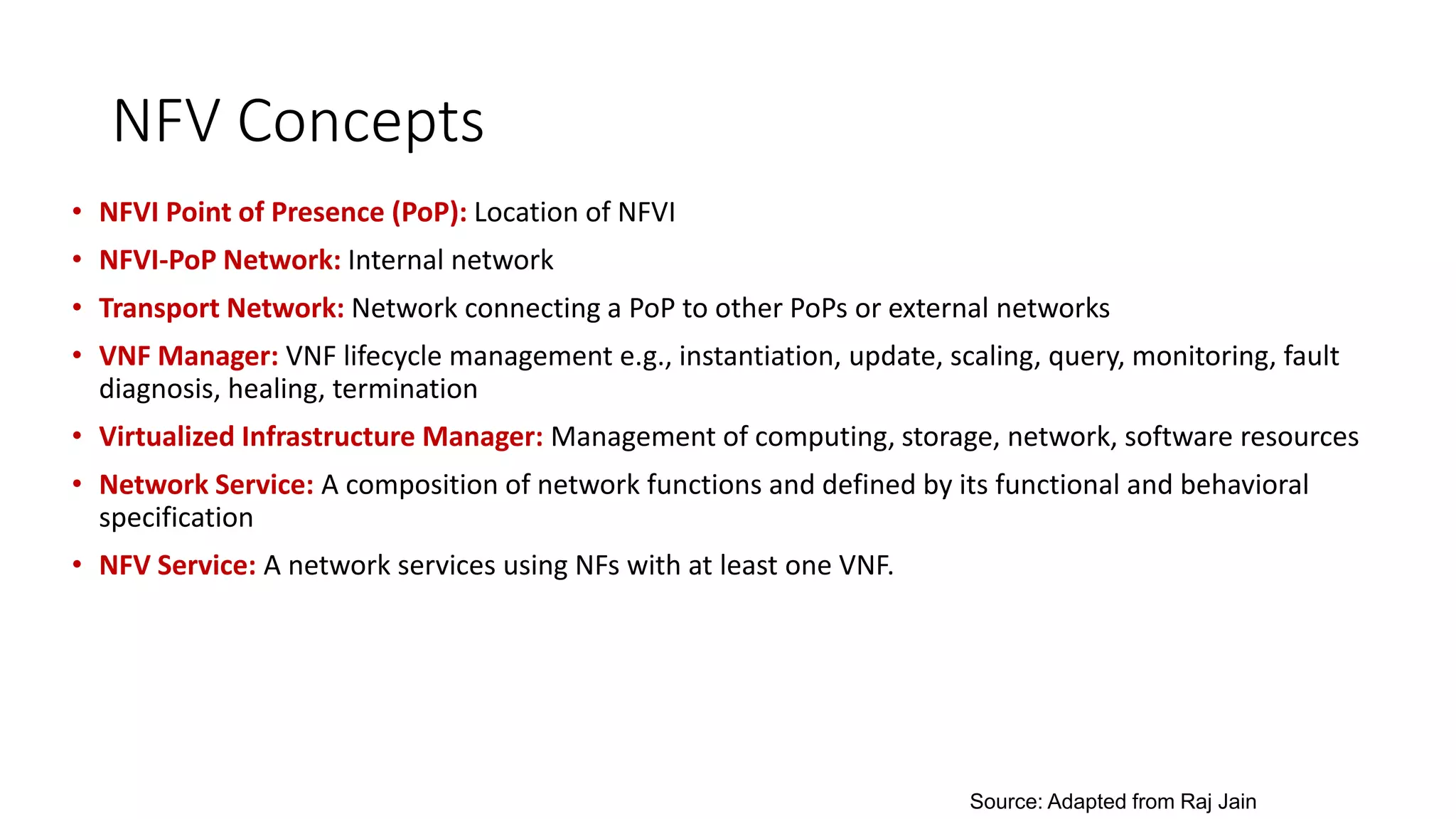
• NFVI Point of Presence (PoP): Location of NFVI
• NFVI-PoP Network: Internal network
• Transport Network: Network connecting a PoP to other PoPs or external networks
• VNF Manager: VNF lifecycle management e.g., instantiation, update, scaling, query, monitoring, fault
diagnosis, healing, termination
• Virtualized Infrastructure Manager: Management of computing, storage, network, software resources
• Network Service: A composition of network functions and defined by its functional and behavioral
specification
• NFV Service: A network services using NFs with at least one VNF.
Source: Adapted from Raj Jain
NFV Concepts
• User Service: Services offered to end users/customers/subscribers.
• Deployment Behavior: NFVI resources that a VNF requires, e.g., Number of VMs, memory, disk, images,
bandwidth, latency
• Operational Behavior: VNF instance topology and lifecycle operations, e.g., start, stop, pause,
migration, …
• VNF Descriptor: Deployment behavior + Operational behavior
Source: Adapted from Raj Jain
Architectural Framework [ETSI NFV]
Souce: ETSI NFV White Paper 2
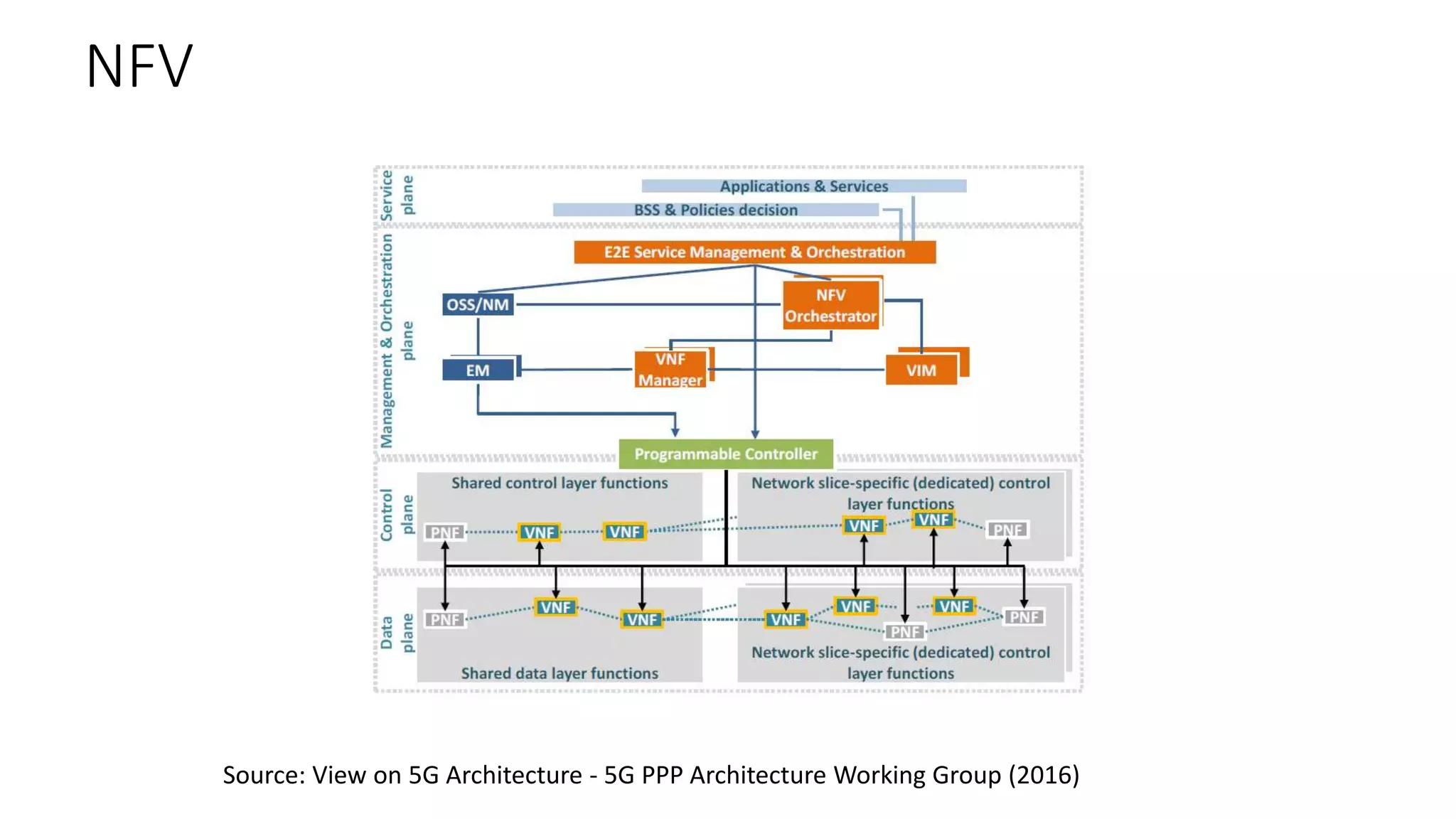
NFV
Source: View on 5G Architecture - 5G PPP Architecture Working Group (2016)
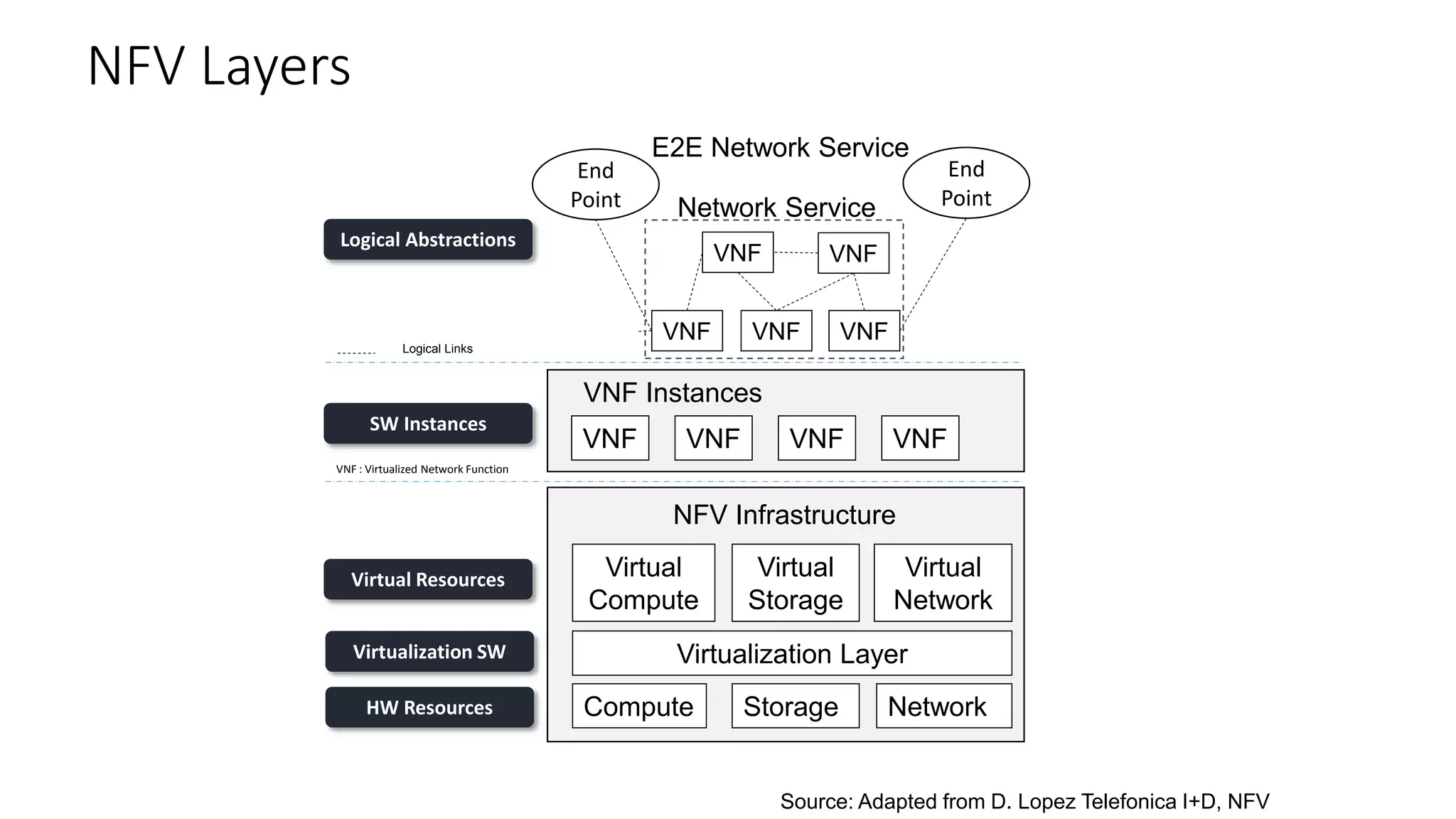
NFV Layers
NFV Infrastructure
End
Point
End
Point
E2E Network Service
Compute Storage NetworkHW Resources
Virtualization LayerVirtualization SW
Virtual
Compute
Virtual
Storage
Virtual
Network
Virtual Resources
Logical Abstractions
Network Service
VNF VNF VNF
VNF VNF
Logical Links
VNF Instances
VNF VNF VNF
SW Instances
VNF : Virtualized Network Function
VNF
Source: Adapted from D. Lopez Telefonica I+D, NFV
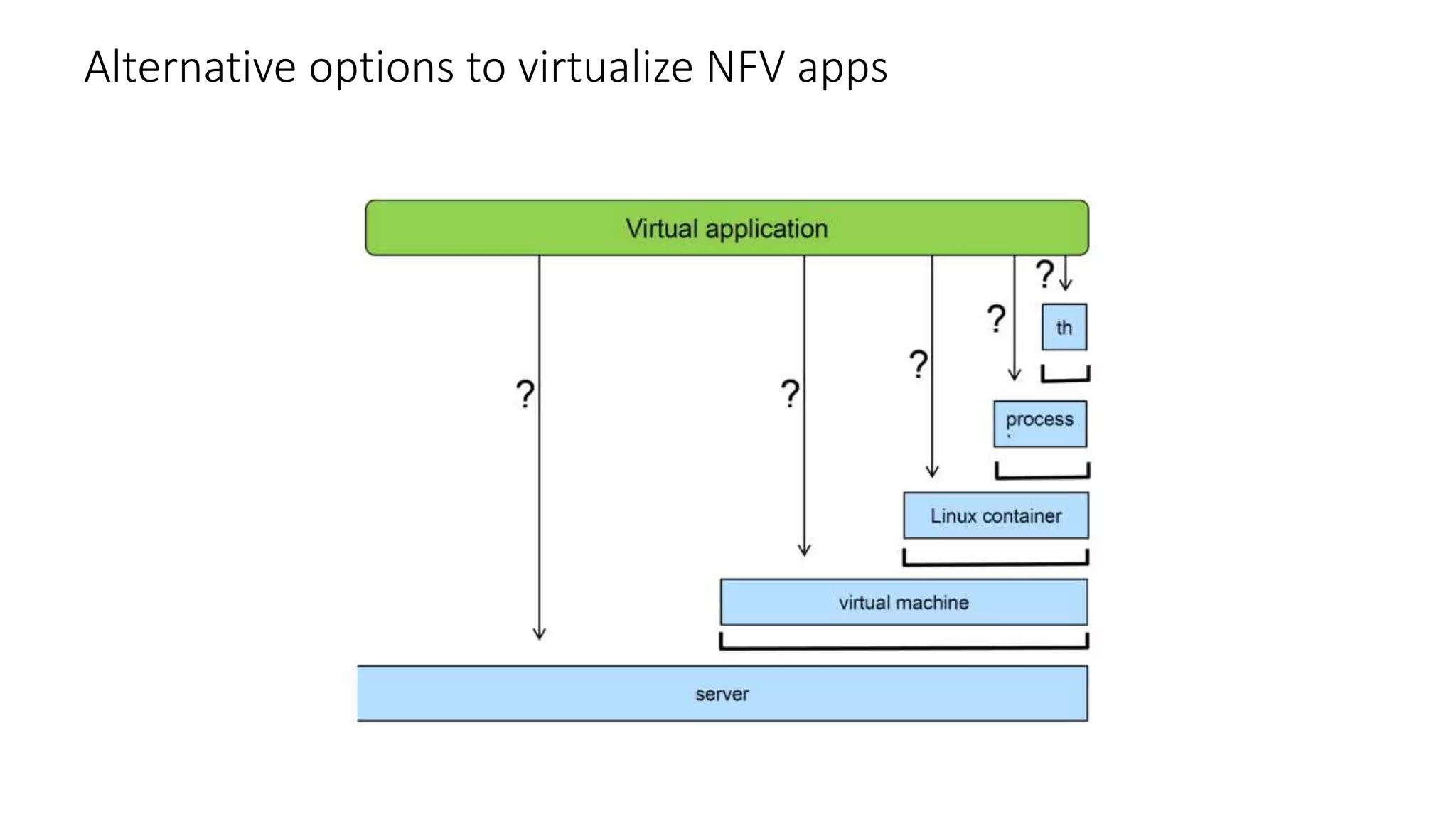
Alternative options to virtualize NFV apps

2016 open-source-network-softwarization

  • 1.
    On the roleof Open Source in the Network Softwarization trend Christian Esteve Rothenberg Palestra da Série de Seminários do IC/Unicamp Nov 18, 2016
  • 2.
    Agenda • What isNetwork Softwarization • Open Source & Networking • Some experiences and ongoing activities
  • 3.
    Network Softwarization? Source: Image (right)http://stunlaw.blogspot.com.br/2013/08/softwarization-tentative-genealogy.html Image (leftt) https://kc4lmd.files.wordpress.com/2015/01/computer-network-networking-austin.jpg
  • 4.
    Network Softwarization Existing • CLIs •Closed Source • Vendor Lead • Classic Network Appliances New • APIs • Open Source • Customer Lead • Network Function Virtualization (NFV)Adapted from: Kyle Mestery, Next Generation Network Developer Skills
  • 5.
    Network Softwarization =SDN & NFV Network Programmability /Flexibility Sources: Ahmad Rostami, Ericsson Research (Kista): http://www.itc26.org/fileadmin/ITC26_files/ITC26-Tutorial-Rostami.pdf and Uwe Michel, T-Systems
  • 6.
    A means tomake the network more flexible and simple by minimizing dependence on HW constraints Network Function Virtualization (NFV) Source: Adapted from D. Lopez Telefonica I+D, NFV
  • 7.
    Network equipment as Blackboxes Open interfaces (OpenFlow) for instructing the boxes what to do SDN Boxes with autonomous behaviour Decisions are taken out of the box FEATURE FEATURE OPERATING SYSTEM SPECIALIZED PACKET FORWARDING HARDWAREFEATURE FEATURE OPERATING SYSTEM SPECIALIZED PACKET FORWARDING HARDWARE FEATURE FEATURE OPERATING SYSTEM SPECIALIZED PACKET FORWARDING HARDWAREFEATURE FEATURE OPERATING SYSTEM SPECIALIZED PACKET FORWARDING HARDWARE SDN Adapting OSS to manage black boxes Simpler OSS to manage the SDN controller SDN FEATURE FEATURE OPERATING SYSTEM SPECIALIZED PACKET FORWARDING HARDWAREFEATURE FEATURE OPERATING SYSTEM SPECIALIZED PACKET FORWARDING HARDWARE FEATURE FEATURE OPERATING SYSTEM SPECIALIZED PACKET FORWARDING HARDWAREFEATURE FEATURE OPERATING SYSTEM SPECIALIZED PACKET FORWARDING HARDWARE Software Defined Networking (SDN) Source: Adapted from D. Lopez Telefonica I+D, NFV
  • 8.
    NFV vs. SDN SDN››› flexible forwarding & steering of traffic in a physical or virtual network environment [Network Re-Architecture] NFV ››› flexible placement of virtualized network functions across the network & cloud [Appliance Re-Architecture] (initially) ››› SDN & NFV are complementary tools for achieving full network programmability
  • 9.
    Why NFV/SDN? 1. Virtualization:Use network resource without worrying about where it is physically located, how much it is, how it is organized, etc. 2. Orchestration: Manage thousands of devices 3. Programmability: Should be able to change behavior on the fly. 4. Dynamic Scaling: Should be able to change size, quantity, as a F(load) 5. Automation: Let machines / software do humans’ work 6. Visibility: Monitor resources, connectivity 7. Performance: Optimize network device utilization 8. Multi-tenancy: Slice the network for different customers (as-a-Service) 9. Service Integration: Let network management play nice with OSS/BSS 10. Openness: Full choice of modular plug-ins Source: Adapted from Raj Jain Note: These are exactly the same reasons why we need/want SDN/NFV. Obs: Core difference on the (complementary) SDN and NFV approaches (how?). (SDN :: decoupling of control plane, NFV : decoupling of SW function from HW)
  • 10.
    Intellectual History ofProgrammable Networks Source: N. Feamster, J. Rexford, E. Zegura. The Road to SDN: An Intellectual History of Programmable Networks. http://gtnoise.net/papers/drafts/sdn-cacm-2013-aug22.pdf SDN NFV
  • 11.
    Different SDN Models Control-planecomponent(s) Data-plane component(s) Canonical/Open SDN Traditional Hybrid/Broker Overlay Compiler
  • 12.
    Legacy Different SDN Modelsto Program / Refactor the Stack Data Plane Mgm.APIs Distributed L2/L3 Control Plane Managemt Software Mgm. Apps Southbound Agent (e.g. OF) Network Controller / OS Southbound Protocol (e.g. OF) Business / Control Apps Northbound APIs Mgm. HAL APIs / Drivers Orchestrator APIs Compiler Auto-GeneratedTarget Binary SDN VNF GP-CPU (x86, ARM) HW Resources Virtualization DP CP M g m. NFV VNFM (Manager) VIM (Infra-M) OSS/BSS APIs Southbound APIs/Plugins
  • 13.
    Open Source &Networking
  • 14.
    Open Source MetNetworking long time ago Up until recently, mainly (1) software appliances with limited scope; (2) management plane
  • 15.
    Why Open Sourcein Networking? • Higher reliability, more flexibility • Faster, lower cost, and higher quality development • Collaborative decisions about new features and roadmaps • A common environment for users and app developers • Ability for users to focus resources on differentiating development • Opportunity to drive open standards Bottom Line: The open source model significantly accelerates consensus, delivering high performing, peer-reviewed code that forms a basis for an ecosystem of solutions. Source: Open Source in a Closed Network – Prodip Sen (OPNFV Summit 2015)
  • 16.
    Why Open Sourcein Networking? • Higher reliability, more flexibility • Faster, lower cost, and higher quality development • Collaborative decisions about new features and roadmaps • A common environment for users and app developers • Ability for users to focus resources on differentiating development • Opportunity to drive open standards
  • 17.
    Standard Development &Open Source Organizations Source: SDN IEEE Outreach, http://sdn.ieee.org/outreach Academia Industry
  • 18.
    Foundations : TheNew Player Target Collaboration • Neutral and non-competing • Legal framework for licensing, copyright, intellectual property management "Companies feel they can collaborate on an open source project through an independent, not-for-profit entity that they trust - this is incredibly important to them," --Allison Randa (Board President of Open Source Initiative)
  • 19.
    Recent Events involvingOpen Source • The Battle for the Hypervisor Switch1 • Open vSwitch vs Nexus1000v vs Hyper-V Virtual Switch • The Battle for the Cloud: Stack Wars • Stack wars: OpenStack v. CloudStack v. Eucalyptus • The Battle for the SDN control platform • OpenDaylight vs Floodlight vs etc. etc. • The Battle for the SDN Northbound APIs • ONF vs OpenDaylight vs OpenStack vs etc. • ONF OpenFlow Driver Competition • An open source driver to accelerate developments 1http://www.networkworld.com/community/blog/battle-hypervisor-switch-and-future-networking
  • 20.
    NFV >>> AcceleratingTransformation Source: Adapted from D. Lopez Telefonica I+D, NFV
  • 21.
    Sisyphus on DifferentHills Telco Operators Equipment Vendors SDOs 2-6 Years Demand Drive Standardise Implement Sell Deploy Critical mass of supporters Develop Deploy Publish 2-6 Months Telco Cycle Service Providers Cycle 2-6 years 2-6 months Service Providers AVAILABLE AVAILABLE Idea !! Idea !! Source: Telefonica I+D / ETSI NFV
  • 22.
    Open Source SDN/NFV& Standardization Evolving and accelerating the path to standardization Further Reading: • IETF Trends and Observations draft-arkko-ietf-trends-and-observations-00 • Source of table: "When Open Source Meets Network Control Planes." In IEEE Computer (Special Issue on Software-Defined Networking), vol.47, Nov. 2014. • Source of figure: A. Manzalini et al., “ Towards 5G Software-Defined Ecosystems”
  • 23.
    Open Source SDNProjects (2014 snapshot) Source: "When Open Source Meets Network Control Planes." In IEEE Computer (Special Issue on Software-Defined Networking). 2014.
  • 24.
    Open Source BuildingBlocks 2015 – 2016: Several New Projects Source: The Open Source NFV Eco-system and OPNFV’s Role Therein – Frank Brockners (OPNFV Summit 2016)
  • 25.
    NFV Growing ecosystem ©Fraunhofer FOKUS NFVO
  • 26.
  • 27.
  • 28.
  • 29.
  • 30.
    Continuous Integration Environment •Continuous Integration tool chain speeds development and facilitates collaboration • Gerrit – code review tool • GitHub - code repository • Jenkins – automated build tool • Maven – code build • Ansible/Chef/Puppet – code deployment tool • Docker/Vagrant – deployment to Containers/VMs Source: Open Source Carrier Networking – Chris Donley (OPNFV Summit 2016)
  • 31.
    Example: NTT (TMFORUM 2016) Source: A Transformation From Legacy Operation to Agile Operation – Makoto Eguchi (TM FORUM 2016)
  • 32.
    All of ThisLeads Us To … Software Defined Networking DevOps Defined Networking DevOps Slide courtesy: Kyle Mestery
  • 33.
    Detour on LayeredArchitectures and Complexity And what does this have to do with SDN and Open Source
  • 34.
  • 35.
  • 36.
  • 37.
  • 38.
    Layered architectures make Robustnessand Evolvability compatible Slide adapted: D. Meyer / Doyle Think OS Kernel + Libraries and Drivers Plug-in Architectures Control Plane Drivers + APIs Model-Driven Everything SDN / NFV Orchestrator?
  • 39.
    Some experiences andongoing activities
  • 40.
    • Assistant Professor(tenure track) at FEEC/UNICAMP (since 2013) • Leading the INTRIG lab at DCA/FEEC/UNICAMP INTRIG: Information & Networking Technologies Research & Innovation Group • Currently, supervising 7 PhD, 5 MSc candidates, and 4 undergrad students • PhD in Electrical and Computer Engineering (FEEC/UNICAMP, 2010), MSc in Electrical Eng and Information Technology (Darmstadt University, 2006), Telecommunication Eng (Universidad Politécnica de Madrid, 2004) • Visiting researcher at Ericsson Research Nomadic Lab, Jorvas, Finland, 2008, participated in EU Publish/Subscribe Internet Routing Paradigm (PSIRP). • Research Scientist at CPqD R&D Center in Telecommunication (2010-2013) • Technical Lead of SDN activities in the Converged Networking Division • ONF Research Associate (since Apr/2013) About: Christian Esteve Rothenberg
  • 41.
    Research Interests andMain Goals & Results Software Defined Networking Information Centric Networking Network Functions Virtualization • RouteFlow (hybrid IP-SDN) • softswitch13 • libfluid (ONF Driver) • SDN-2-SDN Peering • MD2-NFV (Multi-Domain Distributed) • VNF-a-a-S / Benchmarking • Mini-CCNx -> Mini-NDNx • LIPSIN (in-packet Bloom filters) • 10G VNF • Multi-Core Architectures • Mininet-WiFi :: Wireless / Mobility
  • 42.
    Open Source mindedResearch @ • Extensive use of open source in support of research activities. • Etherpad, Owncloud, Docker, Gitlab, etc. • Publish versions of papers (in submission/accepted) • Arxiv.org • Make “source code” of papers available • Overleaf, github • Release all research data to allow third parties to re-use and reproduce • Github, wiki + how to reproduce intrsuctions • Highligh the reproducibility aspect in the papers (today: plus, tomorrow: requirement/norm?) • Students use github (private->public) as the research dev repository • Even if no paper accepted or in early • Create community-oriented open source projects
  • 43.
    Technical lead ofsuccessful open source projects: • libfluid, winner of the ONF Driver Competition (Mar/2014) • http://opennetworkingfoundation.github.io/libfluid/ • softswitch13, first OpenFlow 1.2 and 1.3 soft switch, controller, and testing framework [funded and technical collaboration with Ericsson] (2011 - 2013) • https://github.com/CPqD/ofsoftswitch13 • Mini-CCNx, fast prototyping and experimentation of CCN networks (2013 - ) • https://github.com/carlosmscabral/mn-ccnx • RouteFlow, first IP routing architecture for SDN (2010 - ). 3 x GSOC projects • https://github.com/routeflow/ More info: https://github.com/intrig-unicamp/ https://github.com/chesteve/ 43 Research Projects and Open Source Results
  • 44.
    libfluid ONF DriverImplementation *Joint work with E. Fernandes (CPqD), A. Vidal (CPqD), M. Salvador (Lenovo), F. Verdi (Ufscar) Check it out! http://opennetworkingfoundation.github.io/libfluid/
  • 45.
  • 46.
  • 47.
    RouteFlow: High-level Architecture DataPlane Control Plane Glue Linux
  • 48.
  • 49.
    RouteFlow architecture • Evolutionsince QuagFlow PoC Dev(Ops)
  • 51.
    RouteFlow Project History •Start Msc. Thesis work by Marcelo N. • First Prototype • QuagFlow Poster @ SIGCOMM • Open-Source Release • Demos @ ONS11 • Demo @ SuperComputing 11 • Tutorial & Demo @ OFELIA/CHANGE SS• First Short-Paper @ WPEIF • Evaluation on NetFPGA testbed • Indiana University - Pronto OF switches + BGP peering with Juniper MX • Demos @ ONS12 • Running on FIBRE / OFELIA testbed • HotSDN Paper • Collaboraion with NTT
  • 52.
    http://go.cpqd.com.br/routeflow/ Visitors: 40,000+ (20,000+unique) From 3,000+ cities from 130+ countries! 900 days since project start Open Innovation 1000s downloads! Warning! Outdated [2014]
  • 53.
    Community development • MailingList: • 200 Members • 160 Topics • Code contributions: (5K – 10K LOC, many testing hours, bug reports, etc) Warning! Outdated [2014]
  • 54.
  • 55.
  • 56.
    More info: Mininet-WiFi:Emulating Software-Defined Wireless Networks https://github.com/intrig-unicamp/mininet-wifi 56 Mininet-WiFi
  • 57.
    More info: Demos Video01: https://www.youtube.com/watch?v=_PtSmhf7Z8s Video 02: https://www.youtube.com/watch?v=H46EPuJDJhc Video 03: https://www.youtube.com/watch?v=WH6bSOKC7Lk Mininet-WiFi :: Use Cases
  • 58.
    58 Advanced Peering witha Software-Defined Knowledge Plane • Semantic Models / APIs based on NML (Network Markup Language) • Knowledge generation based on Machine Learning & Big Data • ALTO as East/West “Peering” APIs between SDN domains • Exchange Topology and Cost Maps • Optimize Placement & Routing towards Services/Content • Anatomy of current IXP Ecosystem • Extracting requirements for SDN peering and realistic topologies for inter-domain SDN
  • 59.
    Location of EachBrazilian IXP (figure extracted from http://www.ptt.br) 05 9 PTTMetro in Brazil (PTT.br)
  • 60.
    Figure 1b. ExampleGraph of PTT-VIX (Vitória, ES) Methodology: AS-level Graphs Data Sources • PTT.br Official Data at www.ptt.br • PeeringDB (we found it was unreliable) • Telnet Access to IXP's Looking Glasses (BGP Table, Paths Summary, Communities List) Graph analysis on BGP adjacency matrix of all IXPs using NetworkX & Neo4j)
  • 61.
    61 Results (see detailsin SBRC´15 & on-demand) • Profile and Classification of IXP's Members • Who is currently where? Who should be there? • AS Vertices's Degree / Depth / Diameter • How many? How far? • Density of Peering • How many unexpoited peering relationships? –> Peering Recommender system –> SDN-enabled peering opportunities • AS-Prepend for TE • How much indirect TE through BGP hacks? –> SDN-enabled QoS between peers • k-Clique Communities & Machine Learning (ML) • Organization and Classification of Customer/Client/Peers • –> Peering Recommender system?
  • 62.
    Research challenges (1/2) Researchand development around Software Defined Networking (SDN) and Network Function Virtualization (NFV) is vast and testbeds and related toolkits in academia addressing SDN, NFV, Mobile Edge Computing (MEC) and 5G technologies are being set-up • A strong impact on the industry is anticipated Many open source initiatives with high potentials are not known by other researchers due to the lack of visibility • Scientific publications are a good mean for those researchers to get some visibility, but that’s not enough
  • 63.
    Research challenges (2/2) Manyresearchers, students, product developers have no idea how to get started • The large number of existing activities makes very difficult the selection process of the tools needed for supporting their requirements Image Source: https://www.linkedin.com/pulse/how-technology-has-become-blessing-curse-paul-hollington How to get started???
  • 64.
    Towards a “Wikipedia”of Toolkits & Testbeds © Fraunhofer FOKUS
  • 65.
    • http://bit.do/oss-sdn-nfv NEW: Pleasesee and contribute to https://docs.google.com/spreadsheets/d/1NHI4MZZWVDpxF_Rs7OOSTUa_aHL2ACUVA_Ov-YQs1DA/edit#gid=0
  • 66.
    Concluding Remarks Think andbe “open” in your research • Carry effective open source strategy (tool selection + upstream contributions) • Reproducible research (open source + open data) The future is all about Software Ecosystems • Open Interfaces: Protocols, APIs, Code, Tool Chains • Open Control Platforms at every level (layer?) • “Best of Breed” markets
  • 67.
  • 68.
  • 69.
    Phase 3: Openthe Wiki to the public community • Managed by the community • Open to any registered user • Scales nicely / cost-effective (effort/per-person) • Content updates, curation, etc. • Area caretakers to validate updates Image Source: Photographed by Lane Hartwell (http://fetching.net/) on behalf of the Wikimedia Foundation. https://commons.wikimedia.org/wiki/File:Wikipedia_mini_globe_handheld.jpg
  • 70.
    Networking as Learnedin School (text books) Source: Martin Casado CS244 Spring 2013, Lecture 6, SDN
  • 71.
    Networking in Practice “intheory,theoryandpracticearethesame; in practicetheyarenot...” Source: Martin Casado CS244 Spring 2013, Lecture 6, SDN
  • 72.
    Tens of Millionsof lines of code Closed, proprietary, outdated Hundreds of protocols 6,500 RFCs Billions of gates Power hungry and bloated Vertically integrated, complex, closed, proprietary Not good for network owners and users Specialized Packet Forwarding Hardware Specialized Control Plane Specialized Features Problem with Internet Infrastructure Source: ON.LAB
  • 73.
  • 74.
    SDN to therescue!
  • 75.
    So, What isSDN? “OpenFlow is SDN, but SDN is not OpenFlow” (Does not say much about SDN) ̶̶̶̶̶̶̶̶̶ Networking community “Don’t let humans do machines’ work” (probably right…) ̶̶̶̶̶̶̶̶̶ Networking Professional “Let’s call SDN whatever we can ship today” (aka SDN washing) ̶̶̶̶̶̶̶̶̶ Vendor X “SDN is the magic buzzword that will bring us VC funding” (hmmm… N/A, N/C) ̶̶̶̶̶̶̶̶̶ Startup Y “SDN is the magic that will get my paper/grant accepted” (maybe but not at SIGCOMM?) ̶̶̶̶̶̶̶̶̶ Researcher Z
  • 76.
    What is SDN? Inthe SDN architecture, the control and data planes are decoupled, network intelligence and state are logically centralized, and the underlying network infrastructure is abstracted from the applications. ̶̶̶̶̶̶̶̶̶ Open Networking Foundation white paper Software Defined Networking (SDN) refactors the relationship between network devices and the software that controls them. Open interfaces to network switches enable more flexible and predictable network control, and they make it easier to extend network function. ̶̶̶̶̶̶̶̶̶ HotSDN CFP
  • 77.
    SDN definitions • Withthe original (OpenFlow) definition, SDN represented a network architecture where the forwarding state is solely managed by a control plane and is decoupled from the data plane. • The industry, however, has moved on from the original academic purist view of SDN to referring to anything disruptive or fundamentally new as part of SDN. At least two definitions for SDN: 1.academic (purist view : strict decoupling of the data and control plane) 2.industry (many-fold business-driven views) SDN :: Evolving Definition
  • 78.
    Rethinking the “Divisionof Labor” Traditional Computer Networks Data plane: Packet streaming Forward, filter, buffer, mark, rate-limit, and measure packets Source: Adapted from J. Rexford
  • 79.
    Track topology changes,compute routes, install forwarding rules Control plane: Distributed algorithms Rethinking the “Division of Labor” Traditional Computer Networks Source: Adapted from J. Rexford
  • 80.
    Collect measurements and configurethe equipment Management plane: Human time scale Rethinking the “Division of Labor” Traditional Computer Networks Source: Adapted from J. Rexford
  • 81.
    Software Defined Networking(SDN) API to the data plane (e.g., OpenFlow) Logically-centralized control Switches Smart, slow Dumb, fast Source: Adapted from J. Rexford
  • 82.
    SDN refers tosoftware-defined networking architectures where: • Data- and control planes decoupled from one another. • Data plane at forwarding devices managed and controlled (remotely) by a “controller”. • Well-defined programming interface between control- and data planes. • Applications running on controller manage and control underlying (abstract) data plane Source: “Software-Defined Networking: A Comprehensive Survey”, Kreutz et al., In Proceedings of the IEEE, Vol. 103, Issue 1, Jan. 2015.. SDN: Definitions, Concepts, and Terminology
  • 83.
    • Control plane:controls the data plane; logically centralized in the “controller” (a.k.a., network operating system). • Southbound interface: (instruction set to program the data plane) + (protocol btw control- and data planes). E.g., OpenFlow, POF, Forces, Netconf SDN: Definitions, Concepts, and Terminology Source: “Software-Defined Networking: A Comprehensive Survey”, Kreutz et al., In Proceedings of the IEEE, Vol. 103, Issue 1, Jan. 2015..
  • 84.
    • Data plane:network infrastructure consisting of interconnected forwarding devices (a.k.a., forwarding plane). • Forwarding devices: data plane hardware- or software devices responsible for data forwarding. • Flow: sequence of packets between source- destination pair; flow packets receive identical service at forwarding devices. • Flow rules: instruction set that act on incoming packets (e.g., drop, forward to controller, etc) • Flow table: resides on switches and contains rules to handle flow packets. SDN: Definitions, Concepts, and Terminology Source: “Software-Defined Networking: A Comprehensive Survey”, Kreutz et al., In Proceedings of the IEEE, Vol. 103, Issue 1, Jan. 2015..
  • 85.
    SDN: Definitions, Concepts,and Terminology • Northbound interface: API offered by control plane to develop network control- and management applications. • Application Layer / Business Applications (Management plane): functions, e.g., routing, traffic engineering, that use Controller functions / APIs to manage and control network infrastructure. Source: “Software-Defined Networking: A Comprehensive Survey”, Kreutz et al., In Proceedings of the IEEE, Vol. 103, Issue 1, Jan. 2015..
  • 86.
    One SDN torule them all Actually not, different reasonable models and approaches to SDN are being pursued One SDN controller to rule them all, with a discovery app to find them, One SDN controller to tell them all, on which switchport to bind them. In the Data Center, where the packets fly. Source Poem: http://dovernetworks.com/?p=83 Further reading: http://theborgqueen.wordpress.com/2014/03/31/the-legend-of-sdn-one-controller-to-rule-them-all/
  • 87.
    SDN asks (atleast) three major questions Where the control plane resides “Distributed vs Centralized” ? How does the Control Plane talk to the Data Plane ? How are Control and Data Planes programmed ? Source: Adapted from T. Nadeu, slides-85-sdnrg-5.pptx
  • 88.
    ONF recursive SDN architecture SDNcontroller B (Physical) data plane Manager B Customer G application Controller plane (Virtual) data plane (Virtual) data plane Customer R application SDN controller G (Physical) data plane Manager G SDN controller R (Physical) data plane Manager R Controller plane Controller plane (Virtual) data plane Source: ONF TR-504 : SDN Architecture Overview Version 1.1, https://www.opennetworking.org/images/stories/downloads/sdn- resources/technical-reports/TR_SDN-ARCH-Overview-1.1-11112014.02.pdf
  • 89.
    Network Programmability Layers Source:Introducing Network Programmability Fundamentals Part#: CTOD-SDN-1.0-017141 https://learningnetworkstore.cisco.com/skillsoft/introducing- network-programmability-fundamentals-ctod-sdn-1-0-017141
  • 90.
    SDN asks (atleast) three major questions Where the control plane resides “Distributed vs Centralized” ? • What state belongs in distributed protocols? • What state must stay local to switches? • What state should be centralized? •What are the effects of each on: - state synchronization overhead - total control plane overhead - system stability and resiliency - efficiency in resource use - control loop tightness Source: E. Crabbe, slides-85-sdnrg-7.pdf 1
  • 91.
    SDN asks (atleast) three major questions • Prop. IPC • OpenFlow (with or w/extensions) • Open Source south-bound protocols • Via SDN controller broker and south-bound plug-ins • Other standardized protocols •What are the effects of each on: - Interoperability, Evolvability, Performance - Vendor Lock-in How does the Control Plane talk to the Data Plane ? 2
  • 92.
    SDN asks (atleast) three major questions • Levels of Abstraction • Open APIs • Standardized Protocols •What are the effects of each on: - Data plane flexibility - Integration with legacy - Interoperability (CP / DP) - Vendor lock-in Source: E. Crabbe, slides-85-sdnrg-7.pdf How are Control and Data Planes programmed ? 3
  • 93.
    NFV Concepts • NetworkFunction (NF): Functional building block with a well defined interfaces and well defined functional behavior • Virtualized Network Function (VNF): Software implementation of NF that can be deployed in a virtualized infrastructure • VNF Set: Connectivity between VNFs is not specified, e.g., residential gateways • VNF Forwarding Graph: Service chain when network connectivity order is important, e.g., firewall, NAT, load balancer • NFV Infrastructure (NFVI): Hardware and software required to deploy, mange and execute VNFs including computation, networking, and storage. • NFV Orchestrator: Automates the deployment, operation, management, coordination of VNFs and NFVI. Source: Adapted from Raj Jain
  • 94.
    NFV Concepts • NFVIPoint of Presence (PoP): Location of NFVI • NFVI-PoP Network: Internal network • Transport Network: Network connecting a PoP to other PoPs or external networks • VNF Manager: VNF lifecycle management e.g., instantiation, update, scaling, query, monitoring, fault diagnosis, healing, termination • Virtualized Infrastructure Manager: Management of computing, storage, network, software resources • Network Service: A composition of network functions and defined by its functional and behavioral specification • NFV Service: A network services using NFs with at least one VNF. Source: Adapted from Raj Jain
  • 95.
    NFV Concepts • UserService: Services offered to end users/customers/subscribers. • Deployment Behavior: NFVI resources that a VNF requires, e.g., Number of VMs, memory, disk, images, bandwidth, latency • Operational Behavior: VNF instance topology and lifecycle operations, e.g., start, stop, pause, migration, … • VNF Descriptor: Deployment behavior + Operational behavior Source: Adapted from Raj Jain
  • 96.
    Architectural Framework [ETSINFV] Souce: ETSI NFV White Paper 2
  • 97.
    NFV Source: View on5G Architecture - 5G PPP Architecture Working Group (2016)
  • 98.
    NFV Layers NFV Infrastructure End Point End Point E2ENetwork Service Compute Storage NetworkHW Resources Virtualization LayerVirtualization SW Virtual Compute Virtual Storage Virtual Network Virtual Resources Logical Abstractions Network Service VNF VNF VNF VNF VNF Logical Links VNF Instances VNF VNF VNF SW Instances VNF : Virtualized Network Function VNF Source: Adapted from D. Lopez Telefonica I+D, NFV
  • 99.
    Alternative options tovirtualize NFV apps