CSC’s SPED OER Project:
  Open Learning in Action
      Hank McCallum, CSC EDUC Faculty
Ronda Neugebauer, Lumen Faculty Support Guru
             28 February 2012


            Not all sources are covered by this presentation's CC BY.   1
The Scenario: OpenEd 2012
CSC President Rhine attended the
OpenEd 2012 Conference.
He participated in several sessions from
leading experts speaking about Open
Educational Resources (OER).


                  Not all sources are covered by this presentation's CC BY.   2
The Scenario: Kaleidoscope
The Kaleidoscope Project session was particularly
compelling because its model:
•   Eliminates textbook costs as an obstacle to
    student success
•   Uses the best of existing OER
•   Increases student success through assessment-
    driven enhancement of OER curriculum
•   Creates a community to collaboratively evaluate
    and improve open course designs using learning
    analytics


                     Not all sources are covered by this presentation's CC BY.   3
The Scenario: Impact on Campus
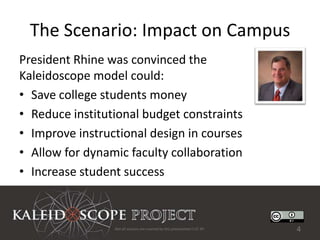
President Rhine was convinced the
Kaleidoscope model could:
• Save college students money
• Reduce institutional budget constraints
• Improve instructional design in courses
• Allow for dynamic faculty collaboration
• Increase student success


                 Not all sources are covered by this presentation's CC BY.   4
The Scenario: Textbook Zero
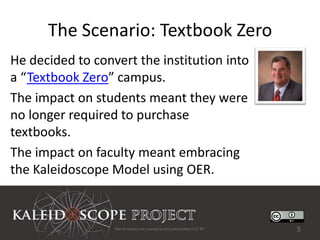
He decided to convert the institution into
a “Textbook Zero” campus.
The impact on students meant they were
no longer required to purchase
textbooks.
The impact on faculty meant embracing
the Kaleidoscope Model using OER.


                  Not all sources are covered by this presentation's CC BY.   5
The Challenge
Professor McCallum, CSC Education Faculty, was
selected by administration to assist in the
transition to Textbook Zero.
Collaborating with Lumen, an ed tech company
aimed to assist institutions with OER adoption,
they facilitated an innovative project called
“Open Learning in Action.”


                Not all sources are covered by this presentation's CC BY.   6
Open Learning In Action: Vision
Fostering active learning and decreasing passive learning
Transitioning the instructor role from an “authority” directing
instruction to a “facilitator” supporting active learning
Increasing educational relevance
Improving the quality of student learning through
collaborative “real-world” opportunities
Assisting future educators with building marketable
knowledge, skills, and dispositions for excellence in teaching


                      Not all sources are covered by this presentation's CC BY.   7
Open Learning in Action: Student Role
 Upon completion of this project, students will:
 • Establish Personal Learning Networks to create
   connections, collaborate, and contribute to their
   professional development and knowledge
 • Understand the implications of open licensing in education
 • Develop a SPED course using instructional design
   methodology and OER
 • Create a course in Instructure’s Canvas platform
 • Publish their work with Creative Commons license to share
   with the open community


                     Not all sources are covered by this presentation's CC BY.   8
Open Learning in Action: Facilitator Roles
 CSC’s Dr. McCallum
 • SPED Subject Matter Expert (SME)
 • Guide and assist students in learning
 • Support students in self-assessment of learning
 Lumen’s Ronda Neugebauer
 • OER Specialist
 • Instructional Design Project Advisor
 • Canvas Administrator, Trainer and Tech Support


                      Not all sources are covered by this presentation's CC BY.   9
Essential Knowledge
•   OER & Copyright
•   Outcome-Based Education & Backwards Design
•   Multiple Measures of Assessment
•   Instructure’s Canvas


                Not all sources are covered by this presentation's CC BY.   10
OER & Copyright


  Not all sources are covered by this presentation's CC BY.   11
What are Open Educational
   Resources (OER)?
 (1) Any kind of teaching materials –
     textbooks, syllabi, lesson plans,
         videos, readings, exams


          Not all sources are covered by this presentation's CC BY.   12
What are Open Educational
   Resources (OER)?
  (2) Free for anyone to access, and
      (3) Include free permission
     to engage in the 4R activities:
   reuse, revise, remix, redistribute


          Not all sources are covered by this presentation's CC BY.   13
Internet                                                             OER
Enables                                                             Allows
    Sharing and educating at
      unprecedented scale


        Not all sources are covered by this presentation's CC BY.            14
Education is Sharing

 Teachers with students
 Students with teachers


    Not all sources are covered by this presentation's CC BY.   15
Teachers Share With Students
       Knowledge and skills
      Feedback and criticism
         Encouragement


        Not all sources are covered by this presentation's CC BY.   16
Students Share With Teachers

                Questions
               Assignments
                   Tests


        Not all sources are covered by this presentation's CC BY.   17
Successful Educators
 Share most completely
 with the most students


    Not all sources are covered by this presentation's CC BY.   18
If there is no sharing…

   there is no education.


      Not all sources are covered by this presentation's CC BY.   19
Knowledge is Magical

It can be given without being given away


            Not all sources are covered by this presentation's CC BY.   20
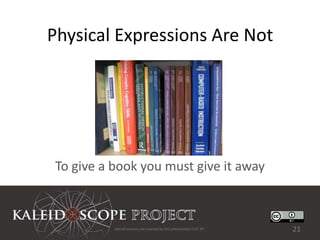
Physical Expressions Are Not


 To give a book you must give it away


           Not all sources are covered by this presentation's CC BY.   21
When Expressions Are Digital
    They also become magical


        Not all sources are covered by this presentation's CC BY.   22
Unprecedented Capacity
 We can share as never before


       Not all sources are covered by this presentation's CC BY.   23
Except We Can’t with Copyright

© forbids copying, distributing, and editing


             Not all sources are covered by this presentation's CC BY.   24
© Cancels the Possibilities

 Of digital media and the Internet


         Not all sources are covered by this presentation's CC BY.   25
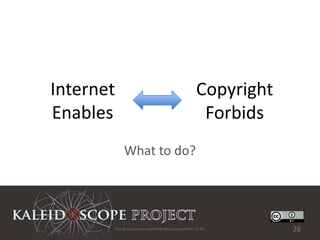
Internet                                                  Copyright
Enables                                                    Forbids
            What to do?


       Not all sources are covered by this presentation's CC BY.      26
Use copyright to enforce sharing

          Watch the video at:
http://creativecommons.org/licenses/


          Not all sources are covered by this presentation's CC BY.   27
The 4Rs of OER
    Reuse – copy verbatim
    Revise – adapt and edit
Remix – combine with other OER
Redistribute – share with others


          Not all sources are covered by this presentation's CC BY.   28
Creative Commons Licenses

    Scroll down link’s page to view:
http://creativecommons.org/licenses/


           Not all sources are covered by this presentation's CC BY.   29
Outcome-Based Education &
    Backwards Design


       Not all sources are covered by this presentation's CC BY.   30
Outcome-Based Education
Aka Mastery Education, Performance-Based Education
Outcomes = skills and knowledge measured empirically
  through observations/experimentation
Constructivist, student-centered learning philosophy
No requirements or specifications for any particular style
  of teaching or learning; however, discourages
  traditional model of direct instruction


                   Not all sources are covered by this presentation's CC BY.   31
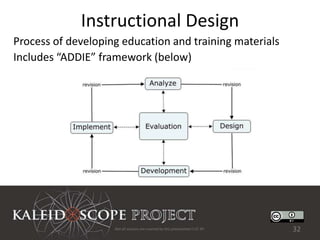
Instructional Design
Process of developing education and training materials
Includes “ADDIE” framework (below)


                    Not all sources are covered by this presentation's CC BY.   32
Backwards Design
Founded by Wiggins & McTigue in
   Understanding by Design
Begins with the end in mind: What do you want
   students to know?
Effective method for teachers who think in
   terms of what they wish to achieve


               Not all sources are covered by this presentation's CC BY.   33
Backwards Design Model
1. Identify Desired Results - Use Standards as Guide
  What do you want students to know, understand, and be
  able to do? (Outcomes)
2. Determine Acceptable Evidence
  How will you know students have achieved results and
  met standards? (Assessments)
3. Plan Learning Experiences & Instruction
  Identify concepts, principles, processes (Content &
  Learning Activities)


                   Not all sources are covered by this presentation's CC BY.   34
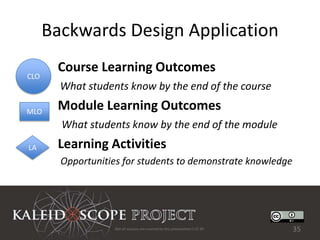
Backwards Design Application
       Course Learning Outcomes
CLO
        What students know by the end of the course

MLO
       Module Learning Outcomes
        What students know by the end of the module
LA     Learning Activities
        Opportunities for students to demonstrate knowledge


                   Not all sources are covered by this presentation's CC BY.   35
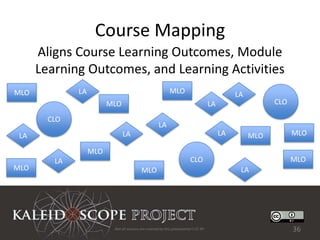
Course Mapping
      Aligns Course Learning Outcomes, Module
      Learning Outcomes, and Learning Activities
MLO           LA                                            MLO                                 LA
                         MLO                                                          LA                   CLO

        CLO
                                                     LA
 LA                            LA                                                          LA        MLO         MLO

                   MLO
         LA                                                              CLO                                     MLO
MLO                                       MLO                                                    LA


                          Not all sources are covered by this presentation's CC BY.                              36
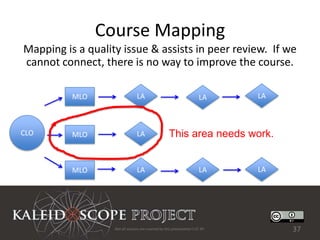
Course Mapping
Mapping is a quality issue & assists in peer review. If we
cannot connect, there is no way to improve the course.

          MLO                   LA                                      LA     LA


CLO       MLO                   LA                   This area needs work.


          MLO                   LA                                      LA     LA


                   Not all sources are covered by this presentation's CC BY.        37
Mapping Example
READ 125 College Reading Strategies
       Link to Google Doc:
https://docs.google.com/document/d/18nSdd1z762UpXAkLvxT4i-
                H7V8UW8w_GrBEuISLURnY/edit


                Not all sources are covered by this presentation's CC BY.   38
Backwards Design: Evaluation
In course evaluation (during and at course
   completion) teachers use data generated by
   students to drive decision-making
This helps teachers improve the course overtime
Empirically, teachers know where students are
   struggling and how best to improve the course


                Not all sources are covered by this presentation's CC BY.   39
Multiple Measures of Assessment


          Not all sources are covered by this presentation's CC BY.   40
Psychometrics
We can’t open our students’ brains to see what
  they know, but we can give them
  opportunities to tell us what they know
Assessment results yield both signal and noise
Rather than give one big assessment, use
  multiple measures to tease out the signal
  from the noise


                Not all sources are covered by this presentation's CC BY.   41
The Pixel Analogy
Why are multiple measures of assessment
important?
                   Watch this video:
http://www.pcworld.com/article/2027906/chromeboo
  k-pixel-the-google-pc-weve-been-waiting-for-.html
Think of multiple measures of assessment like the
pixels that make up the entire digital picture. Aim to
see the whole picture of the student, instead of just
a few pixels.


                  Not all sources are covered by this presentation's CC BY.   42
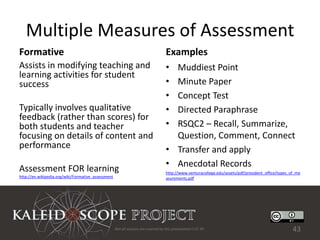
Multiple Measures of Assessment
Formative                                                                           Examples
Assists in modifying teaching and                                                   • Muddiest Point
learning activities for student
success                                                                             • Minute Paper
                                                                                    • Concept Test
Typically involves qualitative                                                      • Directed Paraphrase
feedback (rather than scores) for
both students and teacher                                                           • RSQC2 – Recall, Summarize,
focusing on details of content and                                                    Question, Comment, Connect
performance                                                                         • Transfer and apply
                                                                                    • Anecdotal Records
Assessment FOR learning                                                             http://www.venturacollege.edu/assets/pdf/president_office/types_of_me
http://en.wikipedia.org/wiki/Formative_assessment                                   asurements.pdf


                                                    Not all sources are covered by this presentation's CC BY.                                        43
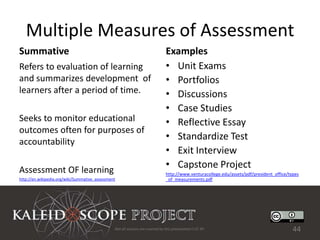
Multiple Measures of Assessment
Summative                                                                       Examples
Refers to evaluation of learning                                                • Unit Exams
and summarizes development of                                                   • Portfolios
learners after a period of time.                                                • Discussions
                                                                                • Case Studies
Seeks to monitor educational                                                    • Reflective Essay
outcomes often for purposes of
accountability
                                                                                • Standardize Test
                                                                                • Exit Interview
Assessment OF learning
                                                                                • Capstone Project
                                                                                http://www.venturacollege.edu/assets/pdf/president_office/types
http://en.wikipedia.org/wiki/Summative_assessment                               _of_measurements.pdf


                                                Not all sources are covered by this presentation's CC BY.                                   44
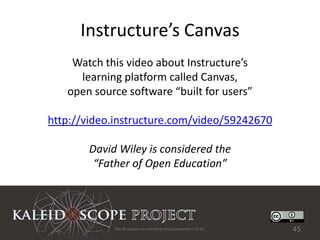
Instructure’s Canvas
    Watch this video about Instructure’s
     learning platform called Canvas,
   open source software “built for users”

http://video.instructure.com/video/59242670

       David Wiley is considered the
        “Father of Open Education”


            Not all sources are covered by this presentation's CC BY.   45
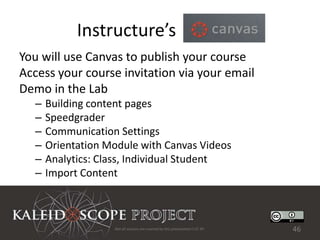
Instructure’s
You will use Canvas to publish your course
Access your course invitation via your email
Demo in the Lab
  –   Building content pages
  –   Speedgrader
  –   Communication Settings
  –   Orientation Module with Canvas Videos
  –   Analytics: Class, Individual Student
  –   Import Content


                   Not all sources are covered by this presentation's CC BY.   46
Questions?


Not all sources are covered by this presentation's CC BY.   47
Sources & Credits
Slide 2 - CC BY OpenEd 2012 http://openedconference.org/2012/program/
Slide 3/4 - CC BY Kaleidoscope Project http://www.project-kaleidoscope.org/
Slide 5 - CC BY Lumen http://www.lumenlearning.com/textbook_zero
Slide 8 - CC BY Wikipedia http://en.wikipedia.org/wiki/Personal_learning_network
          CC BY Creative Commons http://creativecommons.org/education
          Council for Exceptional Children SPED Professional Ethical Principles
          http://www.cec.sped.org/~/media/Files/Standards/Professional%20Ethics%20and%20Practice%20Standards/Ethics%20Translations/CEC_Ethics_English.pdf
          Instructure http://www.instructure.com/
Slide 9 - Schreyer Institute, Penn State http://www.schreyerinstitute.psu.edu/pdf/alex/teacher_facilitator.pdf
Slide 10-28 - CC BY David Wiley http://www.slideshare.net/opencontent
Slide 27 - CC BY Creative Commons http://creativecommons.org/licenses/
Slide 29 - CC BY Creative Commons http://creativecommons.org/licenses/
Slide 31 - CC BY SA PrincetonUniversity http://www.princeton.edu/~achaney/tmve/wiki100k/docs/Outcome-based_education.html
          CC BY SA Wikipedia http://en.wikipedia.org/wiki/Empirical
Slide 32 - CCBY SA http://en.wikipedia.org/wiki/File:ADDIE_Model_of_Design.jpg
Slide 33 - Understanding By Design http://www.ubdexchange.org/web_resources/UbD_Overview/learn_more.cfm
Slides 33/34 - CC BY NC SA EduTech Wiki http://edutechwiki.unige.ch/en/Backwards_design
Slide 38 - CC BY Ronda Neugebauer Mapping Example https://docs.google.com/document/d/18nSdd1z762UpXAkLvxT4i-H7V8UW8w_GrBEuISLURnY/edit
Slide 42- PC World & Google http://www.pcworld.com/article/2027906/chromebook-pixel-the-google-pc-weve-been-waiting-for-.html
Slide 43/44- CC BY SA Wikipedia http://en.wikipedia.org/wiki/Formative_assessment
          Ventura College http://www.venturacollege.edu/assets/pdf/president_office/types_of_measurements.pdf
Slide 45 - Instructure & Vimeo video http://video.instructure.com/video/59242670
          CC BY Lumen http://www.lumenlearning.com/lumen
Slide 46 - Lumen’s Instance of Canvas: https://lumen.instructure.com/
Faculty Partner: Hank McCallum, Education Faculty, Chadron State College
Lumen: David Wiley, Kim Thanos, Ronda Neugebauer


                                                     Not all sources are covered by this presentation's CC BY.                                  48

Open Learning in Action

  • 1.
    CSC’s SPED OERProject: Open Learning in Action Hank McCallum, CSC EDUC Faculty Ronda Neugebauer, Lumen Faculty Support Guru 28 February 2012 Not all sources are covered by this presentation's CC BY. 1
  • 2.
    The Scenario: OpenEd2012 CSC President Rhine attended the OpenEd 2012 Conference. He participated in several sessions from leading experts speaking about Open Educational Resources (OER). Not all sources are covered by this presentation's CC BY. 2
  • 3.
    The Scenario: Kaleidoscope TheKaleidoscope Project session was particularly compelling because its model: • Eliminates textbook costs as an obstacle to student success • Uses the best of existing OER • Increases student success through assessment- driven enhancement of OER curriculum • Creates a community to collaboratively evaluate and improve open course designs using learning analytics Not all sources are covered by this presentation's CC BY. 3
  • 4.
    The Scenario: Impacton Campus President Rhine was convinced the Kaleidoscope model could: • Save college students money • Reduce institutional budget constraints • Improve instructional design in courses • Allow for dynamic faculty collaboration • Increase student success Not all sources are covered by this presentation's CC BY. 4
  • 5.
    The Scenario: TextbookZero He decided to convert the institution into a “Textbook Zero” campus. The impact on students meant they were no longer required to purchase textbooks. The impact on faculty meant embracing the Kaleidoscope Model using OER. Not all sources are covered by this presentation's CC BY. 5
  • 6.
    The Challenge Professor McCallum,CSC Education Faculty, was selected by administration to assist in the transition to Textbook Zero. Collaborating with Lumen, an ed tech company aimed to assist institutions with OER adoption, they facilitated an innovative project called “Open Learning in Action.” Not all sources are covered by this presentation's CC BY. 6
  • 7.
    Open Learning InAction: Vision Fostering active learning and decreasing passive learning Transitioning the instructor role from an “authority” directing instruction to a “facilitator” supporting active learning Increasing educational relevance Improving the quality of student learning through collaborative “real-world” opportunities Assisting future educators with building marketable knowledge, skills, and dispositions for excellence in teaching Not all sources are covered by this presentation's CC BY. 7
  • 8.
    Open Learning inAction: Student Role Upon completion of this project, students will: • Establish Personal Learning Networks to create connections, collaborate, and contribute to their professional development and knowledge • Understand the implications of open licensing in education • Develop a SPED course using instructional design methodology and OER • Create a course in Instructure’s Canvas platform • Publish their work with Creative Commons license to share with the open community Not all sources are covered by this presentation's CC BY. 8
  • 9.
    Open Learning inAction: Facilitator Roles CSC’s Dr. McCallum • SPED Subject Matter Expert (SME) • Guide and assist students in learning • Support students in self-assessment of learning Lumen’s Ronda Neugebauer • OER Specialist • Instructional Design Project Advisor • Canvas Administrator, Trainer and Tech Support Not all sources are covered by this presentation's CC BY. 9
  • 10.
    Essential Knowledge • OER & Copyright • Outcome-Based Education & Backwards Design • Multiple Measures of Assessment • Instructure’s Canvas Not all sources are covered by this presentation's CC BY. 10
  • 11.
    OER & Copyright Not all sources are covered by this presentation's CC BY. 11
  • 12.
    What are OpenEducational Resources (OER)? (1) Any kind of teaching materials – textbooks, syllabi, lesson plans, videos, readings, exams Not all sources are covered by this presentation's CC BY. 12
  • 13.
    What are OpenEducational Resources (OER)? (2) Free for anyone to access, and (3) Include free permission to engage in the 4R activities: reuse, revise, remix, redistribute Not all sources are covered by this presentation's CC BY. 13
  • 14.
    Internet OER Enables Allows Sharing and educating at unprecedented scale Not all sources are covered by this presentation's CC BY. 14
  • 15.
    Education is Sharing Teachers with students Students with teachers Not all sources are covered by this presentation's CC BY. 15
  • 16.
    Teachers Share WithStudents Knowledge and skills Feedback and criticism Encouragement Not all sources are covered by this presentation's CC BY. 16
  • 17.
    Students Share WithTeachers Questions Assignments Tests Not all sources are covered by this presentation's CC BY. 17
  • 18.
    Successful Educators Sharemost completely with the most students Not all sources are covered by this presentation's CC BY. 18
  • 19.
    If there isno sharing… there is no education. Not all sources are covered by this presentation's CC BY. 19
  • 20.
    Knowledge is Magical Itcan be given without being given away Not all sources are covered by this presentation's CC BY. 20
  • 21.
    Physical Expressions AreNot To give a book you must give it away Not all sources are covered by this presentation's CC BY. 21
  • 22.
    When Expressions AreDigital They also become magical Not all sources are covered by this presentation's CC BY. 22
  • 23.
    Unprecedented Capacity Wecan share as never before Not all sources are covered by this presentation's CC BY. 23
  • 24.
    Except We Can’twith Copyright © forbids copying, distributing, and editing Not all sources are covered by this presentation's CC BY. 24
  • 25.
    © Cancels thePossibilities Of digital media and the Internet Not all sources are covered by this presentation's CC BY. 25
  • 26.
    Internet Copyright Enables Forbids What to do? Not all sources are covered by this presentation's CC BY. 26
  • 27.
    Use copyright toenforce sharing Watch the video at: http://creativecommons.org/licenses/ Not all sources are covered by this presentation's CC BY. 27
  • 28.
    The 4Rs ofOER Reuse – copy verbatim Revise – adapt and edit Remix – combine with other OER Redistribute – share with others Not all sources are covered by this presentation's CC BY. 28
  • 29.
    Creative Commons Licenses Scroll down link’s page to view: http://creativecommons.org/licenses/ Not all sources are covered by this presentation's CC BY. 29
  • 30.
    Outcome-Based Education & Backwards Design Not all sources are covered by this presentation's CC BY. 30
  • 31.
    Outcome-Based Education Aka MasteryEducation, Performance-Based Education Outcomes = skills and knowledge measured empirically through observations/experimentation Constructivist, student-centered learning philosophy No requirements or specifications for any particular style of teaching or learning; however, discourages traditional model of direct instruction Not all sources are covered by this presentation's CC BY. 31
  • 32.
    Instructional Design Process ofdeveloping education and training materials Includes “ADDIE” framework (below) Not all sources are covered by this presentation's CC BY. 32
  • 33.
    Backwards Design Founded byWiggins & McTigue in Understanding by Design Begins with the end in mind: What do you want students to know? Effective method for teachers who think in terms of what they wish to achieve Not all sources are covered by this presentation's CC BY. 33
  • 34.
    Backwards Design Model 1.Identify Desired Results - Use Standards as Guide What do you want students to know, understand, and be able to do? (Outcomes) 2. Determine Acceptable Evidence How will you know students have achieved results and met standards? (Assessments) 3. Plan Learning Experiences & Instruction Identify concepts, principles, processes (Content & Learning Activities) Not all sources are covered by this presentation's CC BY. 34
  • 35.
    Backwards Design Application Course Learning Outcomes CLO What students know by the end of the course MLO Module Learning Outcomes What students know by the end of the module LA Learning Activities Opportunities for students to demonstrate knowledge Not all sources are covered by this presentation's CC BY. 35
  • 36.
    Course Mapping Aligns Course Learning Outcomes, Module Learning Outcomes, and Learning Activities MLO LA MLO LA MLO LA CLO CLO LA LA LA LA MLO MLO MLO LA CLO MLO MLO MLO LA Not all sources are covered by this presentation's CC BY. 36
  • 37.
    Course Mapping Mapping isa quality issue & assists in peer review. If we cannot connect, there is no way to improve the course. MLO LA LA LA CLO MLO LA This area needs work. MLO LA LA LA Not all sources are covered by this presentation's CC BY. 37
  • 38.
    Mapping Example READ 125College Reading Strategies Link to Google Doc: https://docs.google.com/document/d/18nSdd1z762UpXAkLvxT4i- H7V8UW8w_GrBEuISLURnY/edit Not all sources are covered by this presentation's CC BY. 38
  • 39.
    Backwards Design: Evaluation Incourse evaluation (during and at course completion) teachers use data generated by students to drive decision-making This helps teachers improve the course overtime Empirically, teachers know where students are struggling and how best to improve the course Not all sources are covered by this presentation's CC BY. 39
  • 40.
    Multiple Measures ofAssessment Not all sources are covered by this presentation's CC BY. 40
  • 41.
    Psychometrics We can’t openour students’ brains to see what they know, but we can give them opportunities to tell us what they know Assessment results yield both signal and noise Rather than give one big assessment, use multiple measures to tease out the signal from the noise Not all sources are covered by this presentation's CC BY. 41
  • 42.
    The Pixel Analogy Whyare multiple measures of assessment important? Watch this video: http://www.pcworld.com/article/2027906/chromeboo k-pixel-the-google-pc-weve-been-waiting-for-.html Think of multiple measures of assessment like the pixels that make up the entire digital picture. Aim to see the whole picture of the student, instead of just a few pixels. Not all sources are covered by this presentation's CC BY. 42
  • 43.
    Multiple Measures ofAssessment Formative Examples Assists in modifying teaching and • Muddiest Point learning activities for student success • Minute Paper • Concept Test Typically involves qualitative • Directed Paraphrase feedback (rather than scores) for both students and teacher • RSQC2 – Recall, Summarize, focusing on details of content and Question, Comment, Connect performance • Transfer and apply • Anecdotal Records Assessment FOR learning http://www.venturacollege.edu/assets/pdf/president_office/types_of_me http://en.wikipedia.org/wiki/Formative_assessment asurements.pdf Not all sources are covered by this presentation's CC BY. 43
  • 44.
    Multiple Measures ofAssessment Summative Examples Refers to evaluation of learning • Unit Exams and summarizes development of • Portfolios learners after a period of time. • Discussions • Case Studies Seeks to monitor educational • Reflective Essay outcomes often for purposes of accountability • Standardize Test • Exit Interview Assessment OF learning • Capstone Project http://www.venturacollege.edu/assets/pdf/president_office/types http://en.wikipedia.org/wiki/Summative_assessment _of_measurements.pdf Not all sources are covered by this presentation's CC BY. 44
  • 45.
    Instructure’s Canvas Watch this video about Instructure’s learning platform called Canvas, open source software “built for users” http://video.instructure.com/video/59242670 David Wiley is considered the “Father of Open Education” Not all sources are covered by this presentation's CC BY. 45
  • 46.
    Instructure’s You will useCanvas to publish your course Access your course invitation via your email Demo in the Lab – Building content pages – Speedgrader – Communication Settings – Orientation Module with Canvas Videos – Analytics: Class, Individual Student – Import Content Not all sources are covered by this presentation's CC BY. 46
  • 47.
    Questions? Not all sourcesare covered by this presentation's CC BY. 47
  • 48.
    Sources & Credits Slide2 - CC BY OpenEd 2012 http://openedconference.org/2012/program/ Slide 3/4 - CC BY Kaleidoscope Project http://www.project-kaleidoscope.org/ Slide 5 - CC BY Lumen http://www.lumenlearning.com/textbook_zero Slide 8 - CC BY Wikipedia http://en.wikipedia.org/wiki/Personal_learning_network CC BY Creative Commons http://creativecommons.org/education Council for Exceptional Children SPED Professional Ethical Principles http://www.cec.sped.org/~/media/Files/Standards/Professional%20Ethics%20and%20Practice%20Standards/Ethics%20Translations/CEC_Ethics_English.pdf Instructure http://www.instructure.com/ Slide 9 - Schreyer Institute, Penn State http://www.schreyerinstitute.psu.edu/pdf/alex/teacher_facilitator.pdf Slide 10-28 - CC BY David Wiley http://www.slideshare.net/opencontent Slide 27 - CC BY Creative Commons http://creativecommons.org/licenses/ Slide 29 - CC BY Creative Commons http://creativecommons.org/licenses/ Slide 31 - CC BY SA PrincetonUniversity http://www.princeton.edu/~achaney/tmve/wiki100k/docs/Outcome-based_education.html CC BY SA Wikipedia http://en.wikipedia.org/wiki/Empirical Slide 32 - CCBY SA http://en.wikipedia.org/wiki/File:ADDIE_Model_of_Design.jpg Slide 33 - Understanding By Design http://www.ubdexchange.org/web_resources/UbD_Overview/learn_more.cfm Slides 33/34 - CC BY NC SA EduTech Wiki http://edutechwiki.unige.ch/en/Backwards_design Slide 38 - CC BY Ronda Neugebauer Mapping Example https://docs.google.com/document/d/18nSdd1z762UpXAkLvxT4i-H7V8UW8w_GrBEuISLURnY/edit Slide 42- PC World & Google http://www.pcworld.com/article/2027906/chromebook-pixel-the-google-pc-weve-been-waiting-for-.html Slide 43/44- CC BY SA Wikipedia http://en.wikipedia.org/wiki/Formative_assessment Ventura College http://www.venturacollege.edu/assets/pdf/president_office/types_of_measurements.pdf Slide 45 - Instructure & Vimeo video http://video.instructure.com/video/59242670 CC BY Lumen http://www.lumenlearning.com/lumen Slide 46 - Lumen’s Instance of Canvas: https://lumen.instructure.com/ Faculty Partner: Hank McCallum, Education Faculty, Chadron State College Lumen: David Wiley, Kim Thanos, Ronda Neugebauer Not all sources are covered by this presentation's CC BY. 48

Editor's Notes

  • #2 CC BY Hank McCallum and Ronda Neugebauer
  • #3 CC BY Hank McCallum and Ronda NeugebauerCC BY OpenEd 2012 http://openedconference.org/2012/program/
  • #4 CC BY Hank McCallum and Ronda NeugebauerCC BY Kaleidoscope Projecthttp://www.project-kaleidoscope.org/
  • #5 CC BY Hank McCallum and Ronda NeugebauerCC BY Kaleidoscope Projecthttp://www.project-kaleidoscope.org/
  • #6 CC BY Hank McCallum and Ronda NeugebauerCC BY Lumen http://www.lumenlearning.com/textbook_zero
  • #7 CC BY Hank McCallum and Ronda Neugebauer
  • #8 CC BY Hank McCallum and Ronda Neugebauer
  • #9 CC BY Hank McCallum and Ronda NeugebauerCC BY Wikipedia http://en.wikipedia.org/wiki/Personal_learning_networkCC BY Creative Commons http://creativecommons.org/educationCouncil for Exceptional Children SPED Professional Ethical Principleshttp://www.cec.sped.org/~/media/Files/Standards/Professional%20Ethics%20and%20Practice%20Standards/Ethics%20Translations/CEC_Ethics_English.pdfInstructure http://www.instructure.com/
  • #10 CC BY Hank McCallum and Ronda NeugebauerSchreyer Institute, Penn State http://www.schreyerinstitute.psu.edu/pdf/alex/teacher_facilitator.pdf
  • #11 CC BY Hank McCallum and Ronda Neugebauer
  • #12 CC BY Hank McCallum and Ronda Neugebauer
  • #13 CC BY David Wiley http://www.slideshare.net/opencontent
  • #14 CC BY David Wiley http://www.slideshare.net/opencontent
  • #15 CC BY David Wiley http://www.slideshare.net/opencontent
  • #16 CC BY David Wiley http://www.slideshare.net/opencontent
  • #17 CC BY David Wiley http://www.slideshare.net/opencontent
  • #18 CC BY David Wiley http://www.slideshare.net/opencontent
  • #19 CC BY David Wiley http://www.slideshare.net/opencontent
  • #20 CC BY David Wiley http://www.slideshare.net/opencontent
  • #21 CC BY David Wiley http://www.slideshare.net/opencontent
  • #22 CC BY David Wiley http://www.slideshare.net/opencontentPhoto CCBY David Wiley
  • #23 CC BY David Wiley http://www.slideshare.net/opencontent
  • #24 CC BY David Wiley http://www.slideshare.net/opencontent
  • #25 CC BY David Wiley http://www.slideshare.net/opencontent
  • #26 CC BY David Wiley http://www.slideshare.net/opencontent
  • #27 CC BY David Wiley http://www.slideshare.net/opencontent
  • #29 CC BY David Wiley http://www.slideshare.net/opencontent
  • #30 CC BY Creative Commons http://creativecommons.org/licenses/
  • #31 CC BY Hank McCallum and Ronda Neugebauer
  • #32 CC BY SA PrincetonUniversity http://www.princeton.edu/~achaney/tmve/wiki100k/docs/Outcome-based_education.htmlCC BY SA Wikipedia http://en.wikipedia.org/wiki/Empirical
  • #33 CC BY Hank McCallum and Ronda NeugebauerImage CCBY SA http://en.wikipedia.org/wiki/File:ADDIE_Model_of_Design.jpg
  • #34 CC BY NC SA EduTech Wiki http://edutechwiki.unige.ch/en/Backwards_designUnderstanding By Design http://www.ubdexchange.org/web_resources/UbD_Overview/learn_more.cfm
  • #35 CC BY Hank McCallum and Ronda NeugebauerCC BY NC SA EduTech Wiki http://edutechwiki.unige.ch/en/Backwards_design
  • #36 CC BY Hank McCallum and Ronda Neugebauer
  • #37 CC BY Hank McCallum and Ronda Neugebauer
  • #38 CC BY Hank McCallum and Ronda Neugebauer
  • #39 CC BY Hank McCallum and Ronda NeugebauerCC BY Ronda Neugebauer Mapping Example https://docs.google.com/document/d/18nSdd1z762UpXAkLvxT4i-H7V8UW8w_GrBEuISLURnY/edit
  • #40 CC BY Hank McCallum, Ronda Neugebauer, and David Wiley
  • #41 CC BY Hank McCallum, Ronda Neugebauer, and David Wiley
  • #42 CC BY Hank McCallum, Ronda Neugebauer, and David Wiley
  • #43 CC BY Hank McCallum, Ronda Neugebauer, and David WileyPC World & Google http://www.pcworld.com/article/2027906/chromebook-pixel-the-google-pc-weve-been-waiting-for-.html
  • #44 CC BY SA Wikipediahttp://en.wikipedia.org/wiki/Formative_assessmentVentura College http://www.venturacollege.edu/assets/pdf/president_office/types_of_measurements.pdf
  • #45 CC BY SA Wikipediahttp://en.wikipedia.org/wiki/Formative_assessmentVentura College http://www.venturacollege.edu/assets/pdf/president_office/types_of_measurements.pdf
  • #46 Instructure & Vimeo video http://video.instructure.com/video/59242670CC BY Lumen http://www.lumenlearning.com/lumen
  • #47 CC BY Hank McCallum, Ronda Neugebauer, and David WileyLumen’s Instance of Canvas: https://lumen.instructure.com/
  • #48 CC BY Hank McCallum and Ronda Neugebauer