Driving Adoptions of OER through
         Communities of Practice

                   Open Education Week
                         March 11, 2013
Presenters

    Charles Key
          Director of College Open Textbooks, Open Doors Group
    Marguerita Sasser
          Senior Manager for Communities, Open Doors Group

Regina Blasberg
     Chair, Engineering Technologies Department, College of the Canyons
Mike Alvord
     Director of Operations, Newhall County Water District
     Adjunct Faculty, College of the Canyons

           Donna Gaudet
                  Faculty, Mathematics, Scottsdale Community College


           Mirya Holman
                  Assistant Professor, Political Science, Florida Atlantic University

   Lisa White-McNulty
         Professor, College of Education, University of St. Francis
Communities of Practice at
                          College Open Textbooks
•   College Open Textbooks (COT) Community:
     Online community for people who develop, use or want to learn
     more about open textbooks.
     Initial focus on US, but now expanding globally
     Initial focus on community colleges, but now expanding to 4-yr
     universities
•   1600 members strong for collaboration
• Content highlights:
     –   Listing of upcoming open textbooks and related OER events
     –   Links to past event replays, discussion threads & resources
     –   Place to share best practices, lessons learned, post questions & solicit feedback
     –   Groups focused on specific subjects including US History, Algebra, Business
         Communications & others.
                    COT Community Senior Managers:
                        Kathy Hooper kathy.hooper@opendoorsgroup.org
                        Marguerita Sasser marguerita.sasser@opendoorsgroup.org
Water Technology
Community of Practice
      Regina Blasberg
      Chair, Engineering Technologies Department,
      College of the Canyons, Santa Clarita, CA
      Regina.Blasberg@canyons.edu

      Mike Alvord
      Director of Operations, Newhall County Water District
      Adjunct Faculty, College of the Canyons
      Michael.alvord@canyons.edu
COC Water Technology Program

• Structure
  – 21 units requiring a total of 7 courses
  – 5 courses mandatory, option for other 2
    courses – either beginning/advanced
    treatment or beginning/advanced distribution
• Courses offered in multiple formats:
  – Online – Hybrid - Onground
• Program now offered 100% online
• Program Focus – Water Operators
Community of Practice

• Faculty
  – Full-Time
  – Part-Time
• Industry
  – Partnerships
  – Advisory Committee
• Goals
  – Well-trained students and productive
    employees
  – Lower educational costs and provide greater
    access to education
The Problem

• Costs of Textbooks and Materials
  – Texts from American Water Works
    Association (AWWA)
  – WSO: Basic Science Concepts and
    Applications, 4th Edition $146 plus bookstore
    markup
• Quality of Textbooks and Materials
  – Although there is some good
    content, materials are typically not set up
    for instruction
• Access to Materials
The Solution


• Water 030 Textbook
• Water 031 Textbook
• Printing:
  – Students can print
  – Arrangement with on-campus repro
    and the bookstore to provide bound
    copy
Successes/Lessons Learned


• Cost savings
  – On average a savings of $5250 to students
    each semester the course is offered
• Student input
• Easy to revise
• Importance of answer key
Developmental Mathematics
  Community of Practice
            Donna Gaudet
            Faculty, Department of
            Mathematics, Scottsdale Community
            College, Arizona
            donna.gaudet@scottsdalecc.edu
History

• Hybrid classes were the genesis of our efforts
• Need for student resources
• Desire to save students money
• Began with a couple of faculty creating materials
  separately (2008 – 2012)
• Began with a couple of faculty creating materials
  separately (2008 – 2012)
    –   Some were creating videos
    –   Some were creating written materials
    –   Some were researching open source textbooks
    –   Some were investigating an open online assessment tool
Evolution


• Spring 2012 two faculty members put the pieces
  together and piloted all the pieces
  – Student Workbook with lesson videos
  – Open Source Textbook
  – Open Source online assessment tool
• Summer 2012
  – Team of about 8 faculty worked to restructure
    materials and create instructor guides
Fall 2012 Implementation


• Completely open source for Arithmetic through
  PreCalculus classes
• 42 instructors (full time and adjunct)
• 65 sections (around 1820 students)
• Roughly $182,000 student textbook dollars
  saved Fall 2012 alone
Community Development

• Our effort would not have been successful without
  the work of many people
• Team approach to materials development was critical
• Resulting materials were at a higher level than an
  individual could do alone
• Team members participated in areas of strength (i.e.
  videos, writing materials, editing, etc…)
Sharing Resources/Processes

• Dropbox
   – Critical tool for developers
   – Sharing of resources and collaboration documents
• Online Site
   – Discussion forums for faculty
   – Errata, use of materials, other suggestions
• Twice a month meetings
   – Discuss errata, changes, how things are going
Instructor Text Funding Resources


• COT Adopter Communities Small Grant
• 25% (of $2500) funds used to purchase materials
  (textbook + workbook) for ALL faculty teaching OER
  courses – Fall 2012
      • ~ 22 faculty for MAT 09x Beginning Algebra
      • ~ 20 faculty for MAT 12x Intermediate Algebra
      • Only Beg Alg was initially proposed, but we expanded to Int.
        Alg
• Remaining funds were used in Spring 2013 and will
  be used in Fall 2013 for revised sets of materials
Thorns and Roses

Thorns                        Roses
• Huge amount of              • Cost savings for students
  development time            • Department community
• Maintenance and updates       building and support
• Distribution (bookstore!)   • Energy of the new users
• Adjunct faculty buy-in      • Support of department
                                and administration
                              • Introduction of creative
                                teaching approaches
                              • Revamp of the curriculum
                              • Working as a team made
                                the product better
American Government
Community of Practice
         Mirya Holman
         Assistant Professor, Political Science,
         Florida Atlantic University, Boca Raton, FL
         mholman5@fau.edu
Basic Process

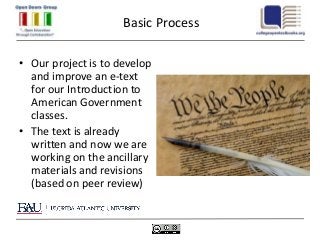
• Our project is to develop
  and improve an e-text
  for our Introduction to
  American Government
  classes.
• The text is already
  written and now we are
  working on the ancillary
  materials and revisions
  (based on peer review)
Work on Project

• Redesign and formatting
• Incorporate changes
  recommended by
  external reviewers
• Development of ancillary
  materials
   – Test bank
   – Primary materials
     supplement
   – Powerpoints
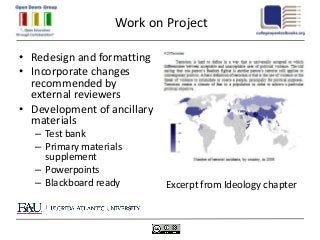
   – Blackboard ready        Excerpt from Ideology chapter
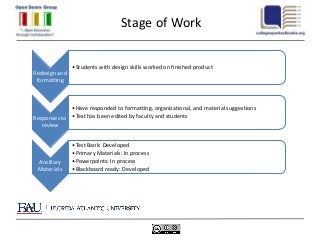
Stage of Work

               • Students with design skills worked on finished product
Redesign and
 formatting


             • Have responded to formatting, organizational, and material suggestions
Responses to • Text has been edited by faculty and students
   review


               • Test Bank: Developed
               • Primary Materials: In process
 Ancillary     • Powerpoints: In process
 Materials     • Blackboard ready: Developed
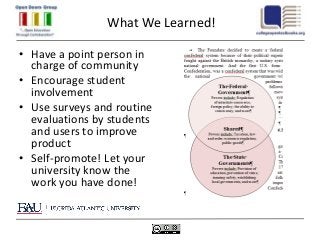
What We Learned!

• Have a point person in
  charge of community
• Encourage student
  involvement
• Use surveys and routine
  evaluations by students
  and users to improve
  product
• Self-promote! Let your
  university know the
  work you have done!
Educational Psychology
Community of Practice
         Lisa White-McNulty
         Professor, College of Education,
         University of St. Francis, Joliet, Illinois
         lwhitemcnulty@stfrancis.edu
Project Goals


• Augment the available open-access
  resources in our discipline (Educational
  Psychology)
• Starting point: Seifert and Sutton’s
  open source text
• “Textbook plus”
Pilot Project

• Develop modules for common topics taught
  by members
• Peer review by Working Group
• Pilot modules in our courses
• Assess student preferences and learning
• Funding from College Open Textbooks
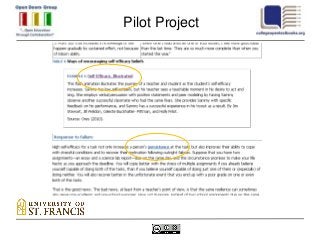
• Published in Connexions Open Access
  Repository: cnx.org
Pilot Modules

• Motivation and the Learning
  Environment
  – Lisa White-McNulty
• Information Processing
  – Brian Beitzel
• Introduction to Assessment
  – Nathan Gonyea
Pilot Project
Project Assessment


• Survey of students’ opinions of open
    source materials
•   Assessment of academic
    performance on topics in which open
    source materials were used
Project Results


• 88 percent of students preferred
  online readings over textbook
• No significant differences in students’
  performance on assessments
Feedback most welcome!

• Brian Beitzel & Nathan Gonyea
   – SUNY-Oneonta
• Lisa White-McNulty
   – University of St. Francis
• Kelvin Seifert
   – University of Manitoba (emeritus)
• Una Daly,
   – Open Courseware Consortium
• Zsuzsanna Szabo
   – Marist College
• Gene Loeb
   – Roosevelt University (retired), journal editor
• John Connor
   – Daytona State University
Contact Us About
         Communities of Practice
                   Open Doors Group
            http://www.opendoorsgroup.org

                College Open Textbooks
            http://collegeopentextbooks.org

          College Open Textbooks Communities
         http://collegeopentextbooks.ning.com/

                        Charles Key
Director of Adoptions, College Open Textbooks, and Grants
             charles.key@opendoorsgroup.org

                  Marguerita Sasser
           Senior Manager for Communities
        marguerita.sasser@opendoorsgroup.org

Driving adoptions through communities of practice

  • 1.
    Driving Adoptions ofOER through Communities of Practice Open Education Week March 11, 2013
  • 2.
    Presenters Charles Key Director of College Open Textbooks, Open Doors Group Marguerita Sasser Senior Manager for Communities, Open Doors Group Regina Blasberg Chair, Engineering Technologies Department, College of the Canyons Mike Alvord Director of Operations, Newhall County Water District Adjunct Faculty, College of the Canyons Donna Gaudet Faculty, Mathematics, Scottsdale Community College Mirya Holman Assistant Professor, Political Science, Florida Atlantic University Lisa White-McNulty Professor, College of Education, University of St. Francis
  • 3.
    Communities of Practiceat College Open Textbooks • College Open Textbooks (COT) Community: Online community for people who develop, use or want to learn more about open textbooks. Initial focus on US, but now expanding globally Initial focus on community colleges, but now expanding to 4-yr universities • 1600 members strong for collaboration • Content highlights: – Listing of upcoming open textbooks and related OER events – Links to past event replays, discussion threads & resources – Place to share best practices, lessons learned, post questions & solicit feedback – Groups focused on specific subjects including US History, Algebra, Business Communications & others. COT Community Senior Managers: Kathy Hooper kathy.hooper@opendoorsgroup.org Marguerita Sasser marguerita.sasser@opendoorsgroup.org
  • 4.
    Water Technology Community ofPractice Regina Blasberg Chair, Engineering Technologies Department, College of the Canyons, Santa Clarita, CA Regina.Blasberg@canyons.edu Mike Alvord Director of Operations, Newhall County Water District Adjunct Faculty, College of the Canyons Michael.alvord@canyons.edu
  • 5.
    COC Water TechnologyProgram • Structure – 21 units requiring a total of 7 courses – 5 courses mandatory, option for other 2 courses – either beginning/advanced treatment or beginning/advanced distribution • Courses offered in multiple formats: – Online – Hybrid - Onground • Program now offered 100% online • Program Focus – Water Operators
  • 6.
    Community of Practice •Faculty – Full-Time – Part-Time • Industry – Partnerships – Advisory Committee • Goals – Well-trained students and productive employees – Lower educational costs and provide greater access to education
  • 7.
    The Problem • Costsof Textbooks and Materials – Texts from American Water Works Association (AWWA) – WSO: Basic Science Concepts and Applications, 4th Edition $146 plus bookstore markup • Quality of Textbooks and Materials – Although there is some good content, materials are typically not set up for instruction • Access to Materials
  • 8.
    The Solution • Water030 Textbook • Water 031 Textbook • Printing: – Students can print – Arrangement with on-campus repro and the bookstore to provide bound copy
  • 9.
    Successes/Lessons Learned • Costsavings – On average a savings of $5250 to students each semester the course is offered • Student input • Easy to revise • Importance of answer key
  • 10.
    Developmental Mathematics Community of Practice Donna Gaudet Faculty, Department of Mathematics, Scottsdale Community College, Arizona donna.gaudet@scottsdalecc.edu
  • 11.
    History • Hybrid classeswere the genesis of our efforts • Need for student resources • Desire to save students money • Began with a couple of faculty creating materials separately (2008 – 2012) • Began with a couple of faculty creating materials separately (2008 – 2012) – Some were creating videos – Some were creating written materials – Some were researching open source textbooks – Some were investigating an open online assessment tool
  • 12.
    Evolution • Spring 2012two faculty members put the pieces together and piloted all the pieces – Student Workbook with lesson videos – Open Source Textbook – Open Source online assessment tool • Summer 2012 – Team of about 8 faculty worked to restructure materials and create instructor guides
  • 13.
    Fall 2012 Implementation •Completely open source for Arithmetic through PreCalculus classes • 42 instructors (full time and adjunct) • 65 sections (around 1820 students) • Roughly $182,000 student textbook dollars saved Fall 2012 alone
  • 14.
    Community Development • Oureffort would not have been successful without the work of many people • Team approach to materials development was critical • Resulting materials were at a higher level than an individual could do alone • Team members participated in areas of strength (i.e. videos, writing materials, editing, etc…)
  • 15.
    Sharing Resources/Processes • Dropbox – Critical tool for developers – Sharing of resources and collaboration documents • Online Site – Discussion forums for faculty – Errata, use of materials, other suggestions • Twice a month meetings – Discuss errata, changes, how things are going
  • 16.
    Instructor Text FundingResources • COT Adopter Communities Small Grant • 25% (of $2500) funds used to purchase materials (textbook + workbook) for ALL faculty teaching OER courses – Fall 2012 • ~ 22 faculty for MAT 09x Beginning Algebra • ~ 20 faculty for MAT 12x Intermediate Algebra • Only Beg Alg was initially proposed, but we expanded to Int. Alg • Remaining funds were used in Spring 2013 and will be used in Fall 2013 for revised sets of materials
  • 17.
    Thorns and Roses Thorns Roses • Huge amount of • Cost savings for students development time • Department community • Maintenance and updates building and support • Distribution (bookstore!) • Energy of the new users • Adjunct faculty buy-in • Support of department and administration • Introduction of creative teaching approaches • Revamp of the curriculum • Working as a team made the product better
  • 18.
    American Government Community ofPractice Mirya Holman Assistant Professor, Political Science, Florida Atlantic University, Boca Raton, FL mholman5@fau.edu
  • 19.
    Basic Process • Ourproject is to develop and improve an e-text for our Introduction to American Government classes. • The text is already written and now we are working on the ancillary materials and revisions (based on peer review)
  • 20.
    Work on Project •Redesign and formatting • Incorporate changes recommended by external reviewers • Development of ancillary materials – Test bank – Primary materials supplement – Powerpoints – Blackboard ready Excerpt from Ideology chapter
  • 21.
    Stage of Work • Students with design skills worked on finished product Redesign and formatting • Have responded to formatting, organizational, and material suggestions Responses to • Text has been edited by faculty and students review • Test Bank: Developed • Primary Materials: In process Ancillary • Powerpoints: In process Materials • Blackboard ready: Developed
  • 22.
    What We Learned! •Have a point person in charge of community • Encourage student involvement • Use surveys and routine evaluations by students and users to improve product • Self-promote! Let your university know the work you have done!
  • 23.
    Educational Psychology Community ofPractice Lisa White-McNulty Professor, College of Education, University of St. Francis, Joliet, Illinois lwhitemcnulty@stfrancis.edu
  • 24.
    Project Goals • Augmentthe available open-access resources in our discipline (Educational Psychology) • Starting point: Seifert and Sutton’s open source text • “Textbook plus”
  • 25.
    Pilot Project • Developmodules for common topics taught by members • Peer review by Working Group • Pilot modules in our courses • Assess student preferences and learning • Funding from College Open Textbooks • Published in Connexions Open Access Repository: cnx.org
  • 26.
    Pilot Modules • Motivationand the Learning Environment – Lisa White-McNulty • Information Processing – Brian Beitzel • Introduction to Assessment – Nathan Gonyea
  • 27.
  • 28.
    Project Assessment • Surveyof students’ opinions of open source materials • Assessment of academic performance on topics in which open source materials were used
  • 29.
    Project Results • 88percent of students preferred online readings over textbook • No significant differences in students’ performance on assessments
  • 30.
    Feedback most welcome! •Brian Beitzel & Nathan Gonyea – SUNY-Oneonta • Lisa White-McNulty – University of St. Francis • Kelvin Seifert – University of Manitoba (emeritus) • Una Daly, – Open Courseware Consortium • Zsuzsanna Szabo – Marist College • Gene Loeb – Roosevelt University (retired), journal editor • John Connor – Daytona State University
  • 31.
    Contact Us About Communities of Practice Open Doors Group http://www.opendoorsgroup.org College Open Textbooks http://collegeopentextbooks.org College Open Textbooks Communities http://collegeopentextbooks.ning.com/ Charles Key Director of Adoptions, College Open Textbooks, and Grants charles.key@opendoorsgroup.org Marguerita Sasser Senior Manager for Communities marguerita.sasser@opendoorsgroup.org