#openls | Portland OR 4-6 Jun 2014
OPEN EDUCATION
leadership summit
2014
Economic Models
Workshop Presentation
Group Leaders: Jason Pickavance (@jpickava) and Linda
Williams
Group Facilitator: Nate Angell (@xolotl)
#openls | Portland OR 4-6 Jun 2014
Workshop Participants (in seated order)
● Jason Pickavance (co-leader), Salt Lake Community College, Director of
Educational Initiatives
● Clea Andreadis, Middlesex Community College, Associate Provost, Instruction
and Assessment
● Ryan Hobbs, Salt Lake Community College, Director of eLearning
● Linda Williams (co-leader), Tidewater Community College, Professor of Business
Administration
● Kara Monroe, Associate Vice President, Academic Online Programs, Ivy Tech
Community College of Indiana
● Peter Quigley, University of Hawaii, Associate Vice President for Academic Affairs
for Community Colleges
● Karen Vignare, University of Maryland University College, Associate Provost,
Center for Innovation in Learning
● Nate Angell (facilitator), Lumen Learning, Doorman
● Randy Morales, Cerritos College, TAACCCT Grant Program Manager
● David Wiley, Lumen Learning, CAO
2
#openls | Portland OR 4-6 Jun 2014
Overview of Issues
● Institutions need help understanding what models
have worked to initiate and/or sustain OER
initiatives at other institutions.
● Institutions come to the table at varying degrees of
OER engagement. Models need to fit an institution’s
current stage.
● Institutions have very different governance, finance,
faculty, union, political, etc environments and
histories. OER funding models need to fit local
institutional particularities.
2
#openls | Portland OR 4-6 Jun 2014
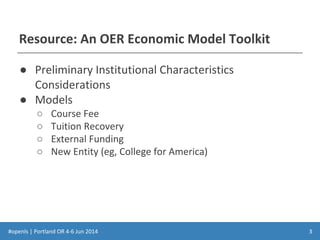
Resource: An OER Economic Model Toolkit
● Preliminary Institutional Characteristics
Considerations
● Models
○ Course Fee
○ Tuition Recovery
○ External Funding
○ New Entity (eg, College for America)
3
#openls | Portland OR 4-6 Jun 2014
Institutional Characteristics Considerations
Before exploring economic models for OER, institutions
should consider local specifics that will help shape what
economic models might fit best.
7
#openls | Portland OR 4-6 Jun 2014
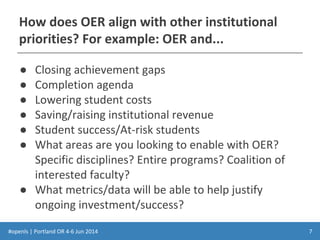
How does OER align with other institutional
priorities? For example: OER and...
● Closing achievement gaps
● Completion agenda
● Lowering student costs
● Saving/raising institutional revenue
● Student success/At-risk students
● What areas are you looking to enable with OER?
Specific disciplines? Entire programs? Coalition of
interested faculty?
● What metrics/data will be able to help justify
ongoing investment/success?
7
#openls | Portland OR 4-6 Jun 2014
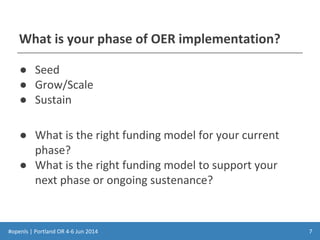
What is your phase of OER implementation?
● Seed
● Grow/Scale
● Sustain
● What is the right funding model for your current
phase?
● What is the right funding model to support your
next phase or ongoing sustenance?
7
#openls | Portland OR 4-6 Jun 2014
What are the political realities of the structure
of your institution?
● Top down?
● Bottom up?
● Unionization?
● System or independent?
7
#openls | Portland OR 4-6 Jun 2014
How standardized/centralized is your
institution?
● At the institutional governance level?
● At the discipline level?
● At the course level?
● At the section level?
● At the instructor level?
● At the pedagogical level?
● At the outcomes level?
● At the LMS/delivery level?
7
#openls | Portland OR 4-6 Jun 2014
What is your current institutional funding
model?
● FTE census?
● FTE completing?
● Performance funding?
● Something else?
7
#openls | Portland OR 4-6 Jun 2014
How does the money flow in you current
environment?
Can you align/augment current flows to support OER?
Will you have to establish a new flow?
● Tuition?
● Financial aid?
● Bookstore?
● Fees?
7
#openls | Portland OR 4-6 Jun 2014
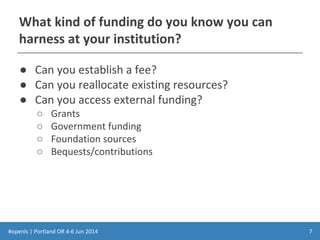
What kind of funding do you know you can
harness at your institution?
● Can you establish a fee?
● Can you reallocate existing resources?
● Can you access external funding?
○ Grants
○ Government funding
○ Foundation sources
○ Bequests/contributions
7
#openls | Portland OR 4-6 Jun 2014
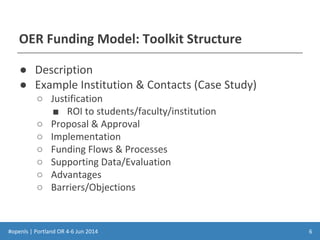
OER Funding Model: Toolkit Structure
● Description
● Example Institution & Contacts (Case Study)
○ Justification
■ ROI to students/faculty/institution
○ Proposal & Approval
○ Implementation
○ Funding Flows & Processes
○ Supporting Data/Evaluation
○ Advantages
○ Barriers/Objections
6
#openls | Portland OR 4-6 Jun 2014
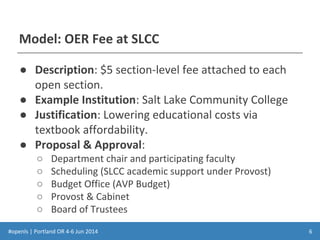
Model: OER Fee at SLCC
● Description: $5 section-level fee attached to each
open section.
● Example Institution: Salt Lake Community College
● Justification: Lowering educational costs via
textbook affordability.
● Proposal & Approval:
○ Department chair and participating faculty
○ Scheduling (SLCC academic support under Provost)
○ Budget Office (AVP Budget)
○ Provost & Cabinet
○ Board of Trustees
6
#openls | Portland OR 4-6 Jun 2014
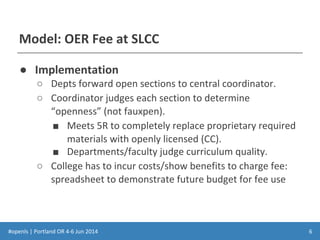
Model: OER Fee at SLCC
● Implementation
○ Depts forward open sections to central coordinator.
○ Coordinator judges each section to determine
“openness” (not fauxpen).
■ Meets 5R to completely replace proprietary required
materials with openly licensed (CC).
■ Departments/faculty judge curriculum quality.
○ College has to incur costs/show benefits to charge fee:
spreadsheet to demonstrate future budget for fee use
6
#openls | Portland OR 4-6 Jun 2014
Model: OER Fee at SLCC
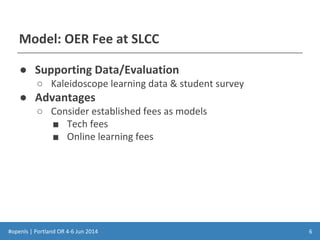
● Supporting Data/Evaluation
○ Kaleidoscope learning data & student survey
● Advantages
○ Consider established fees as models
■ Tech fees
■ Online learning fees
6
#openls | Portland OR 4-6 Jun 2014
Model: OER Fee at SLCC
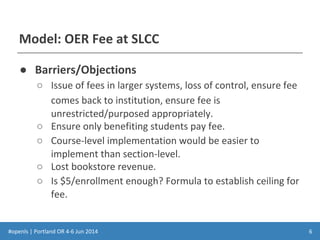
● Barriers/Objections
○ Issue of fees in larger systems, loss of control, ensure fee
comes back to institution, ensure fee is
unrestricted/purposed appropriately.
○ Ensure only benefiting students pay fee.
○ Course-level implementation would be easier to
implement than section-level.
○ Lost bookstore revenue.
○ Is $5/enrollment enough? Formula to establish ceiling for
fee.
6
#openls | Portland OR 4-6 Jun 2014
Model: Tuition Recovery Model at Tidewater
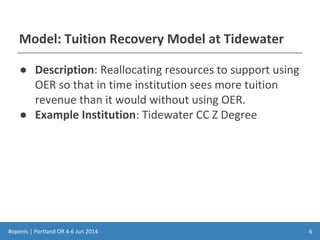
● Description: Reallocating resources to support using
OER so that in time institution sees more tuition
revenue than it would without using OER.
● Example Institution: Tidewater CC Z Degree
6
#openls | Portland OR 4-6 Jun 2014
Model: Tuition Recovery Model at Tidewater
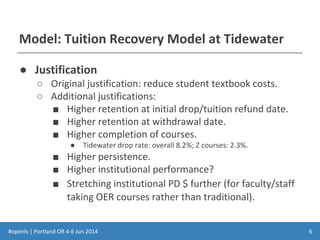
● Justification
○ Original justification: reduce student textbook costs.
○ Additional justifications:
■ Higher retention at initial drop/tuition refund date.
■ Higher retention at withdrawal date.
■ Higher completion of courses.
● Tidewater drop rate: overall 8.2%; Z courses: 2.3%.
■ Higher persistence.
■ Higher institutional performance?
■ Stretching institutional PD $ further (for faculty/staff
taking OER courses rather than traditional).
6
#openls | Portland OR 4-6 Jun 2014
Model: Tuition Recovery Model at Tidewater
● Proposal & Approval
○ Daniel had idea for no cost degree.
○ Danel sold to Tidewater President. The higher up you get
support, the quicker you can move. Start as close to the
top as possible to reallocate existing resources (eg, $ for
PD).
6
#openls | Portland OR 4-6 Jun 2014
Model: Tuition Recovery Model at Tidewater
● Implementation
○ “0 to Z in 12 months.”
○ Evaluated data to identify highest-enrollment program:
business (19K students), both required and elective
courses.
○ Approached individual faculty members to lead each
course.
○ Hired Lumen to identify content and manage licensing.
○ Empty placeholder in section number used to mark
Tidewater Z courses in course schedule.
6
#openls | Portland OR 4-6 Jun 2014
Model: Tuition Recovery Model at Tidewater
● Funding Flows & Processes
○ Redirected existing PD $ to incent faculty.
○ Incented librarians to become OER experts; new position
descriptions.
6
#openls | Portland OR 4-6 Jun 2014
Model: Tuition Recovery Model at Tidewater
● Supporting Data/Evaluation
○ Tidewater data shows that increased tuition revenue
higher than costs of delivering OER Z degree.
○ All Z degree students surveyed via IRB.
○ Are there multiple factors in play at Tidewater that might
affect outcomes?
■ No other interventions, selections, etc.
■ Tidewater students: traditional did worse on OER
assessments, but OER students did just as well on
proprietary assessments.
■ Which sections/courses/faculty have the highest
enrollments and best retention?
6
#openls | Portland OR 4-6 Jun 2014
Model: Tuition Recovery Model at Tidewater
● Advantages
○ Student retention/success.
○ Increase of instructor effectiveness.
○ Increase in instructor efficiency (doing the right things
well).
○ Competitive advantage
○ Bonus funding in formula funding states
○ Improve quality: Related to performance funding models
○ Support moves to lower-cost adjunct faculty
■ Anticipate & have a response to this “advantage”
■ Already present in use of proprietary texts
6
#openls | Portland OR 4-6 Jun 2014
Model: Tuition Recovery Model at Tidewater
● Barriers/Objections
○ None?
6
#openls | Portland OR 4-6 Jun 2014
Additional Economic Models
● External Funding
● New Entity (eg, College for America)
● Others?
3
#openls | Portland OR 4-6 Jun 2014
Collaboration Opportunities & Next Steps
● Establish & publicize toolkit
○ Possibility of online “wizards” to help users explore
tailored models.
● Augment toolkit structure
● Augment existing model examples
● Add more funding model examples
7
#openls | Portland OR 4-6 Jun 2014
Discussion + Q&A
● Comments?
● Questions?
● What did we miss?
● What would you add?
● Directions for further exploration?
8
#openls | Portland OR 4-6 Jun 2014
OPEN EDUCATION
leadership summit
2014

#Openls 2014 Workshop Economic Models

  • 1.
    #openls | PortlandOR 4-6 Jun 2014 OPEN EDUCATION leadership summit 2014 Economic Models Workshop Presentation Group Leaders: Jason Pickavance (@jpickava) and Linda Williams Group Facilitator: Nate Angell (@xolotl)
  • 2.
    #openls | PortlandOR 4-6 Jun 2014 Workshop Participants (in seated order) ● Jason Pickavance (co-leader), Salt Lake Community College, Director of Educational Initiatives ● Clea Andreadis, Middlesex Community College, Associate Provost, Instruction and Assessment ● Ryan Hobbs, Salt Lake Community College, Director of eLearning ● Linda Williams (co-leader), Tidewater Community College, Professor of Business Administration ● Kara Monroe, Associate Vice President, Academic Online Programs, Ivy Tech Community College of Indiana ● Peter Quigley, University of Hawaii, Associate Vice President for Academic Affairs for Community Colleges ● Karen Vignare, University of Maryland University College, Associate Provost, Center for Innovation in Learning ● Nate Angell (facilitator), Lumen Learning, Doorman ● Randy Morales, Cerritos College, TAACCCT Grant Program Manager ● David Wiley, Lumen Learning, CAO 2
  • 3.
    #openls | PortlandOR 4-6 Jun 2014 Overview of Issues ● Institutions need help understanding what models have worked to initiate and/or sustain OER initiatives at other institutions. ● Institutions come to the table at varying degrees of OER engagement. Models need to fit an institution’s current stage. ● Institutions have very different governance, finance, faculty, union, political, etc environments and histories. OER funding models need to fit local institutional particularities. 2
  • 4.
    #openls | PortlandOR 4-6 Jun 2014 Resource: An OER Economic Model Toolkit ● Preliminary Institutional Characteristics Considerations ● Models ○ Course Fee ○ Tuition Recovery ○ External Funding ○ New Entity (eg, College for America) 3
  • 5.
    #openls | PortlandOR 4-6 Jun 2014 Institutional Characteristics Considerations Before exploring economic models for OER, institutions should consider local specifics that will help shape what economic models might fit best. 7
  • 6.
    #openls | PortlandOR 4-6 Jun 2014 How does OER align with other institutional priorities? For example: OER and... ● Closing achievement gaps ● Completion agenda ● Lowering student costs ● Saving/raising institutional revenue ● Student success/At-risk students ● What areas are you looking to enable with OER? Specific disciplines? Entire programs? Coalition of interested faculty? ● What metrics/data will be able to help justify ongoing investment/success? 7
  • 7.
    #openls | PortlandOR 4-6 Jun 2014 What is your phase of OER implementation? ● Seed ● Grow/Scale ● Sustain ● What is the right funding model for your current phase? ● What is the right funding model to support your next phase or ongoing sustenance? 7
  • 8.
    #openls | PortlandOR 4-6 Jun 2014 What are the political realities of the structure of your institution? ● Top down? ● Bottom up? ● Unionization? ● System or independent? 7
  • 9.
    #openls | PortlandOR 4-6 Jun 2014 How standardized/centralized is your institution? ● At the institutional governance level? ● At the discipline level? ● At the course level? ● At the section level? ● At the instructor level? ● At the pedagogical level? ● At the outcomes level? ● At the LMS/delivery level? 7
  • 10.
    #openls | PortlandOR 4-6 Jun 2014 What is your current institutional funding model? ● FTE census? ● FTE completing? ● Performance funding? ● Something else? 7
  • 11.
    #openls | PortlandOR 4-6 Jun 2014 How does the money flow in you current environment? Can you align/augment current flows to support OER? Will you have to establish a new flow? ● Tuition? ● Financial aid? ● Bookstore? ● Fees? 7
  • 12.
    #openls | PortlandOR 4-6 Jun 2014 What kind of funding do you know you can harness at your institution? ● Can you establish a fee? ● Can you reallocate existing resources? ● Can you access external funding? ○ Grants ○ Government funding ○ Foundation sources ○ Bequests/contributions 7
  • 13.
    #openls | PortlandOR 4-6 Jun 2014 OER Funding Model: Toolkit Structure ● Description ● Example Institution & Contacts (Case Study) ○ Justification ■ ROI to students/faculty/institution ○ Proposal & Approval ○ Implementation ○ Funding Flows & Processes ○ Supporting Data/Evaluation ○ Advantages ○ Barriers/Objections 6
  • 14.
    #openls | PortlandOR 4-6 Jun 2014 Model: OER Fee at SLCC ● Description: $5 section-level fee attached to each open section. ● Example Institution: Salt Lake Community College ● Justification: Lowering educational costs via textbook affordability. ● Proposal & Approval: ○ Department chair and participating faculty ○ Scheduling (SLCC academic support under Provost) ○ Budget Office (AVP Budget) ○ Provost & Cabinet ○ Board of Trustees 6
  • 15.
    #openls | PortlandOR 4-6 Jun 2014 Model: OER Fee at SLCC ● Implementation ○ Depts forward open sections to central coordinator. ○ Coordinator judges each section to determine “openness” (not fauxpen). ■ Meets 5R to completely replace proprietary required materials with openly licensed (CC). ■ Departments/faculty judge curriculum quality. ○ College has to incur costs/show benefits to charge fee: spreadsheet to demonstrate future budget for fee use 6
  • 16.
    #openls | PortlandOR 4-6 Jun 2014 Model: OER Fee at SLCC ● Supporting Data/Evaluation ○ Kaleidoscope learning data & student survey ● Advantages ○ Consider established fees as models ■ Tech fees ■ Online learning fees 6
  • 17.
    #openls | PortlandOR 4-6 Jun 2014 Model: OER Fee at SLCC ● Barriers/Objections ○ Issue of fees in larger systems, loss of control, ensure fee comes back to institution, ensure fee is unrestricted/purposed appropriately. ○ Ensure only benefiting students pay fee. ○ Course-level implementation would be easier to implement than section-level. ○ Lost bookstore revenue. ○ Is $5/enrollment enough? Formula to establish ceiling for fee. 6
  • 18.
    #openls | PortlandOR 4-6 Jun 2014 Model: Tuition Recovery Model at Tidewater ● Description: Reallocating resources to support using OER so that in time institution sees more tuition revenue than it would without using OER. ● Example Institution: Tidewater CC Z Degree 6
  • 19.
    #openls | PortlandOR 4-6 Jun 2014 Model: Tuition Recovery Model at Tidewater ● Justification ○ Original justification: reduce student textbook costs. ○ Additional justifications: ■ Higher retention at initial drop/tuition refund date. ■ Higher retention at withdrawal date. ■ Higher completion of courses. ● Tidewater drop rate: overall 8.2%; Z courses: 2.3%. ■ Higher persistence. ■ Higher institutional performance? ■ Stretching institutional PD $ further (for faculty/staff taking OER courses rather than traditional). 6
  • 20.
    #openls | PortlandOR 4-6 Jun 2014 Model: Tuition Recovery Model at Tidewater ● Proposal & Approval ○ Daniel had idea for no cost degree. ○ Danel sold to Tidewater President. The higher up you get support, the quicker you can move. Start as close to the top as possible to reallocate existing resources (eg, $ for PD). 6
  • 21.
    #openls | PortlandOR 4-6 Jun 2014 Model: Tuition Recovery Model at Tidewater ● Implementation ○ “0 to Z in 12 months.” ○ Evaluated data to identify highest-enrollment program: business (19K students), both required and elective courses. ○ Approached individual faculty members to lead each course. ○ Hired Lumen to identify content and manage licensing. ○ Empty placeholder in section number used to mark Tidewater Z courses in course schedule. 6
  • 22.
    #openls | PortlandOR 4-6 Jun 2014 Model: Tuition Recovery Model at Tidewater ● Funding Flows & Processes ○ Redirected existing PD $ to incent faculty. ○ Incented librarians to become OER experts; new position descriptions. 6
  • 23.
    #openls | PortlandOR 4-6 Jun 2014 Model: Tuition Recovery Model at Tidewater ● Supporting Data/Evaluation ○ Tidewater data shows that increased tuition revenue higher than costs of delivering OER Z degree. ○ All Z degree students surveyed via IRB. ○ Are there multiple factors in play at Tidewater that might affect outcomes? ■ No other interventions, selections, etc. ■ Tidewater students: traditional did worse on OER assessments, but OER students did just as well on proprietary assessments. ■ Which sections/courses/faculty have the highest enrollments and best retention? 6
  • 24.
    #openls | PortlandOR 4-6 Jun 2014 Model: Tuition Recovery Model at Tidewater ● Advantages ○ Student retention/success. ○ Increase of instructor effectiveness. ○ Increase in instructor efficiency (doing the right things well). ○ Competitive advantage ○ Bonus funding in formula funding states ○ Improve quality: Related to performance funding models ○ Support moves to lower-cost adjunct faculty ■ Anticipate & have a response to this “advantage” ■ Already present in use of proprietary texts 6
  • 25.
    #openls | PortlandOR 4-6 Jun 2014 Model: Tuition Recovery Model at Tidewater ● Barriers/Objections ○ None? 6
  • 26.
    #openls | PortlandOR 4-6 Jun 2014 Additional Economic Models ● External Funding ● New Entity (eg, College for America) ● Others? 3
  • 27.
    #openls | PortlandOR 4-6 Jun 2014 Collaboration Opportunities & Next Steps ● Establish & publicize toolkit ○ Possibility of online “wizards” to help users explore tailored models. ● Augment toolkit structure ● Augment existing model examples ● Add more funding model examples 7
  • 28.
    #openls | PortlandOR 4-6 Jun 2014 Discussion + Q&A ● Comments? ● Questions? ● What did we miss? ● What would you add? ● Directions for further exploration? 8
  • 29.
    #openls | PortlandOR 4-6 Jun 2014
  • 30.
    #openls | PortlandOR 4-6 Jun 2014 OPEN EDUCATION leadership summit 2014