Open Ed Landscape, Open Course 
Design and 
Increasing Student Engagement 
10 November 2014 
Dr. Ian O’Byrne @wiobyrne 
Professor, University of New Haven 
wiobyrne@gmail.com 
Ronda Neugebauer @openarian 
Open Instructional Systems Technologist 
rd@rondadorsey.com 
Slide content created by Lumen Learning http://lumenlearning.com/and reused under a Creative Commons 
Attribution CC BY License https://creativecommons.org/licenses/by/4.0/
Why Open? 
Shared by David Wiley under a Creative Commons Attribution 3.0 license.
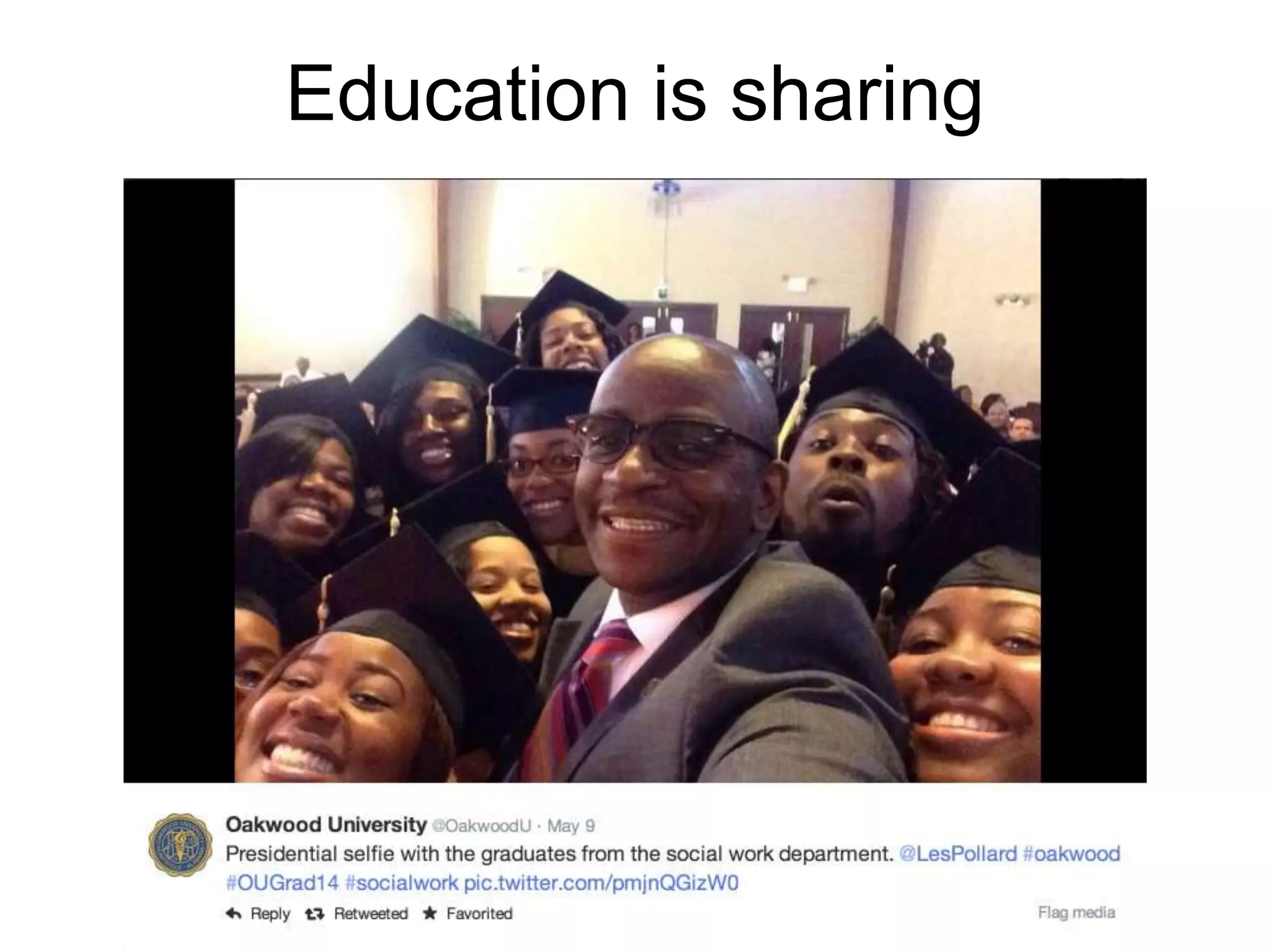
Education is sharing
Successful educators 
share the most completely 
with the most students
If there is no sharing 
there is no education
What can be given without 
being given away? 
knowledge
Ideas are non-rivalrous 
can be given without being given away
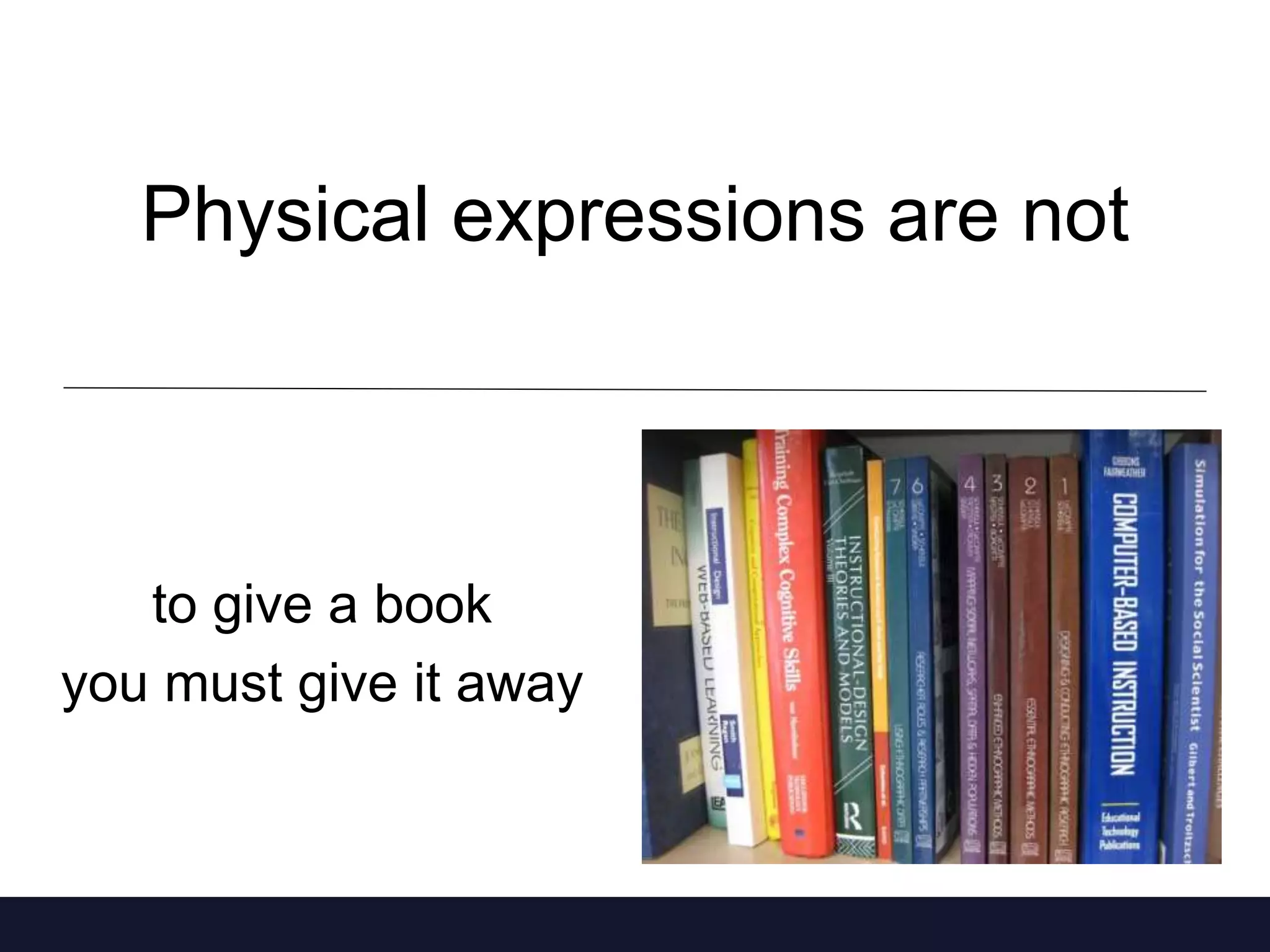
Physical expressions are not 
to give a book 
you must give it away
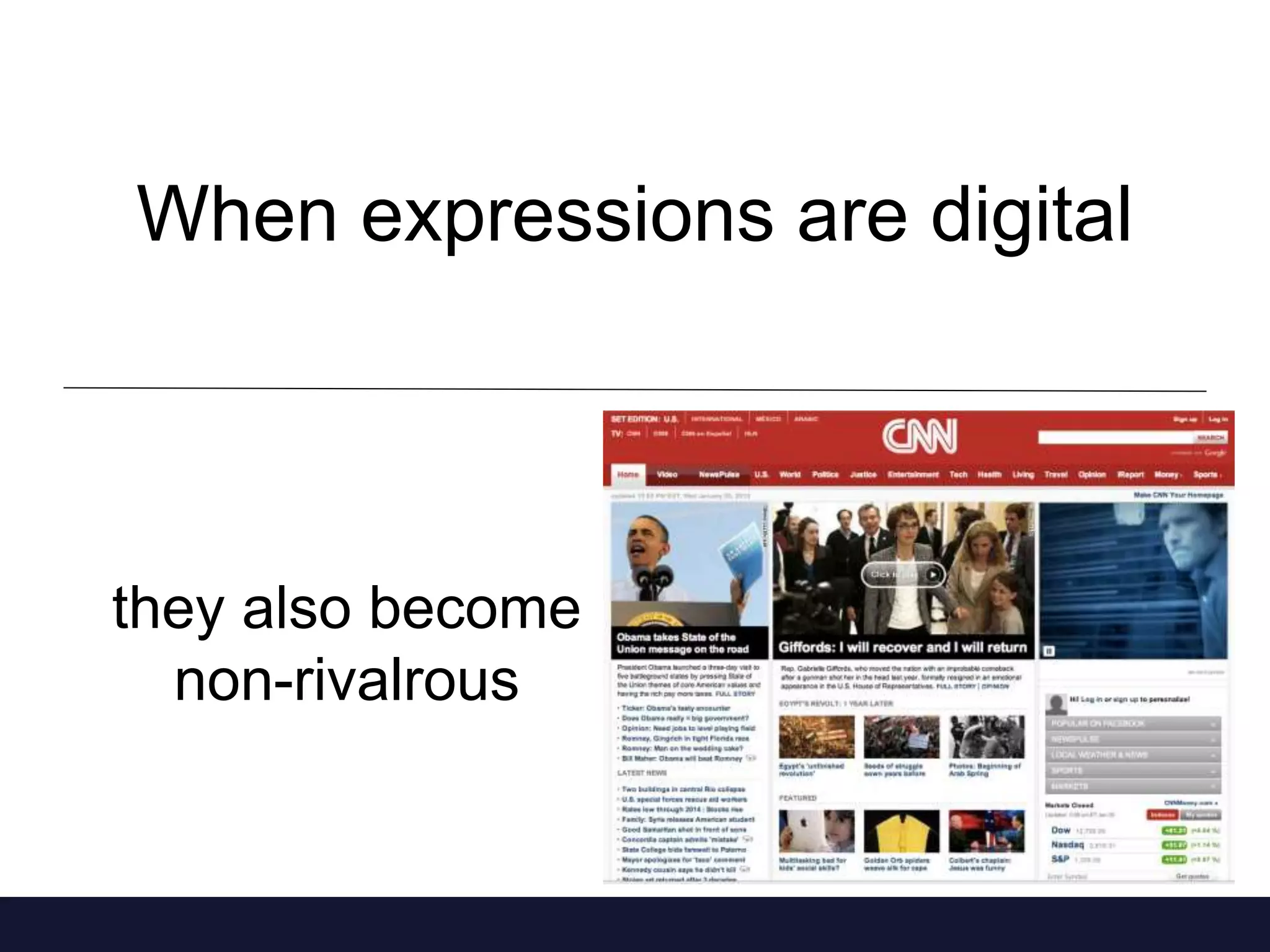
When expressions are digital 
they also become 
non-rivalrous
Internet offers 
unprecedented capacity 
to share and educate as never before
Except we can’t 
© regulates copying, adapting, 
distributing
© cancels the possibilities 
of digital media and the internet
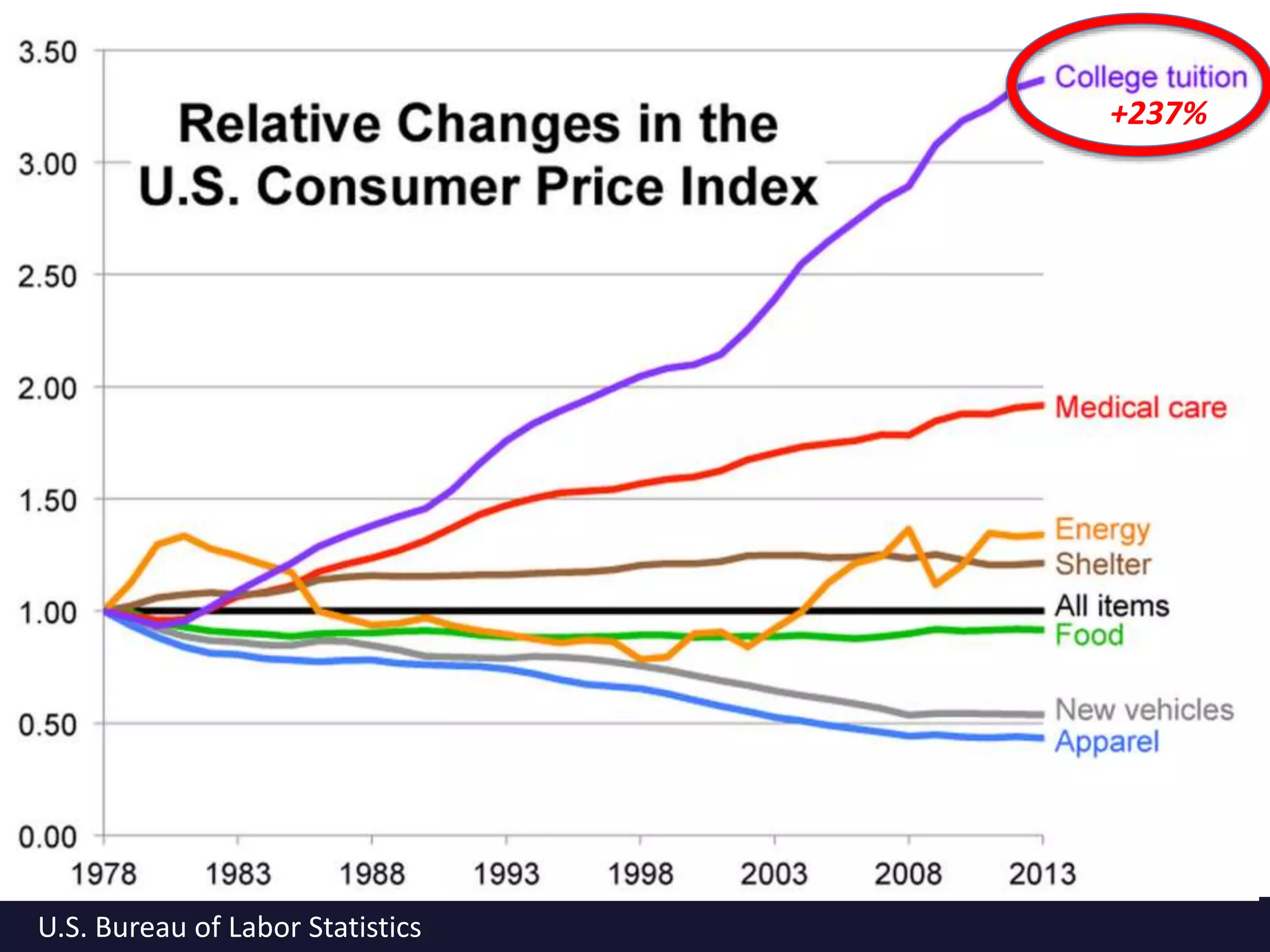
U.S. Bureau of Labor Statistics 
+237%
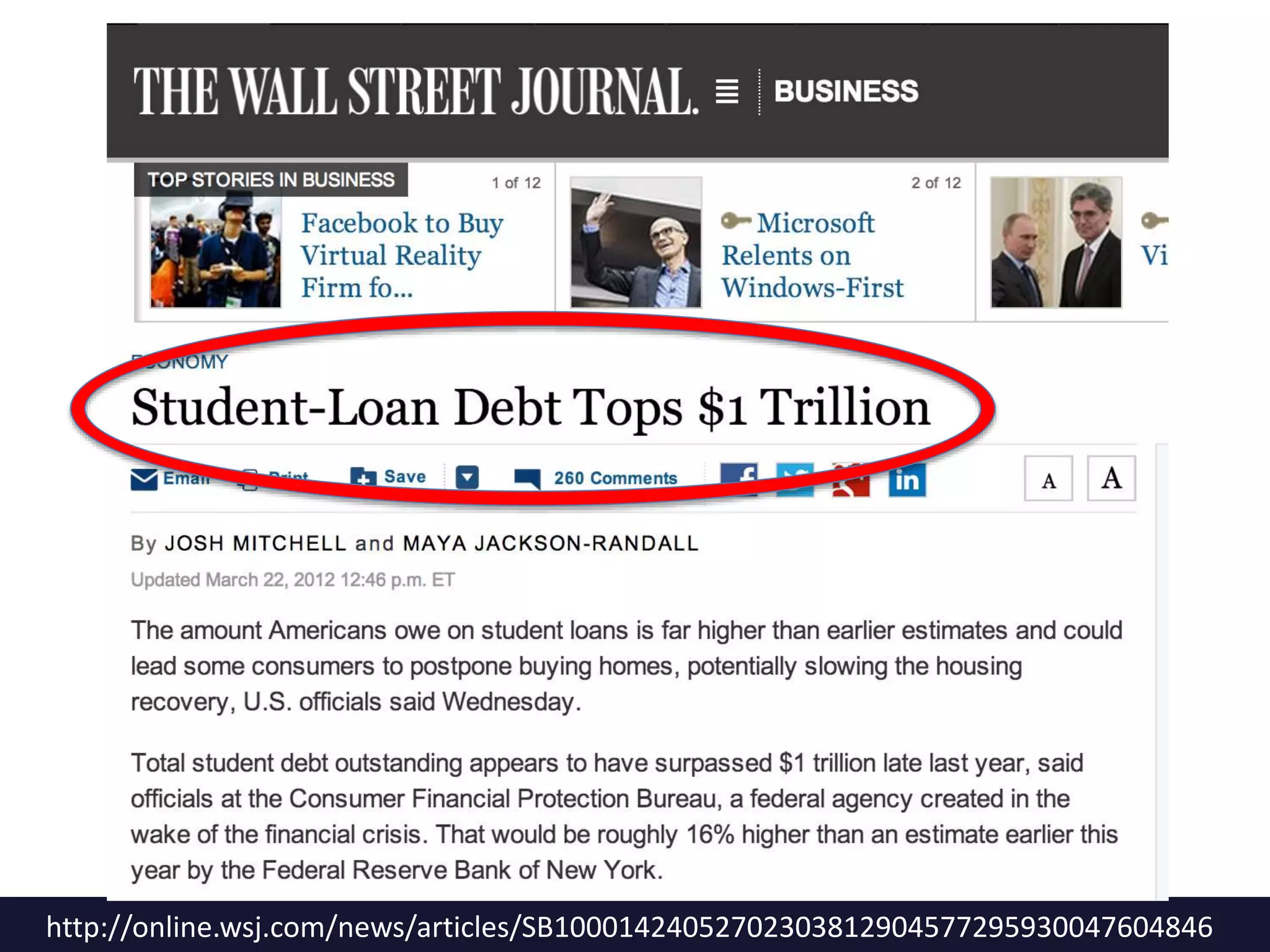
http://online.wsj.com/news/articles/SB10001424052702303812904577295930047604846
Tuition is political 
textbook adoptions are less political
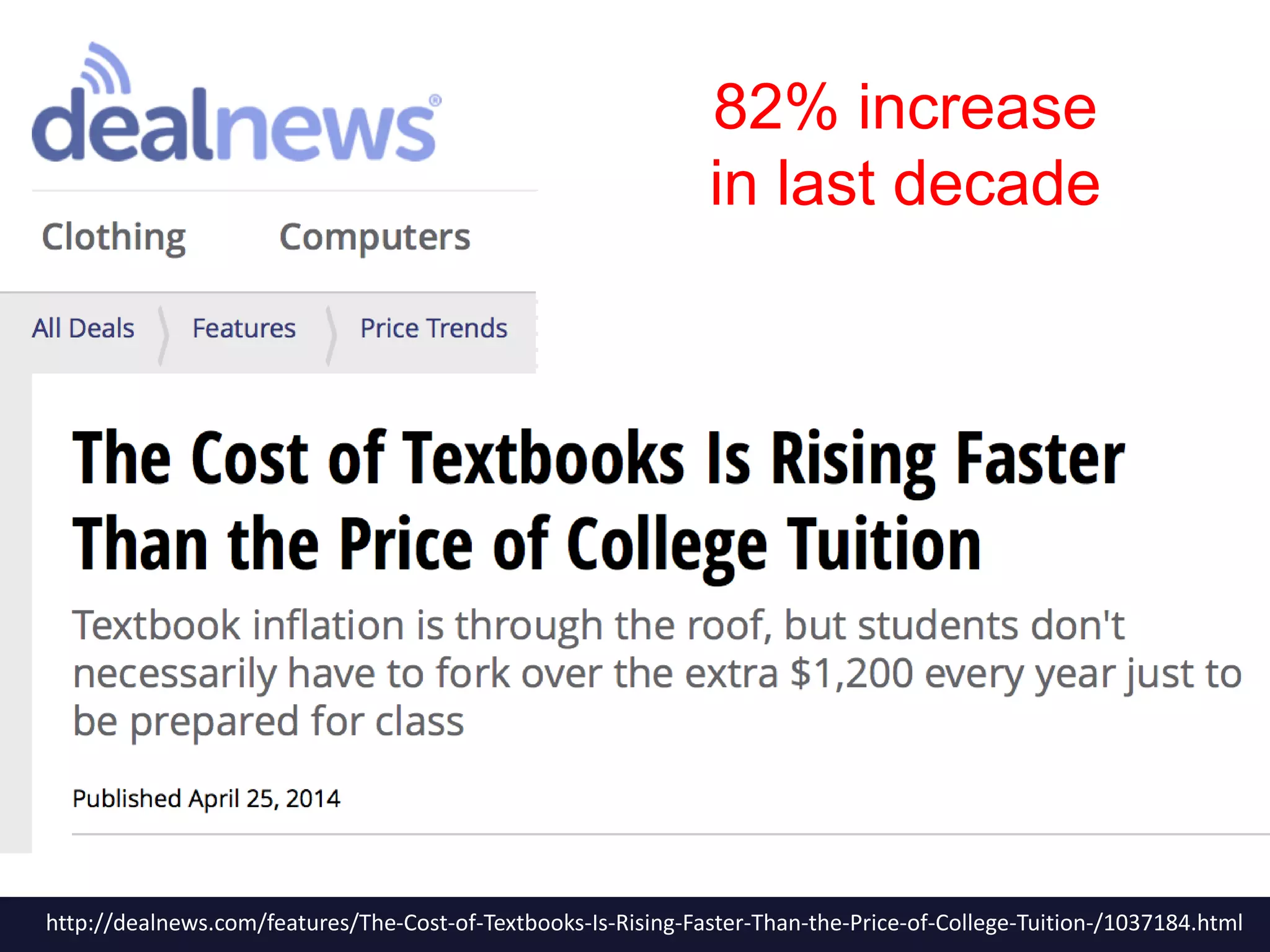
82% increase 
in last decade 
http://dealnews.com/features/The-Cost-of-Textbooks-Is-Rising-Faster-Than-the-Price-of-College-Tuition-/1037184.html
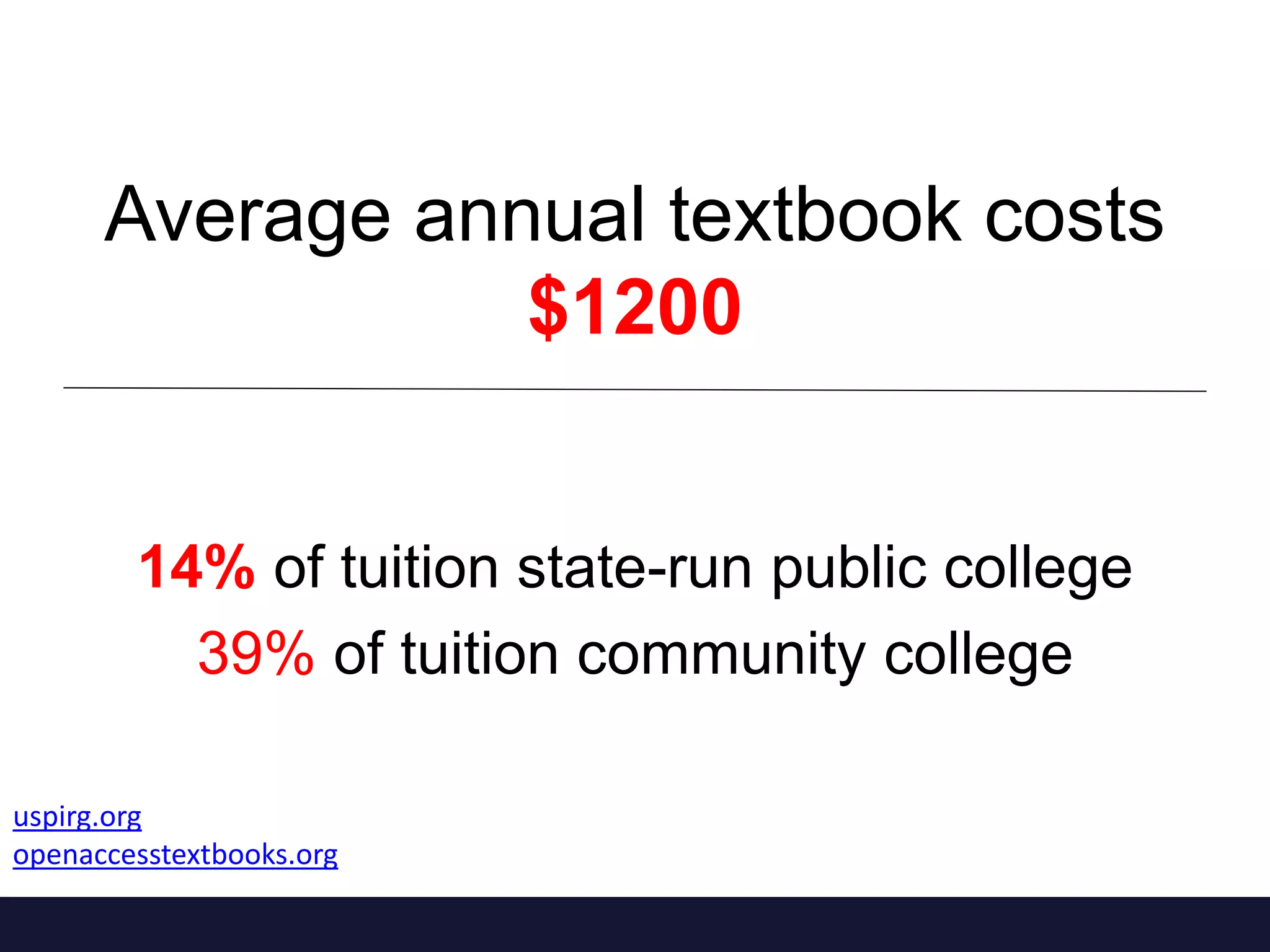
Average annual textbook costs 
$1200 
14% of tuition state-run public college 
39% of tuition community college 
uspirg.org 
openaccesstextbooks.org
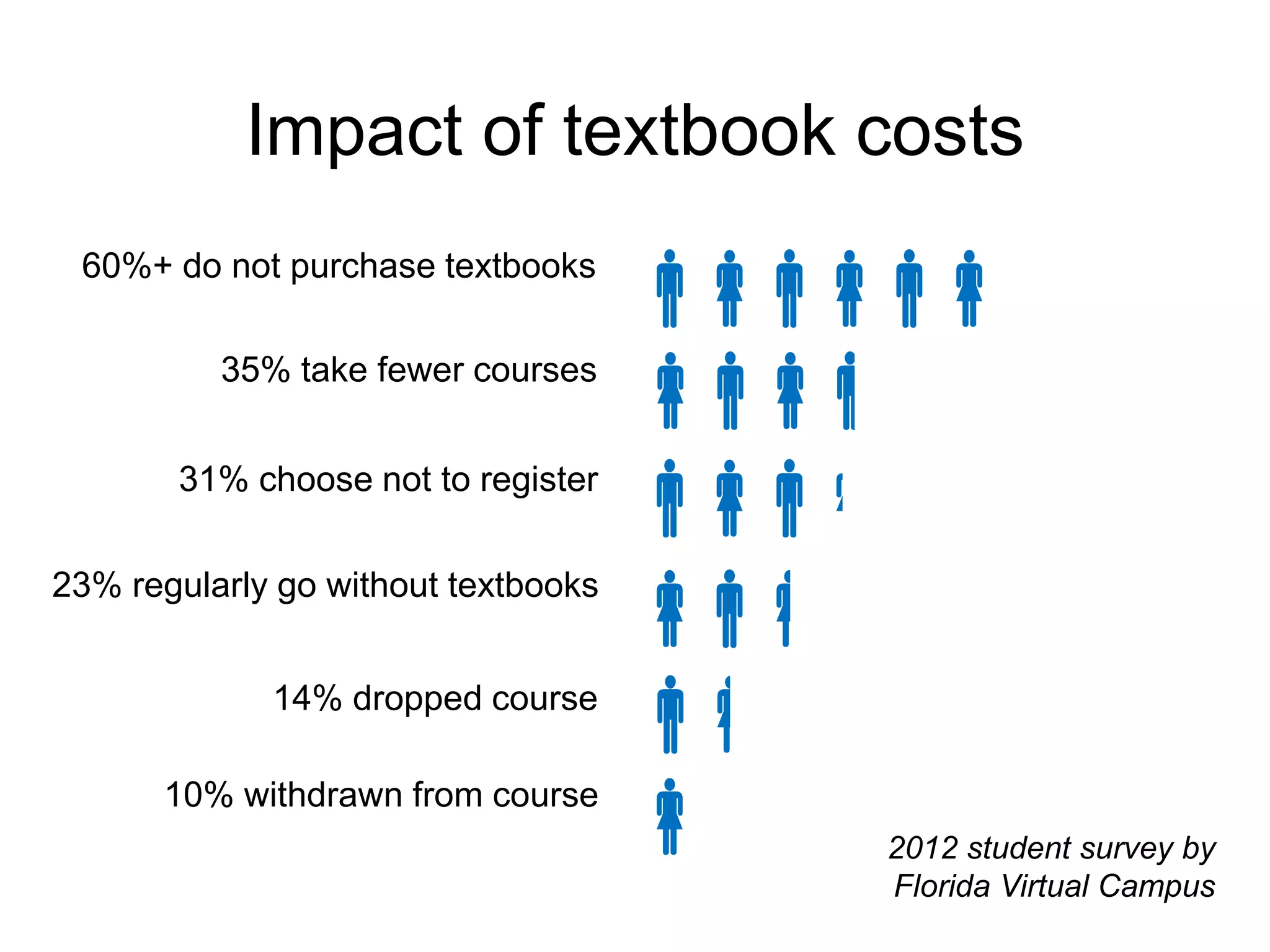
Impact of textbook costs 
60%+ do not purchase textbooks 
35% take fewer courses 
31% choose not to register 
23% regularly go without textbooks 
14% dropped course 
10% withdrawn from course 
 
 
 
 
 
 2012 student survey by 
Florida Virtual Campus
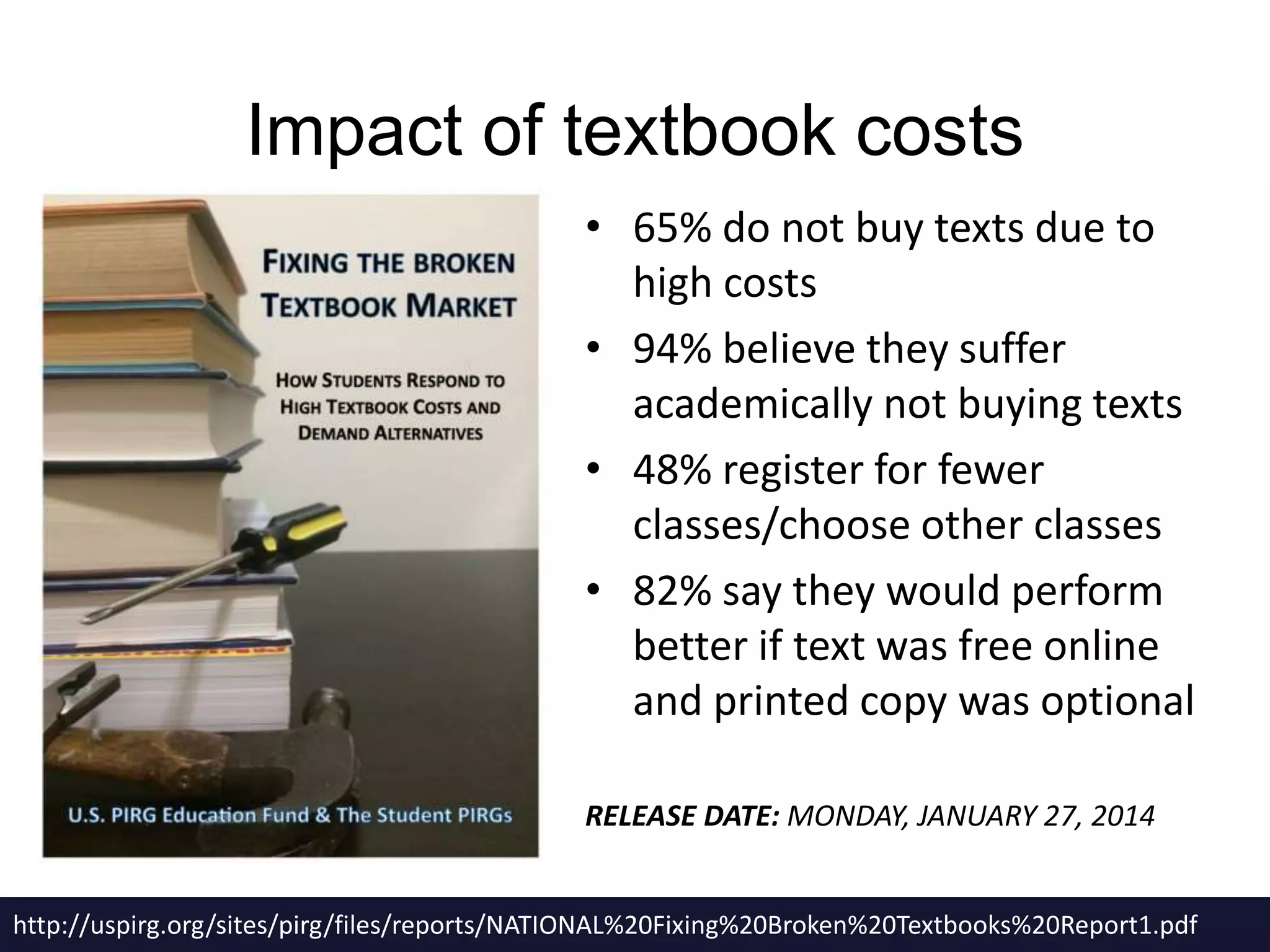
Impact of textbook costs 
• 65% do not buy texts due to 
high costs 
• 94% believe they suffer 
academically not buying texts 
• 48% register for fewer 
classes/choose other classes 
• 82% say they would perform 
better if text was free online 
and printed copy was optional 
RELEASE DATE: MONDAY, JANUARY 27, 2014 
http://uspirg.org/sites/pirg/files/reports/NATIONAL%20Fixing%20Broken%20Textbooks%20Report1.pdf
What to do? 
Shared by David Wiley under a Creative Commons Attribution 3.0 license.
www.lumenlearning.com
+ Institutional 
Partners 
Collaborate and leverage 
open educational resources (OER) 
to eliminate the textbook cost barrier 
Shared by David Wiley under a Creative Commons Attribution 3.0 license.
Sharing and educating 
at unprecedented scale
OER Defined 
Shared by David Wiley under a Creative Commons Attribution 3.0 license.
What are Open Educational 
Resources (OER)? 
(1) Any kind of teaching materials – textbooks, 
syllabi, lesson plans, videos, readings, 
exams 
Shared by David Wiley under a Creative Commons Attribution 3.0 license.
What are Open Educational 
Resources (OER)? 
(1) Any kind of teaching materials – textbooks, 
syllabi, lesson plans, videos, readings, 
exams 
What are Open Educational 
Resources (OER)? 
(2) Are free for anyone to access, and 
(3) Include free permission to engage in 
“5Rs” 
Shared by David Wiley under a Creative Commons Attribution 3.0 license.
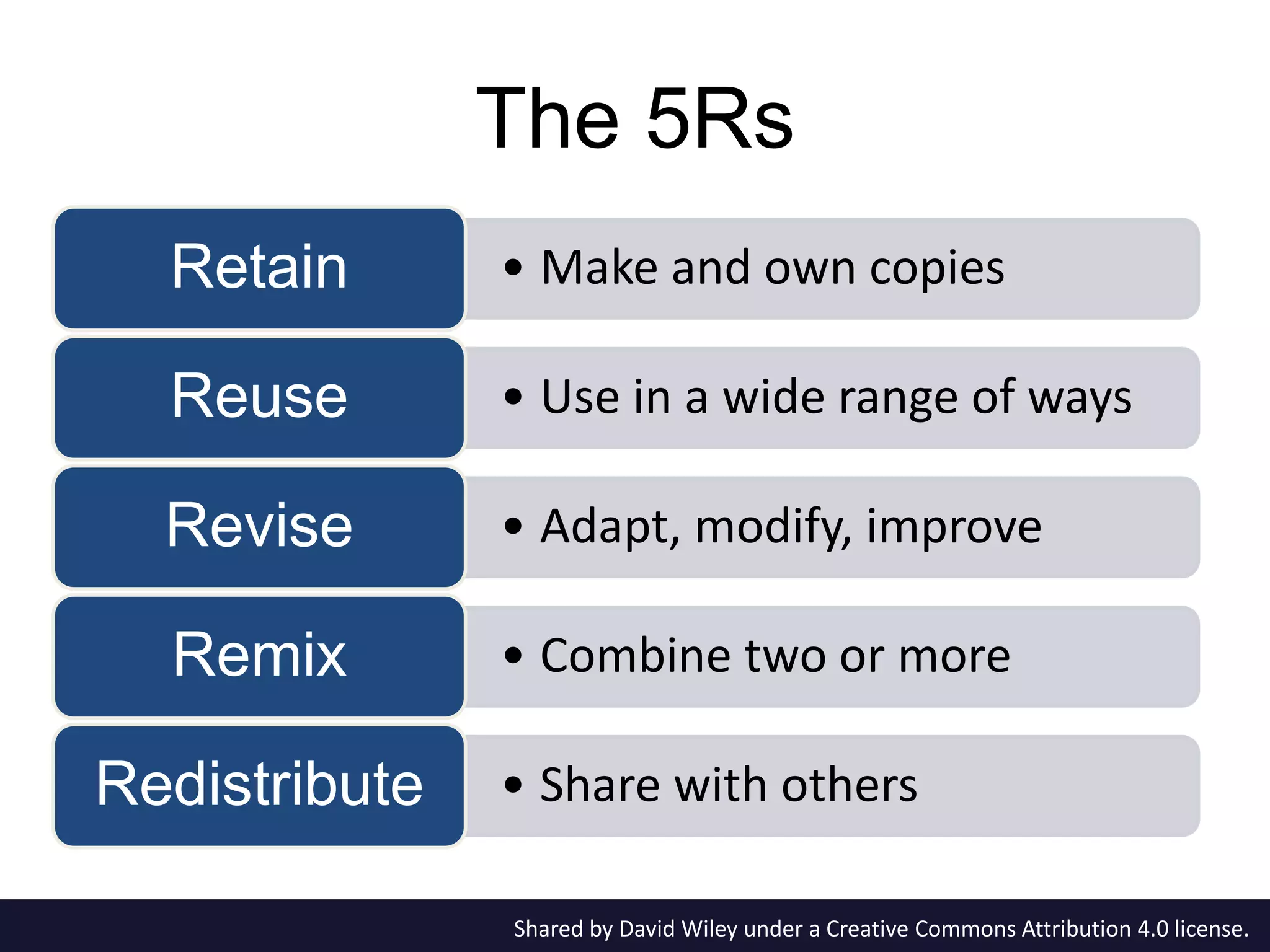
The 5Rs 
Retain • Make and own copies 
Reuse • Use in a wide range of ways 
Revise • Adapt, modify, improve 
Remix • Combine two or more 
Redistribute • Share with others 
Shared by David Wiley under a Creative Commons Attribution 4.0 license.
Open licenses make sharing easy 
simple, standardized, legally robust 
way to grant copyright permissions 
Commons licenses provide a simple, standardized 
grant copyright permissions to creative work. 
500+ million items 
creativecommons.org
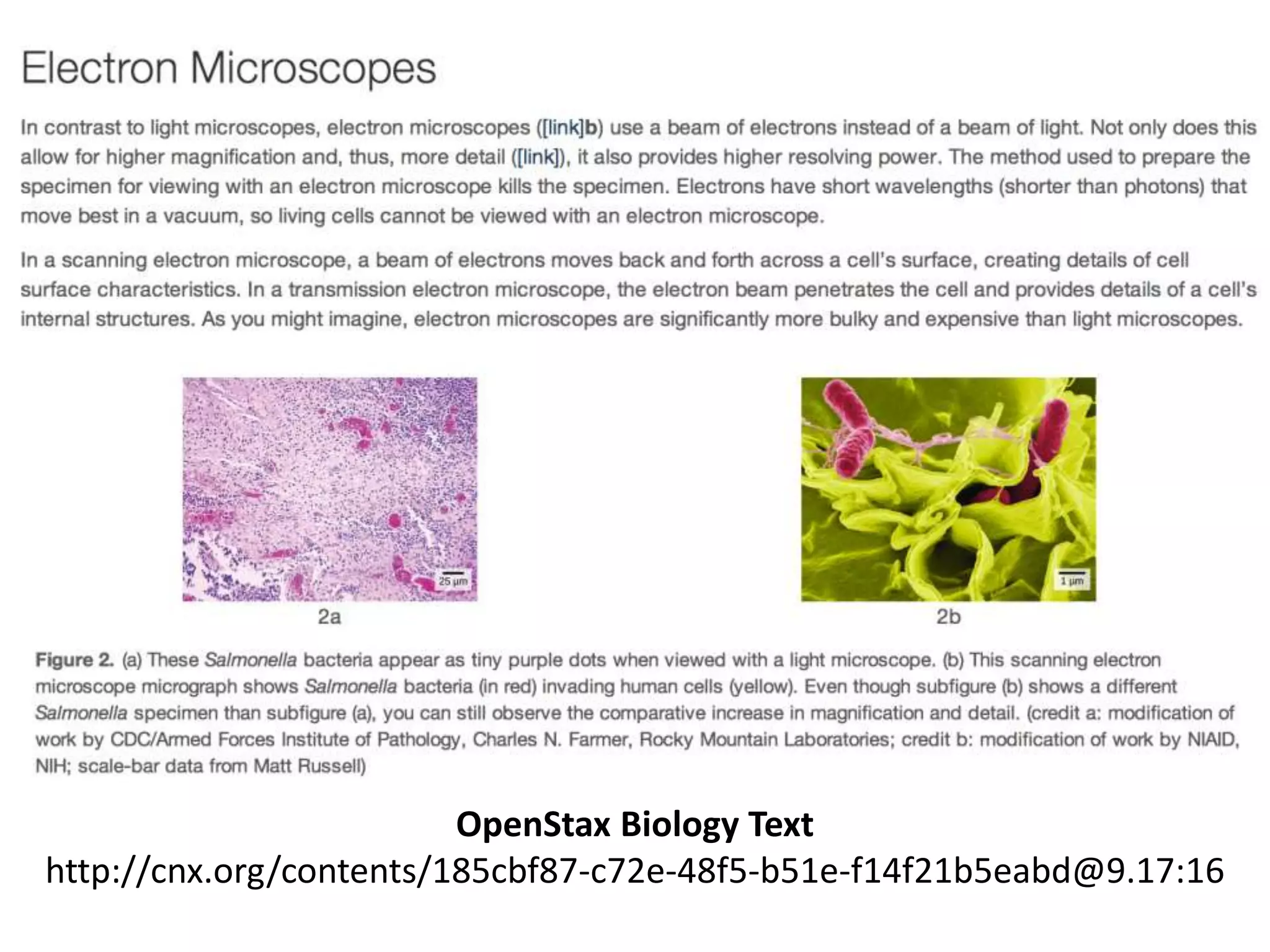
OpenStax Biology Text 
http://cnx.org/contents/185cbf87-c72e-48f5-b51e-f14f21b5eabd@9.17:16
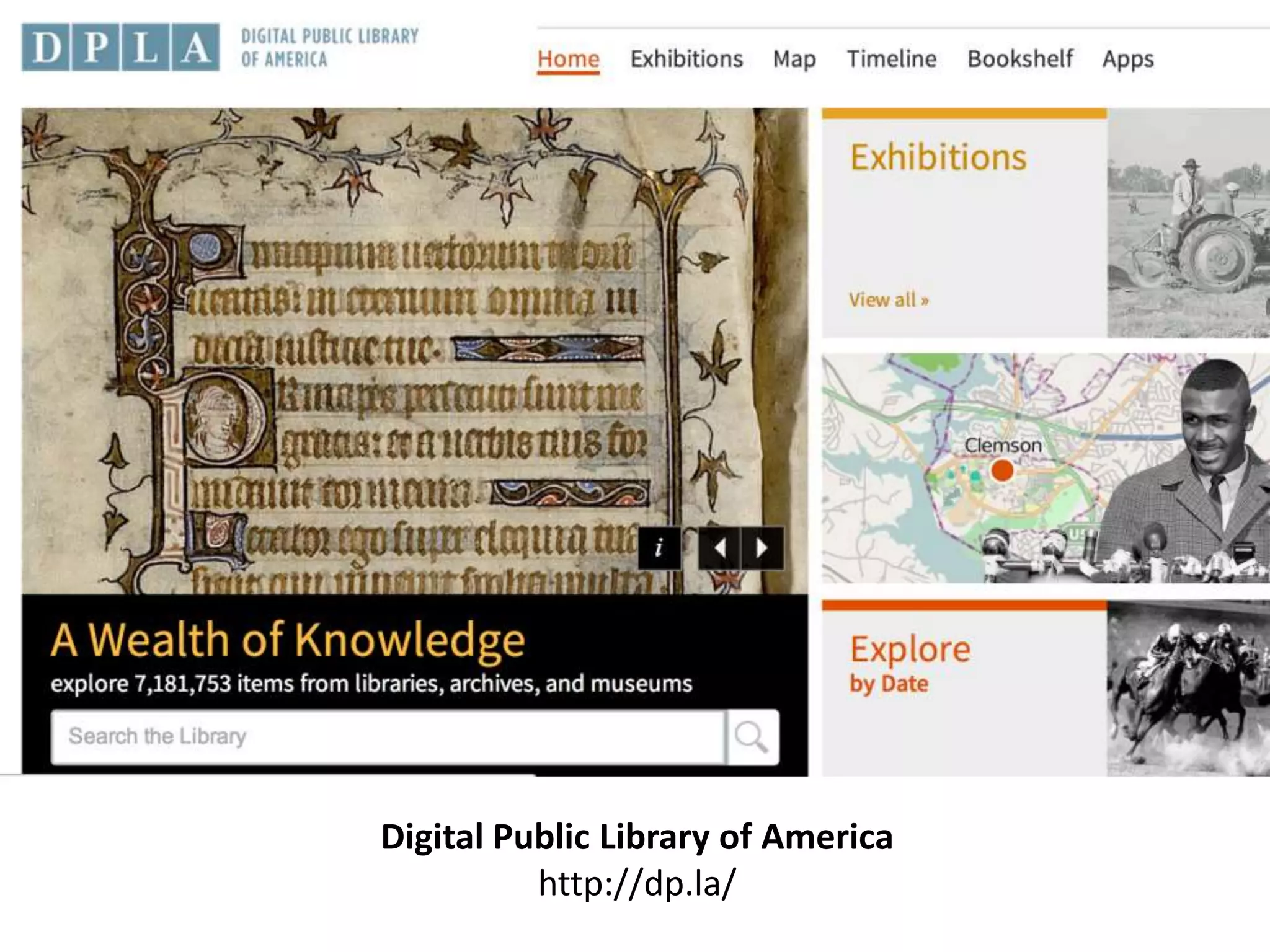
Digital Public Library of America 
http://dp.la/
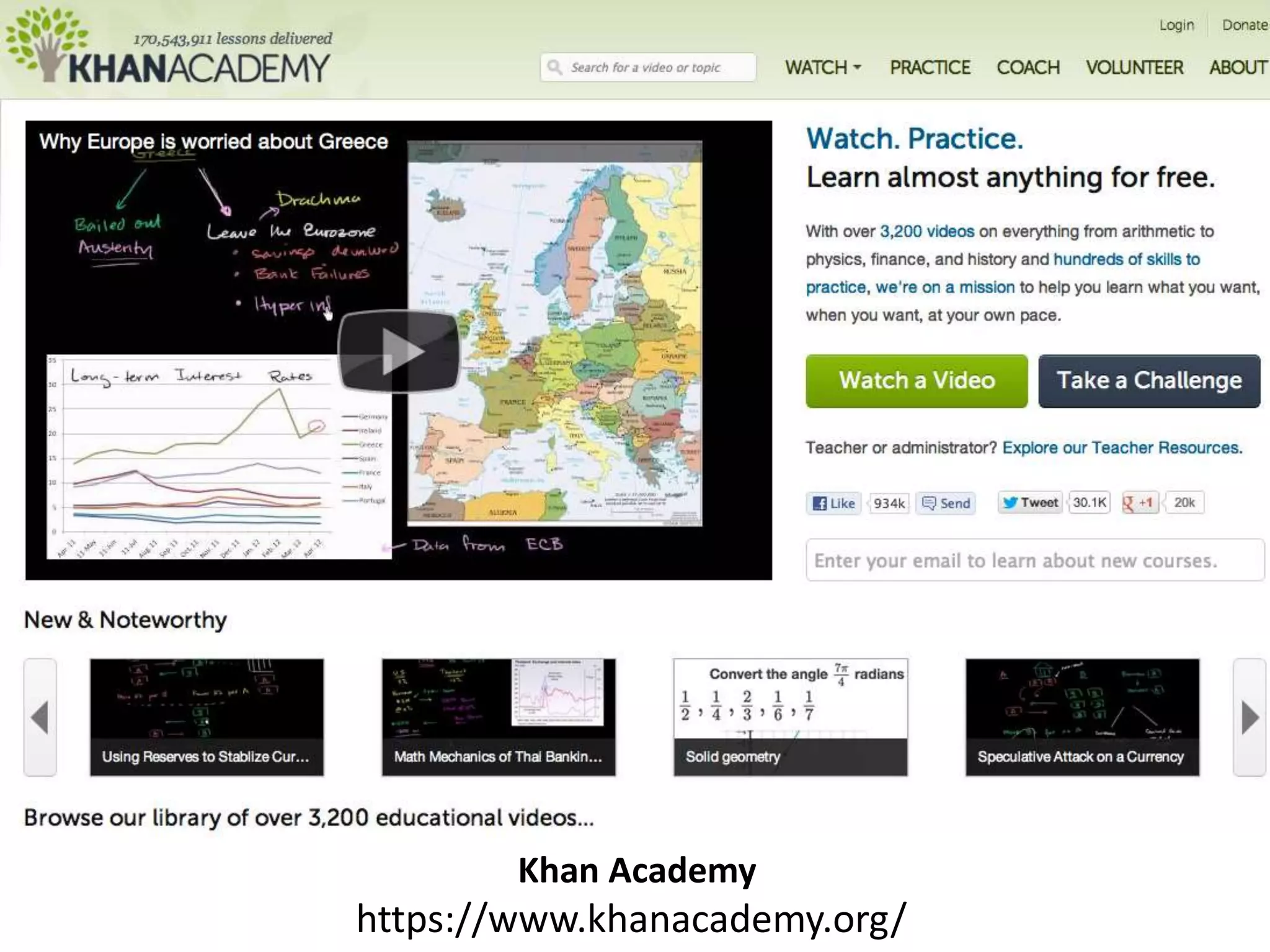
Khan Academy 
https://www.khanacademy.org/
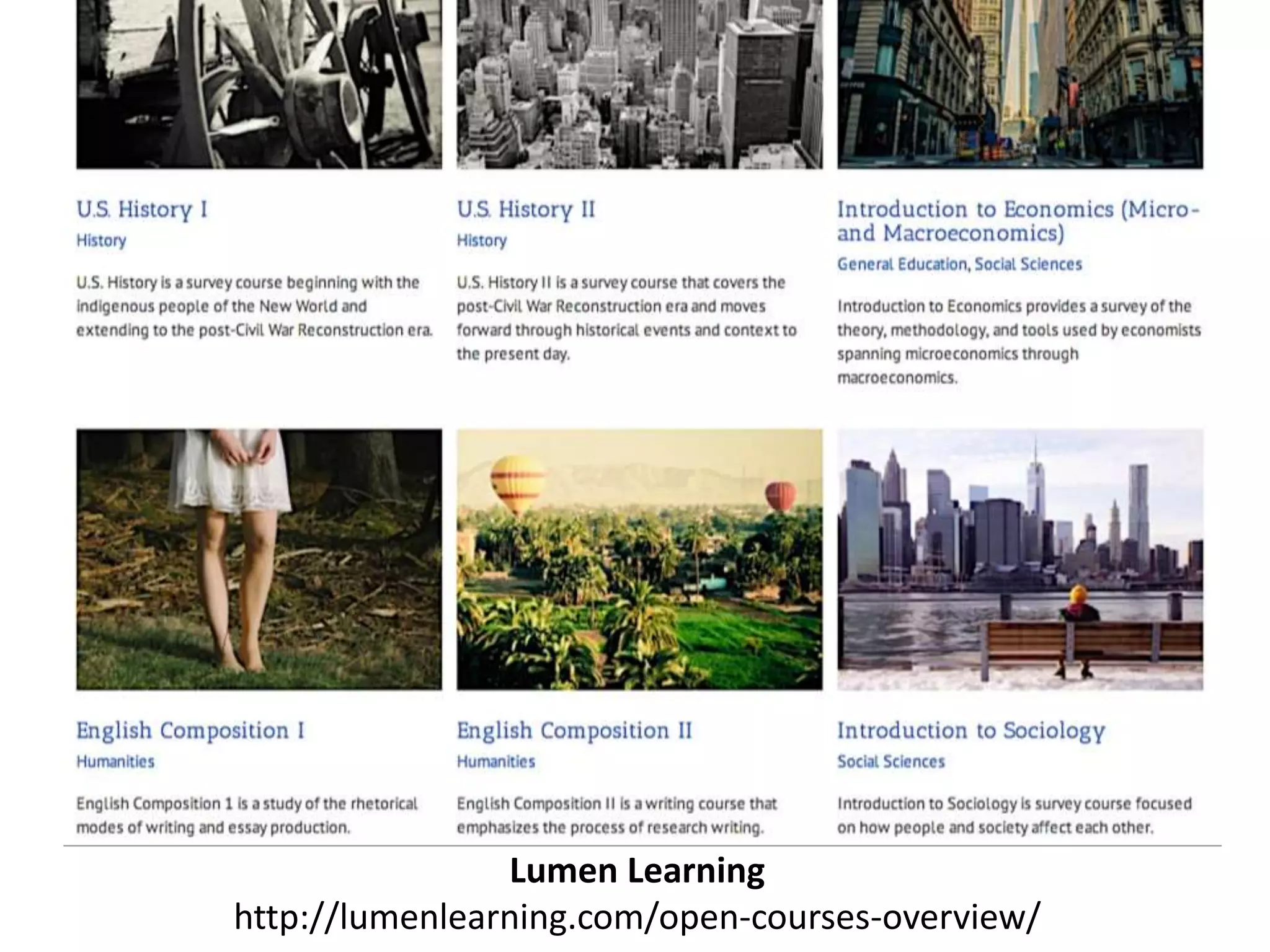
Lumen Learning 
http://lumenlearning.com/open-courses-overview/
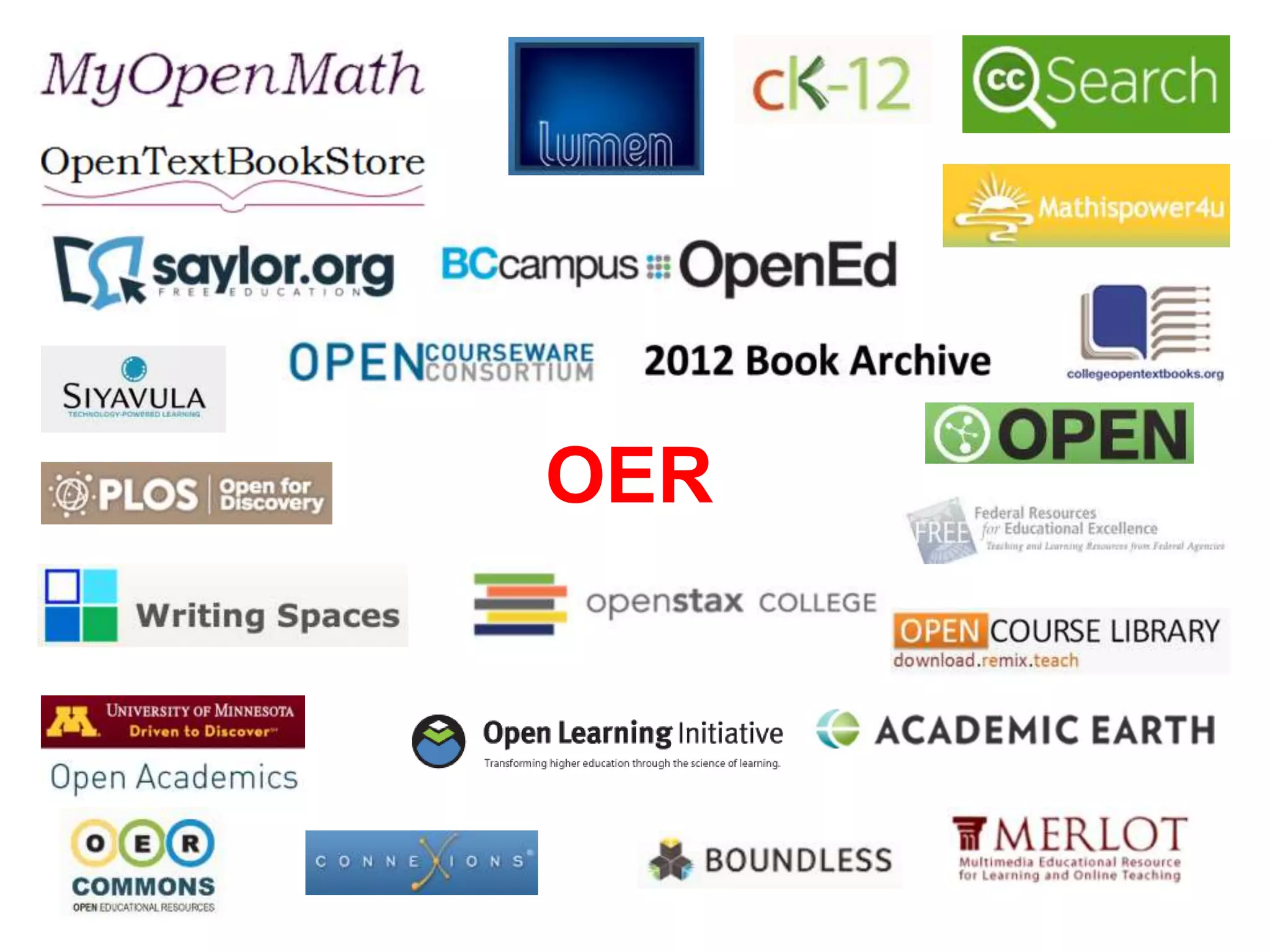
OER
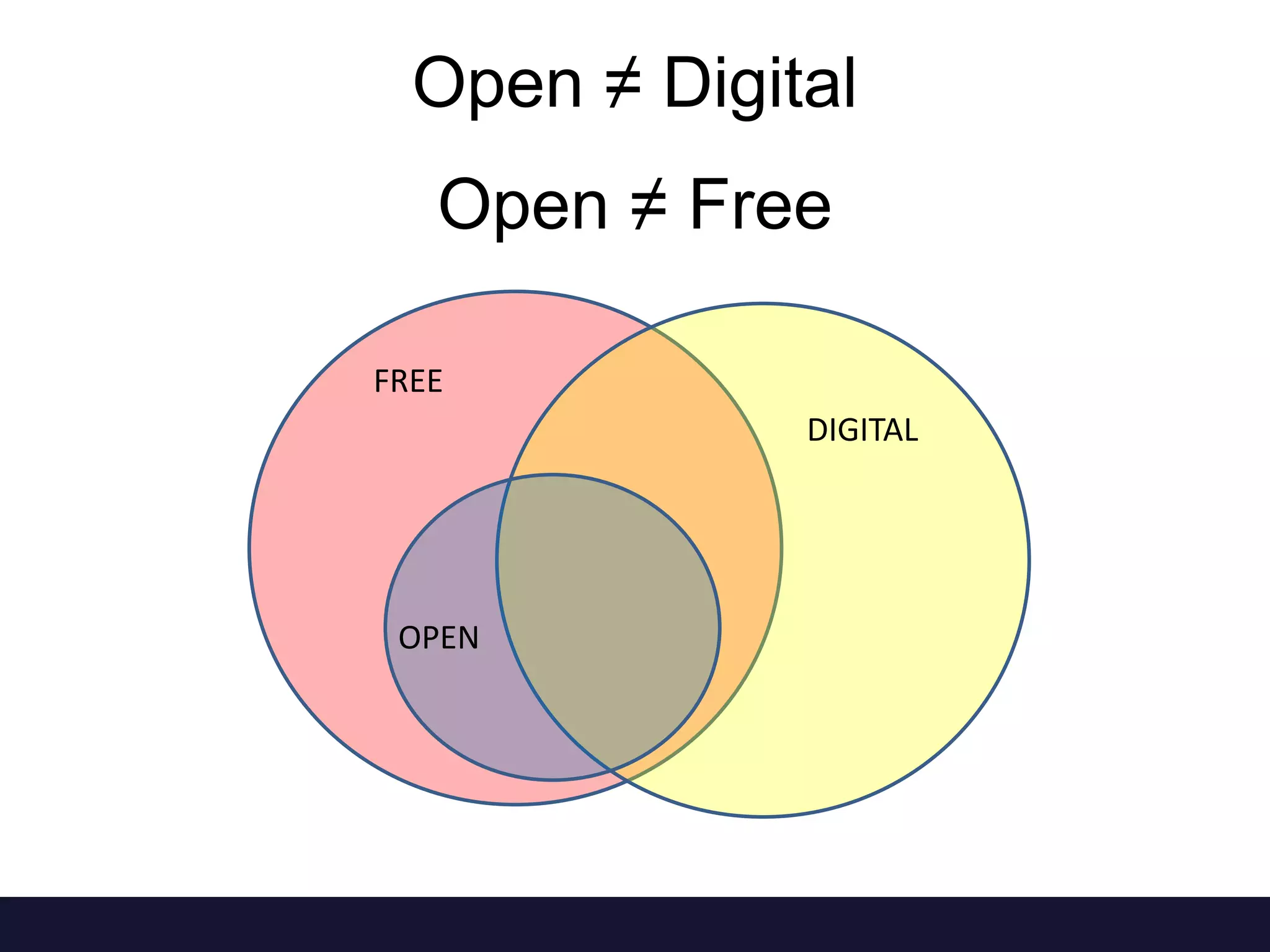
Open ≠ Digital 
Open ≠ Free 
OPEN 
DIGITAL 
FREE
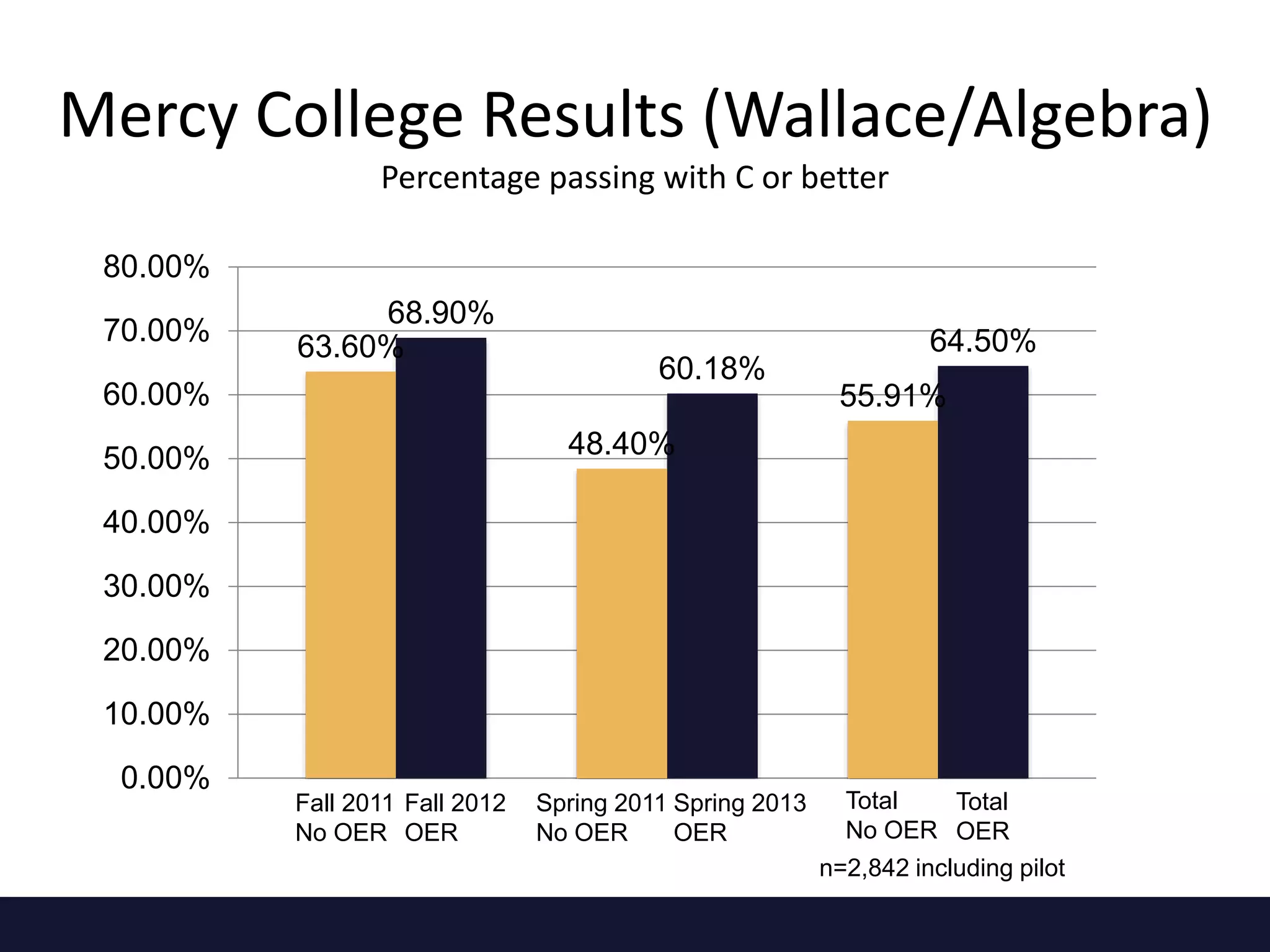
Mercy College Results (Wallace/Algebra) 
Percentage passing with C or better 
68.90% 
63.60% 
60.18% 
48.40% 
64.50% 
55.91% 
80.00% 
70.00% 
60.00% 
50.00% 
40.00% 
30.00% 
20.00% 
10.00% 
0.00% 
Fall 2011 
No OER 
Fall 2012 
OER 
Spring 2011 
No OER 
Spring 2013 
OER 
Total 
No OER 
Total 
OER 
n=2,842 including pilot
Institutional Partners
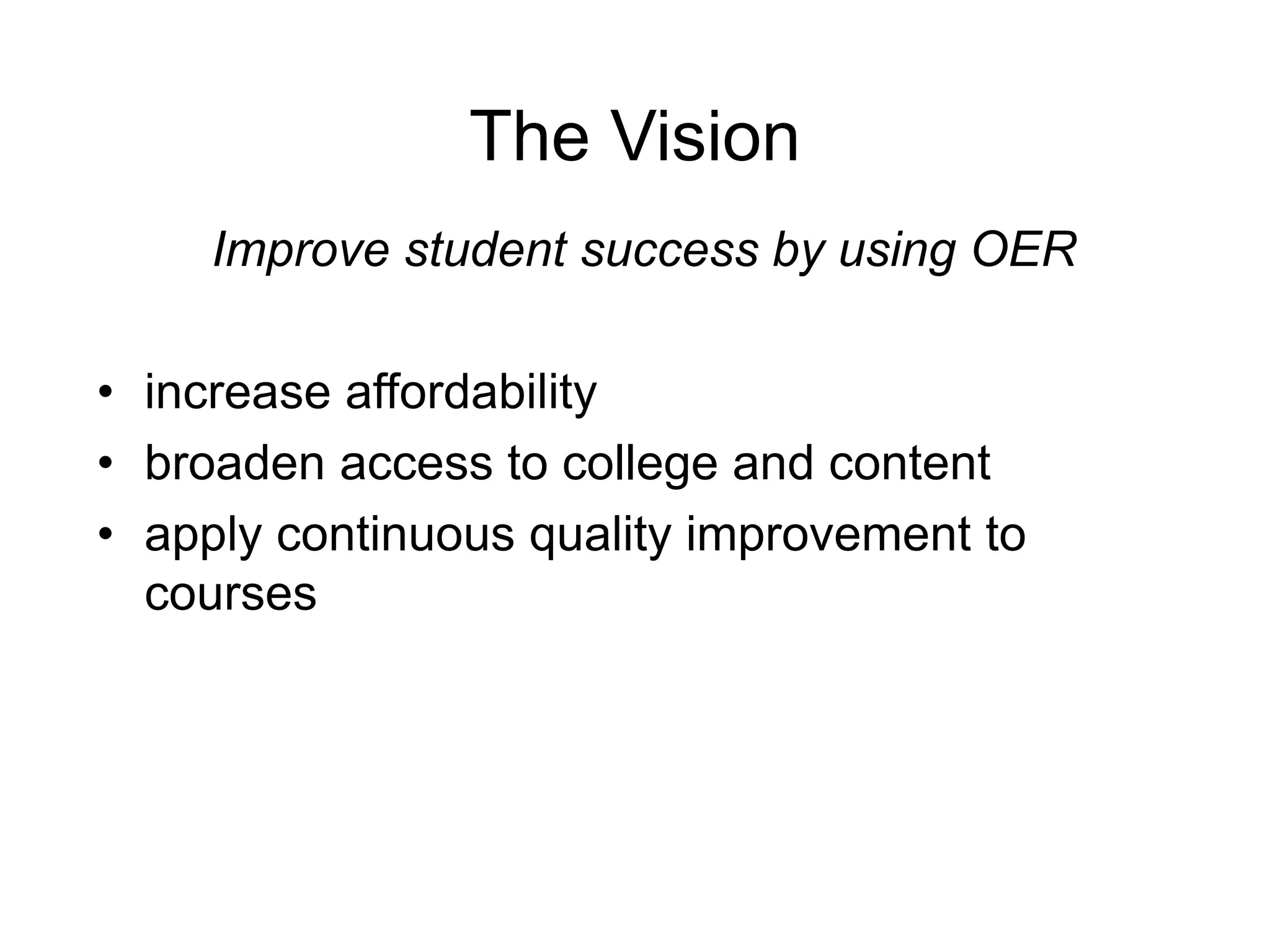
The Vision 
Improve student success by using OER 
• increase affordability 
• broaden access to college and content 
• apply continuous quality improvement to 
courses
100% of students have 
free, digital access on Day 1
Designing for Engagement 
Shared by David Wiley under a Creative Commons Attribution 3.0 license.
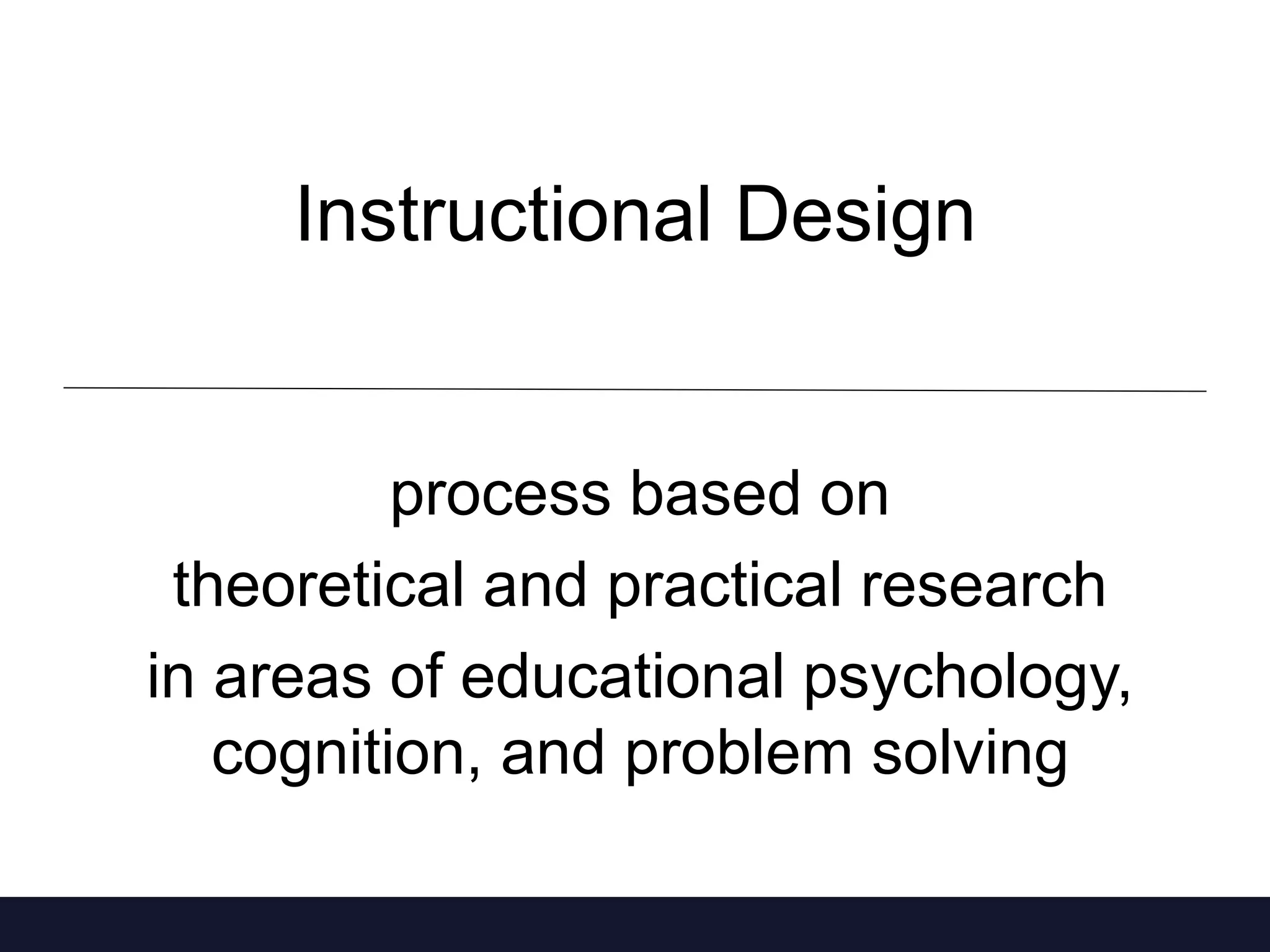
Instructional Design 
process based on 
theoretical and practical research 
in areas of educational psychology, 
cognition, and problem solving
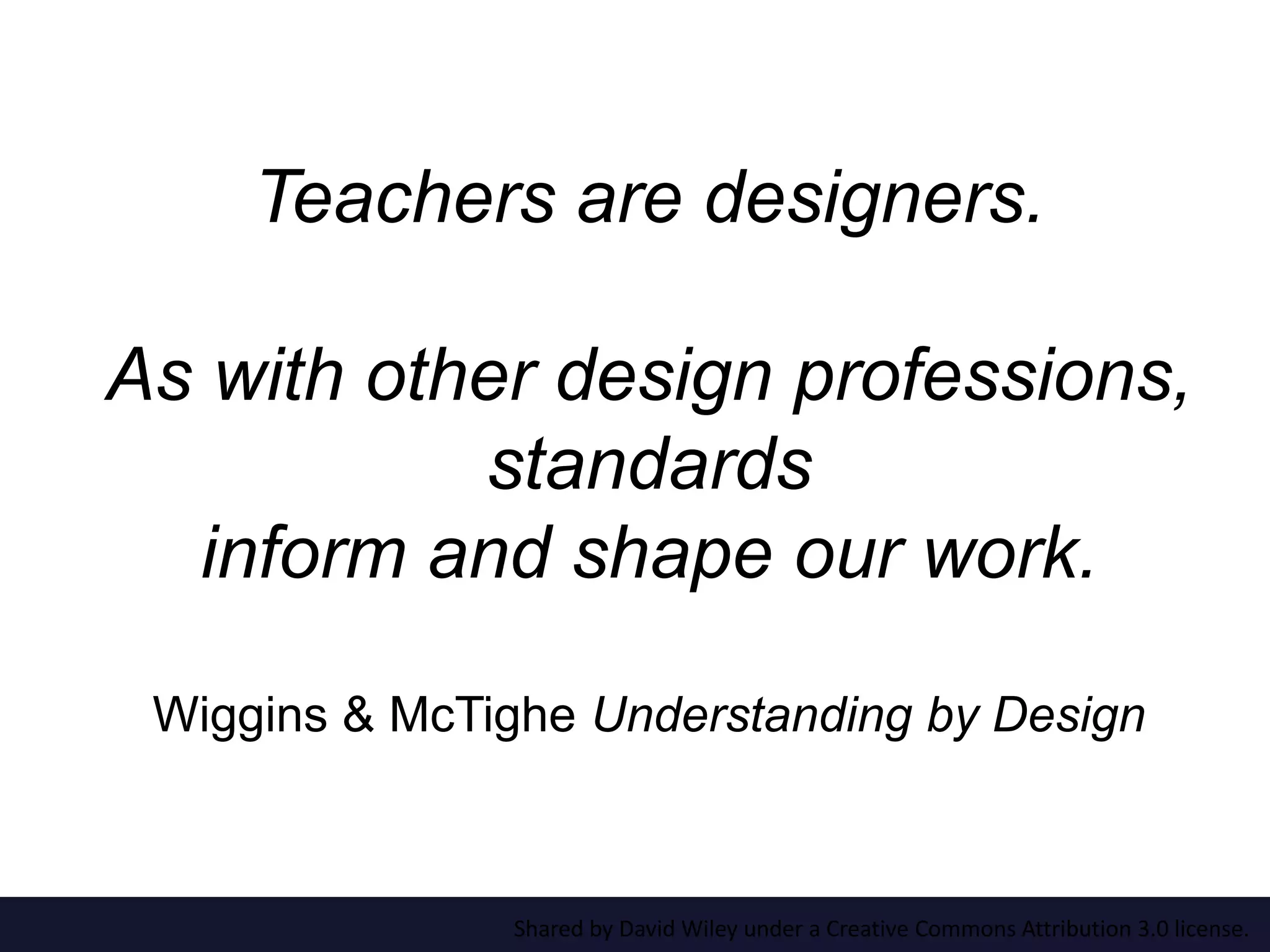
Teachers are designers. 
As with other design professions, 
standards 
inform and shape our work. 
Wiggins & McTighe Understanding by Design 
Shared by David Wiley under a Creative Commons Attribution 3.0 license.
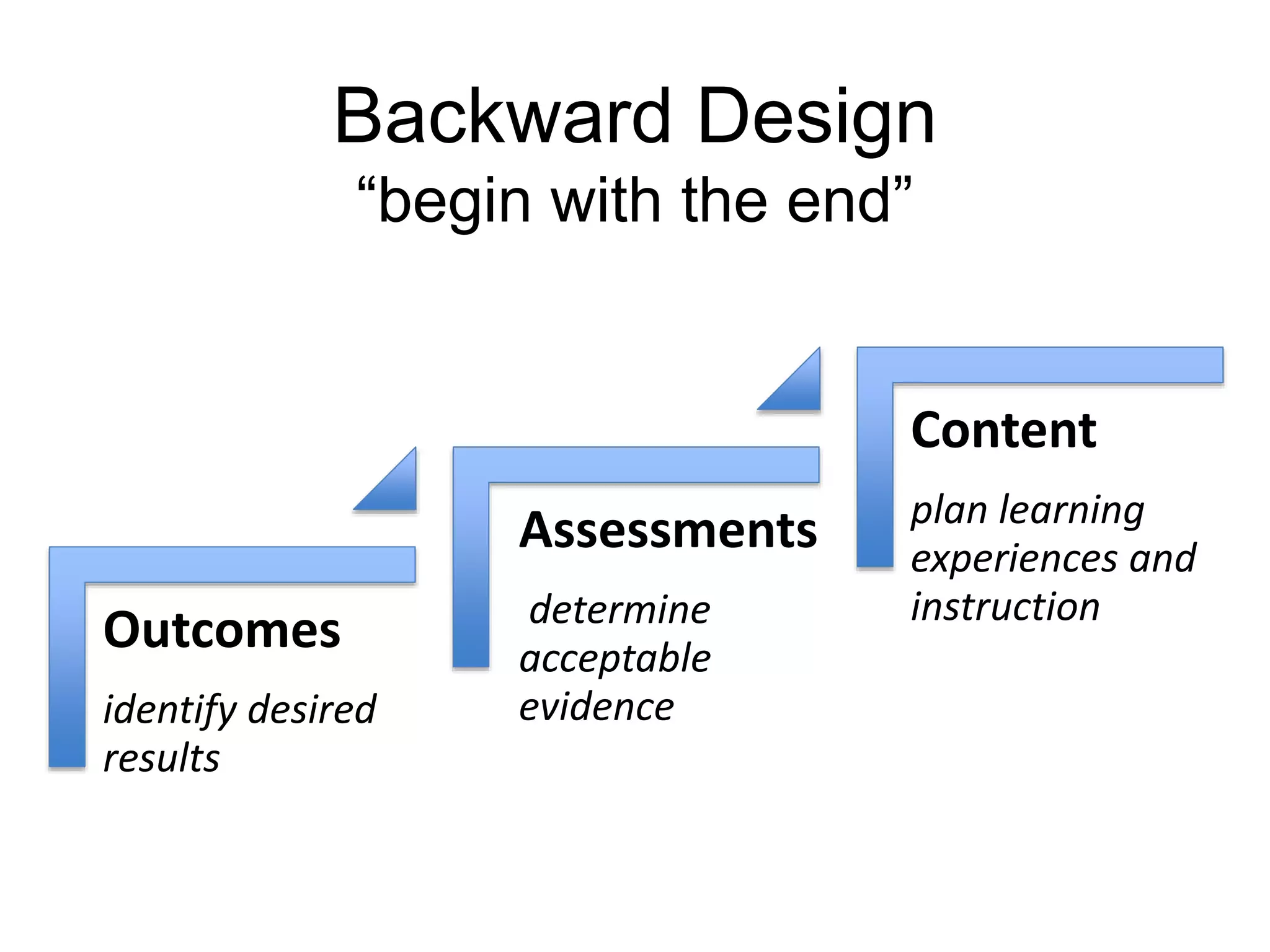
Backward Design 
“begin with the end” 
Outcomes 
identify desired 
results 
Assessments 
determine 
acceptable 
evidence 
Content 
plan learning 
experiences and 
instruction
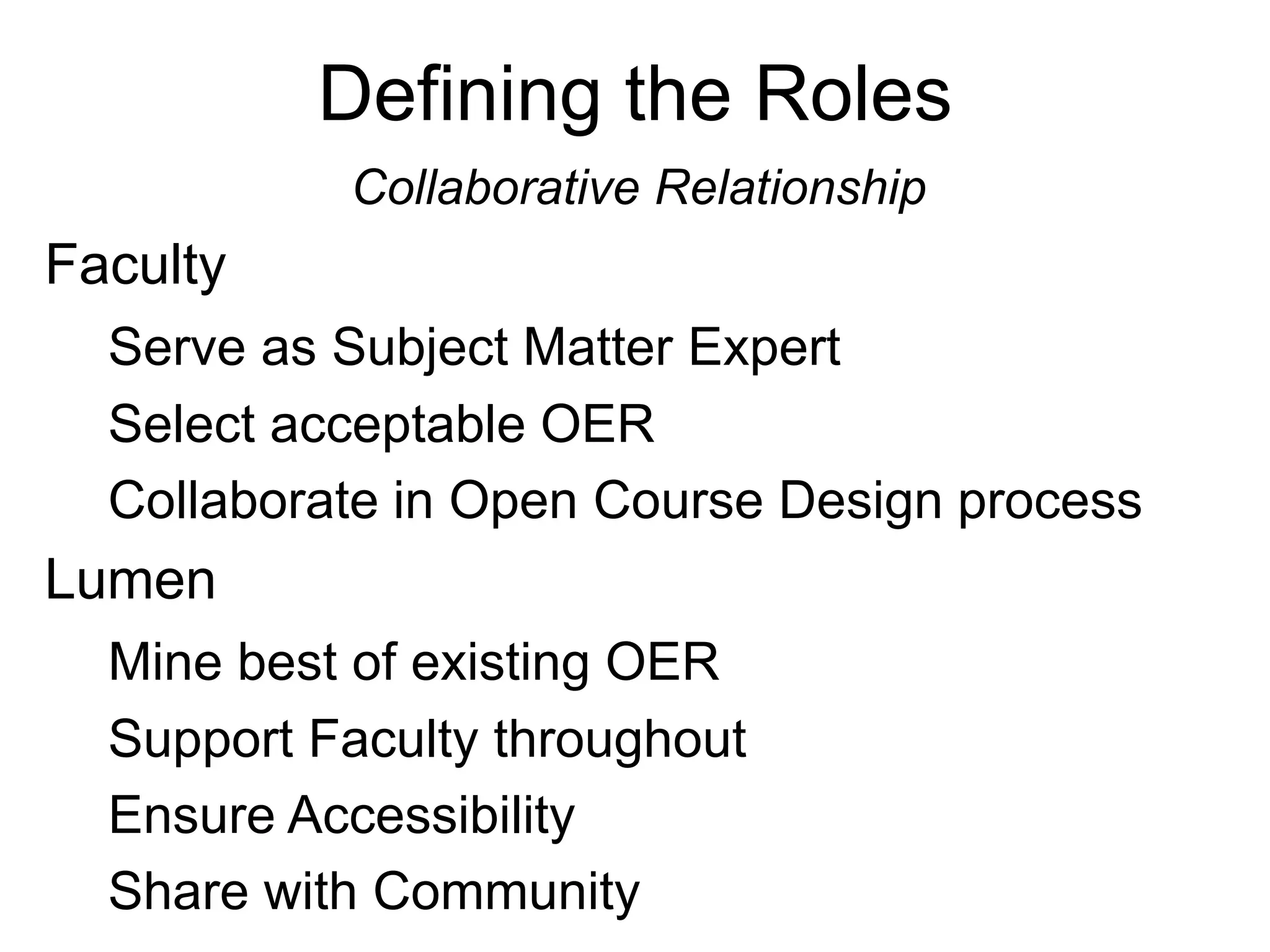
Defining the Roles 
Collaborative Relationship 
Faculty 
Serve as Subject Matter Expert 
Select acceptable OER 
Collaborate in Open Course Design process 
Lumen 
Mine best of existing OER 
Support Faculty throughout 
Ensure Accessibility 
Share with Community
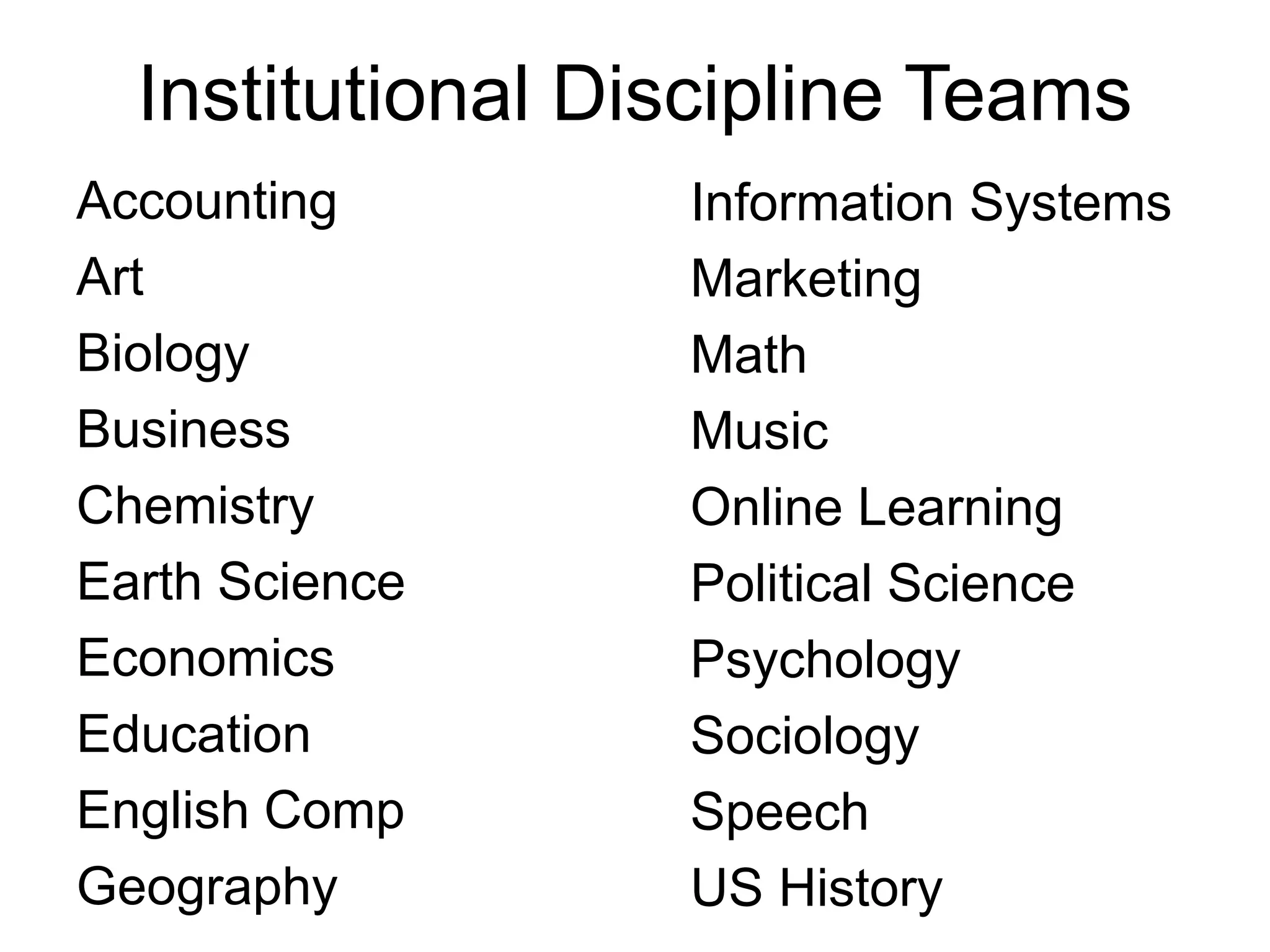
Institutional Discipline Teams 
Accounting 
Art 
Biology 
Business 
Chemistry 
Earth Science 
Economics 
Education 
English Comp 
Geography 
Information Systems 
Marketing 
Math 
Music 
Online Learning 
Political Science 
Psychology 
Sociology 
Speech 
US History
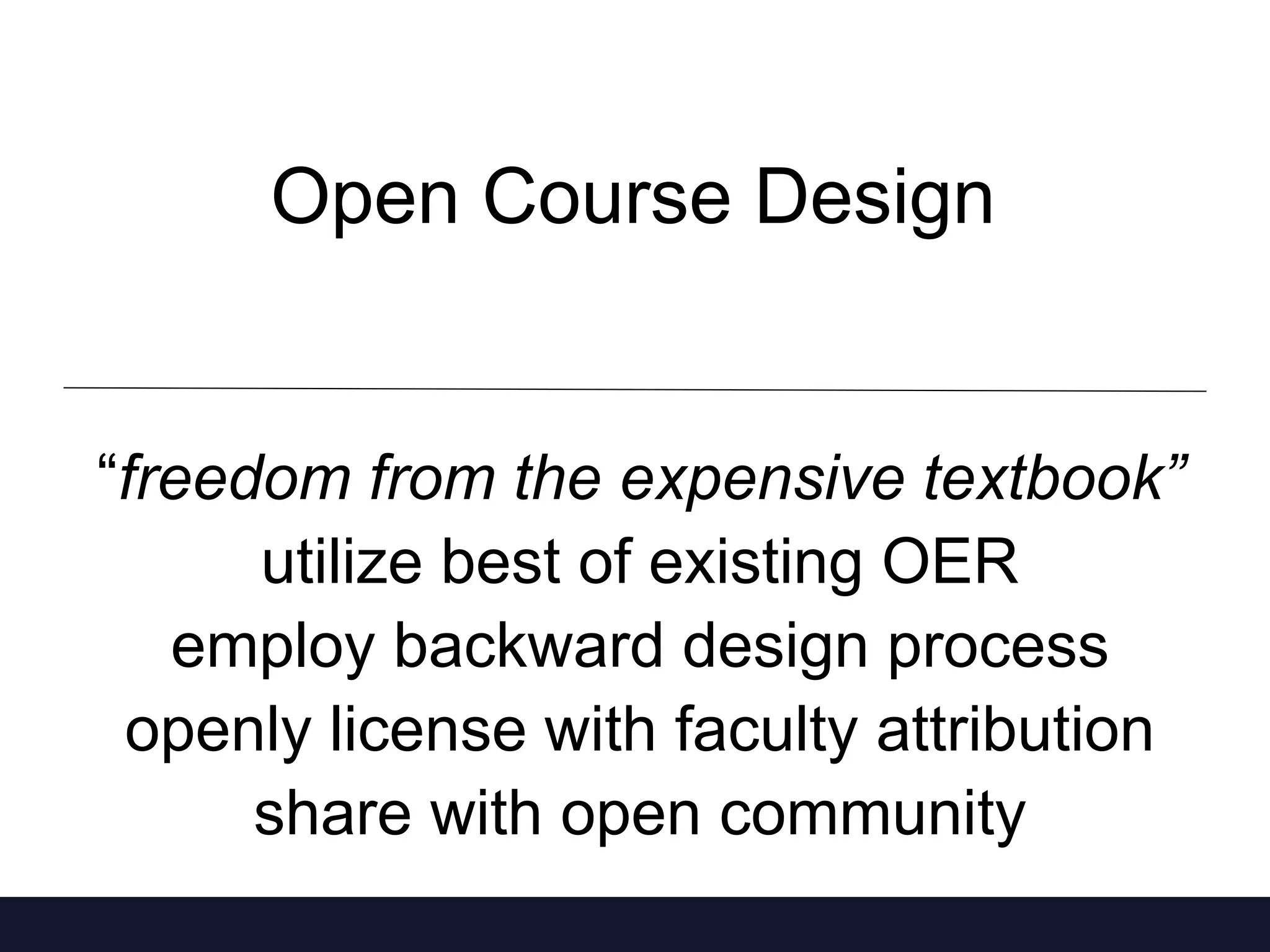
Open Course Design 
“freedom from the expensive textbook” 
utilize best of existing OER 
employ backward design process 
openly license with faculty attribution 
share with open community
Approaches in 
Online Engagement 
Shared by David Wiley under a Creative Commons Attribution 3.0 license.
Student Engagement 
degree of attention, curiosity, 
interest, optimism and passion 
shown when actively learning
Online Student Engagement 
Challenges 
• choose level of communication 
• direct how they spend their time 
• greater opportunities for distractions
Engagement Relationship 
a high degree of faculty engagement 
positively influences student 
satisfaction and retention in online 
learning 
Garrison, D. R. (2007). Online community of inquiry review: Social, cognitive and teaching 
presence issues. Journal of Asynchronous Learning Networks, 11(1), 61-72.
Open Educational Resources Sharing Helps 
http://goo.gl/Is02wX
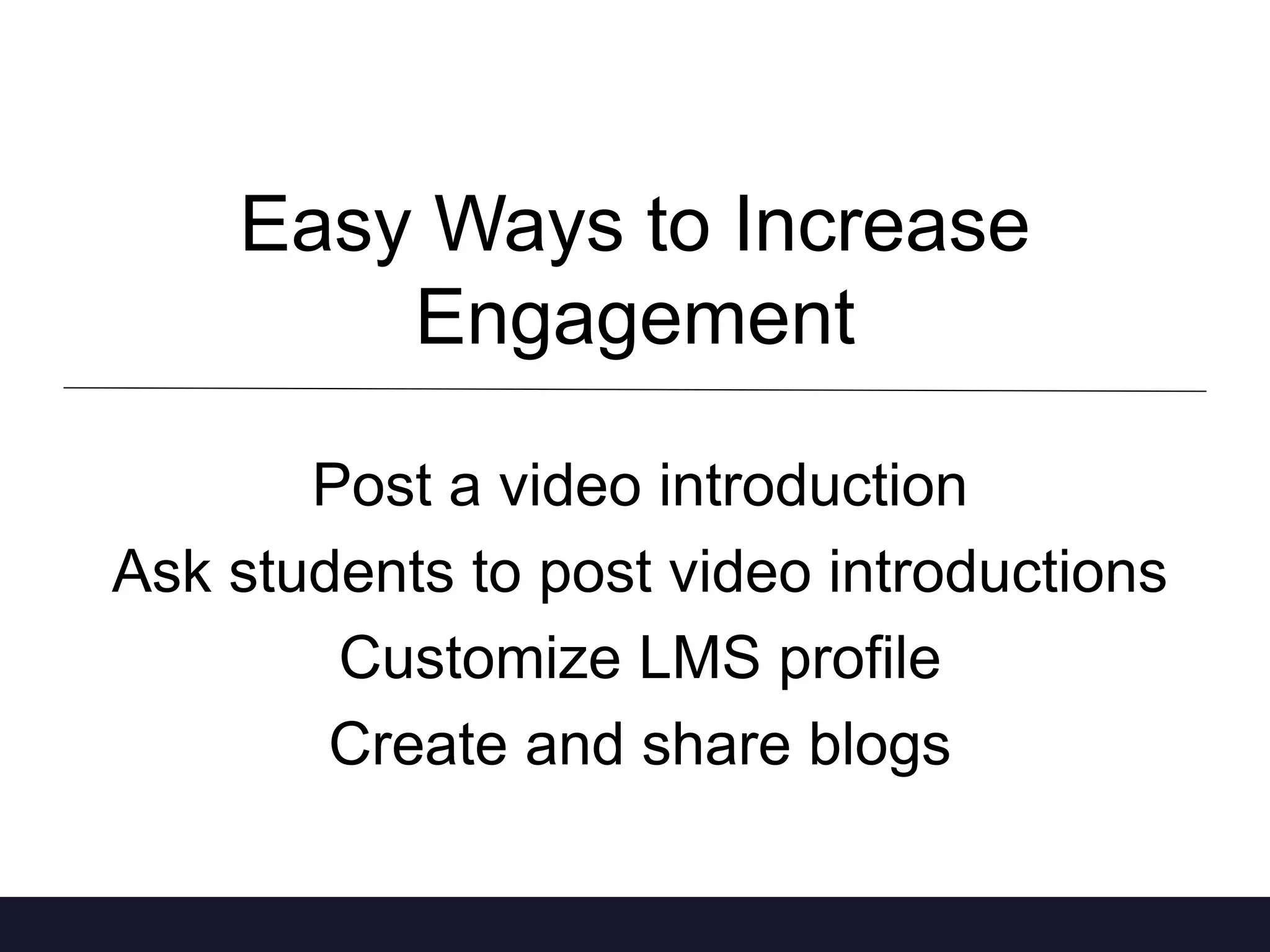
Easy Ways to Increase 
Engagement 
Post a video introduction 
Ask students to post video introductions 
Customize LMS profile 
Create and share blogs
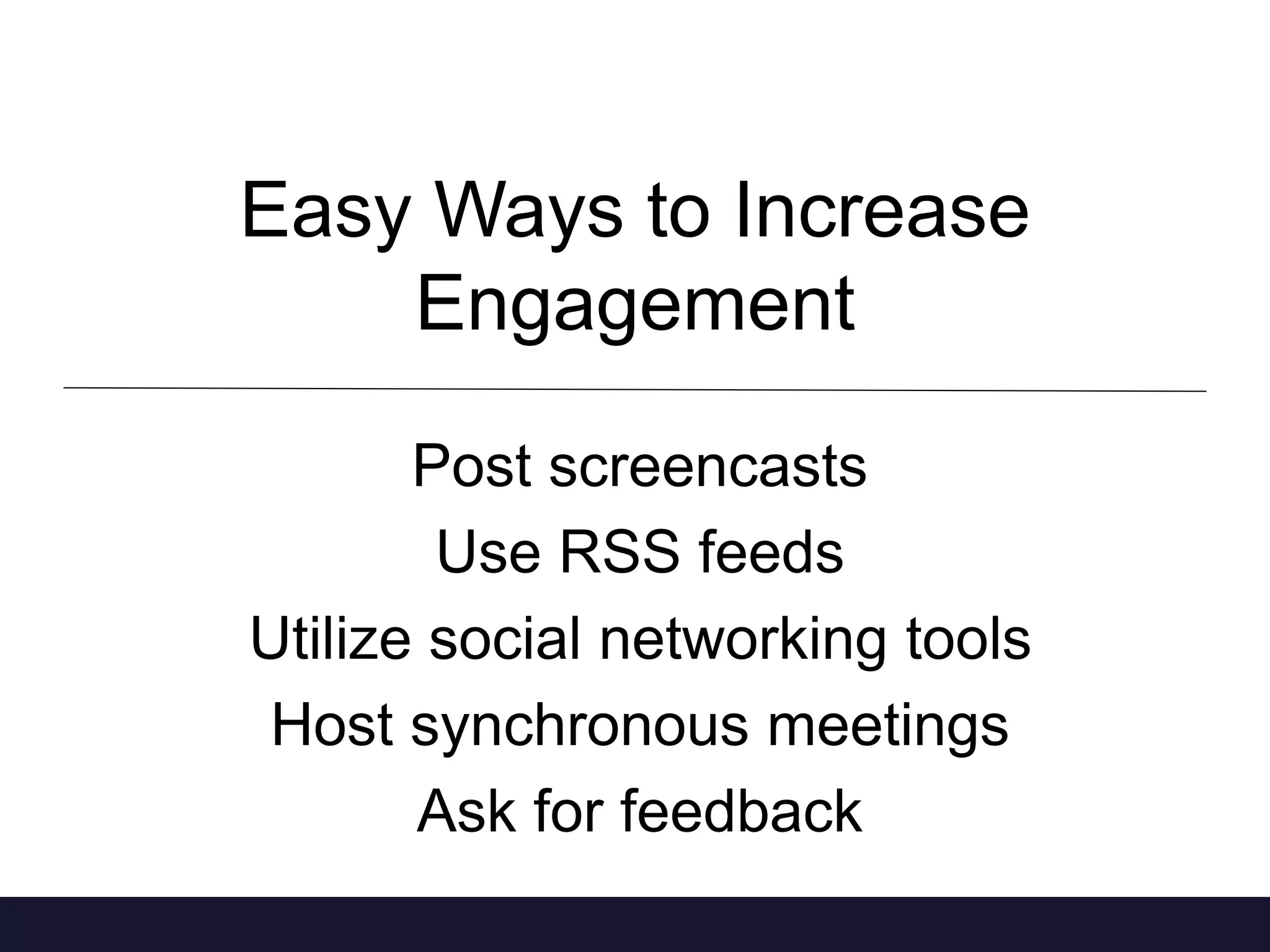
Easy Ways to Increase 
Engagement 
Post screencasts 
Use RSS feeds 
Utilize social networking tools 
Host synchronous meetings 
Ask for feedback
Qualities of Online Teaching 
Success 
Shared by David Wiley under a Creative Commons Attribution 3.0 license.
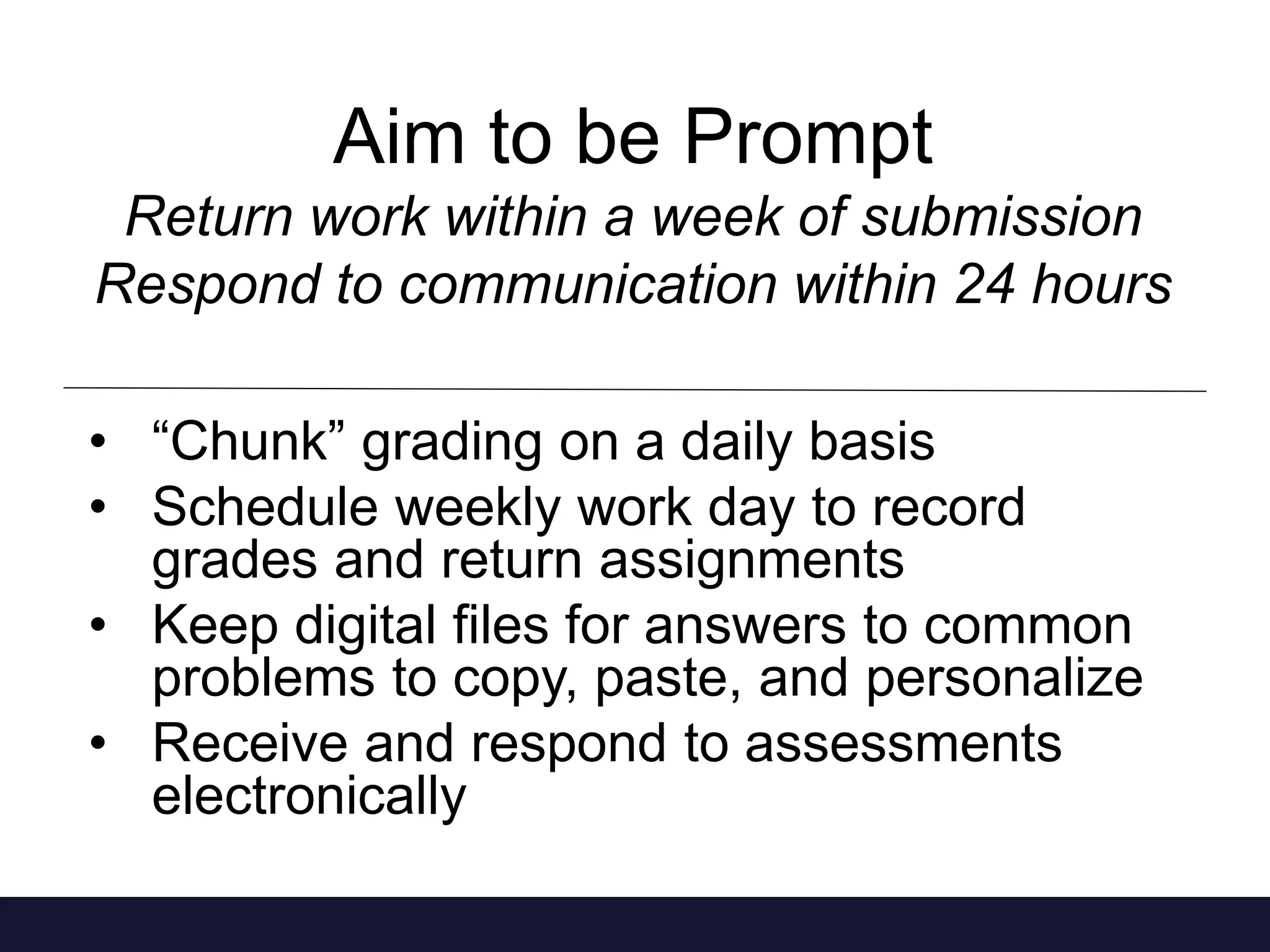
Aim to be Prompt 
Return work within a week of submission 
Respond to communication within 24 hours 
• “Chunk” grading on a daily basis 
• Schedule weekly work day to record 
grades and return assignments 
• Keep digital files for answers to common 
problems to copy, paste, and personalize 
• Receive and respond to assessments 
electronically
Show you are Human 
You are not an avatar! 
• Online learners need to know you are a 
real person 
• Encourage dialogue in responses 
• Use a conversational style in comments 
• Provide as much professional and 
personal information as you are 
comfortable
Reflect a Positive Demeanor 
Praise begets interest 
• Choose words judiciously 
• Humor can be refreshing 
• Recognize strengths first then offer 
specific suggestions for improvement 
• Include reference links if needed
Support Pragmatism over Zeal 
Good evaluation leads to improvement 
• Offer suggestions for completing the 
course on time 
• Encourage time management early on 
by having students communicate their 
plans for meeting course benchmarks
Find Patience in the Process 
The ability continuum is wide 
• Expect a wide range from hi to low of 
tech knowledge, skills, dispositions 
• Be prepared to support students in 
troubleshooting 
• In the beginning, consider using more 
flexible criteria for evaluation

Why Open with Ian Ronda 10 Nov 2014

  • 1.
    Open Ed Landscape,Open Course Design and Increasing Student Engagement 10 November 2014 Dr. Ian O’Byrne @wiobyrne Professor, University of New Haven wiobyrne@gmail.com Ronda Neugebauer @openarian Open Instructional Systems Technologist rd@rondadorsey.com Slide content created by Lumen Learning http://lumenlearning.com/and reused under a Creative Commons Attribution CC BY License https://creativecommons.org/licenses/by/4.0/
  • 2.
    Why Open? Sharedby David Wiley under a Creative Commons Attribution 3.0 license.
  • 4.
  • 5.
    Successful educators sharethe most completely with the most students
  • 6.
    If there isno sharing there is no education
  • 7.
    What can begiven without being given away? knowledge
  • 8.
    Ideas are non-rivalrous can be given without being given away
  • 9.
    Physical expressions arenot to give a book you must give it away
  • 10.
    When expressions aredigital they also become non-rivalrous
  • 11.
    Internet offers unprecedentedcapacity to share and educate as never before
  • 12.
    Except we can’t © regulates copying, adapting, distributing
  • 13.
    © cancels thepossibilities of digital media and the internet
  • 14.
    U.S. Bureau ofLabor Statistics +237%
  • 15.
  • 16.
    Tuition is political textbook adoptions are less political
  • 17.
    82% increase inlast decade http://dealnews.com/features/The-Cost-of-Textbooks-Is-Rising-Faster-Than-the-Price-of-College-Tuition-/1037184.html
  • 18.
    Average annual textbookcosts $1200 14% of tuition state-run public college 39% of tuition community college uspirg.org openaccesstextbooks.org
  • 19.
    Impact of textbookcosts 60%+ do not purchase textbooks 35% take fewer courses 31% choose not to register 23% regularly go without textbooks 14% dropped course 10% withdrawn from course       2012 student survey by Florida Virtual Campus
  • 20.
    Impact of textbookcosts • 65% do not buy texts due to high costs • 94% believe they suffer academically not buying texts • 48% register for fewer classes/choose other classes • 82% say they would perform better if text was free online and printed copy was optional RELEASE DATE: MONDAY, JANUARY 27, 2014 http://uspirg.org/sites/pirg/files/reports/NATIONAL%20Fixing%20Broken%20Textbooks%20Report1.pdf
  • 21.
    What to do? Shared by David Wiley under a Creative Commons Attribution 3.0 license.
  • 22.
  • 23.
    + Institutional Partners Collaborate and leverage open educational resources (OER) to eliminate the textbook cost barrier Shared by David Wiley under a Creative Commons Attribution 3.0 license.
  • 24.
    Sharing and educating at unprecedented scale
  • 25.
    OER Defined Sharedby David Wiley under a Creative Commons Attribution 3.0 license.
  • 26.
    What are OpenEducational Resources (OER)? (1) Any kind of teaching materials – textbooks, syllabi, lesson plans, videos, readings, exams Shared by David Wiley under a Creative Commons Attribution 3.0 license.
  • 27.
    What are OpenEducational Resources (OER)? (1) Any kind of teaching materials – textbooks, syllabi, lesson plans, videos, readings, exams What are Open Educational Resources (OER)? (2) Are free for anyone to access, and (3) Include free permission to engage in “5Rs” Shared by David Wiley under a Creative Commons Attribution 3.0 license.
  • 28.
    The 5Rs Retain• Make and own copies Reuse • Use in a wide range of ways Revise • Adapt, modify, improve Remix • Combine two or more Redistribute • Share with others Shared by David Wiley under a Creative Commons Attribution 4.0 license.
  • 29.
    Open licenses makesharing easy simple, standardized, legally robust way to grant copyright permissions Commons licenses provide a simple, standardized grant copyright permissions to creative work. 500+ million items creativecommons.org
  • 30.
    OpenStax Biology Text http://cnx.org/contents/185cbf87-c72e-48f5-b51e-f14f21b5eabd@9.17:16
  • 31.
    Digital Public Libraryof America http://dp.la/
  • 32.
  • 33.
  • 34.
  • 35.
    Open ≠ Digital Open ≠ Free OPEN DIGITAL FREE
  • 37.
    Mercy College Results(Wallace/Algebra) Percentage passing with C or better 68.90% 63.60% 60.18% 48.40% 64.50% 55.91% 80.00% 70.00% 60.00% 50.00% 40.00% 30.00% 20.00% 10.00% 0.00% Fall 2011 No OER Fall 2012 OER Spring 2011 No OER Spring 2013 OER Total No OER Total OER n=2,842 including pilot
  • 38.
  • 39.
    The Vision Improvestudent success by using OER • increase affordability • broaden access to college and content • apply continuous quality improvement to courses
  • 40.
    100% of studentshave free, digital access on Day 1
  • 41.
    Designing for Engagement Shared by David Wiley under a Creative Commons Attribution 3.0 license.
  • 42.
    Instructional Design processbased on theoretical and practical research in areas of educational psychology, cognition, and problem solving
  • 44.
    Teachers are designers. As with other design professions, standards inform and shape our work. Wiggins & McTighe Understanding by Design Shared by David Wiley under a Creative Commons Attribution 3.0 license.
  • 45.
    Backward Design “beginwith the end” Outcomes identify desired results Assessments determine acceptable evidence Content plan learning experiences and instruction
  • 46.
    Defining the Roles Collaborative Relationship Faculty Serve as Subject Matter Expert Select acceptable OER Collaborate in Open Course Design process Lumen Mine best of existing OER Support Faculty throughout Ensure Accessibility Share with Community
  • 47.
    Institutional Discipline Teams Accounting Art Biology Business Chemistry Earth Science Economics Education English Comp Geography Information Systems Marketing Math Music Online Learning Political Science Psychology Sociology Speech US History
  • 48.
    Open Course Design “freedom from the expensive textbook” utilize best of existing OER employ backward design process openly license with faculty attribution share with open community
  • 49.
    Approaches in OnlineEngagement Shared by David Wiley under a Creative Commons Attribution 3.0 license.
  • 50.
    Student Engagement degreeof attention, curiosity, interest, optimism and passion shown when actively learning
  • 51.
    Online Student Engagement Challenges • choose level of communication • direct how they spend their time • greater opportunities for distractions
  • 52.
    Engagement Relationship ahigh degree of faculty engagement positively influences student satisfaction and retention in online learning Garrison, D. R. (2007). Online community of inquiry review: Social, cognitive and teaching presence issues. Journal of Asynchronous Learning Networks, 11(1), 61-72.
  • 53.
    Open Educational ResourcesSharing Helps http://goo.gl/Is02wX
  • 54.
    Easy Ways toIncrease Engagement Post a video introduction Ask students to post video introductions Customize LMS profile Create and share blogs
  • 55.
    Easy Ways toIncrease Engagement Post screencasts Use RSS feeds Utilize social networking tools Host synchronous meetings Ask for feedback
  • 56.
    Qualities of OnlineTeaching Success Shared by David Wiley under a Creative Commons Attribution 3.0 license.
  • 57.
    Aim to bePrompt Return work within a week of submission Respond to communication within 24 hours • “Chunk” grading on a daily basis • Schedule weekly work day to record grades and return assignments • Keep digital files for answers to common problems to copy, paste, and personalize • Receive and respond to assessments electronically
  • 58.
    Show you areHuman You are not an avatar! • Online learners need to know you are a real person • Encourage dialogue in responses • Use a conversational style in comments • Provide as much professional and personal information as you are comfortable
  • 59.
    Reflect a PositiveDemeanor Praise begets interest • Choose words judiciously • Humor can be refreshing • Recognize strengths first then offer specific suggestions for improvement • Include reference links if needed
  • 60.
    Support Pragmatism overZeal Good evaluation leads to improvement • Offer suggestions for completing the course on time • Encourage time management early on by having students communicate their plans for meeting course benchmarks
  • 61.
    Find Patience inthe Process The ability continuum is wide • Expect a wide range from hi to low of tech knowledge, skills, dispositions • Be prepared to support students in troubleshooting • In the beginning, consider using more flexible criteria for evaluation

Editor's Notes

  • #2 Slide content created Lumen Learning http://lumenlearning.com/and reused under a Creative Commons Attribution CC BY License https://creativecommons.org/licenses/by/4.0/
  • #3 Let’s talk about openness and its role in education
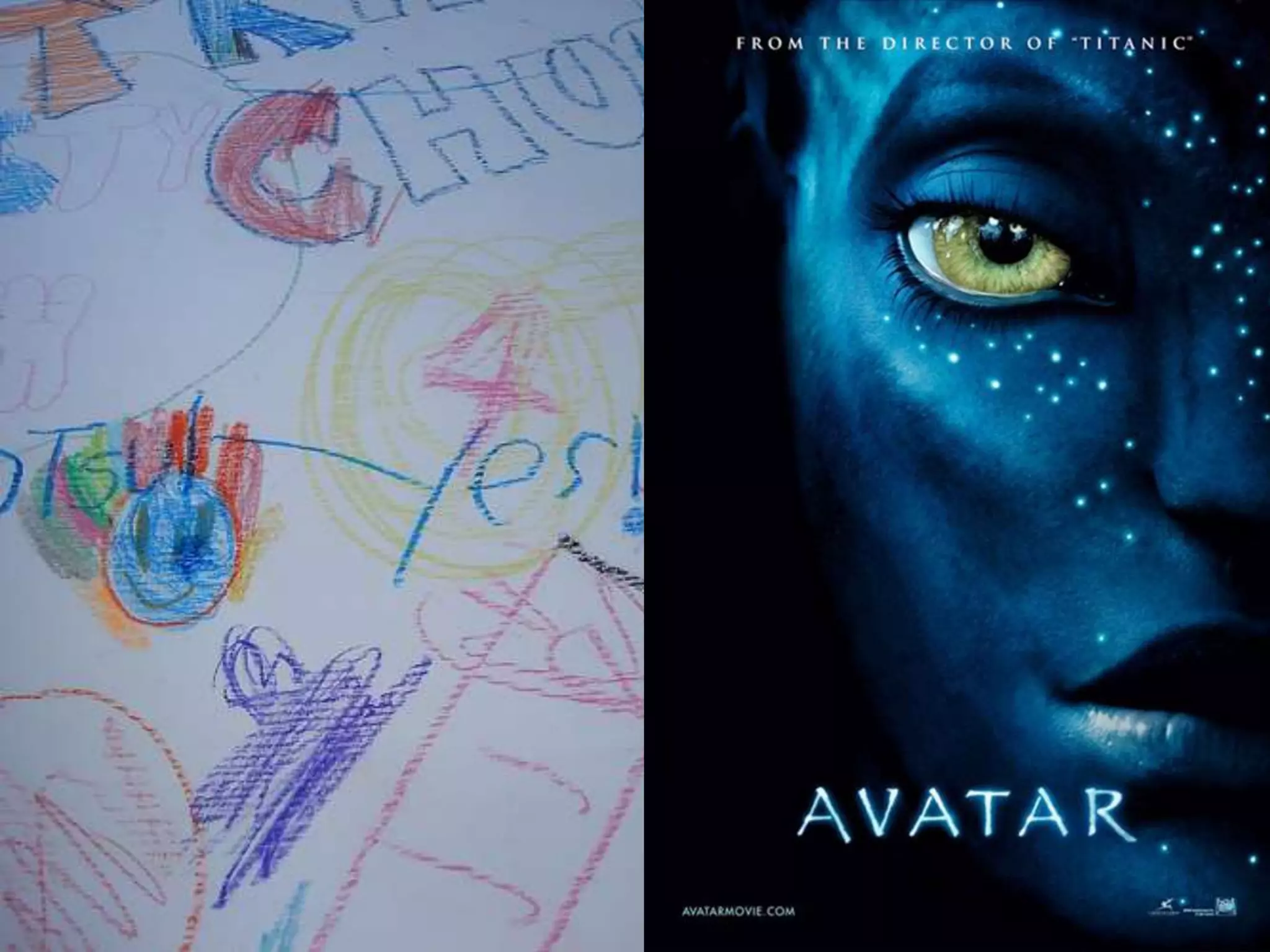
  • #4 What is the same about these? (Discussion) Point: both are covered under the full protection of the law; have full protection of copyright law, anything I create has the same protection as the most expensive movie ever created, all copyright is pervasive...what is the impact of this? It impacts the way we share, the way we teach, the way we learn.
  • #5 Education is sharing Teacher share knowledge and skills, feedback and criticism, encouragement Students share questions, assignments, feedback even president’s selfies with Social Work graduates
  • #7 If there is no sharing, then there is no education
  • #8 What can be given, shared -
  • #10 To give a book, you must give it away. Photo CC BY David Wiley
  • #11 Because of the Internet, my colleague and I can view the same page simultaneously with millions of other people all over the world…and practically for free. Fundamental shift…we can share pervasively
  • #12 Not at an increase in cost, but at an increase in the ability to share.
  • #13 Copyright: regulates copying, distributing, editing, and adapting
  • #14 Copyright: regulates copying, distributing, editing, and adapting
  • #15 College Tuition Has Outpaced Inflation by 237% Since 1978 Result exacerbates income inequality by depriving those of less means of the schooling they need to advance Graph Source: http://dvschroeder.blogspot.com/2013/08/college-tuition-has-outpaced-inflation.html Bloomberg: http://www.bloomberg.com/news/2013-08-26/college-costs-surge-500-in-u-s-since-1985-chart-of-the-day.html exacerbate income inequality by depriving those of less means of the schooling they need to advance and may also derail the “prestige and status” of U.S. higher education, said Michelle Cooper, president of the Washington-based Institute for Higher Education Policy. While U.S. schools have remained competitive globally in the face of declining state subsidies and rising tuition costs, it’s fair to ask whether students are getting what they pay for, she said.
  • #16 While U.S. schools have remained competitive globally in the face of declining state subsidies and rising tuition costs, it’s fair to ask whether students are getting what they pay for
  • #17 Copyright: regulates copying, distributing, editing, and adapting Most of us have the power to choose our textbooks- with that said, we have the power to choose how much students must pay for the textbook required for class
  • #18 Textbooks have risen over 82% in the last ten years
  • #19 Copyright: regulates copying, distributing, editing, and adapting
  • #20 Bottom line: when students don’t have access to content – especially those most at-risk – they are not prepared for academic success
  • #21 Bottom line: when students don’t have access to content – especially those most at-risk – they are not prepared for academic success survey of over 2000 students at 163 colleges in US
  • #23 Like a fundamental of Judo: take opponents’ strengths and use it against them
  • #25 Potential to positively disrupt the textbook divide in higher education
  • #27 Openly sharing materials is powerful
  • #28 Openly sharing materials is powerful
  • #29 At its core, open materials are 5Rs First four are what impact teaching and learning Bundling multiple texts is expensive: Focused on return of investment of textbook Revise: reduce the amount of materials Opportunity for students to engage in materials…engaging students to revise and add to the textbook for their course
  • #30 Creative Commons makes it easy to share Open source software community has it There are broad global uses of CC outside of education as well (Click on hyperlink) Discuss 3 layers of licensing: Human Readable (language means I can understand it); Legal Code (legalese); Machine Readable (Google search can pick it up) Demo Advanced Google search and looking for CC logo (generally found at the bottom of webpages) Case against using CC NC for materials you create is removing the option to print materials for students CC button says it gives permission CCBY means attribute it to the original author Creates professional network Personal connections Commerical Use: can someone use the material Sharealike: revise but keep the same license NC License hurts when printing: need to have a sustainable process; CK 12 agreement under $5 per book; extra piece; we are still living in a world where we need print materials If Kscope is funding faculty time, materials created must be CCBY
  • #31 What do OER look like? Biology textbook
  • #33 Videos, interactives, simulations
  • #34 Courses…OER can be almost anything!
  • #35 and there’s even more… Although millions of philanthropic dollars have been poured into OER development, the idea that “if you build it, they will adopt it” has not necessarily applied in OER adoption. OER is available, but mining can be painful. Contact support@lumenlearning with questions, concerns, comments. Images: MyOpenMath - https://www.myopenmath.com/ OpenTextBookStore - http://www.opentextbookstore.com/catalog.php Lumen Learning - http://www.lumenlearning.com/courses Google Advanced Search - http://www.google.com/advanced_search BC Campus Open Ed - http://open.bccampus.ca/find-open-textbooks/?subject= Creative Commons Search - http://search.creativecommons.org/ CK-12 - http://www.ck12.org/teacher/ Siyavula - http://everythingscience.co.za/@@textbook-catalogue Saylor Foundation - http://www.saylor.org/ Open Courseware Consortium - http://www.ocwconsortium.org/ Mathispower4u - http://mathispower4u.yolasite.com/ OER Commons - http://www.oercommons.org/ OER Commons - http://www.oercommons.org/ Public Library of Science - http://www.plos.org/ Open Professionals Education Network - http://open4us.org/find-oer/ Federal Resources for Educational Excellence - http://free.ed.gov/ Writing Spaces – http://writingspaces.org/ OpenStax - http://openstaxcollege.org/ Open Course Library - http://opencourselibrary.org/ Andy Schmitz’s 2012 Book Archive - http://2012books.lardbucket.org/ Boundless - https://www.boundless.com/ Academic Earth - http://academicearth.org/ UMN Open Academics - https://open.umn.edu/opentextbooks/ College Open Textbooks - http://www.collegeopentextbooks.org/ CMU Open Learning Initiative - http://oli.cmu.edu/ Connexions - http://cnx.org/ Merlot - http://www.merlot.org/merlot/index.htm
  • #36 just to clear up some potential confusion There are free materials online that are not open, and there are open materials that are not online. * “open content” began with the idea of “open” from open source software
  • #37 Collaboration of OER Leaders and Experts Top row: how to be smart Middle: Technology and content providers larger project and match Last: Funding ____ Given that faculty collaborators in the initial phase of the project (myself included) had little or no knowledge or experience with OER, including open licensing, mining the wealth of existing OER, and identifying quality OER were unsure of how to effectively collaborate across institutions were not strong instructional designers or educational technologists nor knew how to utilize learning analytics for continuous improvement it was imperative that the project included OER experts in advisory roles from different organizations. These advisors continue to support the project through the current iteration of our work and beyond. Images: http://www.lumenlearning.com/ http://home.byu.edu/home/ http://creativecommons.org/ http://www.cmu.edu/index.shtml http://www.mit.edu/ http://www.aacu.org/ http://openstaxcollege.org/ http://www.saylor.org/ http://www.instructure.com/ http://opencourselibrary.org/ http://www.ck12.org/teacher/ http://nextgenlearning.org/ http://www.gatesfoundation.org/ http://www.shuttleworthfoundation.org/
  • #38 In the first phase of Kaleidoscope Open Course Initiative, 11 Gen Ed courses were developed, over 9,000 students participated, the required textbook cost dropped to $0, and the average change in student success (C or better in the course) reported was +10% some as high as +14%
  • #39 with Faculty Collaborators ____ In 2011, Kaleidoscope’s founding 8 members consisted of community colleges and open access, 4-year schools ranging from California across to New York. I represented Chadron State College, a four-year open enrollment institution in Nebraska, as a Faculty Collaborator in developmental reading, writing, and college success courses Today 3 years later, the next phase of this growing project – one that has and continues to be one of the most profound experiences of my career.
  • #40 taking textbook costs out of the equation Case studies at both Houston Community College (2012) and Virginia State University (2010) suggest that classes using open textbooks have higher grades and better course completion rates http://creativecommons.org/tag/open-textbooks
  • #41 All with a shared vision: students have 100% free, digital access to all materials on the first day of the course. With this step alone, institutions have already boosted student success and retention simply by taking textbook costs out of the equation.    If that is the day 1 impact of OER, just think about the other ways we can move the needle on student success by designing, adopting, measuring success and improving OER-based courses.
  • #42 http://goo.gl/R7BHfC
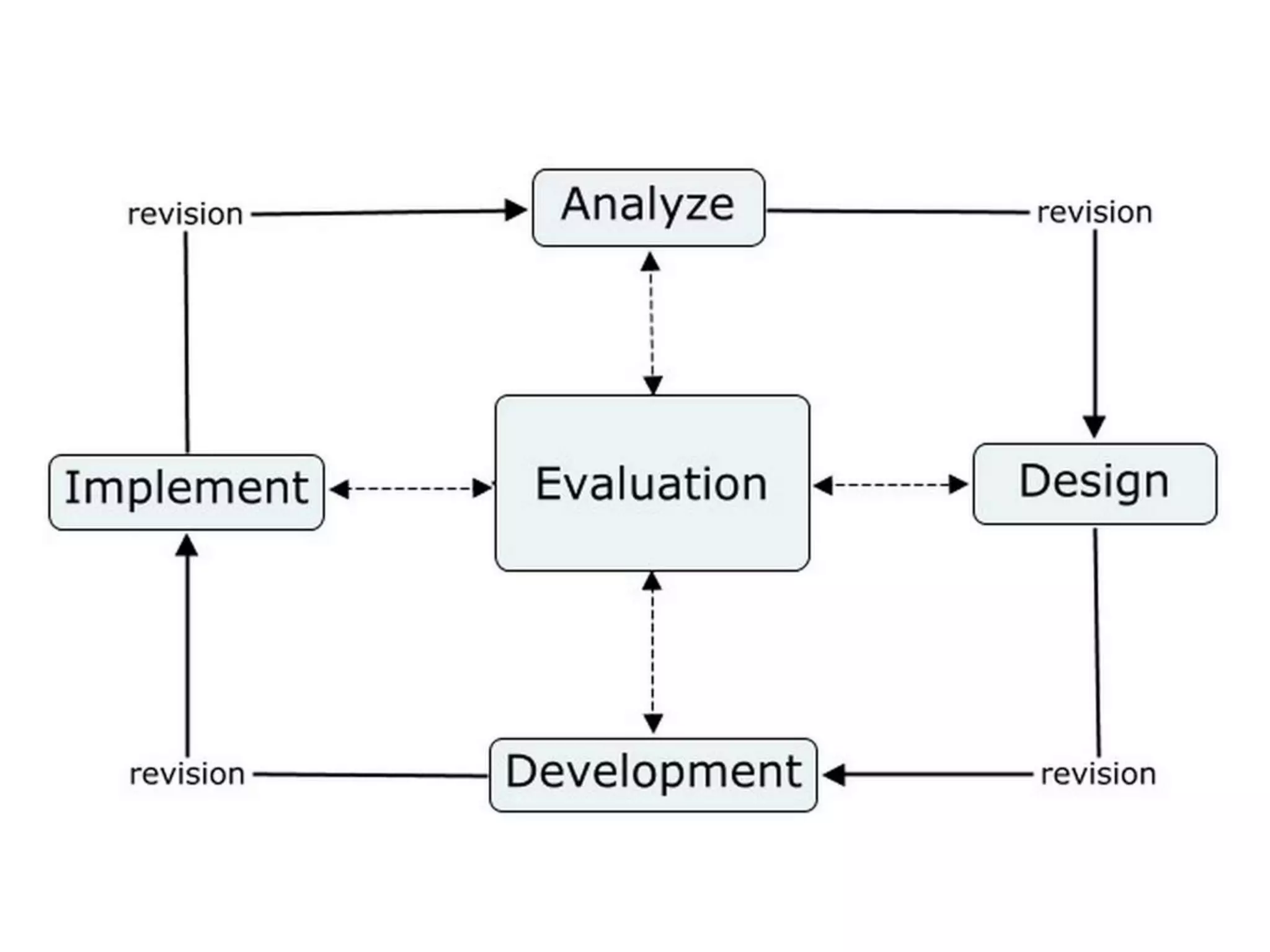
  • #44 http://en.wikipedia.org/wiki/ADDIE_Model
  • #45 http://www-tc.pbs.org/teacherline/courses/inst325/docs/inst325_wiggins_mctighe.pdf
  • #46 Many instructors begin with textbook, favored lessons, and time-honored activities rather than deriving those tools from targeted goals or standards – “backward” from conventional habits. This approach can be thought of as purposeful task-analysis. The results are a more sharply defined teaching and learning target so that students perform better knowing their goal. There is greater coherence among desired results, key performances, and teaching and learning experiences which leads to better students performance – the purpose of instructional design. http://www-tc.pbs.org/teacherline/courses/inst325/docs/inst325_wiggins_mctighe.pdf
  • #47 Serve as SME – Subject Matter Expert Collaborate in course development Identify content and assessments Align outcomes, content, and assessments Identify and fill gaps in OER Supplement existing content if necessary Any original content licensed CCBY Teach 2+ sections of course Offer feedback for continuous improvement Identify and fill gaps in OER Supplement existing content if necessary Any original content licensed CCBY Course Adopter Teach sections of course Offer Feedback
  • #48 Current teams collaborating in the development and adoption in these disciplines. Some courses have iterated several times over, others are just beginning to pave the way
  • #49 Open Course Template to download http://goo.gl/zEHUDZ
  • #51 http://edglossary.org/student-engagement/ extends to motivation to learn, persist, and attainment circles back to meeting the President Obama’s 2012 goal for America to become No. 1 in the world for college graduates which includes increasing attainment for certificates and degrees by 50% by 2020 http://www.ed.gov/news/press-releases/new-state-state-college-attainment-numbers-show-progress-toward-2020-goal
  • #52 traditional classroom, students are sequestered in the same place generally free from outside distraction, must follow along with activities faculty have chosen may choose to focus only on assignments and ignore lectures and discussions whether online, friends, family, work http://www.deltak-innovation.com/sites/deltak/files/Faculty-Engagement-in-Online-Learning_0.pdf
  • #53 http://www.deltak-innovation.com/sites/deltak/files/Faculty-Engagement-in-Online-Learning_0.pdf
  • #55 Video Intro Example: https://www.youtube.com/watch?v=YZvFUhqpdzg Blog: http://openforsuccess.org/page/2/
  • #57 factors are suggestions based on research for increasing the completion rate of online courses.
  • #58 http://www.outreach.washington.edu/teaching/online_instructor_training/instr-training/guidelines.html According to research, prompt evaluation and return of assignments and assessments is the single most significant factor in increasing the completion rate of online courses.
  • #59 http://www.outreach.washington.edu/teaching/online_instructor_training/instr-training/guidelines.html
  • #60 http://www.outreach.washington.edu/teaching/online_instructor_training/instr-training/guidelines.html
  • #61 http://www.outreach.washington.edu/teaching/online_instructor_training/instr-training/guidelines.html
  • #62 http://www.outreach.washington.edu/teaching/online_instructor_training/instr-training/guidelines.html