This work is licenced under a Creative Commons Licence.


          Openness as a catalyst for
           innovation in education
              R. John Robertson, JISC CETIS
              SPU Symposium, Seattle 2011


                                         1
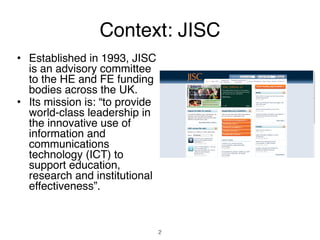
Context: JISC
• Established in 1993, JISC
  is an advisory committee
  to the HE and FE funding
  bodies across the UK.
• Its mission is: “to provide
  world-class leadership in
  the innovative use of
  information and
  communications
  technology (ICT) to
  support education,
  research and institutional
  effectiveness”.


                                2
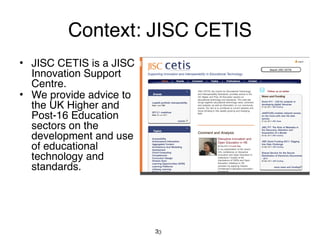
Context: JISC CETIS
• JISC CETIS is a JISC
  Innovation Support
  Centre.
• We provide advice to
  the UK Higher and
  Post-16 Education
  sectors on the
  development and use
  of educational
  technology and
  standards.


                         33
To return to the beginning
• "Out of every ten             • “Make lots of
  innovations                     mistakes and make
  attempted, all very             them quickly”
  splendid, nine will end
  up in silliness"
  Antonio Machado


                            4
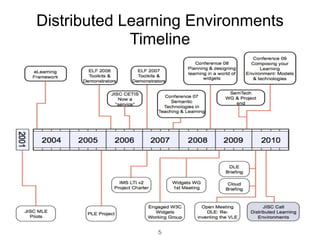
Distributed Learning Environments
             Timeline


                5
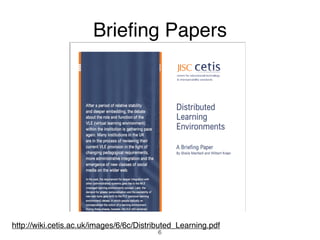
Briefing Papers


http://wiki.cetis.ac.uk/images/6/6c/Distributed_Learning.pdf
                                          6
Introduction: UKOER Programmes
        • The Open Educational Resources
          Programme is a collaboration between the
          JISC and the Higher Education Academy in
          the UK.

        • The Higher Education Funding Council for
          England (HEFCE) provided an initial £5.7
          million of funding, for a pilot programme
          (April 2009 to March 2010) and a
          subsequent £5 million of funding (August
          2010- August 2011) for a follow-up
          programme both of which explore how to
          expand the open availability and use of
          free, high quality online educational
          resources.


                     7
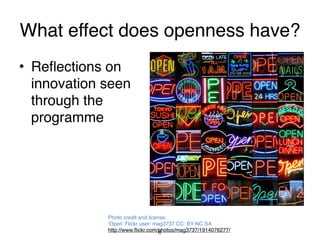
What effect does openness have?
• Reflections on
  innovation seen
  through the
  programme


             Photo credit and license:
             ‘Open’ Flickr user: mag3737 CC: BY NC SA
             http://www.flickr.com/photos/mag3737/1914076277/
                                   8
Open content as a catalyst for innovation

• I’d contend that we   
 “The future is already
  know lots of ways to    here — it's just not very
  innovate and improve evenly distributed.”
  education – making    
 William Gibson
  any of them happen is 
 Interview with NPR
  a different question
                        
 1993


                         9
Defining Open
• thinking about
  licensing can actually
  make it simpler
• Creative Commons
  – BY
  – SA or ND                    http://creativecommons.org/
  – NC


                           10
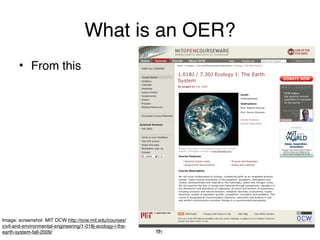
What is an OER?
       • From this


Image: screenshot MIT OCW http://ocw.mit.edu/courses/
civil-and-environmental-engineering/1-018j-ecology-i-the-
earth-system-fall-2009/                                     11
                                                             11
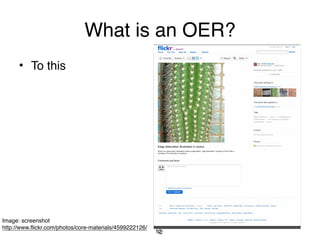
What is an OER?
      • To this


Image: screenshot
http://www.flickr.com/photos/core-materials/4599222126/
                                                          12
                                                          12
An Open proposition
• Value proposition that
  sharing content openly
  can provide a greater
  return than strict control
• Discussing this as a
  catalyst not necessarily
  a cause


                               13
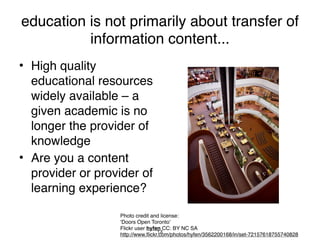
education is not primarily about transfer of
          information content...
• High quality
  educational resources
  widely available – a
  given academic is no
  longer the provider of
  knowledge
• Are you a content
  provider or provider of
  learning experience?

                  Photo credit and license:
                  ‘Doors Open Toronto’
                  Flickr user hyfen CC: BY NC SA
                                   14
                  http://www.flickr.com/photos/hyfen/3562200168/in/set-72157618755740828
Social responsibility

• If publicly funded,
  should the public
  have access?


                        15
Managing your educational content
•   Where do you find it?
•   Who owns it?
•   Who can use it?
•   If you want to reuse
    your colleagues
    lecture materials - can
    you find them?


                              16
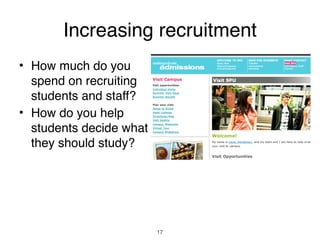
Increasing recruitment
• How much do you
  spend on recruiting
  students and staff?
• How do you help
  students decide what
  they should study?


                         17
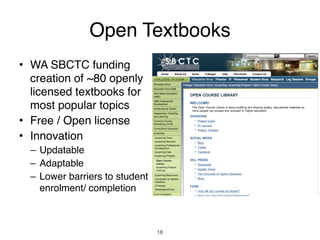
Open Textbooks
• WA SBCTC funding
  creation of ~80 openly
  licensed textbooks for
  most popular topics
• Free / Open license
• Innovation
  – Updatable
  – Adaptable
  – Lower barriers to student
    enrolment/ completion


                                18
Changes in student expectations?
• Does providing more
  flexible access to your
  resources support
  student learning?
• It may be cheaper
  and easier to give
  content to the world
  than manage access
  to limited student
  body.

                            19
Changes in pedagogy?
• If instructor time and peer interaction are key
  components of high impact learning
  experiences (Kuh) – why are we spending so
  much contact time on lectures?


                         20
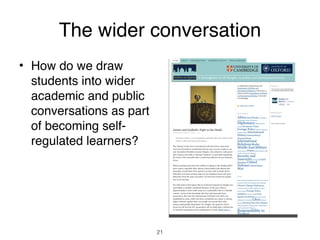
The wider conversation
• How do we draw
  students into wider
  academic and public
  conversations as part
  of becoming self-
  regulated learners?


                          21
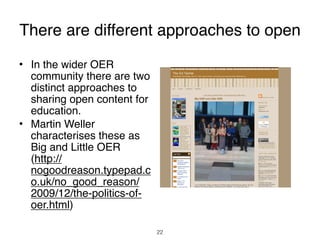
There are different approaches to open
• In the wider OER
  community there are two
  distinct approaches to
  sharing open content for
  education.
• Martin Weller
  characterises these as
  Big and Little OER
  (http://
  nogoodreason.typepad.c
  o.uk/no_good_reason/
  2009/12/the-politics-of-
  oer.html)

                             22
Questions


    23

Openness as a catalyst for innovation in education

  • 1.
    This work islicenced under a Creative Commons Licence. Openness as a catalyst for innovation in education R. John Robertson, JISC CETIS SPU Symposium, Seattle 2011 1
  • 2.
    Context: JISC • Establishedin 1993, JISC is an advisory committee to the HE and FE funding bodies across the UK. • Its mission is: “to provide world-class leadership in the innovative use of information and communications technology (ICT) to support education, research and institutional effectiveness”. 2
  • 3.
    Context: JISC CETIS •JISC CETIS is a JISC Innovation Support Centre. • We provide advice to the UK Higher and Post-16 Education sectors on the development and use of educational technology and standards. 33
  • 4.
    To return tothe beginning • "Out of every ten • “Make lots of innovations mistakes and make attempted, all very them quickly” splendid, nine will end up in silliness" Antonio Machado 4
  • 5.
  • 6.
  • 7.
    Introduction: UKOER Programmes • The Open Educational Resources Programme is a collaboration between the JISC and the Higher Education Academy in the UK. • The Higher Education Funding Council for England (HEFCE) provided an initial £5.7 million of funding, for a pilot programme (April 2009 to March 2010) and a subsequent £5 million of funding (August 2010- August 2011) for a follow-up programme both of which explore how to expand the open availability and use of free, high quality online educational resources. 7
  • 8.
    What effect doesopenness have? • Reflections on innovation seen through the programme Photo credit and license: ‘Open’ Flickr user: mag3737 CC: BY NC SA http://www.flickr.com/photos/mag3737/1914076277/ 8
  • 9.
    Open content asa catalyst for innovation • I’d contend that we “The future is already know lots of ways to here — it's just not very innovate and improve evenly distributed.” education – making William Gibson any of them happen is Interview with NPR a different question 1993 9
  • 10.
    Defining Open • thinkingabout licensing can actually make it simpler • Creative Commons – BY – SA or ND http://creativecommons.org/ – NC 10
  • 11.
    What is anOER? • From this Image: screenshot MIT OCW http://ocw.mit.edu/courses/ civil-and-environmental-engineering/1-018j-ecology-i-the- earth-system-fall-2009/ 11 11
  • 12.
    What is anOER? • To this Image: screenshot http://www.flickr.com/photos/core-materials/4599222126/ 12 12
  • 13.
    An Open proposition •Value proposition that sharing content openly can provide a greater return than strict control • Discussing this as a catalyst not necessarily a cause 13
  • 14.
    education is notprimarily about transfer of information content... • High quality educational resources widely available – a given academic is no longer the provider of knowledge • Are you a content provider or provider of learning experience? Photo credit and license: ‘Doors Open Toronto’ Flickr user hyfen CC: BY NC SA 14 http://www.flickr.com/photos/hyfen/3562200168/in/set-72157618755740828
  • 15.
    Social responsibility • Ifpublicly funded, should the public have access? 15
  • 16.
    Managing your educationalcontent • Where do you find it? • Who owns it? • Who can use it? • If you want to reuse your colleagues lecture materials - can you find them? 16
  • 17.
    Increasing recruitment • Howmuch do you spend on recruiting students and staff? • How do you help students decide what they should study? 17
  • 18.
    Open Textbooks • WASBCTC funding creation of ~80 openly licensed textbooks for most popular topics • Free / Open license • Innovation – Updatable – Adaptable – Lower barriers to student enrolment/ completion 18
  • 19.
    Changes in studentexpectations? • Does providing more flexible access to your resources support student learning? • It may be cheaper and easier to give content to the world than manage access to limited student body. 19
  • 20.
    Changes in pedagogy? •If instructor time and peer interaction are key components of high impact learning experiences (Kuh) – why are we spending so much contact time on lectures? 20
  • 21.
    The wider conversation •How do we draw students into wider academic and public conversations as part of becoming self- regulated learners? 21
  • 22.
    There are differentapproaches to open • In the wider OER community there are two distinct approaches to sharing open content for education. • Martin Weller characterises these as Big and Little OER (http:// nogoodreason.typepad.c o.uk/no_good_reason/ 2009/12/the-politics-of- oer.html) 22
  • 23.