THE NIGERIAN
LIBRARIAN IN THE
INFORMATION AGE:
THE DEMANDS,
COMPETENCIES AND
DILEMMAS
R. U. ONONOGBO (PhD)
Maiden conference of the Nigerian Library Association, Abia State Chapter
@ National Root Crops Research Institute, Umudike. Dec.11-13, 2012
INTRODUCTION
Information explosion is more real now
than ever.
Information is still relevant in S & T,
R & D, Teaching and Learning
Technology for information
communication grew more sophisticated
The real age of ICT dawns
The information worker, the user, the
libraries, documentation centres, etc –
all affected
THE LIBRARIAN -
WHO IS HE?
He is anyone who is involved
in the identification, capture,
organisation, storage,
retrieval, analysis,
interpretation, packaging and
dissemination of information
(St. Clair, 2001).
CATEGORIES OF
LIBRARIANS
- IN GENERAL TERMS
The professional librarian
The paraprofessional librarian
(Related to the professional
librarian in a secondary or
supplementary capacity)
The support staff (an amorphous
group with over 37 job titles)
THE USER GROUP
- who are they?
They make demands on the
information services provider – they
are the user community
They are categorised according to:
1.Professional or vocational
characteristics 2.Institutional
affiliation 3. Geographical location 4.
Restrictions in terms of access (Gwang,
2011).
DEMANDS ON THE
LIBRARIAN
Demands determined by changing role of
libraries and economy of information include:
(a). Rapid response to capture of information,
knowledge, rapid response to the new age
(libraries transiting from a library centre to an
information-centred entity)
(b). Demand to be linked up with information
resources as appropriate
( c). Demands on the Nigerian libraries to
jettison the old traditional block filled with
print materials and move on to the digital scene
(d). Demands on librarians to change his
operational equipment and services
(microform equipment, library cards,
kardex, etc to give way to hardware,
software and systems).
(e). Demands on the librarian to be
proactive, break away from insularity
and reach out to the user, external
sources, etc.
(f). Demand on the librarian to extend
services to the farmer, trader, the
handicapped, etc.
COMPETENCIES OF THE
LIBRARIAN
- discussed under IT, Professional
and Personal competencies
1. IT Competencies (the 13 key IT
competencies given by Aman & Norliyana,
2002 and Choi & Rasmussen, 2006) – See
text.
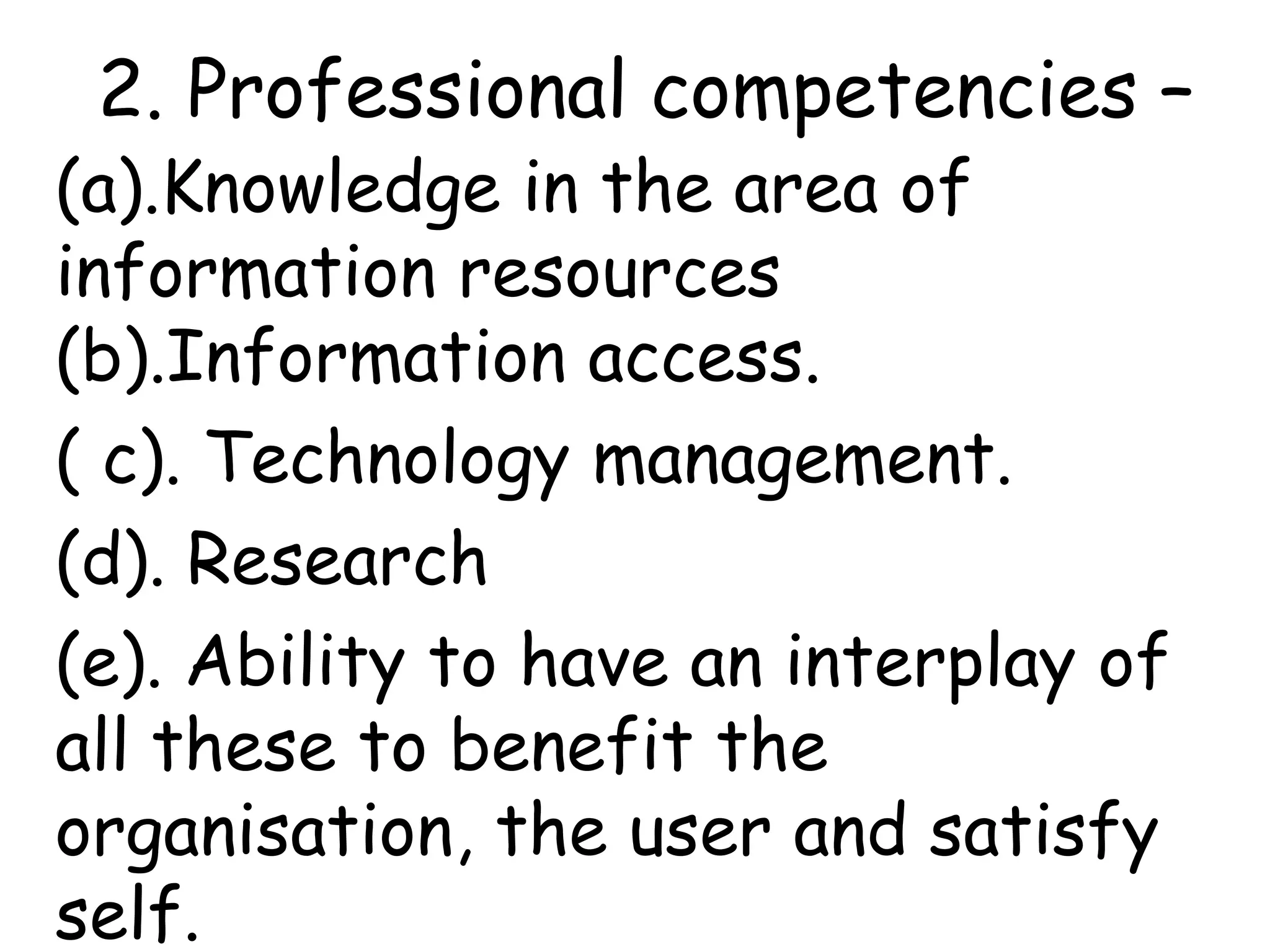
2. Professional competencies –
(a).Knowledge in the area of
information resources
(b).Information access.
( c). Technology management.
(d). Research
(e). Ability to have an interplay of
all these to benefit the
organisation, the user and satisfy
self.
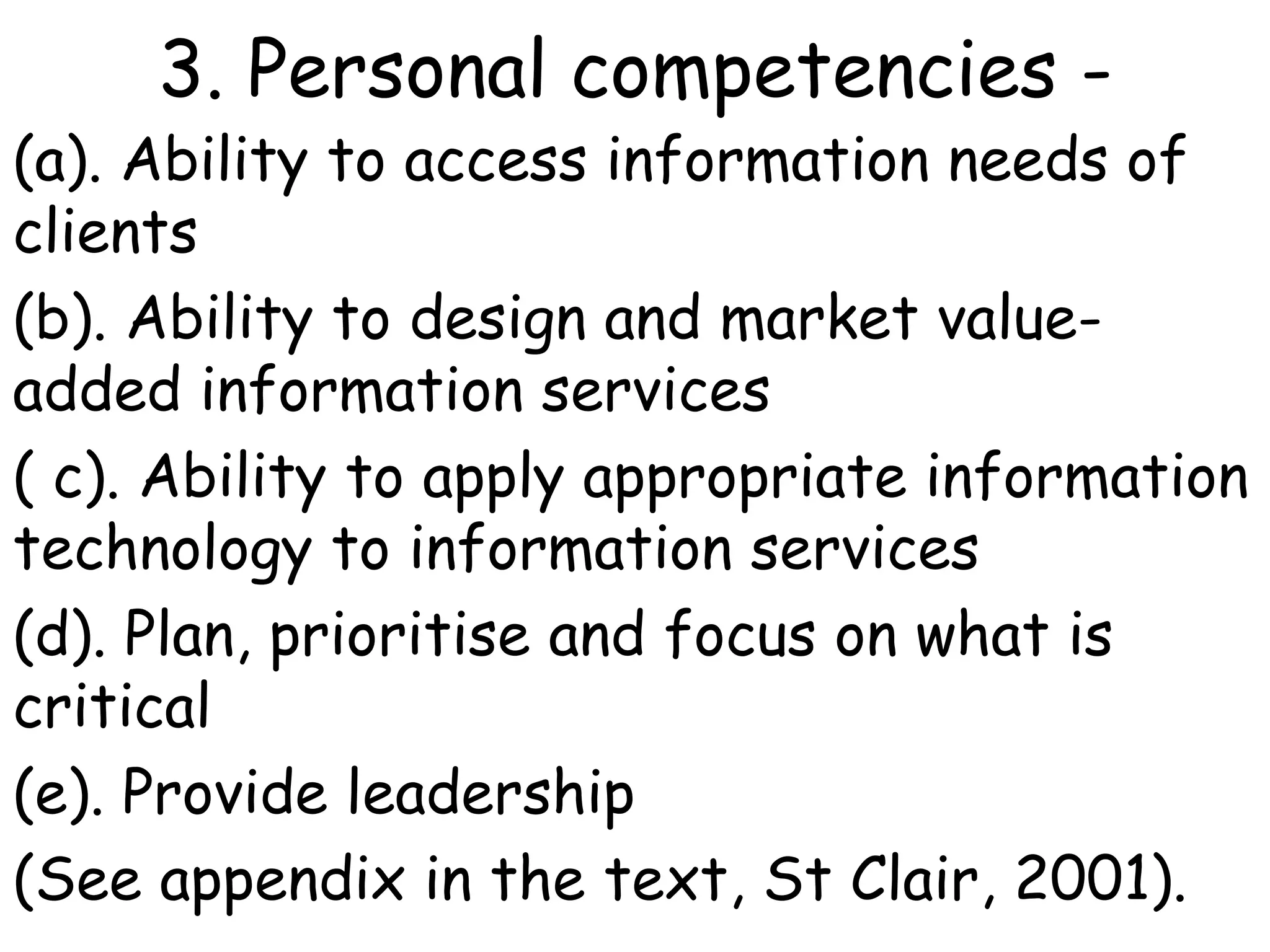
3. Personal competencies -
(a). Ability to access information needs of
clients
(b). Ability to design and market value-
added information services
( c). Ability to apply appropriate information
technology to information services
(d). Plan, prioritise and focus on what is
critical
(e). Provide leadership
(See appendix in the text, St Clair, 2001).
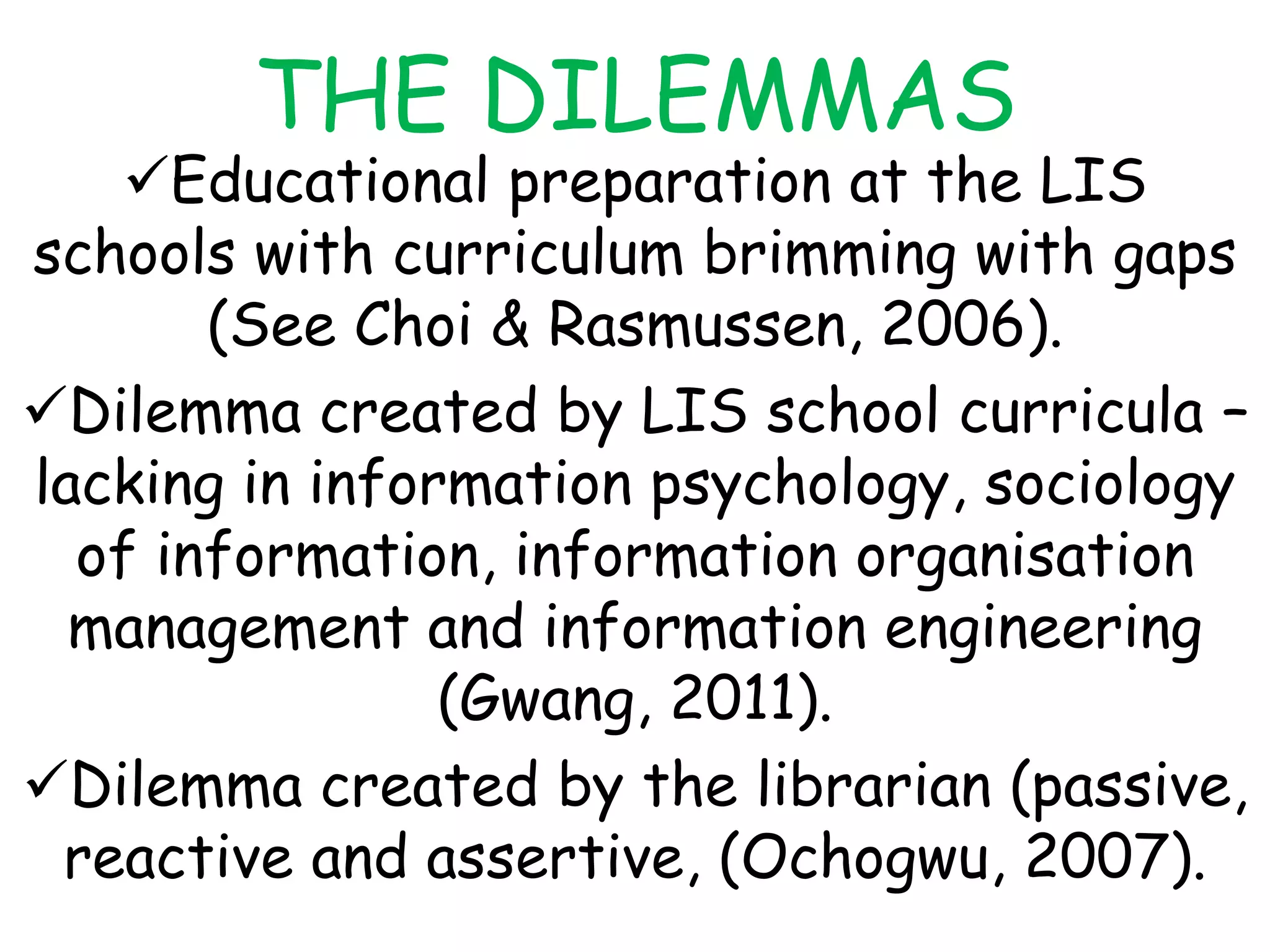
THE DILEMMAS
Educational preparation at the LIS
schools with curriculum brimming with gaps
(See Choi & Rasmussen, 2006).
Dilemma created by LIS school curricula –
lacking in information psychology, sociology
of information, information organisation
management and information engineering
(Gwang, 2011).
Dilemma created by the librarian (passive,
reactive and assertive, (Ochogwu, 2007).
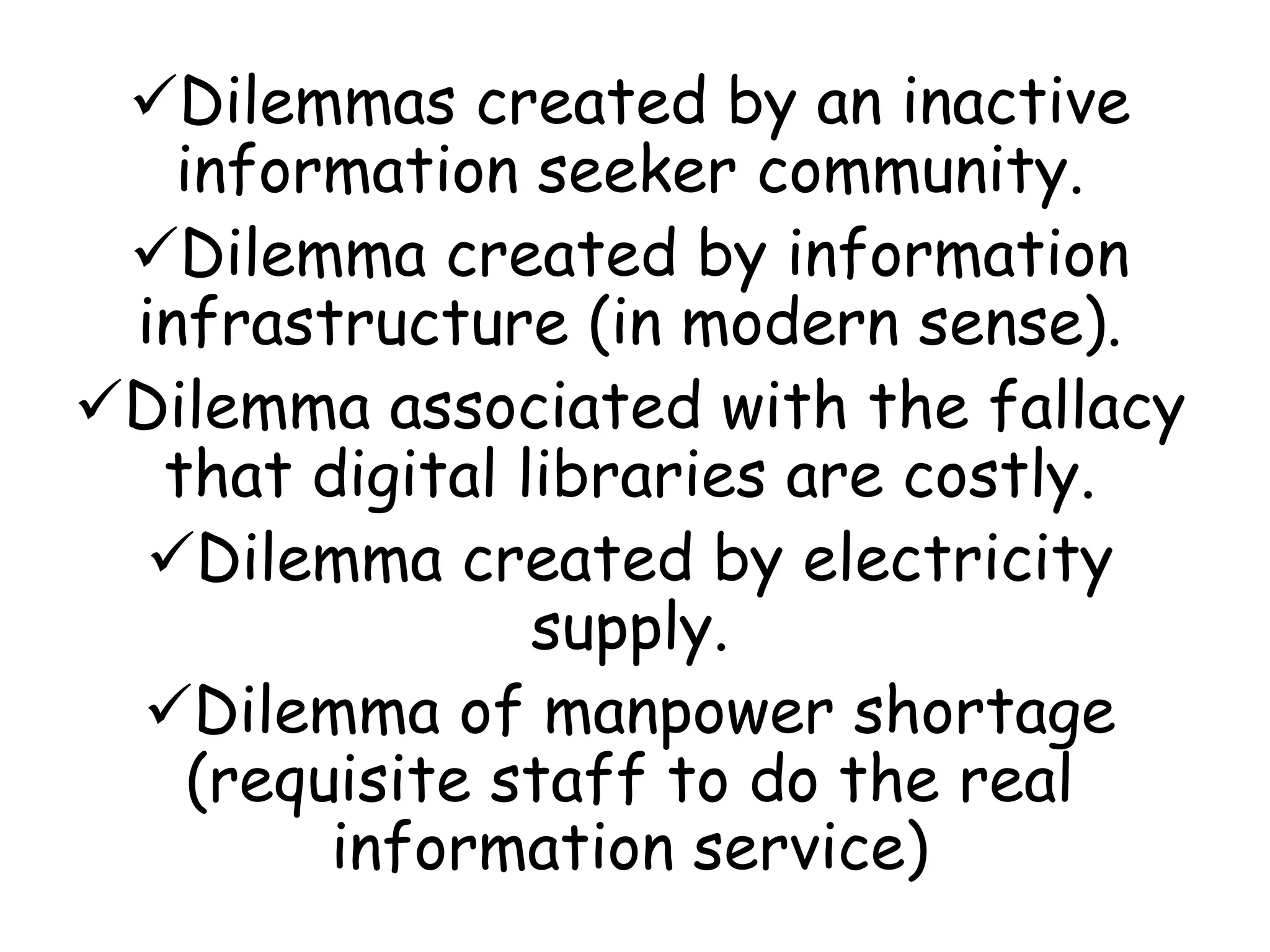
Dilemmas created by an inactive
information seeker community.
Dilemma created by information
infrastructure (in modern sense).
Dilemma associated with the fallacy
that digital libraries are costly.
Dilemma created by electricity
supply.
Dilemma of manpower shortage
(requisite staff to do the real
information service)
CONCLUSION
The arrow of information points
forward. Its momentum is enormous as
it carries speed and mass. Information
is at the cutting edge of civilisation.
The librarian is on the throne of its
capture, organisation and
dissemination. The Nigerian librarian
should grasp the nettle now.
Thank you for Listening

The Nigerian Librarian in the Information Age, demands, competences, dilemmas

  • 1.
    THE NIGERIAN LIBRARIAN INTHE INFORMATION AGE: THE DEMANDS, COMPETENCIES AND DILEMMAS R. U. ONONOGBO (PhD) Maiden conference of the Nigerian Library Association, Abia State Chapter @ National Root Crops Research Institute, Umudike. Dec.11-13, 2012
  • 2.
    INTRODUCTION Information explosion ismore real now than ever. Information is still relevant in S & T, R & D, Teaching and Learning Technology for information communication grew more sophisticated The real age of ICT dawns The information worker, the user, the libraries, documentation centres, etc – all affected
  • 3.
    THE LIBRARIAN - WHOIS HE? He is anyone who is involved in the identification, capture, organisation, storage, retrieval, analysis, interpretation, packaging and dissemination of information (St. Clair, 2001).
  • 4.
    CATEGORIES OF LIBRARIANS - INGENERAL TERMS The professional librarian The paraprofessional librarian (Related to the professional librarian in a secondary or supplementary capacity) The support staff (an amorphous group with over 37 job titles)
  • 5.
    THE USER GROUP -who are they? They make demands on the information services provider – they are the user community They are categorised according to: 1.Professional or vocational characteristics 2.Institutional affiliation 3. Geographical location 4. Restrictions in terms of access (Gwang, 2011).
  • 6.
    DEMANDS ON THE LIBRARIAN Demandsdetermined by changing role of libraries and economy of information include: (a). Rapid response to capture of information, knowledge, rapid response to the new age (libraries transiting from a library centre to an information-centred entity) (b). Demand to be linked up with information resources as appropriate ( c). Demands on the Nigerian libraries to jettison the old traditional block filled with print materials and move on to the digital scene
  • 7.
    (d). Demands onlibrarians to change his operational equipment and services (microform equipment, library cards, kardex, etc to give way to hardware, software and systems). (e). Demands on the librarian to be proactive, break away from insularity and reach out to the user, external sources, etc. (f). Demand on the librarian to extend services to the farmer, trader, the handicapped, etc.
  • 8.
    COMPETENCIES OF THE LIBRARIAN -discussed under IT, Professional and Personal competencies 1. IT Competencies (the 13 key IT competencies given by Aman & Norliyana, 2002 and Choi & Rasmussen, 2006) – See text.
  • 9.
    2. Professional competencies– (a).Knowledge in the area of information resources (b).Information access. ( c). Technology management. (d). Research (e). Ability to have an interplay of all these to benefit the organisation, the user and satisfy self.
  • 10.
    3. Personal competencies- (a). Ability to access information needs of clients (b). Ability to design and market value- added information services ( c). Ability to apply appropriate information technology to information services (d). Plan, prioritise and focus on what is critical (e). Provide leadership (See appendix in the text, St Clair, 2001).
  • 11.
    THE DILEMMAS Educational preparationat the LIS schools with curriculum brimming with gaps (See Choi & Rasmussen, 2006). Dilemma created by LIS school curricula – lacking in information psychology, sociology of information, information organisation management and information engineering (Gwang, 2011). Dilemma created by the librarian (passive, reactive and assertive, (Ochogwu, 2007).
  • 12.
    Dilemmas created byan inactive information seeker community. Dilemma created by information infrastructure (in modern sense). Dilemma associated with the fallacy that digital libraries are costly. Dilemma created by electricity supply. Dilemma of manpower shortage (requisite staff to do the real information service)
  • 13.
    CONCLUSION The arrow ofinformation points forward. Its momentum is enormous as it carries speed and mass. Information is at the cutting edge of civilisation. The librarian is on the throne of its capture, organisation and dissemination. The Nigerian librarian should grasp the nettle now.
  • 14.
    Thank you forListening