❖ Imagine being in a new school. Everything is
unknown to you.
❖ How do you familiarize yourself with your
new environment?
❖ How do you get to know everything and
anyone around you?
❖ All these information are important for you
to survive in your new environment.
❖ We learned that all processed data in a broad
sense is considered information.
❖ These can be gained through inquiry,
experience, education, signs, and symbols.
Now, one may think that getting information
is easy.
❖ However, we always have to consider if the
information we get is true and valid.
❖ Being able to look for the right information in an
effective way is a skill that everyone should have.
❖ Information comes from the Latin word
“informare” which means, “formation of
the mind or teaching”.
❖ Information is vital in our everyday
communication and growth, just like how
we find the need to gather information in
our new environment, or how we would
want to feature our favorite person.
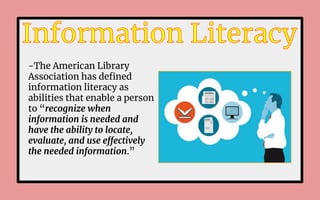
-The American Library
Association has defined
information literacy as
abilities that enable a person
to “recognize when
information is needed and
have the ability to locate,
evaluate, and use effectively
the needed information.”
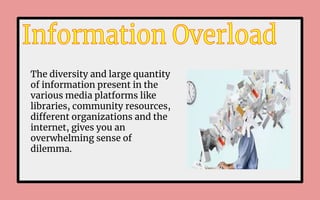
The diversity and large quantity
of information present in the
various media platforms like
libraries, community resources,
different organizations and the
internet, gives you an
overwhelming sense of
dilemma.
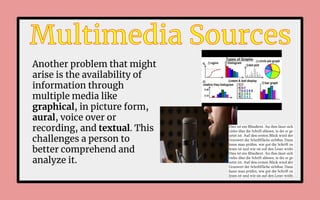
Another problem that might
arise is the availability of
information through
multiple media like
graphical, in picture form,
aural, voice over or
recording, and textual. This
challenges a person to
better comprehend and
analyze it.
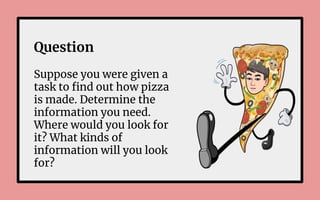
Question
Suppose you were given a
task to find out how pizza
is made. Determine the
information you need.
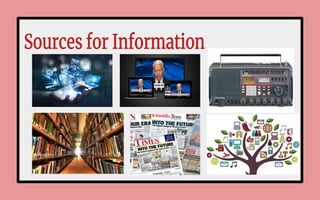
Where would you look for
it? What kinds of
information will you look
for?
“The stages of information literacy
can help you with how you can get an
information effectively.”
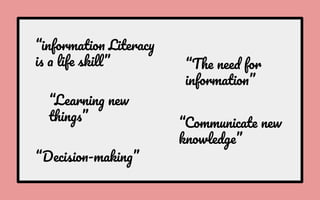
“information Literacy
is a life skill” “The need for
information”
“Learning new
things” “Communicate new
knowledge”
“Decision-making”
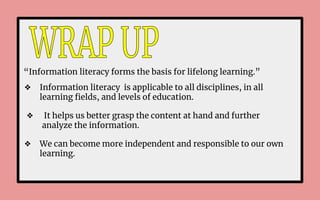
“Information literacy forms the basis for lifelong learning.”
❖ Information literacy is applicable to all disciplines, in all
learning fields, and levels of education.
❖ It helps us better grasp the content at hand and further
analyze the information.
❖ We can become more independent and responsible to our own
learning.

Information Literacy

  • 2.
    ❖ Imagine beingin a new school. Everything is unknown to you. ❖ How do you familiarize yourself with your new environment? ❖ How do you get to know everything and anyone around you? ❖ All these information are important for you to survive in your new environment.
  • 3.
    ❖ We learnedthat all processed data in a broad sense is considered information. ❖ These can be gained through inquiry, experience, education, signs, and symbols. Now, one may think that getting information is easy. ❖ However, we always have to consider if the information we get is true and valid. ❖ Being able to look for the right information in an effective way is a skill that everyone should have.
  • 4.
    ❖ Information comesfrom the Latin word “informare” which means, “formation of the mind or teaching”. ❖ Information is vital in our everyday communication and growth, just like how we find the need to gather information in our new environment, or how we would want to feature our favorite person.
  • 5.
    -The American Library Associationhas defined information literacy as abilities that enable a person to “recognize when information is needed and have the ability to locate, evaluate, and use effectively the needed information.”
  • 7.
    The diversity andlarge quantity of information present in the various media platforms like libraries, community resources, different organizations and the internet, gives you an overwhelming sense of dilemma.
  • 8.
    Another problem thatmight arise is the availability of information through multiple media like graphical, in picture form, aural, voice over or recording, and textual. This challenges a person to better comprehend and analyze it.
  • 10.
    Question Suppose you weregiven a task to find out how pizza is made. Determine the information you need. Where would you look for it? What kinds of information will you look for?
  • 11.
    “The stages ofinformation literacy can help you with how you can get an information effectively.”
  • 19.
    “information Literacy is alife skill” “The need for information” “Learning new things” “Communicate new knowledge” “Decision-making”
  • 21.
    “Information literacy formsthe basis for lifelong learning.” ❖ Information literacy is applicable to all disciplines, in all learning fields, and levels of education. ❖ It helps us better grasp the content at hand and further analyze the information. ❖ We can become more independent and responsible to our own learning.