Engaging Students with Information :  A participatory constructivist framework for teaching information skills Nasser Saleh Integrated Learning Librarian  nasser.saleh@queensu.ca  A presentation to:  The Many Dimensions of Students Engagement Conference Wilfred Laurier University  February 18, 2009 Engineering & Science Library This presentation is licensed under a Creative Commons Attribution 2.5 Canada Licence
Overview This presentation is about the experimental use of a participatory constructivist approach for Information Practice in selective undergraduate Engineering courses.  The presentation also discusses the role of academic librarians in students engagement as academic enablers.
Agenda What is Information Literacy (IL)?  Current Model of IL Redefining IL and the role of academic librarian. Participatory Nature of Information Practice (IP) Examples of Direct and Embedded IP in Engineering Courses Questions?
Information Literacy Information literacy (IL) is a set of abilities requiring individuals to "recognize  when  information is needed and  have the ability  to locate, evaluate, and use effectively the needed information.” Resource:  Association of College and Research Libraries (ACRL).(2003) Information Literacy Competency Standards for Higher Education. [Online]. Available: http://www.ala.org/ala/acrl/acrlstandards/informationliteracycompetency.cfm
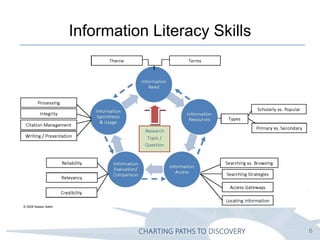
Information literacy related skills that students are  expected  to develop in APSC100: Determining  the nature of the information they need. Accessing   the needed information effectively and efficiently. Evaluating  information and its sources critically and incorporating selected information into their coursework.  Using  information effectively to accomplish the specific purpose of their coursework. Understanding  many of the economic, legal, and social issues surrounding the use of information, and using information ethically and legally with the proper level of citation.
Information Literacy Skills © 2008 Nasser Saleh
IL Rubric for APSC100
Limitations to the current model Information literacy includes cognitive activities.  IL is enabled by many technical skills such as the use of computers. IL, as a learning experience, is a socio-constructive model where knowledge is constructed, accumulated and communicated.
Redefine IL There is a need to redefine IL to be more than skills  “ ...information literacy is knowledge rather than simply skill, achieved by education rather than training, created through partnership between professionals and is a lifelong endeavour that is contextual in field and service access”. (Town, 2002) Town, J. S. (2002b). Information literacy and the information society, In:  Challenge and change in the information society , edited by S. Hornby & Z. Clarke. (pp. 83-103.) London: Facet.
IL is not a linear model! Information Practice Connecting with Information Interacting with Information Making sense/use of Information
Information needs Information needs are dependents on learners’ preconceptions that do not necessarily include misconceptions Once learners can identify their real information needs, they can start  “connection with information”.
Constructivist Information Practice The theoretical foundation applies a constructivist approach, employing learner control in a social, collaborative setting.  The instructional layer uses  reflection  as a  sense-making  strategy and is employed to encourage  self-discovery.
Examples From In-Class Information Practice Workshops
Start your Project What is the main purpose of your project/ research?  What is/are the main question(s) of your project/ research? Do you feel that you have background information about the main topic? If yes, try to list the key concepts that you already know. What other information do you need? and where can you find them?
Start your Project Example: Project #3: Solar-Thermal refrigerator
Examples of students preconceptions
Examples of tacit knowledge elicitation Collaborative  upper year project  Individual student in 2 nd  year
Examples From Online Information Practice
Using Wiki in design projects
Using social networking
Inquiry@Queen’s  Undergraduate Research Conference Undergraduate Research Multidisciplinary Presentation Skills Writing Skills  Conference Experience Published Proceedings
Final notes .. Academic librarians are academic enablers. Improving students’ learning is about understanding the learner's perspective. Learning is about change in conceptions, a well integrated information practice plan can enable students to develop more complex understandings.
Through others, we become ourselves.   L.S. Vygotsky Nasser Saleh Integrated Learning Librarian E-mail :  [email_address]

Engaging Students with Information

  • 1.
    Engaging Students withInformation : A participatory constructivist framework for teaching information skills Nasser Saleh Integrated Learning Librarian nasser.saleh@queensu.ca A presentation to: The Many Dimensions of Students Engagement Conference Wilfred Laurier University February 18, 2009 Engineering & Science Library This presentation is licensed under a Creative Commons Attribution 2.5 Canada Licence
  • 2.
    Overview This presentationis about the experimental use of a participatory constructivist approach for Information Practice in selective undergraduate Engineering courses. The presentation also discusses the role of academic librarians in students engagement as academic enablers.
  • 3.
    Agenda What isInformation Literacy (IL)? Current Model of IL Redefining IL and the role of academic librarian. Participatory Nature of Information Practice (IP) Examples of Direct and Embedded IP in Engineering Courses Questions?
  • 4.
    Information Literacy Informationliteracy (IL) is a set of abilities requiring individuals to "recognize when information is needed and have the ability to locate, evaluate, and use effectively the needed information.” Resource: Association of College and Research Libraries (ACRL).(2003) Information Literacy Competency Standards for Higher Education. [Online]. Available: http://www.ala.org/ala/acrl/acrlstandards/informationliteracycompetency.cfm
  • 5.
    Information literacy relatedskills that students are expected to develop in APSC100: Determining the nature of the information they need. Accessing the needed information effectively and efficiently. Evaluating information and its sources critically and incorporating selected information into their coursework. Using information effectively to accomplish the specific purpose of their coursework. Understanding many of the economic, legal, and social issues surrounding the use of information, and using information ethically and legally with the proper level of citation.
  • 6.
    Information Literacy Skills© 2008 Nasser Saleh
  • 7.
  • 8.
    Limitations to thecurrent model Information literacy includes cognitive activities. IL is enabled by many technical skills such as the use of computers. IL, as a learning experience, is a socio-constructive model where knowledge is constructed, accumulated and communicated.
  • 9.
    Redefine IL Thereis a need to redefine IL to be more than skills “ ...information literacy is knowledge rather than simply skill, achieved by education rather than training, created through partnership between professionals and is a lifelong endeavour that is contextual in field and service access”. (Town, 2002) Town, J. S. (2002b). Information literacy and the information society, In: Challenge and change in the information society , edited by S. Hornby & Z. Clarke. (pp. 83-103.) London: Facet.
  • 10.
    IL is nota linear model! Information Practice Connecting with Information Interacting with Information Making sense/use of Information
  • 11.
    Information needs Informationneeds are dependents on learners’ preconceptions that do not necessarily include misconceptions Once learners can identify their real information needs, they can start “connection with information”.
  • 12.
    Constructivist Information PracticeThe theoretical foundation applies a constructivist approach, employing learner control in a social, collaborative setting. The instructional layer uses reflection as a sense-making strategy and is employed to encourage self-discovery.
  • 13.
    Examples From In-ClassInformation Practice Workshops
  • 14.
    Start your ProjectWhat is the main purpose of your project/ research? What is/are the main question(s) of your project/ research? Do you feel that you have background information about the main topic? If yes, try to list the key concepts that you already know. What other information do you need? and where can you find them?
  • 15.
    Start your ProjectExample: Project #3: Solar-Thermal refrigerator
  • 16.
    Examples of studentspreconceptions
  • 17.
    Examples of tacitknowledge elicitation Collaborative upper year project Individual student in 2 nd year
  • 18.
    Examples From OnlineInformation Practice
  • 19.
    Using Wiki indesign projects
  • 20.
    Using Wiki indesign projects
  • 21.
  • 22.
    Inquiry@Queen’s UndergraduateResearch Conference Undergraduate Research Multidisciplinary Presentation Skills Writing Skills Conference Experience Published Proceedings
  • 23.
    Final notes ..Academic librarians are academic enablers. Improving students’ learning is about understanding the learner's perspective. Learning is about change in conceptions, a well integrated information practice plan can enable students to develop more complex understandings.
  • 24.
    Through others, webecome ourselves. L.S. Vygotsky Nasser Saleh Integrated Learning Librarian E-mail : [email_address]