



Online Research:
New Challenges &
Opportunities
Glen Farrelly
University of Toronto
Outline
• Definition of “online”
• Online research methods
 types
 benefits & limitations
• Studying online phenomena
• Tips & caveats
• In-class exercise
• Bibliography
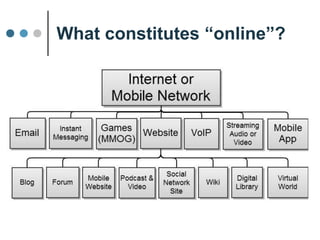
What Constitutes “Online”?
Online Research
Methods
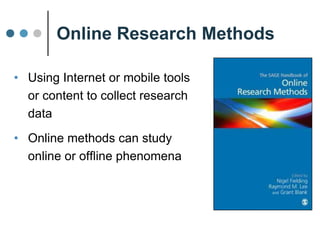
Online Research Methods
• Using Internet or mobile
tools or content to collect
research data
• Online methods can
study online or
offline phenomena
Types of Online Methods
Common online methods:
• Web-based surveys
• Email & VoIP interviews
• Computer-captured data
• Remote observation
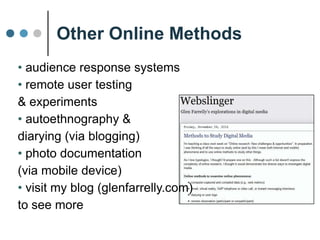
Other Online Methods
• Audience response systems
• Remote user testing
& experiments
• Autoethnography
(via blogging)
• Photo documentation
(via mobile device)
Benefits of Online Methods
For researchers:
• Lowers costs
• Increases geographical reach
• Facilitates data transcription & analysis
For participants:
• Reduces spatial & temporal barriers
• Channel preference & familiarity
Limits of Online Methods
• Digital Divide, limits participation by:
 Access (rural areas, income)
 Literacy & technical familiarity
 Physical abilities
• Glitches & cross-platform support
• Difficulty controlling research environment
(e.g., participant distraction)
Studying
Online
Phenomena
Why Study Online Phenomena?
Choosing a Method
Options:
• Online methods
• Offline methods
• Both
Consider:
• Research objectives
• Context of study
• Location & familiarity of participants
Eye-tracking study
of how people view webpages
Tips
&
Caveats
Ethical Online Research
• Consent not needed to research “public forum”
• If you need to register for website, then get
informed consent from participants
• Be careful if considering deception or
working with children or medically infirm
Beware the “Real Life” Trap
“Consequently, an analysis that takes
the face-to-face as its starting point
is unable to explain the specificity
of the online phenomenon it aims
to study; it can explain what is going
on online only in terms of
face-to-face qualities.”
(Orgad, p.48)
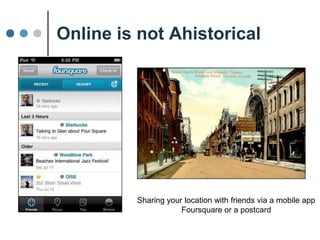
Online Is Not Ahistorical
Sharing your location with friends via a mobile
app Foursquare or a postcard
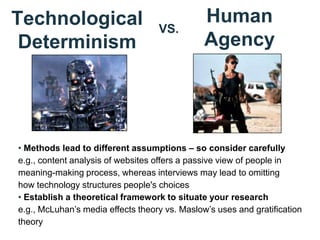
Technological
Determinism
Human
Agency
VS.
• Methods lead to different assumptions
So consider carefully…
• Establish a theoretical framework to situate your research
e.g., McLuhan’s media effects theory
Maslow’s uses and gratification theory
Class Activity
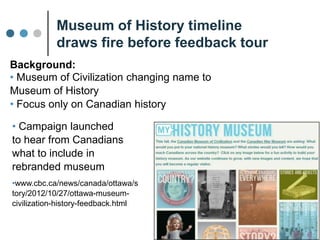
Background:
• Museum of Civilization changing name and focus
• Campaign to hear from Canadians on the changes
• CBC ran a news article
on this and enabled public
to comment
• Result = a rich source of
discourse on this issue
Coding Online Discourse
1. Read through CBC article and
reader comments
2. As you encounter passages of interest,
circle it and give it an indicative
label (a “code”)
3. Codes can be one word or a few
4. Be creative – similar to brainstorming
5. Find other instances of the code
Exercise Instructions
Identifying Themes
1. Find a partner
2. Discuss prominent or reoccurring
codes you identified
3. Discuss how your findings help
elucidate a theme or indicate a pattern
Class Discussion
1. What themes did you find?
2. What level of analysis did you use?
3. What did you learn from your
experience of coding?
Conclusion
&
Questions
Bibliography
• Bakardjieva, M. (2009). A response to Shani Orgad. Internet inquiry:
Conversations about method (pp. 54–60). Thousand Oaks, CA: Sage.
• Brown, M. C. (2012, August 16). An iPhone in the DRC. Time.
Retrieved from http://lightbox.time.com/
• Fielding, N. G., Lee, R. M., & Blank, G. (Eds.). (2008). The Sage handbook of
online research methods. Thousand Oaks, CA: Sage.
• Hamilton, R. J., & Bowers, B. J. (2006). Internet recruitment & e-mail interviews in
qualitative studies. Qualitative Health Research, 16(6), 821–835.
• Markham, A., & Buchanan, E. (2012). Ethical decision-making & Internet research:
Version 2.0. AoIR. Retrieved from http://aoir.org/documents/ethics-guide
• Nielsen, J. (2006, April 17). F-shaped pattern for reading web content. Alertbox.
Retrieved from http://www.useit.com/alertbox/reading_pattern.html
• Opdenakker, R. (2006). Advantages & disadvantages of four interview techniques in
qualitative research. Forum: Qualitative Social Research, 7(4), 1.
• Orgad, S. (2009). How can researchers make sense of the issues involved in
collecting & interpreting online & offline data? In A. Markham & N. K. Baym (Eds.),
Internet inquiry: Conversations about method (pp. 33–53).Thousand Oaks, CA: Sage.

Online Research: New Challenges and Opportunities

  • 1.
    Online Research: New Challenges& Opportunities Glen Farrelly University of Toronto
  • 2.
    Outline • Definition of“online” • Online research methods  types  benefits & limitations • Studying online phenomena • Tips & caveats • In-class exercise • Bibliography
  • 3.
  • 4.
  • 5.
    Online Research Methods •Using Internet or mobile tools or content to collect research data • Online methods can study online or offline phenomena
  • 6.
    Types of OnlineMethods Common online methods: • Web-based surveys • Email & VoIP interviews • Computer-captured data • Remote observation
  • 7.
    Other Online Methods •Audience response systems • Remote user testing & experiments • Autoethnography (via blogging) • Photo documentation (via mobile device)
  • 8.
    Benefits of OnlineMethods For researchers: • Lowers costs • Increases geographical reach • Facilitates data transcription & analysis For participants: • Reduces spatial & temporal barriers • Channel preference & familiarity
  • 9.
    Limits of OnlineMethods • Digital Divide, limits participation by:  Access (rural areas, income)  Literacy & technical familiarity  Physical abilities • Glitches & cross-platform support • Difficulty controlling research environment (e.g., participant distraction)
  • 10.
  • 11.
    Why Study OnlinePhenomena?
  • 12.
    Choosing a Method Options: •Online methods • Offline methods • Both Consider: • Research objectives • Context of study • Location & familiarity of participants Eye-tracking study of how people view webpages
  • 13.
  • 14.
    Ethical Online Research •Consent not needed to research “public forum” • If you need to register for website, then get informed consent from participants • Be careful if considering deception or working with children or medically infirm
  • 15.
    Beware the “RealLife” Trap “Consequently, an analysis that takes the face-to-face as its starting point is unable to explain the specificity of the online phenomenon it aims to study; it can explain what is going on online only in terms of face-to-face qualities.” (Orgad, p.48)
  • 16.
    Online Is NotAhistorical Sharing your location with friends via a mobile app Foursquare or a postcard
  • 17.
    Technological Determinism Human Agency VS. • Methods leadto different assumptions So consider carefully… • Establish a theoretical framework to situate your research e.g., McLuhan’s media effects theory Maslow’s uses and gratification theory
  • 18.
  • 19.
    Background: • Museum ofCivilization changing name and focus • Campaign to hear from Canadians on the changes • CBC ran a news article on this and enabled public to comment • Result = a rich source of discourse on this issue Coding Online Discourse
  • 20.
    1. Read throughCBC article and reader comments 2. As you encounter passages of interest, circle it and give it an indicative label (a “code”) 3. Codes can be one word or a few 4. Be creative – similar to brainstorming 5. Find other instances of the code Exercise Instructions
  • 21.
    Identifying Themes 1. Finda partner 2. Discuss prominent or reoccurring codes you identified 3. Discuss how your findings help elucidate a theme or indicate a pattern
  • 22.
    Class Discussion 1. Whatthemes did you find? 2. What level of analysis did you use? 3. What did you learn from your experience of coding?
  • 23.
  • 24.
    Bibliography • Bakardjieva, M.(2009). A response to Shani Orgad. Internet inquiry: Conversations about method (pp. 54–60). Thousand Oaks, CA: Sage. • Brown, M. C. (2012, August 16). An iPhone in the DRC. Time. Retrieved from http://lightbox.time.com/ • Fielding, N. G., Lee, R. M., & Blank, G. (Eds.). (2008). The Sage handbook of online research methods. Thousand Oaks, CA: Sage. • Hamilton, R. J., & Bowers, B. J. (2006). Internet recruitment & e-mail interviews in qualitative studies. Qualitative Health Research, 16(6), 821–835. • Markham, A., & Buchanan, E. (2012). Ethical decision-making & Internet research: Version 2.0. AoIR. Retrieved from http://aoir.org/documents/ethics-guide • Nielsen, J. (2006, April 17). F-shaped pattern for reading web content. Alertbox. Retrieved from http://www.useit.com/alertbox/reading_pattern.html • Opdenakker, R. (2006). Advantages & disadvantages of four interview techniques in qualitative research. Forum: Qualitative Social Research, 7(4), 1. • Orgad, S. (2009). How can researchers make sense of the issues involved in collecting & interpreting online & offline data? In A. Markham & N. K. Baym (Eds.), Internet inquiry: Conversations about method (pp. 33–53).Thousand Oaks, CA: Sage.