University of Adelaide • 18 February 2019
Convenient Isn’t Always Simple:
Digital Visitors and Residents
Lynn Silipigni Connaway, PhD
Director of Library Trends and User Research
connawal@oclc.org
@LynnConnaway
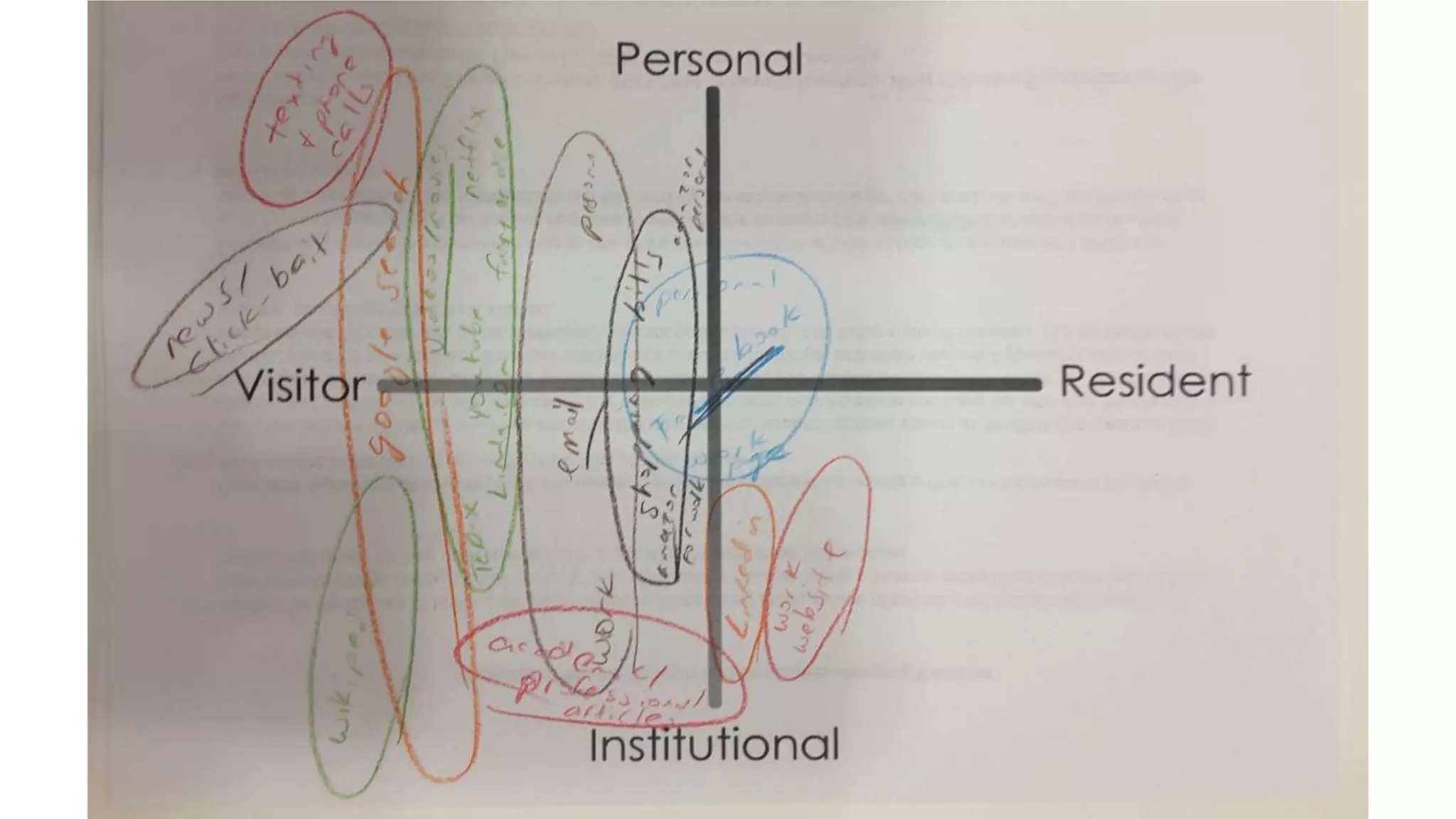
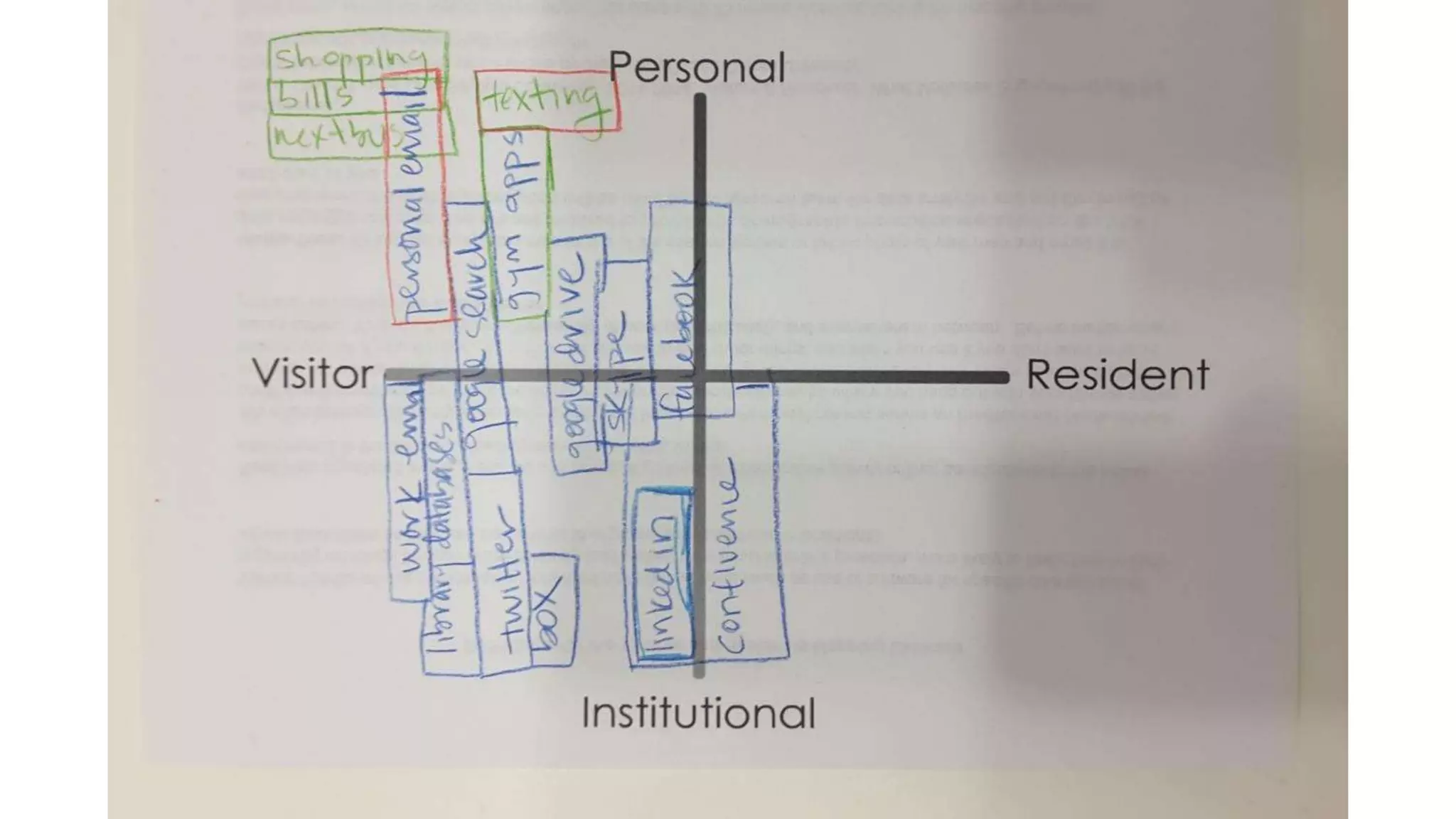
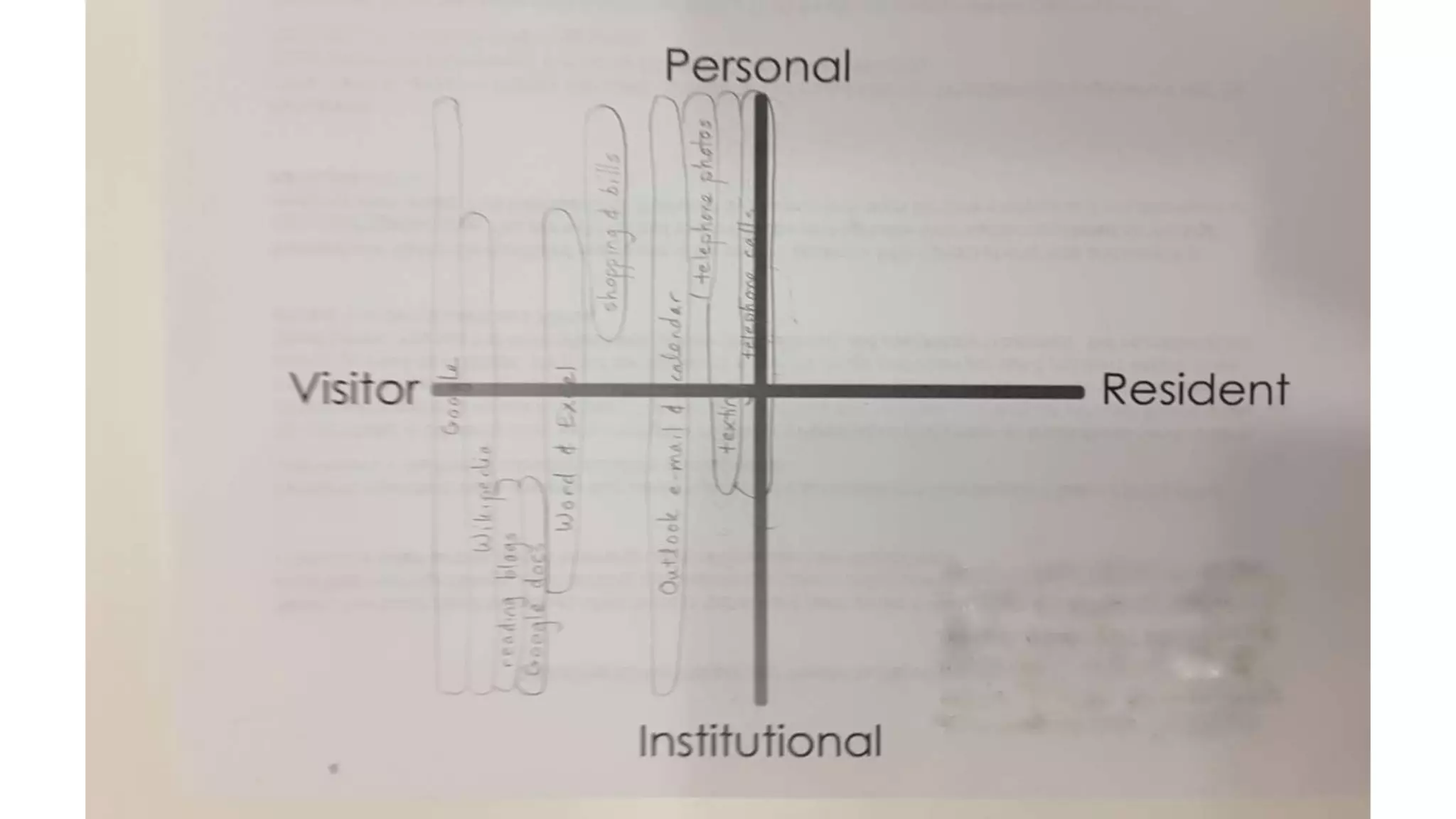
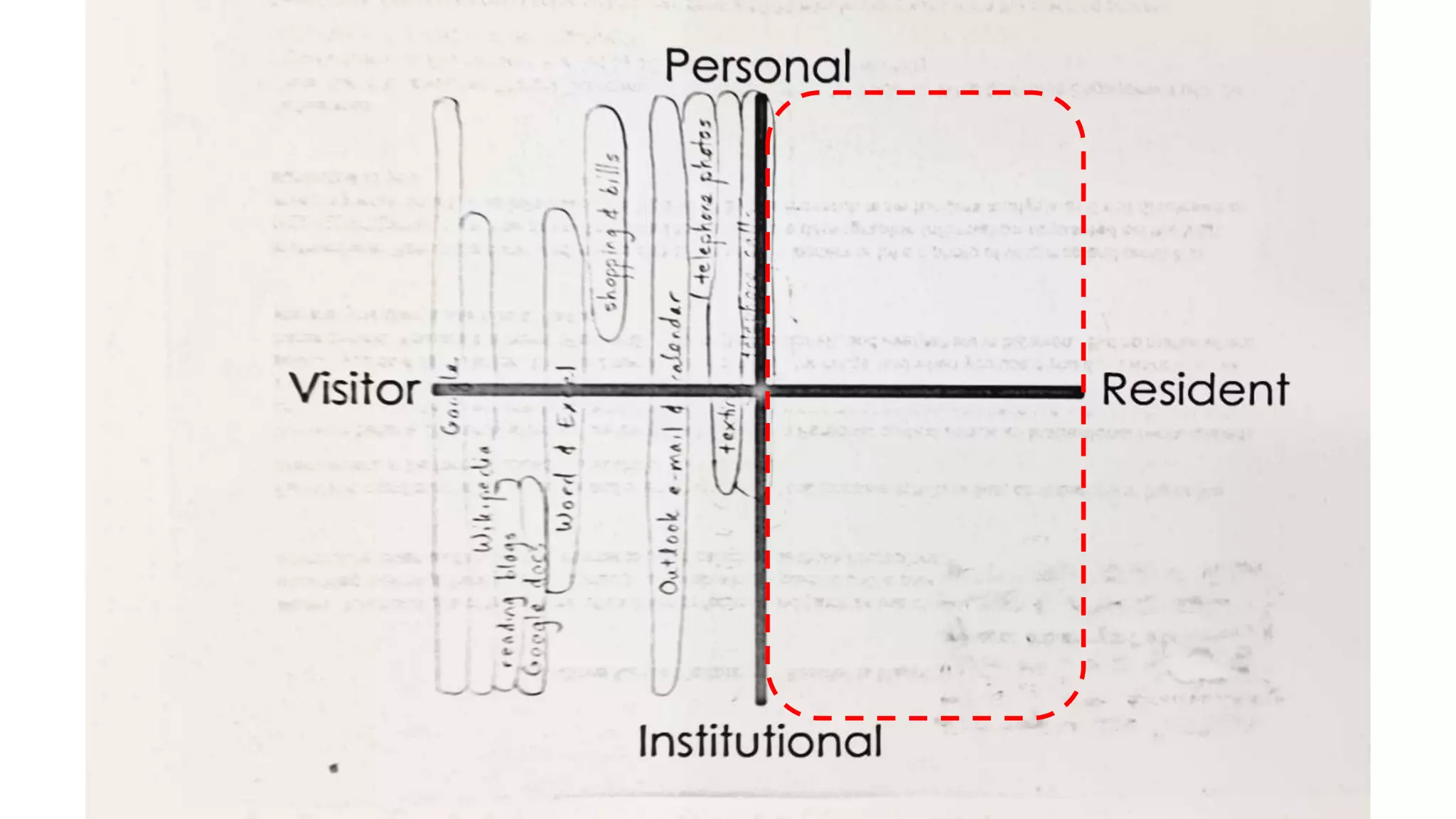
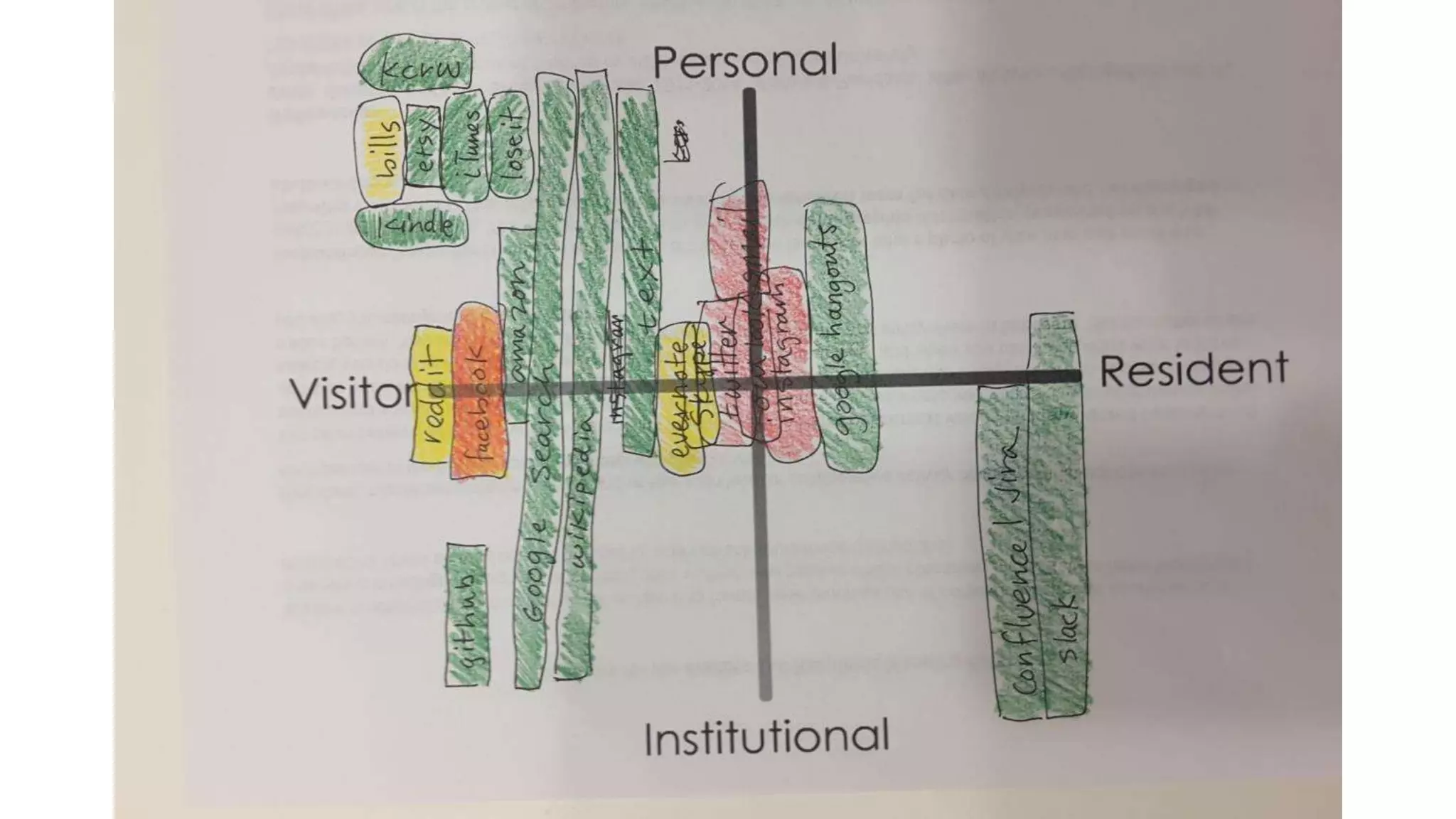
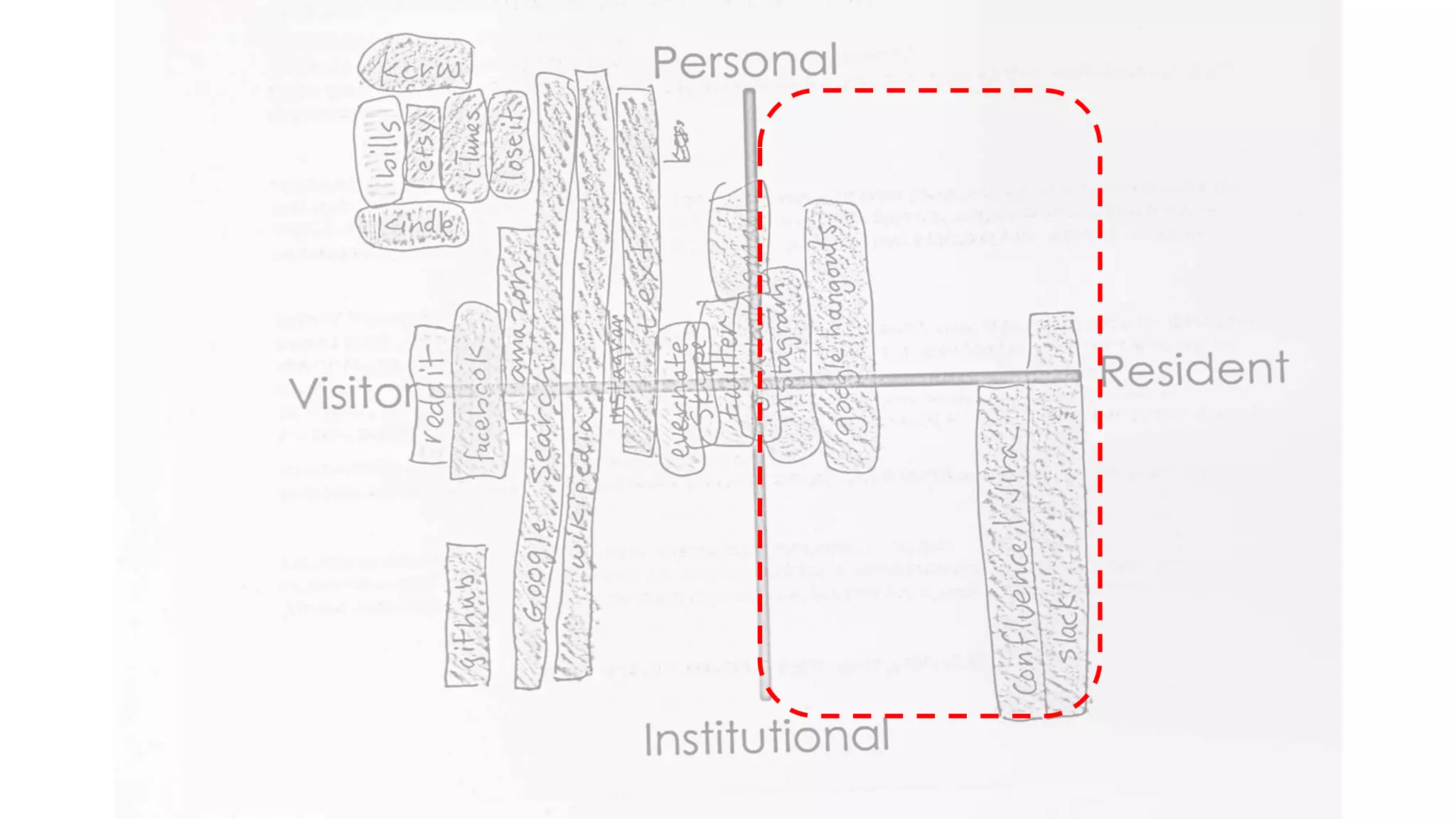
VISITORS AND RESIDENTS
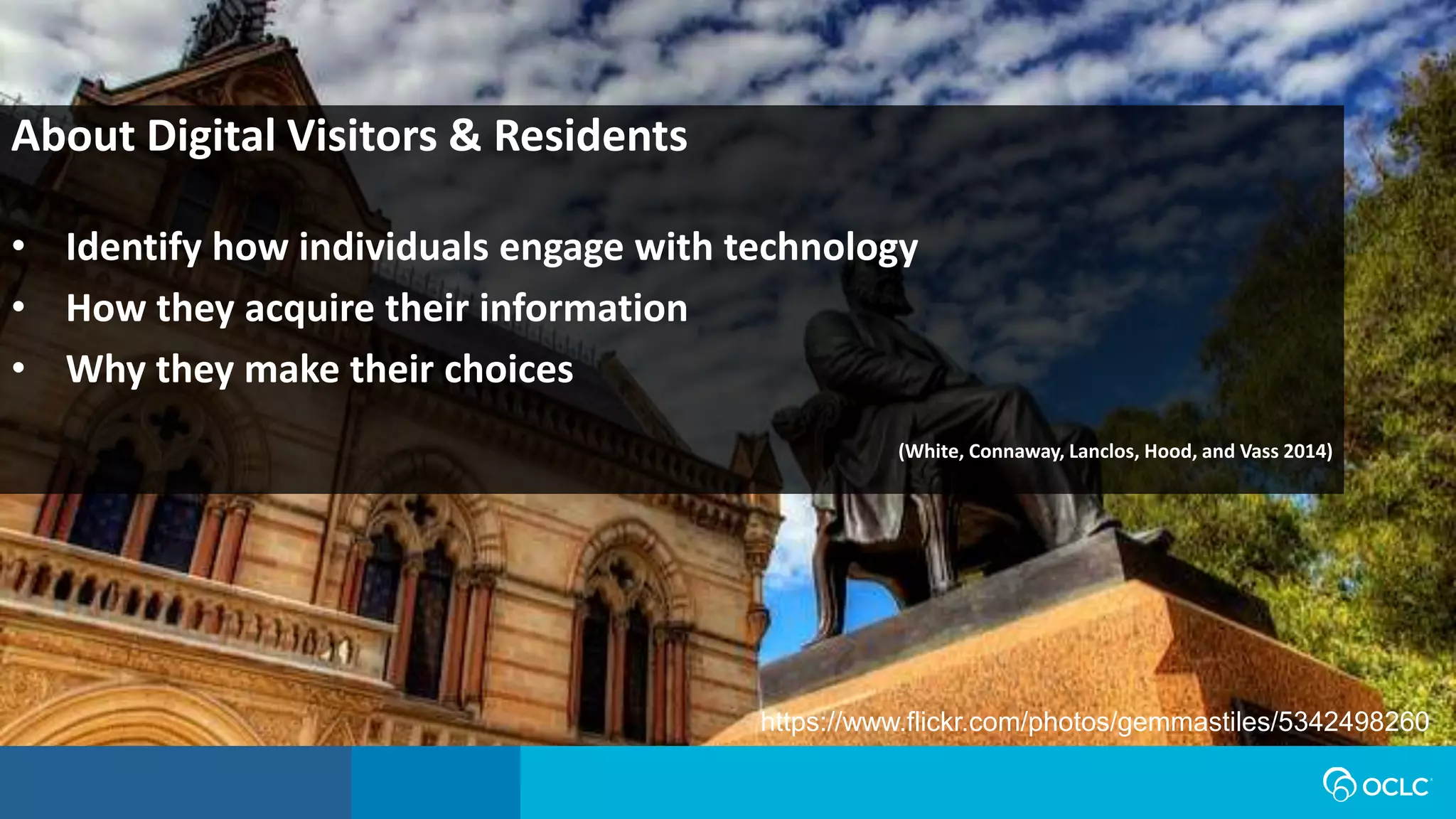
About Digital Visitors & Residents
• Identify how individuals engage with technology
• How they acquire their information
• Why they make their choices
(White, Connaway, Lanclos, Hood, and Vass 2014)
https://www.flickr.com/photos/gemmastiles/5342498260
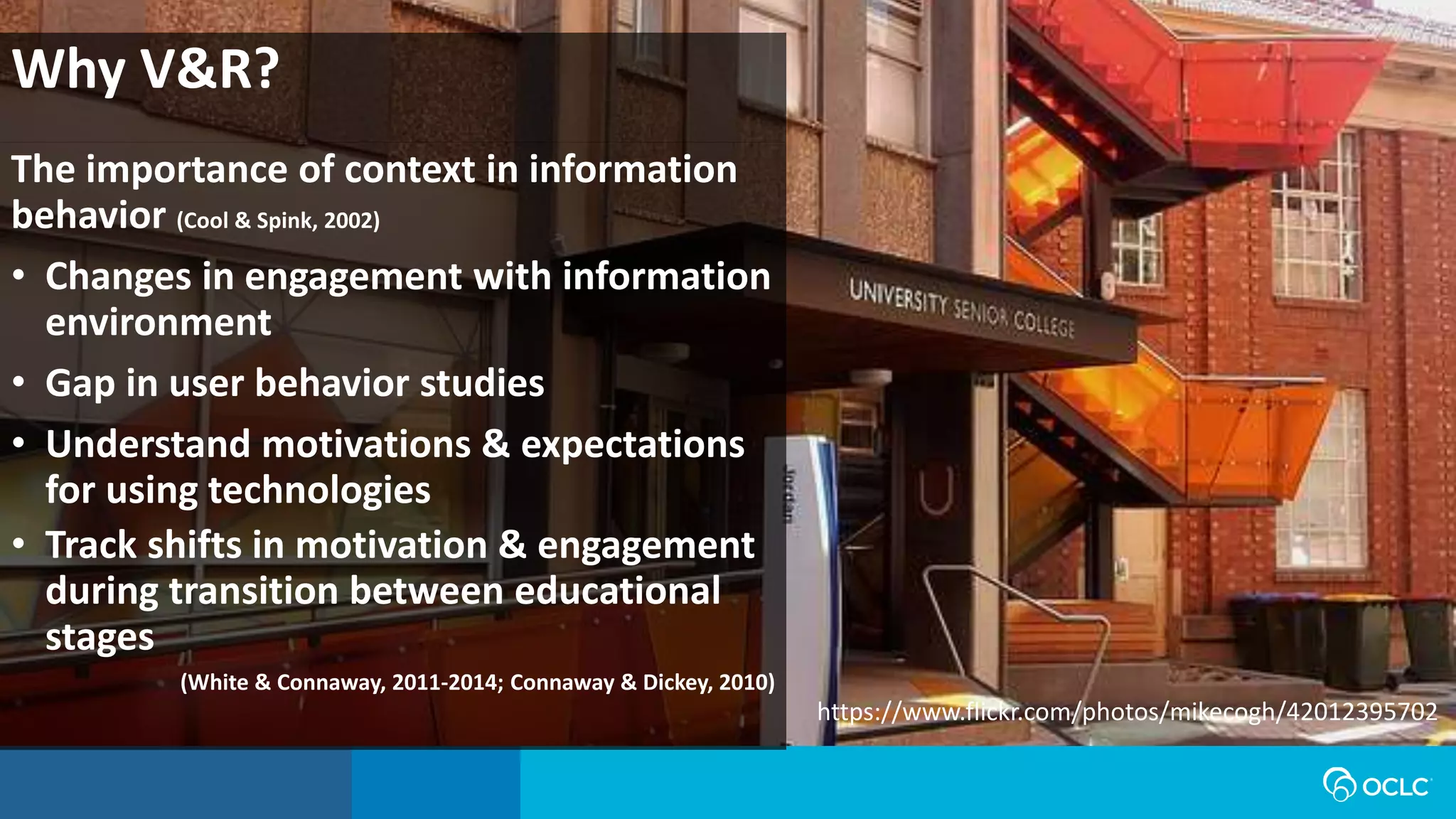
Why V&R?
The importance of context in information
behavior (Cool & Spink, 2002)
• Changes in engagement with information
environment
• Gap in user behavior studies
• Understand motivations & expectations
for using technologies
• Track shifts in motivation & engagement
during transition between educational
stages
(White & Connaway, 2011-2014; Connaway & Dickey, 2010)
https://www.flickr.com/photos/mikecogh/42012395702
•Functional use of technology
•Formal need
•Invisible online presence
•Internet is a toolbox
(White & Connaway 2011-2014)
Visitor Mode
Image: https://www.flickr.com/photos/daveynin/1974474522 by daveynin / CC BY 2.0
Resident Mode
• Visible & persistent online
presence
• Collaborative activity online
• Contribute online
• Internet is a place
(White & Connaway 2011-2014)
https://www.flickr.com/photos/heatherw/258337934/
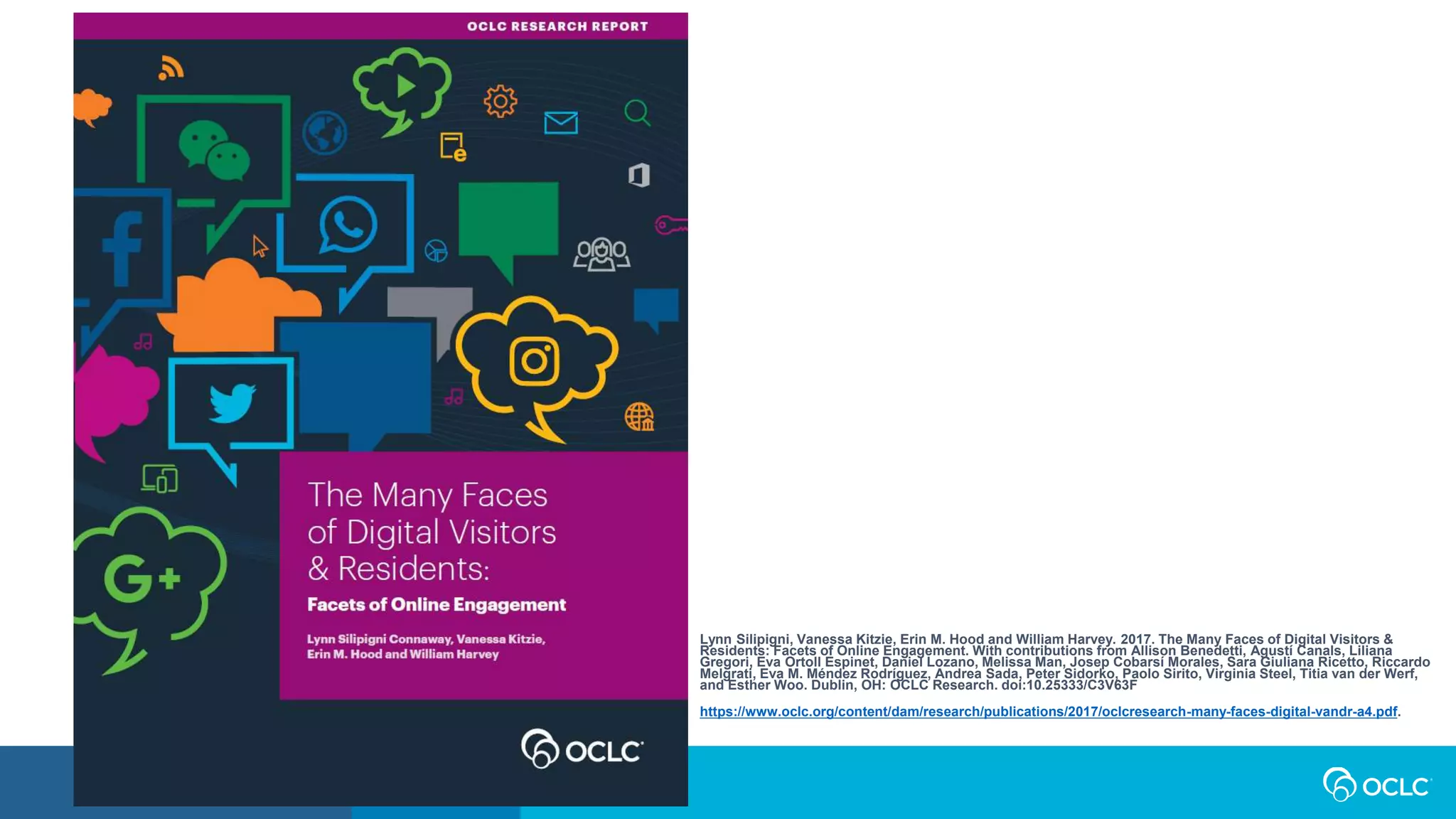
Lynn Silipigni, Vanessa Kitzie, Erin M. Hood and William Harvey. 2017. The Many Faces of Digital Visitors &
Residents: Facets of Online Engagement. With contributions from Allison Benedetti, Agustí Canals, Liliana
Gregori, Eva Ortoll Espinet, Daniel Lozano, Melissa Man, Josep Cobarsí Morales, Sara Giuliana Ricetto, Riccardo
Melgrati, Eva M. Méndez Rodríguez, Andrea Sada, Peter Sidorko, Paolo Sirito, Virginia Steel, Titia van der Werf,
and Esther Woo. Dublin, OH: OCLC Research. doi:10.25333/C3V63F
https://www.oclc.org/content/dam/research/publications/2017/oclcresearch-many-faces-digital-vandr-a4.pdf.
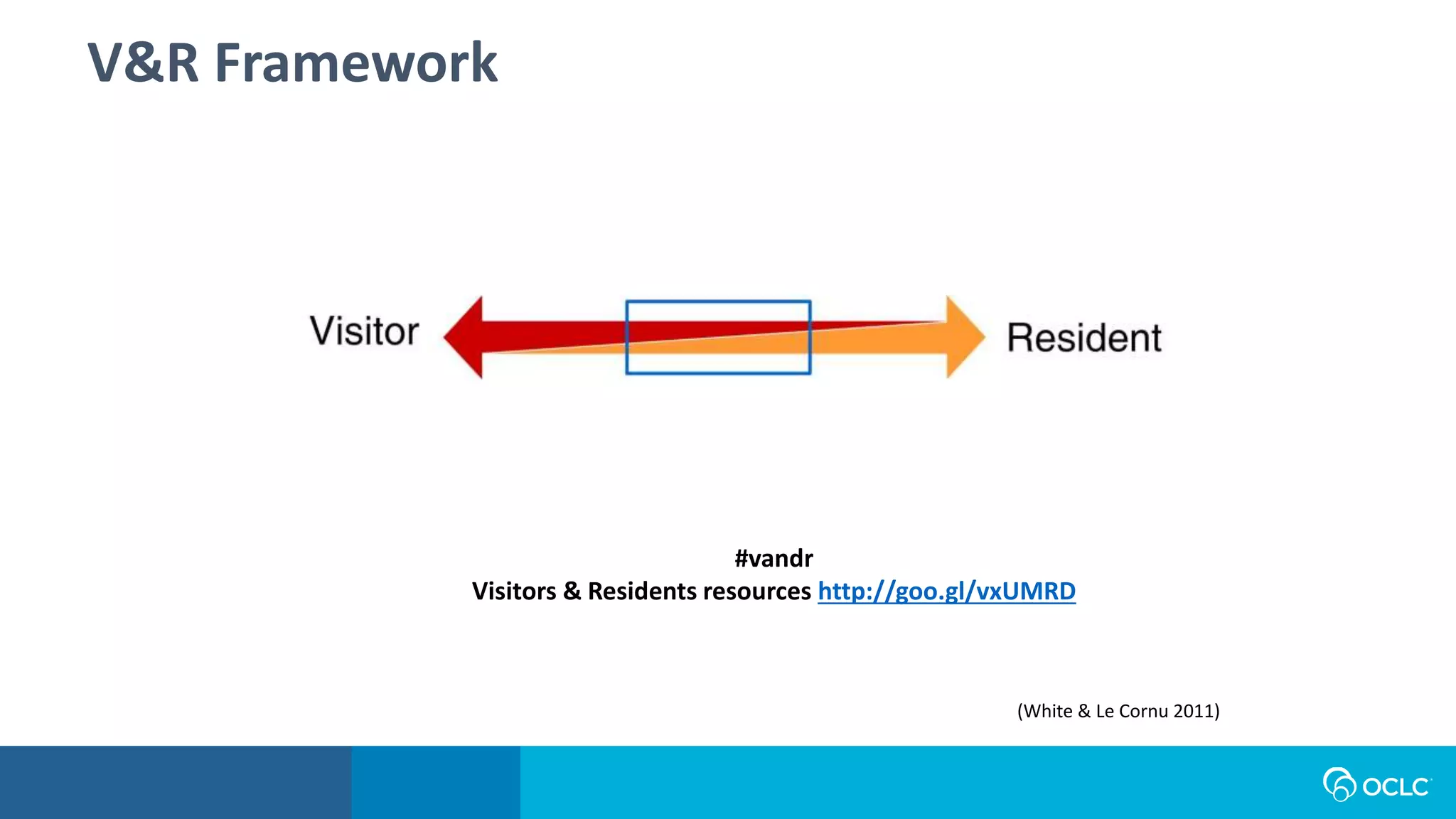
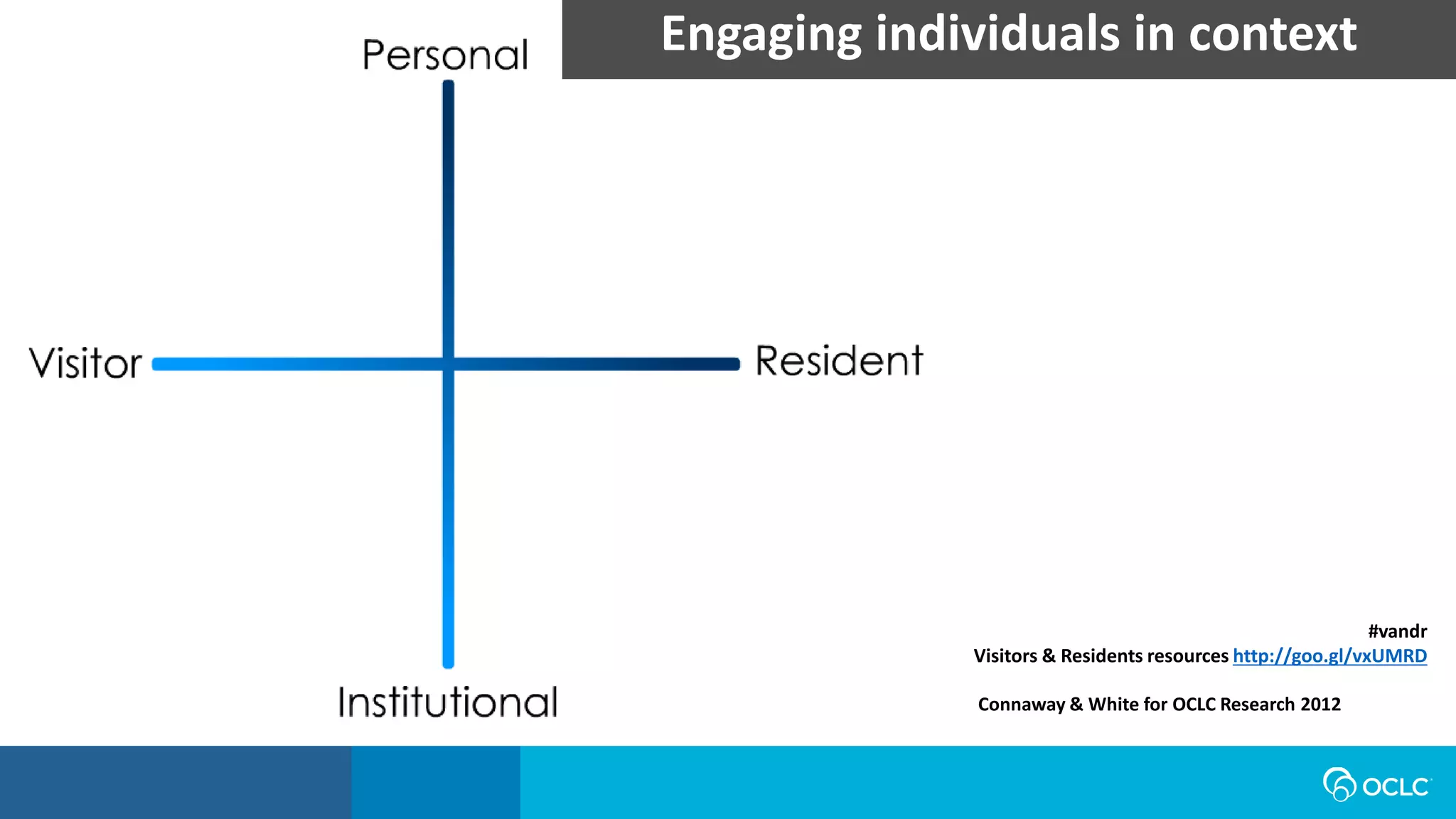
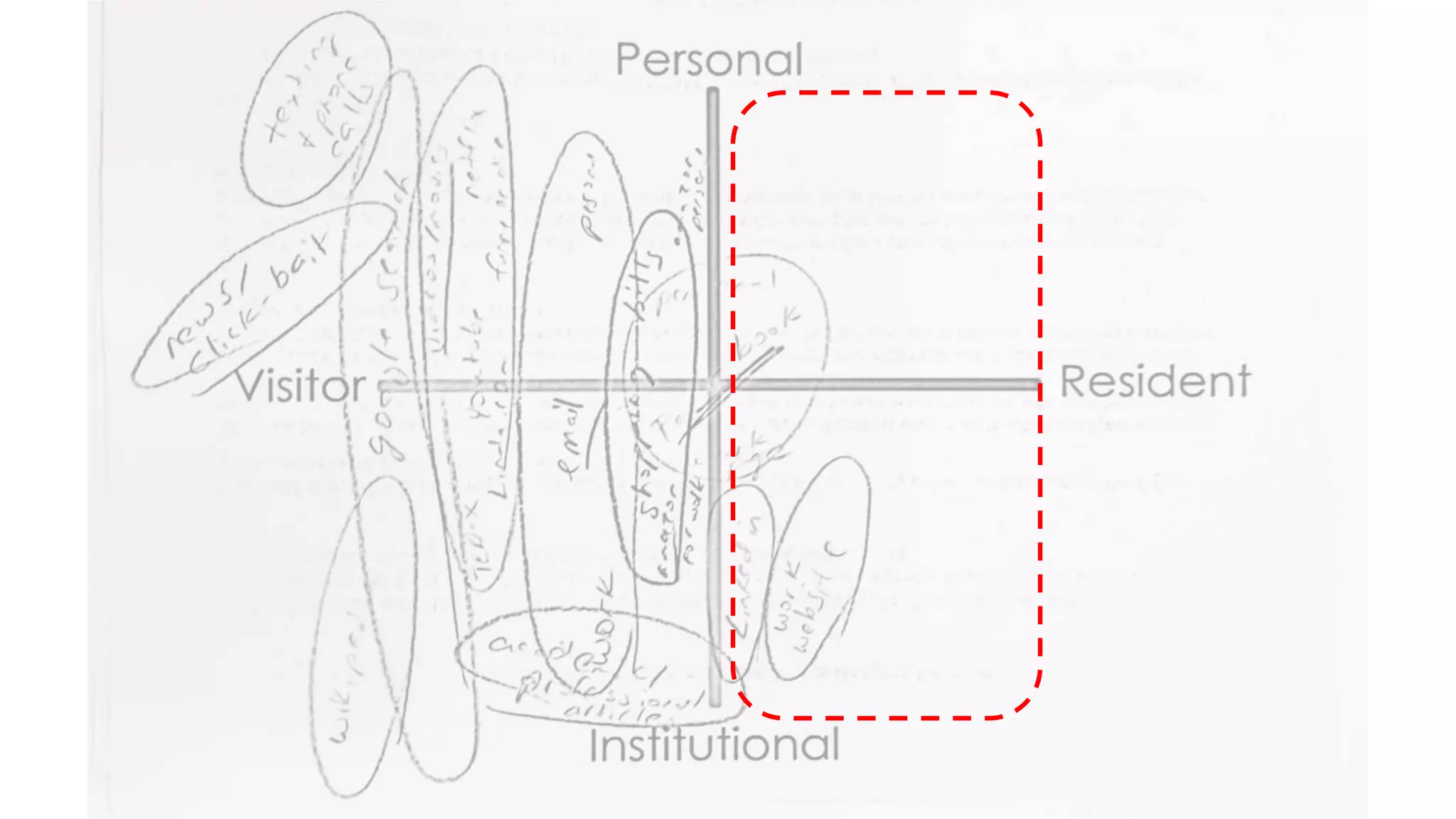
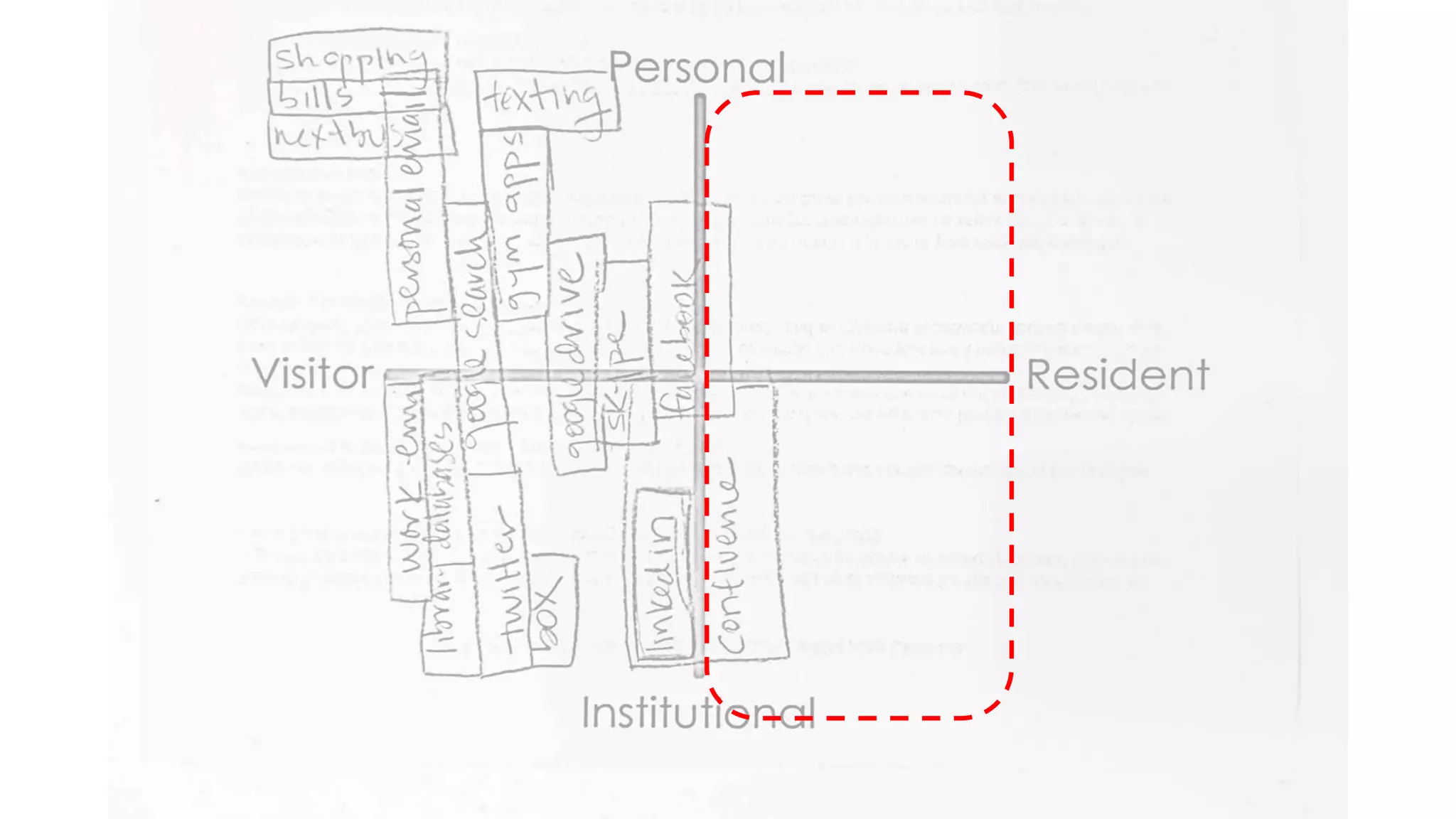
V&R Framework
(White & Le Cornu 2011)
#vandr
Visitors & Residents resources http://goo.gl/vxUMRD
Engaging individuals in context
#vandr
Visitors & Residents resources http://goo.gl/vxUMRD
Connaway & White for OCLC Research 2012
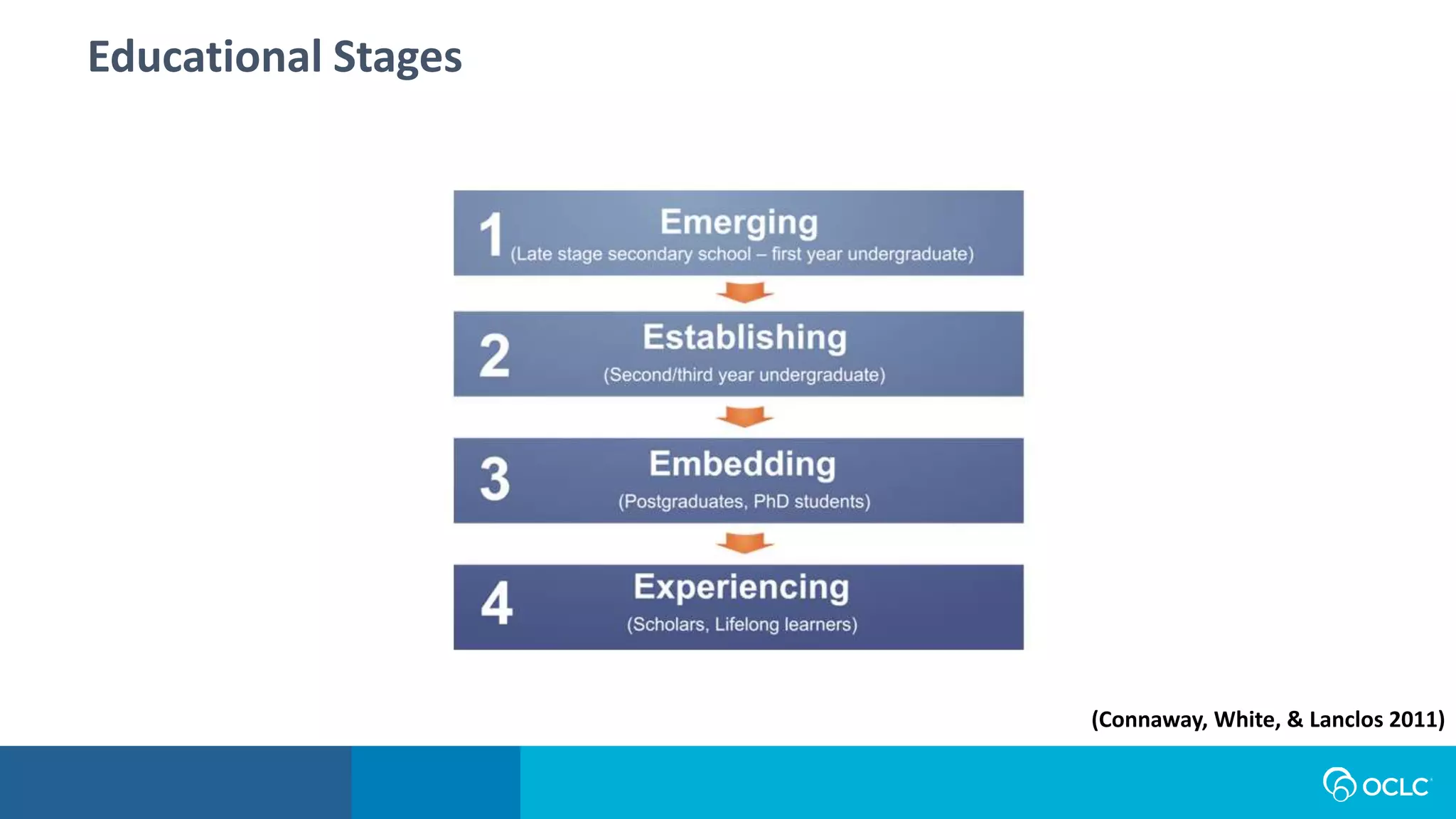
Educational Stages
(Connaway, White, & Lanclos 2011)
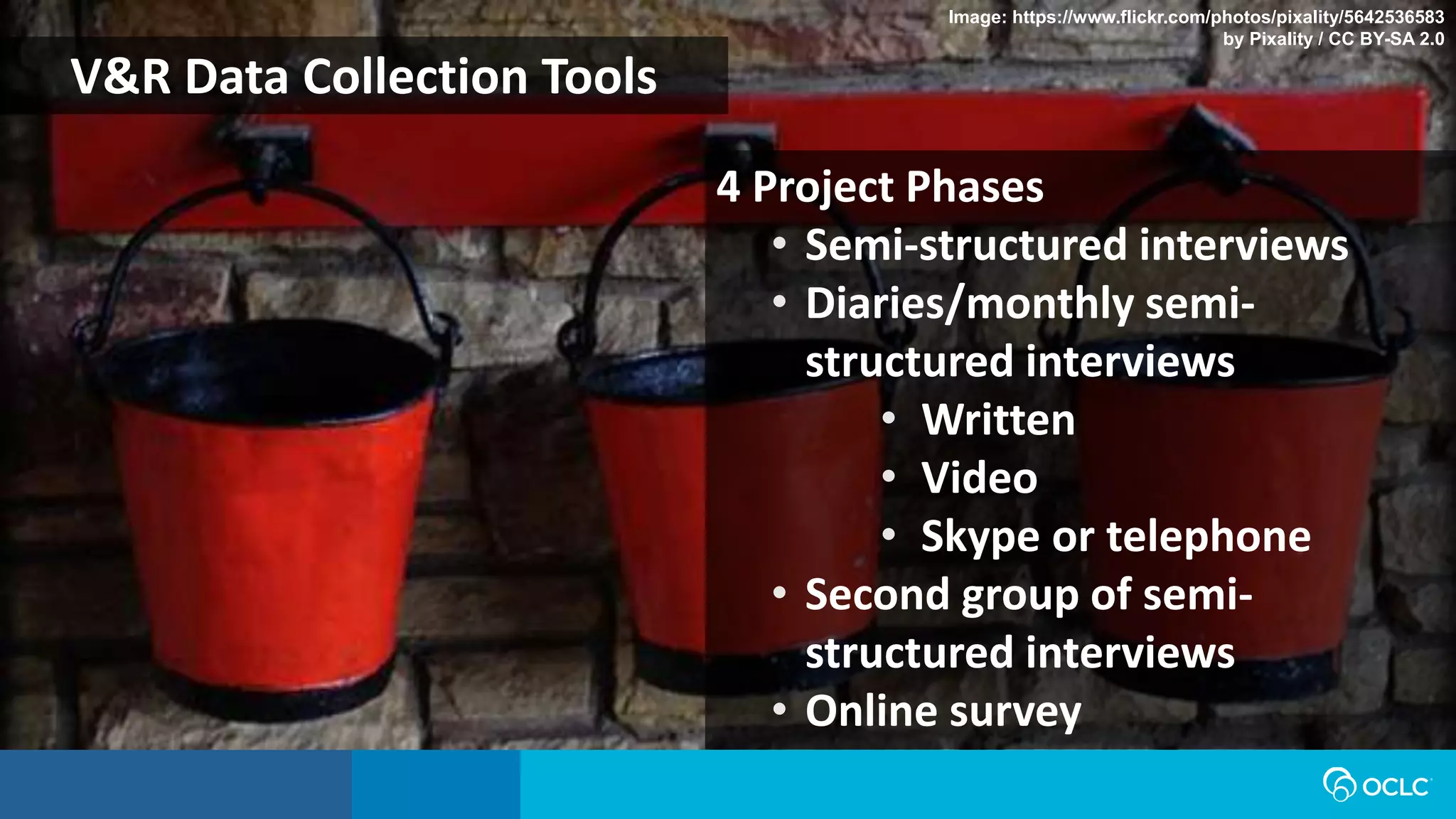
4 Project Phases
• Semi-structured interviews
• Diaries/monthly semi-
structured interviews
• Written
• Video
• Skype or telephone
• Second group of semi-
structured interviews
• Online survey
V&R Data Collection Tools
Image: https://www.flickr.com/photos/pixality/5642536583
by Pixality / CC BY-SA 2.0
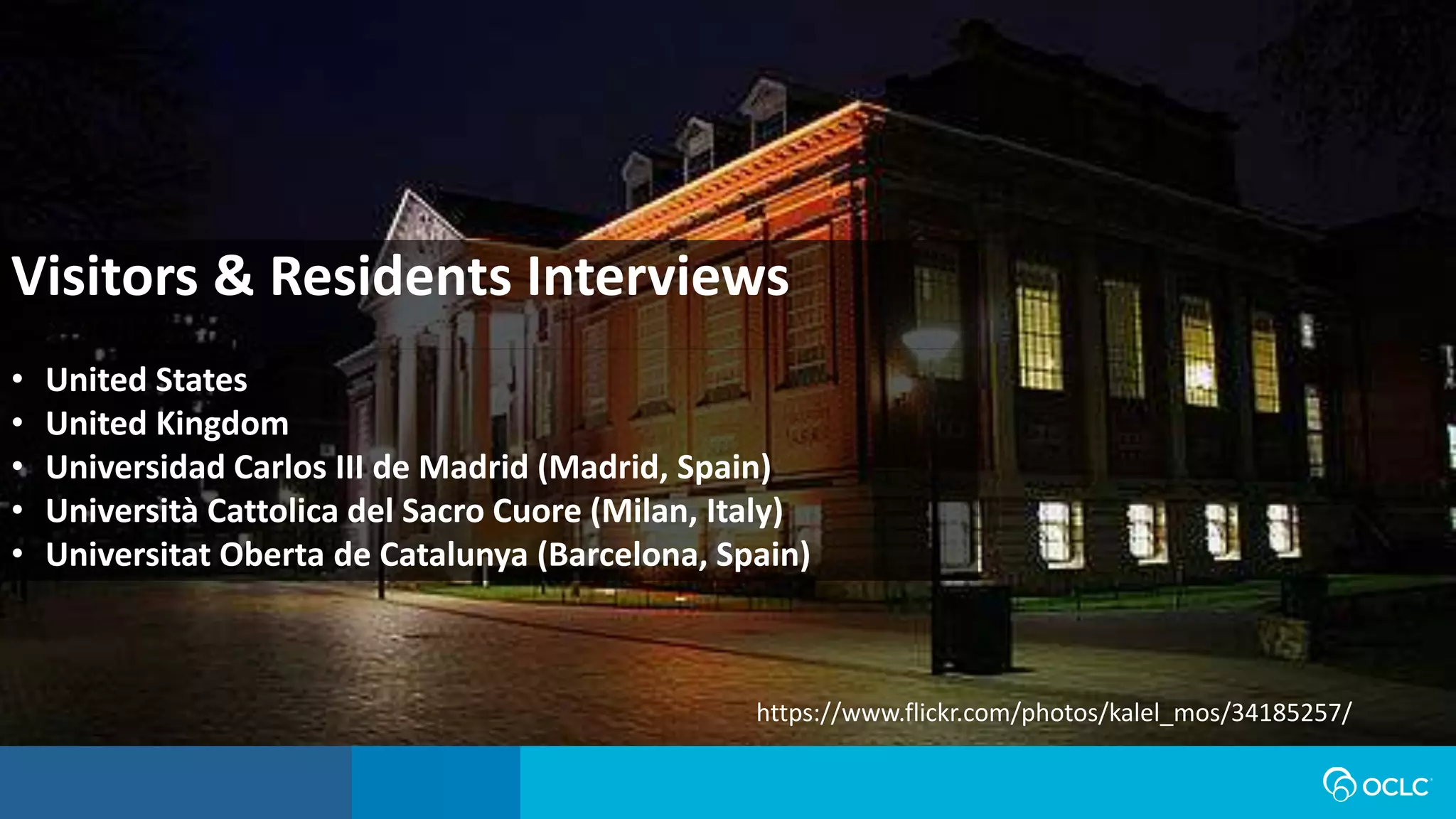
Visitors & Residents Interviews
• United States
• United Kingdom
• Universidad Carlos III de Madrid (Madrid, Spain)
• Università Cattolica del Sacro Cuore (Milan, Italy)
• Universitat Oberta de Catalunya (Barcelona, Spain)
https://www.flickr.com/photos/kalel_mos/34185257/
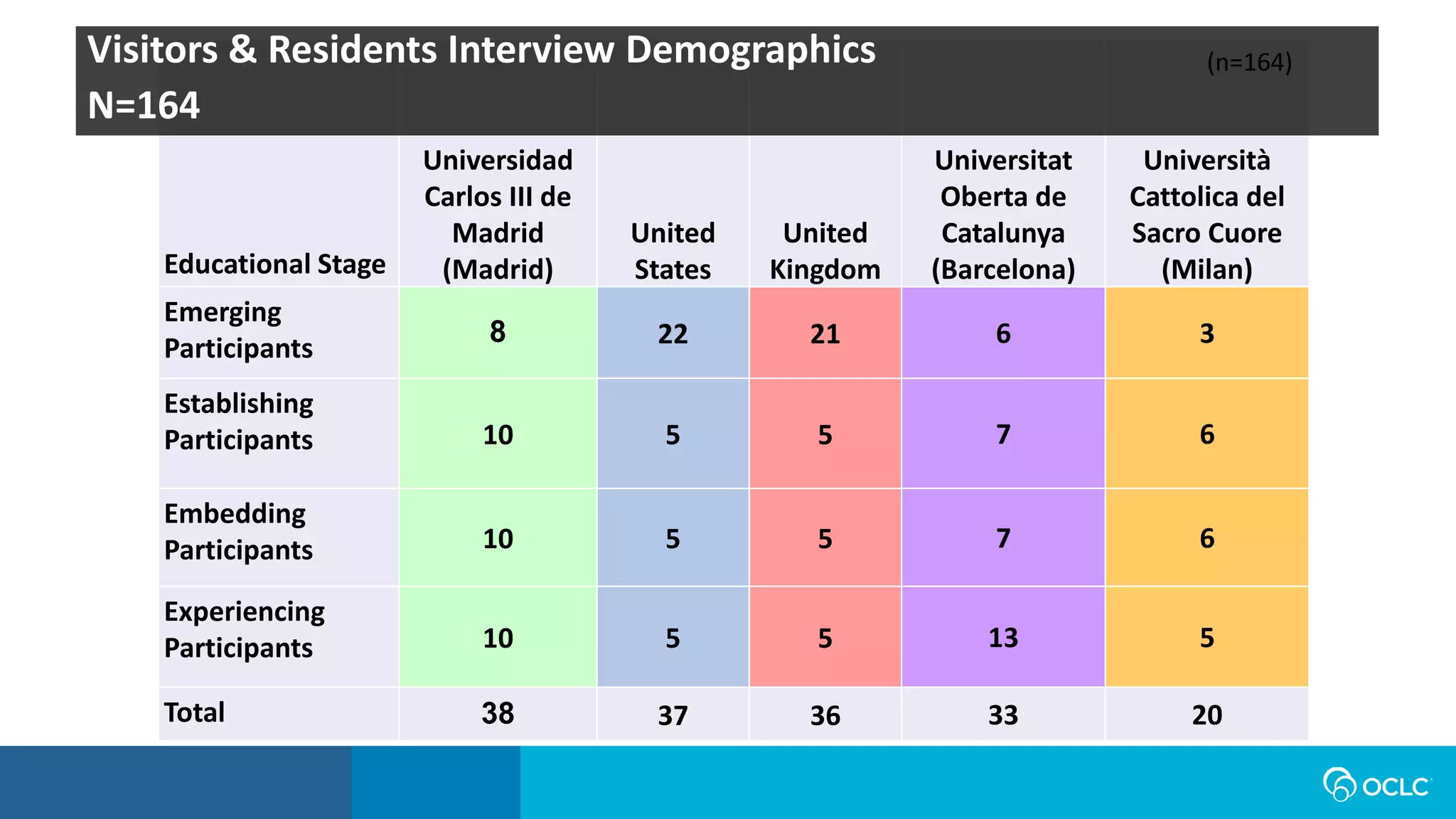
Educational Stage
Universidad
Carlos III de
Madrid
(Madrid)
United
States
United
Kingdom
Universitat
Oberta de
Catalunya
(Barcelona)
Università
Cattolica del
Sacro Cuore
(Milan)
Emerging
Participants
8 22 21 6 3
Establishing
Participants 10 5 5 7 6
Embedding
Participants 10 5 5 7 6
Experiencing
Participants 10 5 5 13 5
Total 38 37 36 33 20
Visitors & Residents Interview Demographics
N=164
(n=164)
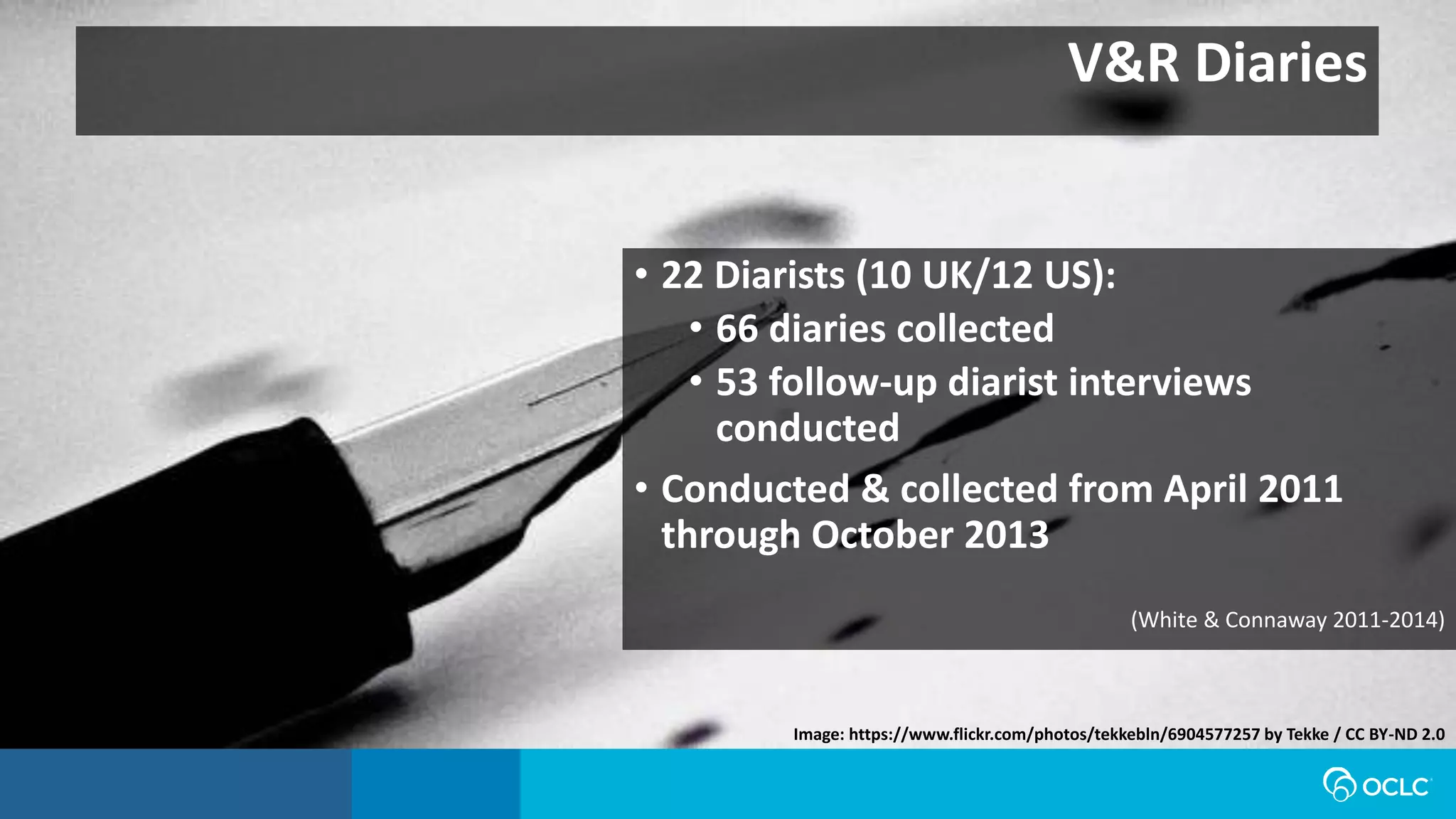
V&R Diaries
• 22 Diarists (10 UK/12 US):
• 66 diaries collected
• 53 follow-up diarist interviews
conducted
• Conducted & collected from April 2011
through October 2013
(White & Connaway 2011-2014)
Image: https://www.flickr.com/photos/tekkebln/6904577257 by Tekke / CC BY-ND 2.0
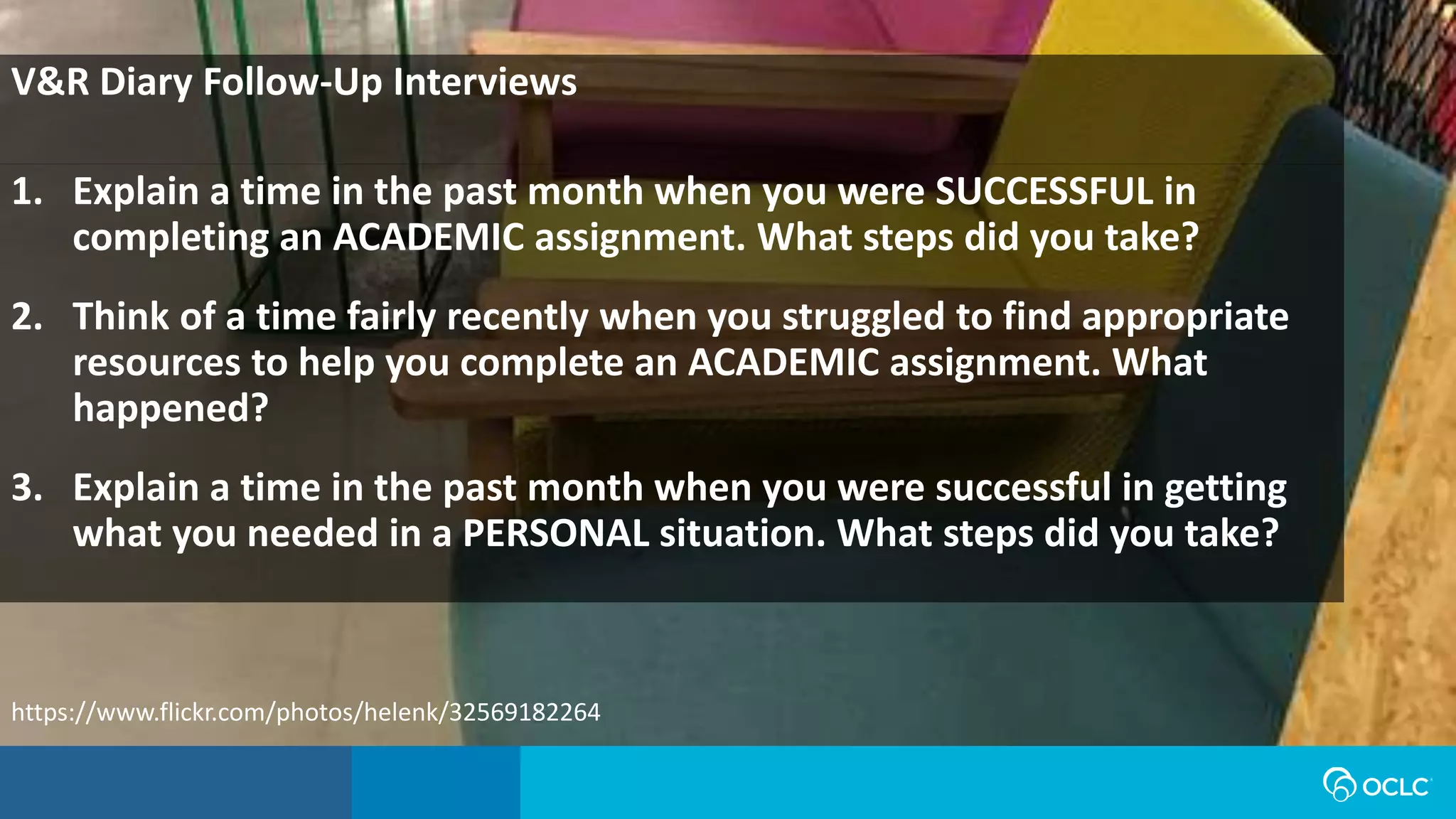
1. Explain a time in the past month when you were SUCCESSFUL in
completing an ACADEMIC assignment. What steps did you take?
2. Think of a time fairly recently when you struggled to find appropriate
resources to help you complete an ACADEMIC assignment. What
happened?
3. Explain a time in the past month when you were successful in getting
what you needed in a PERSONAL situation. What steps did you take?
V&R Diary Follow-Up Interviews
https://www.flickr.com/photos/helenk/32569182264
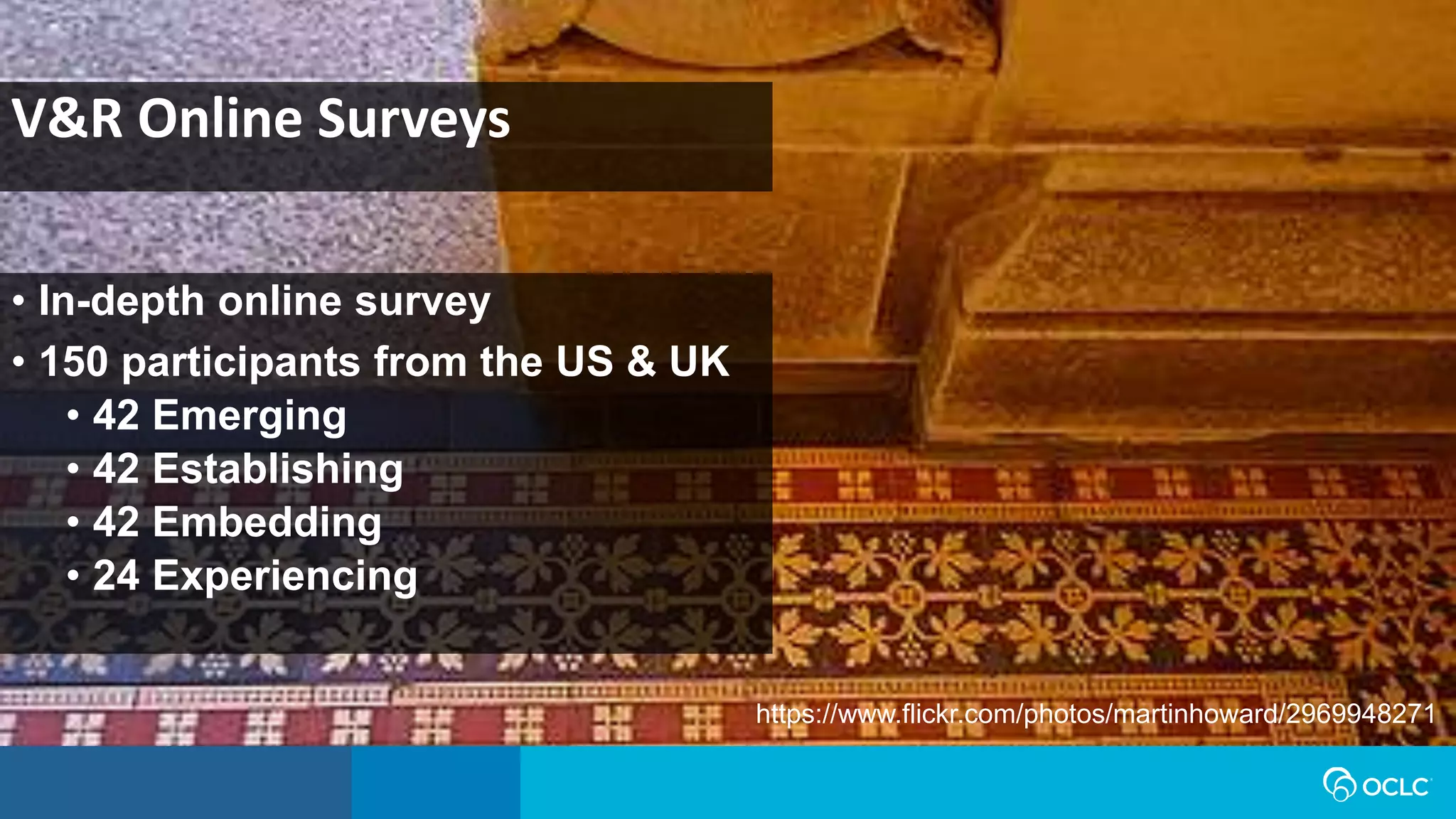
V&R Online Surveys
• In-depth online survey
• 150 participants from the US & UK
• 42 Emerging
• 42 Establishing
• 42 Embedding
• 24 Experiencing
https://www.flickr.com/photos/martinhoward/2969948271
Visitors & Residents
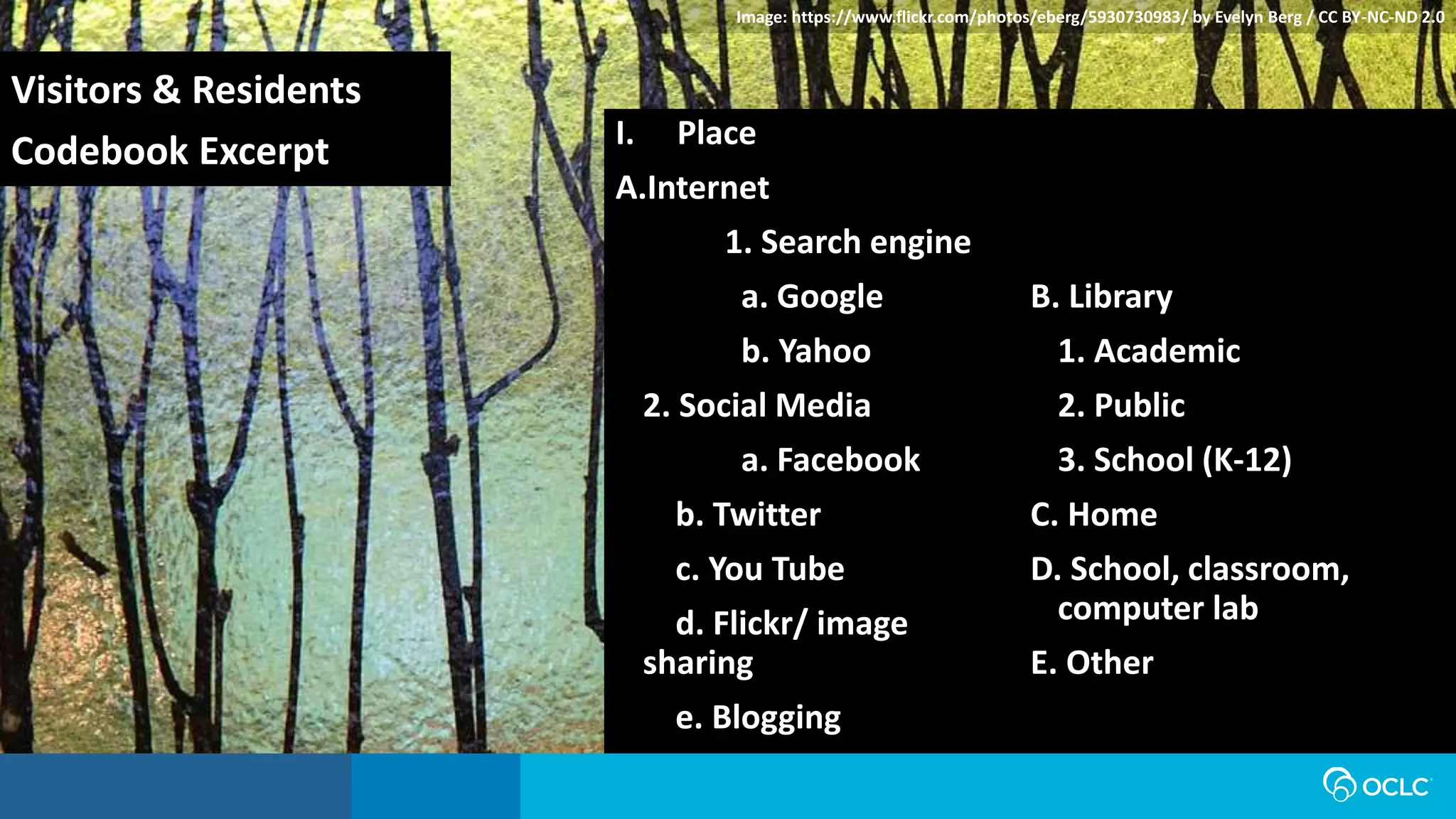
Codebook Excerpt
Image: https://www.flickr.com/photos/eberg/5930730983/ by Evelyn Berg / CC BY-NC-ND 2.0
I. Place
A.Internet
1. Search engine
a. Google
b. Yahoo
2. Social Media
a. Facebook
b. Twitter
c. You Tube
d. Flickr/ image
sharing
e. Blogging
B. Library
1. Academic
2. Public
3. School (K-12)
C. Home
D. School, classroom,
computer lab
E. Other
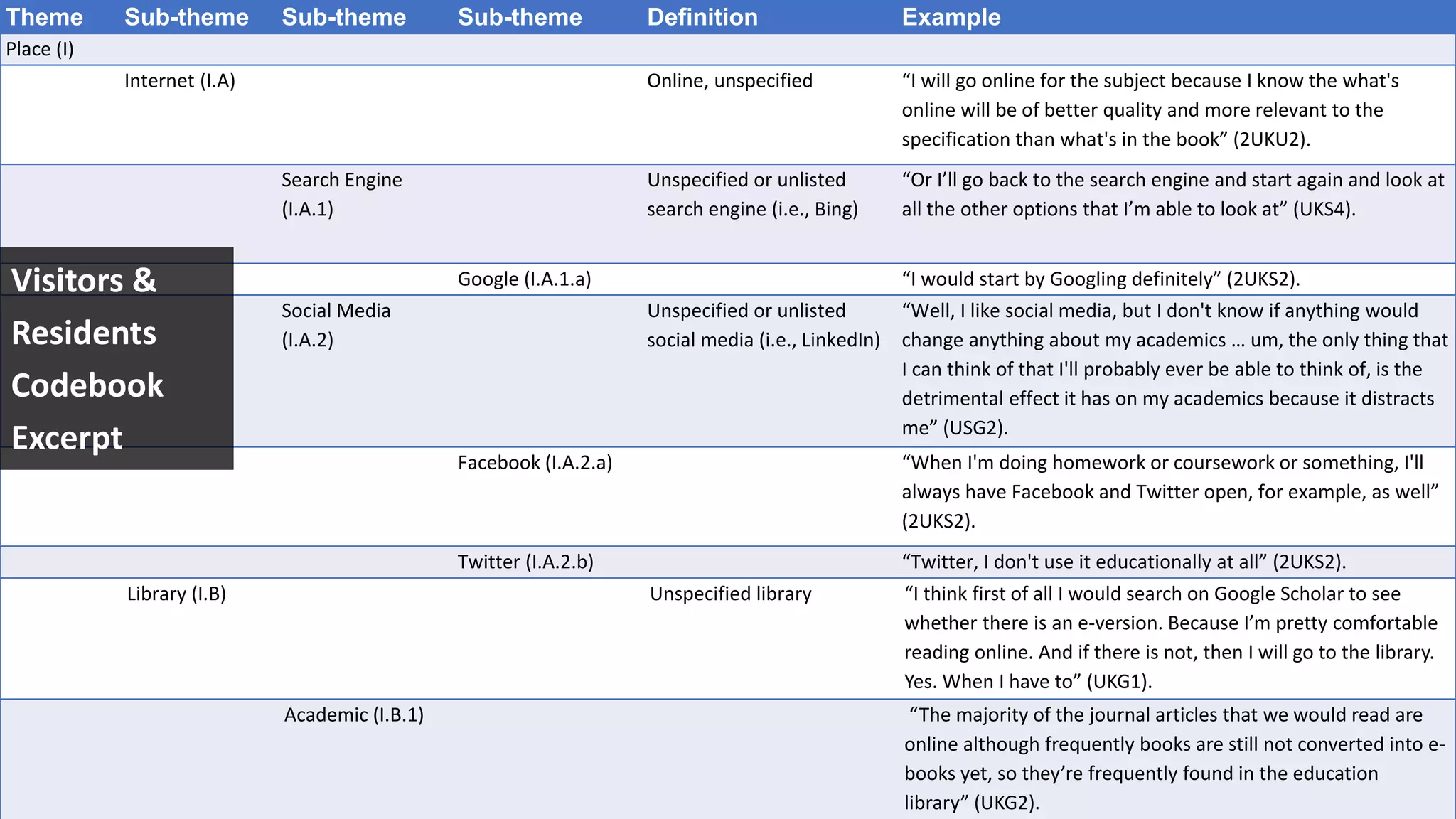
Theme Sub-theme Sub-theme Sub-theme Definition Example
Place (I)
Internet (I.A) Online, unspecified “I will go online for the subject because I know the what's
online will be of better quality and more relevant to the
specification than what's in the book” (2UKU2).
Search Engine
(I.A.1)
Unspecified or unlisted
search engine (i.e., Bing)
“Or I’ll go back to the search engine and start again and look at
all the other options that I’m able to look at” (UKS4).
Google (I.A.1.a) “I would start by Googling definitely” (2UKS2).
Social Media
(I.A.2)
Unspecified or unlisted
social media (i.e., LinkedIn)
“Well, I like social media, but I don't know if anything would
change anything about my academics … um, the only thing that
I can think of that I'll probably ever be able to think of, is the
detrimental effect it has on my academics because it distracts
me” (USG2).
Facebook (I.A.2.a) “When I'm doing homework or coursework or something, I'll
always have Facebook and Twitter open, for example, as well”
(2UKS2).
Twitter (I.A.2.b) “Twitter, I don't use it educationally at all” (2UKS2).
Library (I.B) Unspecified library “I think first of all I would search on Google Scholar to see
whether there is an e-version. Because I’m pretty comfortable
reading online. And if there is not, then I will go to the library.
Yes. When I have to” (UKG1).
Academic (I.B.1) “The majority of the journal articles that we would read are
online although frequently books are still not converted into e-
books yet, so they’re frequently found in the education
library” (UKG2).
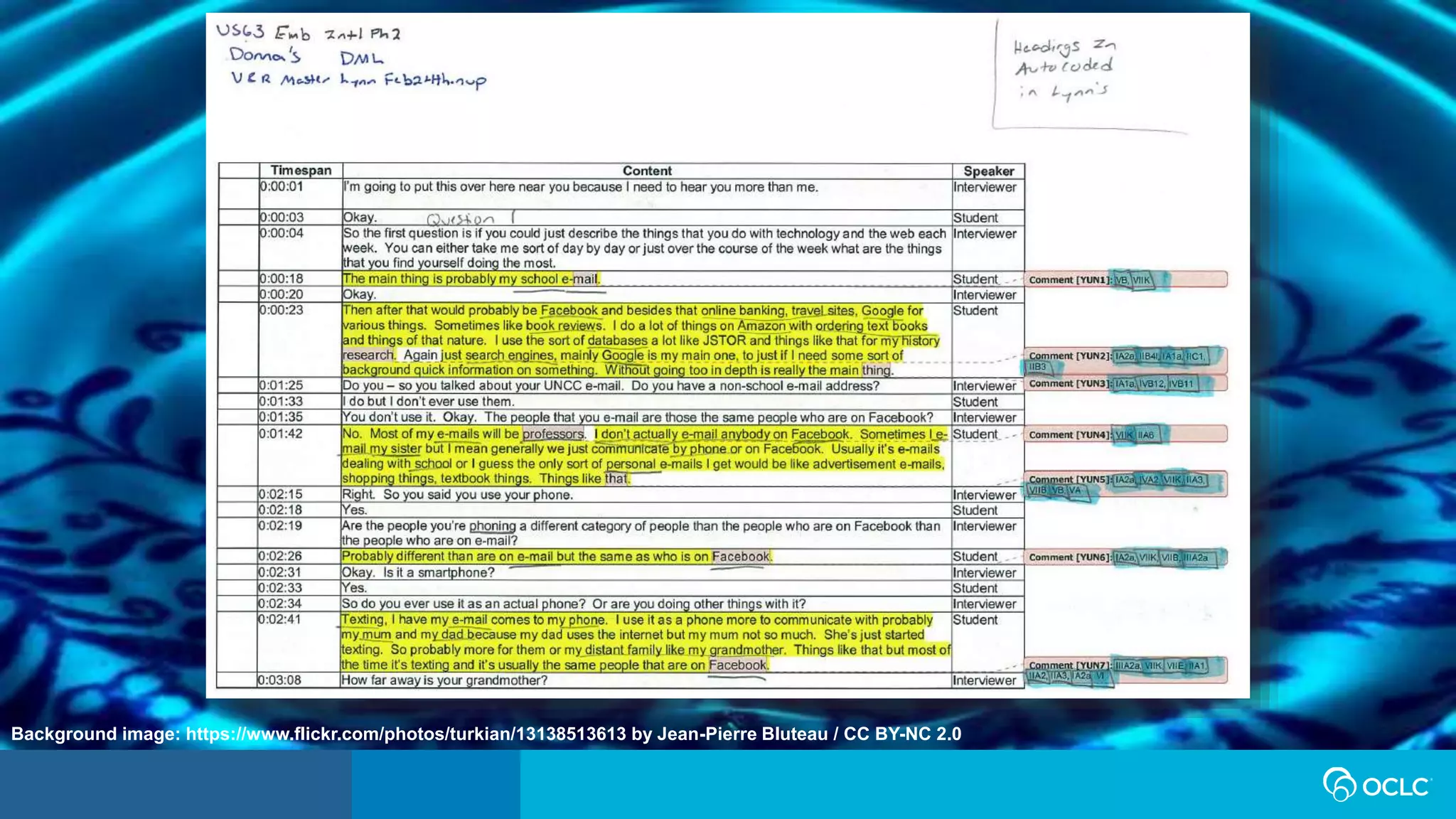
Visitors &
Residents
Codebook
Excerpt
Background image: https://www.flickr.com/photos/turkian/13138513613 by Jean-Pierre Bluteau / CC BY-NC 2.0
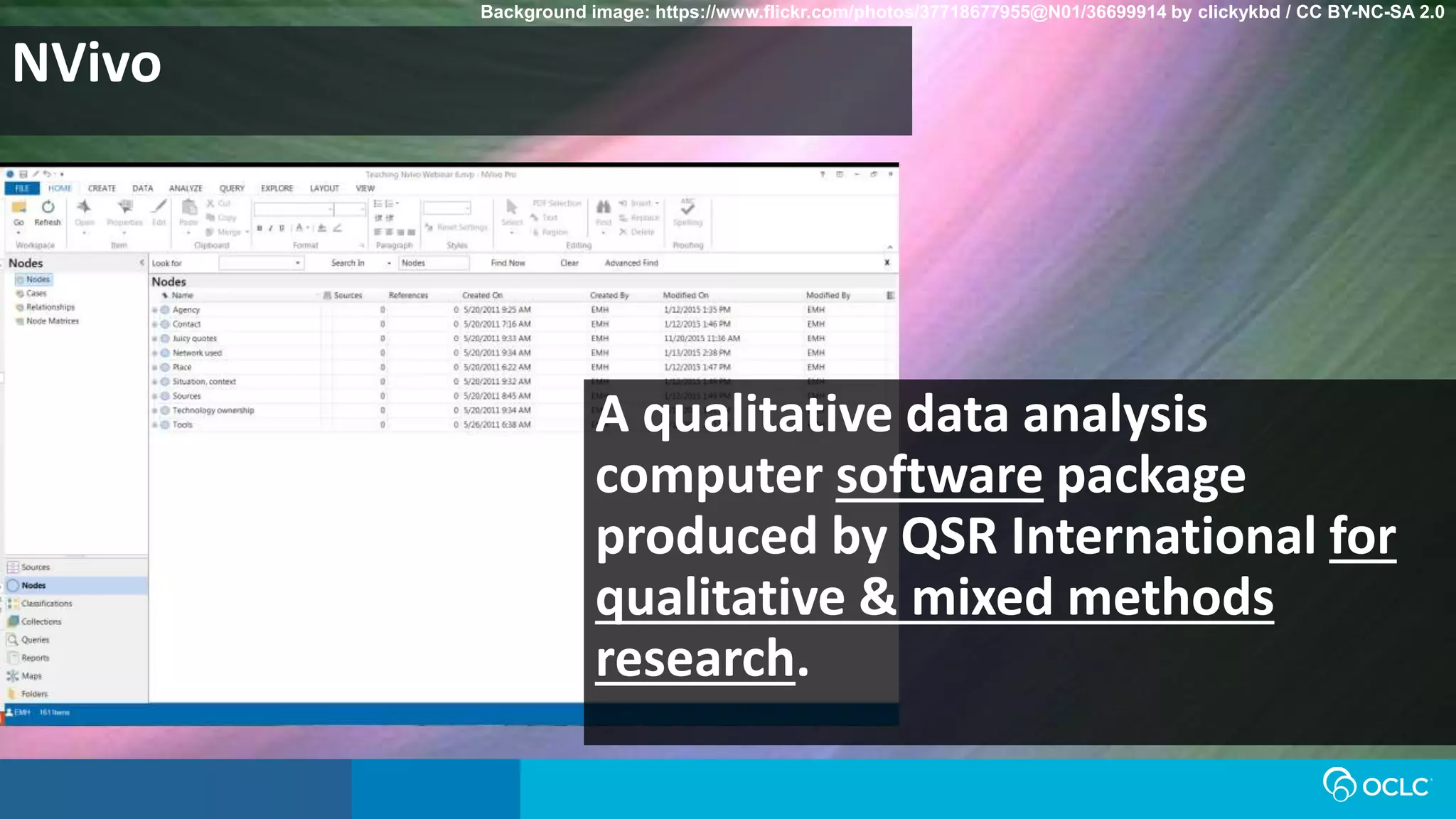
NVivo
Background image: https://www.flickr.com/photos/37718677955@N01/36699914 by clickykbd / CC BY-NC-SA 2.0
A qualitative data analysis
computer software package
produced by QSR International for
qualitative & mixed methods
research.
EXAMPLE:
UNIVERSITY OF ADELAIDE
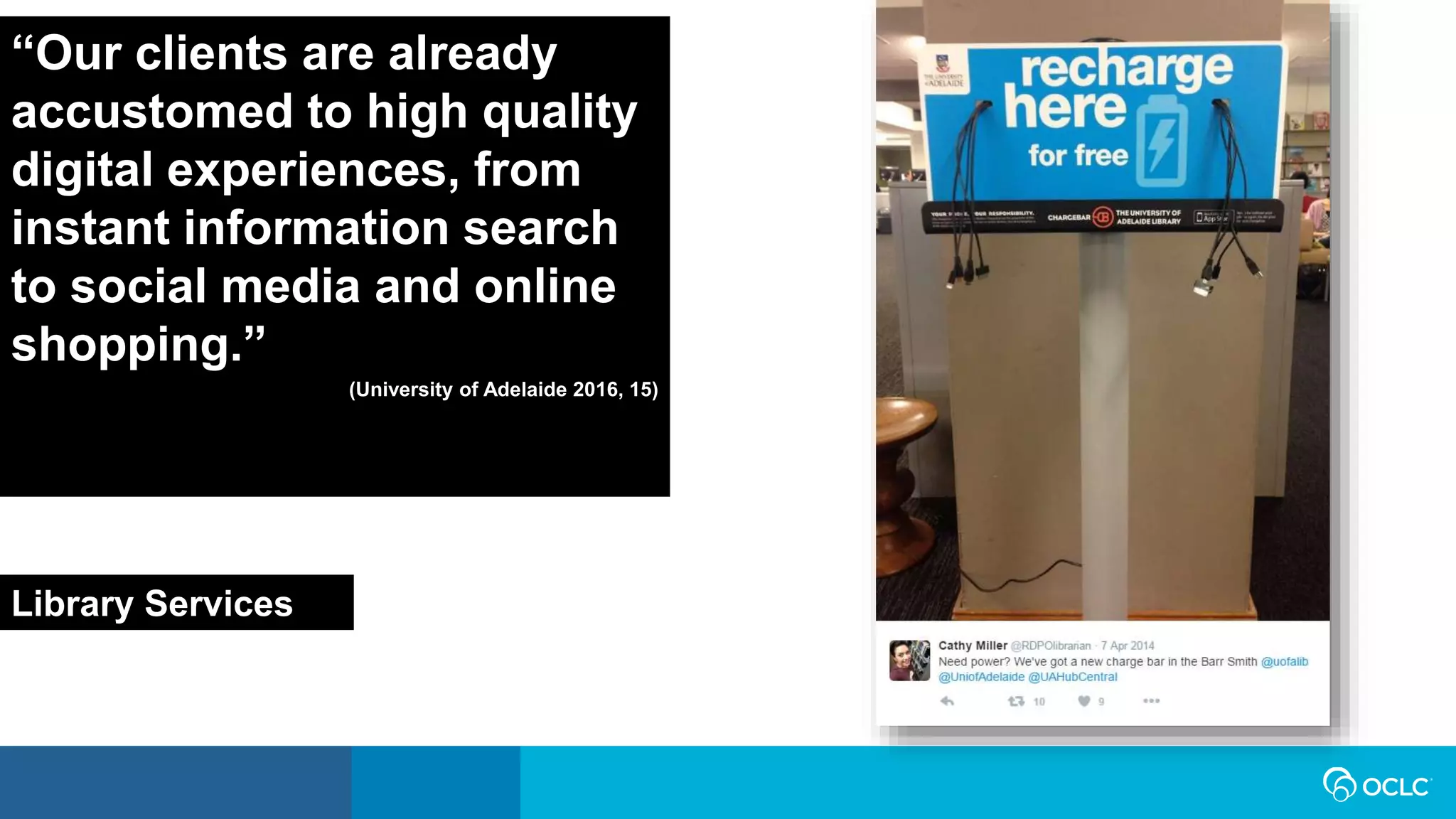
“Our clients are already
accustomed to high quality
digital experiences, from
instant information search
to social media and online
shopping.”
(University of Adelaide 2016, 15)
Library Services
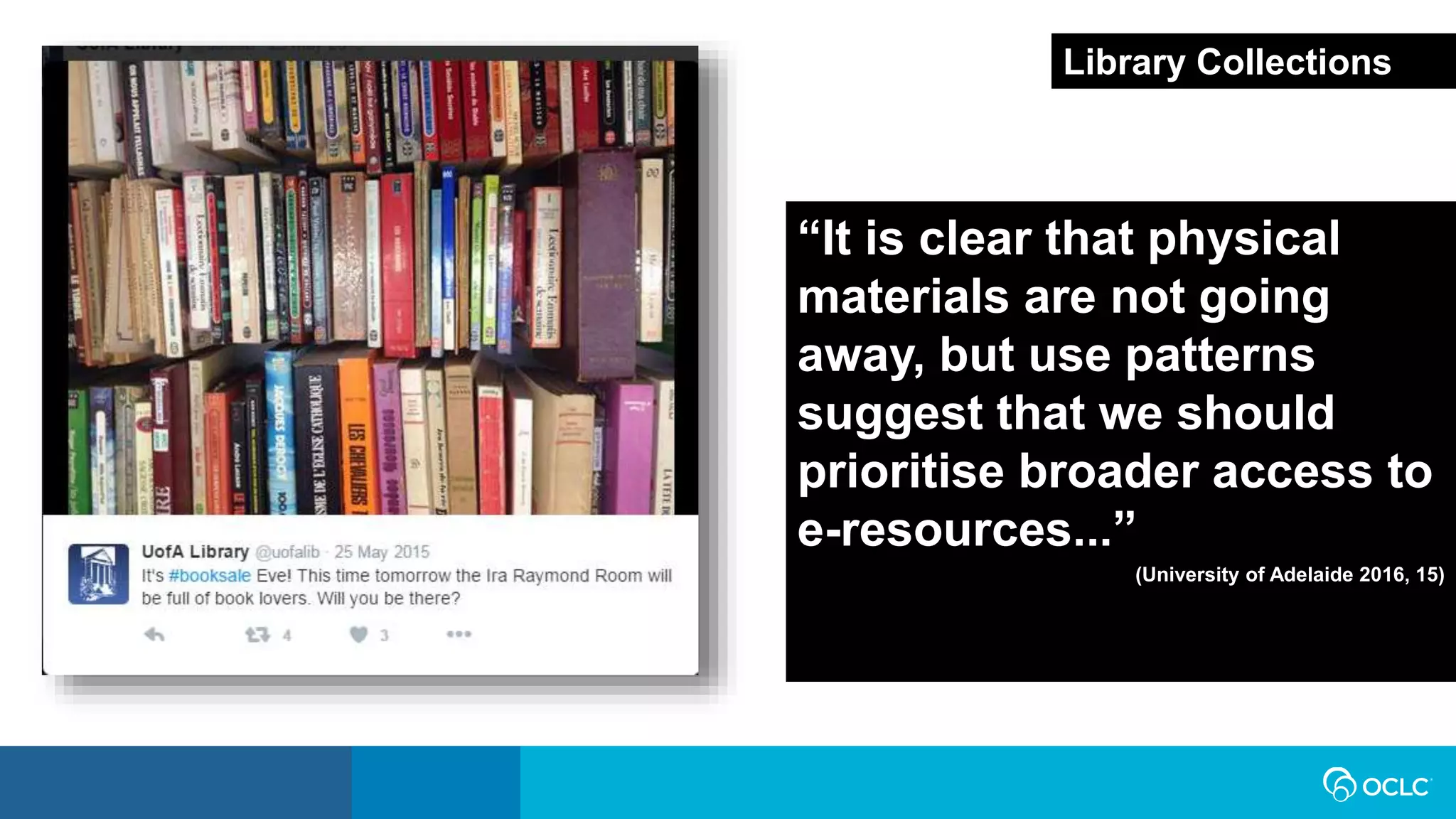
“It is clear that physical
materials are not going
away, but use patterns
suggest that we should
prioritise broader access to
e-resources...”
(University of Adelaide 2016, 15)
Library Collections
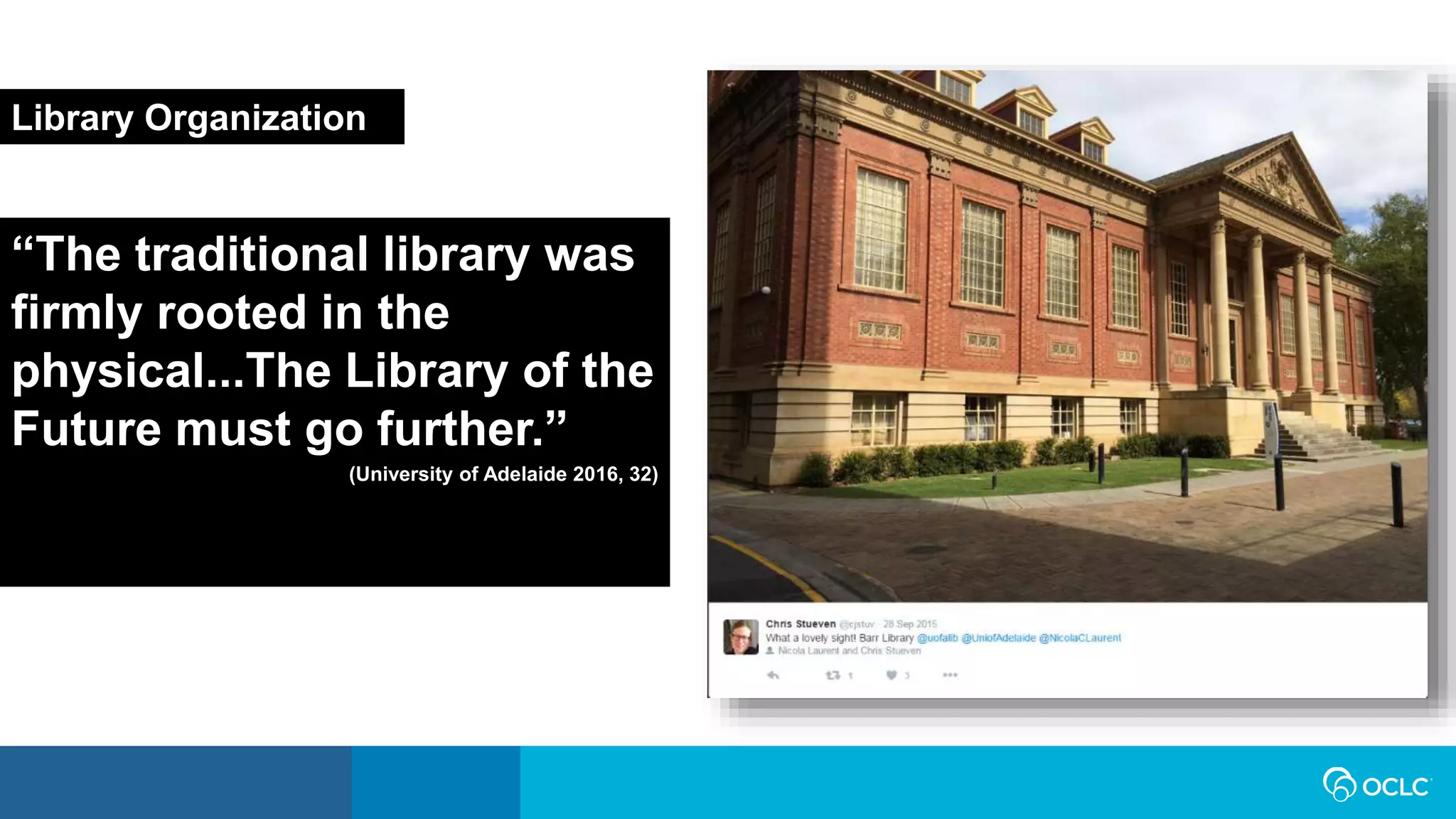
“The traditional library was
firmly rooted in the
physical...The Library of the
Future must go further.”
(University of Adelaide 2016, 32)
Library Organization
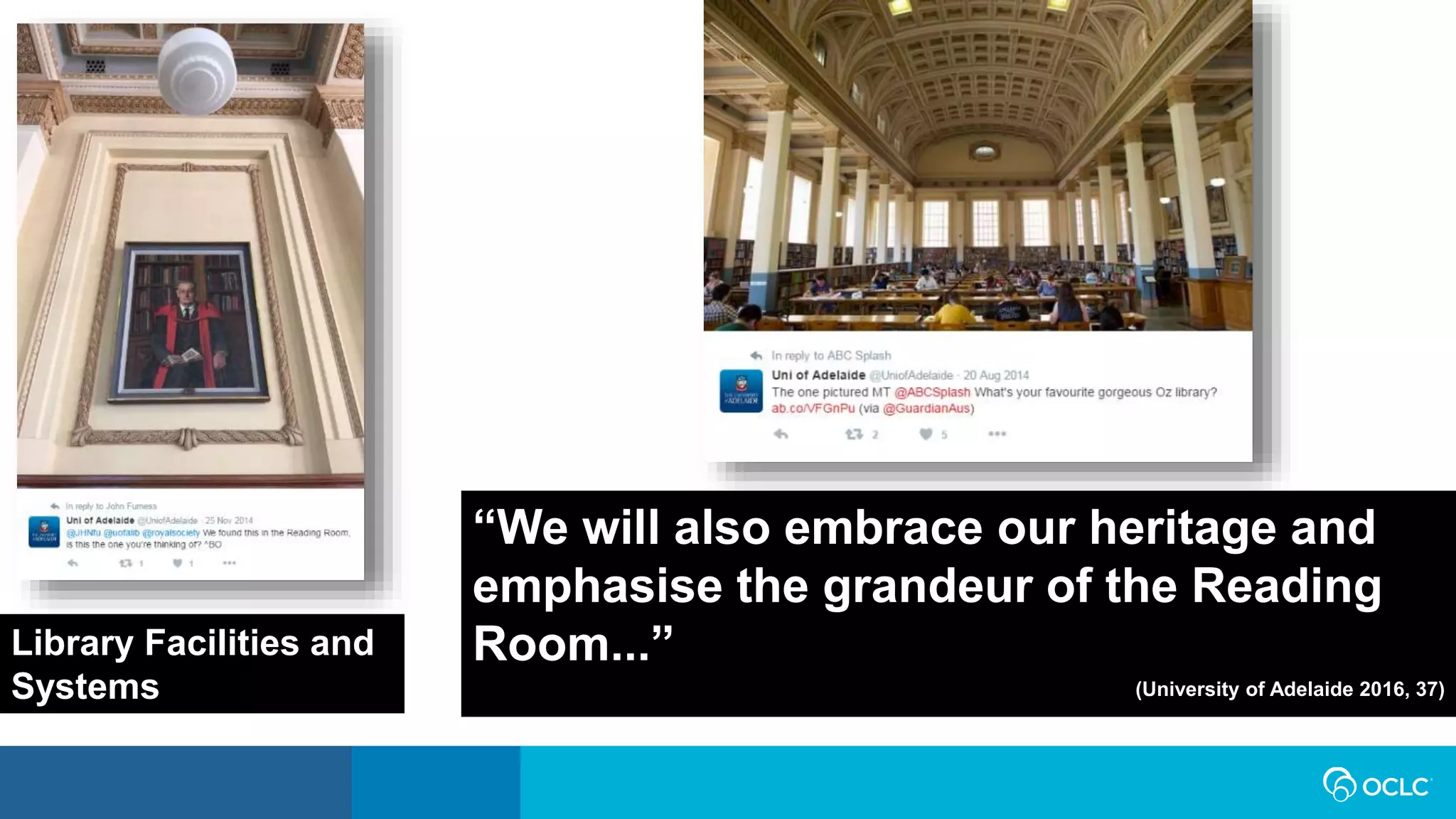
“We will also embrace our heritage and
emphasise the grandeur of the Reading
Room...”
(University of Adelaide 2016, 37)
Library Facilities and
Systems
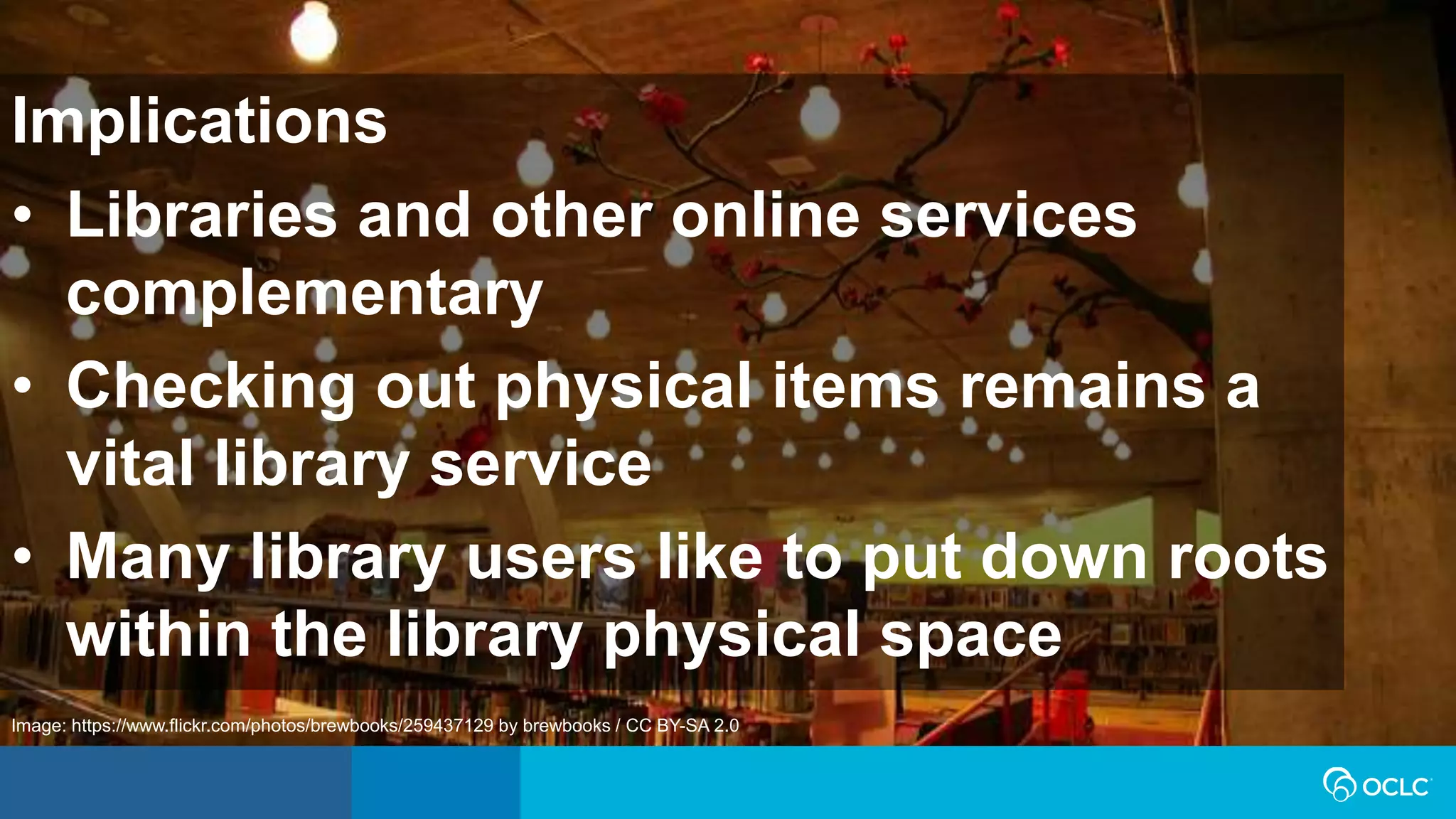
Implications
• Libraries and other online services
complementary
• Checking out physical items remains a
vital library service
• Many library users like to put down roots
within the library physical space
Image: https://www.flickr.com/photos/brewbooks/259437129 by brewbooks / CC BY-SA 2.0
CREDIBILITY
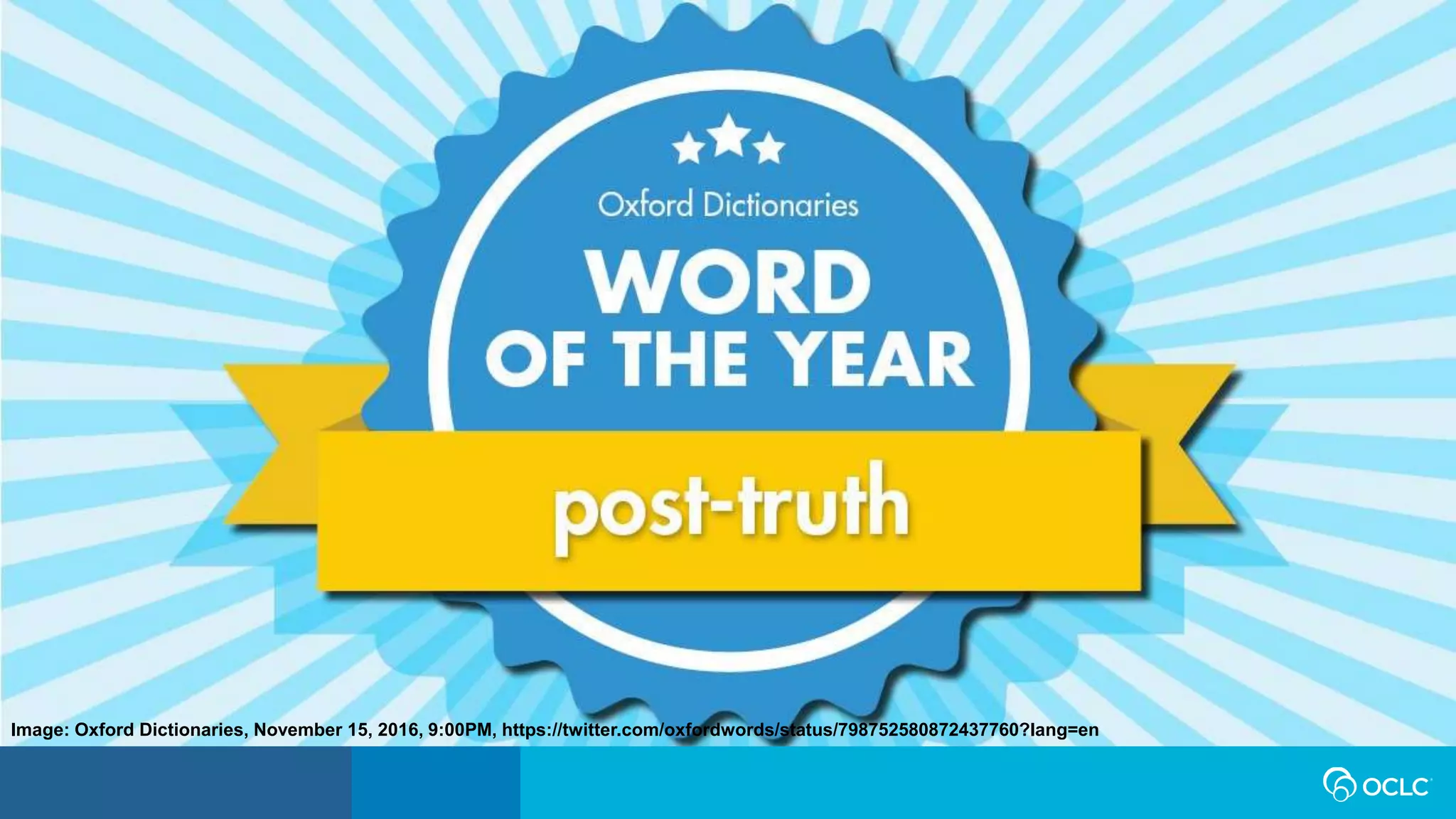
Image: Oxford Dictionaries, November 15, 2016, 9:00PM, https://twitter.com/oxfordwords/status/798752580872437760?lang=en
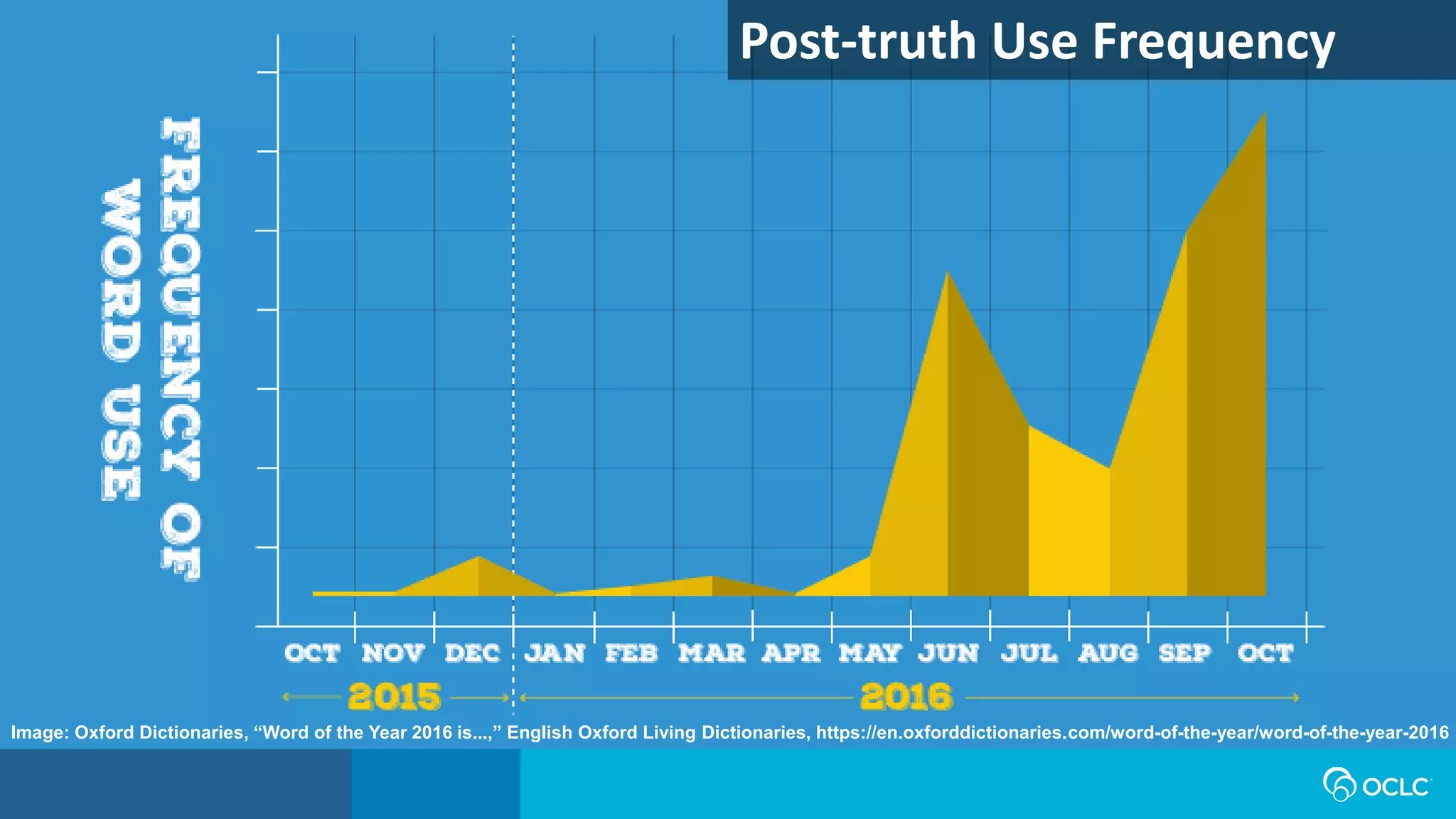
Post-truth Use Frequency
Oxforddictionaries.comImage: Oxford Dictionaries, “Word of the Year 2016 is...,” English Oxford Living Dictionaries, https://en.oxforddictionaries.com/word-of-the-year/word-of-the-year-2016
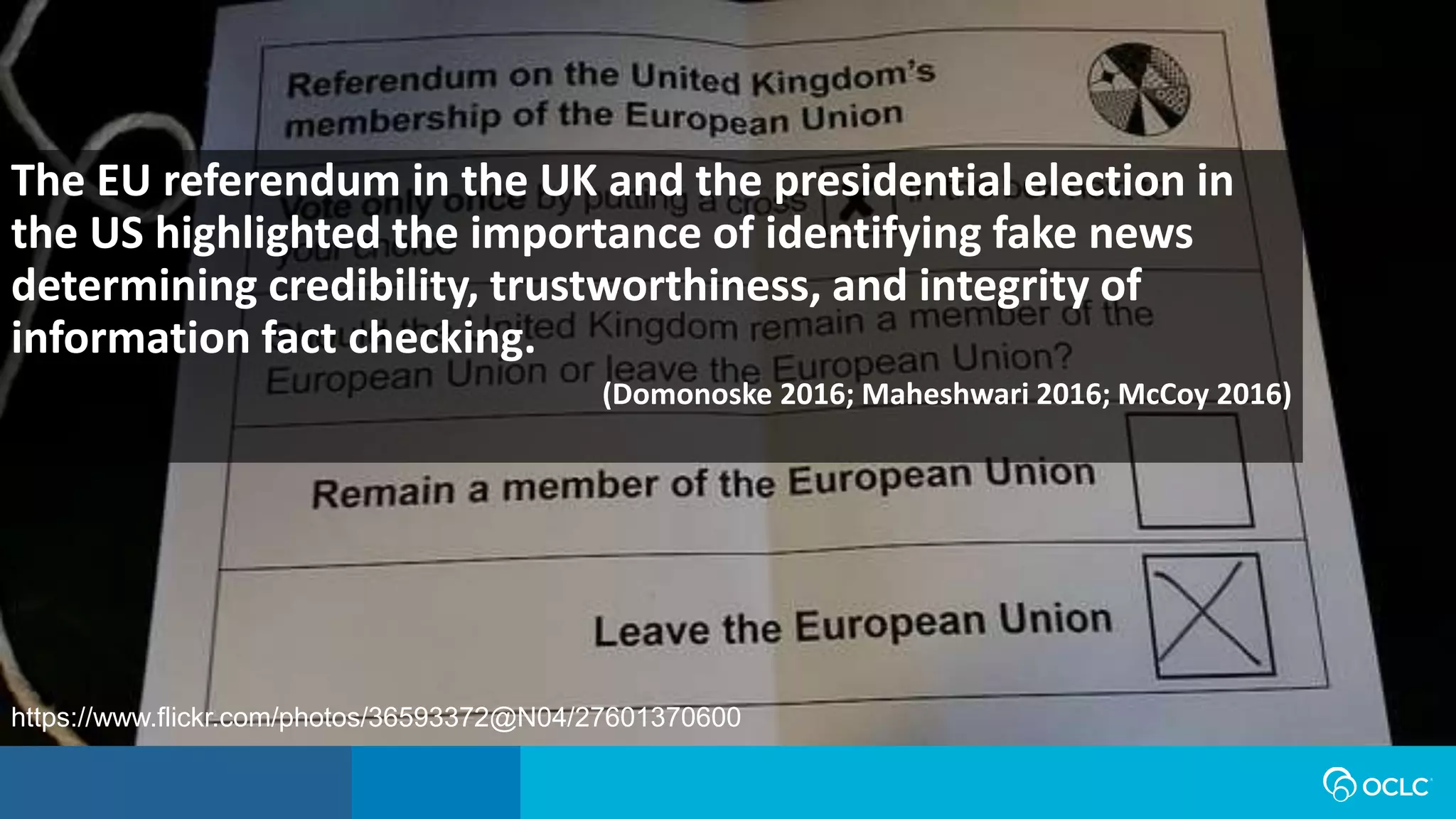
The EU referendum in the UK and the presidential election in
the US highlighted the importance of identifying fake news
determining credibility, trustworthiness, and integrity of
information fact checking.
(Domonoske 2016; Maheshwari 2016; McCoy 2016)
https://www.flickr.com/photos/36593372@N04/27601370600
Image: https://www.flickr.com/photos/dskley/13716083704 by Dennis Skley / CC BY-ND 2.0
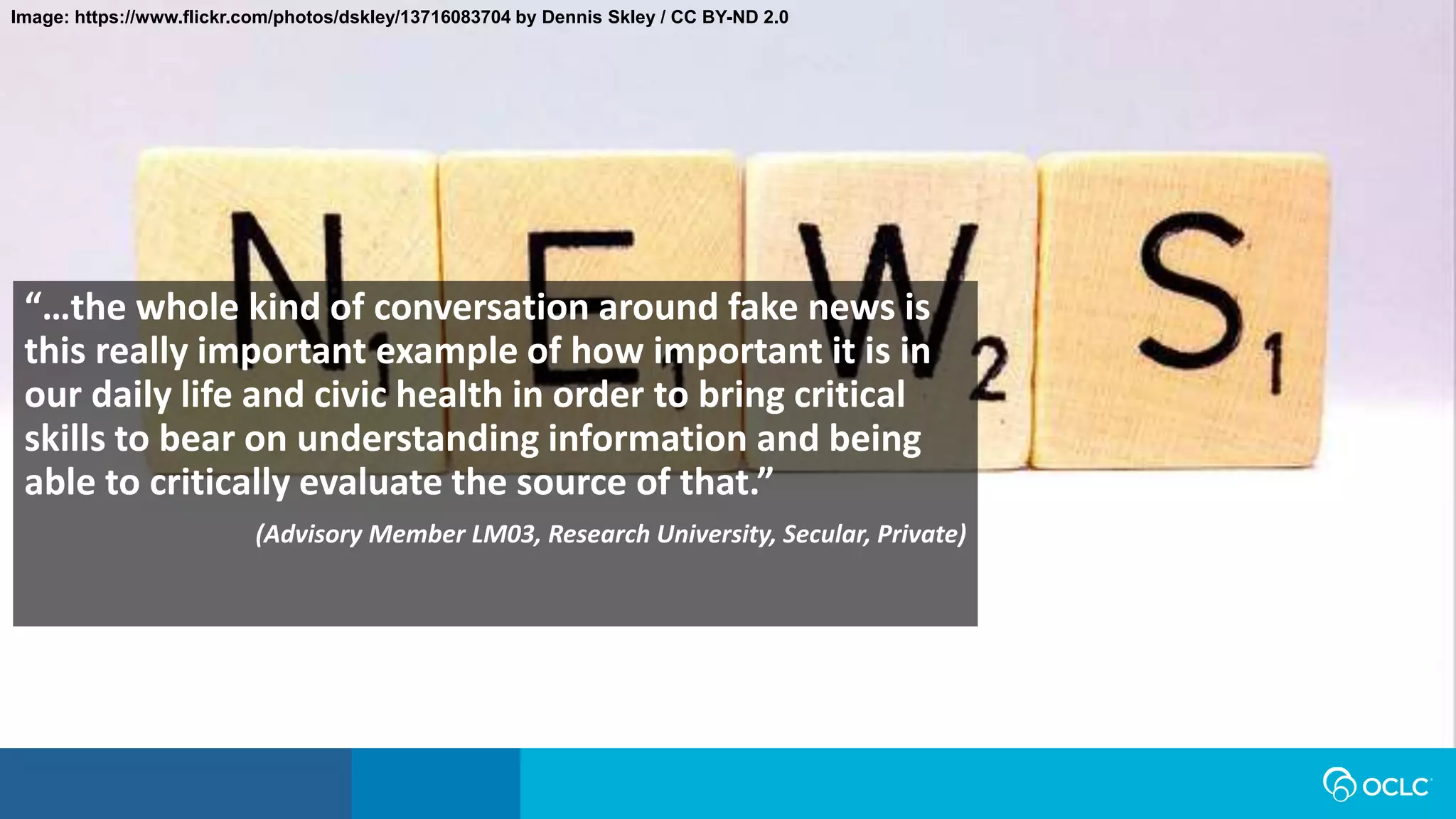
“…the whole kind of conversation around fake news is
this really important example of how important it is in
our daily life and civic health in order to bring critical
skills to bear on understanding information and being
able to critically evaluate the source of that.”
(Advisory Member LM03, Research University, Secular, Private)
“People [are] talking about the problems of educating people to be
citizens more, with this election being indicative of that. This is a
hard thing to confront right now because we are going to have an
administration that doesn't think that's important at all.”
(Provost Interviewee PP02, Research University, Non-Secular, Private)
Image: http://bit.ly/2lPFoNi by Clemens V. Vogelsang / CC BY 2.0
Determining trustworthy
sources of information is
difficult in today’s
environment
Image: https://www.flickr.com/photos/gabbysol/21510538432 by Michelle Grewe / Public Domain
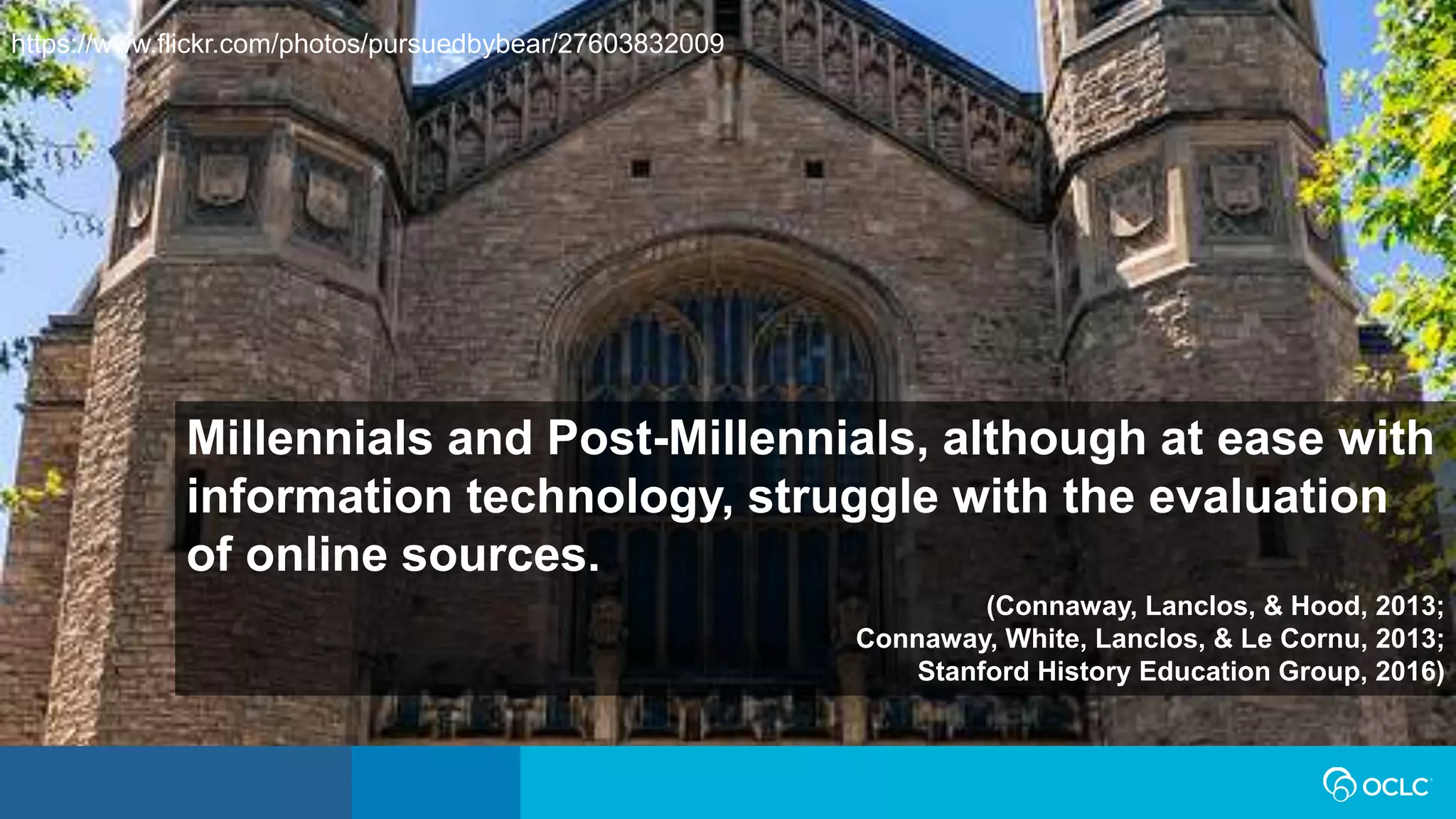
Millennials and Post-Millennials, although at ease with
information technology, struggle with the evaluation
of online sources.
(Connaway, Lanclos, & Hood, 2013;
Connaway, White, Lanclos, & Le Cornu, 2013;
Stanford History Education Group, 2016)
https://www.flickr.com/photos/pursuedbybear/27603832009
Image: https://www.flickr.com/photos/bobx-nc/14056106583/ by Bob Muller / CC BY-NC 2.0
“It depends. It depends who’s made the website or
what I have been told about the website or whether I
know about it at all. But — it sounds silly — but
sometimes you can just tell whether a website looks
reliable or not depending on how professional [it]
looks and who’s written it.”
(Digital Visitors and Residents, UKU6, Female, Age 19, Emerging)
Image: https://www.flickr.com/photos/skinnylawyer/6337956175/ by InSapphoWeTrust / CC BY-SA 2.0
“I always stick with the first thing that
comes up on Google because I think that’s
the most popular site which means that’s
the most correct.”
(Digital Visitors and Residents, USS1, Female, Age 17, High School Student)
“That's a YouTube video.
No thank you. …anybody
could have uploaded
that.”
(Researching Students’ Information Choices, G22)
Image: https://www.flickr.com/photos/gabbysol/21510538432 by Michelle Grewe / Public Domain
In information seeking,
convenience is key…
But it depends on context
and situation.
“You spend many
hours with Saint
Google. We entrust
ourselves to Saint
Google and that
solves it for us.”
(Digital Visitors & Residents, UOCFI6,
Male, Age 53, Arts & Humanities)
https://www.flickr.com/photos/82134796@N03/12578094834
“Wikipedia… it’s perfect, because it gives you the
words, the things, the technical words that you need
to look, keywords, so Wikipedia is always, always the
first step.”
(UOCG1, Male, Age 35-44, Professions and Applied Sciences)
Image: https://www.flickr.com/photos/mayopants/4021073588/ by stateofplace / CC BY-NC 2.0
“People lack patience to wade
through content silos…”
(Connaway 2015, 134)
“Yes, it [Matrix film plug-in to brain] - sort of
makes information gathering effortless and
without having to sort of manually go through and
separate the chaff from the wheat.”
(Digital Visitors and Residents, UKU10, Male, Age 20, Law)
https://www.flickr.com/photos/82134796@N03/9534745875
“Because, most likely, I won't
be able to see the book, just a
little abstract, and that might
not be helpful because I won't
get the entire information, just
a part of it. That gets
frustrating.”
(Researcing Students’ Information Choices, S07)
Image: https://www.flickr.com/photos/johnloo/7424050476 by John Loo / CC BY 2.0
Image: https://www.flickr.com/photos/gabbysol/21510538432 by Michelle Grewe / Public Domain
Critical thinking skills are a primary
concern of university administrators
and are crucial for developing an
informed citizenry.
(Connaway et al., 2017; Najmabadi, 2017)
“I do not think the learning stops after [students
graduate]. How do we set our students up for
success? How do they reach the outcomes that we
want for them? How do we have them thinking
about, and in particular for libraries, how do they
think about that down the road as, using public
libraries and the resources we have there as well?”
(Provost Interviewee PP06, Research University, Secular, Public)
Image: https://www.flickr.com/photos/benhosg/32627578042 by Benjamin Ho / CC BY-NC-ND 2.0
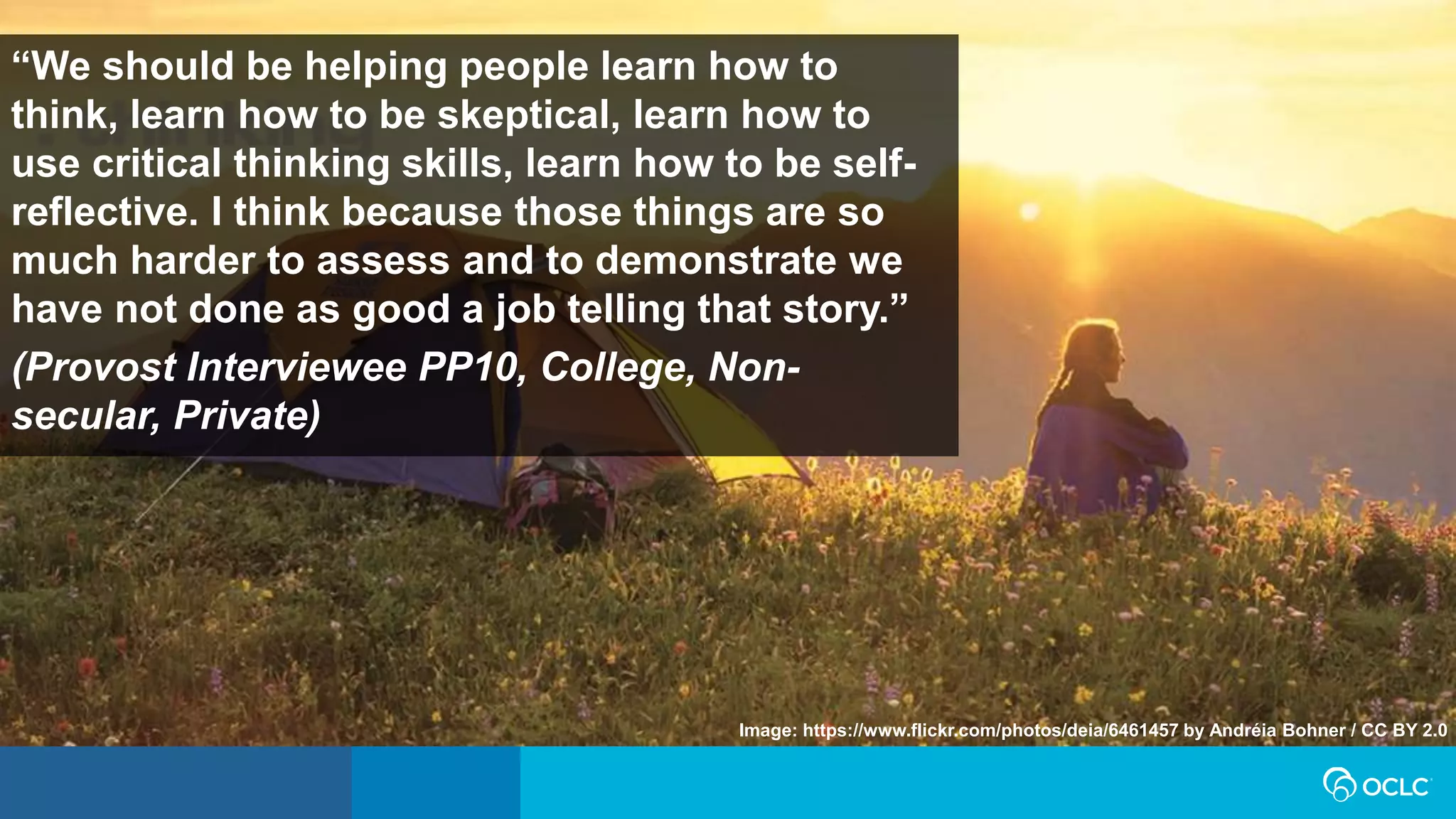
“We should be helping people learn how to
think, learn how to be skeptical, learn how to
use critical thinking skills, learn how to be self-
reflective. I think because those things are so
much harder to assess and to demonstrate we
have not done as good a job telling that story.”
(Provost Interviewee PP10, College, Non-
secular, Private)
Image: https://www.flickr.com/photos/deia/6461457 by Andréia Bohner / CC BY 2.0
(Connaway et al., 2017)
Image: https://www.flickr.com/photos/gabbysol/21510538432 by Michelle Grewe / Public Domain
“Humans are a valued source of information.”
“Regarding health affairs, I usually don’t search on the
internet because… you have pain in one finger and then you
end up [thinking] you have the bubonic plague… For this
situation, I would use personal contacts.” (UOCG3, Male, Age
28, Computer Science)
Image: https://www.flickr.com/photos/zachduffy/2634956354 by Zach Duffy / CC BY-NC-ND 2.0
“A wise person. I like books and
technology, but people are better.”
(UOCU1, Female, 19-25, Professions and Applied Sciences)
The magic future would be…
Image: https://www.flickr.com/photos/photophilde/4353228184
by photophilde / CC BY-SA 2.0
(Connaway et al., 2017)
Image: https://www.flickr.com/photos/gabbysol/21510538432 by Michelle Grewe / Public Domain
“Wikipedia is used by individuals in all educational stages to
familiarize themselves with a subject or topic.”
“Wikipedia… it’s perfect, because it gives you the
words, the things, the technical words that you need
to look, keywords, so Wikipedia is always, always the
first step.”
(UOCG1, Male, Age 35-44, Professions and Applied Sciences)
Image: https://www.flickr.com/photos/mayopants/4021073588/ by stateofplace / CC BY-NC 2.0
“I used to seek information in Wikipedia, even my colleagues said
that there are wrong things on it…but I said Enciclopedia Larousse
[Traditional encyclopedia] also have mistakes…the only difference
is that it is printed and is impossible to correct the mistakes once
you have the printed version…Mistakes are not about technology,
are about people.”
(Digital Visitors & Residents, UOCFE6, Male, Age 53, Computer Science)
Image: http://www.flickr.com/photos/20452143@N08/3841271286 by Adam DeClercq / CC BY-NC-SA 2.0
“It’s like a taboo I guess with all
teachers, they just all say – you
know, when they explain the
paper they always say, ‘Don’t use
Wikipedia.’”
(Digital Visitors & Residents, USU7, Female, Age 19, Political Science)
The Learning Black Market
Image: https://www.flickr.com/photos/asuranlv/8784338892 by Eduards Osis / CC BY-NC 2.0
“Convenience is a priority when making decisions about what
tools and sources to use.”
(Connaway et al., 2017)
Image: https://www.flickr.com/photos/gabbysol/21510538432 by Michelle Grewe / Public Domain
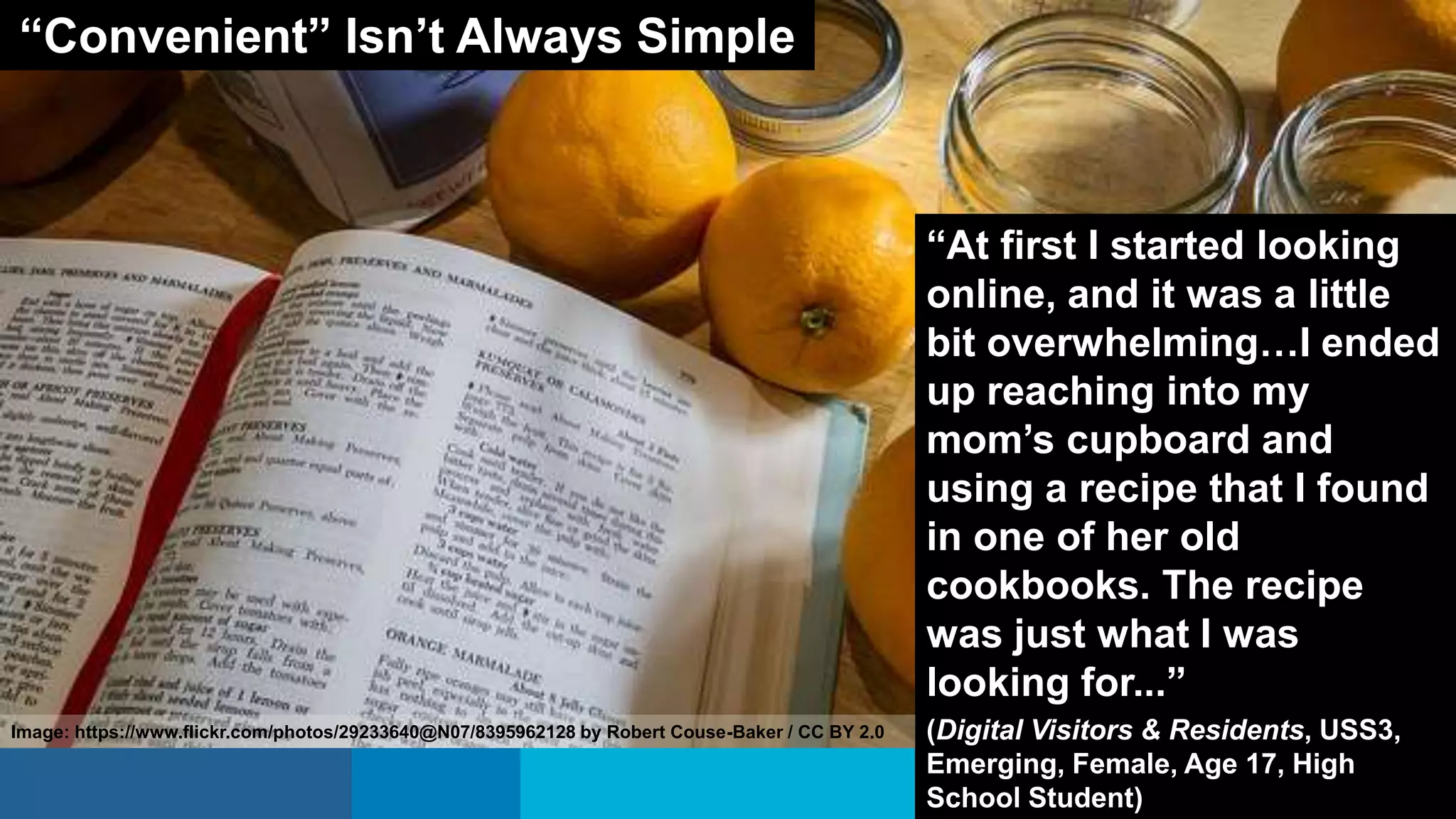
“At first I started looking
online, and it was a little
bit overwhelming…I ended
up reaching into my
mom’s cupboard and
using a recipe that I found
in one of her old
cookbooks. The recipe
was just what I was
looking for...”
(Digital Visitors & Residents, USS3,
Emerging, Female, Age 17, High
School Student)
“Convenient” Isn’t Always Simple
Image: https://www.flickr.com/photos/29233640@N07/8395962128 by Robert Couse-Baker / CC BY 2.0
Satisficing…What is enough information?
“…I needed the answer, my maths,
I was doing an exercise, I got stuck
on a question, I still had the rest of
the exercise to go and I had like an
hour to do it and I just wanted the
formula and the quickest way to do
it was to type it into Google and it
came up.”
(Digital Visitors & Residents, UKS2, Female, Age 17,
Secondary School Student)
Image: https://www.flickr.com/photos/irchriscdk/13946605527 by Chris de Kok / CC BY 2.0
“Participants report extensive use of search engines, especially
Google, and take them for granted.”
(Connaway et al., 2017)
Image: https://www.flickr.com/photos/gabbysol/21510538432 by Michelle Grewe / Public Domain
Centrality of Google & search engines
“…I just think it’s [VLE web site] too
complicated and it’s limited, that I just
carried on going on Google.”
(Digital Visitors & Residents, UKS6, Emerging, Female, Age 16, Secondary
School Student)
Image: https://www.flickr.com/photos/thomashawk/307750722 by Thomas Hawk / CC BY-NC 2.0
“You spend many hours with Saint Google. We entrust
ourselves to Saint Google and that solves it for us.”
(Digital Visitors & Residents, UOCFI6, Male, Age 53, Arts & Humanities)
https://www.flickr.com/photos/dileeshus/8447597692/
“Library sources are used but not recognized or attributed to the
library.”
(Connaway et al., 2017)
Image: https://www.flickr.com/photos/gabbysol/21510538432 by Michelle Grewe / Public Domain
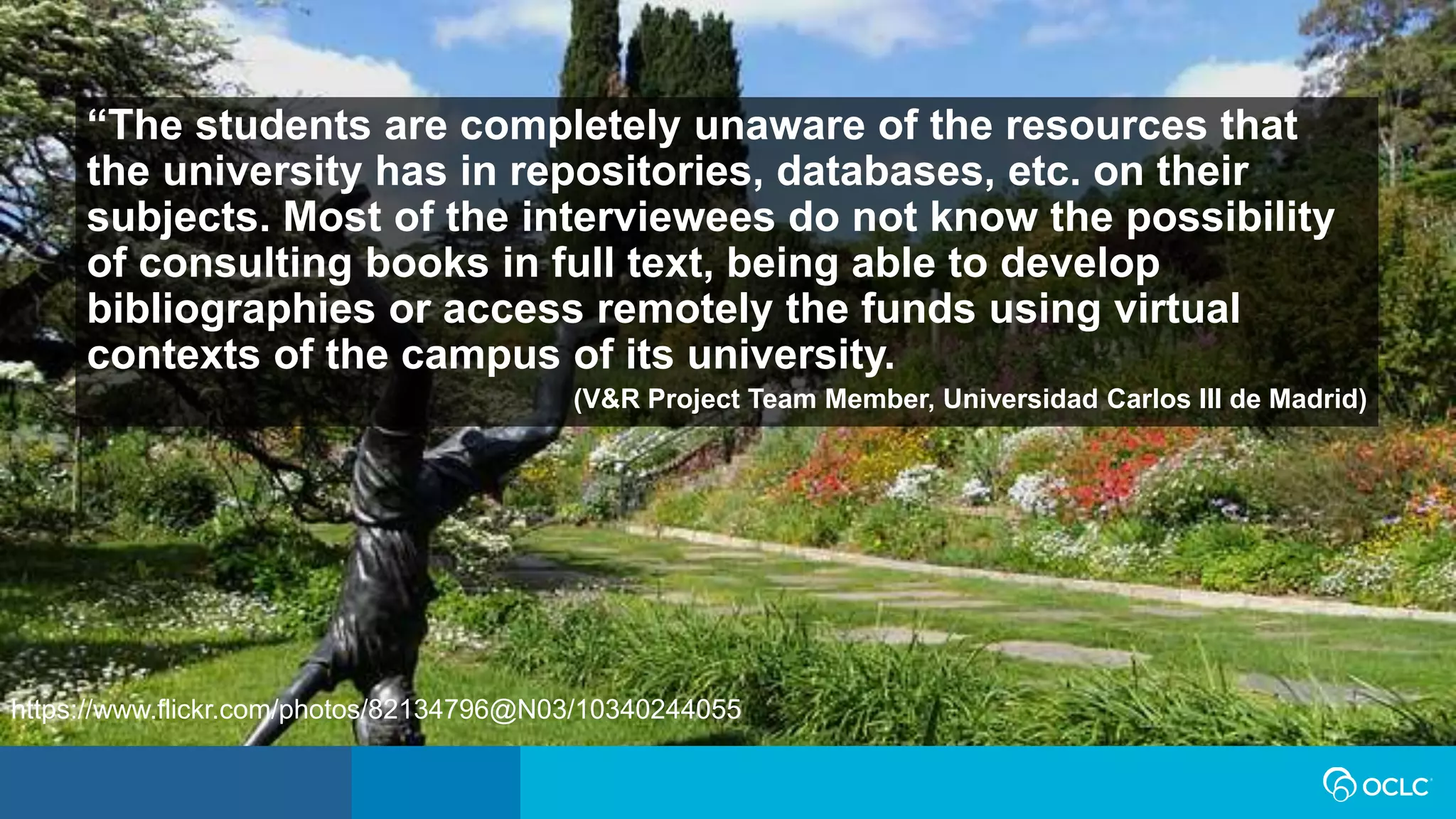
“The students are completely unaware of the resources that
the university has in repositories, databases, etc. on their
subjects. Most of the interviewees do not know the possibility
of consulting books in full text, being able to develop
bibliographies or access remotely the funds using virtual
contexts of the campus of its university.
(V&R Project Team Member, Universidad Carlos III de Madrid)
https://www.flickr.com/photos/82134796@N03/10340244055
“Perhaps one of the more interesting actions could be to
promote the library services to students and how to use them.
Now, the library resources are embedded in the virtual
classroom and the students are not aware of this, but in
contrast, they don’t explore the full potential of [the] academic
library.”
(Eva Ortoll Espinet, Universitat Oberta de Catalunya)
https://www.flickr.com/photos/124930081@N08/16026272820
“People lack patience to wade through content silos…”
(Connaway 2015, 134)
“Yes, it [Matrix film plug-in to brain] - sort of
makes information gathering effortless and
without having to sort of manually go through and
separate the chaff from the wheat.”
(Digital Visitors & Residents, UKU10, Male, Age 20, Law)
CONTAINER COLLAPSE
Researching Students’ Information Choices
(RSIC): Determining Identity and Judging
Credibility in Digital Spaces
• 4-year IMLS funded National Leadership Grant #LG-81-15-0155
• Research questions:
• Do STEM students differentiate among different types of
digital resources at point of selection?
• How do STEM students determine the credibility of digital
resources?
http://guides.uflib.ufl.edu/RSIC
“Google Generation are format agnostic and have
little interest in the containers (reports, book
chapters, encyclopedia entries)…we feel this one is
still wide open. It is a hugely important issue for
libraries and publishers”
(Williams & Rowlands, 2007, p. 20)
Container Collapse (#containercollapse)
• Visual context and cues that print containers provide used to
help individuals identify a document’s origins and measure its
value
• Cues are obscured or more difficult to discern
• “In digital format, a document is decanted from its original
container and must be carefully examined to determine the
journey it took to reach the individual.”
(Connaway et al., 2018)
https://www.flickr.com/photos/82134796@N03/11830719395
Research Methods
Data Collection
• Pre-screen survey
• Simulation
• Pre-interview
• Information Choice Tasks
• Post-Interview
Participants - Alachua County,
FL
• 4th – 5th grade
• 6th – 8th grade
• 9th – 12th grade
• Community college
• University undergraduate
• University graduate
https://www.flickr.com/photos/tomshouse/448094130
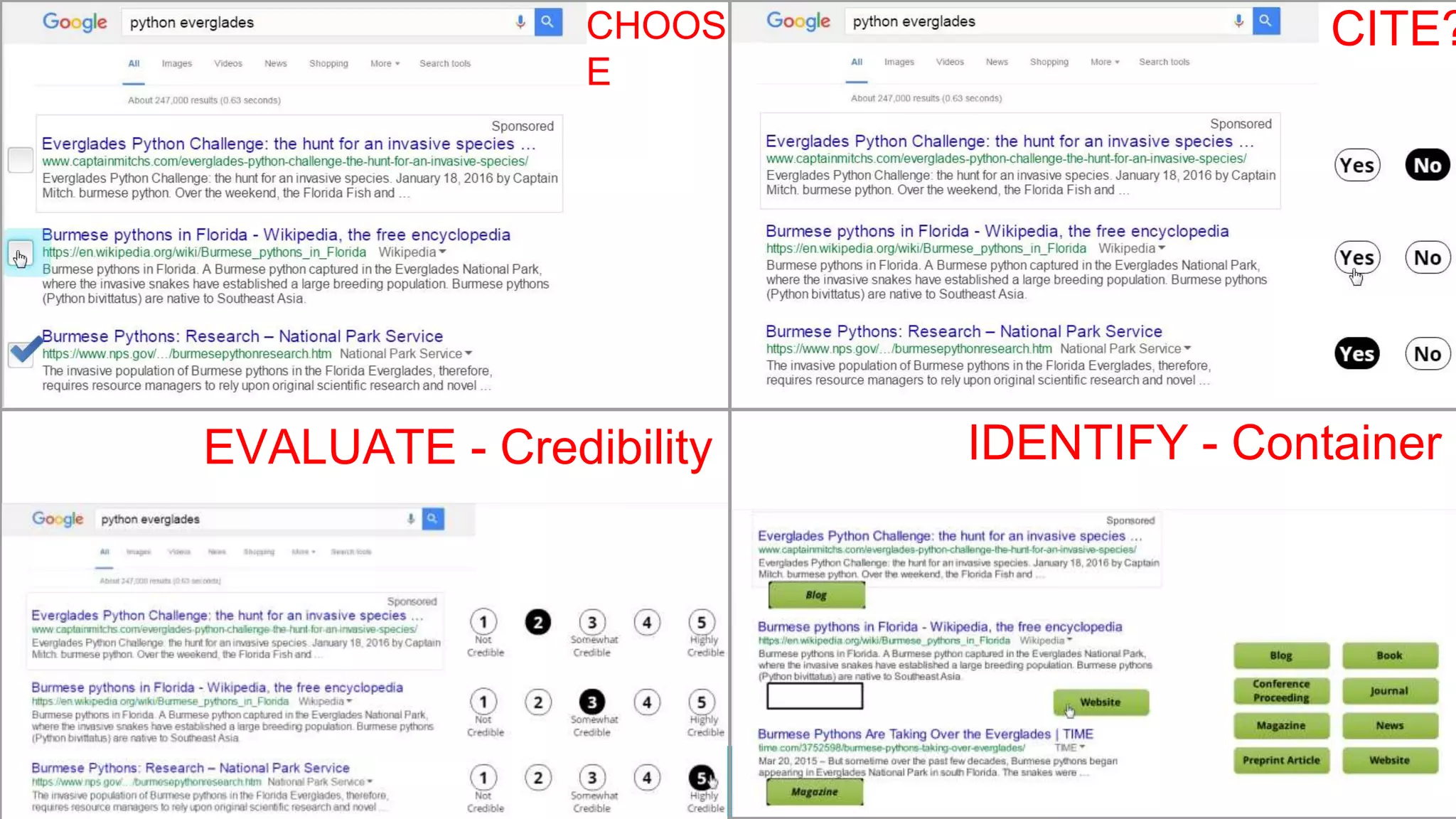
Simulation tasks
1. Useful task – select 20 useful sources
2. Cite task – would you cite your useful sources?
3. Why Not Useful task – why weren’t they useful?
4. Credibility task – how credible are these resources?
5. Container tagging – what container best describes
these 20 resources?
https://www.flickr.com/photos/56001877@N04/10241910294
CHOOS
E
CITE?
EVALUATE - Credibility IDENTIFY - Container
Simulation data collected
• Quantitative data from Storyline
• Choices made in each task
• Every click into a resource
• Qualitative data
• Pre and Post interview questions
• Audio transcript
• Video file – attempted clicks or points not captured by
Storyline
https://www.flickr.com/photos/56001877@N04/8337331974
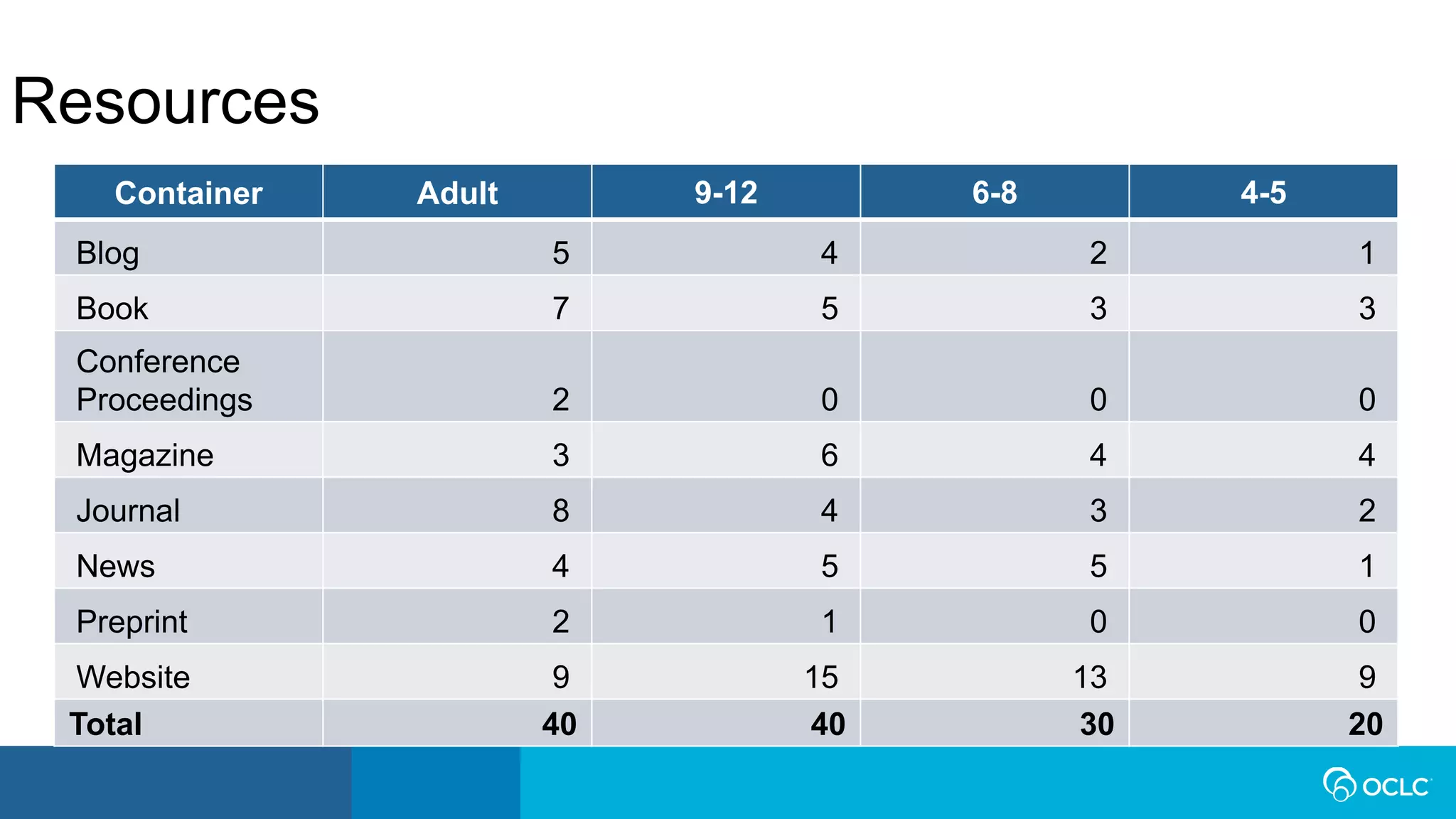
Resources
Container Adult 9-12 6-8 4-5
Blog 5 4 2 1
Book 7 5 3 3
Conference
Proceedings 2 0 0 0
Magazine 3 6 4 4
Journal 8 4 3 2
News 4 5 5 1
Preprint 2 1 0 0
Website 9 15 13 9
Total 40 40 30 20
Container Collapse
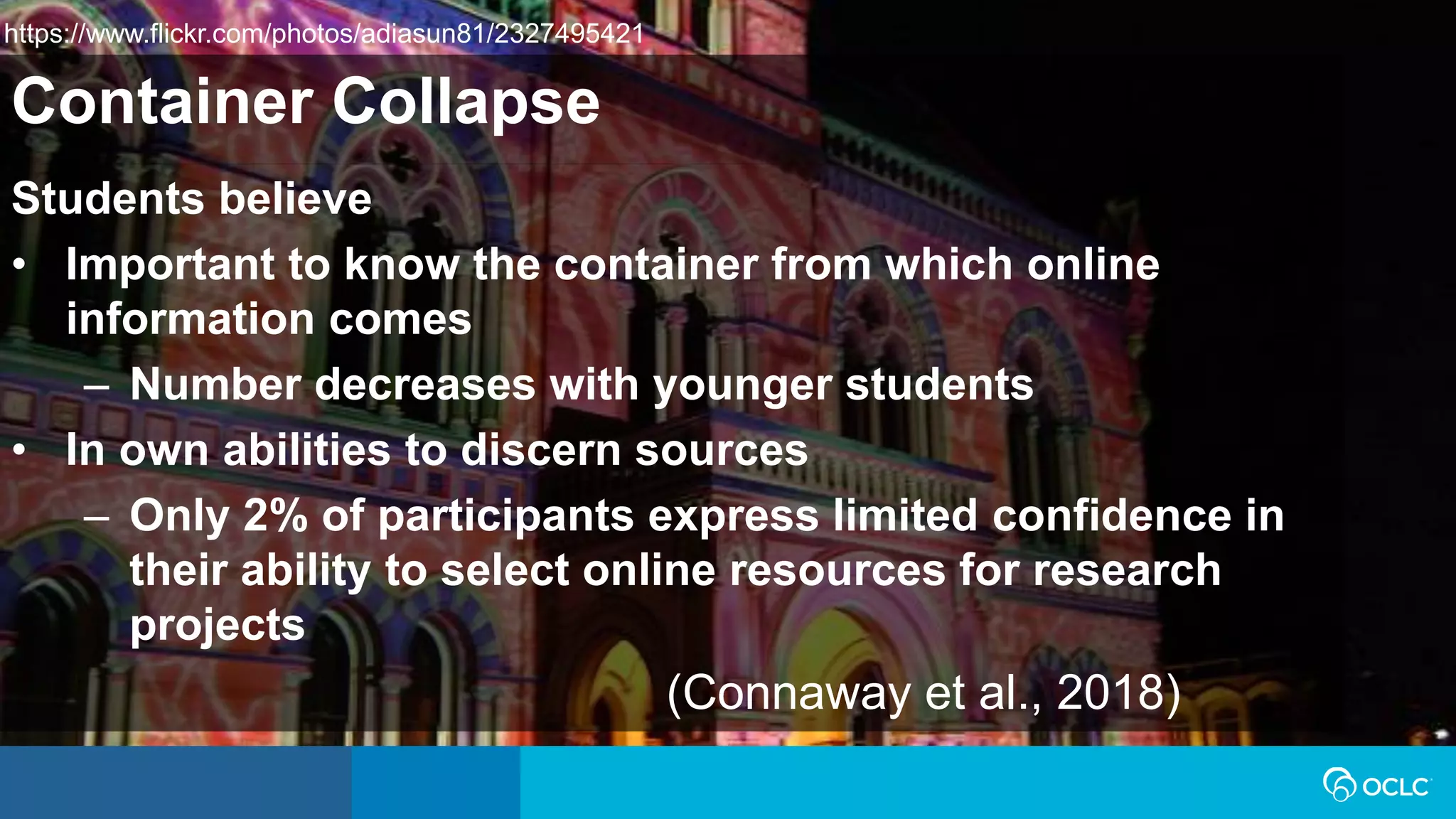
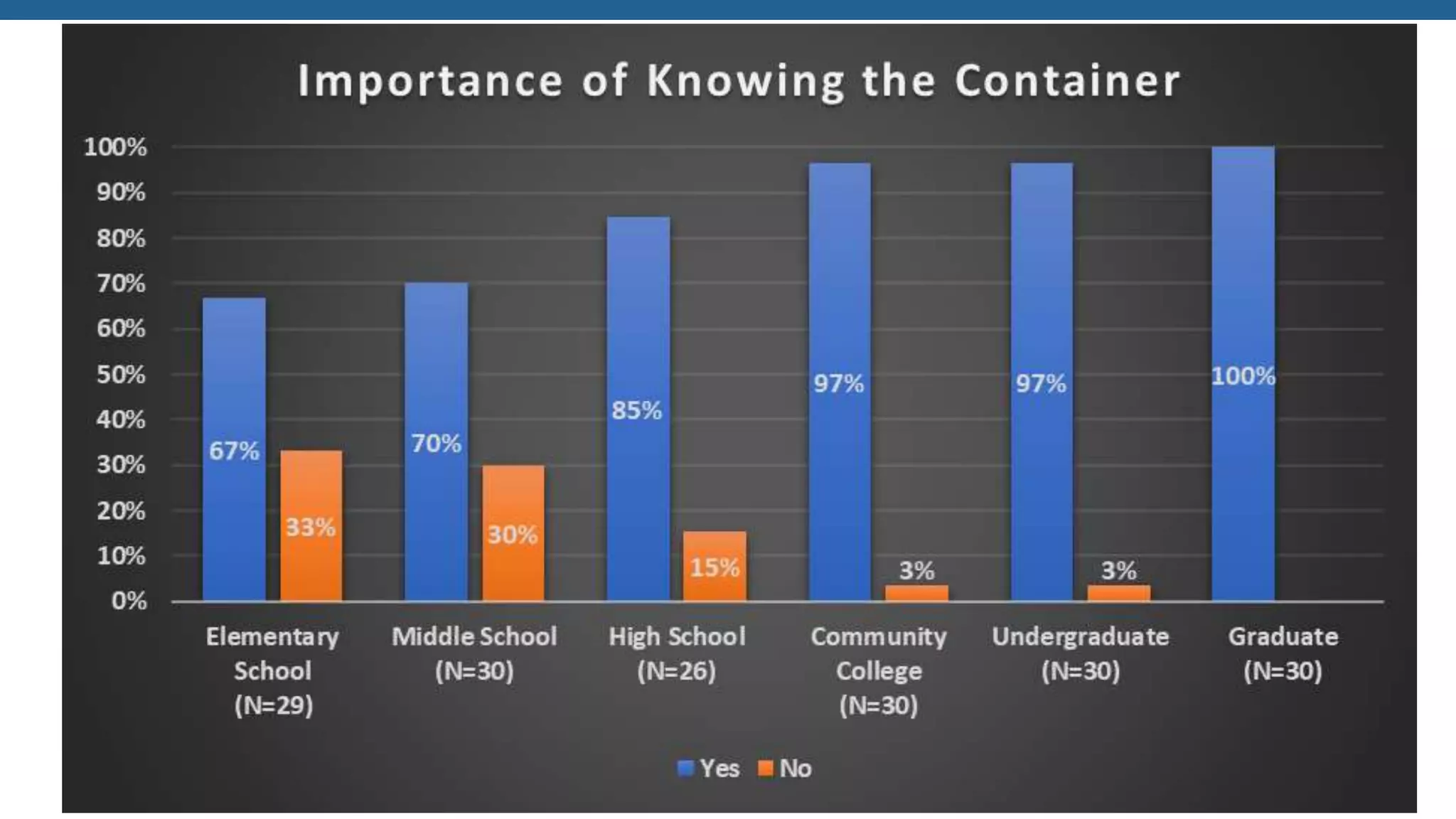
Students believe
• Important to know the container from which online
information comes
– Number decreases with younger students
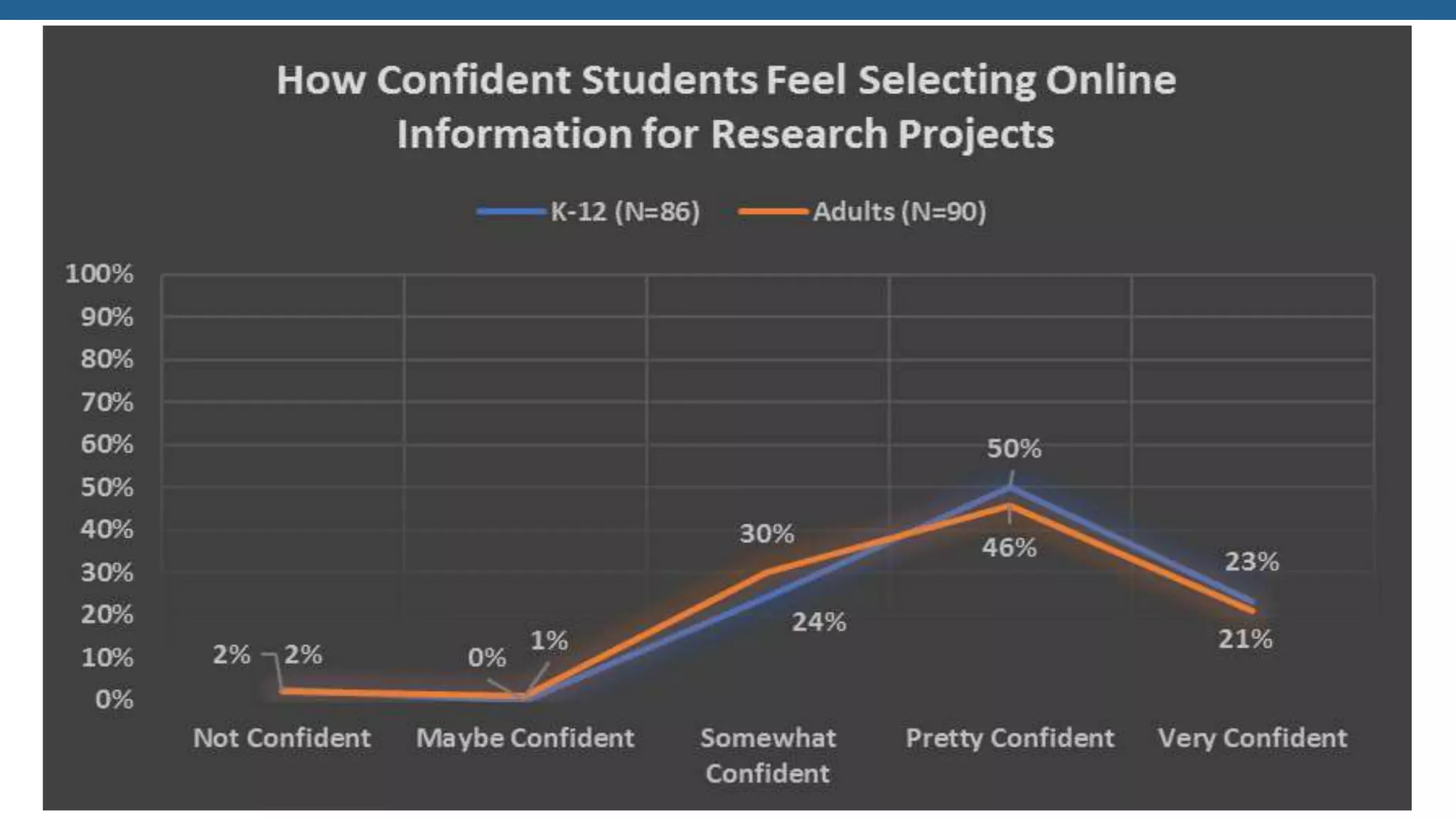
• In own abilities to discern sources
– Only 2% of participants express limited confidence in
their ability to select online resources for research
projects
(Connaway et al., 2018)
https://www.flickr.com/photos/adiasun81/2327495421
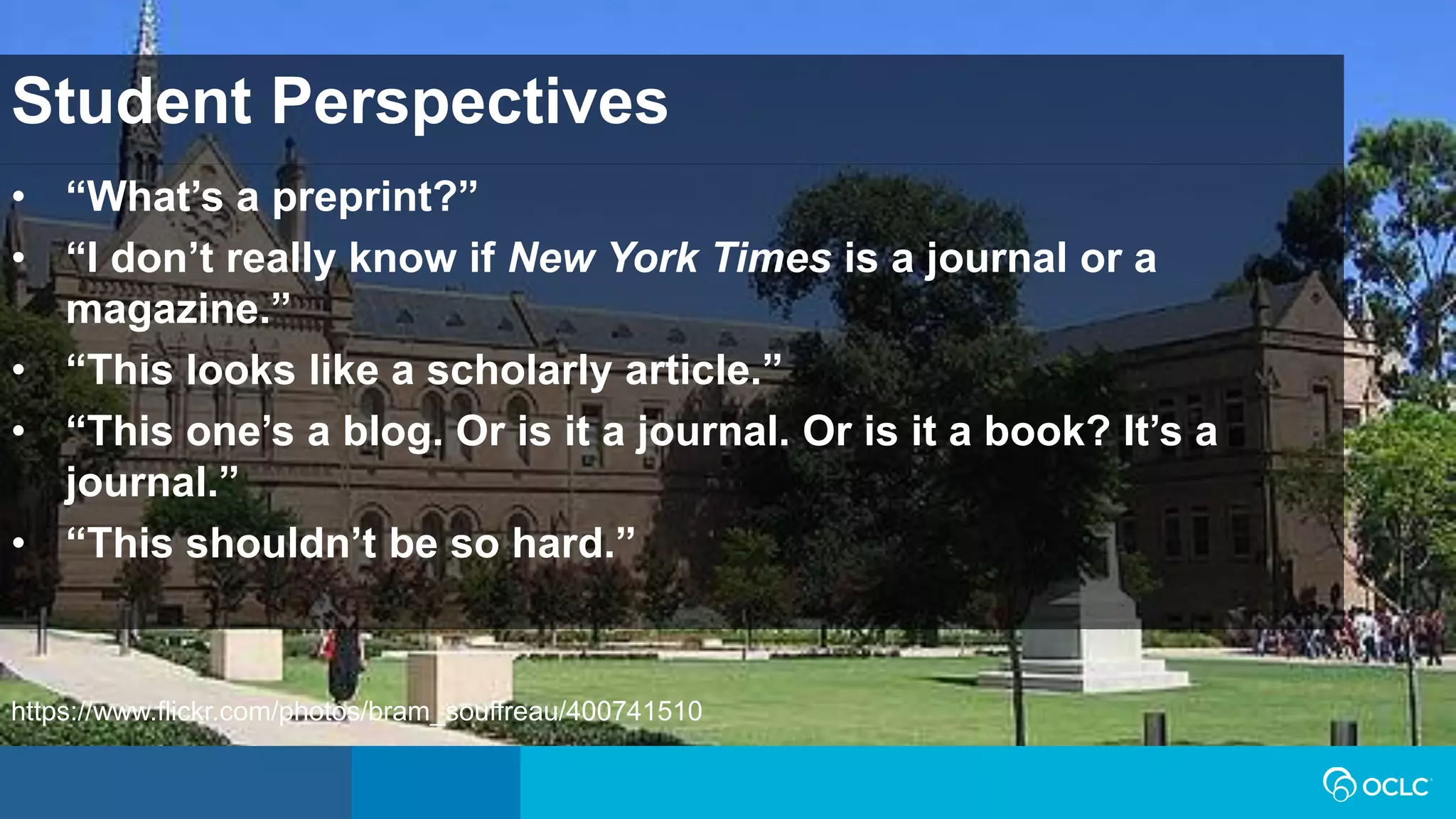
Student Perspectives
• “What’s a preprint?”
• “I don’t really know if New York Times is a journal or a
magazine.”
• “This looks like a scholarly article.”
• “This one’s a blog. Or is it a journal. Or is it a book? It’s a
journal.”
• “This shouldn’t be so hard.”
https://www.flickr.com/photos/bram_souffreau/400741510
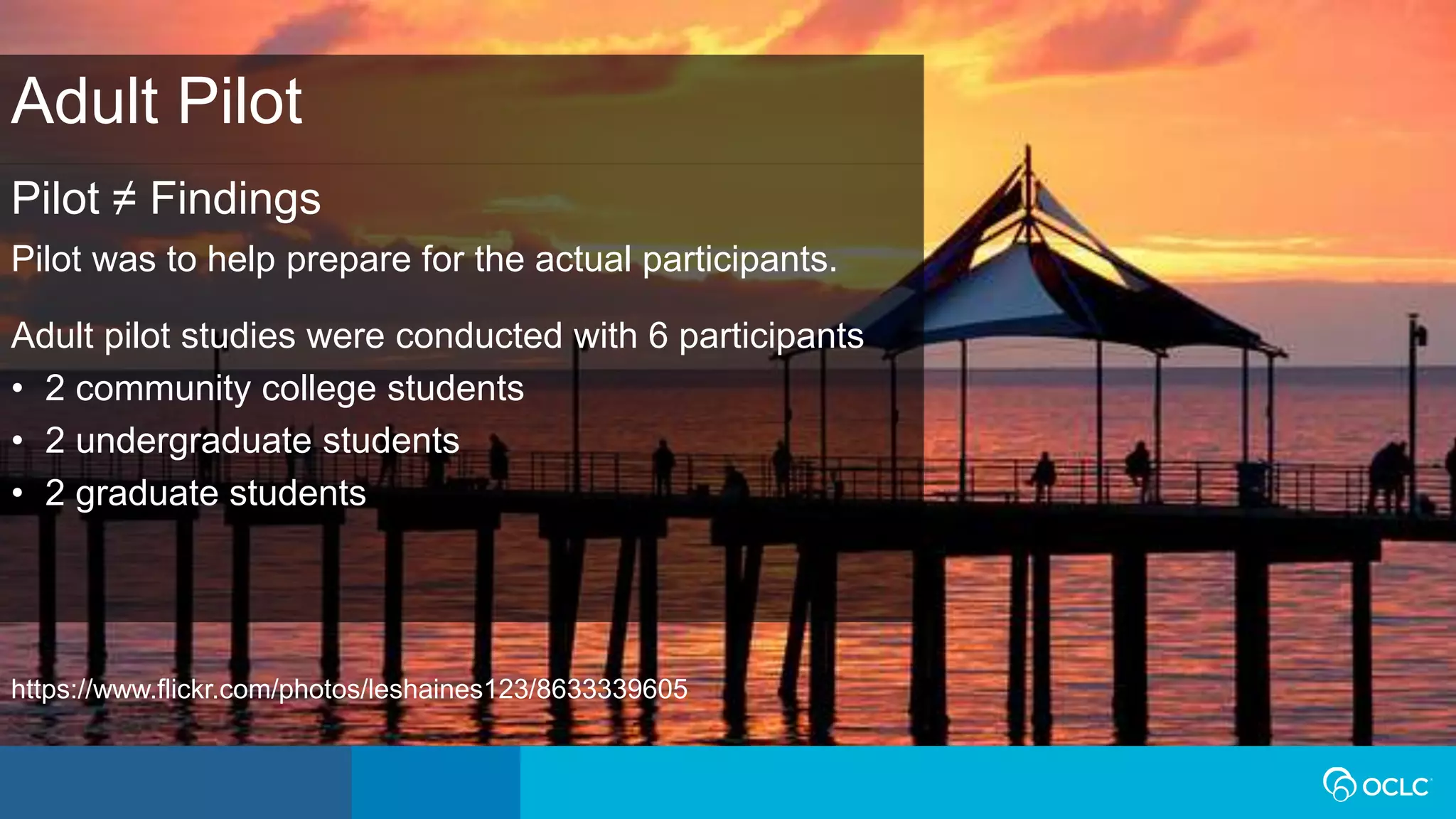
Pilot ≠ Findings
Pilot was to help prepare for the actual participants.
Adult pilot studies were conducted with 6 participants
• 2 community college students
• 2 undergraduate students
• 2 graduate students
Adult Pilot
https://www.flickr.com/photos/leshaines123/8633339605
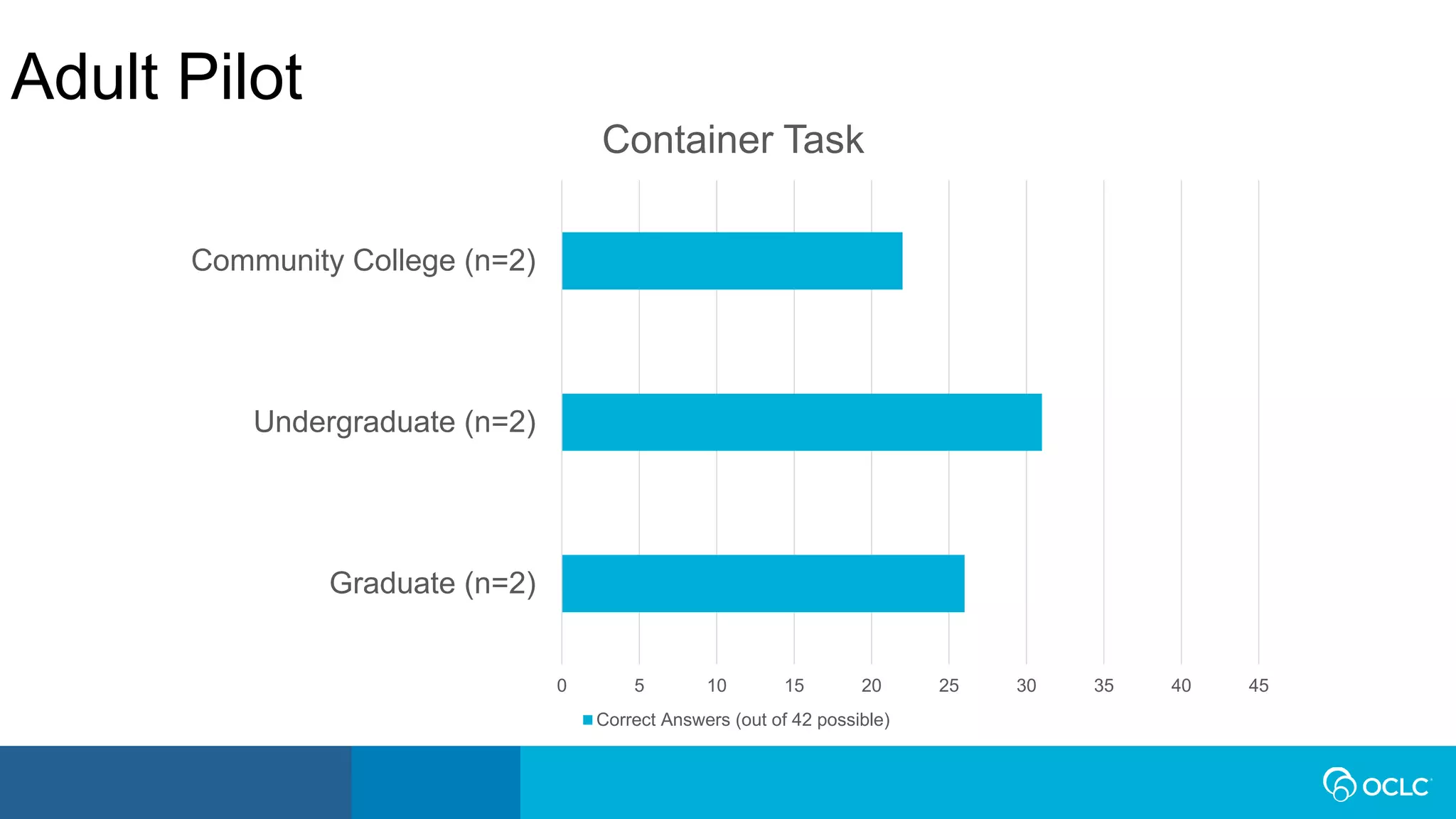
0 5 10 15 20 25 30 35 40 45
Graduate (n=2)
Undergraduate (n=2)
Community College (n=2)
Container Task
Correct Answers (out of 42 possible)
Adult Pilot
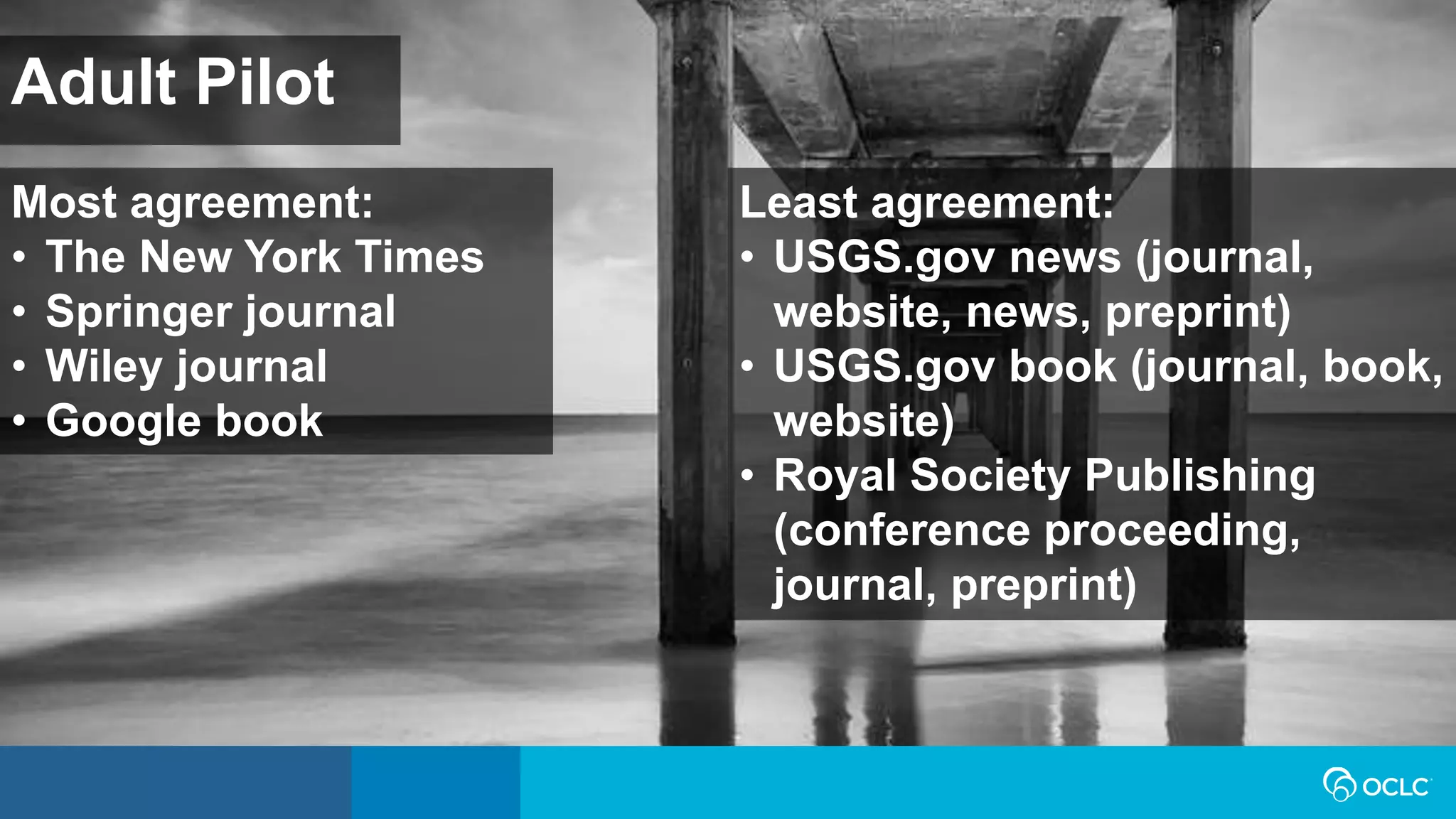
Adult Pilot
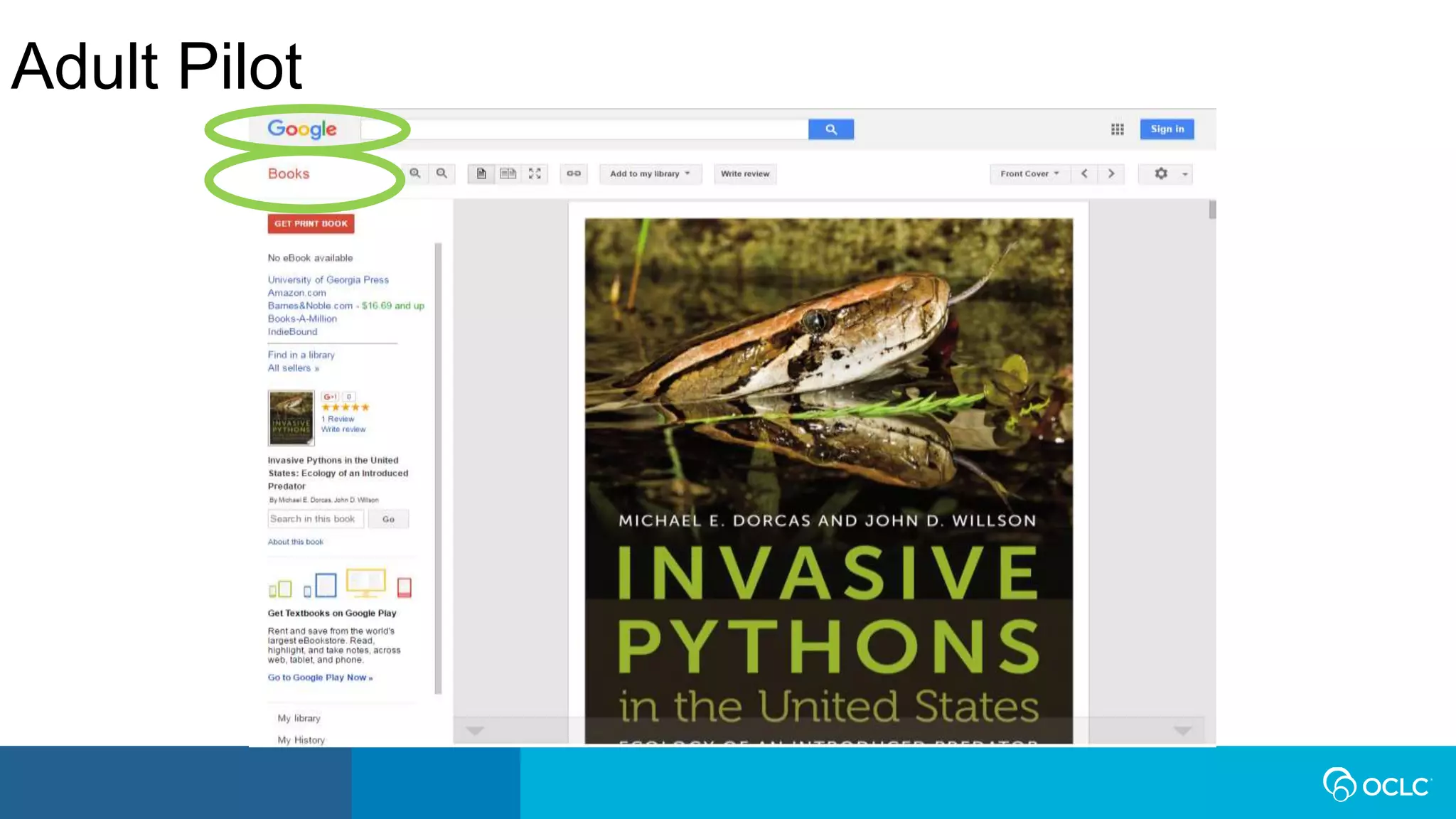
Most agreement:
• The New York Times
• Springer journal
• Wiley journal
• Google book
Least agreement:
• USGS.gov news (journal,
website, news, preprint)
• USGS.gov book (journal, book,
website)
• Royal Society Publishing
(conference proceeding,
journal, preprint)
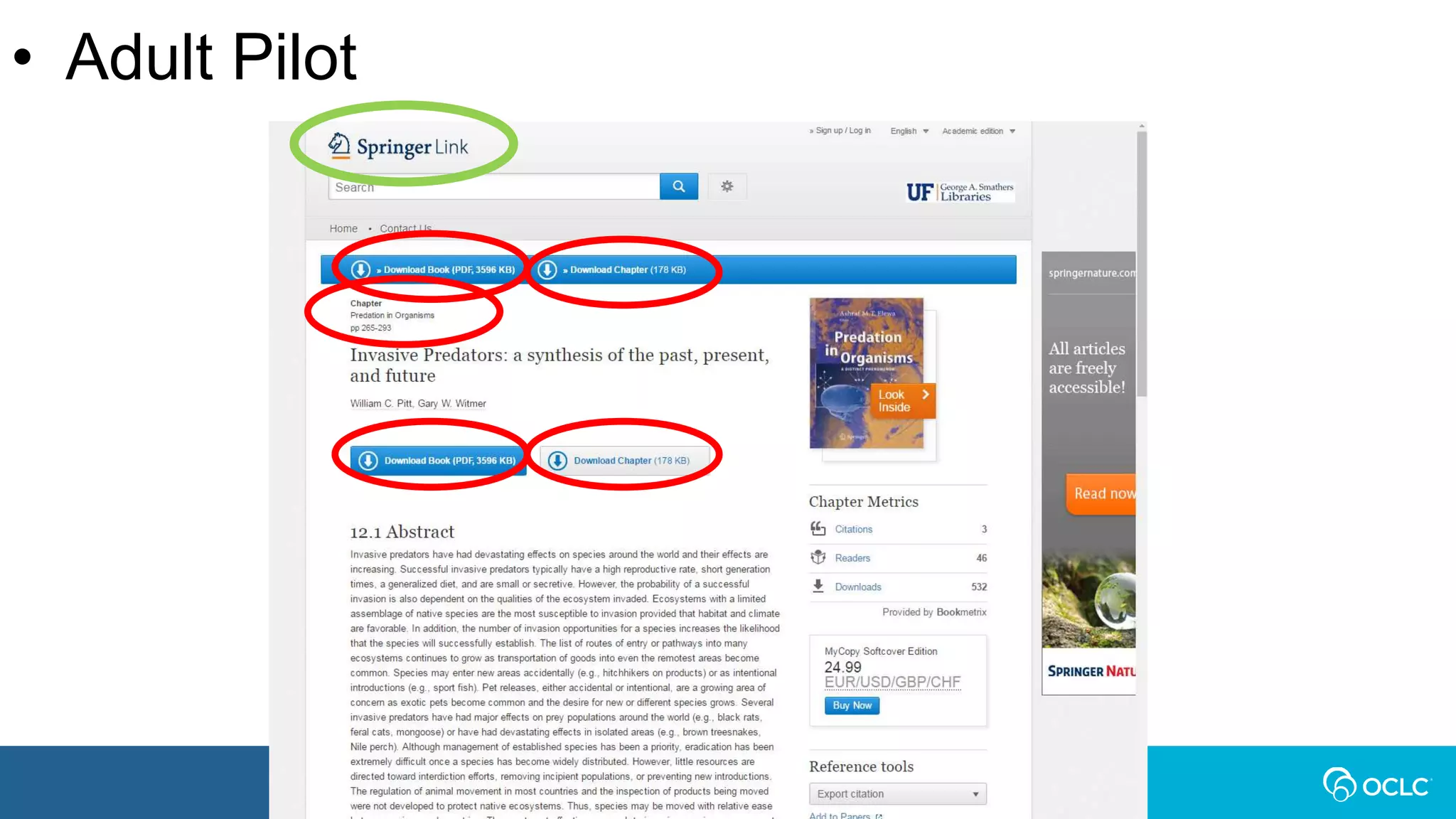
• Adult Pilot
Adult Pilot
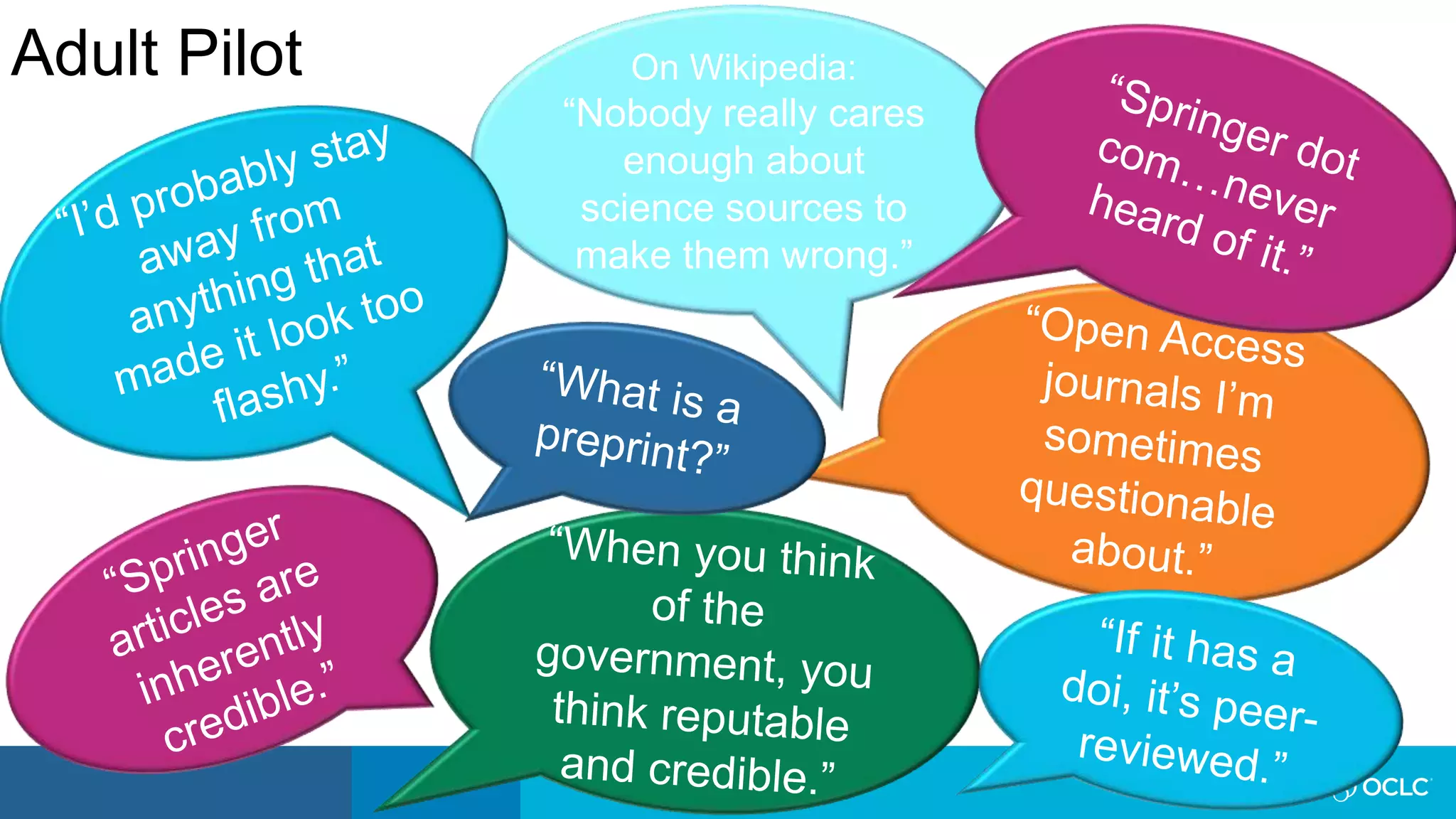
On Wikipedia:
“Nobody really cares
enough about
science sources to
make them wrong.”
Adult Pilot
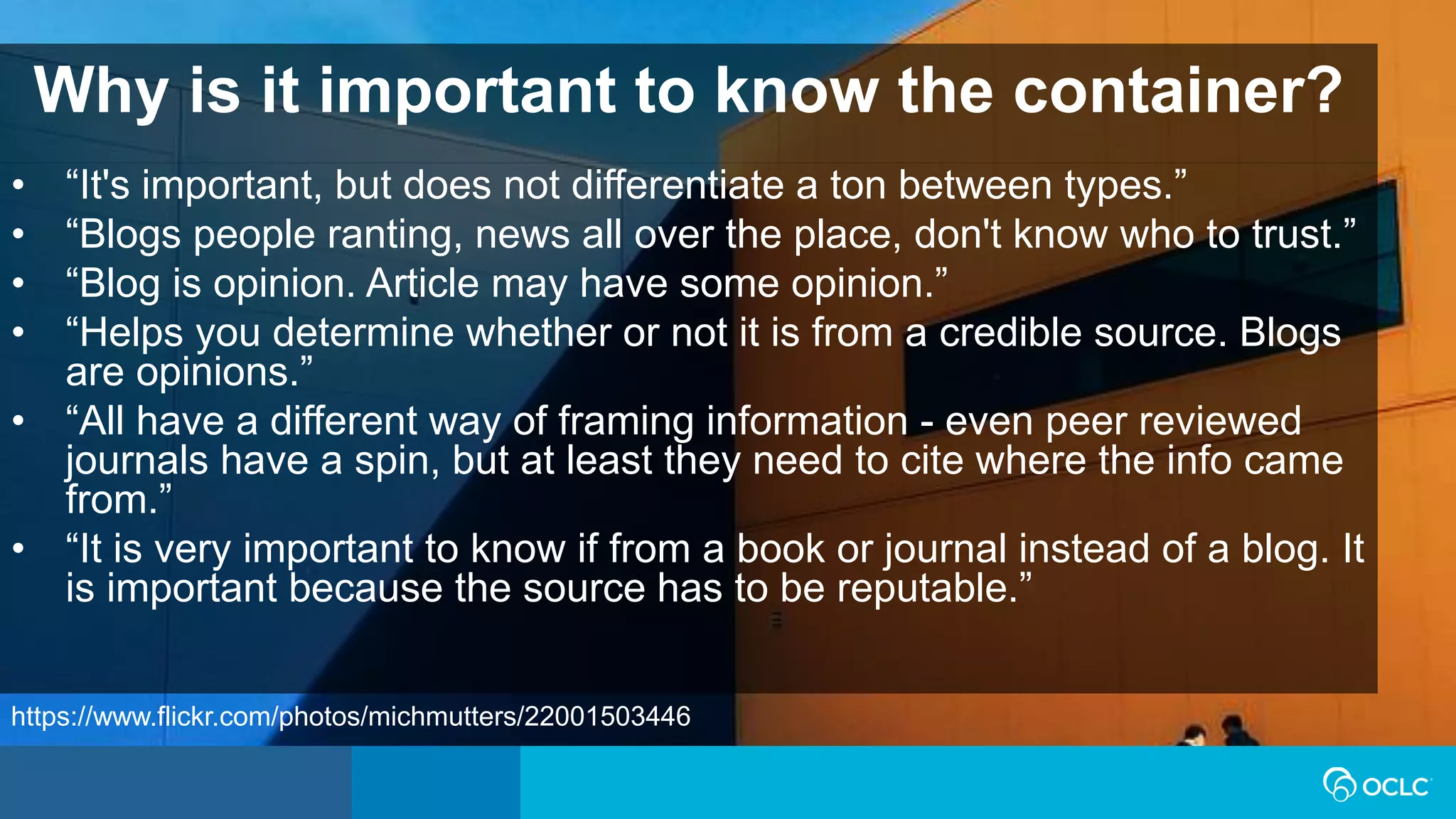
Why is it important to know the container?
• “It's important, but does not differentiate a ton between types.”
• “Blogs people ranting, news all over the place, don't know who to trust.”
• “Blog is opinion. Article may have some opinion.”
• “Helps you determine whether or not it is from a credible source. Blogs
are opinions.”
• “All have a different way of framing information - even peer reviewed
journals have a spin, but at least they need to cite where the info came
from.”
• “It is very important to know if from a book or journal instead of a blog. It
is important because the source has to be reputable.”
https://www.flickr.com/photos/michmutters/22001503446
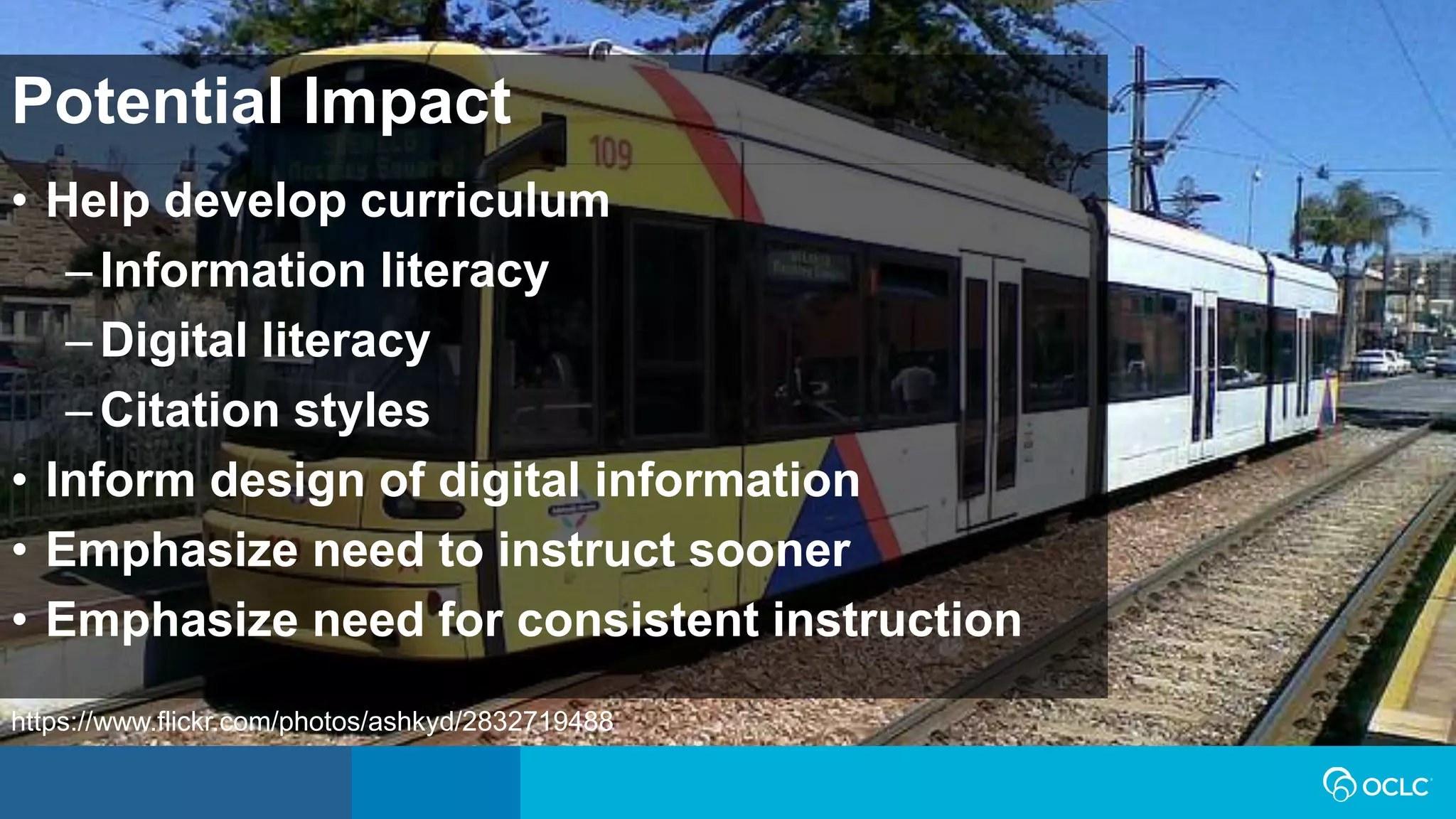
• Help develop curriculum
–Information literacy
–Digital literacy
–Citation styles
• Inform design of digital information
• Emphasize need to instruct sooner
• Emphasize need for consistent instruction
Potential Impact
https://www.flickr.com/photos/ashkyd/2832719488
MAPPING EXERCISE
Play
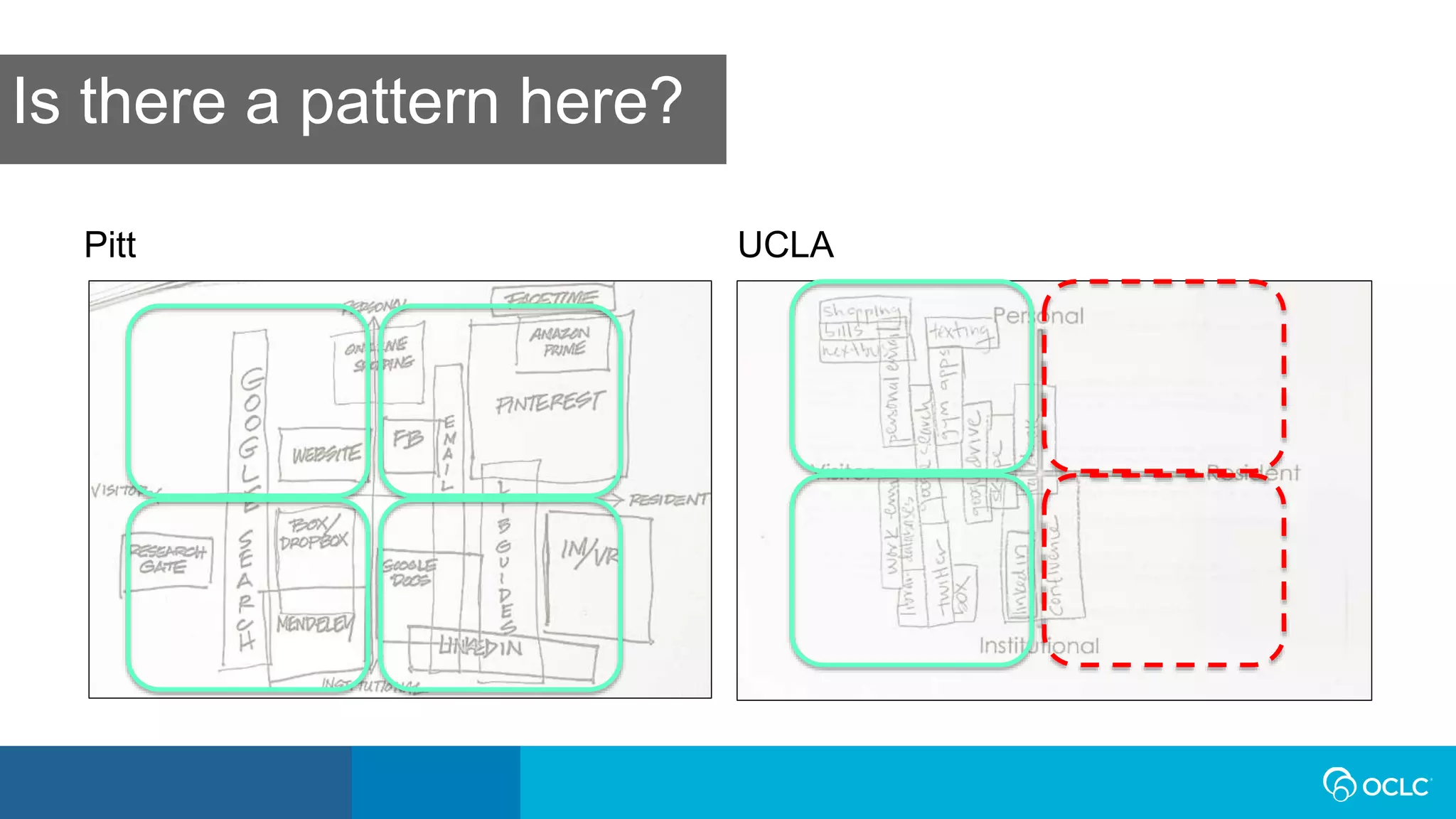
Is there a pattern here?
Pitt UCLA
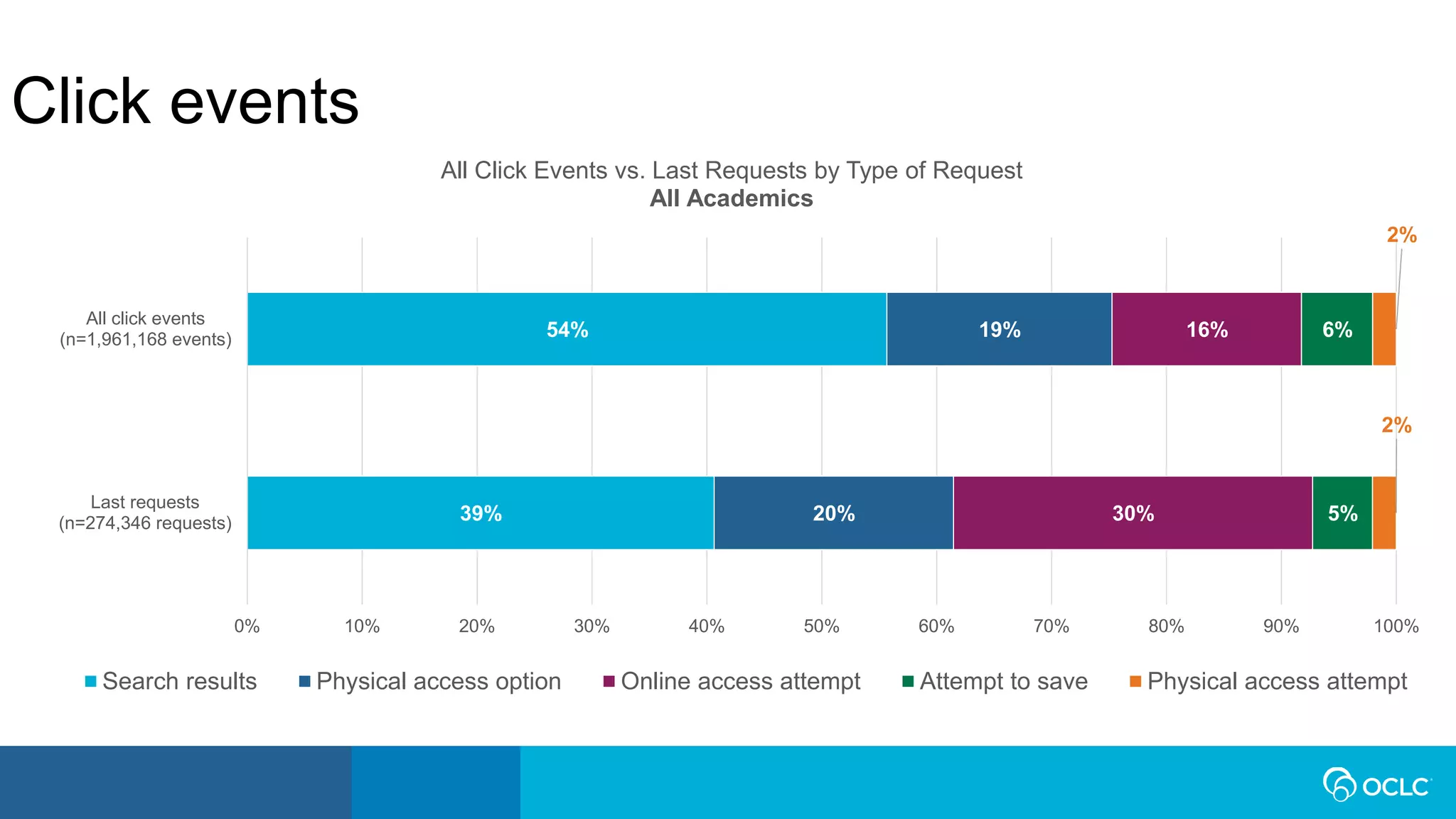
DISCOVERY AND ACCESS:
• How do academic library users navigate
the path from discovery to access?
39%
54%
20%
19%
30%
16%
5%
6%
2%
2%
0% 10% 20% 30% 40% 50% 60% 70% 80% 90% 100%
Last requests
(n=274,346 requests)
All click events
(n=1,961,168 events)
All Click Events vs. Last Requests by Type of Request
All Academics
Search results Physical access option Online access attempt Attempt to save Physical access attempt
Click events
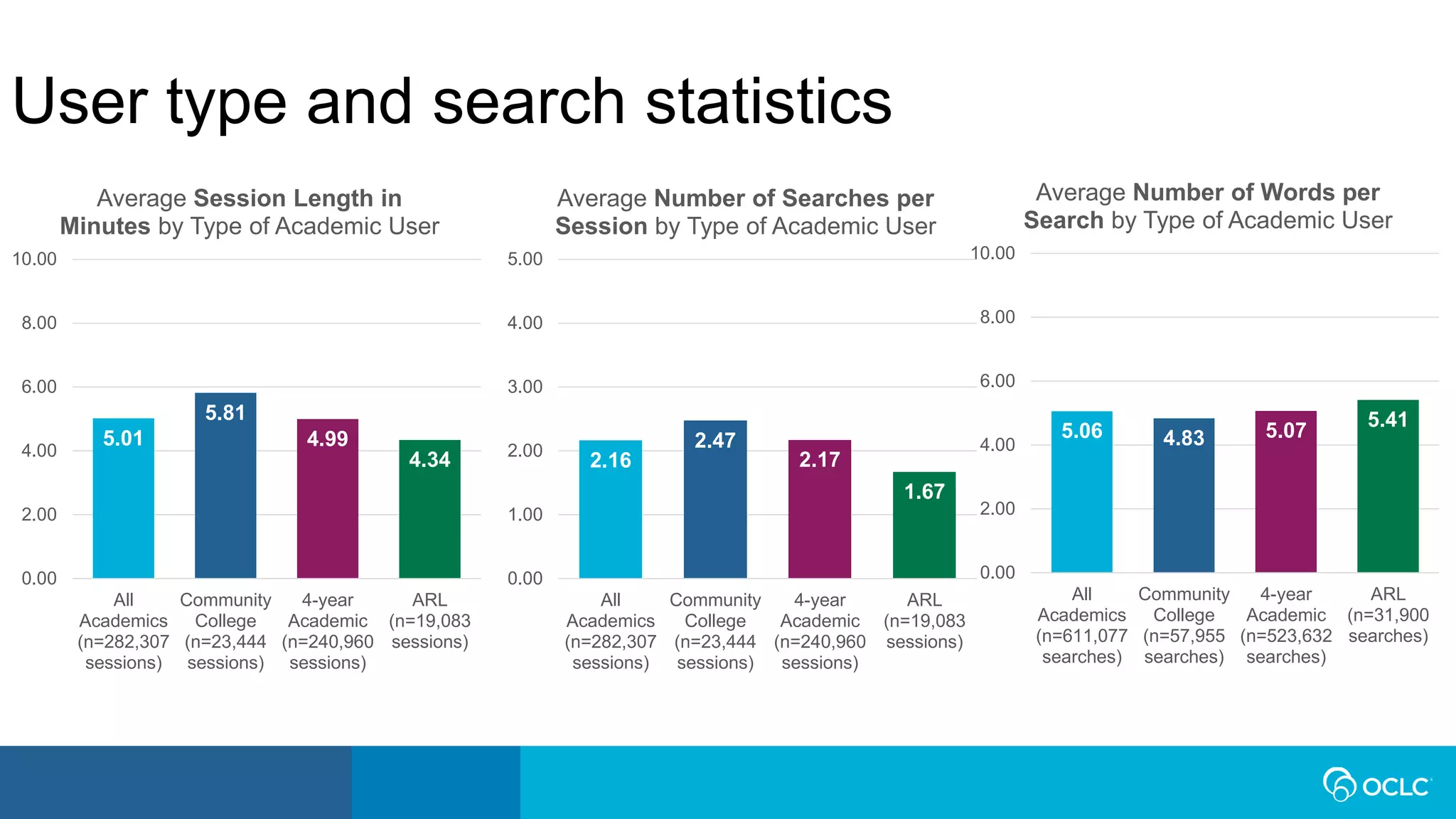
5.01
5.81
4.99
4.34
0.00
2.00
4.00
6.00
8.00
10.00
All
Academics
(n=282,307
sessions)
Community
College
(n=23,444
sessions)
4-year
Academic
(n=240,960
sessions)
ARL
(n=19,083
sessions)
Average Session Length in
Minutes by Type of Academic User
2.16
2.47
2.17
1.67
0.00
1.00
2.00
3.00
4.00
5.00
All
Academics
(n=282,307
sessions)
Community
College
(n=23,444
sessions)
4-year
Academic
(n=240,960
sessions)
ARL
(n=19,083
sessions)
Average Number of Searches per
Session by Type of Academic User
5.06 4.83 5.07
5.41
0.00
2.00
4.00
6.00
8.00
10.00
All
Academics
(n=611,077
searches)
Community
College
(n=57,955
searches)
4-year
Academic
(n=523,632
searches)
ARL
(n=31,900
searches)
Average Number of Words per
Search by Type of Academic User
User type and search statistics
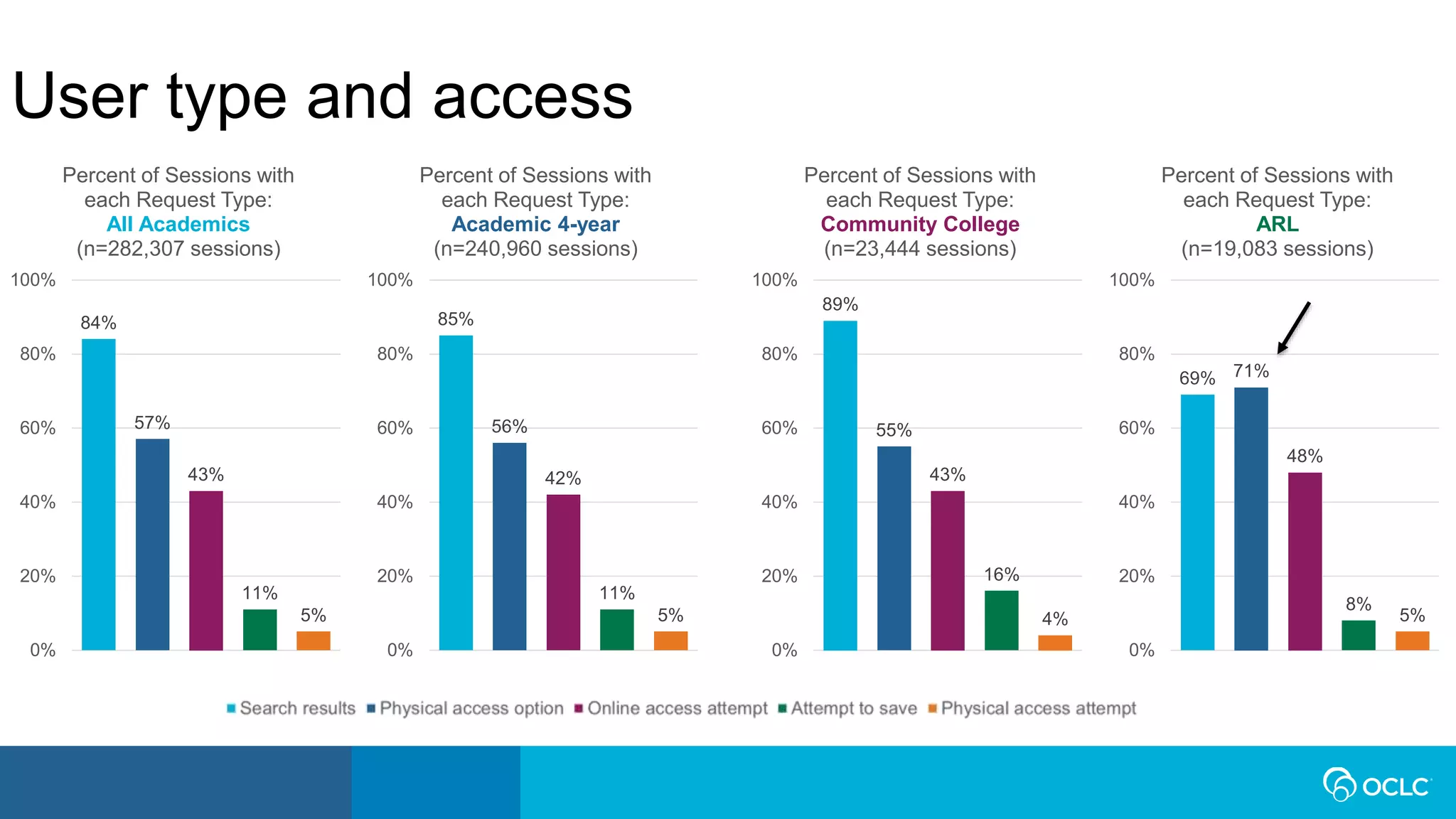
84%
57%
43%
11%
5%
0%
20%
40%
60%
80%
100%
Percent of Sessions with
each Request Type:
All Academics
(n=282,307 sessions)
85%
56%
42%
11%
5%
0%
20%
40%
60%
80%
100%
Percent of Sessions with
each Request Type:
Academic 4-year
(n=240,960 sessions)
89%
55%
43%
16%
4%
0%
20%
40%
60%
80%
100%
Percent of Sessions with
each Request Type:
Community College
(n=23,444 sessions)
69% 71%
48%
8%
5%
0%
20%
40%
60%
80%
100%
Percent of Sessions with
each Request Type:
ARL
(n=19,083 sessions)
User type and access
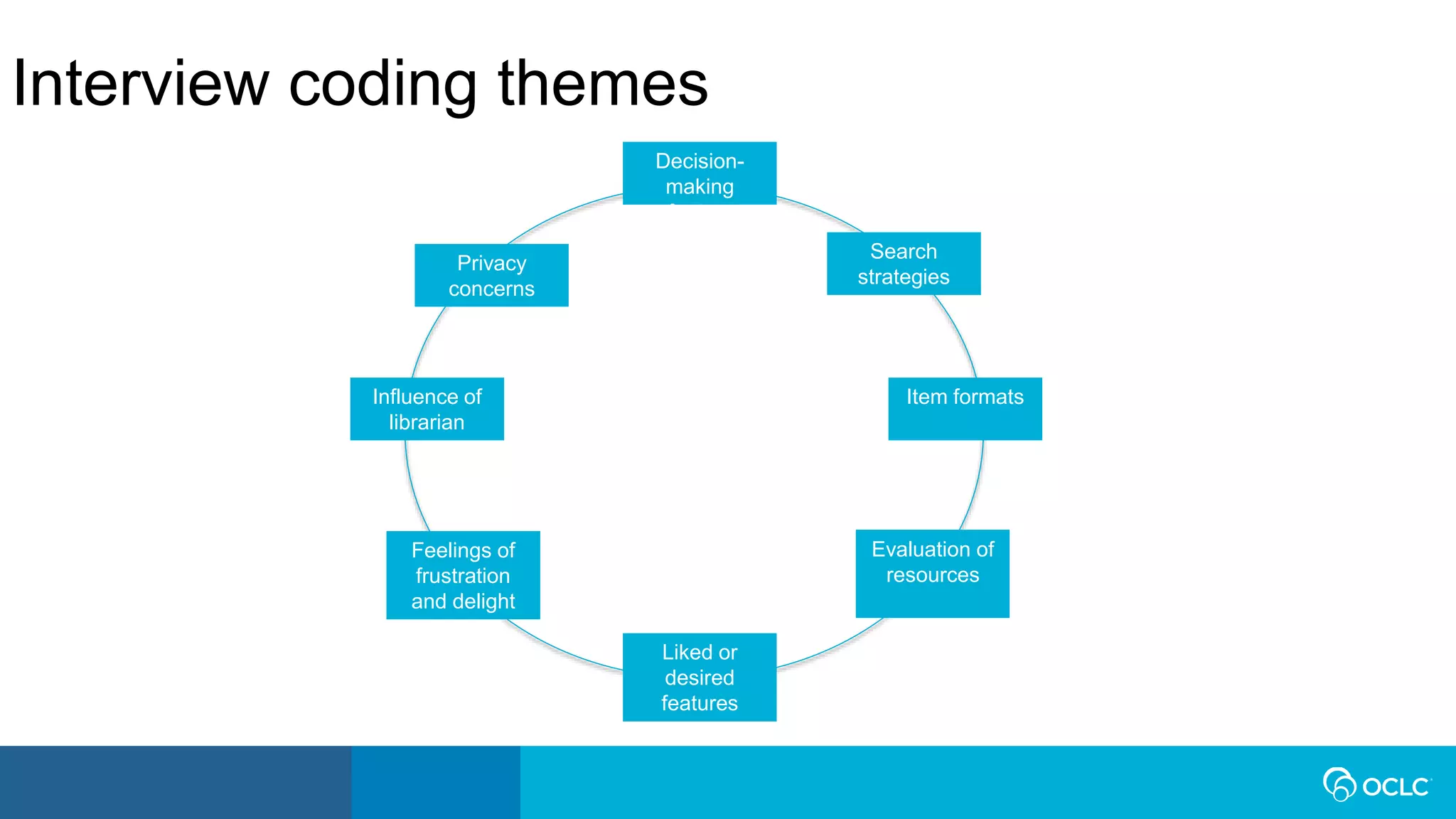
Decision-
making
factors
Search
strategies
Item formats
Evaluation of
resources
Liked or
desired
features
Feelings of
frustration
and delight
Influence of
librarian
Privacy
concerns
Interview coding themes
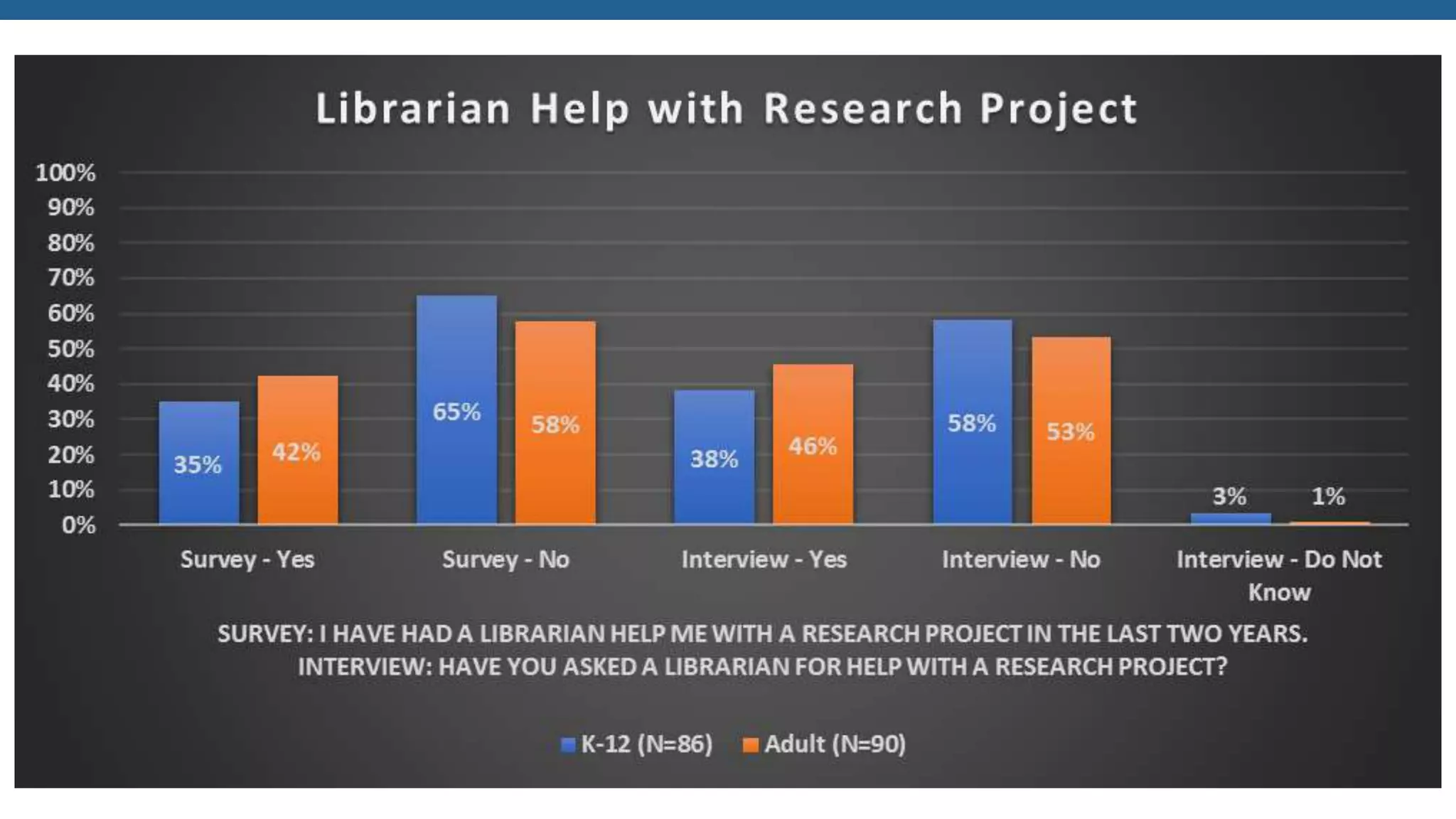
Librarians and library instruction enhance search
experience
Searches can be frustrating when users see too many
results
Convenience is a key factor in choosing online
resources
Implications
https://www.flickr.com/photos/anthonycramp/4428561177
Lessons Learned
• Human interaction/relationships still very important
when seeking information whether online or face-
to-face
• Convenience is priority for determining sources
and tools
• Convenience determined by context and
situation
• Individuals tend to use technologies they are
familiar and comfortable with and what their peers,
colleagues use and what they are required to use
for academic/professional situations
https://www.flickr.com/photos/jamesclay/3509154015
Lessons Learned
• Human interaction/relationships are still very
important Higher education administrations view
librarians as major component of student learning
and success, i.e., determining credibility,
developing critical thinking skills, and becoming
self-reflective
• Librarians and library instruction positively impact
search experience
• Library still associated with books
• People want and use library physical space
• Wikipedia is heavily used but not heavily cited or
acknowledged
https://www.flickr.com/photos/161174688@N08/39694088401
ACKNOWLEDGEMENTS
I would like to thank Chris Cyr for his assistance in
preparing this presentation.
References
Asher, A. & Miller, S. (2011). So You Want to Do Anthropology in Your Library? Or a Practical Guide to
Ethnographic Research in Academic Libraries. Chicago: The ERIAL Project.
Buhler, A., Cataldo, T. T., Faniel, I. M., Connaway, L. S., Valenza, J. K., Graff, R., Elrod, R., Putnam S., Cyr
C., Towler, C., Hood, E., Fowler R., Howland S., Brannon B, Langer, K., Kirlew, S. (2015-2018). Researching
students’ information choices: Determining identity and judging credibility in digital spaces. IMLS Grant
Project LG-81-15-0155. http://guides.uflib.ufl.edu/RSIC.
Clark, K. (2007). Mapping Diaries, or Where Do They Go All Day? In N. Foster & S. Gibbons (Eds.), Studying
Students: The Undergraduate Research Project at the University of Rochester. Chicago: Association College
and Research Libraries.
Connaway, L. S. (2016). “Is Anything More Important than Convenience?” Next, May 24,
http://www.oclc.org/blog/main/is-anything-more-important-than-convenience/.
Connaway, L. S. (2016). “#Librariesinlife: The Convenience Imperative.” Next, March 7,
http://www.oclc.org/blog/main/librariesinlife-the-convenience-imperative/.
References
Connaway, L. S. (2017, June 19). Putting the library in the life of the user: Listen, then lead, to promote a
unique and compelling role for academic libraries [blog post]. Guest of Choice, Choice360 blog. Retrieved
from http://www.choice360.org/blog/putting-the-library-in-the-life-of-the-user
Connaway, L. S. (2017, August 25). Can you believe it? How to determine credibility in the era of fake news.
Inside ASIS&T President’s Column, August 2017.
Connaway, L. S., Buhler, A., Cataldo, T., Faniel, I., Valenza, J., Elrod, R., Graff, R., Putnam, S., Brannon, B.,
Hood, E., Fowler, R., Langer, K., Kirlew, S. (2018). What is “container collapse” and why should librarians and
teachers care? OCLC Next. http://www.oclc.org/blog/main/what-is-container-collapse-and-why-should-
librarians-and-teachers-care/.
Connaway, L. S., & Dickey, T. J. (2010). The digital information seeker: Report of the findings from selected
OCLC, RIN, and JISC user behaviour projects. Retrieved from
http://www.jisc.ac.uk/media/documents/publications/reports/2010/digitalinformationseekerreport.pdf
References
Connaway, L. S., Lanclos, D. M., & Hood, E. M. (2013, December 6). “I always stick with the first thing that
comes up on Google…” Where people go for information, what they use, and why. EDUCAUSE Review
Online. Retrieved from http://er.educause.edu/articles/2013/12/i-always-stick-with-the-first-thing-that-comes-
up-on-google---where-people-go-for-information-what-they-use-and-why
Connaway, L. S., White, D., Lanclos, D., & Le Cornu, A. (2013). Visitors and Residents: What motivates
engagement with the digital information environment? Information Research, 18(1). Retrieved from
http://informationr.net/ir/18-1/infres181.html
Connaway, L. S., Harvey, H., Kitzie, V., and Mikitish, S. 2017. Action-Oriented Research Agenda on Library
Contributions to Student Learning and Success. January 10, 2017.
http://www.oclc.org/content/dam/research/themes/acrl-research-agenda-jan-2017.pdf.
References
Connaway, Lynn Silipigni, Vanessa Kitzie, Erin M. Hood and William Harvey. 2017. The Many Faces of Digital
Visitors & Residents: Facets of Online Engagement. With contributions from Allison Benedetti, Agustí Canals,
Liliana Gregori, Eva Ortoll Espinet, Daniel Lozano, Melissa Man, Josep Cobarsí Morales, Sara Giuliana
Ricetto, Riccardo Melgrati, Eva M. Méndez Rodríguez, Andrea Sada, Peter Sidorko, Paolo Sirito, Virginia
Steel, Titia van der Werf, and Esther Woo. Dublin, OH: OCLC Research. doi:10.25333/C3V63F
Connaway, L. S., Seadle, M., Julien, H., & Kasprak, A. (2017). Digital literacy in the era of fake news: Key
roles for information professionals. ASIS&T President’s Invited Panel.
Cool, C., & Spink, A. (2002). Issues of context in information retrieval (IR): An introduction to the special
issue. Information Processing and Management: An International Journal, 38(5), 605-611.
Dervin, Brenda, Lynn Silipigni Connaway, and Chandra Prabha. 2003-2006. Sense-making the Information
Confluence: The Whys and Hows of College and University User Satisficing of Information Needs. Funded by
the Institute of Museum and Library Services (IMLS).
http://www.oclc.org/research/activities/past/orprojects/imls/default.htm.
References
Domonoske, C. 2016. “Students Have ‘Dismaying’ Inability to Tell Fake News from Real, Study Finds.” NPR,
November 23, http://www.npr.org/sections/thetwo-way/2016/11/23/503129818/study-finds-students-have-
dismaying-inability-to-tell-fake-news-from-real.
English Oxford Living Dictionaries. 2016. “Word of the Year 2016 Is…” Accessed August 23,
2017. https://en.oxforddictionaries.com/word-of-the-year/word-of-the-year-2016.
English Oxford Living Dictionaries. 2017. “Word of the Year 2017 Is…” Accessed March 25,
2018. https://en.oxforddictionaries.com/word-of-the-year/word-of-the-year-2017.
Maheshwari, S. 2016. “How Fake News Goes Viral: A Case Study.” The New York Times, November
20, https://www.nytimes.com/2016/11/20/business/media/how-fake-news-spreads.html.
McCoy, T. 2016. “For the ‘New Yellow Journalists,’ Opportunity Comes in Clicks and Bucks.” The Washington
Post, November 20, https://www.washingtonpost.com/national/for-the-new-yellow-journalists-opportunity-
comes-in-clicks-and-bucks/2016/11/20/d58d036c-adbf-11e6-8b45-f8e493f06fcd_story.html.
References
Najmabadi, Shannon. 2017. “How Colleges Can Teach Students to Be Good Citizens.” The Chronicle of
Higher Education, January 13.
Prabha, Chandra, Lynn Silipigni Connaway, Lawrence Olszewski, and Lillie Jenkins. 2007. “What is enough?
Satisficing information needs.” Journal of Documentation 63, no. 1: 74–89.
http://www.oclc.org/content/dam/research/publications/newsletters/prabha-satisficing.pdf.
Simon, Herb. 1955. “A behavioral model of rational choice.” Quarterly Journal of Economics 69, no. 1: 99-
118.
Stanford History Education Group. (2016). Evaluating information: The cornerstone of civic online reasoning.
Retrieved from https://sheg.stanford.edu/upload/V3LessonPlans/Executive Summary 11.21.16.pdf
Steiner, P. (1993, July 5) On the internet. [Cartoon] The New Yorker. Retrieved from
https://condenaststore.com/featured/on-the-internet-peter-steiner.html
References
University of Adelaide. 2016. Library of the Future: Recommendations for a Bold and Agile University Library.
http://www.adelaide.edu.au/library/about/projects/lotf/Library_of_the_Future_Report_Final.pdf.
Williams, P., & Rowlands, I. (2007). Information Behaviour of the Researcher of the Future: The Literature on
Young People and Their Information Behaviour. British Library/JISC. Retrieved from
http://www.jisc.ac.uk/media/documents/programmes/reppres/ggworkpackageii.pdf
White, David S., and Lynn Silipigni Connaway. 2011-2014. Visitors & Residents: What Motivates Engagement
with the Digital Information Environment. Funded by JISC, OCLC, and Oxford University.
http://www.oclc.org/research/activities/vandr/.
Questions?
Lynn Silipigni Connaway, PhD
Director of Library Trends and User Research
connawal@oclc.org
@LynnConnaway

Convenient isn't always simple: Digital Visitors and Residents.

  • 1.
    University of Adelaide• 18 February 2019 Convenient Isn’t Always Simple: Digital Visitors and Residents Lynn Silipigni Connaway, PhD Director of Library Trends and User Research connawal@oclc.org @LynnConnaway
  • 2.
  • 3.
    About Digital Visitors& Residents • Identify how individuals engage with technology • How they acquire their information • Why they make their choices (White, Connaway, Lanclos, Hood, and Vass 2014) https://www.flickr.com/photos/gemmastiles/5342498260
  • 4.
    Why V&R? The importanceof context in information behavior (Cool & Spink, 2002) • Changes in engagement with information environment • Gap in user behavior studies • Understand motivations & expectations for using technologies • Track shifts in motivation & engagement during transition between educational stages (White & Connaway, 2011-2014; Connaway & Dickey, 2010) https://www.flickr.com/photos/mikecogh/42012395702
  • 5.
    •Functional use oftechnology •Formal need •Invisible online presence •Internet is a toolbox (White & Connaway 2011-2014) Visitor Mode Image: https://www.flickr.com/photos/daveynin/1974474522 by daveynin / CC BY 2.0
  • 6.
    Resident Mode • Visible& persistent online presence • Collaborative activity online • Contribute online • Internet is a place (White & Connaway 2011-2014) https://www.flickr.com/photos/heatherw/258337934/
  • 7.
    Lynn Silipigni, VanessaKitzie, Erin M. Hood and William Harvey. 2017. The Many Faces of Digital Visitors & Residents: Facets of Online Engagement. With contributions from Allison Benedetti, Agustí Canals, Liliana Gregori, Eva Ortoll Espinet, Daniel Lozano, Melissa Man, Josep Cobarsí Morales, Sara Giuliana Ricetto, Riccardo Melgrati, Eva M. Méndez Rodríguez, Andrea Sada, Peter Sidorko, Paolo Sirito, Virginia Steel, Titia van der Werf, and Esther Woo. Dublin, OH: OCLC Research. doi:10.25333/C3V63F https://www.oclc.org/content/dam/research/publications/2017/oclcresearch-many-faces-digital-vandr-a4.pdf.
  • 8.
    V&R Framework (White &Le Cornu 2011) #vandr Visitors & Residents resources http://goo.gl/vxUMRD
  • 9.
    Engaging individuals incontext #vandr Visitors & Residents resources http://goo.gl/vxUMRD Connaway & White for OCLC Research 2012
  • 10.
  • 11.
    4 Project Phases •Semi-structured interviews • Diaries/monthly semi- structured interviews • Written • Video • Skype or telephone • Second group of semi- structured interviews • Online survey V&R Data Collection Tools Image: https://www.flickr.com/photos/pixality/5642536583 by Pixality / CC BY-SA 2.0
  • 12.
    Visitors & ResidentsInterviews • United States • United Kingdom • Universidad Carlos III de Madrid (Madrid, Spain) • Università Cattolica del Sacro Cuore (Milan, Italy) • Universitat Oberta de Catalunya (Barcelona, Spain) https://www.flickr.com/photos/kalel_mos/34185257/
  • 13.
    Educational Stage Universidad Carlos IIIde Madrid (Madrid) United States United Kingdom Universitat Oberta de Catalunya (Barcelona) Università Cattolica del Sacro Cuore (Milan) Emerging Participants 8 22 21 6 3 Establishing Participants 10 5 5 7 6 Embedding Participants 10 5 5 7 6 Experiencing Participants 10 5 5 13 5 Total 38 37 36 33 20 Visitors & Residents Interview Demographics N=164 (n=164)
  • 14.
    V&R Diaries • 22Diarists (10 UK/12 US): • 66 diaries collected • 53 follow-up diarist interviews conducted • Conducted & collected from April 2011 through October 2013 (White & Connaway 2011-2014) Image: https://www.flickr.com/photos/tekkebln/6904577257 by Tekke / CC BY-ND 2.0
  • 15.
    1. Explain atime in the past month when you were SUCCESSFUL in completing an ACADEMIC assignment. What steps did you take? 2. Think of a time fairly recently when you struggled to find appropriate resources to help you complete an ACADEMIC assignment. What happened? 3. Explain a time in the past month when you were successful in getting what you needed in a PERSONAL situation. What steps did you take? V&R Diary Follow-Up Interviews https://www.flickr.com/photos/helenk/32569182264
  • 16.
    V&R Online Surveys •In-depth online survey • 150 participants from the US & UK • 42 Emerging • 42 Establishing • 42 Embedding • 24 Experiencing https://www.flickr.com/photos/martinhoward/2969948271
  • 17.
    Visitors & Residents CodebookExcerpt Image: https://www.flickr.com/photos/eberg/5930730983/ by Evelyn Berg / CC BY-NC-ND 2.0 I. Place A.Internet 1. Search engine a. Google b. Yahoo 2. Social Media a. Facebook b. Twitter c. You Tube d. Flickr/ image sharing e. Blogging B. Library 1. Academic 2. Public 3. School (K-12) C. Home D. School, classroom, computer lab E. Other
  • 18.
    Theme Sub-theme Sub-themeSub-theme Definition Example Place (I) Internet (I.A) Online, unspecified “I will go online for the subject because I know the what's online will be of better quality and more relevant to the specification than what's in the book” (2UKU2). Search Engine (I.A.1) Unspecified or unlisted search engine (i.e., Bing) “Or I’ll go back to the search engine and start again and look at all the other options that I’m able to look at” (UKS4). Google (I.A.1.a) “I would start by Googling definitely” (2UKS2). Social Media (I.A.2) Unspecified or unlisted social media (i.e., LinkedIn) “Well, I like social media, but I don't know if anything would change anything about my academics … um, the only thing that I can think of that I'll probably ever be able to think of, is the detrimental effect it has on my academics because it distracts me” (USG2). Facebook (I.A.2.a) “When I'm doing homework or coursework or something, I'll always have Facebook and Twitter open, for example, as well” (2UKS2). Twitter (I.A.2.b) “Twitter, I don't use it educationally at all” (2UKS2). Library (I.B) Unspecified library “I think first of all I would search on Google Scholar to see whether there is an e-version. Because I’m pretty comfortable reading online. And if there is not, then I will go to the library. Yes. When I have to” (UKG1). Academic (I.B.1) “The majority of the journal articles that we would read are online although frequently books are still not converted into e- books yet, so they’re frequently found in the education library” (UKG2). Visitors & Residents Codebook Excerpt
  • 19.
  • 20.
    NVivo Background image: https://www.flickr.com/photos/37718677955@N01/36699914by clickykbd / CC BY-NC-SA 2.0 A qualitative data analysis computer software package produced by QSR International for qualitative & mixed methods research.
  • 21.
  • 22.
    “Our clients arealready accustomed to high quality digital experiences, from instant information search to social media and online shopping.” (University of Adelaide 2016, 15) Library Services
  • 23.
    “It is clearthat physical materials are not going away, but use patterns suggest that we should prioritise broader access to e-resources...” (University of Adelaide 2016, 15) Library Collections
  • 24.
    “The traditional librarywas firmly rooted in the physical...The Library of the Future must go further.” (University of Adelaide 2016, 32) Library Organization
  • 25.
    “We will alsoembrace our heritage and emphasise the grandeur of the Reading Room...” (University of Adelaide 2016, 37) Library Facilities and Systems
  • 26.
    Implications • Libraries andother online services complementary • Checking out physical items remains a vital library service • Many library users like to put down roots within the library physical space Image: https://www.flickr.com/photos/brewbooks/259437129 by brewbooks / CC BY-SA 2.0
  • 27.
  • 28.
    Image: Oxford Dictionaries,November 15, 2016, 9:00PM, https://twitter.com/oxfordwords/status/798752580872437760?lang=en
  • 29.
    Post-truth Use Frequency Oxforddictionaries.comImage:Oxford Dictionaries, “Word of the Year 2016 is...,” English Oxford Living Dictionaries, https://en.oxforddictionaries.com/word-of-the-year/word-of-the-year-2016
  • 30.
    The EU referendumin the UK and the presidential election in the US highlighted the importance of identifying fake news determining credibility, trustworthiness, and integrity of information fact checking. (Domonoske 2016; Maheshwari 2016; McCoy 2016) https://www.flickr.com/photos/36593372@N04/27601370600
  • 31.
    Image: https://www.flickr.com/photos/dskley/13716083704 byDennis Skley / CC BY-ND 2.0 “…the whole kind of conversation around fake news is this really important example of how important it is in our daily life and civic health in order to bring critical skills to bear on understanding information and being able to critically evaluate the source of that.” (Advisory Member LM03, Research University, Secular, Private)
  • 32.
    “People [are] talkingabout the problems of educating people to be citizens more, with this election being indicative of that. This is a hard thing to confront right now because we are going to have an administration that doesn't think that's important at all.” (Provost Interviewee PP02, Research University, Non-Secular, Private) Image: http://bit.ly/2lPFoNi by Clemens V. Vogelsang / CC BY 2.0
  • 33.
    Determining trustworthy sources ofinformation is difficult in today’s environment Image: https://www.flickr.com/photos/gabbysol/21510538432 by Michelle Grewe / Public Domain
  • 34.
    Millennials and Post-Millennials,although at ease with information technology, struggle with the evaluation of online sources. (Connaway, Lanclos, & Hood, 2013; Connaway, White, Lanclos, & Le Cornu, 2013; Stanford History Education Group, 2016) https://www.flickr.com/photos/pursuedbybear/27603832009
  • 35.
    Image: https://www.flickr.com/photos/bobx-nc/14056106583/ byBob Muller / CC BY-NC 2.0 “It depends. It depends who’s made the website or what I have been told about the website or whether I know about it at all. But — it sounds silly — but sometimes you can just tell whether a website looks reliable or not depending on how professional [it] looks and who’s written it.” (Digital Visitors and Residents, UKU6, Female, Age 19, Emerging)
  • 36.
    Image: https://www.flickr.com/photos/skinnylawyer/6337956175/ byInSapphoWeTrust / CC BY-SA 2.0 “I always stick with the first thing that comes up on Google because I think that’s the most popular site which means that’s the most correct.” (Digital Visitors and Residents, USS1, Female, Age 17, High School Student)
  • 37.
    “That's a YouTubevideo. No thank you. …anybody could have uploaded that.” (Researching Students’ Information Choices, G22)
  • 38.
    Image: https://www.flickr.com/photos/gabbysol/21510538432 byMichelle Grewe / Public Domain In information seeking, convenience is key… But it depends on context and situation.
  • 39.
    “You spend many hourswith Saint Google. We entrust ourselves to Saint Google and that solves it for us.” (Digital Visitors & Residents, UOCFI6, Male, Age 53, Arts & Humanities) https://www.flickr.com/photos/82134796@N03/12578094834
  • 40.
    “Wikipedia… it’s perfect,because it gives you the words, the things, the technical words that you need to look, keywords, so Wikipedia is always, always the first step.” (UOCG1, Male, Age 35-44, Professions and Applied Sciences) Image: https://www.flickr.com/photos/mayopants/4021073588/ by stateofplace / CC BY-NC 2.0
  • 41.
    “People lack patienceto wade through content silos…” (Connaway 2015, 134) “Yes, it [Matrix film plug-in to brain] - sort of makes information gathering effortless and without having to sort of manually go through and separate the chaff from the wheat.” (Digital Visitors and Residents, UKU10, Male, Age 20, Law) https://www.flickr.com/photos/82134796@N03/9534745875
  • 42.
    “Because, most likely,I won't be able to see the book, just a little abstract, and that might not be helpful because I won't get the entire information, just a part of it. That gets frustrating.” (Researcing Students’ Information Choices, S07) Image: https://www.flickr.com/photos/johnloo/7424050476 by John Loo / CC BY 2.0
  • 43.
    Image: https://www.flickr.com/photos/gabbysol/21510538432 byMichelle Grewe / Public Domain Critical thinking skills are a primary concern of university administrators and are crucial for developing an informed citizenry. (Connaway et al., 2017; Najmabadi, 2017)
  • 44.
    “I do notthink the learning stops after [students graduate]. How do we set our students up for success? How do they reach the outcomes that we want for them? How do we have them thinking about, and in particular for libraries, how do they think about that down the road as, using public libraries and the resources we have there as well?” (Provost Interviewee PP06, Research University, Secular, Public) Image: https://www.flickr.com/photos/benhosg/32627578042 by Benjamin Ho / CC BY-NC-ND 2.0
  • 45.
    “We should behelping people learn how to think, learn how to be skeptical, learn how to use critical thinking skills, learn how to be self- reflective. I think because those things are so much harder to assess and to demonstrate we have not done as good a job telling that story.” (Provost Interviewee PP10, College, Non- secular, Private) Image: https://www.flickr.com/photos/deia/6461457 by Andréia Bohner / CC BY 2.0
  • 46.
    (Connaway et al.,2017) Image: https://www.flickr.com/photos/gabbysol/21510538432 by Michelle Grewe / Public Domain “Humans are a valued source of information.”
  • 47.
    “Regarding health affairs,I usually don’t search on the internet because… you have pain in one finger and then you end up [thinking] you have the bubonic plague… For this situation, I would use personal contacts.” (UOCG3, Male, Age 28, Computer Science) Image: https://www.flickr.com/photos/zachduffy/2634956354 by Zach Duffy / CC BY-NC-ND 2.0
  • 48.
    “A wise person.I like books and technology, but people are better.” (UOCU1, Female, 19-25, Professions and Applied Sciences) The magic future would be… Image: https://www.flickr.com/photos/photophilde/4353228184 by photophilde / CC BY-SA 2.0
  • 49.
    (Connaway et al.,2017) Image: https://www.flickr.com/photos/gabbysol/21510538432 by Michelle Grewe / Public Domain “Wikipedia is used by individuals in all educational stages to familiarize themselves with a subject or topic.”
  • 50.
    “Wikipedia… it’s perfect,because it gives you the words, the things, the technical words that you need to look, keywords, so Wikipedia is always, always the first step.” (UOCG1, Male, Age 35-44, Professions and Applied Sciences) Image: https://www.flickr.com/photos/mayopants/4021073588/ by stateofplace / CC BY-NC 2.0
  • 51.
    “I used toseek information in Wikipedia, even my colleagues said that there are wrong things on it…but I said Enciclopedia Larousse [Traditional encyclopedia] also have mistakes…the only difference is that it is printed and is impossible to correct the mistakes once you have the printed version…Mistakes are not about technology, are about people.” (Digital Visitors & Residents, UOCFE6, Male, Age 53, Computer Science) Image: http://www.flickr.com/photos/20452143@N08/3841271286 by Adam DeClercq / CC BY-NC-SA 2.0
  • 52.
    “It’s like ataboo I guess with all teachers, they just all say – you know, when they explain the paper they always say, ‘Don’t use Wikipedia.’” (Digital Visitors & Residents, USU7, Female, Age 19, Political Science) The Learning Black Market Image: https://www.flickr.com/photos/asuranlv/8784338892 by Eduards Osis / CC BY-NC 2.0
  • 53.
    “Convenience is apriority when making decisions about what tools and sources to use.” (Connaway et al., 2017) Image: https://www.flickr.com/photos/gabbysol/21510538432 by Michelle Grewe / Public Domain
  • 54.
    “At first Istarted looking online, and it was a little bit overwhelming…I ended up reaching into my mom’s cupboard and using a recipe that I found in one of her old cookbooks. The recipe was just what I was looking for...” (Digital Visitors & Residents, USS3, Emerging, Female, Age 17, High School Student) “Convenient” Isn’t Always Simple Image: https://www.flickr.com/photos/29233640@N07/8395962128 by Robert Couse-Baker / CC BY 2.0
  • 55.
    Satisficing…What is enoughinformation? “…I needed the answer, my maths, I was doing an exercise, I got stuck on a question, I still had the rest of the exercise to go and I had like an hour to do it and I just wanted the formula and the quickest way to do it was to type it into Google and it came up.” (Digital Visitors & Residents, UKS2, Female, Age 17, Secondary School Student) Image: https://www.flickr.com/photos/irchriscdk/13946605527 by Chris de Kok / CC BY 2.0
  • 56.
    “Participants report extensiveuse of search engines, especially Google, and take them for granted.” (Connaway et al., 2017) Image: https://www.flickr.com/photos/gabbysol/21510538432 by Michelle Grewe / Public Domain
  • 57.
    Centrality of Google& search engines “…I just think it’s [VLE web site] too complicated and it’s limited, that I just carried on going on Google.” (Digital Visitors & Residents, UKS6, Emerging, Female, Age 16, Secondary School Student) Image: https://www.flickr.com/photos/thomashawk/307750722 by Thomas Hawk / CC BY-NC 2.0
  • 58.
    “You spend manyhours with Saint Google. We entrust ourselves to Saint Google and that solves it for us.” (Digital Visitors & Residents, UOCFI6, Male, Age 53, Arts & Humanities) https://www.flickr.com/photos/dileeshus/8447597692/
  • 59.
    “Library sources areused but not recognized or attributed to the library.” (Connaway et al., 2017) Image: https://www.flickr.com/photos/gabbysol/21510538432 by Michelle Grewe / Public Domain
  • 60.
    “The students arecompletely unaware of the resources that the university has in repositories, databases, etc. on their subjects. Most of the interviewees do not know the possibility of consulting books in full text, being able to develop bibliographies or access remotely the funds using virtual contexts of the campus of its university. (V&R Project Team Member, Universidad Carlos III de Madrid) https://www.flickr.com/photos/82134796@N03/10340244055
  • 61.
    “Perhaps one ofthe more interesting actions could be to promote the library services to students and how to use them. Now, the library resources are embedded in the virtual classroom and the students are not aware of this, but in contrast, they don’t explore the full potential of [the] academic library.” (Eva Ortoll Espinet, Universitat Oberta de Catalunya) https://www.flickr.com/photos/124930081@N08/16026272820
  • 62.
    “People lack patienceto wade through content silos…” (Connaway 2015, 134) “Yes, it [Matrix film plug-in to brain] - sort of makes information gathering effortless and without having to sort of manually go through and separate the chaff from the wheat.” (Digital Visitors & Residents, UKU10, Male, Age 20, Law)
  • 63.
  • 64.
    Researching Students’ InformationChoices (RSIC): Determining Identity and Judging Credibility in Digital Spaces • 4-year IMLS funded National Leadership Grant #LG-81-15-0155 • Research questions: • Do STEM students differentiate among different types of digital resources at point of selection? • How do STEM students determine the credibility of digital resources? http://guides.uflib.ufl.edu/RSIC
  • 65.
    “Google Generation areformat agnostic and have little interest in the containers (reports, book chapters, encyclopedia entries)…we feel this one is still wide open. It is a hugely important issue for libraries and publishers” (Williams & Rowlands, 2007, p. 20)
  • 66.
    Container Collapse (#containercollapse) •Visual context and cues that print containers provide used to help individuals identify a document’s origins and measure its value • Cues are obscured or more difficult to discern • “In digital format, a document is decanted from its original container and must be carefully examined to determine the journey it took to reach the individual.” (Connaway et al., 2018) https://www.flickr.com/photos/82134796@N03/11830719395
  • 67.
    Research Methods Data Collection •Pre-screen survey • Simulation • Pre-interview • Information Choice Tasks • Post-Interview Participants - Alachua County, FL • 4th – 5th grade • 6th – 8th grade • 9th – 12th grade • Community college • University undergraduate • University graduate https://www.flickr.com/photos/tomshouse/448094130
  • 68.
    Simulation tasks 1. Usefultask – select 20 useful sources 2. Cite task – would you cite your useful sources? 3. Why Not Useful task – why weren’t they useful? 4. Credibility task – how credible are these resources? 5. Container tagging – what container best describes these 20 resources? https://www.flickr.com/photos/56001877@N04/10241910294
  • 69.
  • 70.
    Simulation data collected •Quantitative data from Storyline • Choices made in each task • Every click into a resource • Qualitative data • Pre and Post interview questions • Audio transcript • Video file – attempted clicks or points not captured by Storyline https://www.flickr.com/photos/56001877@N04/8337331974
  • 71.
    Resources Container Adult 9-126-8 4-5 Blog 5 4 2 1 Book 7 5 3 3 Conference Proceedings 2 0 0 0 Magazine 3 6 4 4 Journal 8 4 3 2 News 4 5 5 1 Preprint 2 1 0 0 Website 9 15 13 9 Total 40 40 30 20
  • 75.
    Container Collapse Students believe •Important to know the container from which online information comes – Number decreases with younger students • In own abilities to discern sources – Only 2% of participants express limited confidence in their ability to select online resources for research projects (Connaway et al., 2018) https://www.flickr.com/photos/adiasun81/2327495421
  • 78.
    Student Perspectives • “What’sa preprint?” • “I don’t really know if New York Times is a journal or a magazine.” • “This looks like a scholarly article.” • “This one’s a blog. Or is it a journal. Or is it a book? It’s a journal.” • “This shouldn’t be so hard.” https://www.flickr.com/photos/bram_souffreau/400741510
  • 79.
    Pilot ≠ Findings Pilotwas to help prepare for the actual participants. Adult pilot studies were conducted with 6 participants • 2 community college students • 2 undergraduate students • 2 graduate students Adult Pilot https://www.flickr.com/photos/leshaines123/8633339605
  • 80.
    0 5 1015 20 25 30 35 40 45 Graduate (n=2) Undergraduate (n=2) Community College (n=2) Container Task Correct Answers (out of 42 possible) Adult Pilot
  • 81.
    Adult Pilot Most agreement: •The New York Times • Springer journal • Wiley journal • Google book Least agreement: • USGS.gov news (journal, website, news, preprint) • USGS.gov book (journal, book, website) • Royal Society Publishing (conference proceeding, journal, preprint)
  • 82.
  • 83.
  • 84.
    On Wikipedia: “Nobody reallycares enough about science sources to make them wrong.” Adult Pilot
  • 85.
    Why is itimportant to know the container? • “It's important, but does not differentiate a ton between types.” • “Blogs people ranting, news all over the place, don't know who to trust.” • “Blog is opinion. Article may have some opinion.” • “Helps you determine whether or not it is from a credible source. Blogs are opinions.” • “All have a different way of framing information - even peer reviewed journals have a spin, but at least they need to cite where the info came from.” • “It is very important to know if from a book or journal instead of a blog. It is important because the source has to be reputable.” https://www.flickr.com/photos/michmutters/22001503446
  • 86.
    • Help developcurriculum –Information literacy –Digital literacy –Citation styles • Inform design of digital information • Emphasize need to instruct sooner • Emphasize need for consistent instruction Potential Impact https://www.flickr.com/photos/ashkyd/2832719488
  • 87.
  • 88.
  • 89.
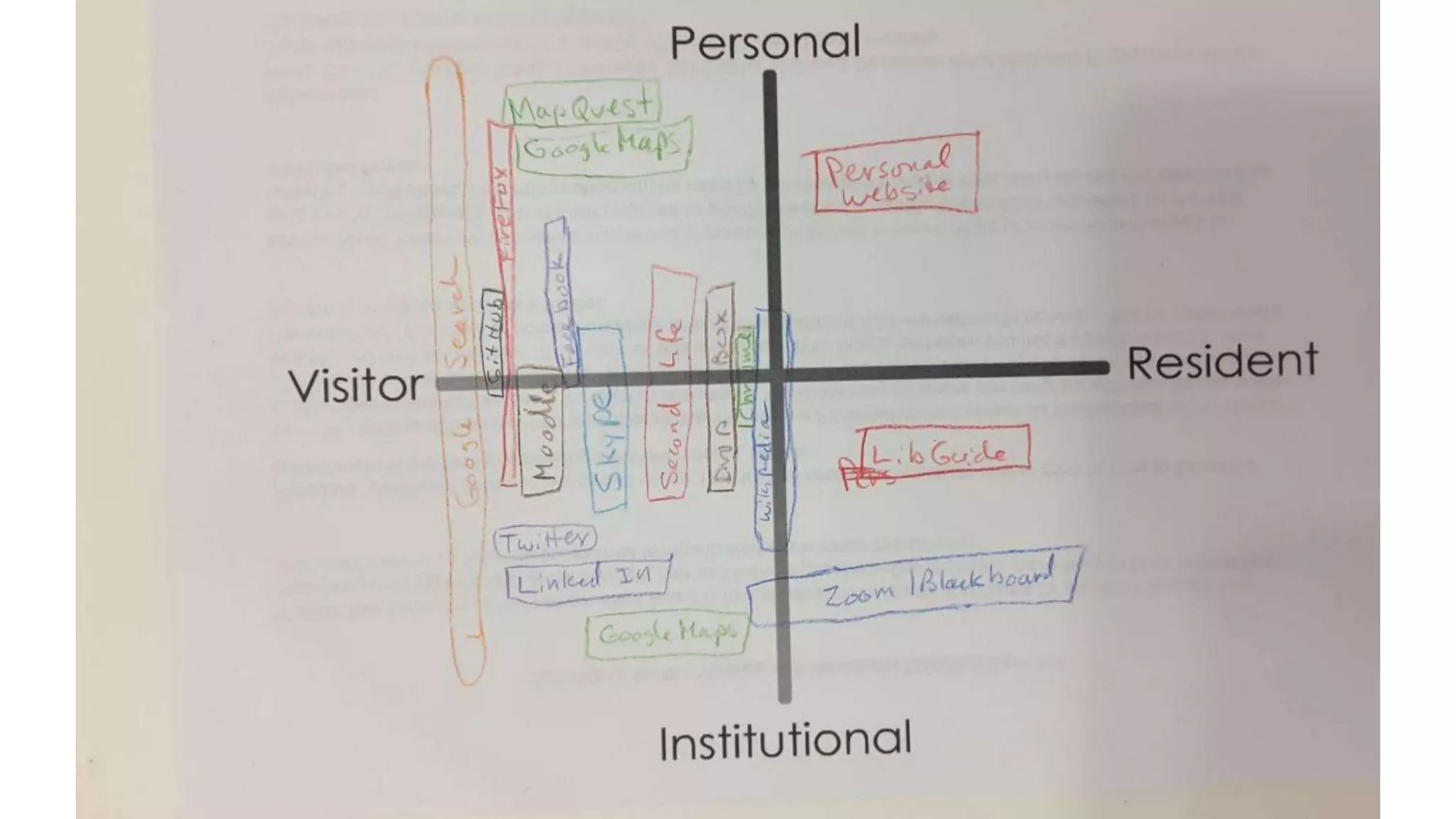
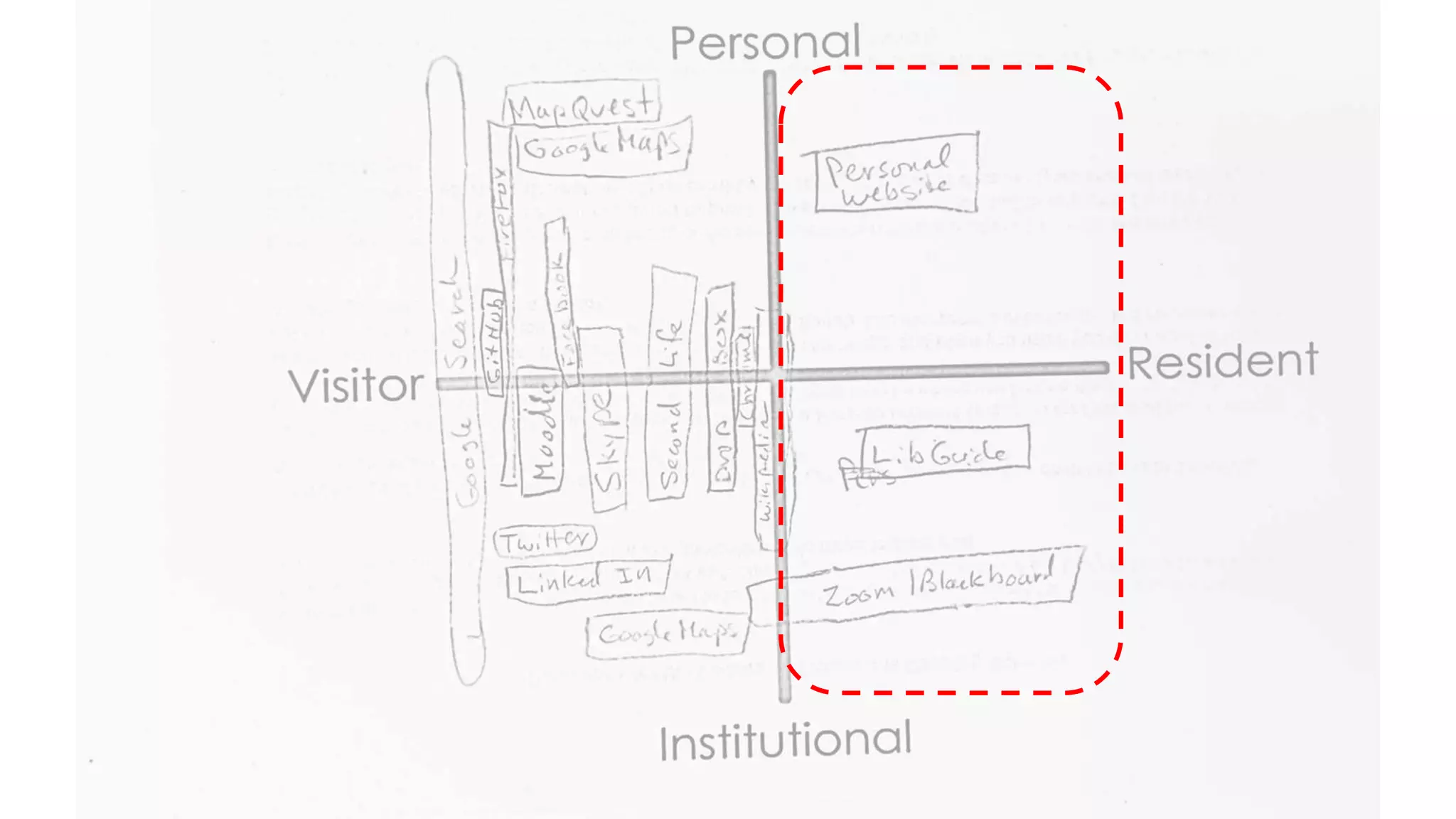
    Is there apattern here? Pitt UCLA
  • 100.
    DISCOVERY AND ACCESS: •How do academic library users navigate the path from discovery to access?
  • 101.
    39% 54% 20% 19% 30% 16% 5% 6% 2% 2% 0% 10% 20%30% 40% 50% 60% 70% 80% 90% 100% Last requests (n=274,346 requests) All click events (n=1,961,168 events) All Click Events vs. Last Requests by Type of Request All Academics Search results Physical access option Online access attempt Attempt to save Physical access attempt Click events
  • 102.
    5.01 5.81 4.99 4.34 0.00 2.00 4.00 6.00 8.00 10.00 All Academics (n=282,307 sessions) Community College (n=23,444 sessions) 4-year Academic (n=240,960 sessions) ARL (n=19,083 sessions) Average Session Lengthin Minutes by Type of Academic User 2.16 2.47 2.17 1.67 0.00 1.00 2.00 3.00 4.00 5.00 All Academics (n=282,307 sessions) Community College (n=23,444 sessions) 4-year Academic (n=240,960 sessions) ARL (n=19,083 sessions) Average Number of Searches per Session by Type of Academic User 5.06 4.83 5.07 5.41 0.00 2.00 4.00 6.00 8.00 10.00 All Academics (n=611,077 searches) Community College (n=57,955 searches) 4-year Academic (n=523,632 searches) ARL (n=31,900 searches) Average Number of Words per Search by Type of Academic User User type and search statistics
  • 103.
    84% 57% 43% 11% 5% 0% 20% 40% 60% 80% 100% Percent of Sessionswith each Request Type: All Academics (n=282,307 sessions) 85% 56% 42% 11% 5% 0% 20% 40% 60% 80% 100% Percent of Sessions with each Request Type: Academic 4-year (n=240,960 sessions) 89% 55% 43% 16% 4% 0% 20% 40% 60% 80% 100% Percent of Sessions with each Request Type: Community College (n=23,444 sessions) 69% 71% 48% 8% 5% 0% 20% 40% 60% 80% 100% Percent of Sessions with each Request Type: ARL (n=19,083 sessions) User type and access
  • 104.
    Decision- making factors Search strategies Item formats Evaluation of resources Likedor desired features Feelings of frustration and delight Influence of librarian Privacy concerns Interview coding themes
  • 105.
    Librarians and libraryinstruction enhance search experience Searches can be frustrating when users see too many results Convenience is a key factor in choosing online resources Implications https://www.flickr.com/photos/anthonycramp/4428561177
  • 106.
    Lessons Learned • Humaninteraction/relationships still very important when seeking information whether online or face- to-face • Convenience is priority for determining sources and tools • Convenience determined by context and situation • Individuals tend to use technologies they are familiar and comfortable with and what their peers, colleagues use and what they are required to use for academic/professional situations https://www.flickr.com/photos/jamesclay/3509154015
  • 107.
    Lessons Learned • Humaninteraction/relationships are still very important Higher education administrations view librarians as major component of student learning and success, i.e., determining credibility, developing critical thinking skills, and becoming self-reflective • Librarians and library instruction positively impact search experience • Library still associated with books • People want and use library physical space • Wikipedia is heavily used but not heavily cited or acknowledged https://www.flickr.com/photos/161174688@N08/39694088401
  • 108.
    ACKNOWLEDGEMENTS I would liketo thank Chris Cyr for his assistance in preparing this presentation.
  • 109.
    References Asher, A. &Miller, S. (2011). So You Want to Do Anthropology in Your Library? Or a Practical Guide to Ethnographic Research in Academic Libraries. Chicago: The ERIAL Project. Buhler, A., Cataldo, T. T., Faniel, I. M., Connaway, L. S., Valenza, J. K., Graff, R., Elrod, R., Putnam S., Cyr C., Towler, C., Hood, E., Fowler R., Howland S., Brannon B, Langer, K., Kirlew, S. (2015-2018). Researching students’ information choices: Determining identity and judging credibility in digital spaces. IMLS Grant Project LG-81-15-0155. http://guides.uflib.ufl.edu/RSIC. Clark, K. (2007). Mapping Diaries, or Where Do They Go All Day? In N. Foster & S. Gibbons (Eds.), Studying Students: The Undergraduate Research Project at the University of Rochester. Chicago: Association College and Research Libraries. Connaway, L. S. (2016). “Is Anything More Important than Convenience?” Next, May 24, http://www.oclc.org/blog/main/is-anything-more-important-than-convenience/. Connaway, L. S. (2016). “#Librariesinlife: The Convenience Imperative.” Next, March 7, http://www.oclc.org/blog/main/librariesinlife-the-convenience-imperative/.
  • 110.
    References Connaway, L. S.(2017, June 19). Putting the library in the life of the user: Listen, then lead, to promote a unique and compelling role for academic libraries [blog post]. Guest of Choice, Choice360 blog. Retrieved from http://www.choice360.org/blog/putting-the-library-in-the-life-of-the-user Connaway, L. S. (2017, August 25). Can you believe it? How to determine credibility in the era of fake news. Inside ASIS&T President’s Column, August 2017. Connaway, L. S., Buhler, A., Cataldo, T., Faniel, I., Valenza, J., Elrod, R., Graff, R., Putnam, S., Brannon, B., Hood, E., Fowler, R., Langer, K., Kirlew, S. (2018). What is “container collapse” and why should librarians and teachers care? OCLC Next. http://www.oclc.org/blog/main/what-is-container-collapse-and-why-should- librarians-and-teachers-care/. Connaway, L. S., & Dickey, T. J. (2010). The digital information seeker: Report of the findings from selected OCLC, RIN, and JISC user behaviour projects. Retrieved from http://www.jisc.ac.uk/media/documents/publications/reports/2010/digitalinformationseekerreport.pdf
  • 111.
    References Connaway, L. S.,Lanclos, D. M., & Hood, E. M. (2013, December 6). “I always stick with the first thing that comes up on Google…” Where people go for information, what they use, and why. EDUCAUSE Review Online. Retrieved from http://er.educause.edu/articles/2013/12/i-always-stick-with-the-first-thing-that-comes- up-on-google---where-people-go-for-information-what-they-use-and-why Connaway, L. S., White, D., Lanclos, D., & Le Cornu, A. (2013). Visitors and Residents: What motivates engagement with the digital information environment? Information Research, 18(1). Retrieved from http://informationr.net/ir/18-1/infres181.html Connaway, L. S., Harvey, H., Kitzie, V., and Mikitish, S. 2017. Action-Oriented Research Agenda on Library Contributions to Student Learning and Success. January 10, 2017. http://www.oclc.org/content/dam/research/themes/acrl-research-agenda-jan-2017.pdf.
  • 112.
    References Connaway, Lynn Silipigni,Vanessa Kitzie, Erin M. Hood and William Harvey. 2017. The Many Faces of Digital Visitors & Residents: Facets of Online Engagement. With contributions from Allison Benedetti, Agustí Canals, Liliana Gregori, Eva Ortoll Espinet, Daniel Lozano, Melissa Man, Josep Cobarsí Morales, Sara Giuliana Ricetto, Riccardo Melgrati, Eva M. Méndez Rodríguez, Andrea Sada, Peter Sidorko, Paolo Sirito, Virginia Steel, Titia van der Werf, and Esther Woo. Dublin, OH: OCLC Research. doi:10.25333/C3V63F Connaway, L. S., Seadle, M., Julien, H., & Kasprak, A. (2017). Digital literacy in the era of fake news: Key roles for information professionals. ASIS&T President’s Invited Panel. Cool, C., & Spink, A. (2002). Issues of context in information retrieval (IR): An introduction to the special issue. Information Processing and Management: An International Journal, 38(5), 605-611. Dervin, Brenda, Lynn Silipigni Connaway, and Chandra Prabha. 2003-2006. Sense-making the Information Confluence: The Whys and Hows of College and University User Satisficing of Information Needs. Funded by the Institute of Museum and Library Services (IMLS). http://www.oclc.org/research/activities/past/orprojects/imls/default.htm.
  • 113.
    References Domonoske, C. 2016.“Students Have ‘Dismaying’ Inability to Tell Fake News from Real, Study Finds.” NPR, November 23, http://www.npr.org/sections/thetwo-way/2016/11/23/503129818/study-finds-students-have- dismaying-inability-to-tell-fake-news-from-real. English Oxford Living Dictionaries. 2016. “Word of the Year 2016 Is…” Accessed August 23, 2017. https://en.oxforddictionaries.com/word-of-the-year/word-of-the-year-2016. English Oxford Living Dictionaries. 2017. “Word of the Year 2017 Is…” Accessed March 25, 2018. https://en.oxforddictionaries.com/word-of-the-year/word-of-the-year-2017. Maheshwari, S. 2016. “How Fake News Goes Viral: A Case Study.” The New York Times, November 20, https://www.nytimes.com/2016/11/20/business/media/how-fake-news-spreads.html. McCoy, T. 2016. “For the ‘New Yellow Journalists,’ Opportunity Comes in Clicks and Bucks.” The Washington Post, November 20, https://www.washingtonpost.com/national/for-the-new-yellow-journalists-opportunity- comes-in-clicks-and-bucks/2016/11/20/d58d036c-adbf-11e6-8b45-f8e493f06fcd_story.html.
  • 114.
    References Najmabadi, Shannon. 2017.“How Colleges Can Teach Students to Be Good Citizens.” The Chronicle of Higher Education, January 13. Prabha, Chandra, Lynn Silipigni Connaway, Lawrence Olszewski, and Lillie Jenkins. 2007. “What is enough? Satisficing information needs.” Journal of Documentation 63, no. 1: 74–89. http://www.oclc.org/content/dam/research/publications/newsletters/prabha-satisficing.pdf. Simon, Herb. 1955. “A behavioral model of rational choice.” Quarterly Journal of Economics 69, no. 1: 99- 118. Stanford History Education Group. (2016). Evaluating information: The cornerstone of civic online reasoning. Retrieved from https://sheg.stanford.edu/upload/V3LessonPlans/Executive Summary 11.21.16.pdf Steiner, P. (1993, July 5) On the internet. [Cartoon] The New Yorker. Retrieved from https://condenaststore.com/featured/on-the-internet-peter-steiner.html
  • 115.
    References University of Adelaide.2016. Library of the Future: Recommendations for a Bold and Agile University Library. http://www.adelaide.edu.au/library/about/projects/lotf/Library_of_the_Future_Report_Final.pdf. Williams, P., & Rowlands, I. (2007). Information Behaviour of the Researcher of the Future: The Literature on Young People and Their Information Behaviour. British Library/JISC. Retrieved from http://www.jisc.ac.uk/media/documents/programmes/reppres/ggworkpackageii.pdf White, David S., and Lynn Silipigni Connaway. 2011-2014. Visitors & Residents: What Motivates Engagement with the Digital Information Environment. Funded by JISC, OCLC, and Oxford University. http://www.oclc.org/research/activities/vandr/.
  • 116.
    Questions? Lynn Silipigni Connaway,PhD Director of Library Trends and User Research connawal@oclc.org @LynnConnaway