DEPARTMENT FOR CONTINUING EDUCATION
  TECHNOLOGY-ASSISTED LIFELONG LEARNING


              Digital Visitors and Residents:
                     Project Feedback

                  Developing Digital Literacies - #jiscdiglit
                         Visitors & Residents - #vandr

David White (Co-PI)    Dr. Lynn Silipigni Connaway (Co-PI)
@daveowhite            OCLC Research
University of Oxford

Dr. Alison Le Cornu    Dr. Donna Lancllos
University of Oxford   University of North Carolina, Charlotte


9th December 2011
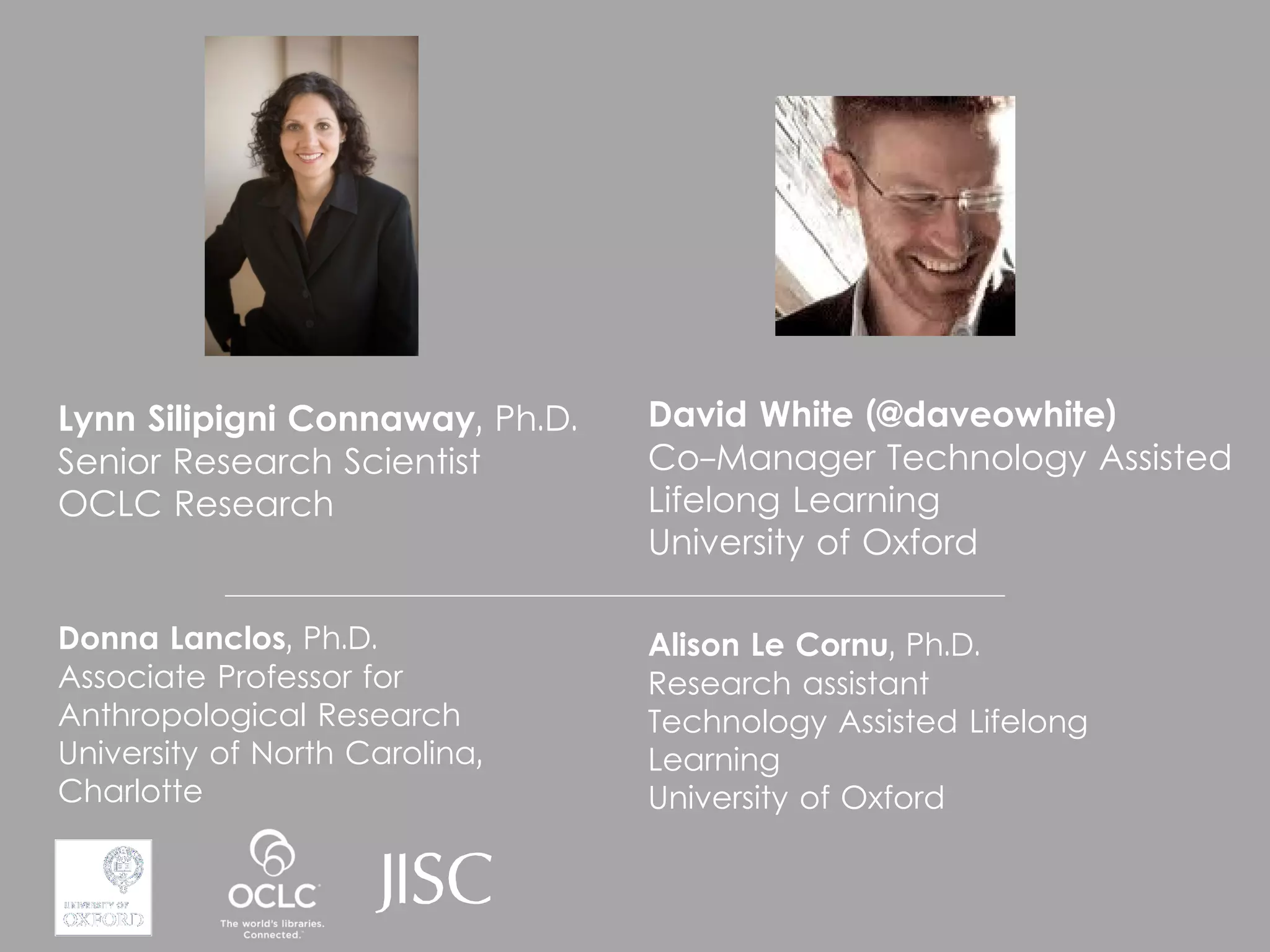
Lynn Silipigni Connaway, Ph.D.   David White (@daveowhite)
Senior Research Scientist        Co-Manager Technology Assisted
OCLC Research                    Lifelong Learning
                                 University of Oxford

Donna Lanclos, Ph.D.             Alison Le Cornu, Ph.D.
Associate Professor for          Research assistant
Anthropological Research         Technology Assisted Lifelong
University of North Carolina,    Learning
Charlotte                        University of Oxford
‘I just type it
into Google
and see what
comes up.’
         (UKS2)
‘I always stick with the
first thing that comes
up on Google because
I think that’s the most
popular site which
means that’s the most
correct.’
                  (USS1)
‘I knew that the
internet wouldn’t give
me a wrong answer.’
                   (UKS4)
Background
•The Digital Information Seeker: Report – Connaway, et al.
2010

•Thriving in the 21st Century: Learning Literacies for the Digital
Age (LLiDA Project) – Beetham. et al. 2009

•Not ‘Natives’ & ‘Immigrants’ but ‘Visitors’ & ‘Residents’ (blog
post) – White. 2008

•Information Behaviour of the Researcher of the Future –
Nicholas. et al. 2008

•‘If it is too inconvenient I’m not going after it:’ Convenience
as a Critical Factor in Information-seeking Behaviors.” –
Connaway, et al. 2011
Even confident
internet users often
lack evaluative
and critical skills.


LLiDA project: http://www.academy.gcal.ac.uk/llida/
DEPARTMENT FOR CONTINUING EDUCATION
TECHNOLOGY-ASSISTED LIFELONG LEARNING


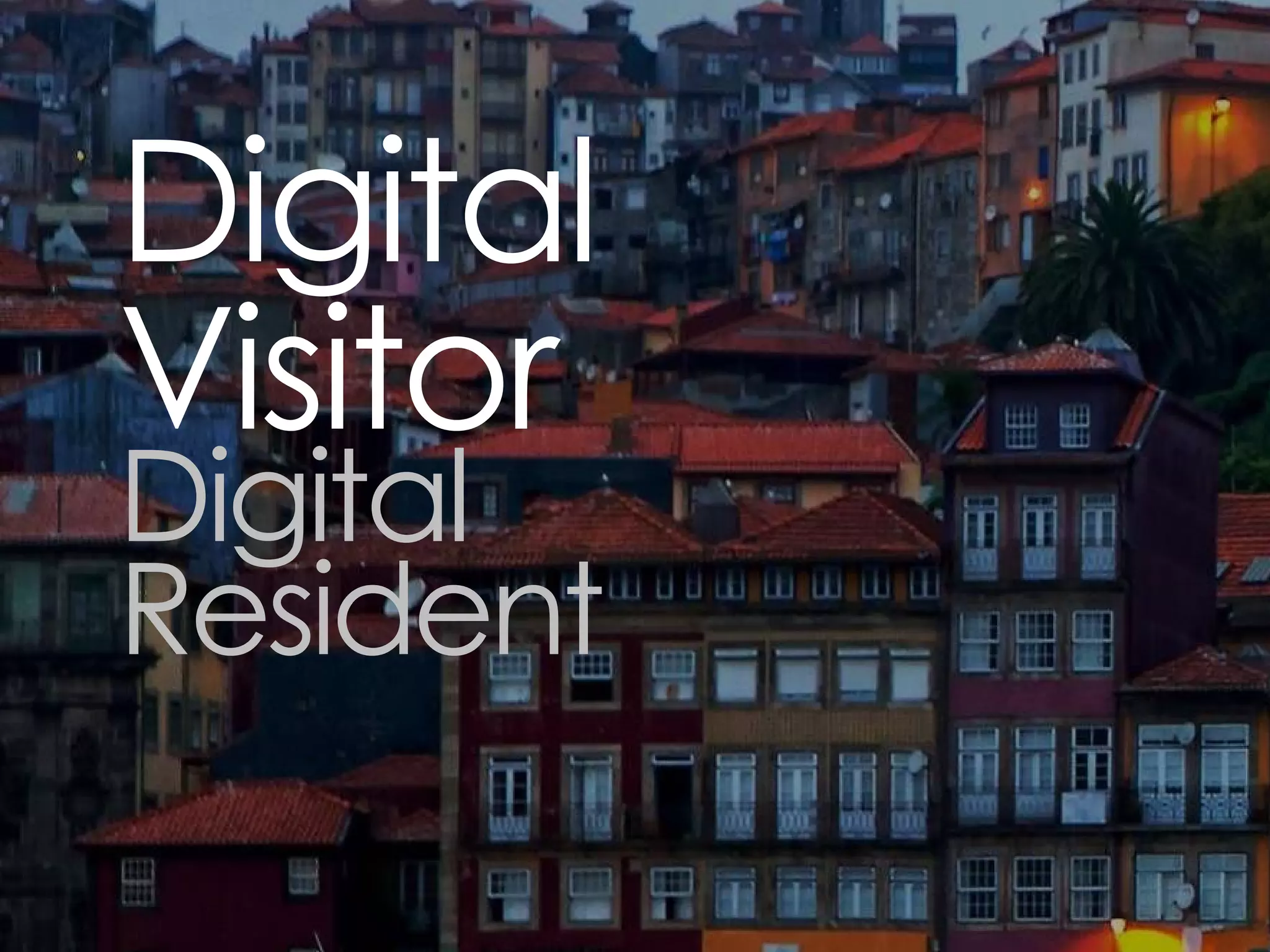
Digital
Visitor
Digital
Resident
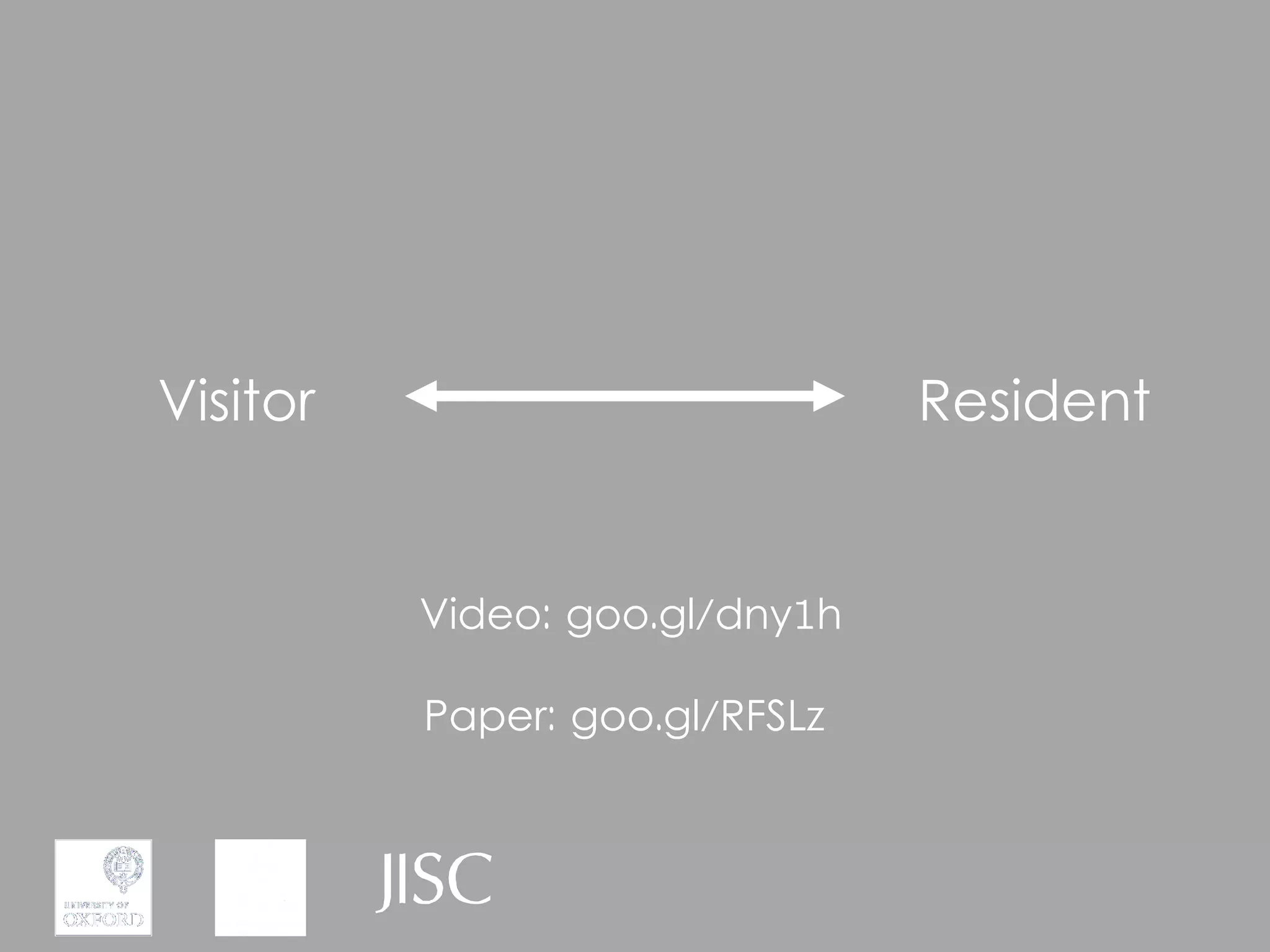
Visitor                         Resident


          Video: goo.gl/dny1h

          Paper: goo.gl/RFSLz
Visitor          Resident
Unseen               Visible
Instrumental      Networked
Functional     Communicative
Individual        Communal
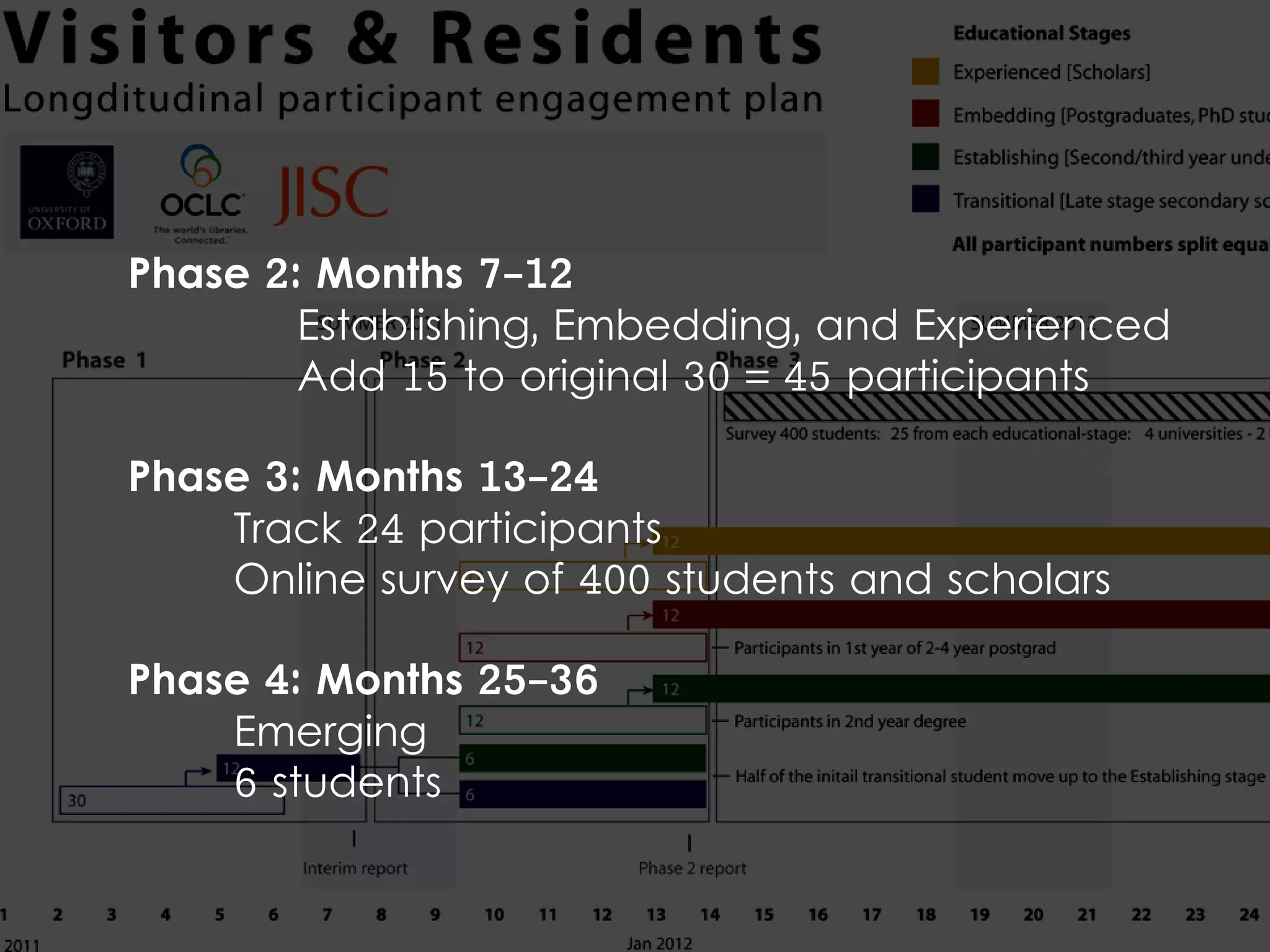
Phase 2: Months 7-12
        Establishing, Embedding, and Experienced
        Add 15 to original 30 = 45 participants

Phase 3: Months 13-24
    Track 24 participants
    Online survey of 400 students and scholars

Phase 4: Months 25-36
    Emerging
    6 students

                                                   Page 12
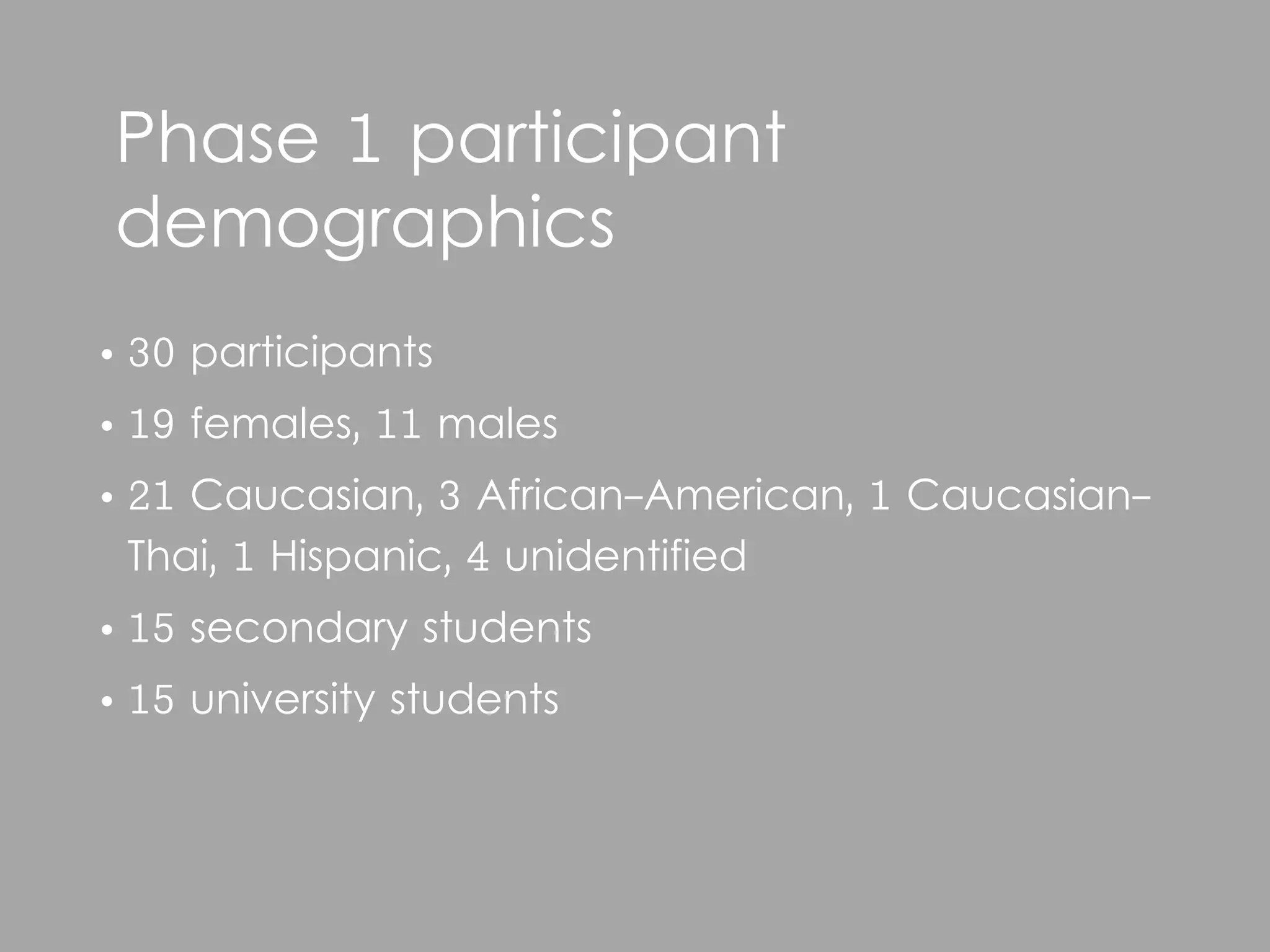
Phase 1 participant
demographics
• 30   participants
• 19   females, 11 males
• 21Caucasian, 3 African-American, 1 Caucasian-
 Thai, 1 Hispanic, 4 unidentified
• 15   secondary students
• 15   university students
Methodology:

      •Interviews
      •Diaries
      •Survey
      •Mapping
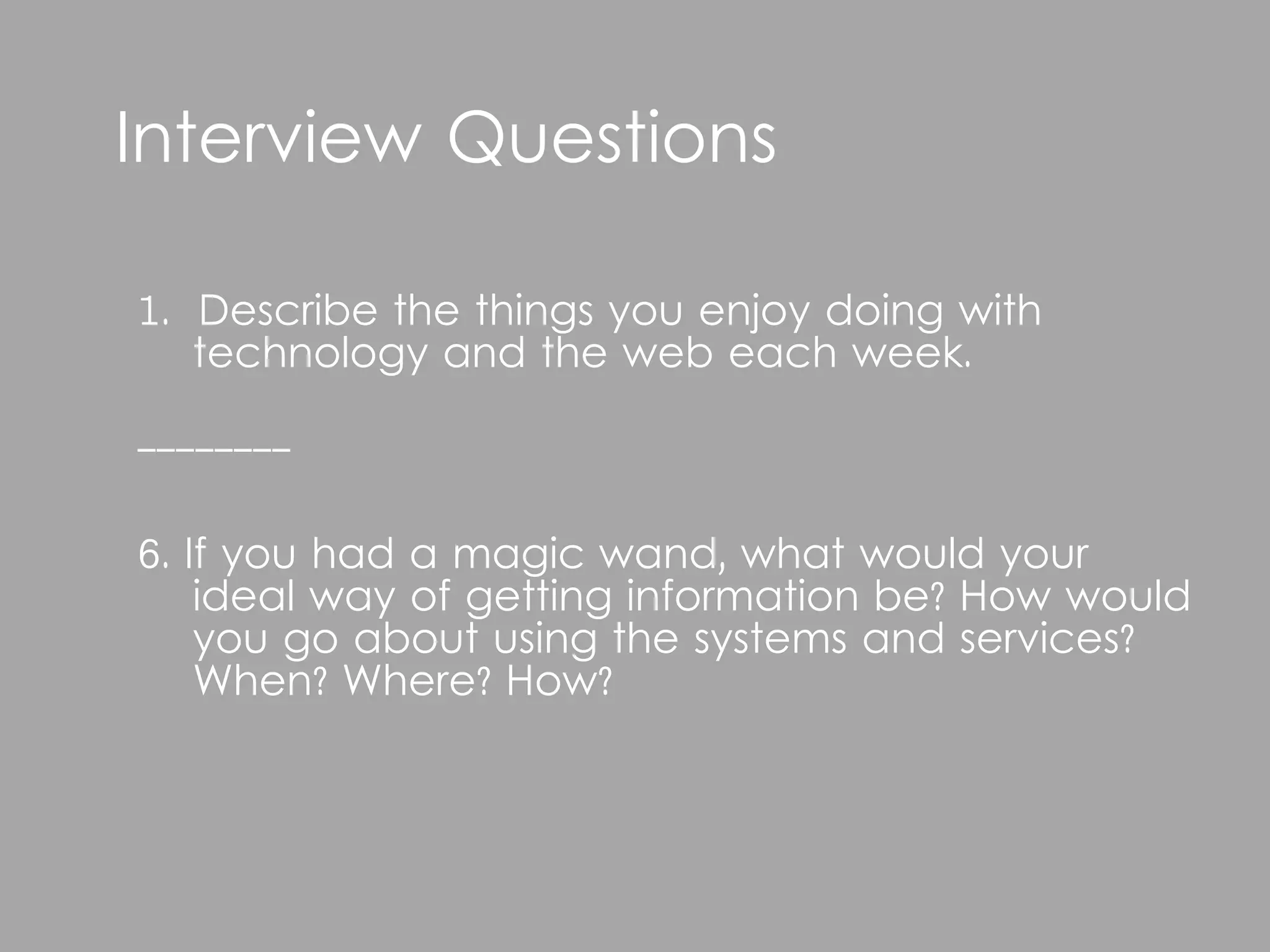
Interview Questions

1. Describe the things you enjoy doing with
   technology and the web each week.

--------

6. If you had a magic wand, what would your
    ideal way of getting information be? How would
    you go about using the systems and services?
    When? Where? How?
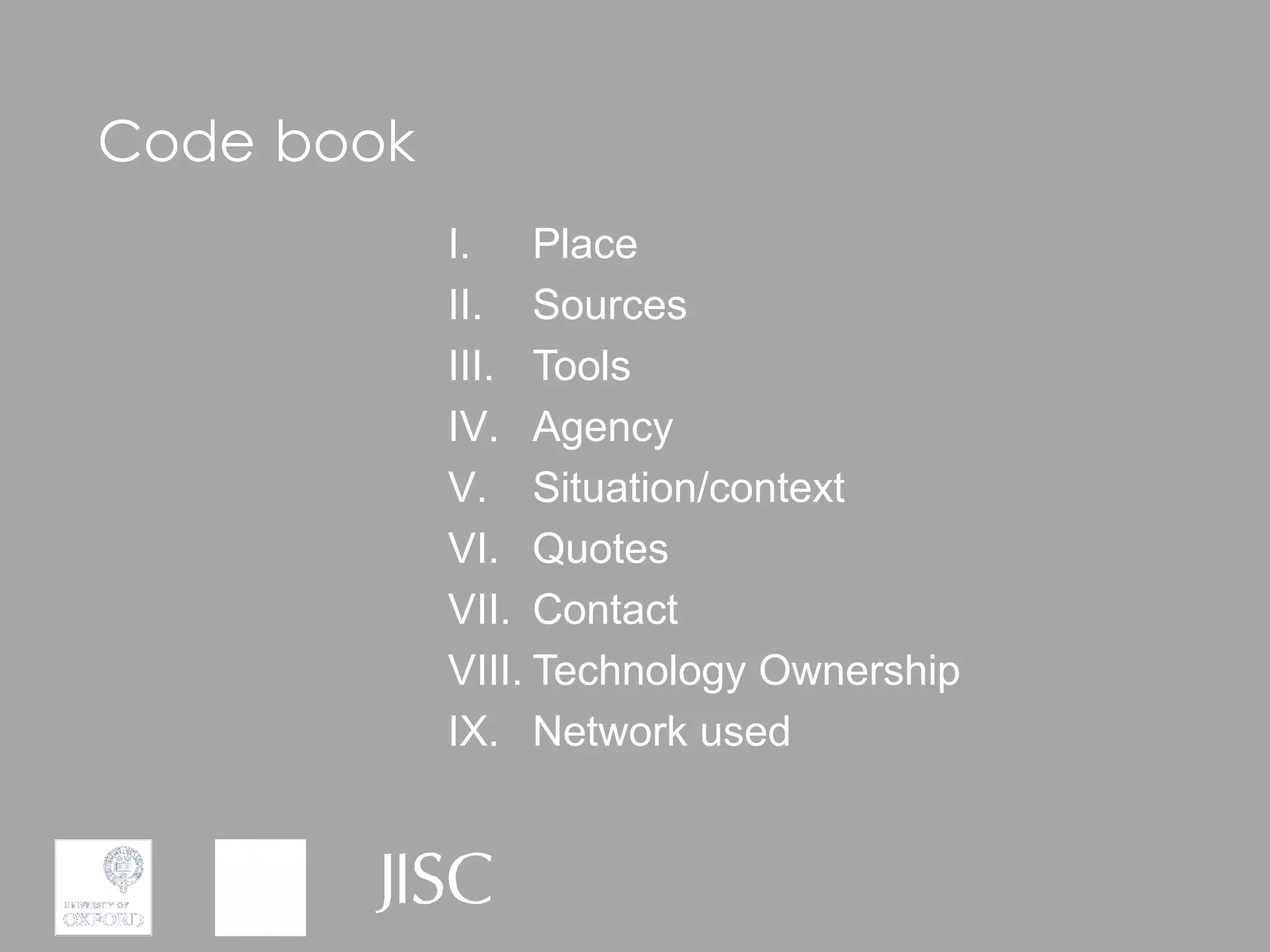
Code book
            I. Place
            II. Sources
            III. Tools
            IV. Agency
            V. Situation/context
            VI. Quotes
            VII. Contact
            VIII. Technology Ownership
            IX. Network used
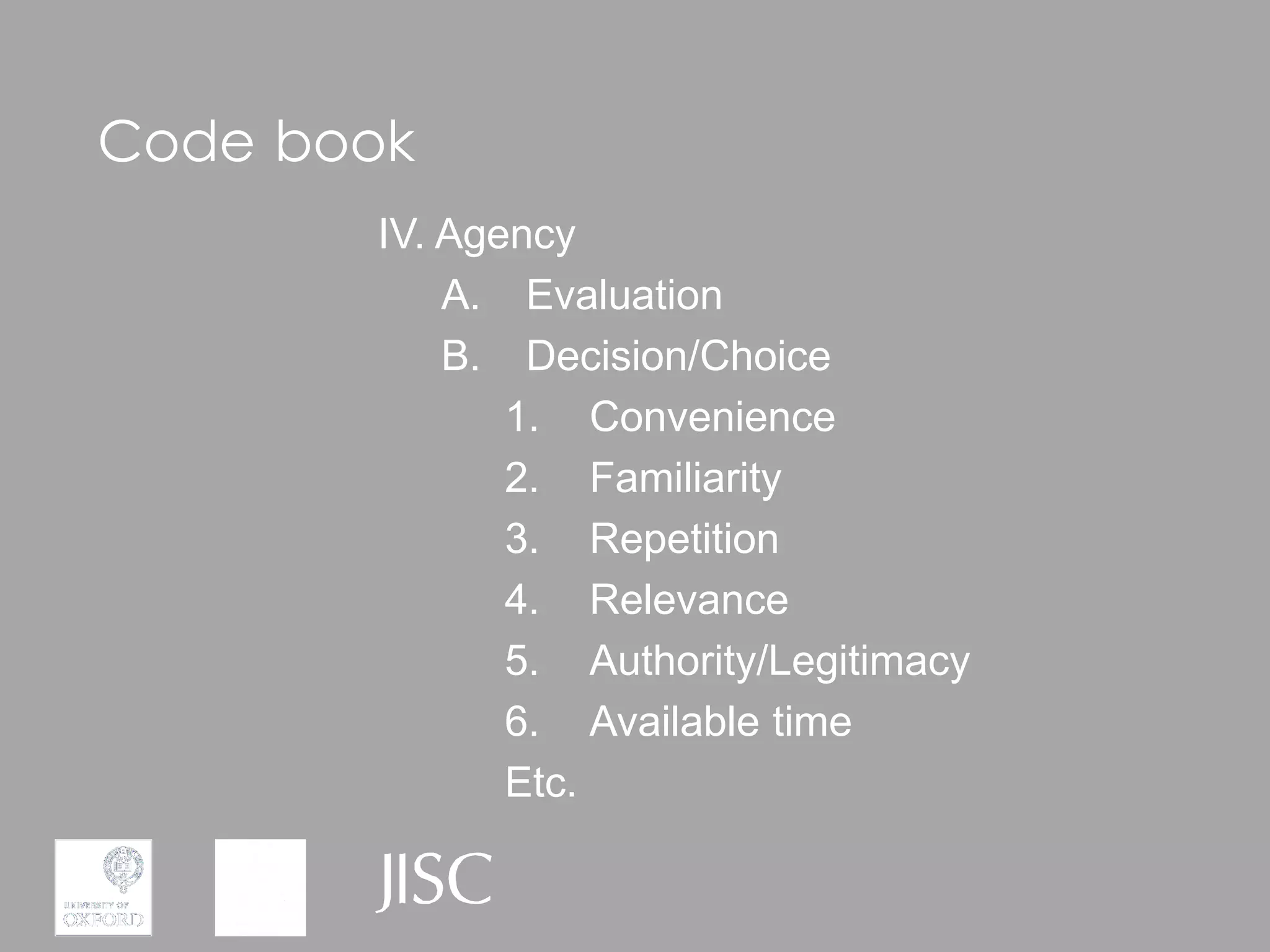
Code book
       IV. Agency
           A. Evaluation
           B. Decision/Choice
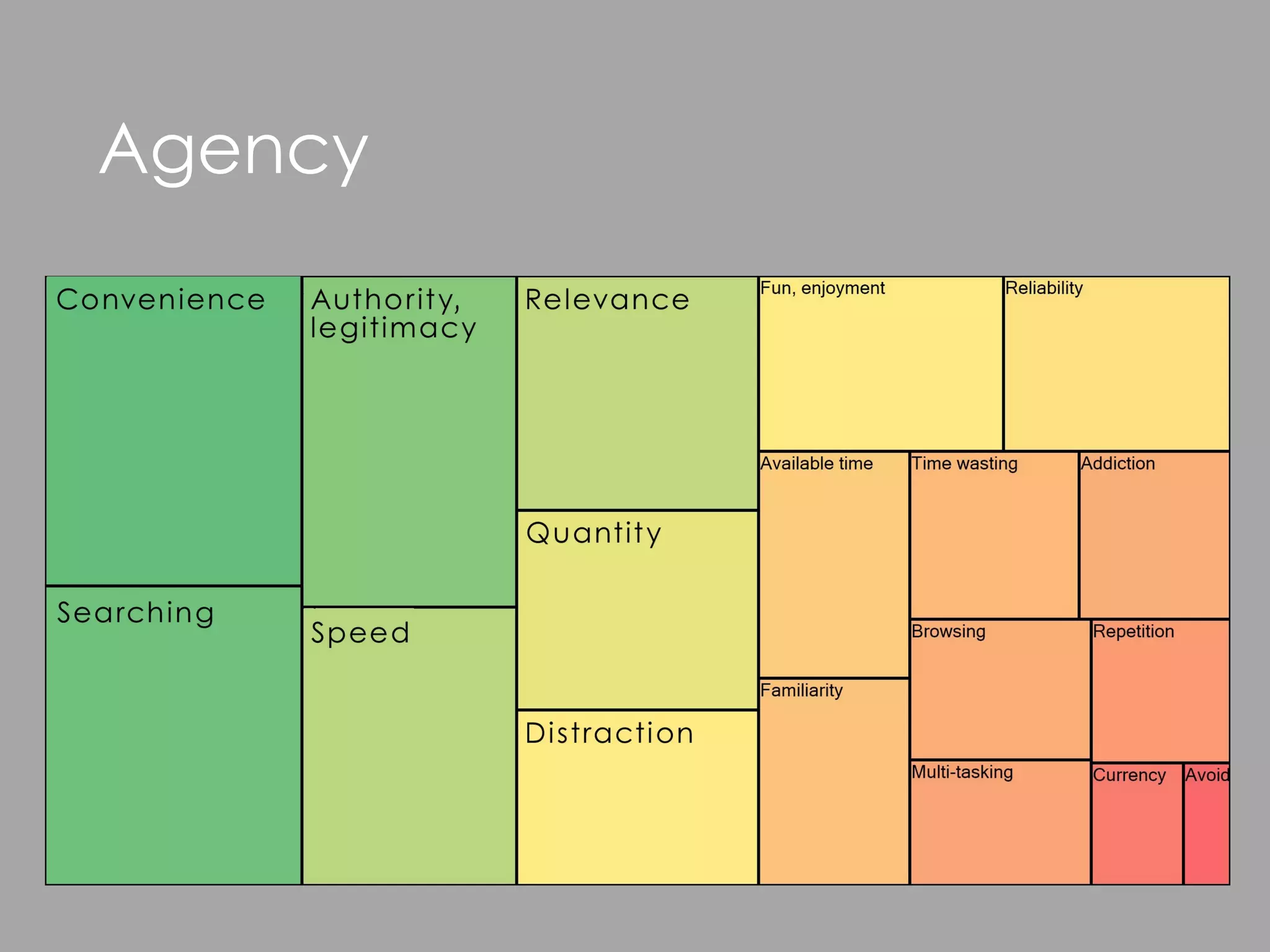
              1. Convenience
              2. Familiarity
              3. Repetition
              4. Relevance
              5. Authority/Legitimacy
              6. Available time
              Etc.
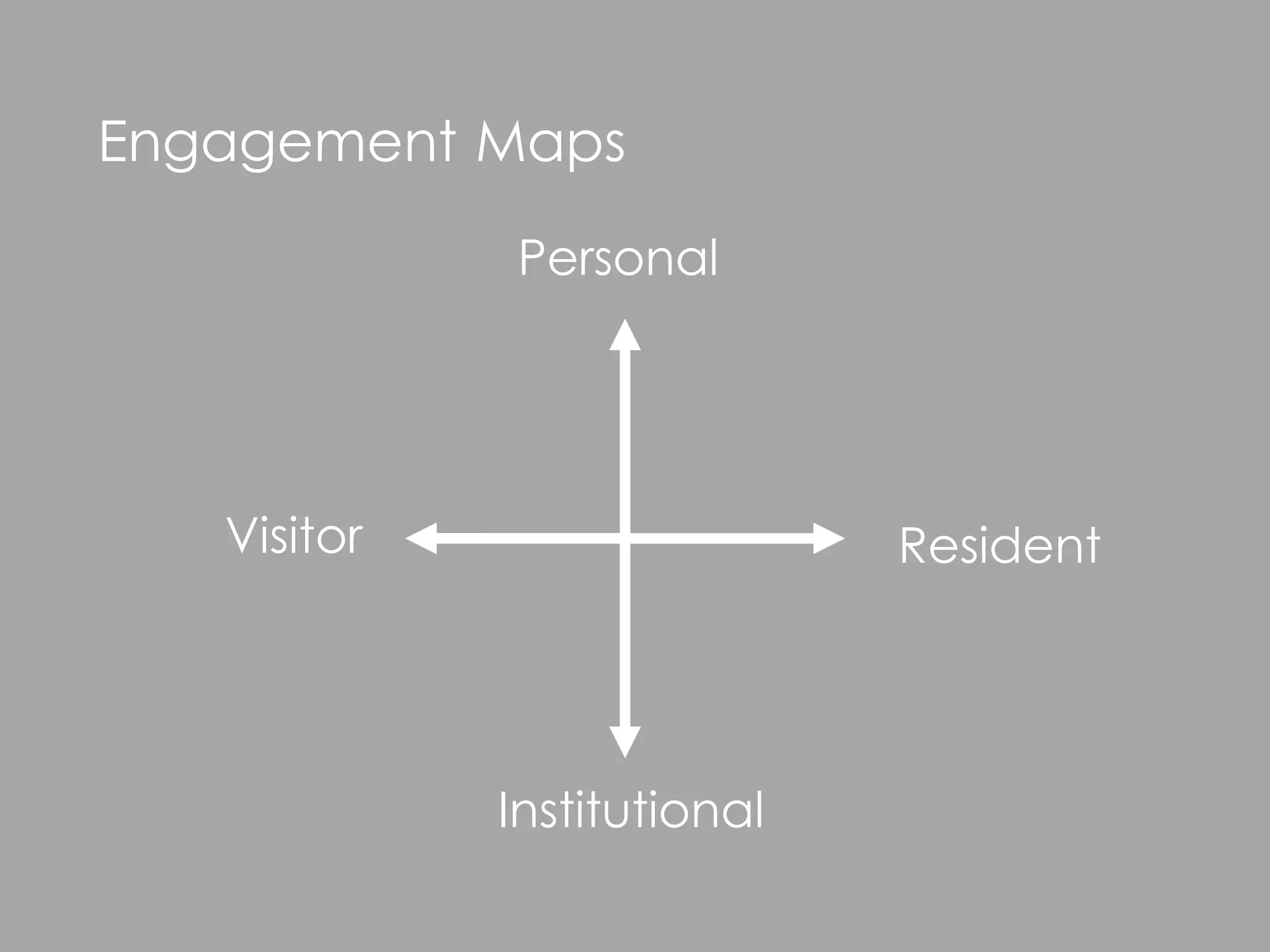
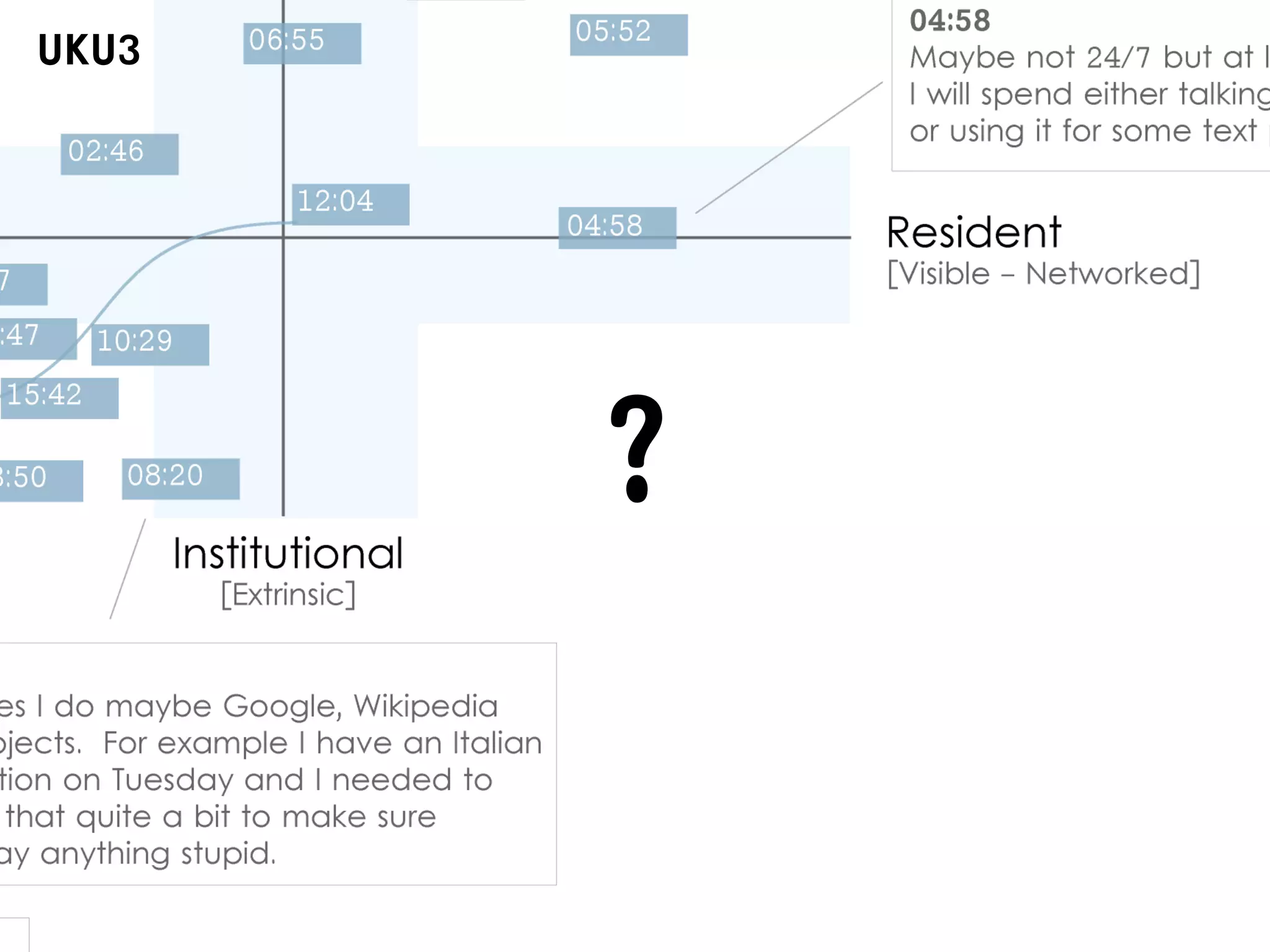
Engagement Maps

             Personal


   Visitor                   Resident


             Institutional
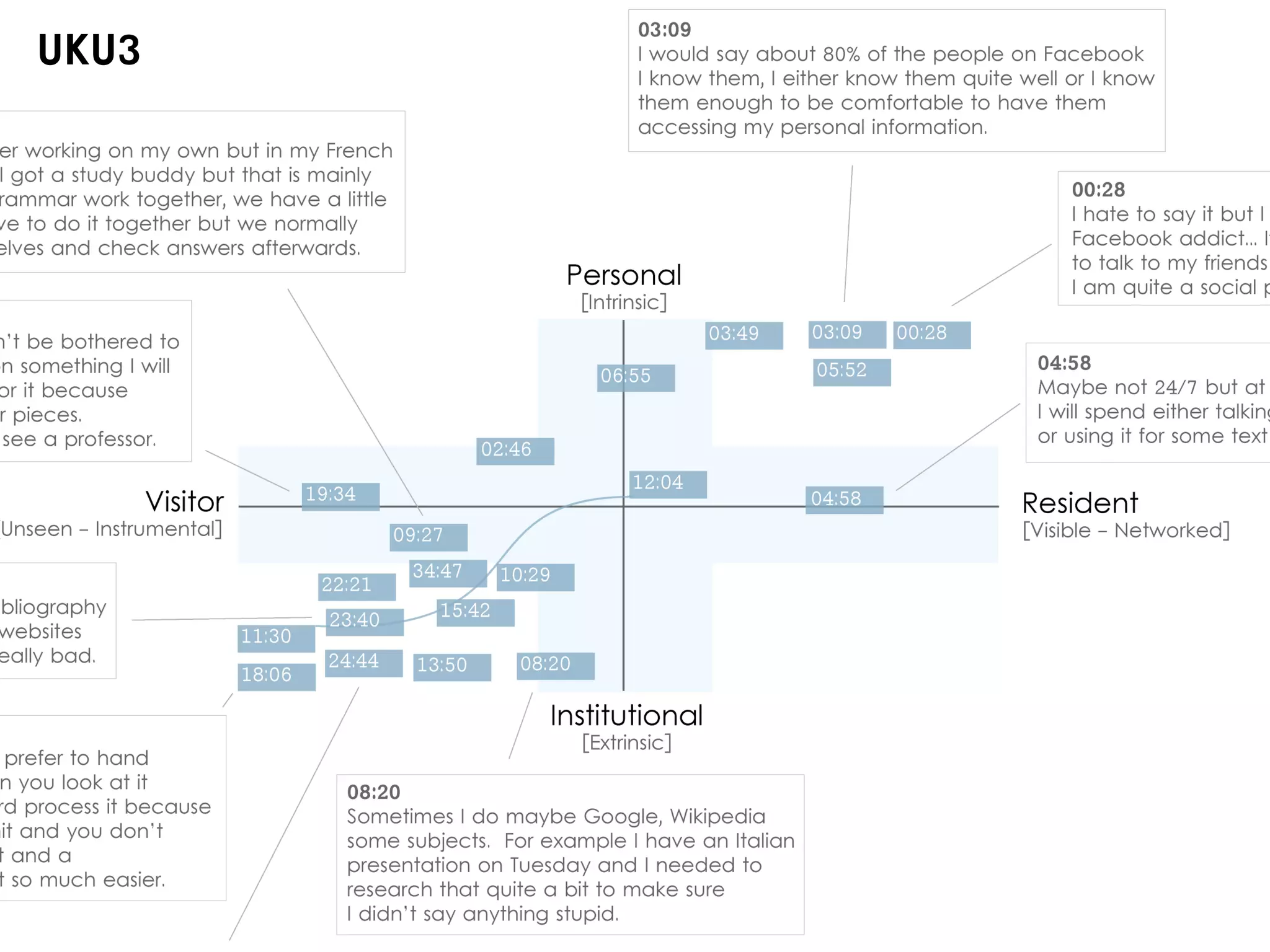
UKU3
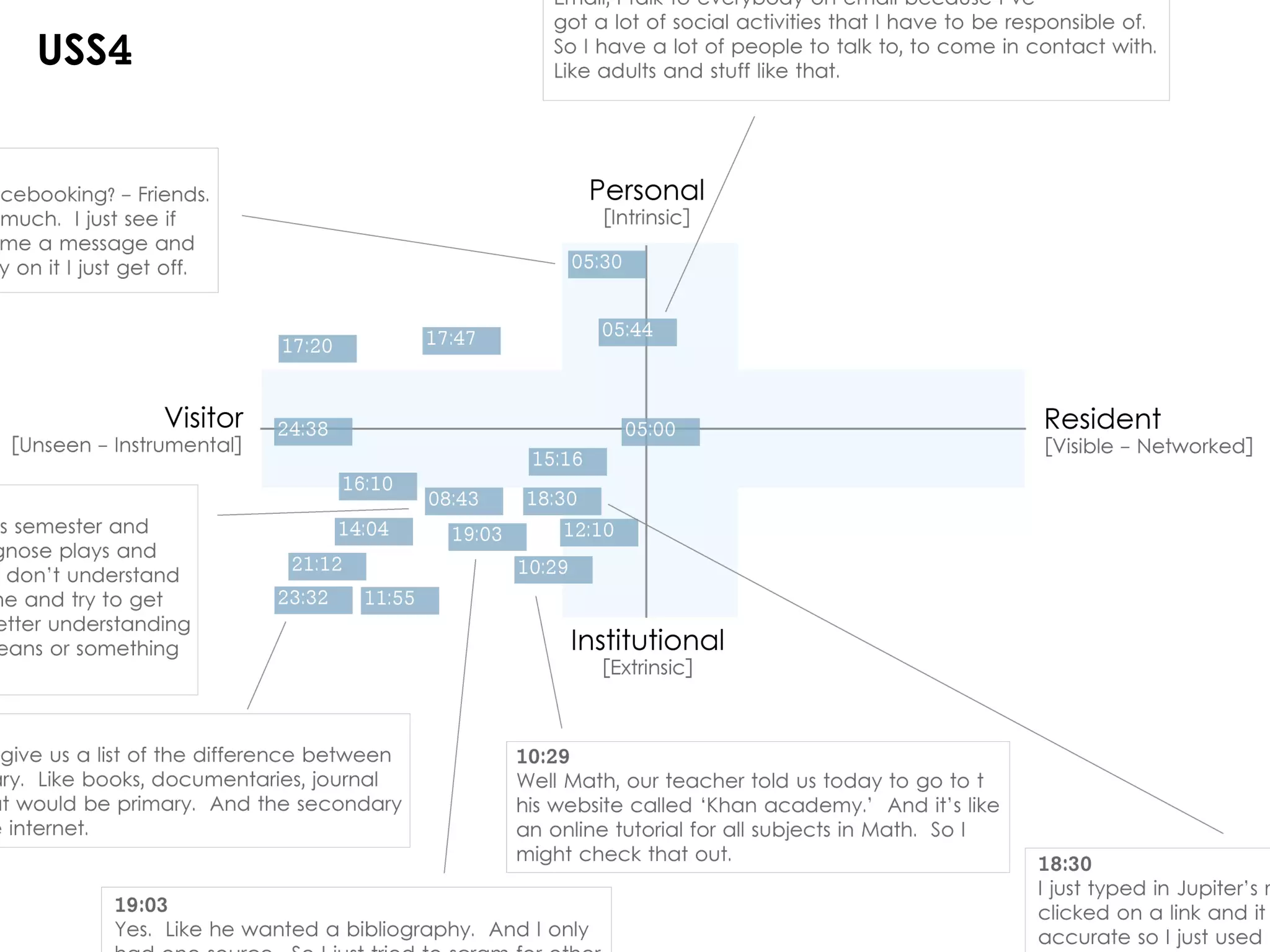
USS4
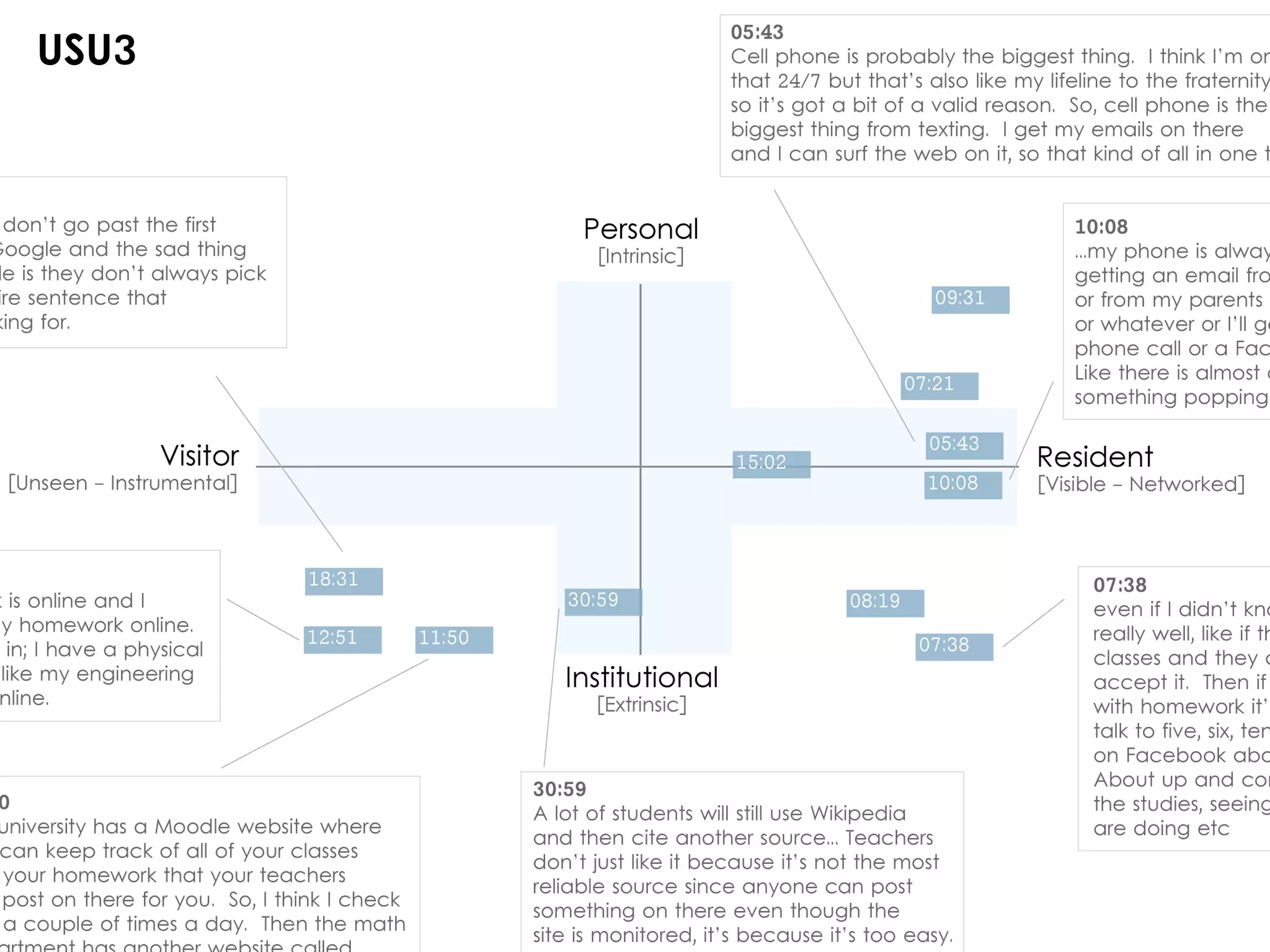
USU3
Programmatically?

   • Map the Code book to the
    Visitors and Residents
     continuum

   • Compare the mappings
     between
    Educational stages
Questions?
Information-seeking cycle
‘I simply just
type it into
Google and
just see what
comes up’
           (UKS4)
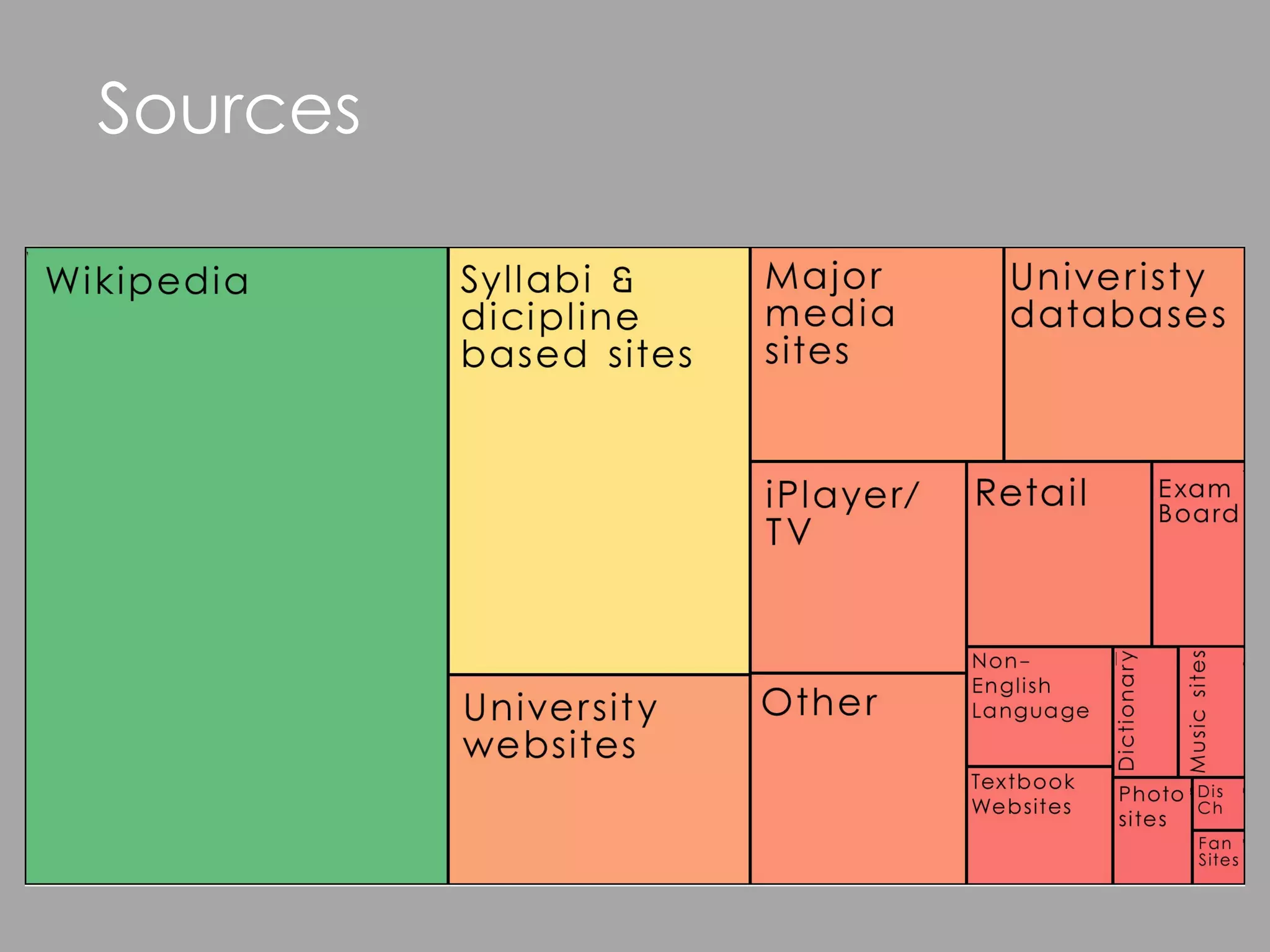
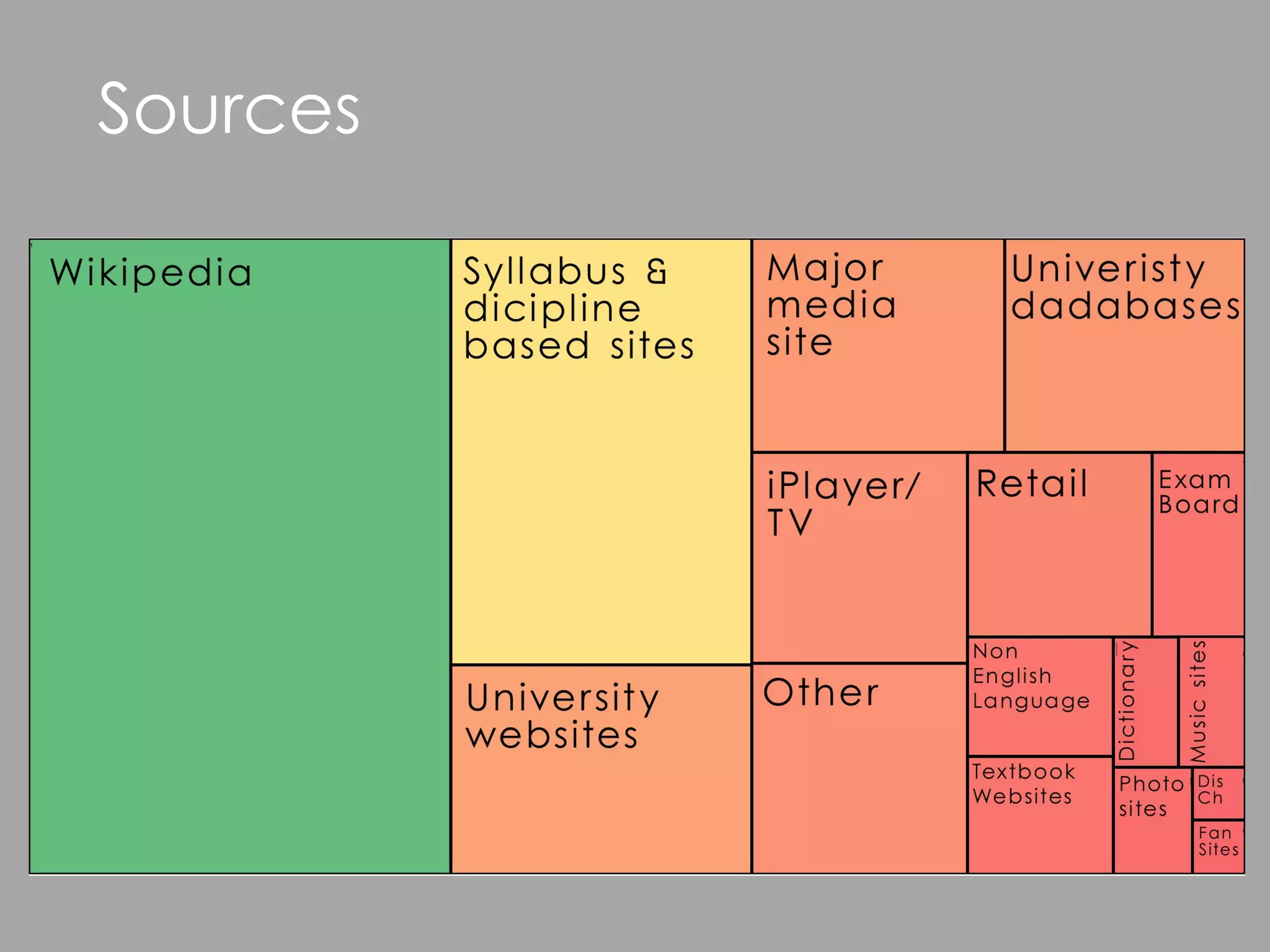
Sources
UKU3


       ?
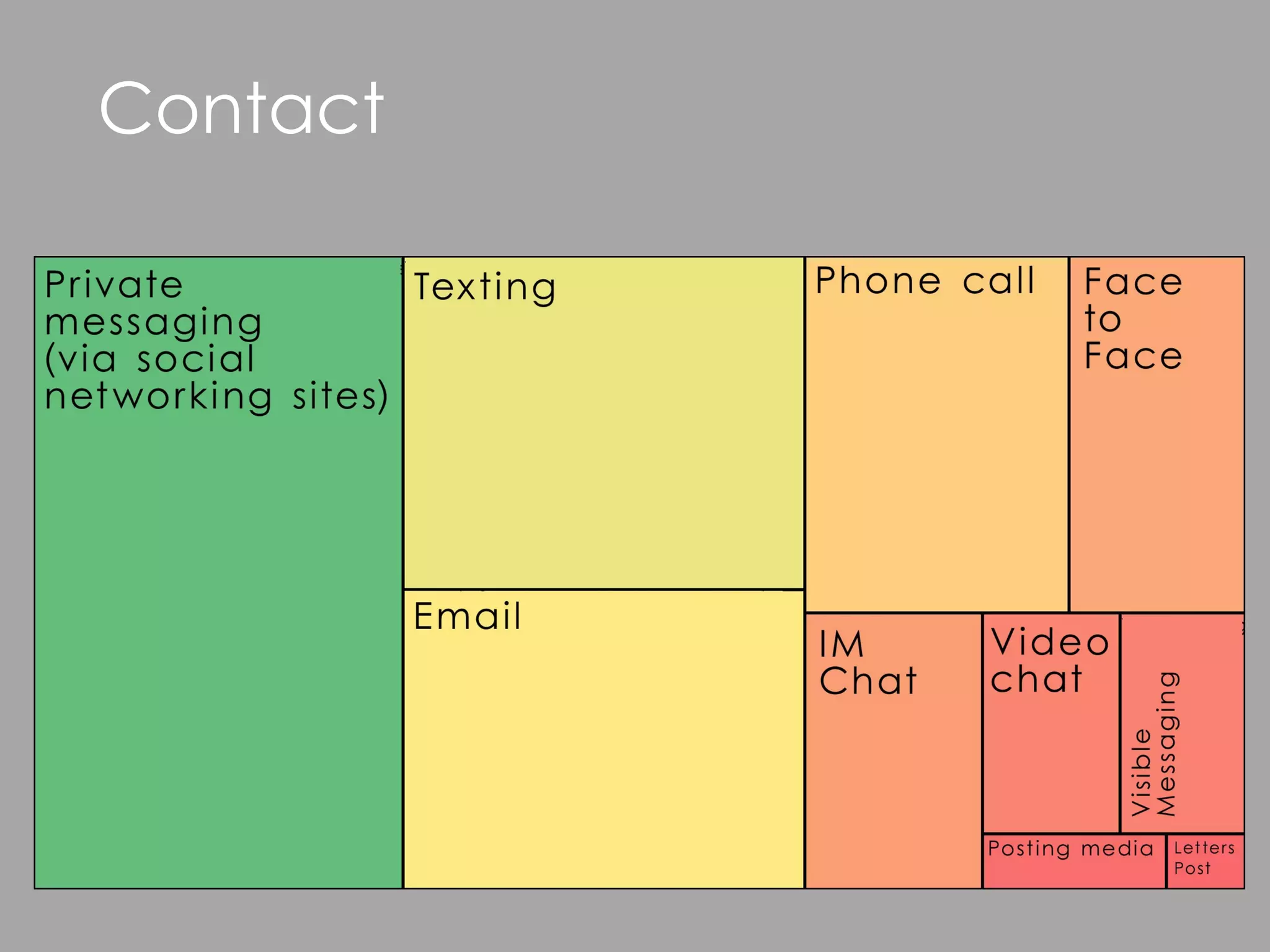
Contact
Email vs IM

‘My email is also like the most
important way of contacting
people, especially through
the school...’
                       (USU7 )
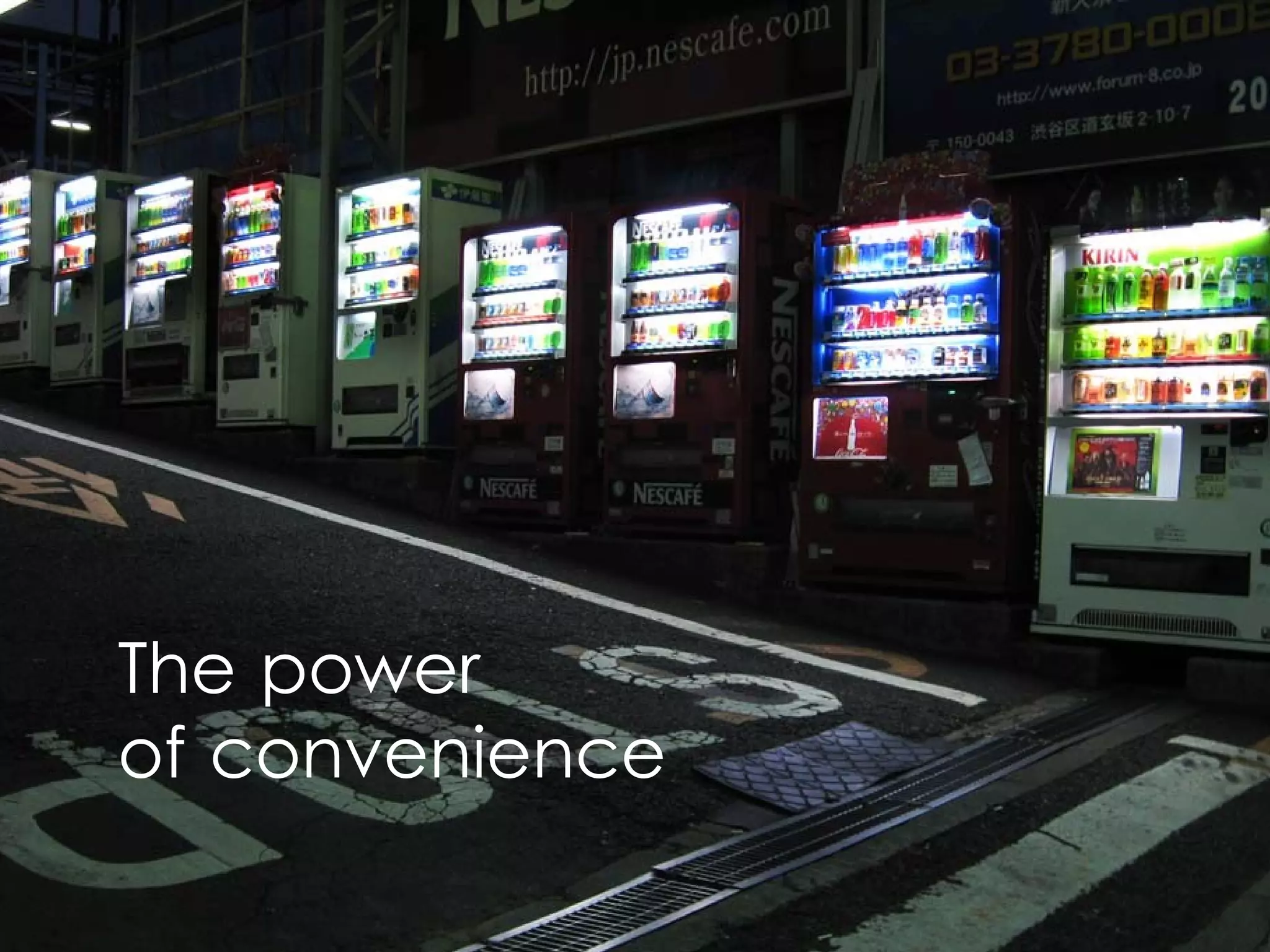
The power
of convenience
Agency
Convergence
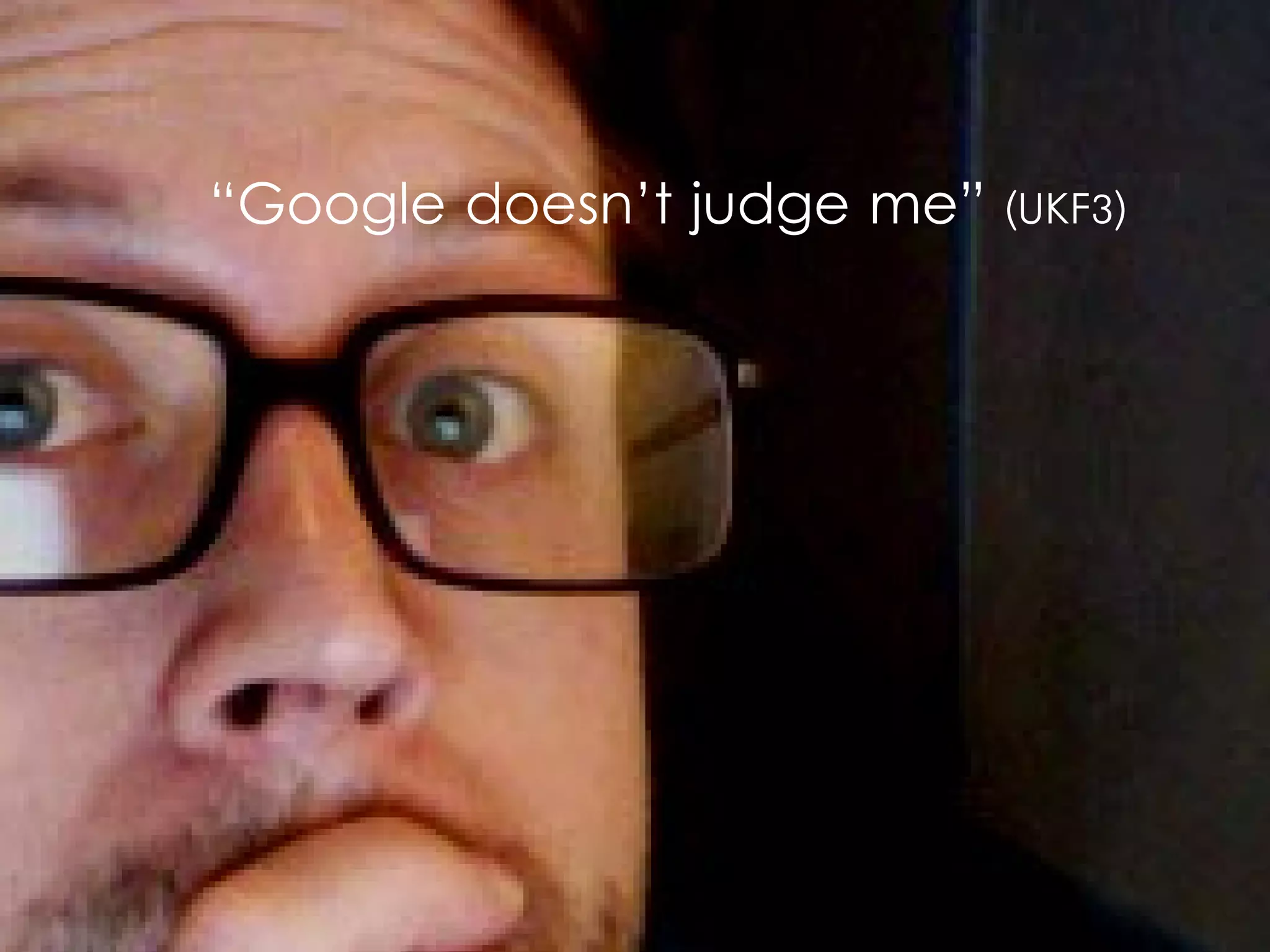
“Google doesn’t judge me”   (UKF3)
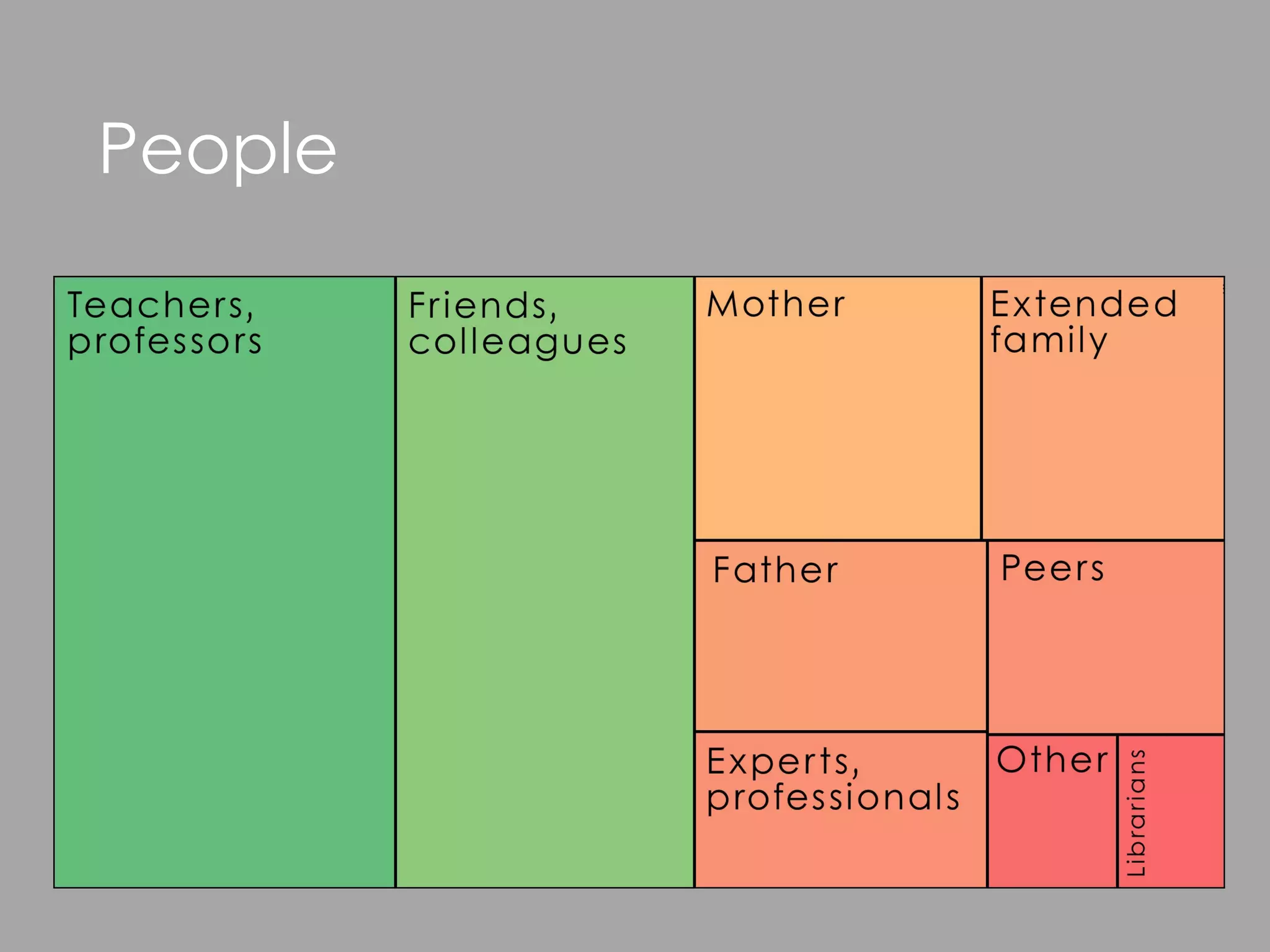
People
‘Oh, definitely one of my teachers just
being able to appear, definitely. Just to
be able to have maybe a professor or
someone that is an expert in that area,
and just for them to be there when I
want them to, so that if I don’t get
something they can explain it to me.
Because that’s the other thing, it’s more
verbal communication that I find easier,
so not always the website, although I do
usually use the internet it’s not my
preferred choice.’
                                     (UKS4)
Questions?
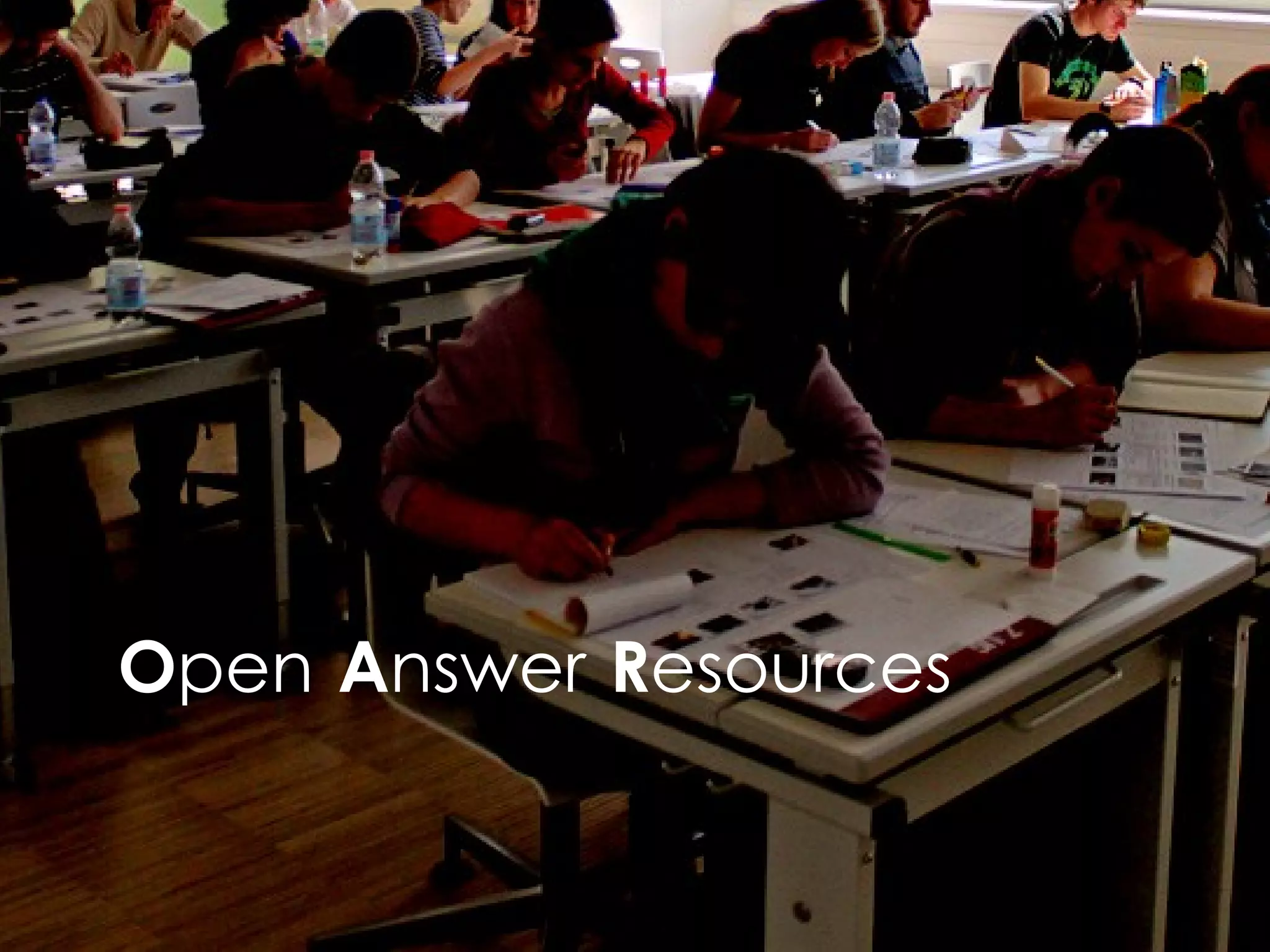
Open Answer Resources
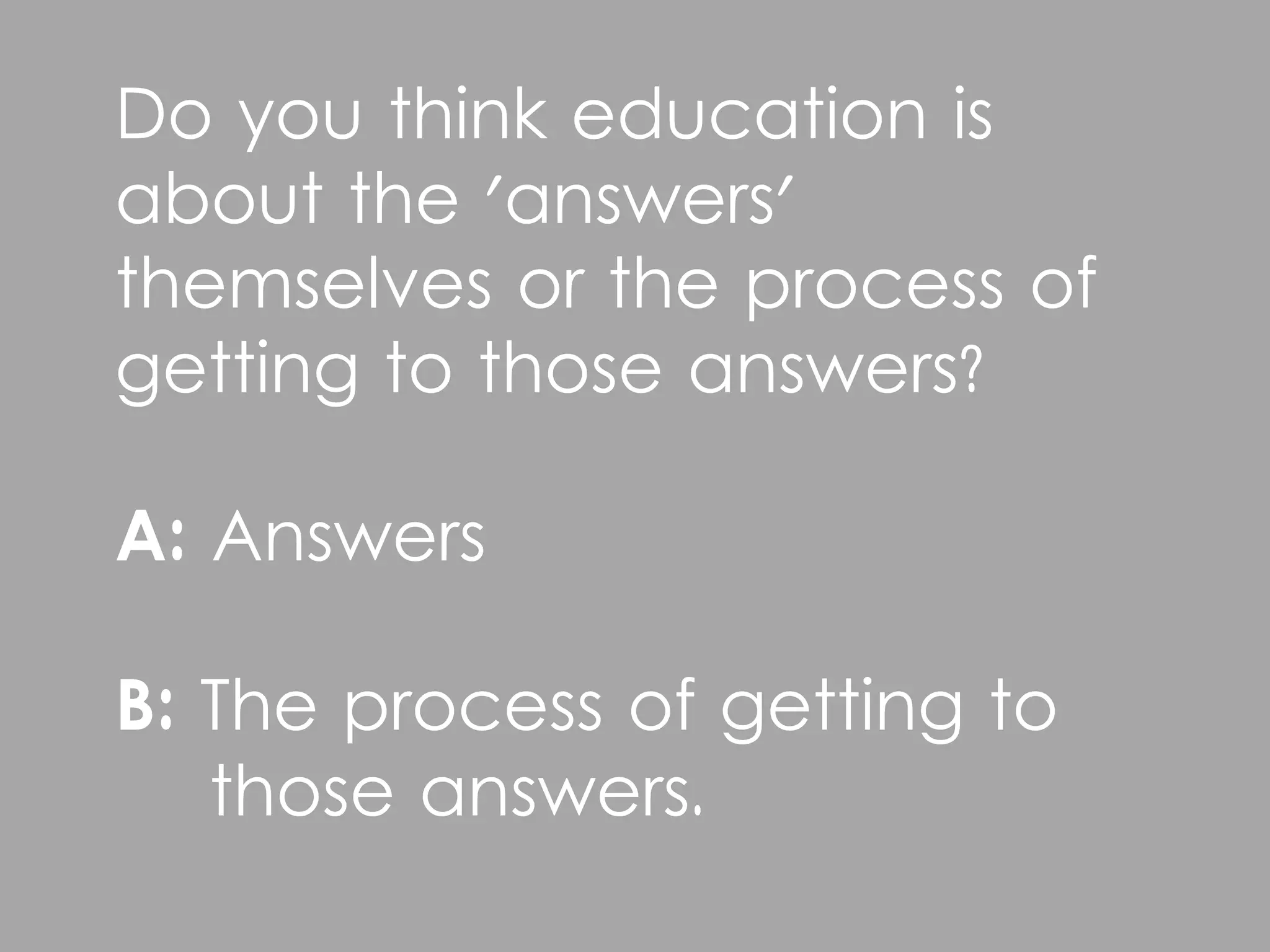
Do you think education is
about the 'answers'
themselves or the process of
getting to those answers?

A: Answers

B: The process of getting to
   those answers.
Sources
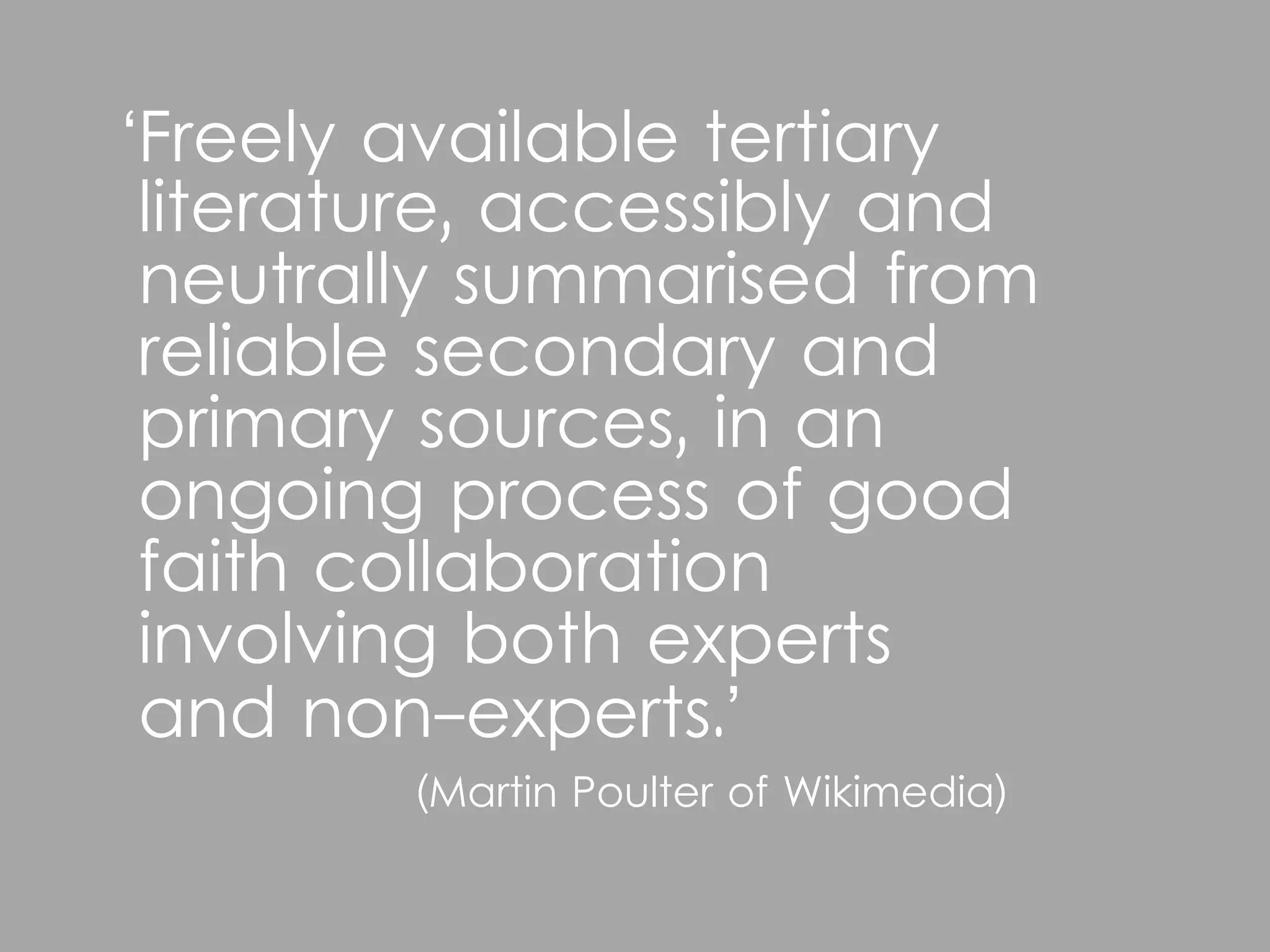
‘Freely available tertiary
 literature, accessibly and
 neutrally summarised from
 reliable secondary and
 primary sources, in an
 ongoing process of good
 faith collaboration
 involving both experts
 and non-experts.’
        (Martin Poulter of Wikimedia)
‘The problem with
Wikipedia is it’s too
easy. You can go to
Wikipedia, you can get
an answer, you don’t
actually learn anything,
you just get an answer.’
          (USU6 – quoting a teacher)
‘Perfect thing, I think it
would be that all the
useful, accurate, reliable
information would like glow
a different colour or
something so I could tell
without wasting my time
going through all of them’

                      (UKS2)
Education is
about questions

The web is
about answers
‘Do they actually fail you?’

‘They don’t fail you but you
get ridiculed in front of
everyone for sourcing
Wikipedia.’
                       (USS3)
Learning
Black
Market

http://wp.me/pLtlj-fH
Phase 3 (Mar 2012 – Mar 2013)

      •Survey
      •Diaries
      •Phase 2 coding
      •Triangulation
Outputs – January 2012

     •Report
       •Engagement maps
       •Emerging findings
       •Implications

     •Video
       •Project discussion
Thanks


Lynn Silipigni Connaway, Ph.D.   David White (@daveowhite)
Senior Research Scientist        Co-Manager Technology Assisted
OCLC Research                    Lifelong Learning
                                 University of Oxford

connawal@oclc.org                david.white@conted.ox.ac.uk
Selected Readings
Beetham, Helen, Lou McGill, and Allison Littlejohn. Thriving in the 21st
  Century: Learning Literacies for the Digital Age (LLiDA Project).
  Glasgow: The Caledonian Academy, Glasgow Caledonian
  University, 2009.
  http://www.academy.gcal.ac.uk/llida/LLiDAReportJune2009.pdf.

Connaway, Lynn Silipigni, and Timothy J. Dickey. The Digital
  Information Seeker: Report of the Findings from Selected OCLC,
  RIN, and JISC User Behaviour Projects. 2010.
  http://www.jisc.ac.uk/media/documents/publications/reports/2010
  /digitalinformationseekerreport.pdf.

Connaway, Lynn Silipigni, Timothy J. Dickey, and Marie L. Radford. “‘If
 it is too inconvenient I’m not going after it:’ Convenience as a
 Critical Factor in Information-seeking Behaviors.” Library &
 Information Science Research 33, no. 3 (2011): 179-90.
Selected Readings
Nicholas, David. Rowlands, Ian. Huntingdon, Paul. Information
  Behaviour of the Researcher of the Future: A CIBER Briefing
  Paper. London: CIBER, 2008.
  http://www.jisc.ac.uk/media/documents/programmes/reppres/
  gg_final_keynote_11012008.pdf.

White, Dave. “Not ‘Natives’ & ‘Immigrants’ but ‘Visitors’ &
 ‘Residents.’” Posted on TALL Blog, July 23, 2008.
 http://tallblog.conted.ox.ac.uk/index.php/2008/07/23/not-
 natives-immigrants-but-visitors-residents/.

White, David. Le Cornu, Alison. “Visitors and Residents: A New
 Typology for Online Engagement.” First Monday 16, no. 9 (2011).
 http://firstmonday.org/htbin/cgiwrap/bin/ojs/index.php/fm/articl
 e/viewArticle/3171/3049.
Picture credits
Exam room: zeligfilm
http://www.flickr.com/photos/zeligdoc/4536875415/

Vending machines: midoisyu
http://www.flickr.com/photos/midorisyu/752223850/

Cycle route: Damian Cugley
http://www.flickr.com/photos/midorisyu/752223850/

Glasses face: peterburnham
http://www.flickr.com/photos/pburnham/5238764188/

3 Generations (Street at night): Gilderic
http://www.flickr.com/photos/lanier67/5253473681

Porto Riberia: lanier67 http://www.flickr.com/photos/lanier67/5253473681

Digital Visitors and Residents: Project Feedback

  • 1.
    DEPARTMENT FOR CONTINUINGEDUCATION TECHNOLOGY-ASSISTED LIFELONG LEARNING Digital Visitors and Residents: Project Feedback Developing Digital Literacies - #jiscdiglit Visitors & Residents - #vandr David White (Co-PI) Dr. Lynn Silipigni Connaway (Co-PI) @daveowhite OCLC Research University of Oxford Dr. Alison Le Cornu Dr. Donna Lancllos University of Oxford University of North Carolina, Charlotte 9th December 2011
  • 2.
    Lynn Silipigni Connaway,Ph.D. David White (@daveowhite) Senior Research Scientist Co-Manager Technology Assisted OCLC Research Lifelong Learning University of Oxford Donna Lanclos, Ph.D. Alison Le Cornu, Ph.D. Associate Professor for Research assistant Anthropological Research Technology Assisted Lifelong University of North Carolina, Learning Charlotte University of Oxford
  • 3.
    ‘I just typeit into Google and see what comes up.’ (UKS2)
  • 4.
    ‘I always stickwith the first thing that comes up on Google because I think that’s the most popular site which means that’s the most correct.’ (USS1)
  • 5.
    ‘I knew thatthe internet wouldn’t give me a wrong answer.’ (UKS4)
  • 6.
    Background •The Digital InformationSeeker: Report – Connaway, et al. 2010 •Thriving in the 21st Century: Learning Literacies for the Digital Age (LLiDA Project) – Beetham. et al. 2009 •Not ‘Natives’ & ‘Immigrants’ but ‘Visitors’ & ‘Residents’ (blog post) – White. 2008 •Information Behaviour of the Researcher of the Future – Nicholas. et al. 2008 •‘If it is too inconvenient I’m not going after it:’ Convenience as a Critical Factor in Information-seeking Behaviors.” – Connaway, et al. 2011
  • 7.
    Even confident internet usersoften lack evaluative and critical skills. LLiDA project: http://www.academy.gcal.ac.uk/llida/
  • 8.
    DEPARTMENT FOR CONTINUINGEDUCATION TECHNOLOGY-ASSISTED LIFELONG LEARNING Digital Visitor Digital Resident
  • 9.
    Visitor Resident Video: goo.gl/dny1h Paper: goo.gl/RFSLz
  • 10.
    Visitor Resident Unseen Visible Instrumental Networked Functional Communicative Individual Communal
  • 12.
    Phase 2: Months7-12 Establishing, Embedding, and Experienced Add 15 to original 30 = 45 participants Phase 3: Months 13-24 Track 24 participants Online survey of 400 students and scholars Phase 4: Months 25-36 Emerging 6 students Page 12
  • 13.
    Phase 1 participant demographics •30 participants • 19 females, 11 males • 21Caucasian, 3 African-American, 1 Caucasian- Thai, 1 Hispanic, 4 unidentified • 15 secondary students • 15 university students
  • 14.
    Methodology: •Interviews •Diaries •Survey •Mapping
  • 15.
    Interview Questions 1. Describethe things you enjoy doing with technology and the web each week. -------- 6. If you had a magic wand, what would your ideal way of getting information be? How would you go about using the systems and services? When? Where? How?
  • 16.
    Code book I. Place II. Sources III. Tools IV. Agency V. Situation/context VI. Quotes VII. Contact VIII. Technology Ownership IX. Network used
  • 17.
    Code book IV. Agency A. Evaluation B. Decision/Choice 1. Convenience 2. Familiarity 3. Repetition 4. Relevance 5. Authority/Legitimacy 6. Available time Etc.
  • 18.
    Engagement Maps Personal Visitor Resident Institutional
  • 19.
  • 20.
  • 21.
  • 22.
    Programmatically? • Map the Code book to the Visitors and Residents continuum • Compare the mappings between Educational stages
  • 23.
  • 24.
  • 25.
    ‘I simply just typeit into Google and just see what comes up’ (UKS4)
  • 26.
  • 27.
  • 28.
  • 29.
    Email vs IM ‘Myemail is also like the most important way of contacting people, especially through the school...’ (USU7 )
  • 30.
  • 31.
  • 32.
  • 33.
  • 34.
    ‘Oh, definitely oneof my teachers just being able to appear, definitely. Just to be able to have maybe a professor or someone that is an expert in that area, and just for them to be there when I want them to, so that if I don’t get something they can explain it to me. Because that’s the other thing, it’s more verbal communication that I find easier, so not always the website, although I do usually use the internet it’s not my preferred choice.’ (UKS4)
  • 35.
  • 36.
  • 37.
    Do you thinkeducation is about the 'answers' themselves or the process of getting to those answers? A: Answers B: The process of getting to those answers.
  • 38.
  • 39.
    ‘Freely available tertiary literature, accessibly and neutrally summarised from reliable secondary and primary sources, in an ongoing process of good faith collaboration involving both experts and non-experts.’ (Martin Poulter of Wikimedia)
  • 40.
    ‘The problem with Wikipediais it’s too easy. You can go to Wikipedia, you can get an answer, you don’t actually learn anything, you just get an answer.’ (USU6 – quoting a teacher)
  • 41.
    ‘Perfect thing, Ithink it would be that all the useful, accurate, reliable information would like glow a different colour or something so I could tell without wasting my time going through all of them’ (UKS2)
  • 42.
  • 43.
    ‘Do they actuallyfail you?’ ‘They don’t fail you but you get ridiculed in front of everyone for sourcing Wikipedia.’ (USS3)
  • 44.
  • 45.
    Phase 3 (Mar2012 – Mar 2013) •Survey •Diaries •Phase 2 coding •Triangulation
  • 46.
    Outputs – January2012 •Report •Engagement maps •Emerging findings •Implications •Video •Project discussion
  • 47.
    Thanks Lynn Silipigni Connaway,Ph.D. David White (@daveowhite) Senior Research Scientist Co-Manager Technology Assisted OCLC Research Lifelong Learning University of Oxford connawal@oclc.org david.white@conted.ox.ac.uk
  • 48.
    Selected Readings Beetham, Helen,Lou McGill, and Allison Littlejohn. Thriving in the 21st Century: Learning Literacies for the Digital Age (LLiDA Project). Glasgow: The Caledonian Academy, Glasgow Caledonian University, 2009. http://www.academy.gcal.ac.uk/llida/LLiDAReportJune2009.pdf. Connaway, Lynn Silipigni, and Timothy J. Dickey. The Digital Information Seeker: Report of the Findings from Selected OCLC, RIN, and JISC User Behaviour Projects. 2010. http://www.jisc.ac.uk/media/documents/publications/reports/2010 /digitalinformationseekerreport.pdf. Connaway, Lynn Silipigni, Timothy J. Dickey, and Marie L. Radford. “‘If it is too inconvenient I’m not going after it:’ Convenience as a Critical Factor in Information-seeking Behaviors.” Library & Information Science Research 33, no. 3 (2011): 179-90.
  • 49.
    Selected Readings Nicholas, David.Rowlands, Ian. Huntingdon, Paul. Information Behaviour of the Researcher of the Future: A CIBER Briefing Paper. London: CIBER, 2008. http://www.jisc.ac.uk/media/documents/programmes/reppres/ gg_final_keynote_11012008.pdf. White, Dave. “Not ‘Natives’ & ‘Immigrants’ but ‘Visitors’ & ‘Residents.’” Posted on TALL Blog, July 23, 2008. http://tallblog.conted.ox.ac.uk/index.php/2008/07/23/not- natives-immigrants-but-visitors-residents/. White, David. Le Cornu, Alison. “Visitors and Residents: A New Typology for Online Engagement.” First Monday 16, no. 9 (2011). http://firstmonday.org/htbin/cgiwrap/bin/ojs/index.php/fm/articl e/viewArticle/3171/3049.
  • 50.
    Picture credits Exam room:zeligfilm http://www.flickr.com/photos/zeligdoc/4536875415/ Vending machines: midoisyu http://www.flickr.com/photos/midorisyu/752223850/ Cycle route: Damian Cugley http://www.flickr.com/photos/midorisyu/752223850/ Glasses face: peterburnham http://www.flickr.com/photos/pburnham/5238764188/ 3 Generations (Street at night): Gilderic http://www.flickr.com/photos/lanier67/5253473681 Porto Riberia: lanier67 http://www.flickr.com/photos/lanier67/5253473681