Hajah Amalina Hj Md Sawara (11M8191)
Dk Rabilatul Adawiyah Pg Sallehudin (11M8929)
                 Zuriana Mohd Said (11M8921)
               Khairunnisa Hj Sibah (11M8055)
                        Leja Ambol (11M8066)
INTERNET
 As an umbrella term that includes the associated terms
 cyberspace and the Web (World Wide Web).

 Refer to the actual network and the exchange of data
 between computers.

 Social spaces where relationships, communities, and
 cultures emerge through the exchange of text and
 images, either in real time or in delayed time
 sequences. (Markham, 2003)

 Email has been the most frequently used Internet tools
 in the survey research for its convenience.
TYPES OF INTERNET SOURCES

 Youtube

 Skype (Online Conferencing)

 E-mail

 Web Survey Application

 Facebook
Research articles
R1      The Youtube effect: How youtube has provided
        new ways to consume, create and share music

        Using the Internet for Survey Research:
R2       A Case Study

        English language teaching and learning issues in
R3      Malaysia: Learners’ perceptions via Facebook dialogue
        journal

        ‘America’ through my eyes and your eyes: The
R4      development of Intercultural Awareness in Spanish
        Language Class


R5    • The Use and Abuse of Online Social Network Sites by
        Gen Y in the EU: Can Marketing Make a Difference?
PARTICIPANTS
     R1                R2            R3                R4               R5

 Teenage          203 LIS      46 private      10 students       239
musician –        (Library and   and public       taking            Generation   Y
Wade              Information    college and      advanced          students
Johnston          Science)       university       Spanish class     (internet
                  authors        students in      consists of:      literate)
 3 Panels -                     Kota Kinabalu,
who are                          Sabah.           - 5 native
selected by the                                   Spanish
researcher                                        -    4    Latin
                                                  America
 9 audience                                      - 1 Spanish
members                                           Castilian
DATA COLLECTION
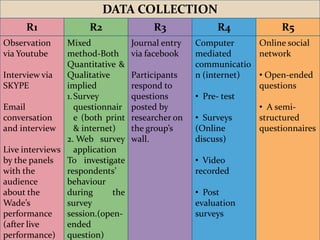
      R1              R2                R3              R4            R5
Observation     Mixed              Journal entry   Computer     Online social
via Youtube     method-Both        via facebook    mediated     network
                Quantitative &                     communicatio
Interview via   Qualitative        Participants    n (internet) • Open-ended
SKYPE           implied            respond to                   questions
                1. Survey          questions       • Pre- test
Email              questionnair    posted by                    • A semi-
conversation       e (both print   researcher on   • Surveys    structured
and interview      & internet)     the group’s     (Online      questionnaires
                2. Web survey      wall.           discuss)
Live interviews application
by the panels   To investigate                     • Video
with the        respondents’                       recorded
audience        behaviour
about the       during       the                   • Post
Wade’s          survey                             evaluation
performance     session.(open-                     surveys
(after live     ended
performance) question)
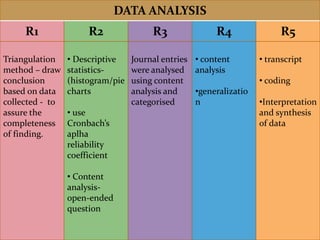
DATA ANALYSIS
     R1               R2               R3                R4                R5

Triangulation    • Descriptive    Journal entries   • content        • transcript
method – draw    statistics-      were analysed     analysis
conclusion       (histogram/pie   using content                      • coding
based on data    charts           analysis and      •generalizatio
collected - to                    categorised       n                •Interpretation
assure the       • use                                               and synthesis
completeness     Cronbach’s                                          of data
of finding.      aplha
                 reliability
                 coefficient

                 • Content
                 analysis-
                 open-ended
                 question
STRENGTHS                               LIMITATIONS
1. Communication facilitation           1. Technological limitations
 Easy access and convenience           Technology will fail.
                                        Receiving of messages in a non-
2. Practical and economic benefits chronological sequence can disrupt the
Recruitment is easily negotiated       flow of topic discussion.
through email
Reduced travel, venue and              2. Network traffic
transcribing costs;                     Chat communication can become
Easy communication storage and         disjointed through lag caused by signal
archiving;                              delays and overcrowded lines.
Ease of publishing and updating        Low speed modems  when
results online.                         obtaining response rate via web survey/
                                        problems of loading the questionnaire
3. Access to diverse participants       from home computers.
Diversity can be obtained from a
range of groups, geographical locations
and across national boundaries.
Enable members to gather across
distances to exchange ideas.
Ethical issues
 Obtaining the permission with the participants about
 the research.

 Confidentiality.
  Example: their name refer as pseudonyms.

 Privacy and Protection
 Example: Protecting participants’ privacy – post in
 closed group. Unique case ID given to the participants.
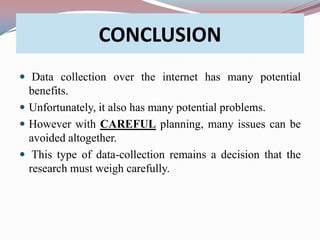
CONCLUSION
 Data collection over the internet has many potential
  benefits.
 Unfortunately, it also has many potential problems.
 However with CAREFUL planning, many issues can be
  avoided altogether.
 This type of data-collection remains a decision that the
  research must weigh carefully.
References
Clarke, R. (1998). Message transmission security risks. [Online]
  http://www.anu.edu.au/people/Roger.Clarke/II/CryptoSecyRisks.html
  [2000, May 16]
Connor, H. & Madge, C. (2003). “Focus groups in cyberspace”: using the
  internet for qualitative research. Qualitative Market Research: An
  International Journal. 6(2). 133-143. DOI: 10.1108/13522750310470190
Erickson, T. (1999). Persistent Conversation: An Introduction.
  Journal of Computer mediated Communication, 4 (4). [Online]
  http://www.ascusc.org/jcmc/vol4/issue4/ericksonintro.html
  [2000, May 15].
Gaiser, T.J. (1997). Conducting On-Line Focus Groups: A
  Methodological Discussion.
Hiew, W. (2012). English language teaching and learnin issues in
  Malaysia: Learners’ perceptions via facebook dialogue journal.
  International Refereed Researh Journal, 3(1),11-19.
References
Hirst, A., Bednall, D. D., Ashwin, S. M. & Icoz, O. 2009, ‘The use and abuse
  of online social network sites by Gen Y in the EU: can marketing make a
  difference?,’ in ICBME 2009: Proceedings of the 5th International
  Conference on Business, Management and Economics, 22 – 24 October
  2009, Yasar University, Izmir, Turkey, viewed 20 May 2010,
  <http://wbiconpro.com/10.Marie.html>.

Levinson, P. (1990). Computer conferencing in the context of the evolution
  of media. In L.M. Harasim. (Ed.), Online education: Perspectives on a new
  environment. NY: Praeger.
Reference
Smith, M.A. (1992). Voices from the WELL: The Logic of the Virtual
  Commons. [Online]
  http://www.sscnet.ucla.edu/soc/csoc/papers/voices/ [2000, January 4].
Stewart, F., Eckermann, E, and Zhou, K. (1998). Using the Internet in
  Qualitative Public Health Research: A Comparison of Chinese and
  Australian Young Women's Perceptions of Tobacco Use. Internet Journal
  of Health Promotion, 1998. [Online]
  http://www.monash.edu.au/health/IJHP/1998/12 [2000, June 5].
Wild, M. (1999). The anatomy of practice in the use of mailing lists: A case
  study. Australian Journal of Educational Technology. 15(2), 117-135.
  [Online] http://cleo.murdoch.edu.au/ajet/ajet15/wild.html
Zhang, Y. (2000). Using the internet for survey research: A case study.
  Journal of the American Society for Information Science, 51(1), 57-68.
Thank you !
Where to post your question!

http://questions4groupS.wordpress.com


             Please state

              Your name
            Registration No
                Group
Where to post your question!
Data Collection: Internet sources

Data Collection: Internet sources

  • 1.
    Hajah Amalina HjMd Sawara (11M8191) Dk Rabilatul Adawiyah Pg Sallehudin (11M8929) Zuriana Mohd Said (11M8921) Khairunnisa Hj Sibah (11M8055) Leja Ambol (11M8066)
  • 2.
    INTERNET  As anumbrella term that includes the associated terms cyberspace and the Web (World Wide Web).  Refer to the actual network and the exchange of data between computers.  Social spaces where relationships, communities, and cultures emerge through the exchange of text and images, either in real time or in delayed time sequences. (Markham, 2003)  Email has been the most frequently used Internet tools in the survey research for its convenience.
  • 3.
    TYPES OF INTERNETSOURCES  Youtube  Skype (Online Conferencing)  E-mail  Web Survey Application  Facebook
  • 4.
    Research articles R1 The Youtube effect: How youtube has provided new ways to consume, create and share music Using the Internet for Survey Research: R2 A Case Study English language teaching and learning issues in R3 Malaysia: Learners’ perceptions via Facebook dialogue journal ‘America’ through my eyes and your eyes: The R4 development of Intercultural Awareness in Spanish Language Class R5 • The Use and Abuse of Online Social Network Sites by Gen Y in the EU: Can Marketing Make a Difference?
  • 5.
    PARTICIPANTS R1 R2 R3 R4 R5  Teenage  203 LIS 46 private 10 students  239 musician – (Library and and public taking Generation Y Wade Information college and advanced students Johnston Science) university Spanish class (internet authors students in consists of: literate)  3 Panels - Kota Kinabalu, who are Sabah. - 5 native selected by the Spanish researcher - 4 Latin America  9 audience - 1 Spanish members Castilian
  • 6.
    DATA COLLECTION R1 R2 R3 R4 R5 Observation Mixed Journal entry Computer Online social via Youtube method-Both via facebook mediated network Quantitative & communicatio Interview via Qualitative Participants n (internet) • Open-ended SKYPE implied respond to questions 1. Survey questions • Pre- test Email questionnair posted by • A semi- conversation e (both print researcher on • Surveys structured and interview & internet) the group’s (Online questionnaires 2. Web survey wall. discuss) Live interviews application by the panels To investigate • Video with the respondents’ recorded audience behaviour about the during the • Post Wade’s survey evaluation performance session.(open- surveys (after live ended performance) question)
  • 7.
    DATA ANALYSIS R1 R2 R3 R4 R5 Triangulation • Descriptive Journal entries • content • transcript method – draw statistics- were analysed analysis conclusion (histogram/pie using content • coding based on data charts analysis and •generalizatio collected - to categorised n •Interpretation assure the • use and synthesis completeness Cronbach’s of data of finding. aplha reliability coefficient • Content analysis- open-ended question
  • 8.
    STRENGTHS LIMITATIONS 1. Communication facilitation 1. Technological limitations  Easy access and convenience Technology will fail. Receiving of messages in a non- 2. Practical and economic benefits chronological sequence can disrupt the Recruitment is easily negotiated flow of topic discussion. through email Reduced travel, venue and 2. Network traffic transcribing costs; Chat communication can become Easy communication storage and disjointed through lag caused by signal archiving; delays and overcrowded lines. Ease of publishing and updating Low speed modems  when results online. obtaining response rate via web survey/ problems of loading the questionnaire 3. Access to diverse participants from home computers. Diversity can be obtained from a range of groups, geographical locations and across national boundaries. Enable members to gather across distances to exchange ideas.
  • 9.
    Ethical issues  Obtainingthe permission with the participants about the research.  Confidentiality. Example: their name refer as pseudonyms.  Privacy and Protection Example: Protecting participants’ privacy – post in closed group. Unique case ID given to the participants.
  • 10.
    CONCLUSION  Data collectionover the internet has many potential benefits.  Unfortunately, it also has many potential problems.  However with CAREFUL planning, many issues can be avoided altogether.  This type of data-collection remains a decision that the research must weigh carefully.
  • 11.
    References Clarke, R. (1998).Message transmission security risks. [Online] http://www.anu.edu.au/people/Roger.Clarke/II/CryptoSecyRisks.html [2000, May 16] Connor, H. & Madge, C. (2003). “Focus groups in cyberspace”: using the internet for qualitative research. Qualitative Market Research: An International Journal. 6(2). 133-143. DOI: 10.1108/13522750310470190 Erickson, T. (1999). Persistent Conversation: An Introduction. Journal of Computer mediated Communication, 4 (4). [Online] http://www.ascusc.org/jcmc/vol4/issue4/ericksonintro.html [2000, May 15]. Gaiser, T.J. (1997). Conducting On-Line Focus Groups: A Methodological Discussion. Hiew, W. (2012). English language teaching and learnin issues in Malaysia: Learners’ perceptions via facebook dialogue journal. International Refereed Researh Journal, 3(1),11-19.
  • 12.
    References Hirst, A., Bednall,D. D., Ashwin, S. M. & Icoz, O. 2009, ‘The use and abuse of online social network sites by Gen Y in the EU: can marketing make a difference?,’ in ICBME 2009: Proceedings of the 5th International Conference on Business, Management and Economics, 22 – 24 October 2009, Yasar University, Izmir, Turkey, viewed 20 May 2010, <http://wbiconpro.com/10.Marie.html>. Levinson, P. (1990). Computer conferencing in the context of the evolution of media. In L.M. Harasim. (Ed.), Online education: Perspectives on a new environment. NY: Praeger.
  • 13.
    Reference Smith, M.A. (1992).Voices from the WELL: The Logic of the Virtual Commons. [Online] http://www.sscnet.ucla.edu/soc/csoc/papers/voices/ [2000, January 4]. Stewart, F., Eckermann, E, and Zhou, K. (1998). Using the Internet in Qualitative Public Health Research: A Comparison of Chinese and Australian Young Women's Perceptions of Tobacco Use. Internet Journal of Health Promotion, 1998. [Online] http://www.monash.edu.au/health/IJHP/1998/12 [2000, June 5]. Wild, M. (1999). The anatomy of practice in the use of mailing lists: A case study. Australian Journal of Educational Technology. 15(2), 117-135. [Online] http://cleo.murdoch.edu.au/ajet/ajet15/wild.html Zhang, Y. (2000). Using the internet for survey research: A case study. Journal of the American Society for Information Science, 51(1), 57-68.
  • 14.
  • 15.
    Where to postyour question! http://questions4groupS.wordpress.com Please state Your name Registration No Group
  • 16.
    Where to postyour question!