Social Georeferencing
A Model for Libraries
By Glen Farrelly

February 2014
About Me
• Doctoral candidate @ University of Toronto,
Faculty of Information
• 15+ years as digital media consultant and
web producer
• My dissertation examines how people’s use of
locative media affects their spatial relationships
• For further Glen info  glenfarrelly.com
Presentation Overview
1.
2.
3.
4.
5.

Introduction
Terminology
Importance
Social georeferencing
Examples
a. British Library
b. OurOntario
c. Flickr
d. LibraryThing
6. Caveats
7. Recommendations

Sample of a libraries local studies collection
Introduction
• Location-based services (LBS)
made geographically relevant
info more accessible & desired
• Current ways to georeference
are insufficient
• Online, crowdsourcing offers
potential solution
Terminology
Geographic Info Retrieval
Importance of Topic
• People value geographically relevant
information
• Long history of media used to
deliver geo. relevance
• LBS have increased demand

• Much info in libraries not
sufficiently georeferenced
Use of Location-Based Services
60

% of respondents

50
40
30
20
10
0
Find nearby Find nearby Find nearby
businesses
events
sites

View
pictures or
videos of
location

Read
Read history Read local
current info of location
news
of location

Read
reviews of
nearby
businesses

In a survey I did, 86% of respondents reported using their device to access at least one place-related
function in the past month. The results are dated now, so I expect these rates to be higher.
At the high end, 84% reported finding proximal businesses or services, reading local news
(74%), finding nearby sites (67%), and reading information about their location (66%).
Social Georeferencing
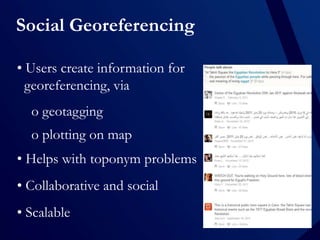
• Users create information for
georeferencing, via
o geotagging
o plotting on map
• Helps with toponym problems
• Collaborative and social

• Scalable
Examples…
British Library
• Asked public to georeference maps

• Used online tool (below) developed by Klokan
(klokantech.com/georeferencer)
• In 7 weeks, 2700
maps completed
• More details:
www.bl.uk/maps
OurOntario
• Collaborative project with libraries & museums
across Ontario

• Assisted in digitizing and online cataloguing of
local history collections
• Public contributed
objects and comments on
location & details of
existing online items
• More info:
http://ourontario.ca/
Flickr Map
• Easy to use and familiar online tool to georeference
location of photos via plotting on map
• Flickr also enables geotagging,
i.e. folksonomy tags

• Geotags may better capture
place-name info seeking
behaviour of people
• Visit map:
flickr.com/photos/glenfarrelly/map
LibraryThing
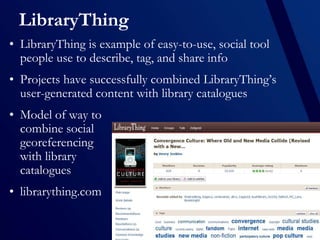
• LibraryThing is example of easy-to-use, social tool
people use to describe, tag, and share info

• Projects have successfully combined LibraryThing’s
user-generated content with library catalogues
• Model of way to
combine social
georeferencing
with library
catalogues
• librarything.com
Caveats
• Quality and accuracy of public’s work
• Malicious hijacking
• Exploitation of free labour
• Creating and managing an online, collaborative
system is time-consuming
• Maintaining public (and internal) interest in project
Encouraging Participation
• Offer incentives and prizes
• Reward “super users”

• Give credit for contributions
• Promote with social media

• Engaging user experience (incl. gamification)
Read: Holley, R. (2010). Crowdsourcing: How and why should libraries do it?
D-Lib Magazine, 16(3/4).
More Information
 delicious.com/glenfarrelly/HHLIB
 glenfarrelly.blogspot.ca

Social Georeferencing: A Model for Libraries

  • 1.
    Social Georeferencing A Modelfor Libraries By Glen Farrelly February 2014
  • 2.
    About Me • Doctoralcandidate @ University of Toronto, Faculty of Information • 15+ years as digital media consultant and web producer • My dissertation examines how people’s use of locative media affects their spatial relationships • For further Glen info  glenfarrelly.com
  • 3.
    Presentation Overview 1. 2. 3. 4. 5. Introduction Terminology Importance Social georeferencing Examples a.British Library b. OurOntario c. Flickr d. LibraryThing 6. Caveats 7. Recommendations Sample of a libraries local studies collection
  • 4.
    Introduction • Location-based services(LBS) made geographically relevant info more accessible & desired • Current ways to georeference are insufficient • Online, crowdsourcing offers potential solution
  • 5.
  • 6.
  • 7.
    Importance of Topic •People value geographically relevant information • Long history of media used to deliver geo. relevance • LBS have increased demand • Much info in libraries not sufficiently georeferenced
  • 8.
    Use of Location-BasedServices 60 % of respondents 50 40 30 20 10 0 Find nearby Find nearby Find nearby businesses events sites View pictures or videos of location Read Read history Read local current info of location news of location Read reviews of nearby businesses In a survey I did, 86% of respondents reported using their device to access at least one place-related function in the past month. The results are dated now, so I expect these rates to be higher. At the high end, 84% reported finding proximal businesses or services, reading local news (74%), finding nearby sites (67%), and reading information about their location (66%).
  • 9.
    Social Georeferencing • Userscreate information for georeferencing, via o geotagging o plotting on map • Helps with toponym problems • Collaborative and social • Scalable
  • 10.
  • 11.
    British Library • Askedpublic to georeference maps • Used online tool (below) developed by Klokan (klokantech.com/georeferencer) • In 7 weeks, 2700 maps completed • More details: www.bl.uk/maps
  • 12.
    OurOntario • Collaborative projectwith libraries & museums across Ontario • Assisted in digitizing and online cataloguing of local history collections • Public contributed objects and comments on location & details of existing online items • More info: http://ourontario.ca/
  • 13.
    Flickr Map • Easyto use and familiar online tool to georeference location of photos via plotting on map • Flickr also enables geotagging, i.e. folksonomy tags • Geotags may better capture place-name info seeking behaviour of people • Visit map: flickr.com/photos/glenfarrelly/map
  • 14.
    LibraryThing • LibraryThing isexample of easy-to-use, social tool people use to describe, tag, and share info • Projects have successfully combined LibraryThing’s user-generated content with library catalogues • Model of way to combine social georeferencing with library catalogues • librarything.com
  • 15.
    Caveats • Quality andaccuracy of public’s work • Malicious hijacking • Exploitation of free labour • Creating and managing an online, collaborative system is time-consuming • Maintaining public (and internal) interest in project
  • 16.
    Encouraging Participation • Offerincentives and prizes • Reward “super users” • Give credit for contributions • Promote with social media • Engaging user experience (incl. gamification) Read: Holley, R. (2010). Crowdsourcing: How and why should libraries do it? D-Lib Magazine, 16(3/4).
  • 17.