Anna Haverinen, PhD, Design Anthropologist
DIGGING DEEP
IN THE DIGITAL –
PRACTICING ONLINE
ETHNOGRAPHY
1. What is online ethnography?
2. Four waves of online ethnography
3. Method examples
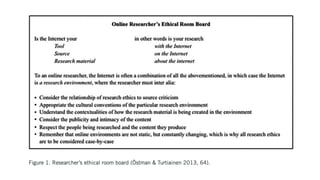
4. Ethical questions
AGENDA
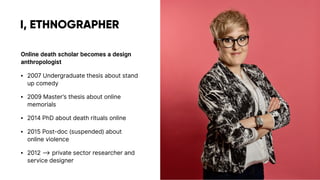
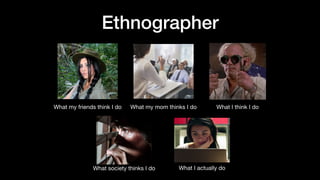
I, ETHNOGRAPHER
Online death scholar becomes a design
anthropologist
• 2007 Undergraduate thesis about stand
up comedy
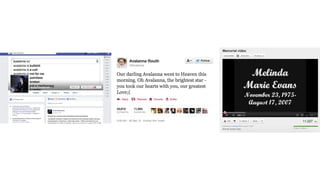
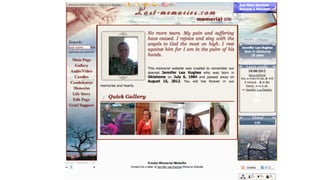
• 2009 Master’s thesis about online
memorials
• 2014 PhD about death rituals online
• 2015 Post-doc (suspended) about
online violence
• 2012 ⟶ private sector researcher and
service designer
1.What is online ethnography?
Online ethnography is qualitative
research where the focus of inquiry
is in online environments accessible
through computers, VR/AR and smart
devices.
“Ethnography is a flexible,
responsive methodology, sensitive to
emergent phenomena and emergent
research questions”
(Boellstorff, Nardi, Pearce & Taylor 2012, 6).
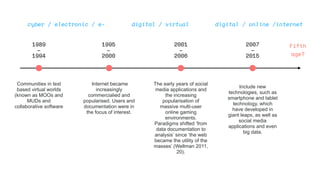
2.Four waves of online
ethnography
1989
–
1994
1995
–
2000
Communities in text
based virtual worlds
(known as MOOs and
MUDs and
collaborative software
Internet became
increasingly
commercialied and
popularised. Users and
documentation were in
the focus of interest.
Include new
technologies, such as
smartphone and tablet
technology, which
have developed in
giant leaps, as well as
social media
applications and even
big data.
2007
–
2015
The early years of social
media applications and
the increasing
popularisation of
massive multi-user
online gaming
environments.
Paradigms shifted ‘from
data documentation to
analysis’ since ‘the web
became the utility of the
masses’ (Wellman 2011,
20).
Fifth
age?
2001
–
2006
cyber / electronic / e- digital / virtual digital / online /internet
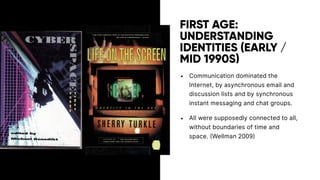
FIRST AGE:
UNDERSTANDING
IDENTITIES (EARLY /
MID 1990S)
• Communication dominated the
Internet, by asynchronous email and
discussion lists and by synchronous
instant messaging and chat groups.
• All were supposedly connected to all,
without boundaries of time and
space. (Wellman 2009)
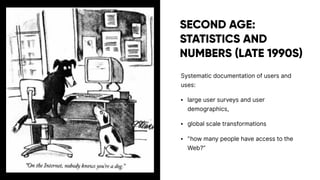
SECOND AGE:
STATISTICS AND
NUMBERS (LATE 1990S)
Systematic documentation of users and
uses:
• large user surveys and user
demographics,
• global scale transformations
• ”how many people have access to the
Web?”
THIRD AGE: SPECIALISTS
AND NEW COMERS
(EARLY 2000S)
• Internet research was incorporated in existing fields
• More developed theories, methods and substantive lore
of the disciplines into play, although sometimes at the
cost of the adventurous innovativeness of
interdisciplinary Internet research
• Association of Internet Researchers (AoIR) started in
2000
• Journals: Computers in Human Behavior, Information,
Communication and Society; The Information Society;
Journal of Computer Mediated Communication, New
Media and Society..
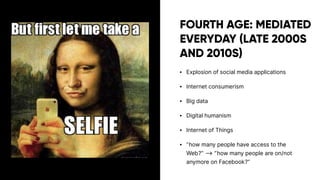
FOURTH AGE: MEDIATED
EVERYDAY (LATE 2000S
AND 2010S)
• Explosion of social media applications
• Internet consumerism
• Big data
• Digital humanism
• Internet of Things
• ”how many people have access to the
Web?” ⟶ ”how many people are on/not
anymore on Facebook?”
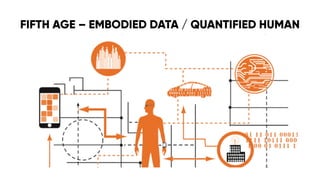
FIFTH AGE – EMBODIED DATA / QUANTIFIED HUMAN
3.Method examples
”Just saying something is
ethnographic does not make it so.”
(Boellstorff 2012, 40)
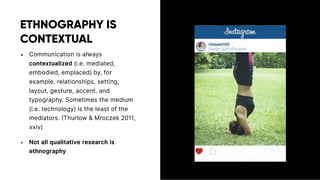
ETHNOGRAPHY IS
CONTEXTUAL
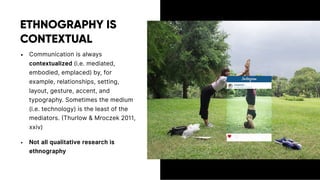
• Communication is always
contextualized (i.e. mediated,
embodied, emplaced) by, for
example, relationships, setting,
layout, gesture, accent, and
typography. Sometimes the medium
(i.e. technology) is the least of the
mediators. (Thurlow & Mroczek 2011,
xxiv)
• Not all qualitative research is
ethnography
ETHNOGRAPHY IS
CONTEXTUAL
• Communication is always
contextualized (i.e. mediated,
embodied, emplaced) by, for
example, relationships, setting,
layout, gesture, accent, and
typography. Sometimes the medium
(i.e. technology) is the least of the
mediators. (Thurlow & Mroczek 2011,
xxiv)
• Not all qualitative research is
ethnography
Qualitative
interview
is often aiming for
comparability.
Ethnographic
interview
leaves room for
improvisation, the
new insight.
Qualitative
interview usually
has a theoretical
frame and a
hypothesis.
Ethnographic
interview is open and
the theory /
hypothesis is formed
through analysis.
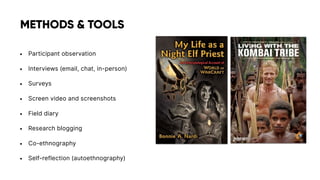
• Participant observation
• Interviews (email, chat, in-person)
• Surveys
• Screen video and screenshots
• Field diary
• Research blogging
• Co-ethnography
• Self-reflection (autoethnography)
METHODS & TOOLS
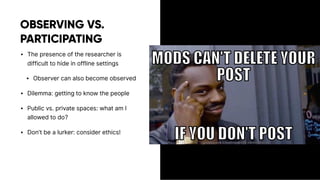
OBSERVING VS.
PARTICIPATING
• The presence of the researcher is
difficult to hide in offline settings
• Observer can also become observed
• Dilemma: getting to know the people
• Public vs. private spaces: what am I
allowed to do?
• Don’t be a lurker: consider ethics!
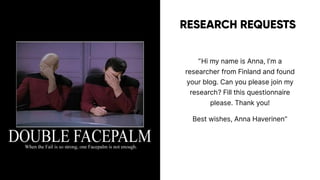
RESEARCH REQUESTS
”Hi my name is Anna, I’m a
researcher from Finland and found
your blog. Can you please join my
research? Fill this questionnaire
please. Thank you!
Best wishes, Anna Haverinen”
RESEARCH REQUESTS
”Hi my name is Anna, I’m a
researcher from Finland and found
your blog. Can you please join my
research? Fill this questionnaire
please. Thank you!
Best wishes, Anna Haverinen”
RESEARCH REQUEST
CHECK LIST
• Be polite, but not boring
• Always show your full name & contact
details, the name of the study, your
university and your supervisor
• Be explicit what is being studied and
why? Why should the person
participate?
• Ditch the jargon: your grandma should
understand the topic
• Consider GDPR!
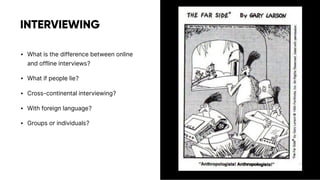
INTERVIEWING
• What is the difference between online
and offline interviews?
• What if people lie?
• Cross-continental interviewing?
• With foreign language?
• Groups or individuals?
INTERVIEWING
CHECKLIST
• Practise your questions and themes, use
colleagues and friends for practise
• Double check your documentation
technology. Then double check again
• Being nervous is ok!
• Don’t be afraid of the silence
• Ask why and why again, assuming is
dangerous
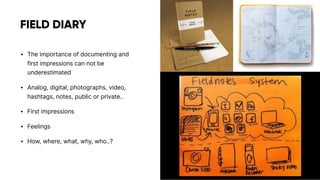
FIELD DIARY
• The importance of documenting and
first impressions can not be
underestimated
• Analog, digital, photographs, video,
hashtags, notes, public or private..
• First impressions
• Feelings
• How, where, what, why, who..?
• Social media data collection tools: http://socialmediadata.wikidot.com/ (Curated by Deen
Freelon, Ph.D. | freelon@american.edu | http://dfreelon.org | @dfreelon)
• Smart phone technology has enabled an explosion of data accessibility and data production
• If it’s accessible, it might not be ethical to access
• It’s if downloadable / recordable, it might not be ethical to download / record
DATA COLLECTION – EASIER BUT MORE
COMPLEX
4.Ethical questions
• Is it an empirical study of cultural and social behavior?
• Are you engaging in the phenomenon yourself or just observing?
• Are you collecting data in a contextually rich way?
• Have you conducted qualitatively rich interviews?
• Is it based on actual lived experiences or in ”laboratory” settings?
• Is it inductive? (i.e. knowledge builds gradually)
IS MY RESEARCH ETHNOGRAPHIC?
THANK YOU.
Anna Haverinen | PhD | Design Anthropologist
aehaverinen@gmail.com
www.annahaverinen.com | @Ahaverine
More great research references in my Ethnos ry. article:
Internet Ethnography: The Past, the Present and the Future (2015)

Introduction to online ethnography

  • 1.
    Anna Haverinen, PhD,Design Anthropologist DIGGING DEEP IN THE DIGITAL – PRACTICING ONLINE ETHNOGRAPHY
  • 2.
    1. What isonline ethnography? 2. Four waves of online ethnography 3. Method examples 4. Ethical questions AGENDA
  • 3.
    I, ETHNOGRAPHER Online deathscholar becomes a design anthropologist • 2007 Undergraduate thesis about stand up comedy • 2009 Master’s thesis about online memorials • 2014 PhD about death rituals online • 2015 Post-doc (suspended) about online violence • 2012 ⟶ private sector researcher and service designer
  • 4.
    1.What is onlineethnography?
  • 5.
    Online ethnography isqualitative research where the focus of inquiry is in online environments accessible through computers, VR/AR and smart devices.
  • 6.
    “Ethnography is aflexible, responsive methodology, sensitive to emergent phenomena and emergent research questions” (Boellstorff, Nardi, Pearce & Taylor 2012, 6).
  • 7.
    2.Four waves ofonline ethnography
  • 8.
    1989 – 1994 1995 – 2000 Communities in text basedvirtual worlds (known as MOOs and MUDs and collaborative software Internet became increasingly commercialied and popularised. Users and documentation were in the focus of interest. Include new technologies, such as smartphone and tablet technology, which have developed in giant leaps, as well as social media applications and even big data. 2007 – 2015 The early years of social media applications and the increasing popularisation of massive multi-user online gaming environments. Paradigms shifted ‘from data documentation to analysis’ since ‘the web became the utility of the masses’ (Wellman 2011, 20). Fifth age? 2001 – 2006 cyber / electronic / e- digital / virtual digital / online /internet
  • 9.
    FIRST AGE: UNDERSTANDING IDENTITIES (EARLY/ MID 1990S) • Communication dominated the Internet, by asynchronous email and discussion lists and by synchronous instant messaging and chat groups. • All were supposedly connected to all, without boundaries of time and space. (Wellman 2009)
  • 10.
    SECOND AGE: STATISTICS AND NUMBERS(LATE 1990S) Systematic documentation of users and uses: • large user surveys and user demographics, • global scale transformations • ”how many people have access to the Web?”
  • 11.
    THIRD AGE: SPECIALISTS ANDNEW COMERS (EARLY 2000S) • Internet research was incorporated in existing fields • More developed theories, methods and substantive lore of the disciplines into play, although sometimes at the cost of the adventurous innovativeness of interdisciplinary Internet research • Association of Internet Researchers (AoIR) started in 2000 • Journals: Computers in Human Behavior, Information, Communication and Society; The Information Society; Journal of Computer Mediated Communication, New Media and Society..
  • 12.
    FOURTH AGE: MEDIATED EVERYDAY(LATE 2000S AND 2010S) • Explosion of social media applications • Internet consumerism • Big data • Digital humanism • Internet of Things • ”how many people have access to the Web?” ⟶ ”how many people are on/not anymore on Facebook?”
  • 13.
    FIFTH AGE –EMBODIED DATA / QUANTIFIED HUMAN
  • 14.
  • 15.
    ”Just saying somethingis ethnographic does not make it so.” (Boellstorff 2012, 40)
  • 16.
    ETHNOGRAPHY IS CONTEXTUAL • Communicationis always contextualized (i.e. mediated, embodied, emplaced) by, for example, relationships, setting, layout, gesture, accent, and typography. Sometimes the medium (i.e. technology) is the least of the mediators. (Thurlow & Mroczek 2011, xxiv) • Not all qualitative research is ethnography
  • 17.
    ETHNOGRAPHY IS CONTEXTUAL • Communicationis always contextualized (i.e. mediated, embodied, emplaced) by, for example, relationships, setting, layout, gesture, accent, and typography. Sometimes the medium (i.e. technology) is the least of the mediators. (Thurlow & Mroczek 2011, xxiv) • Not all qualitative research is ethnography
  • 18.
    Qualitative interview is often aimingfor comparability. Ethnographic interview leaves room for improvisation, the new insight.
  • 19.
    Qualitative interview usually has atheoretical frame and a hypothesis. Ethnographic interview is open and the theory / hypothesis is formed through analysis.
  • 20.
    • Participant observation •Interviews (email, chat, in-person) • Surveys • Screen video and screenshots • Field diary • Research blogging • Co-ethnography • Self-reflection (autoethnography) METHODS & TOOLS
  • 24.
    OBSERVING VS. PARTICIPATING • Thepresence of the researcher is difficult to hide in offline settings • Observer can also become observed • Dilemma: getting to know the people • Public vs. private spaces: what am I allowed to do? • Don’t be a lurker: consider ethics!
  • 25.
    RESEARCH REQUESTS ”Hi myname is Anna, I’m a researcher from Finland and found your blog. Can you please join my research? Fill this questionnaire please. Thank you! Best wishes, Anna Haverinen”
  • 26.
    RESEARCH REQUESTS ”Hi myname is Anna, I’m a researcher from Finland and found your blog. Can you please join my research? Fill this questionnaire please. Thank you! Best wishes, Anna Haverinen”
  • 27.
    RESEARCH REQUEST CHECK LIST •Be polite, but not boring • Always show your full name & contact details, the name of the study, your university and your supervisor • Be explicit what is being studied and why? Why should the person participate? • Ditch the jargon: your grandma should understand the topic • Consider GDPR!
  • 28.
    INTERVIEWING • What isthe difference between online and offline interviews? • What if people lie? • Cross-continental interviewing? • With foreign language? • Groups or individuals?
  • 29.
    INTERVIEWING CHECKLIST • Practise yourquestions and themes, use colleagues and friends for practise • Double check your documentation technology. Then double check again • Being nervous is ok! • Don’t be afraid of the silence • Ask why and why again, assuming is dangerous
  • 31.
    FIELD DIARY • Theimportance of documenting and first impressions can not be underestimated • Analog, digital, photographs, video, hashtags, notes, public or private.. • First impressions • Feelings • How, where, what, why, who..?
  • 32.
    • Social mediadata collection tools: http://socialmediadata.wikidot.com/ (Curated by Deen Freelon, Ph.D. | freelon@american.edu | http://dfreelon.org | @dfreelon) • Smart phone technology has enabled an explosion of data accessibility and data production • If it’s accessible, it might not be ethical to access • It’s if downloadable / recordable, it might not be ethical to download / record DATA COLLECTION – EASIER BUT MORE COMPLEX
  • 33.
  • 34.
    • Is itan empirical study of cultural and social behavior? • Are you engaging in the phenomenon yourself or just observing? • Are you collecting data in a contextually rich way? • Have you conducted qualitatively rich interviews? • Is it based on actual lived experiences or in ”laboratory” settings? • Is it inductive? (i.e. knowledge builds gradually) IS MY RESEARCH ETHNOGRAPHIC?
  • 37.
    THANK YOU. Anna Haverinen| PhD | Design Anthropologist aehaverinen@gmail.com www.annahaverinen.com | @Ahaverine More great research references in my Ethnos ry. article: Internet Ethnography: The Past, the Present and the Future (2015)