ONLINE
ASSIGNMENT
RESHMA R
180/14376008
MATHEMATICS
TOPIC
PRINCIPLES OF CURRICULUM ORGANIZATION
TOPICAL AND SPIRAL , LOGICAL AND
PSYCHOLOGICAL , CONCENTRIC AND SPIRAL
CORRELATION.
INTRODUCTION
If instruction in Mathematics is to be worthwhile it must be planned
with the idea of achieving certain aims with respect to the values attained from its
study . Selection of material should be made with a purpose , that is to be served
by Mathematics in the general scheme of education . In recent times , we find
rapid, social, technological and scientific changes. We also find significant change
in man's outlook on life.
The word 'curriculum' is derived from the Latin word 'curresre'
which means to run . So 'curriculum' is a course or path which one runs to reach a
goal. Thus curriculum includes the subject - matter and all learning experiences
arranged by the school for a particular subject.
Curriculum should not be taken as a rigid pattern. It should
rather be looked upon as a general outline of the material considered necessary
as a part of the learner's training . There should be some freedom for the teacher
and the taught to choose their subject - matter in the light of learning situation as
they arise.
Ordinarily, the official curriculum gives only the names of the
topics to be done in different classes. The teacher cannot know what exactly he is
expected to do. The present syllabus is anything but definite. The teacher is
required to work out the details in his own way. It amounts to an excessive
expectation from average teacher. Expert guidance is , therefore , needed; but it
should come from a trained and experienced person rather than from one who
has never taught the subject at school.
ORGANIZATION OF CURRICULUM
Curriculum has to be organized on the basis of certain
principles. It is these principles that help the scientific planning of the curriculum .
Organization of curriculum lies in the distribution of subject - matter of the
curriculum in different classes. It is quite essential that it is planned in a scientific
way . The teacher should have a say in the selection as well as arrangement of the
course content. His experience is of practical nature so it must count in this
respect. Teacher should be actively associated with the organization of the
subject matter of curriculum .
Good arrangement requires that,
i. Every topic should be divided into parts,
ii. Those parts should be graded according to difficulty, and
iii. Each part should be introduced at a proper stage.
Curriculum has so far been organized mostly for class teaching. The
principles which are generally kept in mind while organizing the curriculum are:
1. TOPICAL AND SPIRAL ARRANGEMENT
Topical arrangement means that a topic should be
finished entirely at one stage. It take the topics as a unit . Spiral arrangement
implies that a topic should be split up into different portions and these portions
should be spread over different grades. Easier portions and should be dealt with
in the lower grades and the difficult portion should be gradually introduced in the
next grade. The later is definitely portion of a topic should be dealt with at one
which is un psychological.
2.PSYCHOLOGICAL AND LOGICAL ARRANGEMENT
The arrangement of subject - matter based on the
principles of psychology is known as psychological approach . In this approach ,
the criterion for inclusion of an item in the curriculum will be the psychological
needs , requirements , potentials , capacities , etc . appropriate for the
developmental level of the stage for which the curriculum is being designed . In
other words this approach is in tune with the principles of child - centerdness . In
the logical approach stress is given to the logical sequencing of the subject
concerned . Contents of every subject have been developed in tune with such a
logical sequence . It is often criticized that by splitting topics to suit the
developmental status of the learner , this logical development is broken . Logical
approach demands maintaining the logical sequence while developing a
curriculum . At the same time , a good curriculum , if carefully developed can
maintain the psychological approach without sacrificing the logical sequence of
the subject . The only thing is that the logical continuity is taken care of at every
stage of curriculum transaction done in tune with the psychological approach .
3. CONCENTRIC AND SPIRAL ARRANGEMENT
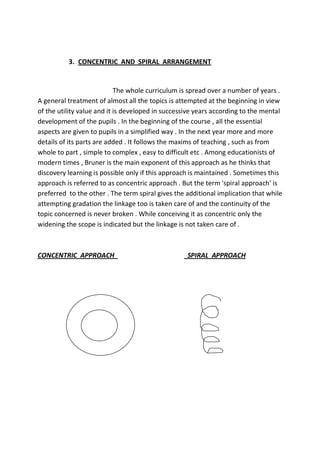
The whole curriculum is spread over a number of years .
A general treatment of almost all the topics is attempted at the beginning in view
of the utility value and it is developed in successive years according to the mental
development of the pupils . In the beginning of the course , all the essential
aspects are given to pupils in a simplified way . In the next year more and more
details of its parts are added . It follows the maxims of teaching , such as from
whole to part , simple to complex , easy to difficult etc . Among educationists of
modern times , Bruner is the main exponent of this approach as he thinks that
discovery learning is possible only if this approach is maintained . Sometimes this
approach is referred to as concentric approach . But the term 'spiral approach' is
preferred to the other . The term spiral gives the additional implication that while
attempting gradation the linkage too is taken care of and the continuity of the
topic concerned is never broken . While conceiving it as concentric only the
widening the scope is indicated but the linkage is not taken care of .
CONCENTRIC APPROACH SPIRAL APPROACH
4. PRINCIPLES OF CORRELATION
While organizing the content in Mathematics the principle of
correlation should always be given due weightage . Correlation may be of
different varieties .
The following types of correlation must be kept in mind while
organizing curriculum in Mathematics :
i . Correlation of Mathematics with the problems of everyday life .
ii . Correlation of Mathematics with other subjects .
iii . Correlation between different branches of Mathematics .
iv . correlation between different topics of a particular branch of Mathematics .
v . Correlation with craft or work experience .
For correlating subjects - matter we must know the following :
i . Day to day activities of the students .
ii . The nature of topics included in other subjects at the same stage.
iii . The topics included in different branches of the subject e.g., Arithmetic,
Algebra, Geometry etc.
iv . The sequence of topics of the same branch of the subject .
v . The nature of work experience or projects undertaken by the students .
CONCLUTION
While constructing curriculum for a grade , various
considerations are to be kept in mind . Nothing should be included simply
because of disciplinary value . Utility should provide the chief criterion of
curriculum construction . Of course , the latest trends in the subject , the needs of
community , the needs of students and above all , the views of the teachers
should be given due weight in any scheme of curriculum construction .
REFERENCES
1 . Teaching of Mathematics - Sudhir Kumar and
D N Ratnalikar
2 . The Teaching of Mathematics - Kulbir Singh Sidhu

online assignment

  • 1.
  • 2.
    TOPIC PRINCIPLES OF CURRICULUMORGANIZATION TOPICAL AND SPIRAL , LOGICAL AND PSYCHOLOGICAL , CONCENTRIC AND SPIRAL CORRELATION.
  • 3.
    INTRODUCTION If instruction inMathematics is to be worthwhile it must be planned with the idea of achieving certain aims with respect to the values attained from its study . Selection of material should be made with a purpose , that is to be served by Mathematics in the general scheme of education . In recent times , we find rapid, social, technological and scientific changes. We also find significant change in man's outlook on life. The word 'curriculum' is derived from the Latin word 'curresre' which means to run . So 'curriculum' is a course or path which one runs to reach a goal. Thus curriculum includes the subject - matter and all learning experiences arranged by the school for a particular subject. Curriculum should not be taken as a rigid pattern. It should rather be looked upon as a general outline of the material considered necessary as a part of the learner's training . There should be some freedom for the teacher and the taught to choose their subject - matter in the light of learning situation as they arise. Ordinarily, the official curriculum gives only the names of the topics to be done in different classes. The teacher cannot know what exactly he is expected to do. The present syllabus is anything but definite. The teacher is
  • 4.
    expected to do.The present syllabus is anything but definite. The teacher is required to work out the details in his own way. It amounts to an excessive expectation from average teacher. Expert guidance is , therefore , needed; but it should come from a trained and experienced person rather than from one who has never taught the subject at school. ORGANIZATION OF CURRICULUM Curriculum has to be organized on the basis of certain principles. It is these principles that help the scientific planning of the curriculum . Organization of curriculum lies in the distribution of subject - matter of the curriculum in different classes. It is quite essential that it is planned in a scientific way . The teacher should have a say in the selection as well as arrangement of the course content. His experience is of practical nature so it must count in this respect. Teacher should be actively associated with the organization of the subject matter of curriculum . Good arrangement requires that, i. Every topic should be divided into parts, ii. Those parts should be graded according to difficulty, and iii. Each part should be introduced at a proper stage. Curriculum has so far been organized mostly for class teaching. The principles which are generally kept in mind while organizing the curriculum are:
  • 5.
    1. TOPICAL ANDSPIRAL ARRANGEMENT Topical arrangement means that a topic should be finished entirely at one stage. It take the topics as a unit . Spiral arrangement implies that a topic should be split up into different portions and these portions should be spread over different grades. Easier portions and should be dealt with in the lower grades and the difficult portion should be gradually introduced in the next grade. The later is definitely portion of a topic should be dealt with at one which is un psychological. 2.PSYCHOLOGICAL AND LOGICAL ARRANGEMENT The arrangement of subject - matter based on the principles of psychology is known as psychological approach . In this approach , the criterion for inclusion of an item in the curriculum will be the psychological needs , requirements , potentials , capacities , etc . appropriate for the developmental level of the stage for which the curriculum is being designed . In other words this approach is in tune with the principles of child - centerdness . In the logical approach stress is given to the logical sequencing of the subject concerned . Contents of every subject have been developed in tune with such a logical sequence . It is often criticized that by splitting topics to suit the developmental status of the learner , this logical development is broken . Logical approach demands maintaining the logical sequence while developing a curriculum . At the same time , a good curriculum , if carefully developed can maintain the psychological approach without sacrificing the logical sequence of the subject . The only thing is that the logical continuity is taken care of at every stage of curriculum transaction done in tune with the psychological approach .
  • 6.
    3. CONCENTRIC ANDSPIRAL ARRANGEMENT The whole curriculum is spread over a number of years . A general treatment of almost all the topics is attempted at the beginning in view of the utility value and it is developed in successive years according to the mental development of the pupils . In the beginning of the course , all the essential aspects are given to pupils in a simplified way . In the next year more and more details of its parts are added . It follows the maxims of teaching , such as from whole to part , simple to complex , easy to difficult etc . Among educationists of modern times , Bruner is the main exponent of this approach as he thinks that discovery learning is possible only if this approach is maintained . Sometimes this approach is referred to as concentric approach . But the term 'spiral approach' is preferred to the other . The term spiral gives the additional implication that while attempting gradation the linkage too is taken care of and the continuity of the topic concerned is never broken . While conceiving it as concentric only the widening the scope is indicated but the linkage is not taken care of . CONCENTRIC APPROACH SPIRAL APPROACH
  • 7.
    4. PRINCIPLES OFCORRELATION While organizing the content in Mathematics the principle of correlation should always be given due weightage . Correlation may be of different varieties . The following types of correlation must be kept in mind while organizing curriculum in Mathematics : i . Correlation of Mathematics with the problems of everyday life . ii . Correlation of Mathematics with other subjects . iii . Correlation between different branches of Mathematics . iv . correlation between different topics of a particular branch of Mathematics . v . Correlation with craft or work experience . For correlating subjects - matter we must know the following : i . Day to day activities of the students . ii . The nature of topics included in other subjects at the same stage. iii . The topics included in different branches of the subject e.g., Arithmetic, Algebra, Geometry etc. iv . The sequence of topics of the same branch of the subject . v . The nature of work experience or projects undertaken by the students .
  • 8.
    CONCLUTION While constructing curriculumfor a grade , various considerations are to be kept in mind . Nothing should be included simply because of disciplinary value . Utility should provide the chief criterion of curriculum construction . Of course , the latest trends in the subject , the needs of community , the needs of students and above all , the views of the teachers should be given due weight in any scheme of curriculum construction . REFERENCES 1 . Teaching of Mathematics - Sudhir Kumar and D N Ratnalikar 2 . The Teaching of Mathematics - Kulbir Singh Sidhu