DESIGNING THE
CURRICULUM
Principles of curriculum design
• A curriculum is :
“ an attempt to communicate the
essential features and principles of an
educational proposal in such a form that it
is open to critical scrutiny and capable of
effective translation into practice. “
Stenhouse 1975
Principles of curriculum design
• A curriculum is :
“the public face of a profession’s best
educational thinking”
Fish 2003
Principles of curriculum design
• A curriculum includes:
formal and informal
overt and covert
recognised and overlooked
intentional and unintentional
it is determined as much by what it omits as
what it contains
Principles of curriculum design
• Values underpin our curriculum
“They drive our actions,attitudes thoughts
and beliefs. They shape what we prioritise
in our professional life and how we
conduct ourselves in clinical and
educational settings. And that conduct
reveals our values to colleagues ,patients
and learners”
Fish 2003
Principles of curriculum design
Values which influence curriculum design
are those of:
the curriculum designers
the teachers
the learners
the society in which it is
delivered
Principles of curriculum design
Values may be :
values in use
espoused values
Principles of curriculum design
Every curriculum has three levels:
Planned :
what is intended by
designers
Delivered :
what is organised by
institution
what is taught by teachers
Experienced: what is learned by students
Curriculum Approaches
SUBJECT - CENTERED
Organized on the basis of
separate and distinct subjects,
each of which embodies a
body of knowledge and skills.
The learner is expected to
acquire this body of
knowledge skills.
CHILD - CENTERED

Child is the center of the
educational process and the
curriculum should be built
upon interests, abilities,
purposes, and needs.
PROBLEM - CENTERED
A framework in which the child is
guided toward maturity within the
context of the social group. It assumes
that in the process of living, children
experience problem.
BEHAVIORAL APPROACH
•

Behavioral Approach. This is based on a blueprint, where
goals and objectives are specified, contents and activities
are also arranged to match with the learning objectives.
The learning outcomes are evaluated in terms of goals
and objectives set at the beginning. This approach started
with the idea of Frederick Taylor which is aimed to
achieve efficiency. In education, behavioral approach
begins with educational plans that start with the setting of
goals or objectives. These are the important ingredients in
curriculum implementation as evaluating the learning
outcomes as a change of behavior. The change of
behavior indicates the measure of the accomplishment.
MANAGERIAL APPROACH
In this approach, the principal is the curriculum leader and
at the same time instructional leader who is supposed to
be the general manager. The general manager sets the
policies and priorities, establishes the direction of change
and innovation, and planning and organizing curriculum
and instruction. School administrators are less concerned
about the content than about organization and
implementation. They are less concerned about subject
matter, methods and materials than improving the
curriculum. Curriculum managers look at curriculum
changes and innovations as they administer the resources
and restructure the schools.
SYSTEMS APPROACH
This was influenced by systems theory, where the
parts of the total school district or school are
examined in terms of how they relate to each other.
The organizational chart of the school represents a
systems approach. It shows the line-staff
relationships of personnel and how decisions are
made. The following are of equal importance: a)
administration b) counselling c) curriculum d)
instruction e) evaluation.
HUMANISTIC APPROACH
This approach is rooted in the progressive
philosophy and child - centered movement. It
considers the formal or planned curriculum
and the informal or hidden curriculum. It
considers the whole child and believes that in
curriculum the total development of the
individual is the prime consideration. The
learner s at the center of the curriculum.
ROLE OF CURRICULUM
SUPERVISOR
a. help develop the school's
education goals
b. plan curriculum with students,
parents, teachers and other
stakeholders
c. design programs of study by
grade levels
d. plan or schedule classes or
school calendar
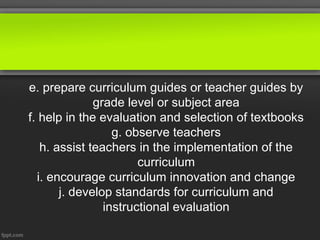
e. prepare curriculum guides or teacher guides by
grade level or subject area
f. help in the evaluation and selection of textbooks
g. observe teachers
h. assist teachers in the implementation of the
curriculum
i. encourage curriculum innovation and change
j. develop standards for curriculum and
instructional evaluation
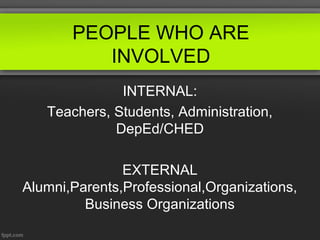
PEOPLE WHO ARE
INVOLVED
INTERNAL:
Teachers, Students, Administration,
DepEd/CHED
EXTERNAL
Alumni,Parents,Professional,Organizations,
Business Organizations

Curriculumdevelopmentreport 130107005619-phpapp02

  • 1.
  • 2.
    Principles of curriculumdesign • A curriculum is : “ an attempt to communicate the essential features and principles of an educational proposal in such a form that it is open to critical scrutiny and capable of effective translation into practice. “ Stenhouse 1975
  • 3.
    Principles of curriculumdesign • A curriculum is : “the public face of a profession’s best educational thinking” Fish 2003
  • 4.
    Principles of curriculumdesign • A curriculum includes: formal and informal overt and covert recognised and overlooked intentional and unintentional it is determined as much by what it omits as what it contains
  • 5.
    Principles of curriculumdesign • Values underpin our curriculum “They drive our actions,attitudes thoughts and beliefs. They shape what we prioritise in our professional life and how we conduct ourselves in clinical and educational settings. And that conduct reveals our values to colleagues ,patients and learners” Fish 2003
  • 6.
    Principles of curriculumdesign Values which influence curriculum design are those of: the curriculum designers the teachers the learners the society in which it is delivered
  • 7.
    Principles of curriculumdesign Values may be : values in use espoused values
  • 8.
    Principles of curriculumdesign Every curriculum has three levels: Planned : what is intended by designers Delivered : what is organised by institution what is taught by teachers Experienced: what is learned by students
  • 9.
  • 10.
    SUBJECT - CENTERED Organizedon the basis of separate and distinct subjects, each of which embodies a body of knowledge and skills. The learner is expected to acquire this body of knowledge skills.
  • 11.
    CHILD - CENTERED Childis the center of the educational process and the curriculum should be built upon interests, abilities, purposes, and needs.
  • 12.
    PROBLEM - CENTERED Aframework in which the child is guided toward maturity within the context of the social group. It assumes that in the process of living, children experience problem.
  • 13.
    BEHAVIORAL APPROACH • Behavioral Approach.This is based on a blueprint, where goals and objectives are specified, contents and activities are also arranged to match with the learning objectives. The learning outcomes are evaluated in terms of goals and objectives set at the beginning. This approach started with the idea of Frederick Taylor which is aimed to achieve efficiency. In education, behavioral approach begins with educational plans that start with the setting of goals or objectives. These are the important ingredients in curriculum implementation as evaluating the learning outcomes as a change of behavior. The change of behavior indicates the measure of the accomplishment.
  • 14.
    MANAGERIAL APPROACH In thisapproach, the principal is the curriculum leader and at the same time instructional leader who is supposed to be the general manager. The general manager sets the policies and priorities, establishes the direction of change and innovation, and planning and organizing curriculum and instruction. School administrators are less concerned about the content than about organization and implementation. They are less concerned about subject matter, methods and materials than improving the curriculum. Curriculum managers look at curriculum changes and innovations as they administer the resources and restructure the schools.
  • 15.
    SYSTEMS APPROACH This wasinfluenced by systems theory, where the parts of the total school district or school are examined in terms of how they relate to each other. The organizational chart of the school represents a systems approach. It shows the line-staff relationships of personnel and how decisions are made. The following are of equal importance: a) administration b) counselling c) curriculum d) instruction e) evaluation.
  • 16.
    HUMANISTIC APPROACH This approachis rooted in the progressive philosophy and child - centered movement. It considers the formal or planned curriculum and the informal or hidden curriculum. It considers the whole child and believes that in curriculum the total development of the individual is the prime consideration. The learner s at the center of the curriculum.
  • 17.
    ROLE OF CURRICULUM SUPERVISOR a.help develop the school's education goals b. plan curriculum with students, parents, teachers and other stakeholders c. design programs of study by grade levels d. plan or schedule classes or school calendar
  • 18.
    e. prepare curriculumguides or teacher guides by grade level or subject area f. help in the evaluation and selection of textbooks g. observe teachers h. assist teachers in the implementation of the curriculum i. encourage curriculum innovation and change j. develop standards for curriculum and instructional evaluation
  • 19.
    PEOPLE WHO ARE INVOLVED INTERNAL: Teachers,Students, Administration, DepEd/CHED EXTERNAL Alumni,Parents,Professional,Organizations, Business Organizations