Effective One-to-One Coaching Program “ Unleashing Potential” Angelo R. D’Agostino December 1, 2008 Magazine Publishing Industry HRD 830/440:  Concepts of Human Resource Development HRD Program Clemson University
Introduction I Work at Reed Business Information (RBI), the world’s largest Business-to-Business Publishing Company.  RBI is a subsidiary of Reed Elsevier PLC I am a Senior Director of Human Resources for the East Coast covering all office from Atlanta, GA, Washington DC, Boston and New York City, where we are headquartered and I am based out of.  I manage a work place population of approximately 2,000 employees.  I have 5 direct reports.  I have been working for the past 4+ years at the company trying to develop as an HR executive while at the same time teaching the importance of effective coaching between manger and employee.  My job is to instill managers with the ability to coach their team while at the same time help the team be more profitable by sharing all necessary tools to help this happen.
objectives Improve skills for conducting effective one-to-one coaching conversations and achieve enhanced business results.  Learn an effective framework for conducting one-to-one conversations and ongoing performance discussions. Understand the personal challenge in developing own coaching capability and practice applying the skills to live issues.
what is coaching? “ Paying positive attention to people” Coaching is a process in which someone, through  direct discussion  and  guided activity ,  enables  another to learn to solve a problem  or to do a  task better  than would otherwise have been the case. This will  improve  the individual’s capability  to continuously  sustain  increasing levels of  performance and  support  further individual development. It should be viewed as a developmental activity intended to  sustain or  enhance  current performance.
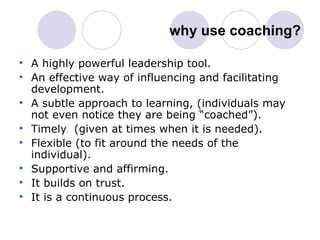
why use coaching? A highly powerful leadership tool.  An effective way of influencing and facilitating development. A subtle approach to learning, (individuals may not even notice they are being “coached”). Timely  (given at times when it is needed). Flexible (to fit around the needs of the individual). Supportive and affirming. It builds on trust. It is a continuous process.
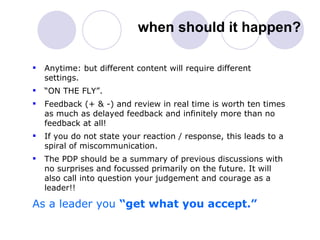
when should it happen? Anytime: but different content will require different settings. “ ON THE FLY”. Feedback (+ & -) and review in real time is worth ten times as much as delayed feedback and infinitely more than no feedback at all!  If you do not state your reaction / response, this leads to a spiral of miscommunication. The PDP should be a summary of previous discussions with no surprises and focussed primarily on the future. It will also call into question your judgement and courage as a leader!! As a leader you  “get what you accept.”
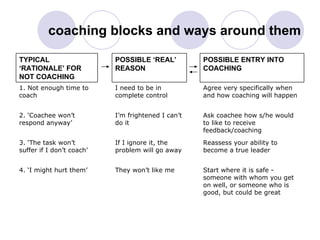
coaching blocks and ways around them Start where it is safe - someone with whom you get on well, or someone who is good, but could be great   They won’t like me 4. ‘I might hurt them’ Reassess your ability to become a true leader If I ignore it, the problem will go away 3. ‘The task won’t suffer if I don’t coach’ Ask coachee how s/he would to like to receive feedback/coaching I’m frightened I can’t do it 2. ‘Coachee won’t respond anyway’ Agree very specifically when and how coaching will happen I need to be in complete control 1. Not enough time to coach POSSIBLE ENTRY INTO COACHING POSSIBLE ‘REAL’ REASON TYPICAL ‘RATIONALE’ FOR NOT COACHING
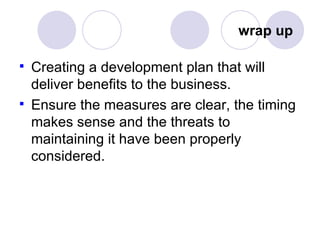
wrap up  Creating a development plan that will deliver benefits to the business. Ensure the measures are clear, the timing makes sense and the threats to maintaining it have been properly considered.
personal challenge What two things can you do, starting immediately, to improve how you coach ?
Contact Information Angelo D’Agostino [email_address]   [email_address]

One On One Coaching

  • 1.
    Effective One-to-One CoachingProgram “ Unleashing Potential” Angelo R. D’Agostino December 1, 2008 Magazine Publishing Industry HRD 830/440: Concepts of Human Resource Development HRD Program Clemson University
  • 2.
    Introduction I Workat Reed Business Information (RBI), the world’s largest Business-to-Business Publishing Company. RBI is a subsidiary of Reed Elsevier PLC I am a Senior Director of Human Resources for the East Coast covering all office from Atlanta, GA, Washington DC, Boston and New York City, where we are headquartered and I am based out of. I manage a work place population of approximately 2,000 employees. I have 5 direct reports. I have been working for the past 4+ years at the company trying to develop as an HR executive while at the same time teaching the importance of effective coaching between manger and employee. My job is to instill managers with the ability to coach their team while at the same time help the team be more profitable by sharing all necessary tools to help this happen.
  • 3.
    objectives Improve skillsfor conducting effective one-to-one coaching conversations and achieve enhanced business results. Learn an effective framework for conducting one-to-one conversations and ongoing performance discussions. Understand the personal challenge in developing own coaching capability and practice applying the skills to live issues.
  • 4.
    what is coaching?“ Paying positive attention to people” Coaching is a process in which someone, through direct discussion and guided activity , enables another to learn to solve a problem or to do a task better than would otherwise have been the case. This will improve the individual’s capability to continuously sustain increasing levels of performance and support further individual development. It should be viewed as a developmental activity intended to sustain or enhance current performance.
  • 5.
    why use coaching?A highly powerful leadership tool. An effective way of influencing and facilitating development. A subtle approach to learning, (individuals may not even notice they are being “coached”). Timely (given at times when it is needed). Flexible (to fit around the needs of the individual). Supportive and affirming. It builds on trust. It is a continuous process.
  • 6.
    when should ithappen? Anytime: but different content will require different settings. “ ON THE FLY”. Feedback (+ & -) and review in real time is worth ten times as much as delayed feedback and infinitely more than no feedback at all! If you do not state your reaction / response, this leads to a spiral of miscommunication. The PDP should be a summary of previous discussions with no surprises and focussed primarily on the future. It will also call into question your judgement and courage as a leader!! As a leader you “get what you accept.”
  • 7.
    coaching blocks andways around them Start where it is safe - someone with whom you get on well, or someone who is good, but could be great They won’t like me 4. ‘I might hurt them’ Reassess your ability to become a true leader If I ignore it, the problem will go away 3. ‘The task won’t suffer if I don’t coach’ Ask coachee how s/he would to like to receive feedback/coaching I’m frightened I can’t do it 2. ‘Coachee won’t respond anyway’ Agree very specifically when and how coaching will happen I need to be in complete control 1. Not enough time to coach POSSIBLE ENTRY INTO COACHING POSSIBLE ‘REAL’ REASON TYPICAL ‘RATIONALE’ FOR NOT COACHING
  • 8.
    wrap up Creating a development plan that will deliver benefits to the business. Ensure the measures are clear, the timing makes sense and the threats to maintaining it have been properly considered.
  • 9.
    personal challenge Whattwo things can you do, starting immediately, to improve how you coach ?
  • 10.
    Contact Information AngeloD’Agostino [email_address] [email_address]