GRIEVANCES &
GRIEVANCE
HANDLING
Rohit Sahay - 47
Prarabda Pathak - 52
Dhiraj Nayak - 54
1
Grievances
• A grievance is a formal dispute between an
employee & management on the conditions of
employment.
• Grievances are complaints that have been formally
registered in accordance with the grievance
procedure.
• A grievance is any dissatisfaction or feeling of
injustice in connection with one’s employment
situation that is brought to the attention of the
management.

2
Grievance must fall under the
following category:
•
•
•
•
•
•
•
•

Amenities
Compensation
Conditions of work
Continuity of service
Disciplinary action
Fines
Leave
Medical benefits

•
•
•
•
•
•
•
•

Nature of job
Payments
Promotions
Safety environment
Super Annuation
Supersession
Transfers
Victimisation
3
W’s of Grievance Handling
•
•
•
•
•
•
•
•

WHO is involved
WHEN did it happen
WHERE did it happen
WHAT happened (EXACTLY)
WHY is it grieve-able
WHEN must the grievance be filed
WHAT are the deadline dates
WHAT must be done
4
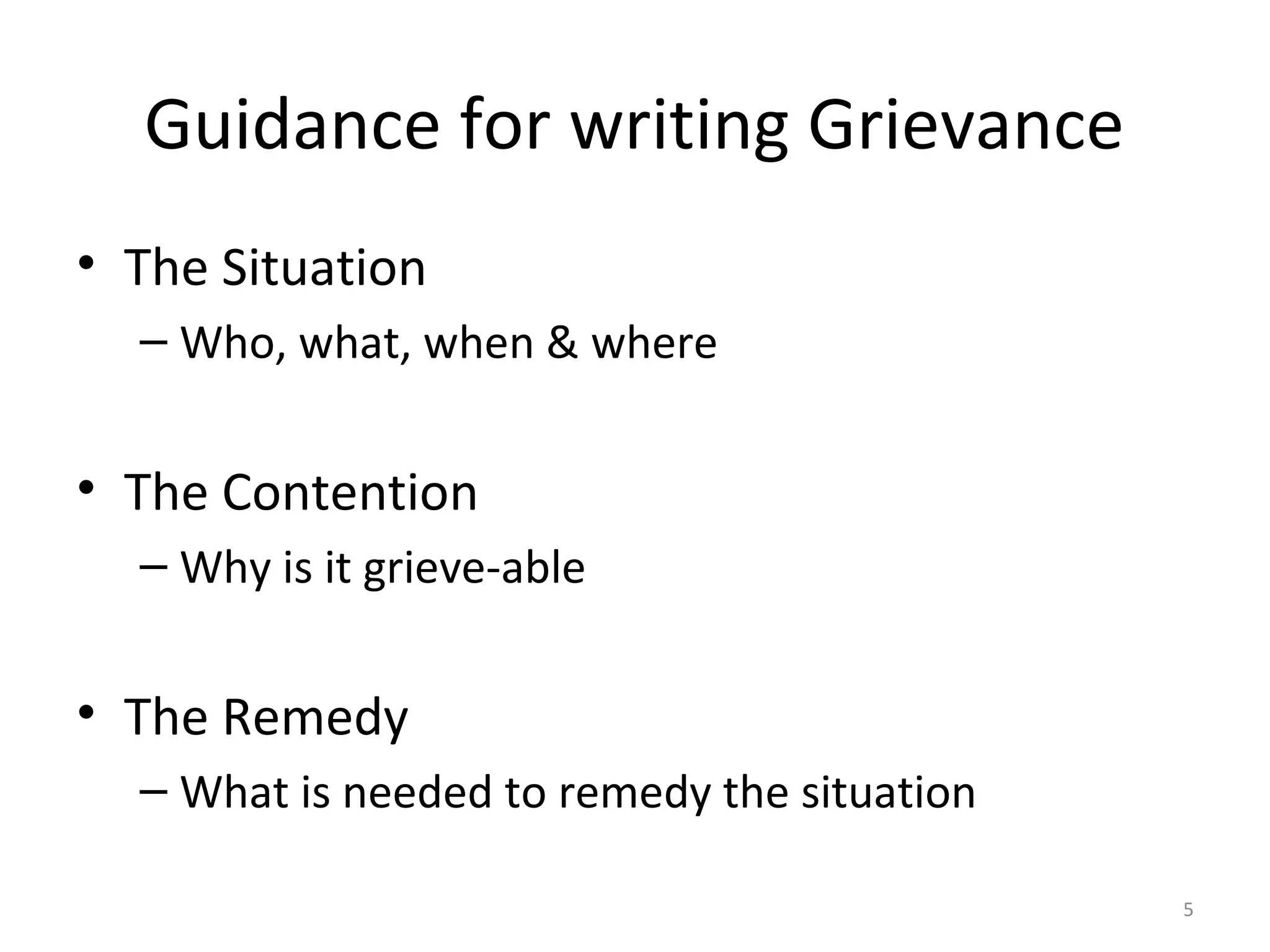
Guidance for writing Grievance
• The Situation
– Who, what, when & where

• The Contention
– Why is it grieve-able

• The Remedy
– What is needed to remedy the situation
5
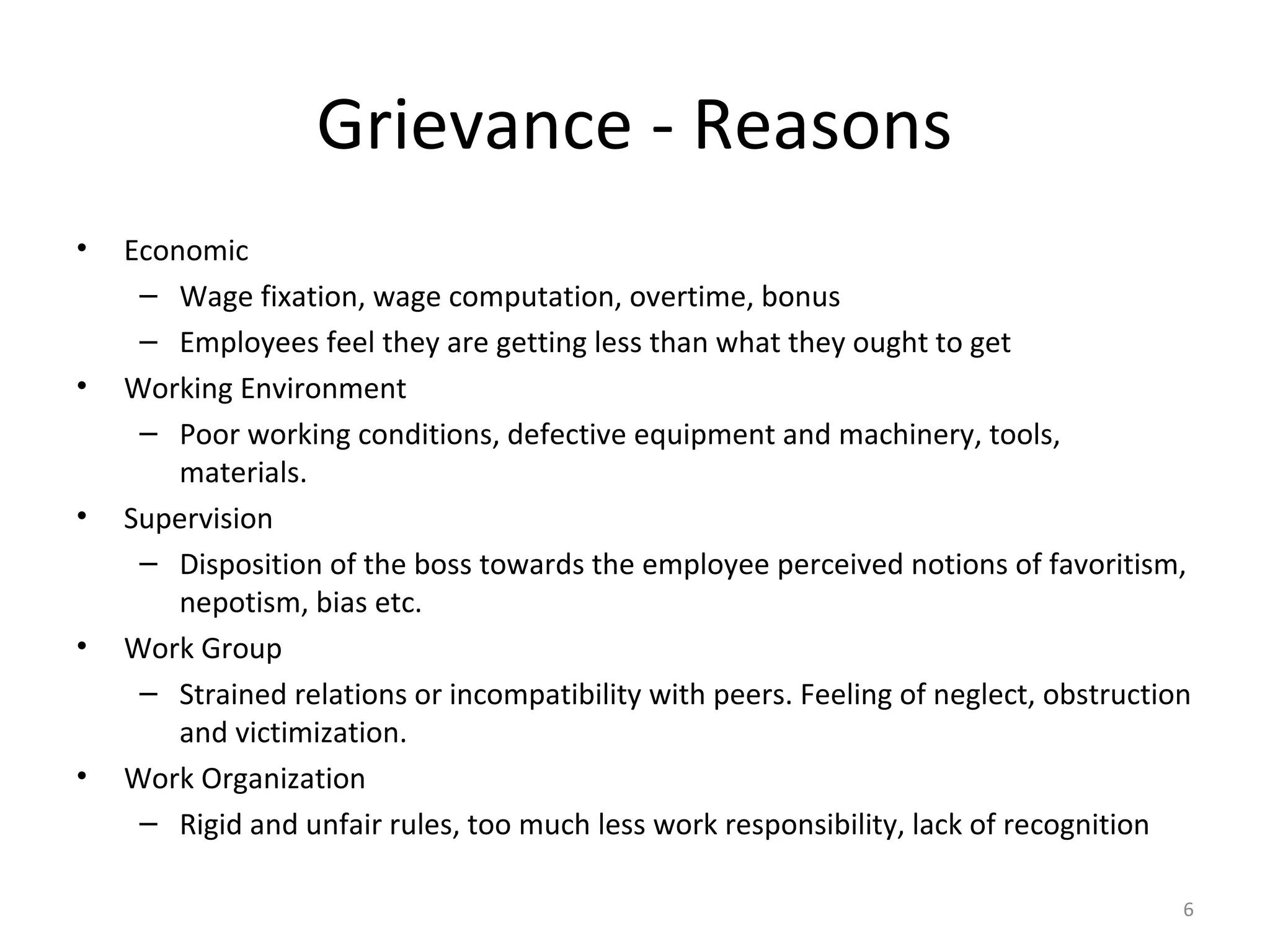
Grievance - Reasons
•

•

•

•

•

Economic
– Wage fixation, wage computation, overtime, bonus
– Employees feel they are getting less than what they ought to get
Working Environment
– Poor working conditions, defective equipment and machinery, tools,
materials.
Supervision
– Disposition of the boss towards the employee perceived notions of favoritism,
nepotism, bias etc.
Work Group
– Strained relations or incompatibility with peers. Feeling of neglect, obstruction
and victimization.
Work Organization
– Rigid and unfair rules, too much less work responsibility, lack of recognition
6
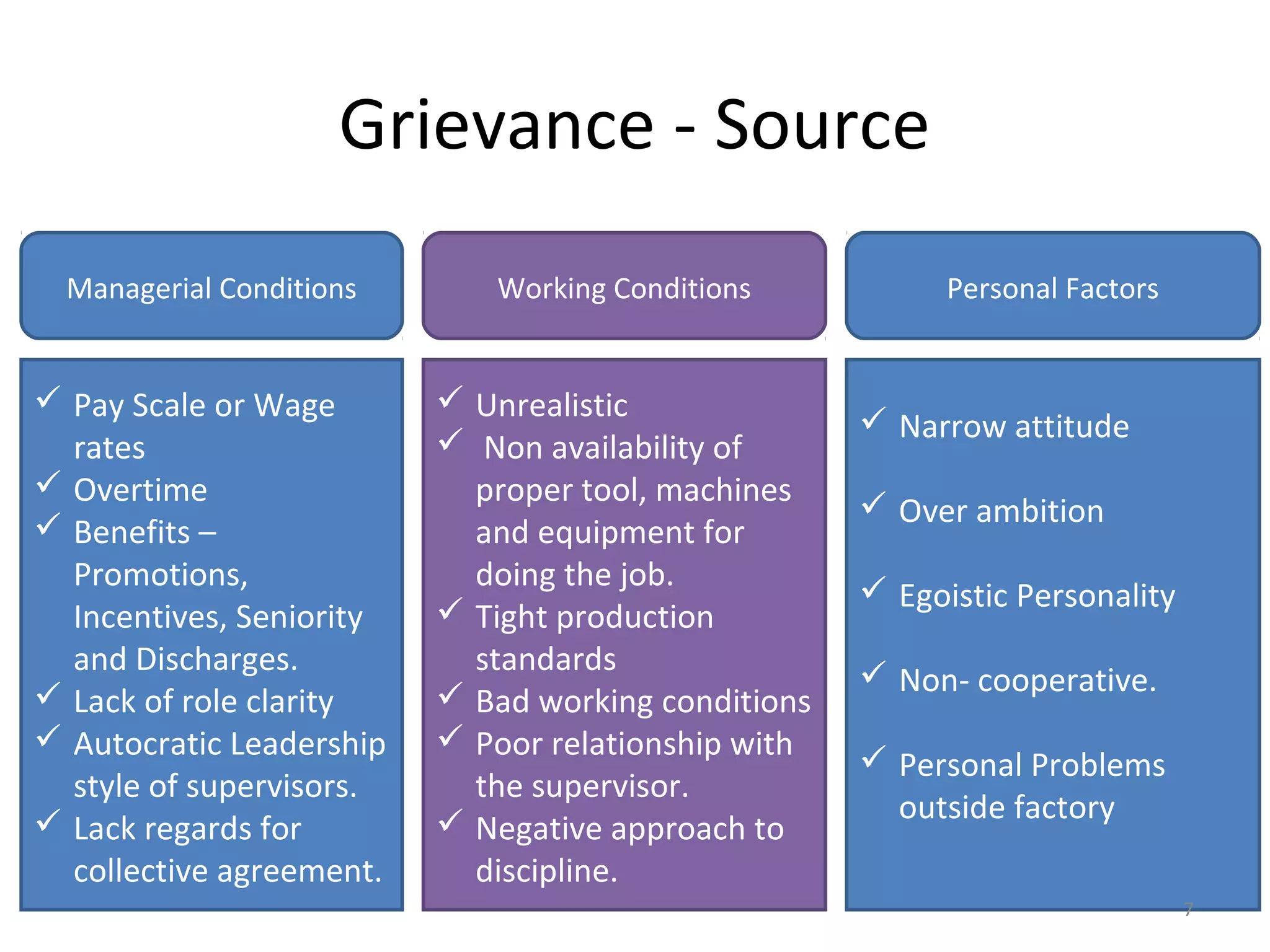
Grievance - Source
Managerial Conditions

Working Conditions

 Pay Scale or Wage
rates
 Overtime
 Benefits –
Promotions,
Incentives, Seniority
and Discharges.
 Lack of role clarity
 Autocratic Leadership
style of supervisors.
 Lack regards for
collective agreement.

 Unrealistic
 Non availability of
proper tool, machines
and equipment for
doing the job.
 Tight production
standards
 Bad working conditions
 Poor relationship with
the supervisor.
 Negative approach to
discipline.

Personal Factors

 Narrow attitude
 Over ambition
 Egoistic Personality
 Non- cooperative.
 Personal Problems
outside factory
7
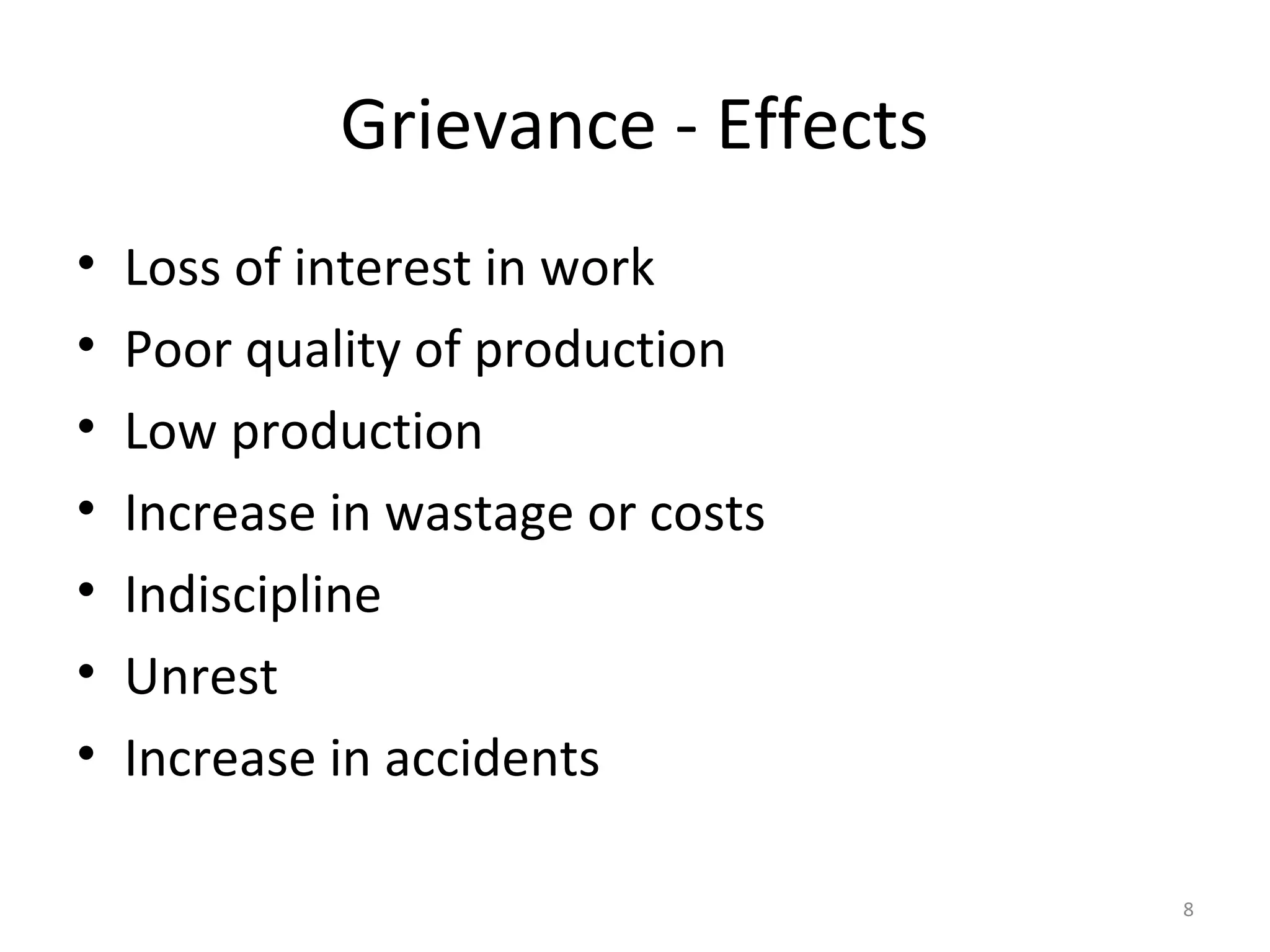
Grievance - Effects
•
•
•
•
•
•
•

Loss of interest in work
Poor quality of production
Low production
Increase in wastage or costs
Indiscipline
Unrest
Increase in accidents
8
Grievance - Effects
• On Production
– Low quality of production, Low productivity, Increase
in wastage, Increase in cost of production.

• On Employees
– Increased absenteeism, Reduction in level of
commitment, Increase in accidents, Reduced level of
employee moral.

• On Managers
– Strained superior- subordinate relations, Need for
increased supervision/control and follow up, Increase
in unrest.
9
Do’s
•
•
•
•
•
•
•

•

Identify the relief the union is
seeking.
Fully inform your own superior of
grievance matters.
Hold discussions privately.
Command the respect of the
union representatives.
Examine the grievant’s personal
record.
Treat the union representative as
your equal.
Get the union to identify specific
contractual provisions allegedly
violated.
Enforce the contractual time
limits.

Don’t’s
•

•

•
•
•
•
•

Discuss the case with the union
steward alone; the grievant
should definitely be there.
Make agreements with
individuals that are inconsistent
with the labour arrangements.
Hold back the remedy if the
company is wrong.
Admit the binding effect of a past
practice.
Relinquish your authority to the
union.
Apply the grievance remedy to an
improper grievance.
Argue grievance issues off the
work premises.
10
Benefits of Grievance Handling
• It encourages employees to raise concerns
without fear of reprisal.
• It provides a fair & speedy means of dealing of
grievances.
• It prevents minor disagreements developing
into more serious disputes.
• It saves employer’s time & money as solutions
are found for workplace problems.
• It helps build in organisational climate based
on openness and trust.

11
Grievance Identification Technique
• Observations

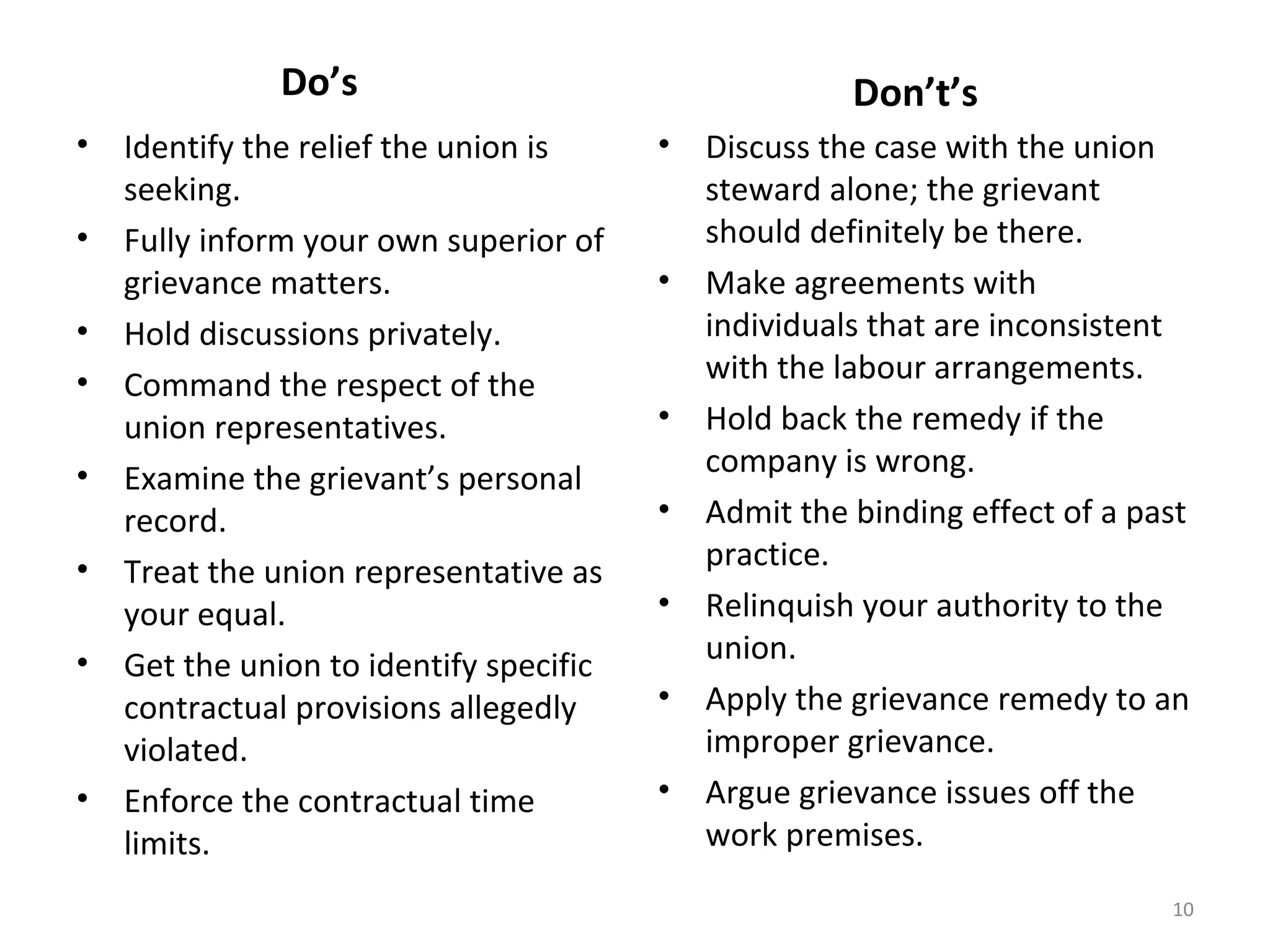
• Open Door Policy

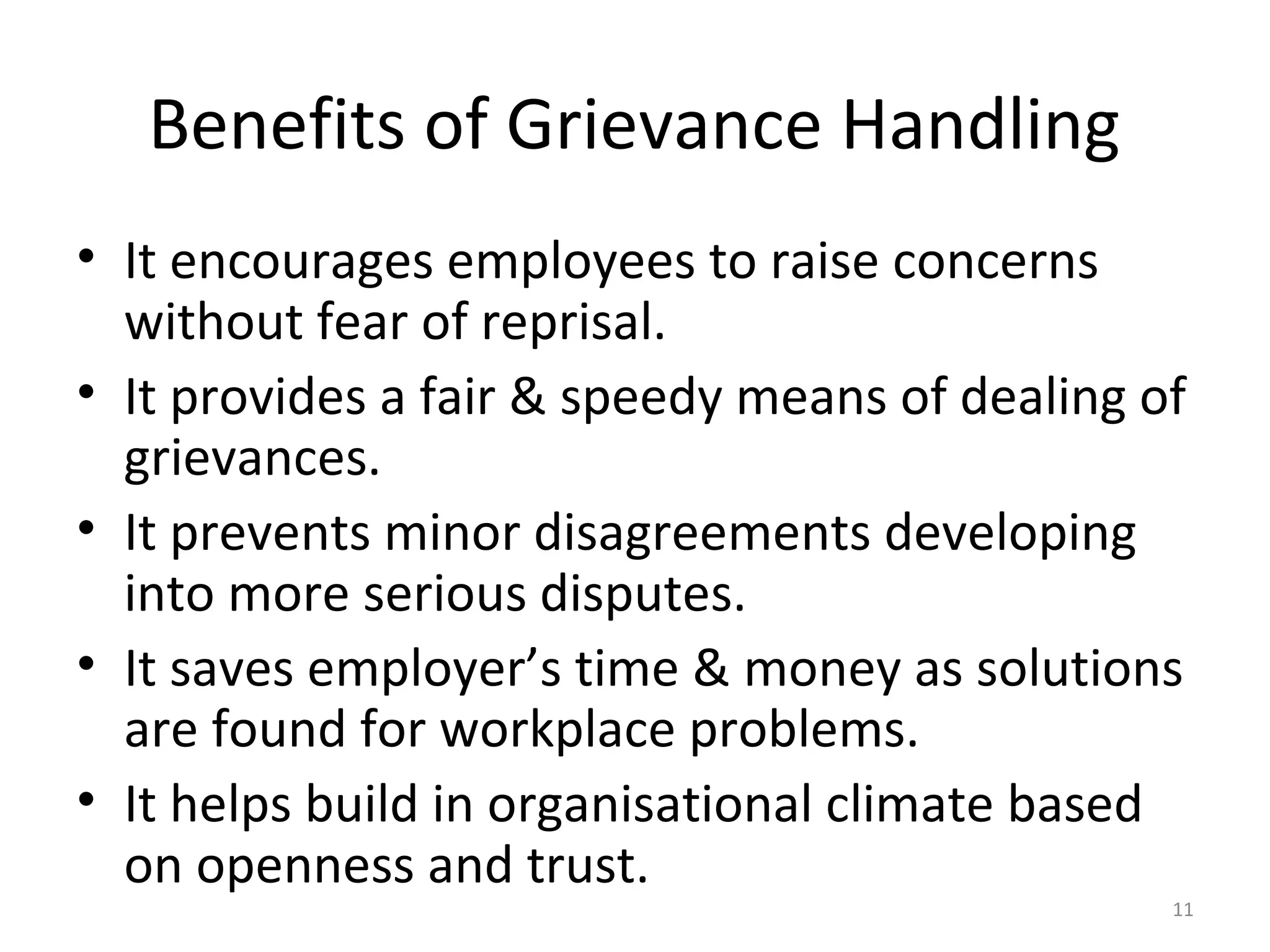
• Gripe Boxes

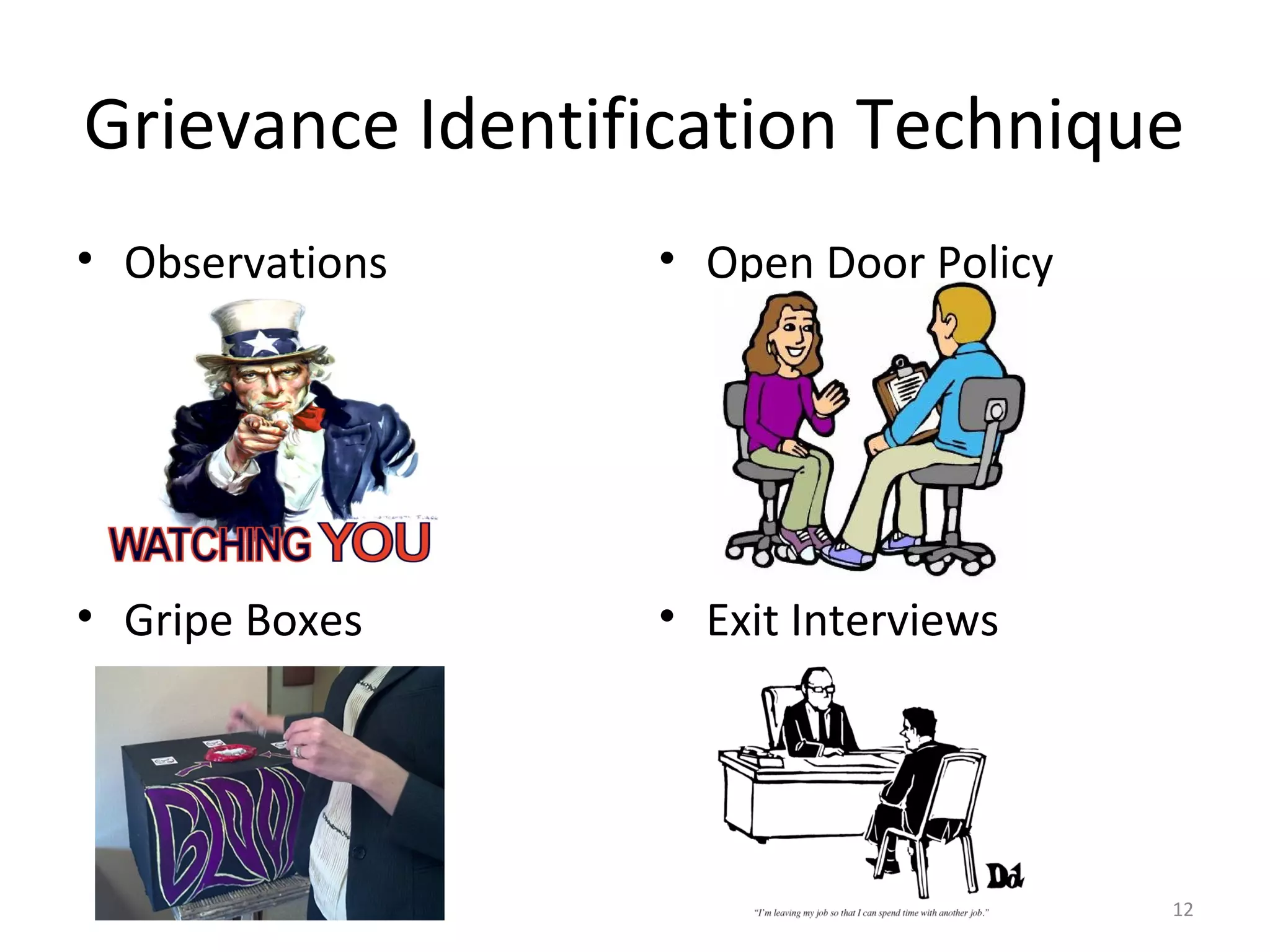
• Exit Interviews

12
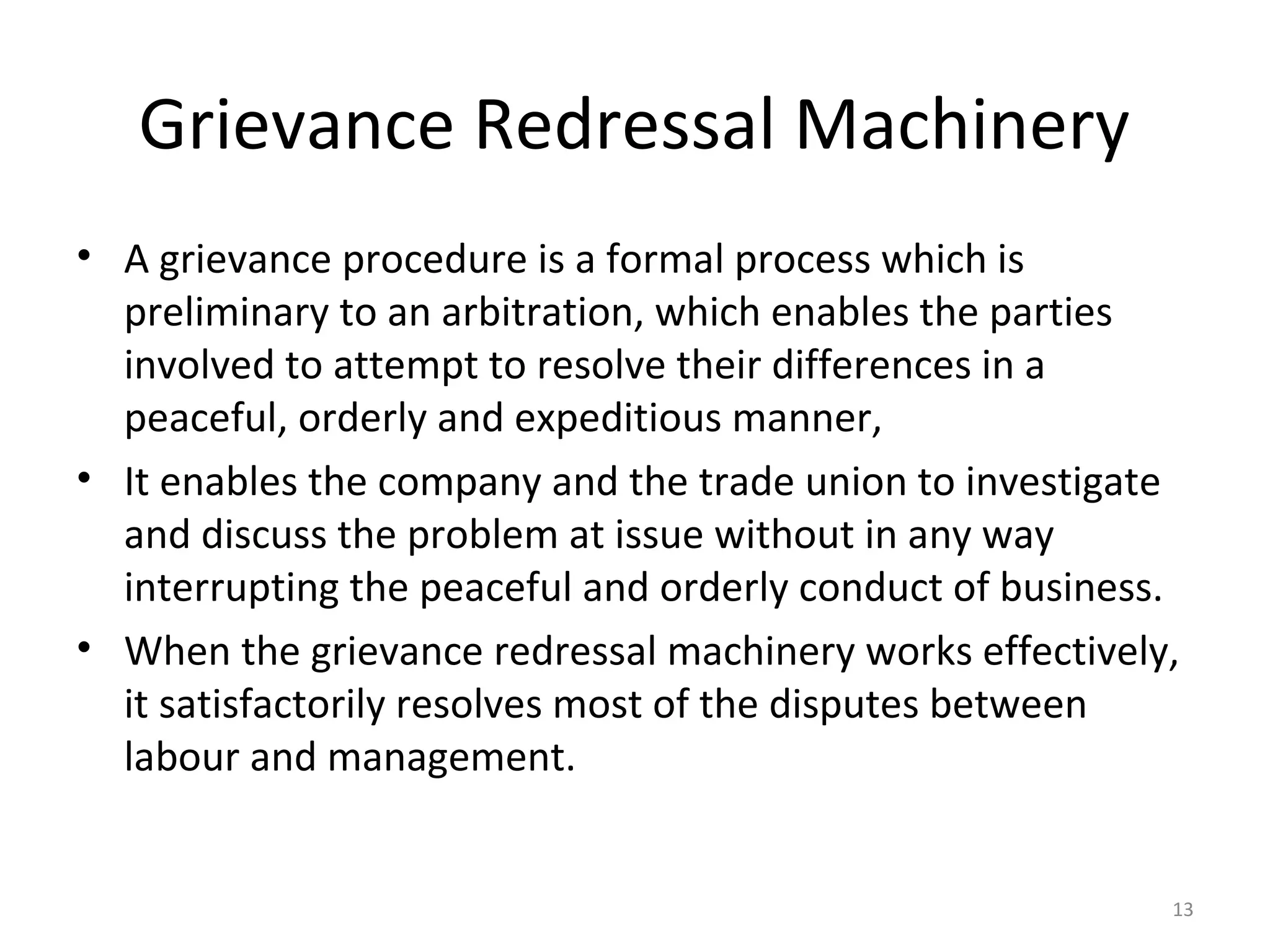
Grievance Redressal Machinery
• A grievance procedure is a formal process which is
preliminary to an arbitration, which enables the parties
involved to attempt to resolve their differences in a
peaceful, orderly and expeditious manner,
• It enables the company and the trade union to investigate
and discuss the problem at issue without in any way
interrupting the peaceful and orderly conduct of business.
• When the grievance redressal machinery works effectively,
it satisfactorily resolves most of the disputes between
labour and management.

13
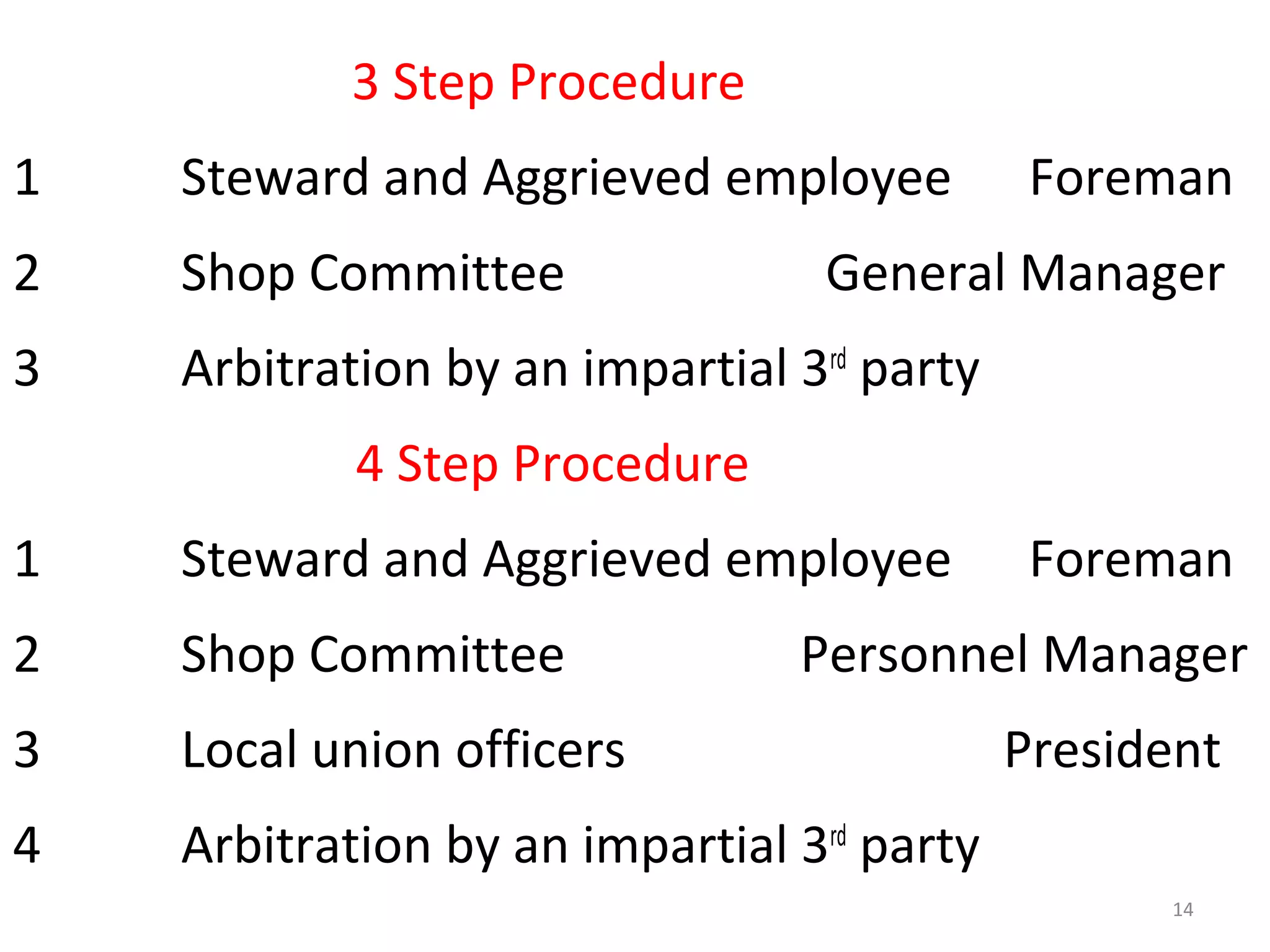
3 Step Procedure
1

Steward and Aggrieved employee

2

Shop Committee

3

Foreman

Arbitration by an impartial 3rd party

General Manager

4 Step Procedure
1

Steward and Aggrieved employee

2

Shop Committee

3

Local union officers

4

Foreman

Arbitration by an impartial 3rd party

Personnel Manager
President
14
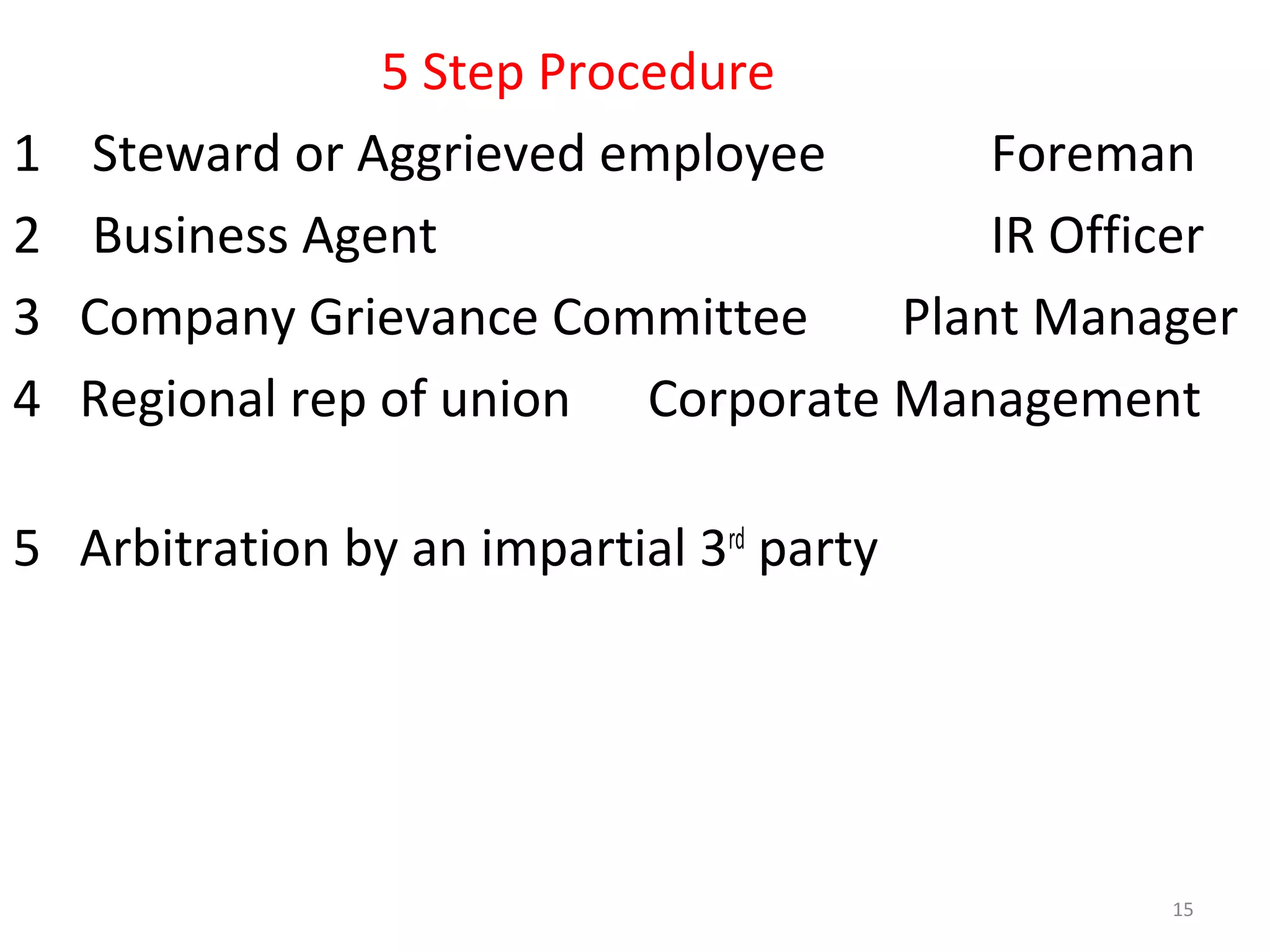
1
2
3
4

5 Step Procedure
Steward or Aggrieved employee
Foreman
Business Agent
IR Officer
Company Grievance Committee
Plant Manager
Regional rep of union Corporate Management

5 Arbitration by an impartial 3rd party

15
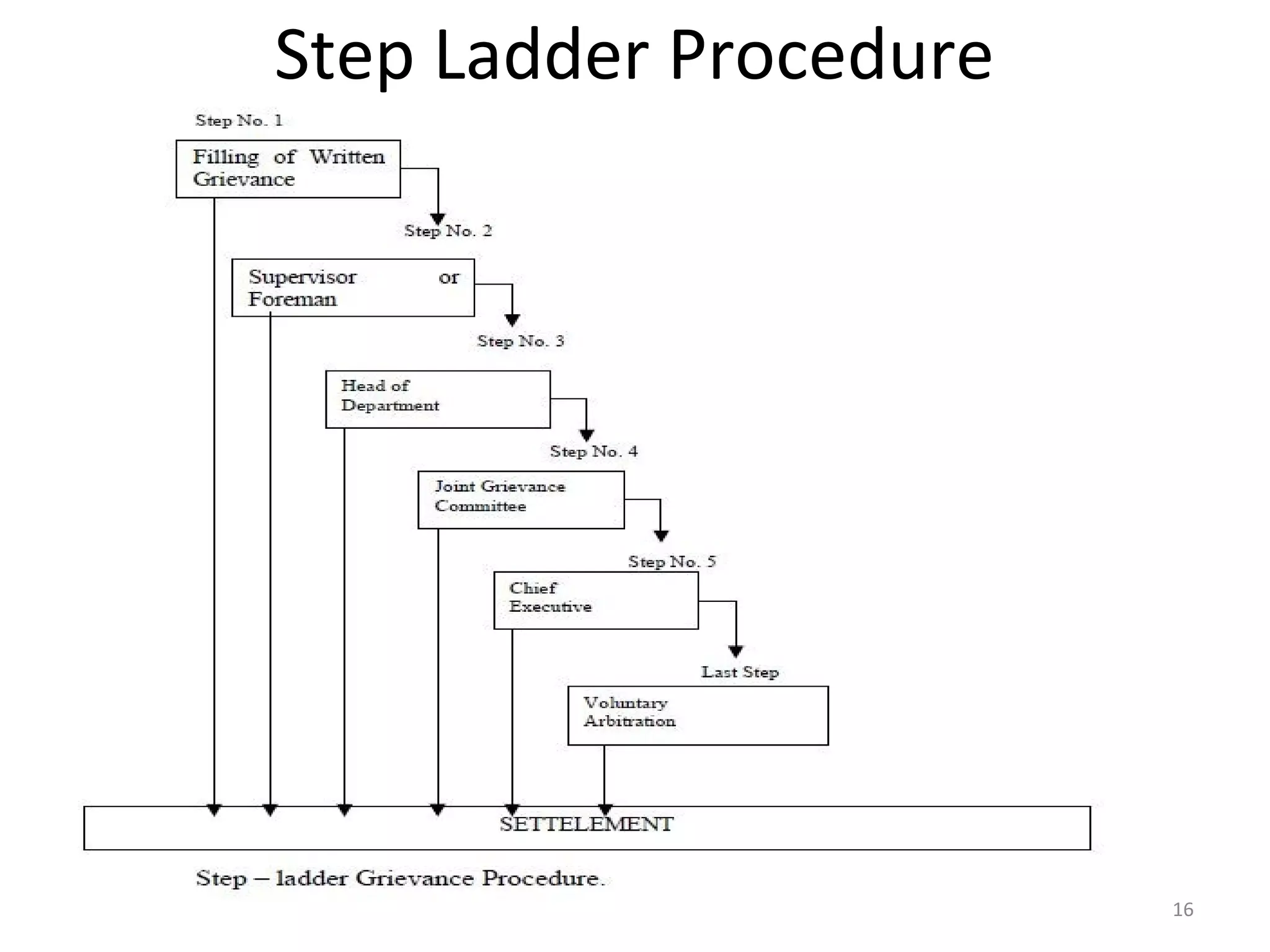
Step Ladder Procedure

16
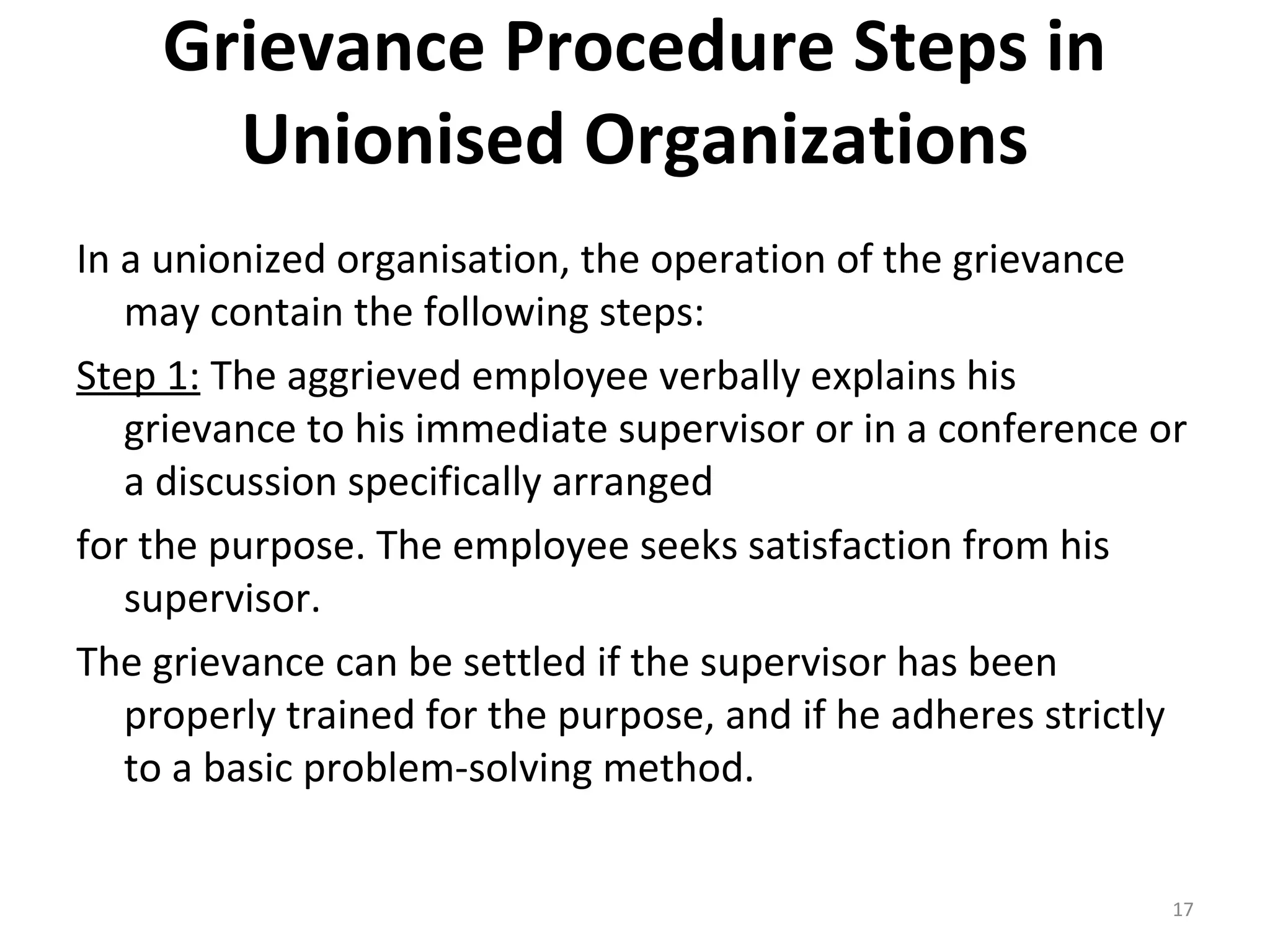
Grievance Procedure Steps in
Unionised Organizations
In a unionized organisation, the operation of the grievance
may contain the following steps:
Step 1: The aggrieved employee verbally explains his
grievance to his immediate supervisor or in a conference or
a discussion specifically arranged
for the purpose. The employee seeks satisfaction from his
supervisor.
The grievance can be settled if the supervisor has been
properly trained for the purpose, and if he adheres strictly
to a basic problem-solving method.
17
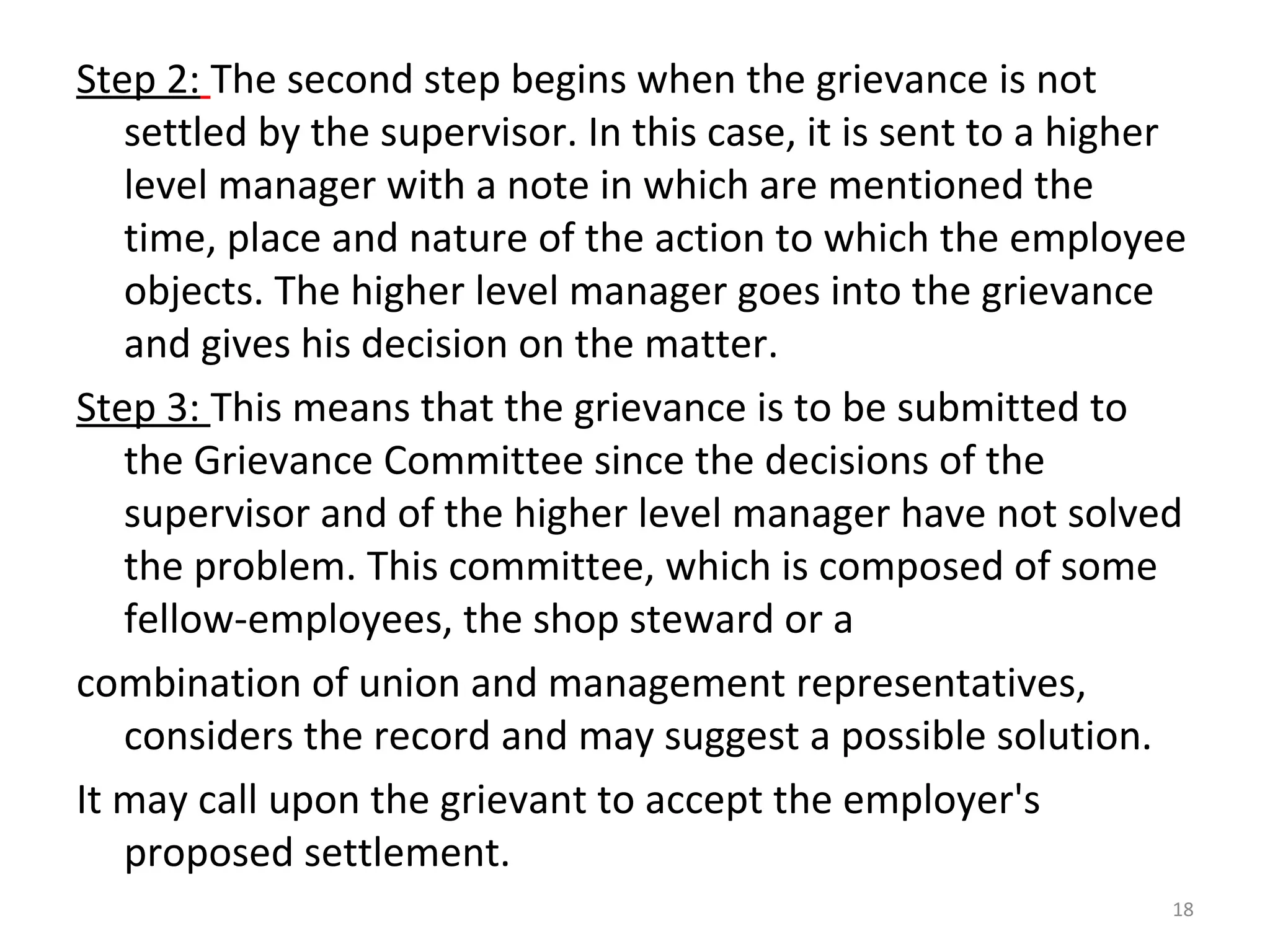
Step 2: The second step begins when the grievance is not
settled by the supervisor. In this case, it is sent to a higher
level manager with a note in which are mentioned the
time, place and nature of the action to which the employee
objects. The higher level manager goes into the grievance
and gives his decision on the matter.
Step 3: This means that the grievance is to be submitted to
the Grievance Committee since the decisions of the
supervisor and of the higher level manager have not solved
the problem. This committee, which is composed of some
fellow-employees, the shop steward or a
combination of union and management representatives,
considers the record and may suggest a possible solution.
It may call upon the grievant to accept the employer's
proposed settlement.
18
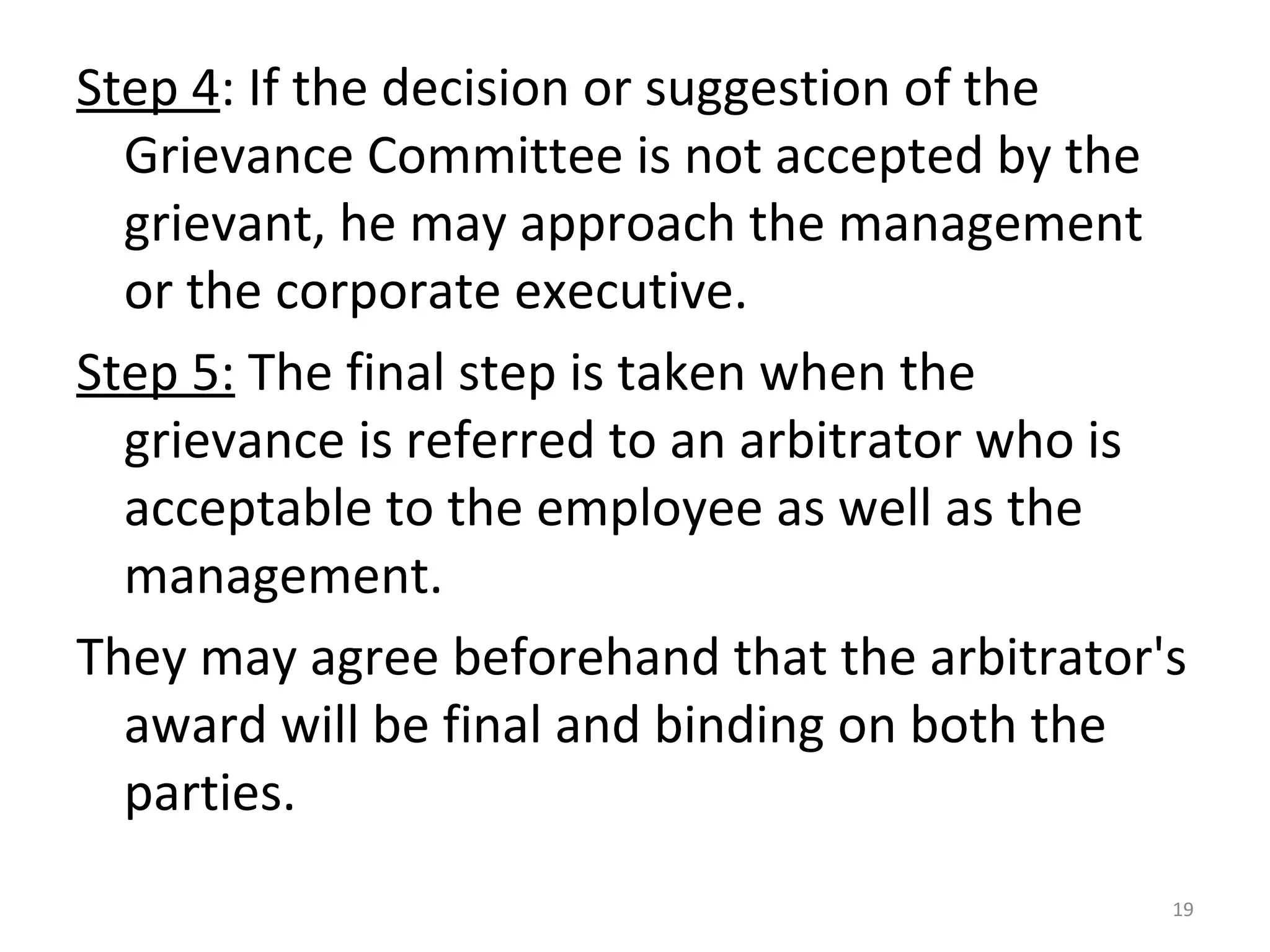
Step 4: If the decision or suggestion of the
Grievance Committee is not accepted by the
grievant, he may approach the management
or the corporate executive.
Step 5: The final step is taken when the
grievance is referred to an arbitrator who is
acceptable to the employee as well as the
management.
They may agree beforehand that the arbitrator's
award will be final and binding on both the
parties.
19

Grievances and Grievance Handling

  • 1.
    GRIEVANCES & GRIEVANCE HANDLING Rohit Sahay- 47 Prarabda Pathak - 52 Dhiraj Nayak - 54 1
  • 2.
    Grievances • A grievanceis a formal dispute between an employee & management on the conditions of employment. • Grievances are complaints that have been formally registered in accordance with the grievance procedure. • A grievance is any dissatisfaction or feeling of injustice in connection with one’s employment situation that is brought to the attention of the management. 2
  • 3.
    Grievance must fallunder the following category: • • • • • • • • Amenities Compensation Conditions of work Continuity of service Disciplinary action Fines Leave Medical benefits • • • • • • • • Nature of job Payments Promotions Safety environment Super Annuation Supersession Transfers Victimisation 3
  • 4.
    W’s of GrievanceHandling • • • • • • • • WHO is involved WHEN did it happen WHERE did it happen WHAT happened (EXACTLY) WHY is it grieve-able WHEN must the grievance be filed WHAT are the deadline dates WHAT must be done 4
  • 5.
    Guidance for writingGrievance • The Situation – Who, what, when & where • The Contention – Why is it grieve-able • The Remedy – What is needed to remedy the situation 5
  • 6.
    Grievance - Reasons • • • • • Economic –Wage fixation, wage computation, overtime, bonus – Employees feel they are getting less than what they ought to get Working Environment – Poor working conditions, defective equipment and machinery, tools, materials. Supervision – Disposition of the boss towards the employee perceived notions of favoritism, nepotism, bias etc. Work Group – Strained relations or incompatibility with peers. Feeling of neglect, obstruction and victimization. Work Organization – Rigid and unfair rules, too much less work responsibility, lack of recognition 6
  • 7.
    Grievance - Source ManagerialConditions Working Conditions  Pay Scale or Wage rates  Overtime  Benefits – Promotions, Incentives, Seniority and Discharges.  Lack of role clarity  Autocratic Leadership style of supervisors.  Lack regards for collective agreement.  Unrealistic  Non availability of proper tool, machines and equipment for doing the job.  Tight production standards  Bad working conditions  Poor relationship with the supervisor.  Negative approach to discipline. Personal Factors  Narrow attitude  Over ambition  Egoistic Personality  Non- cooperative.  Personal Problems outside factory 7
  • 8.
    Grievance - Effects • • • • • • • Lossof interest in work Poor quality of production Low production Increase in wastage or costs Indiscipline Unrest Increase in accidents 8
  • 9.
    Grievance - Effects •On Production – Low quality of production, Low productivity, Increase in wastage, Increase in cost of production. • On Employees – Increased absenteeism, Reduction in level of commitment, Increase in accidents, Reduced level of employee moral. • On Managers – Strained superior- subordinate relations, Need for increased supervision/control and follow up, Increase in unrest. 9
  • 10.
    Do’s • • • • • • • • Identify the reliefthe union is seeking. Fully inform your own superior of grievance matters. Hold discussions privately. Command the respect of the union representatives. Examine the grievant’s personal record. Treat the union representative as your equal. Get the union to identify specific contractual provisions allegedly violated. Enforce the contractual time limits. Don’t’s • • • • • • • Discuss the case with the union steward alone; the grievant should definitely be there. Make agreements with individuals that are inconsistent with the labour arrangements. Hold back the remedy if the company is wrong. Admit the binding effect of a past practice. Relinquish your authority to the union. Apply the grievance remedy to an improper grievance. Argue grievance issues off the work premises. 10
  • 11.
    Benefits of GrievanceHandling • It encourages employees to raise concerns without fear of reprisal. • It provides a fair & speedy means of dealing of grievances. • It prevents minor disagreements developing into more serious disputes. • It saves employer’s time & money as solutions are found for workplace problems. • It helps build in organisational climate based on openness and trust. 11
  • 12.
    Grievance Identification Technique •Observations • Open Door Policy • Gripe Boxes • Exit Interviews 12
  • 13.
    Grievance Redressal Machinery •A grievance procedure is a formal process which is preliminary to an arbitration, which enables the parties involved to attempt to resolve their differences in a peaceful, orderly and expeditious manner, • It enables the company and the trade union to investigate and discuss the problem at issue without in any way interrupting the peaceful and orderly conduct of business. • When the grievance redressal machinery works effectively, it satisfactorily resolves most of the disputes between labour and management. 13
  • 14.
    3 Step Procedure 1 Stewardand Aggrieved employee 2 Shop Committee 3 Foreman Arbitration by an impartial 3rd party General Manager 4 Step Procedure 1 Steward and Aggrieved employee 2 Shop Committee 3 Local union officers 4 Foreman Arbitration by an impartial 3rd party Personnel Manager President 14
  • 15.
    1 2 3 4 5 Step Procedure Stewardor Aggrieved employee Foreman Business Agent IR Officer Company Grievance Committee Plant Manager Regional rep of union Corporate Management 5 Arbitration by an impartial 3rd party 15
  • 16.
  • 17.
    Grievance Procedure Stepsin Unionised Organizations In a unionized organisation, the operation of the grievance may contain the following steps: Step 1: The aggrieved employee verbally explains his grievance to his immediate supervisor or in a conference or a discussion specifically arranged for the purpose. The employee seeks satisfaction from his supervisor. The grievance can be settled if the supervisor has been properly trained for the purpose, and if he adheres strictly to a basic problem-solving method. 17
  • 18.
    Step 2: Thesecond step begins when the grievance is not settled by the supervisor. In this case, it is sent to a higher level manager with a note in which are mentioned the time, place and nature of the action to which the employee objects. The higher level manager goes into the grievance and gives his decision on the matter. Step 3: This means that the grievance is to be submitted to the Grievance Committee since the decisions of the supervisor and of the higher level manager have not solved the problem. This committee, which is composed of some fellow-employees, the shop steward or a combination of union and management representatives, considers the record and may suggest a possible solution. It may call upon the grievant to accept the employer's proposed settlement. 18
  • 19.
    Step 4: Ifthe decision or suggestion of the Grievance Committee is not accepted by the grievant, he may approach the management or the corporate executive. Step 5: The final step is taken when the grievance is referred to an arbitrator who is acceptable to the employee as well as the management. They may agree beforehand that the arbitrator's award will be final and binding on both the parties. 19