Phased Array Scan Planning
Considerations for Weld Inspection
University of Ultrasonics
Olympus Scientific Solutions Americas Webinar
February 4th, 2014
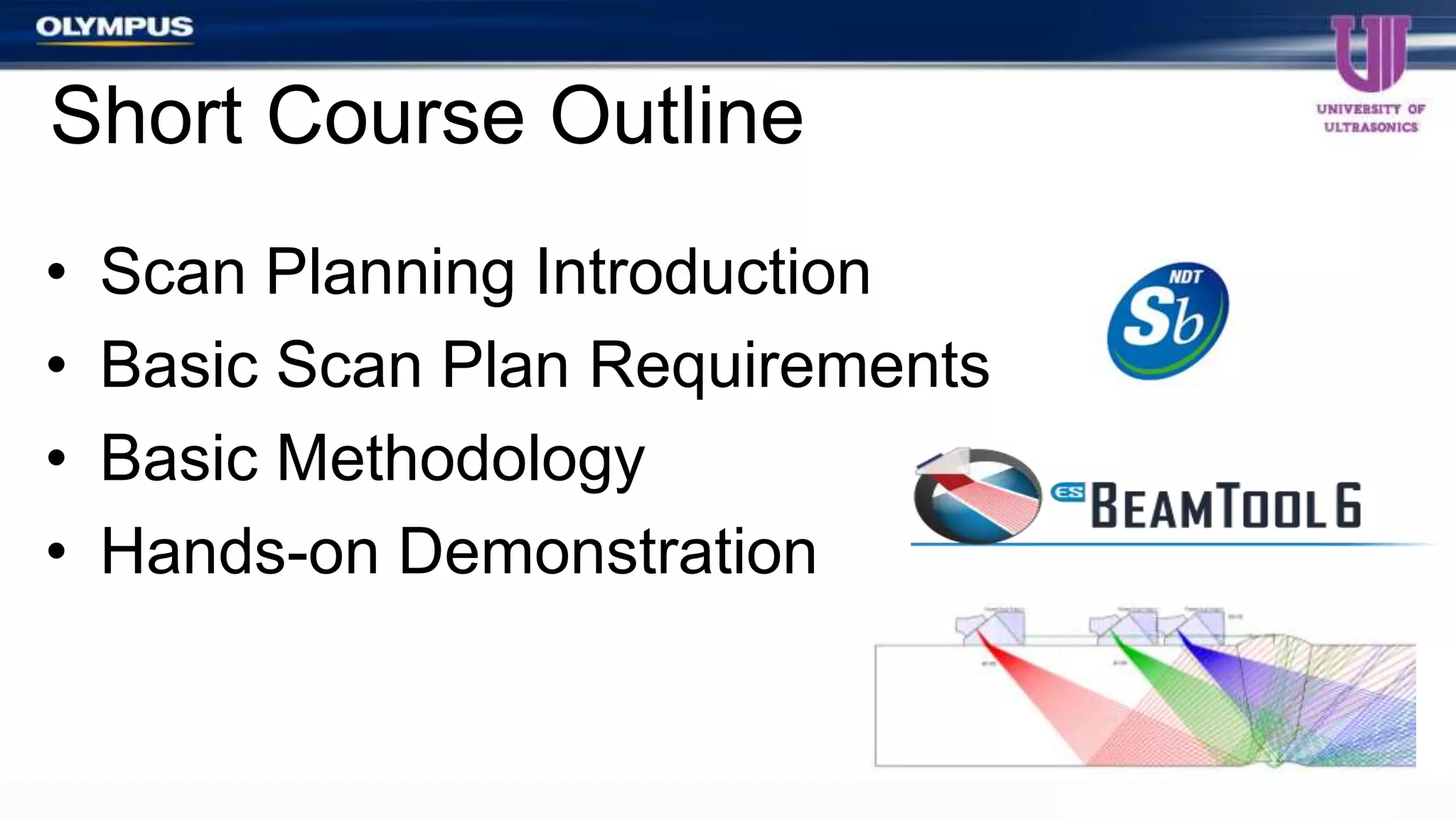
• Scan Planning Introduction
• Basic Scan Plan Requirements
• Basic Methodology
• Hands-on Demonstration
Short Course Outline
Scan Plan History
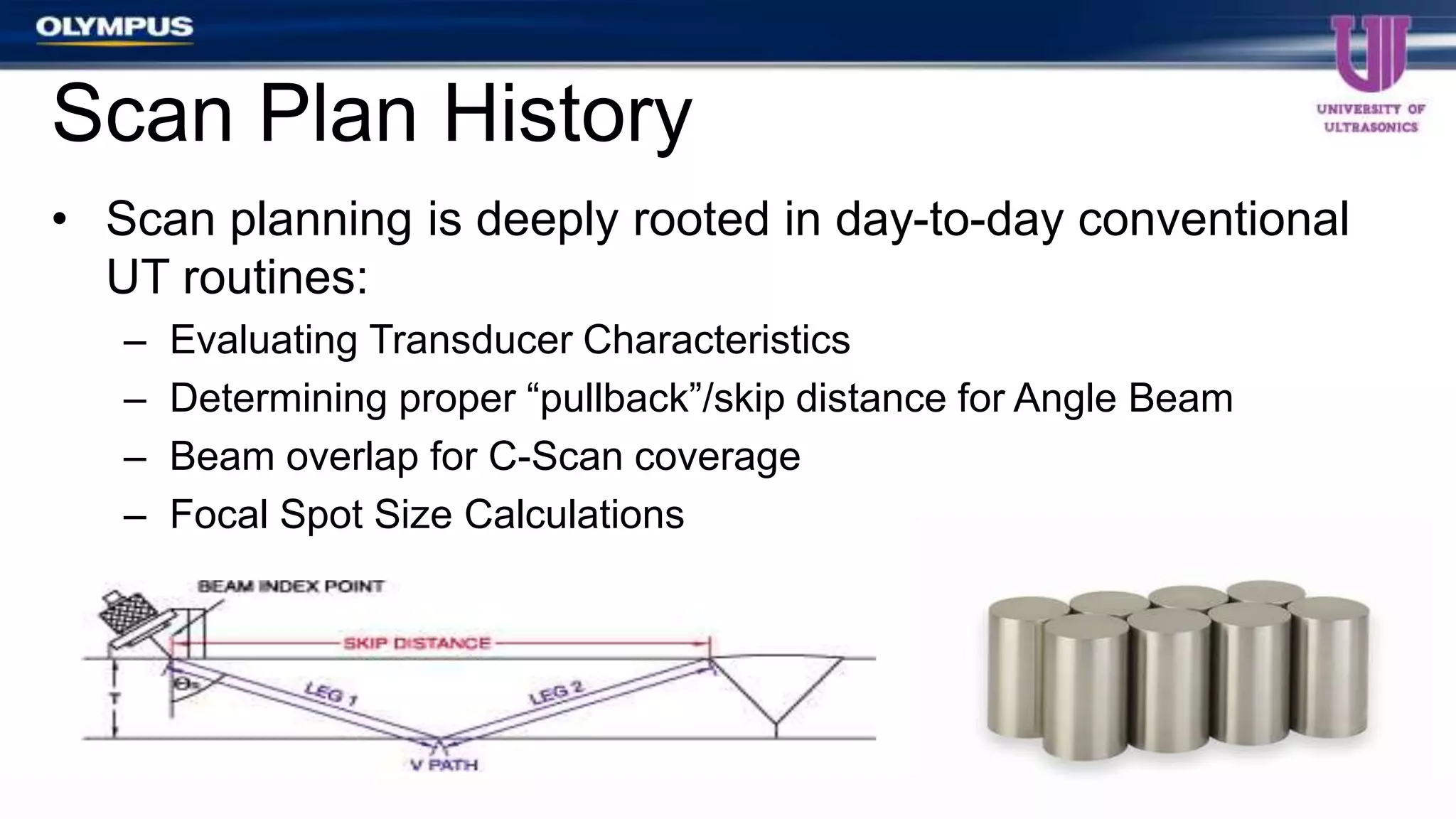
• Scan planning is deeply rooted in day-to-day conventional
UT routines:
– Evaluating Transducer Characteristics
– Determining proper “pullback”/skip distance for Angle Beam
– Beam overlap for C-Scan coverage
– Focal Spot Size Calculations
Scan Plans???
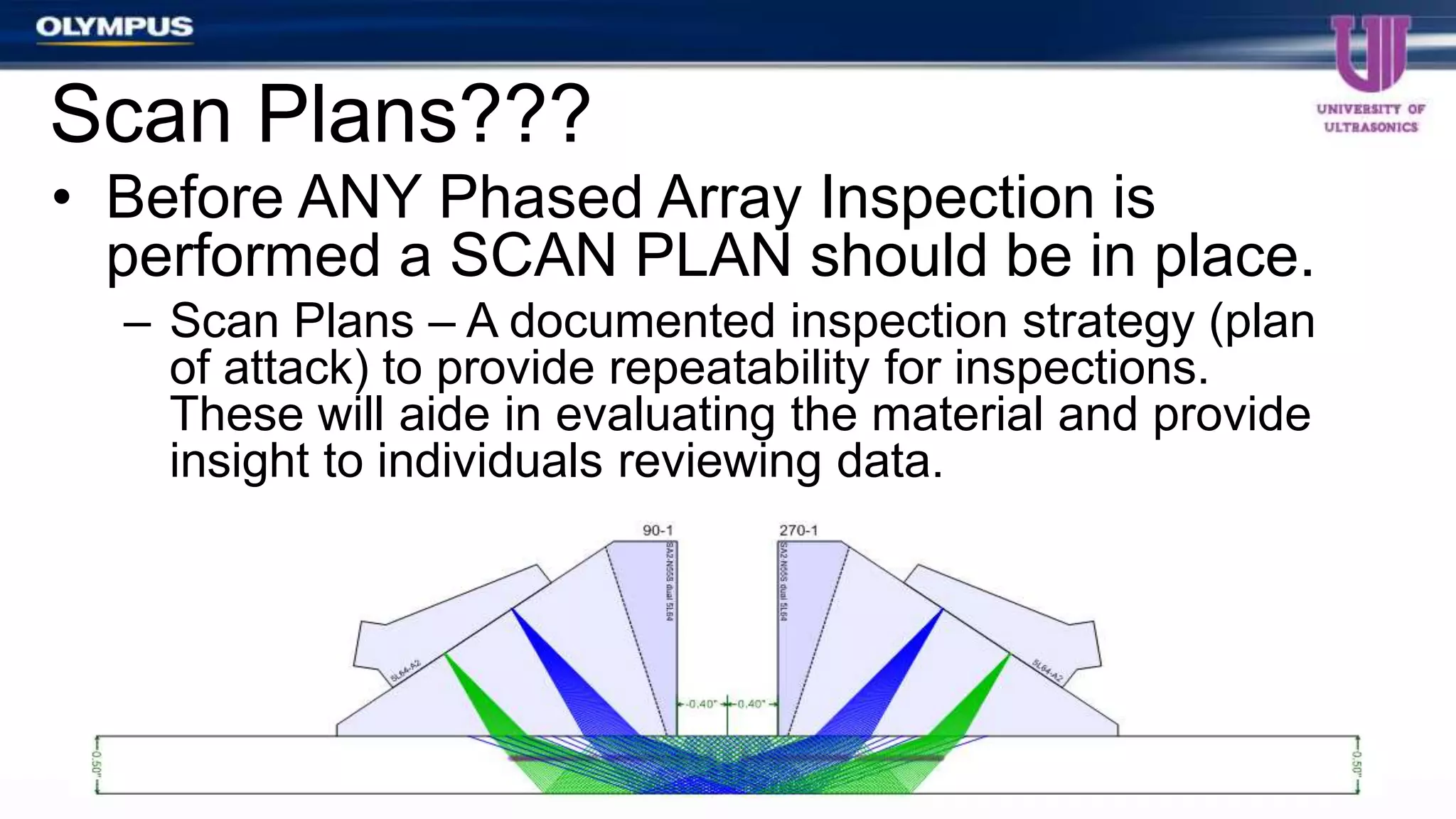
• Before ANY Phased Array Inspection is
performed a SCAN PLAN should be in place.
– Scan Plans – A documented inspection strategy (plan
of attack) to provide repeatability for inspections.
These will aide in evaluating the material and provide
insight to individuals reviewing data.
Scan Plan Importance
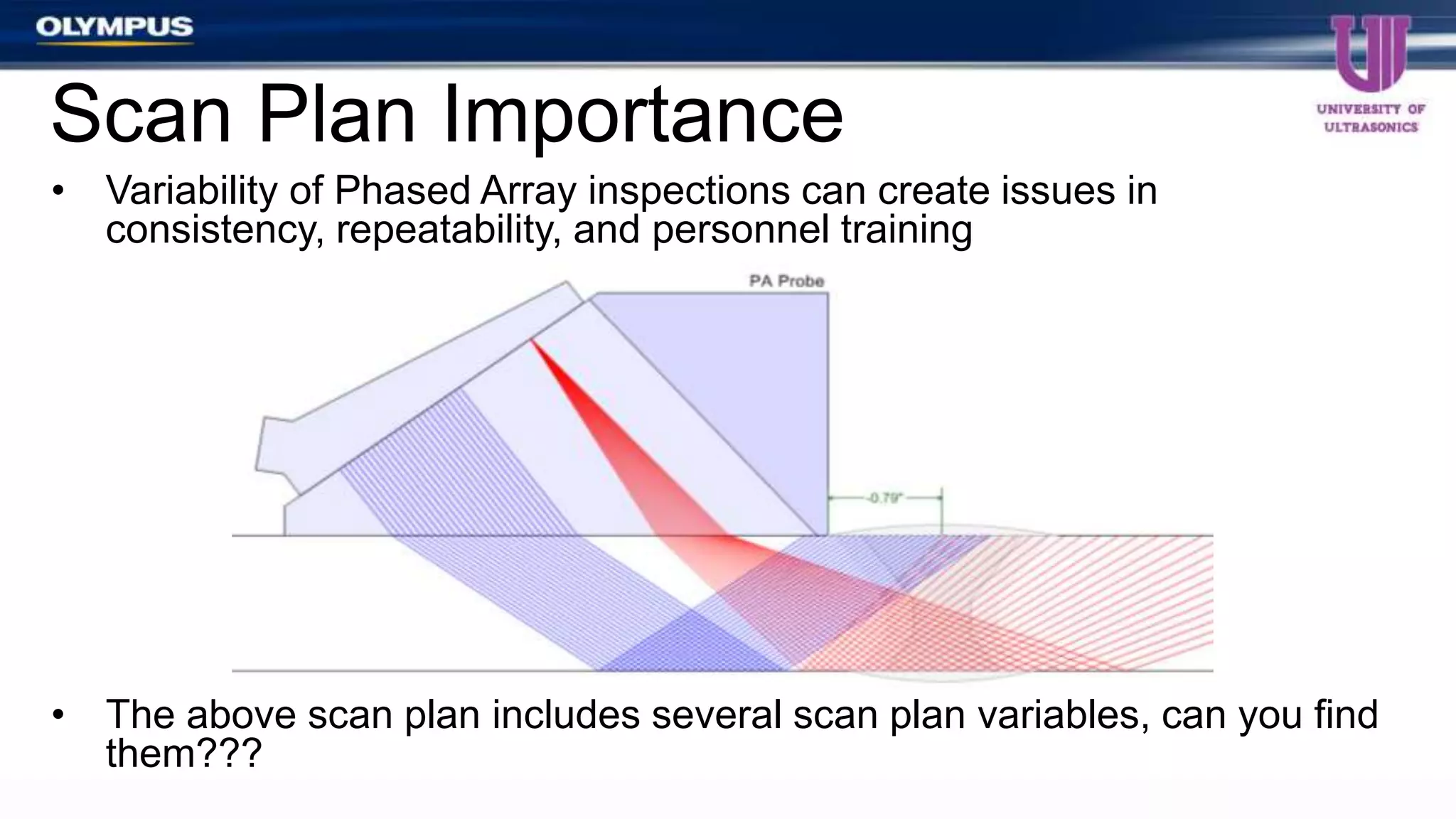
• Variability of Phased Array inspections can create issues in
consistency, repeatability, and personnel training
• The above scan plan includes several scan plan variables, can you find
them???
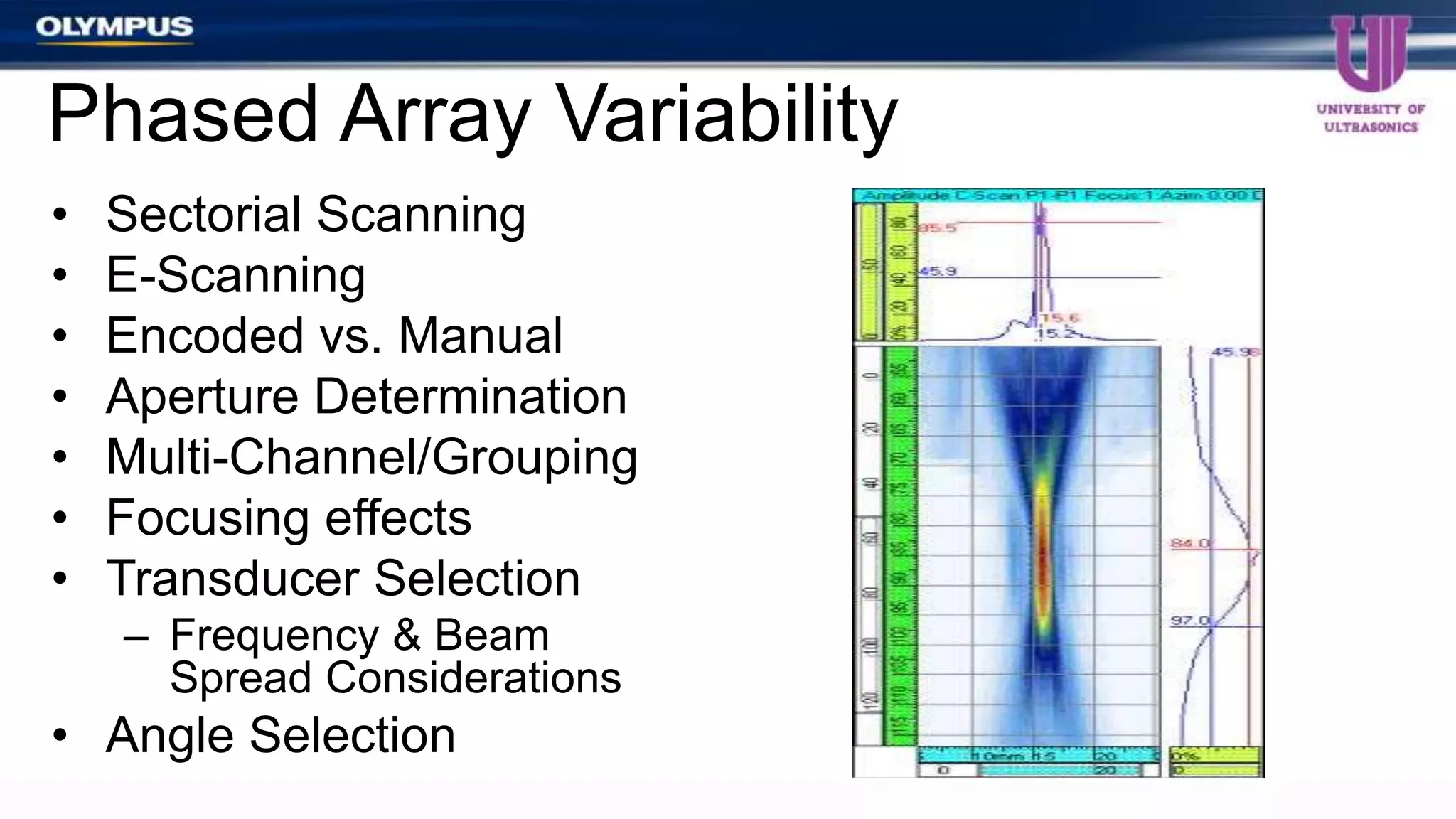
Phased Array Variability
• Sectorial Scanning
• E-Scanning
• Encoded vs. Manual
• Aperture Determination
• Multi-Channel/Grouping
• Focusing effects
• Transducer Selection
– Frequency & Beam
Spread Considerations
• Angle Selection
Scan Planning
Code Perspective
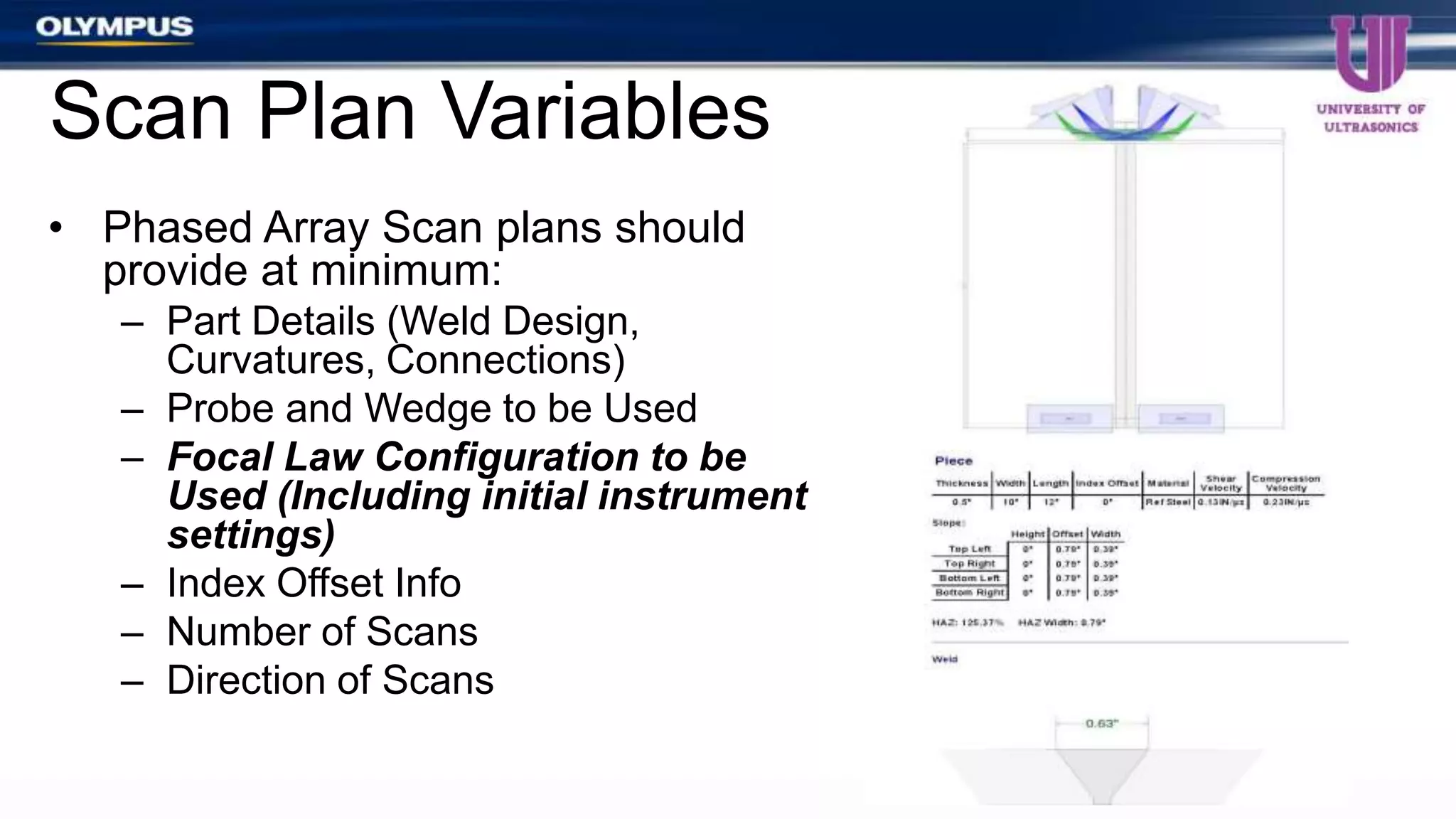
Scan Plan Variables
• Phased Array Scan plans should
provide at minimum:
– Part Details (Weld Design,
Curvatures, Connections)
– Probe and Wedge to be Used
– Focal Law Configuration to be
Used (Including initial instrument
settings)
– Index Offset Info
– Number of Scans
– Direction of Scans
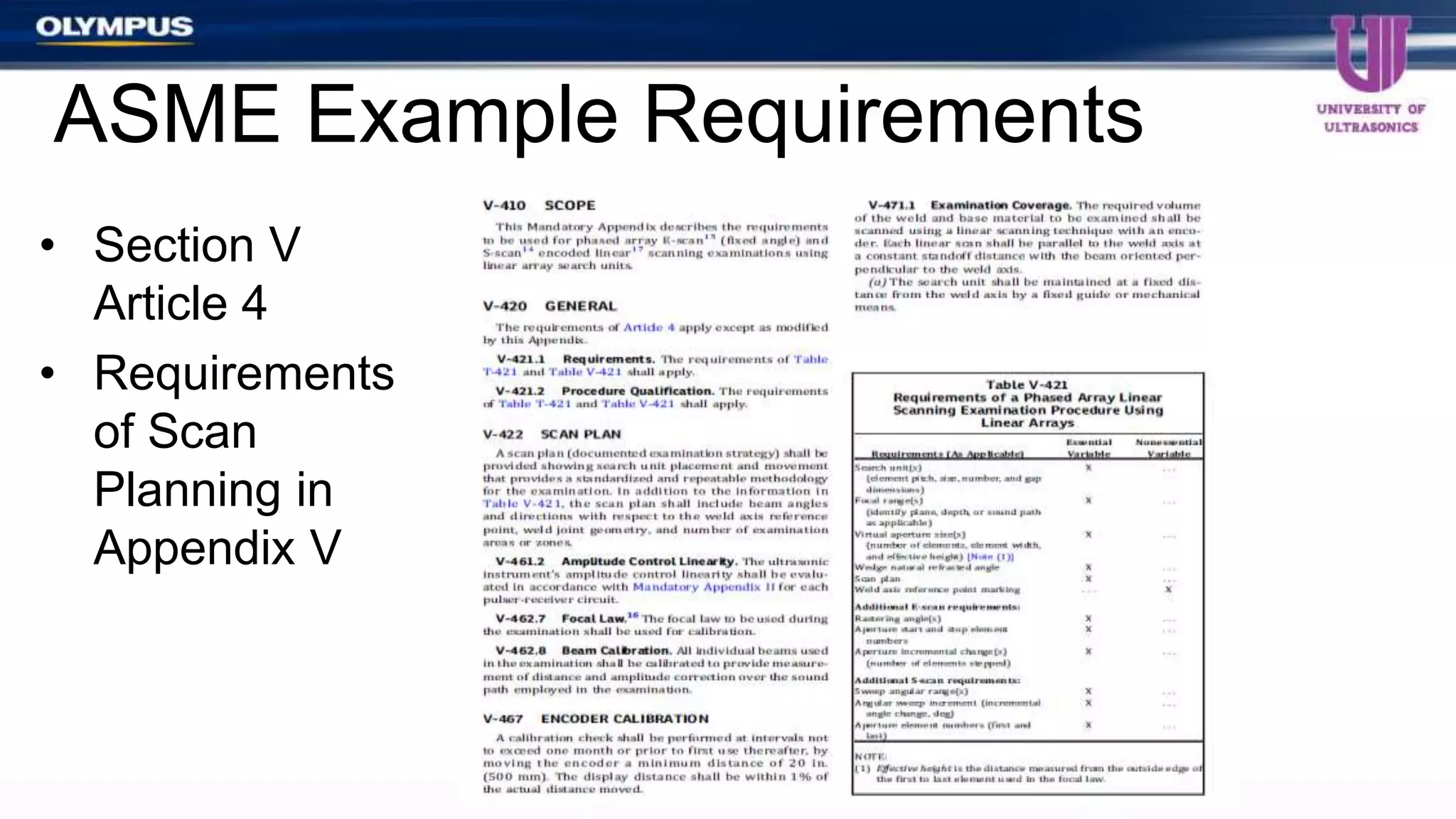
ASME Example Requirements
• Section V
Article 4
• Requirements
of Scan
Planning in
Appendix V
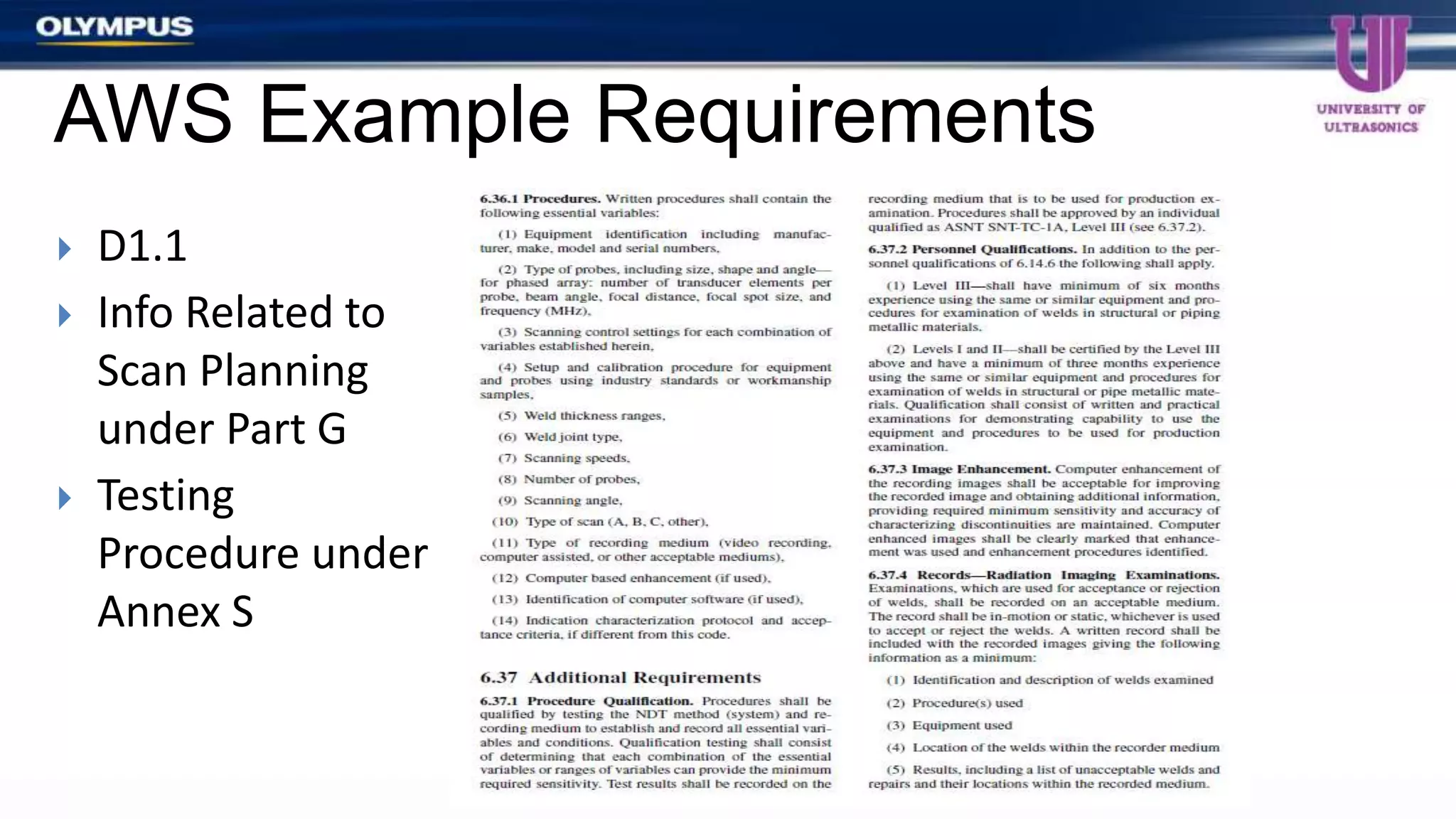
AWS Example Requirements
 D1.1
 Info Related to
Scan Planning
under Part G
 Testing
Procedure under
Annex S
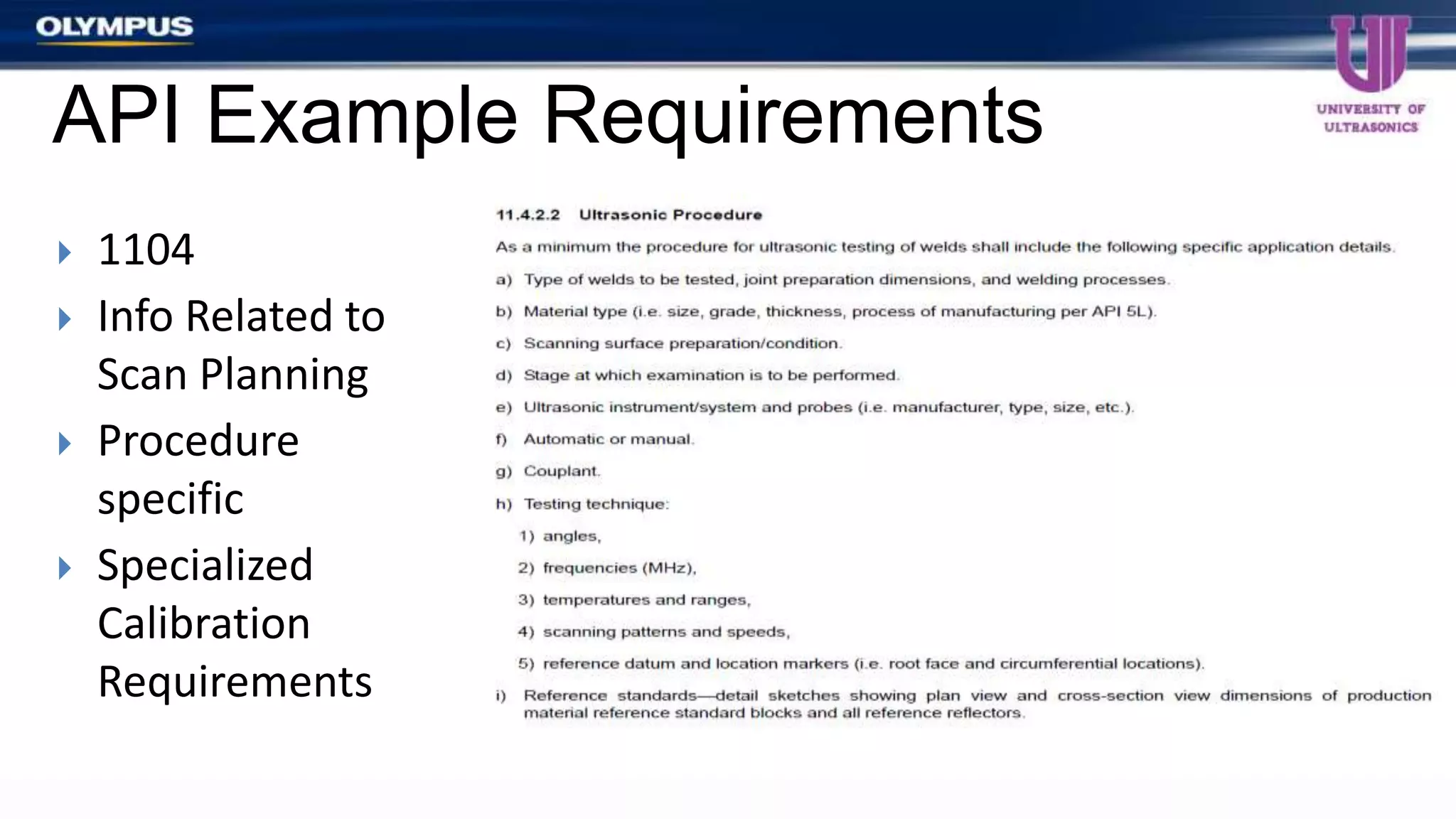
API Example Requirements
 1104
 Info Related to
Scan Planning
 Procedure
specific
 Specialized
Calibration
Requirements
Phased Array
Scan Plan Equipment
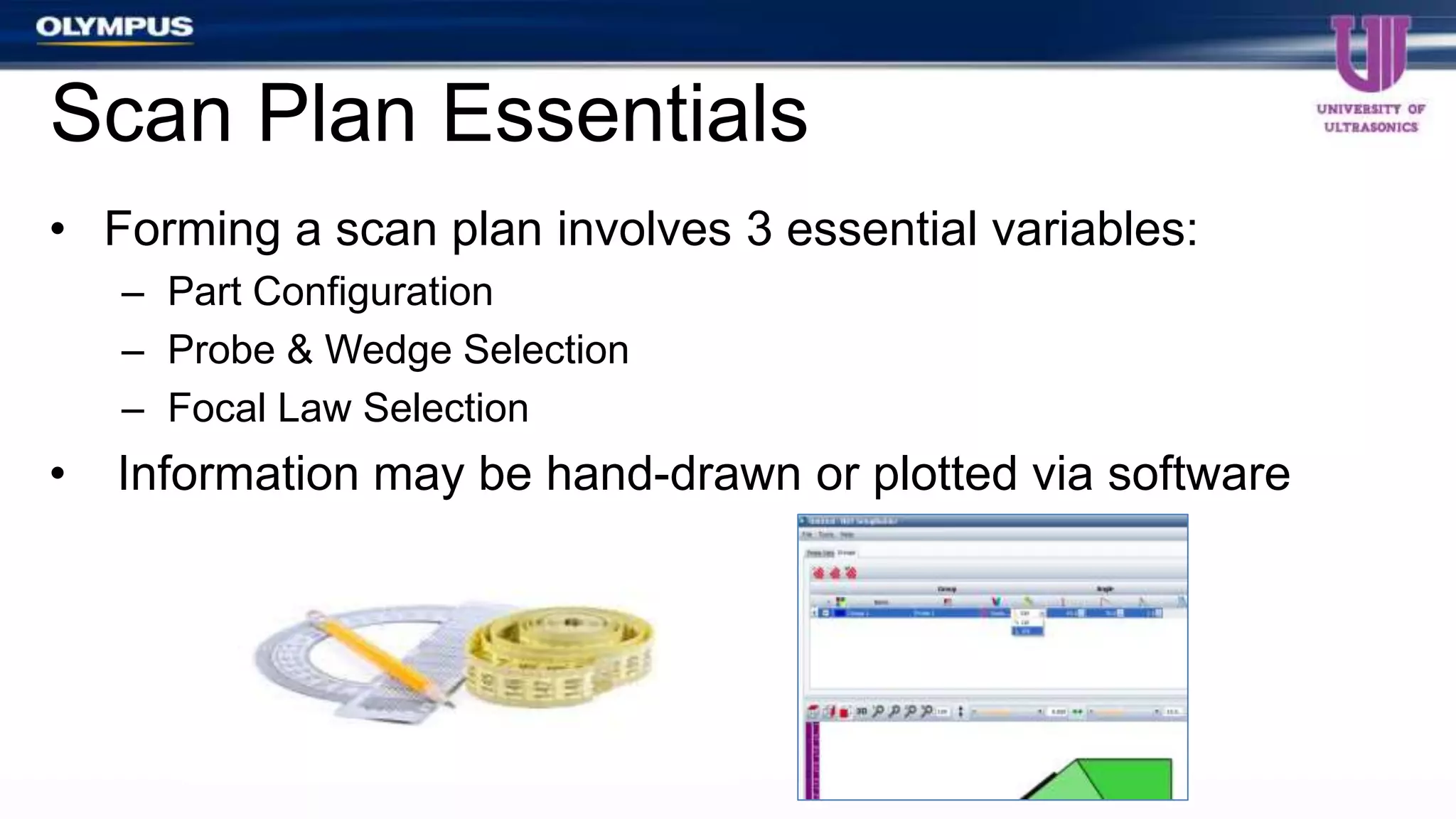
• Forming a scan plan involves 3 essential variables:
– Part Configuration
– Probe & Wedge Selection
– Focal Law Selection
• Information may be hand-drawn or plotted via software
Scan Plan Essentials
• Pros:
– Accounts for errors in Equipment
– Plots actual beam index point
– Focal Law adjustments visualized
• Cons:
– Time Consuming
– Visual Measurements
– Requires Equipment
– Actual Inspection piece may vary
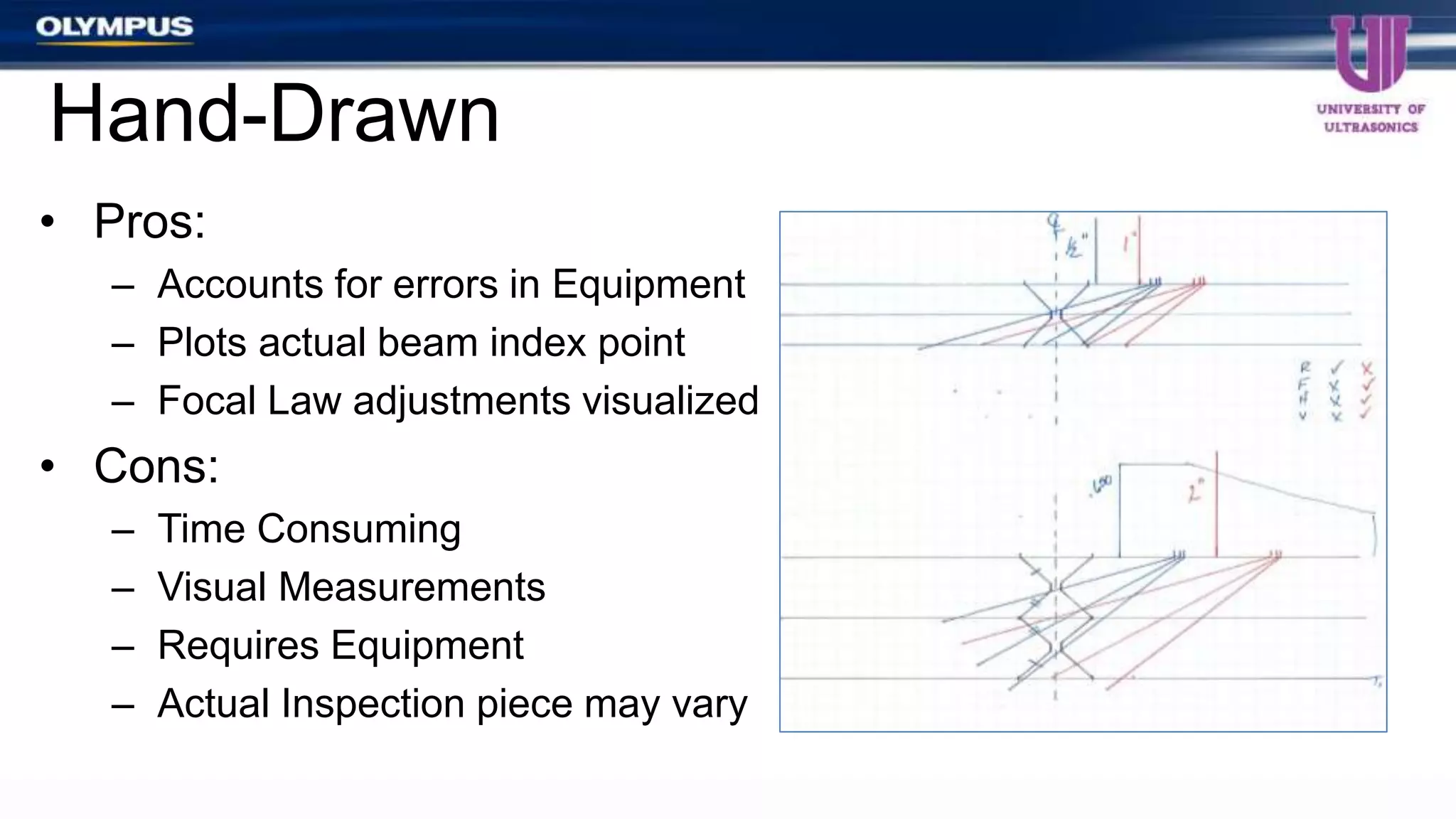
Hand-Drawn
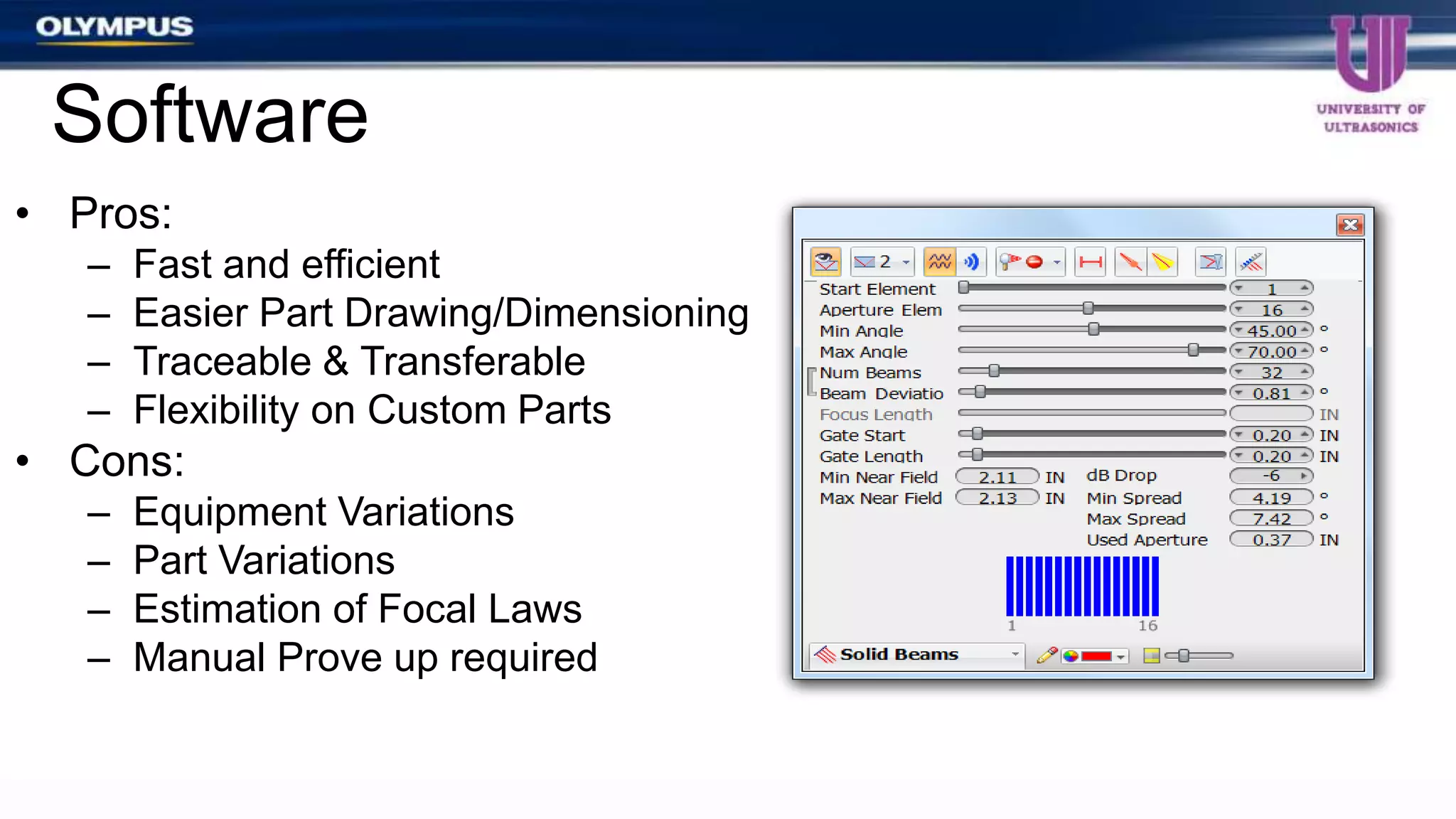
• Pros:
– Fast and efficient
– Easier Part Drawing/Dimensioning
– Traceable & Transferable
– Flexibility on Custom Parts
• Cons:
– Equipment Variations
– Part Variations
– Estimation of Focal Laws
– Manual Prove up required
Software
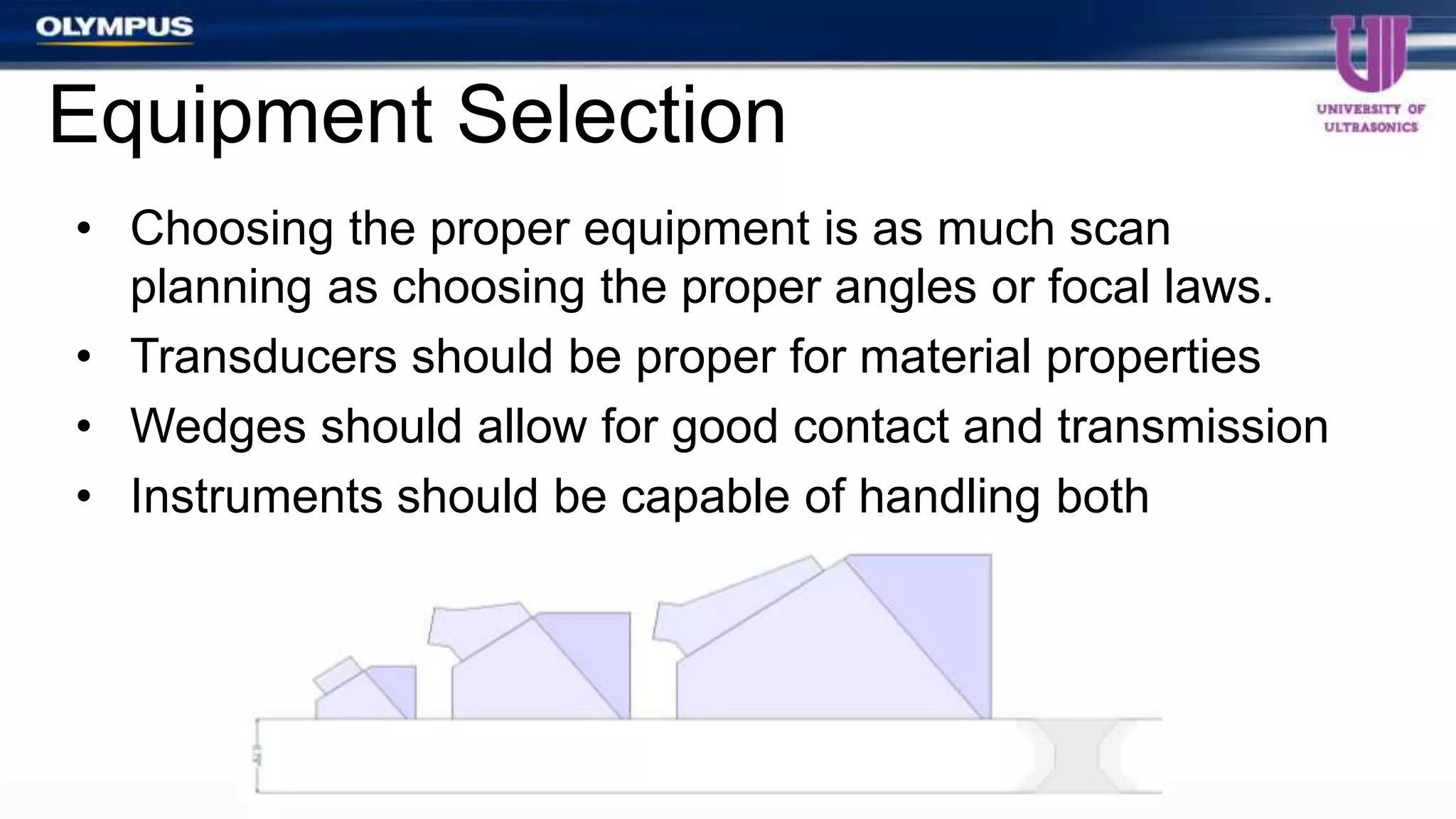
• Choosing the proper equipment is as much scan
planning as choosing the proper angles or focal laws.
• Transducers should be proper for material properties
• Wedges should allow for good contact and transmission
• Instruments should be capable of handling both
Equipment Selection
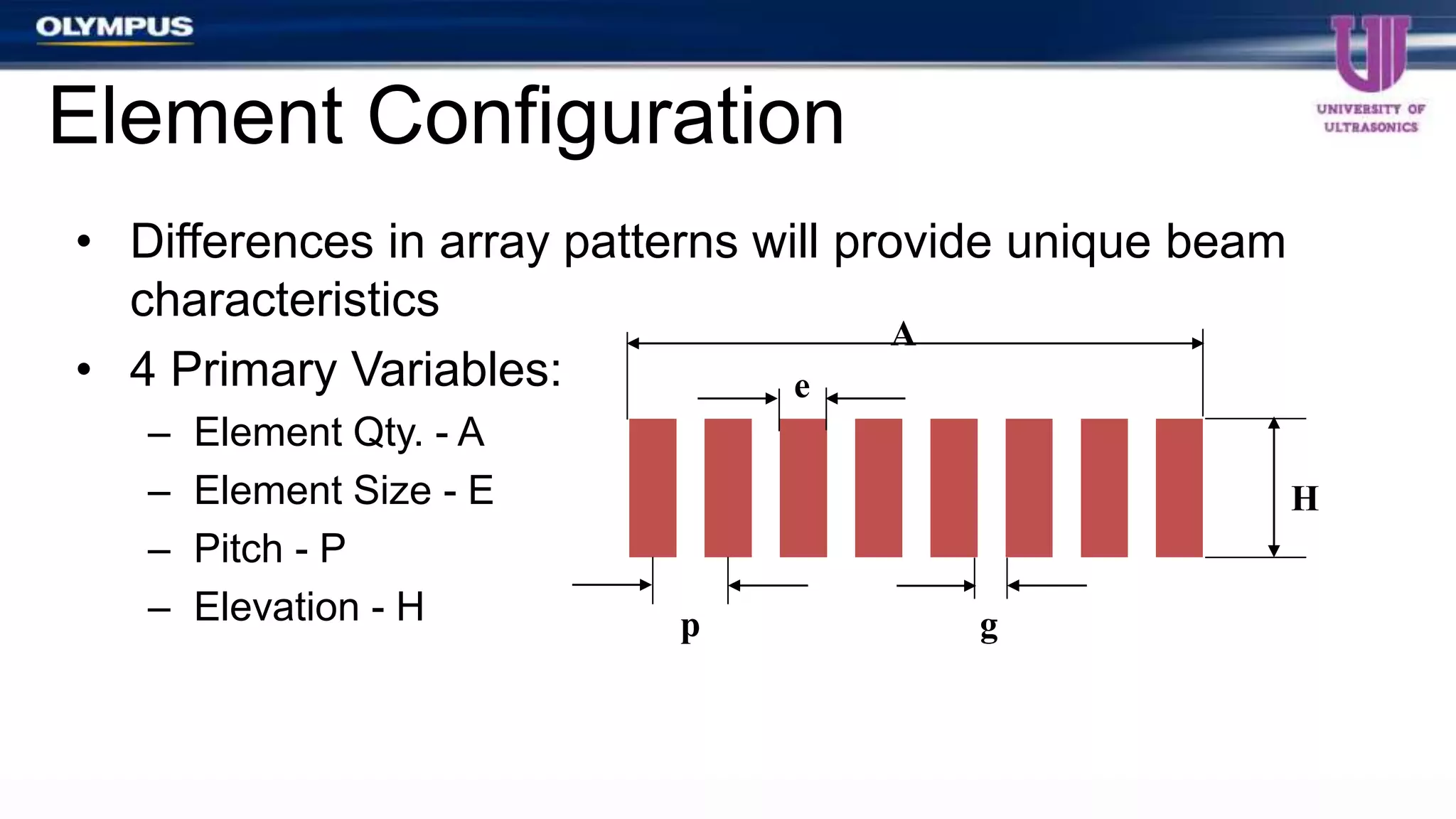
• Differences in array patterns will provide unique beam
characteristics
• 4 Primary Variables:
– Element Qty. - A
– Element Size - E
– Pitch - P
– Elevation - H
Element Configuration
p g
e
H
A
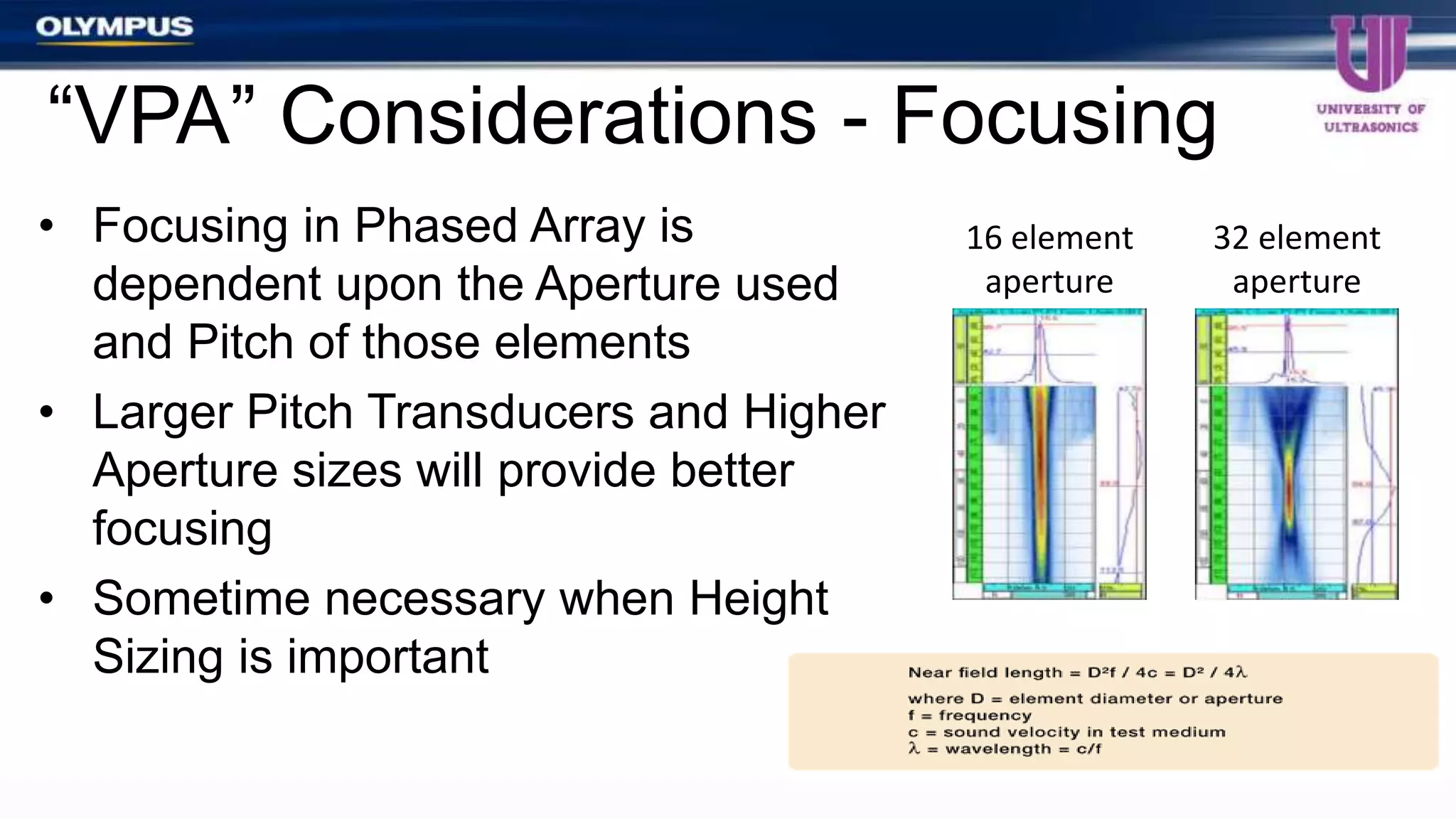
• Focusing in Phased Array is
dependent upon the Aperture used
and Pitch of those elements
• Larger Pitch Transducers and Higher
Aperture sizes will provide better
focusing
• Sometime necessary when Height
Sizing is important
“VPA” Considerations - Focusing
16 element
aperture
32 element
aperture
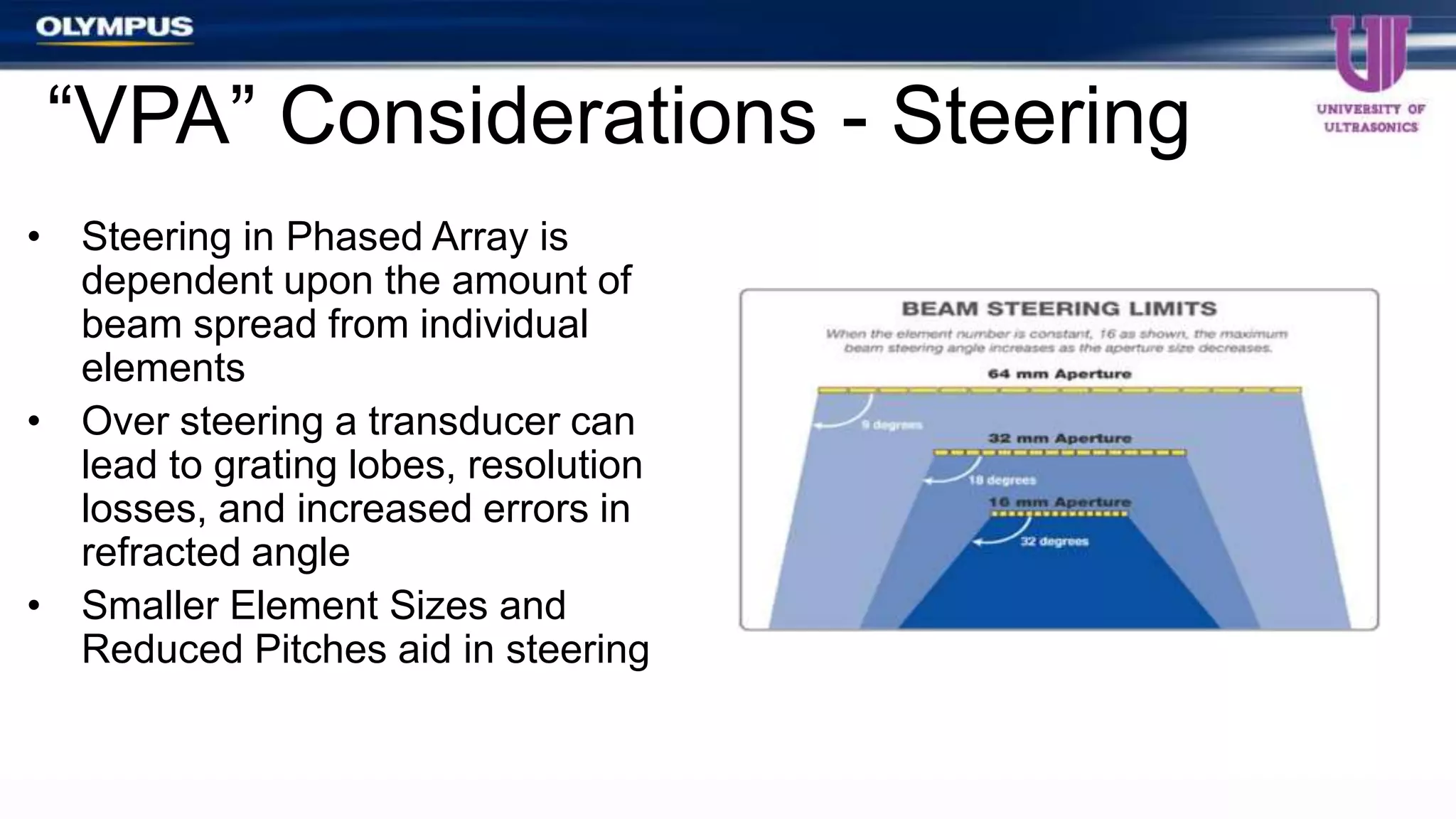
• Steering in Phased Array is
dependent upon the amount of
beam spread from individual
elements
• Over steering a transducer can
lead to grating lobes, resolution
losses, and increased errors in
refracted angle
• Smaller Element Sizes and
Reduced Pitches aid in steering
“VPA” Considerations - Steering
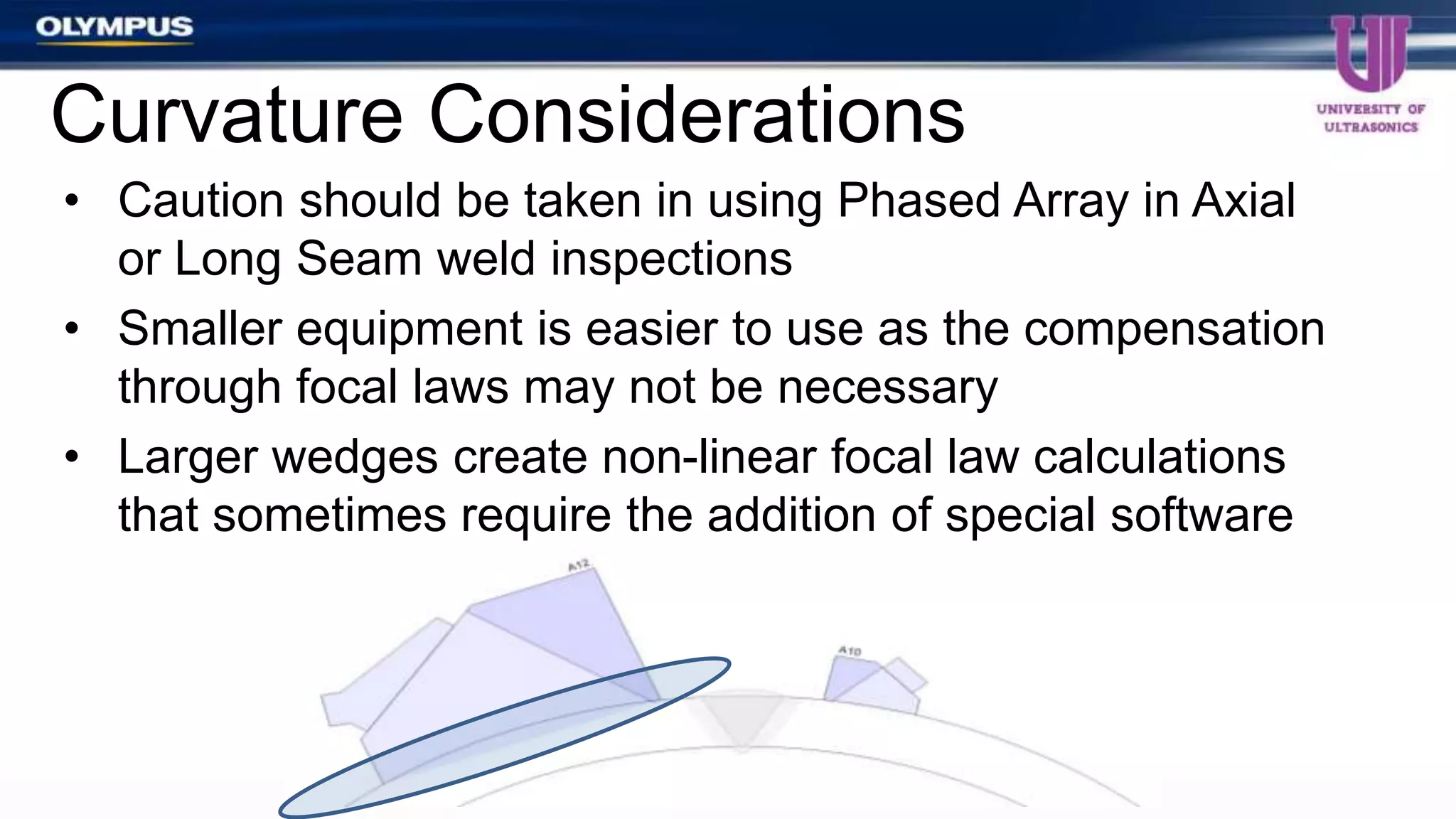
• Caution should be taken in using Phased Array in Axial
or Long Seam weld inspections
• Smaller equipment is easier to use as the compensation
through focal laws may not be necessary
• Larger wedges create non-linear focal law calculations
that sometimes require the addition of special software
Curvature Considerations
Phased Array
Scan Plan Creation
• From the perspective of the technician, a scan plan
provides instruction for probe placement and focal law
creation
• With no direct code instruction and high variance on
Phased Array use, this leaves more room for
interpretation and how to provide these instructions
• 2 Extremes of Scan Plan Creation
– Minimalistic
– Flood Method
Scan Plan Thoughts
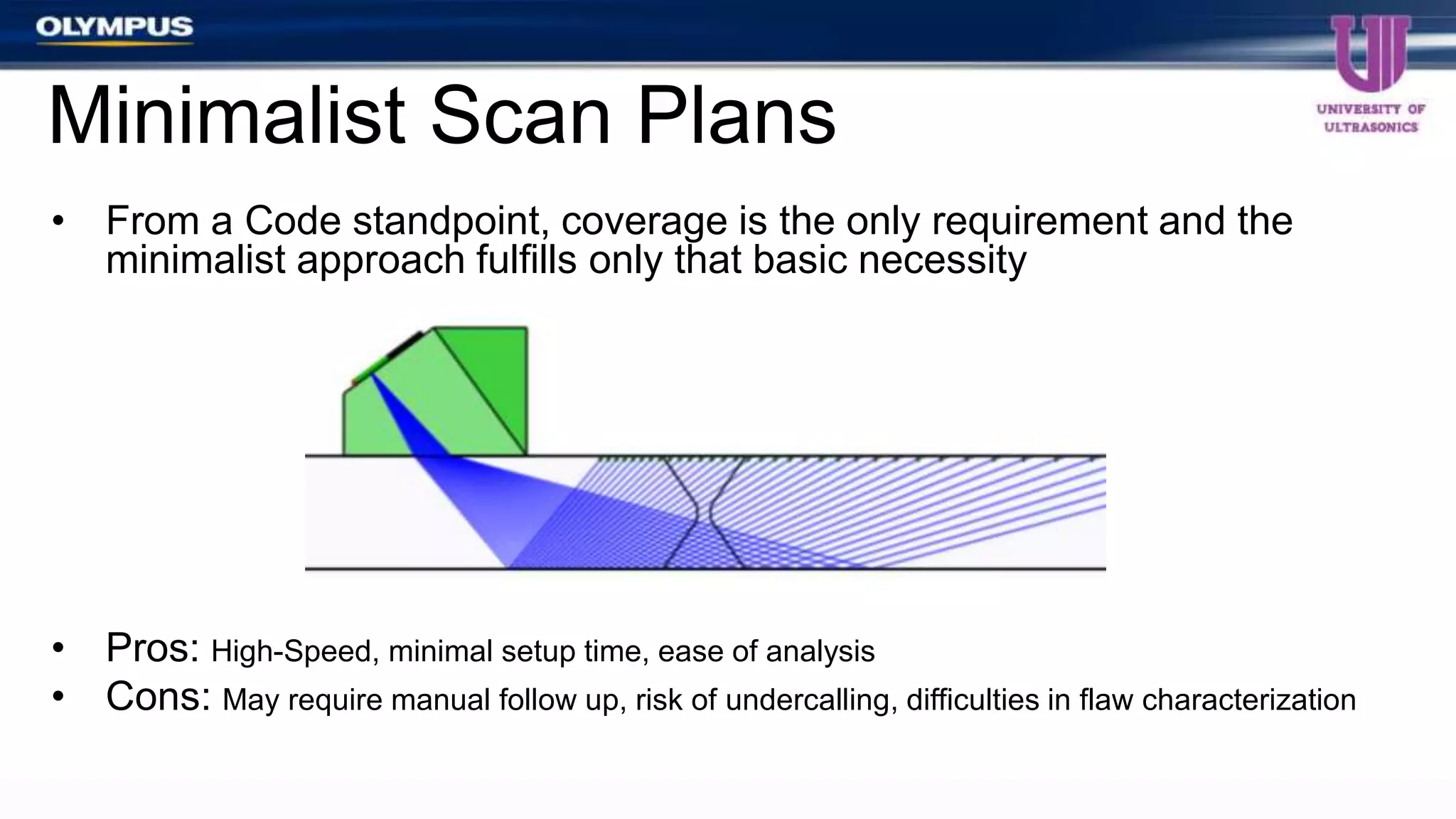
• From a Code standpoint, coverage is the only requirement and the
minimalist approach fulfills only that basic necessity
• Pros: High-Speed, minimal setup time, ease of analysis
• Cons: May require manual follow up, risk of undercalling, difficulties in flaw characterization
Minimalist Scan Plans
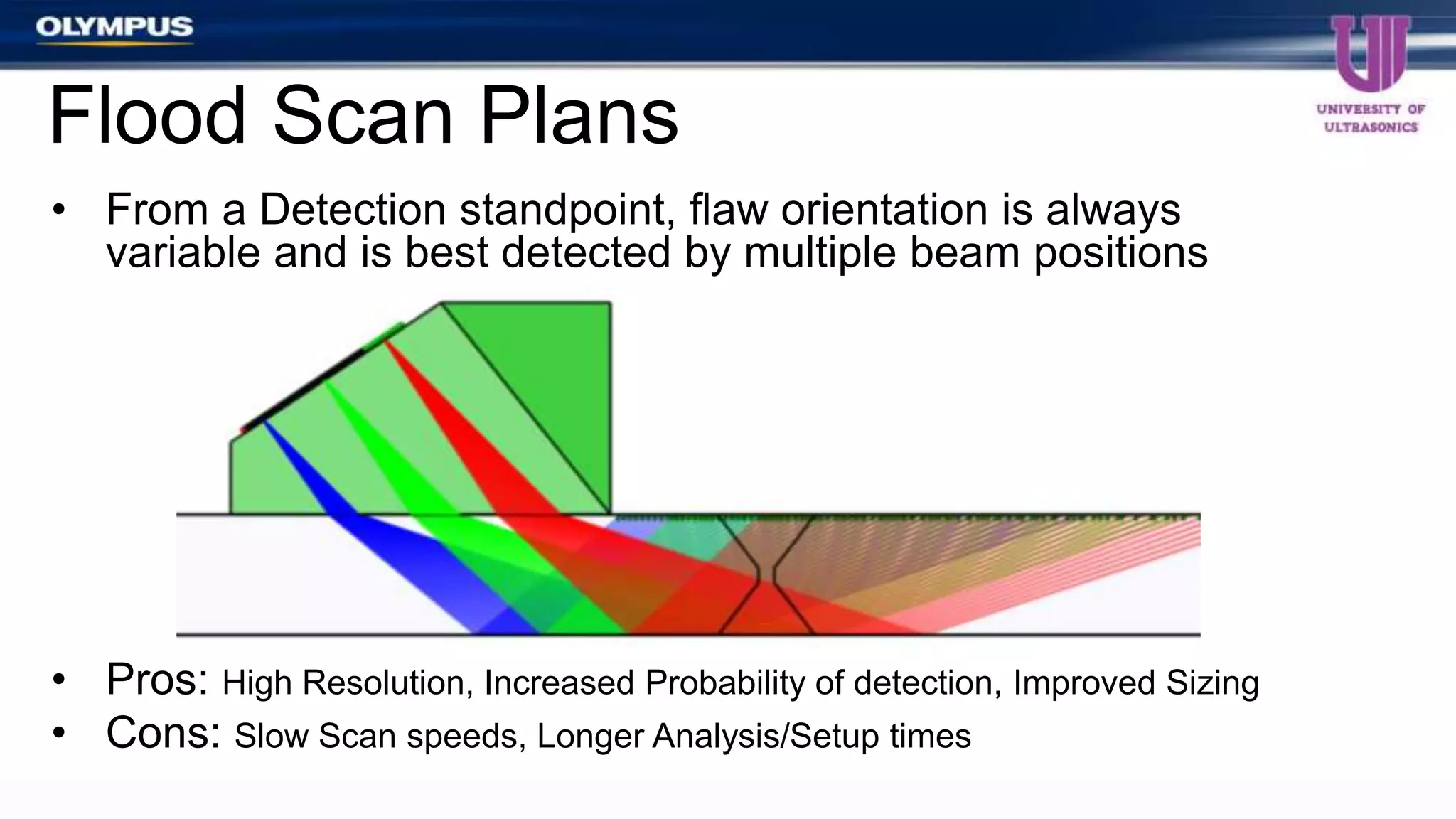
• From a Detection standpoint, flaw orientation is always
variable and is best detected by multiple beam positions
• Pros: High Resolution, Increased Probability of detection, Improved Sizing
• Cons: Slow Scan speeds, Longer Analysis/Setup times
Flood Scan Plans
• First need a plan of attack….
– How am I to approach the inspection? (Single side
access…duel side access..etc.)
– What types of flaw mechanisms are potentially present?
– What incident angles will best reveal the potential flaw
mechanisms?
– FLAWS ARE ANGULAR DEPENDANT
• Most codes simply state full volumetric coverage including the
Heat Affected Zone is required….. This is too vague.
• Breaking that required coverage into specific areas and
specific angles will provide consistency and reliability.
Scan Plan Focal Law Methodology
• More than just coverage!!!!
• Must interrogate specific parts of the joint with specific angles
which will provide optimum responses to suspected flaw
mechanisms.
• General coverage principles for Weld Inspection
– Root Coverage
– Fusion Zone Coverage
– Heat affected zone coverage
– Volumetric
• This does NOT indicate that 4 scans on each side must be
configured.…The number of scans is determined by your
proof of coverage.
Scan Plan Methodology Welds
• 1. Weld Root Interrogation – First objective is to index close
to the weld toe with the intent of weld root interrogation
– Primary Flaw Types: Lack of penetration, Root or ID Cracks,
Centerline Cracking in Double Vee Weld
– This is the most critical part of a weld joint and the first objective
to cover in scan planning.
– First have to consider the joint type and the potential flaws.
– This also assures maximum 1st leg inspection coverage.
Scan Plan Methodology continued
• 2. Fusion Zone Coverage – second objective is to ensure the
fusion zone is covered WITH SPECIFIC ANGLES.
• Primary Flaw Types: Lack of side wall fusion, Sidewall Cracking
• With conventional ultrasonics, the optimum bevel incident angle (BIA) is
considered between 5 and 7 degrees of normal incidence with some
dependency on the frequency of the sound wave.
• Studies have found that with Phased Array, the optimum BIA with
• Sectorial Scans = +/-10 degrees of normal incidence
• E-Scans = +/-5 degrees of normal incidence.
Scan Plan Methodology continued
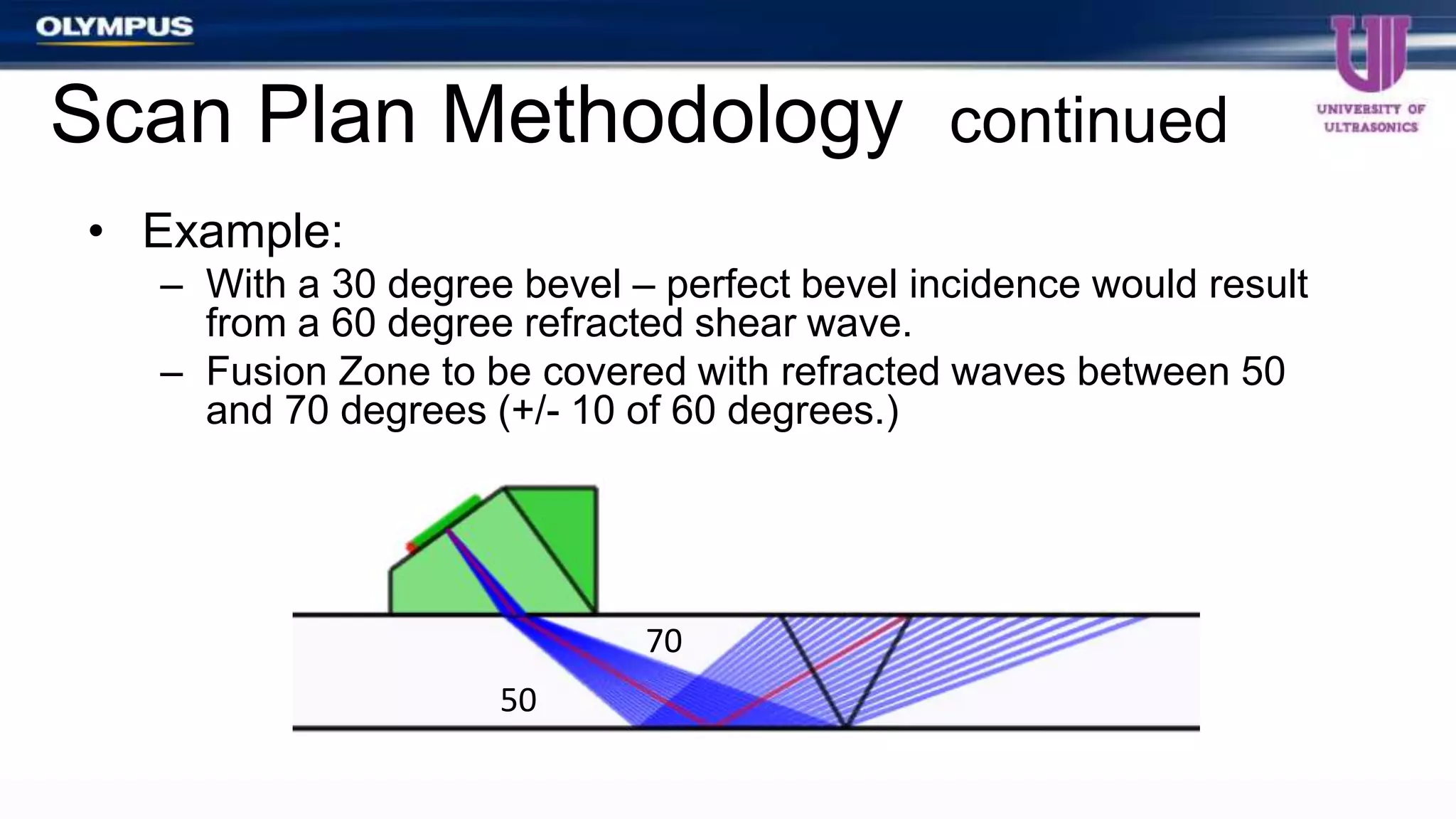
• Example:
– With a 30 degree bevel – perfect bevel incidence would result
from a 60 degree refracted shear wave.
– Fusion Zone to be covered with refracted waves between 50
and 70 degrees (+/- 10 of 60 degrees.)
50
70
Scan Plan Methodology continued
• 3. Heat Affected Zone (HAZ) Coverage – The total code specified
area of interest must be covered. ASME specifies the weld zone
plus 1” or “t” whichever is less for materials less than 3” thick.
– Primary Flaw Types: CRACKING
– Studies have identified that optimum responses from a notch corner
result from shear waves between approximately 35 and 58 degrees.
– Plan for these angles to interrogate the HAZ zone.
– Occasionally, HAZ coverage may be specified as being achieved on the
probe side for a given index position.
Scan Plan Methodology continued
• 4. Volumetric Coverage – If the previous three steps
are complete, this will be sufficiently covered without
addition considerations.
– This is for slag and porosity detection which are typically omni-
directional type reflectors (similar to a Side-drilled hole, omni-
directional reflectors tend to reflect sound regardless of the angle
of attack).
Scan Plan Methodology continued
Thank You!
For more on Olympus Phased Array:
www.olympus-ims.com

Advancements in Phased Array Scan Planning

  • 1.
    Phased Array ScanPlanning Considerations for Weld Inspection University of Ultrasonics Olympus Scientific Solutions Americas Webinar February 4th, 2014
  • 2.
    • Scan PlanningIntroduction • Basic Scan Plan Requirements • Basic Methodology • Hands-on Demonstration Short Course Outline
  • 3.
    Scan Plan History •Scan planning is deeply rooted in day-to-day conventional UT routines: – Evaluating Transducer Characteristics – Determining proper “pullback”/skip distance for Angle Beam – Beam overlap for C-Scan coverage – Focal Spot Size Calculations
  • 4.
    Scan Plans??? • BeforeANY Phased Array Inspection is performed a SCAN PLAN should be in place. – Scan Plans – A documented inspection strategy (plan of attack) to provide repeatability for inspections. These will aide in evaluating the material and provide insight to individuals reviewing data.
  • 5.
    Scan Plan Importance •Variability of Phased Array inspections can create issues in consistency, repeatability, and personnel training • The above scan plan includes several scan plan variables, can you find them???
  • 6.
    Phased Array Variability •Sectorial Scanning • E-Scanning • Encoded vs. Manual • Aperture Determination • Multi-Channel/Grouping • Focusing effects • Transducer Selection – Frequency & Beam Spread Considerations • Angle Selection
  • 7.
  • 8.
    Scan Plan Variables •Phased Array Scan plans should provide at minimum: – Part Details (Weld Design, Curvatures, Connections) – Probe and Wedge to be Used – Focal Law Configuration to be Used (Including initial instrument settings) – Index Offset Info – Number of Scans – Direction of Scans
  • 9.
    ASME Example Requirements •Section V Article 4 • Requirements of Scan Planning in Appendix V
  • 10.
    AWS Example Requirements D1.1  Info Related to Scan Planning under Part G  Testing Procedure under Annex S
  • 11.
    API Example Requirements 1104  Info Related to Scan Planning  Procedure specific  Specialized Calibration Requirements
  • 12.
  • 13.
    • Forming ascan plan involves 3 essential variables: – Part Configuration – Probe & Wedge Selection – Focal Law Selection • Information may be hand-drawn or plotted via software Scan Plan Essentials
  • 14.
    • Pros: – Accountsfor errors in Equipment – Plots actual beam index point – Focal Law adjustments visualized • Cons: – Time Consuming – Visual Measurements – Requires Equipment – Actual Inspection piece may vary Hand-Drawn
  • 15.
    • Pros: – Fastand efficient – Easier Part Drawing/Dimensioning – Traceable & Transferable – Flexibility on Custom Parts • Cons: – Equipment Variations – Part Variations – Estimation of Focal Laws – Manual Prove up required Software
  • 16.
    • Choosing theproper equipment is as much scan planning as choosing the proper angles or focal laws. • Transducers should be proper for material properties • Wedges should allow for good contact and transmission • Instruments should be capable of handling both Equipment Selection
  • 17.
    • Differences inarray patterns will provide unique beam characteristics • 4 Primary Variables: – Element Qty. - A – Element Size - E – Pitch - P – Elevation - H Element Configuration p g e H A
  • 18.
    • Focusing inPhased Array is dependent upon the Aperture used and Pitch of those elements • Larger Pitch Transducers and Higher Aperture sizes will provide better focusing • Sometime necessary when Height Sizing is important “VPA” Considerations - Focusing 16 element aperture 32 element aperture
  • 19.
    • Steering inPhased Array is dependent upon the amount of beam spread from individual elements • Over steering a transducer can lead to grating lobes, resolution losses, and increased errors in refracted angle • Smaller Element Sizes and Reduced Pitches aid in steering “VPA” Considerations - Steering
  • 20.
    • Caution shouldbe taken in using Phased Array in Axial or Long Seam weld inspections • Smaller equipment is easier to use as the compensation through focal laws may not be necessary • Larger wedges create non-linear focal law calculations that sometimes require the addition of special software Curvature Considerations
  • 21.
  • 22.
    • From theperspective of the technician, a scan plan provides instruction for probe placement and focal law creation • With no direct code instruction and high variance on Phased Array use, this leaves more room for interpretation and how to provide these instructions • 2 Extremes of Scan Plan Creation – Minimalistic – Flood Method Scan Plan Thoughts
  • 23.
    • From aCode standpoint, coverage is the only requirement and the minimalist approach fulfills only that basic necessity • Pros: High-Speed, minimal setup time, ease of analysis • Cons: May require manual follow up, risk of undercalling, difficulties in flaw characterization Minimalist Scan Plans
  • 24.
    • From aDetection standpoint, flaw orientation is always variable and is best detected by multiple beam positions • Pros: High Resolution, Increased Probability of detection, Improved Sizing • Cons: Slow Scan speeds, Longer Analysis/Setup times Flood Scan Plans
  • 25.
    • First needa plan of attack…. – How am I to approach the inspection? (Single side access…duel side access..etc.) – What types of flaw mechanisms are potentially present? – What incident angles will best reveal the potential flaw mechanisms? – FLAWS ARE ANGULAR DEPENDANT • Most codes simply state full volumetric coverage including the Heat Affected Zone is required….. This is too vague. • Breaking that required coverage into specific areas and specific angles will provide consistency and reliability. Scan Plan Focal Law Methodology
  • 26.
    • More thanjust coverage!!!! • Must interrogate specific parts of the joint with specific angles which will provide optimum responses to suspected flaw mechanisms. • General coverage principles for Weld Inspection – Root Coverage – Fusion Zone Coverage – Heat affected zone coverage – Volumetric • This does NOT indicate that 4 scans on each side must be configured.…The number of scans is determined by your proof of coverage. Scan Plan Methodology Welds
  • 27.
    • 1. WeldRoot Interrogation – First objective is to index close to the weld toe with the intent of weld root interrogation – Primary Flaw Types: Lack of penetration, Root or ID Cracks, Centerline Cracking in Double Vee Weld – This is the most critical part of a weld joint and the first objective to cover in scan planning. – First have to consider the joint type and the potential flaws. – This also assures maximum 1st leg inspection coverage. Scan Plan Methodology continued
  • 28.
    • 2. FusionZone Coverage – second objective is to ensure the fusion zone is covered WITH SPECIFIC ANGLES. • Primary Flaw Types: Lack of side wall fusion, Sidewall Cracking • With conventional ultrasonics, the optimum bevel incident angle (BIA) is considered between 5 and 7 degrees of normal incidence with some dependency on the frequency of the sound wave. • Studies have found that with Phased Array, the optimum BIA with • Sectorial Scans = +/-10 degrees of normal incidence • E-Scans = +/-5 degrees of normal incidence. Scan Plan Methodology continued
  • 29.
    • Example: – Witha 30 degree bevel – perfect bevel incidence would result from a 60 degree refracted shear wave. – Fusion Zone to be covered with refracted waves between 50 and 70 degrees (+/- 10 of 60 degrees.) 50 70 Scan Plan Methodology continued
  • 30.
    • 3. HeatAffected Zone (HAZ) Coverage – The total code specified area of interest must be covered. ASME specifies the weld zone plus 1” or “t” whichever is less for materials less than 3” thick. – Primary Flaw Types: CRACKING – Studies have identified that optimum responses from a notch corner result from shear waves between approximately 35 and 58 degrees. – Plan for these angles to interrogate the HAZ zone. – Occasionally, HAZ coverage may be specified as being achieved on the probe side for a given index position. Scan Plan Methodology continued
  • 31.
    • 4. VolumetricCoverage – If the previous three steps are complete, this will be sufficiently covered without addition considerations. – This is for slag and porosity detection which are typically omni- directional type reflectors (similar to a Side-drilled hole, omni- directional reflectors tend to reflect sound regardless of the angle of attack). Scan Plan Methodology continued
  • 32.
    Thank You! For moreon Olympus Phased Array: www.olympus-ims.com

Editor's Notes

  • #3 Inserted higher resolution sub icon
  • #7 Consider change of linear scan to E-scan to match later reference and because linear is a code confusing terminology, i.e. asme uses for motion of scan
  • #9 Image position- goes off view when in presentation, in general is it possible to look at the slides and try to stay out of the title bar section with images?
  • #10 Will you make reference to the applicable appendix here either as a bullet or at least orally
  • #19 Hanged pa to phased array. Do you want to define VPA here as a bullet so when viewed as a presentation possibly later it is clear?
  • #23 Changed pa to phased array
  • #25 Hanged pod to prob of detection
  • #26 Changed haz to heat affected zone
  • #27 Unabbreviated haz
  • #28 Can we change from cont…. To continued or cont. in the next slides? Minor but it is a bit distracting. Unabbreviated dbl v, drawing a blank on IDC but would also unabbreviate
  • #29 Hanged paut to phased array, unabbreviated loswf