Engineers India Limited
Delivering Excellence Through People
July 23, 2022
BASICS CALIBRATION
OF PAUT & TOFD
Irshad Ahmad
Delivering Excellence Through People
2
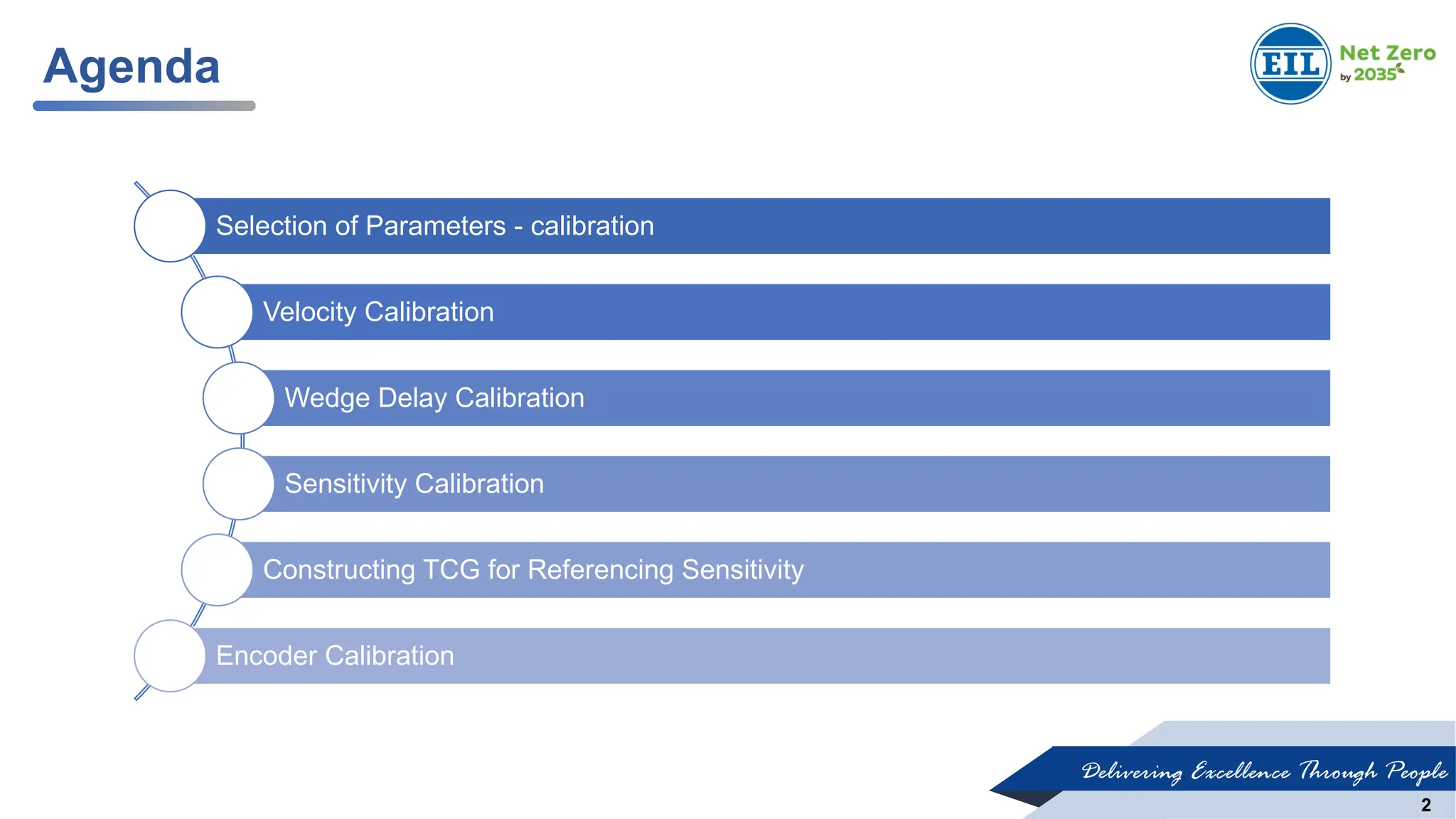
Selection of Parameters - calibration
Velocity Calibration
Wedge Delay Calibration
Sensitivity Calibration
Constructing TCG for Referencing Sensitivity
Encoder Calibration
Agenda
Delivering Excellence Through People
3
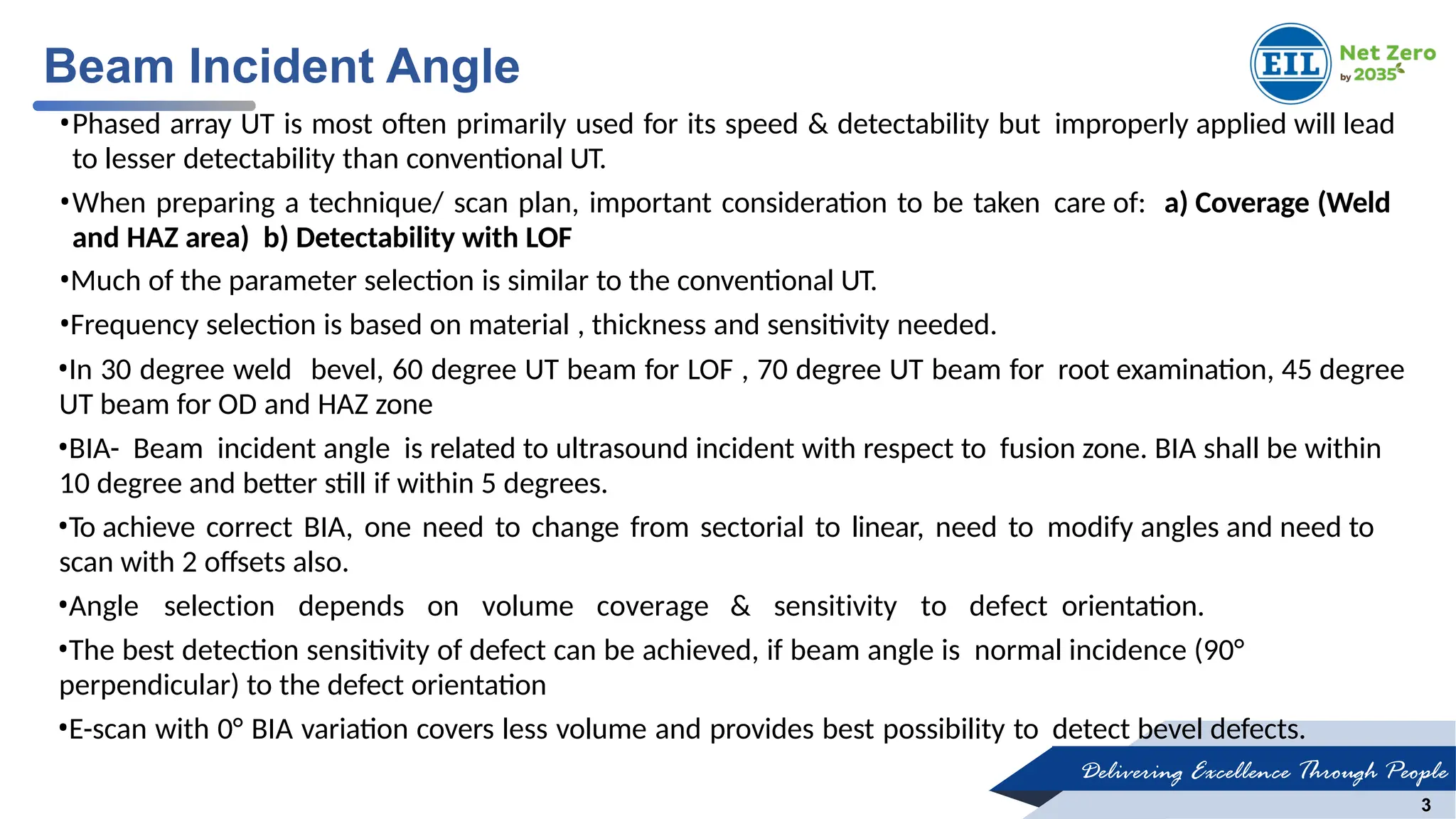
•Phased array UT is most often primarily used for its speed & detectability but improperly applied will lead
to lesser detectability than conventional UT.
•When preparing a technique/ scan plan, important consideration to be taken care of: a) Coverage (Weld
and HAZ area) b) Detectability with LOF
•Much of the parameter selection is similar to the conventional UT.
•Frequency selection is based on material , thickness and sensitivity needed.
•In 30 degree weld bevel, 60 degree UT beam for LOF , 70 degree UT beam for root examination, 45 degree
UT beam for OD and HAZ zone
•BIA- Beam incident angle is related to ultrasound incident with respect to fusion zone. BIA shall be within
10 degree and better still if within 5 degrees.
•To achieve correct BIA, one need to change from sectorial to linear, need to modify angles and need to
scan with 2 offsets also.
•Angle selection depends on volume coverage & sensitivity to defect orientation.
•The best detection sensitivity of defect can be achieved, if beam angle is normal incidence (90°
perpendicular) to the defect orientation
•E-scan with 0° BIA variation covers less volume and provides best possibility to detect bevel defects.
Beam Incident Angle
Delivering Excellence Through People
4
Beam Incident Angle
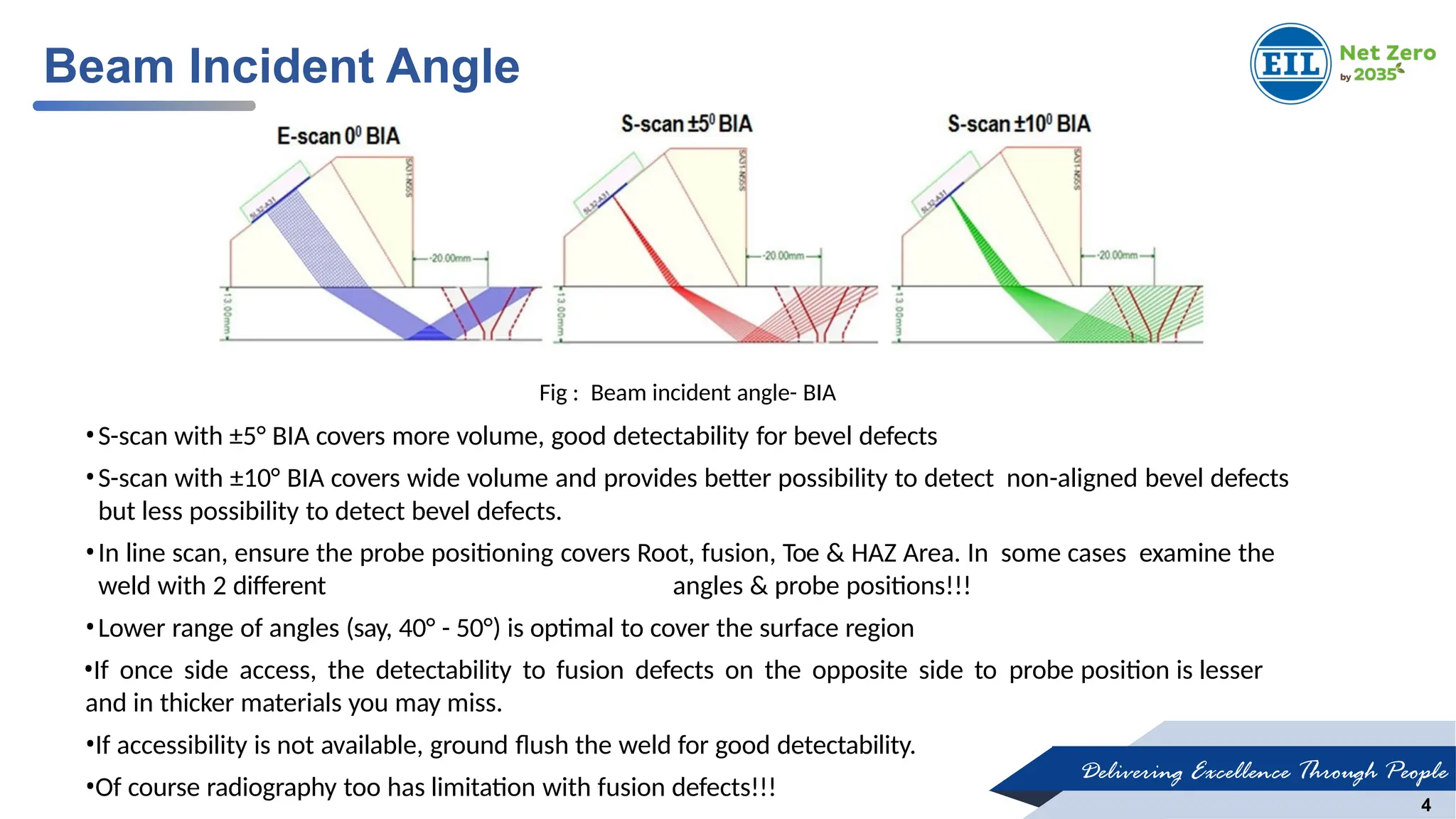
Fig : Beam incident angle- BIA
•S-scan with ±5° BIA covers more volume, good detectability for bevel defects
•S-scan with ±10° BIA covers wide volume and provides better possibility to detect non-aligned bevel defects
but less possibility to detect bevel defects.
•In line scan, ensure the probe positioning covers Root, fusion, Toe & HAZ Area. In some cases examine the
weld with 2 different angles & probe positions!!!
•Lower range of angles (say, 40° - 50°) is optimal to cover the surface region
•If once side access, the detectability to fusion defects on the opposite side to probe position is lesser
and in thicker materials you may miss.
•If accessibility is not available, ground flush the weld for good detectability.
•Of course radiography too has limitation with fusion defects!!!
Delivering Excellence Through People
5
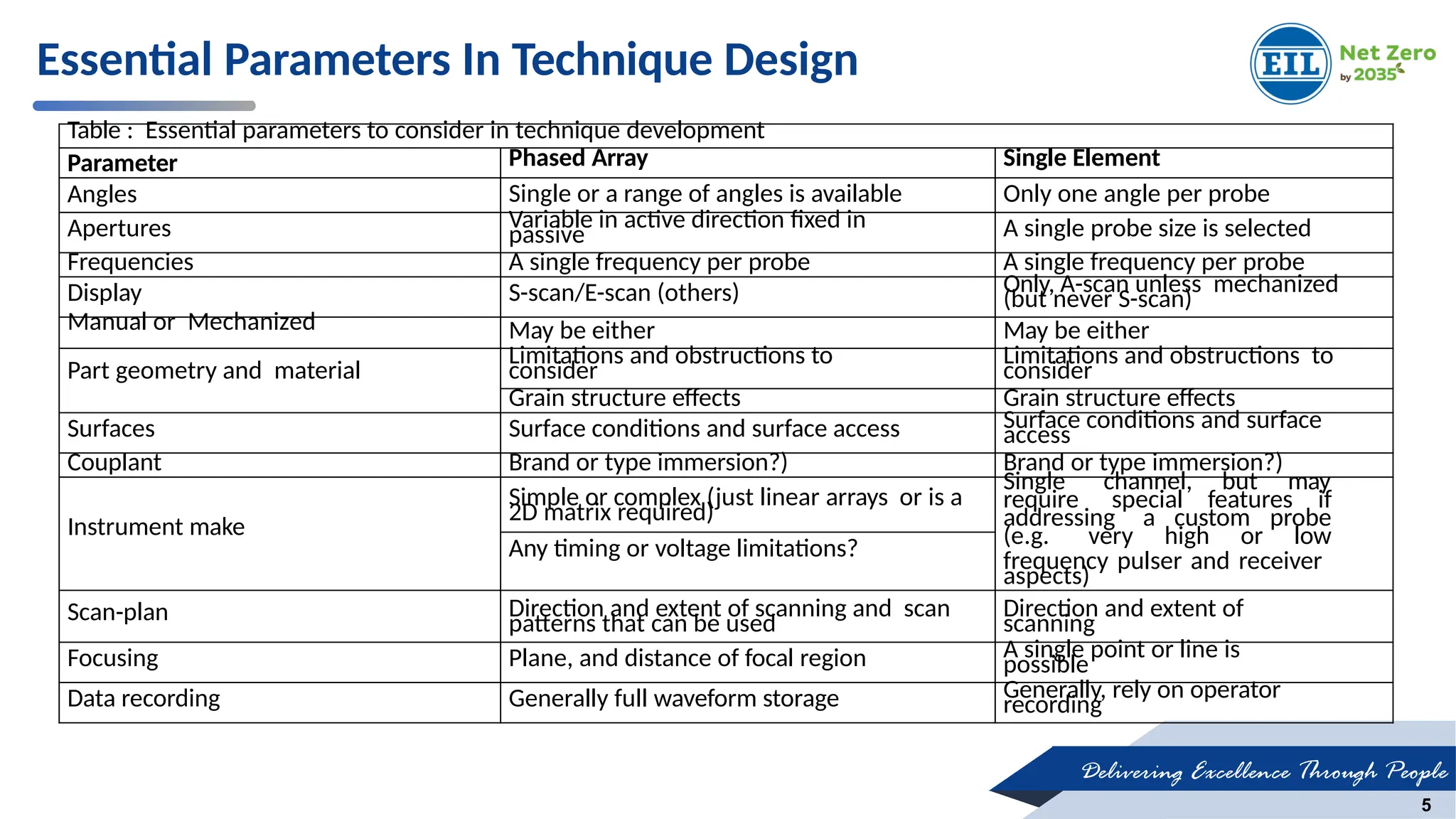
Table : Essential parameters to consider in technique development
Parameter Phased Array Single Element
Angles Single or a range of angles is available Only one angle per probe
Apertures Variable in active direction fixed in
passive A single probe size is selected
Frequencies A single frequency per probe A single frequency per probe
Display S-scan/E-scan (others) Only, A-scan unless mechanized
(but never S-scan)
Manual or Mechanized May be either May be either
Part geometry and material
Limitations and obstructions to
consider
Limitations and obstructions to
consider
Grain structure effects Grain structure effects
Surfaces Surface conditions and surface access Surface conditions and surface
access
Couplant Brand or type immersion?) Brand or type immersion?)
Instrument make
Simple or complex (just linear arrays or is a
2D matrix required)
Single channel, but may
require special features if
addressing a custom probe
(e.g. very high or low
frequency pulser and receiver
aspects)
Any timing or voltage limitations?
Scan-plan Direction and extent of scanning and scan
patterns that can be used
Direction and extent of
scanning
Focusing Plane, and distance of focal region A single point or line is
possible
Data recording Generally full waveform storage Generally, rely on operator
recording
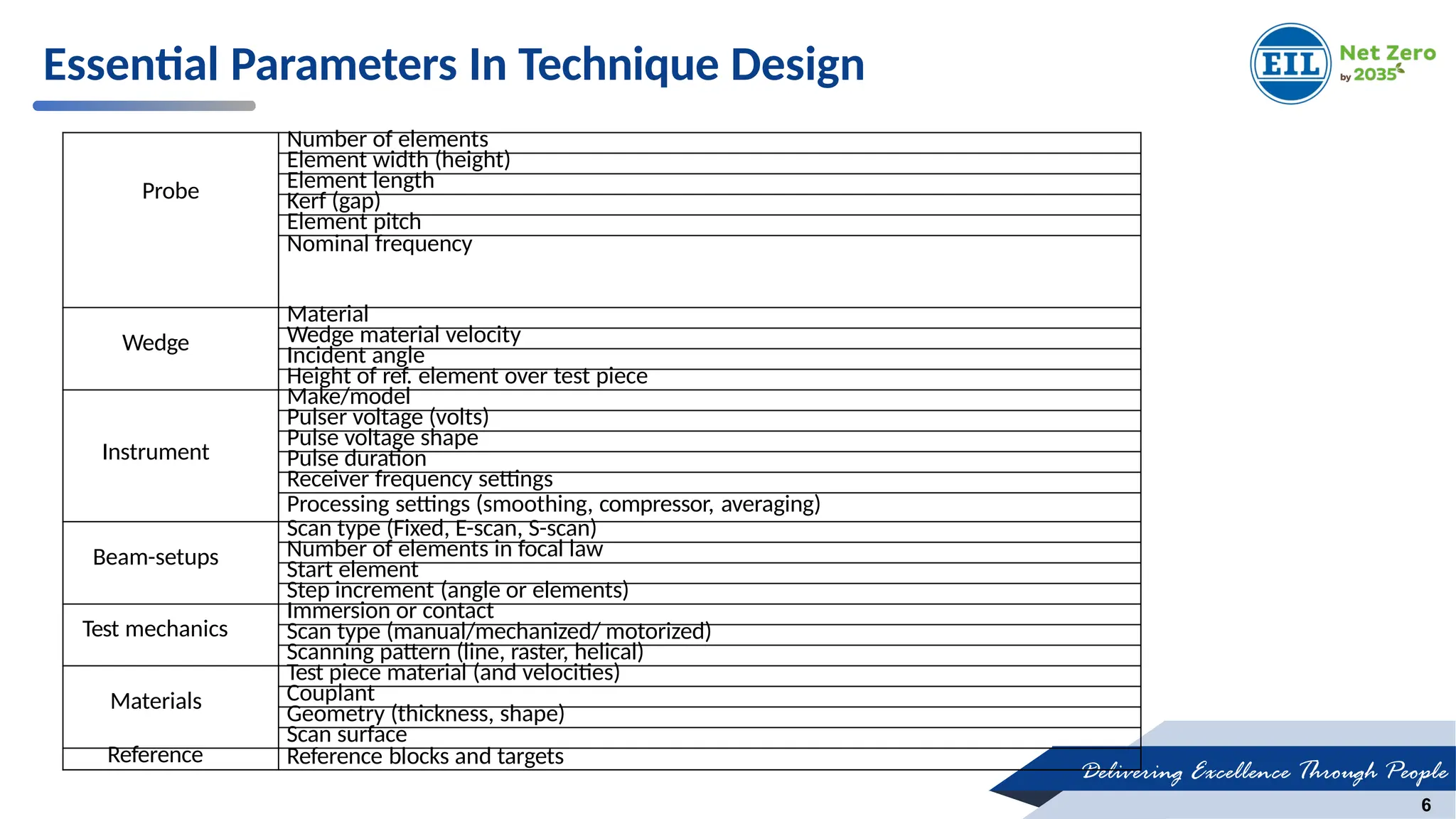
Essential Parameters In Technique Design
Delivering Excellence Through People
6
Essential Parameters In Technique Design
Probe
Number of elements
Element width (height)
Element length
Kerf (gap)
Element pitch
Nominal frequency
Wedge
Material
Wedge material velocity
Incident angle
Height of ref. element over test piece
Instrument
Make/model
Pulser voltage (volts)
Pulse voltage shape
Pulse duration
Receiver frequency settings
Processing settings (smoothing, compressor, averaging)
Beam-setups
Scan type (Fixed, E-scan, S-scan)
Number of elements in focal law
Start element
Step increment (angle or elements)
Test mechanics
Immersion or contact
Scan type (manual/mechanized/ motorized)
Scanning pattern (line, raster, helical)
Materials
Test piece material (and velocities)
Couplant
Geometry (thickness, shape)
Scan surface
Reference Reference blocks and targets
Delivering Excellence Through People
7
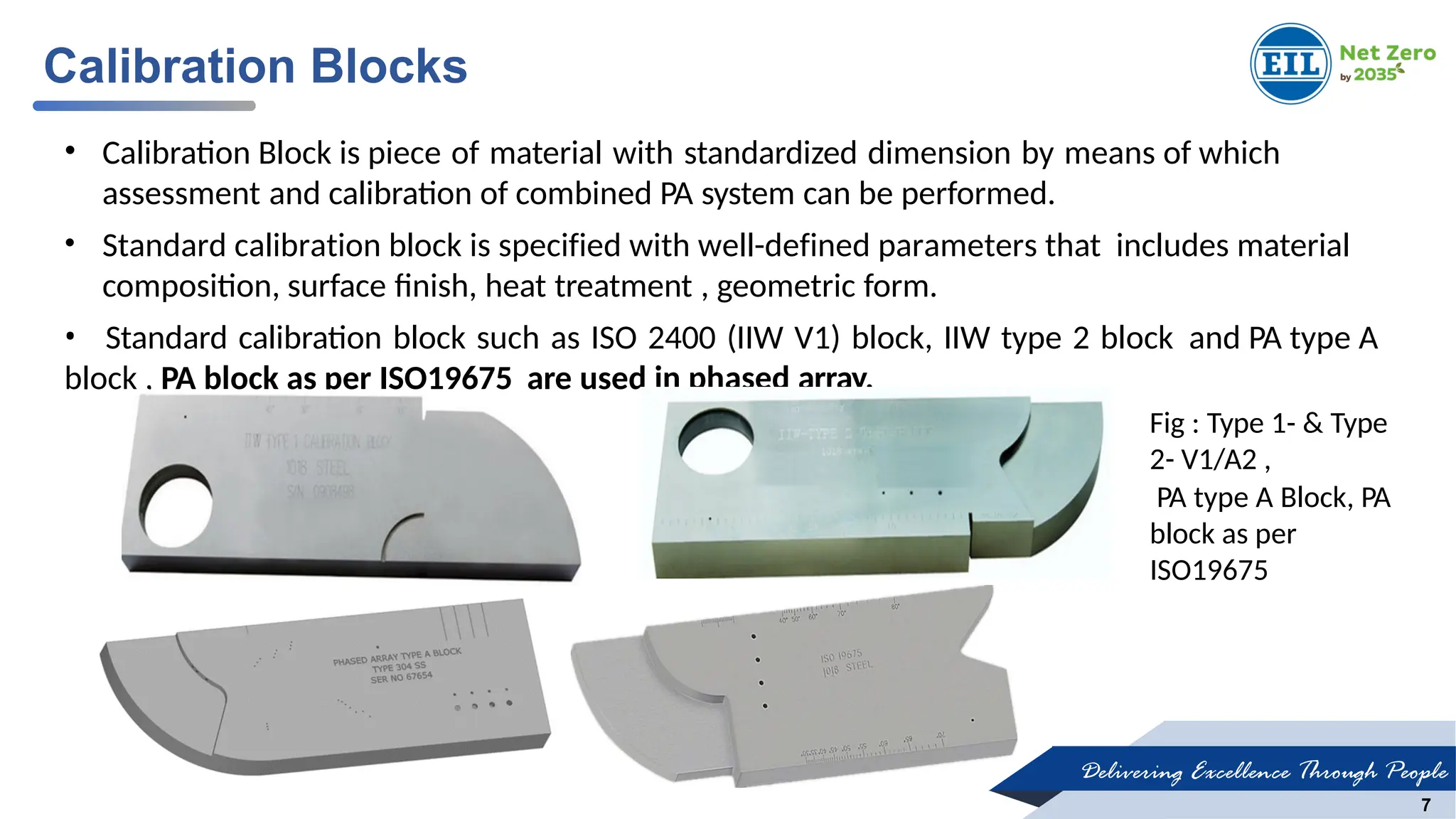
• Calibration Block is piece of material with standardized dimension by means of which
assessment and calibration of combined PA system can be performed.
• Standard calibration block is specified with well-defined parameters that includes material
composition, surface finish, heat treatment , geometric form.
• Standard calibration block such as ISO 2400 (IIW V1) block, IIW type 2 block and PA type A
block , PA block as per ISO19675 are used in phased array.
Calibration Blocks
Fig : Type 1- & Type
2- V1/A2 ,
PA type A Block, PA
block as per
ISO19675
Delivering Excellence Through People
8
Reference Block
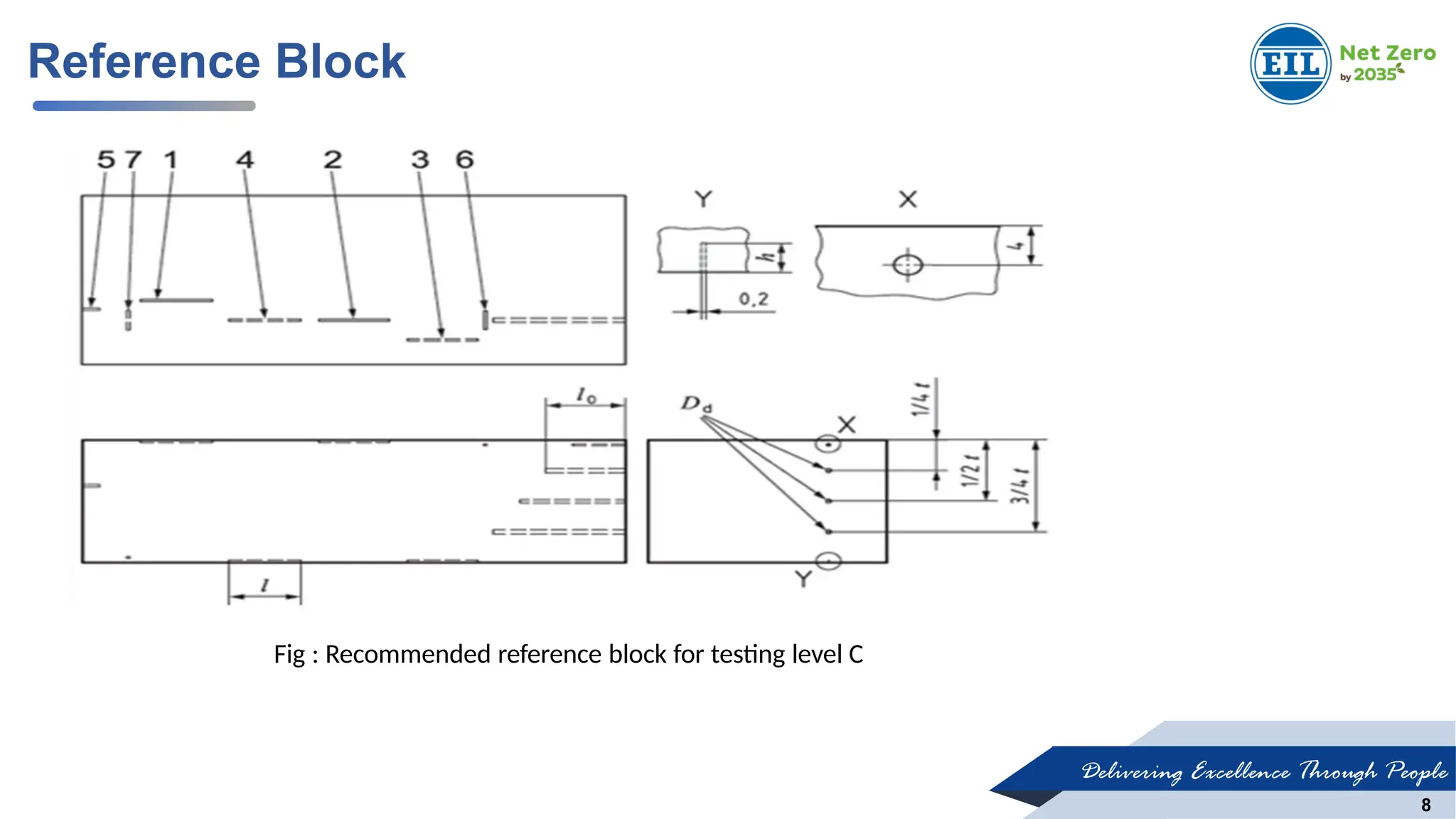
Fig : Recommended reference block for testing level C
Delivering Excellence Through People
9
•Made with similar material (with regard to sound velocity, grain structure and surface condition) and shall consist of
well-defined reference reflectors.
•The length and width of the reference block is chosen such that all the reference reflectors can be properly scanned.
•In general SDH, Notch and FBH are used as typical reference reflector.
•The reference block, its length, width, depth of notches and length, depth , diameter of SDH are selected according
to the testing level required for the phased array inspection as per codes and standards.
Calibrations
The following Calibration process sequence involved in inspection setting.
1. Velocity calibration
2. Wedge delay calibration
3. Amplitude balancing (sensitivity calibration)
4. Time corrected gain [TCG]
5. Encoder calibration
Reference Block
Delivering Excellence Through People
10
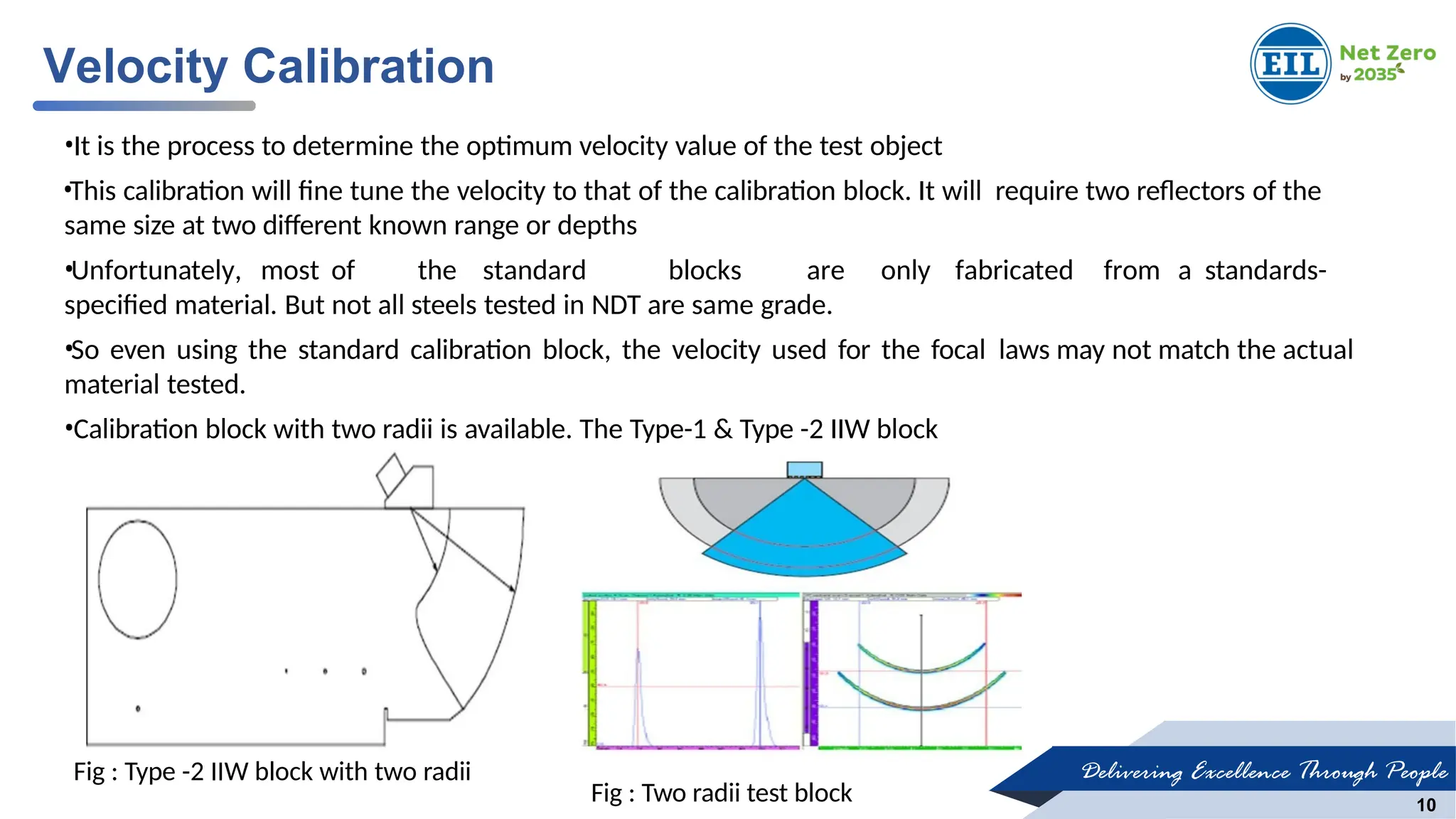
•It is the process to determine the optimum velocity value of the test object
•This calibration will fine tune the velocity to that of the calibration block. It will require two reflectors of the
same size at two different known range or depths
•Unfortunately, most of the standard blocks are only fabricated from a standards-
specified material. But not all steels tested in NDT are same grade.
•So even using the standard calibration block, the velocity used for the focal laws may not match the actual
material tested.
•Calibration block with two radii is available. The Type-1 & Type -2 IIW block
Velocity Calibration
Fig : Type -2 IIW block with two radii
Fig : Two radii test block
Delivering Excellence Through People
11
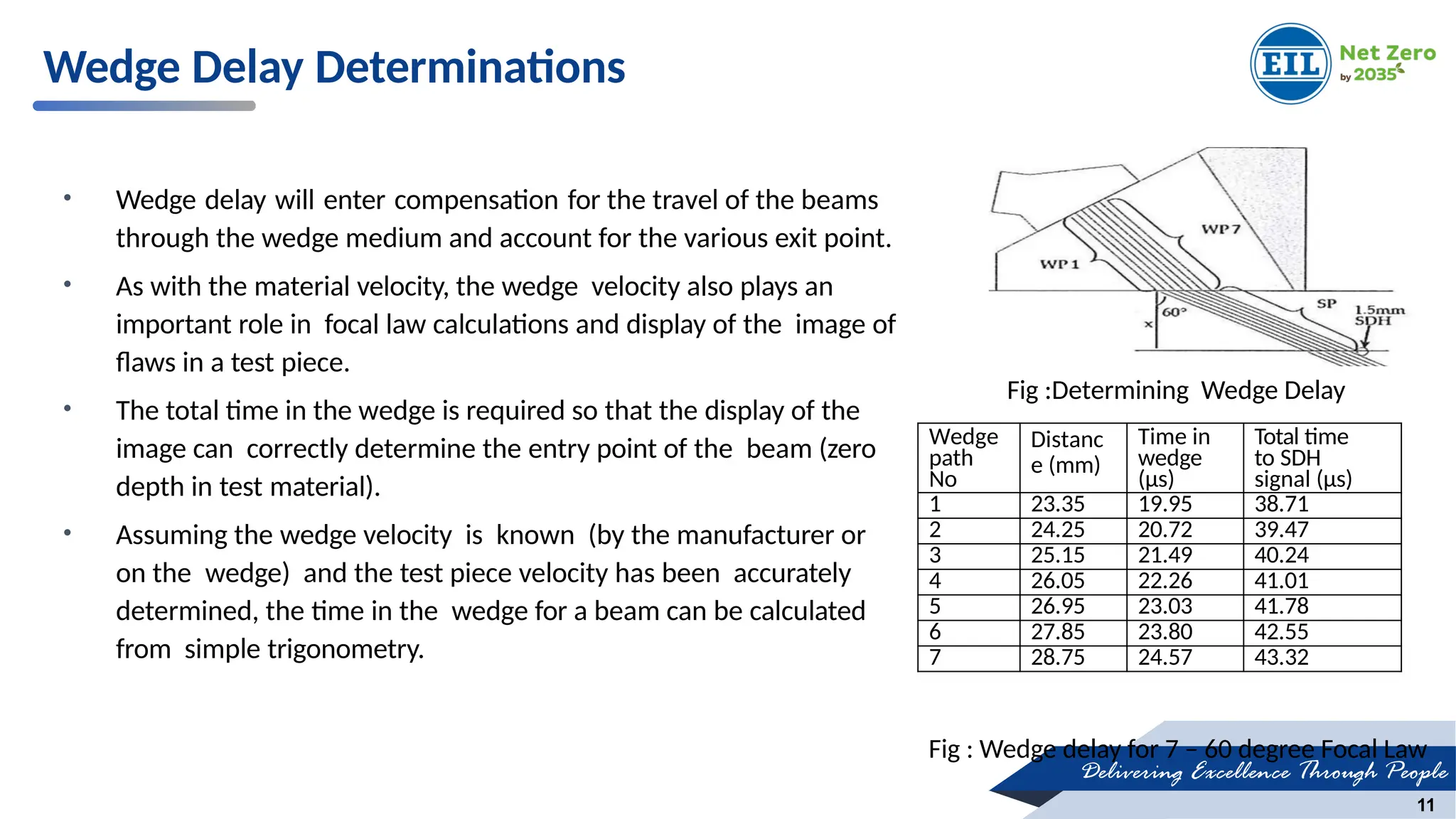
• Wedge delay will enter compensation for the travel of the beams
through the wedge medium and account for the various exit point.
• As with the material velocity, the wedge velocity also plays an
important role in focal law calculations and display of the image of
flaws in a test piece.
• The total time in the wedge is required so that the display of the
image can correctly determine the entry point of the beam (zero
depth in test material).
• Assuming the wedge velocity is known (by the manufacturer or
on the wedge) and the test piece velocity has been accurately
determined, the time in the wedge for a beam can be calculated
from simple trigonometry.
Wedge Delay Determinations
Wedge
path
No
Distanc
e (mm)
Time in
wedge
(µs)
Total time
to SDH
signal (µs)
1 23.35 19.95 38.71
2 24.25 20.72 39.47
3 25.15 21.49 40.24
4 26.05 22.26 41.01
5 26.95 23.03 41.78
6 27.85 23.80 42.55
7 28.75 24.57 43.32
Fig :Determining Wedge Delay
Fig : Wedge delay for 7 – 60 degree Focal Law
Delivering Excellence Through People
12
Wedge Delay Determinations
•But manual calculations is cumbersome, software do those calculations.
•wizard establishes the beam delay values for all individual focal law involved in scan plan by means of standard
calibration block, provided test object material is similar to the standard block material.
• As the probe is moved across the block such that the response from the SDH peaks under each focal law
the instrument will be a noting signal at increasing times, as the probe is moved from right to left.
•This is because, when moving from the right to the left, the first beam interacting with the SDH is the one
made with the lowest element as the start element, so it has the shortest travel in the wedge.
•The wedge path distance increases as the beams farther up the probe interact with the beam.
•A PAUT system could be set up to provide the assumed delays by simply making calculations from the design
drawings of the wedge.
•But some wedges are custom-made and some wedges that are off-the-shelf may have some wear so that the
original dimensions are no longer accurate.
Delivering Excellence Through People
13
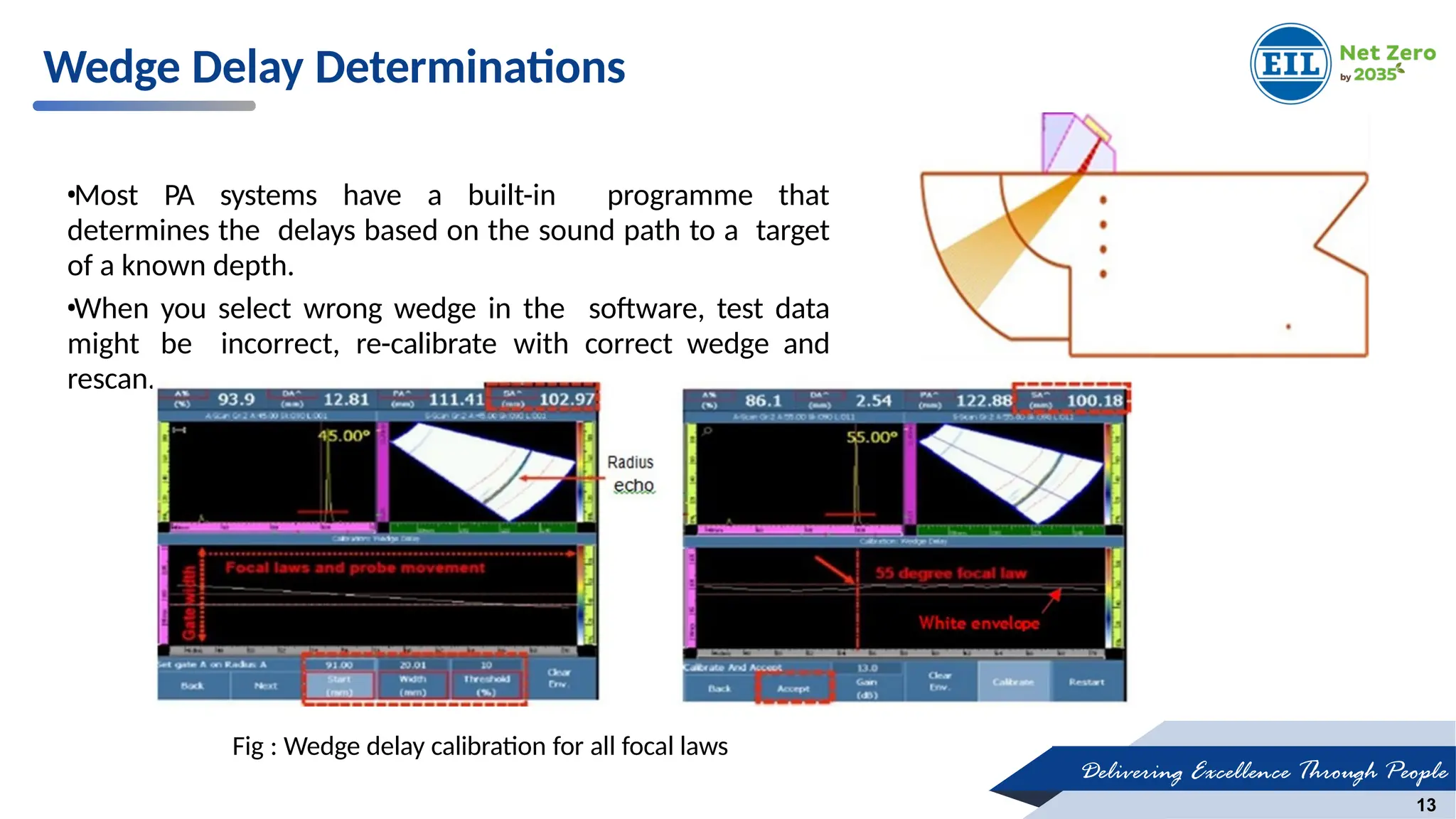
•Most PA systems have a built-in programme that
determines the delays based on the sound path to a target
of a known depth.
•When you select wrong wedge in the software, test data
might be incorrect, re-calibrate with correct wedge and
rescan.
Wedge Delay Determinations
Fig : Wedge delay calibration for all focal laws
Delivering Excellence Through People
14
Sensitivity Calibration
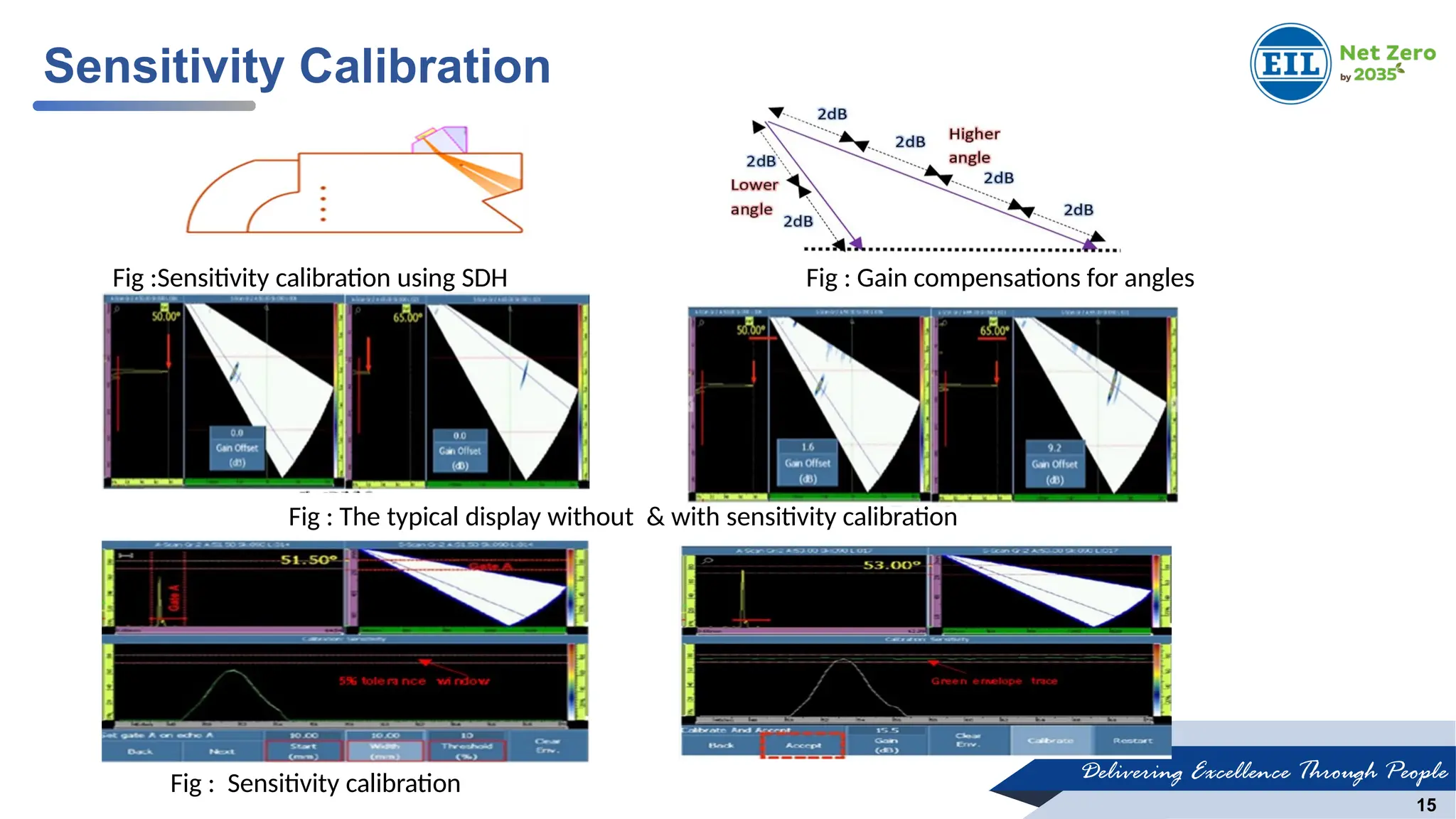
•Sensitivity calibration or focal law balancing or angle correct gain (ACG) is the process to establish appropriate
gain offset values for all individual focal law to achieve same amplitude level over a fixed target at required
depth.
•Sensitivity setting main purpose is to ensure a minimum or agreed-upon level of gain or “detection” to provide
the means for a repeatable inspection.
•Sensitivity calibrations equalize the sensitivity (amplitude) to a given reflector through all the angles (across all
beams).
•It’s a unique and essential feature of PAUT.
•This will insure no matter what angle the reflector is seen at the % FSH is the same for rejection or detection
purposes as well as for the amplitude based color coded imaging selections.
•Established by means of appropriate reference block notch, SDH or Radius
•In general, the reference amplitude is set to 80% FSH. Tolerance window value is not to exceed 5% which would
place the window from 75% to 85%.
•When using ultrasonic methods, the amplifier gain is not the only parameter that determines if a particular
flaw is detected or not
Delivering Excellence Through People
15
Sensitivity Calibration
Fig :Sensitivity calibration using SDH Fig : Gain compensations for angles
Fig : The typical display without & with sensitivity calibration
Fig : Sensitivity calibration
Delivering Excellence Through People
16
Constructing TCG for Referencing Sensitivity
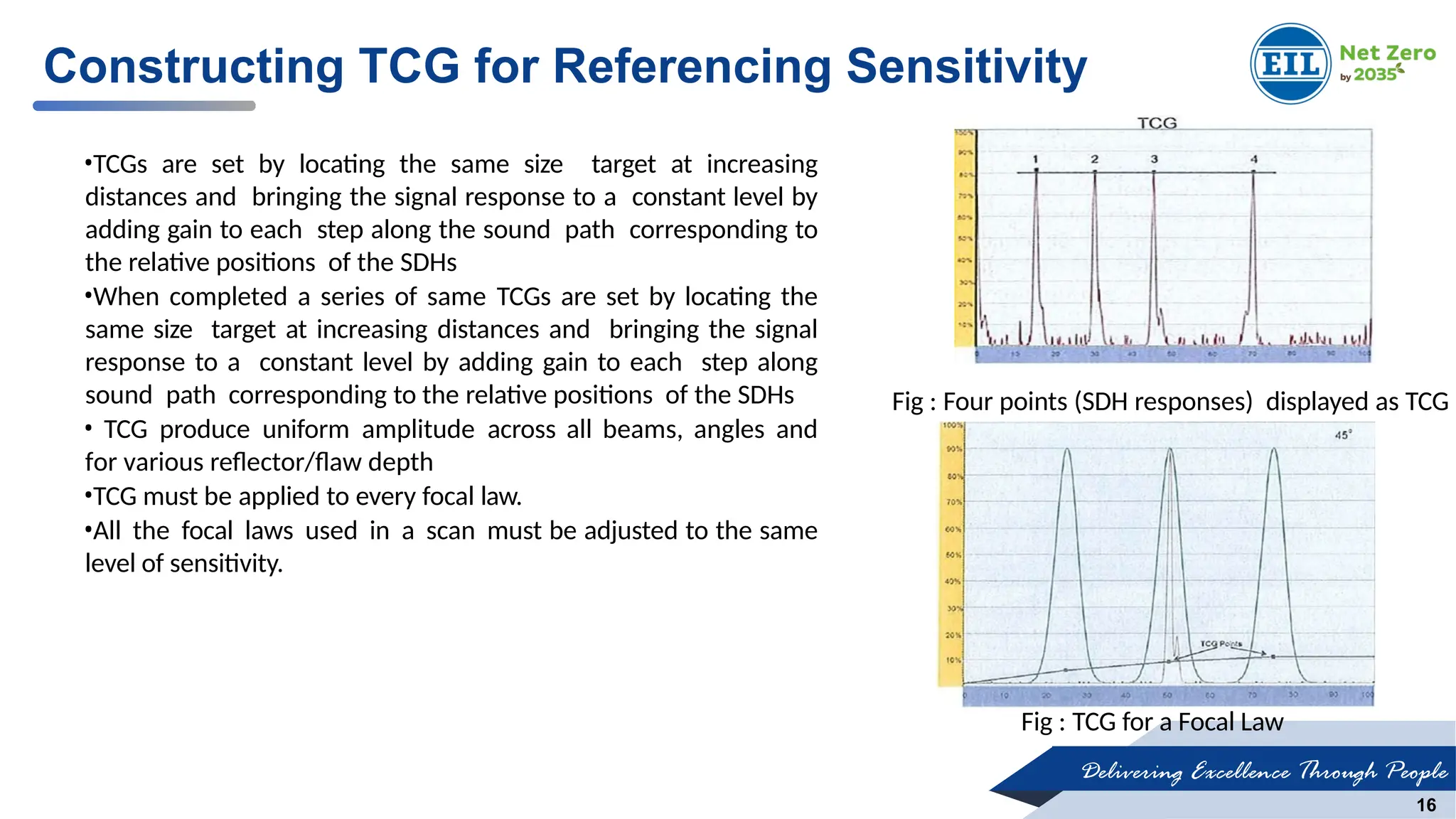
•TCGs are set by locating the same size target at increasing
distances and bringing the signal response to a constant level by
adding gain to each step along the sound path corresponding to
the relative positions of the SDHs
•When completed a series of same TCGs are set by locating the
same size target at increasing distances and bringing the signal
response to a constant level by adding gain to each step along
sound path corresponding to the relative positions of the SDHs
• TCG produce uniform amplitude across all beams, angles and
for various reflector/flaw depth
•TCG must be applied to every focal law.
•All the focal laws used in a scan must be adjusted to the same
level of sensitivity.
Fig : Four points (SDH responses) displayed as TCG
Fig : TCG for a Focal Law
Delivering Excellence Through People
17
Constructing TCG for Referencing Sensitivity
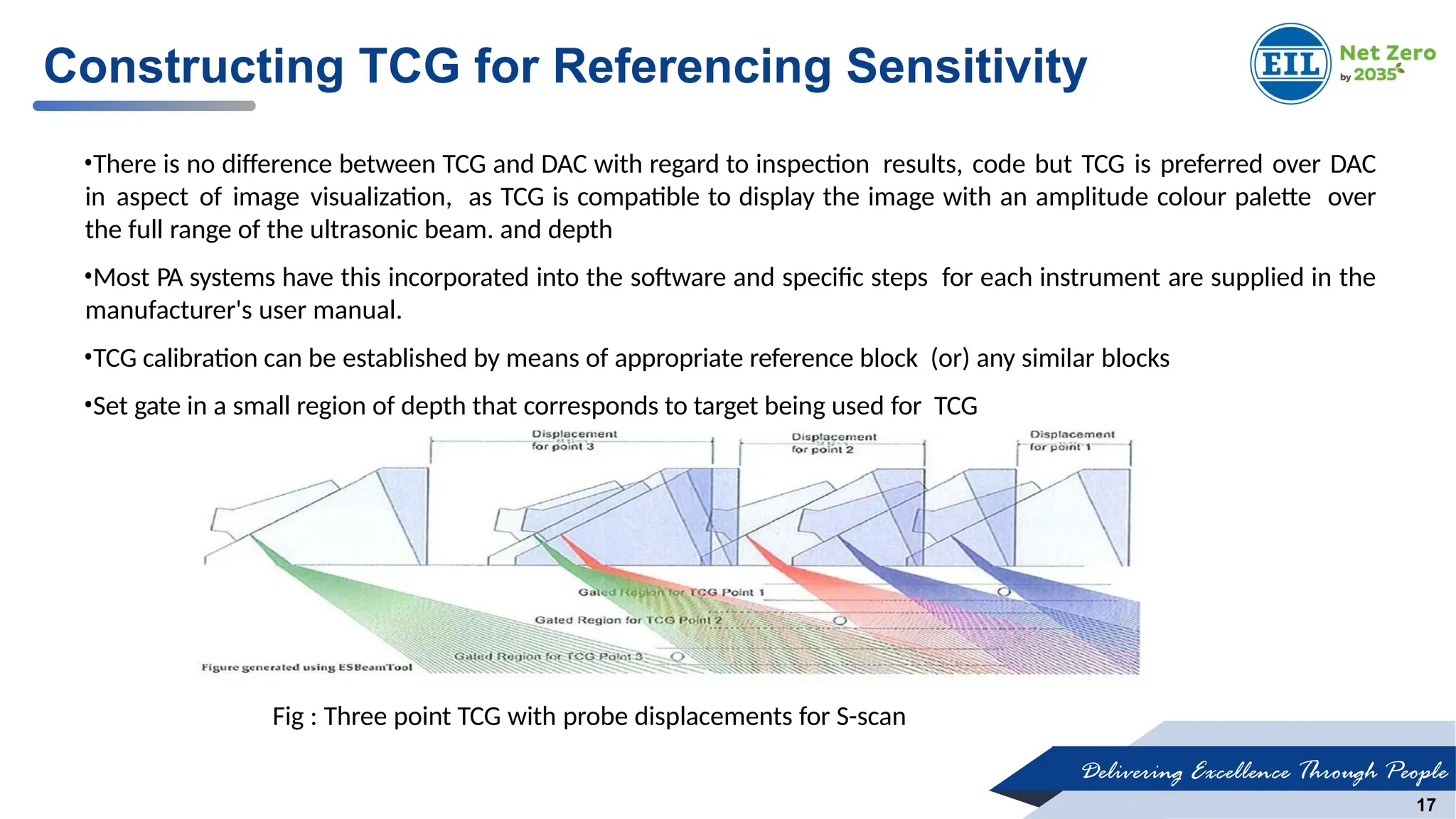
•There is no difference between TCG and DAC with regard to inspection results, code but TCG is preferred over DAC
in aspect of image visualization, as TCG is compatible to display the image with an amplitude colour palette over
the full range of the ultrasonic beam. and depth
•Most PA systems have this incorporated into the software and specific steps for each instrument are supplied in the
manufacturer's user manual.
•TCG calibration can be established by means of appropriate reference block (or) any similar blocks
•Set gate in a small region of depth that corresponds to target being used for TCG
Fig : Three point TCG with probe displacements for S-scan
Delivering Excellence Through People
18
Constructing TCG for Referencing Sensitivity
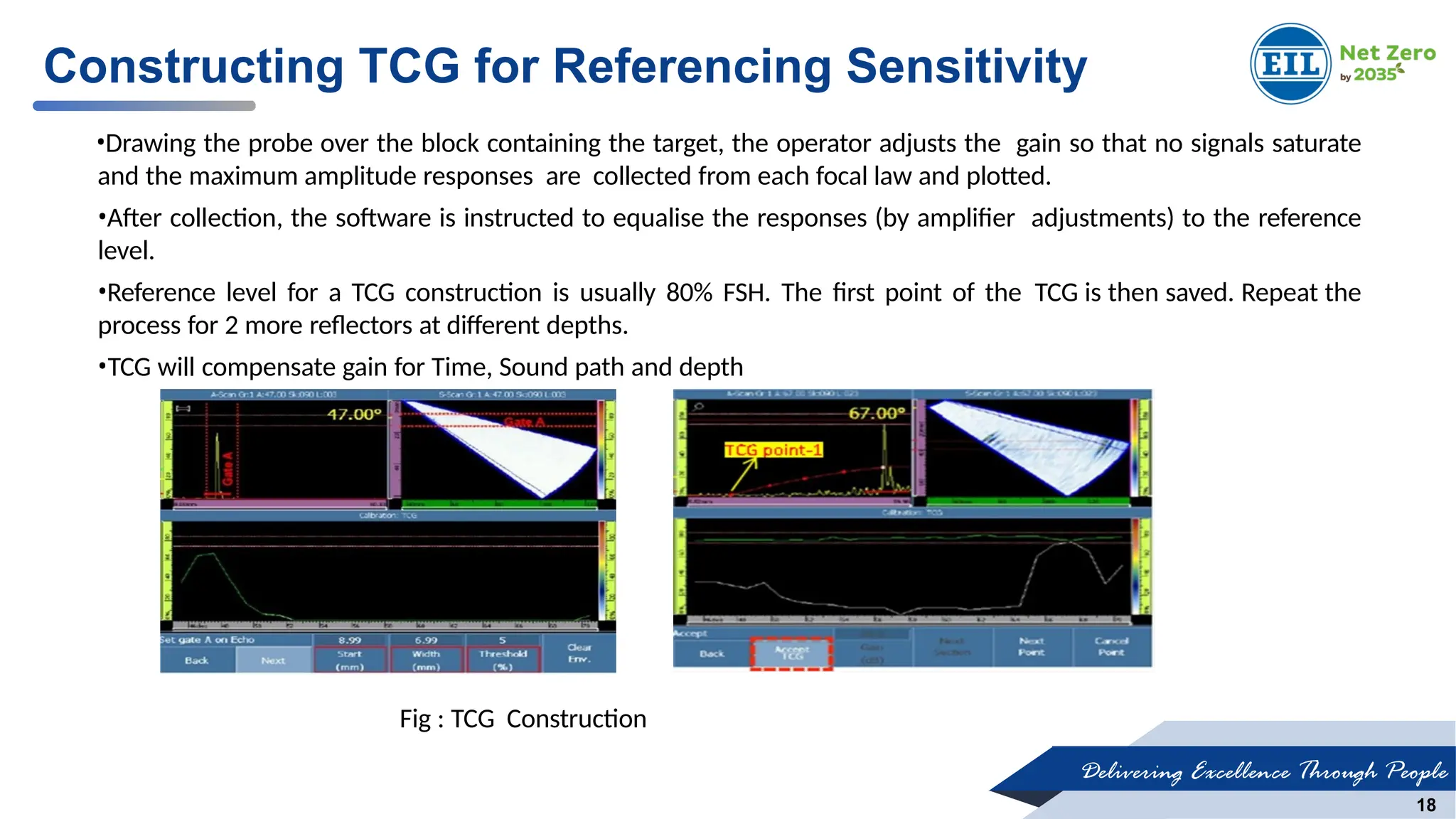
Fig : TCG Construction
•Drawing the probe over the block containing the target, the operator adjusts the gain so that no signals saturate
and the maximum amplitude responses are collected from each focal law and plotted.
•After collection, the software is instructed to equalise the responses (by amplifier adjustments) to the reference
level.
•Reference level for a TCG construction is usually 80% FSH. The first point of the TCG is then saved. Repeat the
process for 2 more reflectors at different depths.
•TCG will compensate gain for Time, Sound path and depth
Delivering Excellence Through People
19
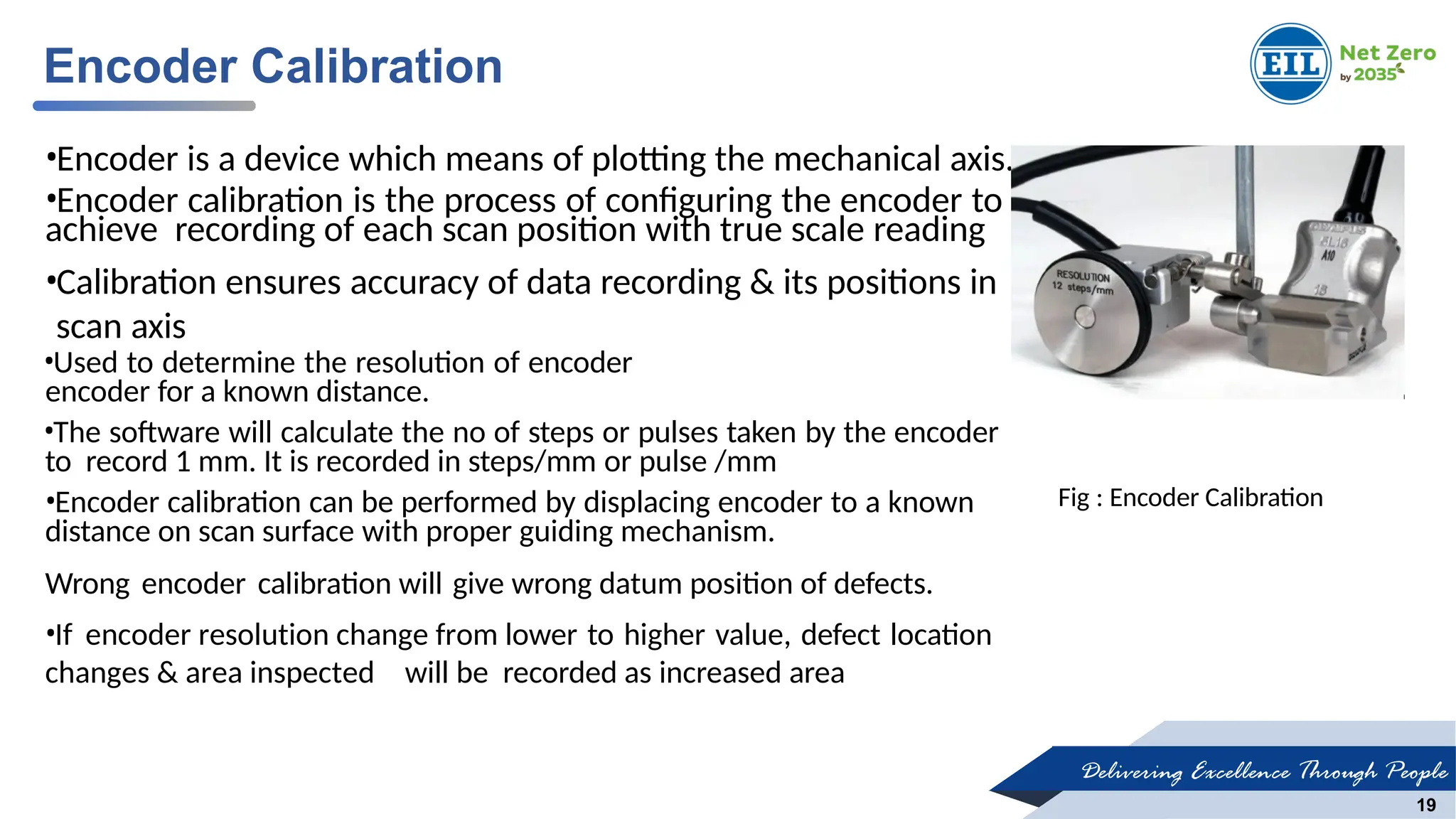
•Encoder is a device which means of plotting the mechanical axis.
•Encoder calibration is the process of configuring the encoder to
achieve recording of each scan position with true scale reading
•Calibration ensures accuracy of data recording & its positions in
scan axis
•Used to determine the resolution of encoder
encoder for a known distance.
•The software will calculate the no of steps or pulses taken by the encoder
to record 1 mm. It is recorded in steps/mm or pulse /mm
•Encoder calibration can be performed by displacing encoder to a known
distance on scan surface with proper guiding mechanism.
Wrong encoder calibration will give wrong datum position of defects.
•If encoder resolution change from lower to higher value, defect location
changes & area inspected will be recorded as increased area
Encoder Calibration
Fig : Encoder Calibration
Insert the Sub Title of Your Presentation
THANK YOU
Delivering Excellence Through People
20

Calibration of Phased array UT and TOFD (1).pptx

  • 1.
    Engineers India Limited DeliveringExcellence Through People July 23, 2022 BASICS CALIBRATION OF PAUT & TOFD Irshad Ahmad
  • 2.
    Delivering Excellence ThroughPeople 2 Selection of Parameters - calibration Velocity Calibration Wedge Delay Calibration Sensitivity Calibration Constructing TCG for Referencing Sensitivity Encoder Calibration Agenda
  • 3.
    Delivering Excellence ThroughPeople 3 •Phased array UT is most often primarily used for its speed & detectability but improperly applied will lead to lesser detectability than conventional UT. •When preparing a technique/ scan plan, important consideration to be taken care of: a) Coverage (Weld and HAZ area) b) Detectability with LOF •Much of the parameter selection is similar to the conventional UT. •Frequency selection is based on material , thickness and sensitivity needed. •In 30 degree weld bevel, 60 degree UT beam for LOF , 70 degree UT beam for root examination, 45 degree UT beam for OD and HAZ zone •BIA- Beam incident angle is related to ultrasound incident with respect to fusion zone. BIA shall be within 10 degree and better still if within 5 degrees. •To achieve correct BIA, one need to change from sectorial to linear, need to modify angles and need to scan with 2 offsets also. •Angle selection depends on volume coverage & sensitivity to defect orientation. •The best detection sensitivity of defect can be achieved, if beam angle is normal incidence (90° perpendicular) to the defect orientation •E-scan with 0° BIA variation covers less volume and provides best possibility to detect bevel defects. Beam Incident Angle
  • 4.
    Delivering Excellence ThroughPeople 4 Beam Incident Angle Fig : Beam incident angle- BIA •S-scan with ±5° BIA covers more volume, good detectability for bevel defects •S-scan with ±10° BIA covers wide volume and provides better possibility to detect non-aligned bevel defects but less possibility to detect bevel defects. •In line scan, ensure the probe positioning covers Root, fusion, Toe & HAZ Area. In some cases examine the weld with 2 different angles & probe positions!!! •Lower range of angles (say, 40° - 50°) is optimal to cover the surface region •If once side access, the detectability to fusion defects on the opposite side to probe position is lesser and in thicker materials you may miss. •If accessibility is not available, ground flush the weld for good detectability. •Of course radiography too has limitation with fusion defects!!!
  • 5.
    Delivering Excellence ThroughPeople 5 Table : Essential parameters to consider in technique development Parameter Phased Array Single Element Angles Single or a range of angles is available Only one angle per probe Apertures Variable in active direction fixed in passive A single probe size is selected Frequencies A single frequency per probe A single frequency per probe Display S-scan/E-scan (others) Only, A-scan unless mechanized (but never S-scan) Manual or Mechanized May be either May be either Part geometry and material Limitations and obstructions to consider Limitations and obstructions to consider Grain structure effects Grain structure effects Surfaces Surface conditions and surface access Surface conditions and surface access Couplant Brand or type immersion?) Brand or type immersion?) Instrument make Simple or complex (just linear arrays or is a 2D matrix required) Single channel, but may require special features if addressing a custom probe (e.g. very high or low frequency pulser and receiver aspects) Any timing or voltage limitations? Scan-plan Direction and extent of scanning and scan patterns that can be used Direction and extent of scanning Focusing Plane, and distance of focal region A single point or line is possible Data recording Generally full waveform storage Generally, rely on operator recording Essential Parameters In Technique Design
  • 6.
    Delivering Excellence ThroughPeople 6 Essential Parameters In Technique Design Probe Number of elements Element width (height) Element length Kerf (gap) Element pitch Nominal frequency Wedge Material Wedge material velocity Incident angle Height of ref. element over test piece Instrument Make/model Pulser voltage (volts) Pulse voltage shape Pulse duration Receiver frequency settings Processing settings (smoothing, compressor, averaging) Beam-setups Scan type (Fixed, E-scan, S-scan) Number of elements in focal law Start element Step increment (angle or elements) Test mechanics Immersion or contact Scan type (manual/mechanized/ motorized) Scanning pattern (line, raster, helical) Materials Test piece material (and velocities) Couplant Geometry (thickness, shape) Scan surface Reference Reference blocks and targets
  • 7.
    Delivering Excellence ThroughPeople 7 • Calibration Block is piece of material with standardized dimension by means of which assessment and calibration of combined PA system can be performed. • Standard calibration block is specified with well-defined parameters that includes material composition, surface finish, heat treatment , geometric form. • Standard calibration block such as ISO 2400 (IIW V1) block, IIW type 2 block and PA type A block , PA block as per ISO19675 are used in phased array. Calibration Blocks Fig : Type 1- & Type 2- V1/A2 , PA type A Block, PA block as per ISO19675
  • 8.
    Delivering Excellence ThroughPeople 8 Reference Block Fig : Recommended reference block for testing level C
  • 9.
    Delivering Excellence ThroughPeople 9 •Made with similar material (with regard to sound velocity, grain structure and surface condition) and shall consist of well-defined reference reflectors. •The length and width of the reference block is chosen such that all the reference reflectors can be properly scanned. •In general SDH, Notch and FBH are used as typical reference reflector. •The reference block, its length, width, depth of notches and length, depth , diameter of SDH are selected according to the testing level required for the phased array inspection as per codes and standards. Calibrations The following Calibration process sequence involved in inspection setting. 1. Velocity calibration 2. Wedge delay calibration 3. Amplitude balancing (sensitivity calibration) 4. Time corrected gain [TCG] 5. Encoder calibration Reference Block
  • 10.
    Delivering Excellence ThroughPeople 10 •It is the process to determine the optimum velocity value of the test object •This calibration will fine tune the velocity to that of the calibration block. It will require two reflectors of the same size at two different known range or depths •Unfortunately, most of the standard blocks are only fabricated from a standards- specified material. But not all steels tested in NDT are same grade. •So even using the standard calibration block, the velocity used for the focal laws may not match the actual material tested. •Calibration block with two radii is available. The Type-1 & Type -2 IIW block Velocity Calibration Fig : Type -2 IIW block with two radii Fig : Two radii test block
  • 11.
    Delivering Excellence ThroughPeople 11 • Wedge delay will enter compensation for the travel of the beams through the wedge medium and account for the various exit point. • As with the material velocity, the wedge velocity also plays an important role in focal law calculations and display of the image of flaws in a test piece. • The total time in the wedge is required so that the display of the image can correctly determine the entry point of the beam (zero depth in test material). • Assuming the wedge velocity is known (by the manufacturer or on the wedge) and the test piece velocity has been accurately determined, the time in the wedge for a beam can be calculated from simple trigonometry. Wedge Delay Determinations Wedge path No Distanc e (mm) Time in wedge (µs) Total time to SDH signal (µs) 1 23.35 19.95 38.71 2 24.25 20.72 39.47 3 25.15 21.49 40.24 4 26.05 22.26 41.01 5 26.95 23.03 41.78 6 27.85 23.80 42.55 7 28.75 24.57 43.32 Fig :Determining Wedge Delay Fig : Wedge delay for 7 – 60 degree Focal Law
  • 12.
    Delivering Excellence ThroughPeople 12 Wedge Delay Determinations •But manual calculations is cumbersome, software do those calculations. •wizard establishes the beam delay values for all individual focal law involved in scan plan by means of standard calibration block, provided test object material is similar to the standard block material. • As the probe is moved across the block such that the response from the SDH peaks under each focal law the instrument will be a noting signal at increasing times, as the probe is moved from right to left. •This is because, when moving from the right to the left, the first beam interacting with the SDH is the one made with the lowest element as the start element, so it has the shortest travel in the wedge. •The wedge path distance increases as the beams farther up the probe interact with the beam. •A PAUT system could be set up to provide the assumed delays by simply making calculations from the design drawings of the wedge. •But some wedges are custom-made and some wedges that are off-the-shelf may have some wear so that the original dimensions are no longer accurate.
  • 13.
    Delivering Excellence ThroughPeople 13 •Most PA systems have a built-in programme that determines the delays based on the sound path to a target of a known depth. •When you select wrong wedge in the software, test data might be incorrect, re-calibrate with correct wedge and rescan. Wedge Delay Determinations Fig : Wedge delay calibration for all focal laws
  • 14.
    Delivering Excellence ThroughPeople 14 Sensitivity Calibration •Sensitivity calibration or focal law balancing or angle correct gain (ACG) is the process to establish appropriate gain offset values for all individual focal law to achieve same amplitude level over a fixed target at required depth. •Sensitivity setting main purpose is to ensure a minimum or agreed-upon level of gain or “detection” to provide the means for a repeatable inspection. •Sensitivity calibrations equalize the sensitivity (amplitude) to a given reflector through all the angles (across all beams). •It’s a unique and essential feature of PAUT. •This will insure no matter what angle the reflector is seen at the % FSH is the same for rejection or detection purposes as well as for the amplitude based color coded imaging selections. •Established by means of appropriate reference block notch, SDH or Radius •In general, the reference amplitude is set to 80% FSH. Tolerance window value is not to exceed 5% which would place the window from 75% to 85%. •When using ultrasonic methods, the amplifier gain is not the only parameter that determines if a particular flaw is detected or not
  • 15.
    Delivering Excellence ThroughPeople 15 Sensitivity Calibration Fig :Sensitivity calibration using SDH Fig : Gain compensations for angles Fig : The typical display without & with sensitivity calibration Fig : Sensitivity calibration
  • 16.
    Delivering Excellence ThroughPeople 16 Constructing TCG for Referencing Sensitivity •TCGs are set by locating the same size target at increasing distances and bringing the signal response to a constant level by adding gain to each step along the sound path corresponding to the relative positions of the SDHs •When completed a series of same TCGs are set by locating the same size target at increasing distances and bringing the signal response to a constant level by adding gain to each step along sound path corresponding to the relative positions of the SDHs • TCG produce uniform amplitude across all beams, angles and for various reflector/flaw depth •TCG must be applied to every focal law. •All the focal laws used in a scan must be adjusted to the same level of sensitivity. Fig : Four points (SDH responses) displayed as TCG Fig : TCG for a Focal Law
  • 17.
    Delivering Excellence ThroughPeople 17 Constructing TCG for Referencing Sensitivity •There is no difference between TCG and DAC with regard to inspection results, code but TCG is preferred over DAC in aspect of image visualization, as TCG is compatible to display the image with an amplitude colour palette over the full range of the ultrasonic beam. and depth •Most PA systems have this incorporated into the software and specific steps for each instrument are supplied in the manufacturer's user manual. •TCG calibration can be established by means of appropriate reference block (or) any similar blocks •Set gate in a small region of depth that corresponds to target being used for TCG Fig : Three point TCG with probe displacements for S-scan
  • 18.
    Delivering Excellence ThroughPeople 18 Constructing TCG for Referencing Sensitivity Fig : TCG Construction •Drawing the probe over the block containing the target, the operator adjusts the gain so that no signals saturate and the maximum amplitude responses are collected from each focal law and plotted. •After collection, the software is instructed to equalise the responses (by amplifier adjustments) to the reference level. •Reference level for a TCG construction is usually 80% FSH. The first point of the TCG is then saved. Repeat the process for 2 more reflectors at different depths. •TCG will compensate gain for Time, Sound path and depth
  • 19.
    Delivering Excellence ThroughPeople 19 •Encoder is a device which means of plotting the mechanical axis. •Encoder calibration is the process of configuring the encoder to achieve recording of each scan position with true scale reading •Calibration ensures accuracy of data recording & its positions in scan axis •Used to determine the resolution of encoder encoder for a known distance. •The software will calculate the no of steps or pulses taken by the encoder to record 1 mm. It is recorded in steps/mm or pulse /mm •Encoder calibration can be performed by displacing encoder to a known distance on scan surface with proper guiding mechanism. Wrong encoder calibration will give wrong datum position of defects. •If encoder resolution change from lower to higher value, defect location changes & area inspected will be recorded as increased area Encoder Calibration Fig : Encoder Calibration
  • 20.
    Insert the SubTitle of Your Presentation THANK YOU Delivering Excellence Through People 20

Editor's Notes

  • #1 NOTE: To change the image on this slide, select the picture and delete it. Then click the Pictures icon in the placeholder to insert your own image.