SSD Industry Marketing | Thomas Sauer
Hamburg, 16.10. 2018
Coating Thickness
Test with
Portable XRF
Agenda
Coating Thickness Test with portable XRF – TS2 08/11/2018
1 Coatings – overview
2 Short Introduction in XRF
3 Range of Applications for the Vanta Coating App
4 3 Steps to create a Coating Template
5 Some Examples
6 Summary
Agenda
Coating Thickness Test with portable XRF – TS3 08/11/2018
1 Coatings – overview
2 Short Introduction in XRF
3 Range of Applications for the Vanta Coating App
4 3 Steps to create a Coating Template
5 Some Examples
6 Summary
08/11/2018 Coating Thickness Test with portable XRF – TS4
COATING - Overview
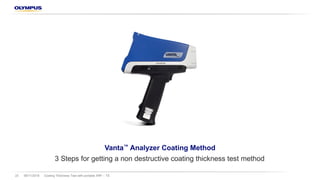
A COATING IS A COVERING APPLIED TO A SURFACE OF A
„SUBSTRATE“.
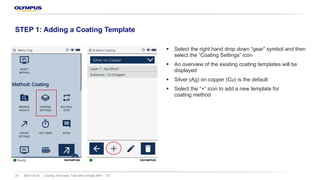
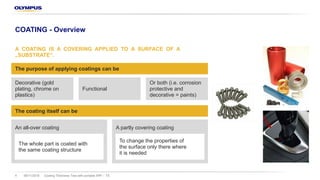
The purpose of applying coatings can be
Decorative (gold
plating, chrome on
plastics)
Functional
Or both (i.e. corrosion
protective and
decorative = paints)
The coating itself can be
An all-over coating A partly covering coating
The whole part is coated with
the same coating structure
To change the properties of
the surface only there where
it is needed
08/11/2018 Coating Thickness Test with portable XRF – TS5
COATING - Overview
METAL BASED SURFACE LAYER, PAINTS AND LACQUERS ARE
COATINGS FOR DUAL USES:
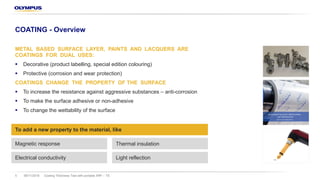
§ Decorative (product labelling, special edition colouring)
§ Protective (corrosion and wear protection)
COATINGS CHANGE THE PROPERTY OF THE SURFACE
§ To increase the resistance against aggressive substances – anti-corrosion
§ To make the surface adhesive or non-adhesive
§ To change the wettability of the surface
Magnetic response Thermal insulation
To add a new property to the material, like
Electrical conductivity Light reflection
08/11/2018 Coating Thickness Test with portable XRF – TS6
COATING - Overview
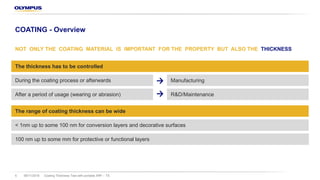
NOT ONLY THE COATING MATERIAL IS IMPORTANT FOR THE PROPERTY BUT ALSO THE THICKNESS
During the coating process or afterwards Manufacturing
The thickness has to be controlled
After a period of usage (wearing or abrasion) R&D/Maintenance
< 1nm up to some 100 nm for conversion layers and decorative surfaces
The range of coating thickness can be wide
100 nm up to some mm for protective or functional layers
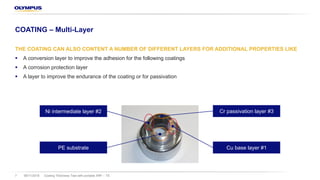
Cu base layer #1
Cr passivation layer #3
08/11/2018 Coating Thickness Test with portable XRF – TS7
COATING – Multi-Layer
THE COATING CAN ALSO CONTENT A NUMBER OF DIFFERENT LAYERS FOR ADDITIONAL PROPERTIES LIKE
§ A conversion layer to improve the adhesion for the following coatings
§ A corrosion protection layer
§ A layer to improve the endurance of the coating or for passivation
PE substrate
Ni intermediate layer #2
Agenda
Coating Thickness Test with portable XRF – TS8 08/11/2018
1 Coatings – overview
2 Short Introduction in XRF
3 Range of Applications for the Vanta Coating App
4 3 Steps to create a Coating Template
5 Some Examples
6 Summary
08/11/2018 Coating Thickness Test with portable XRF – TS9
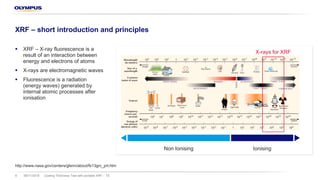
XRF – short introduction and principles
§ XRF – X-ray fluorescence is a
result of an interaction between
energy and electrons of atoms
§ X-rays are electromagnetic waves
§ Fluorescence is a radiation
(energy waves) generated by
internal atomic processes after
ionisation
http://www.nasa.gov/centers/glenn/about/fs13grc_prt.htm
Non Ionising Ionising
X-rays for XRF
08/11/2018 Coating Thickness Test with portable XRF – TS10
XRF – short introduction and principles
§ Every element has a unique and known X-ray
fluorescence
§ The detector and the AXON electronics can acquire
radiation from up to 40 elements from Mg to Pu,
simultaneously
Ni
Fe
Cr
Mo
Energy [keV]
Counts[cps]
08/11/2018 Coating Thickness Test with portable XRF – TS11
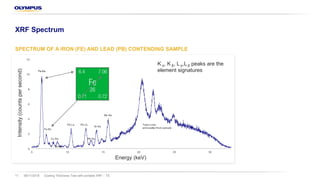
XRF Spectrum
0
2
4
6
8
10
12
5 10 15 20 25 30
Fe Ka
Fe Kb
Cu Ka
Zn Kb
Tube Lines
and scatter from sample
Pb La Pb Lb
Rb Ka
Sr Ka
Mo Ka
Energy (keV)
Intensity(countspersecond)
SPECTRUM OF A IRON (FE) AND LEAD (PB) CONTENDING SAMPLE
K α, K β, Lα,Lβ peaks are the
element signatures
08/11/2018 Coating Thickness Test with portable XRF – TS12
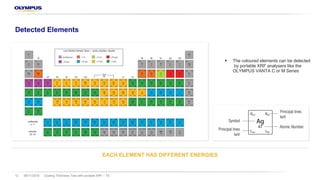
Detected Elements
EACH ELEMENT HAS DIFFERENT ENERGIES
§ The coloured elements can be detected
by portable XRF analysers like the
OLYMPUS VANTA C or M Series
Agenda
Coating Thickness Test with portable XRF – TS13 08/11/2018
1 Coatings – overview
2 Short Introduction in XRF
3 Applications for the Vanta Coating App in the Automotive Industry
4 3 Steps to create a Coating Template
5 Some Examples
6 Summary
08/11/2018 Coating Thickness Test with portable XRF – TS14
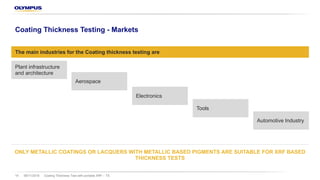
Coating Thickness Testing - Markets
The main industries for the Coating thickness testing are
ONLY METALLIC COATINGS OR LACQUERS WITH METALLIC BASED PIGMENTS ARE SUITABLE FOR XRF BASED
THICKNESS TESTS
Plant infrastructure
and architecture
Automotive Industry
Electronics
Tools
Aerospace
08/11/2018 Coating Thickness Test with portable XRF – TS15
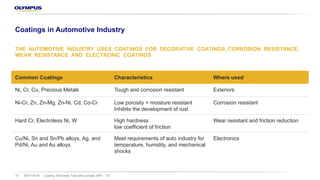
Coatings in Automotive Industry
THE AUTOMOTIVE INDUSTRY USES COATINGS FOR DECORATIVE COATINGS, CORROSION RESISTANCE,
WEAR RESISTANCE AND ELECTRONIC COATINGS
Common Coatings Characteristics Where used
Ni, Cr, Cu, Precious Metals Tough and corrosion resistant Exteriors
Ni-Cr, Zn, Zn-Mg, Zn-Ni, Cd, Co-Cr Low porosity = moisture resistant
Inhibits the development of rust
Corrosion resistant
Hard Cr, Electroless Ni, W High hardness
low coefficient of friction
Wear resistant and friction reduction
Cu/Ni, Sn and Sn/Pb alloys, Ag, and
Pd/Ni, Au and Au alloys
Meet requirements of auto industry for
temperature, humidity, and mechanical
shocks
Electronics
08/11/2018 Coating Thickness Test with portable XRF – TS16
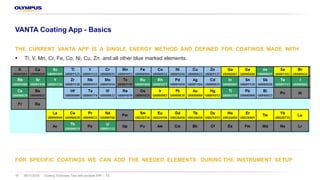
VANTA Coating App - Basics
THE CURRENT VANTA APP IS A SINGLE ENERGY METHOD AND DEFINED FOR COATINGS MADE WITH
§ Ti, V, Mn, Cr, Fe, Co, Ni, Cu, Zn and all other blue marked elements.
FOR SPECIFIC COATINGS WE CAN ADD THE NEEDED ELEMENTS DURING THE INSTRUMENT SETUP
08/11/2018 Coating Thickness Test with portable XRF – TS17
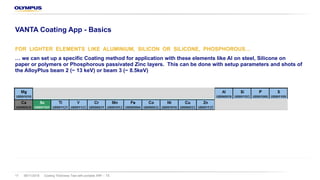
VANTA Coating App - Basics
FOR LIGHTER ELEMENTS LIKE ALUMINIUM, SILICON OR SILICONE, PHOSPHOROUS…
… we can set up a specific Coating method for application with these elements like Al on steel, Silicone on
paper or polymers or Phosphorous passivated Zinc layers. This can be done with setup parameters and shots of
the AlloyPlus beam 2 (~ 13 keV) or beam 3 (~ 8.5keV)
08/11/2018 Coating Thickness Test with portable XRF – TS18
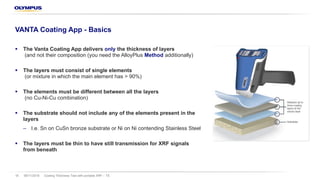
VANTA Coating App - Basics
§ The Vanta Coating App delivers only the thickness of layers
(and not their composition (you need the AlloyPlus Method additionally)
§ The layers must consist of single elements
(or mixture in which the main element has > 90%)
§ The elements must be different between all the layers
(no Cu-Ni-Cu combination)
§ The substrate should not include any of the elements present in the
layers
‒ I.e. Sn on CuSn bronze substrate or Ni on Ni contending Stainless Steel
§ The layers must be thin to have still transmission for XRF signals
from beneath
08/11/2018 Coating Thickness Test with portable XRF – TS19
XRF for Coating Thickness Testing - Basics
§ As heavier the elements used in the coating layers are as lower the penetration depth and with that the range of
measurable thicknesses are
§ The mass attenuation factor of each elemental layer has an strong impact of the detectable thickness for the layers
closer to the substrate
MASS ATTENUATION COEFFICIENT OF DIFFERENT ELEMENTS
0.1
1
10
100
1000
10000
100000
0 10 20 30 40 50 60
µMassattenuation
Energy [keV]
08/11/2018 Coating Thickness Test with portable XRF – TS20
XRF for Coating Thickness Testing - Basics
§ The composition of the substrate and the layer structure (elements, order and thickness of the layers) have an
impact to the results
§ It is necessary to create for every combination a specific coating model to achieve the best performance
§ If a layer consists of a multi element alloy (Zn-Ni, Al-Cu-Pb) one of them can be used as a leading element for
the thickness if the composition stays constant. For different compositions different models are needed
§ To get the composition of a single coating layer made of an alloy or element combination
like Zn-Ni it is necessary to work with a specific adjusted Alloy analysis method
‒ Therefore we can use a User factor set with only the elements of interest getting a factor of 1 and all the other
elements a factor of 0
08/11/2018 Coating Thickness Test with portable XRF – TS21
XRF for Coating Thickness Testing – Detection range
The measurable thickness range with XRF starts at ~ 5 nm and ends at ~ 20 – 45 µm depending on the elements
used in the coating and their XRF emission energies
Element Energy-line Max. Thickness [µm] Element Energy-line Max. Thickness [µm]
Titanium (Ti) Ka 20 Copper (Cu) Ka 30
Vanadium (V) Ka 20 Zinc (Zn) Ka 30
Chrome (Cr) Ka 25 Tantalum (Ta) Lß 30
Mangnese (Mn) Ka 25 Tungsten (W) Lß 30
Iron (Fe) Ka 25 Lead (Pb) Lß 35
Cobalt (Co) Ka 30 Bismuth (Bi) Lß 35
Nickel (Ni) Ka 30 Molybdenum (Mo) Ka 40
Agenda
Coating Thickness Test with portable XRF – TS22 08/11/2018
1 Coatings – overview
2 Short Introduction in XRF
3 Range of Applications for the Vanta Coating App
4 3 Steps to create a Coating Template
5 Some Examples
6 Summary
08/11/2018 Coating Thickness Test with portable XRF – TS23
Vanta™ Analyzer Coating Method
3 Steps for getting a non destructive coating thickness test method
§ Coating method offers a one point calibration
‒ Similar to user factors
‒ Tune calibration to a customer’s sample
§ Coating will display
‒ Thickness [µm, µinch] or Loading [mg/cm², g/m²]
§ Coating will not display
‒ Chemistry
08/11/2018 Coating Thickness Test with portable XRF – TS24
Overview
§ Select the right hand drop down “gear” symbol and then
select the “Coating Settings” icon
§ An overview of the existing coating templates will be
displayed
§ Silver (Ag) on copper (Cu) is the default
§ Select the “+” icon to add a new template for
coating method
08/11/2018 Coating Thickness Test with portable XRF – TS25
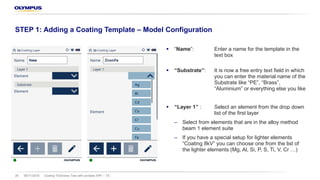
STEP 1: Adding a Coating Template
§ “Name”: Enter a name for the template in the
text box
§ “Substrate”: It is now a free entry text field in which
you can enter the material name of the
Substrate like “PE”, “Brass”,
“Aluminium” or everything else you like
§ “Layer 1” : Select an element from the drop down
list of the first layer
‒ Select from elements that are in the alloy method
beam 1 element suite
‒ If you have a special setup for lighter elements
“Coating 8kV” you can choose one from the list of
the lighter elements (Mg, Al, Si, P, S, Ti, V, Cr …)
08/11/2018 Coating Thickness Test with portable XRF – TS26
STEP 1: Adding a Coating Template – Model Configuration
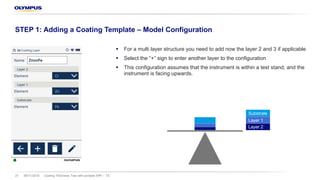
§ For a multi layer structure you need to add now the layer 2 and 3 if applicable
§ Select the “+” sign to enter another layer to the configuration
§ This configuration assumes that the instrument is within a test stand, and the
instrument is facing upwards.
08/11/2018 Coating Thickness Test with portable XRF – TS27
STEP 1: Adding a Coating Template – Model Configuration
Layer 2
Layer 1
Substrate
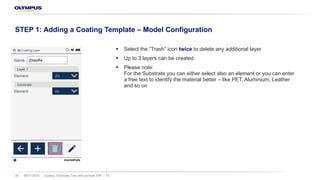
§ Select the “Trash” icon twice to delete any additional layer
§ Up to 3 layers can be created
§ Please note:
For the Substrate you can either select also an element or you can enter
a free text to identify the material better – like PET, Aluminium, Leather
and so on
08/11/2018 Coating Thickness Test with portable XRF – TS28
STEP 1: Adding a Coating Template – Model Configuration
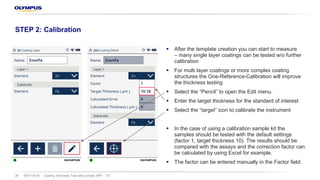
§ After the template creation you can start to measure
– many single layer coatings can be tested w/o further
calibration
§ For multi layer coatings or more complex coating
structures the One-Reference-Calibration will improve
the thickness testing
§ Select the “Pencil” to open the Edit menu.
§ Enter the target thickness for the standard of interest
§ Select the “target” icon to calibrate the instrument
§ In the case of using a calibration sample kit the
samples should be tested with the default settings
(factor 1, target thickness 10). The results should be
compared with the assays and the correction factor can
be calculated by using Excel for example.
§ The factor can be entered manually in the Factor field.
08/11/2018 Coating Thickness Test with portable XRF – TS29
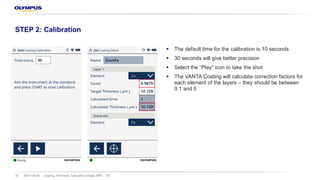
STEP 2: Calibration
§ The default time for the calibration is 10 seconds
§ 30 seconds will give better precision
§ Select the “Play” icon to take the shot
§ The VANTA Coating will calculate correction factors for
each element of the layers – they should be between
0.1 and 5
08/11/2018 Coating Thickness Test with portable XRF – TS30
STEP 2: Calibration
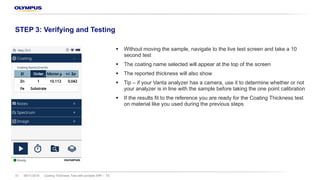
§ Without moving the sample, navigate to the live test screen and take a 10
second test
§ The coating name selected will appear at the top of the screen
§ The reported thickness will also show
§ Tip – if your Vanta analyzer has a camera, use it to determine whether or not
your analyzer is in line with the sample before taking the one point calibration
§ If the results fit to the reference you are ready for the Coating Thickness test
on material like you used during the previous steps
08/11/2018 Coating Thickness Test with portable XRF – TS31
STEP 3: Verifying and Testing
Agenda
Coating Thickness Test with portable XRF – TS32 08/11/2018
1 Coatings – overview
2 Short Introduction in XRF
3 Range of Applications for the Vanta Coating App
4 3 Steps to create a Coating Template
5 Some Examples
6 Summary
§ Example: Cu-Ni coated Cr-steel ring (1 – 1.5µm each)
with differences in the coating layer thickness
§ 16 segments tested (each 10 sec) instead of cutting out
a piece for testing with microscope
11/8/18 Coating Thickness Test with portable XRF – TS33
Non-destructive Coating Thickness Testing saves time
Segment Layer 1 – Cu [µm] Layer 2 – Ni [µm]
1 1,129 1,237
2 1,296 1,283
3 1,25 1,21
4 1,404 1,313
5 1,508 1,404
6 1,523 1,454
7 1,424 1,484
8 1,199 1,458
9 1,028 1,343
10 1,186 1,579
11 0,894 1,384
12 0,888 1,439
13 0,991 1,608
14 0,985 1,559
15 0,920 1,346
16 1,043 1,441
08/11/2018 Coating Thickness Test with portable XRF – TS34
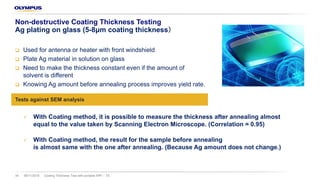
Non-destructive Coating Thickness Testing
Ag plating on glass (5-8μm coating thickness
q Used for antenna or heater with front windshield
q Plate Ag material in solution on glass
q Need to make the thickness constant even if the amount of
solvent is different
q Knowing Ag amount before annealing process improves yield rate.
Tests against SEM analysis
ü With Coating method, it is possible to measure the thickness after annealing almost
equal to the value taken by Scanning Electron Microscope. (Correlation = 0.95)
ü With Coating method, the result for the sample before annealing
is almost same with the one after annealing. (Because Ag amount does not change.)
08/11/2018 Coating Thickness Test with portable XRF – TS35
Non-destructive Coating Thickness Testing
Busbar Technology
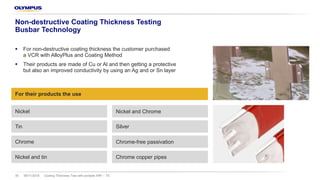
§ For non-destructive coating thickness the customer purchased
a VCR with AlloyPlus and Coating Method
§ Their products are made of Cu or Al and then getting a protective
but also an improved conductivity by using an Ag and or Sn layer
For their products the use
Nickel Nickel and Chrome
Tin Silver
Chrome Chrome-free passivation
Nickel and tin Chrome copper pipes
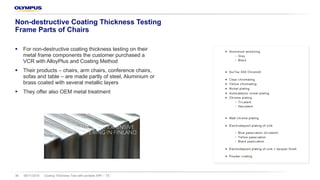
§ For non-destructive coating thickness testing on their
metal frame components the customer purchased a
VCR with AlloyPlus and Coating Method
§ Their products – chairs, arm chairs, conference chairs,
sofas and table – are made partly of steel, Aluminium or
brass coated with several metallic layers
§ They offer also OEM metal treatment
08/11/2018 Coating Thickness Test with portable XRF – TS36
Non-destructive Coating Thickness Testing
Frame Parts of Chairs
Agenda
Coating Thickness Test with portable XRF – TS37 08/11/2018
1 Coatings – overview
2 Short Introduction in XRF
3 Range of Applications for the Vanta Coating App
4 3 Steps to create a Coating Template
5 Some Examples
6 Summary
08/11/2018 Coating Thickness Test with portable XRF – TS38
Summary
VANTA Portable XRF can be used easily for on-site coating thickness tests
Various coating templates can be created on one instrument in three simple steps
The detectable elements of the coating structure must belong to the group of metals or metal contending materials
Multiple layer coating systems (3 layers max) can be tested in few seconds with a minimum of work for calibration
on wide range of materials
The VANTA with it’s strong performance delivers reliable results in less than 10 seconds
Thomas Sauer
Senior Product & Application Specialist
XRF OEKG
Thank you for
your attention
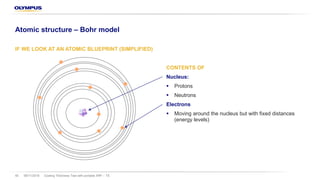
IF WE LOOK AT AN ATOMIC BLUEPRINT (SIMPLIFIED)
CONTENTS OF
Nucleus:
§ Protons
§ Neutrons
Electrons
§ Moving around the nucleus but with fixed distances
(energy levels)
08/11/2018 Coating Thickness Test with portable XRF – TS40
Atomic structure – Bohr model
08/11/2018 Coating Thickness Test with portable XRF – TS41
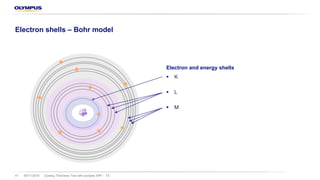
Electron and energy shells
§ K
§ L
§ M
Electron shells – Bohr model
08/11/2018 Coating Thickness Test with portable XRF – TS42
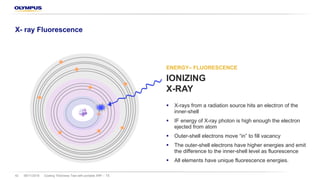
§ X-rays from a radiation source hits an electron of the
inner-shell
§ IF energy of X-ray photon is high enough the electron
ejected from atom
§ Outer-shell electrons move “in” to fill vacancy
§ The outer-shell electrons have higher energies and emit
the difference to the inner-shell level as fluorescence
§ All elements have unique fluorescence energies.
ENERGY– FLUORESCENCE
X- ray Fluorescence

Coating Thickness Test with Portable XRF

  • 1.
    SSD Industry Marketing| Thomas Sauer Hamburg, 16.10. 2018 Coating Thickness Test with Portable XRF
  • 2.
    Agenda Coating Thickness Testwith portable XRF – TS2 08/11/2018 1 Coatings – overview 2 Short Introduction in XRF 3 Range of Applications for the Vanta Coating App 4 3 Steps to create a Coating Template 5 Some Examples 6 Summary
  • 3.
    Agenda Coating Thickness Testwith portable XRF – TS3 08/11/2018 1 Coatings – overview 2 Short Introduction in XRF 3 Range of Applications for the Vanta Coating App 4 3 Steps to create a Coating Template 5 Some Examples 6 Summary
  • 4.
    08/11/2018 Coating ThicknessTest with portable XRF – TS4 COATING - Overview A COATING IS A COVERING APPLIED TO A SURFACE OF A „SUBSTRATE“. The purpose of applying coatings can be Decorative (gold plating, chrome on plastics) Functional Or both (i.e. corrosion protective and decorative = paints) The coating itself can be An all-over coating A partly covering coating The whole part is coated with the same coating structure To change the properties of the surface only there where it is needed
  • 5.
    08/11/2018 Coating ThicknessTest with portable XRF – TS5 COATING - Overview METAL BASED SURFACE LAYER, PAINTS AND LACQUERS ARE COATINGS FOR DUAL USES: § Decorative (product labelling, special edition colouring) § Protective (corrosion and wear protection) COATINGS CHANGE THE PROPERTY OF THE SURFACE § To increase the resistance against aggressive substances – anti-corrosion § To make the surface adhesive or non-adhesive § To change the wettability of the surface Magnetic response Thermal insulation To add a new property to the material, like Electrical conductivity Light reflection
  • 6.
    08/11/2018 Coating ThicknessTest with portable XRF – TS6 COATING - Overview NOT ONLY THE COATING MATERIAL IS IMPORTANT FOR THE PROPERTY BUT ALSO THE THICKNESS During the coating process or afterwards Manufacturing The thickness has to be controlled After a period of usage (wearing or abrasion) R&D/Maintenance < 1nm up to some 100 nm for conversion layers and decorative surfaces The range of coating thickness can be wide 100 nm up to some mm for protective or functional layers
  • 7.
    Cu base layer#1 Cr passivation layer #3 08/11/2018 Coating Thickness Test with portable XRF – TS7 COATING – Multi-Layer THE COATING CAN ALSO CONTENT A NUMBER OF DIFFERENT LAYERS FOR ADDITIONAL PROPERTIES LIKE § A conversion layer to improve the adhesion for the following coatings § A corrosion protection layer § A layer to improve the endurance of the coating or for passivation PE substrate Ni intermediate layer #2
  • 8.
    Agenda Coating Thickness Testwith portable XRF – TS8 08/11/2018 1 Coatings – overview 2 Short Introduction in XRF 3 Range of Applications for the Vanta Coating App 4 3 Steps to create a Coating Template 5 Some Examples 6 Summary
  • 9.
    08/11/2018 Coating ThicknessTest with portable XRF – TS9 XRF – short introduction and principles § XRF – X-ray fluorescence is a result of an interaction between energy and electrons of atoms § X-rays are electromagnetic waves § Fluorescence is a radiation (energy waves) generated by internal atomic processes after ionisation http://www.nasa.gov/centers/glenn/about/fs13grc_prt.htm Non Ionising Ionising X-rays for XRF
  • 10.
    08/11/2018 Coating ThicknessTest with portable XRF – TS10 XRF – short introduction and principles § Every element has a unique and known X-ray fluorescence § The detector and the AXON electronics can acquire radiation from up to 40 elements from Mg to Pu, simultaneously Ni Fe Cr Mo Energy [keV] Counts[cps]
  • 11.
    08/11/2018 Coating ThicknessTest with portable XRF – TS11 XRF Spectrum 0 2 4 6 8 10 12 5 10 15 20 25 30 Fe Ka Fe Kb Cu Ka Zn Kb Tube Lines and scatter from sample Pb La Pb Lb Rb Ka Sr Ka Mo Ka Energy (keV) Intensity(countspersecond) SPECTRUM OF A IRON (FE) AND LEAD (PB) CONTENDING SAMPLE K α, K β, Lα,Lβ peaks are the element signatures
  • 12.
    08/11/2018 Coating ThicknessTest with portable XRF – TS12 Detected Elements EACH ELEMENT HAS DIFFERENT ENERGIES § The coloured elements can be detected by portable XRF analysers like the OLYMPUS VANTA C or M Series
  • 13.
    Agenda Coating Thickness Testwith portable XRF – TS13 08/11/2018 1 Coatings – overview 2 Short Introduction in XRF 3 Applications for the Vanta Coating App in the Automotive Industry 4 3 Steps to create a Coating Template 5 Some Examples 6 Summary
  • 14.
    08/11/2018 Coating ThicknessTest with portable XRF – TS14 Coating Thickness Testing - Markets The main industries for the Coating thickness testing are ONLY METALLIC COATINGS OR LACQUERS WITH METALLIC BASED PIGMENTS ARE SUITABLE FOR XRF BASED THICKNESS TESTS Plant infrastructure and architecture Automotive Industry Electronics Tools Aerospace
  • 15.
    08/11/2018 Coating ThicknessTest with portable XRF – TS15 Coatings in Automotive Industry THE AUTOMOTIVE INDUSTRY USES COATINGS FOR DECORATIVE COATINGS, CORROSION RESISTANCE, WEAR RESISTANCE AND ELECTRONIC COATINGS Common Coatings Characteristics Where used Ni, Cr, Cu, Precious Metals Tough and corrosion resistant Exteriors Ni-Cr, Zn, Zn-Mg, Zn-Ni, Cd, Co-Cr Low porosity = moisture resistant Inhibits the development of rust Corrosion resistant Hard Cr, Electroless Ni, W High hardness low coefficient of friction Wear resistant and friction reduction Cu/Ni, Sn and Sn/Pb alloys, Ag, and Pd/Ni, Au and Au alloys Meet requirements of auto industry for temperature, humidity, and mechanical shocks Electronics
  • 16.
    08/11/2018 Coating ThicknessTest with portable XRF – TS16 VANTA Coating App - Basics THE CURRENT VANTA APP IS A SINGLE ENERGY METHOD AND DEFINED FOR COATINGS MADE WITH § Ti, V, Mn, Cr, Fe, Co, Ni, Cu, Zn and all other blue marked elements. FOR SPECIFIC COATINGS WE CAN ADD THE NEEDED ELEMENTS DURING THE INSTRUMENT SETUP
  • 17.
    08/11/2018 Coating ThicknessTest with portable XRF – TS17 VANTA Coating App - Basics FOR LIGHTER ELEMENTS LIKE ALUMINIUM, SILICON OR SILICONE, PHOSPHOROUS… … we can set up a specific Coating method for application with these elements like Al on steel, Silicone on paper or polymers or Phosphorous passivated Zinc layers. This can be done with setup parameters and shots of the AlloyPlus beam 2 (~ 13 keV) or beam 3 (~ 8.5keV)
  • 18.
    08/11/2018 Coating ThicknessTest with portable XRF – TS18 VANTA Coating App - Basics § The Vanta Coating App delivers only the thickness of layers (and not their composition (you need the AlloyPlus Method additionally) § The layers must consist of single elements (or mixture in which the main element has > 90%) § The elements must be different between all the layers (no Cu-Ni-Cu combination) § The substrate should not include any of the elements present in the layers ‒ I.e. Sn on CuSn bronze substrate or Ni on Ni contending Stainless Steel § The layers must be thin to have still transmission for XRF signals from beneath
  • 19.
    08/11/2018 Coating ThicknessTest with portable XRF – TS19 XRF for Coating Thickness Testing - Basics § As heavier the elements used in the coating layers are as lower the penetration depth and with that the range of measurable thicknesses are § The mass attenuation factor of each elemental layer has an strong impact of the detectable thickness for the layers closer to the substrate MASS ATTENUATION COEFFICIENT OF DIFFERENT ELEMENTS 0.1 1 10 100 1000 10000 100000 0 10 20 30 40 50 60 µMassattenuation Energy [keV]
  • 20.
    08/11/2018 Coating ThicknessTest with portable XRF – TS20 XRF for Coating Thickness Testing - Basics § The composition of the substrate and the layer structure (elements, order and thickness of the layers) have an impact to the results § It is necessary to create for every combination a specific coating model to achieve the best performance § If a layer consists of a multi element alloy (Zn-Ni, Al-Cu-Pb) one of them can be used as a leading element for the thickness if the composition stays constant. For different compositions different models are needed § To get the composition of a single coating layer made of an alloy or element combination like Zn-Ni it is necessary to work with a specific adjusted Alloy analysis method ‒ Therefore we can use a User factor set with only the elements of interest getting a factor of 1 and all the other elements a factor of 0
  • 21.
    08/11/2018 Coating ThicknessTest with portable XRF – TS21 XRF for Coating Thickness Testing – Detection range The measurable thickness range with XRF starts at ~ 5 nm and ends at ~ 20 – 45 µm depending on the elements used in the coating and their XRF emission energies Element Energy-line Max. Thickness [µm] Element Energy-line Max. Thickness [µm] Titanium (Ti) Ka 20 Copper (Cu) Ka 30 Vanadium (V) Ka 20 Zinc (Zn) Ka 30 Chrome (Cr) Ka 25 Tantalum (Ta) Lß 30 Mangnese (Mn) Ka 25 Tungsten (W) Lß 30 Iron (Fe) Ka 25 Lead (Pb) Lß 35 Cobalt (Co) Ka 30 Bismuth (Bi) Lß 35 Nickel (Ni) Ka 30 Molybdenum (Mo) Ka 40
  • 22.
    Agenda Coating Thickness Testwith portable XRF – TS22 08/11/2018 1 Coatings – overview 2 Short Introduction in XRF 3 Range of Applications for the Vanta Coating App 4 3 Steps to create a Coating Template 5 Some Examples 6 Summary
  • 23.
    08/11/2018 Coating ThicknessTest with portable XRF – TS23 Vanta™ Analyzer Coating Method 3 Steps for getting a non destructive coating thickness test method
  • 24.
    § Coating methodoffers a one point calibration ‒ Similar to user factors ‒ Tune calibration to a customer’s sample § Coating will display ‒ Thickness [µm, µinch] or Loading [mg/cm², g/m²] § Coating will not display ‒ Chemistry 08/11/2018 Coating Thickness Test with portable XRF – TS24 Overview
  • 25.
    § Select theright hand drop down “gear” symbol and then select the “Coating Settings” icon § An overview of the existing coating templates will be displayed § Silver (Ag) on copper (Cu) is the default § Select the “+” icon to add a new template for coating method 08/11/2018 Coating Thickness Test with portable XRF – TS25 STEP 1: Adding a Coating Template
  • 26.
    § “Name”: Entera name for the template in the text box § “Substrate”: It is now a free entry text field in which you can enter the material name of the Substrate like “PE”, “Brass”, “Aluminium” or everything else you like § “Layer 1” : Select an element from the drop down list of the first layer ‒ Select from elements that are in the alloy method beam 1 element suite ‒ If you have a special setup for lighter elements “Coating 8kV” you can choose one from the list of the lighter elements (Mg, Al, Si, P, S, Ti, V, Cr …) 08/11/2018 Coating Thickness Test with portable XRF – TS26 STEP 1: Adding a Coating Template – Model Configuration
  • 27.
    § For amulti layer structure you need to add now the layer 2 and 3 if applicable § Select the “+” sign to enter another layer to the configuration § This configuration assumes that the instrument is within a test stand, and the instrument is facing upwards. 08/11/2018 Coating Thickness Test with portable XRF – TS27 STEP 1: Adding a Coating Template – Model Configuration Layer 2 Layer 1 Substrate
  • 28.
    § Select the“Trash” icon twice to delete any additional layer § Up to 3 layers can be created § Please note: For the Substrate you can either select also an element or you can enter a free text to identify the material better – like PET, Aluminium, Leather and so on 08/11/2018 Coating Thickness Test with portable XRF – TS28 STEP 1: Adding a Coating Template – Model Configuration
  • 29.
    § After thetemplate creation you can start to measure – many single layer coatings can be tested w/o further calibration § For multi layer coatings or more complex coating structures the One-Reference-Calibration will improve the thickness testing § Select the “Pencil” to open the Edit menu. § Enter the target thickness for the standard of interest § Select the “target” icon to calibrate the instrument § In the case of using a calibration sample kit the samples should be tested with the default settings (factor 1, target thickness 10). The results should be compared with the assays and the correction factor can be calculated by using Excel for example. § The factor can be entered manually in the Factor field. 08/11/2018 Coating Thickness Test with portable XRF – TS29 STEP 2: Calibration
  • 30.
    § The defaulttime for the calibration is 10 seconds § 30 seconds will give better precision § Select the “Play” icon to take the shot § The VANTA Coating will calculate correction factors for each element of the layers – they should be between 0.1 and 5 08/11/2018 Coating Thickness Test with portable XRF – TS30 STEP 2: Calibration
  • 31.
    § Without movingthe sample, navigate to the live test screen and take a 10 second test § The coating name selected will appear at the top of the screen § The reported thickness will also show § Tip – if your Vanta analyzer has a camera, use it to determine whether or not your analyzer is in line with the sample before taking the one point calibration § If the results fit to the reference you are ready for the Coating Thickness test on material like you used during the previous steps 08/11/2018 Coating Thickness Test with portable XRF – TS31 STEP 3: Verifying and Testing
  • 32.
    Agenda Coating Thickness Testwith portable XRF – TS32 08/11/2018 1 Coatings – overview 2 Short Introduction in XRF 3 Range of Applications for the Vanta Coating App 4 3 Steps to create a Coating Template 5 Some Examples 6 Summary
  • 33.
    § Example: Cu-Nicoated Cr-steel ring (1 – 1.5µm each) with differences in the coating layer thickness § 16 segments tested (each 10 sec) instead of cutting out a piece for testing with microscope 11/8/18 Coating Thickness Test with portable XRF – TS33 Non-destructive Coating Thickness Testing saves time Segment Layer 1 – Cu [µm] Layer 2 – Ni [µm] 1 1,129 1,237 2 1,296 1,283 3 1,25 1,21 4 1,404 1,313 5 1,508 1,404 6 1,523 1,454 7 1,424 1,484 8 1,199 1,458 9 1,028 1,343 10 1,186 1,579 11 0,894 1,384 12 0,888 1,439 13 0,991 1,608 14 0,985 1,559 15 0,920 1,346 16 1,043 1,441
  • 34.
    08/11/2018 Coating ThicknessTest with portable XRF – TS34 Non-destructive Coating Thickness Testing Ag plating on glass (5-8μm coating thickness q Used for antenna or heater with front windshield q Plate Ag material in solution on glass q Need to make the thickness constant even if the amount of solvent is different q Knowing Ag amount before annealing process improves yield rate. Tests against SEM analysis ü With Coating method, it is possible to measure the thickness after annealing almost equal to the value taken by Scanning Electron Microscope. (Correlation = 0.95) ü With Coating method, the result for the sample before annealing is almost same with the one after annealing. (Because Ag amount does not change.)
  • 35.
    08/11/2018 Coating ThicknessTest with portable XRF – TS35 Non-destructive Coating Thickness Testing Busbar Technology § For non-destructive coating thickness the customer purchased a VCR with AlloyPlus and Coating Method § Their products are made of Cu or Al and then getting a protective but also an improved conductivity by using an Ag and or Sn layer For their products the use Nickel Nickel and Chrome Tin Silver Chrome Chrome-free passivation Nickel and tin Chrome copper pipes
  • 36.
    § For non-destructivecoating thickness testing on their metal frame components the customer purchased a VCR with AlloyPlus and Coating Method § Their products – chairs, arm chairs, conference chairs, sofas and table – are made partly of steel, Aluminium or brass coated with several metallic layers § They offer also OEM metal treatment 08/11/2018 Coating Thickness Test with portable XRF – TS36 Non-destructive Coating Thickness Testing Frame Parts of Chairs
  • 37.
    Agenda Coating Thickness Testwith portable XRF – TS37 08/11/2018 1 Coatings – overview 2 Short Introduction in XRF 3 Range of Applications for the Vanta Coating App 4 3 Steps to create a Coating Template 5 Some Examples 6 Summary
  • 38.
    08/11/2018 Coating ThicknessTest with portable XRF – TS38 Summary VANTA Portable XRF can be used easily for on-site coating thickness tests Various coating templates can be created on one instrument in three simple steps The detectable elements of the coating structure must belong to the group of metals or metal contending materials Multiple layer coating systems (3 layers max) can be tested in few seconds with a minimum of work for calibration on wide range of materials The VANTA with it’s strong performance delivers reliable results in less than 10 seconds
  • 39.
    Thomas Sauer Senior Product& Application Specialist XRF OEKG Thank you for your attention
  • 40.
    IF WE LOOKAT AN ATOMIC BLUEPRINT (SIMPLIFIED) CONTENTS OF Nucleus: § Protons § Neutrons Electrons § Moving around the nucleus but with fixed distances (energy levels) 08/11/2018 Coating Thickness Test with portable XRF – TS40 Atomic structure – Bohr model
  • 41.
    08/11/2018 Coating ThicknessTest with portable XRF – TS41 Electron and energy shells § K § L § M Electron shells – Bohr model
  • 42.
    08/11/2018 Coating ThicknessTest with portable XRF – TS42 § X-rays from a radiation source hits an electron of the inner-shell § IF energy of X-ray photon is high enough the electron ejected from atom § Outer-shell electrons move “in” to fill vacancy § The outer-shell electrons have higher energies and emit the difference to the inner-shell level as fluorescence § All elements have unique fluorescence energies. ENERGY– FLUORESCENCE X- ray Fluorescence