Ultrasonic Testing Part 2 TWI
Ultrasonic Testing techniques Pulse Echo Through Transmission Transmission with Reflection
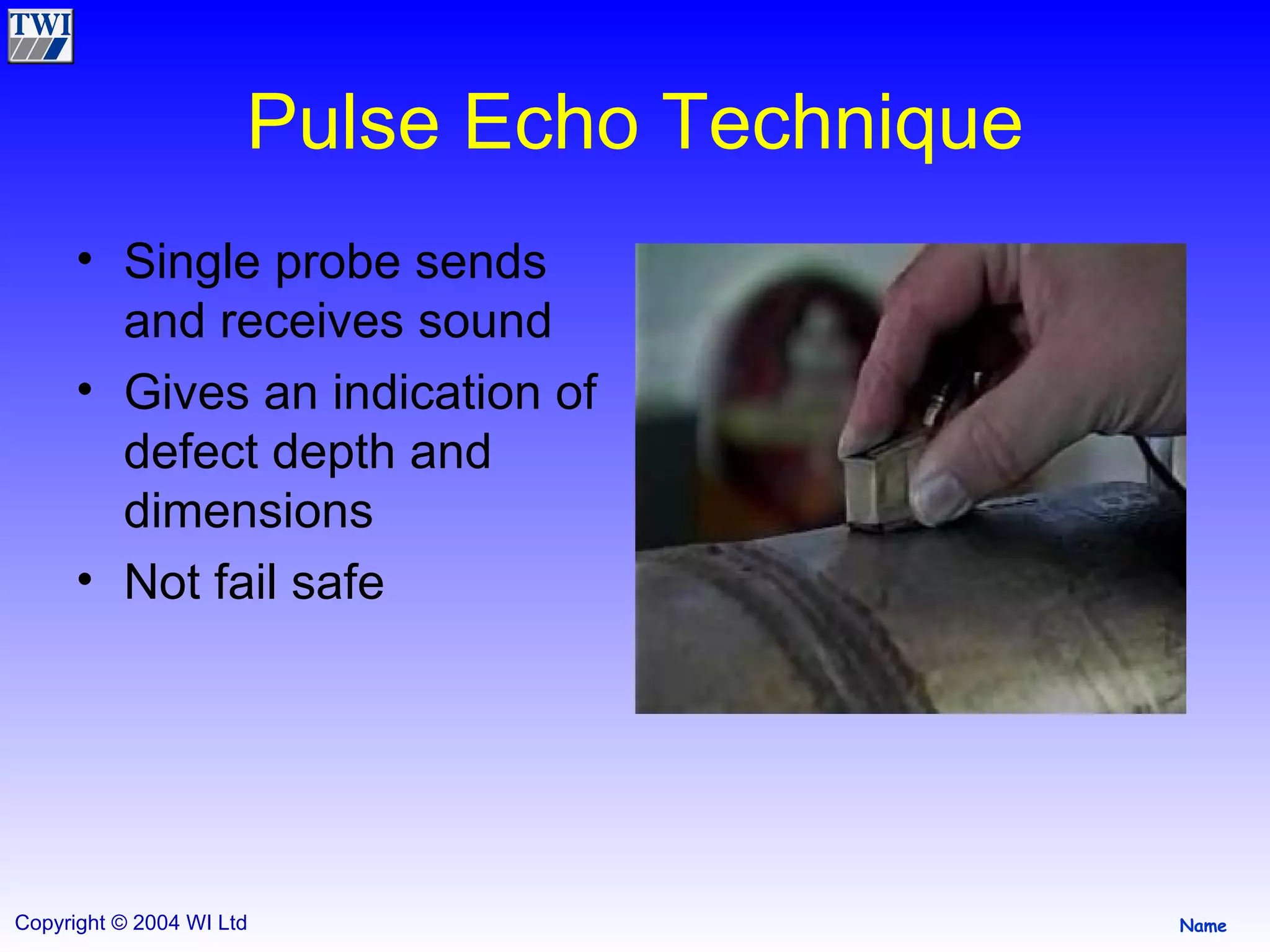
Pulse Echo Technique Single probe sends and receives sound Gives an indication of defect depth and dimensions Not fail safe
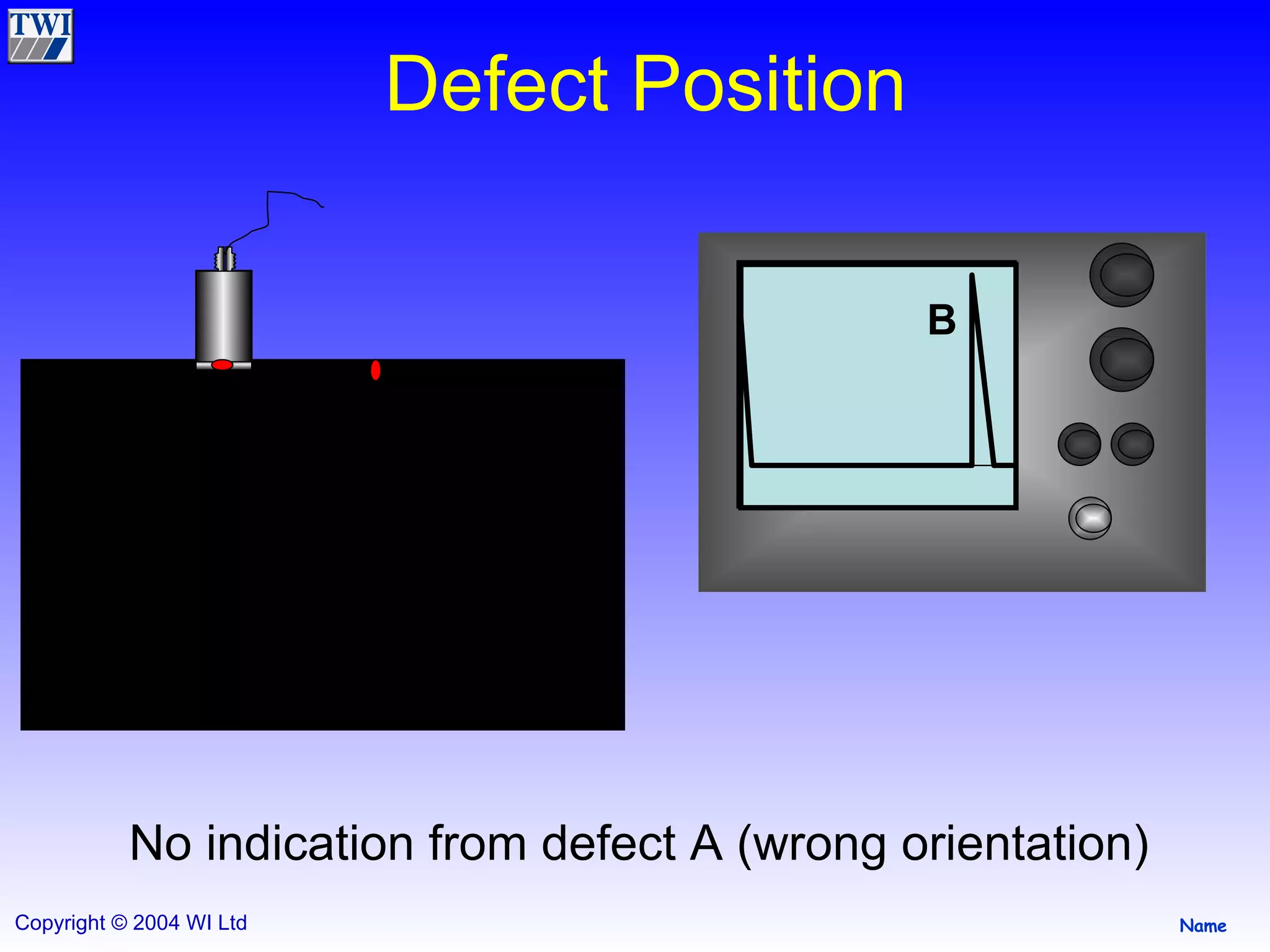
Defect Position No indication from defect A (wrong orientation) A B B
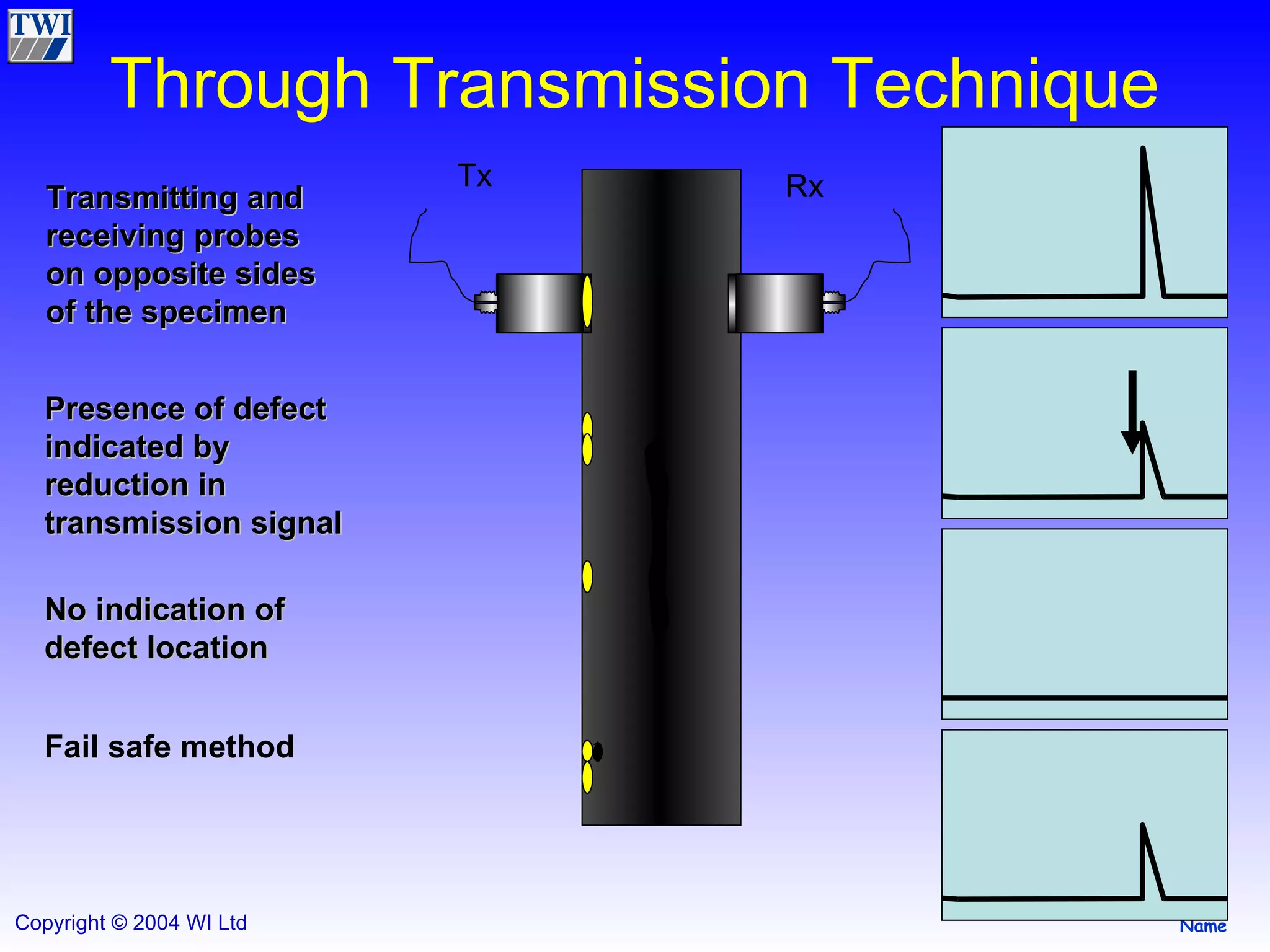
Through Transmission Technique Transmitting and receiving probes on opposite sides of the specimen Presence of defect indicated by reduction in transmission signal No indication of defect location Fail safe method Tx Rx
 
Through Transmission Technique Advantages Less attenuation No probe ringing No dead zone Orientation does not matter  Disadvantages Defect not located Defect can’t be identified Vertical defects don’t show Must be automated Need access to both surfaces
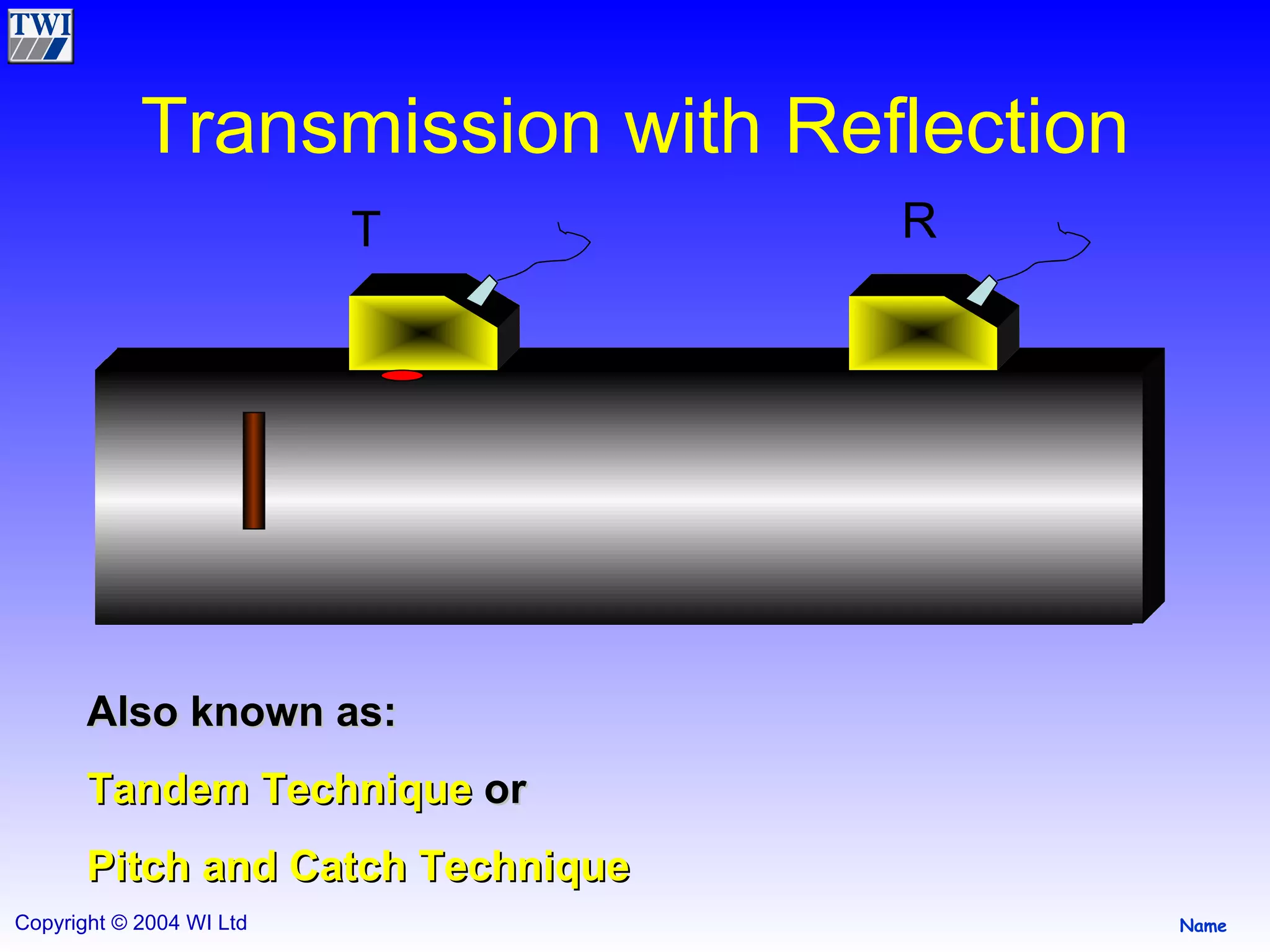
Transmission with Reflection Also known as: Tandem Technique  or  Pitch and Catch Technique R T
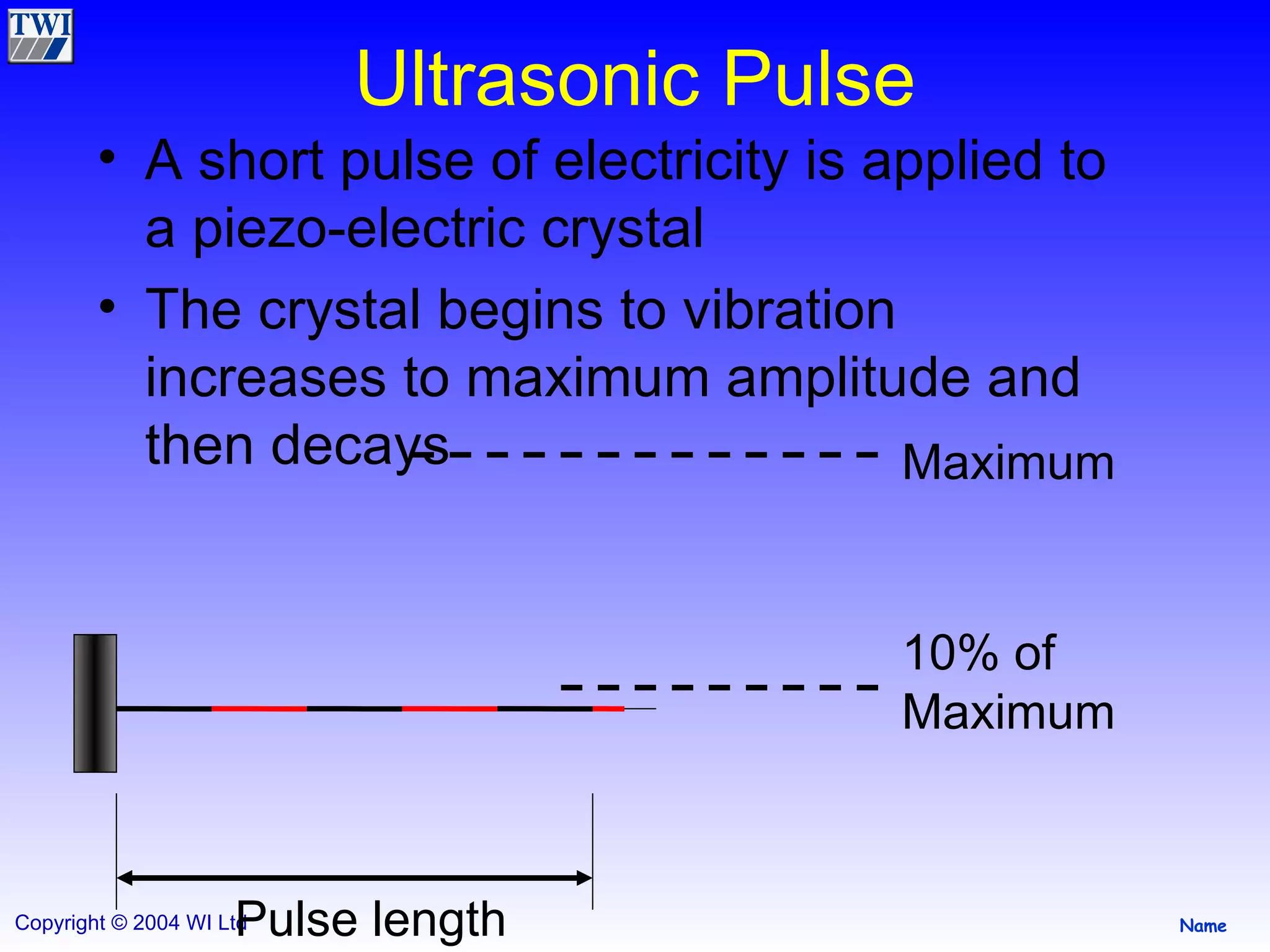
Ultrasonic Pulse  A short pulse of electricity is applied to a piezo-electric crystal The crystal begins to vibration increases to maximum amplitude and then decays  Pulse length Maximum 10% of Maximum
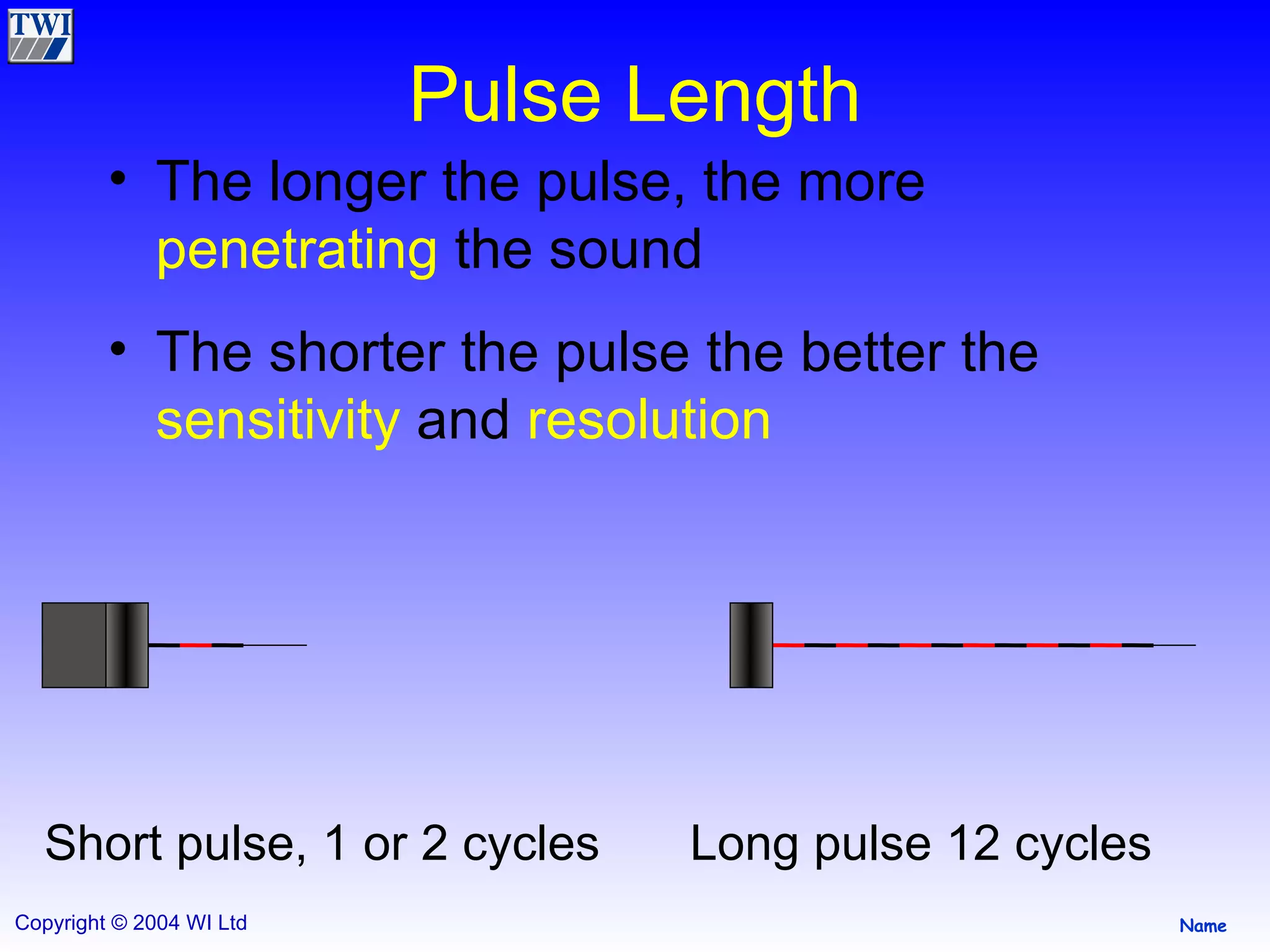
Pulse Length The longer the pulse, the more  penetrating  the sound  The shorter the pulse the better the  sensitivity  and  resolution Short pulse, 1 or 2 cycles Long pulse 12 cycles
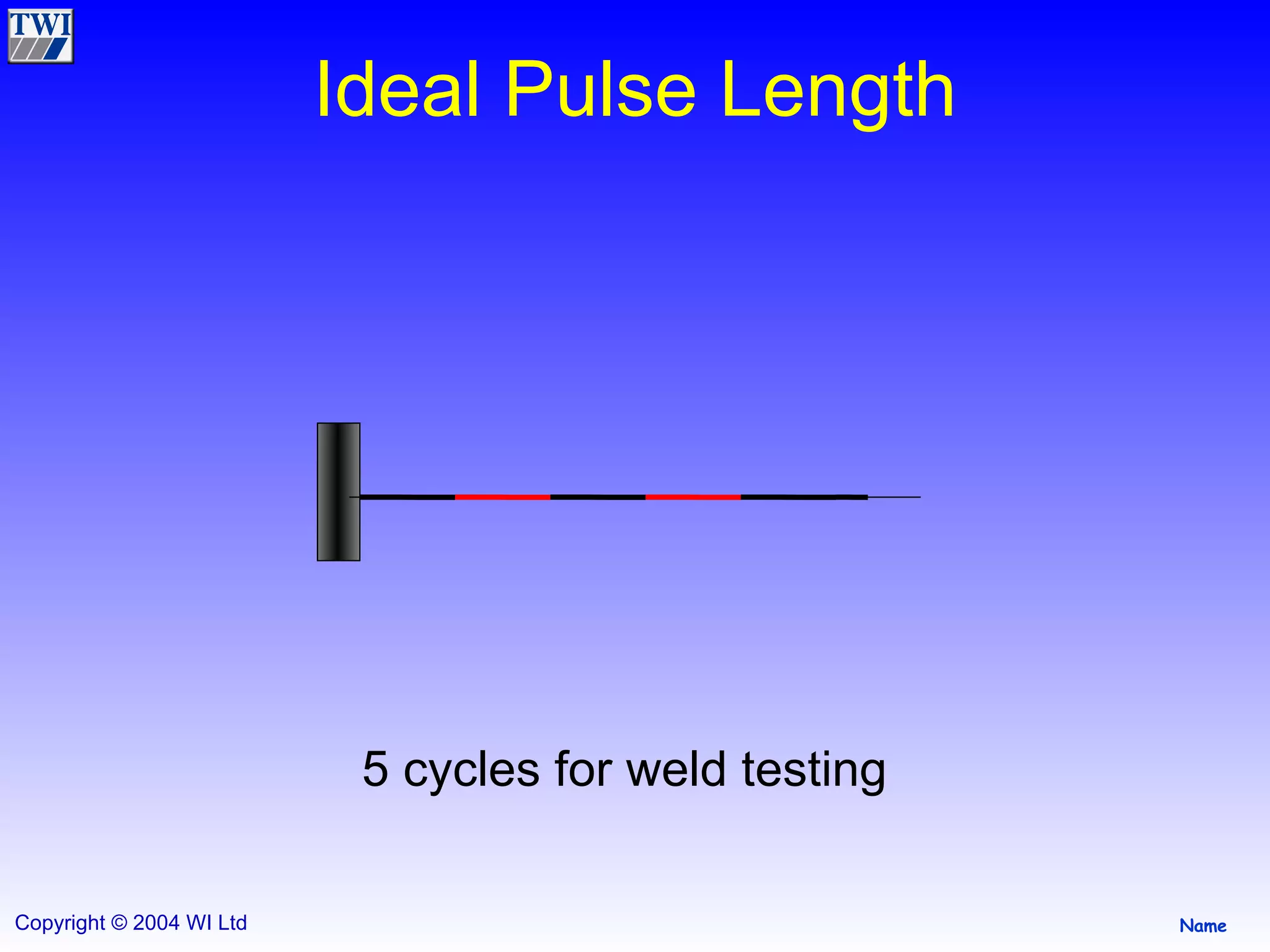
Ideal Pulse Length 5 cycles for weld testing
The Sound Beam Dead Zone Near Zone or Fresnel Zone Far Zone or Fraunhofer Zone
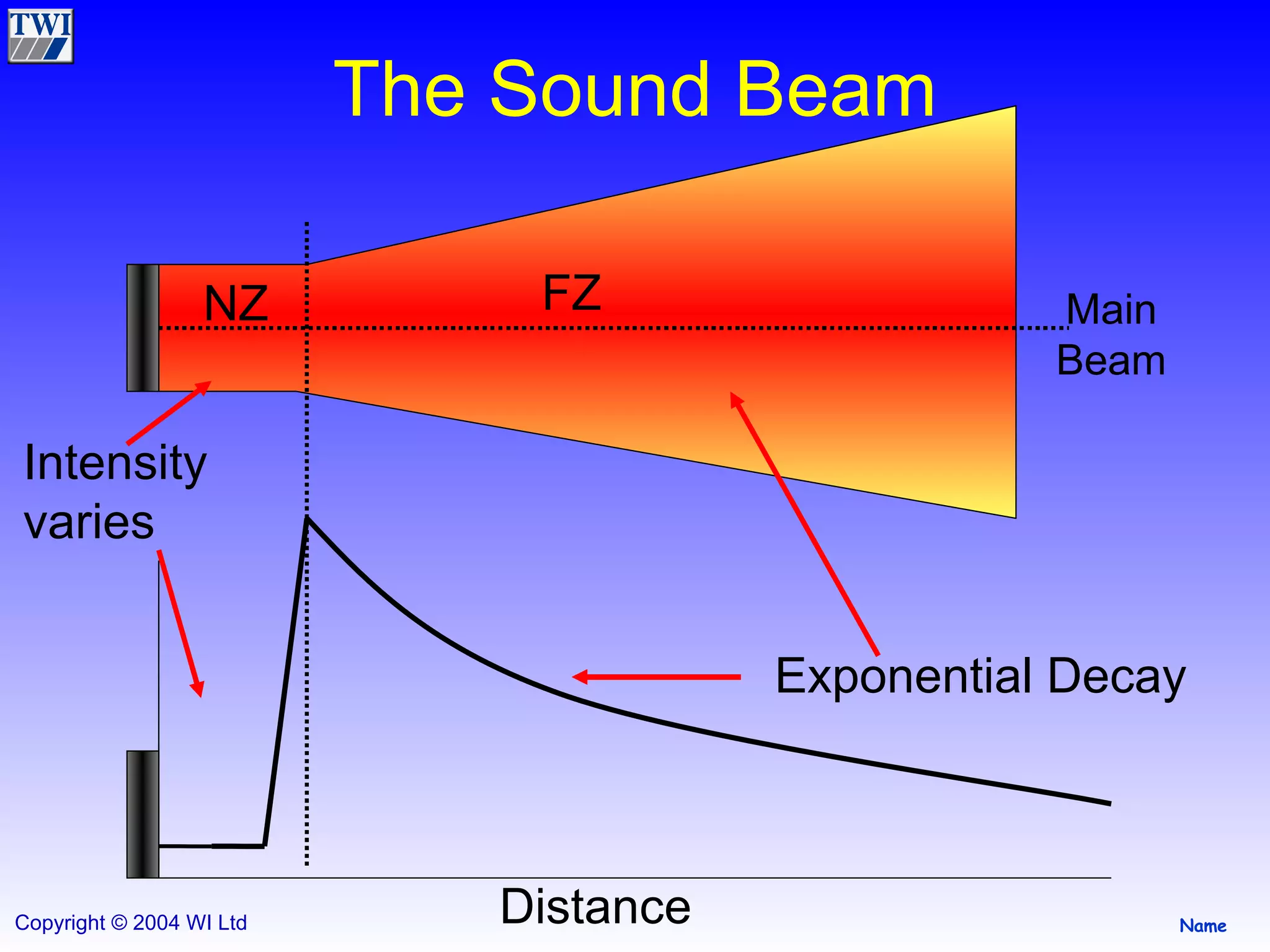
The Sound Beam NZ FZ Main Beam Distance Intensity varies Exponential Decay
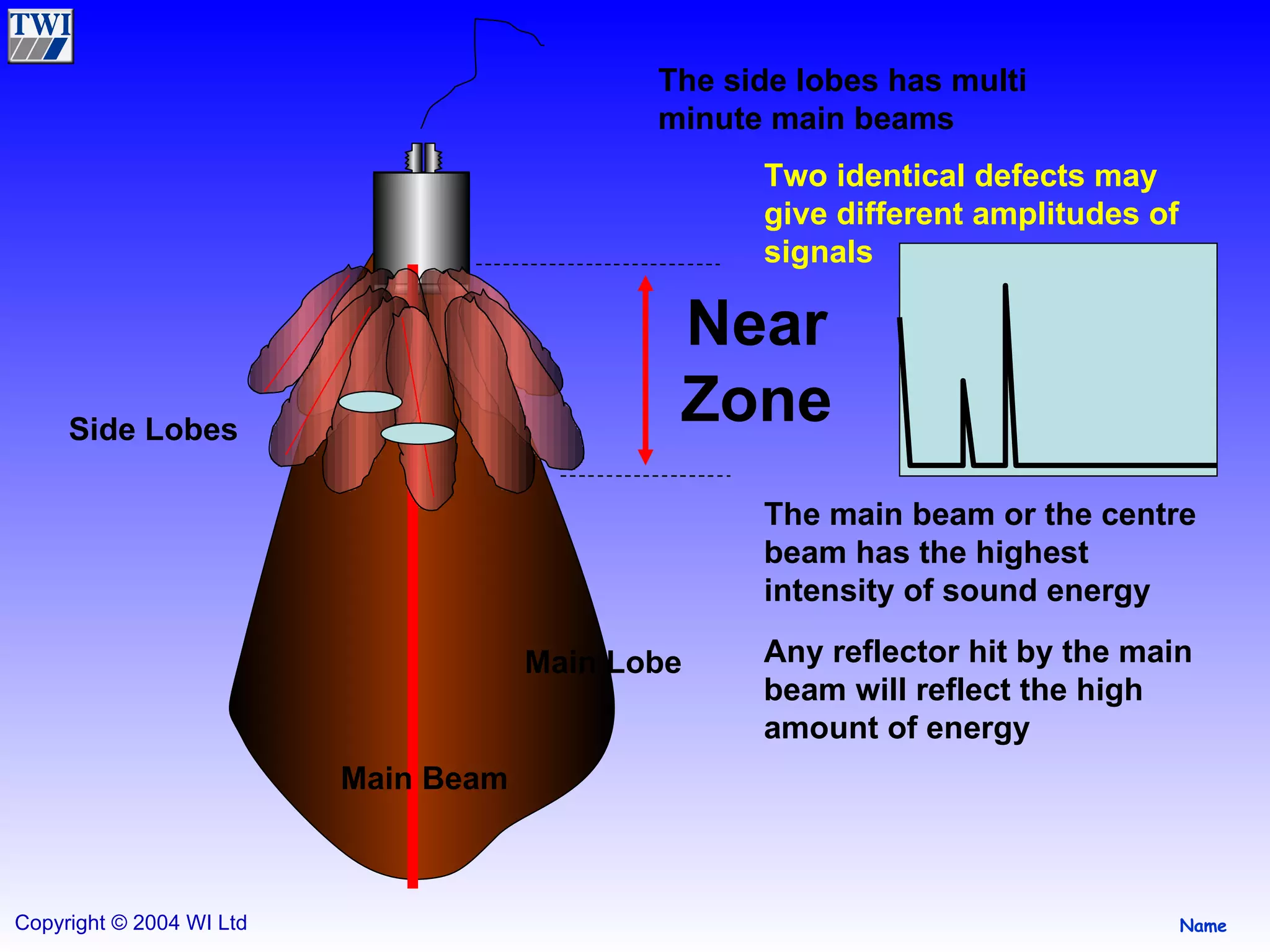
Main Lobe Side Lobes Near Zone Main Beam The main beam or the centre beam has the highest intensity of sound energy Any reflector hit by the main beam will reflect the high amount of energy The side lobes has multi minute main beams Two identical defects may give different amplitudes of signals
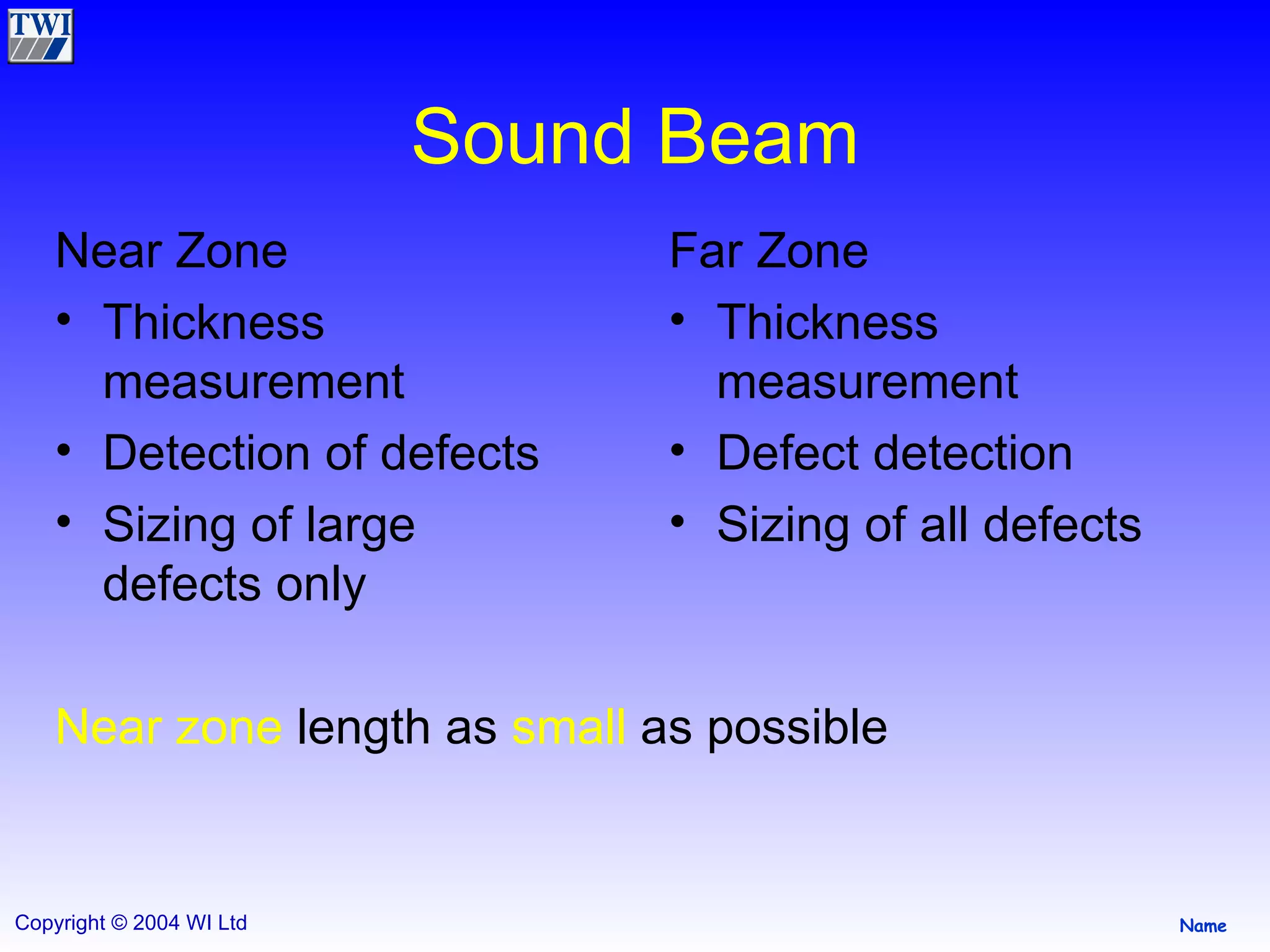
Sound Beam Near Zone Thickness measurement Detection of defects Sizing of large defects only Far Zone Thickness measurement Defect detection Sizing of all defects Near zone  length as  small  as possible
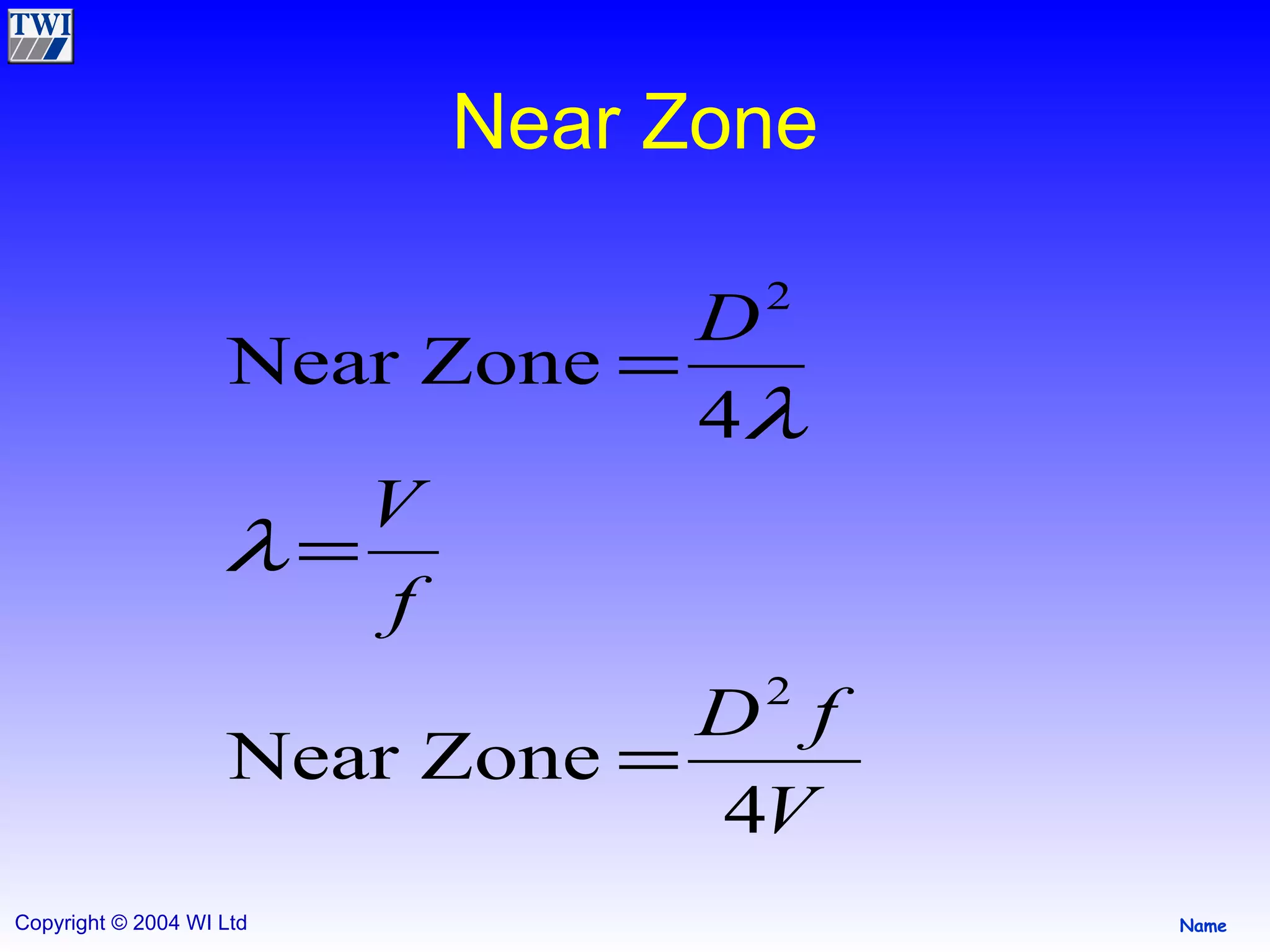
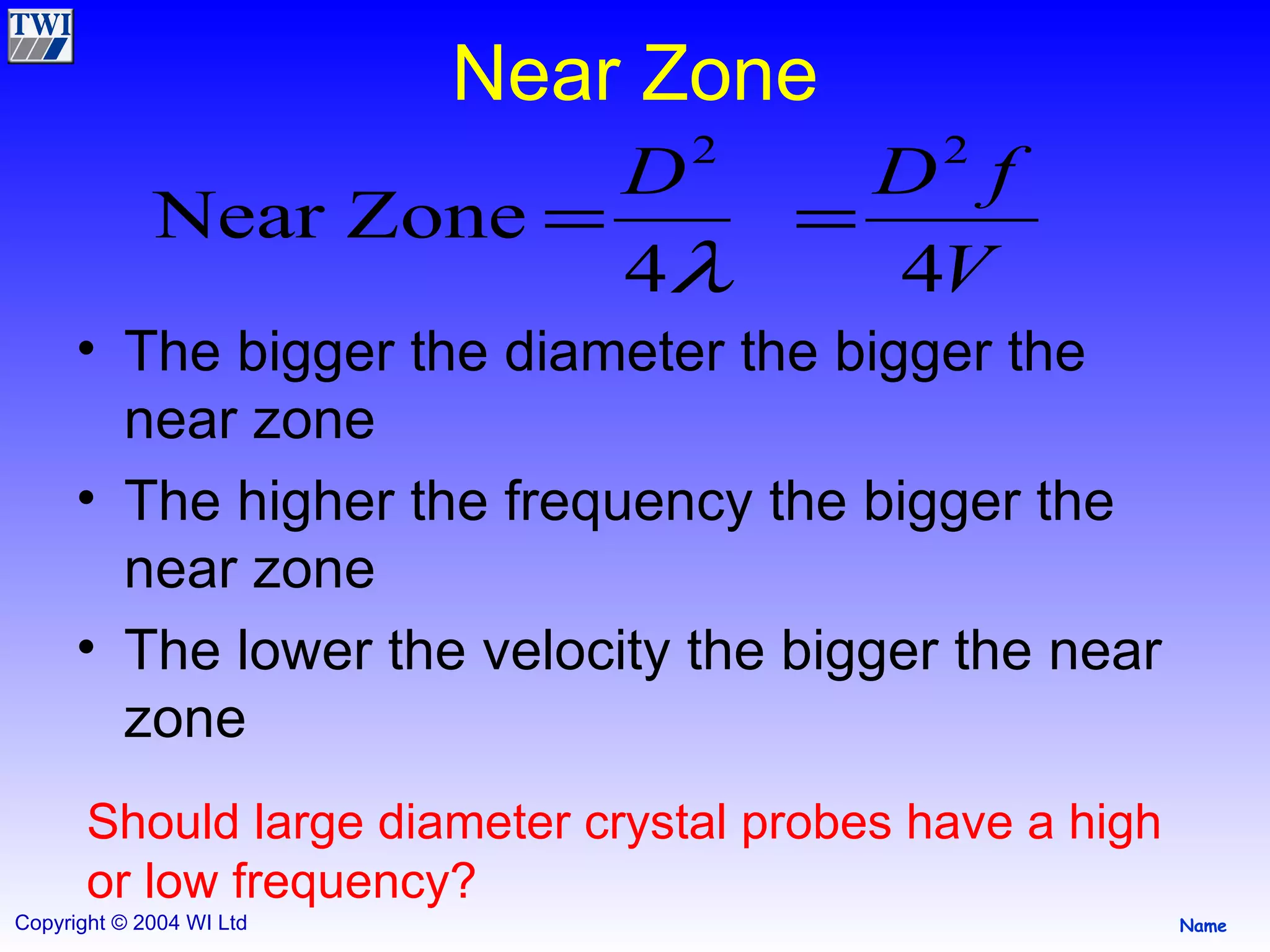
Near Zone
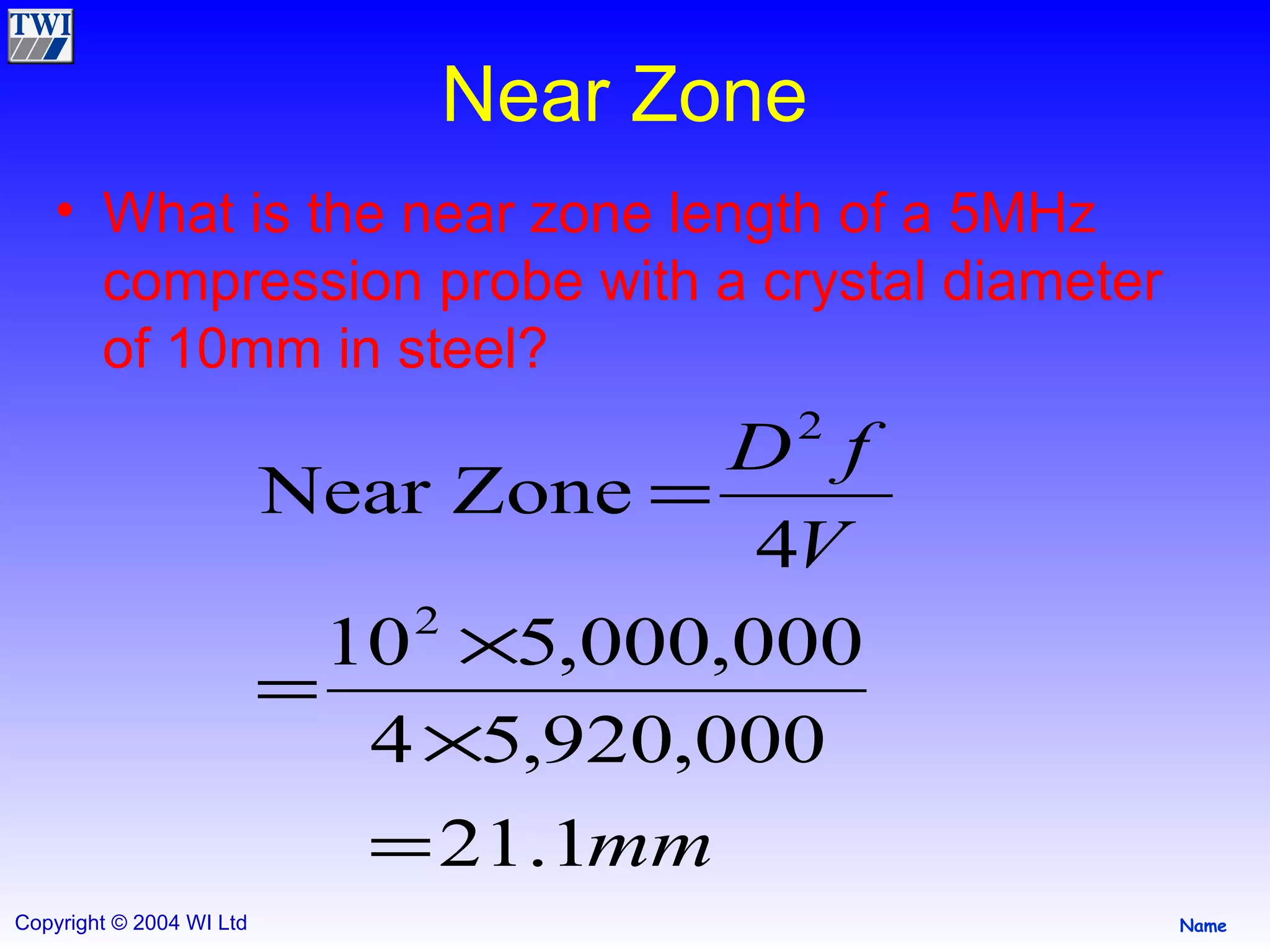
Near Zone What is the near zone length of a 5MHz compression probe with a crystal diameter of 10mm in steel?
Near Zone The bigger the diameter the bigger the near zone The higher the frequency the bigger the near zone The lower the velocity the bigger the near zone  Should large diameter crystal probes have a high or low frequency?
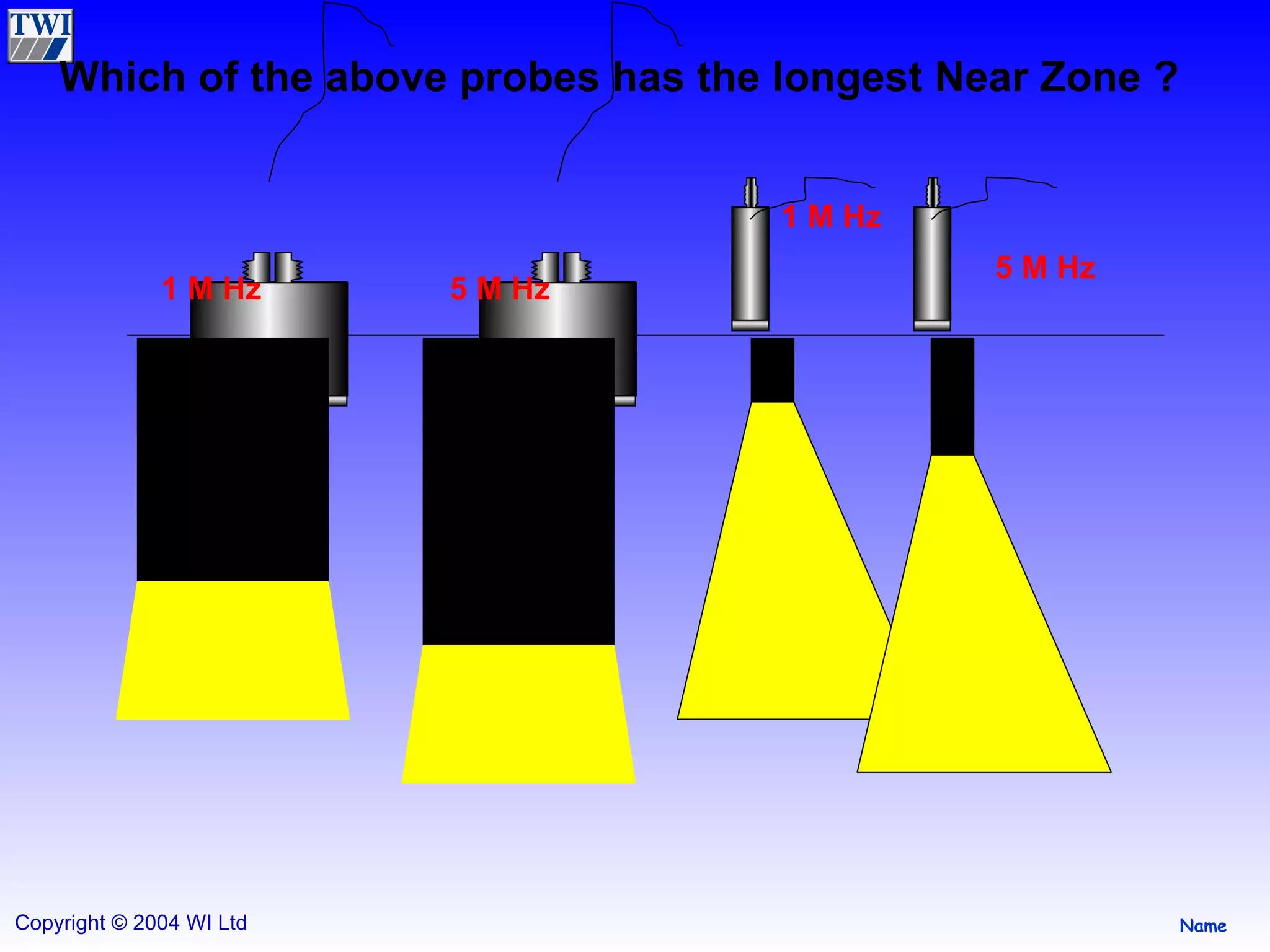
Which of the above probes has the longest Near Zone ? 1 M Hz 5 M Hz 1 M Hz 5 M Hz
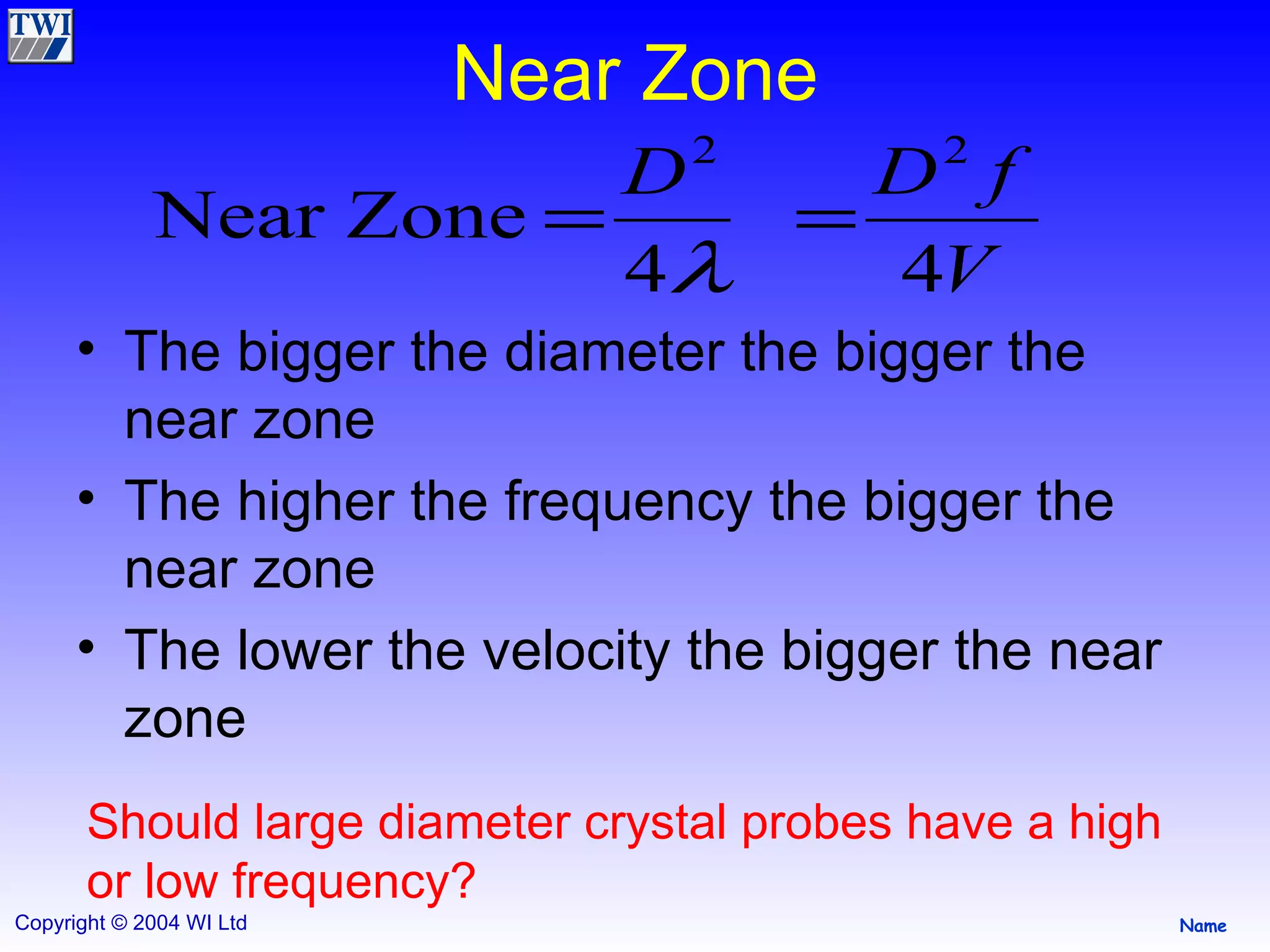
Near Zone The bigger the diameter the bigger the near zone The higher the frequency the bigger the near zone The lower the velocity the bigger the near zone  Should large diameter crystal probes have a high or low frequency?
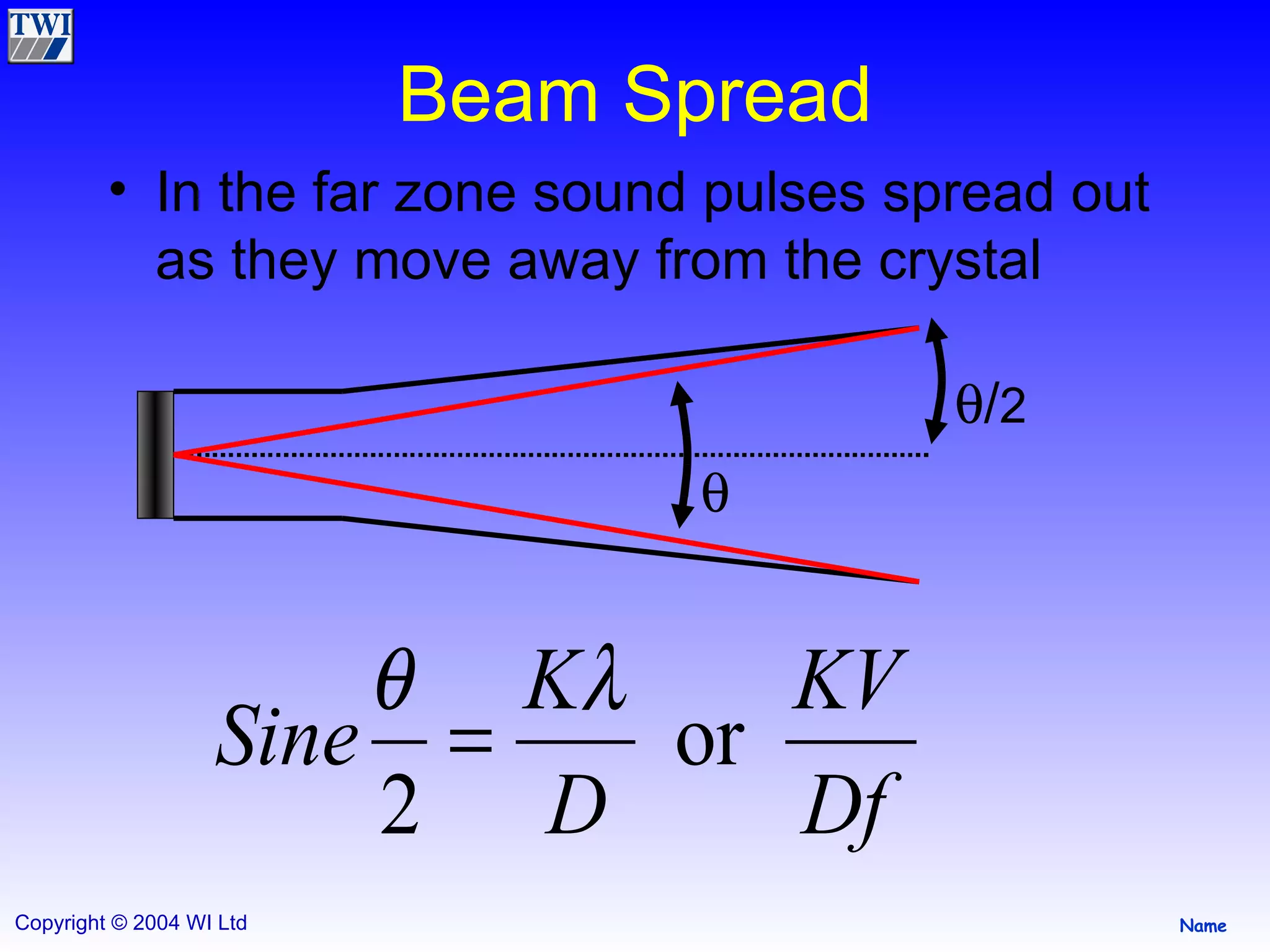
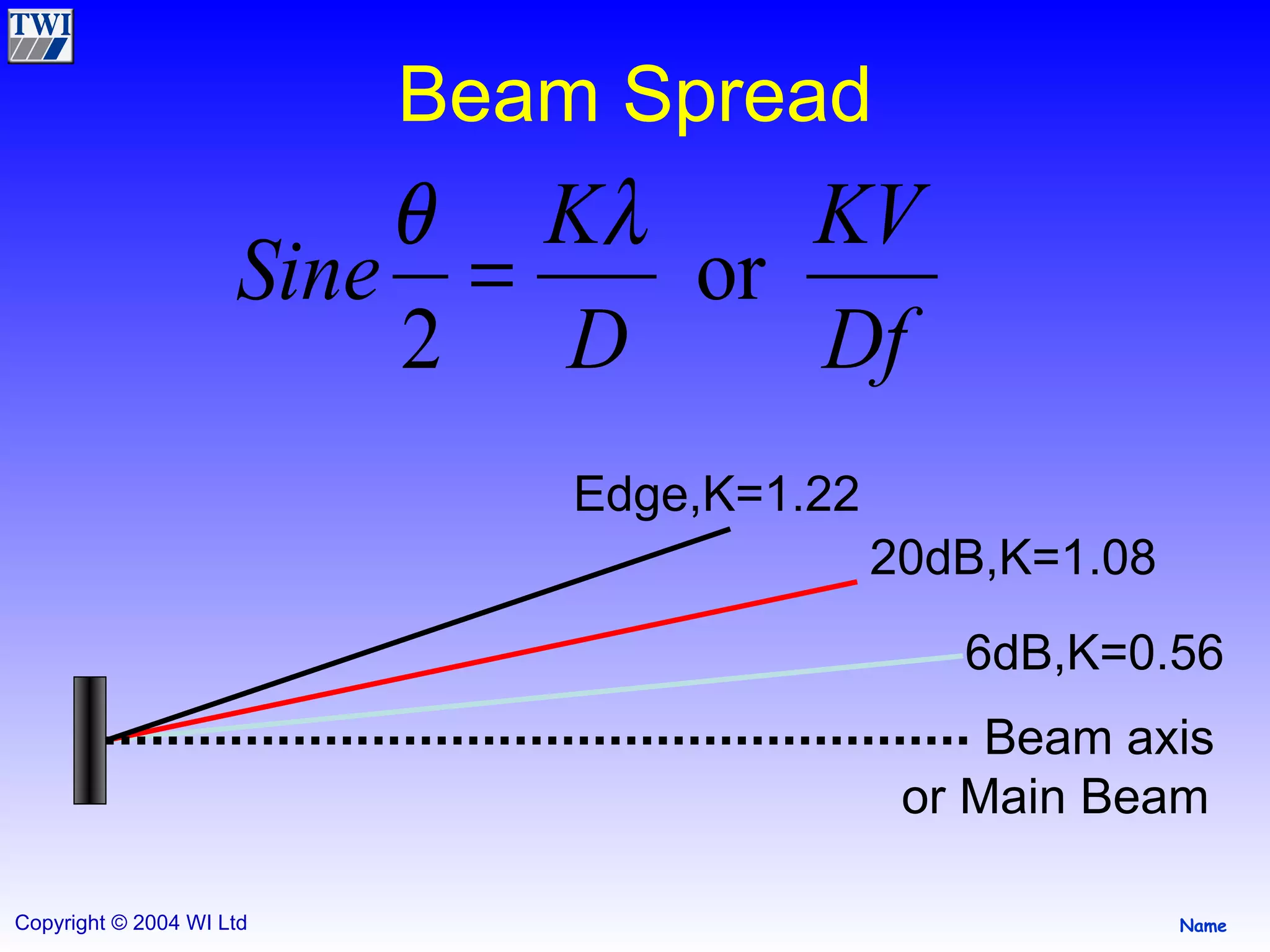
Beam Spread In the far zone sound pulses spread out as they move away from the crystal   / 2
Beam Spread Edge,K=1.22 20dB,K=1.08 6dB,K=0.56 Beam axis or Main Beam
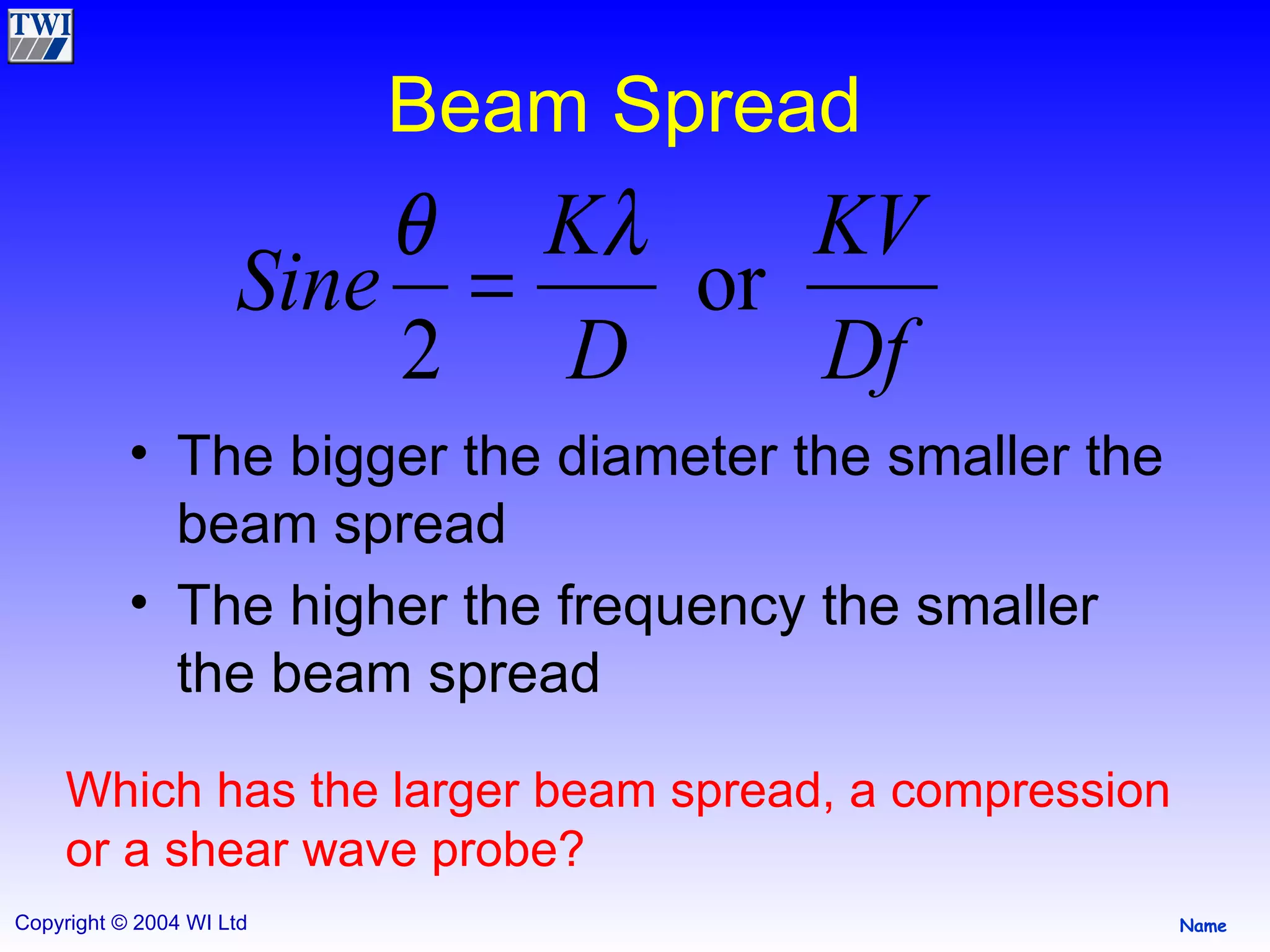
Beam Spread The bigger the diameter the smaller the beam spread The higher the frequency the smaller the beam spread Which has the larger beam spread, a compression or a shear wave probe?
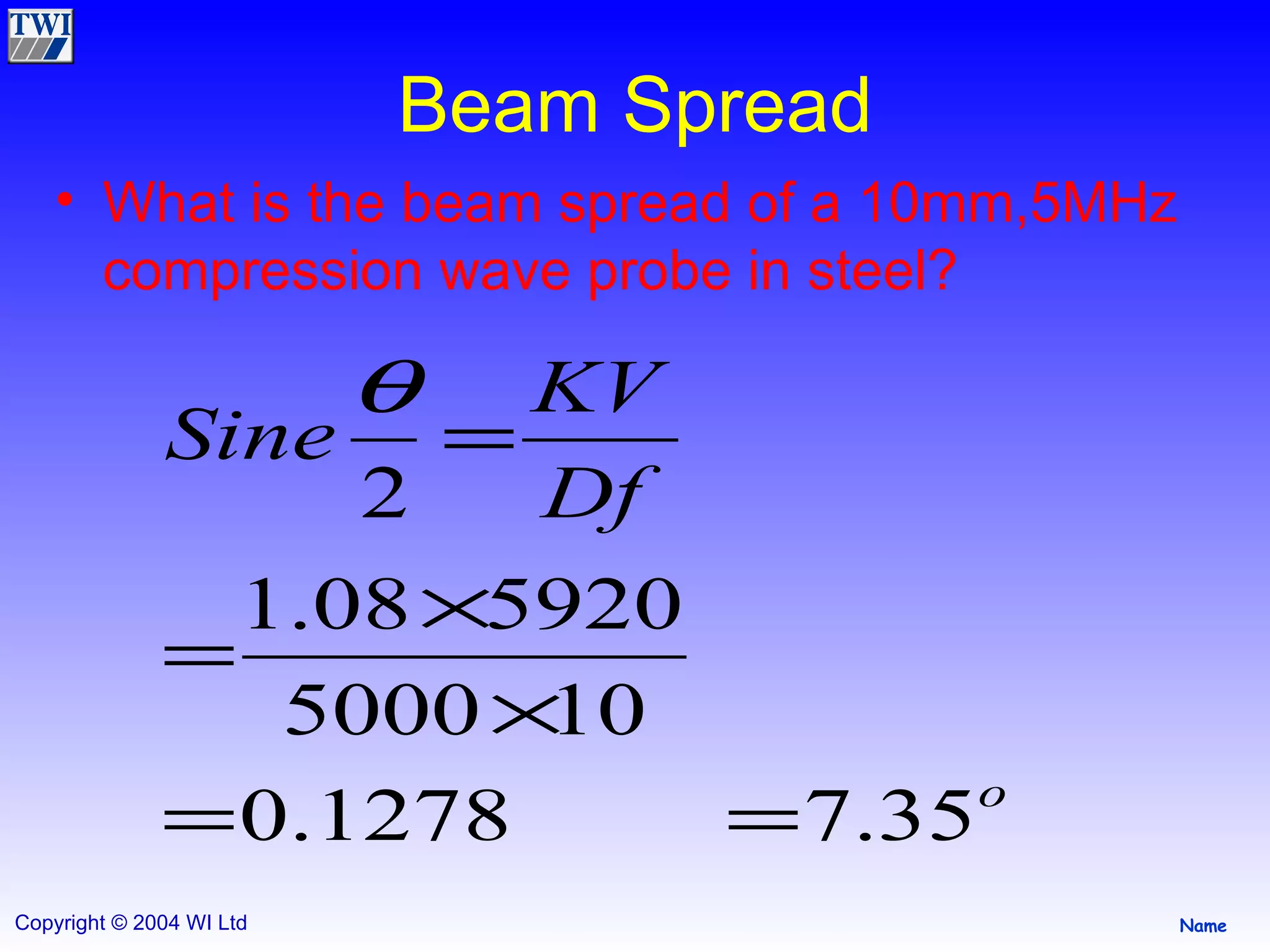
Beam Spread What is the beam spread of a 10mm,5MHz compression wave probe in steel?
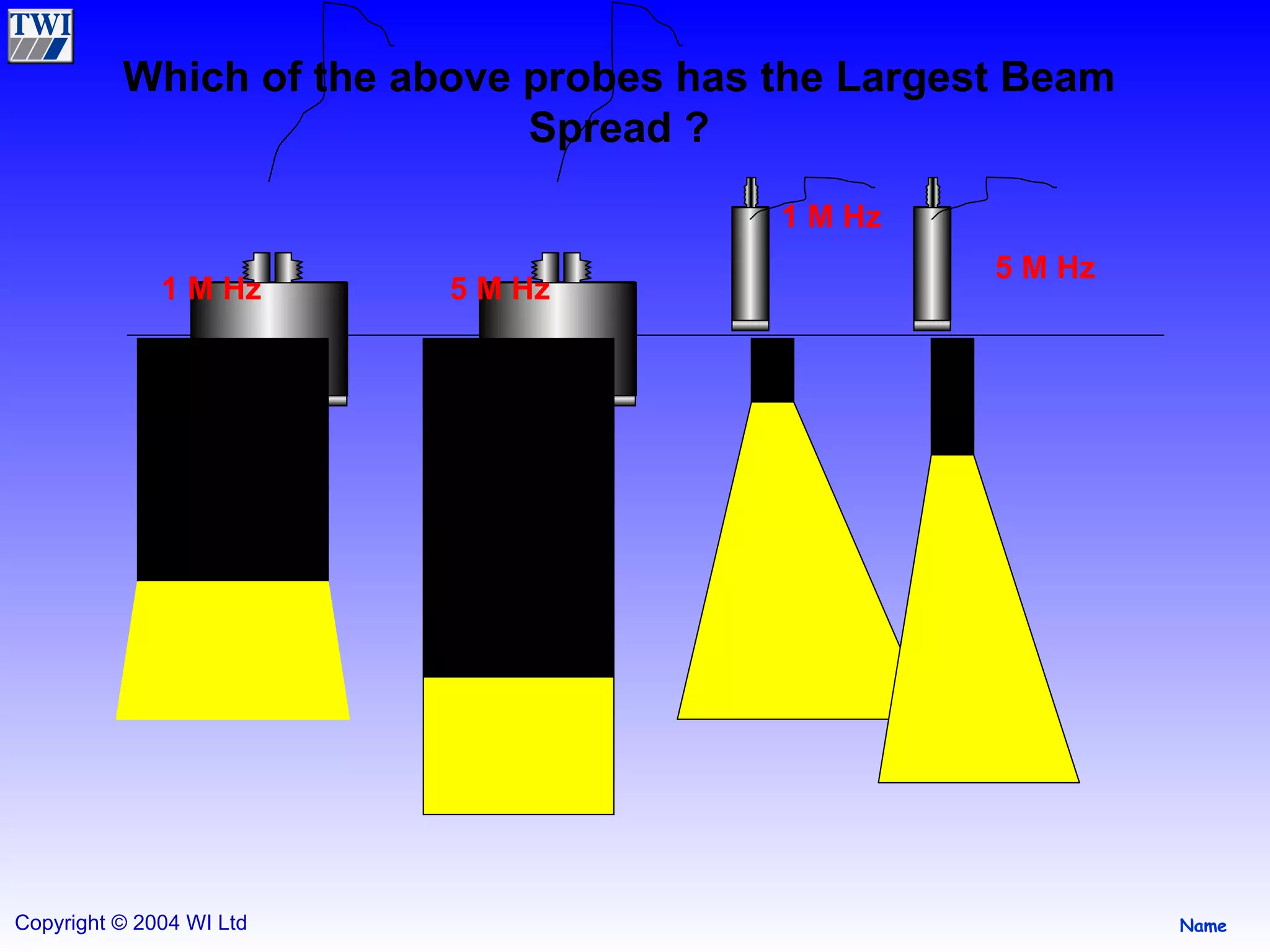
Which of the above probes has the Largest Beam Spread ? 1 M Hz 5 M Hz 1 M Hz 5 M Hz
Beam Spread The bigger the diameter the smaller the beam spread The higher the frequency the smaller the beam spread Which has the larger beam spread, a compression or a shear wave probe?
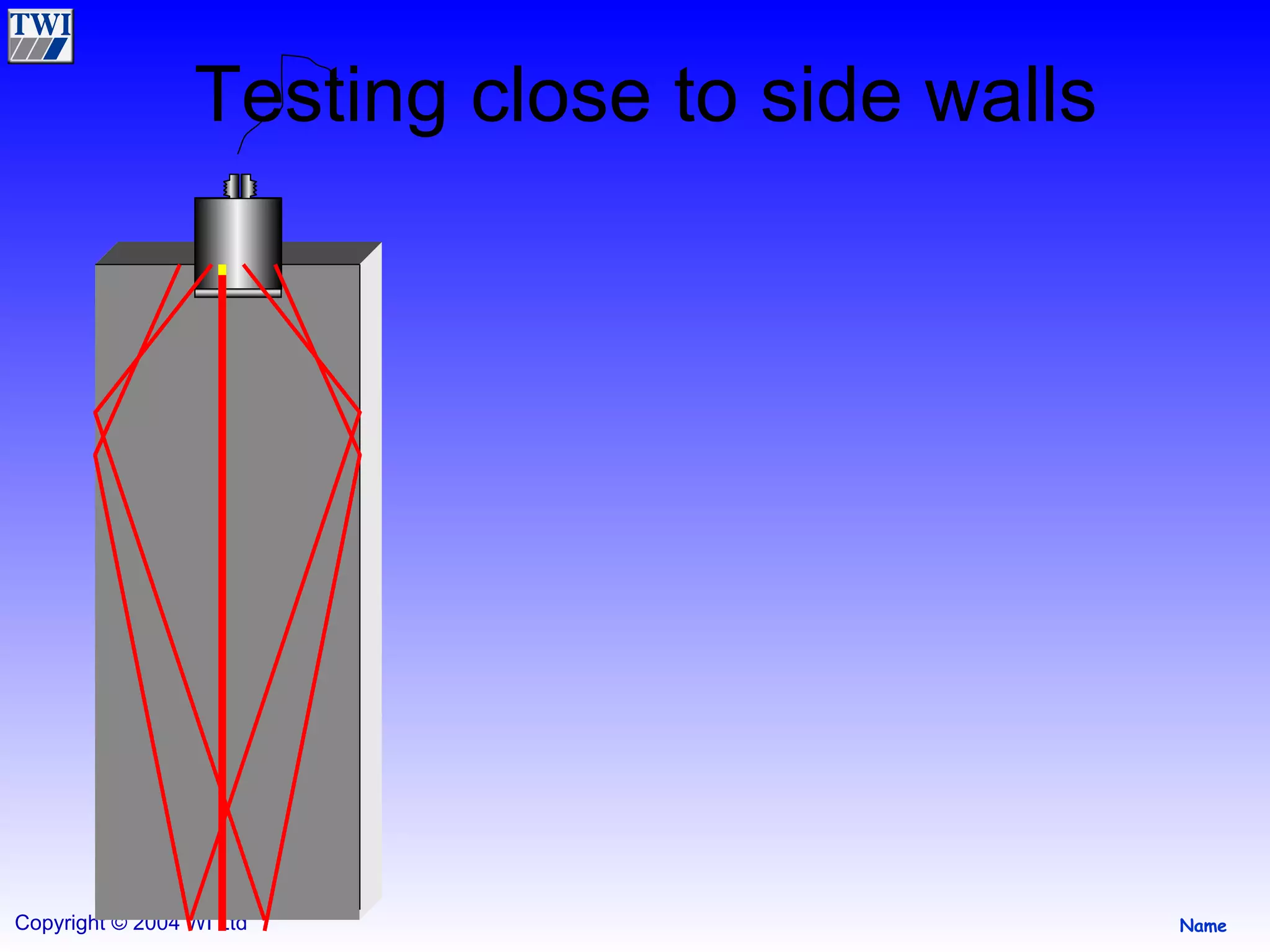
Testing close to side walls
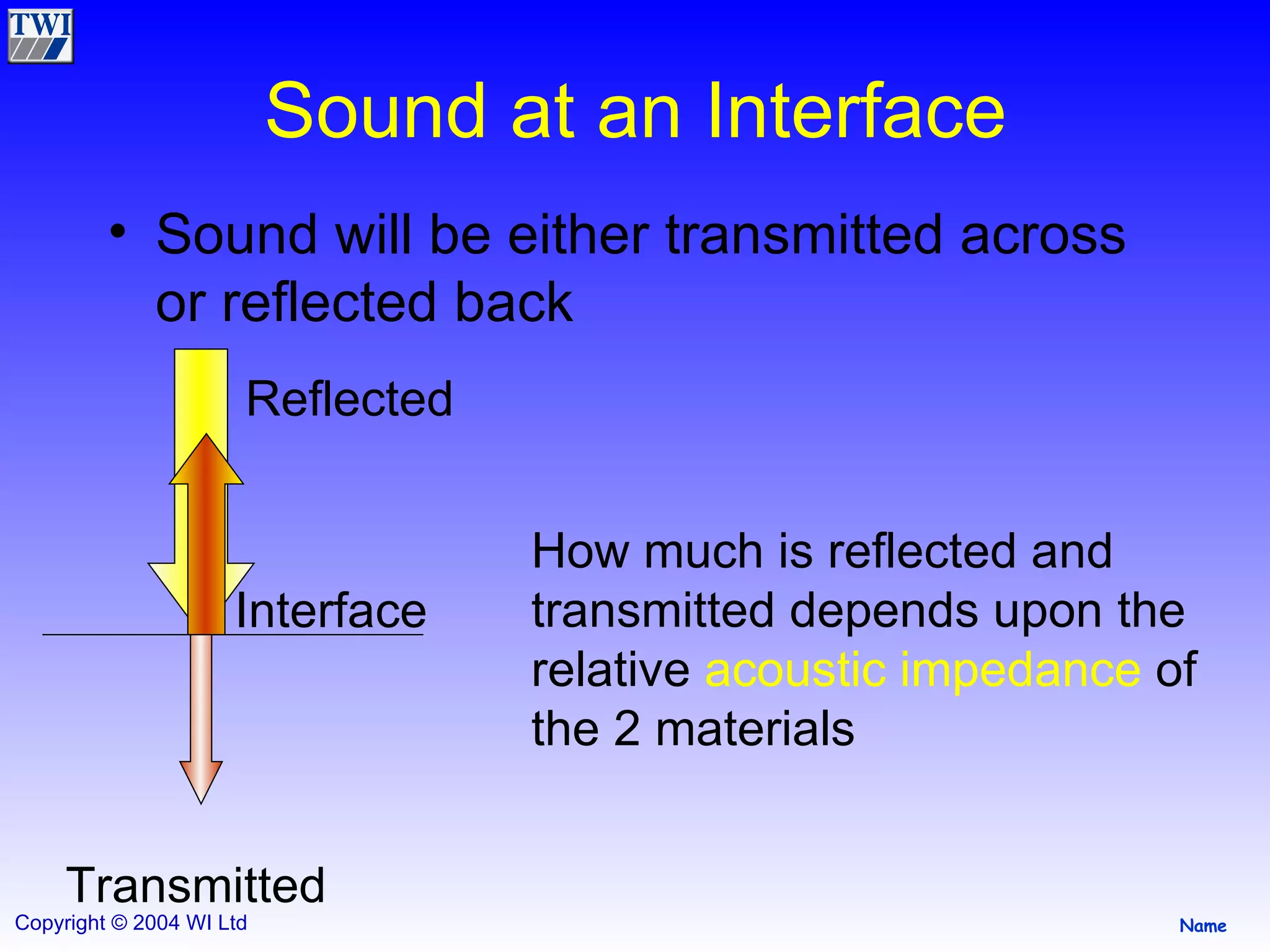
Sound at an Interface Sound will be either transmitted across or reflected back  Reflected  Transmitted  How much is reflected and transmitted depends upon the relative  acoustic impedance  of the 2 materials  Interface
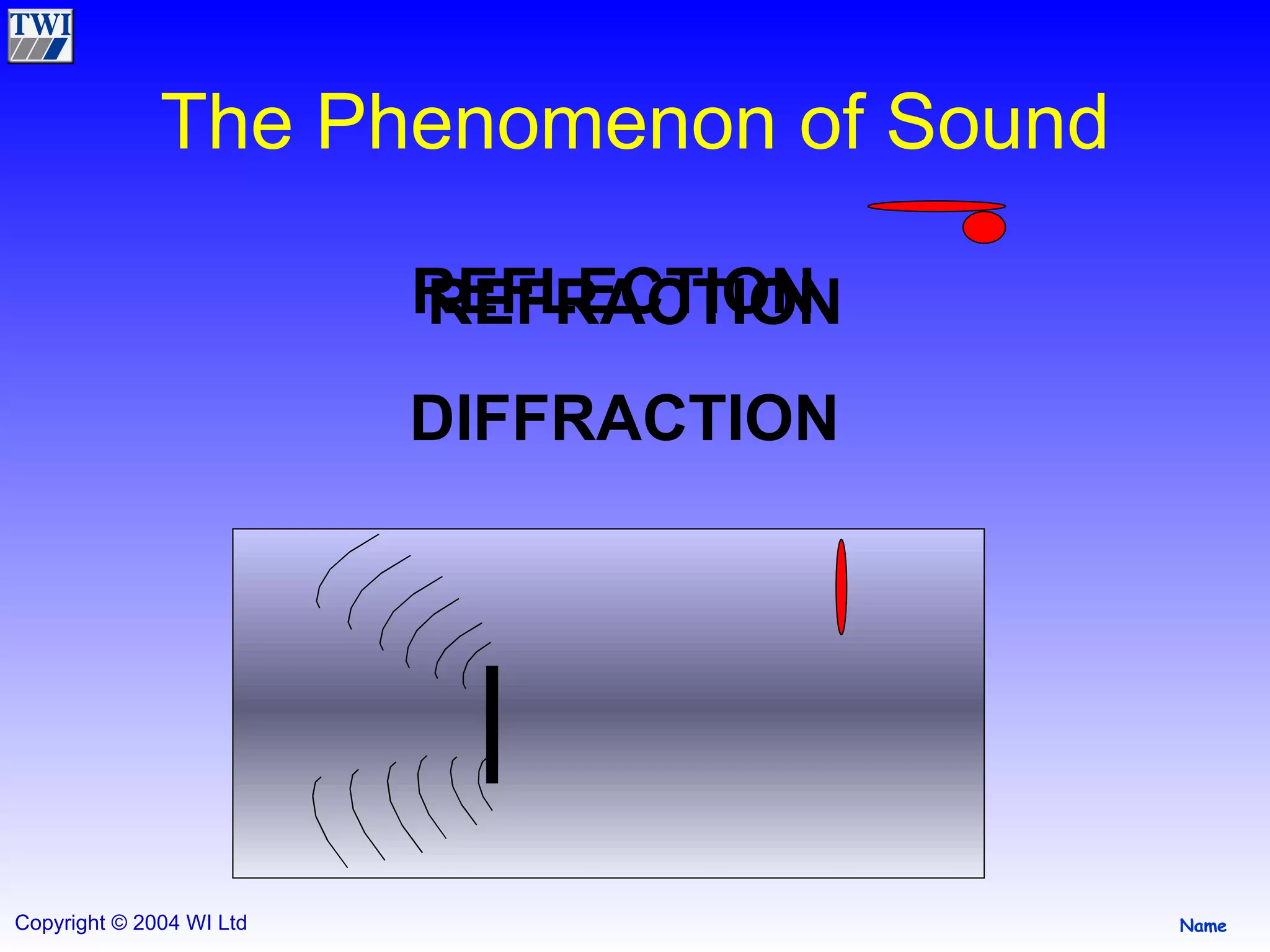
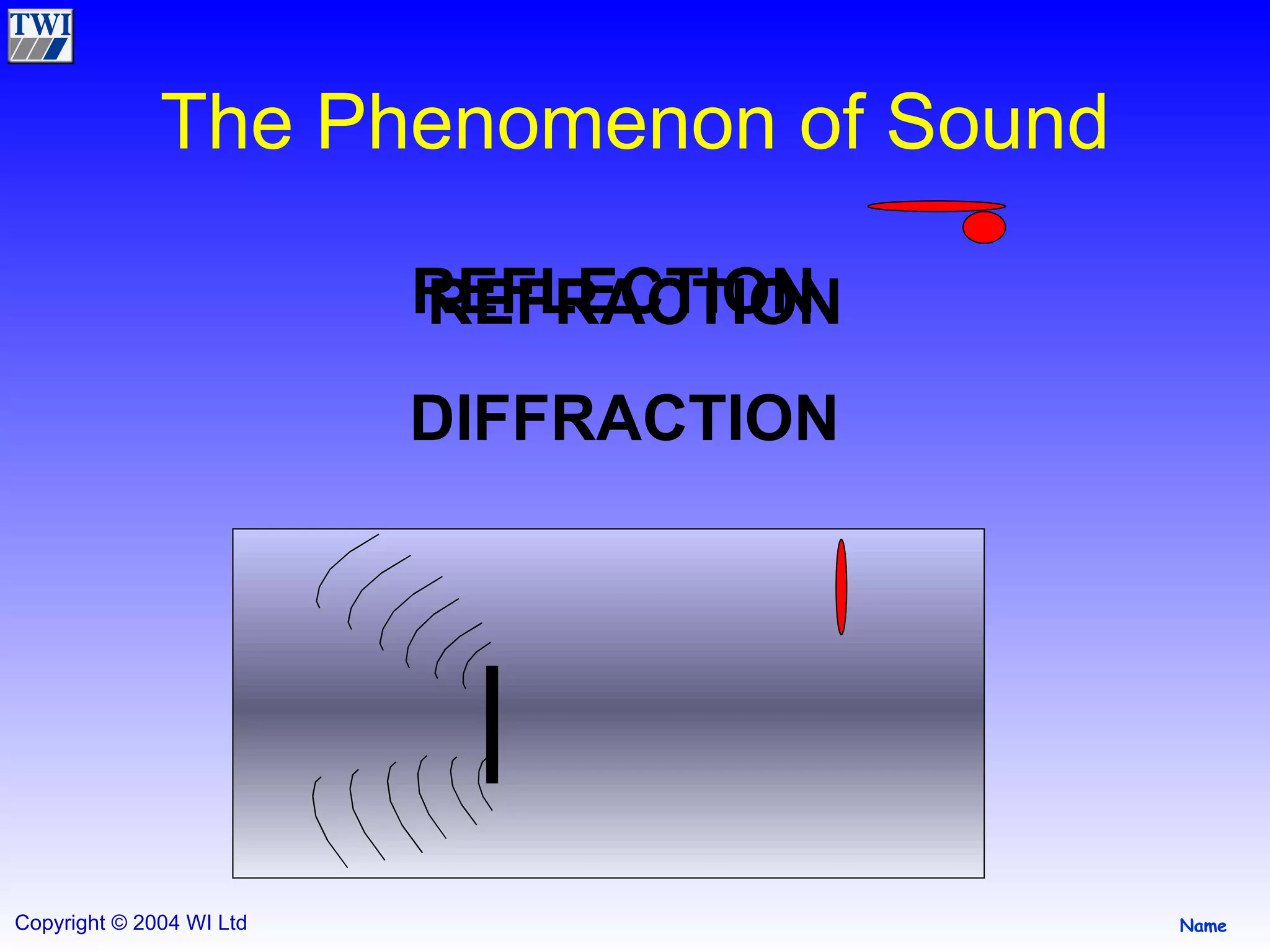
The Phenomenon of Sound REFLECTION REFRACTION DIFFRACTION
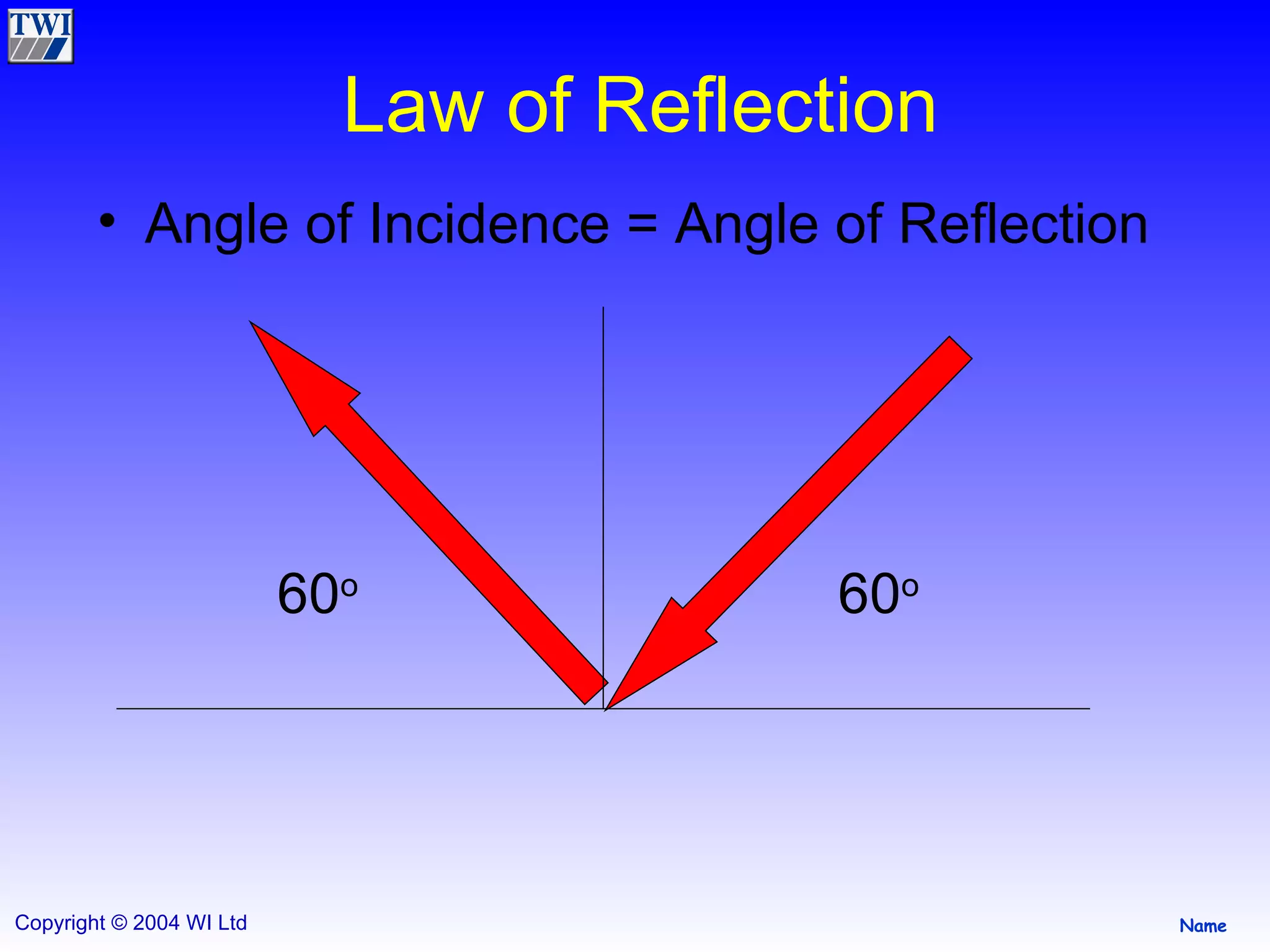
Law of Reflection Angle of Incidence = Angle of Reflection 60 o 60 o
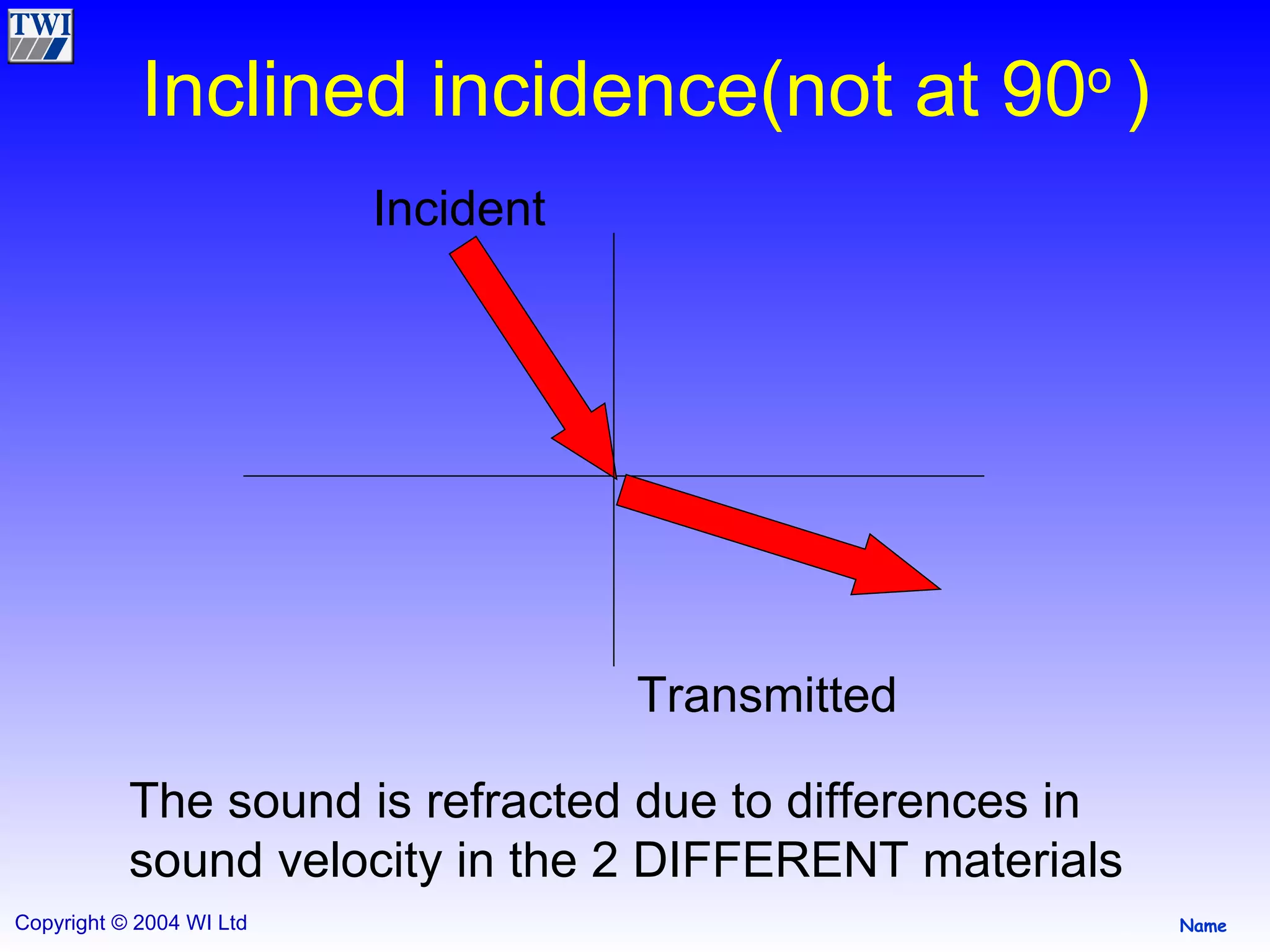
Inclined incidence(not at 90 o  ) Incident Transmitted The sound is refracted due to differences in sound velocity in the 2 DIFFERENT materials
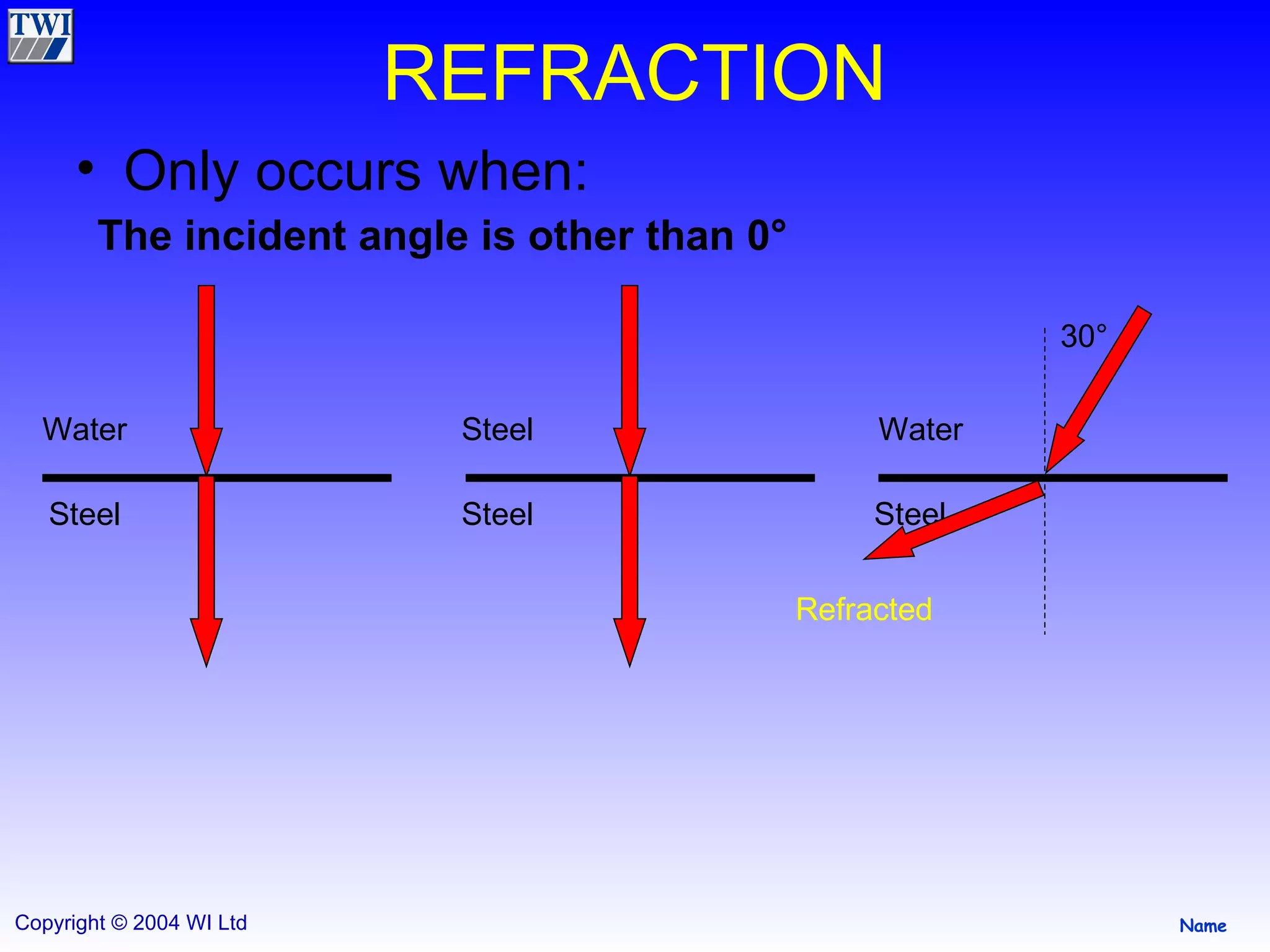
REFRACTION Only occurs when: The incident angle is other than 0 ° 30 ° Refracted Water Steel Steel Steel Water Steel
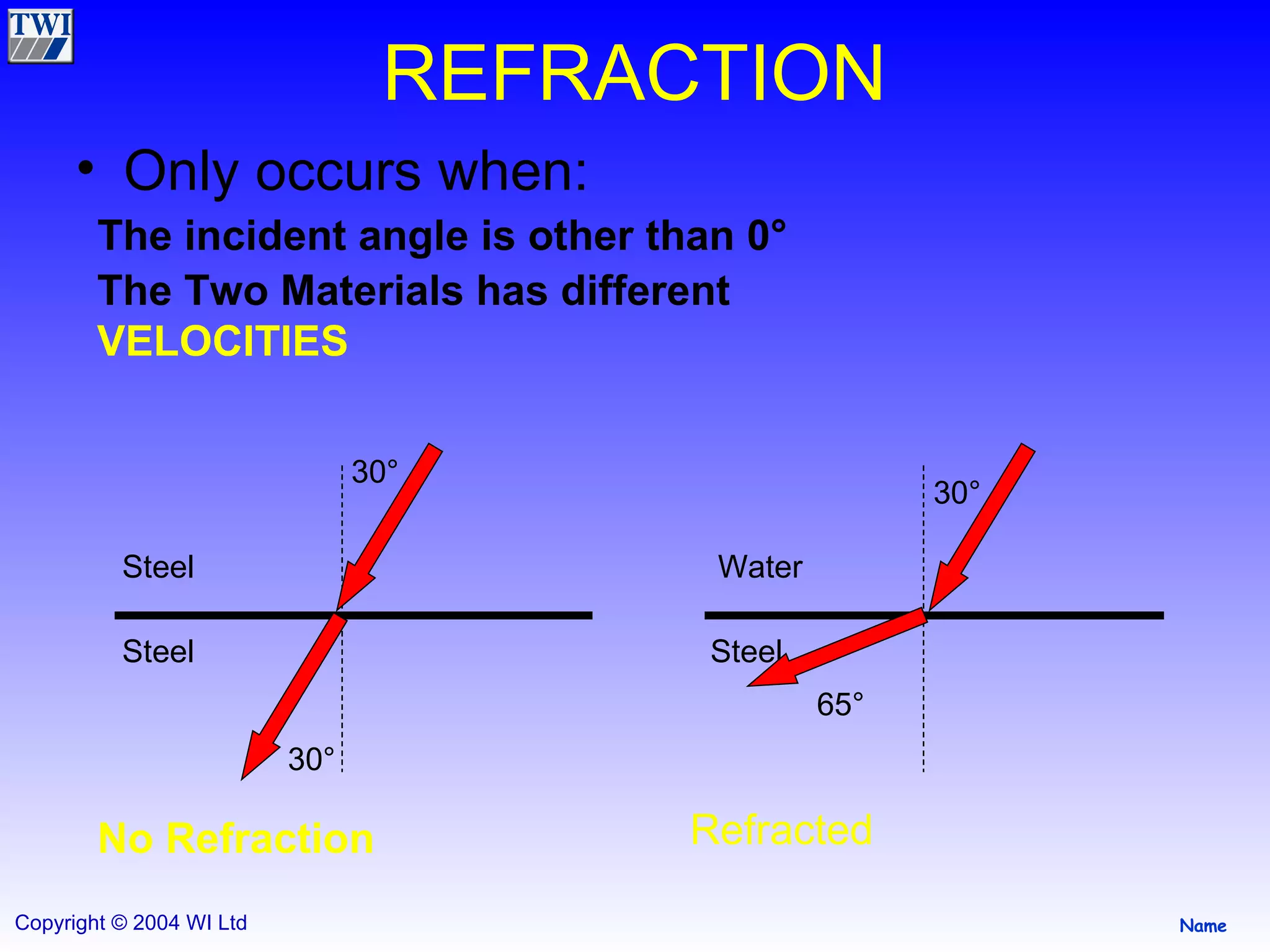
REFRACTION Only occurs when: The incident angle is other than 0 ° 30 ° Refracted The Two Materials has different  VELOCITIES No Refraction 30 ° 30 ° 65 ° Steel Steel Water Steel
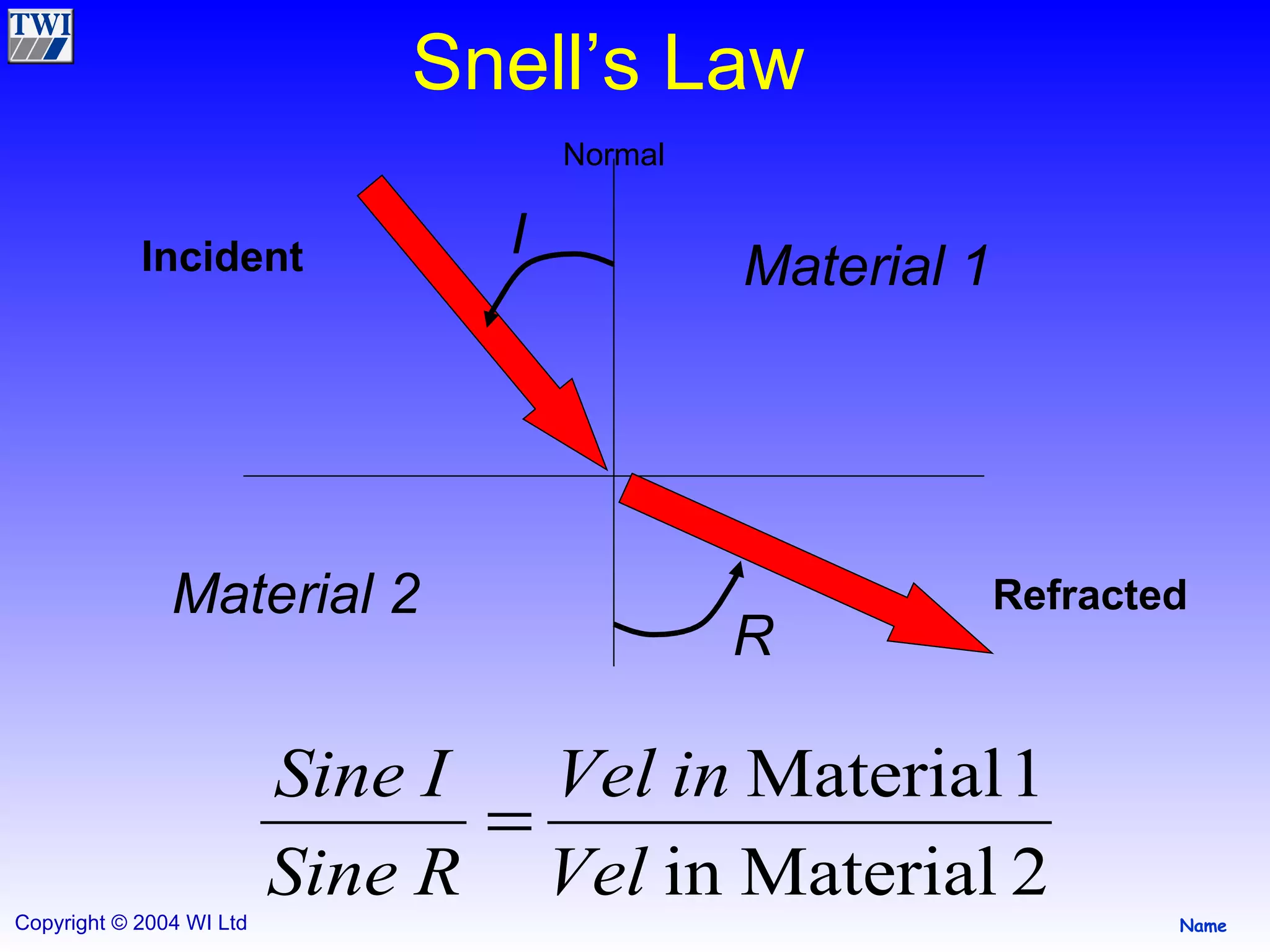
Snell’s Law I R Material 1 Material 2 Incident Refracted Normal
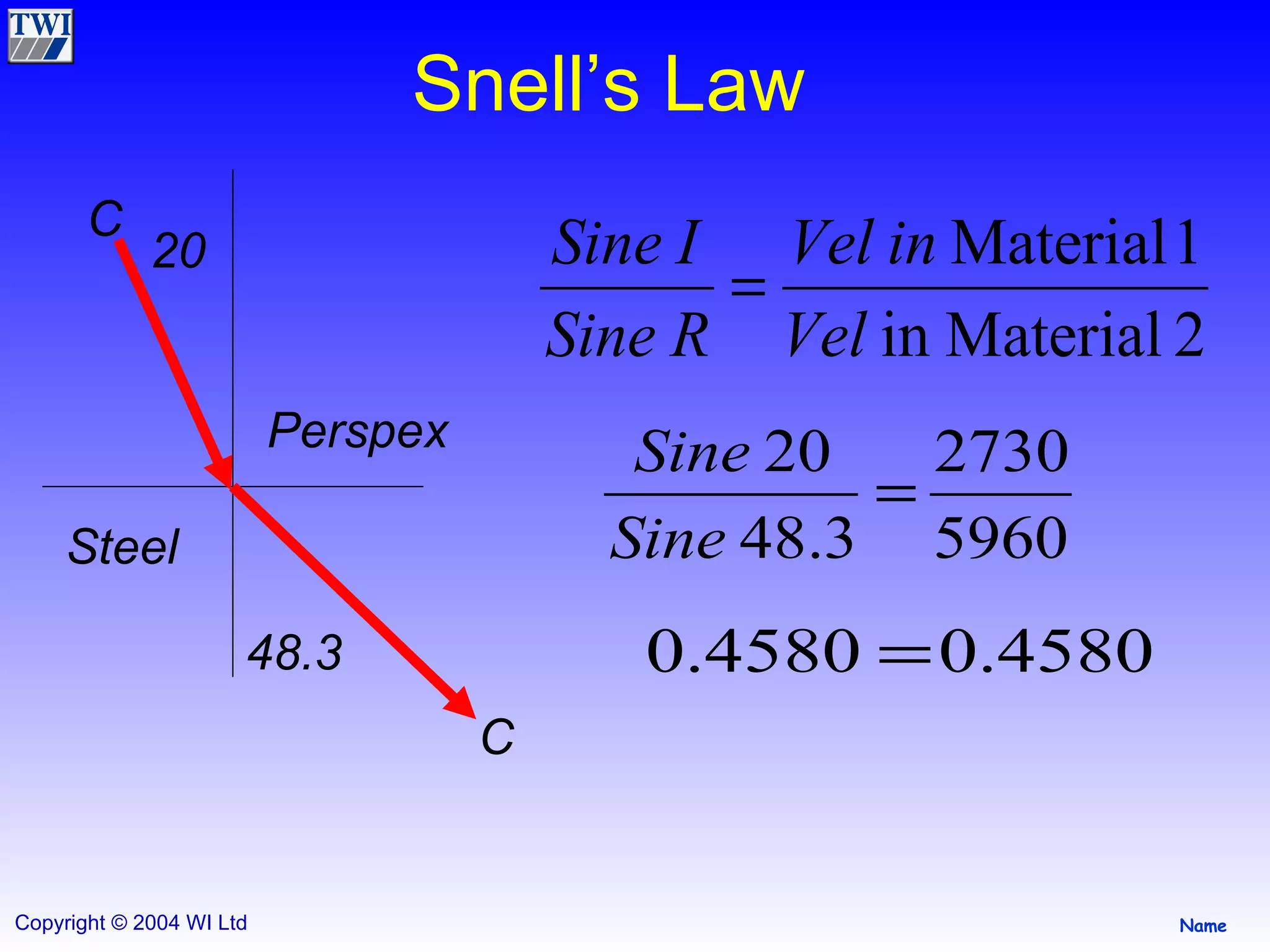
Snell’s Law C Perspex Steel C 20 48.3
Snell’s Law C Perspex Steel C 15 34.4
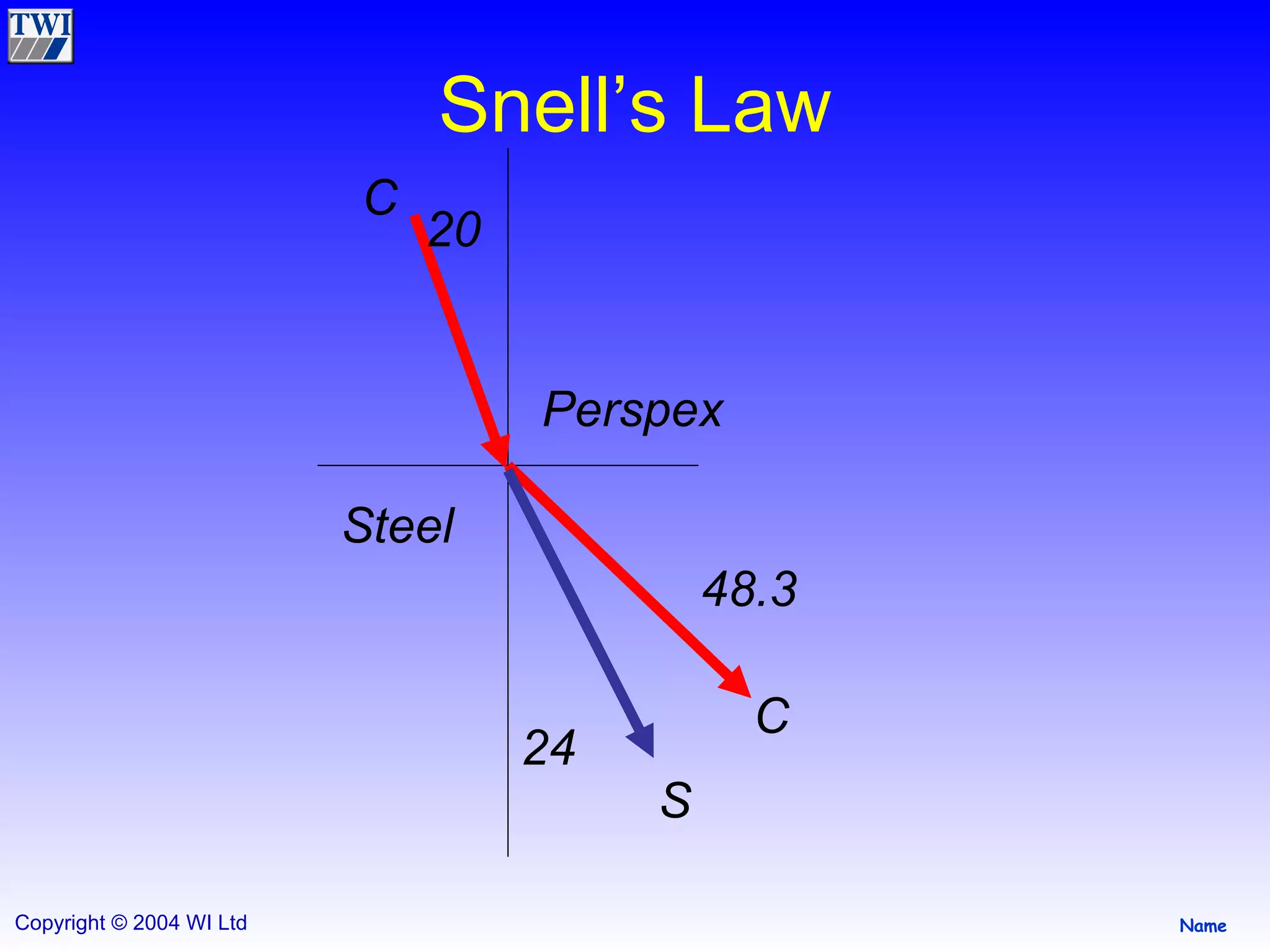
Snell’s Law C Perspex Steel C 20 S 48.3 24
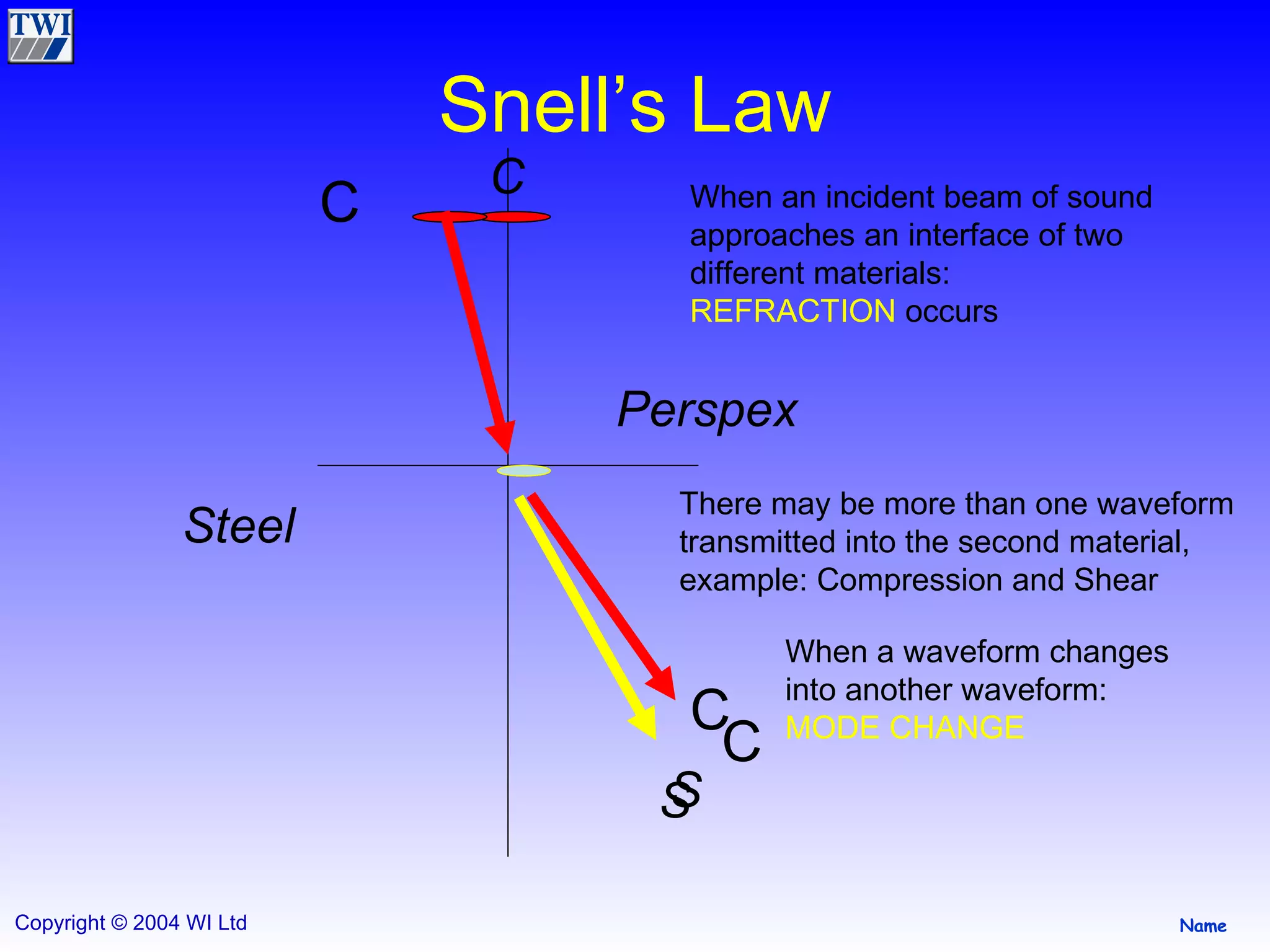
Snell’s Law Perspex Steel S C C When an incident beam of sound approaches an interface of two different materials: REFRACTION  occurs There may be more than one waveform transmitted into the second material, example: Compression and Shear When a waveform changes into another waveform:  MODE CHANGE C C S
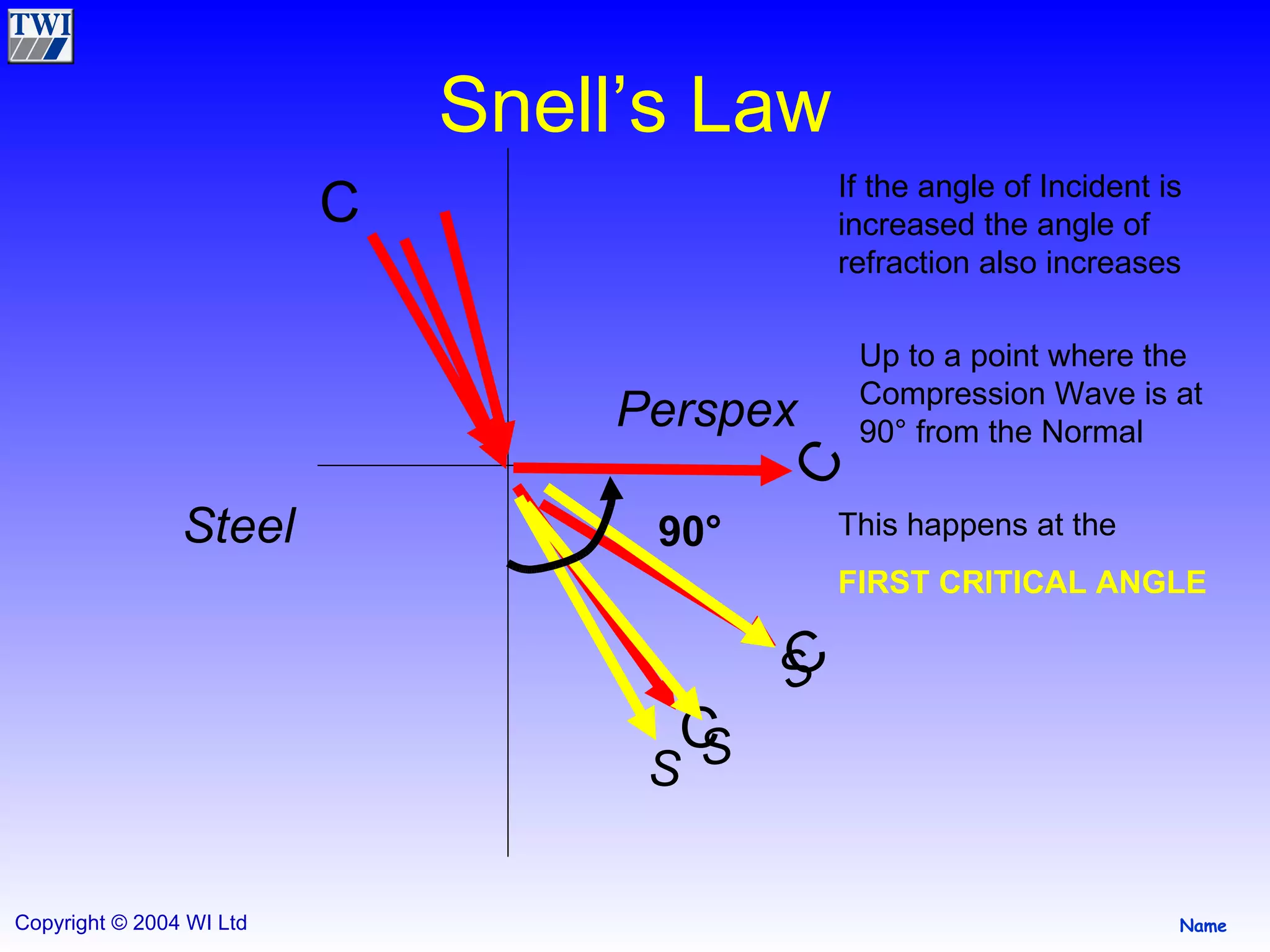
Snell’s Law Perspex Steel C If the angle of Incident is increased the angle of refraction also increases Up to a point where the Compression Wave is at 90 ° from the Normal 90 ° This happens at the  FIRST CRITICAL ANGLE C S C S C S
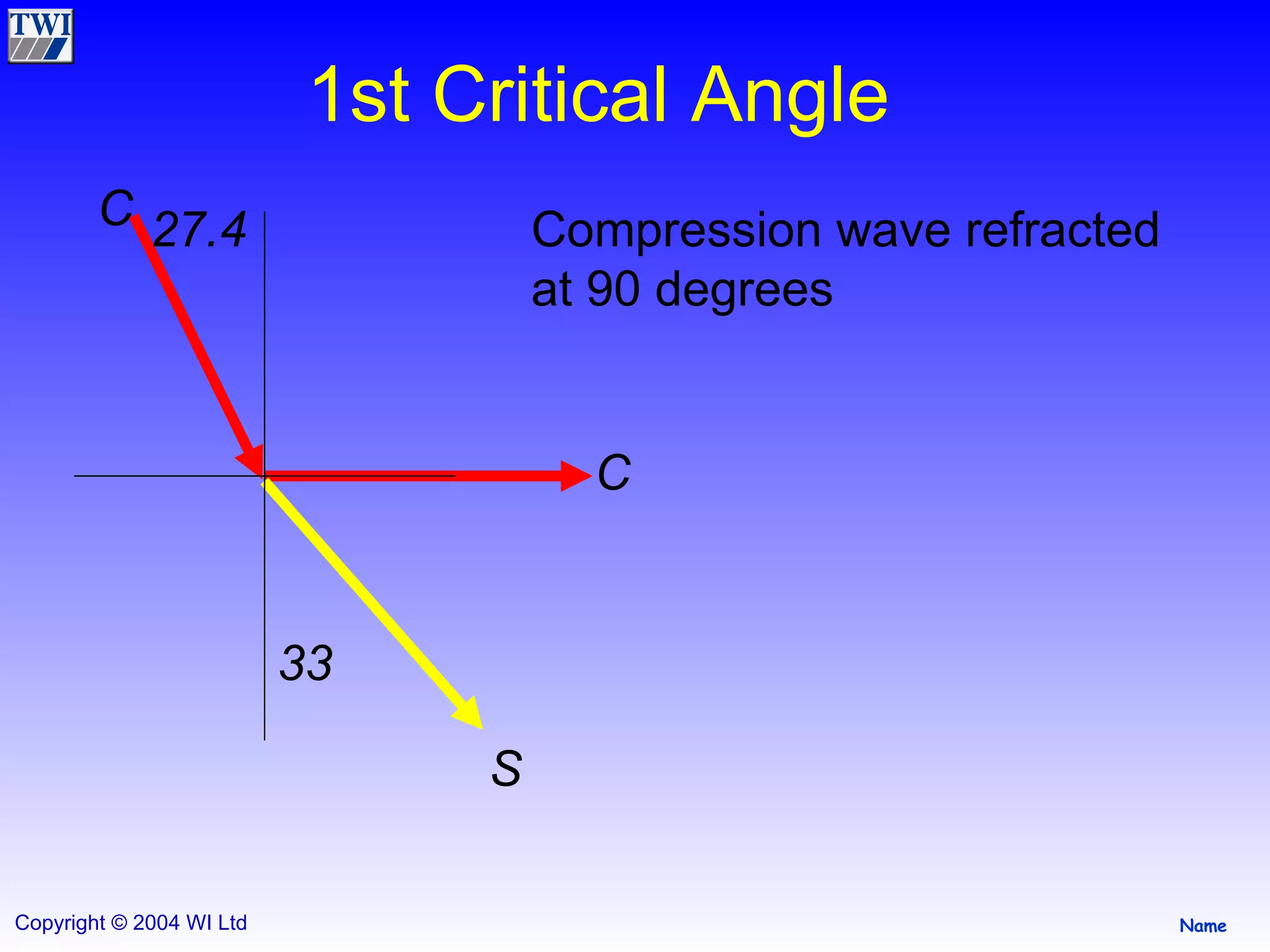
1st Critical Angle C 27.4 S 33 C Compression wave refracted at 90 degrees
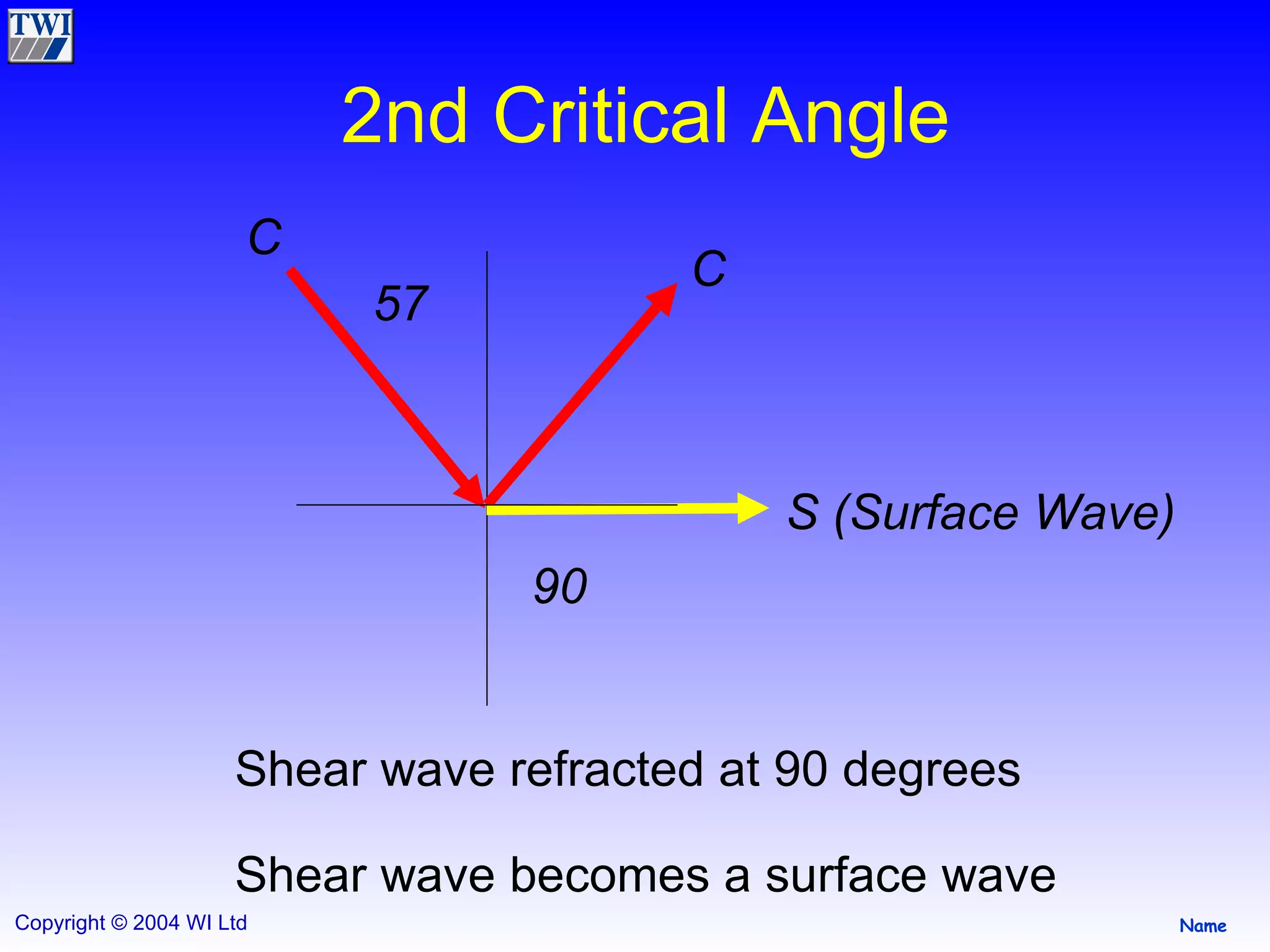
2nd Critical Angle C S (Surface Wave) 90 C Shear wave refracted at 90 degrees 57 Shear wave becomes a surface wave
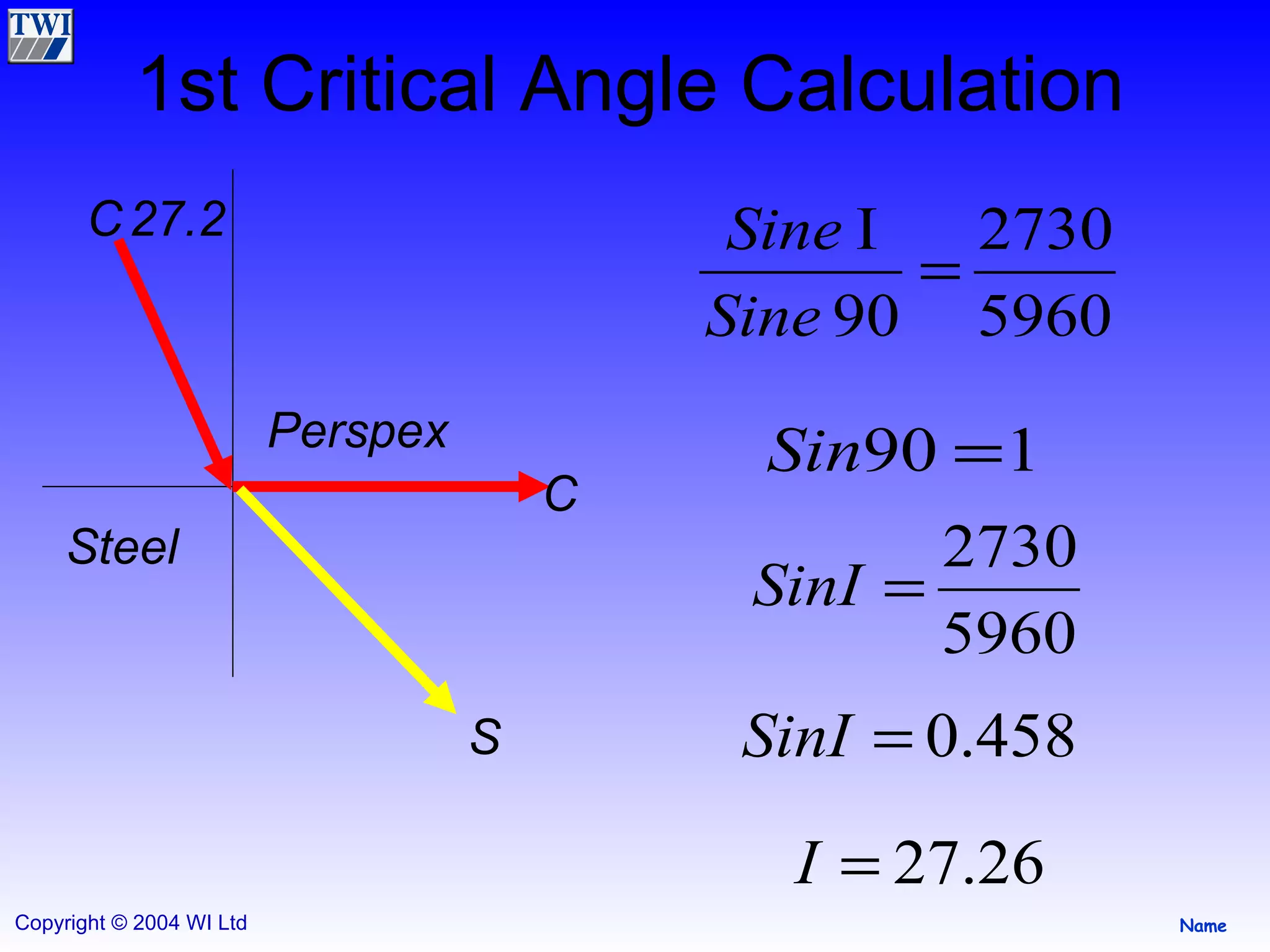
1st Critical Angle Calculation C Perspex Steel C S 27.2
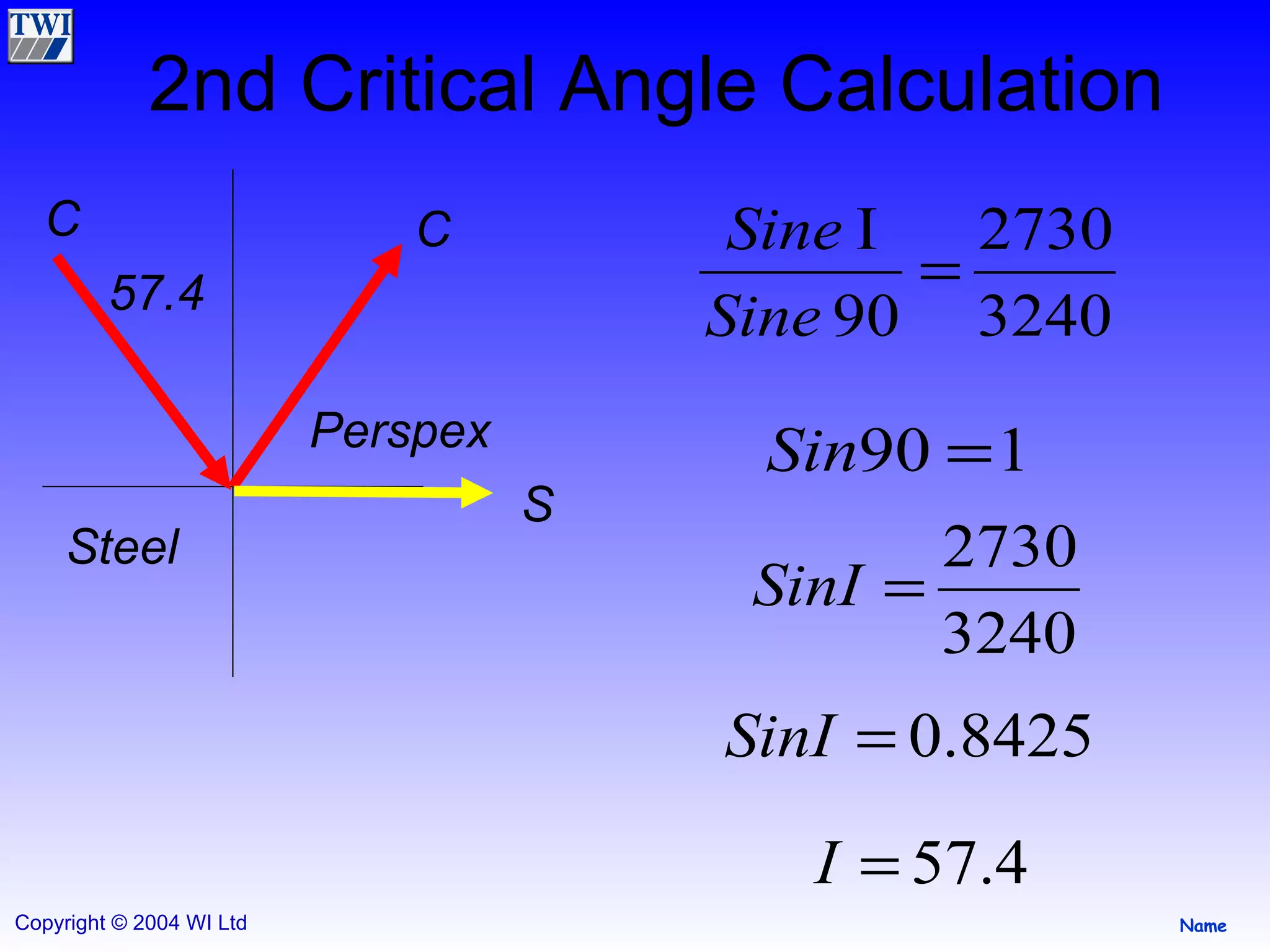
2nd Critical Angle Calculation C Perspex Steel C S 57.4
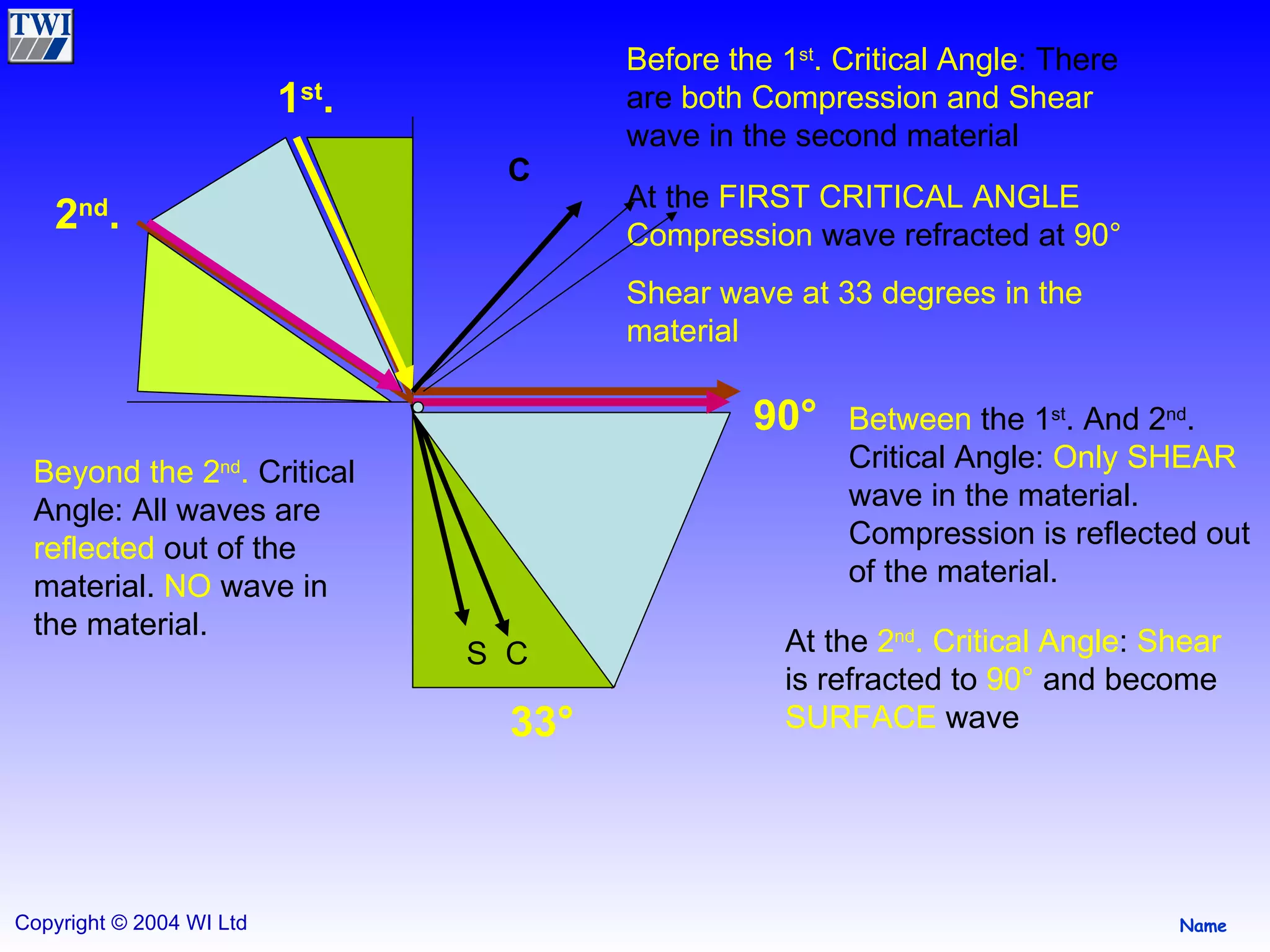
1 st . 2 nd . 33 ° 90 ° Before the 1 st . Critical Angle : There are  both Compression and Shear  wave in the second material At the  FIRST CRITICAL ANGLE   Compression  wave refracted at  90 ° Shear wave at 33 degrees in the material Between  the 1 st . And 2 nd . Critical Angle:  Only SHEAR  wave in the material. Compression is reflected out of the material. At the  2 nd . Critical Angle :  Shear  is refracted to  90 °  and become  SURFACE  wave Beyond the 2 nd .  Critical Angle: All waves are  reflected  out of the material.  NO  wave in the material. S  C C
 
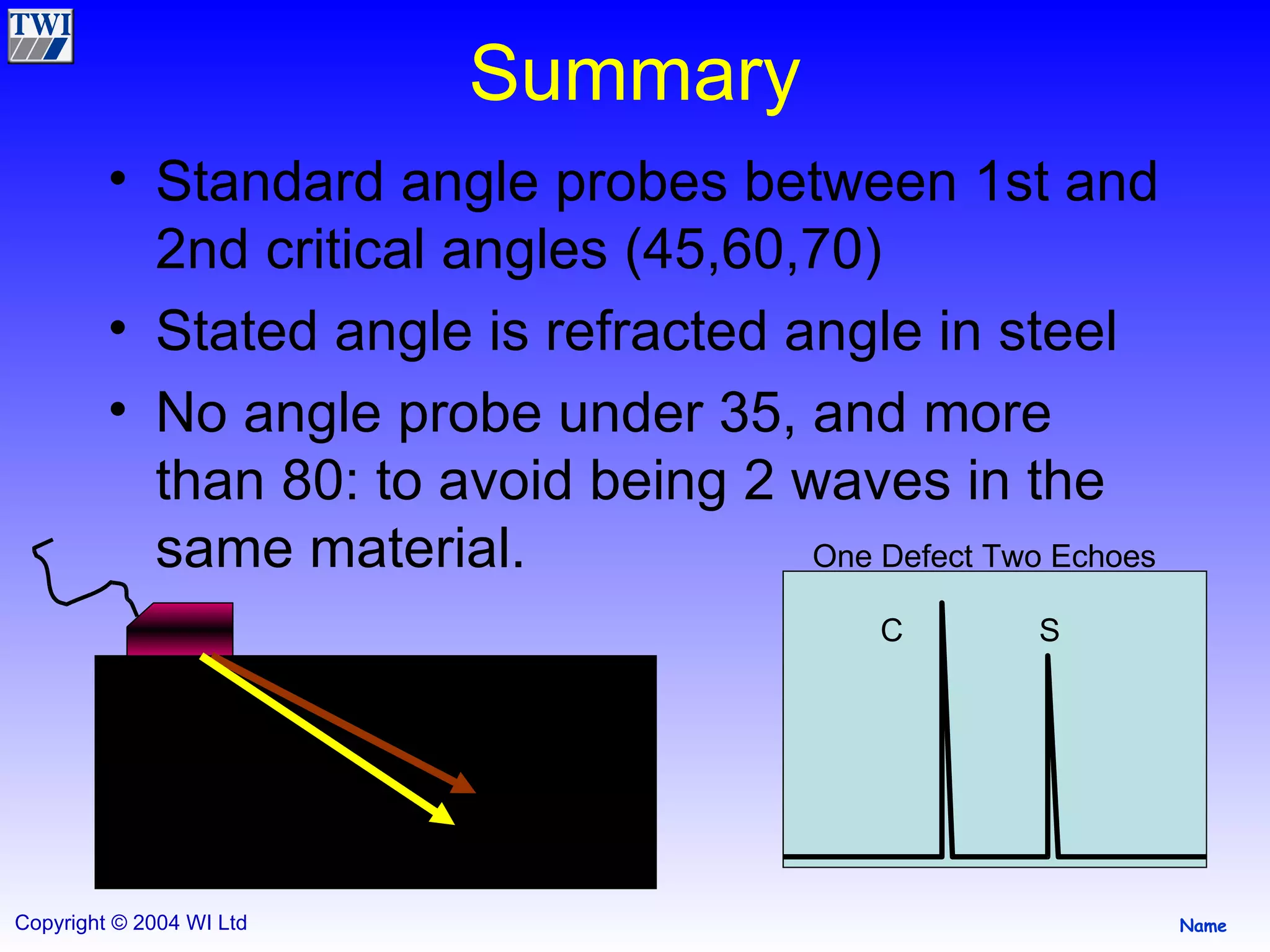
Summary Standard angle probes between 1st and 2nd critical angles (45,60,70) Stated angle is refracted angle in steel No angle probe under 35, and more than 80: to avoid being 2 waves in the same material. C S One Defect Two Echoes C S
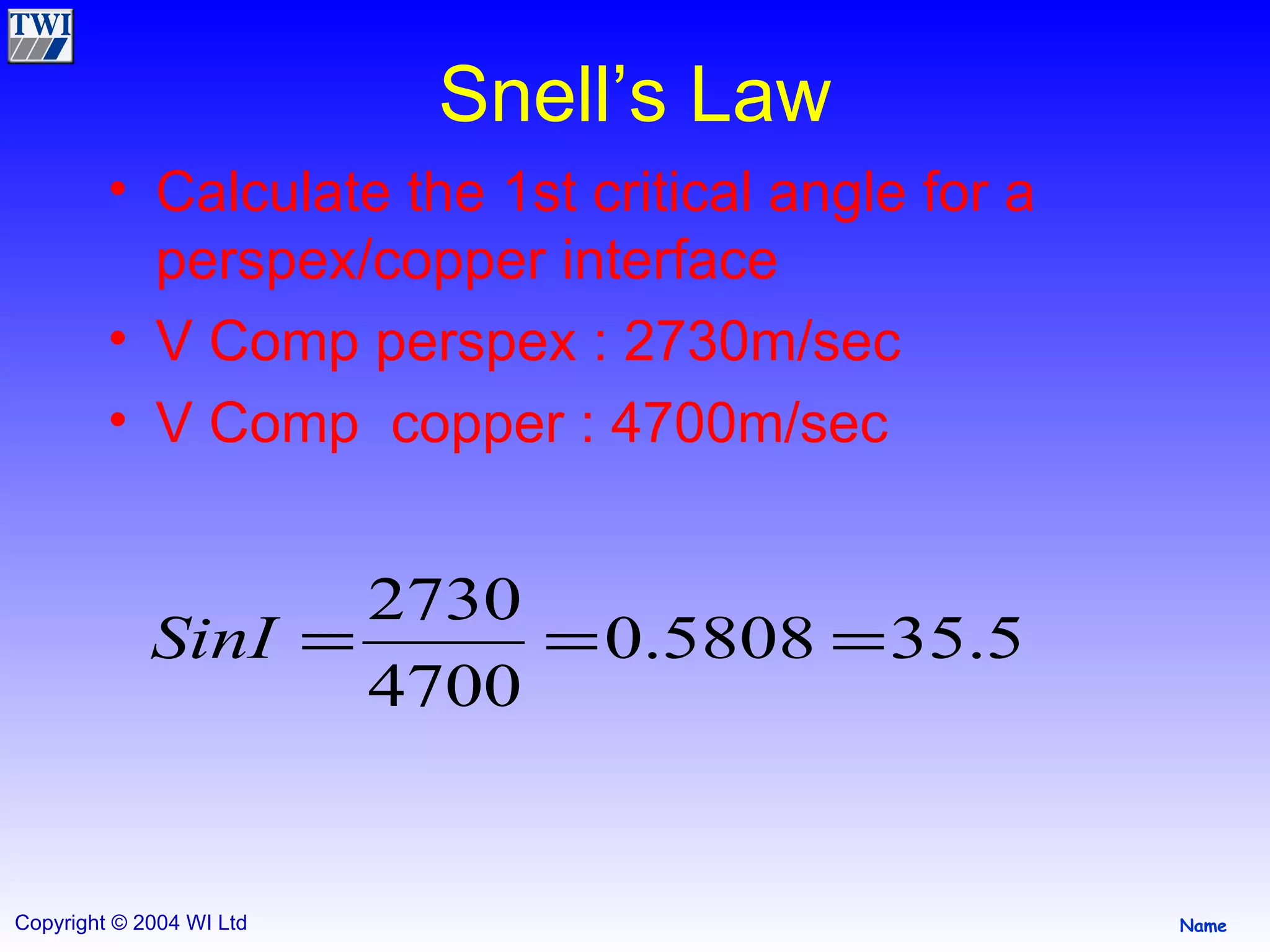
Snell’s Law Calculate the 1st critical angle for a perspex/copper interface V Comp perspex : 2730m/sec V Comp  copper : 4700m/sec

Ut P2

  • 1.
  • 2.
    Ultrasonic Testing techniquesPulse Echo Through Transmission Transmission with Reflection
  • 3.
    Pulse Echo TechniqueSingle probe sends and receives sound Gives an indication of defect depth and dimensions Not fail safe
  • 4.
    Defect Position Noindication from defect A (wrong orientation) A B B
  • 5.
    Through Transmission TechniqueTransmitting and receiving probes on opposite sides of the specimen Presence of defect indicated by reduction in transmission signal No indication of defect location Fail safe method Tx Rx
  • 6.
  • 7.
    Through Transmission TechniqueAdvantages Less attenuation No probe ringing No dead zone Orientation does not matter Disadvantages Defect not located Defect can’t be identified Vertical defects don’t show Must be automated Need access to both surfaces
  • 8.
    Transmission with ReflectionAlso known as: Tandem Technique or Pitch and Catch Technique R T
  • 9.
    Ultrasonic Pulse A short pulse of electricity is applied to a piezo-electric crystal The crystal begins to vibration increases to maximum amplitude and then decays Pulse length Maximum 10% of Maximum
  • 10.
    Pulse Length Thelonger the pulse, the more penetrating the sound The shorter the pulse the better the sensitivity and resolution Short pulse, 1 or 2 cycles Long pulse 12 cycles
  • 11.
    Ideal Pulse Length5 cycles for weld testing
  • 12.
    The Sound BeamDead Zone Near Zone or Fresnel Zone Far Zone or Fraunhofer Zone
  • 13.
    The Sound BeamNZ FZ Main Beam Distance Intensity varies Exponential Decay
  • 14.
    Main Lobe SideLobes Near Zone Main Beam The main beam or the centre beam has the highest intensity of sound energy Any reflector hit by the main beam will reflect the high amount of energy The side lobes has multi minute main beams Two identical defects may give different amplitudes of signals
  • 15.
    Sound Beam NearZone Thickness measurement Detection of defects Sizing of large defects only Far Zone Thickness measurement Defect detection Sizing of all defects Near zone length as small as possible
  • 16.
  • 17.
    Near Zone Whatis the near zone length of a 5MHz compression probe with a crystal diameter of 10mm in steel?
  • 18.
    Near Zone Thebigger the diameter the bigger the near zone The higher the frequency the bigger the near zone The lower the velocity the bigger the near zone Should large diameter crystal probes have a high or low frequency?
  • 19.
    Which of theabove probes has the longest Near Zone ? 1 M Hz 5 M Hz 1 M Hz 5 M Hz
  • 20.
    Near Zone Thebigger the diameter the bigger the near zone The higher the frequency the bigger the near zone The lower the velocity the bigger the near zone Should large diameter crystal probes have a high or low frequency?
  • 21.
    Beam Spread Inthe far zone sound pulses spread out as they move away from the crystal   / 2
  • 22.
    Beam Spread Edge,K=1.2220dB,K=1.08 6dB,K=0.56 Beam axis or Main Beam
  • 23.
    Beam Spread Thebigger the diameter the smaller the beam spread The higher the frequency the smaller the beam spread Which has the larger beam spread, a compression or a shear wave probe?
  • 24.
    Beam Spread Whatis the beam spread of a 10mm,5MHz compression wave probe in steel?
  • 25.
    Which of theabove probes has the Largest Beam Spread ? 1 M Hz 5 M Hz 1 M Hz 5 M Hz
  • 26.
    Beam Spread Thebigger the diameter the smaller the beam spread The higher the frequency the smaller the beam spread Which has the larger beam spread, a compression or a shear wave probe?
  • 27.
    Testing close toside walls
  • 28.
    Sound at anInterface Sound will be either transmitted across or reflected back Reflected Transmitted How much is reflected and transmitted depends upon the relative acoustic impedance of the 2 materials Interface
  • 29.
    The Phenomenon ofSound REFLECTION REFRACTION DIFFRACTION
  • 30.
    The Phenomenon ofSound REFLECTION REFRACTION DIFFRACTION
  • 31.
    Law of ReflectionAngle of Incidence = Angle of Reflection 60 o 60 o
  • 32.
    Inclined incidence(not at90 o ) Incident Transmitted The sound is refracted due to differences in sound velocity in the 2 DIFFERENT materials
  • 33.
    REFRACTION Only occurswhen: The incident angle is other than 0 ° 30 ° Refracted Water Steel Steel Steel Water Steel
  • 34.
    REFRACTION Only occurswhen: The incident angle is other than 0 ° 30 ° Refracted The Two Materials has different VELOCITIES No Refraction 30 ° 30 ° 65 ° Steel Steel Water Steel
  • 35.
    Snell’s Law IR Material 1 Material 2 Incident Refracted Normal
  • 36.
    Snell’s Law CPerspex Steel C 20 48.3
  • 37.
    Snell’s Law CPerspex Steel C 15 34.4
  • 38.
    Snell’s Law CPerspex Steel C 20 S 48.3 24
  • 39.
    Snell’s Law PerspexSteel S C C When an incident beam of sound approaches an interface of two different materials: REFRACTION occurs There may be more than one waveform transmitted into the second material, example: Compression and Shear When a waveform changes into another waveform: MODE CHANGE C C S
  • 40.
    Snell’s Law PerspexSteel C If the angle of Incident is increased the angle of refraction also increases Up to a point where the Compression Wave is at 90 ° from the Normal 90 ° This happens at the FIRST CRITICAL ANGLE C S C S C S
  • 41.
    1st Critical AngleC 27.4 S 33 C Compression wave refracted at 90 degrees
  • 42.
    2nd Critical AngleC S (Surface Wave) 90 C Shear wave refracted at 90 degrees 57 Shear wave becomes a surface wave
  • 43.
    1st Critical AngleCalculation C Perspex Steel C S 27.2
  • 44.
    2nd Critical AngleCalculation C Perspex Steel C S 57.4
  • 45.
    1 st .2 nd . 33 ° 90 ° Before the 1 st . Critical Angle : There are both Compression and Shear wave in the second material At the FIRST CRITICAL ANGLE Compression wave refracted at 90 ° Shear wave at 33 degrees in the material Between the 1 st . And 2 nd . Critical Angle: Only SHEAR wave in the material. Compression is reflected out of the material. At the 2 nd . Critical Angle : Shear is refracted to 90 ° and become SURFACE wave Beyond the 2 nd . Critical Angle: All waves are reflected out of the material. NO wave in the material. S C C
  • 46.
  • 47.
    Summary Standard angleprobes between 1st and 2nd critical angles (45,60,70) Stated angle is refracted angle in steel No angle probe under 35, and more than 80: to avoid being 2 waves in the same material. C S One Defect Two Echoes C S
  • 48.
    Snell’s Law Calculatethe 1st critical angle for a perspex/copper interface V Comp perspex : 2730m/sec V Comp copper : 4700m/sec