OSMOTIC POWER GENERATION
P .Rajanikanth Reddy
M.Tech-Thermal
172071010
4/3/2018 Department of Mechanical Engineering 1
Introduction
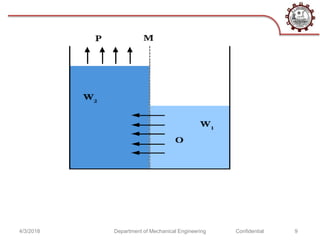
 The tendency of a fluid, usually water, to pass through a
semi-permeable membrane into a solution where the
solvent concentration is higher, thus equalizing the
concentrations of materials on either side of the membrane.
 The diffusion of fluids through membranes or porous
partitions.
 Movement of a solvent (such as water) through
a semipermeable membrane (as of a living cell) into a
solution of higher solute concentration that tends to
equalize the concentrations of solute on the two sides of
the membrane
4/3/2018 Department of Mechanical Engineering Confidential 2
Introduction
Osmotic power, salinity gradient power or blue energy is the
energy available from the difference in the salt concentration
between seawater and river water.
Two practical methods for this are reverse electrodialysis (RED)
and pressure retarded osmosis (PRO).
Both processes rely on osmosis with membranes and the
byproduct is brackish water.
Because brackish water is hostile to the growth of most
terrestrial plant species, without appropriate management it is
damaging to the environment
4/3/2018 Department of Mechanical Engineering 3
Introduction
The method of generating power by pressure retarded osmosis
was invented by Prof. Sidney Loeb in 1973 at the Ben-Gurion
University of the Negev, Beersheba, Israel.
4/3/2018 Department of Mechanical Engineering 4
Basics of salinity gradient power
 Salinity gradient power is a specific renewable energy
alternative that creates renewable and sustainable power by
using naturally occurring processes and no release of carbon
dioxide.
 Salinity gradient energy is based on using the resources of
“osmotic pressure difference between fresh water and sea
water.
 All energy that is proposed to use salinity gradient technology
relies on the evaporation to separate water from salt.
 Osmotic pressure is the "chemical potential of concentrated and
dilute solutions of salt"
4/3/2018 Department of Mechanical Engineering Confidential 5
 Commonly discussed generation techniques are pressure-
retarded osmosis (PRO).
 While the mechanics and concepts of salinity gradient power are
still being studied, the power source has been implemented in
several different locations. Most of these are experimental, but
thus far they have been predominantly successful
 The various companies that have utilized this power have also
done so in many different ways as there are several concepts and
processes that harness the power from salinity gradient.
4/3/2018 Department of Mechanical Engineering 6
Pressure-retarded osmosis
4/3/2018 Department of Mechanical Engineering 7
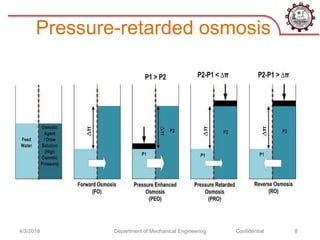
One method to utilize salinity gradient energy is
called pressure-retarded osmosis.
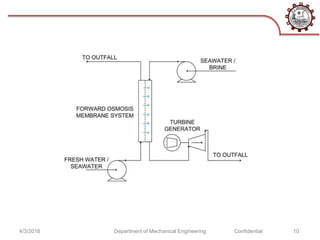
In this method, seawater is pumped into a pressure chamber that
is at a pressure lower than the difference between the pressures of
saline water and fresh water.
 Freshwater is also pumped into the pressure chamber through a
membrane, which increase both the volume and pressure of the
chamber.
As the pressure differences are compensated, a turbine is spun,
providing kinetic energy.
Pressure-retarded osmosis
4/3/2018 Department of Mechanical Engineering Confidential 8
4/3/2018 Department of Mechanical Engineering Confidential 9
4/3/2018 Department of Mechanical Engineering Confidential 10
Reversed electrodialysis
4/3/2018 Department of Mechanical Engineering Confidential 11
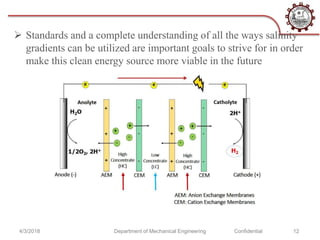
A second method being developed and studied is reversed
electrodialysis or reverse dialysis, which is essentially the
creation of a salt battery.
This method was described by Weinstein and Leitz as “an
array of alternating anion and cation exchange membranes
can be used to generate electric power from the free energy
of river and sea water.”
The technology related to this type of power is still in its
infant stages, even though the principle was discovered in
the 1950s.
 Standards and a complete understanding of all the ways salinity
gradients can be utilized are important goals to strive for in order
make this clean energy source more viable in the future
4/3/2018 Department of Mechanical Engineering Confidential 12
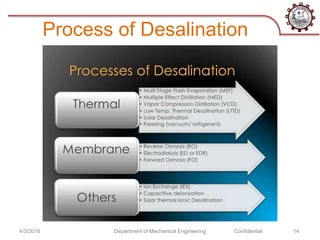
Capacitive method
 Relatively new method and is used only in lab till now.
 With this method energy can be extracted out of the mixing
of saline water and freshwater by cyclically charging
up electrodes in contact with saline water, followed by a
discharge in freshwater.
 Since the amount of electrical energy which is needed during
the charging step is less than one gets out during the
discharge step, each completed cycle effectively produces
energy.
 By introducing a salinity gradient and allowing some of the
ions to diffuse out of the capacitor, this reduces the
capacitance, and so the voltage must increase, since the
voltage equals the ratio of charge to capacitance.
4/3/2018 Department of Mechanical Engineering Confidential 13
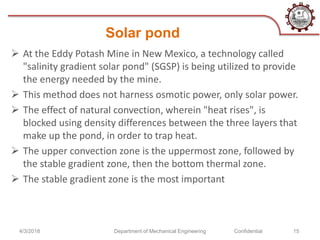
Process of Desalination
4/3/2018 Department of Mechanical Engineering Confidential 14
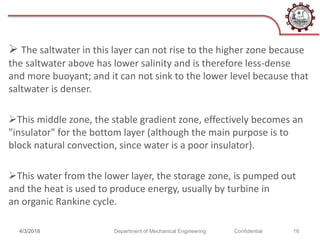
Solar pond
 At the Eddy Potash Mine in New Mexico, a technology called
"salinity gradient solar pond" (SGSP) is being utilized to provide
the energy needed by the mine.
 This method does not harness osmotic power, only solar power.
 The effect of natural convection, wherein "heat rises", is
blocked using density differences between the three layers that
make up the pond, in order to trap heat.
 The upper convection zone is the uppermost zone, followed by
the stable gradient zone, then the bottom thermal zone.
 The stable gradient zone is the most important
4/3/2018 Confidential 15Department of Mechanical Engineering
 The saltwater in this layer can not rise to the higher zone because
the saltwater above has lower salinity and is therefore less-dense
and more buoyant; and it can not sink to the lower level because that
saltwater is denser.
This middle zone, the stable gradient zone, effectively becomes an
"insulator" for the bottom layer (although the main purpose is to
block natural convection, since water is a poor insulator).
This water from the lower layer, the storage zone, is pumped out
and the heat is used to produce energy, usually by turbine in
an organic Rankine cycle.
4/3/2018 Confidential 16Department of Mechanical Engineering
 In theory a solar pond could be used to generate osmotic
power if evaporation from solar heat is used to create a
salinity gradient, and the potential energy in this salinity
gradient is harnessed directly using one of the first three
methods above, such as the capacitive method.
4/3/2018 Department of Mechanical Engineering Confidential 17
Possible negative environmental
impact
 Marine and river environments have obvious differences in
water quality, namely salinity.
 Each species of aquatic plant and animal is adapted to survive
in either marine, brackish, or freshwater environments.
 The main waste product of salinity gradient technology is
brackish water.
 The discharge of brackish water into the surrounding
waters, if done in large quantities and with any regularity,
will cause salinity fluctuations.

4/3/2018 Department of Mechanical Engineering Confidential 18
 While some variation in salinity is usual, particularly where
fresh water (rivers) empties into an ocean or sea anyway, these
variations become less important for both bodies of water with
the addition of brackish waste waters.
 Extreme salinity changes in an aquatic environment may result
in findings of low densities of both animals and plants due to
intolerance of sudden severe salinity drops or spikes.
 The impact of brackish water on ecosystems can be minimized
by pumping it out to sea and releasing it into the mid-layer,
away from the surface and bottom ecosystems.
4/3/2018 Department of Mechanical Engineering Confidential 19
Thank you
4/3/2018 Department of Mechanical Engineering Confidential 20

Osmotic power generation

  • 1.
    OSMOTIC POWER GENERATION P.Rajanikanth Reddy M.Tech-Thermal 172071010 4/3/2018 Department of Mechanical Engineering 1
  • 2.
    Introduction  The tendencyof a fluid, usually water, to pass through a semi-permeable membrane into a solution where the solvent concentration is higher, thus equalizing the concentrations of materials on either side of the membrane.  The diffusion of fluids through membranes or porous partitions.  Movement of a solvent (such as water) through a semipermeable membrane (as of a living cell) into a solution of higher solute concentration that tends to equalize the concentrations of solute on the two sides of the membrane 4/3/2018 Department of Mechanical Engineering Confidential 2
  • 3.
    Introduction Osmotic power, salinitygradient power or blue energy is the energy available from the difference in the salt concentration between seawater and river water. Two practical methods for this are reverse electrodialysis (RED) and pressure retarded osmosis (PRO). Both processes rely on osmosis with membranes and the byproduct is brackish water. Because brackish water is hostile to the growth of most terrestrial plant species, without appropriate management it is damaging to the environment 4/3/2018 Department of Mechanical Engineering 3
  • 4.
    Introduction The method ofgenerating power by pressure retarded osmosis was invented by Prof. Sidney Loeb in 1973 at the Ben-Gurion University of the Negev, Beersheba, Israel. 4/3/2018 Department of Mechanical Engineering 4
  • 5.
    Basics of salinitygradient power  Salinity gradient power is a specific renewable energy alternative that creates renewable and sustainable power by using naturally occurring processes and no release of carbon dioxide.  Salinity gradient energy is based on using the resources of “osmotic pressure difference between fresh water and sea water.  All energy that is proposed to use salinity gradient technology relies on the evaporation to separate water from salt.  Osmotic pressure is the "chemical potential of concentrated and dilute solutions of salt" 4/3/2018 Department of Mechanical Engineering Confidential 5
  • 6.
     Commonly discussedgeneration techniques are pressure- retarded osmosis (PRO).  While the mechanics and concepts of salinity gradient power are still being studied, the power source has been implemented in several different locations. Most of these are experimental, but thus far they have been predominantly successful  The various companies that have utilized this power have also done so in many different ways as there are several concepts and processes that harness the power from salinity gradient. 4/3/2018 Department of Mechanical Engineering 6
  • 7.
    Pressure-retarded osmosis 4/3/2018 Departmentof Mechanical Engineering 7 One method to utilize salinity gradient energy is called pressure-retarded osmosis. In this method, seawater is pumped into a pressure chamber that is at a pressure lower than the difference between the pressures of saline water and fresh water.  Freshwater is also pumped into the pressure chamber through a membrane, which increase both the volume and pressure of the chamber. As the pressure differences are compensated, a turbine is spun, providing kinetic energy.
  • 8.
    Pressure-retarded osmosis 4/3/2018 Departmentof Mechanical Engineering Confidential 8
  • 9.
    4/3/2018 Department ofMechanical Engineering Confidential 9
  • 10.
    4/3/2018 Department ofMechanical Engineering Confidential 10
  • 11.
    Reversed electrodialysis 4/3/2018 Departmentof Mechanical Engineering Confidential 11 A second method being developed and studied is reversed electrodialysis or reverse dialysis, which is essentially the creation of a salt battery. This method was described by Weinstein and Leitz as “an array of alternating anion and cation exchange membranes can be used to generate electric power from the free energy of river and sea water.” The technology related to this type of power is still in its infant stages, even though the principle was discovered in the 1950s.
  • 12.
     Standards anda complete understanding of all the ways salinity gradients can be utilized are important goals to strive for in order make this clean energy source more viable in the future 4/3/2018 Department of Mechanical Engineering Confidential 12
  • 13.
    Capacitive method  Relativelynew method and is used only in lab till now.  With this method energy can be extracted out of the mixing of saline water and freshwater by cyclically charging up electrodes in contact with saline water, followed by a discharge in freshwater.  Since the amount of electrical energy which is needed during the charging step is less than one gets out during the discharge step, each completed cycle effectively produces energy.  By introducing a salinity gradient and allowing some of the ions to diffuse out of the capacitor, this reduces the capacitance, and so the voltage must increase, since the voltage equals the ratio of charge to capacitance. 4/3/2018 Department of Mechanical Engineering Confidential 13
  • 14.
    Process of Desalination 4/3/2018Department of Mechanical Engineering Confidential 14
  • 15.
    Solar pond  Atthe Eddy Potash Mine in New Mexico, a technology called "salinity gradient solar pond" (SGSP) is being utilized to provide the energy needed by the mine.  This method does not harness osmotic power, only solar power.  The effect of natural convection, wherein "heat rises", is blocked using density differences between the three layers that make up the pond, in order to trap heat.  The upper convection zone is the uppermost zone, followed by the stable gradient zone, then the bottom thermal zone.  The stable gradient zone is the most important 4/3/2018 Confidential 15Department of Mechanical Engineering
  • 16.
     The saltwaterin this layer can not rise to the higher zone because the saltwater above has lower salinity and is therefore less-dense and more buoyant; and it can not sink to the lower level because that saltwater is denser. This middle zone, the stable gradient zone, effectively becomes an "insulator" for the bottom layer (although the main purpose is to block natural convection, since water is a poor insulator). This water from the lower layer, the storage zone, is pumped out and the heat is used to produce energy, usually by turbine in an organic Rankine cycle. 4/3/2018 Confidential 16Department of Mechanical Engineering
  • 17.
     In theorya solar pond could be used to generate osmotic power if evaporation from solar heat is used to create a salinity gradient, and the potential energy in this salinity gradient is harnessed directly using one of the first three methods above, such as the capacitive method. 4/3/2018 Department of Mechanical Engineering Confidential 17
  • 18.
    Possible negative environmental impact Marine and river environments have obvious differences in water quality, namely salinity.  Each species of aquatic plant and animal is adapted to survive in either marine, brackish, or freshwater environments.  The main waste product of salinity gradient technology is brackish water.  The discharge of brackish water into the surrounding waters, if done in large quantities and with any regularity, will cause salinity fluctuations.  4/3/2018 Department of Mechanical Engineering Confidential 18
  • 19.
     While somevariation in salinity is usual, particularly where fresh water (rivers) empties into an ocean or sea anyway, these variations become less important for both bodies of water with the addition of brackish waste waters.  Extreme salinity changes in an aquatic environment may result in findings of low densities of both animals and plants due to intolerance of sudden severe salinity drops or spikes.  The impact of brackish water on ecosystems can be minimized by pumping it out to sea and releasing it into the mid-layer, away from the surface and bottom ecosystems. 4/3/2018 Department of Mechanical Engineering Confidential 19
  • 20.
    Thank you 4/3/2018 Departmentof Mechanical Engineering Confidential 20