PHYSIOLOGY OF SMELL
BY GROUP 5
Name ID
1. TUT WICHMACH…………………...RU2059/13
2. EYOB KASEYA…………………………RU0037/13
3. NEJMUDIN NURA………………….RU2317/13
4. TARIKU DEMLEW……………….…RU1304/13
5. TINSAE KASSA………………………..RU3052/13
6. GIFTY GADISA…………………………RU0322/12
OUT LINE
• The olfactory (smell) system
• Olfactory stimuli
• Olfactory cortex of the Olfactory System
• Olfactory receptor cells 1&2
• Mechanism of excitation of the olfactory cells
• Membrane potential & action potential of
olfactory cell
• Transmission of olfactory signal to olfactory bulb
• Olfactory glomeruli
The Olfactory (Smell) System
 The olfactory system is the least understood sensory system
 It helps us enjoy life (e.g. perfume, and food)
 Smell can be a powerful stimulant of human emotions.
 It is also a warning system alerting us to dangerous signals
(e.g., gas leak, spoiled food)
 It helps in choosing mates in some mammals (release of
pheromones)
 Minute quantity of an odorant in the air can elicit a smell
sensation
 Methylmercaptan can be smelled when only 25x10-12 g is
present in each ml of air.
 This substance is mixed with natural gas so that even a
small amount of gas leak can be detected.
Olfaction – The Sense of Smell
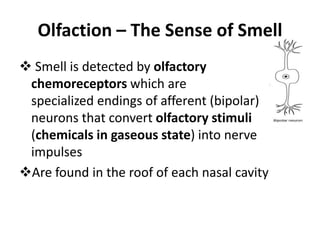
 Smell is detected by olfactory
chemoreceptors which are
specialized endings of afferent (bipolar)
neurons that convert olfactory stimuli
(chemicals in gaseous state) into nerve
impulses
Are found in the roof of each nasal cavity
Olfaction – The Sense of Smell
What are Olfactory Stimuli?
 Odorants (airborne molecules)
 Odorants must be volatile (they give off vapors)
 More vapors are given off when an odorant is
heated!! (warm soup smells better than cold
soup)
 Odorants reach olfactory
receptors by being inhaled:
• Through the nose.
• Through the mouth
(vapors circulate up
through throat)
Olfactory cortex of the Olfactory System
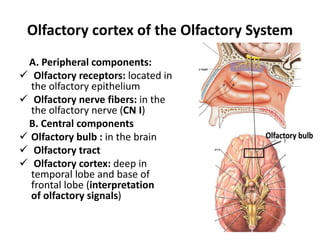
A. Peripheral components:
 Olfactory receptors: located in
the olfactory epithelium
 Olfactory nerve fibers: in the
the olfactory nerve (CN I)
B. Central components
 Olfactory bulb : in the brain
 Olfactory tract
 Olfactory cortex: deep in
temporal lobe and base of
frontal lobe (interpretation
of olfactory signals)
Olfactory Receptor Cells-1
Are the receptor cells for smell sensation.
There are ~ 100 million of these cells in the
olfactory epithelium
 Convert olfactory stimuli into nerve impulses
Chemicals must be dissolved in mucus for
detection
Olfactory Receptor Cells-1
Olfactory Receptor Cells-2
They are bipolar nerve cells and , unlike other
primary afferent neurons, terminate
directly in the telencephalon
 The mucosal end of the olfactory cell forms a
knob
 4 to 25 olfactory hairs (cilia) emerge from the
knob
 The cilia react to odors in the air, and stimulate
the olfactory cells (causing depolarization), but
HOW?
Olfactory Receptor Cells-2
Mechanism of Excitation of the
Olfactory Cells
 Diffusion of the odorant substance, into the mucus
 Odorant binds and activates the receptor protein, resulting
in activation of G-protein complex
 This causes activation of adenylcyclase in the cell
membrane
 This enzyme converts ATP intocAMP (a second messenger).
 This causes activation of sodiumion channels resulting in
 Depolarization and excitation of the olfactory neuron
 Transmission of nerve impulses into CNS by the olfactory
nerve.
Mechanism of Excitation of the
Olfactory Cells
Membrane Potential & Action Potential of
Olfactory Cells
 The resting membrane potential of olfactory cells
is ~ –55 mV.
 At this potential, most of the olfactory cells
generate continuous nerve impulses/action
potentials (APs) at a very slow rate (0.05 to 3 Hz).
 Most odorants cause depolarization and an
increase in the rate of APs up to 30 Hz
 Like other sensory receptors, the rate of olfactory
nerve impulses is dependent on of the stimulus
strength.
Transmission of Olfactory Signal to
Olfactory Bulb
Axons of the receptor cells penetrate the
cribriform plate and form the olfactory nerve
(CN I)
They synapse on Mitral cells in the olfactory bulb
which is just superior to the cribriform plate
Axons of Mitral cells travel along the olfactory
tract to reach the olfactory cortex
and the limbic system
Transmission of Olfactory Signal to
Olfactory Bulb
Olfactory Glomeruli
 Olfactory receptor neurons
express one type of odor
receptor
 Receptor neurons with the
same receptor type project to
the same glomerulus
 They synapse with dendrites of
mitral cells in the glomerulus.
 Mitral cells project to the
olfactory cortex.
 Granule & Periglomerular cells
(inhibitory interneurons)
modulate mitral cell activity.
Olfactory Cortex
Neuronal Connections of the OS-1
The olfactory tract
divides into 2 pathways:
1. The medial olfactory area:
• Consists of nuclei anterior to the
hypothalamus
• Concerned with basic behavior e.g.
responses to the smell of food(salivation)
Neuronal Connections of the OS-1
Neuronal Connections of the OS-2
The olfactory tract divides into 2 pathways:
2. The lateral olfactory area:
• Provide inputs to all portion of the limbic
system
e.g. hippocampus
Neuronal Connections of the OS-2
Olfactory Projection Pathways
Reference
• djouhri test and smell
 kandel test and smell
 ksumsc physiology of olfactory
https:www.nih.gov
KSUMSC physiology of smell
•THANK YOU

olfactory.pptx

  • 1.
  • 2.
    BY GROUP 5 NameID 1. TUT WICHMACH…………………...RU2059/13 2. EYOB KASEYA…………………………RU0037/13 3. NEJMUDIN NURA………………….RU2317/13 4. TARIKU DEMLEW……………….…RU1304/13 5. TINSAE KASSA………………………..RU3052/13 6. GIFTY GADISA…………………………RU0322/12
  • 3.
    OUT LINE • Theolfactory (smell) system • Olfactory stimuli • Olfactory cortex of the Olfactory System • Olfactory receptor cells 1&2 • Mechanism of excitation of the olfactory cells • Membrane potential & action potential of olfactory cell • Transmission of olfactory signal to olfactory bulb • Olfactory glomeruli
  • 4.
    The Olfactory (Smell)System  The olfactory system is the least understood sensory system  It helps us enjoy life (e.g. perfume, and food)  Smell can be a powerful stimulant of human emotions.  It is also a warning system alerting us to dangerous signals (e.g., gas leak, spoiled food)  It helps in choosing mates in some mammals (release of pheromones)  Minute quantity of an odorant in the air can elicit a smell sensation  Methylmercaptan can be smelled when only 25x10-12 g is present in each ml of air.  This substance is mixed with natural gas so that even a small amount of gas leak can be detected.
  • 5.
    Olfaction – TheSense of Smell  Smell is detected by olfactory chemoreceptors which are specialized endings of afferent (bipolar) neurons that convert olfactory stimuli (chemicals in gaseous state) into nerve impulses Are found in the roof of each nasal cavity
  • 6.
    Olfaction – TheSense of Smell
  • 7.
    What are OlfactoryStimuli?  Odorants (airborne molecules)  Odorants must be volatile (they give off vapors)  More vapors are given off when an odorant is heated!! (warm soup smells better than cold soup)  Odorants reach olfactory receptors by being inhaled: • Through the nose. • Through the mouth (vapors circulate up through throat)
  • 8.
    Olfactory cortex ofthe Olfactory System A. Peripheral components:  Olfactory receptors: located in the olfactory epithelium  Olfactory nerve fibers: in the the olfactory nerve (CN I) B. Central components  Olfactory bulb : in the brain  Olfactory tract  Olfactory cortex: deep in temporal lobe and base of frontal lobe (interpretation of olfactory signals)
  • 9.
    Olfactory Receptor Cells-1 Arethe receptor cells for smell sensation. There are ~ 100 million of these cells in the olfactory epithelium  Convert olfactory stimuli into nerve impulses Chemicals must be dissolved in mucus for detection
  • 10.
  • 11.
    Olfactory Receptor Cells-2 Theyare bipolar nerve cells and , unlike other primary afferent neurons, terminate directly in the telencephalon  The mucosal end of the olfactory cell forms a knob  4 to 25 olfactory hairs (cilia) emerge from the knob  The cilia react to odors in the air, and stimulate the olfactory cells (causing depolarization), but HOW?
  • 12.
  • 13.
    Mechanism of Excitationof the Olfactory Cells  Diffusion of the odorant substance, into the mucus  Odorant binds and activates the receptor protein, resulting in activation of G-protein complex  This causes activation of adenylcyclase in the cell membrane  This enzyme converts ATP intocAMP (a second messenger).  This causes activation of sodiumion channels resulting in  Depolarization and excitation of the olfactory neuron  Transmission of nerve impulses into CNS by the olfactory nerve.
  • 14.
    Mechanism of Excitationof the Olfactory Cells
  • 15.
    Membrane Potential &Action Potential of Olfactory Cells  The resting membrane potential of olfactory cells is ~ –55 mV.  At this potential, most of the olfactory cells generate continuous nerve impulses/action potentials (APs) at a very slow rate (0.05 to 3 Hz).  Most odorants cause depolarization and an increase in the rate of APs up to 30 Hz  Like other sensory receptors, the rate of olfactory nerve impulses is dependent on of the stimulus strength.
  • 16.
    Transmission of OlfactorySignal to Olfactory Bulb Axons of the receptor cells penetrate the cribriform plate and form the olfactory nerve (CN I) They synapse on Mitral cells in the olfactory bulb which is just superior to the cribriform plate Axons of Mitral cells travel along the olfactory tract to reach the olfactory cortex and the limbic system
  • 17.
    Transmission of OlfactorySignal to Olfactory Bulb
  • 18.
    Olfactory Glomeruli  Olfactoryreceptor neurons express one type of odor receptor  Receptor neurons with the same receptor type project to the same glomerulus  They synapse with dendrites of mitral cells in the glomerulus.  Mitral cells project to the olfactory cortex.  Granule & Periglomerular cells (inhibitory interneurons) modulate mitral cell activity.
  • 19.
  • 20.
    Neuronal Connections ofthe OS-1 The olfactory tract divides into 2 pathways: 1. The medial olfactory area: • Consists of nuclei anterior to the hypothalamus • Concerned with basic behavior e.g. responses to the smell of food(salivation)
  • 21.
  • 22.
    Neuronal Connections ofthe OS-2 The olfactory tract divides into 2 pathways: 2. The lateral olfactory area: • Provide inputs to all portion of the limbic system e.g. hippocampus
  • 23.
  • 24.
  • 25.
    Reference • djouhri testand smell  kandel test and smell  ksumsc physiology of olfactory https:www.nih.gov KSUMSC physiology of smell
  • 26.