Katie McKnight, Ph.D
@literacyworld
Katie@KatherineMcKnight.com
David Witek
@davidmwitek
dwitek@wps60.org
What We Will Do…
 A brief discussion of the connection of 21st century
technology and humanities curricula.
 Present the context where Dave teaches.
 Provide a brief overview of the Humanities Course at
Waukegan High School.
 Provide rich descriptions of the assignments, student
work and celebrations.
Kids and Technology
 Today’s students, millenials grew up with the Internet.
 Access to unlimited information that can be accessed
at any time .
 Many students prefer to use information found on the
Internet because they feel it is more abundant,
accessible, an d up-to-date (U.S. DOE 2004).
 U.S. Department if Education (U.S> DOE), Office of Educational Technology (OET). Toward A New
Golden Age in American Education: How the Internet, the Law and Today’s Expectations are
Revolutionizing Expectations. Washington, D.C., 2004.
Why do we need new stuff to teach old stuff?
 Teens spend more time online than watching
television.
 94% of teens use the Internet for school-related
research.
 71% of teens rely on Internet sources for projects.
 48% of teens think that the Internet improves their
relationships.
 24% of teens have created their own Web pages or
sites.
 43% of children (ages 4-18) in 2003 owned at least one
wireless device.
Millenials’ Demographics
(Patrick, 2004)
 Teens spend more time online than watching television.
 94% of teens use the Internet for school-related research.
 71% of teens rely on Internet sources for projects.
 48% of teens think that the Internet improves their
relationships.
 24% of teens have created their own Web pages or sites.
 43% of children (ages 4-18) in 2003 owned at least one
wireless device.
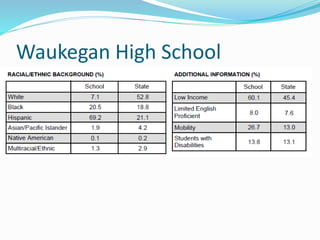
Waukegan High School
Humanities
 Taught on the 9th grade level
 Integrated curricula
The Freshman Humanities course at Waukegan High School,
which is part of Waukegan’s College Studies Program, is
designed to give students an introduction to and critical
understanding of the creative arts. Class work will include
historical surveys plus formal assessments and analyses of
the fine arts. Students will also study the work of non-
Western cultures, including Africa, Asia, India, Middle East
and Latin America. Each unit will be accompanied by a
creative assignment.
Getting Started….
When You Have NOTHING!
 Scoured for materials
 Found some materials but needed to be updated
 Textbooks that were outdated
 No Budget
Student Project #1
 Final Exam Scrapbook
 Students have a choice between taking the final exam
or creating a scrapbook.
 Students choose a topic to explore.
 Students must demonstrate what they have learned
about the topic.
Student Project #2
 Art Institute Project
 Students participate in a field trip experience.
 Students create a book about the artwork that they
viewed.
Additional Student Projects
 Romeo and Juliet project
 Soundtracks
 Video project
Cool Tools for Now
 http://prezi.com/
 http://audacity.sourceforge.net/
 http://moodle.org/
 http://www.joblo.com/
 http://www.imdb.com/
 http://www.facebook.com/

Old and New

  • 1.
  • 2.
    What We WillDo…  A brief discussion of the connection of 21st century technology and humanities curricula.  Present the context where Dave teaches.  Provide a brief overview of the Humanities Course at Waukegan High School.  Provide rich descriptions of the assignments, student work and celebrations.
  • 3.
    Kids and Technology Today’s students, millenials grew up with the Internet.  Access to unlimited information that can be accessed at any time .  Many students prefer to use information found on the Internet because they feel it is more abundant, accessible, an d up-to-date (U.S. DOE 2004).  U.S. Department if Education (U.S> DOE), Office of Educational Technology (OET). Toward A New Golden Age in American Education: How the Internet, the Law and Today’s Expectations are Revolutionizing Expectations. Washington, D.C., 2004.
  • 4.
    Why do weneed new stuff to teach old stuff?  Teens spend more time online than watching television.  94% of teens use the Internet for school-related research.  71% of teens rely on Internet sources for projects.  48% of teens think that the Internet improves their relationships.  24% of teens have created their own Web pages or sites.  43% of children (ages 4-18) in 2003 owned at least one wireless device.
  • 5.
    Millenials’ Demographics (Patrick, 2004) Teens spend more time online than watching television.  94% of teens use the Internet for school-related research.  71% of teens rely on Internet sources for projects.  48% of teens think that the Internet improves their relationships.  24% of teens have created their own Web pages or sites.  43% of children (ages 4-18) in 2003 owned at least one wireless device.
  • 6.
  • 7.
    Humanities  Taught onthe 9th grade level  Integrated curricula The Freshman Humanities course at Waukegan High School, which is part of Waukegan’s College Studies Program, is designed to give students an introduction to and critical understanding of the creative arts. Class work will include historical surveys plus formal assessments and analyses of the fine arts. Students will also study the work of non- Western cultures, including Africa, Asia, India, Middle East and Latin America. Each unit will be accompanied by a creative assignment.
  • 8.
    Getting Started…. When YouHave NOTHING!  Scoured for materials  Found some materials but needed to be updated  Textbooks that were outdated  No Budget
  • 9.
    Student Project #1 Final Exam Scrapbook  Students have a choice between taking the final exam or creating a scrapbook.  Students choose a topic to explore.  Students must demonstrate what they have learned about the topic.
  • 10.
    Student Project #2 Art Institute Project  Students participate in a field trip experience.  Students create a book about the artwork that they viewed.
  • 11.
    Additional Student Projects Romeo and Juliet project  Soundtracks  Video project
  • 12.
    Cool Tools forNow  http://prezi.com/  http://audacity.sourceforge.net/  http://moodle.org/  http://www.joblo.com/  http://www.imdb.com/  http://www.facebook.com/