Boys and Girls in the
21st Century
 Bridging the Gender Gap with Technology
                      Dr. Dave Kommer, Ashland University
              Michelle Koussa, Independence Middle School
                                                     Ohio


http://amlegendertech.pbworks.com
Agenda
 Participant Questionnaire
 Brief Overview: Gender Learning
  Differences
 Survey Results
 Video
 Implications for 21st Century Skills
 Examples of Gender Appropriate
  Strategies
e-Clicker Questionnaire
   If you have a device that gets on the
    Internet…
    ◦ Smartphone
    ◦ Tablet
    ◦ Computer
   Please go the the following URL and
    sign in.
Quick Factoids
 Men, women and chimpanzees!
 Size doesn’t matter
 But who’s counting?
 Women have more connections than
  men.
 Women have more to say.
 Side by side
Boys
   Have trouble discovering their best way to learn.
   Competitive
   Active
   Risk-takers
   Physical
   Use non-verbal communication
   Spatial
   Math and Science
   Are more confident than they should be, or less.
   Lack emotional language
   Influenced by the media
Girls
   Generally like to please the teacher
   Cooperative
   Relationships
   Use communication
   Not risk-takers
   Less physical
   Linguistic
   Language Arts and Social Studies
   Deal better with emotions
   View selves through the perceptions of others
   Hear better
   Better able to read emotions of others
   Influenced by media
Survey Results
 differences among boys and girls.
 What we found is that with the
  exception of gaming, boys and girls
  are pretty similar in terms of
  technology comfort and use.
 Technology bridges the genders when
  using P21 Skills as a framework
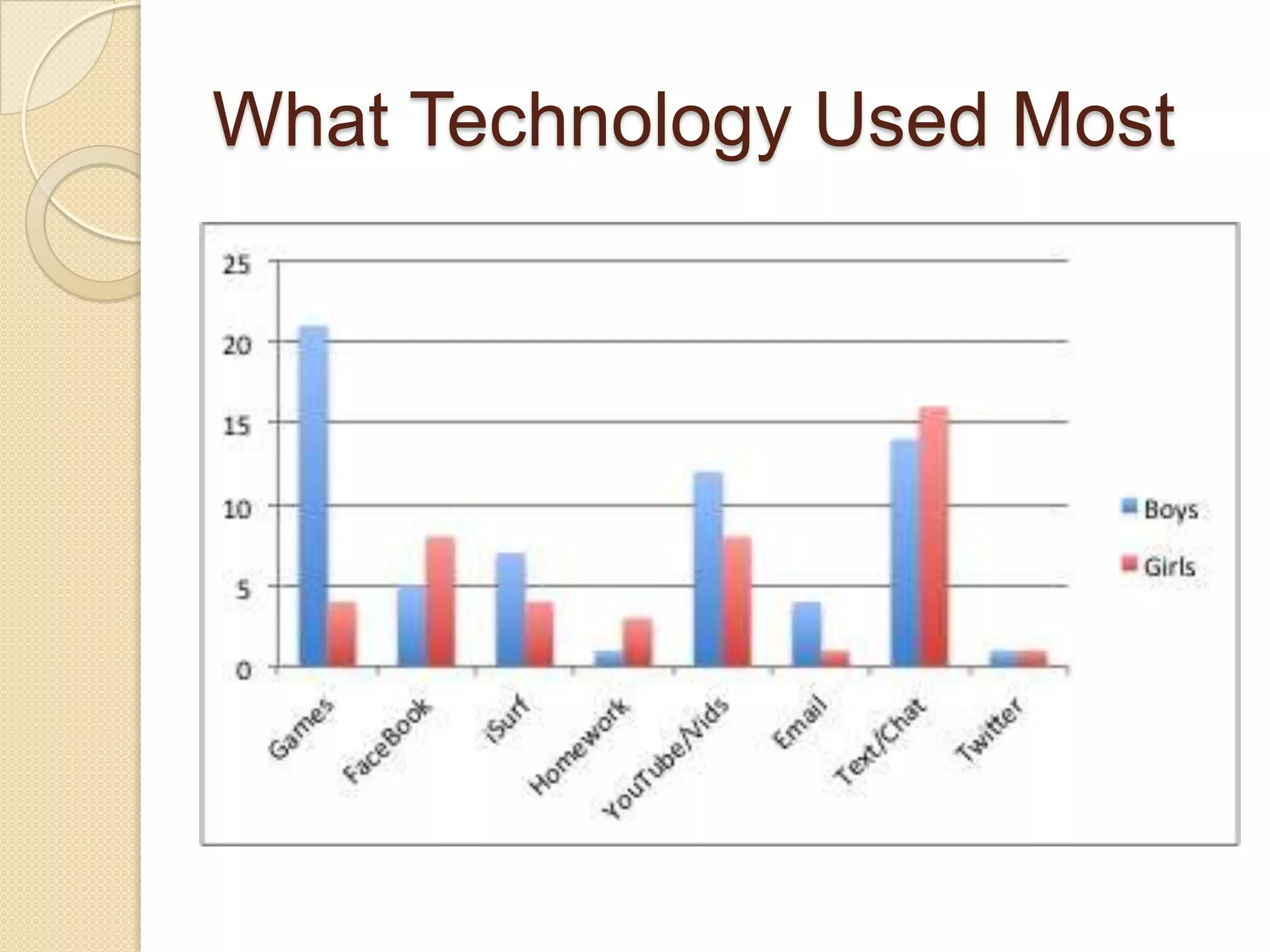
What Technology Used Most
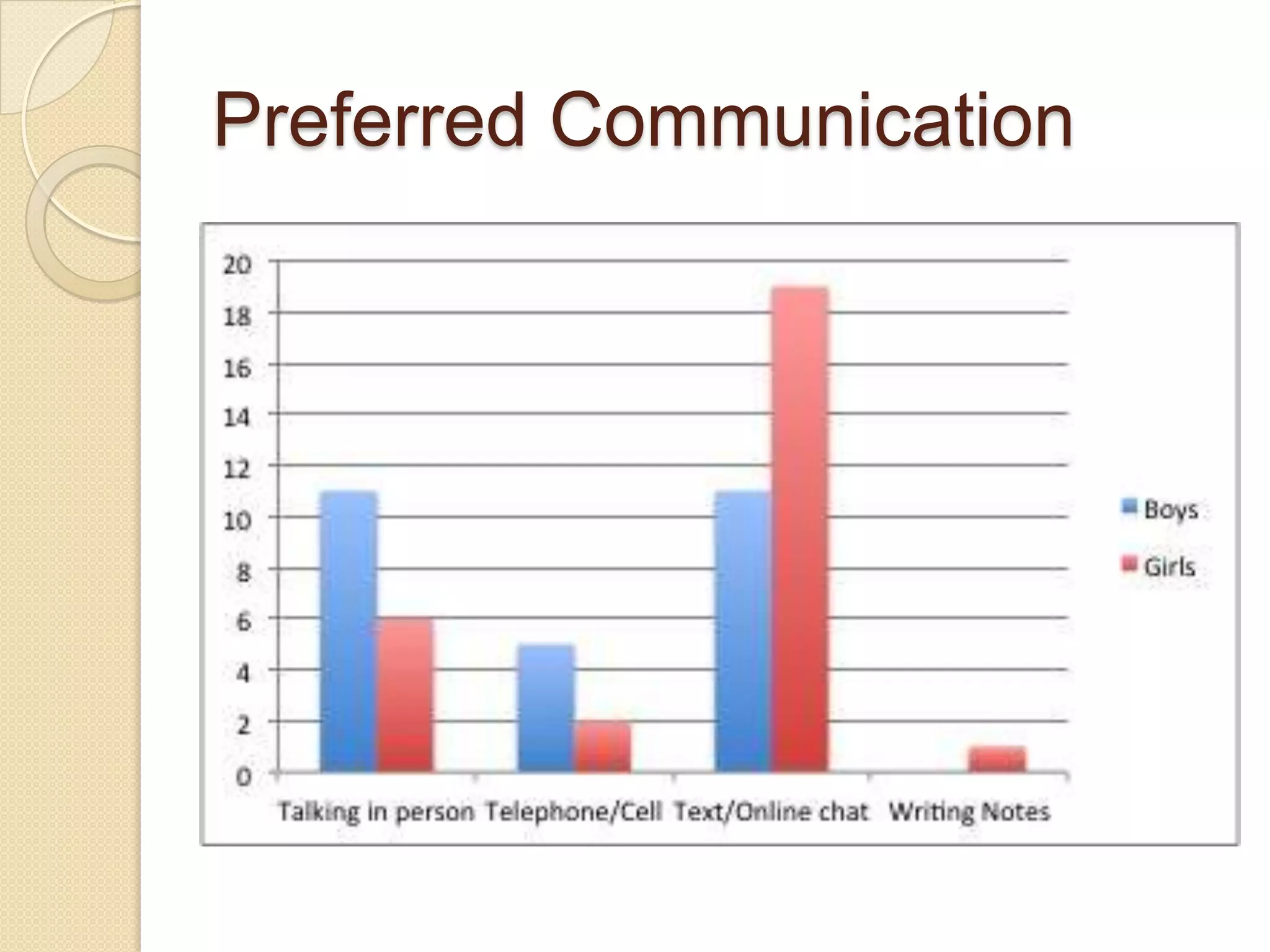
Preferred Communication
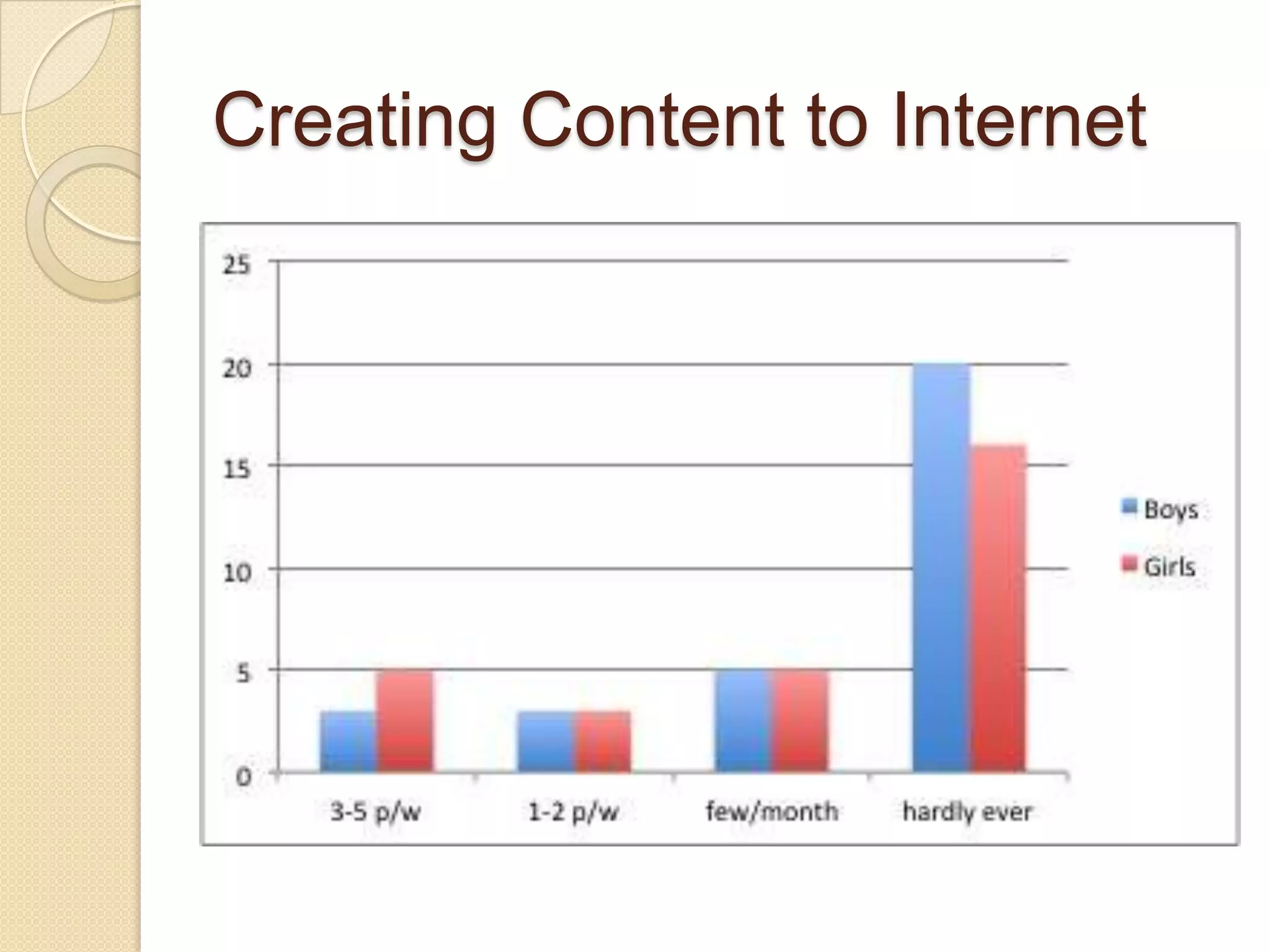
Creating Content to Internet
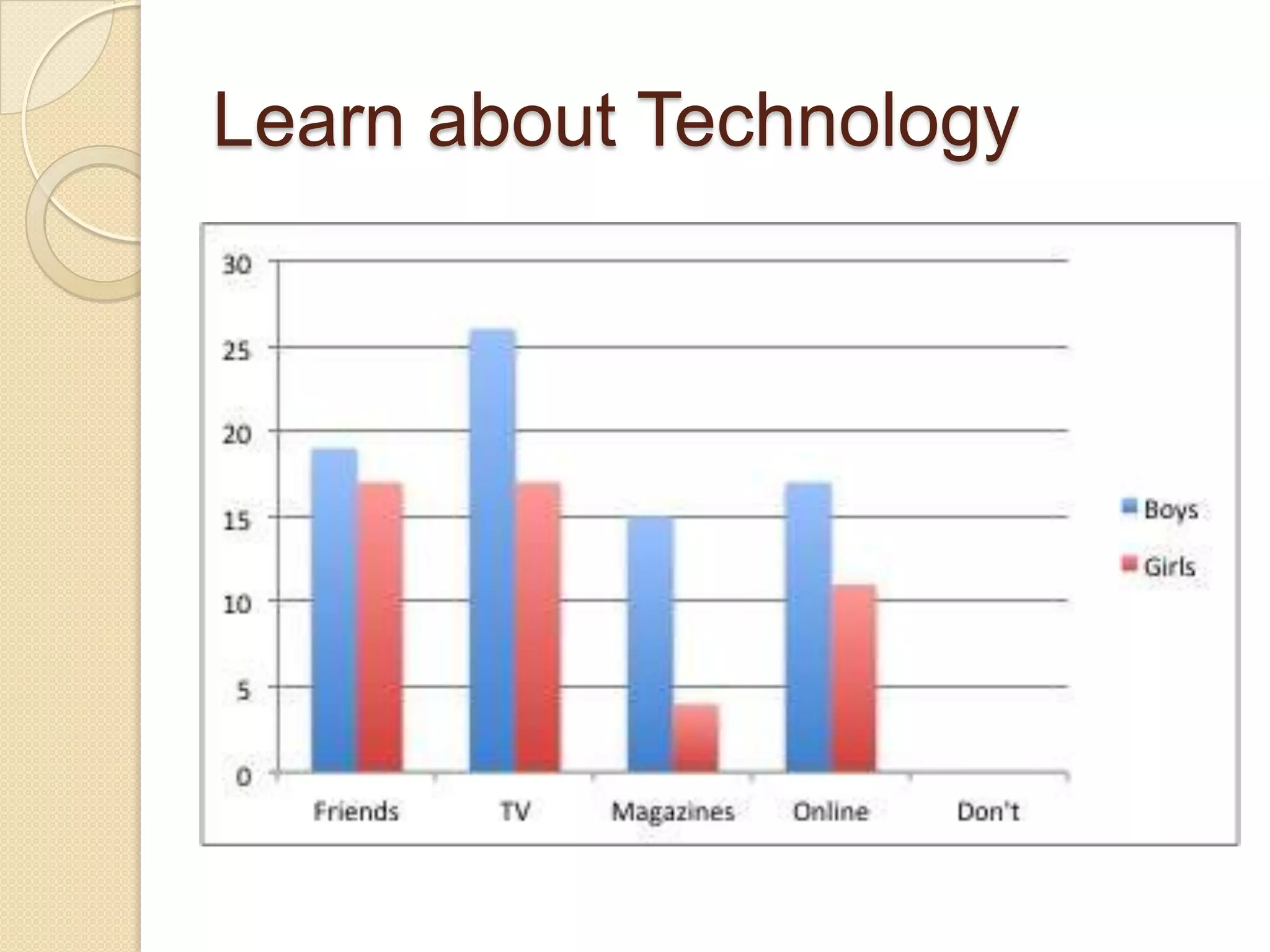
Learn about Technology
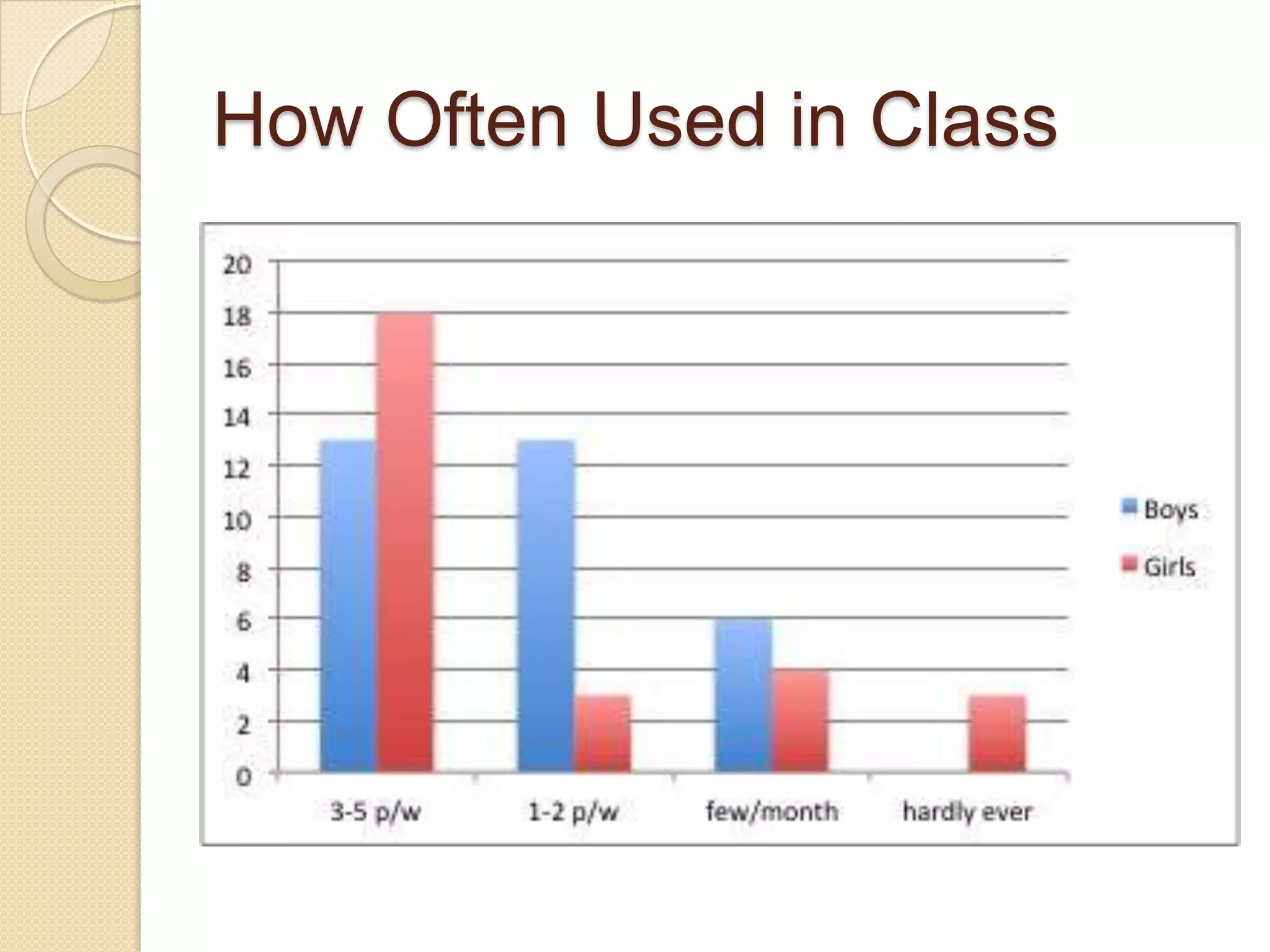
How Often Used in Class
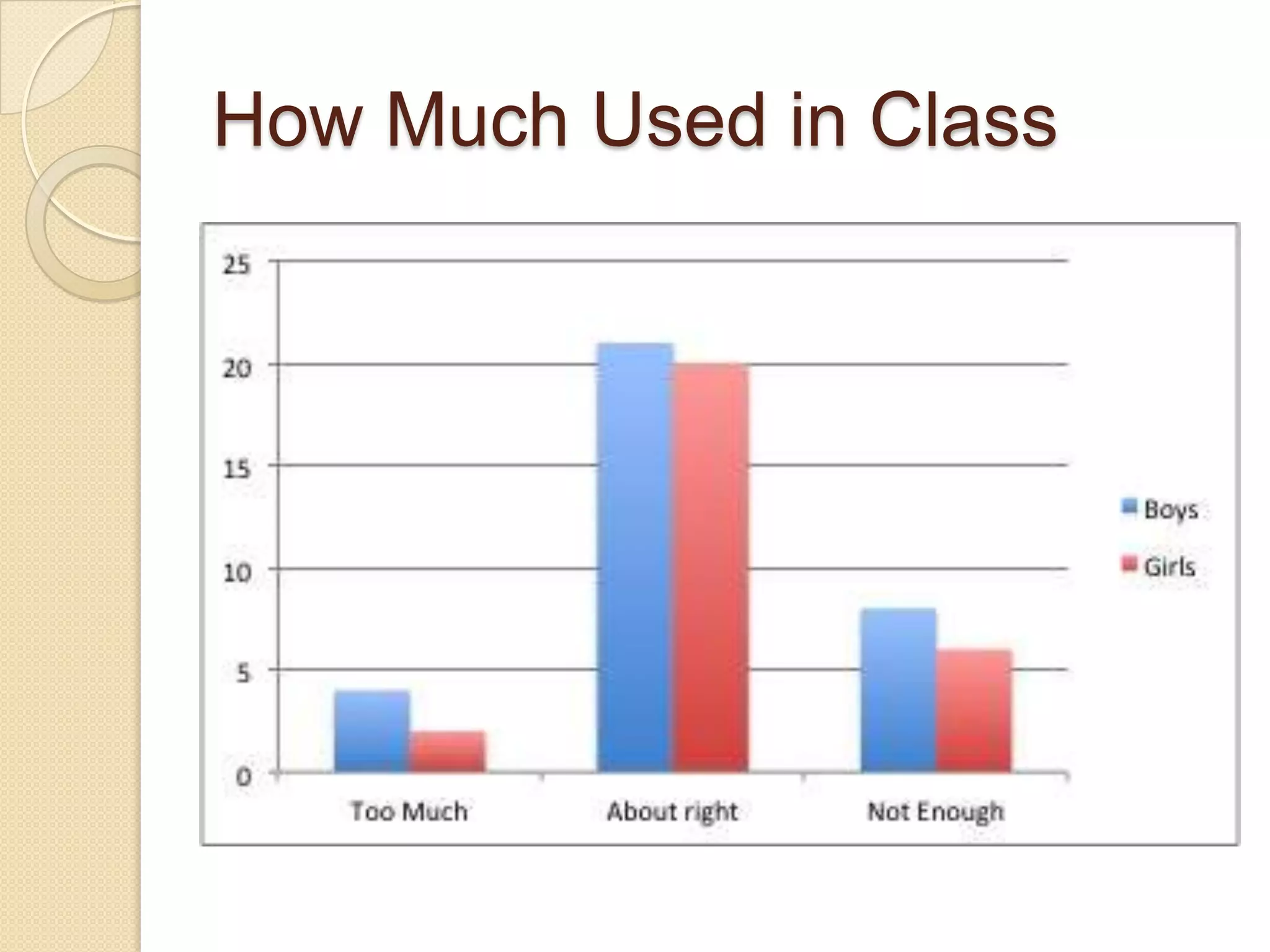
How Much Used in Class
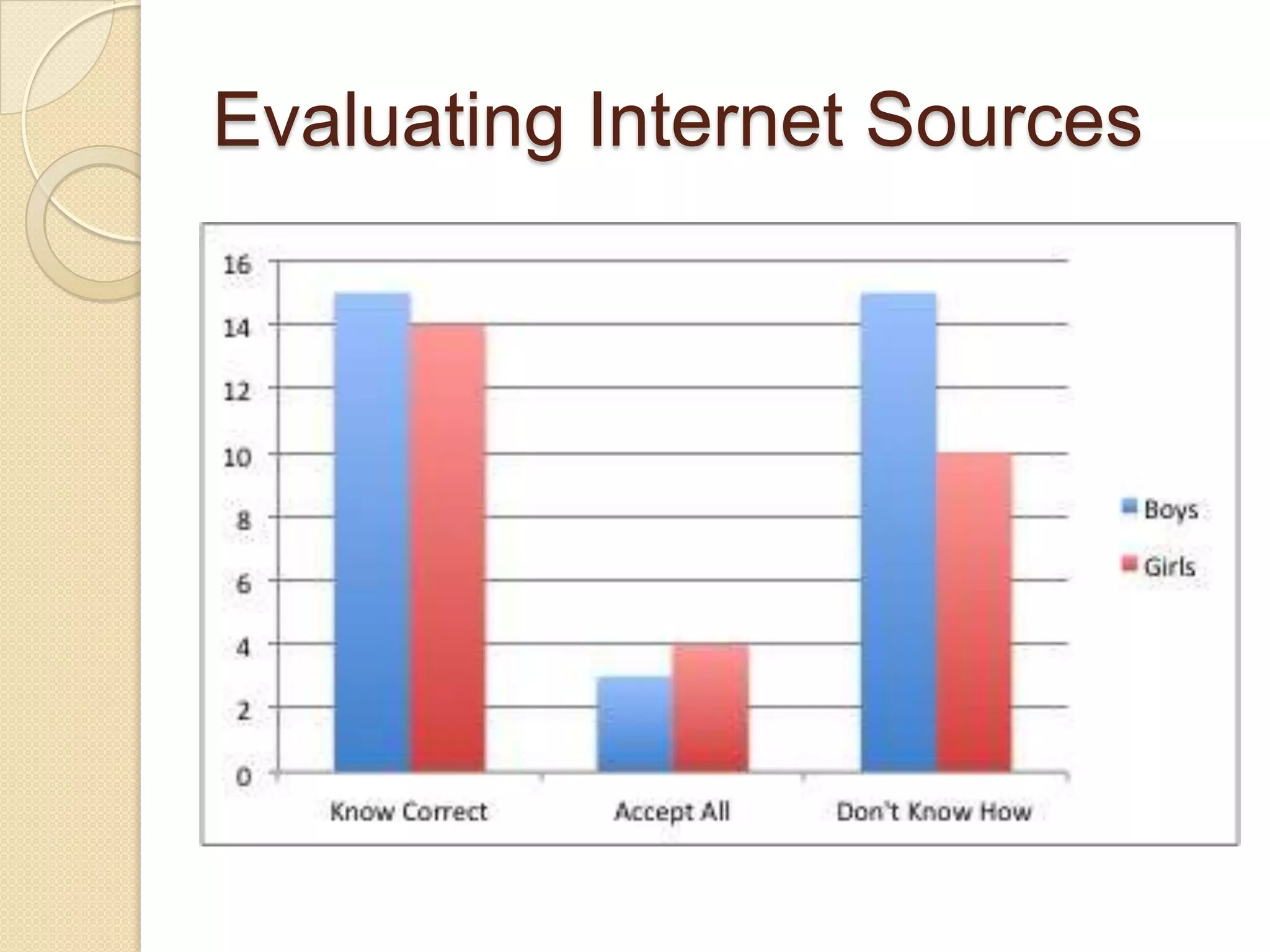
Evaluating Internet Sources
Video
Implications for 21st Century
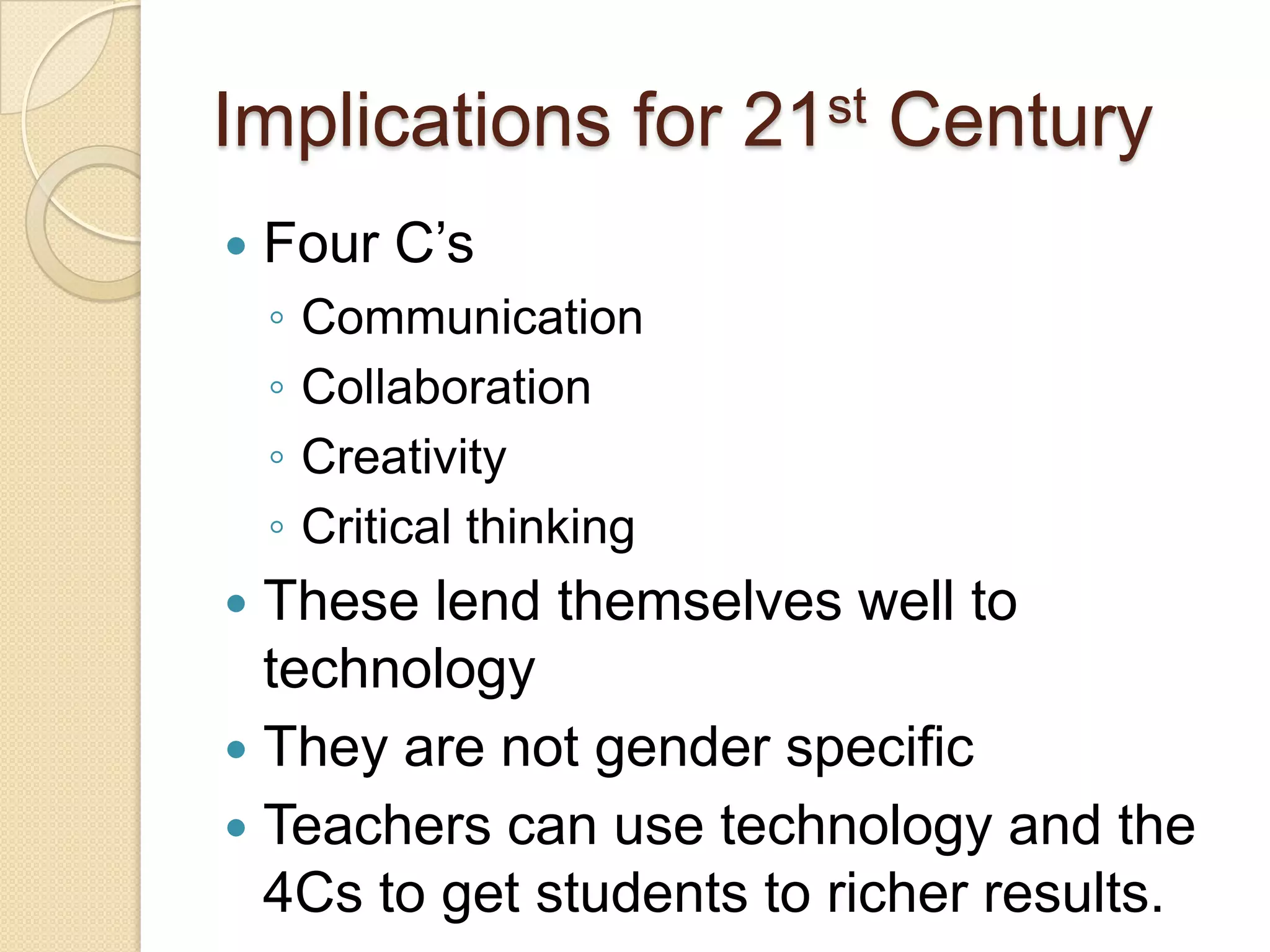
   Four C’s
    ◦   Communication
    ◦   Collaboration
    ◦   Creativity
    ◦   Critical thinking
 These lend themselves well to
  technology
 They are not gender specific
 Teachers can use technology and the
  4Cs to get students to richer results.
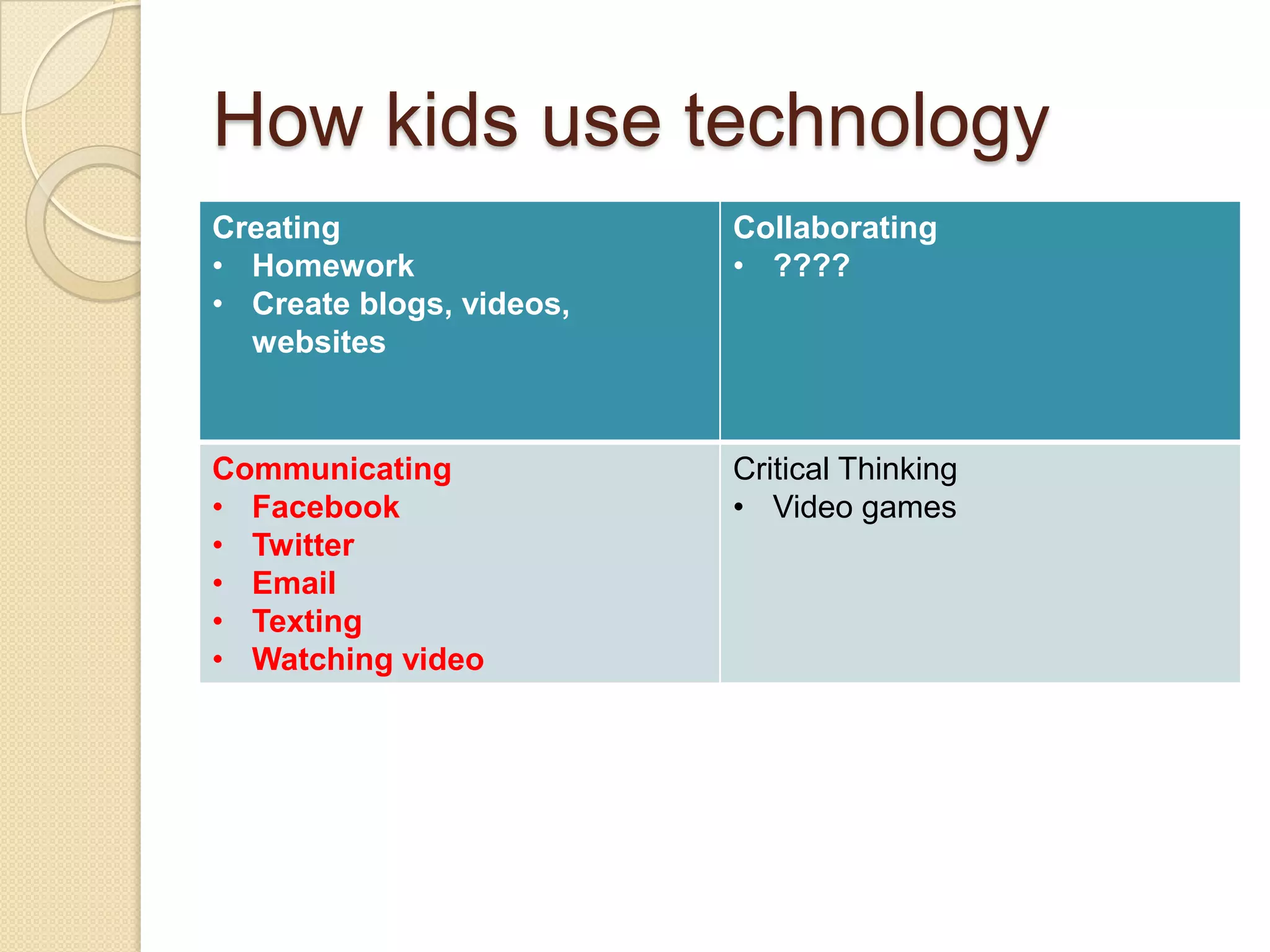
How kids use technology
Creating                  Collaborating
• Homework                • ????
• Create blogs, videos,
  websites


Communicating             Critical Thinking
• Facebook                • Video games
• Twitter
• Email
• Texting
• Watching video
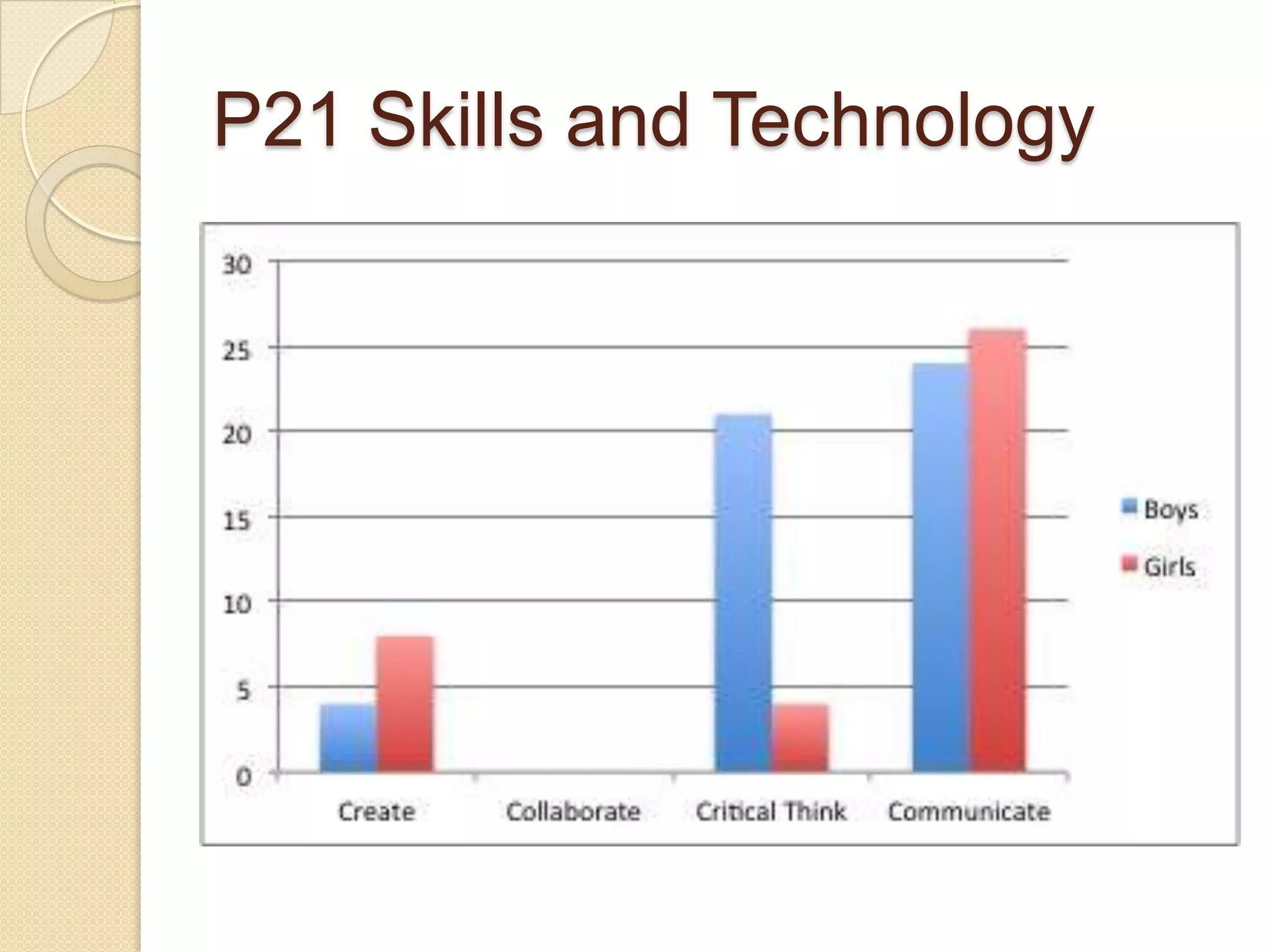
P21 Skills and Technology
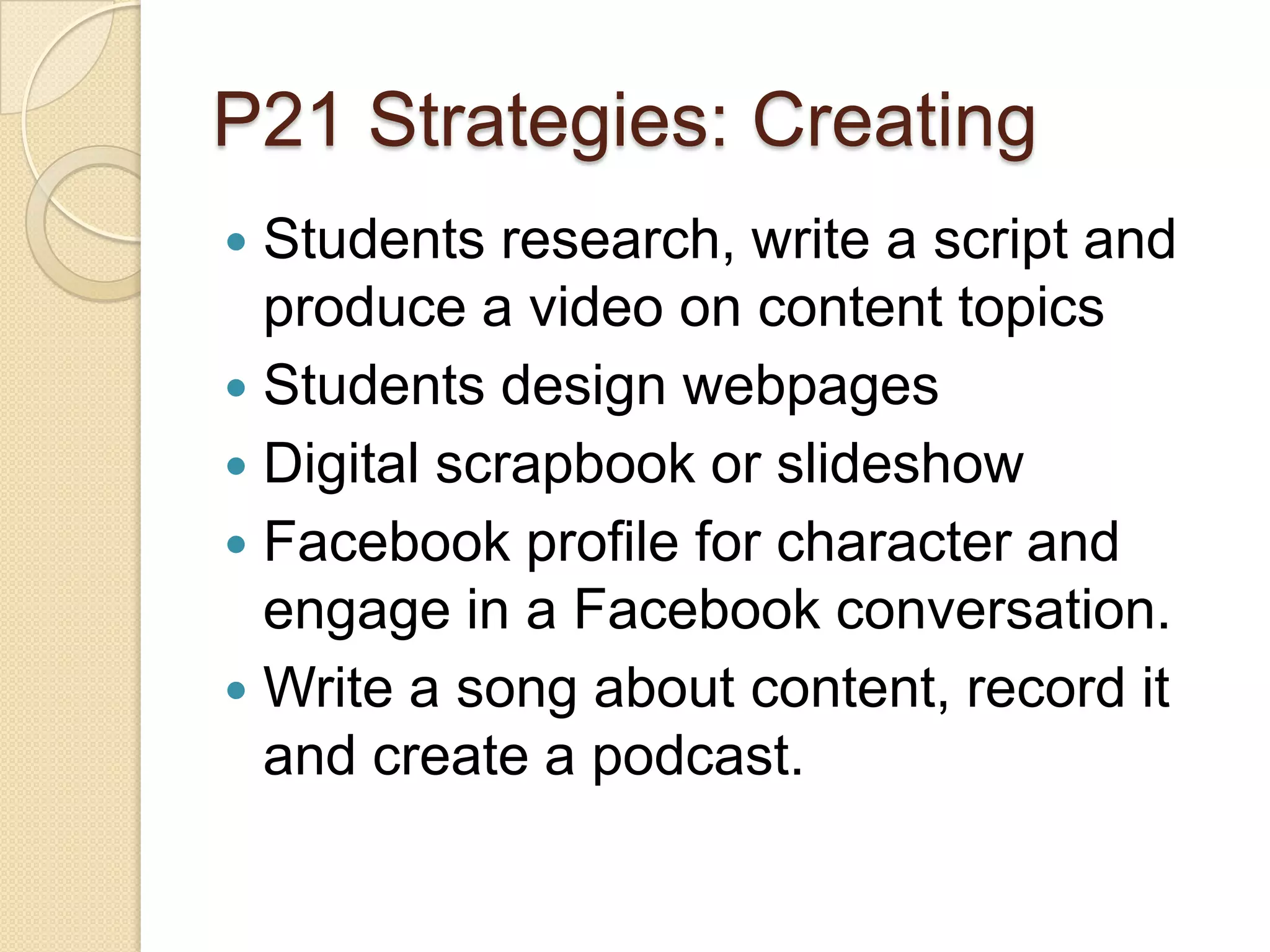
P21 Strategies: Creating
 Students research, write a script and
  produce a video on content topics
 Students design webpages
 Digital scrapbook or slideshow
 Facebook profile for character and
  engage in a Facebook conversation.
 Write a song about content, record it
  and create a podcast.
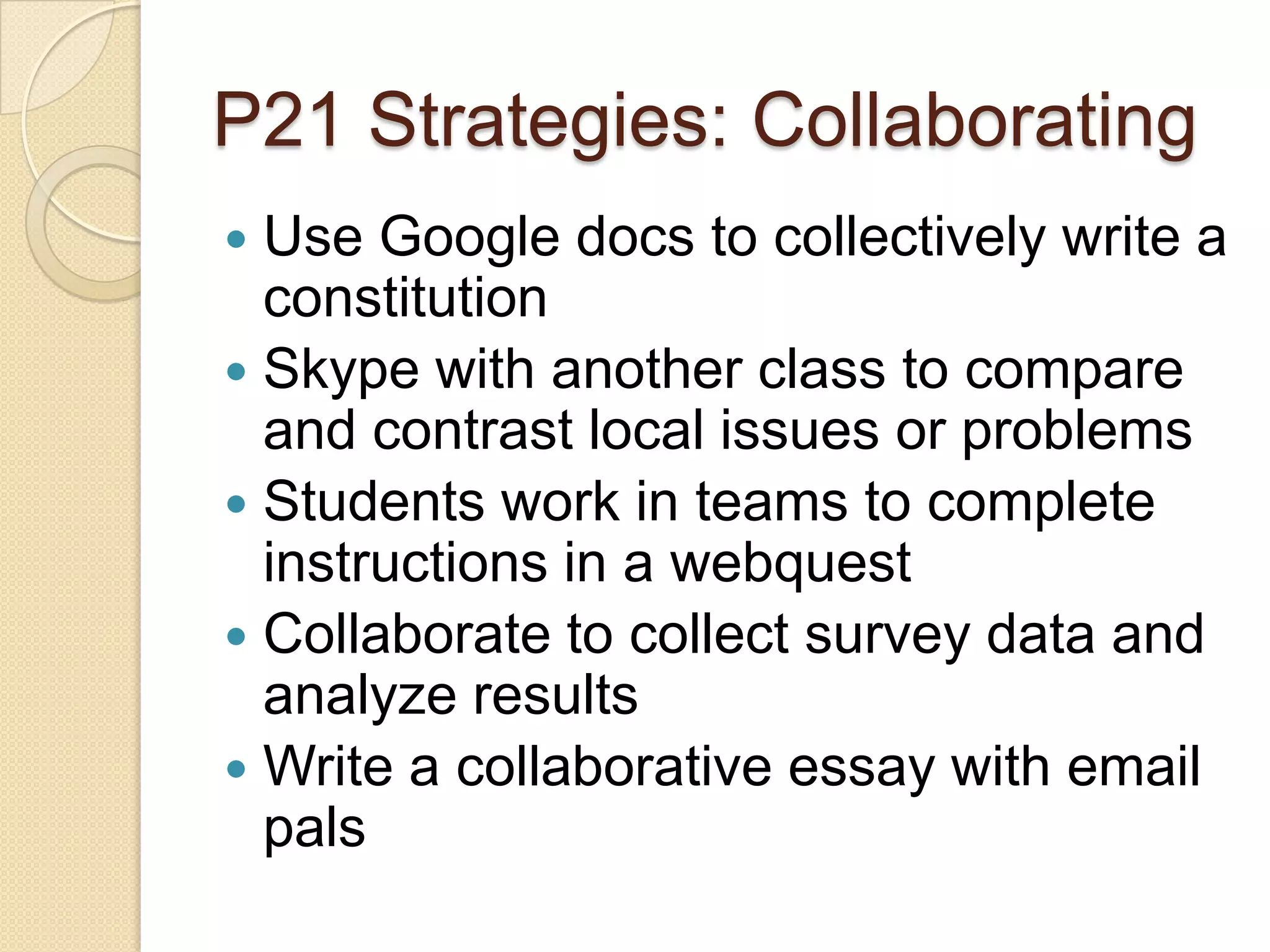
P21 Strategies: Collaborating
 Use Google docs to collectively write a
  constitution
 Skype with another class to compare
  and contrast local issues or problems
 Students work in teams to complete
  instructions in a webquest
 Collaborate to collect survey data and
  analyze results
 Write a collaborative essay with email
  pals
P21 Strategies: Critical
Thinking
 Evaluate a website
 Use the Internet to research a political
  or social issue and determine a class
  position
 Compare/Contrast a book and movie
 Analyze business trends or stock and
  make predictions
 Create graphical representations of
  data using graphing calculators and
  spreadsheets.
P21 Strategies:
Communicating
 Conduct interviews and create digital
  gallery of images and audio files
 Keep a class journal on daily learning
  on a Blog
 Join a listserv to stay informed about
  an issue
 Create a digital bookshelf about class
  readings
 Write an editorial or review for local
  newspaper
Next Steps
 Visit the P21 Website and download
  the Toolkit.
 Toolkit has a wealth of resources to
  move your classroom toward each of
  the FourCs.
 Include students in your technology
  decisions-making.
Session Code

Gen tech present

  • 1.
    Boys and Girlsin the 21st Century Bridging the Gender Gap with Technology Dr. Dave Kommer, Ashland University Michelle Koussa, Independence Middle School Ohio http://amlegendertech.pbworks.com
  • 2.
    Agenda  Participant Questionnaire Brief Overview: Gender Learning Differences  Survey Results  Video  Implications for 21st Century Skills  Examples of Gender Appropriate Strategies
  • 3.
    e-Clicker Questionnaire  If you have a device that gets on the Internet… ◦ Smartphone ◦ Tablet ◦ Computer  Please go the the following URL and sign in.
  • 4.
    Quick Factoids  Men,women and chimpanzees!  Size doesn’t matter  But who’s counting?  Women have more connections than men.  Women have more to say.  Side by side
  • 5.
    Boys  Have trouble discovering their best way to learn.  Competitive  Active  Risk-takers  Physical  Use non-verbal communication  Spatial  Math and Science  Are more confident than they should be, or less.  Lack emotional language  Influenced by the media
  • 6.
    Girls  Generally like to please the teacher  Cooperative  Relationships  Use communication  Not risk-takers  Less physical  Linguistic  Language Arts and Social Studies  Deal better with emotions  View selves through the perceptions of others  Hear better  Better able to read emotions of others  Influenced by media
  • 7.
    Survey Results  differencesamong boys and girls.  What we found is that with the exception of gaming, boys and girls are pretty similar in terms of technology comfort and use.  Technology bridges the genders when using P21 Skills as a framework
  • 8.
  • 9.
  • 10.
  • 11.
  • 12.
  • 13.
    How Much Usedin Class
  • 14.
  • 15.
  • 16.
    Implications for 21stCentury  Four C’s ◦ Communication ◦ Collaboration ◦ Creativity ◦ Critical thinking  These lend themselves well to technology  They are not gender specific  Teachers can use technology and the 4Cs to get students to richer results.
  • 17.
    How kids usetechnology Creating Collaborating • Homework • ???? • Create blogs, videos, websites Communicating Critical Thinking • Facebook • Video games • Twitter • Email • Texting • Watching video
  • 18.
    P21 Skills andTechnology
  • 19.
    P21 Strategies: Creating Students research, write a script and produce a video on content topics  Students design webpages  Digital scrapbook or slideshow  Facebook profile for character and engage in a Facebook conversation.  Write a song about content, record it and create a podcast.
  • 20.
    P21 Strategies: Collaborating Use Google docs to collectively write a constitution  Skype with another class to compare and contrast local issues or problems  Students work in teams to complete instructions in a webquest  Collaborate to collect survey data and analyze results  Write a collaborative essay with email pals
  • 21.
    P21 Strategies: Critical Thinking Evaluate a website  Use the Internet to research a political or social issue and determine a class position  Compare/Contrast a book and movie  Analyze business trends or stock and make predictions  Create graphical representations of data using graphing calculators and spreadsheets.
  • 22.
    P21 Strategies: Communicating  Conductinterviews and create digital gallery of images and audio files  Keep a class journal on daily learning on a Blog  Join a listserv to stay informed about an issue  Create a digital bookshelf about class readings  Write an editorial or review for local newspaper
  • 23.
    Next Steps  Visitthe P21 Website and download the Toolkit.  Toolkit has a wealth of resources to move your classroom toward each of the FourCs.  Include students in your technology decisions-making.
  • 24.

Editor's Notes

  • #2 For the past 8 years or so, I have researched the differences in how boys and girls learn. Along the way I got wind of how boys and girls approached computer use. It made sense to me that boys preferred gaming while girls were into Facebook. As we did our research for this presentation, it wasn’t quite so simple. While those two differences did emerge, other differences didn’t. So what was going on? Using the UbD Backward Design approach we expected to find vastly different computer use experiences between boys and girls. As our research progressed, we weren’t finding that, it became clear to us that technology is a bridge between the genders.Through research and a survey we discovered when it comes to technology it is more about how you use it than what you are using. They make like gaming, but the types of games are different.
  • #5 Men and women are genetically about 1-2% different—or about the same difference as humans are from chimpanzees!The male brain is a bit larger than the female brain and this difference is not a result merely of having larger heads.Some studies show men have more brain cells, while others suggest women have about the same number, though they are arranged differently.One study shows women have more connections between the neurons than men.Women may have more cells in the part of the brain that is devoted to language.The corpus callosum, or neurons that connect the two halves of the brain are different in women than men.
  • #6 A Y chromosome does not guarantee a male learner. The absence of one, does not guarantee a female learner.Risk taking helps explain their fascination with gaming, as does their spatial talents.What are some of images boys receive in the media?
  • #7 Girls are all about relationships, both positive and negative. FaceBook is perfect for them.What are some of images girls receive in the media?
  • #8 It is interesting that when we created the chart in Excel, it automatically used pink for the girls and blue for the boys. How did it know?
  • #9 We gave the students a list of technology applications and asked them to respond by telling us how much time they spent per week. We arranged that data in this fashion.This chart definitely shows that boys are into gaming. They spend the most time using games during the week. They also show a bit more time spend watching videos and web surfing. What was surprising was the parity among boys and girls when using text, chat and email. With our n=60, these charts often show wide differences that only represent one or two students. These students were from a upper middle class community and 100% of the students have access to a home computer. We also could not measure any ethic differences.
  • #10 While the previous data showed Boys preferred gaming to social networks and gaming, this one shows that they prefer verbal communication, especially face-to-face, to typing. No surprise here.
  • #11 This one surprised a little and perhaps the respondents didn’t really understand what was being asked. However, the data seems to indicate that overwhelmingly, young people are readers of information, not producers of it. They do not create websites, blogs, etc.
  • #12 Well, not too surprisingly, boys are out in front of learning how to do new technology. The most interesting thing here is that they often do it through reading magazines and reading online. Boys do read, but not Twilight! There are instructional implications here we will discuss a little later on.The data also show that both genders stay informed.
  • #13 Girls perceive that technology is used in class more than boys, though both see it used every week. Perhaps girls think it is used more often because they don’t “like” it as much? We have no evidence that is the case. Maybe they just have a better or worse sense of time spent.Refer back to initial eClicker survey. Do the results correlate?
  • #14 Overwhelmingly both genders think they get just about enough technology in their classes.Relate also to initial participant survey.It is interesting that although the perception of how much it is used is different that both genders feel it is enough. It is important to know your kids and what they have access to. My kids use tech so much outside of school sometimes they don’t want to use it all the time at school. Research shows that typically teachers feel they are using it a lot more than the kids would perceive them to.
  • #15 Well, they either are sure they know how to determine if the information is right, or they have no idea! I wonder how many of the ones who are sure is right actually should have responded that they pretty much accept anything?Refer back to participant survey…Is there a difference here.Are the students really media literate?Are we using media to teach “at them” or equipping them with the skills to use it on their own?Are we teaching them to evaluate?“Literacy is no longer considered just the ability to read and write, but rather now encompasses the ability to be able to communicate through various mediums. Literacy can be defined as being able to master blogging, chatting, skyping, social networking, texting and tweeting.”From Lavender Krupp, are you iliterate.Becoming smarter about new sources of information. In an age of overflowing information and proliferating media, kids need to rapidly process what's coming at them and distinguish between what's reliable and what isn't. "It's important that students know how to manage it, interpret it, validate it, and how to act on it," says Dell executive Karen Bruett, who serves on the board of the Partnership for 21st Century Skills, a group of corporate and education leaders focused on upgrading American education. (Time Magazine)
  • #17 Blogs: Girls actually like to add blog comments; boys like creating the blog and will add comments. So the technology helps both.Another example: Both use Facebook, but girls might use it to share feelings, while boys use it share or get information. So, how can we use a form they both enjoy and equip them equally well for the future?Teachers can use these as guides when planning lessons. By focusing on all the FourCs throughout a week or unit learners can use strengths and strengthen weaknesses throughout the process.This gets to the point that we need to be very purposeful in how we use technology. If we are using it merely to present information, learners are developing the critical media skills they need for the 21st century.There's a dark little joke exchanged by educators with a dissident streak: Rip Van Winkle awakens in the 21st century after a hundred-year snooze and is, of course, utterly bewildered by what he sees. Men and women dash about, talking to small metal devices pinned to their ears. Young people sit at home on sofas, moving miniature athletes around on electronic screens. Older folk defy death and disability with metronomes in their chests and with hips made of metal and plastic. Airports, hospitals, shopping malls--every place Rip goes just baffles him. But when he finally walks into a schoolroom, the old man knows exactly where he is. "This is a school," he declares. "We used to have these back in 1906. Only now the blackboards are green.” (Time Magazine)
  • #18 When we looked at the types of activities students do in classes, it made sense to sort them into the Four Cs categories. We were able to do this with most of them. What we learned from that is that they get to do a bunch of communicating, but not much else in the other categories. This leads us into ways we can incorporate more effective technology use into the curriculum.
  • #19 We looked at the various ways that boys and girls might use technology. Then we organized those activities around the Four C’s of the P21 skills.What we found:Girls might slightly more creative, but we are only talking about a couple of responses here.Boys do more critical thinking, but this is mostly represented by their use of gaming.They are pretty even when it comes to communication, which was a bit of a surprise to us.We defined Collaboration as working together to achieve a goal or create a product. None of our examples really fit this.
  • #20 Historical events or peopleScientific ProcessBook TrailerMath in everyday life