IT in education: A view through the lenses
of Diffusion of Innovation Theory
Boris Koichu
Technion – Israel Institute of Technology
2.10.2015
IT in education: A view through the lenses
of Diffusion of Innovation Theory
(a reversed talk)
Boris Koichu
Technion – Israel Institute of Technology
2.10.2015
Thanks!
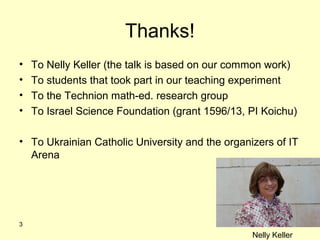
• To Nelly Keller (the talk is based on our common work)
• To students that took part in our teaching experiment
• To the Technion math-ed. research group
• To Israel Science Foundation (grant 1596/13, PI Koichu)
• To Ukrainian Catholic University and the organizers of IT
Arena
3
Nelly Keller
The (reversed) goal tree
• To devise a new generation of methods for effective teaching
mathematics as a science based on solving challenging
problems
• To understand authentic processes of learning mathematics
through solving problems
• To design situations for school students so that they would be
given a chance for “real” problem solving
• To complement traditional lessons by collaborative problem
solving in social networks
• To accustom the students to use social networks for
collaborative problem solving
• To make the students to enter a forum and begin working!!!
4
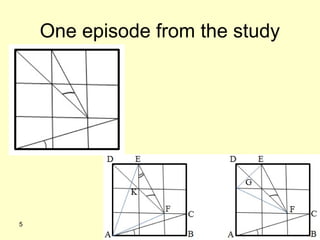
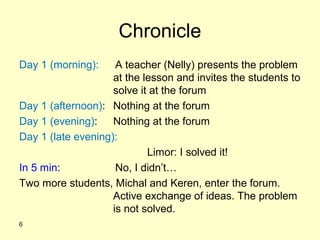
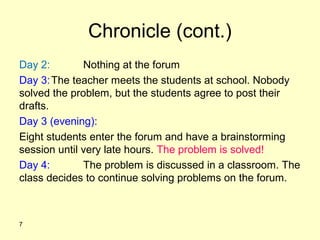
One episode from the study
5
Chronicle
Day 1 (morning): A teacher (Nelly) presents the problem
at the lesson and invites the students to
solve it at the forum
Day 1 (afternoon): Nothing at the forum
Day 1 (evening): Nothing at the forum
Day 1 (late evening):
Limor: I solved it!
In 5 min: No, I didn’t…
Two more students, Michal and Keren, enter the forum.
Active exchange of ideas. The problem
is not solved.
6
Chronicle (cont.)
Day 2: Nothing at the forum
Day 3:The teacher meets the students at school. Nobody
solved the problem, but the students agree to post their
drafts.
Day 3 (evening):
Eight students enter the forum and have a brainstorming
session until very late hours. The problem is solved!
Day 4: The problem is discussed in a classroom. The
class decides to continue solving problems on the forum.
7
Chronicle (cont.)
In two months:
•Most of the students take part at the forum. Some remain
silent observers.
•A crises with the Facebook. Google+.
•Appearance of forum-like lessons
In half a year:
•The forum becomes multifunctional (math questions, HW,
preparation for tests)
•The students learned to share their ideas in progress
•Many brainstorming sessions
•Nothing at the forum. Why???
8
Chronicle (cont.)
9
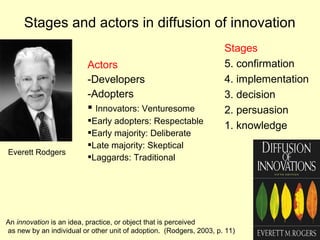
Stages and actors in diffusion of innovation
Stages
5. confirmation
4. implementation
3. decision
2. persuasion
1. knowledge
Actors
-Developers
-Adopters
 Innovators: Venturesome
Early adopters: Respectable
Early majority: Deliberate
Late majority: Skeptical
Laggards: Traditional
Everett Rodgers
An innovation is an idea, practice, or object that is perceived
as new by an individual or other unit of adoption. (Rodgers, 2003, p. 11)
12
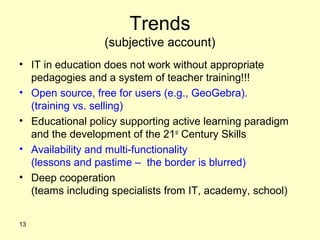
Trends
(subjective account)
• IT in education does not work without appropriate
pedagogies and a system of teacher training!!!
• Open source, free for users (e.g., GeoGebra).
(training vs. selling)
• Educational policy supporting active learning paradigm
and the development of the 21st
Century Skills
• Availability and multi-functionality
(lessons and pastime – the border is blurred)
• Deep cooperation
(teams including specialists from IT, academy, school)
13
Comments?
Questions?
bkoichu@technion.ac.il
14

IT in Education: A View through the Lenses of Diffusion of Innovation Theory (Borys Koichu Business Stream)

  • 1.
    IT in education:A view through the lenses of Diffusion of Innovation Theory Boris Koichu Technion – Israel Institute of Technology 2.10.2015
  • 2.
    IT in education:A view through the lenses of Diffusion of Innovation Theory (a reversed talk) Boris Koichu Technion – Israel Institute of Technology 2.10.2015
  • 3.
    Thanks! • To NellyKeller (the talk is based on our common work) • To students that took part in our teaching experiment • To the Technion math-ed. research group • To Israel Science Foundation (grant 1596/13, PI Koichu) • To Ukrainian Catholic University and the organizers of IT Arena 3 Nelly Keller
  • 4.
    The (reversed) goaltree • To devise a new generation of methods for effective teaching mathematics as a science based on solving challenging problems • To understand authentic processes of learning mathematics through solving problems • To design situations for school students so that they would be given a chance for “real” problem solving • To complement traditional lessons by collaborative problem solving in social networks • To accustom the students to use social networks for collaborative problem solving • To make the students to enter a forum and begin working!!! 4
  • 5.
    One episode fromthe study 5
  • 6.
    Chronicle Day 1 (morning):A teacher (Nelly) presents the problem at the lesson and invites the students to solve it at the forum Day 1 (afternoon): Nothing at the forum Day 1 (evening): Nothing at the forum Day 1 (late evening): Limor: I solved it! In 5 min: No, I didn’t… Two more students, Michal and Keren, enter the forum. Active exchange of ideas. The problem is not solved. 6
  • 7.
    Chronicle (cont.) Day 2:Nothing at the forum Day 3:The teacher meets the students at school. Nobody solved the problem, but the students agree to post their drafts. Day 3 (evening): Eight students enter the forum and have a brainstorming session until very late hours. The problem is solved! Day 4: The problem is discussed in a classroom. The class decides to continue solving problems on the forum. 7
  • 8.
    Chronicle (cont.) In twomonths: •Most of the students take part at the forum. Some remain silent observers. •A crises with the Facebook. Google+. •Appearance of forum-like lessons In half a year: •The forum becomes multifunctional (math questions, HW, preparation for tests) •The students learned to share their ideas in progress •Many brainstorming sessions •Nothing at the forum. Why??? 8
  • 9.
  • 10.
    Stages and actorsin diffusion of innovation Stages 5. confirmation 4. implementation 3. decision 2. persuasion 1. knowledge Actors -Developers -Adopters  Innovators: Venturesome Early adopters: Respectable Early majority: Deliberate Late majority: Skeptical Laggards: Traditional Everett Rodgers An innovation is an idea, practice, or object that is perceived as new by an individual or other unit of adoption. (Rodgers, 2003, p. 11)
  • 12.
  • 13.
    Trends (subjective account) • ITin education does not work without appropriate pedagogies and a system of teacher training!!! • Open source, free for users (e.g., GeoGebra). (training vs. selling) • Educational policy supporting active learning paradigm and the development of the 21st Century Skills • Availability and multi-functionality (lessons and pastime – the border is blurred) • Deep cooperation (teams including specialists from IT, academy, school) 13
  • 14.