Digital Humanities pedagogy: 
new approaches and new ways of thinking 
about the Humanities? 
University College Cork (2013), Teaching and Learning 
Centre, 
Simon Mahony (University College London) 
s.mahony@ucl.ac.uk 
With thanks and acknowledgement to all my colleagues at UCLDH and also to 
Elena Pierazzo (King’s College London) who co-authored the book chapter that 
prompted this talk. 
All original content is licenced under a 
Creative Commons Attribution 3.0 Unported License
UCLDH 
What we do: 
Teaching & Learning 
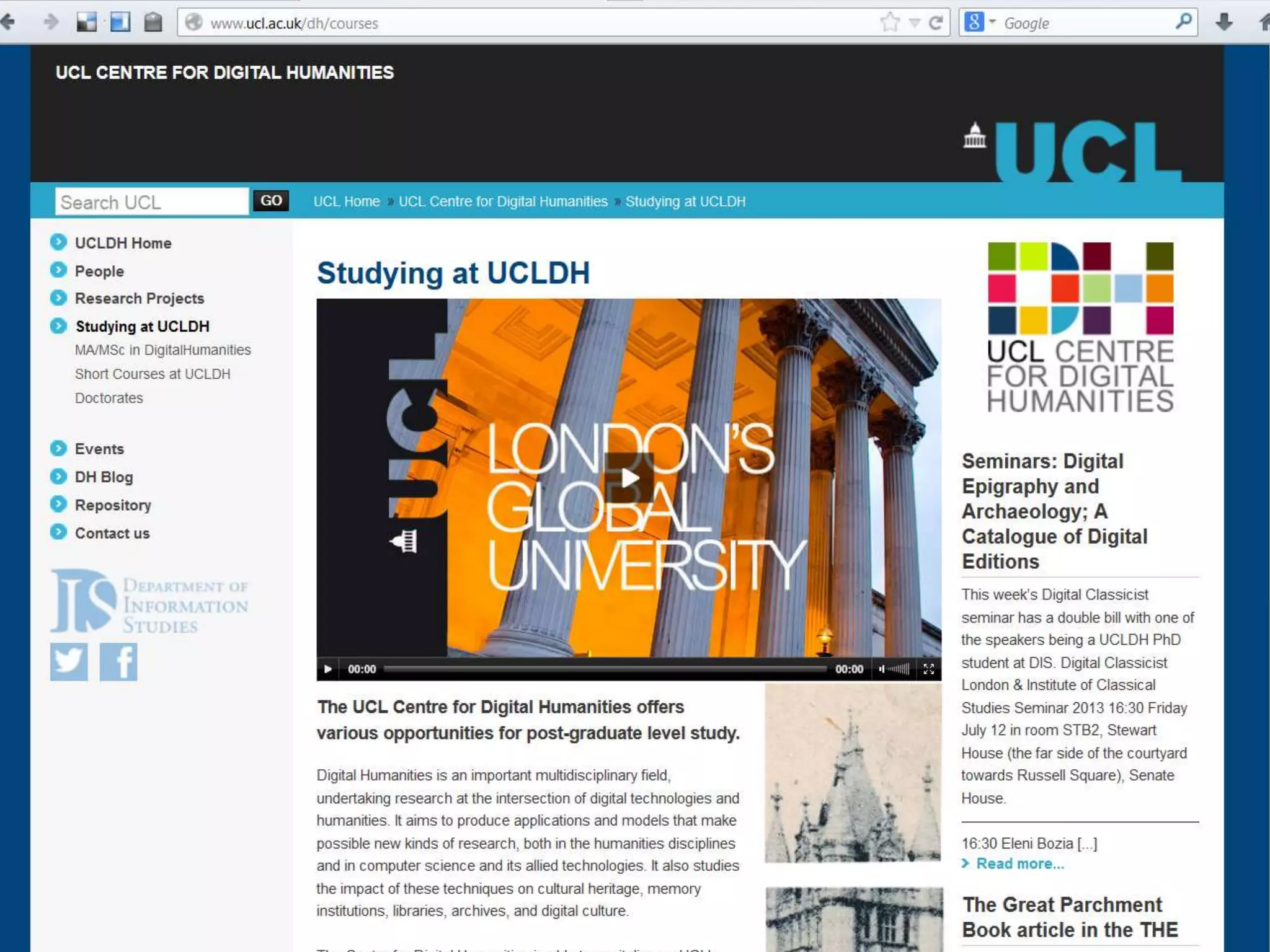
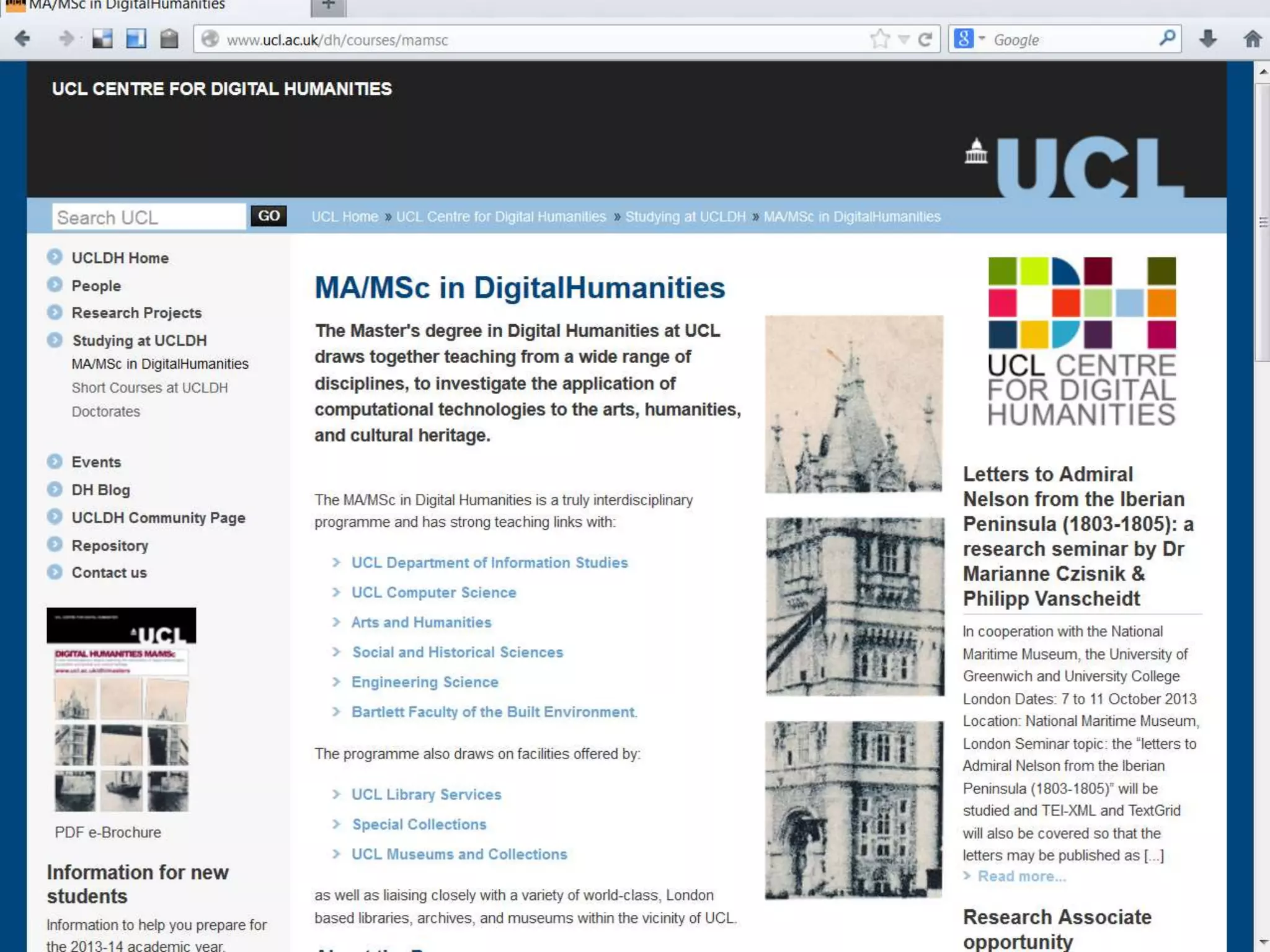
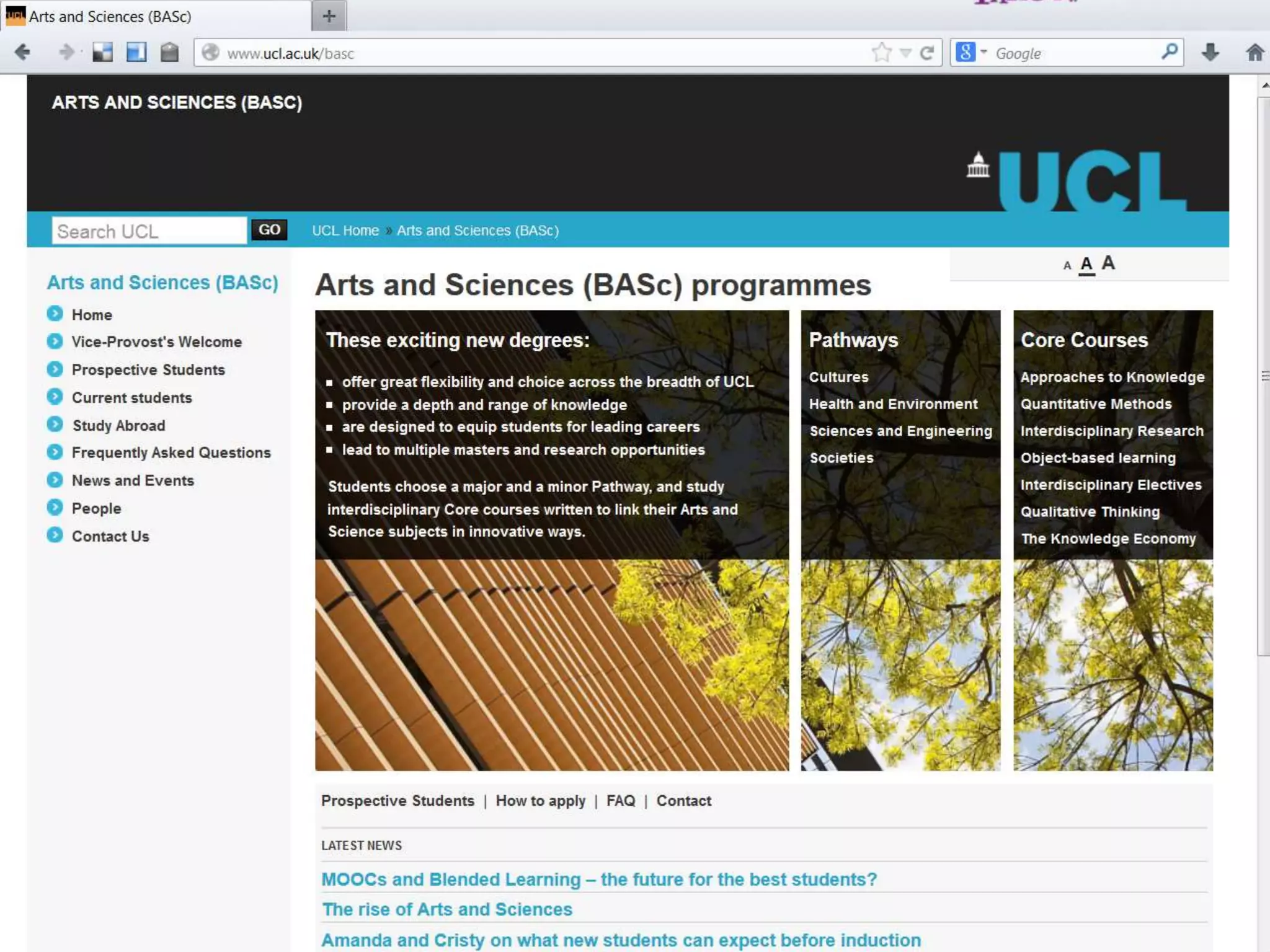
• A new interdisciplinary degree 
exploring the intersection of digital 
technologies, humanities scholar-ships 
and cultural heritage 
• MA/MSc Digital Humanities, 
launched in 2011/12
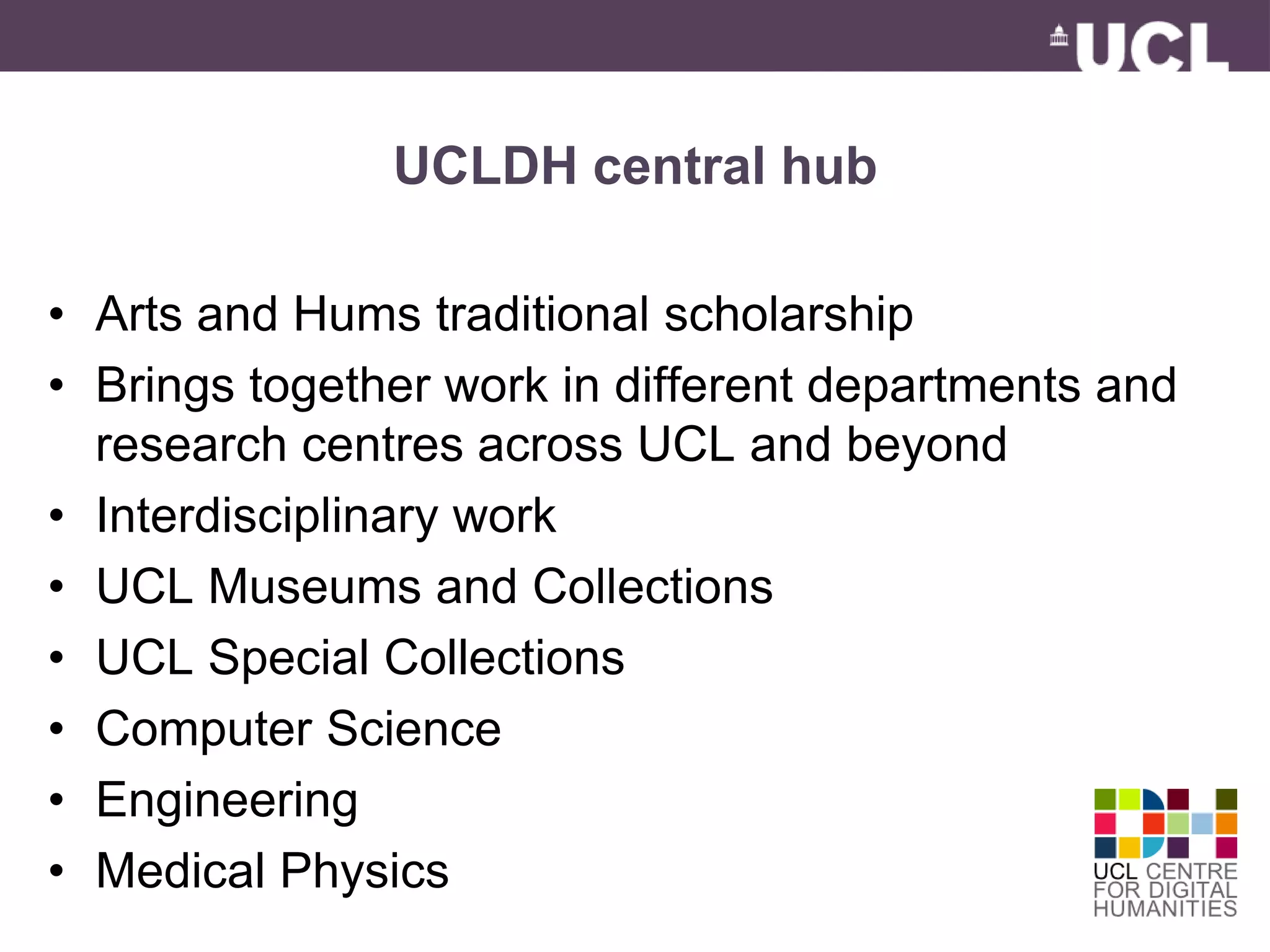
UCLDH central hub 
• Arts and Hums traditional scholarship 
• Brings together work in different departments and 
research centres across UCL and beyond 
• Interdisciplinary work 
• UCL Museums and Collections 
• UCL Special Collections 
• Computer Science 
• Engineering 
• Medical Physics
Putting together a new programme? 
• Does it exist in a vacuum? 
• Building on experience
What should we be teaching in DH? 
• Skills? 
• Methodology? 
• New ways of thinking about traditional material? 
• New and better questions? 
• Wide range of academic backgrounds 
• And skill levels 
• How do we accommodate all?
Skills? 
• Collaborative 
• Interdisciplinary 
• Methodology 
• Reflective practice 
• Technical skills?
Information literacy 
• Higher Education in a Web 2.0 World 
– Committee of Inquiry into the Changing Learner Experience 
• Uncritical acceptance of the Web 
• Expect Google to give them the answer 
• So-called "Digital Divide" 
• "Google Generation" CIBER at UCL 
– Report for JISC and British Library
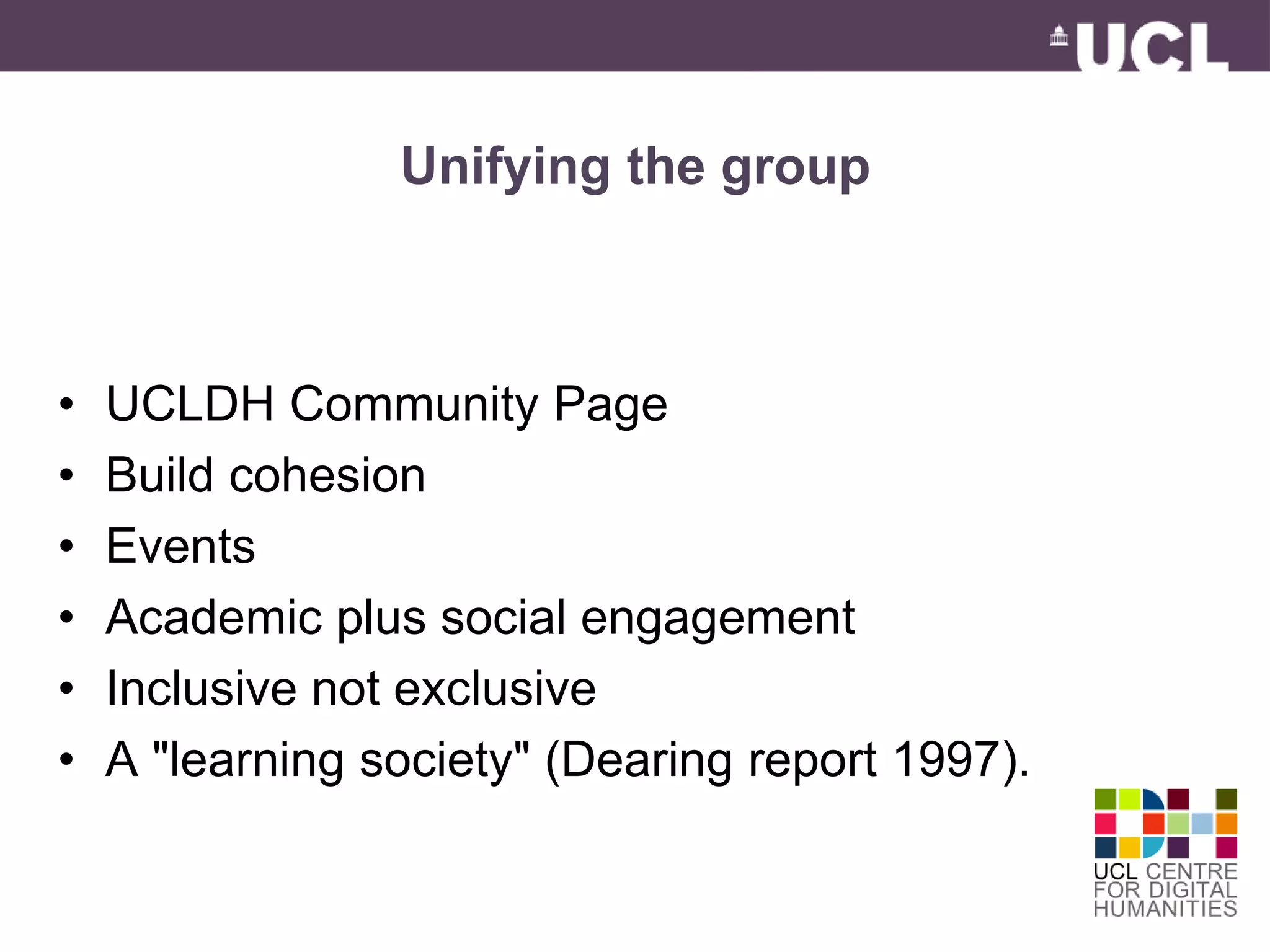
Unifying the group 
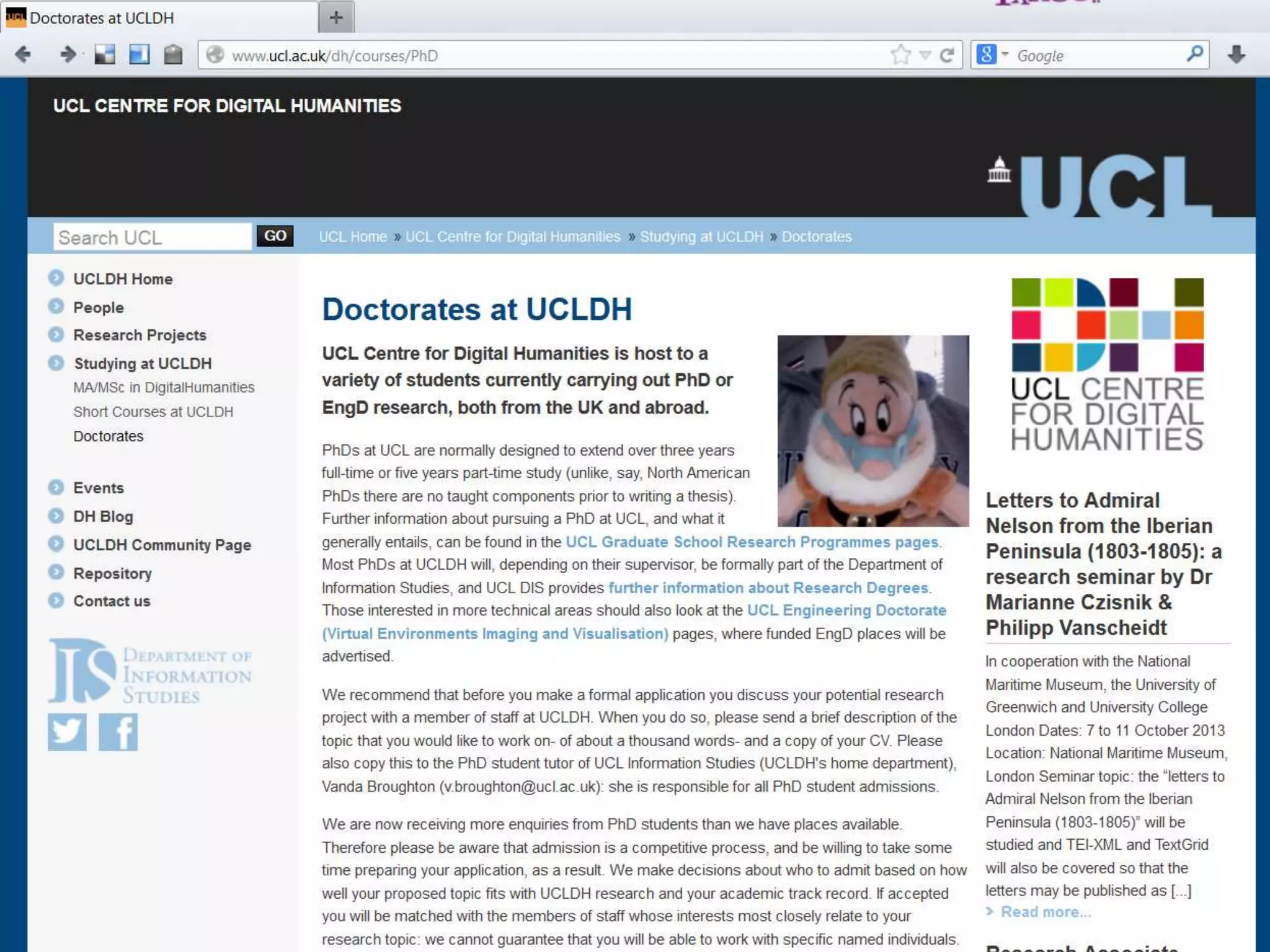
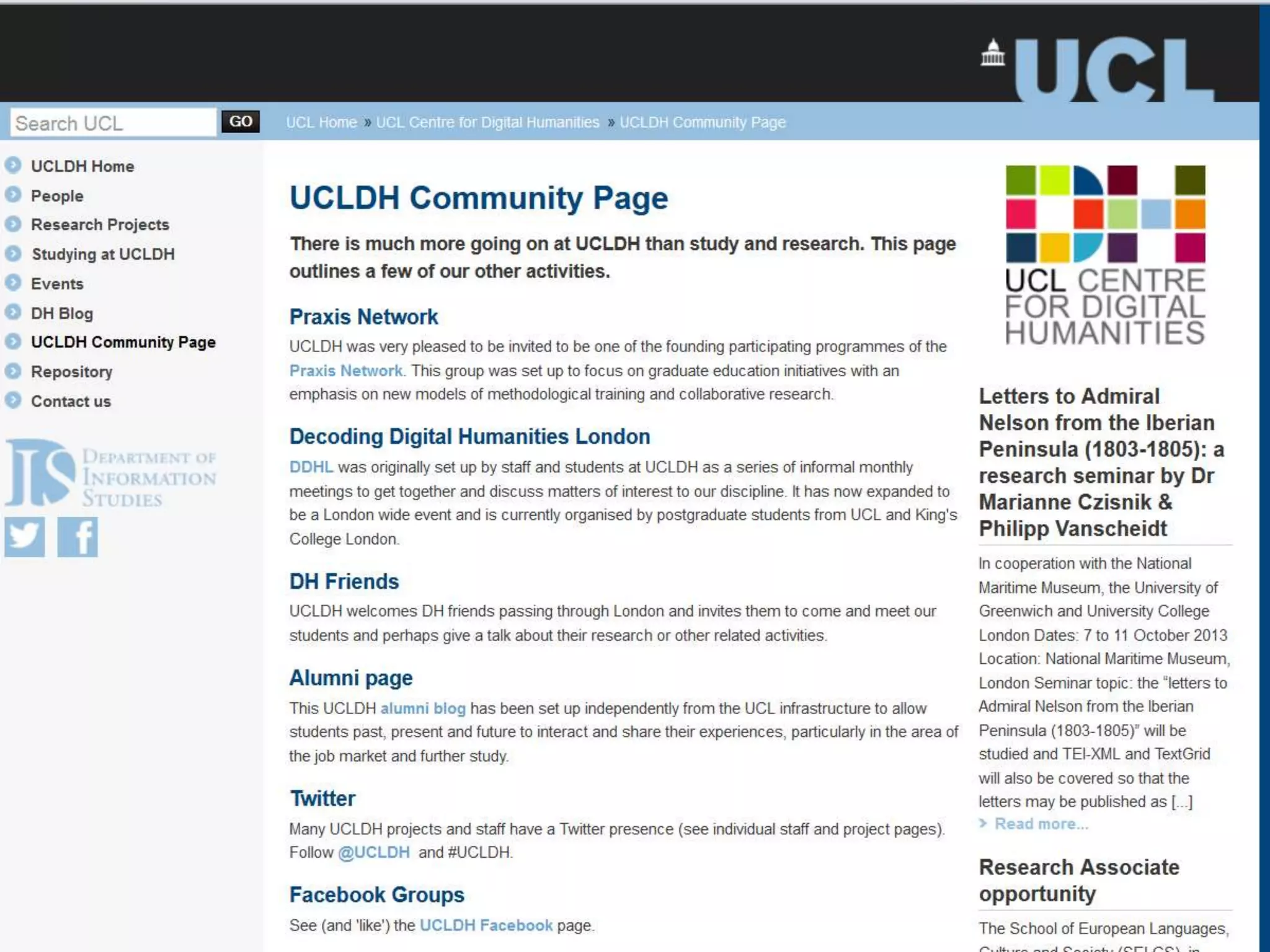
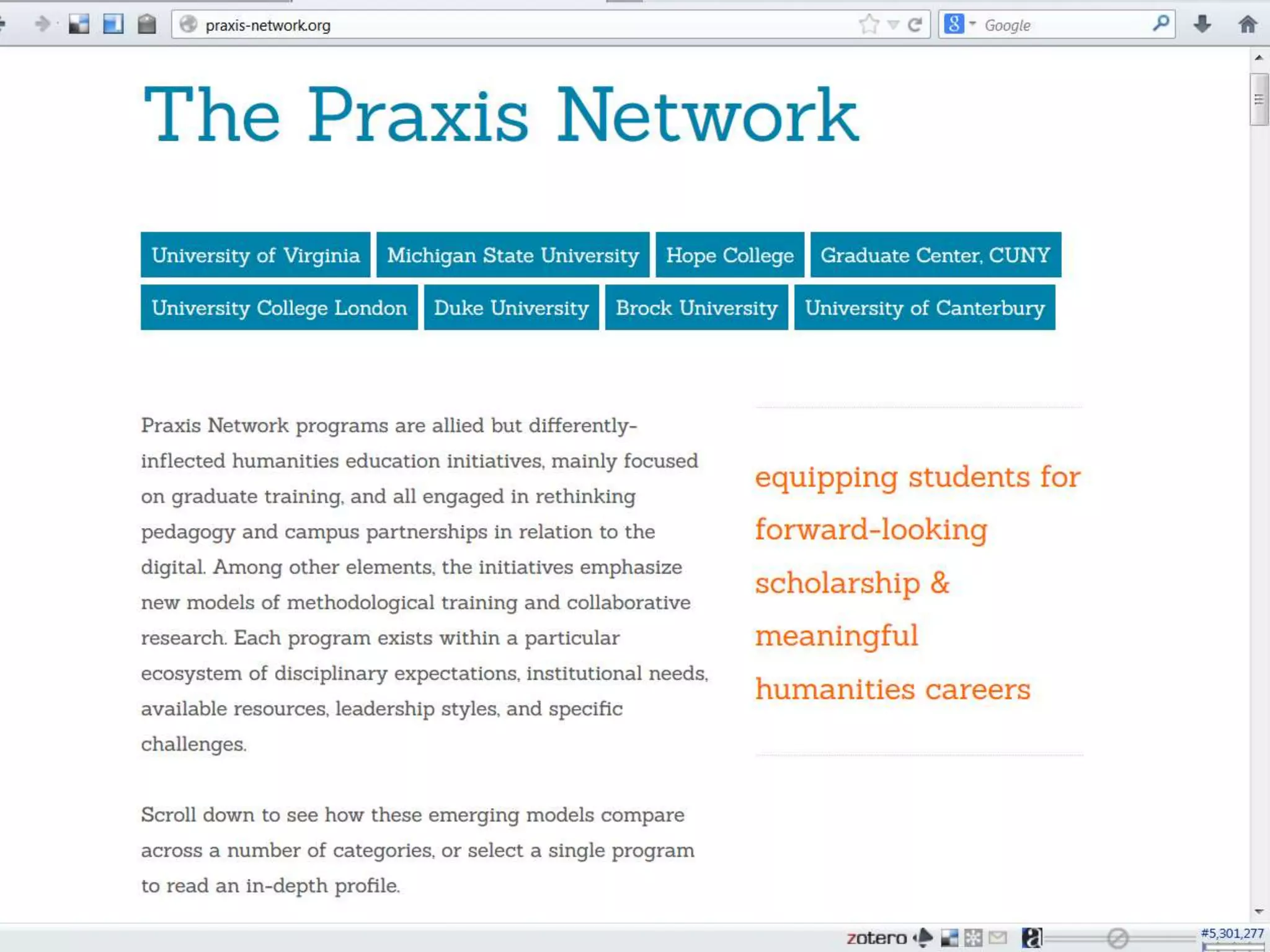
• UCLDH Community Page 
• Build cohesion 
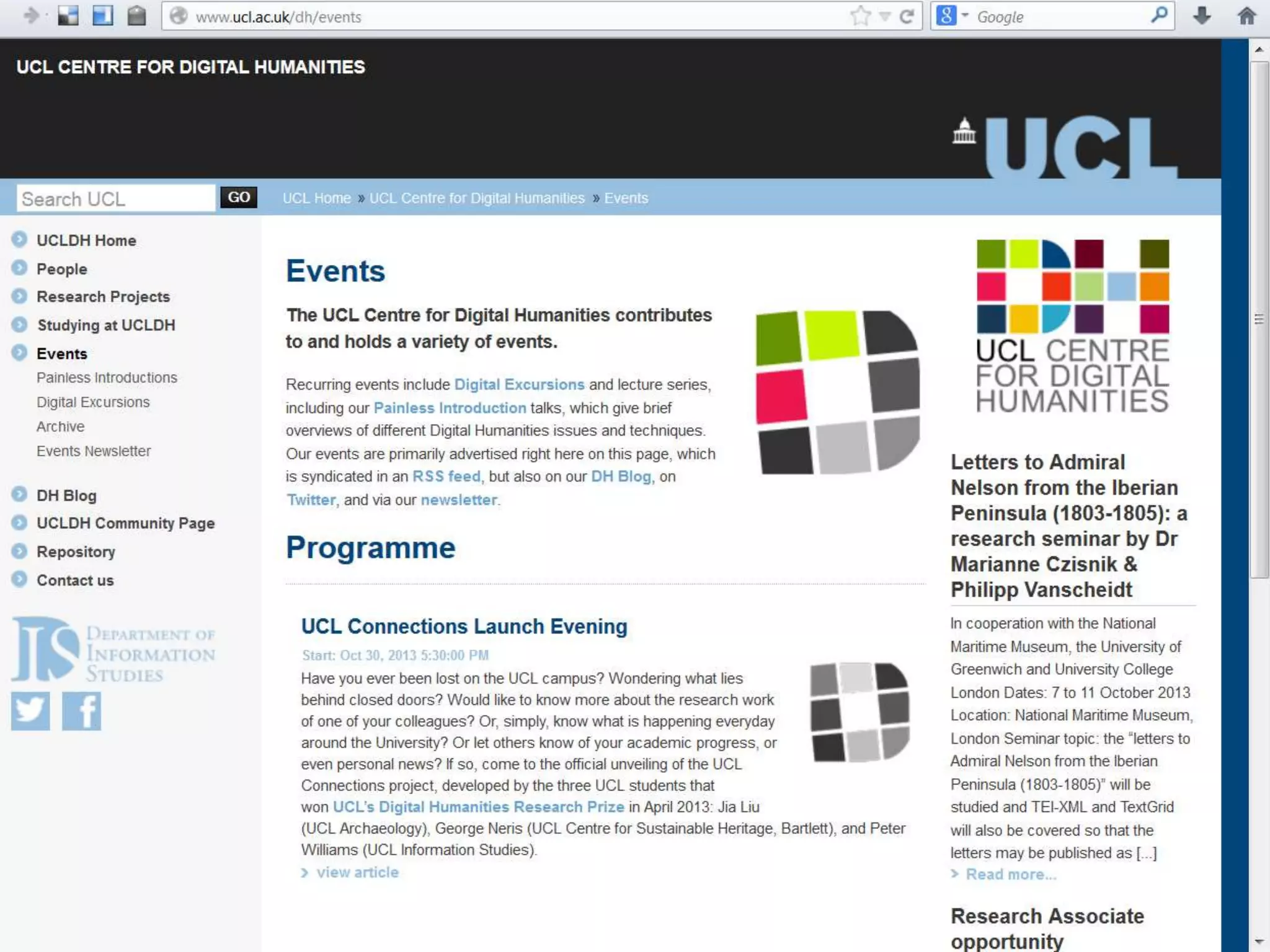
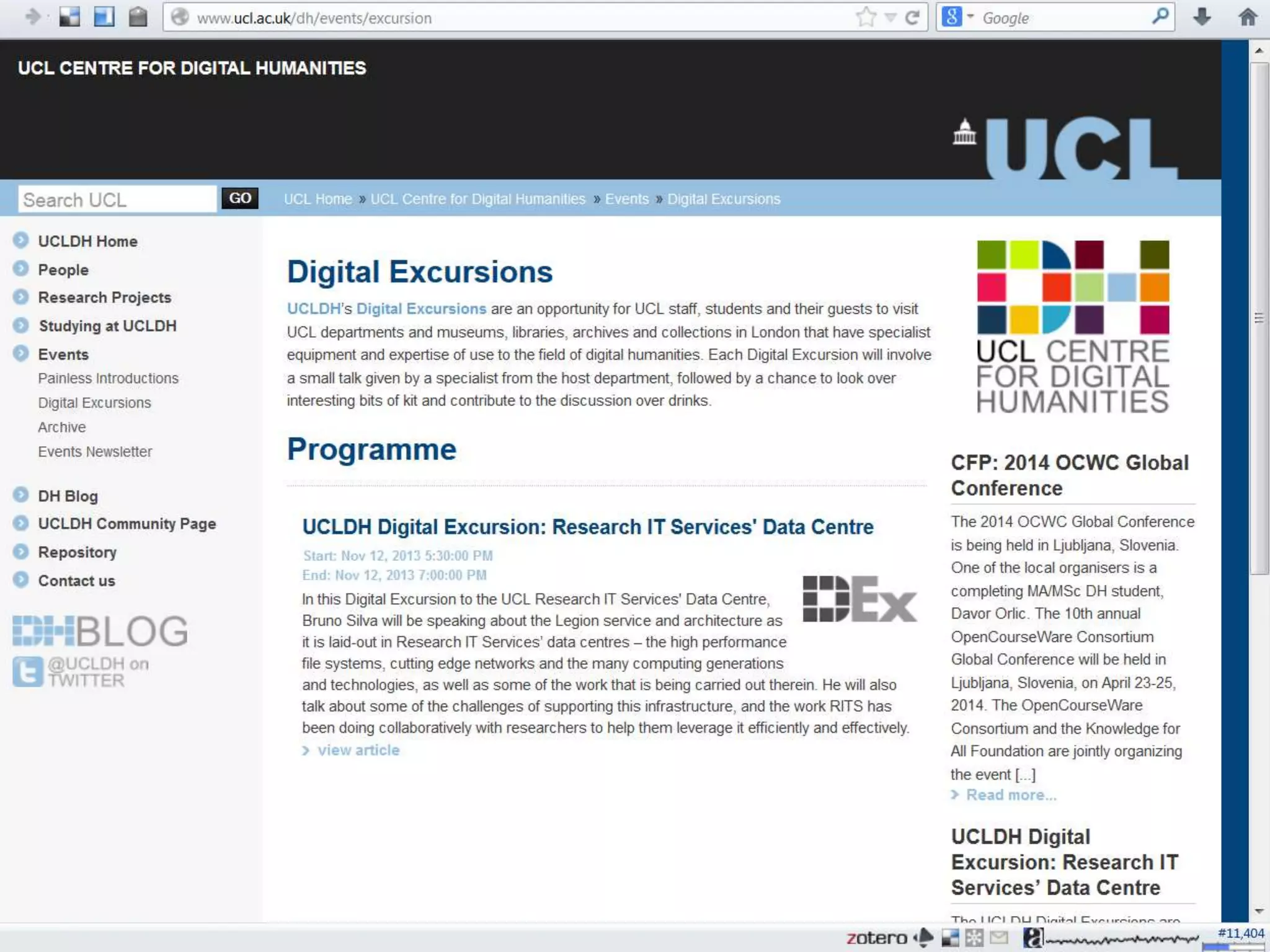
• Events 
• Academic plus social engagement 
• Inclusive not exclusive 
• A "learning society" (Dearing report 1997).
Previous experience in DH 
• Undergraduate 
– Introduction to DH: Stand alone option module 
• Postgraduate (taught Master’s) King’s and UCL 
• Research/study skills: Arts & Hums 
• Digital literacy
Skills? 
• IT services 
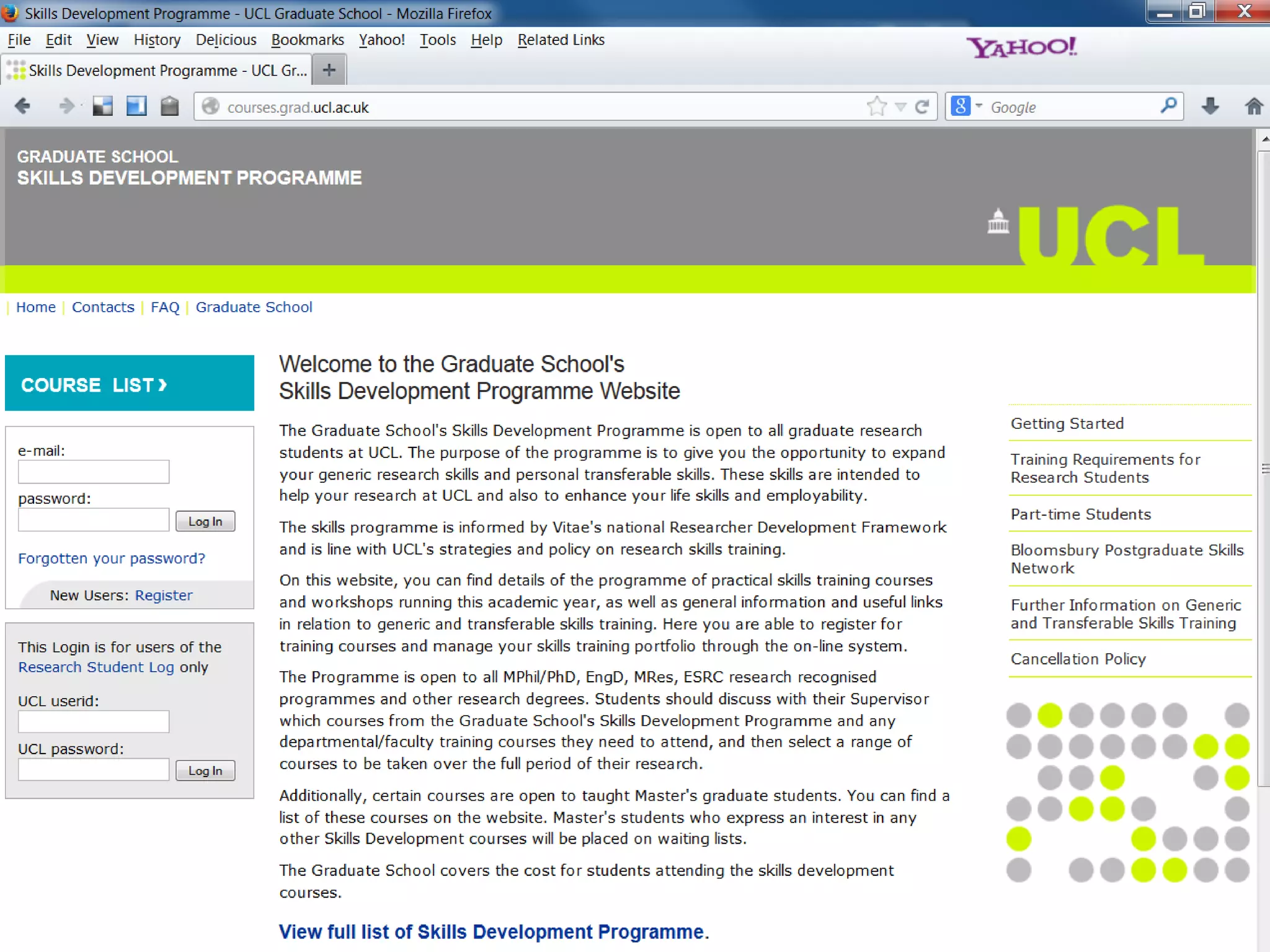
• UCL Graduate School 
• Skills development programme
Skills? 
• IT services 
• UCL Graduate School 
• Skills development programme 
• Technical skills not thinking skills 
• Not research training 
• Pedagogical underpinning?
Building on what went before 
• Proto-DH (ECP) 
• Electronic Communication and Publishing 
– Now incorporated in MA Publishing 
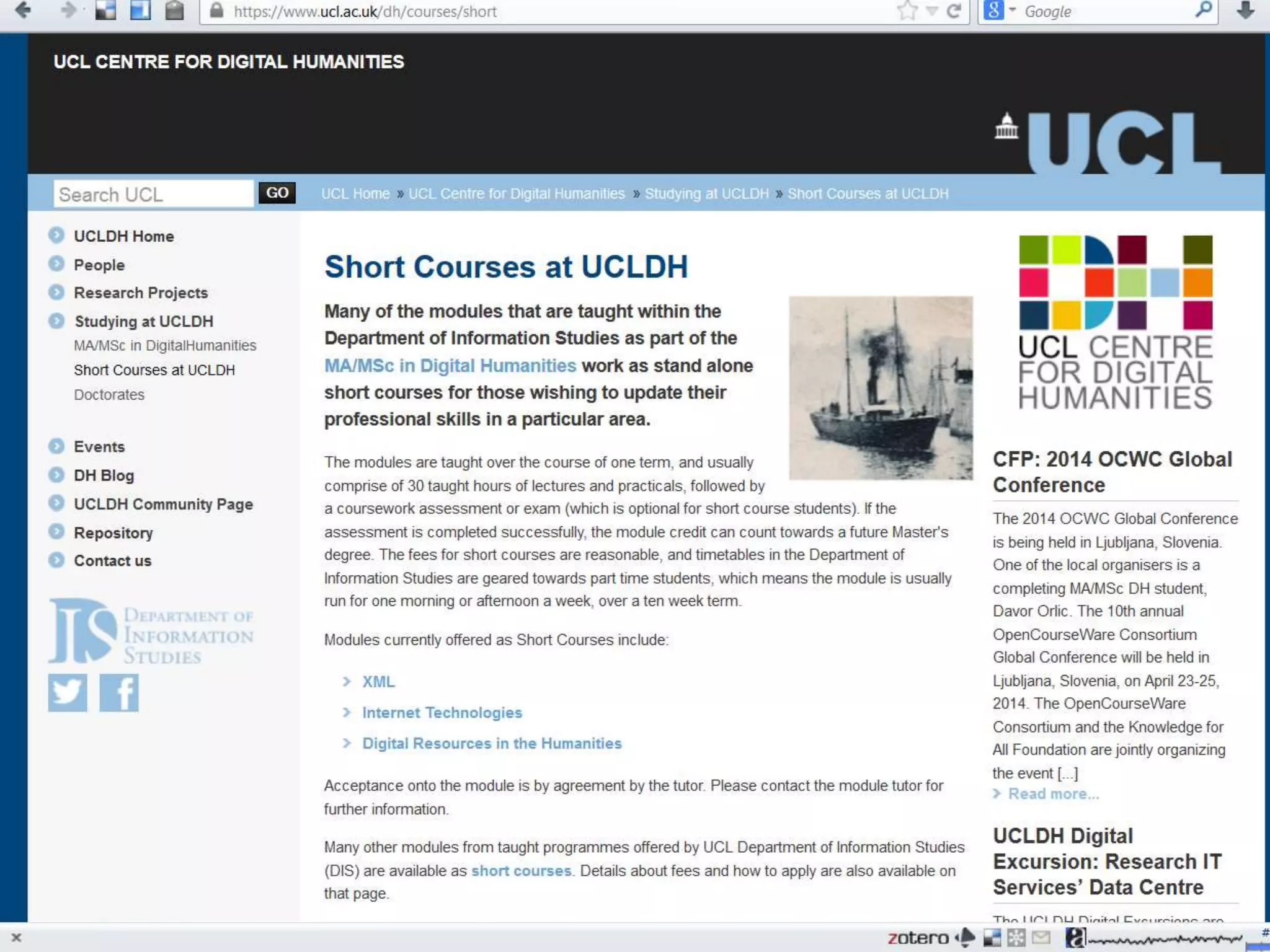
• Internet Technologies 
• Digital Resources in the Humanities 
• XML (Extensible Markup Language)
Core curriculum 
• Internet Technologies 
• Digital Resources in the Humanities 
• XML (Extensible Markup Language)
XML: what’s in a name? 
• Assignment: individual project from start to finish: 
• Prescriptive or allow student choice? 
• Choose material 
• Choose output 
• Choose outcome 
• How well do they execute this?
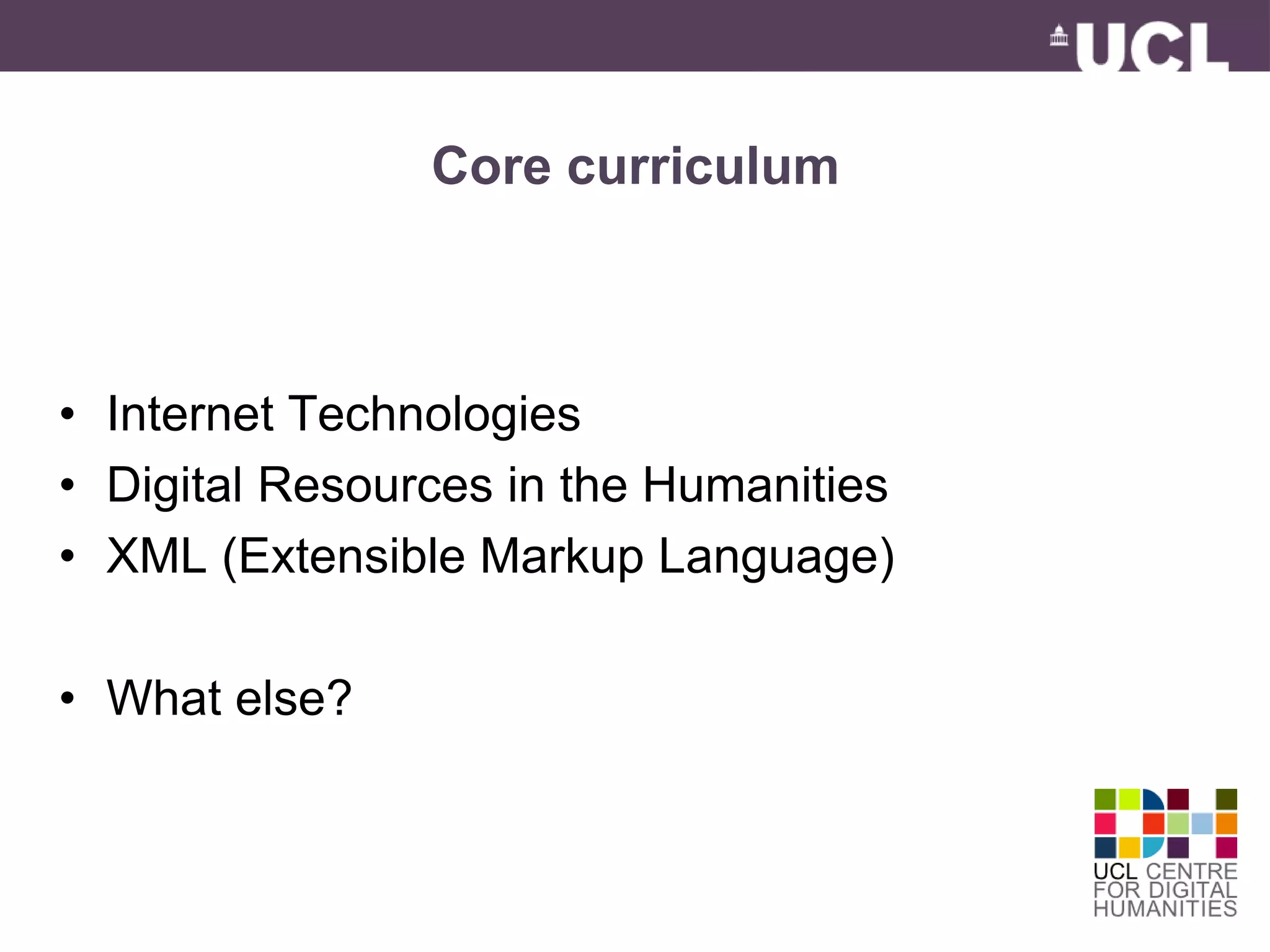
Core curriculum 
• Internet Technologies 
• Digital Resources in the Humanities 
• XML (Extensible Markup Language) 
• What else?
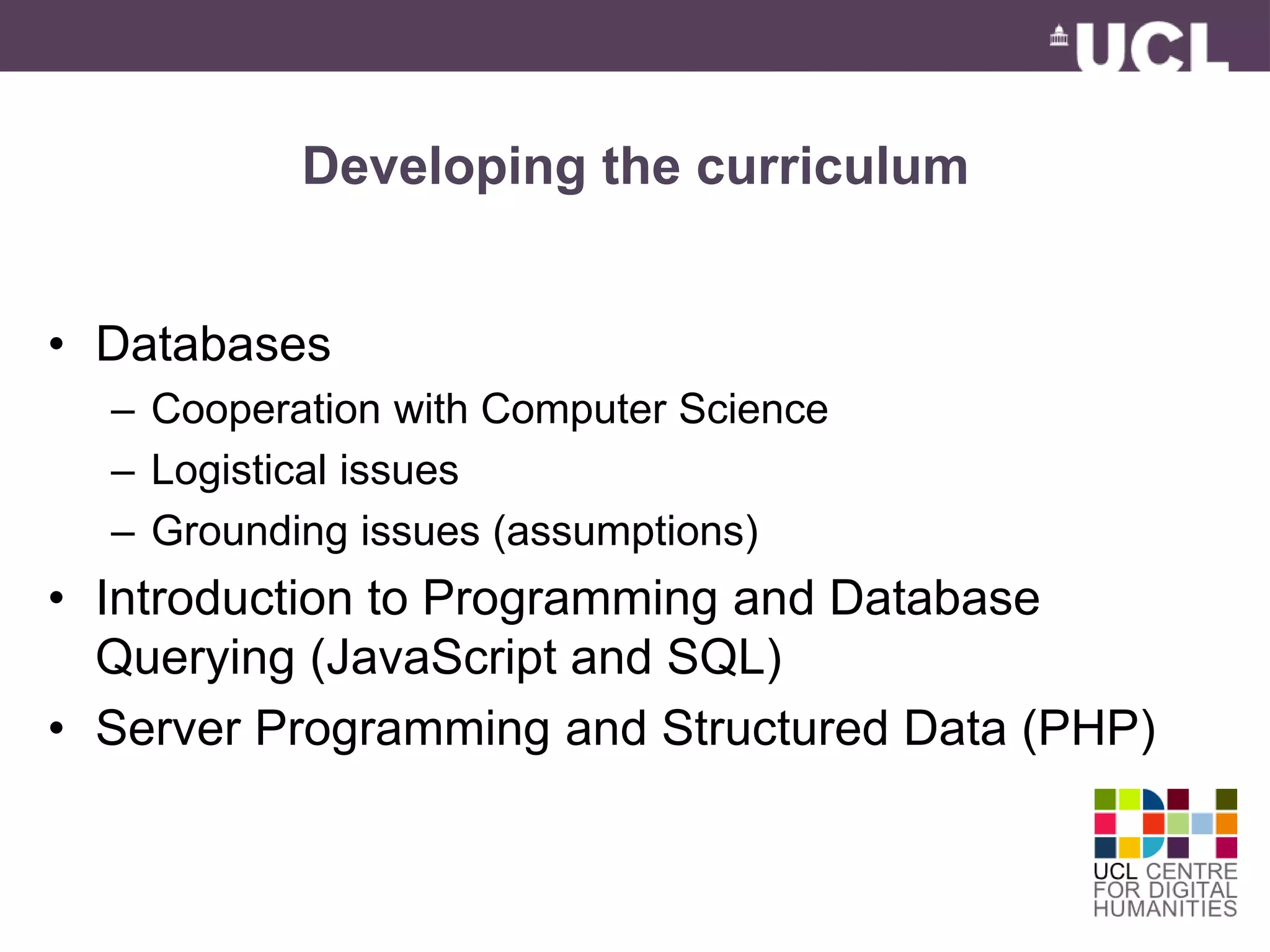
Developing the curriculum 
• Databases 
– Cooperation with Computer Science 
– Logistical issues 
– Grounding issues (assumptions) 
• Introduction to Programming and Database 
Querying (JavaScript and SQL) 
• Server Programming and Structured Data (PHP)
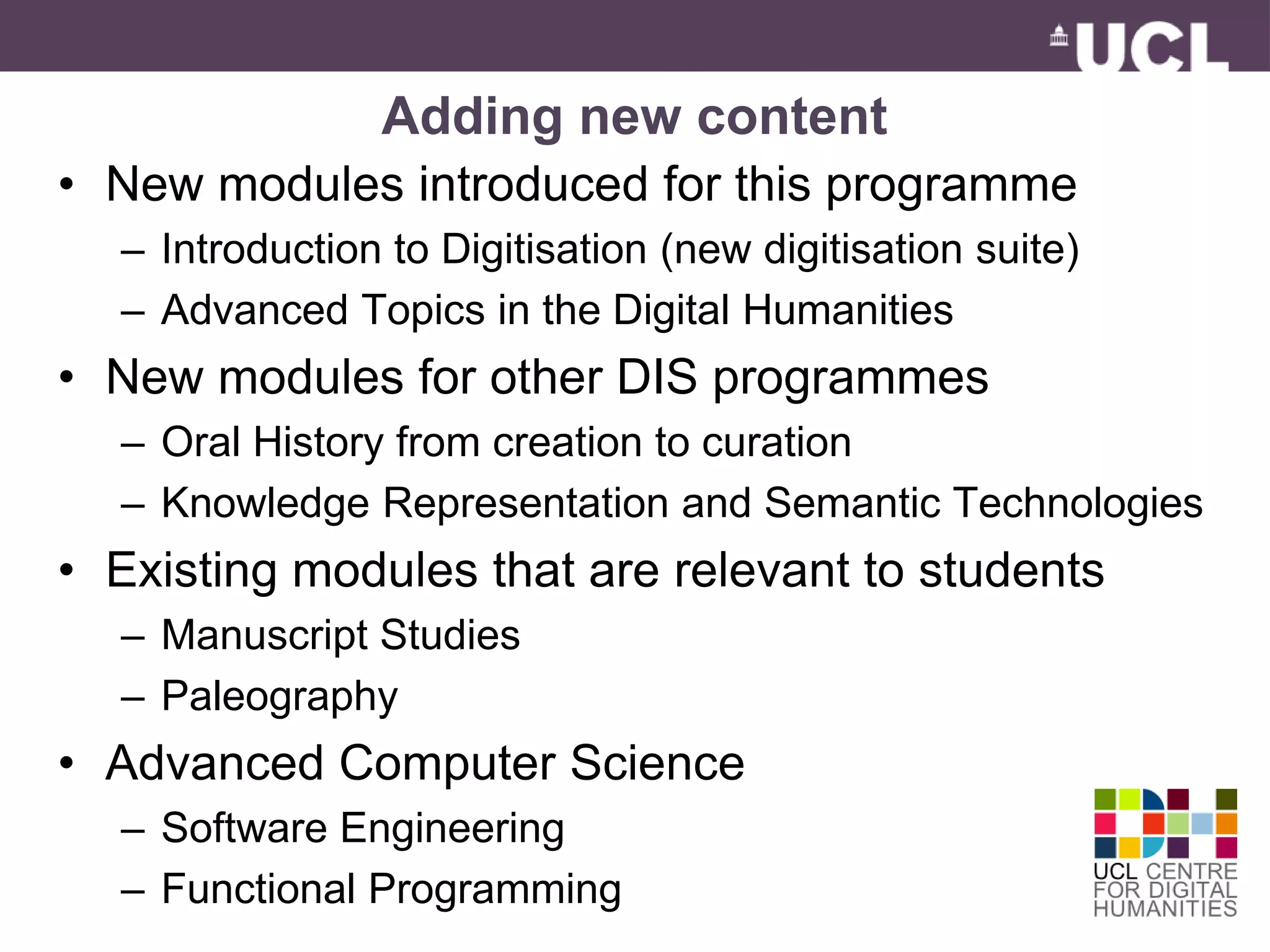
Adding new content 
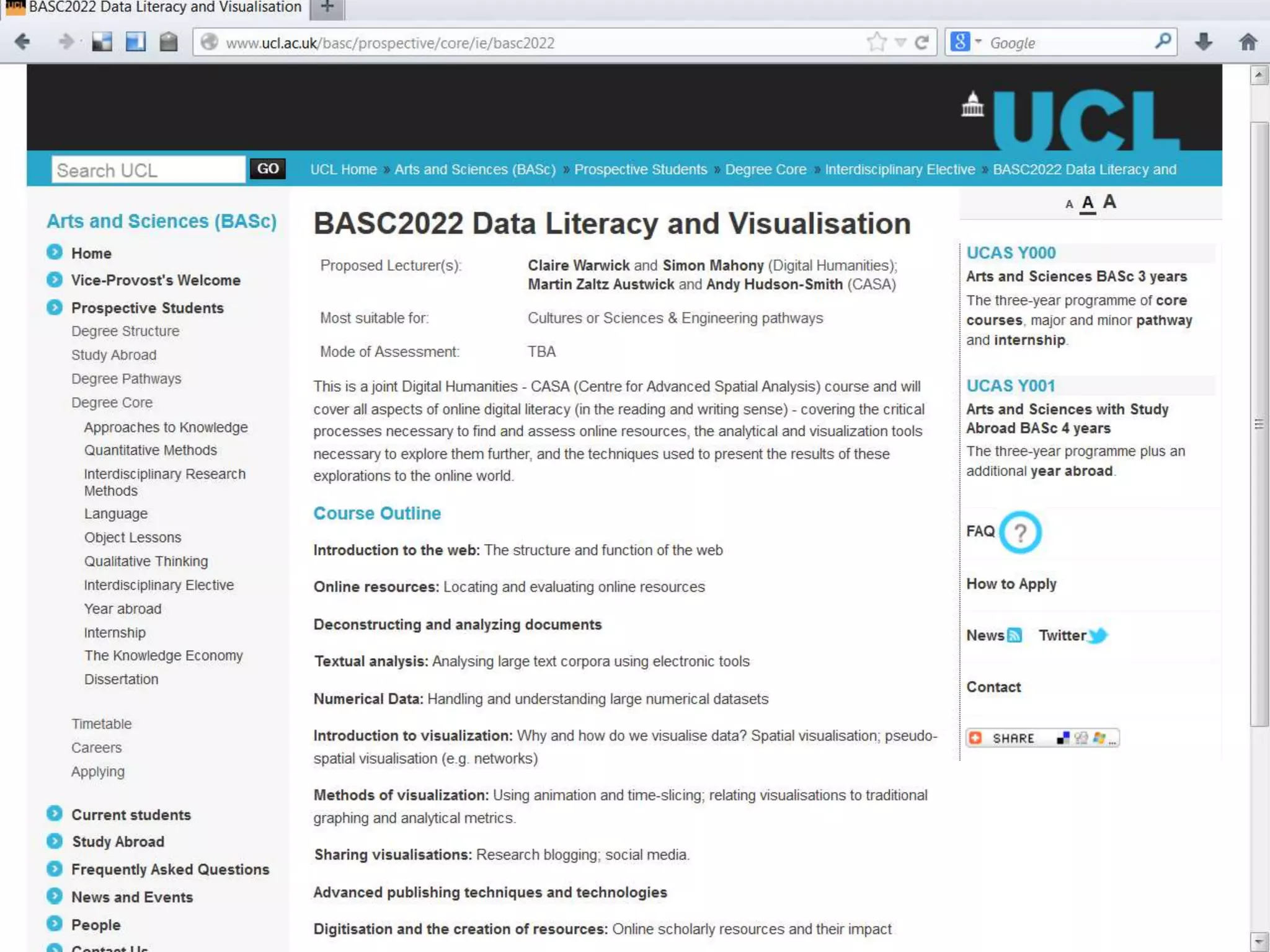
• New modules introduced for this programme 
– Introduction to Digitisation (new digitisation suite) 
– Advanced Topics in the Digital Humanities 
• New modules for other DIS programmes 
– Oral History from creation to curation 
– Knowledge Representation and Semantic Technologies 
• Existing modules that are relevant to students 
– Manuscript Studies 
– Paleography 
• Advanced Computer Science 
– Software Engineering 
– Functional Programming
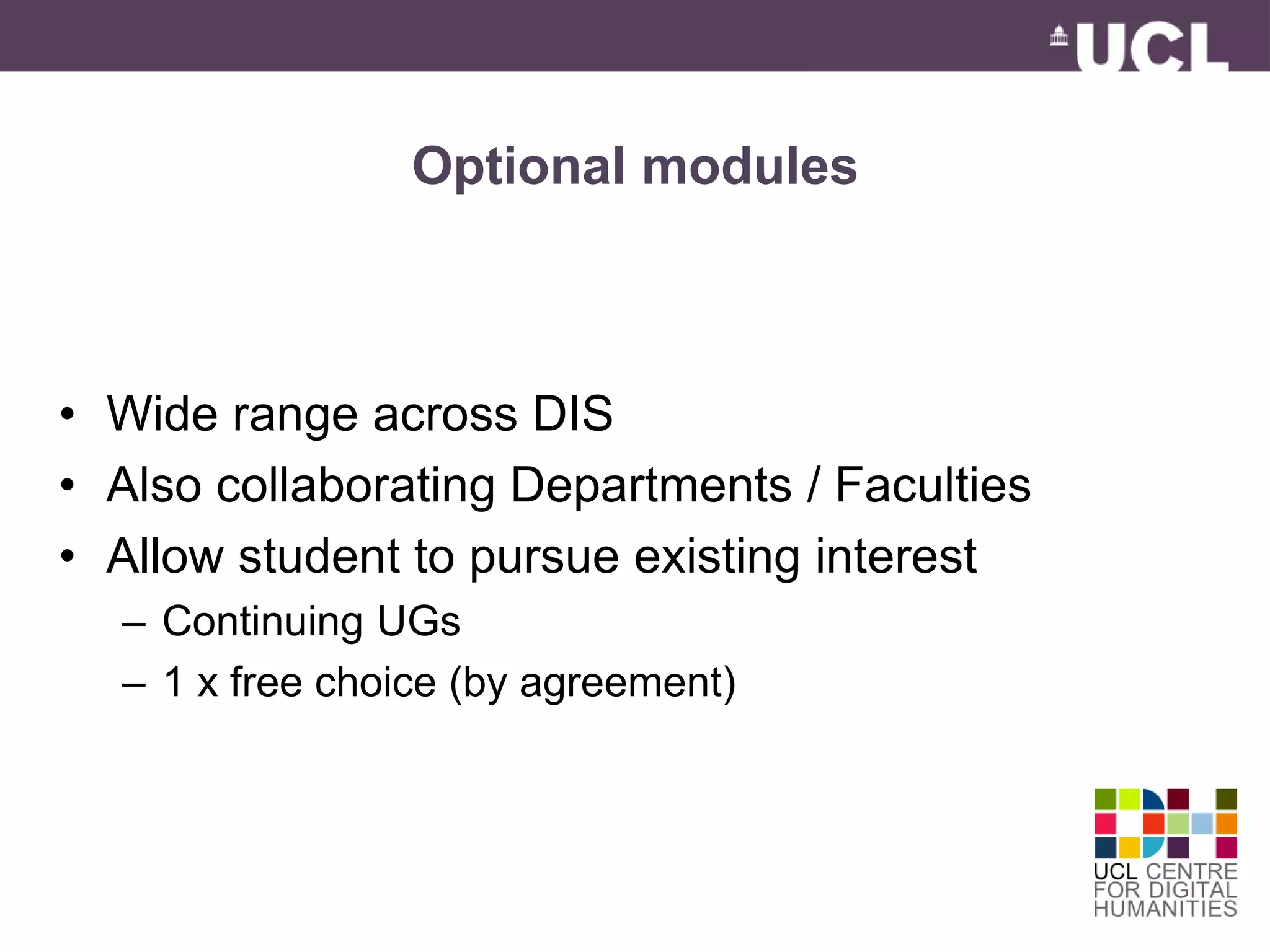
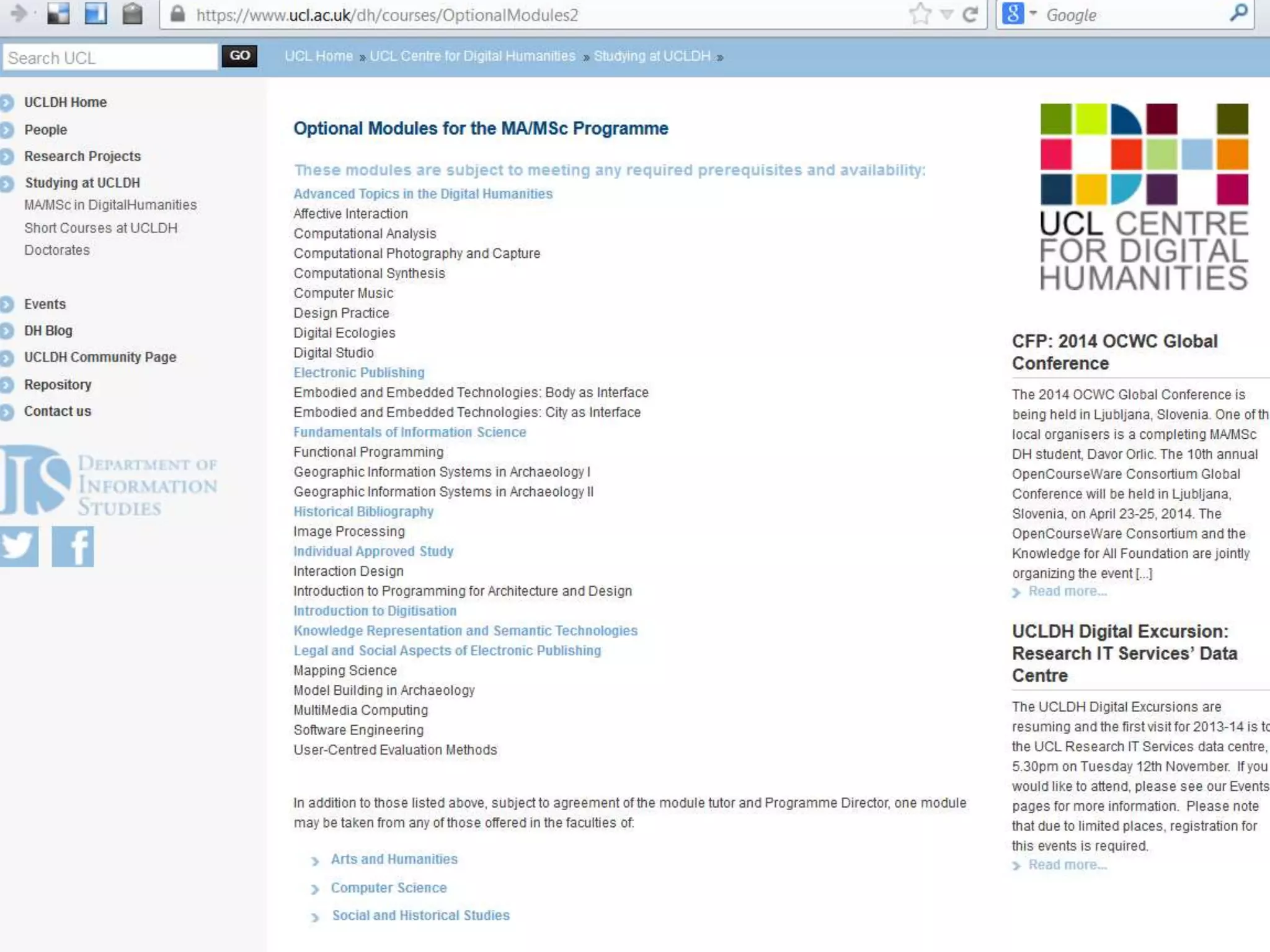
Optional modules 
• Wide range across DIS 
• Also collaborating Departments / Faculties 
• Allow student to pursue existing interest 
– Continuing UGs 
– 1 x free choice (by agreement)
Making necessary adjustments? 
• To be effective needs to be relevant 
• Make use of existing interests 
• Transition from students to research-students 
• Things that can be learnt can be taught 
• Cannot take our familiarity with tools and 
resources for granted 
• Pedagogy: not about learning technical skills
Iterative design? 
• Respond to (reasonable) feedback 
• Pay attention to what works 
• Monitor the programme 
• Get the students’ interest 
• Field trips?
What do we learn? 
• Create a community of learning 
• Learn from our students 
• Wider range of cultural diversity 
• We are constantly learning
Teaching Digital Humanities 
• Fundamental need: research methodologies 
• Thinking skills most important, most transferable 
• Develop students' ability to think 
• Build on existing familiarity 
• Reflective process 
• New and different ways of thinking 
• Engage with other programmes and departments 
• Encourage partnerships and synergies
References: 
Ron Dearing, et al, (1997) Higher Education in the Learning Society: The 
Report of the National Committee of Inquiry into Higher Education. HMSO 
Simon Mahony and Elena Pierazzo (2013) 'Teaching Skills or Teaching 
Methodology?', in Hirsch ed. Digital Humanities Pedagogy: Practices, 
Principles and Politics, Open Book Publishers. 
David Melville, Cliff Allan, Julian Crampton, and John Fothergill, et al, (2009) 
“Higher Education in a Web 2.0 World,” JISC report , Changing Learner 
Experience. 
http://www.jisc.ac.uk/media/documents/publications/heweb20rptv1.pdf. 
David Nicholas, Ian Rowlands, and Paul Huntington, et al, (2008) “Information 
Behaviour of the Researcher of the Future,” UCL CIBER Group briefing 
paper prepared for JISC and the British Library. 
http://www.jisc.ac.uk/whatwedo/programmes/resurcediscovery/googlegen. 
aspx.

Cork slideshare

  • 1.
    Digital Humanities pedagogy: new approaches and new ways of thinking about the Humanities? University College Cork (2013), Teaching and Learning Centre, Simon Mahony (University College London) s.mahony@ucl.ac.uk With thanks and acknowledgement to all my colleagues at UCLDH and also to Elena Pierazzo (King’s College London) who co-authored the book chapter that prompted this talk. All original content is licenced under a Creative Commons Attribution 3.0 Unported License
  • 2.
    UCLDH What wedo: Teaching & Learning • A new interdisciplinary degree exploring the intersection of digital technologies, humanities scholar-ships and cultural heritage • MA/MSc Digital Humanities, launched in 2011/12
  • 12.
    UCLDH central hub • Arts and Hums traditional scholarship • Brings together work in different departments and research centres across UCL and beyond • Interdisciplinary work • UCL Museums and Collections • UCL Special Collections • Computer Science • Engineering • Medical Physics
  • 13.
    Putting together anew programme? • Does it exist in a vacuum? • Building on experience
  • 14.
    What should webe teaching in DH? • Skills? • Methodology? • New ways of thinking about traditional material? • New and better questions? • Wide range of academic backgrounds • And skill levels • How do we accommodate all?
  • 15.
    Skills? • Collaborative • Interdisciplinary • Methodology • Reflective practice • Technical skills?
  • 16.
    Information literacy •Higher Education in a Web 2.0 World – Committee of Inquiry into the Changing Learner Experience • Uncritical acceptance of the Web • Expect Google to give them the answer • So-called "Digital Divide" • "Google Generation" CIBER at UCL – Report for JISC and British Library
  • 17.
    Unifying the group • UCLDH Community Page • Build cohesion • Events • Academic plus social engagement • Inclusive not exclusive • A "learning society" (Dearing report 1997).
  • 22.
    Previous experience inDH • Undergraduate – Introduction to DH: Stand alone option module • Postgraduate (taught Master’s) King’s and UCL • Research/study skills: Arts & Hums • Digital literacy
  • 23.
    Skills? • ITservices • UCL Graduate School • Skills development programme
  • 25.
    Skills? • ITservices • UCL Graduate School • Skills development programme • Technical skills not thinking skills • Not research training • Pedagogical underpinning?
  • 26.
    Building on whatwent before • Proto-DH (ECP) • Electronic Communication and Publishing – Now incorporated in MA Publishing • Internet Technologies • Digital Resources in the Humanities • XML (Extensible Markup Language)
  • 27.
    Core curriculum •Internet Technologies • Digital Resources in the Humanities • XML (Extensible Markup Language)
  • 28.
    XML: what’s ina name? • Assignment: individual project from start to finish: • Prescriptive or allow student choice? • Choose material • Choose output • Choose outcome • How well do they execute this?
  • 29.
    Core curriculum •Internet Technologies • Digital Resources in the Humanities • XML (Extensible Markup Language) • What else?
  • 30.
    Developing the curriculum • Databases – Cooperation with Computer Science – Logistical issues – Grounding issues (assumptions) • Introduction to Programming and Database Querying (JavaScript and SQL) • Server Programming and Structured Data (PHP)
  • 31.
    Adding new content • New modules introduced for this programme – Introduction to Digitisation (new digitisation suite) – Advanced Topics in the Digital Humanities • New modules for other DIS programmes – Oral History from creation to curation – Knowledge Representation and Semantic Technologies • Existing modules that are relevant to students – Manuscript Studies – Paleography • Advanced Computer Science – Software Engineering – Functional Programming
  • 32.
    Optional modules •Wide range across DIS • Also collaborating Departments / Faculties • Allow student to pursue existing interest – Continuing UGs – 1 x free choice (by agreement)
  • 34.
    Making necessary adjustments? • To be effective needs to be relevant • Make use of existing interests • Transition from students to research-students • Things that can be learnt can be taught • Cannot take our familiarity with tools and resources for granted • Pedagogy: not about learning technical skills
  • 35.
    Iterative design? •Respond to (reasonable) feedback • Pay attention to what works • Monitor the programme • Get the students’ interest • Field trips?
  • 36.
    What do welearn? • Create a community of learning • Learn from our students • Wider range of cultural diversity • We are constantly learning
  • 37.
    Teaching Digital Humanities • Fundamental need: research methodologies • Thinking skills most important, most transferable • Develop students' ability to think • Build on existing familiarity • Reflective process • New and different ways of thinking • Engage with other programmes and departments • Encourage partnerships and synergies
  • 38.
    References: Ron Dearing,et al, (1997) Higher Education in the Learning Society: The Report of the National Committee of Inquiry into Higher Education. HMSO Simon Mahony and Elena Pierazzo (2013) 'Teaching Skills or Teaching Methodology?', in Hirsch ed. Digital Humanities Pedagogy: Practices, Principles and Politics, Open Book Publishers. David Melville, Cliff Allan, Julian Crampton, and John Fothergill, et al, (2009) “Higher Education in a Web 2.0 World,” JISC report , Changing Learner Experience. http://www.jisc.ac.uk/media/documents/publications/heweb20rptv1.pdf. David Nicholas, Ian Rowlands, and Paul Huntington, et al, (2008) “Information Behaviour of the Researcher of the Future,” UCL CIBER Group briefing paper prepared for JISC and the British Library. http://www.jisc.ac.uk/whatwedo/programmes/resurcediscovery/googlegen. aspx.