 1
Dangerous Degrees
 2
“Carbon pollution in the atmosphere has risen by 40 per cent since the start of
the Industrial Revolution. It’s now at levels greater than at any time for least
800,000, possibly millions of years. We are stumbling blindly into utterly
uncharted territory where a few degrees make a world of difference.”
John Connor
CEO, The Climate Institute
Dangerous Degrees
This presentation summaries a booklet explaining why a rise of only a few degrees in the average global temperature risks
our prosperity, security, and health. It explains why it is so important to reverse the rise in emissions within the decade.
And why it is still within our means to do so.
Some of the imagery in this presentation was
provided by Michael Hall, Creative Fellow of The
Climate Institute
 3
Introduction
Today, CO2 emissions from fossil fuels are around 50 per cent higher than they were 20 years ago, and
have been rising each year. This kind of change to the chemical mixture in the air doesn’t come without
consequences. Acting like a blanket, the build-up of greenhouse gases is the main reason why the
average global temperature has risen by nearly 1 C in the last century. This booklet explains why a rise of
only a few degrees in the average global temperature risks our prosperity, security, and health. It explains
why it is so important to reverse the rise in emissions within the decade. And why it is still within our means
to do so.
 4
Key Findings
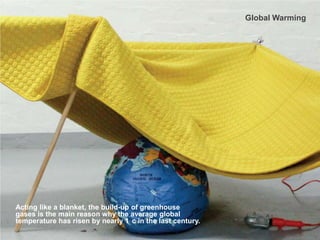
Acting like a blanket, the build-up of greenhouse
gases is the main reason why the average global
temperature has risen by nearly 1 c in the last century.
Global Warming
 5
Sky-high Emissions
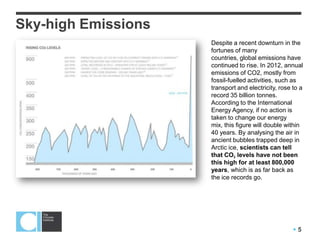
Despite a recent downturn in the
fortunes of many
countries, global emissions have
continued to rise. In 2012, annual
emissions of CO2, mostly from
fossil-fuelled activities, such as
transport and electricity, rose to a
record 35 billion tonnes.
According to the International
Energy Agency, if no action is
taken to change our energy
mix, this figure will double within
40 years. By analysing the air in
ancient bubbles trapped deep in
Arctic ice, scientists can tell
that CO2 levels have not been
this high for at least 800,000
years, which is as far back as
the ice records go.
 6
The Canary in the Coalmine
The average global temperature is
now around 0.8 C higher than it
was at the start of the 20th century.
And it’s getting warmer faster: the
20 warmest years on record have
all occurred since 1981, and the 10
warmest since 2000. Global
temperatures hit a new record high
in 2010.
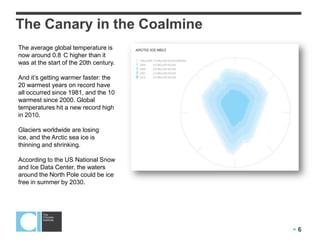
Glaciers worldwide are losing
ice, and the Arctic sea ice is
thinning and shrinking.
According to the US National Snow
and Ice Data Center, the waters
around the North Pole could be ice
free in summer by 2030.
 7
A few degrees makes a world of difference.
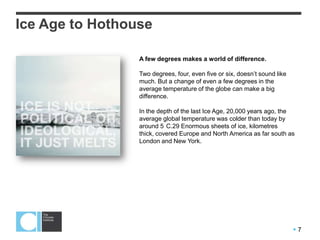
Two degrees, four, even five or six, doesn’t sound like
much. But a change of even a few degrees in the
average temperature of the globe can make a big
difference.
In the depth of the last Ice Age, 20,000 years ago, the
average global temperature was colder than today by
around 5 C.29 Enormous sheets of ice, kilometres
thick, covered Europe and North America as far south as
London and New York.
Ice Age to Hothouse
 8
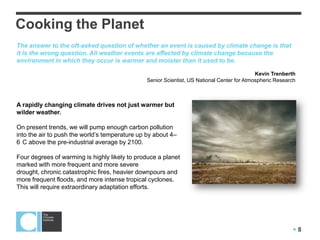
A rapidly changing climate drives not just warmer but
wilder weather.
On present trends, we will pump enough carbon pollution
into the air to push the world’s temperature up by about 4–
6 C above the pre-industrial average by 2100.
Four degrees of warming is highly likely to produce a planet
marked with more frequent and more severe
drought, chronic catastrophic fires, heavier downpours and
more frequent floods, and more intense tropical cyclones.
This will require extraordinary adaptation efforts.
Cooking the Planet
The answer to the oft-asked question of whether an event is caused by climate change is that
it is the wrong question. All weather events are affected by climate change because the
environment in which they occur is warmer and moister than it used to be.
Kevin Trenberth
Senior Scientist, US National Center for Atmospheric Research
 9
Shocks and Surprises
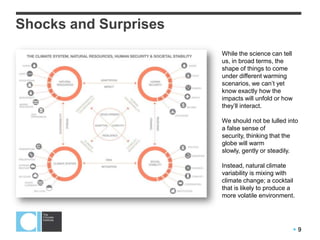
While the science can tell
us, in broad terms, the
shape of things to come
under different warming
scenarios, we can’t yet
know exactly how the
impacts will unfold or how
they’ll interact.
We should not be lulled into
a false sense of
security, thinking that the
globe will warm
slowly, gently or steadily.
Instead, natural climate
variability is mixing with
climate change; a cocktail
that is likely to produce a
more volatile environment.
 10
Shocks and Surprises
“A 4 c world is so different
from the current one that it
comes with high uncertainty
and new risks that threaten
our ability to anticipate and
plan for future adaptation
needs…A 4 c world can, and
must, be avoided.”
Dr Jim Yong Kim
President, World Bank
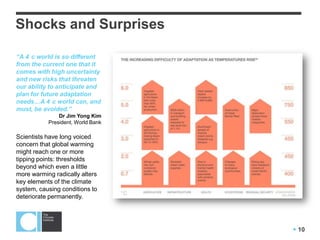
Scientists have long voiced
concern that global warming
might reach one or more
tipping points: thresholds
beyond which even a little
more warming radically alters
key elements of the climate
system, causing conditions to
deteriorate permanently.
 11
Concerns
 12
A Less Safe, Less Secure World
A storm, heat wave or drought doesn’t occur
in a vacuum. No country, community or
company experiences disasters in isolation.
Strife in one corner of the world easily spills
over into others. Disasters tie up emergency
services, armed forces, and medical teams.
They damage supplies of power, water, fuel
and food. They destroy farms and damage
tourism, and may slash export earnings by
millions, even billions of dollars.
A growing stack of American and European
reports has identified climate change as an
emerging risk to peace and security. Recent
work by the American Security Project
reveals that the defence departments and
intelligence services of more than 100
countries now view global warming as, not
simply an environmental issue, but a real
risk to national security.
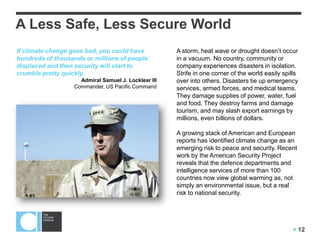
If climate change goes bad, you could have
hundreds of thousands or millions of people
displaced and then security will start to
crumble pretty quickly.
Admiral Samuel J. Locklear III
Commander, US Pacific Command
 13
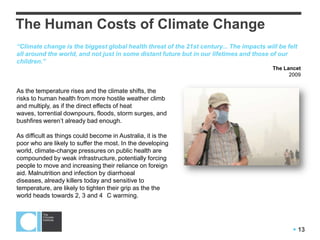
The Human Costs of Climate Change
“Climate change is the biggest global health threat of the 21st century... The impacts will be felt
all around the world, and not just in some distant future but in our lifetimes and those of our
children.”
The Lancet
2009
As the temperature rises and the climate shifts, the
risks to human health from more hostile weather climb
and multiply, as if the direct effects of heat
waves, torrential downpours, floods, storm surges, and
bushfires weren’t already bad enough.
As difficult as things could become in Australia, it is the
poor who are likely to suffer the most. In the developing
world, climate-change pressures on public health are
compounded by weak infrastructure, potentially forcing
people to move and increasing their reliance on foreign
aid. Malnutrition and infection by diarrhoeal
diseases, already killers today and sensitive to
temperature, are likely to tighten their grip as the the
world heads towards 2, 3 and 4 C warming.
 14
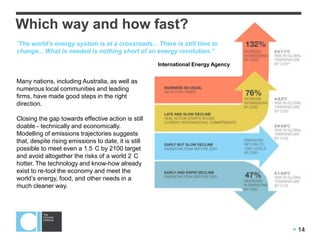
Many nations, including Australia, as well as
numerous local communities and leading
firms, have made good steps in the right
direction.
Closing the gap towards effective action is still
doable - technically and economically.
Modelling of emissions trajectories suggests
that, despite rising emissions to date, it is still
possible to meet even a 1.5 C by 2100 target
and avoid altogether the risks of a world 2 C
hotter. The technology and know-how already
exist to re-tool the economy and meet the
world’s energy, food, and other needs in a
much cleaner way.
Which way and how fast?
“The world’s energy system is at a crossroads... There is still time to
change... What is needed is nothing short of an energy revolution.”
International Energy Agency
 15
Steering Clear of 4oC
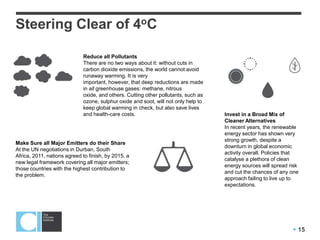
Reduce all Pollutants
There are no two ways about it: without cuts in
carbon dioxide emissions, the world cannot avoid
runaway warming. It is very
important, however, that deep reductions are made
in all greenhouse gases: methane, nitrous
oxide, and others. Cutting other pollutants, such as
ozone, sulphur oxide and soot, will not only help to
keep global warming in check, but also save lives
and health-care costs.
Make Sure all Major Emitters do their Share
At the UN negotiations in Durban, South
Africa, 2011, nations agreed to finish, by 2015, a
new legal framework covering all major emitters;
those countries with the highest contribution to
the problem.
Invest in a Broad Mix of
Cleaner Alternatives
In recent years, the renewable
energy sector has shown very
strong growth, despite a
downturn in global economic
activity overall. Policies that
catalyse a plethora of clean
energy sources will spread risk
and cut the chances of any one
approach failing to live up to
expectations.
 16
Steering Clear of 4oC
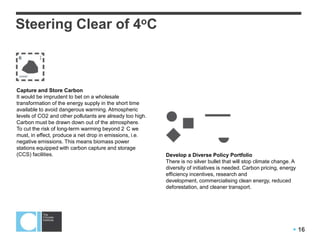
Capture and Store Carbon
It would be imprudent to bet on a wholesale
transformation of the energy supply in the short time
available to avoid dangerous warming. Atmospheric
levels of CO2 and other pollutants are already too high.
Carbon must be drawn down out of the atmosphere.
To cut the risk of long-term warming beyond 2 C we
must, in effect, produce a net drop in emissions, i.e.
negative emissions. This means biomass power
stations equipped with carbon capture and storage
(CCS) facilities. Develop a Diverse Policy Portfolio
There is no silver bullet that will stop climate change. A
diversity of initiatives is needed. Carbon pricing, energy
efficiency incentives, research and
development, commercialising clean energy, reduced
deforestation, and cleaner transport.
 17
Reducing Emissions
Action in the electricity sector—renewable
energy and energy efficiency—is
particularly important, though not enough by
itself. Emissions from transport can be
avoided by using hybrid and electric
vehicles in tandem with clean energy. And
putting deforestation into reverse is critical.
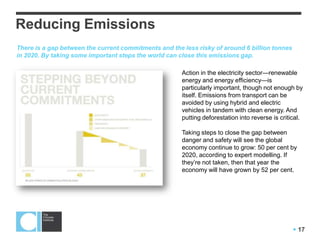
Taking steps to close the gap between
danger and safety will see the global
economy continue to grow: 50 per cent by
2020, according to expert modelling. If
they’re not taken, then that year the
economy will have grown by 52 per cent.
There is a gap between the current commitments and the less risky of around 6 billion tonnes
in 2020. By taking some important steps the world can close this emissions gap.
 18
Getting on Track Means Starting Now
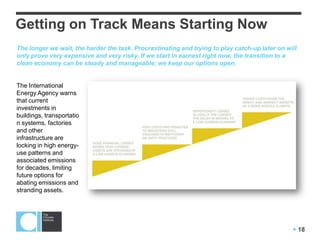
The International
Energy Agency warns
that current
investments in
buildings, transportatio
n systems, factories
and other
infrastructure are
locking in high energy-
use patterns and
associated emissions
for decades, limiting
future options for
abating emissions and
stranding assets.
The longer we wait, the harder the task. Procrastinating and trying to play catch-up later on will
only prove very expensive and very risky. If we start in earnest right now, the transition to a
clean economy can be steady and manageable; we keep our options open.
 19
Addressing climate change
 20
More information
Visit www.climateinstitute.org.au/
dangerous-degrees.html
Or connect with us on Facebook or Twitter for the latest news on climate change impacts & solutions…
www.facebook.com/theclimateinstitute
www.twitter.com/climateinstitut

Dangerous Degrees

  • 1.
  • 2.
     2 “Carbon pollutionin the atmosphere has risen by 40 per cent since the start of the Industrial Revolution. It’s now at levels greater than at any time for least 800,000, possibly millions of years. We are stumbling blindly into utterly uncharted territory where a few degrees make a world of difference.” John Connor CEO, The Climate Institute Dangerous Degrees This presentation summaries a booklet explaining why a rise of only a few degrees in the average global temperature risks our prosperity, security, and health. It explains why it is so important to reverse the rise in emissions within the decade. And why it is still within our means to do so. Some of the imagery in this presentation was provided by Michael Hall, Creative Fellow of The Climate Institute
  • 3.
     3 Introduction Today, CO2emissions from fossil fuels are around 50 per cent higher than they were 20 years ago, and have been rising each year. This kind of change to the chemical mixture in the air doesn’t come without consequences. Acting like a blanket, the build-up of greenhouse gases is the main reason why the average global temperature has risen by nearly 1 C in the last century. This booklet explains why a rise of only a few degrees in the average global temperature risks our prosperity, security, and health. It explains why it is so important to reverse the rise in emissions within the decade. And why it is still within our means to do so.
  • 4.
     4 Key Findings Actinglike a blanket, the build-up of greenhouse gases is the main reason why the average global temperature has risen by nearly 1 c in the last century. Global Warming
  • 5.
     5 Sky-high Emissions Despitea recent downturn in the fortunes of many countries, global emissions have continued to rise. In 2012, annual emissions of CO2, mostly from fossil-fuelled activities, such as transport and electricity, rose to a record 35 billion tonnes. According to the International Energy Agency, if no action is taken to change our energy mix, this figure will double within 40 years. By analysing the air in ancient bubbles trapped deep in Arctic ice, scientists can tell that CO2 levels have not been this high for at least 800,000 years, which is as far back as the ice records go.
  • 6.
     6 The Canaryin the Coalmine The average global temperature is now around 0.8 C higher than it was at the start of the 20th century. And it’s getting warmer faster: the 20 warmest years on record have all occurred since 1981, and the 10 warmest since 2000. Global temperatures hit a new record high in 2010. Glaciers worldwide are losing ice, and the Arctic sea ice is thinning and shrinking. According to the US National Snow and Ice Data Center, the waters around the North Pole could be ice free in summer by 2030.
  • 7.
     7 A fewdegrees makes a world of difference. Two degrees, four, even five or six, doesn’t sound like much. But a change of even a few degrees in the average temperature of the globe can make a big difference. In the depth of the last Ice Age, 20,000 years ago, the average global temperature was colder than today by around 5 C.29 Enormous sheets of ice, kilometres thick, covered Europe and North America as far south as London and New York. Ice Age to Hothouse
  • 8.
     8 A rapidlychanging climate drives not just warmer but wilder weather. On present trends, we will pump enough carbon pollution into the air to push the world’s temperature up by about 4– 6 C above the pre-industrial average by 2100. Four degrees of warming is highly likely to produce a planet marked with more frequent and more severe drought, chronic catastrophic fires, heavier downpours and more frequent floods, and more intense tropical cyclones. This will require extraordinary adaptation efforts. Cooking the Planet The answer to the oft-asked question of whether an event is caused by climate change is that it is the wrong question. All weather events are affected by climate change because the environment in which they occur is warmer and moister than it used to be. Kevin Trenberth Senior Scientist, US National Center for Atmospheric Research
  • 9.
     9 Shocks andSurprises While the science can tell us, in broad terms, the shape of things to come under different warming scenarios, we can’t yet know exactly how the impacts will unfold or how they’ll interact. We should not be lulled into a false sense of security, thinking that the globe will warm slowly, gently or steadily. Instead, natural climate variability is mixing with climate change; a cocktail that is likely to produce a more volatile environment.
  • 10.
     10 Shocks andSurprises “A 4 c world is so different from the current one that it comes with high uncertainty and new risks that threaten our ability to anticipate and plan for future adaptation needs…A 4 c world can, and must, be avoided.” Dr Jim Yong Kim President, World Bank Scientists have long voiced concern that global warming might reach one or more tipping points: thresholds beyond which even a little more warming radically alters key elements of the climate system, causing conditions to deteriorate permanently.
  • 11.
  • 12.
     12 A LessSafe, Less Secure World A storm, heat wave or drought doesn’t occur in a vacuum. No country, community or company experiences disasters in isolation. Strife in one corner of the world easily spills over into others. Disasters tie up emergency services, armed forces, and medical teams. They damage supplies of power, water, fuel and food. They destroy farms and damage tourism, and may slash export earnings by millions, even billions of dollars. A growing stack of American and European reports has identified climate change as an emerging risk to peace and security. Recent work by the American Security Project reveals that the defence departments and intelligence services of more than 100 countries now view global warming as, not simply an environmental issue, but a real risk to national security. If climate change goes bad, you could have hundreds of thousands or millions of people displaced and then security will start to crumble pretty quickly. Admiral Samuel J. Locklear III Commander, US Pacific Command
  • 13.
     13 The HumanCosts of Climate Change “Climate change is the biggest global health threat of the 21st century... The impacts will be felt all around the world, and not just in some distant future but in our lifetimes and those of our children.” The Lancet 2009 As the temperature rises and the climate shifts, the risks to human health from more hostile weather climb and multiply, as if the direct effects of heat waves, torrential downpours, floods, storm surges, and bushfires weren’t already bad enough. As difficult as things could become in Australia, it is the poor who are likely to suffer the most. In the developing world, climate-change pressures on public health are compounded by weak infrastructure, potentially forcing people to move and increasing their reliance on foreign aid. Malnutrition and infection by diarrhoeal diseases, already killers today and sensitive to temperature, are likely to tighten their grip as the the world heads towards 2, 3 and 4 C warming.
  • 14.
     14 Many nations,including Australia, as well as numerous local communities and leading firms, have made good steps in the right direction. Closing the gap towards effective action is still doable - technically and economically. Modelling of emissions trajectories suggests that, despite rising emissions to date, it is still possible to meet even a 1.5 C by 2100 target and avoid altogether the risks of a world 2 C hotter. The technology and know-how already exist to re-tool the economy and meet the world’s energy, food, and other needs in a much cleaner way. Which way and how fast? “The world’s energy system is at a crossroads... There is still time to change... What is needed is nothing short of an energy revolution.” International Energy Agency
  • 15.
     15 Steering Clearof 4oC Reduce all Pollutants There are no two ways about it: without cuts in carbon dioxide emissions, the world cannot avoid runaway warming. It is very important, however, that deep reductions are made in all greenhouse gases: methane, nitrous oxide, and others. Cutting other pollutants, such as ozone, sulphur oxide and soot, will not only help to keep global warming in check, but also save lives and health-care costs. Make Sure all Major Emitters do their Share At the UN negotiations in Durban, South Africa, 2011, nations agreed to finish, by 2015, a new legal framework covering all major emitters; those countries with the highest contribution to the problem. Invest in a Broad Mix of Cleaner Alternatives In recent years, the renewable energy sector has shown very strong growth, despite a downturn in global economic activity overall. Policies that catalyse a plethora of clean energy sources will spread risk and cut the chances of any one approach failing to live up to expectations.
  • 16.
     16 Steering Clearof 4oC Capture and Store Carbon It would be imprudent to bet on a wholesale transformation of the energy supply in the short time available to avoid dangerous warming. Atmospheric levels of CO2 and other pollutants are already too high. Carbon must be drawn down out of the atmosphere. To cut the risk of long-term warming beyond 2 C we must, in effect, produce a net drop in emissions, i.e. negative emissions. This means biomass power stations equipped with carbon capture and storage (CCS) facilities. Develop a Diverse Policy Portfolio There is no silver bullet that will stop climate change. A diversity of initiatives is needed. Carbon pricing, energy efficiency incentives, research and development, commercialising clean energy, reduced deforestation, and cleaner transport.
  • 17.
     17 Reducing Emissions Actionin the electricity sector—renewable energy and energy efficiency—is particularly important, though not enough by itself. Emissions from transport can be avoided by using hybrid and electric vehicles in tandem with clean energy. And putting deforestation into reverse is critical. Taking steps to close the gap between danger and safety will see the global economy continue to grow: 50 per cent by 2020, according to expert modelling. If they’re not taken, then that year the economy will have grown by 52 per cent. There is a gap between the current commitments and the less risky of around 6 billion tonnes in 2020. By taking some important steps the world can close this emissions gap.
  • 18.
     18 Getting onTrack Means Starting Now The International Energy Agency warns that current investments in buildings, transportatio n systems, factories and other infrastructure are locking in high energy- use patterns and associated emissions for decades, limiting future options for abating emissions and stranding assets. The longer we wait, the harder the task. Procrastinating and trying to play catch-up later on will only prove very expensive and very risky. If we start in earnest right now, the transition to a clean economy can be steady and manageable; we keep our options open.
  • 19.
  • 20.
     20 More information Visitwww.climateinstitute.org.au/ dangerous-degrees.html Or connect with us on Facebook or Twitter for the latest news on climate change impacts & solutions… www.facebook.com/theclimateinstitute www.twitter.com/climateinstitut