Global Warming Is “Unequivocal” R H Gammon   University of Washington Bainbridge Graduate Institute 4/22/10
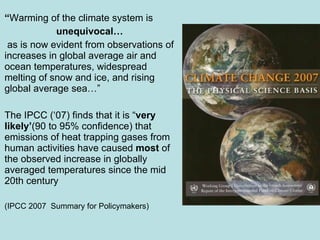
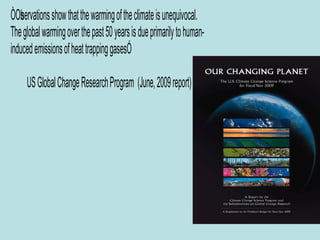
“ Warming of the climate system is unequivocal… as is now evident from observations of increases in global average air and ocean temperatures, widespread melting of snow and ice, and rising global average sea…” The IPCC (‘07) finds that it is “ very likely’ (90 to 95% confidence) that emissions of heat trapping gases from human activities have caused  most  of the observed increase in globally averaged temperatures since the mid 20th century (IPCC 2007  Summary for Policymakers)
 
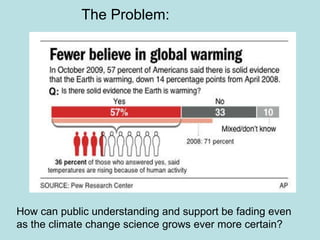
How can public understanding and support be fading even as the climate change science grows ever more certain? The Problem:
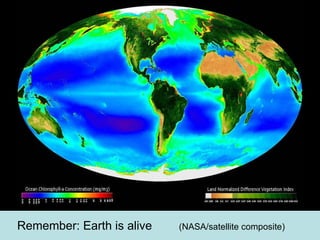
Remember: Earth is alive   (NASA/satellite composite)
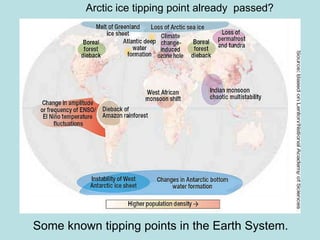
Some known tipping points in the Earth System. Arctic ice tipping point already  passed?
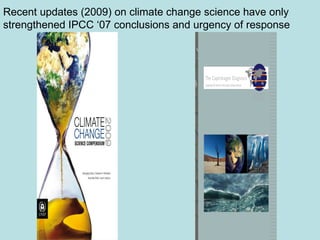
Recent updates (2009) on climate change science have only strengthened IPCC ‘07 conclusions and urgency of response
 
 
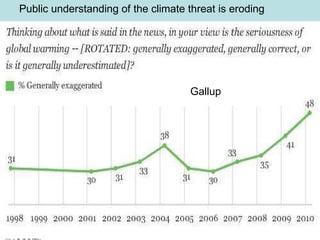
Public understanding of the climate threat is eroding Gallup
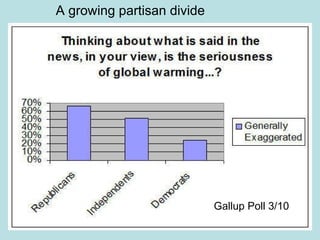
Gallup Poll 3/10 A growing partisan divide
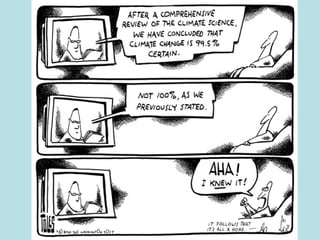
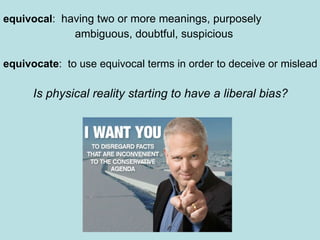
equivocal :  having two or more meanings, purposely ambiguous, doubtful, suspicious equivocate :  to use equivocal terms in order to deceive or mislead Is physical reality starting to have a liberal bias?
Global Temperatures Last Month Broke Heat Records for March WASHINGTON, DC , April 16, 2010 (ENS) - The world's combined global land and ocean surface temperature made last month the warmest March on record, according to federal government scientists with the National Oceanic and Atmospheric Administration, NOAA.
Spring comes 10 days earlier in Changed U.S. climate WASHINGTON (Reuters) – Spring comes about 10 days earlier in the United States than it did two decades ago, a consequence of climate change that favors invasive species over indigenous ones, scientists said on Tuesday.
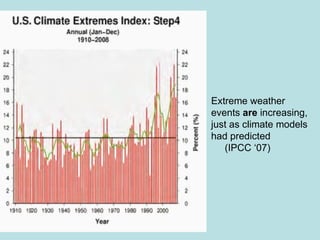
Extreme weather  events  are  increasing,  just as climate models had predicted  (IPCC ‘07)
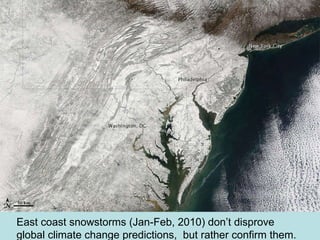
East coast snowstorms (Jan-Feb, 2010) don’t disprove global climate change predictions,  but rather confirm them.
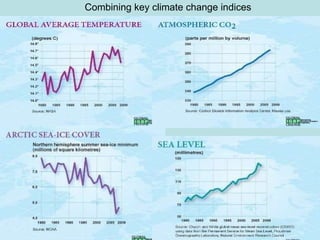
e Combining key climate change indices
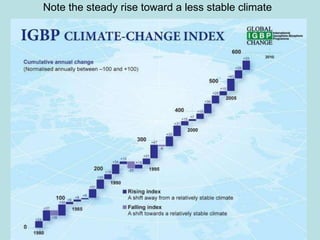
Note the steady rise toward a less stable climate
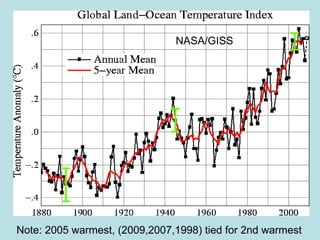
NASA/GISS Note: 2005 warmest, (2009,2007,1998) tied for 2nd warmest
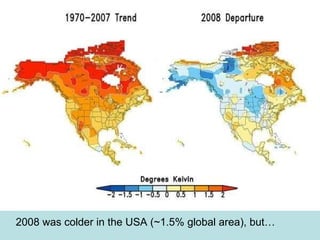
2008 was colder in the USA (~1.5% global area), but…
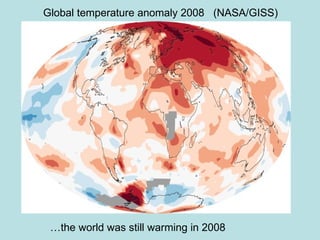
  … the world was still warming in 2008 Global temperature anomaly 2008  (NASA/GISS)
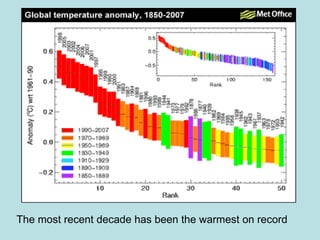
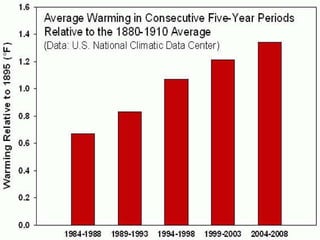
The most recent decade has been the warmest on record
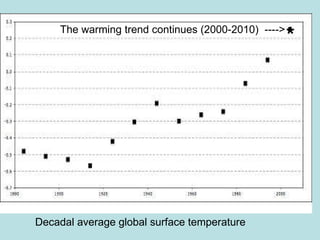
The warming trend continues (2000-2010)  ----> Decadal average global surface temperature *
 
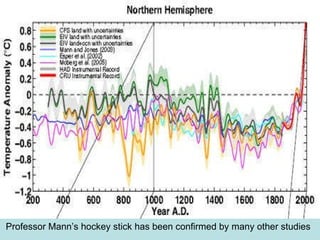
Professor Mann’s hockey stick has been confirmed by many other studies
A new (independent) ‘hockey stick’: Arctic temperature trends for the past 2000 years (Kaufman et al, Science, Sept ‘09)
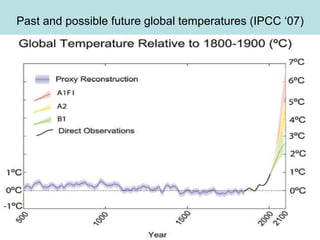
Past and possible future global temperatures (IPCC ‘07)
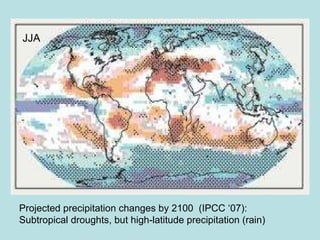
Projected precipitation changes by 2100  (IPCC ‘07): Subtropical droughts, but high-latitude precipitation (rain) JJA
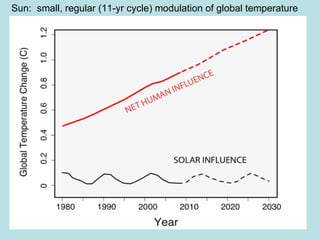
Sun:  small, regular (11-yr cycle) modulation of global temperature
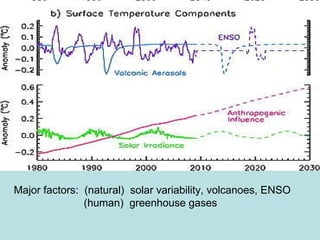
Major factors:  (natural)  solar variability, volcanoes, ENSO   (human)  greenhouse gases
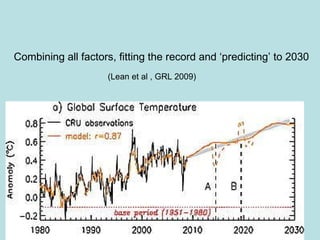
Combining all factors, fitting the record and ‘predicting’ to 2030 (Lean et al , GRL 2009)
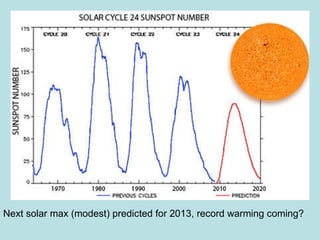
Quiet sun (2009) Next solar max (modest) predicted for 2013, record warming coming?
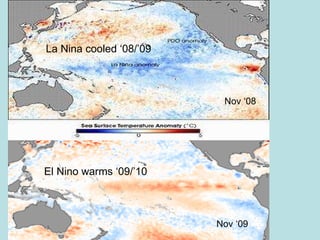
Nov ‘09 Nov ‘08 La Nina cooled ‘08/’09 El Nino warms ‘09/’10
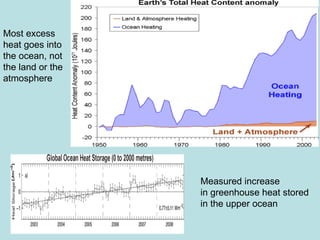
Measured increase in greenhouse heat stored in the upper ocean Most excess heat goes into  the ocean, not  the land or the atmosphere
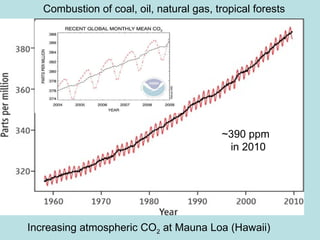
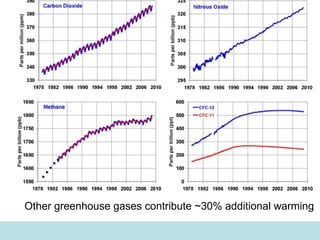
Increasing atmospheric CO 2  at Mauna Loa (Hawaii) Combustion of coal, oil, natural gas, tropical forests ~390 ppm in 2010
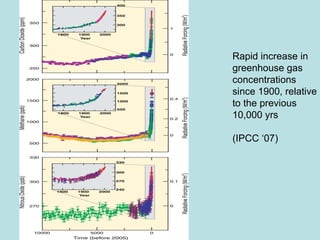
Rapid increase in greenhouse gas concentrations since 1900, relative to the previous 10,000 yrs (IPCC ‘07)
Other greenhouse gases contribute ~30% additional warming
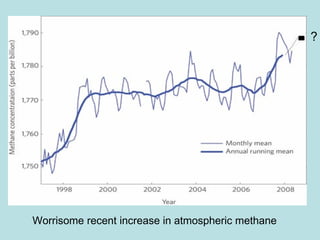
Worrisome recent increase in atmospheric methane ?
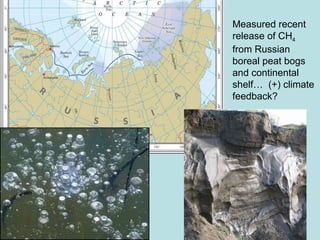
Measured recent release of CH 4 from Russian boreal peat bogs and continental shelf…  (+) climate feedback?
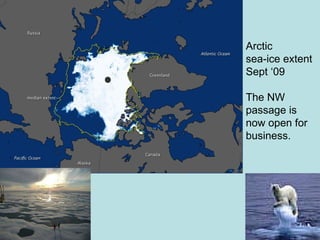
Arctic  sea-ice extent Sept ‘09 The NW passage is now open for business.
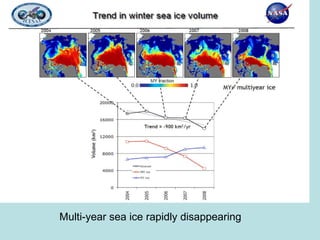
Multi-year sea ice rapidly disappearing
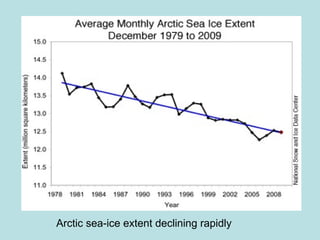
Arctic sea-ice extent declining rapidly
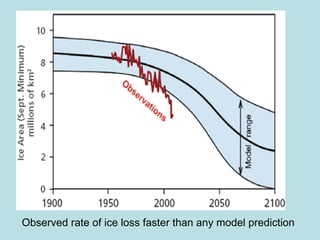
Observed rate of ice loss faster than any model prediction
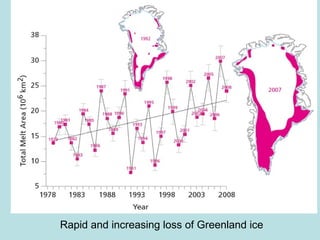
Rapid and increasing loss of Greenland ice
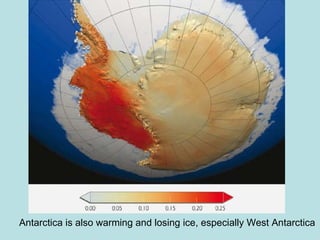
Antarctica is also warming and losing ice, especially West Antarctica
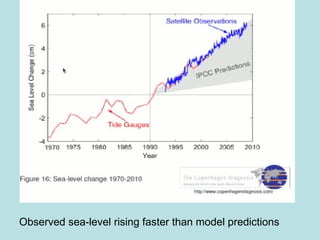
Observed sea-level rising faster than model predictions
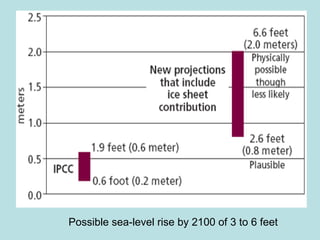
Possible sea-level rise by 2100 of 3 to 6 feet
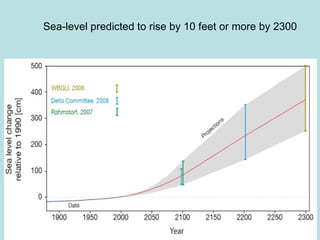
Sea-level predicted to rise by 10 feet or more by 2300
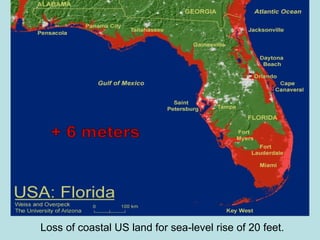
Loss of coastal US land for sea-level rise of 20 feet.
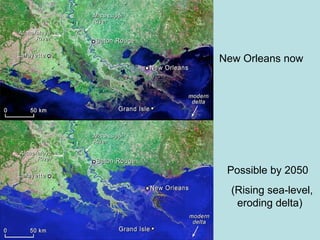
New Orleans now Possible by 2050 (Rising sea-level, eroding delta)
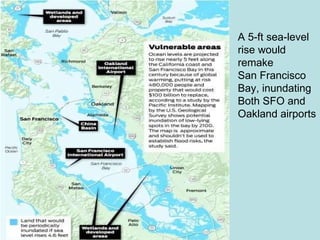
A 5-ft sea-level rise would remake San Francisco Bay, inundating Both SFO and Oakland airports
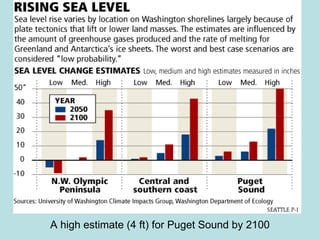
A high estimate (4 ft) for Puget Sound by 2100
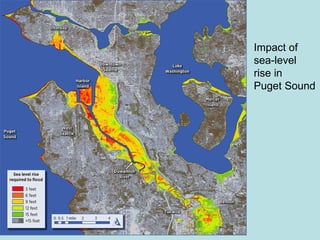
Impact of  sea-level rise in Puget Sound
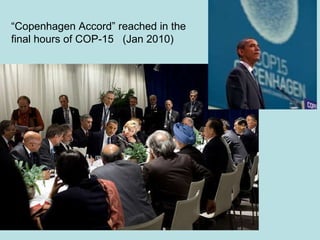
“Copenhagen Accord” reached in the final hours of COP-15  (Jan 2010)
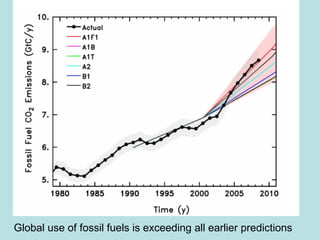
Global use of fossil fuels is exceeding all earlier predictions
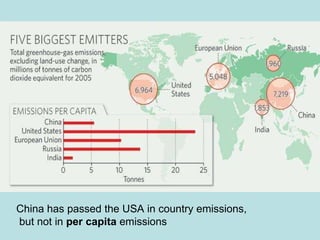
China has passed the USA in country emissions, but not in  per capita  emissions
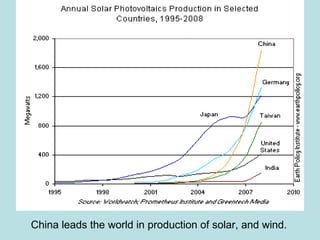
China leads the world in production of solar, and wind.
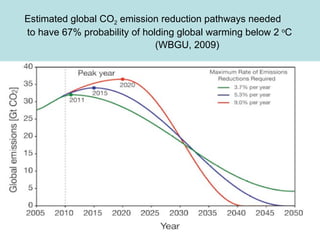
Estimated global CO 2  emission reduction pathways needed to have 67% probability of holding global warming below 2  o C   (WBGU, 2009)
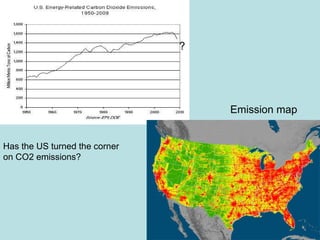
Has the US turned the corner on CO2 emissions? ? Emission map
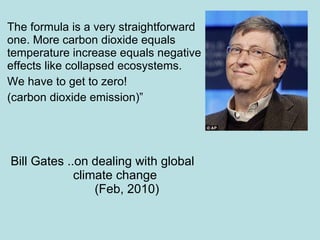
The formula is a very straightforward one. More carbon dioxide equals temperature increase equals negative effects like collapsed ecosystems.  We have to get to zero!  (carbon dioxide emission)”   Bill Gates ..on dealing with global    climate change     (Feb, 2010)
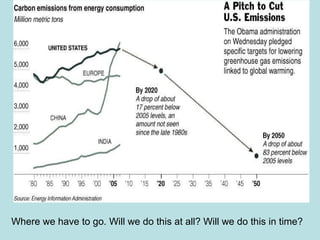
Where we have to go. Will we do this at all? Will we do this in time?
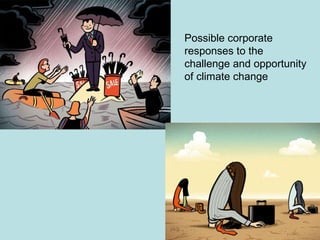
Possible corporate responses to the  challenge and opportunity of climate change
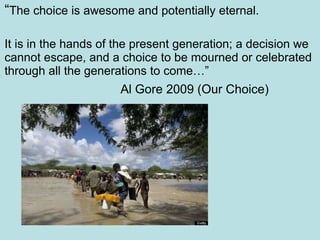
“ The choice is awesome and potentially eternal. It is in the hands of the present generation; a decision we cannot escape, and a choice to be mourned or celebrated through all the generations to come…”   Al Gore 2009 (Our Choice)
 
 
What You Can Do   *  Learn about climate change, convince others of the challenge * Urge your leaders to pass strong climate mitigation laws * Support clean, renewable energy * Replace incandescent light-bulbs with cfls * Save energy and water at home * Buy energy-efficient appliances  * Plant a tree, protect a forest * Recycle, reuse, rethink (don’t waste anything)  * Support better public transportation, walk, ride a bike. * Drive green (take your foot off the gas!), consider a Prius   “ Start by doing what’s necessary, then do what’s possible,    and soon you will be doing the impossible…” St Francis of Assisi

BGI Dr Gammon Presentation on Climate Change 4.22.10

  • 1.
    Global Warming Is“Unequivocal” R H Gammon University of Washington Bainbridge Graduate Institute 4/22/10
  • 2.
    “ Warming ofthe climate system is unequivocal… as is now evident from observations of increases in global average air and ocean temperatures, widespread melting of snow and ice, and rising global average sea…” The IPCC (‘07) finds that it is “ very likely’ (90 to 95% confidence) that emissions of heat trapping gases from human activities have caused most of the observed increase in globally averaged temperatures since the mid 20th century (IPCC 2007 Summary for Policymakers)
  • 3.
  • 4.
    How can publicunderstanding and support be fading even as the climate change science grows ever more certain? The Problem:
  • 5.
    Remember: Earth isalive (NASA/satellite composite)
  • 6.
    Some known tippingpoints in the Earth System. Arctic ice tipping point already passed?
  • 7.
    Recent updates (2009)on climate change science have only strengthened IPCC ‘07 conclusions and urgency of response
  • 8.
  • 9.
  • 10.
    Public understanding ofthe climate threat is eroding Gallup
  • 11.
    Gallup Poll 3/10A growing partisan divide
  • 12.
    equivocal : having two or more meanings, purposely ambiguous, doubtful, suspicious equivocate : to use equivocal terms in order to deceive or mislead Is physical reality starting to have a liberal bias?
  • 13.
    Global Temperatures LastMonth Broke Heat Records for March WASHINGTON, DC , April 16, 2010 (ENS) - The world's combined global land and ocean surface temperature made last month the warmest March on record, according to federal government scientists with the National Oceanic and Atmospheric Administration, NOAA.
  • 14.
    Spring comes 10days earlier in Changed U.S. climate WASHINGTON (Reuters) – Spring comes about 10 days earlier in the United States than it did two decades ago, a consequence of climate change that favors invasive species over indigenous ones, scientists said on Tuesday.
  • 15.
    Extreme weather events are increasing, just as climate models had predicted (IPCC ‘07)
  • 16.
    East coast snowstorms(Jan-Feb, 2010) don’t disprove global climate change predictions, but rather confirm them.
  • 17.
    e Combining keyclimate change indices
  • 18.
    Note the steadyrise toward a less stable climate
  • 19.
    NASA/GISS Note: 2005warmest, (2009,2007,1998) tied for 2nd warmest
  • 20.
    2008 was colderin the USA (~1.5% global area), but…
  • 21.
    the world was still warming in 2008 Global temperature anomaly 2008 (NASA/GISS)
  • 22.
    The most recentdecade has been the warmest on record
  • 23.
    The warming trendcontinues (2000-2010) ----> Decadal average global surface temperature *
  • 24.
  • 25.
    Professor Mann’s hockeystick has been confirmed by many other studies
  • 26.
    A new (independent)‘hockey stick’: Arctic temperature trends for the past 2000 years (Kaufman et al, Science, Sept ‘09)
  • 27.
    Past and possiblefuture global temperatures (IPCC ‘07)
  • 28.
    Projected precipitation changesby 2100 (IPCC ‘07): Subtropical droughts, but high-latitude precipitation (rain) JJA
  • 29.
    Sun: small,regular (11-yr cycle) modulation of global temperature
  • 30.
    Major factors: (natural) solar variability, volcanoes, ENSO (human) greenhouse gases
  • 31.
    Combining all factors,fitting the record and ‘predicting’ to 2030 (Lean et al , GRL 2009)
  • 32.
    Quiet sun (2009)Next solar max (modest) predicted for 2013, record warming coming?
  • 33.
    Nov ‘09 Nov‘08 La Nina cooled ‘08/’09 El Nino warms ‘09/’10
  • 34.
    Measured increase ingreenhouse heat stored in the upper ocean Most excess heat goes into the ocean, not the land or the atmosphere
  • 35.
    Increasing atmospheric CO2 at Mauna Loa (Hawaii) Combustion of coal, oil, natural gas, tropical forests ~390 ppm in 2010
  • 36.
    Rapid increase ingreenhouse gas concentrations since 1900, relative to the previous 10,000 yrs (IPCC ‘07)
  • 37.
    Other greenhouse gasescontribute ~30% additional warming
  • 38.
    Worrisome recent increasein atmospheric methane ?
  • 39.
    Measured recent releaseof CH 4 from Russian boreal peat bogs and continental shelf… (+) climate feedback?
  • 40.
    Arctic sea-iceextent Sept ‘09 The NW passage is now open for business.
  • 41.
    Multi-year sea icerapidly disappearing
  • 42.
    Arctic sea-ice extentdeclining rapidly
  • 43.
    Observed rate ofice loss faster than any model prediction
  • 44.
    Rapid and increasingloss of Greenland ice
  • 45.
    Antarctica is alsowarming and losing ice, especially West Antarctica
  • 46.
    Observed sea-level risingfaster than model predictions
  • 47.
    Possible sea-level riseby 2100 of 3 to 6 feet
  • 48.
    Sea-level predicted torise by 10 feet or more by 2300
  • 49.
    Loss of coastalUS land for sea-level rise of 20 feet.
  • 50.
    New Orleans nowPossible by 2050 (Rising sea-level, eroding delta)
  • 51.
    A 5-ft sea-levelrise would remake San Francisco Bay, inundating Both SFO and Oakland airports
  • 52.
    A high estimate(4 ft) for Puget Sound by 2100
  • 53.
    Impact of sea-level rise in Puget Sound
  • 54.
    “Copenhagen Accord” reachedin the final hours of COP-15 (Jan 2010)
  • 55.
    Global use offossil fuels is exceeding all earlier predictions
  • 56.
    China has passedthe USA in country emissions, but not in per capita emissions
  • 57.
    China leads theworld in production of solar, and wind.
  • 58.
    Estimated global CO2 emission reduction pathways needed to have 67% probability of holding global warming below 2 o C (WBGU, 2009)
  • 59.
    Has the USturned the corner on CO2 emissions? ? Emission map
  • 60.
    The formula isa very straightforward one. More carbon dioxide equals temperature increase equals negative effects like collapsed ecosystems. We have to get to zero! (carbon dioxide emission)”   Bill Gates ..on dealing with global climate change (Feb, 2010)
  • 61.
    Where we haveto go. Will we do this at all? Will we do this in time?
  • 62.
    Possible corporate responsesto the challenge and opportunity of climate change
  • 63.
    “ The choiceis awesome and potentially eternal. It is in the hands of the present generation; a decision we cannot escape, and a choice to be mourned or celebrated through all the generations to come…” Al Gore 2009 (Our Choice)
  • 64.
  • 65.
  • 66.
    What You CanDo * Learn about climate change, convince others of the challenge * Urge your leaders to pass strong climate mitigation laws * Support clean, renewable energy * Replace incandescent light-bulbs with cfls * Save energy and water at home * Buy energy-efficient appliances * Plant a tree, protect a forest * Recycle, reuse, rethink (don’t waste anything) * Support better public transportation, walk, ride a bike. * Drive green (take your foot off the gas!), consider a Prius “ Start by doing what’s necessary, then do what’s possible, and soon you will be doing the impossible…” St Francis of Assisi