BP OIL SPILL : Case Study
Background of the Oil Spill
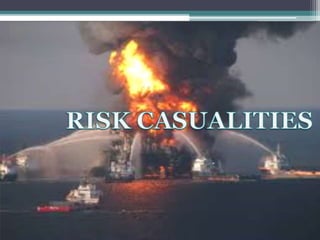
The Deepwater Horizon oil spill took place on 20 April 2010 in the
Gulf of Mexico.
It proved to be the largest accidental oil spill in the world as it was
greater than both the Ixtoc blowout off the coast of Mexico and the
Exxon Valdez spill in Alaska.
It killed eleven crew members of the Deepwater Horizon drilling
rig, injured many others, affected the livelihoods of thousands of
fishermen, destroyed countless marine animals, organism and
fouled marshes and beaches in Louisiana, Mississippi, Alabama,
and Florida.
Even though massive response plan was initiated to stop spreading
of oil utilizing skimmer ships, floating booms, controlled burns and
1.84 million US of oil dispersant was dispersed but due to the
months long spill.
The spill not only affected humans but the entire marine life as well
with its effects everlasting.
.
Cause of Problem
• The government was too slow to respond due to which resources could not be mobilized on
time to combat the spill. On the other hand B.P. also lacked in its efforts to ensure an
effective oil spill control plan and created many mistakes acting negligently
• firstly it gave a wrong report of the spill i.e. it reported that there was a flow rate of 1000
barrels per day but in reality there was a flow rate of 40,000 to 60,000 barrels per day as
reported by Coast Guard (which was ten times greater than what BP was stating)
• it delayed the Coast Guard's response effort to organize the massive response required for
such a large spill despite the existence of contingency plans for that very purpose.
• BP's response plan was wholly inadequate as it claimed that BP had the ability to respond
to a blowout of 250,000 barrels per day, more than four times the reported maximum
discharge from the Macondo blowout but nowhere did the plan specifically described as to
how it would handle such a spill. The plan referred only to equipment available to BP,
specific technology would be needed or available to respond to a deepwater blow-out,
instead, it just emphasized that such a spill was unlikely, and that if it were to occur,
environmental damage would be minimal because the well was forty-eight miles from
shore.
• The Presidential Commission investigating the BP spill concluded that mistakes by three
major companies were responsible for the blowout, and the contingency plans of all the
major oil companies were inadequate
• The Judgement came on November 2012, when BP and
the United States Department of Justice settled federal
criminal charges on BP which agreed to four years of
government monitoring of its safety practices and ethics,
it was temporarily banned from new contracts with the
US government as per report of (Environment
Protection Agency), coupled with a fine amount worth
$4.525 billion
• The case continued as further fine was still being
assessed to determine payouts and fines under the Clean
Water Act and the Natural Resources Damage
Assessment. Thus in September 2014, a U.S. District
Court awarded B.P. with additional penalties as high as
$18 billion.
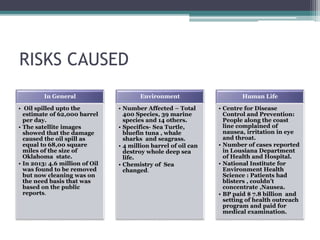
RISKS CAUSED
In General
• Oil spilled upto the
estimate of 62,000 barrel
per day.
• The satellite images
showed that the damage
caused the oil spill as
equal to 68,00 square
miles of the size of
Oklahoma state.
• In 2013: 4.6 million of Oil
was found to be removed
but now cleaning was on
the need basis that was
based on the public
reports.
Environment
• Number Affected – Total
400 Species, 39 marine
species and 14 others.
• Specifics- Sea Turtle,
bluefin tuna , whale
sharks and seagrass.
• 4 million barrel of oil can
destroy whole deep sea
life.
• Chemistry of Sea
changed.
Human Life
• Centre for Disease
Control and Prevention:
People along the coast
line complained of
nausea, irritation in eye
and throat.
• Number of cases reported
in Lousiana Department
of Health and Hospital.
• National Institute for
Environment Health
Science : Patients had
blisters , couldn’t
concentrate ,Nausea.
• BP paid $ 7.8 billion and
setting of health outreach
program and paid for
medical examination.
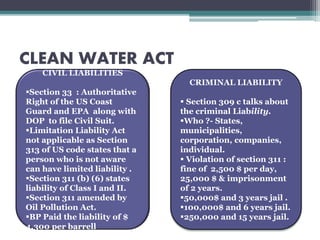
CLEAN WATER ACT
CIVIL LIABILITIES
Section 33 : Authoritative
Right of the US Coast
Guard and EPA along with
DOP to file Civil Suit.
Limitation Liability Act
not applicable as Section
313 of US code states that a
person who is not aware
can have limited liability .
Section 311 (b) (6) states
liability of Class I and II.
Section 311 amended by
Oil Pollution Act.
BP Paid the liability of $
4,300 per barrell
CRIMINAL LIABILITY
 Section 309 c talks about
the criminal Liability.
Who ?- States,
municipalities,
corporation, companies,
individual.
 Violation of section 311 :
fine of 2,500 $ per day,
25,000 $ & imprisonment
of 2 years.
50,000$ and 3 years jail .
100,000$ and 6 years jail.
250,000 and 15 years jail.
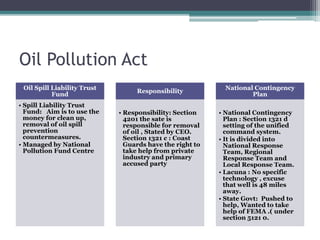
Oil Pollution Act
Oil Spill Liability Trust
Fund
• Spill Liability Trust
Fund: Aim is to use the
money for clean up,
removal of oil spill
prevention
countermeasures.
• Managed by National
Pollution Fund Centre
Responsibility
• Responsibility: Section
4201 the sate is
responsible for removal
of oil , Stated by CEO.
Section 1321 c : Coast
Guards have the right to
take help from private
industry and primary
accused party
National Contingency
Plan
• National Contingency
Plan : Section 1321 d
setting of the unified
command system.
• It is divided into
National Response
Team, Regional
Response Team and
Local Response Team.
• Lacuna : No specific
technology , excuse
that well is 48 miles
away.
• State Govt: Pushed to
help, Wanted to take
help of FEMA .( under
section 5121 0.
Transocean And Halliburton
Transocean
Position Holder : Swiss Company
holding the rig .
Charges : Simple Negligence
Damages Provided For :
Parties Affected : Banks, five states,
fisherman, people
Halliburton
Position Holder – Houston Oilfield
Service Company provided the
cement for the walls of the well.
Charges: Simple Negligence
Damage Provided for - $ 1.1 Billion.
Parties Affected: Banks, states ,
fisherman
State’s Liability : Obama’s Another
Katrina
 Section 4201: States that it is the State which is responsible for oil clean
up activities.
 States failed with respect of providing for ; resources on time ; excuse
given that BP had provided with wrong figures of 1,000 barrel of oil spill
and in reality it was 60, 000 barrel of oil spill ( Earth Observatory
Reported).
 Boby Jindal ; Governor of Louisiana made claim that government was
sluggish in its approach and need for putting sand barrier was there.
 NOAA estimate showed to be ; 110,000 per day ; they were refused by the
office of Management and Budget from making it public.
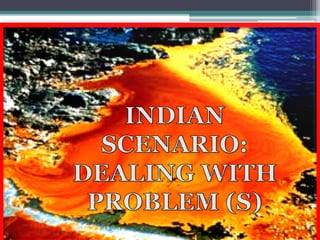
INDIAN SCENARIO : DEALING WITH
PROBLEM (S)
Regulatory Framework in India
• It is not comprehensive ,conclusive to deal with
any type of oil spill disaster effectively
• The remedies available under the Indian legal
system is only for Indian shipping policy.
• The principal legislation dealing with the
combating of oil pollution are The Merchant
Shipping Act of 1958 (MS Act), The Marine
Insurance Act of 1963 and The Merchant
Shipping (Prevention of Pollution of the Sea by
Oil) Rules, 1974.
Merchant Shipping Act of 1958
• Section 352 deals with the extent of the liability of the shipowner, but he is exempted
from liability in certain specified cases in case of oil pollution damage(incident has
occurred as a result of the actual fault or privity of the owner, then the owner is not entitled
to such limitation.)
• The act also prevents the discharge of oil or oily mixtures into the sea anywhere within the
coastal waters of India and violation of this provision attracts a penalty which may extend
to $10,000.
• Section 331 deals with the regulation of the carriage of dangerous goods, while sending
an unseaworthy ship to sea is an offence under Section 334 of the Act.
• The act provides for the creation of an oil pollution tax to combat oil pollution, thus a ship
cannot be granted port clearance until the requisite amount of tax has been paid, but it
does not apply to pollution on the high seas.
• The International Convention relating to Intervention on the High Seas in case of Pollution
Casualties, 1969, India has not yet ratified this convention. The act empowers the court to
hold formal investigations, arrest witnesses, board vessels, commit trial, and censure or
remove masters, mates or engineer.
Criminal Liability
• Under the Civil Liability Convention and Fund conventions,
the ship-owner earlier was not criminally liable.
• The International Convention for the Prevention of Pollution
from Ships, 1973 (ICPPS) which India ratified in 1986,
introduced criminal liability( it covers pollution by oil,
chemicals, harmful substances) in packaged form, sewage and
garbage, it deals with operational pollution and some aspects
of accidental pollution too and provides that any violation
within the jurisdiction of any state which is a party to the
convention shall be punishable under the law of that state.
• Under ICPPS, very limited discharge is permitted but, when
the discharge is due to force majeure, the polluter is
exempted.
Marine Insurance
• Section 352 N -owner of a ship which carries 2,000
tons or more of oil to have suitable insurance or
some other form of financial guarantee.
• It provides that, if the contract of marine insurance
expressly includes any liability to third parties, the
measure of indemnity would be the amount paid or
payable by the assured to such third party in respect
of such liability.
• India urgently needs to develop its insurance
regime in tune with the rest of the world as it should
be mandatory to include coverage for liabilities to
third parties in a contract for maritime insurance.
Prevention measures by Indian coast
guards
• Marine environment security is a statutory
function of a coast guard under the Coast Guard
Act, 1978.
• The Indian coast guard is the designated
national authority for oil spill response in Indian
waters under the National Oil Spill Disaster
Contingency Plan.
• There have been twelve spill incidents so far
where the coast guard has undertaken response
actions in Indian waters.
Reality
• Recent oil spill in Mumbai depicted weak,
inadequate and ineffective implementation plan of
the government to combat any kind of oil spill in
case of an emergency(Mumbai has witnessed three
oil spills in just one year but still there has not been
any revision of policy)
• India had started with a strong framework ,National
Oil Spill Disaster Contingency Plan (NOSDCP) in
1993. The Ministry of Defence was made the nodal
authority for implementation of this contingency
plan with a response system in place for every
Indian port (reality-not a single port in the country
is equipped with it).
Drawbacks of the plan
• Polluter Pays Principle- deals with cost of recovery,
clean-up and restoration of the environment ( recovery
and clean-up costs are easy to compute but the costs for
restoration of the environment is hard to quantify as
impacts of an oil spill on environment is hard to
determine.
• The Oil Pollution Preparedness, Response and
Cooperation (OPRC) Convention, adopted
internationally in 1995 with a protocol on Hazardous and
Noxious Substances (HNS) in 2000 aimed to deal with
pollution incidents, either nationally or in cooperation
with other countries, international cooperation in
combating major incidents and the threat of marine
pollution. India is not a part of it.
• Third India is not a part of International Convention
on Civil Liability, hence it cannot make the flag
country i.e. the country where the ship or tanker is
registered liable as in the case Mumbai oil spill, the
Indian government could not even approach the flag
country, Panama to compensate for the loss.
• Fourth issue is with reference to Environment
Impact Assessment as under it is mandatory for any
industrial activity to get an EIA done before
operations begin. Indian context out of 36 oil
drilling installations, only six are under the ambit of
the EIA, hence the rest have not even gone through
environmental examination.
Art. 14 of P.S.C.
• protection of environment
• does not talk about the nature of liability of
contractor whether it is strict or absolute, as the
words are as follows ‘the contractor shall
conduct its petroleum operations with due
regard to concerns with respect to protection of
the environment and conservation of natural
resources’, thus it can be interpreted that it is
mandatory for the contractor to comply with the
provision and act accordingly
Comparison
• If similar accident occurred in India, then the contractor would not have been liable to pay
compensation to tune of $13 billion as India does not have any national legislation to
combat oil spill disasters like oil pollution act in the United States, it only has three
legislations to check oil pollution caused by ships and tankers which are namely, The
Merchant Shipping Act of 1958 (MS Act), The Marine Insurance Act of 1963 and The
Merchant Shipping (Prevention of Pollution of the Sea by Oil) Rules, 1974. India also
enacted International Fund for Oil Pollution Damage in 1990 which provides compensation
for oil pollution damage resulting from oil discharge from tankers
• Indian coast guard is responsible for oil spill response in Indian waters under the National
Oil Spill Disaster Contingency Plan
• 12 oil spill occurred, no remedial action with respect to environment have been carried out
• Comparing the case of Union Carbide vs UOI(Bhopal Gas Tragedy) wherein 20,000 people
were killed due to nuclear disaster and a whole city poisoned, the compensation paid was
only $470 million when the world witnessed one of its largest industrial disaster. The irony
to the situation is that when an oil spill happened in America it made British Petroleum pay
$13 billion wherein only a few people were killed. This showed the weak position of Indian
government to recover compensation from a foreign company and also how wrong can a
judgement go in terms of justice. Thus only if comprehensive and stringent laws are made
for the entire country to combat disasters such as oil spill and industrial nuclear disasters,
can the government recover compensation from its owners (even foreign companies) and
preserve mankind and environment in a healthy state.
Conclusion
• Legislation not adequate,
• India lacks both in technology and the capacity to handle oil spill disasters
(most laws address only ships carrying toxic waste and oil tankers, not oil
platforms and deep water horizon spills)
• No binding international rules or standards to deal with oil spill disaters
• An international framework for cooperation and technology transfer must
be galvanised ,common procedure should be formulated globally
• The MoEF must frame strong procedures for installations predating 2006
to get EIAs done according to the new EIA notification. Stricter rules have
to be framed to place liability and properly evaluate environmental damage.
• Nations across the world learn a lesson from the BP oil spill and invest in
preparing themselves for such accidents. India too must invest reasonable
resources to ensure that its oil infrastructure is sound and that safety
standards are adhered to.
BP oil spill

BP oil spill

  • 1.
    BP OIL SPILL: Case Study
  • 3.
    Background of theOil Spill The Deepwater Horizon oil spill took place on 20 April 2010 in the Gulf of Mexico. It proved to be the largest accidental oil spill in the world as it was greater than both the Ixtoc blowout off the coast of Mexico and the Exxon Valdez spill in Alaska. It killed eleven crew members of the Deepwater Horizon drilling rig, injured many others, affected the livelihoods of thousands of fishermen, destroyed countless marine animals, organism and fouled marshes and beaches in Louisiana, Mississippi, Alabama, and Florida. Even though massive response plan was initiated to stop spreading of oil utilizing skimmer ships, floating booms, controlled burns and 1.84 million US of oil dispersant was dispersed but due to the months long spill. The spill not only affected humans but the entire marine life as well with its effects everlasting. .
  • 4.
    Cause of Problem •The government was too slow to respond due to which resources could not be mobilized on time to combat the spill. On the other hand B.P. also lacked in its efforts to ensure an effective oil spill control plan and created many mistakes acting negligently • firstly it gave a wrong report of the spill i.e. it reported that there was a flow rate of 1000 barrels per day but in reality there was a flow rate of 40,000 to 60,000 barrels per day as reported by Coast Guard (which was ten times greater than what BP was stating) • it delayed the Coast Guard's response effort to organize the massive response required for such a large spill despite the existence of contingency plans for that very purpose. • BP's response plan was wholly inadequate as it claimed that BP had the ability to respond to a blowout of 250,000 barrels per day, more than four times the reported maximum discharge from the Macondo blowout but nowhere did the plan specifically described as to how it would handle such a spill. The plan referred only to equipment available to BP, specific technology would be needed or available to respond to a deepwater blow-out, instead, it just emphasized that such a spill was unlikely, and that if it were to occur, environmental damage would be minimal because the well was forty-eight miles from shore. • The Presidential Commission investigating the BP spill concluded that mistakes by three major companies were responsible for the blowout, and the contingency plans of all the major oil companies were inadequate
  • 5.
    • The Judgementcame on November 2012, when BP and the United States Department of Justice settled federal criminal charges on BP which agreed to four years of government monitoring of its safety practices and ethics, it was temporarily banned from new contracts with the US government as per report of (Environment Protection Agency), coupled with a fine amount worth $4.525 billion • The case continued as further fine was still being assessed to determine payouts and fines under the Clean Water Act and the Natural Resources Damage Assessment. Thus in September 2014, a U.S. District Court awarded B.P. with additional penalties as high as $18 billion.
  • 7.
    RISKS CAUSED In General •Oil spilled upto the estimate of 62,000 barrel per day. • The satellite images showed that the damage caused the oil spill as equal to 68,00 square miles of the size of Oklahoma state. • In 2013: 4.6 million of Oil was found to be removed but now cleaning was on the need basis that was based on the public reports. Environment • Number Affected – Total 400 Species, 39 marine species and 14 others. • Specifics- Sea Turtle, bluefin tuna , whale sharks and seagrass. • 4 million barrel of oil can destroy whole deep sea life. • Chemistry of Sea changed. Human Life • Centre for Disease Control and Prevention: People along the coast line complained of nausea, irritation in eye and throat. • Number of cases reported in Lousiana Department of Health and Hospital. • National Institute for Environment Health Science : Patients had blisters , couldn’t concentrate ,Nausea. • BP paid $ 7.8 billion and setting of health outreach program and paid for medical examination.
  • 9.
    CLEAN WATER ACT CIVILLIABILITIES Section 33 : Authoritative Right of the US Coast Guard and EPA along with DOP to file Civil Suit. Limitation Liability Act not applicable as Section 313 of US code states that a person who is not aware can have limited liability . Section 311 (b) (6) states liability of Class I and II. Section 311 amended by Oil Pollution Act. BP Paid the liability of $ 4,300 per barrell CRIMINAL LIABILITY  Section 309 c talks about the criminal Liability. Who ?- States, municipalities, corporation, companies, individual.  Violation of section 311 : fine of 2,500 $ per day, 25,000 $ & imprisonment of 2 years. 50,000$ and 3 years jail . 100,000$ and 6 years jail. 250,000 and 15 years jail.
  • 10.
    Oil Pollution Act OilSpill Liability Trust Fund • Spill Liability Trust Fund: Aim is to use the money for clean up, removal of oil spill prevention countermeasures. • Managed by National Pollution Fund Centre Responsibility • Responsibility: Section 4201 the sate is responsible for removal of oil , Stated by CEO. Section 1321 c : Coast Guards have the right to take help from private industry and primary accused party National Contingency Plan • National Contingency Plan : Section 1321 d setting of the unified command system. • It is divided into National Response Team, Regional Response Team and Local Response Team. • Lacuna : No specific technology , excuse that well is 48 miles away. • State Govt: Pushed to help, Wanted to take help of FEMA .( under section 5121 0.
  • 11.
    Transocean And Halliburton Transocean PositionHolder : Swiss Company holding the rig . Charges : Simple Negligence Damages Provided For : Parties Affected : Banks, five states, fisherman, people Halliburton Position Holder – Houston Oilfield Service Company provided the cement for the walls of the well. Charges: Simple Negligence Damage Provided for - $ 1.1 Billion. Parties Affected: Banks, states , fisherman
  • 12.
    State’s Liability :Obama’s Another Katrina  Section 4201: States that it is the State which is responsible for oil clean up activities.  States failed with respect of providing for ; resources on time ; excuse given that BP had provided with wrong figures of 1,000 barrel of oil spill and in reality it was 60, 000 barrel of oil spill ( Earth Observatory Reported).  Boby Jindal ; Governor of Louisiana made claim that government was sluggish in its approach and need for putting sand barrier was there.  NOAA estimate showed to be ; 110,000 per day ; they were refused by the office of Management and Budget from making it public.
  • 13.
    INDIAN SCENARIO :DEALING WITH PROBLEM (S)
  • 14.
    Regulatory Framework inIndia • It is not comprehensive ,conclusive to deal with any type of oil spill disaster effectively • The remedies available under the Indian legal system is only for Indian shipping policy. • The principal legislation dealing with the combating of oil pollution are The Merchant Shipping Act of 1958 (MS Act), The Marine Insurance Act of 1963 and The Merchant Shipping (Prevention of Pollution of the Sea by Oil) Rules, 1974.
  • 15.
    Merchant Shipping Actof 1958 • Section 352 deals with the extent of the liability of the shipowner, but he is exempted from liability in certain specified cases in case of oil pollution damage(incident has occurred as a result of the actual fault or privity of the owner, then the owner is not entitled to such limitation.) • The act also prevents the discharge of oil or oily mixtures into the sea anywhere within the coastal waters of India and violation of this provision attracts a penalty which may extend to $10,000. • Section 331 deals with the regulation of the carriage of dangerous goods, while sending an unseaworthy ship to sea is an offence under Section 334 of the Act. • The act provides for the creation of an oil pollution tax to combat oil pollution, thus a ship cannot be granted port clearance until the requisite amount of tax has been paid, but it does not apply to pollution on the high seas. • The International Convention relating to Intervention on the High Seas in case of Pollution Casualties, 1969, India has not yet ratified this convention. The act empowers the court to hold formal investigations, arrest witnesses, board vessels, commit trial, and censure or remove masters, mates or engineer.
  • 16.
    Criminal Liability • Underthe Civil Liability Convention and Fund conventions, the ship-owner earlier was not criminally liable. • The International Convention for the Prevention of Pollution from Ships, 1973 (ICPPS) which India ratified in 1986, introduced criminal liability( it covers pollution by oil, chemicals, harmful substances) in packaged form, sewage and garbage, it deals with operational pollution and some aspects of accidental pollution too and provides that any violation within the jurisdiction of any state which is a party to the convention shall be punishable under the law of that state. • Under ICPPS, very limited discharge is permitted but, when the discharge is due to force majeure, the polluter is exempted.
  • 17.
    Marine Insurance • Section352 N -owner of a ship which carries 2,000 tons or more of oil to have suitable insurance or some other form of financial guarantee. • It provides that, if the contract of marine insurance expressly includes any liability to third parties, the measure of indemnity would be the amount paid or payable by the assured to such third party in respect of such liability. • India urgently needs to develop its insurance regime in tune with the rest of the world as it should be mandatory to include coverage for liabilities to third parties in a contract for maritime insurance.
  • 18.
    Prevention measures byIndian coast guards • Marine environment security is a statutory function of a coast guard under the Coast Guard Act, 1978. • The Indian coast guard is the designated national authority for oil spill response in Indian waters under the National Oil Spill Disaster Contingency Plan. • There have been twelve spill incidents so far where the coast guard has undertaken response actions in Indian waters.
  • 19.
    Reality • Recent oilspill in Mumbai depicted weak, inadequate and ineffective implementation plan of the government to combat any kind of oil spill in case of an emergency(Mumbai has witnessed three oil spills in just one year but still there has not been any revision of policy) • India had started with a strong framework ,National Oil Spill Disaster Contingency Plan (NOSDCP) in 1993. The Ministry of Defence was made the nodal authority for implementation of this contingency plan with a response system in place for every Indian port (reality-not a single port in the country is equipped with it).
  • 20.
    Drawbacks of theplan • Polluter Pays Principle- deals with cost of recovery, clean-up and restoration of the environment ( recovery and clean-up costs are easy to compute but the costs for restoration of the environment is hard to quantify as impacts of an oil spill on environment is hard to determine. • The Oil Pollution Preparedness, Response and Cooperation (OPRC) Convention, adopted internationally in 1995 with a protocol on Hazardous and Noxious Substances (HNS) in 2000 aimed to deal with pollution incidents, either nationally or in cooperation with other countries, international cooperation in combating major incidents and the threat of marine pollution. India is not a part of it.
  • 21.
    • Third Indiais not a part of International Convention on Civil Liability, hence it cannot make the flag country i.e. the country where the ship or tanker is registered liable as in the case Mumbai oil spill, the Indian government could not even approach the flag country, Panama to compensate for the loss. • Fourth issue is with reference to Environment Impact Assessment as under it is mandatory for any industrial activity to get an EIA done before operations begin. Indian context out of 36 oil drilling installations, only six are under the ambit of the EIA, hence the rest have not even gone through environmental examination.
  • 22.
    Art. 14 ofP.S.C. • protection of environment • does not talk about the nature of liability of contractor whether it is strict or absolute, as the words are as follows ‘the contractor shall conduct its petroleum operations with due regard to concerns with respect to protection of the environment and conservation of natural resources’, thus it can be interpreted that it is mandatory for the contractor to comply with the provision and act accordingly
  • 23.
    Comparison • If similaraccident occurred in India, then the contractor would not have been liable to pay compensation to tune of $13 billion as India does not have any national legislation to combat oil spill disasters like oil pollution act in the United States, it only has three legislations to check oil pollution caused by ships and tankers which are namely, The Merchant Shipping Act of 1958 (MS Act), The Marine Insurance Act of 1963 and The Merchant Shipping (Prevention of Pollution of the Sea by Oil) Rules, 1974. India also enacted International Fund for Oil Pollution Damage in 1990 which provides compensation for oil pollution damage resulting from oil discharge from tankers • Indian coast guard is responsible for oil spill response in Indian waters under the National Oil Spill Disaster Contingency Plan • 12 oil spill occurred, no remedial action with respect to environment have been carried out • Comparing the case of Union Carbide vs UOI(Bhopal Gas Tragedy) wherein 20,000 people were killed due to nuclear disaster and a whole city poisoned, the compensation paid was only $470 million when the world witnessed one of its largest industrial disaster. The irony to the situation is that when an oil spill happened in America it made British Petroleum pay $13 billion wherein only a few people were killed. This showed the weak position of Indian government to recover compensation from a foreign company and also how wrong can a judgement go in terms of justice. Thus only if comprehensive and stringent laws are made for the entire country to combat disasters such as oil spill and industrial nuclear disasters, can the government recover compensation from its owners (even foreign companies) and preserve mankind and environment in a healthy state.
  • 24.
    Conclusion • Legislation notadequate, • India lacks both in technology and the capacity to handle oil spill disasters (most laws address only ships carrying toxic waste and oil tankers, not oil platforms and deep water horizon spills) • No binding international rules or standards to deal with oil spill disaters • An international framework for cooperation and technology transfer must be galvanised ,common procedure should be formulated globally • The MoEF must frame strong procedures for installations predating 2006 to get EIAs done according to the new EIA notification. Stricter rules have to be framed to place liability and properly evaluate environmental damage. • Nations across the world learn a lesson from the BP oil spill and invest in preparing themselves for such accidents. India too must invest reasonable resources to ensure that its oil infrastructure is sound and that safety standards are adhered to.