Ohm’s Law explains the
relationship between voltage (V
or E), current (I) and resistance
(R)
Used by electricians, automotive
technicians, stereo installers
Ohm’s Law

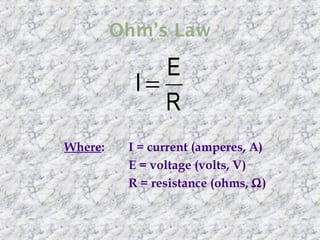
E
I=
R
Where:

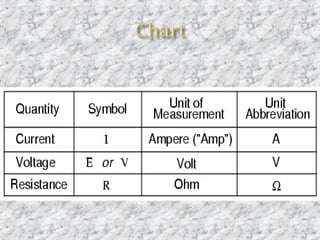
I = current (amperes, A)
E = voltage (volts, V)
R = resistance (ohms, Ω)
Ohm’s Law: Resistance and Resistors
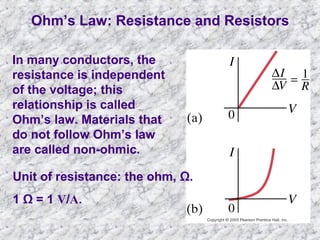
In many conductors, the
resistance is independent
of the voltage; this
relationship is called
Ohm’s law. Materials that
do not follow Ohm’s law
are called non-ohmic.
Unit of resistance: the ohm, Ω.
1 Ω = 1 V/A.
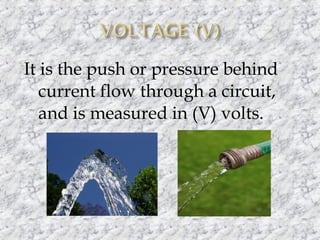
It is the push or pressure behind
current flow through a circuit,
and is measured in (V) volts. 
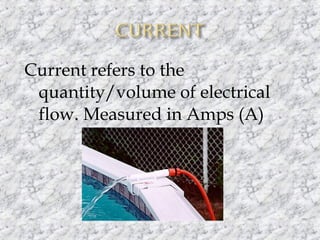
Current refers to the
quantity/volume of electrical
flow. Measured in Amps (A)
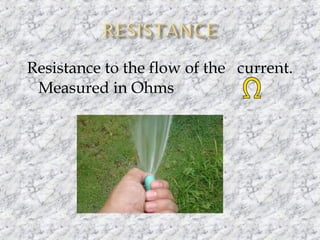
 Resistance

to the flow of the current.
Measured in Ohms
1.
2.
3.

4.
5.
6.

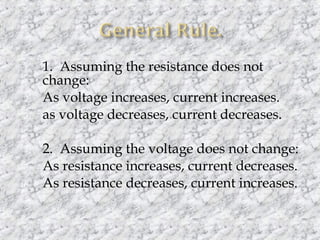
1.  Assuming the resistance does not
change:
As voltage increases, current increases.
as voltage decreases, current decreases.
2.  Assuming the voltage does not change:
As resistance increases, current decreases.
As resistance decreases, current increases.
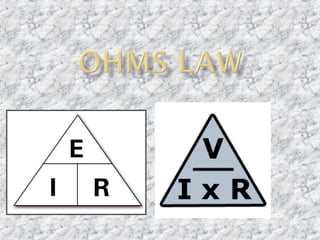
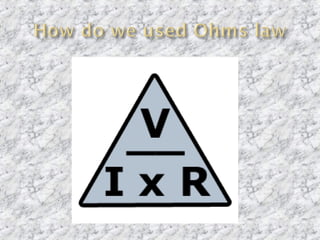
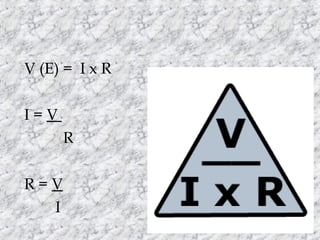
V (E) = I x R
I=V
R
R=V
I

Ohms law added by arvi

  • 1.
    Ohm’s Law explainsthe relationship between voltage (V or E), current (I) and resistance (R) Used by electricians, automotive technicians, stereo installers
  • 2.
    Ohm’s Law E I= R Where: I =current (amperes, A) E = voltage (volts, V) R = resistance (ohms, Ω)
  • 3.
    Ohm’s Law: Resistanceand Resistors In many conductors, the resistance is independent of the voltage; this relationship is called Ohm’s law. Materials that do not follow Ohm’s law are called non-ohmic. Unit of resistance: the ohm, Ω. 1 Ω = 1 V/A.
  • 5.
    It is thepush or pressure behind current flow through a circuit, and is measured in (V) volts. 
  • 6.
    Current refers tothe quantity/volume of electrical flow. Measured in Amps (A)
  • 7.
     Resistance to the flowof the current. Measured in Ohms
  • 9.
    1. 2. 3. 4. 5. 6. 1.  Assuming theresistance does not change: As voltage increases, current increases. as voltage decreases, current decreases. 2.  Assuming the voltage does not change: As resistance increases, current decreases. As resistance decreases, current increases.
  • 11.
    V (E) =I x R I=V R R=V I