1
Palestine Polytechnic University
Collage of IT and Computer Engineering
Computer Systems Engineering Department
Electrical Circuits Lab
Experiment Title: Ohm's Low
Experiment Number: 2
Date: 18 February 2013
Instructor:
Zahir Sa'afeen
Experiment # 1: Ohm's Law
2
Objectives:
To study the dependence of current (I) on the potential difference (V)
across a resistor and determine its resistance using Ohm's low. Also plot
a graph between V and I. Additionally to know how to find the resistance
by different ways: color code, DMM, and Ohm's low.
Equipments:
1. DMM(Digital Multimeter).
2. Ammeter.
3. Wires.
4. Power Supply.
5. DC Fundamental circuit board.
6. FACET base unit.
Theory:
Ohm's Law states that the direct current flowing in a conductoris
directly proportional to the potential difference between its ends. It is
usually formulated as V = IR, where V is the potential difference, or
voltage, I is the current, and R is the resistance of the conductor;which
its value can be measured by ohm's low, color codeor DMM.
Current, voltage and resistance have a linear relation. In any circuit I is
directly proportional with voltage and inversely proportional with
resistance.
3
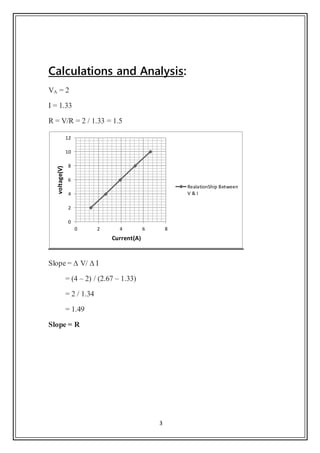
Calculations and Analysis:
VA = 2
I = 1.33
R = V/R = 2 / 1.33 = 1.5
Slope = ∆ V/ ∆ I
= (4 – 2) / (2.67 – 1.33)
= 2 / 1.34
= 1.49
Slope = R
0
2
4
6
8
10
12
0 2 4 6 8
voltage(V)
Current(A)
RealationShip Between
V & I
4
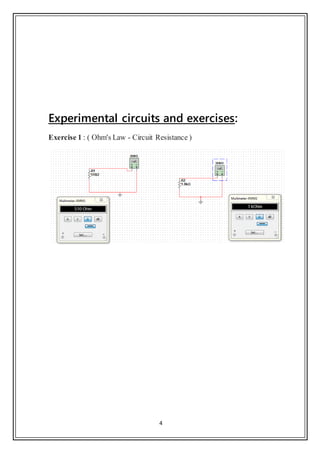
Experimental circuits and exercises:
Exercise 1 : ( Ohm's Law - Circuit Resistance )
5
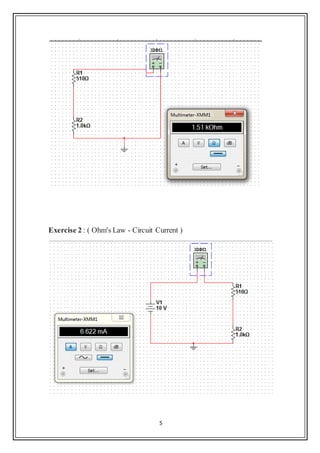
Exercise 2 : ( Ohm's Law - Circuit Current )
6
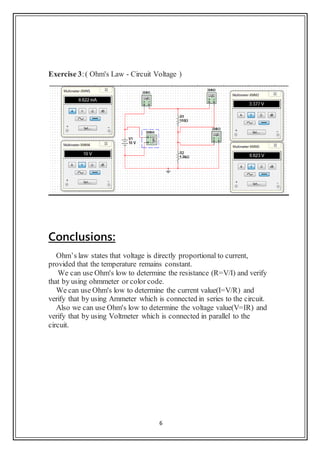
Exercise 3:( Ohm's Law - Circuit Voltage )
Conclusions:
Ohm’s law states that voltage is directly proportional to current,
provided that the temperature remains constant.
We can use Ohm's low to determine the resistance (R=V/I) and verify
that by using ohmmeter or color code.
We can use Ohm's low to determine the current value(I=V/R) and
verify that by using Ammeter which is connected in series to the circuit.
Also we can use Ohm's low to determine the voltage value(V=IR) and
verify that by using Voltmeter which is connected in parallel to the
circuit.

Lab 2

  • 1.
    1 Palestine Polytechnic University Collageof IT and Computer Engineering Computer Systems Engineering Department Electrical Circuits Lab Experiment Title: Ohm's Low Experiment Number: 2 Date: 18 February 2013 Instructor: Zahir Sa'afeen Experiment # 1: Ohm's Law
  • 2.
    2 Objectives: To study thedependence of current (I) on the potential difference (V) across a resistor and determine its resistance using Ohm's low. Also plot a graph between V and I. Additionally to know how to find the resistance by different ways: color code, DMM, and Ohm's low. Equipments: 1. DMM(Digital Multimeter). 2. Ammeter. 3. Wires. 4. Power Supply. 5. DC Fundamental circuit board. 6. FACET base unit. Theory: Ohm's Law states that the direct current flowing in a conductoris directly proportional to the potential difference between its ends. It is usually formulated as V = IR, where V is the potential difference, or voltage, I is the current, and R is the resistance of the conductor;which its value can be measured by ohm's low, color codeor DMM. Current, voltage and resistance have a linear relation. In any circuit I is directly proportional with voltage and inversely proportional with resistance.
  • 3.
    3 Calculations and Analysis: VA= 2 I = 1.33 R = V/R = 2 / 1.33 = 1.5 Slope = ∆ V/ ∆ I = (4 – 2) / (2.67 – 1.33) = 2 / 1.34 = 1.49 Slope = R 0 2 4 6 8 10 12 0 2 4 6 8 voltage(V) Current(A) RealationShip Between V & I
  • 4.
    4 Experimental circuits andexercises: Exercise 1 : ( Ohm's Law - Circuit Resistance )
  • 5.
    5 Exercise 2 :( Ohm's Law - Circuit Current )
  • 6.
    6 Exercise 3:( Ohm'sLaw - Circuit Voltage ) Conclusions: Ohm’s law states that voltage is directly proportional to current, provided that the temperature remains constant. We can use Ohm's low to determine the resistance (R=V/I) and verify that by using ohmmeter or color code. We can use Ohm's low to determine the current value(I=V/R) and verify that by using Ammeter which is connected in series to the circuit. Also we can use Ohm's low to determine the voltage value(V=IR) and verify that by using Voltmeter which is connected in parallel to the circuit.