Strategy implementation seminar for Open Universities belonging to the MORIL consortium MORIL under the OLCOS perspective  Julià Minguillón Universitat Oberta de Catalunya 28/05/2008
Table of contents OLCOS basics OER lifecycle Key issues Research challenges OER in a European perspective Enablers and barriers Recommendations Conclusions
OLCOS project Open eLearning Content Observatory Services Transversal action funded by the EC under the eLearning programme, 2006-2007 Partners: European Center for Media Competence, Germany European Distance Elearning Network, Hungary FernUniversitaet in Hagen, Germany Mediamaisteri Group, Finland Universitat Oberta de Catalunya, Spain Salzburg Research, Austria (project coordinator)‏
OLCOS main goals To foster the creation, sharing and reuse of open educational resources, including: Content for teaching and learning Software based tools and services Licenses Three main results: OLCOS roadmap 2012 Tutorials Community creation and engagement
OLCOS methodology Qualitative research: Data gathering Focus groups and communities of practice Experts were interviewed Dissemination: OLCOS roadmap 2012 (book and PDF)‏ Tutorials (wiki)‏ Promotional videos OLCOS web site:  www.olcos.org
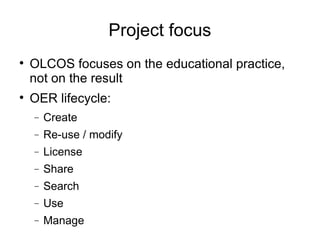
Project focus OLCOS focuses on the educational practice, not on the result OER lifecycle: Create Re-use / modify License Share Search Use Manage
Project outcomes The OLCOS Roadmap 2012 aims to provide educational decision makers with orientation and recommendations about OER: Current situation Strategical advice Tutorials are practical recommendations for creating, sharing, licensing and using OER, mainly for teachers and students List of selected OER related projects and resources
Key issues Technology Powerpoint is not open Methodology Learning is more than just contents Sustainability CAREO has been recently closed Licensing Lack of copyright does not mean open access
Research challenges Methodological: Critical mass, granularity and integration Quality assesment Technological: Efficient search (semantic)‏ Supporting OER lifecycle CC Licensing covers authors, not editors Socio-cultural issues Organizational and infrastructure changes
OER in a European perspective Slow growth in a situation of fragmentation International collaborative efforts need to be strengthened Valorisation of public sector information hampered by lack of open access Little impact of project based digital repositories The European digital library as a flagship Communities of interest and practice and knowledge technologies as critical success
Areas and topics covered Three main groups: Policies, institution frameworks and business models Open access and open content repositories Laboratories of open educational practices and resources (research)‏ For each area: Drivers and enablers Barriers
Policies, institutional frameworks and business models Enablers: Policies emphasise educational  innovation  and organisational change ICT based  lifelong learning  needs to be promoted International interest in (and funding of) OER  opportunities CC  licensing  is firmly established and increasingly used Healthy  competition  among leading institutions Open and distance education more  attractive The  Bologna  process is a driver for collaboration
Policies, institutional frameworks and business models Barriers: Business models  in OER are tricky Lack of institutional policies and incentives for educators to excel in OER cause  hesitation Considerable effort on  teacher training  and support Difficulty of finding a balanced  marketing  for open and commercial educational offerings Little innovation by most academic and educational publishers, lack of  culture  changing Possible implementation of  rigid  DRM systems
Open access and open content repositories Enablers: Strong breakthrough and adoption of the Open Access  principle  in academic publishing Funding bodies require that project results be made available as open access Widespread tried and tested  know-how  in distributed open access repositories (OAI)‏ Open content repositories increasingly surface from the deep web
Open access and open content repositories Barriers: Fears of low  recognition  and  reputation  among researchers and academics Need to reinforce institutional open access  policies  and measures Barriers to making research data openly available Creation of rich educational metadata is  costly Ontology based educational semantic webs still a promise, not a reality
Laboratories of open educational practices and resources Enablers: Free and open source software is  widely   used  in higher education and further education institutions The “industrialist” Learning Object approach has run out of steam, needs new  impulse  from OER New systems for creating Learning Designs Social software  tools and services empower learners to create, share and license content RSS  feeds enrich and keep up-to-date educational portals and learners' sites Emergence of  personal learning environments  and semantic applications for accesing knowledge
Laboratories of open educational practices and resources Barriers: More cooperation between tool developers and educators is needed Lack of know-how for enabling and promoting innovative education Educational repositories need to think how to become communities of practice, and to implement advanced tools and services Library services may be slow to find their place in open environments
Recommendations Devised for: Educational policy makers and funding bodies Boards, directors and supervisors of educational institutions Teachers Students Educational repositories E-learning tools and enviroments developers
Recommendations for boards, directors and supervisors Scrutinise whether educational institutions are employing innovative approaches beyond teacher centered knowledge transfer Promote sharing and re-use of OER and experiences from open educational practices Establish reward mechanisms and supportive measures for developing and sharing OER Clarify copyrights and define licensing schemes for making OER available
Conclusions Main MORIL concerns are aligned with OLCOS: Business model and sustainability issues Learning model and innovative pedagogies Marketing and reaching new audiences Any proposal should address: Organisational changes Methodological changes Technological changes Sustainability issues Licensing

olcos

  • 1.
    Strategy implementation seminarfor Open Universities belonging to the MORIL consortium MORIL under the OLCOS perspective Julià Minguillón Universitat Oberta de Catalunya 28/05/2008
  • 2.
    Table of contentsOLCOS basics OER lifecycle Key issues Research challenges OER in a European perspective Enablers and barriers Recommendations Conclusions
  • 3.
    OLCOS project OpeneLearning Content Observatory Services Transversal action funded by the EC under the eLearning programme, 2006-2007 Partners: European Center for Media Competence, Germany European Distance Elearning Network, Hungary FernUniversitaet in Hagen, Germany Mediamaisteri Group, Finland Universitat Oberta de Catalunya, Spain Salzburg Research, Austria (project coordinator)‏
  • 4.
    OLCOS main goalsTo foster the creation, sharing and reuse of open educational resources, including: Content for teaching and learning Software based tools and services Licenses Three main results: OLCOS roadmap 2012 Tutorials Community creation and engagement
  • 5.
    OLCOS methodology Qualitativeresearch: Data gathering Focus groups and communities of practice Experts were interviewed Dissemination: OLCOS roadmap 2012 (book and PDF)‏ Tutorials (wiki)‏ Promotional videos OLCOS web site: www.olcos.org
  • 6.
    Project focus OLCOSfocuses on the educational practice, not on the result OER lifecycle: Create Re-use / modify License Share Search Use Manage
  • 7.
    Project outcomes TheOLCOS Roadmap 2012 aims to provide educational decision makers with orientation and recommendations about OER: Current situation Strategical advice Tutorials are practical recommendations for creating, sharing, licensing and using OER, mainly for teachers and students List of selected OER related projects and resources
  • 8.
    Key issues TechnologyPowerpoint is not open Methodology Learning is more than just contents Sustainability CAREO has been recently closed Licensing Lack of copyright does not mean open access
  • 9.
    Research challenges Methodological:Critical mass, granularity and integration Quality assesment Technological: Efficient search (semantic)‏ Supporting OER lifecycle CC Licensing covers authors, not editors Socio-cultural issues Organizational and infrastructure changes
  • 10.
    OER in aEuropean perspective Slow growth in a situation of fragmentation International collaborative efforts need to be strengthened Valorisation of public sector information hampered by lack of open access Little impact of project based digital repositories The European digital library as a flagship Communities of interest and practice and knowledge technologies as critical success
  • 11.
    Areas and topicscovered Three main groups: Policies, institution frameworks and business models Open access and open content repositories Laboratories of open educational practices and resources (research)‏ For each area: Drivers and enablers Barriers
  • 12.
    Policies, institutional frameworksand business models Enablers: Policies emphasise educational innovation and organisational change ICT based lifelong learning needs to be promoted International interest in (and funding of) OER opportunities CC licensing is firmly established and increasingly used Healthy competition among leading institutions Open and distance education more attractive The Bologna process is a driver for collaboration
  • 13.
    Policies, institutional frameworksand business models Barriers: Business models in OER are tricky Lack of institutional policies and incentives for educators to excel in OER cause hesitation Considerable effort on teacher training and support Difficulty of finding a balanced marketing for open and commercial educational offerings Little innovation by most academic and educational publishers, lack of culture changing Possible implementation of rigid DRM systems
  • 14.
    Open access andopen content repositories Enablers: Strong breakthrough and adoption of the Open Access principle in academic publishing Funding bodies require that project results be made available as open access Widespread tried and tested know-how in distributed open access repositories (OAI)‏ Open content repositories increasingly surface from the deep web
  • 15.
    Open access andopen content repositories Barriers: Fears of low recognition and reputation among researchers and academics Need to reinforce institutional open access policies and measures Barriers to making research data openly available Creation of rich educational metadata is costly Ontology based educational semantic webs still a promise, not a reality
  • 16.
    Laboratories of openeducational practices and resources Enablers: Free and open source software is widely used in higher education and further education institutions The “industrialist” Learning Object approach has run out of steam, needs new impulse from OER New systems for creating Learning Designs Social software tools and services empower learners to create, share and license content RSS feeds enrich and keep up-to-date educational portals and learners' sites Emergence of personal learning environments and semantic applications for accesing knowledge
  • 17.
    Laboratories of openeducational practices and resources Barriers: More cooperation between tool developers and educators is needed Lack of know-how for enabling and promoting innovative education Educational repositories need to think how to become communities of practice, and to implement advanced tools and services Library services may be slow to find their place in open environments
  • 18.
    Recommendations Devised for:Educational policy makers and funding bodies Boards, directors and supervisors of educational institutions Teachers Students Educational repositories E-learning tools and enviroments developers
  • 19.
    Recommendations for boards,directors and supervisors Scrutinise whether educational institutions are employing innovative approaches beyond teacher centered knowledge transfer Promote sharing and re-use of OER and experiences from open educational practices Establish reward mechanisms and supportive measures for developing and sharing OER Clarify copyrights and define licensing schemes for making OER available
  • 20.
    Conclusions Main MORILconcerns are aligned with OLCOS: Business model and sustainability issues Learning model and innovative pedagogies Marketing and reaching new audiences Any proposal should address: Organisational changes Methodological changes Technological changes Sustainability issues Licensing